
Sexist Media Images Redux
Posted: August 10, 2011 Filed under: 2012 presidential campaign, Media, U.S. Politics, Women's Rights | Tags: Michelle Bachmann Cover Newsweek 58 Comments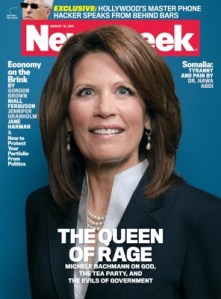 We undoubtedly are going to have some levels of disagreement about the Newsweek cover photo of Michelle Bachmann and about whether Tina Brown–by choosing an unflattering image of the candidate–was trying to grab headlines or chose to ignore a sisterhood moment. I have to admit that Michelle Bachmann is a difficult person in general to stand up for, and I’ve been fighting my natural tendency to think that since she’s crazy it’s okay to use a photo that captures it. But, I have to say after watching the media portray female candidates in a variety of truly sexist ways, I can’t say any more than I think this is just a photo that sort’ve captures that moment when she did her alternative address to the nation after the state of the union address. She’s dressed in a suit which is better than the running outfit photo that kept showing up all over the place for Bachmann’s tea party pal, Sarah Palin. Bachmann’s not Photoshopped so we’re clearly aware that she’s an over-50 woman with her share of wrinkles. There is only the title that seems a bit over the top. That would be the “Queen of Rage”. Still, Bachmann’s thing is being angry at every thing and every body so is that a sexist mis-characterization?
The “Queen of Rage” headline is where things get interesting. Is that accurate? To a degree, in the sense that Bachmann’s primary appeal is to the GOP’s angry wing. Her constituency is the resentful, the conspiracy-minded, the get-government’s-hands-off-my-Medicare crowd (this applies to Bachmann herself, who personally profits from farm subsidies and Medicaid payments while decrying the tyranny of government spending). If you’re looking for a sensible, experienced manager, Bachmann is not your candidate. What’s interesting, though, is that as she stokes and profits from angry voters, she is extremely careful to keep a smile on her face. If Newsweek put an unflattering picture of Sarah Palin on its cover, you can bet she’d be whining about the lamestream media and their campaign to keep her down. But Bachmann hasn’t said a thing about the Newsweek cover. She knows there’s nothing to be gained by complaining, and the controversy is actually great for her.
 Fox News jumped into the fray immediately and made hay with the fact that NOW came out against Tina Brown’s choice of cover photos. This
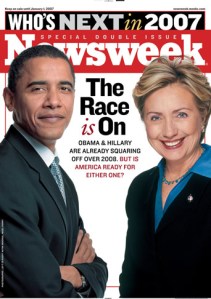
  undoubtedly puts a good size notch in Brown’s journalistic belt. Conservative blogs are all over the NOW statements. These folks had nothing to say about the treatment of Hillary Clinton, but when it’s one of their own, they immediately become politically correct.
One of presidential candidate Michele Bachmann’s major political opponents is defending her against what it says is blatant sexism on the part of Newsweek magazine.
Monday, the National Organization for Women (NOW) spoke out against Newsweek’s most recent cover, which features an extreme close-up of Michele Bachmann and the title “The Queen of Rage.”
“It’s sexist,” NOW president Terry O’Neill told TheDC. “Casting her in that expression and then adding ‘The Queen of Rage’ I think [it is]. Gloria Steinem has a very simple test: If this were done to a man or would it ever be done to a man – has it ever been done to a man? Surely this has never been done to a man.”
While some have pointed out that Newsweek has used unflattering photos of men such as Rush Limbaugh and John McCain on its cover, O’Neill says that is not the issue.
“Who has ever called a man ‘The King of Rage?’ Basically what Newsweek magazine – and this is important, what Newsweek magazine, not a blog, Newsweek magazine – what they are saying of a woman who is a serious contender for President of the United States of America…They are basically casting her as a nut job,” O’Neill said. “The ‘Queen of Rage’ is something you apply to wrestlers or somebody who is crazy. They didn’t even do this to Howard Dean when he had his famous scream.”
Wisconsin Recall Vote comes with High Turnout
Posted: August 9, 2011 Filed under: worker rights | Tags: Wisconsin recall votes 55 CommentsRecall votes on 6 republican state senators are being held today in Wisconsin. All 6 hold seats in traditionally republican areas of rural and 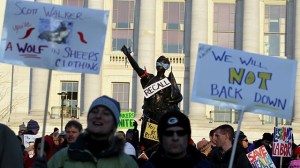 suburban Wisconsin. Tons of outside money has poured in for some of the most vituperous ads in political history. It’s been a match of high money rollers on the republican side and on the ground voter turn work by unions on the democratic side. Indications are that turn out is as high as it usually is in a presidential race.
Various clerks in the recall districts reported steady turnout so far with some projecting numbers that will rival a presidential election.
In the 10th SD in western Wisconsin, River Falls City Clerk Lu Ann Hecht said today’s numbers could be as high as the 2008 Presidential election. The city issued 1,003 absentee ballots, twice as many as a regular election.
The municipality is home to both GOP Sen. Sheila Harsdorf and Dem challenger Shelly Moore.
“We expect the turnout to remain steady throughout the day,” Hecht said.
Hudson City Clerk Nancy Korson said voter turnout in Hudson, also part of the 10th, would likely not reach the levels of a presidential election. But they were comparable to the spring Supreme Court election, with over 500 absentee ballots received.
In Baraboo, Deputy Clerk Donna Munz said turnout was much higher than normal. She also said she’d received voter complaints over people at some polling places contacting them as they went into the polling places. At one, about nine people were outside and some voters said they were angry that they felt intimidated.
“We have received angry calls from voters regarding how persistent the people outside the polling places are,” Munz said.
In the 8th SD, one of the top races with GOP Sen. Alberta Darling and Dem Rep. Sandy Pasch, Whitefish Bay officials reported a steady stream during the morning, but said it was too early to say how turnout would end up in Pasch’s hometown.
In River Hills, where Darling lives, Village Clerk Barb Goeckner reported steady turnout through the morning. By 9:45 a.m., about 200 of the municipality’s 1,300 registered voters had cast ballots.
“It’s just been steady,” she said. “It’s not been a mad rush. We don’t have any lines, but it’s definitely been a steady turnout so far.”
In the 2nd SD, DePere officials predicted a turnout of around 45 percent by day’s end. In next door Green Bay, turnout was around 15 percent following the morning checks with polling places. In the April Supreme Court race, turnout was about 11 percent following the morning checks.
A lot is at stake in Wisconsin.
Wisconsin Republicans are in real danger of losing control of the state Senate in tonight’s recall elections, as it looks more and more possible that they will lose at least three of the six seats that are on the ballot.
The losses would be cast by Democrats as a severe rebuke of Gov. Scott Walker’s (R) policies. And wins by Republicans would be cast by them as validation for Walker’s tough-love budgeting style.
Both of those evaluations would be fair. (For more on just how we’ve gotten here, see Michael A. Fletcher’s piece today and our primer from last week.)
Beyond Walker’s political capital, though, it’s hard to draw many broad national conclusions about what the recall elections mean. That’s because what’s happening in Wisconsin is occurring very much in a vacuum, for several reasons.
The first is that, as with special elections, these recall elections have have such unusual turnout and have received such inordinate attention from national third-party groups trying to influence the races and send a message. In fact, the recalls have essentially been special elections on steroids, with spending reaching nearly $30 million.
As of a couple weeks ago, about two-thirds of that has gone to benefit Democrats, and Republicans acknowledge that they were essentially caught flat-footed by the whole thing. And because of that, they’ve been fighting from behind in recent weeks.
“This is a referendum on Walker, and the Democrats have everything to lose, and the Republicans did not have a plan for what they started,” said one Republican monitoring the recalls. “And the national folks never saw it for what it was, which is a proxy fight.”
The proxy fight is between organized labor and the new coalitions of GOP governors and state legislative majorities. In the end, Walker’s gambit to cut collective bargaining rights through a legislative maneuver so badly irritated organized labor — and Wisconsin’s laws made it so easy to recall a member of the state legislature — that here we are amidst the biggest mass recall in United States history.
The second reason is that, while some Republican governors have been aggressive in cutting their budgets, the maneuver executed by Walker and the state legislature takes the cake.
The spending has been substantial according to ABC News.
The level of campaign spending has been unprecedented, especially considering it is a recall effort. Spending through Monday was estimated at about $28 million from outside groups on both sides of the aisle and about $5 million spent by the candidates themselves, according to the Wisconsin Democracy Campaign.
That number was expected to increase by today. Wisconsin Democracy Campaign officials “estimate at this point it’s about even,” research director Mike Buelow said of spending on both sides.
The group will do a full accounting of spending after the election and will have a clearer picture of whether the spending totals are even.
JR Ross, the editor of Wispolitics.com, said turnout will determine which side is victorious by the end of the day.
“I don’t care who you talk to who says they know, they don’t,” Ross said. “It’s all about turnout. We’re in an unprecedented situation. … We don’t have elections in August in Wisconsin in the middle of summer.
“We do know that Democrats and union members are motivated and angry at Republicans and Walker specifically. If Republican voters can match that intensity and turn out in numbers to protect their guys, [then the Republican senators will be safe]. If not, the Democrats win control.”
Polls in Wisconsin close in less than an hour and the returns may be mostly in by 10 pm cst. We’re going to follow those here in a live blog thread.
WTF is a Supercommittee and who is likely to get appointed? (updated)
Posted: August 9, 2011 Filed under: U.S. Economy, U.S. Politics, We are so F'd | Tags: supercommittee 34 Comments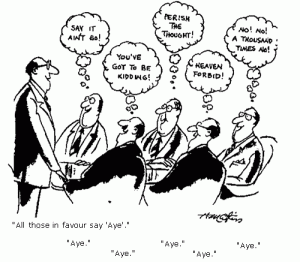 We’ve had a catfood commission and a gang of six. Both groups basically had such essential differences that nothing ever came of their recommendations and nothing resembling a consensus appeared. How is some congressional mandate handed over to a “supercommittee” going to be any different? I see no reason for the Republicans to not continue the gridlock. However, I did want to find out more. So, here’s what I found.
It seems obvious to me that the supercommittee has been given a mandate to do things that no single congress critter wants on his record. They are there to cut extremely popular programs. I personally wonder if they will give cover to Republicans that signed on to Grover Norquist’s no tax pledge for reasonable changes in revenue policies as well. I found a reasonably short explanation of their mandate on the PR&P Tax Update Blog.
The Act reduces spending by $0.9 trillion over the next 10 years and creates a 12-member, bi-partisan joint “super” committee charged with making recommendations to cut an additional $1.5 trillion from the deficit over 10 years. The committee may recommend any combination of spending cuts or tax increases. If legislation is not enacted by January 15, 2012 to cut the deficit by at least $1.2 trillion, then any shortfall must be taken equally out of defense and social spending by January 1, 2013. This latter provision is so distasteful to each political party that it is seen as the vehicle to force through an agreement from the super committee.
Super committee appointments are to be made by August 16, 2011 with the first meeting held no later than September 16, 2011. The committee must vote on their conclusions no later than November 23, 2011. If a majority votes in favor, then legislative language must be reported out no later then December 2, 2011. Both the House and the Senate must vote on the proposal by December 23, 2011 with no amendments considered. The committee may rely on previous proposals to reform spending and taxation due to the time constraint it must work under.
There is an incredible amount of speculation on possible appointments to the supercommittee. This is Politico’s best guess for the Senate appointees. They have their guesses for the House appointees as well as a list of ‘dark horses’.
The major contenders to be selected by Senate Majority Leader Harry Reid (D-Nev.):
• Sen. Max Baucus (D-Mont.) – Finance Committee chairman has jurisdiction over entitlement programs and he served on the Simpson-Bowles commission. The Huffington Post, however, reported on Monday that Baucus is unlikely to be tapped.
• Sen. Dick Durbin (D-Ill.) – Reid deputy is a Gang of Six member who also served on Simpson-Bowles.
• Sen. Daniel Inouye (D-Hawaii) – Appropriations Committee chairman participated in the Biden talks.
• Sen. Charles Schumer (D-N.Y.) – Schumer is a Reid ally who would not let Democrats get rolled in the negotiations.
The major contenders to be selected by Senate Minority Leader Mitch McConnell (R-Ky.):
• Sen. John Barrasso (R-Wyo.) – Member of leadership team who throws sharp elbows on 2010 healthcare law.
• Sen. Orrin Hatch (R-Utah) – Ranking member of Finance Committee told The Hill, “I can live with [being appointed] or live without it.” Some point out that Hatch, who could face a primary challenge next year, will not be keen on finding common ground with Democrats.
• Sen. Jon Kyl (R-Ariz.) – McConnell’s deputy participated in the Biden talks and is not seeking reelection.
• Sen. Rob Portman (R-Ohio) – Portman, a budget director in George W. Bush’s administration, has been mentioned a lot in recent days. The former House Ways and Means Committee member is widely respected on both sides of the aisle.
Sam Stein at HuffPo writes that Conrad and Baucus will not make the cut. Obama mentioned that the White House will be involved in the process of what the supercommittee does but he did not mention how that will happen.
To whom he will be submitting the plan remains the major mystery. But over the weekend, information about potential committee members began to leak from Capitol Hill. According to multiple Democratic sources, Senate Democratic leaders are winnowing down the names on the short list and they are leaning strongly against including some of the party’s most notable budget hawks.
Two senators, in particular, were said to be unlikely to end up on the committee: Max Baucus (D-Mont.), who chairs the Finance Committee, and Kent Conrad (D-N.D.), who chairs the Budget Committee.
Final decisions have not yet been made, two aides cautioned. But two other Democratic aides with knowledge of deliberations said they would be very surprised if either ended up on the final list.
“The committee is built for failure — everyone will either stack it with loyalists to leadership and the caucuses or with partisan firebrands to make sure those folks defend key priorities,” said one of those aides. “If they don’t, they will immediately regret it. You need grown-up smart pros that know the issues, know the caucus position and will not waver.”
It appears that Conrad himself does not expect to make the cut. On Aug. 1, the night before the debt ceiling deal was signed, a reporter told him that a few people had floated his name as a super committee member. “I’m sure it’s a very few,” the senator responded.
The exclusion of Conrad and Baucus could have major implications for the committee’s tenor and the actions it will ultimately take. During the debt ceiling debate, Conrad pushed far-reaching deficit reduction proposals that included entitlement and tax reform and called for one dollar in spending cuts for every dollar in tax revenue raised. Baucus is more protective of entitlements but enjoys close ties to the financial service industry. Both are considered senior statesmen among Democrats on debt related negotiations. They are also distrusted by the party base, primarily because of their long records as fiscal hawks.
There are many concerns that people have expressed with the formation of this group. One of the major issues is transparency.
Transparency concerns: Some groups have expressed concern that the joint committee will have an extremely powerful role in shaping policy, but may not be subject to the same transparency obligations as other congressional committees. “Right now, the creation of the committee doesn’t come with many requirements for transparency,” noted the Project on Government Oversight.
In a letter to Congressional leadership Aug. 3, the Sunlight Foundation recommended the joint committee include on its website:
- Live webcasts of all official meetings and hearings,
- the Committee’s report should be posted for 72 hours before a final committee vote,
- disclosure of every meeting held with lobbyists and other powerful interests,
- disclosure of campaign contributions as they are received (on their campaign website), and
- financial disclosures of Committee members and staffers.
The downgrade creates “a sense of urgency for the two parties to come together,” Rep. Steve Southerland, R-Fla. told the Times, adding that the possibility of a further downgrade “scares” him. Added Rep. Blake Farenthold, R-Texas, “Anything that encourages the new committee to get the job done and get us back on a rational fiscal path is a good thing.”
At least some lawmakers called on Congress to return from its August recess to take up more deficit-reduction legislation.
“I sent a letter today to Leader Cantor requesting we come back to DC to resolve our deficit and spending issues. We should be in session!” Rep. Allen West, R-Fla., tweeted. West, a Tea Party-aligned House member, gained attention for his early support of the debt deal Republican leaders agreed to with President Obama.
Similarly, Rep. Jack Kingston, R-Ga., said in a statement that “Congress should immediately reconvene to take up the fundamental reforms necessary to right the ship and lay the groundwork for a more stable and secure future for our children and grandchildren.”
Rep. Barney Frank, D-Mass., said on CBS’ “The Early Show” Monday that “there’s going to be incredible pressure on this commission now to come up with $1.5 trillion worth of deficit cuts,” but he expressed skepticism they’d get the job done. “Do you think if Democrats appoint their six most liberal members and Republicans appoint their six most conservatives that this committee will get anything done?” He said that the two parties should at least be able to support defense spending cuts. As Frank noted, there’s reason to believe the partisan fighting that S&P cited in its downgrade will continue in the supercommittee.
In the first of what will be a closely watched selection process for a powerful new deficit panel, Senate Majority Leader Harry Reid announced he will appoint Democratic Sens. Patty Murray (Wash.), Max Baucus (Mont.) and John Kerry (Mass.) as his three choices for a super committee charged with finding more than $1 trillion in spending cuts by the end of this year.
Murray will serve as co-chair of the 12-member panel. Speaker John Boehner (R-Ohio) will select her co-chair and two other panelists, as required by the next debt limit agreement signed into law by President Barack Obama last week. Minority Leaders Nancy Pelosi and Mitch McConnell will each select three additional members.
Somber Obama meets the Press: Live Blog
Posted: August 8, 2011 Filed under: Barack Obama, Live | Tags: Market crash, Presidential Speech 57 CommentsWithout taking any questions, President Obama addressed the state of the U.S. economy and the deaths of US troops this weekend. The DJ dipped below 11,000 briefly while the President was speaking. Obama said the country will always be a AAA country and quoted Warren Buffet who has said the country is AAAA. However, this is a serious sell off and there’s a realization that there’s something wrong with the US economy. The bond market is holding up better than the stock market which indicates that there is more concern about the economy than the US ability to pay debt. This was clearly an attempt to send a message to global markets and to US citizens that are panicked about a possible second recession during a period when we have clearly not recovered from the last one.
Obama asked for extensions for unemployment insurance and the payroll tax holiday. He additionally said that his administration would be making recommendations to the super congress. He called for expenditures on infrastructure. He also wants to see ‘modest adjustments’ to Medicare.
The president says Washington didn’t need a downgrade to realize that it has a problem. “Our challenge is the need to tackle our deficits over the long term,” he says. (1:56 p.m.)
Obama says the debt agreement reached was “historic,” but that there isn’t much more that can be done to reduce defense or discretionary domestic spending.
He suggests “tax reform that would ask those who can afford it to pay their fair share,” and “modest” adjustments to health care programs like Medicare should be the next step. (1:57 p.m.)
Next, Obama calls on Congress to “put what’s best for the country ahead of self interest, ideology or party.”
He says he will present his own recommendations on how to proceed. “That committee will have this administration’s full cooperation.” (1:58 p.m.)
Continuing to discuss the economy, Obama says the country’s “most immediate concern” is jobs. If the government can deal with the deficit, there would be “more room” to pursue proposals that can get the economy growing faster, he explains. (1:59 p.m.)
Obama calls on Congress to extend the payroll tax cut “as soon as possible,” saying Republicans have agreed to do so countless times in the past.
The president then recalls the earthquake in Japan and unrest in the Middle East that have resulted in higher gas prices. “How we respond to those tests, that’s entirely up to us,” he says. (1:59 p.m.)
Obama recalls the earthquake in Japan and unrest in the Middle East that have resulted in higher gas prices. “How
we respond to those tests, that’s entirely up to us.”
“Markets will rise and fall, but this is the United States of America,” he says. “No matter what some agency may say, we’ve always been and always will be a triple-A country.”
The market plunge stabilized during the speech, but appears to be back on its downward spiral. It’s back below 11,000 again. There was little was no new information so that would be expected.
The President also mentioned the deaths of 30 US troops and 7 Afghani in that Chinook helicopter. A Pentagon statement today mentioned that the catastrophic nature of the disaster means that the remains are not identifiable.
Monday Reads
Posted: August 8, 2011 Filed under: morning reads | Tags: AFL-CIO, double dip recession, Jackie O Tapes, market turmoil, Merce Cunningham, Timothy Geither, Trade agreements 31 Comments Good Morning!
All eyes are on global markets for bonds, commodities, currencies, and equities. Gold futures were hanging around $1700 a troy ounce last night when the Asian markets opened. Silver is also moving up. The US dollar set a record low against the Swiss Franc. There’s the down grade to US Treasuries and the negative outlook given to the US to reprice and there’s still consideration for a second recession which could be much worse than the last one.
“It would be disastrous if we entered into a recession at this stage, given that we haven’t yet made up for the last recession,” said Conrad DeQuadros, senior economist at RDQ Economics.
When the last downturn hit, the credit bubble left Americans with lots of fat to cut, but a new one would force families to cut from the bone. Making things worse, policy makers used most of the economic tools at their disposal to combat the last recession, and have few options available.
Anxiety and uncertainty have increased in the last few days after the decision by Standard & Poor’s to downgrade the country’s credit rating and as Europe continues its desperate attempt to stem its debt crisis.
Good news for investment banks. Timothy Geithner has agreed to stay on as Treasury Secretary.
Geithner told the president Friday morning that he would remain in his post. Hours later, he had to go to the White House to meet with Obama again and tell him the nation would likely lose its AAA credit rating.
On Sunday afternoon, Geithner joined an emergency conference call involving the seven major economic powers to discuss the impact of the downgrade.
“Secretary Geithner has let the president know that he plans to stay on in his position at Treasury,” Treasury spokeswoman Jenni LeCompte said in a statement. “He looks forward to the important work ahead on the challenges facing our great country.”
White House press secretary Jay Carney said, “The president asked Secretary Geithner to stay on at Treasury and welcomes his decision.”
So, let me change the topic to real Camelot Days and The Daily Mail who claims that there’s some Jackie O tapes with some interesting gossip from back in the day.
Jackie Onassis believed that Lyndon B Johnson and a cabal of Texas tycoons were involved in the assassination of her husband John F Kennedy, ‘explosive’ recordings are set to reveal.
The secret tapes will show that the former first lady felt that her husband’s successor was at the heart of the plot to murder him.
She became convinced that the then vice president, along with businessmen in the South, had orchestrated the Dallas shooting, with gunman Lee Harvey Oswald – long claimed to have been a lone assassin – merely part of a much larger conspiracy.
Texas-born Mr Johnson, who served as the state’s governor and senator, completed Mr Kennedy’s term and went on to be elected president in his own right.
The tapes were recorded with leading historian Arthur Schlesinger Jnr within months of the assassination on November 22, 1963, and had been sealed in a vault at the Kennedy Library in Boston.
The President and Republicans in Congress may want full speed ahead on trade agreements but labor organizations are trying to put on the brakes. There are agreements with Panama, Colombia and South Korea in the pipe.
“We’ll be talking to every legislator out there about the trade deals,” AFL-CIO President Richard Trumka said Friday.
The AFL-CIO will hold more than 450 events across the country this month where the deals will be discussed, and it has started a petition “urging politicians to bring the same urgency to the jobs crisis that they brought to the politically manufactured crisis over the deficit,” Trumka said.
The fight over the agreements is splitting President Obama from unions and other liberal groups at a time when there is already tension between the White House and the left over the debt-ceiling deal.
Supporters of the trade deals in the administration, Congress and the business community argue they will create jobs and help the economy recover.
Juno began its journey to Jupiter on the 5th of this month. Juno is a solar-powered probe with a mission to study the origins of our solar system.
Juno is set to unite with Jupiter on July 4, 2016, when the spacecraft will enter orbit around the largest planet in our solar system. As the spacecraft circles Jupiter 33 times over the course of one year, passing over the planet’s poles, Juno will gather information about its atmosphere, magnetic field and structure.
Of all the planets in the solar system, astronomers think that Jupiter formed first, and its strong, clingy gravitational field means that any scraps of primordial material it snatched up then may still be present today—and in 2016, when Juno arrives at the gas giant. By measuring Jupiter’s chemical content, Juno could aid in scientists’ understanding of what this solar system looked like when it first formed.
Two years ago, my brother-in-law’s uncle died, but his dance troupe and legacy live on. There’s a wonderful article on the legacy of Merce Cunningham at NPR that includes a beautiful photo of the troupe performing Antic Meet. It’s a wonderful narrative of dancers committed to keeping the spirit and vision of the famed choreographer alive.
Passing on Cunningham’s legacy is crucial to more than just the world of dance. In the 1950s, Cunningham broke with the basic notion of dance being inspired by drama and emotion, as he and his partner, the composer John Cage, moved dance into a new era of abstraction. Their work was a key part of the art world’s seismic shift to post-modernism; Cunningham is now seen as one of the 20th century’s most influential artists, on a par with Picasso and Stravinsky.
By the end of his 90 years, Cunningham was in a wheelchair, and instead of creating new dances, he finally began to think about saving the ones he had already made. His longtime friend Laura Kuhn says she urged him to plan for his legacy before it was too late.
“He was making new work up until the end of his life,” Kuhn says. “But the making of new work was less possible — it became less and less possible for him. So I think it became clear to him that in order for his work to survive, someone was going to have to step in.”
So Kuhn and others close to Cunningham helped him set up the Merce Cunningham Trust, which will maintain an archive of his work and license his pieces, and employ former dancers, like longtime Cunningham dancer Rob Swinston, to teach them to other troupes.
What’s on your reading and blogging list today?

 peej
peej Carissa
 bostonboomer
 dakinikat
 ecocatwoman
 jjlo
jjlo mablue2
 Mama Lopez
 peggysue22
 quixote
 skydancingguestblogger
 Mona (aka Wonk the Vote)





Recent Comments