
What’s so hard to understand about the word Contractionary?
Posted: December 10, 2011 Filed under: Bailout Blues, Banksters, Economy, financial institutions | Tags: Eurozone, macroeocnomics, Paul Krugman 17 Comments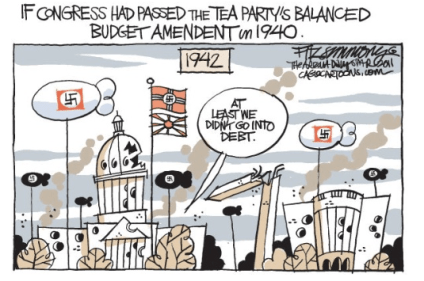 I just read an excellent article at VOXEU called “A summit to the Death” by Kevin O’Rourke. It’s full of common sense economic analysis about the state of the EU that reminds me of how rare common sense can be. While the analysis looks at he EU, it could well apply to the US as well. There seems to be some disease in political bodies these days that cannot grasp the concept of contractionary policy as contractionary.
There’s also this scramble to save financial institutions at all costs while doing nothing to prevent recurrence of bad practices and solving the fall out anywhere outside a bank balance sheet. To a certain extent, the EU crisis comes from the inability of many countries to think of policy in terms of something other than currency devaluation as a way of making their workers and goods appear cheap to the rest of the world. In this scenario, a country can goose some of its business activities at the expense of some of its businesses and its citizens and not get caught by any one but those of us that watch those sort of things. That long run game of devaluing US workers has caught up with us here.
One lesson that the world has learned since the financial crisis of 2008 is that a contractionary fiscal policy means what it says: contraction. Since 2010, a Europe-wide experiment has conclusively falsified the idea that fiscal contractions are expansionary. August 2011 saw the largest monthly decrease in eurozone industrial production since September 2009, German exports fell sharply in October, and now-casting.com is predicting declines in eurozone GDP for late 2011 and early 2012.
A second, related lesson is that it is difficult to cut nominal wages, and that they are certainly not flexible enough to eliminate unemployment. That is true even in a country as flexible, small, and open as Ireland, where unemployment increased last month to 14.5%, emigration notwithstanding, and where tax revenues in November ran 1.6% below target as a result. If the nineteenth-century “internal devaluation” strategy to promote growth by cutting domestic wages and prices is proving so difficult in Ireland, how does the EU expect it to work across the entire eurozone periphery?
The world nowadays looks very much like the theoretical world that economists have traditionally used to examine the costs and benefits of monetary unions. The eurozone members’ loss of ability to devalue their exchange rates is a major cost. Governments’ efforts to promote wage cuts, or to engineer them by driving their countries into recession, cannot substitute for exchange-rate devaluation. Placing the entire burden of adjustment on deficit countries is a recipe for disaster.
In order to protect financial markets, countries like the UK and the US have been willing to prop up poorly performing financial institutions at an extremely high cost while further driving the nominal wages of their workers to lower and lower levels through currency debasement. Then, after slashing spending, they wonder why they’re economies don’t expand. It seems like some of the very easiest lessons of Macro 101 weren’t absorbed by a number of world leaders today. That vehicle of robbing Peter to prop up Paul and a few exporters isn’t available to countries in a currency union unless the Central Bank wants to do it for all.
O’Rourke’s analysis led Paul Krugman to rightly make this observation.
Maybe it was always thus, but the relentless wrong-headedness of the Europeans, their insistence on seeing their crisis as something it isn’t, and responding with actions that deepen the real crisis, has been a wonder to behold. In the 1930s policy makers had the excuse of ignorance; there was nobody to explain what was happening. Now, their actions amount to a willful disregard of Econ 101.
Let me provide an interesting bit of perspective. In 2007, Spain ran a budget surplus. That actually was its third budget surplus in row. At the time, its growth had been forecast to decline but ot was slammed by the global financial crisis. Spain is now on the list of problem countries–the S of the PIIGS–because it was trying to deal with 30 years of budget deficits to get in line with the EU Criteria. Balanced budgets are the proscribed way to handle an economy that is operating where it should be operating. Spain’s is having problems because financial institutions all over the world gambled and lost. Their economic activity declined, their tax receipts went down, and their obligations to the unemployed went up. So, as would be expected, their deficits widened. Now, the banks that caused the huge global crisis are getting full court sympathy and Spain is being blamed for threatening the status of the union.
Congressional Insider Trading: A case study in Moral Hazard
Posted: December 9, 2011 Filed under: #Occupy and We are the 99 percent!, corruption | Tags: congressional insider trading, congressional self dealing, josephy stiglitz 9 Comments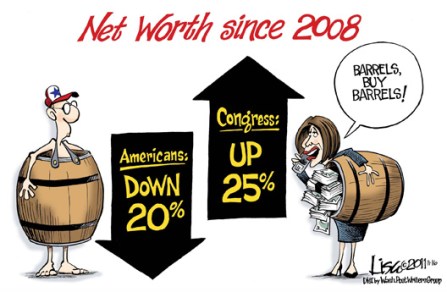 The more I’ve become aware of how pervasive the problem is of congressional insider trading, the more horrified I’ve become. This is a worst case scenario because this is just like congressional raises and campaign finance reform in that the foxes are in charge of their taxpayer funded chicken coop. They are unlikely to pass any kind of law that controls self-dealing behavior and there is no other way to get it done. There are always a few of them that are willing to do the right thing but the leadership of each house is most likely to be the stellar examples of those that manipulate the system to their own advantage. So, if a law comes up, the leadership will stop any forward momentum. Insider trading appears to be a bi-partisan problem with egregious examples from both sides of the aisle.
Insider trading in the financial markets is one of the most prosecuted and investigated crimes. The realization that inside information–information you have that is not available to the public–gives you an unfair advantage in predicting prices of assets is long standing. It’s been declared unethical and illegal for some time. Insider, self dealing behavior has been a problem for our country both in and outside of government. One good early congressional example is that of William Duer who was a member of the Continental Congress. However, Duer was an outlier for his time. Recent investigation by journalists indicate that the current congresspeople regularly self deal by buying stocks and other assets while influencing legislation that directly impacts those holdings.
Eric Cantor just blocked a bill that would outlaw insider trading by members of congress. This appears to be another example of a congressional leader who has made money off a practice ensuring they can continue to ride their gravy train. The behavior is clearly an example of self-dealing and is considered unethical in Wall Street and financial market circles. Given those guys frequently try to push the envelop on acceptable investing behaviors, that really puts Cantor in the poster child of moral hazard category.
The Republican sponsor of the bill in the House, Financial Services Chairman Spencer Bachus of Alabama, had scheduled a markup of the Stop Trading on Congressional Knowledge (STOCK) Act for next week. But on Wednesday, Majority Leader Eric Cantor of Virginia cancelled the markup session.
Cantor reportedly said he blocked the bill to give Congress more time to examine the issue. Critics of the move, however, fear that any delay could kill the bill entirely.
Some version of the the STOCK Act has been bouncing around Capitol Hill for six years. But recent attention to the issue of Congressional insider trading, following reports from CNBC’s Eamon Javers and a “60 Minutes” report, brought the bill out of stasis and made its passage into law seem likely. If the latest delay pushes the bill into next year, it may become lost in election-year politics.
Trading by lawmakers based on non-public information about legislation falls into what many see as a loophole in insider trading regulations.
Although corporate insiders are banned from trading on non-public information about their companies, congressional representatives and senators may not be banned from trading on non-public information about legislation or regulation. The legal issue is disputed by scholars and regulators.
The head of the enforcement division of the Securities and Exchange Commission recently argued that congressional insider trading is already banned. But he admitted that no legal action has ever been taken against a member of Congress.
Studies have shown the investment portfolios of House members and Senators consistently outperform the market by significant degrees, suggesting they are either miraculously bright and lucky investors or using their access to non-public information when trading. Financial experts regard the idea that it is just luck or investing smarts as laughable.
Minnesota Democrat-Farm-Labor Representative Tim Walz has been one of the bill’s sponsor. He’s currently doing interviews in an attempt to shame Cantor into releasing his hold.
The 1st District DFL Rep. Tim Walz-sponsored STOCK Act — Stop Trading in Congressional Knowledge — has been around for six years, but just recently started getting attention. It had been going nowhere until a “60 Minutes” report in November.
“We know that during the health care debate, people were trading health care stocks. We know that during the financial crisis of 2008, they were getting out of the market before the rest of America really knew what was going on,” Peter Schweizer, a fellow at the conservative Hoover Institution said on “60 Minutes.”
Overnight, the bill went from a handful of co-sponsors to having dozens. A month later, the bill has more than 220 co-sponsors from both parties, but mostly from the House.
This is a bill that should be on the top of the list for things that those sympathetic of the Occupy movement. It should appeal to Tea Republicans too. This is clearly something that is highly unethical and similar behavior by senior management in the private sector would be subject to criminal investigation and would result in charges. You can watch the 60 Minutes segment here. It’s worth watching. This bill should pass and be implemented. Something is seriously wrong with Eric Cantor’s moral barometer if he really thinks it needs more study.
Cantor’s move comes after we find that the wealth of US households suffered their biggest loss last quarter since the worst part of the financial crisis in 2008. Congress actually gained net worth during the same period. Last quarter’s losses by ordinary Americans are undoubtedly due to the eurozone crisis–which is essentially yet another bank problem–and the brinkmanship behavior of Congress balking at passing the debt ceiling increase to pay for spending they approved. The inability of congress to do anything substantial for the economy and instead engaging in naked partisan one-up-man-ship has been beyond the comprehension of most economists who know exactly what needs to be done to put the nation back on solid ground.
Even more unsettling than the latest quarterly figures on wealth destruction is the amount of wealth that has been vaporized in the past four years. The net worth of American households peaked in 2007 at $66.8 trillion. As of September 30, 2011, the net worth of American households had plunged to $57.4 trillion for a loss of $9.4 trillion. To put these number in perspective, this is a loss of net worth per person in the United States of $30,618. A family of four is statistically poorer by $122,472 than they were in 2007.
This is nothing less than malpractice on the part of elected officials that are more focused on gaining and keeping seats in their caucuses than doing right by the American people. Joseph Stiglitz’s ‘The Book of Jobs’ in January’s Vanity Fair is a compelling list of America’s economic troubles and the sins our elected officials in getting everything backasswards. This has not been our grandparent’s Great Depression where the government and the administration thought and acted big to take care of American people and their communities. Instead, our congress jumped to benefit personally from their knowledge of the problems by investing correctly and conducting policy improperly. They seem to know what their actions are doing when it comes to smartly using their own funds for their own enrichment.
It has now been almost five years since the bursting of the housing bubble, and four years since the onset of the recession. There are 6.6 million fewer jobs in the United States than there were four years ago. Some 23 million Americans who would like to work full-time cannot get a job. Almost half of those who are unemployed have been unemployed long-term. Wages are falling—the real income of a typical American household is now below the level it was in 1997.
We knew the crisis was serious back in 2008. And we thought we knew who the “bad guys” were—the nation’s big banks, which through cynical lending and reckless gambling had brought the U.S. to the brink of ruin. The Bush and Obama administrations justified a bailout on the grounds that only if the banks were handed money without limit—and without conditions—could the economy recover. We did this not because we loved the banks but because (we were told) we couldn’t do without the lending that they made possible. Many, especially in the financial sector, argued that strong, resolute, and generous action to save not just the banks but the bankers, their shareholders, and their creditors would return the economy to where it had been before the crisis. In the meantime, a short-term stimulus, moderate in size, would suffice to tide the economy over until the banks could be restored to health.
The banks got their bailout. Some of the money went to bonuses. Little of it went to lending. And the economy didn’t really recover—output is barely greater than it was before the crisis, and the job situation is bleak. The diagnosis of our condition and the prescription that followed from it were incorrect.
The problem is that congress–due to its ability to self deal–has no experience of any of this. In fact, the more we suffer it appears the more they make up fairy tales that suggest the only people doing well in this economy should be left to repeat the sins of their past. A congressional seat should not be an easy path to a secure position among the 1 percent. It appalls me that so many folks don’t seem to actually get this. Witness the rise of ultimate self-dealer Newt Gingrich to the front runner status of the republican presidential campaign. If we can’t stand up to the likes of Eric Cantor and we can’t reject the leadership model of Newt Gingrich, we will certainly loose any semblance of truly representative government. This bill would close the door on one faucet of the moral hazard problems that are rampant in government.
Friday Reads
Posted: December 9, 2011 Filed under: morning reads | Tags: captured drone, Christopher Hitchens, Filibuster, iran, recession, Senate Republicans, unemployment 20 Comments Good Morning!
I had another week full of weird things to do. I completely forgot my driver’s license expired last month on my birthday and had to rush out to get it renewed. I really don’t keep track of my age at all any more so I forgot the entire divisible-by-four thing. I also have been rushing around doing odds and ends that have just been driving me nuts. It just seems life is just one complex set of paperwork to fill out for someone or another these days. This week I had to prove all kinds of things to all kinds of people. I guess no one takes you at face value any more. We’ve turned into a nation where you have to show every one your papers. It made the week a combination of something Kafkaesque and Stalinesque. I simultaneously wanted to laugh, cry, and slap people multiple times this week.
There’s an interesting article at The Atlantic on how the economic recovery is affecting women differently from men. The article is called “The Recession was Sexist (So is the Recovery)” and it’s worth a read. It’s written by Jordan Weissmann.
Since November 2010, 70% of new jobs have gone to men. At first blush that sounds reasonable. If men lost more jobs, they should also recoup more. The problem crops up when you look at the number of job gains as a fraction of losses. Men have regained about a third of the jobs they shed in the recession. Women have only regained about one in five.
Ladies and gentlemen, we have a gender gap. And it’s not clear whether it will narrow. In November, female job gains actually outpaced males, 65,000 to 55,000. But going forward, women are going to have to contend with one of the most nastiest forces in job market: government budgets.
As the graphic to the left shows, women far outnumber men on state and local government payrolls, especially in public schools. Early in the recession, those employers were propped up by stimulus money. No longer. We live in an age of belt tightening, and government employees are being shown the door by the thousands. Last month, state and municipal payrolls shrank by 16,000 workers. There’s no sign of the trend letting up.
If you want to see the graphs that go with the discussion, you should check the article out. The trend is really noticeable.
There’s also continued filibusters from Mitch McConnell of anything that could remotely help the unemployed, families hurt by recession, and anything that looks like it might have gone near the President. I can’t believe all this belligerence is a winning strategy for them, but only time will tell. As much as I’ve had problems with Obama, McConnell’s got me so hopping mad and the clown set running for the Republican nomination have me more distressed. I’ve never seen a bunch of more mean-spirited, ignorant, hateful, religious fanatics in my life. In this situation, Obama is definitely the lesser of evils. This is an election that will bring the definition of evil to a new nadir. There’s not a woman- or child-friendly politician to be had any where.
The filibuster — a stall tactic that requires time-consuming motions and 60 votes to overcome — can be used on virtually all Senate business, including on whether to even bring up bills for debate.
…
Democrats say Republican tactics this week will come back to haunt them. On Thursday, Republicans are well-positioned to filibuster the nomination of Richard Cordray to head the new Consumer Financial Protection Bureau. For weeks, the GOP has demanded several changes to the bureau to roll back its powers.
Democrats say it’s “the first time in history” that a nominee will be blocked because of the concerns over the agency that the person was selected by the president to head — rather than the qualifications of the nominee.
“I said to some of my Republican colleagues, ‘Do you want this to happen when someday there’ll be a Republican president?’” said Sen. Sherrod Brown (D-Ohio). “It’s clearly a terrible precedent.”
en. Bob Menendez (D-N.J.) said he didn’t think any minority should adopt such tactics that he called “highly dangerous for the country.”
Republicans are highly dubious of the claims, saying there’s nothing unusual over holding up nominees until legitimate concerns over policy are addressed.
“This is the first time in history that I’m aware of that an agency of this kind has been created,” said Sen. Mike Crapo (R-Idaho), a member of the Senate Banking Committee.
The tit-for-tat has been going on since Tuesday when Republicans sustained a filibuster by a 54-45 vote on the Halligan nomination to the D.C. appellate court, accusing President Barack Obama of nominating an “activist judge” hostile to gun rights.
But Democrats said she was a well-qualified nominee with an exemplary résumé, and that the standard set by the so-called Gang of 14 senators in 2005 to only filibuster judicial nominees in “extraordinary circumstances” had been effectively nullifed.
Ruemmler, the White House counsel, said she could “rattle off a litany of folks who would be on any Republican shortlist” that would be rejected under the new standard, like attorney Paul Clement who is representing Republicans in the House in defending the Defense of Marriage Act. But she said it would be “ridiculous” if Democrats did that over such an ideological dispute.
The White House points to 20 judicial nominees awaiting Senate action, several of whom would fill posts considered “emergency” vacancies, and officials complain that the chamber is moving at a much slower pace now than it was when Bush was in office.
Iran has been showing film of a captured US drone. There’s been confirmation now that the film is authentic and so is the drone. This confirms some of the rumors floating around earlier this week.
Iran’s Press TV said that the Iranian army’s “electronic warfare unit” brought down the drone on 4 December as it was flying over the city of Kashmar.
Brig General Amir-Ali Hajizadeh, head of Iran’s Revolutionary Guards’ aerospace unit, told Iranian media that the drone “fell into the trap” of the unit “who then managed to land it with minimum damage”.
He said Iran was “well aware of what priceless technological information” could be gleaned from the aircraft.
Nato said at the weekend that an unarmed reconnaissance aircraft had been flying a mission over western Afghanistan late last week when its operators lost control of it.
Pentagon officials have said they are concerned about Iran possibly acquiring information about the technology.
I still haven’t gotten used to seeing armadillos all around the place since I moved down here. Looks like Kentucky is going to have to get used to them too as they are moving north and east. The move started in the 1980s and has been increasing since then. Like many local critters, they appear to be moving north with climates getting warmer.
“The first road-killed armadillo I encountered in Kentucky was in 2003, and the first live one I saw was in 2006,” said John MacGregor, a herpetologist with the Kentucky Department of Fish and Wildlife Resources.
MacGregor said in recent years there have been several confirmed sightings by staff biologists in eastern and south central Kentucky.
Steve Bonney, northeastern region wildlife coordinator for Kentucky Fish and Wildlife, encountered a road-killed armadillo in Rowan County in 2009 on the way to work. “I routinely record road kills. When I saw what I thought was an armadillo, my radar went off,” said Bonney. “It kind of shocked me.”
When Bonney arrived at work, he immediately drove back to the site of the road kill on Ky. 801 in Farmers, Kentucky to photograph and pick up the armadillo.
Of the 20 known species of armadillos, the nine-banded armadillo is the most widely distributed. It is the only armadillo species to have
ventured north of Mexico. Today, the nine-banded armadillo is established as far east as South Carolina and as far west as southern Nebraska. Loughry said range expansion “has been consistent over the years, and is the continuation of a long-term trend.”
But what biologists can’t agree on is why range expansion is occurring so fast. Factors that may be fueling this expansion include: climate change, the armadillo’s general adaptability, its high reproductive rate and little desire on the part of humans to hunt or eat armadillos.
The two most likely things to cause armadillo mortality are getting run over by vehicles on roads or being eaten by coyotes.
If any of them amble up to a neighborhood near you, here’s some cajun recipes for those of you brave enough to try them.
Here’s an interesting interview with Bruce Judson on the Societal Dangers of income inequality. Judson is a professor of management that specializes in entrepreneurship at Yale School of Managment. He has a new e-book coming out on making capitalism work for the 99%. BC is Bryce Covert of ND 2.0.
BC: What does inequality mean for the middle class, which is the foundation of our country’s economy?
BJ: Early America lacked the class barriers then prevalent in Europe: Everyone mixed with each other. This led the more fortunate to have empathy and a visceral understanding for the problems of the less fortunate. As economic inequality has increased, we see far less mixing among people at different income levels. Now everyone has less of a sense that they are part of one large community and that we have a responsibility to each other.
Political theorists, going back to Aristotle, have all concluded that a vibrant middle class is essential for a vibrant democracy. The members of the middle class hope to move up, so they want mobility to remain a desirable option, but they also fear moving down, so they are more likely to support a social safety net. In essence, the middle is the group that ensures stability as a barrier to legislative extremes that unduly reward the wealthy or harm the poor.
Unfortunately, inequality that chips away at the middle class can lead to violence. There was violence that occurred in the Depression, with riots in the Midwest. People also started to take the law into their own hands. In penny auctions, after your farm was foreclosed on, you showed up at the courthouse with all of your friends — farmers who had their rifles with them — and took over the bidding and bought back your farm for penny. As income inequality increases, the dispossessed may start to feel they have been treated unfairly and things can get ugly.
BC: Your work also predicted revolution. What’s your current take?
BJ: The book did not predict revolution. The book said that if we allow income inequality to continue growing unchecked, then we would face a high risk of political instability or revolution. We discussed earlier how the book detailed a series of stages, or a narrative, for how growing economic inequality can lead to social upheaval. Unfortunately the narrative I detailed seems to be happening.
My best estimate is we have now passed through 60 percent of the narrative. A lot needs to happen before the risk of political instability becomes a reality. I am hopeful that with inequality now on the national agenda, we will see the reforms needed.
So, there’s a lot of juicy stuff in that interview including Judson’s take on the Occupy movement.
BC: Does the emergence of the Occupy Wall Street movement make you more or less hopeful for the nation’s future?
BJ: It absolutely makes me hopeful that we will start to see some meaningful reforms. The Occupy movement is casting a bright and unforgiving light on some of the unacceptable practices in our society that, sadly, have become commonplace.
I believe the Occupy movement is not going away. The reason it grew so quickly is that it was the flashpoint for the country’s anger and widespread feelings of unfairness. It’s almost inevitable that in some way it will expand to include people who feel they’ve been unfairly foreclosed on, the record numbers of Americans experiencing long-term unemployment, and many of the unemployed in general who feel they’ve been cheated out of the opportunity to work – mainstream America.
The danger is that if the Occupy movement does not succeed, and nothing takes its place, we will move further along the narrative I described.
So, that’s my offerings this morning. I have a few more paper chases to do today before I settle in for the weekend. I’m thinking I’ll end this week with a nice long soak in the tub, some read wine, and the new Vanity Fair with the Gaga in red pic on the cover. I’m going to read about the romance between Queen Elizabeth and Prince Phillip and look at all those really old photos. I’d say that out to put reality out of my mind for awhile. Okay, I’m going to read the Stiglitz article first (Fix the Economy? What Obama and the GOP won’t tell you). Then, I’m going to read Christopher Hitchens on Nietzsche, then I’ll do the Queen’s young romance. So, okay, I”ll give you one taste.
Hitchens describes chemotherapy. This is something I know well. I also know what it’s like to kiss death and know that it hovers over your bed waiting for you to move closer to its embrace.
I often grandly say that writing is not just my living and my livelihood but my very life, and it’s true. Almost like the threatened loss of my voice, which is currently being alleviated by some temporary injections into my vocal folds, I feel my personality and identity dissolving as I contemplate dead hands and the loss of the transmission belts that connect me to writing and thinking.
These are progressive weaknesses that in a more “normal” life might have taken decades to catch up with me. But, as with the normal life, one finds that every passing day represents more and more relentlessly subtracted from less and less. In other words, the process both etiolates you and moves you nearer toward death. How could it be otherwise? Just as I was beginning to reflect along these lines, I came across an article on the treatment of post-traumatic stress disorder. We now know, from dearly bought experience, much more about this malady than we used to. Apparently, one of the symptoms by which it is made known is that a tough veteran will say, seeking to make light of his experience, that “what didn’t kill me made me stronger.” This is one of the manifestations that “denial” takes.
I am attracted to the German etymology of the word “stark,” and its relative used by Nietzsche, stärker, which means “stronger.” In Yiddish, to call someone a shtarker is to credit him with being a militant, a tough guy, a hard worker. So far, I have decided to take whatever my disease can throw at me, and to stay combative even while taking the measure of my inevitable decline. I repeat, this is no more than what a healthy person has to do in slower motion. It is our common fate. In either case, though, one can dispense with facile maxims that don’t live up to their apparent billing.
This is NOT what a Feminist Looks Like (yet again)
Posted: December 8, 2011 Filed under: Team Obama, Women's Rights | Tags: abortion rights, Reproductive Rights, women's health 15 Comments I watched the last presidential presser this afternoon. The President wants to be seen as a fighter, yet once again, the President will not fight for the constitutional rights or health of our country’s women.
Here’s the sum up from USA Today.
President Obama said today that “as the father of two daughters,” he supports his Health secretary’s decision to block over-the-counter sales of the Plan B “morning after” birth control pill to girls under 17 years of age.
“I did not get involved in the process,” Obama said during a White House news conference, though he added he supports the decision by Health and Human Services Secretary Kathleen Sebelius.
Sebelius, overruling the Food and Drug Administration, said there are too many questions about the safety of Plan B for girls who can bear children as young as 10 or 11 years old.
“I think it is important for us to make sure that we apply some common sense to various rules when it comes to over-the-counter medicine,” Obama said during an impromptu news conference at the White House.
He said Sebelius decided 10- and 11-year-olds should not be able to buy the drug “alongside bubble gum or batteries” because it could have an adverse effect if not used properly. He said “most parents” probably feel the same way.
Put another way:
From Empty Wheel: Obama: “As the Father of 2 Daughters” I Want the Government to Ignore Science
Barack Obama, who was educated in the country’s most esteemed universities, has implied that having daughters has convinced him the government should ignore science.
From FDL: Obama’s Deeply Paternalistic Statement on Plan B Decision
This is a pure expression of male paternalism regarding women being able to make their own reproductive decisions. … Who needs lengthy scientific review, when apparently father knows best?
I have only one more question. Have any of you ever seen any kind of drug stored next to batteries or bubble gum? When is the last time this man visited a pharmacy?
Desperate Men in Desperate Times do Desperate Things
Posted: December 8, 2011 Filed under: 2012 presidential campaign, Republican politics, Republican presidential politics | Tags: Pat Robertson, pure evil, Rick Perry 19 CommentsTexas Governor Rick Perry is supposed to be the next president of these United States. Perry’s wife insists that “god” told her this in some sort’ve conversation that used to

Rick Perry Keeps Shooting off his mouth and foot.
land people in huge institutions for long periods of rest far away from the rest of us. However, this day and age, all kinds of socially rude and crude behavior usually winds up in political ads. Perry’s desperate attempt to gain momentum in Iowa is pathetic and mean.
Perry’s debate performance, some giddy speeches that brought up questions of drug and alcohol abuse and his demonstrable inability to get simple facts correct–like the country’s voting age–has pushed him down to the bottom of the crazy clown pack. So, when the going get’s tough, Rick Perry turns mean and sanctimonious. He’s launched an Iowa Ad that has not only disturbed people in the state, but people in his own campaign. I’m going to let you watch the you tube and let you absorb Perry saying how the majority’s religion is just so disrespected by those gay people who refuse to stay in the closet and by liberals and those of us that are heretics or pagans or whatever they call it now.
HuffPo’s Sam Stein spoke with some members of the campaign and many of them are not happy campers with the tone of the ad either. What exactly does it mean when a campaign has to scapegoat and belittle the country’s minorities? I’m trying hard not to Godwin here, so be patient with me.
That a presidential campaign would suffer from internal disagreements over a controversial ad or broader campaign strategy is far from shocking. High-stakes political operations are often rife with strategic disputes. But it is rare for those disputes to spill over into public view and even rarer (at least when it comes to Republican politics) for them to center on the issue of gay rights.
It just so happens that several members of Perry’s campaign staff have worked to advance LGBT causes inside the GOP. Liz Mair, a consultant to the Texas governor, serves on the advisory board of the group GOProud. And Fabrizio has done polling for the Log Cabin Republicans in addition to urging lawmakers to reconsider their approach to the culture wars and embrace basic fairness for gay Americans on the issue of marriage. He was considered an ally by pro-gay rights conservatives.
This isn’t a unique feature of Perry’s campaign. Republican candidates are increasingly relying on younger operatives who are far more sympathetic to gay rights. Mississippi Gov. Haley Barbour did during his exploratory run for the presidential nomination earlier this year. But Barbour never aired a blatantly anti-gay ad campaign that demonized one of the LGBT community’s signature legislative achievements.
“It is the height of hypocrisy for Tony Fabrizio to have been a part of that,” said Jimmy LaSalvia, co-founder and executive director of GOProud. “He has lined his pockets for years with money from the gay community to conduct polls to ostensibly help gay people in this country, and for him to be a part of this is the height of Washington hypocrisy. It is absolutely what is wrong with Washington. It is all about the payday for these people.”
If Fabrizio found the ad repugnant and it aired over his objections, LaSalvia argued, he should have quit in protest. “Perry said in the ad that the service of tens of thousands of patriotic gay Americans is what’s wrong in this country,” LaSalvia said. “That is an outrageous and un-American statement.”
How Rick Perry can suggest that the white christian straight majority in this country is under attack is beyond me. He argues that his way of life is under attack simply because nonwhite, nonchristian and/or nonstraight minorities want their constitutional right to be themselves and not be forced to conform, hide, or skulk. This time of year constantly puts me in the position of having to opt out of things or violate my beliefs. How are his rights under attack by forcing me–and many others like me– to participate in things that the constitution says that I have the right to refuse to participate in? He can go pray and sing christmas carols in his church any times he wants. That’s the really beautiful thing about the Constitution. Every one has the right to erect a house of worship and do their thing there. What he doesn’t have the right to do is make the rest of us participate and applaud, fund them, or sanction their dogmas as public law.
You have no idea what it feels like to have to continually opt out of some one else’s sacred cows when they are in a solid majority and they can make life a living hell for you in the workplace if you don’t appease them. It’s not a pleasant experience to either give in or say no way. No, I do not want to do Secret Santas. No, I am not donating to buy gifts and lunches for secretaries. I will do that myself on Secretaries’ Day. No, I do not want to pay for or attend “holiday parties’ or have decorations every where in my workplace. No, I do not want to celebrate your marriage in a church that excludes people and openly discriminates . If I cannot celebrate marriages of gay friends in the same way and you support some bigotry under any guise, I will opt out.
It’s okay for Rick Perry to kiss his wife in public but he expects two gay men to do it at home so he doesn’t feel under attack? People in a minority have to continually watch themselves so as not to ‘offend’ the majority or they will face all kinds of consequences including discrimination in many places including their work environment. The white, straight, christian majority in this nation does not have to tip toe around the minorities’ sensibilities. In fact, people like Rick Perry prefer to aggressively promote it to the detriment of others. He can be in the face of the public but wants everything that’s not his thing to go hide behind close doors and not object to his proselytizing and promoting ways.
I do not think it’s right or constitutional that because you have some specific religious belief, Mr. Perry, that says certain things that means my daughters can’t access safe and legal abortions or that if they were lesbians, that their relationships would not be given the same privileges given to straight couples. I never did practice Perry’s brand of Christianity even when I was going along with the rest of the group and not questioning things. I’m not about to start it now that I’ve opted out.
There are so many things that are wrong with this ad that it’s hard to know where to start. The biggest one is that it’s clearly not representing the values that were expressed in our Constitution, in which there is no mention of ‘god’ and a clear mandate to separate distinct religious dogma–majority or other–from state policy. People being able to live their lives by being true to their own beliefs and their own selves is not a war on your religion.
Rick Perry is one dumb and arrogant ass. At least he has no chance in hell of ever being remotely near the presidency. It’s a shame that he chooses to exercise his right to free speech in such a reckless and mean manner AND as a Governor of one of the two major political parties. Excuse me while I go brush my teeth. I have a very bad taste in my mouth for some reason.
Maybe it’s because I also watched this take on the same policy from evil old Pat Robertson.
and in other Rick Perry News: He’s declined Trump’s Debate invitation.

 peej
peej Carissa
 bostonboomer
 dakinikat
 ecocatwoman
 jjlo
jjlo mablue2
 Mama Lopez
 peggysue22
 quixote
 skydancingguestblogger
 Mona (aka Wonk the Vote)





Recent Comments