
Taking on a Big Question: Why Embrace Plutocracy over Working Class Heroes?
Posted: June 9, 2012 Filed under: religious extremists, right wing hate grouups, Voter Ignorance | Tags: fear, Reagan Democrats, the conservative brain, voting against your interests 66 Comments The UK Guardian has always been one of my favorite papers. One of my high school social science teachers–Steve Wiitala–introduced me to the paper when I was taking an honors world history seminar class. I’ve been reading it ever since. Jonathan Haidt–a psychology prof–asks a question that I’ve been wondering for years. Why on earth would any working class person support some one like Ronald Reagan or Mitt Romney? Why would they even consider voting for reactionaries funded by the likes of the Koch Brothers? Why would they vote against their own interests?
I’ve always looked to the slave plantation model for answers. White overseers for rich masters were given just enough special favors and made to feel above the plantations’ slaves that they felt better thinking “well, at least I’m not one of them”. White working class people have a history of indentured servitude and sharecropping. Why go back to people that really would like to re-institute these things? Haidt says that fear of the collapse of society sends them look for order and anything national greatness. I wanted to explore his arguments here. (You can also watch this interview with Haidt by Bill Moyers. ht/ to EcoCatWoman.)
Many commentators on the left have embraced some version of the duping hypothesis: the Republican party dupes people into voting against their economic interests by triggering outrage on cultural issues. “Vote for us and we’ll protect the American flag!” say the Republicans. “We’ll make English the official language of the United States! And most importantly, we’ll prevent gay people from threatening your marriage when they … marry! Along the way we’ll cut taxes on the rich, cut benefits for the poor, and allow industries to dump their waste into your drinking water, but never mind that. Only we can protect you from gay, Spanish-speaking flag-burners!”
One of the most robust findings in socialpsychology is that people find ways to believe whatever they want to believe. And the left really want to believe the duping hypothesis. It absolves them from blame and protects them from the need to look in the mirror or figure out what they stand for in the 21st century.
Here’s a more painful but ultimately constructive diagnosis, from the point of view of moral psychology: politics at the national level is more like religion than it is like shopping. It’s more about a moral vision that unifies a nation and calls it to greatness than it is about self-interest or specific policies. In most countries, the right tends to see that more clearly than the left. In America the Republicans did the hard work of drafting their moral vision in the 1970s, and Ronald Reagan was their eloquent spokesman. Patriotism, social order, strong families, personal responsibility (not government safety nets) and free enterprise. Those are values, not government programs.
Brain research is beginning to find that folks that tend to call themselves “conservative” tend to be more fearful. Chris Mooney–Author of The Conservative Brain–explains it like this.
Looking at MRIs of a large sample of young adults last year, researchers at University College London discovered that “greater conservatism was associated with increased volume of the right amygdala” ($$). The amygdala is an ancient brain structure that’s activated during states of fear and anxiety. (The researchers also found that “greater liberalism was associated with increased gray matter volume in the anterior cingulate cortex” – a region in the brain that is believed to help people manage complexity.)
That has implications for our political world. In a recent interview, Chris Mooney, author of The Republican Brain, explained, “The amygdala plays the same role in every species that has an amygdala. It basically takes over to save your life. It does other things too, but in a situation of threat, you cease to process information rationally and you’re moving automatically to protect yourself.”
Haidt says that this kind of thinking has some disturbing impact on people that tend to obsess on fear. Group loyalty can drive people who want to feel safe. Does this explain the effectiveness of Willie Horton ads and all those Rovian tricks that seem paranoid and some what zombieland-like to us?
But on matters relating to group loyalty, respect for authority and sanctity (treating things as sacred and untouchable, not only in the context of religion), it sometimes seems that liberals lack the moral taste buds, or at least, their moral “cuisine” makes less use of them. For example, according to our data, if you want to hire someone to criticize your nation on a radio show in another nation (loyalty), give the finger to his boss (authority), or sign a piece of paper stating one’s willingness to sell his soul (sanctity), you can save a lot of money by posting a sign: “Conservatives need not apply.”
In America, it is these three moral foundations that underlie most of the “cultural” issues that, according to duping theorists, are used to distract voters from their self-interest. But are voters really voting against their self-interest when they vote for candidates who share their values? Loyalty, respect for authority and some degree of sanctification create a more binding social order that places some limits on individualism and egoism. As marriage rates plummet, and globalization and rising diversity erodes the sense of common heritage within each nation, a lot of voters in many western nations find themselves hungering for conservative moral cuisine.
Does our place in Maslow’s hierarchy really determine our susceptibility, vulnerability, and motivation at the voting booth? Haidt says yes and sums his thesis up this way.
When working-class people vote conservative, as most do in the US, they are not voting against their self-interest; they are voting for their moral interest. They are voting for the party that serves to them a more satisfying moral cuisine.
So, these are the same motivators that drive people to guns, bibles, and tribal thinking that demonizes the ‘other’. Is the angry right just a bunch of folks that are scared shitless? It’s an interesting theses. Dr. Bostonboomer probably has more information on some of this than me. I am interested in hearing your thoughts. What is the appeal of voting for your own servitude?
Friday Reads
Posted: June 8, 2012 Filed under: 2012 presidential campaign, campaign financing, morning reads | Tags: American economic outlook, Bill Clinton on Wall Street, monetary policy, the Fed, tightening of MS, voter polls, Wisconsin recall 35 Comments Good Morning!
I admit to being completely exhausted. So, let’s see what I can dig up while I’m half asleep.
Josh Holland at AltNet thinks right wingers shouldn’t get too excited about Scott Walker’s win in Wisconsin on Tuesday.
An honest reading of the published exit poll leads to an important conclusion about Walker’s victory that has little to do with unions, Walker’s policies, the economy or any of the other factors that have pundits’ tongues wagging.
Fully 70 percent of those voters polled believed that recall elections are either never appropriate (10 percent) or are only appropriate in the case of official misconduct (60 percent).
The governor won 72 percent of this group. And it’s worth noting that a third of those voters who said “official misconduct” is a good reason to recall a governor voted to oust Walker, who has seen six of his staffers charged with 15 felonies in the “John Doe” probe.
While Walker himself has not yet been charged, reports suggest that the investigation is circling closer to him. Over the past seven weeks, he transferred $160,000 from his campaign funds to a legal defense fund, according to the Milwaukee Journal-Sentinel.
Mohamed A. El-Erian –CEO and co-Chief Investment Officer of the global investment company PIMCO speculates on US economic growth at Project Syndicate. He wonders “Is American Healing Fast Enough?”
Six internal factors suggest that the United States’ economy is slowly healing. For some observers, these factors were deemed sufficient to form the critical mass needed to propel the economy into escape velocity.
While I hoped that they might be proven right, the recent stream of weak economic data, including May’s timid net job creation of only 69,000, confirmed my doubts. With this and other elements of a disheartening employment report now suddenly raising widespread worries about the underlying health and durability of America’s recovery, it is important to understand the positive factors and why they are not enough as yet.
For starters, large US multinational companies are as healthy as I have ever seen them. Their cash balances are extremely high, interest payments on debt are low, and principal obligations have been termed out. Many of them are successfully tapping into buoyant demand in emerging economies, generating significant free cash flow.
Company cash is not the only source of considerable spending power waiting on the sidelines. Rich households also hold significant resources that could be deployed in support of both consumption and investment.
The third and fourth positive factors relate to housing and the labor market. These two long-standing areas of persistent weakness have constituted a major drag on the type of cyclical dynamics that traditionally thrust the US out of its periodic economic slowdowns. But recent data support the view that the housing sector could be in the process of establishing a bottom, albeit an elongated one. Meanwhile, job growth, while anemic, has nonetheless been consistently positive since September 2010.
Great! The richer are richer and big corporations are making it big abroad. What about the poor American worker? Evidently the Fed must think things are shaping up because Bernanke and Yellen are both hinting that the days of historically low interest rates might be nearing the end.
In spite of May’s weak jobs report, Fed Chairman Ben Bernanke still sees no reason for the central bank to expand its efforts to boost the American economy. The Fed is assessing whether the economy would continue to grow fast enough to reduce the unemployment rate without further intervention, he said.
This is an interesting youtube by Mauro Martino at Northeastern University. It’s aninfographic of fundraising by the presidential candidates from March 2011 to Feburary 2012.
David a Graham of The Atlantic gives us some analysis.
There’s a lot going on here, but the animated graphic shows how much each of the candidates raised each week and what states it came from, based on the amount of contribution per capita. The top half lists the states on a spectrum from most liberal to most conservative.
What’s great about the graphic is it shows just how drastically Mitt Romney and Barack Obama are in a different monetary league than the other Republican candidates who battled Romney for the nomination. That’s most obvious in the spikes — Ron Paul, Newt Gingrich, and Rick Santorum seldom did better than Romney even on their best days, but Romney’s highest peaks are exponentially larger than theirs.
The disparity becomes clear in the geographic breakdown, too. Romney and Obama tend to raise the most money in the same set of states: D.C., Massachusetts, California, New York, Florida, Texas, Connecticut, and Colorado. Of those states, five are solid Democratic, one is solid Republican, and two are swing. But they’re also the states with the highest concentrations of wealthy people. Meanwhile, the circles for Santorum, Gingrich, and Paul are fairly consistent across the map. At a time when the role of money and politics is fiercely debated, this visualization shows just how far out of proportion the relation between money and votes is. Obama has no chance of winning Texas, but it’s a cash cow for him; the same goes for Romney and California. It’s not hard to imagine how that distorts incentives for candidates. It’s not just that Romney and Obama are playing in a different league. Until August or so, they might as well be playing in a different nation, one comprised of 10 states or so.
Alec MacGillis asks: “Why we are listening to Bill Clinton on Wall Street?” over at TNR in an interesting article called “Let Us Bow Down before the Big Dog”.
Left largely unsaid, though, is that it is also hardly unsurprising for Clinton to be speaking up in defense of high finance. Remember: this is the man who as president presided over the alliance of Wall Street and the Democratic Party, embodied in his treasury secretary, Goldman Sachs veteran (and future Citigroup executive) Robert Rubin. It was Clinton who signed the repeal of Glass-Steagall, the 1933 law breaking up securities firms and commercial banks; it was Clinton whose advisers, notably Rubin and Larry Summers, blocked Brooksley Born’s push for tighter regulation of derivatives; it was Clinton who lowered the capital gains tax in 1997, vastly boosting the bottom line of private equity managers like Mitt Romney who, via the carried interest loophole, had their compensation treated as capital gains rather than ordinary income.
Surely it is no accident that Clinton’s other recent remark undermining Obama was also related to Obama’s allegedly over-populist stance toward high finance and the very wealthy. In an interview last fall with Newsmax — yes, Newsmax — Clinton critiqued Obama’s talk of raising taxes on millionaires who currently pay at very low rates (“The Buffett Rule”) by saying that it was a bad idea to raise anyone’s taxes “until we get this economy off the ground.” He added for good measure: “We don’t have a lot of resentment against people who are successful. We kind of like it, Americans. It’s one of our best characteristics that, if we think someone earned their money fairly, we do not resent their success. Americans lost the fact that, whatever you think about this millionaire surcharge — I don’t really care because I would pay it but it won’t affect me because I already paid income because I live in New York. I will pay more, but it won’t solve the problem.” Clinton tried to clarify these remarks later, but not before Crossroads GPS, the group founded by Karl Rove, built an Obama attack ad around the remarks.
What is utterly lost in the pundits’ exaltation of Clinton’s comments on Bain is that there is, in fact, a real debate going on within the Democratic Party, and that the reaction to the Obama campaign’s attacks on Bain are bringing out the intra-party tensions. On the one side are Democrats like Obama who have seen many former Wall Street supporters turn away from them for daring to hold them responsible for the 2008 financial collapse, for proposing reforms like closing the carried-interest loophole, and for generally believing that the explosive growth of the financial sector the past three decades has not exactly been healthy for the country. These Democrats argue that, while attacks on Bain might not play so well in the Acela Corridor, they may well resonate in Ohio. On the other side of the debate are Democrats like Clinton and Cory Booker, the mayor of the 68th biggest city in the country, who have managed to remain in the good graces of Wall Street, not least because they are not in the position of having to fix what went terribly wrong in the fall of 2008, and who also, it must be noted, are indebted to the high-finance world — Booker for its crucial support of his campaigns, and Clinton for its support of his post-White House philanthropic efforts.
Big dogs never bite the hand that feeds them.
So, this is my offering this morning. What’s on your reading and blogging list today?
RIP Ray Bradbury
Posted: June 6, 2012 Filed under: just because | Tags: Ray Bradbury 5 CommentsLegendary Science Fiction author Ray Bradbury has died at age 91. Bradbury was a favorite of mine. His books got me started down the path of reading the genre.  Many of his best books have become movies. My junior high school had us read and watch Fahrenheit 451.
His writings ranged from horror and mystery to humor and sympathetic stories about the Irish, blacks and Mexican-Americans. Bradbury also scripted John Huston’s 1956 film version of “Moby Dick” and wrote for “The Twilight Zone” and other television programs, including “The Ray Bradbury Theater,” for which he adapted dozens of his works.
“What I have always been is a hybrid author,” Bradbury said in 2009. “I am completely in love with movies, and I am completely in love with theater, and I am completely in love with libraries.”
Bradbury broke through in 1950 with “The Martian Chronicles,” a series of intertwined stories that satirized capitalism, racism and superpower tensions as it portrayed Earth colonizers destroying an idyllic Martian civilization.
Like Arthur C. Clarke’s “Childhood’s End” and the Robert Wise film “The Day the Earth Stood Still,” Bradbury’s book was a Cold War morality tale in which imagined lives on other planets serve as commentary on human behavior on Earth. “The Martian Chronicles” has been published in more than 30 languages, was made into a TV miniseries and inspired a computer game.
“The Martian Chronicles” prophesized the banning of books, especially works of fantasy, a theme Bradbury would take on fully in the 1953 release, “Fahrenheit 451.” Inspired by the Cold War, the rise of television and the author’s passion for libraries, it was an apocalyptic narrative of nuclear war abroad and empty pleasure at home, with firefighters assigned to burn books instead of putting blazes out (451 degrees Fahrenheit, Bradbury had been told, was the temperature at which texts went up in flames).
It was Bradbury’s only true science-fiction work, according to the author, who said all his other works should have been classified as fantasy. “It was a book based on real facts and also on my hatred for people who burn books,” he told The Associated Press in 2002.
His books were as much social statements on our modern lives as they were about possible futures.
Upon hearing of the death of Ray Bradbury, author of The Martian Chronicles, Fahrenheit 451, and Something Wicked This Way Comes, director Guillermo del Toro e-mailed Vulture a brief note. “I feel lonelier. The world is vast and barren: Bradbury was one of the titans of fantastic fiction and a unique voice in American literature. The lyricism of his prose influenced many generations across the globe. A humanist before anything else, Bradbury nurtured my youthful hopes, my flights of fancy. His soul was gentle but his imagination was fierce.”
 Bradbury was prolific. Yet, many of his books are literary classics. He lifted a genre known for bad b grade movies and worse paper back dime store pap to something beyond.
Ray Bradbury’s more than 27 novels and 600 short stories helped give stylistic heft to fantasy and science fiction. In ‘The Martian Chronicles’ and other works, the L.A.-based Bradbury mixed small-town familiarity with otherworldly settings.
He had been way laid by a stroke recently. Still, he will be known as an enduring figure of the last century as he projected and wrote about our possible futures.
Live Blog: Wisconsin Recall
Posted: June 5, 2012 Filed under: Labor unions, Live | Tags: Scott Walker, Tom Barrett, Wisconson Recall 71 Comments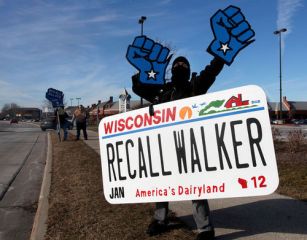 The polls are still open until 8 pm in Wisconsin but exit polls and extraordinary turnout show the race is very close. We’ll be updating this thread as the evening progresses so stay tuned.
Early exit polling of voters in the Wisconsin recall election showed a close contest, with a clear majority of voters having made up their minds well before the final weeks which saw intense campaigning on both sides of the aisle. The CNN exit polls showed that nearly nine of ten voters made their decisions prior to May, when Milwaukee Mayor Tom Barrett won the Democratic primary to challenge Gov. Scott Walker, a Republican. Petitions for the recall election circulated after Walker signed a bill last spring which cut collective bargaining rights for many state employees, prompting massive protests at the state house.
Voters in line before 8 pm must be allowed to vote. This could be a late night in precincts where turn out is at historic levels.

 From Josh Marshall at TPM on the Exit polls.
First, exits show President Obama with a 6 point margin over Romney among this special election electorate. Big deal? Not necessarily. Most polls with showed Walker with a margin over Barrett showed Obama with an even bigger margin over Romney. Judged in partisan terms, voters were inconsistent, which they often are. No surprise there. So we shouldn’t be surprised by this finding.
Second and more significant, the percentage of union households in the electorate jumped 6 points since 2010. That’s significant and very welcome news for the Dems and for the Barrett campaign. Whether it’s enough is a whole different questions. But that’s significant.
Voters in this electorate also have a very narrowly positive take on unions. Again, encouraging for the Dems. But you need to see big numbers to think there’s a good chance of overcoming the advantage Walker had in the polls.
Next, absentee ballots. Chuck Todd says between 10% and 12% of the electorate voted absentee. What does that tell us? No idea. Only another big unpredictable and wild card.

Exit Poll Highlights from the NYT.
Preliminary exit poll results indicate an uptick in turnout among voters from union households – something Democrats were hoping for in their effort to oust Gov. Scott Walker on Tuesday.
But whether that holds as voters continue to head to the polls, and whether it is enough to give Mayor Tom Barrett of Milwaukee the edge, are open questions at this point.
About a third of voters in preliminary exit poll results say they or someone in their household belong to a labor union. That is an increase from 2010 and 2008, when 26 percent of voters in each of those elections were from a union household.
High union turnout is crucial for the Democrats. In 2010, 63 percent of voters in union households supported Mr. Barrett, compared with 37 percent for Mr. Walker.
Monday Reads
Posted: June 4, 2012 Filed under: 2012 presidential campaign, U.S. Economy, U.S. Politics, unemployment, voodoo economics, We are so F'd | Tags: Barack Obama, Bill Moyers, Debt Ceiling, Frank VanderSloot, Garrett Epps, John Boehner, Koch Brothers, Mitt Romney, Paul Krugman, recession, Ryan budget, Scott Walker, Tom Barrett, whiny billionaires, Wisconsin recall 74 Comments Good Morning!
I thought I’d start this morning reads off with Bill Moyers who is having a good laugh at the expense of billionaires that are donating lots of money to political campaigns. It seems they really don’t like having their names bandied about and their closets opened. Pity the Poor Billionaires!!!
Last month, an Obama website cited eight mega-donors to Mitt Romney’s campaign as possessing “less-than-reputable records.” Among them was Frank VanderSloot, a Romney national finance co-chairman who has raised millions for the campaign. He’s a rancher – with 110,448 acres, on which he no doubt roams playing “This Land is Your Land” on his little Stradivarius — and CEO of the billion-dollar company Melaleuca, which Rolling Stone describes as “a ‘multilevel marketing’ firm based in Idaho that sells off-brand cleaning products and nutritional supplements.”
VanderSloot and his wealthy pals went ballistic and cried intimidation. “You go back to the Dark Ages,” VanderSloot said, “when they put these people in the stocks or whatever they did, or publicly humiliated them as a deterrent to everybody else — watch this — watch what we do to the guy who did this.”
Conservatives described the Obama ranking of Romney contributors as an “enemies list,” conjuring images of Nixonian wiretaps and punitive tax audits. But despite protestations to the contrary, these deep-pocketed plutocrats aren’t shelling out the shekels for the love of flag, Mom and apple pie (or tarte tatin, as they call it in the swanky joints).
“Most of the megadonors backing [Romney’s] candidacy are elderly billionaires,” Tim Dickinson writes in Rolling Stone. “Their median age is 66, and their median wealth is $1 billion. Each is looking for a payoff that will benefit his business interests, and they will all profit from Romney’s pledge to eliminate inheritance taxes, extend the Bush tax cuts for the superwealthy — and then slash the top tax rate by another 20 percent.” As at least one of them has said, they view these cash infusions as an “investment,” plain and simple.
Money is rolling into Wisconsin in Tuesday’s recall election. The Hill reports that it’s the most expensive race in Wisconsin history. The Koch Brothers are knee deep in money trying to keep their union bustin’ boy in office. We’ll be live blogging this tomorrow night so stay tuned!
Out-of-state sources have funded both sides heavily in the contest CPI said. Barrett has received about 26 percent of his $4 million in donations from sources outside of Wisconsin, while Walker has received two-thirds of his $30.5 million haul from out-of-state. Both campaigns have been aided by strong spending by super-PACs and other outside groups.
Labor unions have spent heavily to defeat Walker. The report says that the nation’s three largest public unions, the National Education Association (NEA), American Federation of State, County and Municipal Employees (AFSCME), and the Service Employees International Union (SEIU), have directed at least $2 million to anti-Walker efforts.
Walker, for his part, has been aided by conservative businessmen including casino mogul Sheldon Adelson and billionaire David Koch. The Republican Governors Association received a $1 million contribution from Koch in February, according to CPI.
The economy is slowing down. Oil prices are dropping in response. The stock market has lost all its value. Will we see another recession shortly?
The statistics on Friday were daunting. Only 69,000 jobs were created last month, far lower than what’s needed just to keep up with population growth. The job tallies for March and April, shabby to begin with, were revised down, for an average monthly tally of 96,000 over the past three months, versus 252,000 in the prior three months.
The weakness was not only displayed in job growth. Average weekly wages declined in May, to $805, as a measly two-cents-an-hour raise was more than clawed back by a drop to 34.4 hours in the length of the typical workweek.
Similarly, the rise in the number of people looking for work is normally considered a sign of optimism, but, on closer inspection, it appears to be simply the reversal of a drop in job-seekers in April.
Granted, it is better for jobless workers to be actively looking for work than sitting on the sidelines. But without enough jobs to go around, the inevitable result is higher official unemployment. The jobless rate ticked up from 8.1 percent in April to 8.2 percent in May, or 12.7 million people. Of those, 42.8 percent, or 5.4 million people, have been out of work for more than six months, a profound measure of personal suffering and economic decline.
There’s no sign that Washington is prepared to shoulder this responsibility. President Obama’s last big push for job creation, the $450 billion package proposed last fall, would have created an estimated 1.3 million to 1.9 million jobs by providing aid to states for teachers and other vital public employees, investments in infrastructure and tax breaks for new hiring. It was filibustered by Senate Republicans and not brought up for a vote in the Republican-dominated House, with Republican lawmakers claiming that deficit reduction was more important. Since then, they have balked at even smaller administration proposals, like modest investments in clean-energy projects.
Blocking constructive action is bad enough, but it’s not the worst of it. Recently, the House speaker, John Boehner, has ratcheted up economic uncertainty by pledging to force another showdown this year over legislation to raise the debt ceiling. A debt-ceiling debacle would come on top of the expiration at the end of 2012 of the Bush-era tax cuts and the onset of some $1 trillion in automatic spending cuts. If allowed to take effect as planned, those measures would take a huge bite out of growth, further weakening the economy.
Paul Krugman slammed the “anti-bipartisanship” in the Paul Ryan budget and in Romney’s support of obstructionist policies aimed at tanking the economy yesterday on ABC. Krugman said that the budget Romney supports is a “fraud”.
This morning on “This Week,” New York Times columnist Paul Krugman called Rep. Paul Ryan’s proposed budget plan a “fraud” as Romney campaign senior advisor Eric Fehrnstrom confirmed his candidate’s support for the plan that would trim trillions in federal spending over the next decade.
“The Ryan plan — and I guess this is what counts as a personal attack — but it isn’t. It’s not an attack on the person; it’s an attack on the plan. The plan’s a fraud,” said Krugman. “And so to say that — just tell the truth that there is really no plan there, neither from Ryan, nor from Governor Romney, is just the truth. That’s not — if that’s — if that’s being harsh and partisan, gosh, then I guess the truth is anti-bipartisanship. ”
Krugman, who has been critical of the Ryan, R-Wis., plan in the past, was responding to the Fehrnstrom, who confirmed Romney’s support for the plan after ABC News’ George Will asked Fehrnstrom to clarify his candidate’s stance on the Ryan proposal.
“He’s for the Ryan plan. He believes it goes in the right direction. The governor has also put forward a plan to reduce spending by $500 billion by the year 2016,” said Fehrnstrom. “In fact, he’s put details on the table about how exactly he would achieve that. So to say he doesn’t have a plan to — a plan to restrain government spending is just untrue.”
Krugman defended the president’s budget plan when asked by Fehrnstrom if he preferred it over the Ryan plan.
“I mean, the president — at least it’s — you know, I don’t approve of everything, but there are no gigantic mystery numbers in his stuff. We do know what he’s talking about. His numbers are — you know, all economic forecasts are wrong, but his are not — are not insane. These are — these are just imaginary,” he said.
Molly Ball writes about the mediocre Mitt Romney Governorship of Massachusetts at the Atlantic. Here’s my favorite quote “He believed that a PowerPoint presentation would solve all our problems.” Here’s some other tidbits that lead up to that very funny line.
Romney campaigned on a promise to clean up Massachusetts’ notoriously cronyistic state government, painting his opponent, the sitting state treasurer, as a product of a backroom-dealing Beacon Hill culture. But his efforts once he was elected were somewhat halfhearted and largely fruitless.
One example was the state’s judiciary, a notorious hotbed of patronage. Romney’s attempts to reform it didn’t succeed, and instead, he ended up succumbing to the status quo, the Washington Post reports. His attempt to consolidate transportation agencies was shot down by the legislature, as was his push to remove from the state university system William Bulger, brother of mobster “Whitey” Bulger. (Bulger did eventually resign, in part due to Romney’s pressure.)
“A lot of governors come in offering to change the political culture,” said Cunningham. “But he wasn’t here long enough, he didn’t put enough effort into it, and he had a very formidable opponent.”
Perhaps because of his outsider mien, Romney enjoyed notably chilly relationships with legislators and local officials, who found him distant and somewhat disengaged. John Barrett, who was mayor of the city of North Adams during Romney’s governorship, described him Thursday as “a governor who just ignored us, who didn’t want our effort,” saying he never met with mayors or sought their input. “He believed that a PowerPoint presentation would solve all our problems,” Barrett said.
So, the biggest issue on my mind is the looming Debt-Ceiling fight and the horrible Agent Orange. I pretty much believe that the House Republicans will crash all the markets and then some if they think it makes Obama less likely to be elected. Here’s Garrett Epps at the American Prospect. He believes–as do I–that Obama should use the Constitutional Option and tell them all to go to hell regardless. It will be interesting to see how soon they will heat this up.
The debt limit will apparently become a crisis again sometime after the election. Boehner two weeks ago announced his plan to demand another round of cuts when the current ceiling is reached at the end of the year. (I suspect this manufactured crisis will only happen if Obama is re-elected; if Mitt Romney wins the election, Republicans will suddenly find economic recovery an important value after all.)
Obama should begin now to prepare for the predicted crisis. And if there is any way to climb down from the inane “my attorney Bernie says I can’t” comment, he should find it. I called the U.S. Department of Justice to ask whether the Office of Legal Counsel has issued, or is preparing, a formal opinion on the President’s possible power under Section Four; the DOJ’s spokesman did not return my call.
There’s an interesting analysis at TP on how the last debt ceiling debate hurt the economy. A repeat under current conditions could be disastrous.
House Republicans last year used the imminent approach of the nation’s credit limit to force Congress into enacting a series of spending cuts. The hostage scenario led to the nation’s first ever credit downgrade, with the credit rating agency Standard & Poor’s repeatedly citing the GOP’s intransigence on revenue as a key justification. Speaker of the House John Boehner (R-OH) has indicated that the GOP is ready to reenact the debt ceiling debacle the next time the nation comes close to its borrowing limit. But as economists Betsey Stevenson and Justin Wolfers write, the economy was significantly setback during the last showdown, which they call “an act of economic sabotage“
Follow the links to the Bloomberg analysis and you’ll see why we’re in worse position to weather that kind of anti-bipartisanship nonsense this year. So, who really killed the confidence fairy last year?
High-frequency data on consumer confidence from the research company Gallup, based on surveys of 500 Americans daily, provide a good picture of the debt-ceiling debate’s impact (see chart). Confidence began falling right around May 11, when Boehner first announced he would not support increasing the debt limit. It went into freefall as the political stalemate worsened through July. Over the entire episode, confidence declined more than it did following the collapse of Lehman Brothers Holdings Inc. in 2008. After July 31, when the deal to break the impasse was announced, consumer confidence stabilized and began a long, slow climb that brought it back to its starting point almost a year later. (Disclosure: We have a consulting relationship with Gallup.)
Businesses were also hurt by uncertainty, which rose to record levels as measured by the number of newspaper articles mentioning the subject. This proved far more damaging than the regulatory uncertainty on which Republican criticisms of Barack Obama’s administration have focused (more on that subject in a Bloomberg View editorial today). Employers held back on hiring, sapping momentum from a recovery that remains far too fragile.
It’s going to be a very long, hot summer.
What’s on your reading and blogging list today?

 peej
peej Carissa
 bostonboomer
 dakinikat
 ecocatwoman
 jjlo
jjlo mablue2
 Mama Lopez
 peggysue22
 quixote
 skydancingguestblogger
 Mona (aka Wonk the Vote)





Recent Comments