
Hillary on the Verdict: “George Zimmerman verdict brought ‘deep heartache’”
Posted: July 16, 2013 Filed under: Hillary Clinton, War on Women, Women's Rights | Tags: Trayvon Martin case 51 Comments Hillary Clinton has been regaining her mojo on the speaking tour after a few months rest from retiring as a rock star SOS. Last night, she spoke out on the miscarriage of justice that saw the release of a man who should’ve–at the very least–be charged with reckless manslaughter.
Former Secretary of State Hillary Clinton spoke about the “heartache” of the Trayvon Martin case in D.C. Tuesday evening while speaking to an African-American sorority group.
“My prayers are with the Martin family and with every family who loves someone who is lost to violence,” she said in an almost 30-minute speech. “No mother, no father, should ever have to fear for their child walking down a street in the United States of America.”
She said she knew this week has “brought heartache, deep painful heartache” to families in the wake of the not guilty verdict in George Zimmerman’s trial last Saturday.
Exactly. We all fear hearing that some stalker has followed our child as he or she walks home from school, from their job, from their activities or friends’ house. We teach stranger danger. Yet, in this instance, the stranger that ended a teen’s life was acquitted. What message does this send? And please, who gets to stand their ground or claim self defense when you’ve basically been stalking a kid fully knowing you have a loaded gun on you? And, of course he was racially profiling.
Clinton also referenced U.S. Attorney General Eric Holder’s announcement Monday that the Justice Department will review the case.
“Yesterday I know you heard from the Attorney General about the next steps from the Justice Department and the need for a national dialogue,” she said. “As we move forward as we must I hope this sisterhood will continue to be a force for justice and understanding.”
Clinton’s comments came in a speech to the 51st annual convention of the Delta Sigma Theta Sorority, the largest African-American women’s organization in the country. Organizers said that more than 14,000 people were in the room to hear her speak.
There have been some many stabs deep into the laws that protect rights it’s hard to know where to start. However, Clinton spent time on what it means to have the VRA crippled. She also spoke to the abhorrent attacks on the rights of wome.
“The Supreme Court struck at the heart of the Voting Rights Act,” Clinton said. “For more than four decades this law has helped overcome constitutional barriers to voting. Again and again it has demonstrated its essential role in protecting our freedoms.”
She urged attendees at the convention to push Congress to take action on restoring and rewriting Section 4 of the law.
“Unless Congress acts, you know and I know more obstacles are on their way,” she said. “They’re going to make it difficult for poor people, elderly people, minority people, and working people to do what we should be able to take for granted.”
She spoke, as she’s done recently at other women-centric events, about the need for more women to take up positions of power — and about Delta members like former Labor Secretary Alexis Herman and Rep. Martha Fudge who have advanced the cause of women in leadership.
“As you know, women still comprise a majority of the world’s unhealthy, unschooled, unfed and unpaid,” she said, adding that there’s been “a lot of progress” on women’s rights but that more needs to be done.
As has been the case in many of her speeches this year, Clinton’s potential 2016 bid wasn’t far from people’s minds. As she exited the stage, audience members cheered, “Run, Hillary, Run!”
Yup, RUN HILLARY RUN!!!
Monday Reads: Prehistoric Rock and Roll
Posted: July 15, 2013 Filed under: morning reads | Tags: blue collar temp jobs, cave art and psychedelic drugs, mansplaining abortion rights 103 Comments Good Morning!
I thought I’d bring a little bit of prehistory and prehistoric-like thinking into this morning’s reads. A recent student suggests that all that funky paleolithic Cave Art may have been the product of some really good psychedelic drugs.
Prehistoric cave paintings across the continents have similar geometric patterns not because early humans were learning to draw like Paleolithic pre-schoolers, but because they were high on drugs, and their brains—like ours—have a biological predisposition to “see” certain patterns, especially during consciousness altering states.
This thesis—that humanity’s earliest artists were not just reeling due to mind-altering activities, but deliberately sought those elevated states and gave greater meaning to those common visions—is the contention of a new paper by an international research team.
Their thesis intriguingly explores the “biologically embodied mind,” which they contend gave rise to similarities in Paleolithic art across the continents dating back 40,000 years, and can also be seen in the body painting patterns dating back even further, according to recent archelogical discoveries.
At its core, this theory challenges the long-held notion that the earliest art and atrists were merely trying to draw the external world. Instead, it sees cave art as a deliberate mix of rituals inducing altered states for participants, coupled with brain chemistry that elicits certain visual patterns for humanity’s early chroniclers.
Put another way, if Jackson Pollock could get drunk and make his splatter paintings while his his head was spinning, primitive men and women could eat pyschedelic plants and commence painting on cave walls—in part, presenting the patterns prompted by brain biochemistry but seen as having super-sensory significance.
“The prevalence of certain geometric patterns in the symbolic material culture of many prehistoric cultures, starting shortly after the emergence of our biological species and continuing in some indigenous cultures until today, is explained in terms of the characteristic contents of biologically determined hallucinatory experience,” the researchers hypothesize.
The war on women that is raging in every state where Republicans can abuse the legislative process to make laws that reflect personal religious  bigotries rather than medical science is bringing up discussion on how confused the public is on the issue. Of course, many men write about the issue and when doing so, they seem to forget one important thing. This is about one woman and her body. It is basically nobody else’s damned business. No one’s opinion should matter for any one else on this if it’s not your damned body and your damned pregnancy. It’s not like a war or public education or daming up great rivers which are societal efforts and concerns. These are topics where every one should have a say. Abortion rights are about saying women can make the best decision and are autonomous individauls and not the government or any one else has a stake in that. It’s denying the woman selfhood and autonomy even when its some open minded, pro-choice guy–in this case David Leonhardt–who mansplains it to us.
Antiabortion laws and polls are the ultimate busybody neighbor. They presume every one knows best but the woman involved. Imagine that every appendectomy, every vasectomy, and every tonsillectomy were subjected to every one else’s religious views and opinions. Imagine if that wart you had treated was the subject of a poll. This is America where women’s bodies continue to be subjected to public opinion and polling and regulation and religion and state-approved ownership.
On abortion rights, both parties have a claim on public opinion. Maybe more to the point, both can make a strong case that the other party has an extreme view. Abortion is the relatively rare issue in which the cliché is true: public opinion does actually rest about midway between the parties’ platforms.
As a result, abortion occupies a different place in the Republicans’ continuing struggle about whether and how to modernize their party. On a set of other social issues related to the increasingly diverse American population, the party clearly faces big challenges. The two fastest-growing ethnic groups — Latinos and Asian-Americans — are decidedly liberal. Younger white adults also lean left. My colleague Nate Silver estimates that in the year 2020, ballot initiatives on same-sex marriage would pass in 44 states, based on the direction of public opinion. The only six states where the initiatives would likely fail are solidly Republican Southern states.
Anyone following the Texas abortion debate through social media could easily imagine that the issue belongs in the same category. During her filibuster against the bill, State Senator Wendy Davis inspired a hashtag — #StandWithWendy — and a Twitter explosion. An often overlooked aspect of social media, however, is that it still skews slightly liberal.
Nationwide, polls consistently show that people are no more “pro choice” than “pro life,” when asked to choose a label. More detailed questions yield similar results. And women are no more in favor of abortion rights than men. “Abortion is not heading in either party’s direction,” says Andrew Kohut of the Pew Research Center.
About 60 percent of Americans favor access to abortion in the first trimester (or first 12 weeks) of pregnancy, but close to 70 percent think it should be illegal in the second trimester, according to Gallup. Likewise, a recent National Journal poll found 48 percent of respondents favoring, and only 44 percent opposing, a House of Representatives bill that would ban abortions after 20 weeks of pregnancy except in cases of rape and incest.
“About 8 in 10 Americans believe abortion is taking a life,” said Ed Goeas, president of the Tarrance Group, a Republican polling firm. “What you then have is a discussion about when it is acceptable.”
Perhaps the best weapon of abortion rights advocates is their opponents’ extremism. The Texas bill, for instance, would close most of the state’s abortion providers and ban the procedure after 20 weeks, without exceptions for rape or incest. A clear majority of Americans support such exceptions, as well as those for the health of the mother, polls show.
 There’s been a little bit of this and that in the news about the impact of the sequester. Primarily, it’s been the impact on things like hurricane preparedness or lines in airports which both have been addressed by congress when governors or other powerful people complain. Here’s compelling evidence on what the sequester is doing to the poorest and weakest among us. I’ve already covered a little of this in a previous post. But, you know me, I can never let go of an opportunity to show how truly bad our societal values have become. Even our prehistoric relatives knew that taking care of the elderly and the young was important for survival of all as well as a central role in attaching ourselves to our families and others. Here, we put our babies and our old people out on the ice floes. We only protect the clump of cells in our neighbor’s womb.
The federal government’s across-the-board sequestration cuts, which began taking effect in March, may seem like an overhyped piece of political theater–that is, unless you’re an unemployed adult living in Michigan. There, roughly 82,000 people, like Kristina Feldotte of Saginaw, have watched their federal unemployment checks dwindle by 10.7 percent since late March. That’s as much as a $150 per month from payments that, at most, clock in at $1,440.
“It flabbergasts me that our government can’t get its crap together,” says Feldotte, 47, a mother of four and a laid-off public-school teacher. “With the air-traffic controllers, Congress fixed that right away because it affected the planes going in and out of Washington. But they’re not doing anything that benefits the people.”
That’s especially true of poor people since Congress and the White House failed to reach a deal to undo the cuts in March. Air-traffic controllers and meat inspectors, represented by powerful unions and lobbyists, got reprieves. Agencies such as the Justice and Homeland Security departments found wiggle room in their budgets to stave off furloughs. But programs outside of D.C. for low-income or distressed people — such as Head Start, Meals on Wheels, or federal unemployment benefits — have suffered as the cuts kicked in, leading to cancellations, fewer meals, smaller checks, and staff layoffs.
“The impacts of the sequester have been hard to document, but it really is a diminution of services,” says Sharon Parrott, vice president for budget policy and economic opportunity at the left-leaning Center on Budget and Policy Priorities.
Take the Meals on Wheels program in Contra Costa County, California, which, like the national program, has had to cut 5.1 percent of its budget. After losing $89,000 in federal funding over a six-month period, the program had to scale back the number of meals it serves from 1,500 to 1,300 a day. This puts its director in the unenviable position of having to choose which low-income or lonely 80-year-olds are less deserving of a meal delivery. “We’re only adding new clients in the direst circumstances — like they will die or be institutionalized if we don’t get to them,” says Paul Kraintz, director of the county’s nutrition program.
The Head Start program in Rockland County, N.Y., had to make similarly tough choices. It managed to keep open its summer program for the youngest children, ages 1 to 3, but had to cancel the summer sessions for 3-to-5-year-olds and lay off 12 staff members to save roughly $240,000, says Ouida Foster Toutebon, executive director of Head Start Rockland. Like the national program, it will lose about 5 percent of its budget — in this case, $414,925 — by the end of the fiscal year, September 30. “The parents were upset, because they needed to make other arrangements,” Toutebon says.
I love reading good, in-depth real journalism. Pro-Publica frequently provides this. It’s even better when it relates to my field of study. Here is a disheartening and realistic look at what it means to be a worker in America these days. Basically, you are expendable. You are just one more thing that can be thrown away at a moment’s notice. Blue collar workers are now temping in large numbers.
In cities all across the country, workers stand on street corners, line up in alleys or wait in a neon-lit beauty salon for rickety vans to whisk them off to warehouses miles away. Some vans are so packed that to get to work, people must squat on milk crates, sit on the laps of passengers they do not know or sometimes lie on the floor, the other workers’ feet on top of them.
This is not Mexico. It is not Guatemala or Honduras. This is Chicago, New Jersey, Boston.
The people here are not day laborers looking for an odd job from a passing contractor. They are regular employees of temp agencies working in the supply chain of many of America’s largest companies – Walmart, Macy’s, Nike, Frito-Lay. They make our frozen pizzas, sort the recycling from our trash, cut our vegetables and clean our imported fish. They unload clothing and toys made overseas and pack them to fill our store shelves. They are as important to the global economy as shipping containers and Asian garment workers.
Many get by on minimum wage, renting rooms in rundown houses, eating dinners of beans and potatoes, and surviving on food banks and taxpayer-funded health care. They almost never get benefits and have little opportunity for advancement.
Across America, temporary work has become a mainstay of the economy, leading to the proliferation of what researchers have begun to call “temp towns.” They are often dense Latino neighborhoods teeming with temp agencies. Or they are cities where it has become nearly impossible even for whites and African-Americans with vocational training to find factory and warehouse work without first being directed to a temp firm.
In June, the Labor Department reported that the nation had more temp workers than ever before: 2.7 million. Overall, almost one-fifth of the total job growth since the recession ended in mid-2009 has been in the temp sector, federal data shows. But according to the American Staffing Association, the temp industry’s trade group, the pool is even larger: Every year, a tenth of all U.S. workers finds a job at a staffing agency.
The proportion of temp workers in the labor force reached its peak in early 2000 before the 2001 slump and then the Great Recession. But as the economy continues its slow, uneven recovery, temp work is roaring back 10 times faster than private-sector employment as a whole – a pace “exceeding even the dramatic run-up of the early 1990s,” according to the staffing association.
The overwhelming majority of that growth has come in blue-collar work in factories and warehouses, as the temp industry sheds the Kelly Girl image of the past. Last year, more than one in every 20 blue-collar workers was a temp.
Several temp agencies, such as Adecco and Manpower, are now among the largest employers in the United States. One list put Kelly Services as second only to Walmart.
Most of the news today is on the Zimmerman acquittal and the peaceful protests that happened yesterday in remembrance of the needless death of an American teenager at the hand of an armed, ignorant vigilante. I feel a lot like I did the day that OJ Simpson got away with murdering two people. I remember exactly where I was when I heard that verdict. Karma caught up with OJ. I am sure the same thing will happen to Zimmerman. It just freaks me out that he can still carry a concealed weapon around and play pseudo cop. Oh, he wants to be a lawyer now and help people like him; whatever that means.
What’s on your reading and blogging list today?
What I learned this Week from our Country’s Republicans
Posted: July 13, 2013 Filed under: religious extremists, Reproductive Health, Reproductive Rights, Republican Tax Fetishists, right wing hate grouups, Violence against women, Voter Ignorance, War on Women, We are so F'd, Women's Healthcare, Women's Rights 17 Comments There are several lessons I learned from the Right Wing this week.
But we all know where the mind goes when the word “profiled” is used, especially in a case like this. Besides, from Zimmerman’s continuous calls to the Sanford Police Department involving African American men to his nonemergency call that tragic night in February 2012, race was omnipresent in this case.
So, no wonder it struck more than a few people as a little odd when Florida Assistant State Attorney John Guy told the jury during his rebuttal closing argument that the Zimmerman case was not about race. But what he did was brilliant. He used race to take race off the table and he did it by pulling a reverse Matthew McConaughey.
The 1996 movie “A Time to Kill” is set in Mississippi and stars McConaughey as country lawyer Jake Tyler Brigance. He takes the case of Carl Lee Hailey, a black man who shot and killed the two white men who raped and tortured his daughter. Hailey doesn’t stand a chance with the all-white jury, but Brigance makes a dramatic closing statement that left me in tears when I saw it in the theater 17 years ago this month.
Brigance asks the jury to close their eyes as he tells them a story. “I want you to listen to me. I want you to listen to yourselves,” he says. “This is a story about a little girl walking home from the grocery store one sunny afternoon. I want you to picture this girl. Suddenly a truck races up. Two men grab her.” And then Brigance describes every abominable thing the men did to her. Choking back tears of his own, Brigance concludes his closing with a powerful request of the jury.
I want you to picture…
…that little girl….
Now, imagine she’s white.Guy asked the Zimmerman jury to do the same thing but with a twist. Rather than switch the race of the victim, he switched the race of the defendant.
“This case is not about race; this is about right and wrong,” he told the all-white jury of women. “What if it was Trayvon Martin who shot and killed George Zimmerman? What would your verdict be?,” Guy asked. “That’s how you know it’s not about race.”
Whether we want to admit it or not, we know the answer to Guy’s question. If the verdict would be guilty for Trayvon if he were the accused murderer then it must be the same for Zimmerman. Now, we wait to see if the jury agrees.
Second, women have less rights than the clumps of cells attached to their bodies because MotorCycle Safety, Masturbating Fetuses, and Men that want to believe all kinds of crazy things about biology based on religious tripe. Regulation is not for industries that can kill hundreds of workers or guns that can kill thousands. It’s for tampons and some one else’s uterus.
When North Dakota’s Republican Governor Jack Dalrymple signed the nation’s most restrictive abortion law in March, Bette Grande was thrilled. The Republican state legislator had spent months lining up support for a bill that makes it illegal for women to end a pregnancy because the fetus is shown to have Down syndrome or other chromosomal abnormalities. Set to take effect in August, the law also bans abortions once a heartbeat is detected, which can be as early as six weeks.
Anti-abortion activists praised Grande’s work. “It’s the right thing to do,” she says. “I don’t worry about the political fallout; I worry about the life of the unborn child.” Yet she concedes the campaign wasn’t quite homegrown. She didn’t come up with the legal justification for the legislation or all the arguments to persuade fellow lawmakers to sign on. A lot of that was provided to her by a group of activists 1,500 miles away in Washington. Americans United for Life gave Grande a cut-and-paste model bill it had drafted, along with statistics and talking points—“good, factual information regarding abnormalities and the discrimination that occurs inside the womb,” she says. “My colleagues didn’t need a whole lot of persuasion after that.”
Familiar in Washington for its 40-year effort to make abortions harder or impossible, Americans United for Life is now having more success outside the capital, offering itself as a backstage adviser to conservative politicians trying to limit state abortion rights. The group’s leaders say they hope Grande’s success will give encouragement to lawmakers in other places, including Texas and North Carolina, that are debating anti-abortion bills AUL is helping to promote. “Our organization has attempted to inject, if you will, a bit of competition between the states,” says Daniel McConchie, vice president for government affairs. The group ranks states by how much they’re doing to reduce abortions (Louisiana ranks first; Washington, 50th). “People come to us and say, ‘What else do we need to do to boost our ranking?’ ”
So far this year, 17 states have enacted a total of 45 new restrictions on abortion, many of them with AUL’s help. The group is explicit about its larger goal: to provoke a Supreme Court challenge to one or more of the state anti-abortion laws, giving the court’s conservative justices a chance to overturn the 1973 Roe v. Wade decision. “In order for the court to actually reconsider Roe, it has to have an active case before it,” says McConchie. “So we work with legislators to pass laws that will essentially spark the right kind of court challenge and give them the opportunity to reconsider the question.”
To increase the number of laws—and therefore potential test cases—the group publishes a 700-page anti-abortion field guide called Defending Life, which contains 48 pre-written bills politicians like Grande can copy. Among the most popular is a bill to limit or outlaw abortions after 20 weeks. That’s one of the restrictions Texas Democratic State Senator Wendy Davis temporarily derailed on June 25 with her pink-sneakered filibuster.
Republicans are acutely aware of the political risk in pressing for new abortion laws. The GOP is already struggling to make up lost ground with women voters, who increasingly favor Democrats and are more likely to regard abortion as a top voting issue. In Defending Life, AUL suggests one way around this problem is to emphasize women’s health when talking about abortion laws. “Legislative and educational efforts that only emphasize the impact of abortion on the unborn are insufficient,” the book says.
Third, if you happen to believe he existed and had some kind of extra special relationship with a universal creator, Jesus does not want us to feed the poor or house the poor or take care of our children. He wants us to subsidize the wealthy as they fit themselves into heaven via the eye of the camel. This is from the excellent mind and keyboard of Charles Pierce.
Witness yesterday’s callous and shameful fandango regarding the Farm Bill. Last week, a traditional Farm Bill failed to pass the House because the flying-monkey caucus thought it was insufficiently harsh on people who use food stamps. So, yesterday, as Democrats went fairly far up the wall, the flying-monkey caucus went one better. They simply took out the food stamp provisions entirely and passed a Farm Bill containing all those sweet, gooey subsidies and gifts to big agribusiness. They were very, very proud of how clever they had been, and they exhibited their shiny red rumps to all the world.
By splitting farm policy from food stamps, the House effectively ended the decades-old political marriage between urban interests concerned about nutrition and rural areas who depend on farm subsidies. “We wanted separation, and we got it,” said Representative Marlin Stutzman, Republican of Indiana, one of the bill’s chief authors. “You’ve got to take these wins when you can get them.”
Do we need to mention that Mr. Stutzman is a member of the Class of ’10, when the country decided with malice aforethought to elect the worst Congress in the history of the Republic? Do we need to mention that this bill has no chance of passing the Senate, or of being signed by the president, or of ever becoming law in this country? Of course, we don’t. That isn’t what this brutal act of maladministration was about. That isn’t what this House is about any more. We’ve made jokes about how Eric Cantor has Boehner’s balls buried in a Mason jar in his backyard. As far as governing the country goes, the rest of the House is more along the lines of Origen of Alexandria who, when he found himself tempted by the sins of the flesh, seized a knife and, as Flann O’Brien’s vision of St, Augustine puts it, deprived himself in one swipe of his personality. Whenever the House majority feels itself tempted by the sin of actually governing, out comes the blade and all of them sing soprano harmonies.
They do this to demonstrate that government cannot work. They do this so that they can go home and talk at all the town halls and bean suppers to audiences choking on the venom that pours out of their radios and off their television screens about how government doesn’t work, and how they stood tall against it, and against Those People who don’t want to work for a living. (When Stutzman says he’s a “fourth-generation farmer” who doesn’t want the Farm Bill to be a “welfare bill,” the folks back in LaGrange County don’t need an Enigma machine to decode what he’s saying.) They do this out of the bent notion, central to their party’s presidential campaign last fall, that anyone on any kind of government assistance is less entitled to the benefits of the political commonwealth. And they all believe that; the only difference between Paul Ryan and Marlin Stutzman is that Ryan has been a nuisance for a longer period of time. That the country rose up and rejected that notion in a thundering manner is irrelevant. What does the country matter in the Third Congressional District of Indiana? There, they believe government cannot work, and they elect Marlin Stutzman to the Congress to demonstrate to the world that it cannot.
Our Congress is now a cut-rate circus with nothing but eunuchs as performers. Some of these people, like Stutzman and his colleagues in the flying-monkey caucus, become eunuchs by choice. Some of them, like John Boehner, are drafted into the position. Their job is to be forcibly impotent so that the government itself becomes forcibly impotent. They are proud of what they do. They consider it a higher calling to public service that they decline to serve the public. They sing a soprano dirge for democracy in Jesus’s name, amen.
Whether we want to admit it our not, we are experiencing an overthrow of democracy in this country. A radical, religious-based, white minority that mostly dwells in the wonderland of the confederacy has completely taken over one of our major political parties. It has strategically planned and plotted do this since nasty Pat Robertson sold evangelical votes to corporate, libertarian-leaning assholes in the 1980s. They can’t pass things through the system and so they are now abusing the process of governance in every possible way they can. They have spent decades insisting that courts be stacked with ideologues and religious nuts. They have made money the central priority in elections. They are drowning our Republic in their gilded bathtubs. This cannot stand. This is the second civil war and again, we must take the side of Lincoln and the rights of people to overthrow the tyranny of an ignorant and ugly minority intent on enslaving us to plutocracy and bigotry. No Republican official should be left standing when this is all over. Vote them out of office with every pull of the lever regardless of what the other choice may be.
Friday Reads
Posted: July 12, 2013 Filed under: morning reads | Tags: Antiabortion nuttiness, Louis Gohmert, Neoconfederates, North Carolina Motor Cycle Safety, Rand Paul, Republican crazies, Republican Right Wing 58 Comments Good Morning!
The overwhelming amount of news these days shows a discouraging trend in that one party continues to want to disenfranchise a large number of people and strip them of their constitutional rights and of programs hard won in the face of our wars against economic depression, discrimination, and poverty Here are some of today’s most disturbing Right Wing Republican Headlines.
Rep. Louie Gohmert (R-TX) on Thursday objected over and over again in order to keep statements out of the congressional record that accused Republicans of hurting working families by taking food stamps out of the farm bill.
Before a vote could be taken on the Republican farm bill that drops the Supplemental Nutrition Assistance Program (SNAP) — or food stamps — Democrats attempted to voice their unhappiness by inserting statements into the record.
“Mr. Speaker, I ask unanimous consent to revise and extend my remarks in strong opposition to the farm bill rule and the underlying bill because it will increase hunger in America,” Rep. Suzanne Bonamici (D-OR) said.
Although requests to “revise and extend” remarks are routine, Gohmert immediate shouted, “Objection!”
Rep. Joe Kennedy (D-IL) next asked permission to “revise and extend” his remarks in opposition to the farm bill “because it takes food nutrition away from working families.”
“Objection!” Gohmert yelled.
“What he is doing is he is not even giving members on our side the courtesy inserting their statement in the record?” Rep. Jim McGovern (D-MA) asked.
As several more Democratic representatives attempted to insert remarks that the bill “hurts the working poor” and “increases hunger and poverty,” Gohmert repeatedly objected.
“I think it is extremely unfortunate that that members on the other side of the aisle would deny members on this side of the aisle the ability to insert written materials in the record,” McGovern noted. “In all my years here, I’ve never seen such uncourteous gesture.”
Republican Senator Aqua Buddha Paul continues to harbor a racist, neoconfederate, successionist aid on the public payroll without apology.
The man who co-wrote Sen. Rand Paul’s 2011 book and currently serves as an aide to the Kentucky Republican reportedly spent years in the 1990s and 2000s as a pro-secessionist activist and radio shock jock.
According to conservative news site The Washington Free Beacon, Jack Hunter, who currently serves as the senator’s new media director, spent his part of his 20s as a member of the League of the South, a group which “advocates the secession and subsequent independence of the Southern States from this forced union and the formation of a Southern republic.” In 1999, Hunter was listed as chairman of the group’s Charleston, S.C., chapter.
While the League of the South maintains that it is not racist, Mark Pitcavage, the director of investigative research at the Anti-Defamation League, told the Free Beacon that the League of the South is an “implicitly racist group.”
“When I was part of it, they were very explicit that’s not what they were about,” Hunter told the Free Beacon. “I was a young person, it was a fairly radical group – the same way a person on the left might be attracted in college to some left-wing radical groups.”
But Hunter’s troubling past doesn’t end there. In the early 2000s, Hunter, now 39, began contributing anonymous political commentary to the South Carolina radio station 96 Wave, under the moniker the “Southern Avenger.” According to the Free Beacon, as the “Southern Avenger,” Hunter would wear a mask printed with a Confederate flag to public appearances.
According to transcripts of monologues reviewed by the Free Beacon, Hunter’s commentaries in the 2000s included assertions that Lincoln assassin John Wilkes Booth’s heart was “in the right place,” that white people are subject to a “racial double standard,” and that a “non-white majority America would simply cease to be America for reasons that are as numerous as they are obvious – whether we are supposed to mention them or not.”
At other times, Hunter equated the atomic bombings of Hiroshima and Nagasaki with the terrorist attacks of Sept. 11, 2001, and said that
“[w]hether for Israel or oil, or both, a permanent U.S. foothold in the Middle East has been the primary neoconservative goal since day one and certainly since long before 9/11.”
While Hunter defended his secessionist views in print as recently as 2009, the Free Beacon reported that he “renounced most of his comments” during an interview on Monday.
Congressional Republicans continue to fight attempts at Immigration Reform.
Representative Steve King, Republican of Iowa, took the lead for stalwart opponents of any legislation that could lead to what they view as amnesty. “You can’t separate the Dream Act kids from those who came across the border with a pack of contraband on their back, and they can’t tell me how they can do that,” Mr. King said, referring to the undocumented immigrants brought here by their parents as young children and known as “Dreamers.”
“Once you start down that line you’re destroying the rule of law.” But the response to his pitch was not as robust as it had been in the past: “It was not a standing ovation,” he conceded.
In fact, the one area where the legislators showed signs of some consensus was around the “Dreamers,” who many agreed should not be punished for the mistakes of their parents. Hours before the meeting, hundreds of young immigrants who had grown up in the country without legal papers held a mock citizenship ceremony on a Senate lawn. “We have come today to claim our citizenship,” said Lorella Praeli, a leader of United We Dream. But she insisted young immigrants would not agree to any plan that included only them and not all undocumented immigrants. “2013 is not the time for separate but equal.”
The North Carolina House is set to vote on a draconian anti-abortion bill Thursday after Republicans bundled the bill’s provisions into a motorcycle safety bill on Wednesday in an effort to hurry it through the legislature. According to Huffington Post’s Amanda Terkel, the state’s GOP made the changes to the motorcycle law bill without giving advance notice to the public or to Democratic legislators.
Democratic legislators told Huffington Post that they’re expecting large and voluble protests to accompany Thursday’s legislative session, which will feature two hours of debate on SB 353 from Democrats and one hour from Republicans.
“We know that proponents — or what I call the anti-women’s health people — are going to do the same, so it’s going to be a zoo,” said Paige Johnson of Planned Parenthood of Central North Carolina.
Republicans originally tried to ram through the brace of anti-choice laws — some of the most stringent in the nation — as part of a Senate bill banning Sharia law in the state. It passed the state Senate July 3, but Republican Gov. Pat McCrory threatened to veto the measure because he felt that the process of writing the bill’s amendments had been rushed.
Senate Republicans instead pulled anti-abortion measures — which require abortion providers to meet a long list of bureaucratic hurdles and mandate that a doctor be present for all abortions, whether they are invasive or not — from the anti-Sharia law bill and bundled them into SB 353, the motorcycle safety bill, and passed it without notifying Democrats. The bill moved on to the House, where Democrats who arrived at the bill’s hearings expected to debate motorcycle safety.
“As a member of the committee, I thought I had a motorcycle safety bill,” state Rep. Joe Sam Queen (D) said to Huffington Post. “I didn’t bring a file on this abortion bill they had, so I wasn’t prepared when we got into the meeting.”
The new bill also denies public employees access to health plans that include abortion coverage and mandates even more red tape licensing requirements for clinics that offer abortion.
“It could very well close down abortion clinics that already exist in this state,” said state Rep. Mickey Michaux (D) to Huffington Post.
Rick Perry and other Republicans may well amp up the GOP Gay-Bashing in the 2016 elections.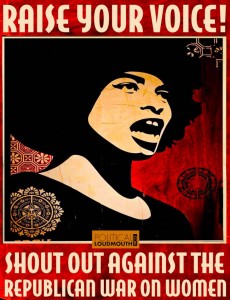
Rick Perry’s long reign as governor of Texas is ending, with the announcement that he’s not running for reelection in 2014. Among other things, he’ll be remembered as one of the most vocally anti-gay governors and political figures in American history. In 2003, Perry lambasted the U.S. Supreme Court for striking down the Texas sodomy ban, and all sodomy bans in the states, calling the court “nine oligarchs in robes.” In 2005, Perry championed a draconian constitutional ban on gay marriage and civil unions in Texas, and signed it into law in a ceremony held in a church. During his 2012 presidential run he cruelly told a 14-year-old bisexual girl on the campaign trail that gays shouldn’t serve in the military because “homosexuality is a sin,” and he demeaned gay service members in a political attack ad that was the most parodied ad of the election season.
So if Perry is stepping down to focus solely on a presidential run in 2016, as some observers contend, what will that mean for GOP political gay-bashing in the 2016 presidential race? Judging from Perry’s most recent rants, 2016 will be 2012 redux, no matter what anyautopsy of the 2012 election by the Republican National Committee or GOP strategists might reveal about how to proceed. Since last fall Perry has only ratcheted up the attacks on gays, much as he has done on abortion. Polls show a majority of Americans, and particularly young Americans (and that includes young GOP Americans), support LGBT rights and even marriage equality. But Christian right groups still influential in the party have been threatening to bolt the GOP unless candidates toe the line. Contrary to strategists who suggest that the GOP will be forced to be more supportive on issues of concern to Latinos, women, gays and other groups, there are thinkers in the GOP who simply want to believe the GOP can win by ignoring all those groups and just getting more straight white male voters to the polls.
Think the whole birther thing is dead? Not in Republican land. Did you catch this on Rachel Maddow last night? This is your Republican Grass Roots in action!! Birthers! Successionists! Racists!! Christofascists! All part and parcel of what is going on in legislatures and congress in this country!
So, is the Republican Party just doubling down or tripling down on white–mostly male and straight–voters? Here’s some interesting analysis of voter and voter trends.
In the aftermath of Barack Obama’s relatively comfortable reelection victory in 2012 — a win fueled by massive margins among African Americans, Hispanics and other nonwhite voters — an intense debate has begun among Republican leaders and strategists over the future direction of the party. The GOP has now lost the national popular vote in five of the last six presidential elections. Yet according to national exit polls, Republican candidates won the white vote by double-digit margins in the last four of these elections, including a 20-point margin in 2012.
Given these results, some prominent Republican strategists, including Karl Rove, believe that the key to the party’s future viability in presidential elections is finding ways to increase its share of the growing nonwhite vote. Since 1992, according to national exit polls, the nonwhite share of the electorate has increased from 13% to 28%, and this trend is almost certain to continue for many years to come. Based on census data, the voters who will be entering the electorate over the next few decades will include a much larger proportion of nonwhites, and especially Latinos, than the voters who will be leaving the electorate.
But not all GOP strategists agree with the approach advocated by Rove and his allies or with the necessity of increasing the party’s share of the nonwhite vote in order to achieve success in future presidential elections. In a recent series of posts at RealClearPolitics.com, analyst Sean Trende has argued that Republicans can effectively compete in future presidential elections without substantially increasing their support among Hispanics and other nonwhite voters by focusing on increasing turnout and support among white voters, who will continue to make up the large majority of the American electorate.
Trende’s argument that the GOP can achieve success by, essentially, doubling down on white voters rests largely on an analysis of racial voting patterns in presidential elections over the past several decades. According to Trende, Republicans have significantly increased their performance among white voters over time. If this trend continues, he argues, given a reasonably favorable political and economic environment, Republican candidates should have a good chance of overcoming the Democratic advantage among nonwhite voters in future presidential elections.
The problem with the PVI
Trende’s claim that Republicans have increased their performance among white voters is based on his calculation of a statistic known as the PVI, or Partisan Voting Index, for white voters. Essentially, this statistic is used to compare the political preferences of a given group to the electorate as a whole. The PVI for white voters compares the Democratic share of the white vote with the Democratic share of the vote in the overall electorate. For our purposes, however, we have calculated the PVI based on the Democratic vote margin among white voters compared with the Democratic vote margin in the overall electorate in order to reduce the impact of votes for third party and independent candidates.
Over time, as the data in Figure 1 show, the PVI for white voters has become increasingly negative, with an especially dramatic decline since 1992. There is no question that in comparison with the overall electorate, white voters have become more Republican over time. But the interpretation of this result is not as straightforward as Trende suggests. That is because the PVI for white voters reflects both the Democratic margin among white voters and the size of the nonwhite electorate.
In fact, the main reason that the gap between the Democratic margin in the overall electorate and the Democratic margin among white voters has increased over time is not because whites have become more Republican but because nonwhites, who are overwhelmingly Democratic, now make up a larger share of the overall electorate. As just one example, the PVI of the white vote in 2012 (-24) was far more negative than it was in 1988 (-13). Yet Democratic margins among both whites and nonwhites were essentially the same in each election. The real change: Nonwhites were just 15% of voters in 1988 compared to 28% in 2012. In other words, the rapid growth of the very Democratic nonwhite share of the electorate makes it seem like white voters are becoming more Republican than they actually are.
It’s been really difficult for me recently to continue to turn on the TV and see assault after assault on women, the GLBT, minorities, immigrants, religious minorities, and the poor. How do we make it stop?
What’s on your reading and blogging list today?
Women Rightfully Take to The Street
Posted: July 10, 2013 Filed under: just because | Tags: religious right republican war on women, Women's Rights 10 Comments It’s become painfully obvious that women still lack a voice in legislatures around the country and in governor’s mansions as state after state find sneaky, undemocratic, underhanded ways to undercut our civil liberties, our constitutional rights and our autonomy in red state after red state. The christofascist wing of the Republican Party has snuck drastic anti-women’s health laws in many states. I passed a billboard today on a local Catholic church reading “More Planned Parenthood means more abortion”. I wanted to stop and spray paint “More Catholic Churches mean more Child Rape” because it makes as much sense. Women are taking to the street and need to do so in greater numbers.
North Carolina House Republicans are pushing legislation that would restrict abortion access, attaching the measure to an unrelated motorcycle safety bill on Wednesday and giving neither the public nor Democratic legislators any advance notice.
On Wednesday morning, state Rep. Joe Sam Queen (D) wrote on Twitter, “New abortion bill being heard in the committee I am on. The public didn’t know. I didn’t even know.”
“I wish I had more time to look at this new bill before I had to ask questions about it or debate it,” he added.
The bill then passed the state House Judiciary Committee in a 10-5 party-line vote.
The stealth maneuver came after North Carolina Gov. Pat McCrory (R) threatened to veto a similar Senate bill on Wednesday morning. The Senate legislation would require abortion providers to meet strict licensing standards and would mandate that a doctor is present for the entire procedure.
The state’s top health official has called for lawmakers to slow down on the abortion legislation, and in his 2012 campaign, McCrory pledged not to sign any legislation that would further restrict abortion access.
House Republicans tweaked the Senate legislation: A doctor would have to be present when the first drug in an abortion procedure is administered — rather than for the entire procedure — and clinics would not have to meet the same standards as ambulatory surgical centers.
The NYT editorial board announced that North Caroline was in a state of decline.
Every Monday since April, thousands of North Carolina residents have gathered at the State Capitol to protest the grotesque damage that a new Republican majority has been doing to a tradition of caring for the least fortunate. Nearly 700 people have been arrested in the “Moral Monday” demonstrations, as they are known. But the bad news keeps on coming from the Legislature, and pretty soon a single day of the week may not be enough to contain the outrage.
In January, after the election of Pat McCrory as governor, Republicans took control of both the executive and legislative branches for the first time since Reconstruction. Since then, state government has become a demolition derby, tearing down years of progress in public education, tax policy, racial equality in the courtroom and access to the ballot.
The cruelest decision by lawmakers went into effect last week: ending federal unemployment benefits for 70,000 residents. Another 100,000 will lose their checks in a few months. Those still receiving benefits will find that they have been cut by a third, to a maximum of $350 weekly from $535, and the length of time they can receive benefits has been slashed from 26 weeks to as few as 12 weeks.
The state has the fifth-highest unemployment rate in the country, and many Republicans insulted workers by blaming their joblessness on generous benefits. In fact, though, North Carolina is the only state that has lost long-term federal benefits, because it did not want to pay back $2.5 billion it owed to Washington for the program. The State Chamber of Commerce argued that cutting weekly benefits would be better than forcing businesses to pay more in taxes to pay off the debt, and lawmakers blindly went along, dropping out of the federal program.
At the same time, the state is also making it harder for future generations of workers to get jobs, cutting back sharply on spending for public schools. Though North Carolina has been growing rapidly, it is spending less on schools now than it did in 2007, ranking 46th in the nation in per-capita education dollars. Teacher pay is falling, 10,000 prekindergarten slots are scheduled to be removed, and even services to disabled children are being chopped.
“We are losing ground,” Superintendent June Atkinson said recently, warning of a teacher exodus after lawmakers proposed ending extra pay for teachers with master’s degrees, cutting teacher assistants and removing limits on class sizes.
Republicans repealed the Racial Justice Act, a 2009 law that was the first in the country to give death-row inmates a chance to prove they were victims of discrimination. They have refused to expand Medicaid and want to cut income taxes for the rich while raising sales taxes on everyone else. The Senate passed a bill that would close most of the state’s abortion clinics.
And, naturally, the Legislature is rushing to impose voter ID requirements and cut back on early voting and Sunday voting, which have been popular among Democratic voters. One particularly transparent move would end a tax deduction for dependents if students vote at college instead of their hometowns, a blatant effort to reduce Democratic voting strength in college towns like Chapel Hill and Durham.
The Texas House of Representatives approved sweeping abortion restrictions on Tuesday, including a ban after 20 weeks of pregnancy and tougher standards for clinics that perform the procedure.
The vote of 98-49 came after a full day of sometimes emotional debate. Before the measure can head to the state Senate, it needs a final vote from the House, which is expected on Wednesday.
The House approved the same proposal during a previous special session of the legislature, but it failed to pass in the Senate after Democratic Senator Wendy Davis staged an 11-hour filibuster that gained national attention.
Here’ in Louisiana, we are trying to stop devastating cuts to Domestic Violence programs and programs to help families with handicapped children. We are asking for a special override session to restore the funding and override a line item veto by the governor that would reestablish funds to these programs.
Domestic violence service providers across Louisiana are facing their second budget crisis in 2 months. The Louisiana Department of Child and Family Services unveiled its proposed budget Thursday. The plan includes a cut of $1.4 million dollars to domestic violence services; this is in addition to the $1 million the Jindal administration cut in the December, mid-year budget adjustments.
Programs will be losing $2.4 million of the $6.2 million the state was spending on domestic violence services. This means emergency shelters across the state will have lost more than 38% of their funding from DCFS in just over six months. This makes a significant impact in a state that consistently leads the nation in domestic homicides.
Executive Director of the Louisiana Coalition Against Domestic Violence, Beth Meeks, warned during the last round of cuts that ‘the situation was precarious and further cuts would destabilize the system’. She calls the current situation dire, “In the last round of cuts programs laid off about 10% of their staff and many used up any rainy day reserves they had set aside. At this level of cuts programs will be forced to reduce and eliminate services in some areas, if they can survive at all.”
According to statistics collected by DCFS, Louisiana domestic violence shelters provided almost 91,000 nights of emergency shelter in the last year and took more than 38,000 crisis calls. There are 18 programs in Louisiana funded by DCFS to provide around the clock emergency domestic violence services. The programs documented more than 1800 unmet needs during that time period due to low staff and full shelter beds.
These states are cutting protections to women’s health and safety and children’s health and safety while transferring lots of resources to create a plague of regulations for abortion providers. This is completely unacceptable. Women need to be taking to the streets now!

 peej
peej Carissa
 bostonboomer
 dakinikat
 ecocatwoman
 jjlo
jjlo mablue2
 Mama Lopez
 peggysue22
 quixote
 skydancingguestblogger
 Mona (aka Wonk the Vote)





Recent Comments