
Friday Reads: Racism Still
Posted: August 10, 2018 Filed under: Afternoon Reads, PUMA 18 Comments
William Kay, active 1795, Seamstresses, St. Kitts, Caribbean, 1798, Watercolor over graphite on moderately thick, slightly textured, cream wove paper
Good Afternoon Sky Dancers!
I have been fully overwhelmed and outraged by how the 2018 campaign season has devolved to overt, ugly, full frontal racism. No more subtle dog whistles and murmured references to culture these days; just naked, hateful racism on fully display. Can we stop talking about economic anxiety or white anxiety or fragility or some fancy schmanzy word that tries to cover the truth that our country has an issue with pervasive, systemic racism? It is time for the media and for all white Americans who see this for what it is to call it out for what it is.
It’s been one year since Charlottesville and four years since Ferguson. The Struggle continues.
Adam Sewer–writing for The Atlantic–believes that ‘The White Nationalists Are Winning.’
A year after white nationalists in Charlottesville chanted, “You will not replace us!” their message has been taken up and amplified by Fox News personalities. Tucker Carlson tells his audience that “Latin American countries are changing election outcomes here by forcing demographic change on this “country.” Laura Ingraham says that “the America that we know and love doesn’t exist anymore” because of “massive demographic changes” as a result of “both illegal and sometimes legal immigration that progressives love.” They echo the white-nationalist claim that America is at risk because the nation is growing more diverse, an argument that treats the mere presence of nonwhite people, citizen or noncitizen, as an existential threat to the country. White nationalists like Cantwell are cheered to hear their beliefs championed on Fox. Cantwell wrote last year that Carlson “is basically telling white America to prepare for war as directly as he can get away with while remaining on Fox News.”
American history is replete with tragedies that are epic in scale, but few are comparable to what has happened to the party of Lincoln, who struck perhaps the most decisive victory against the principle that America is a white man’s country with the proposal and ratification of the Fourteenth Amendment. There is no reason that this new generation of immigrants cannot become loyal Republican voters, much as a previous generation of despised foreign newcomers did. The obstacle is the conservative movement’s growing embrace of a definition of American citizenship that is inherently racial. Where prior conservative champions like George W. Bush or Ronald Reagan might have seen a new generation of Republicans, today many conservatives see only an invasion.
While few sitting Republican legislators echo these sentiments publicly, Republican audiences are now being fed white-nationalist philosophy through mainstream conservative figures with national followings. Unless something changes, conservative constituencies will eventually begin to demand that their representatives adopt those views as well.
White nationalists win by activating white panic, by frightening a sufficient number of white people into believing that their safety and livelihoods can only be protected by defining American citizenship in racial terms, and by convincing them that American politics is a zero-sum game in which white people only win when people of color lose. While this dynamic has always been present in American politics, it has been decades since the White House has been occupied by a president who so visibly delights in exploiting it, aided by a right-wing media infrastructure that has come to see it as a ratings strategy. It is not just the white nationalists who win when racialized fears surrounding crime, immigration, and terrorism shape the political behavior of white voters. Donald Trump also wins. And both the Trump White House and the men who rallied in Charlottesville for the cause of white power know it.

It wasn’t so much a dog whistle as it was an airhorn. Or perhaps a primal scream. But whatever it was, Laura Ingraham’s forceful denunciation of “massive demographic changes” served as another raw example of a Fox News host echoing white nationalist language.
Perhaps it was a glimpse into President Donald Trump’s well of support, too.
The Fox News audience is almost 100% white, according to Nielsen. And on the channel’s highest-rated shows, the politics of white anxiety play out practically every day, as hosts and guests warn about the impacts of immigration and minimize or mock the perspectives of people of color. The talk show segments are clearly intended to appeal to people who perceive they are losing their grip on power.
In 2018, Tucker Carlson, at 8 p.m., and Ingraham, at 10 p.m., spend the most time on this subject. (The host in between, Sean Hannity, concentrates more on defending Trump.)
“The America we know and love doesn’t exist anymore,” Ingraham said Wednesday night. “Massive demographic changes have been foisted on the American people, and they are changes that none of us ever voted for, and most of us don’t like.”
Ingraham said “this is related to both illegal and legal immigration.”
The commentary was amplified on social media by the liberal, anti-Fox watchdog group Media Matters. Many people who viewed it on social media were shocked, as her rhetoric went beyond what other conservative commentators have said in the past.
Nearly 24 hours later, Ingraham’s name was still a top trending topic on Twitter. Media Matters made a video asserting that Ingraham’s “anti-immigrant rant” was “ripped from white supremacists.” Some Democratic lawmakers also spoke out. Senator Tammy Duckworth tweeted that the “racist” comments “shouldn’t have been aired by @FoxNews.”
Fox News declined to comment.

1796 Thomas Rowlandson. Rachel Pringle of Barbados.
Of course they did. NFL Players resumed their #BlackLivesMatter protests and KKKremlin Caligula demanded they be suspended without pay on twitter. Of course he did.
Several NFL players knelt, raised fists or simply refused to take the field during the playing of the national anthem as a controversial protest against police brutality dragged into the 2018 preseason.
As The Associated Press reports, in Philadelphia, Eagles safety Malcolm Jenkins, who suspended his protest last December, and cornerback De’Vante Bausby, raised their fists while defensive end Chris Long stood with his arm around Jenkins’ shoulder.
Defensive end Michael Bennett walked out of the tunnel during the anthem and walked toward the bench while it played.
Sports Illustrated reports that the Jaguars’ Jalen Ramsey, Telvin Smith, Leonard Fournette and T.J. Yeldon did not join their teammates skipping the pregame performance of the anthem.
In Seattle, three Seahawks also declined to take the field.
Meanwhile, the Dolphins’ Kenny Stills and Albert Wilson knelt, while defensive end Robert Quinn raised his fist.

1844 Adoph Rinck. Possibly a portrait of Marie Laveaux.
Twitler on vacation keeps tweeting the ugly.
President Trump, who has been vocal in his opposition to using the anthem as a stage for protest, responded on Friday morning with a pair of tweets blasting Jenkins, Stills and others who didn’t stand at attention.
Meanwhile, ‘Omarosa says Trump is a racist who uses N-word – and claims there’s tape to prove it.’
Donald Trump is a “racist” who has used the “N-word” repeatedly, Omarosa Manigault Newman, once the most prominent African American in the White House, claims in a searing memoir.
The future US president was caught on mic uttering the taboo racial slur “multiple times” during the making of his reality TV show The Apprentice and there is a tape to prove it, according to Manigault Newman, citing three unnamed sources.
Trump has been haunted from around the time of his election in 2016 by allegations that outtakes from the reality TV show exist in which he is heard saying the N-word and using other offensive language.
In her book, Unhinged, a copy of which was obtained by the Guardian ahead of its publication next week, the former Apprentice participantinsists that the reports are true, although she does not say she heard him use the word herself.
She also claims that she personally witnessed Trump use racial epithets about the White House counselor Kellyanne Conway’s husband George Conway, who is half Filipino. “Would you look at this George Conway article?” she quotes the president as saying. “F**ing FLIP! Disloyal! Fucking Goo-goo.”
Both flip and goo-goo are terms of racial abuse for Filipinos.
Critics have previously questioned Manigault Newman’s credibility and are likely to accuse her of seeking revenge against the administration after her abrupt dismissal last December.
At the time, she writes, she felt a “growing realization that Donald Trump was indeed a racist, a bigot and a misogynist. My certainty about the N-word tape and his frequent uses of that word were the top of a high mountain of truly appalling things I’d experienced with him, during the last two years in particular.”

Women in Santo Domingo wearing Tignons.
I believe these accounts even though the source is spurious.
Jonathan Capehart writes ‘Yes, Donald Trump, you are a ‘racist’’
Lemon interviewed Trump on May 1, 2011, and challenged Trump on his views on race and the promotion of the racist birther against then-President Barack Obama. The on-air conversation was fine. Lemon recalled after that interview, an irked Trump “vowed he’d never come back and do an interview with me because I was racist.”
When I read the item about all this in The Post’s Reliable Source on Thursday, I had a sense of deja vu. Trump announced his candidacy on June 16, 2015. The same day he said Mexico was sending “rapists” over the U.S. southern border. By July 6, I’d seen and heard enough and wrote a post decrying Trump’s retweet (and then deletion) of an offensive dig directed at former Florida governor Jeb Bush:
That he retweeted such an offensive comment speaks ill of his judgment. That he would get so personal with a rival speaks ill of his temperament. That he felt comfortable endorsing such a hateful remark speaks ill of the GOP, which has turned a blind eye to this low-boil hate for so long that it has lost all ability to squelch it.
Well, that didn’t go over well with the Queens-born builder. As was his wont, Trump had my piece printed out, then he scribbled out a quick missive atop it and had a PDF sent to me.
Jonathan – You are the racist, not I. Get rid of your “hate.” Best wishes …
Trump’s response was laughable then. Three years later — more than 18 months into his presidency — such a remark remains stunning. There have been so many instances of Trump’s racism that I don’t have time to look for them all. But his wretched response to the white-nationalist mayhem unleashed on Charlottesville a year ago this Sunday remains the most egregious.
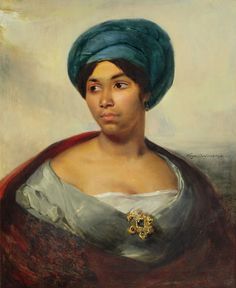
Portrait of a Woman in a Blue Turban by Eugene Delacroix, c. 1827
This seems to be a pattern now. No, you’re the puppet! No, you’re the racist! I know you are but what am I? I have yet to figure out why I get called out for being racist against white people by standing up for the Black Lives Matter movement and supporting black women for office. Is that even a thing?
This CNN interview with Spike Lee over his new movie discusses how the Oval Office is giving racists “a bullhorn.”
Spike Lee believes that racists in America have been given the “green light” from the White House.
“Since [President Trump] has gotten into the White House it is not even a dog whistle, it’s a bullhorn,” Lee said. “We’ve seen a rise to the right. It’s not just America, it’s worldwide.”
The two-time Academy Award nominee spoke to CNN’s Anderson Cooper Thursday about his new film, “BlacKkKlansman,” which tells the true story of Ron Stallworth, the first African-American detective in the Colorado Springs police force in the 1970s. It chronicles how Stallworth, played by John David Washington, manages to infiltrate the Ku Klux Klan.
“BlacKkKlansman,” is set to release Friday, one day before the one-year anniversary of a white nationalist rally in Charlottesville, Virginia, that left counter-protester Heather Heyer dead.
Lee told Cooper that the release date for his latest film was intentional.
“The President of the United States had a chance to denounce hate,” the director said. “The whole world saw what happened and he didn’t do it.”
Lee is no stranger to films about race in America, gaining notary with films like “Do The Right Thing” and “4 Little Girls.”
Cooper went on to ask the director if he would sit down with President Trump to which Lee curtly answered “No.”
Lee added that he refuses to call Trump by his name, instead referring to him as “Agent Orange.”
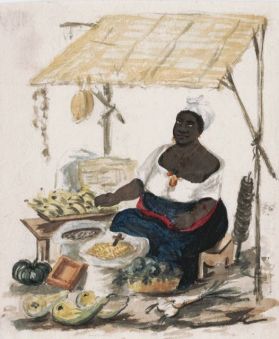 I’m going to end with this essay in Salon by Chauncey DeVega: ‘Beyond Lebron James and Don Lemon: What James Baldwin can teach us about Donald Trump’s racism’ Is the GOP our country’s biggest white identity group?
Donald Trump loves “his” African-Americans.
As black conservatives their primary purpose is to serve as professional “best black friends” for white racists. This is very lucrative work. Being a black conservative is a right-wing American version of the soft bigotry of low expectations.
With Donald Trump they are very busy in their role as human deflector shields: Trump claims to be “the least racist person” but also believes that neo Nazis and white supremacists can be “very fine people,” puts nonwhite immigrants — including babies — in concentration camps, and with other Republicans is doing everything possible to take away voting and other civil rights from black and brown Americans. Quite logically, white supremacists such as Ku Klux Klan leader David Duke claim Donald Trump as a hero.
But woe be unto those black people who do not bow before Donald Trump in deference and obedience. For Trump, black people who are deemed to be “uppity” and “disrespectful” are “low I.Q.” “sons of bitches” who are traitors that should be exiled from America perhaps back to “shithole” countries in Africa. And Trump possesses special rage towards black women who dare to defy him such as Representative Maxine Waters and sports journalist Jemele Hill.
Racism and sexism are intoxicants for Donald Trump; he cannot resist them. For example, Michael Harriot, who is a contributing writer at The Root, recently conducted an analysis of Trump’s tweets which showed that 93.4 percent of his comments on Twitter about African-Americans are negative.

Alexandre Alaux (French/New Orleans, 1851‑1932), “Portrait of Free Woman of Color Wearing a Tignon
But let’s jump to the voice of Baldwin:
It is perfectly timed that last week was James Baldwin’s birthday and his words are so fitting for how they describe the insecurity, and yes jealousy, that afflicts Donald Trump and so many of his white racially resentful, if not outright, racist supporters.
In the “Fire Next Time”, Baldwin observed:
The white man’s unadmitted—and apparently, to him, unspeakable—private fears and longings are projected onto the Negro. The only way he can be released from the Negro’s tyrannical power over him is to consent, in effect, to become black himself, to become part of that suffering and dancing country that he now watches wistfully from the heights of his lonely power.
These fears and longings also drive Donald Trump’s deep insecurities and his fixation on Barack Obama, the latter being a man whose shadow of excellence and achievement Trump will never be able to escape or equal. This obsession is further revealed by Donald Trump’s behavior on Twitter, where he has made at least three times as many comments about Barack Obama than his own family.
I fret over all of this like I do many things these days and feel powerless to do much other than speak up and write and share on social media. I do know that none of this will be put right until our Congress gets more black voices. My Congressman is head of the black caucus. My Senators are a huge part of the problem. Just work wherever you are to get Congress right in 2018.
What’s on your reading and blogging list today?
Monday Reads
Posted: August 6, 2018 Filed under: Donald Trump, Economy, Iran, Middle East, morning reads | Tags: QAnon 13 Comments Monday Strikes Again!
So, BB and I could not figure out anything that made sense about the “Q Anon” stuff that was a press hot item last week. Do you remember back in the day before the internet was overtaken by commercial interests and most of its denizens were academic nerdy types like me? Well, folks started inventing real life versions of fanfic games including maps, and secrets, and treasures that may have followed a reality set up by a game console game. Most of it was just really bad fanfic too. The entire QAnon thing just read like really, really bad fanfic to me. and that is what it now appears to be. Its motivation was to evidently drive boomers nuts and it’s evidently a leftie bro thing. The nonsensical conspiracy site was called “Bread Crumbs.”
According to Q, nearly every president before Trump was a “criminal president” who was part of an evil global organization of Satanist pedophiles. It also claims members of the US military who are not working for the global pedophile cabal supposedly approached Trump and begged him to run for president so that they could purge the government of the deep state operatives without a military coup.
Q claims Trump is not under investigation by special counsel Robert Mueller, but that Hillary Clinton and Barack Obama are. And Trump is actually working with Mueller.
Q regularly drops clues that followers call “crumbs,” which are meant to predict things. For instance, he claimed John Podesta would be arrested or indicted Nov. 3, 2017 — which, of course, didn’t happen
See, bad fanfic. But the bottom line, with tons of documentation at the Buzzfeed piece citied here is that it was a hoax which finally makes sense to me. Imagine bored dateless BernieBros in a basement some where ….
“Let us take for granted, for a while, that QAnon started as a prank in order to trigger right-wing weirdos and have a laugh at them. There’s no doubt it has long become something very different. At a certain level it still sounds like a prank. But who’s pulling it on whom?” they said.
They also point to the fact that even this article runs the risk of being sucked into the QAnon vortex and just adding more fuel to the fire. “If [QAnon’s] perpetrators claimed responsibility for it and showed some evidence (for example, unmistakeable references to our book and the Luther Blissett Project), would the explanation itself become yet another part of the narrative, or would it generate a new narrative encompassing and defusing the previous one?”
So, now that’s cleared up the press can leave it alone. There are real things out there. That sucking sound you hear are wages and wealth going to the richest of the rich.
On May 8th, Brookings officially launched a new initiative on the Future of the Middle Class. Through this initiative, we will publish research, analysis, and insights that are motivated by a desire to improve the quality of life for those in America’s middle class and to improve upward mobility into its ranks. We have already wrestled with how we define this group, considered its changing racial composition, and called upon experts to outline major policies geared toward improving its fate. But why all of this attention? Here are seven of the reasons we are worried about the American middle class.
Today, I feel the “dismal” in the dismal science meme. Retirement prospects for many Boomers includes Bankruptcy.
For a rapidly growing share of older Americans, traditional ideas about life in retirement are being upended by a dismal reality: bankruptcy.
The signs of potential trouble — vanishing pensions, soaring medical expenses, inadequate savings — have been building for years. Now, new research sheds light on the scope of the problem: The rate of people 65 and older filing for bankruptcy is three times what it was in 1991, the study found, and the same group accounts for a far greater share of all filers.
Driving the surge, the study suggests, is a three-decade shift of financial risk from government and employers to individuals, who are bearing an ever-greater responsibility for their own financial well-being as the social safety net shrinks.
The transfer has come in the form of, among other things, longer waits for full Social Security benefits, the replacement of employer-provided pensions with 401(k) savings plans and more out-of-pocket spending on health care. Declining incomes, whether in retirement or leading up to it, compound the challenge.
 Well, that’s no surprise. It’s also no surprise that Trump is behaving badly on the World Stage again. “Trump signs order reimposing sanctions on Iran – a move the EU said it ‘deeply’ regrets.” Well, we knew Bolten had to be getting something to help with all that Putin Ass Kissing.
Donald Trump has signed an executive order reimposing sanctions on Iran – a move the EU said it “deeply” regretted.
Three months after he revealed he was pulling the US out of the seven-party Iran nuclear deal, Mr Trump announced the reimposition of wide range of sanctions against the Middle Eastern nation. Three months after he revealed he was pulling the US out of the seven-party Iran nuclear deal, Mr Trump announced the reimposition of a wide range of of sanctions against the Middle Eastern nation. A second set will be reimposed in a further three months.
“[The Iran nuclear deal] a horrible, one-sided deal, failed to achieve the fundamental objective of blocking all paths to an Iranian nuclear bomb, and it threw a lifeline of cash to a murderous dictatorship that has continued to spread bloodshed, violence, and chaos,” Mr Trump said in a statement.
“Since the deal was reached, Iran’s aggression has only increased. The regime has used the windfall of newly accessible funds it received under the JCPOA to build nuclear-capable missiles, fund terrorism, and fuel conflict across the Middle East and beyond.”
In the aftermath of Mr Trump’s unilateral decision in May, the other parties to the 2015 deal – Russia, China, Germany, France, the UK and the EU – vowed to stick with the deal and to and continue to trade with Iran. Several companies, such as French-based Airbus, felt obliged to pull out of a deal with Iran, rather than risk sanctions from Washington.
The revoking of licensees to the company and its rival, Boeing, saw the aircraft manufacturer lose out on a $39bn deal with Tehran for new planes. Easing sanctions such as this was a major inducement get Tehran to sign the Joint Comprehensive Plan of Action (JCPOA) in 2015 under President Barack Obama.
The executive order signed on Monday, which will come into effect at midnight EST, releases to the purchase or acquisition of US currency Iran, the trade in gold and other precious metals, materials such as graphite, aluminium, steel, coal, and software used in industrial processes. They also target the country’ automotive sector.
The remaining sanctions to be reimposed on November 5 relate to Iran’s port operators and energy, shipping, and shipbuilding sectors. Crucially, they will also target its oil industry and foreign financial institutions with the Central Bank of Iran.
It’s like he’s single handedly destroying our economic, world order, and the environment. This news is awful but typical Trump policy.
Two of America’s biggest steel manufacturers — both with deep ties to administration officials — have successfully objected to hundreds of requests by American companies that buy foreign steel to exempt themselves from President Trump’s stiff metal tariffs. They have argued that the imported products are readily available from American steel manufacturers.
Charlotte-based Nucor, which financed a documentary filmmade by a top trade adviser to Mr. Trump, and Pittsburgh-based United States Steel, which has previously employed several top administration officials, have objected to 1,600 exemption requests filed with the Commerce Department over the past several months.
To date, their efforts have never failed, resulting in denials for companies that are based in the United States but rely on imported pipes, screws, wire and other foreign steel products for their supply chains.
The ability of a single industry to exert so much influence over the exclusions process is striking even in Mr. Trump’s business-friendly White House, given the high stakes for thousands of American companies that depend on foreign metals. But the boundaries of trade policy are being tested by the scope of Mr. Trump’s multifront trade war with allies and adversaries alike, which includes tariffs on up to $200 billion worth of goods from China and possible tariffs on automobiles and auto parts.
And the psychic trauma will only increase:
But after watching Trump for all this time, there’s no reason to beat around the bush on this question anymore. Donald Trump is a racist, and we all know it. He could barely have tried any harder to convince us. Not only did he turn himself into a political figure by making himself America’s most prominent birther, he repeatedly demanded to see Barack Obama’s high school and college transcripts, on the theory that Obama couldn’t possibly have been smart enough to get into Columbia and Harvard Law School on his own merit. He ran a white nationalist campaign for president, and said that the judge in his Trump University fraud cause couldn’t be fair because “He’s a Mexican” (in fact, the judge is an American). On multiple occasions he retweeted racist memes from white supremacists. In a White House meeting about immigration, he said that Haitian immigrants “all have AIDS” and complained that once Nigerian immigrants had seen the United States they would never “go back to their huts” (Nigerian immigrants are one of the most highly educated groups in America). He meets a group of Native American war heroes, and decides to bring up the fact that he insults Elizabeth Warren by calling her “Pocahontas.” And of course, he called non-white nations “shithole countries” and averred that a group of neo-Confederates and neo-Nazis were “very fine people.”
So we know who Donald Trump is, and why he says what he does. The fact that much of what Trump says about African Americans is performative—a public show meant to keep his base angry—doesn’t mean that the bigotry isn’t sincerely felt.
This is a good reminder that Trump’s 2020 campaign will be no less built on hate than his 2016 campaign was. In fact, it could be even more so. Trump will no longer be able to plausibly argue that there’s a system controlled by an elite that’s keeping regular people down, since he and his party are the ones with all the power. So it’s likely that he’ll rely even more heavily on white nationalism to get re-elected.
The weirdest thing happened Sunday in a Twitler Special that basically was a confession to collusion and to a cover up.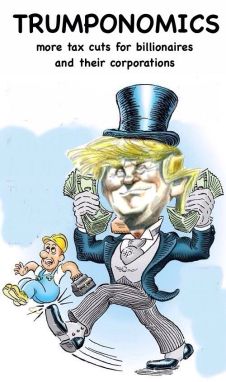
Donald Trump has admitted for the first time that his son met a Kremlin-connected lawyer in 2016 to collect information about Hillary Clinton, but insists the meeting was legal.
In one of a series of Sunday morning tweets issued in apparent reaction to a CNN report, the US president wrote: “Fake News reporting, a complete fabrication, that I am concerned about the meeting my wonderful son, Donald, had in Trump Tower. This was a meeting to get information on an opponent, totally legal and done all the time in politics – and it went nowhere. I did not know about it!”
That explanation differs entirely from one given by Trump 13 months ago, when a statement dictated by the president but released under the name of Donald Trump Jr read: “We primarily discussed a program about the adoption of Russian children that was active and popular with American families years ago.”
The 2016 meeting is pivotal to the special counsel Robert Mueller’s Russia collusion investigation, though Trump’s tweets appeared aimed at conveying the message that he is not worried about Donald Trump Jr’s exposure to the inquiry.
He made the remarks as one of his lawyers warned the special counsel against trying to force the president to be interviewed.
 The dude seriously keeps admitting to crimes. Why can’t we lock hIm up? “President Trump changes story in Twitter rant admitting Trump Tower meeting was to gather intel on Hillary Clinton.”
The President’s latest social media meltdown was in reaction to what he called a “complete fabrication” in Sunday’s Washington Post claiming Trump was concerned “innocent and decent people,” including his son Donald Trump Jr., could be hurt by Mueller’s probe exploring links between Trump’s campaign and Russia.
“This was a meeting to get information on an opponent, totally legal and done all the time in politics — and it went nowhere,” he wrote. “I did not know about it!”
Thirteen months ago, Trump gave a different explanation for the meeting between his eldest son and parties alleging ties to the Russian government. A July 2017 statement credited to Don Jr. and later discovered to have been dictated by the President read: “We primarily discussed a program about the adoption of Russian children that was active and popular with American families years ago.”
Though the President maintains he knew nothing about the Trump Tower meeting prior to its taking place, his former fixer Michael Cohen, who has reportedly indicated a willingness to cooperate with Mueller’s team, has allegedly said otherwise.
Trump lawyer Jay Sekulow said on ABC’s “This Week” on Sunday that he had “bad information” when he personally argued that the meeting was about adoption.
So, this is just an open news dump thread! What’s on your reading and blogging list today?
Friday Reads: Tales from a Tsundoku
Posted: August 3, 2018 Filed under: Afternoon Reads | Tags: Trump attacks on the Media 26 Comments
Good Morning Sky Dancers!
I don’t know how I’m going to fare if we have to endure more televised rallies all the way to election day on TV. I truly believe that the media should issue trigger warnings before clips are shown and that none should be shown live. There have been suggestions that the major news outlets join in supporting an AP pool reporter and only broadcast material that’s ‘newsworthy’. Since each of these events are basically a roll out his most bigoted and autocratic inner voices, he rarely makes news or discusses actual policy. Why make journalists props to propaganda?
UN experts condemn Trump’s attacks on the media which are central to whipping up the crowd and central to authoritarian drumbeats.
President Donald Trump’s media attacks raise the risk of violence against journalists, UN experts have warned.
In a statement, David Kaye and Edison Lanza of the Inter-American Commission on Human Rights called the attacks “strategic” and said they undermined press freedom and “verifiable facts”.
The comments follow hours after Mr Trump’s daughter Ivanka distanced herself from her father’s attacks.
Mr Trump has repeatedly criticised the media before and during his presidency.
He has declared journalists to be “enemies of the people”, drawing condemnation from across the political spectrum.
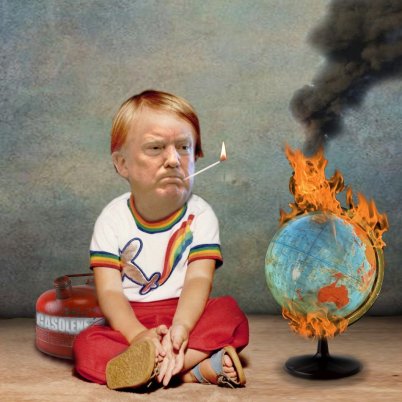 CNN’s Jim Acosta asked the Huckabeast if she personally believed that the media was the enemy of the people. The question was repeated several times and was dodged an equal number.
That set the stage for Thursday, when Mr. Acosta, breaking from the usual sober style of White House reporters, framed his question to Ms. Sanders as a moral choice.
“It would be a good thing if you were to state right here, at this briefing, that the press — the people who are gathered in this room right now, doing their jobs every day, asking questions of officials like the ones you brought forward earlier — are not the enemy of the people,” Mr. Acosta said in his newscaster’s baritone. “I think we deserve that.”
Ms. Sanders deflected — and then mirrored Mr. Acosta’s tone.
“It’s ironic, Jim,” she said, “that not only you and the media attack the president for his rhetoric, when they frequently lower the level of conversation in this country.”
Ms. Sanders, without much evidence, went on to accuse the news media of using “personal attacks without any content other than to incite anger.” She also cited her experience at this year’s White House Correspondents Association dinner, during which the comedian Michelle Wolf mocked Ms. Sanders’s “smokey eye” makeup and compared her to “an Uncle Tom” for “white women.”
“You brought up a comedian to attack my appearance and call me a traitor to my own gender,” Ms. Sanders said. “As far as I know, I’m the first press secretary in the history of the United States that’s required Secret Service protection.”
Her answer did not directly address the question, so Mr. Acosta tried again, with more oomph.
“This democracy, this country, all the people around the world watching what you are saying, Sarah, and the White House for the United States of America — the president of the United States should not refer to us as ‘the enemy of the people,’” he said. “His own daughter acknowledges that, and all I’m asking you to do, Sarah, is to acknowledge that right now and right here.”
Ms. Sanders replied: “I appreciate your passion. I share it. I’ve addressed this question.”
At that, Mr. Acosta promptly walked out.
 He repeated his performance in a corner of Pennsylvania. We will undoubtedly hear it endlessly unless the media spares us and themselves from this abuse. Amie Parnes writes this for the Hill.
Trump has been a president like no other, bending the truth as he sees fit and talking to supporters and bypassing the media with his Twitter account.
Still, he’s been a boon to the media, raising ratings for cable networks that are both supportive and critical of his actions.
Coverage of Trump has become a 24-hour affair with no precedent, as the White House constantly stirs up stories that can both feed outrage about Trump, and fuel anger among the president’s supporters over how he is treated by the press.
Trump, while sometimes offering evident frustration with the media, also has used this dynamic to his benefit, constantly complaining about “fake news” and picking fights with perceived enemies in the press.
Trump has shown no sign of pulling back or urging his supporters to lessen the hostility. And some say it’s been an effective political strategy.
“If you would have asked me two years ago, I would say it’s a bad strategy and he’s not going to win because in previous times it wouldn’t work,” Robert Thompson, the founding director of the Bleier Center for Television and Popular Culture at Syracuse University, said of Trump’s media strategy. “But we’re consistently seeing more and more people for whom that message is working.”
The rising anger has fed worries in some quarters about the possibility of attacks on the press or violence between Trump critics and supporters.
“We can’t shrug off Trump’s attacks on the press. Ever,” Dan Rather, the former CBS News anchor, wrote Thursday on Twitter. “They’re undemocratic and invite, even incite, violence. This bears repeating. It demands repeating.”
Things are likely to just get more heated with the midterm elections approaching. And after that, the nation can look forward to a divisive presidential campaign as Trump seeks reelection against a large cast of Democrats who hope to unseat him.
Meanwhile the looting and grift continues.
The Interior Department’s inspector general is investigating whether Zinke colluded to have Halliburton’s chairman build him the microbrewery he’s always wanted in his hometown of Whitefish, Montana.
 And, we still have children separated from their parents in inhumane and dangerous conditions. It appears the administration has handed them to the ACLU for help. From WAPO we get this headline: ‘Trump administration puts burden on ACLU to find deported parents separated from children’
Justice Department lawyers wrote in a court filing Thursday that the ACLU should use its “considerable resources,” its network of advocacy groups, and information from the government to locate parents removed to foreign countries. The Trump administration added, however, that the State Department has made contact with foreign governments to assist in facilitating family reunions.
In Thursday’s court filing, a joint status report requested by Judge Dana M. Sabraw of the U.S. District Court for the Southern District of California, both the Trump administration and the ACLU laid out their plans for the continued reunification of families. The report gives a sense of the complex challenges ahead for both U.S. officials and immigration lawyers in locating the parents who are no longer in the United States.
In the six weeks before President Trump reversed his “zero-tolerance” policy at the border, immigration officials removed more than 2,500 children from their parents and sent them to government shelters. Sabraw, a Republican appointee, ordered the government to return the children as quickly as possible, setting a deadline of late last month.
The administration has since reunited more than 1,800 children with their parents, but hundreds of children remain in government shelters because their parents have criminal records, their cases remain under review or their parents are outside the country. More than 450 mothers and fathers have been deported without their children.
 If you’re into dancing on graves, we could jam on top of the possible death of the NRA. Between this and the Kochs bailing on Republicans, we could possibly see some candidates go begging for funds again. Oh wait, they’d probably just ask Mother Russia.
The National Rifle Association warns that it is in grave financial jeopardy, according to a recent court filing obtained by Rolling Stone, and that it could soon “be unable to exist… or pursue its advocacy mission.” (Read the NRA’s legal complaint at the bottom of this story.)
The reason, according to the NRA filing, is not its deep entanglement with alleged Russian agents like Maria Butina. Instead, the gun group has been suing New York Gov. Andrew Cuomo and the state’s financial regulators since May, claiming the NRA has been subject to a state-led “blacklisting campaign” that has inflicted “tens of millions of dollars in damages.”
In the new document — an amended complaint filed in U.S. District Court in late July — the NRA says it cannot access financial services essential to its operations and is facing “irrecoverable loss and irreparable harm.”
Specifically, the NRA warns that it has lost insurance coverage — endangering day-to-day operations. “Insurance coverage is necessary for the NRA to continue its existence,” the complaint reads. Without general liability coverage, it adds, the “NRA cannot maintain its physical premises, convene off-site meetings and events, operate educational programs … or hold rallies, conventions and assemblies.”
The complaint says the NRA’s video streaming service and magazines may soon shut down.
“The NRA’s inability to obtain insurance in connection with media liability raises risks that are especially acute; if insurers remain afraid to transact with the NRA, there is a substantial risk that NRATV will be forced to cease operating.” The group also warns it “could be forced to cease circulation of various print publications and magazines.”
In addition to its insurance troubles, the NRA court filing also claims that “abuses” by Cuomo and the New York State Department of Financial Services “will imminently deprive the NRA of basic bank-depository services … and other financial services essential to the NRA’s corporate existence.”
 Bye Bye you miserable POS murder enablers!
If you want me you can find me hiding among the towers of books in my little kathouse by the Mississippi. I practice Tsundoku. I need to thin the herd before showing my house.
The Japanese word describes piling up books to save for later … even if you’ll never actually read them.
“Even when reading is impossible, the presence of books acquired produces such an ecstasy that the buying of more books than one can read is nothing less than the soul reaching towards infinity.” – A. Edward Newton, author, publisher, and collector of 10,000 books.
Are you one of us? A master of tsundoku? Mine takes the shape of the aspirational stack by my bedside table – because I am going to read every night before bed, of course, and upon waking on the weekends. Hahaha. My tsundoku also takes shape in cookbooks … even though I rarely cook from recipes. And I think I most fervently practice tsundoku when I buy three or four novels to pile in my suitcase for a five-day vacation. Sometimes not even one sees its spine cracked.
Thank heavens the Japanese have a word to describe people like us: tsundoku. Doku comes from a verb that can be used for “reading,” while tsun “to pile up.” The ol’ piling up of reading things.
“The phrase ‘tsundoku sensei’ appears in text from 1879 according to the writer Mori Senzo,” Professor Andrew Gerstle, a teacher of pre-modern Japanese texts at the University of London, explains to BBC. “Which is likely to be satirical, about a teacher who has lots of books but doesn’t read them.” Even so, says Gerstle, the term is not currently used in a mocking way.
 Or it’s possible I trip out to hear a few of these people just for fun. Corey Booker, Kamala Harris and Elizabeth Warren are all giving speeches.
While Democratic leaders in Washington push forward with a midterm campaign agenda focused on health care and the economy, activists are embracing sanctuary cities, gay rights and other social issues igniting the Democratic base.
The conference opened with a panel calling explicitly for a “litmus test” on Democrats supporting abortion rights — a direct rebuke of Democratic Congressional Campaign Committee Chairman Ben Ray Luján’s comments last year that the party would impose no such test.
Decrying Trump’s immigration policies, Angelica Rubio, a Democratic state representative from New Mexico, described herself to a small crowd Thursday as “someone who feels incredibly saddened at times, with even my own political party, when it comes to issues of militarization of the border.”
And, invoking former first lady Michelle Obama’s 2016 campaign message, “when they go low, we go high,” Monica Roberts, a transgender rights advocate from Texas, told fellow progressives, “The Democratic Party needs to get some balls … There are some times in political life that you have to go World Wrestling Federation on people.”
There’s also a big insider fundraising party at Carville’s uptown house tonight I may attend if I can. However, one of my cousins is in town for a convention of independent record store owners and I really want to spend some time with him and his wife.
Choices choices … and all involve turning that damned TV off. Please enjoy the photoshopping talents of Matt Johnson @HotPockets4All.
https://twitter.com/HotPockets4All/status/1022577328038322176
What’s on your reading and blogging list today?
Monday Reads: Gas Lit Nation
Posted: July 30, 2018 Filed under: Afternoon Reads | Tags: Gaslighting, Rudy Giuliani 12 Comments Good Afternoon Sky Dancers!
Do you remember the good old’ days of last year when the likes of White House Mommy advanced the concept of ‘alternative facts’ and Sean Spicer announced “This was the largest audience to ever witness an inauguration period!” ?
Well, Gas Lighting never goes out of style in Drumpflandia. Rudy Giuliani has picked up where not even the Huckabeast dares go. And of course the Alt Facts Team at Faux News explored each conspiracy is with zest this morning with him. The bigger zesty bang came later on CNN. This is just psychologically exhausting. When will it end?
Zesty Rudy! Atta Boy!

Gas light, Paris
It’s really hard to explain exactly how much Rudy just told us collusion doesn’t matter, isn’t a crime or whatever because you know, D’oh Hair Furor can’t even use a computer let alone hack one. This is pretty fresh off the keyboard of Aaron Blake of WAPO.
President Trump’s defense in the Russia investigation has been a study in goal-post moving — constantly watering down previous denials and raising the standard for what would constitute actual wrongdoing.
But rarely has it been so concentrated in one morning.
Trump’s lawyer/spokesman Rudolph W. Giuliani appeared on Fox News’s and CNN’s morning shows on Monday to downplay the idea that colluding with the Russians would have even been illegal and to argue against strawmen.
The most notable portion of the interviews was when Giuliani rekindled the idea that collusion isn’t even a crime. Trump’s defenders have occasionally noted that the word doesn’t appear in the criminal code — which is a misnomer — but Giuliani took it a step further: He basically suggested Trump would have had to pay for Russia to interfere on his behalf.
“I don’t even know if that’s a crime — colluding with Russians,” Giuliani said on CNN. “Hacking is the crime. The president didn’t hack. He didn’t pay for the hacking.”

Oskar Rabin (b. 1928) ;”Gaslight”;oil on canvas
46 x 55 cm.;Painted in 1982
So let’s just look at this for what it is.
Rudy Giuliani made two TV appearances this morning, one on Fox and one on CNN. Both are pretty convoluted and a bit hard to follow. So they’ve led to various interpretations. But there’s what I believe is one pretty big admission that is at least very new to me and I think a pretty big problem for Trump and Giuliani.
As I’ve mentioned a few times before, one of the oddities of Giuliani’s rolling defense of Trump in response to Cohen’s accusations is this: Giuliani says that the meeting where Trump allegedly learned about the Russia meeting never happened and he (Giuliani) has talked to the participants and they agree it never happened and Trump didn’t attend the meeting or know about the Russian offer. Now, there’s sort of a problem here. Cohen never said just what meeting he was referring to. And how can you be a witness to a meeting that never happened about what was said in that meeting?
This makes no sense. But from the start, I’ve had the sense that Giuliani does know specifically what Cohen is talking about but is denying the specifics.
Now let’s get to what Giuliani said this morning. In a back and forth with CNN’s Alisyn Carmerota, he appears to say that two days before the meeting with the Russian lawyer there was a planning meeting to prepare for that meeting. This prep meeting would have been on June 7th, 2016. Giuliani says that meeting included Don Jr., Jared Kushner, Manafort, Rick Gates and others.
Now, I’ve had some off the grid moments in the last ten days. But I don’t think I’d ever heard of this planning meeting. If nothing else, it suggests that the Trump team took the planned encounter with the Russian government emissary much more seriously than they’ve suggested to date. And then there’s Rick Gates, Manafort’s deputy. As we know, Gates is now a cooperating witness. Big problem for the Trump Team, if he was at such a planning meeting.
Giuliani’s key aim throughout is to insist that Trump was not in that meeting. He seems to allow that Cohen was in the meeting, just that Cohen’s lying about Trump’s presence. But that point (Cohen’s presence) is less clear to me. Again, watch the video.

Gas lighting at Lincoln’s Inn
… it’s hard for people to cast informed ballots if President Trump is overtly and boldly lying without fear of repercussion. Some say he’s trying to gaslight us into believing the reality he wants more than the one that exists.
We saw it this weekend when New York Times Publisher A.G. Sulzberger felt the need to correct the record after President Trump tweeted an inaccurate version of what was said in their off-the-record meeting.
Last week, President Trump asked people at a rally in Kansas City, MO to “…stick with us. Don’t believe the crap you see from these people, the fake news.” He went on to say “what you’re seeing and what you’re reading is not what’s happening.”
An Op Ed at Teen Vogue explains the technique of gaslighting and argues that we should care about what’s happening to us. Here’s the term applied by Lauren Duca on what we’re being told on the Seperation of Familes policy.
Gaslighting is a tactic of psychological abuse in which the victim is made to doubt their own sanity, only here the abuser is the White House, and the victim is the American people. The Trump administration is sending up so many conflicting versions of reality that they make us doubt what is and is not real. The past week alone has provided one of the most gruesome examples of this, as it seeks to confuse and distract us from the plight of about 2,300 immigrant children separated from their families with no plan for being reunited. Those children are being held in detention centers, or flown across the country, with no guarantee that they will ever see their parents again. On Thursday, Trump signed an executive order which he claimed would end family separation; it does so only in name. The so-called “zero-tolerance” policy will still be enforced, but now the Trump administration plans to hold families in detention centers together and indefinitely. They have made no statement on efforts for reuniting the families who have already been torn apart — but it doesn’t look like it will be happening anytime soon.

Gas lighting in the historical center of Wrocław, Poland is manually turned off and on daily.
Tina Nguyen at Vanity Fare argues that Trump is gaslighting his staff on Russia.
This sort of opacity toward the press isn’t unusual for the Trump administration, nor is the internal, in-the-dark scramble exactly a novelty—Trump caught his entire communications staff off guard in March, when he almost unilaterally agreed to meet with North Korean dictator Kim Jong Un. The more worrisome possibility is that the president, who has consistently and deliberately lied to the American public regarding Russia, is beginning to employ the same tactics with his own staff. A New York Timesreport published Wednesday reveals the extent of Trump’s obfuscation; per the Times, two weeks before his inauguration, Trump was presented with overwhelming evidence by former C.I.A. director John Brennan, former director of national intelligence James Clapper, and former F.B.I. director James Comey, among others, that Russia had meddled in the presidential election, and that Putin himself had very likely ordered the attack. This evidence reportedly included texts, e-mails, and intel from a source close to Putin, as well as the contents of the controversial Steele dossier. According to those present for the briefing, Trump seemed “grudgingly convinced” of its veracity.
Of course, even if Trump was convinced, he’s shown no sign of it. Moreover, he’s repeatedly trashed the very people who briefed him that day, firing Comey months later, and criticizing Clapper and Brennan. He kept up the tirade as recently as Wednesday night, telling CBS’s Jeff Glor, “Certainly I can’t have any confidence in the past . . . I have no confidence in a guy like Brennan. I think he’s a total lowlife. I have no confidence in Clapper. You know, Clapper wrote me a beautiful letter when I first went to office, and it was really nice. And then, all of a sudden, he’s gone haywire because they got to him and they probably got him to say things that maybe he doesn’t even mean.” He continued, “But no, I certainly don’t have confidence in past people. You look at what’s happened. Take a look at all of the shenanigans that have gone on. Very hard to have confidence in that group.”
Trump also told Glor that in his meeting with Putin, he was “very strong on the fact that we can’t have meddling . . . I let him know we can’t have this, we’re not going to have it, and that’s the way it’s going to be.” Whether or not—and to what extent—he was telling the truth, of course, is impossible to divine.
 Now, we’re getting it on the economy. “Team Trump touts GDP growth with gaslighting and brazen lies.” This is from Think Progress’ Aaron Rupar.
President Trump on Friday morning held a press event that amounted to a victory lap for the Gross Domestic Product growing by 4.1 percent in the second quarter of this year.
Trump gave himself all the credit for economic growth, while discrediting the record of his predecessor, Barack Obama.
“We have accomplished an economic turnaround of historic proportions,” Trump said. “Once again we are the economic envy of the entire world.”
Trump went on to tout jobs numbers in particular.
“We have added 3.7 million new jobs since the election,” Trump said. “A number that is unthinkable if you go back to the campaign. Nobody would have said it. Nobody would have even in an optimistic way projected it.”
Trump was fibbing. Though he claimed to have “added 3.7 million new jobs since the election,” 3.2 millions jobs have been created since his inauguration.And it is simply not the case that Trump’s jobs record would have been “unthinkable” during the campaign. In fact, Obama’s jobs record during the final 17 months of his administration — a period of time encompassing Trump’s campaign — outperformed Trump’s during his first 17 months.While Trump attempted to gaslight people, his eldest son touted the GDP number with a brazen lie.
“Incredible numbers,” Donald Trump Jr. tweeted. “I remember when ‘the experts’ laughed about breaking 3%. Just because Obama never broke 2% doesn’t mean that someone with great policies can’t. Let’s keep this going.”

Baltimore first U.S. street gas light
What exactly does it mean when an entire Administration provides “alternative facts” and bobs and weaves to keep up with a continual series of lies and exaggerations?
Now for another random event which happened yesterday. The White House has said that it will no longer provide information about when the president holds conversations with foreign leaders, as it has always done hitherto.
The accounts of the chats may have been anodyne and terse, but they were a useful tool to keep track of foreign policy priorities. And it was always useful to compare and contrast what, say, the Kremlin would have to say about the conversation compared to the White House. Now we will no longer be able to do that.
And so to the final thing. Donald Trump was speaking at a rally in Kansas City. And he came out with a memorable phrase that sounded as though it had been lifted straight from George Orwell’s dystopian novel, 1984. He said: “Just remember, what you are seeing and what you are reading is not what’s happening.”
Or it is. There is just a concerted – and sometimes it would seem – systematic effort to make you think otherwise.
Forget alternative facts. This is rewriting history.
Maybe Stephen Colbert says it best.
“I’m so happy to be with you, you not crazy people,” Stephen Colbert said in his Late Show monologue Tuesday night. “Because you’ve got to remember that you’re not crazy, no matter what Donald Trump says.”
After playing the clip of Trump’s remark, the host feigned relief. “Oh good,” he said. “I was worried, because what I’m seeing and reading is that the president is a racist, horny old burger-goblin who literally steals children from poor people.”
“Oh, I’m being told he’s lying,” Colbert added, “which makes sense, because that’s another one of the things I’m seeing and reading.”
“Every day, just like that, Donald Trump gets a little more brazen,” the host continued, pointing to the announcement that the president wants to revoke the security clearances of several former Obama administration intelligence officials who have criticized him.
“Now, I don’t know if we’ve arrived at dictatorship,” Colbert said. “But we’ve definitely made it to dick.”
Meanwhile, I’m exhausted from all of this. It’s tiring to be continually told stuff that you know is not true and then watch the media go over it and over it. I need a Drumpfcation. I’m not sure if that means he goes some where and there’s a press black out for a week or so or I stay home and watch 1984 over and over and over …
I’m sure it’s not going to get any better when we start getting stuff coming out of the Manafort Trial. Buckle up Sky Dancers! It’s going to be a bumpy ride! Oops! Wrong movie reference! Or is it?
What’s on your reading and blogging list today?
Friday Reads: Express yourself!
Posted: July 27, 2018 Filed under: just because, morning reads | Tags: Before Roe V. Wade, Drag, Polari, RESIST, Tignon Laws 14 Comments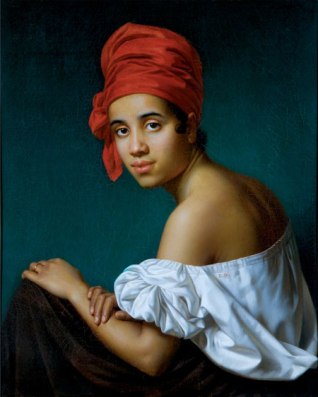
Creole in a Red Headdress; painted by Jacques Guillaume Lucien Amans;ca. 1840; oil on canvas, The Historic New Orleans Collection
Good Morning Sky Dancers!
Today, I’d like to explore some dimensions of the healthy expression of a good “fuck you” to the powers that be coming from a variety of sources because, you know, we all want to do it every day these days. Resistance frequently comes in the form of art, music, culture, and language in support of socio-economic-political change. The form can be a joyous yet angry expression necessitated by the powerless situations of those most oppressed by the dominant culture, ruling class, religion, and economy. The wink wink nod nod of art can save one from jail or worse.
It may seem disparate but I’ve got some examples that demonstrate that the complaints coming from diverse communities may represent the same undercurrent of dissatisfaction. The dominant socio-economic-political culture wants to silence and remove us which is why we must support and understand the concept of intersectionality. What they can do to one group, they can do to all given enough time and power. Together, we are the many. Separate and apart, they can cut us off like livestock to separate and unequal slaughterhouses.
This is why they are trying to stack the courts, gerrymander congressional districts, suppress voting rights, and shut up the press. It is also why they scream “lock her up” to attack Hillary Clinton and “build the wall” at folks of Mexican heritage”. It is why they still describe our first black President as a “Kenyan-born Muslim” and panic dial 911 on black people just living their lives. It is why they dilute “black lives matter” to “all”. It is why they won’t bake cakes for all weddings.
It is also why they want to set us against each other and we must not let that happen.

Daisy Patton’s “Would You Be Lonely Without Me?” runs through August 3 at the Art Gym Gallery. ( Ray Mark Rinaldi, Special to The Denver Post)
I’m going to move around in time for this but I will start with a current art show in Denver. “Denver exhibit puts faces to women who died from botched abortions prior to Roe vs. Wade. Daisy Patton’s paintings of 15 women tell a somber story”. The article is from the Denver Post review of the show.
Quirky and perky, with a face full of determination, it’s hard not to get a quick crush on Vivian Grant the way that Daisy Patton paints her, circa 1960, in a series of women’s portraits on display at Denver’s Art Gym Gallery.
With her emerald green dress, dangling earrings and precision-plucked eyebrows, Grant radiates the kind of organic optimism that could carry her far in her burgeoning career in New York’s publishing world.
But the accompanying text tells a story with a different ending. At 23, she found herself showing signs of pregnancy and sought to terminate it.
Abortion was illegal in those days, and dangerous, the stuff, as we say, of back alleys and shady practitioners and Grant, like many others, was one of its victims, dying from complications of the procedure. An autopsy later showed it was a false pregnancy.
Tragedy on top of tragedy. That’s the narrative arch of Patton’s “Would You Be Lonely Without Me?,” which captures in oil paint on paper the images of 15 women who died as a result of botched abortions in the era before the 1973 Roe vs. Wade Supreme Court decision made abortion legal, and raised the medical standards around the procedure.
Yes, the exhibit is political. Patton’s portraits are rich in physical and emotional detail. They raise sympathy for women who make the difficult decision to end their pregnancy — and their sale could raise money for national organizations that support the ability for all women to make the choice.
In her artist’s statement for the show, Patton, writes of a time when an estimated 5,000 to 10,000 women died each year from abortion-related injuries that were caused by unskilled doctors or self-inflicted by those, fearing no where else to turn, who treated themselves with knitting needles or drank bleach or other chemicals.
She notes, citing published research, how things have changed in the last four decades: “Now it is statistically more dangerous to
birth than to have an abortion.”

Many of these stories draw me in even though they are not my stories, or stories I would likely hear had I not gone looking for them or most likely, stories I would not have seen if I didn’t have friends who have stories that connect them deeply to these voices. I am drawn in by our shared humanity and vulnerability.
In this case, it was a neighbor who watched a woman die of a botched abortion as a 10 year old in a South Chicago Beauty Salon her mother used. She later, at 13, joined the underground railroad to help women seeking abortions. She was the same age as me when I listened to a panel of women who shared the stories of women in their lives who had died of botched abortions in the fellowship hall of my West Omaha Presbyterian Church. I think that was about the first moment that I realized I had a name and it was “feminist”. My neighbor’s story is more compelling than mine though and I’m glad she put up the link and said share this woman’s art.
I don’t remember her name, but she bled to death from a back alley abortion in the spare bedroom of Jackie, the lady who did my mother’s hair on Saturday’s when I was 10. I was sent to go keep an eye on her while my mother was getting her hair done. I was the last person to see her alive, because she was moaning softly and crying while Jackie was shampooing. I asked her if she needed anything and she said she needed something for her bleeding.I went back down the hall and told Jackie. Jackie went into the bathroom and got then to back bedroom and then she came back into the kitchen. Jackie gave me some towels and told be to bring them to her. I could tell when I went back in the room that she was gone, and lying in an incredible pool of blood.It was the same week a woman my Mother worked with, who was white and had money, had a “procedure” at her gynecologist’s office to take care of her unwanted pregnancy.
I learned about Jane the underground to help women when I was 13. I started donating money, and volunteering. I let women into our apartment to sleep on the couch after everyone had gone to bed and then got them out before anyone got up in the morning, on their journey to Canada to have their abortion there, or if they had enough money to the private clinic on the North side of Chicago.
The story of Louisiana’s Tignon laws has always intrigued me. I’ve been seeing renewed interest in them as it appears they are now part of a discussion on cultural appropriation.
Louisiana had slavery but with some vital differences that eventually disturbed the American colonizers who bought the French Colony. The Catholic church insisted that slaves not work on Sundays and that they be allowed to buy their own freedom. This created an entire community of free people of color in New Orleans. It was inevitable that as the traditional model of American Slavery moved towards Louisiana and New Orleans it would create dehumanizing experiences for its Creole communities.
The Tignon laws passed in 1789, however, were enacted by a Spanish governor who was also critical of the French behavior towards free people of color. Tignon laws were enacted to restrict the fashion, dress and hair styles appropriate in public dress for female gens de couleur in colonial society. Black women could not show their hair in public under the law.
This story of Free Black women in New Orleans addresses how
“We cannot discount how enslaved Black women used dress as a form of resistance [and] how even finding different ways of tying the headscarf acted as a form of resistance against the trauma of diaspora and being cut off from Africa,” says Winters. “Or how [African-American] people have drawn inspiration from African traditions as a source of empowerment.”
The tignon remains an important symbol of resistance even today It is essentially a piece of cloth fashioned into a headress to cover the hair of black women. It became much more when styled with bold patterns and color and adorned with jewels.
Even when Louisiana stopped enforcing the laws in the early 1800s, free women of color continued wearing the tignon. It’s a testament to their resilience: The women of New Orleans refused to allow a piece of cloth to humiliate them, erase their status, or diminish their femininity. Instead, they reinterpreted the tignon as a symbol of empowerment. (And Black women in Louisiana weren’t the only women of color to use clothing to resist oppressive laws: In 1773, free women of color in Saint-Domingue were prohibited from wearing shoes, so they wore sandals, adorned their toes with diamonds and continued to do so after the laws were lifted.)
More than 230 years later, remnants of the tignon laws still linger: Traditional hairstyles, such as dreadlocks, are still seen as unprofessional in the workplace; women who wear them are subject to false assumptions—like Giuliana Rancic’s now-notorious snark about Zendaya’s faux locs smelling of “patchouli oil” and “weed.” The military recently lifted its longtime ban on cornrows, Afros, locs, and other protective hairstyles, but we regularly hear stories about Black girls being suspended from school for rocking natural hair.
A number of black women have incorporated the look and statement in their performances.
Pop culture, however, is the most reliable place to look for Black women who still resist the policing of their hair.
The first time we see Beyoncé in Lemonade, her musical celebration of Louisiana’s Afro-Creole women, she’s rocking a tignon while kneeling on a stage. Nina Simone also incorporated the tignon into her signature look, and Lauryn Hill, India.Arie, and Erykah Badu followed her lead in the late 1990s and early 2000s. (Badu even wore a headwrap on Sesame Street). Outside of pop culture, the headwrap is now largely considered a fashion staple. Nnenna Stella travels from Brooklyn to Ghana and Morocco to select the most impeccable textiles for her handcrafted headwraps. Afro-Colombian designer Angelica Balanta’s vibrant headwraps reflect her rich Colombian culture, while Paola Mathé’s collection is inspired by her Haitian heritage.

Nina Simone & her daughter Lisa Celeste Simone | 1965 photo by Brian Duffy
It’s been years since the Tignon laws have been thrown out but they are still a sign of resistance. They also have been appropriated and are part of a bigger discussion
As of present, we can find conversations about what is and what isn’t cultural appropriation by way of hair (aka Kim Kardashian and her “Bo Derek” braids) or current cases playing out in court about what is and what isn’t discrimination based on a hairstyle. Black hair has always been a topic of conversation.
Most Black women can relate to the struggle of getting braids or weave and having unwanted comments from non-black co-workers. Even young Black girls are subject to ridicule because of their hairstyles. The Tignon Laws of 1786 are proof that Black hair has always been policed in America.
Fashion is frequently used for resistance.
People laugh at me when I tell them my Draq Queen friends would most likely be my spirit animal. My mother even knew that I was not one to be put in ruffles and lace with hair like Shirley Temple. It was not me at all. I basically look over the top in anything girlie which is probably why I can totally relate to a lot of drag.
Cross dressing and lip-syncing is entirely different from the insensitive nature and intention of blackface. In queer and feminist communities, drag tends to be widely accepted. It makes sense, counter cultures allowing each other to thrive and experiment. It is the concept of “gender roles” that forces us to so closely associate femininity with women, so when someone who is clearly not a woman performs femininity, it is still thought of to be a reflection on women.
A lot of drag queens get their names and character traits from pop culture, and the media loves to portray women as, to use Mary Cheney’s words, bitchy, catty, dumb, and slutty. Indeed, these are not great attributes for a person to embody, so when drag queens perform those characteristics while dressed and made up like a woman, it could be read as disrespectful or an insult to woman. Drag queens also tend to be hyper sexual, sometimes with a crude sense of humor. When people over sexualize femininity, it dehumanizes women by turning them into an object of sex as opposed to a complex human being.
Many supporters of drag culture argue that the femininity being performed by drag queens is their own form of self expression and has little to do with people who live their daily lives as women. Judith Butler argues that traditional gender roles are exhaustingly heteronormative, and that they attempt to define a norm that gives a sense of “otherness” to queer culture and drag. If we broaden our lense to not view heterosexuality as “having a claim on naturalness and originality” (Butler 384), gender can be scene as a performance for everyone and therefore not so different from drag. Basically, most people view drag as an imitation, but that implies that gender has a norm in which to deviate from. It’s like personality, there isn’t a set way to be an individual, so there isn’t a set way to be feminine.
I want to bring up art history in this exploration of gender because drag so connected with self expression and the artistry around makeup and fashion. Drag is an experiment gender, makeup, performance, fashion, comedy, parody etc… There is a million different ways to “do” drag, as seen by the assortment of characters who have won RuPaul’s drag race all with varying intensities in the femininity of the character.
Wedding Cakes aside, I grew up in an age when you read Oscar Wilde and knew it was indeed ‘the love that dare not speak its name”. I’ve found these expressions of resistance shared by friends that relate to oppression in a way I can only take in as a listener and human being, But, i can still relate. I knew there were jail sentences and death penalties when I was a child as much as I was aware of Jim Crow Laws separating black from white Americans in the South. Only now, is much of the pre civil rights culture of resistance being documented.
“And Gloria cackled, let there be sparkle; and there was sparkle.” It’s a passage from the Bible, but not as we know it: this is a familiar line from the Book of Genesis as spoken in Polari. The secret language became a kind of verbal wink between gay men in Britain during the early 20th Century – allowing them to hide and to reveal at the same time.
“One of the things that makes Polari so powerful is that it is simultaneously about disguise and identification,” the artist Jez Dolan tells BBC Culture. “You would be hiding what you were talking about from people who didn’t know it, but also if you were in a bar and you liked the look of somebody, you’d pop it into conversation and they’d either go ‘ah’ or they’d look blank and you’d be on your way.” Polari is rarely spoken today. Yet in the years when homosexuality was illegal, it was a way of communicating in public without risking arrest – as well as a chance to challenge the status quo.

Divine in a publicity photograph from the 1980s
This form of resistance, identification and survival has a fascinating history.
Baker has found it difficult to untangle a clear history of the lexicon. “Polari has a long and complicated provenance, and not all of it is fully known because it was spoken by marginalised groups who didn’t usually have their voices or stories recorded,” he says. While ‘bona’ (meaning ‘good’ or ‘attractive’), which pops up frequently, was first recorded in Shakespeare’s Henry IV Part II, some of the earliest words in Polari come from 18th-Century ‘Molly Slang’. “Mollies were men who were camp and had sex with other men,” says Baker. “These men were sometimes imprisoned and so some words of the criminal slang Cant would have crept into their language use.”
Baker describes how another form of slang, Parlyaree (from ‘parlare’, the Italian for ‘to talk’), was used by buskers, travelling circus and fairground people, market stall holders, prostitutes and beggars. Derived from Italian, it began to be used in music halls in the late 19th Century, and became known as Palarie. “There were influences from Lingua Franca… used by sailors, as well as cockney rhyming slang and Yiddish which were found particularly in the East End of London.” Some of the words are what’s been called ‘backslang’ – hair is ‘riah’, and face is ‘eek’ (from ‘ecaf’)
“Bona to vada your dolly old eek!” This links to a BBC video worth watching.
British comedian Kenneth Williams often spoke Polari in his performances on BBC radio and TV programmes in the 1950s and 60s, some of which had up to 20 million listeners at a time, introducing the language to a much wider audience.
The highlight of my evenings has been watching the nightly occupation of Lafayette Park across from the White House where noise and culture are making a loud stand. Its first night saw a very large Mariachi Band. There have been New Orleans styled Brass Bands and Drummers. The use of a Mariachi band in an Anti-Trump Protest is clearly ironic and brilliant simultaneously given Trump’s bigoted fascination with purging and dehumaniziang Mexicans and Mexican Americans.
Normally, Lafayette Park is one of those pretty, history-drenched spots in Washington, where you walk around wondering whose footsteps you might be following. You’re right across from the White House, close enough that you can practically see into the front windows. Now, though, the most important thing to know about this D.C. spot is what Occupy Lafayette Park is — because the square might just be full of anti-Trump protestors.
Because of its sight line straight to the White House, Lafayette Park is a frequent spot for rallies and gatherings when people want to protest something that the Trump administration has done, like for example the travel ban. Now, the country seems to be at a fever pitch after Trump’s meeting with Russian President Vladimir Putin, which has gained the name “Treason Summit” on Twitter. Occupy Lafayette Park is an impromptu, grassroots rally set up to protest Trump’s actions in Helsinki, where the meeting was held, and demand his impeachment.
It is only sweeter that idea came from former Clinton Aides. I just hope Trump can never sleep again.
“Nothing says Impeach like a Mariachi band,” one user chimed in.

Raja Gemini; stage name of Sutan Amrull, an Asian-American make-up artist, and drag performer
As you can tell,symbols of resistance can take many forms and they can outlive the original need for the resistance while remaining necessary because of the residual impact. So, one final link to some news about the guy that’s kicked off the #MeToo movement by bragging on sexual assault. It’s from Charles Pierce, Esquire, CNN, Michael Cohen, the Age of Leaks and Treason and more than we’ve all been able to handle. ‘We now stand at a yes-or-no moment in this country’s history.’ It juxtaposes today and that day in 1974 where they found the smoking gun.
We are now at one of those points. With the revelation on CNN Thursday night that, according to the network’s sources, Michael Cohen is ready to testify that the president* knew in advance of the now-legendary meeting in June of 2016 at which individuals connected to the Russian government offered to ratfck Hillary Rodham Clinton’s campaign for him, we stand as a self-governing republic at a stark, unclouded moment—either you believe the president* of the United States is utterly illegitimate, having conspired with a hostile power to gain the office he now holds, and that every act he has taken in that office, up to an including swearing the oath of office, is equally illegitimate, or you do not. It is now a binary. If Cohen is willing to testify to that effect, then the president* conspired with the regime of Vladimir Putin in order to gain control over the executive branch of government in this country—which includes not only the military, but the law-enforcement and intelligence apparatus as well. We are now at yes-or-no.
It’s time, as artfully as possible, to tell this administration to get the fuck out of the people’s house.
What’s on your reading and blogging list today?

 peej
peej Carissa
 bostonboomer
 dakinikat
 ecocatwoman
 jjlo
jjlo mablue2
 Mama Lopez
 peggysue22
 quixote
 skydancingguestblogger
 Mona (aka Wonk the Vote)





Recent Comments