


Idaho was one of several states to pass a “trigger” law before the 2022 decision in Dobbs v. Jackson Women’s Health, with the expectation that it would automatically take effect if the high court overturned Roe. The Idaho law, passed in 2020, bans most abortions and imposes penalties of up to five years in prison on doctors who perform the procedure, with an exception when “necessary to prevent the death of a pregnant woman.”
Lazy Caturday Reads
Posted: January 6, 2024 Filed under: 2024 presidential Campaign, cat art, caturday, Corrupt and Political SCOTUS, Donald Trump, just because, SCOTUS | Tags: 14th amendment, abortion, Colorado, democracy, Idaho, January 6 criminal cases, January 6 insurrection, January 6 pipe bomber, Liz Cheney, President Joe Biden, Supreme Court 9 CommentsHappy Caturday!!

By Matt McCarthy, Surreal Cat Art
Today is the third anniversary of the January 6, 2001 Capitol insurrection, which Trump incited and applauded. It was a failed coup attempt–a last ditch effort to keep Trump in power after all his legal efforts had failed.
Yesterday, President Biden spoke about the insurrection in the first speech of his campaign for reelection, and it was a barn-burner.
David Smith at The Guardian: Fired-up Biden shows gloves are off in January 6 anniversary speech.
This time it’s personal. On Friday Joe Biden tore into his predecessor Donald Trump as never before. He brimmed with anger, disdain and contempt. He apparently had to stop himself from swearing. So much for “when they go low, we go high” – and plenty of Democrats will be just fine with that.
If Biden was seeking to jolt his half-conscious 2024 re-election campaign into life, this may have done the trick. The palpable loathing of Trump took a good 10 or 20 years off him. Keep hating like this and he might do a Benjamin Button all the way to election day.
There is no better illustration of Biden’s evolution than a speech he delivered on the first anniversary of the January 6 insurrection. On that occasion, he denounced a “web of lies” but never mentioned Trump by name, preferring to cite the “former president”. Those were still the days when he would talk about “the former guy” and get a laugh.
Two years on, in an address near Valley Forge, Pennsylvania, Biden spoke the name “Trump” more than 40 times in less than an hour as he warned that his likely 2024 opponent would sacrifice American democracy to put himself in power. The 81-year-old president generally seems like a grandfatherly figure predisposed to give people the benefit of the doubt, which makes his detestation of Trump all the more striking.
Trump’s failure to act as a violent mob stormed the US Capitol, despite the pleas of staff and family members, was “among the worst derelictions of duty by a president in American history”, Biden said, noting that Trump went on to lose 60 court cases that took him back to the truth “that I had won the election and he was a loser”….
The president went on to recall how Trump has called the insurrectionists “patriots” and claimed there was a “lot of love” on January 6. At that, Biden shook his head, blinked and let out a gasp of disbelief, as if stunned anew by the assertion. “The rest of the nation, including law enforcement, saw a lot of hate and violence,” he said.
Biden furiously denounced political violence and Trump’s habit of joking about the big lie-influenced intruder who attacked Paul Pelosi, the former House speaker Nancy Pelosi’s husband, with a hammer, saying: “And he thinks that’s funny. He laughed about it. What a sick – ”
He halted. At the last moment, the president of the United States had saved himself from uttering a profanity. The urge coursed through his body and found relief in his hands, which clenched into fists, as the crowd filled in with laughter and whooping. “My God,” Biden said. “I think it’s despicable, seriously, not just for a president but for any person to say that.”
Read the rest at The Guardian. Read the full transcript of Biden’s speech at The White House site.

By Andrey Scherbak, Russian artist
This review of the speech is by Reid J. Epstein at The New York Times: Biden Condemns Trump as Dire Threat to Democracy in a Blistering Speech.
President Biden on Friday delivered a ferocious condemnation of Donald J. Trump, his likely 2024 opponent, warning in searing language that the former president had directed an insurrection and would aim to undo the nation’s bedrock democracy if he returned to power.
On the eve of the third anniversary of the Jan. 6, 2021, attack on the Capitol by Mr. Trump’s supporters, Mr. Biden framed the coming election as a choice between a candidate devoted to upholding America’s centuries-old ideals and a chaos agent willing to discard them for his personal benefit.
“There’s no confusion about who Trump is or what he intends to do,” Mr. Biden warned in a speech at a community college not far from Valley Forge in Pennsylvania, where George Washington commanded troops during the Revolutionary War. Exhorting supporters to prepare to vote this fall, he said: “We all know who Donald Trump is. The question is: Who are we?”
In an intensely personal address that at one point nearly led Mr. Biden to curse Mr. Trump by name, the president compared his rival to foreign autocrats who rule by fiat and lies. He said Mr. Trump had failed the basic test of American leaders, to trust the people to choose their elected officials and abide by their decisions.
“We must be clear,” Mr. Biden said. “Democracy is on the ballot. Your freedom is on the ballot.”
The harshness of Mr. Biden’s attack on his rival illustrated both what his campaign believes to be the stakes of the 2024 election and his perilous political standing. Confronted with low approval ratings, bad head-to-head polling against Mr. Trump, worries about his age and lingering unease with the economy, Mr. Biden is turning increasingly to the figure who has proved to be Democrats’ single best motivator.
In a speech in New Hampshire, Liz Cheney also issued a dire warning.
The Daily Beast: Liz Cheney Warns That Voting for Trump in 2024 Could Be ‘Last Vote You’ll Ever Cast.’
On the eve of the third anniversary of the Jan. 6 insurrection, former Rep. Liz Cheney (R-WY) warned the 2024 election could be the nation’s last.
Speaking to a room full of Dartmouth College students, Cheney expressed her belief that former President Donald Trump would refuse to hand over the reins of power if elected to a second term.
“He won’t leave office,” Cheney said. “He already tried not to leave office once. So I think there’s a lot of living in a fantasy world that’s going on with Republicans telling themselves, ‘Look, we’ll vote for him, it won’t be so bad.’ It may well be the last real vote you ever get to cast. It will be that bad.”
Giant Cats, artist unknown
What’s more, Cheney looks at her former colleagues in Congress and sees a group of enablers who would happily acquiesce to Trump’s designs and help muscle him back to power if the 2024 election result is in doubt.
The biggest enabler of all, Cheney said, might be her former “good friend” Mike Johnson—the backbencher turned Speaker of the House.
If no presidential candidate is able to secure 270 electoral votes in November, the decision could head to a House floor controlled by Johnson, the architect of the House GOP’s legal efforts to swing the last election to Trump.
“I think we need to be concerned about a Mike Johnson speakership, particularly in an instance where there’s a contested election,” Cheney said on Friday. “It’s a dangerous situation if the Republicans are in the majority.”
The AP discusses the status of the January 6 criminal investigations and trials, as well the unsolved mystery of who planted two pipe bombs.: Hundreds of convictions, but a major mystery is still unsolved 3 years after the Jan. 6 Capitol riot.
Authorities are still working to identify more than 80 people wanted for acts of violence at the Capitol and to find out who placed pipe bombs outside the Republican and Democratic national committees’ offices the day before the Capitol attack. And they continue to regularly make new arrests, even as some Jan. 6 defendants are being released from prison after completing their sentences.
The cases are playing out at the same courthouse where Donald Trump is scheduled to stand trial in March in the case accusing the former president of conspiring to overturn his 2020 election loss in the run-up to the Capitol attack….
More than 1,230 people have been charged with federal crimes in the riot, ranging from misdemeanor offenses like trespassing to felonies like assaulting police officers and seditious conspiracy. Roughly 730 people have pleaded guilty to charges, while another roughly 170 have been convicted of at least one charge at a trial decided by a judge or a jury, according to an Associated Press database.
Only two defendants have been acquitted of all charges, and those were trials decided by a judge rather than a jury.
About 750 people have been sentenced, with almost two-thirds receiving some time behind bars. Prison sentences have ranged from a few days of intermittent confinement to 22 years in prison. The longest sentence was handed down to Enrique Tarrio, the former Proud Boys national chairman who was convicted of seditious conspiracy for what prosecutors described as a plot to stop the transfer of power from Trump, a Republican, to Joe Biden, a Democrat….
Defense attorneys and prosecutors are closely watching a case that will soon be heard by the U.S. Supreme Court that could impact hundreds of Jan. 6 defendants. The justices agreed last month to hear one rioter’s challenge to prosecutors’ use of the charge of obstruction of an official proceeding, which refers to the disruption of Congress’ certification of Biden’s 2020 presidential election victory over Trump.
More than 300 Jan. 6 defendants have been charged with the obstruction offense, and so has Trump in the federal case brought by special counsel Jack Smith. Lawyers representing rioters have argued the charge was inappropriately brought against Jan. 6 defendants.
The justices will hear arguments in March or April, with a decision expected by early summer. But their review of the obstruction charge is already having some impact on the Jan. 6 prosecutions. At least two defendants have convinced judges to delay their sentencings until after the Supreme Court rules on the matter.
On the pipe bombs:
One of the biggest remaining mysteries surrounding the riot is the identity of the person who placed two pipe bombs outside the offices of the Republican and Democratic national committees the day before the Capitol attack. Last year, authorities increased the reward to up to $500,000 for information leading to the person’s arrest. It remains unclear whether there was a connection between the pipe bombs and the riot.
Giant Cat with a Wireless Tail, by 3d1viner
One of the biggest remaining mysteries surrounding the riot is the identity of the person who placed two pipe bombs outside the offices of the Republican and Democratic national committees the day before the Capitol attack. Last year, authorities increased the reward to up to $500,000 for information leading to the person’s arrest. It remains unclear whether there was a connection between the pipe bombs and the riot….
The explosive devices were placed outside the two buildings between 7:30 p.m. and 8:30 p.m. on Jan. 5, 2021, but officers didn’t find them until the next day. Authorities were called to the Republican National Committee’s office around 12:45 p.m. on Jan. 6. Shortly after, a call came in for a similar explosive device found at the Democratic National Committee headquarters. The bombs were rendered safe, and no one was hurt.
Video released by the FBI shows a person in a gray hooded sweatshirt, a face mask and gloves appearing to place one of the explosives under a bench outside the DNC and separately shows the person walking in an alley near the RNC before the bomb was placed there. The person wore black and light gray Nike Air Max Speed Turf sneakers with a yellow logo.
In other news, the Supreme Court has agreed to decide whether Trump can be kept off the Colorado primary ballot. Their decision will obviously affect the other similar cases in multiple states. This week, efforts to disqualify Trump based on the 14th Amendment were initiated in Illinois and Massachusetts.
Adam Liptak at The New York Times: Supreme Court to Decide Whether Trump Is Eligible for Colorado Ballot.
The Supreme Court agreed on Friday to decide whether former President Donald J. Trump is eligible for Colorado’s Republican primary ballot, thrusting the justices into a pivotal role that could alter the course of this year’s presidential election.
The sweep of the court’s ruling is likely to be broad. It will probably resolve not only whether Mr. Trump may appear on the Colorado primary ballot after the state’s top court declared that he had engaged in insurrection in his efforts to subvert the 2020 election, but it will most likely also determine his eligibility to run in the general election and to hold office at all.
Not since Bush v. Gore, the 2000 decision that handed the presidency to George W. Bush, has the Supreme Court taken such a central role in an election for the nation’s highest office.
The case will be argued on Feb. 8, and the court will probably decide it quickly. The Colorado Republican Party had urged the justices to rule by March 5, when many states, including Colorado, hold primaries.
The number of challenges to Mr. Trump’s eligibility across the country can only have added pressure on the court to hear the Colorado case, as they underscored the need for a nationwide resolution of the question.
The case is one of several involving or affecting Mr. Trump on the court’s docket or on the horizon. An appeals court will hear arguments on Tuesday on whether he has absolute immunity from prosecution, and the losing side is all but certain to appeal. And the court has already said that it will rule on the scope of a central charge in the federal election-interference case in a decision expected by June.
Mr. Trump asked the Supreme Court to intervene after Colorado’s top court disqualified him from the ballot last month. That decision is on hold while the justices consider the matter.

Cathedral of St. Paul, by JReischl on Deviant Art
The Supreme Court also agreed to hear an abortion case yesterday, and, since it *only* involves women’s lives and safety, it was overshadowed by the Trump eligibility case. But this one is horrific.
Ann E. Marimow at The Washington Post: Supreme Court to decide if U.S. law requires some emergency room abortions.
The Supreme Court said Friday it will review a case challenging Idaho’s strict abortion ban, which the Biden administration says conflicts with a federal law requiring emergency room doctors to perform the procedure in some circumstances.
Idaho’s attorney general asked the justices to intervene after a lower-court judge blocked a section of Idaho’s abortion statute targeting doctors. The judge said the provision violates a federal law that requires hospitals receiving Medicare funding to guarantee emergency care. In its brief order Friday, the justices allowed the Idaho law to take full effect for now and said they would review the matter on an expedited basis in April.
The Biden administration turned to the Medicare law as a narrow way to challenge state-level abortion bans in federal court after the Supreme Court’s conservative majority overturned the fundamental right to an abortion established decades earlier in Roe v. Wade. The effort was seen as one of the few paths the administration could pursue to preserve access to abortion, which remains a galvanizing and divisive issue across the country in the lead-up to the 2024 presidential election.
The issue of access to abortion in health emergencies is not the only reproductive-rights case to reach the high court this term. The justices also will decide whether to limit access to the widely used abortion medication mifepristone, first approved by the Food and Drug Administration more than 20 years ago.
Abortion rights advocates and medical experts say the Idaho law, and similar bans in more than two dozen other states, have put doctors and hospitals at legal risk as they navigate life-or-death decisions for pregnant patients and seek to interpret vague medical exceptions to decide whether it is permissible in some circumstances to terminate a pregnancy.
In a similar case in Texas, the conservative U.S. Court of Appeals for the 5th Circuit this week ruled against the Biden administration, saying Texas hospitals and doctors are not obligated to perform abortions under the federal emergency-care law.
From the AP: The Supreme Court is allowing Idaho to enforce its strict abortion ban, even in medical emergencies.
The Supreme Court on Friday allowed Idaho to enforce its strict abortion ban, even in medical emergencies, while a legal fight continues.
The justices said they would hear arguments in April and put on hold a lower court ruling that had blocked the Idaho law in hospital emergencies, based on a lawsuit filed by the Biden administration.
The Idaho case gives the court its second major abortion dispute since the justices in 2022 overturned Roe v. Wade and allowed states to severely restrict or ban abortion. The court also in the coming months is hearing a challenge to the Food and Drug Administration’s rules for obtaining mifepristone, one of two medications used in the most common method of abortion in the United States.
In the case over hospital emergencies, the Biden administration has argued that hospitals that receive Medicare funds are required by federal law to provide emergency care, potentially including abortion, no matter if there’s a state law banning abortion.
U.S. District Judge B. Lynn Winmill in Idaho agreed with the administration. But in a separate case in Texas, a judge sided with the state.
Idaho makes it a crime with a prison term of up to five years for anyone who performs or assists in an abortion.
One more from the White House website: Statement from President Joe Biden on Supreme Court Order on Idaho’s Abortion Ban.
Today’s Supreme Court order allows Idaho’s extreme abortion ban to go back into effect and denies women critical emergency abortion care required by federal law. The overturning of Roe v. Wade has enabled Republican elected officials to pursue dangerous abortion bans like this one that continue to jeopardize women’s health, force them to travel out of state for care, and make it harder for doctors to provide care, including in an emergency. These bans are also forcing doctors to leave Idaho and other states because of laws that interfere with their ability to care for their patients. This should never happen in America.
The Vice President and I believe that health care decisions should be made by women and their doctors, not politicians. We will continue to defend a woman’s ability to access emergency care under federal law. As this case continues, the stakes could not be higher for women across America. Congress must immediately restore the protections of Roe v. Wade so that women in every state can access the health care they need.
That’s it for me today. What else is happening?
Wednesday Reads
Posted: January 3, 2024 Filed under: 2024 Elections, 2024 presidential Campaign, just because, Media, polling, The Media SUCKS | Tags: Autocracy, big media, Claudine Gay, democracy, diversity, Greg Sargent, Harvard, journalism, Joyce Vance, Racism, Rick Perlstein, The Washington Post 13 CommentsGood Morning!!
It’s 2024, and the media and the Republicans are gearing up for the presidential election in November. What are the Democrats doing? I’m sure they are raising plenty of money, but when will they wake up and start fighting back against the Republicans and the media? Make no mistake, big media is hoping for another Trump presidency, because it will mean chaos and gobs of money for those who cover the chaos. It will mean riches for the media bosses and reporters alike–think of all the new books they can sell as Trump destroys democracy and attempts to gain dictatorial power?
You’ve probably heard that The Washington Post recently got rid of 240 employees through buyouts. They chose to keep right wing columnists like Hugh Hewitt and dumped liberals like Greg Sargent. Fortunately, Sargent has been hired by The New Republic.
This post by Tom Jones is from Poynter, a site that reports on and critiques the media: Opinion | Washington Post reaches buyout goals to, for now, avert layoffs.
The good news is that the Post has been able to meet its goal of trimming staff through buyouts instead of layoffs. The bad news is the Post will enter the new year with fewer employees — perhaps a couple of hundred.
Greg Sargent
Back in October, the Post announced that it was offering buyouts with the hopes of reducing staff by 240. (At the time, the Post had approximately 2,500 employees.)
Then late last month, Post interim CEO Patty Stonesifer told staff only half of the desired number of staffers — about 120 or so — had accepted the buyouts and that there would be layoffs if not enough employees took the buyouts. At the same time, The Daily Beast’s Corbin Bolies reported that Post executive editor Sally Buzbee told staff in an email that about 36 of the 120 who accepted the buyouts were from the newsroom. She said that was “about 30 percent of our goal across the News department.”
Then came Tuesday’s news that the Post had enough buyouts to avoid layoffs — for now (my words, not the Post’s). The exact number of buyouts isn’t known publicly.
In an email to staff, Stonesifer said the company “will enter the new year with a smaller organization but a better financial position.” Stonesifer also wrote, “I am very aware of how difficult this process has been for everyone involved and I want to thank you for the grace and respect you have shown at every step.”
In July, The New York Times Benjamin Mullin and Katie Robertson reported the Post was on track to lose about $100 million this year.

For the gossip columnists at the WaPo, President Biden is boring. Imagine how much better the paper’s “financial position” will be when Trump gets back in the White House and consolidates his power. The same will be true of The New York Times. Maggie Haberman will be cleaning up, along with her co-writers.
In another positive development, historian and political observer Rick Perlstein will be writing for The American Prospect. I’m seriously thinking about dumping my Washington Post subscription and giving that money to one of these liberal publications.
Perlstein has published his first column. In it, he addresses three issues I worry about: the media focus on polls, the failure of journalists to address real issues, while tending to favor right wing narratives, and the failure of Democratic politicians to fight back hard against those narratives.
Rick Perlstein at The American Prospect: You are Entering the Infernal Triangle: Authoritarian Republicans, ineffectual Democrats, and a clueless media.
Perlstein on Polling:
As a historian who also writes about the present, there are certain well-worn grooves in the way elections get written about by pundits and political journalists from which I instinctively recoil. The obsession with polling, for one. Polls have value when approached with due humility, though you wonder how politicians and the public managed to make do without them before their modern invention in the 1930s. But given how often pollsters blow their most confident—and consequential—calls, their work is as likely to be of use to historians as object lessons in hubris as for the objective data they mean to provide.
Pollsters themselves are often the more useful data to study, especially when their models encode mistaken presumptions frozen in place from the past. In 1980, for instance, Ronald Reagan’s landslide was preceded by a near-universal consensus that the election was tied. The pollster who called it correctly, Lou Harris, was the only one who thought to factor into his models a variable that hadn’t been accounted for in previous elections, because it did not yet really exist: the Christian right.
Polling is systematically biased in just that way: toward variables that were evident in the last election, which may or may not be salient for this election. And the more polls dominate discussions of campaigns and elections, the more they crowd out intellectual energy that could be devoted to figuring out those salient, deeper, structural changes conditioning political reality: the kind of knowledge that doesn’t obediently stand still to be counted, totted up, and reduced to a single number.
On media predictions:
Another waaaaay too well-worn journalistic groove isprediction. I have probably read thousands of newspaper opinion column prognostications going back to the 1950s. Their track record is too embarrassing for me to take the exercise seriously, let alone practice it myself. Like bad polls, pundits’ predictions are most usefulwhen they are wrong. They provide an invaluable record of the unspoken collective assumptions of America’s journalistic elite, one of the most hierarchical, conformist groups of people you’ll ever run across. Unfortunately, they help shape our world nearly as much, and sometimes more, than the politicians they comment about. So their collective mistakes land hard….
Rick Perlstein, author, Reaganland: America’s Right Turn 1976-1980.
And how ritualized? Consider one of elite journalism’s most deeply worn grooves: the morning-after declarations, should any Democrat win a presidential election, that the Republican politics of demagogic hate-mongering has shown itself dead and buried for all time—forgetting how predictably it returns in each new election, often in an increasingly vicious form.
In 1964: When the author of the Civil Rights Act, Lyndon Johnson, defeated a Republican who voted against the Civil Rights Act, Barry Goldwater, one of the most distinguished liberal newspaper editors in the South, Sam Ragan of the Raleigh News & Observer, pronounced that all future American elections would be decided “on issues other than civil rights.” His essay quoted the Los Angeles Times’ Washington bureau chief, who affirmed that conventional wisdom by observing that henceforth, whichever party takes the Black vote would be no more predictable than who would win “freckle-faced redheads and one-armed shortstops.” [There are many more examples of this phenomenon in the essay.]
This particular bias is rooted into elite punditry’s deepest, most dangerous groove of all: a canyon, if you will. On one side of the yawning gulf is the perennial fantasy that America is a nation fundamentally united and at peace with itself, “moderate,” “centrist,” where exceptions are epiphenomena entirely alien to settled American “norms.”

On “Reality”:
On the other side of the gulf is, well, reality.
The media habits that make it so hard to grasp that reality—that made Trump and his merry band of insurrectionists such a surprise to us—are perhaps as systematic as any foisted upon the public by state media in authoritarian nations. A little more innocent than, say, Pravda, however, because one wellspring of this stubborn fantasy, and why audiences are so receptive to it, is simple psychology. To acknowledge the alternative is to stare into a terrifying abyss: the realization that America has never not been part of the way to something like a civil war.But suddenly, in 2024, no one can avoid acknowledging that abyss anymore. And that leaves journalism in a genuine crisis.
Generations of this incumbent, consensus-besotted journalism have produced the very conceptual tools, metaphors, habits, and technologies that we understand as political journalism. But these tools are thoroughly inadequate to understanding what politics now is.
According to polls (which, yes, have their uses, in moderation), something around half of likely voters would like to see as our next president a man who thinks of the law as an extension of his superior will, who talks about race like a Nazi, wants to put journalistic organizations whose coverage he doesn’t like in the dock for “treason,” and who promises that anyone violating standards of good order as he defines them—shoplifters, for instance—will be summarily shot dead by officers of the state who serve only at his pleasure. A fascist, in other words. We find ourselves on the brink of an astonishing watershed, in this 2024 presidential year: a live possibility that government of the people, by the people, and for the people could conceivably perish from these United States, and ordinary people—you, me—may have to make the kind of moral choices about resistance that mid-20th-century existentialist philosophers once wrote about. That’s the case if Trump wins. But it’s just as likely, or even more likely, if he loses, then claims he wins. That’s one prediction I feel comfortable with.
I’ve already quoted too much, but I hope it’s enough so that you’ll want to read the rest at The American Prospect.
Every morning, I read Joyce Vance’s substack, Civil Discourse. Today, she offered “a warning” to all of us who want to save democracy. We have to remember that no everyone is following news and politics closely.
One morning before Christmas, I was working out with a friend who I adore, and workout with regularly. She’s young, smart, and a recent college graduate. In the middle of our session, my phone started going off incessantly and I finally picked it up. It was, of course, breaking news. That day, it was about the Giuliani bankruptcy.
I apologized to her for taking the call. I got off quickly and told her, by way of explanation, “Rudy Giuliani just filed for bankruptcy.”
Joyce Vance
“Who’s Rudy Giuliani?” she asked.
One morning before Christmas, I was working out with a friend who I adore, and workout with regularly. She’s young, smart, and a recent college graduate. In the middle of our session, my phone started going off incessantly and I finally picked it up. It was, of course, breaking news. That day, it was about the Giuliani bankruptcy.
I apologized to her for taking the call. I got off quickly and told her, by way of explanation, “Rudy Giuliani just filed for bankruptcy.”
“Who’s Rudy Giuliani?” she asked.
You know that noise they make in TV sitcoms, the one where the needle scratches across the record, and everything is interrupted? That was what I heard in my head. My mind worked over the implications of her question for the remainder of our time together.
She was born after 9-11. She never knew Giuliani as America’s mayor when the Towers fell and certainly not as the staunch pro-law enforcement mayor in the city in earlier years. But it shocked me that someone of voting age was unaware of Giuliani—didn’t recognize his name and associate it with Trump’s efforts to overturn the 2020 election.
She asked me about the bankruptcy. “Is that a good thing or a bad thing?” I explained that he’d lost a big defamation case in Georgia because he said horrible things about two election workers and disrupted their lives. Still no signs of recognition, but she got the point. “What an a**hole,” she concluded, based on my brief description of what he’d done.

Read the rest at the substack link.
Like Joyce Vance, I grew up in a politically engaged family. It’s always a shock to me when I learn that some people have no idea what’s going on in the government. We need to reach out to the people us and discuss the danger of autocracy.
I’m really troubled by what happened to Claudine Gay, Harvard’s first Black president. She may well have some issues with past plagiarism, but if she had been white, I doubt if the issue would have even come up. The truth is, she was set up by Congressional Republicans who hate diversity in education. Two articles:
At The Atlantic, David Graham expresses the typical liberal media response: it’s a shame and of course she was targeted by right wingers, but Harvard still had to do the “right” thing: An Old-Fashioned Scandal Fells a New Harvard President.
Gay, a political scientist, resigned…, making her the second president of an Ivy League institution to bow out in the past month. University of Pennsylvania President Liz Magill stepped down on December 9, but the cases are not as similar as they might initially seem. Magill’s departure stemmed directly from the shaky December 5 congressional testimony by a panel of college presidents about anti-Semitism and the Israeli-Palestinian conflict, and was viewed as a victory for Elise Stefanik, the Republican representative who led the questioning.
What appear to have doomed Gay were the allegations of plagiarism lodged against her. This is an important distinction. Penn’s board of trustees was spooked by pressure from donors and politicians. The Harvard Corporation, an equivalent body, was not. In a December 12 statement, it acknowledged that Gay’s testimony had gone poorly, but said she would remain in her post, describing its position as a defense of open discourse and academic freedom. Although Stefanik is already claiming credit, what ended Gay’s short tenure were not the hot-button issues of campus speech and anti-Semitism but was instead the kind of scandal that one might expect to fell the president of any educational institution, whether a member of the Ivy League or a community college.
Yes, because Harvard initially supported her remaining president, so the right wingers had to find another reason to get rid of her.
On December 5, Gay, Magill, and MIT’s Sally Kornbluth were hauled before Congress to speak about anti-Semitism on campus, though many GOP members really seemed to be upset about what they saw as inconsistent standards for deciding what speech is and isn’t acceptable on campuses. The hearing was remarkable for, among other things, how little intellectual agility the presidents showed in the face of questioning. A college president has to fulfill a dual role, serving not only as an academic officer but also as a sort of front woman for her institution. The failure of these presidents to represent their universities well in such a public setting was bound to raise questions about their leadership, regardless of the subject matter.
Claudine Gay
Gay survived the initial backlash to her testimony, but since then, the furor around allegations of plagiarism has grown. Many of the examples that have been made public represent extremely lazy rewriting of source material—Gay borrowed sentences or paragraphs, making minor changes to their wording or order of clauses without adding much analysis of her own. Some academics have described this as entirely unacceptable, while others have defended Gay—including some, such as David Canon, from whose work she repeatedly drew. “I am not at all concerned about the passages. This isn’t even close to an example of academic plagiarism,” Canon told The Washington Free Beacon….
The origin of the complaints is still murky. Allegations of academic misconduct against Gay had floated around online message boards for some time, The Wall Street Journal reported. One unnamed individual claims to be the source of the current charges. On October 24, the New York Post contacted the university to ask about allegations against Gay. On December 10, the conservative agitator Christopher Rufo and the journalist Christopher Brunet published claims of plagiarism in Gay’s 1997 Harvard dissertation. The next day, The Washington Free Beacon added more reporting….
Conservatives have long had it out for Gay, Harvard’s first Black president, whose appointment they viewed as a sop to progressive diversity, equity, and inclusion initiatives. The identity of the initial anonymous complainant against Gay is unclear, as is when he or she brought the complaints forward. The appearance of the allegations in conservative outlets and their timing, coming shortly after the war in Gaza thrust Gay into the spotlight, certainly suggest a politically motivated effort.
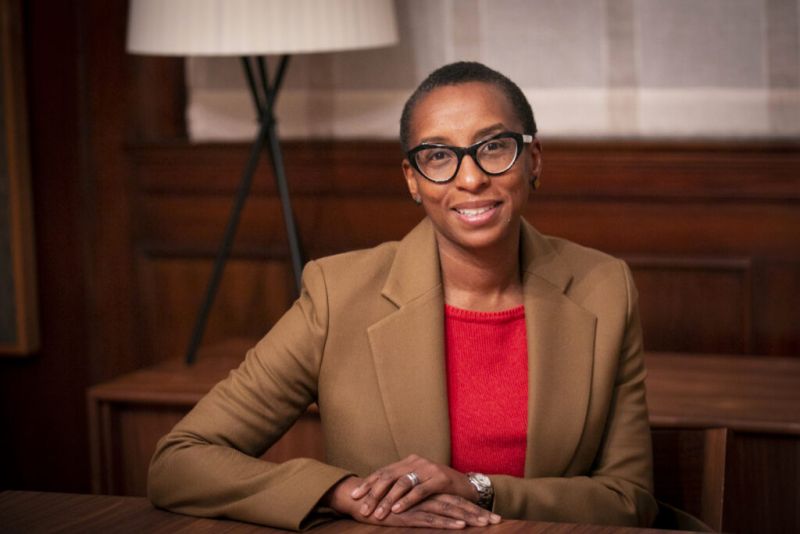
I’ve quoted the parts of Graham’s article that support my point of view. He still thinks she should have been fired.
Nia T. Evans at Mother Jones: What Claudine Gay’s Resignation From Harvard Means for the Rest of Us.
Claudine Gay’s resignation from her post as president of Harvard University is a shocking new twist in the ongoing saga over campus free speech. Gay resigned on Tuesday amid new allegations of plagiarism leveled through an unsigned complaint published in the Washington Free Beacon, a conservative outlet that has long criticized Gay. The news, which was broken by the Crimson, comes after months of attacks on Gay’s response to campus antisemitism and weeks after university leaders reaffirmed their support for her. Gay’s stunning departure is the latest casualty in a growing conservative crusade against “diversity in education” and a chilling reminder of the state of campus free speech amid Israel’s war on Gaza.
“It has become clear that it is in the best interests of Harvard for me to resign,” Gay wrote in a letter to the Harvard community. “It has been distressing to have doubt cast on my commitments to confronting hate and to upholding scholarly rigor—two bedrock values that are fundamental to who I am.”
Gay’s 186-day tenure is the shortest in the school’s 388-year history.
Just six months ago, Gay was heralded as the future of Harvard University. “I stand before you on this stage with the weight and honor of being a first,” she told a rain-soaked crowd during her inauguration ceremony. Her journey to becoming Harvard’s first Black female president felt like the quintessential American dream: she is the daughter of Haitian immigrants, a Stanford graduate with a doctorate from Harvard. An accomplished political scientist with an emphasis on race, democracy, and politics, she was praised by university and political leaders alike after being named Harvard’s 30th president in late 2022. Massachusetts Gov. Maura Healey called her “a leader for our time” driven by the “values to meet the moment” at Gay’s September inauguration ceremony. Harvard’s governing board announced her selection with glee. “We are confident Claudine will be a thoughtful, principled, and inspiring president for all of Harvard,” wrote Harvard Corporation senior fellow Penny Pritzker. “She will be a great Harvard president in no small part because she is such a good person.”
Gay’s brief tenure collided with historic political assaults against diversity and education. In June, the Supreme Court struck down affirmative action in a case in which Harvard was at its center. The October 7 terrorist attack on Israel by Hamas instigated an ongoing war that’s claimed more than 22,000 lives. The war also set off a fierce debate on college campuses across the country over free speech. In one well-documented incident, a conservative group paid for a truck to circle around Harvard Square with a billboard on which the names and photos of opponents of Israel’s actions were displayed. The billboard dubbed them “Harvard’s Leading Antisemites.”
The end result of the controversy and the efforts of right wingers:
Her resignation not only shakes things up at the most prestigious university in the country, it also exposes a larger trend of racial regression that picked up in the years following the 2020 uprisings as Black leaders have been installed in positions of power only to find themselves undermined by the systems they sought to save. Love it or hate it, Harvard sets the tone for national and international debates. To conservative activists celebrating on Twitter, Gay’s ouster is part of a larger project to purge progressive Black leaders from public institutions. Or as Chris Rufo put it, to abolish “DEI ideology from every institution in America.” In the end, Gay’s presidency has created yet another first: Harvard’s first Black female president was also its shortest-serving.
Those are my top stories for today. Lots more is happening, of course. Here are more stories you might find interesting/enraging:
Times of Israel: Israel in talks with Congo and other countries on Gaza ‘voluntary migration’ plan.
The Texas Tribune: Emergency rooms not required to perform life-saving abortions, federal appeals court rules.
Jose Pagliery at The Daily Beast: Jack Smith Keeps Telegraphing Some Seriously Scandalous Trump Crimes.
David Kurtz at TPM’s Morning Memo: The New Argument That Might Save Trump’s March Trial Date.
Newsweek: ‘Storm the Capitol’ Board Game Celebrates Jan. 6 Rioters.
That’s it for me today. What’s on your mind?
Lazy Caturday Reads
Posted: December 30, 2023 Filed under: 2024 Elections, 2024 presidential Campaign, cat art, caturday, Corrupt and Political SCOTUS, Donald Trump, just because, SCOTUS | Tags: 14th amendment, Civil War, Elon Musk, fake electors, Jack Smith, Kenneth Chesebro, lost cause theory, Niki Haley, Ron DeSantis, slavery, Supreme Court 12 CommentsHappy Caturday!!

Benson B. Moore, born Washington, DC 1882-died Stuart, FL 1974
We’ve nearly reached the end of 2023. We’re also at the end of the typically slow news time known as “the holidays.” Therefore, there isn’t a lot of breaking news for me to post about. But here are a few interesting stories that are worth reading, along with some cat art from the Smithsonian “artful cats” collection.
Alex Shephard at The New Republic: Elon Musk Is The New Republic’s 2023 Scoundrel of the Year.
In one sense, Elon Musk has gotten exactly what he wanted. For all his talk about free speech, his primary motivation for sinking $44 billion into buying Twitter last year was clearly an unquenchable desire to be the center of attention. After Donald Trump’s defenestration in the wake of the January 6 insurrection, there was a main-character-size hole on the social network: Enter Musk and his infantile need for validation.
That Twitter—now renamed X, for reasons only Musk really understands—is now teetering on the brink of collapse and worth less than half what the world’s second-richest man paid for it is funny. It elicits deserved schadenfreude. Musk entered Twitter’s office carrying a sink—a terrible joke, and one of his better ones—last fall and has subsequently made countless decisions, big and small, all of which have made the platform significantly less viable and less worth spending any amount of time on. It is hard to think of a billionaire who has done more to damage their own reputation in such a short period of time.
Not so long ago, Musk was seen by many as a good tech billionaire, if not the good tech billionaire. While others like Meta’s Mark Zuckerberg built digital trinkets that actively made the world a worse place, Musk was something different: a visionary intent on building real things, whether they be electric cars or rockets, that were aimed at accelerating a Jetsons-like vision of the future. While rivals at Google and Facebook—and, for that matter, Twitter—were hauled before Congress to testify about the deleterious effects of their creations, Musk remained relatively unscathed. Now it is clear that he is not just more villainous than all of them but that he is also a deeply stupid and unserious person.
Elon Musk is evil. While he has mostly made headlines for his incompetence, he has unleashed and legitimized truly heinous forces on Twitter: He has welcomed back some of the world’s most toxic people—Alex Jones, Donald Trump, innumerable Nazis and bigots—and has gone out of his way, again and again, to validate them. That Musk would endorse a heinous antisemitic conspiracy theory, as he did last month, is both unsurprising and reprehensible. It is, more than anything else, a reflection of who he is: He may be fantastically wealthy, but he is also deeply hateful, someone who has decided to devote his fortune and his time to attacking diversity and progress on nearly every front.
Musk has insisted again that he bought Twitter to save it from itself—that the platform had become too restrictive and that, to become a true “digital town square” where the best ideas rise to the top, it needed to welcome everyone. It is now abundantly clear that Musk’s real intention is and always has been to put his thumb on the scale: to elevate his own hateful views about, in no particular order: liberals; the media; diversity, equity, and inclusion programs; trans people; and liberal Jews. He sees Twitter as a weapon, a way to not only push his agenda but to sic his army of loyalist losers on anyone he deems an enemy.
For all of the talk about Musk being a “real life Tony Stark,” he has always been a deeply uncool person’s idea of a cool person: He is, in many ways, a sentient m’lady Reddit post circa 2011. It’s hard to think of a more pathetic figure now: someone scraping the internet for conspiracy theories and “jokes” aimed at affirming his status and influence. He has, again and again, done the opposite: Far from showing himself as a swaggering, popular figure, he has revealed himself to be a venal, thin-skinned moron. He may very well be the most unfunny person alive, a fact reified dozens of times a day.
Wow! Read the rest at The New Republic. I wonder if Musk is too stupid to read TNR. If he does read this, he’ll probably sue Alex Shephard
At HuffPost, SV Date assesses the DeSantis campaign: DeSantis’ 2023: More Than $160 Million Spent To Buy A Collapse In The Polls.
A year after Ron DeSantis led Donald Trump in some 2024 presidential primary polls, and with just weeks to go before the first ballots are cast, the Florida governor is already explaining how Democrats conspired to stop him: by repeatedly charging the coup-attempting former president with breaking the law.
DeSantis’ campaign and super PAC have spent more than $160 million to boost him, and he spent the better part of 2023 on the road. But, he now says, it may not have been enough to overcome the advantage he believes Trump received from getting indicted four times.
Jacques Hnizdovsky, born Pylypcze, Ukraine 1915-died New York City 1985
“If I could have one thing change, I wish Trump hadn’t been indicted on any of this stuff,” he told the Christian Broadcasting Network last week. “It sucked out a lot of oxygen.” [….]
“The race was decided totally out of their control,” said one DeSantis donor and supporter who spoke on condition of anonymity. “Trump got indicted. And indicted and indicted and indicted. The race was over after the first indictment.”
Other Republicans are less charitable as they describe DeSantis’ steady decline over the year ― which began with GOP donors giving him unsolicited six- and seven-figure checks, saw him spend far more time and energy attacking the Walt Disney Co. and the nation’s top doctor during the COVID pandemic than he ever did taking on the front-runner in his race, and ended with DeSantis some 40 points behind Trump in national polls.
“He started the primary on third base and stole second,” said David Jolly, who served with DeSantis as a fellow Republican member of Congress from Florida. “We’ve now witnessed one of the most expensive and embarrassing collapses in Republican history.”
Fergus Cullen, a former New Hampshire Republican Party chair, wondered about DeSantis’ apparent strategy of trying to win over the roughly one-third of primary voters who are “only Trump,” rather than the two-thirds who are open to someone else….
The Florida governor’s various missteps over the year ― as well as those of his campaign and his supporting super political action committee ― have been well documented, from the time he called Russia’s invasion of Ukraine a “territorial dispute” to the mass campaign layoffs just two months after he officially began his run to the recent dysfunction at the super PAC, Never Back Down.

There’s more at the link.
Historian Heather Cox Richardson weighed in on Niki Haley’s Civil War gaffe at her substack, Letters from an American:
When asked at a town hall on Wednesday to identify the cause of the United States Civil War, presidential candidate and former governor of South Carolina Nikki Haley answered that the cause “was basically how government was going to run, the freedoms, and what people could and couldn’t do…. I think it always comes down to the role of government and what the rights of the people are…. And I will always stand by the fact that, I think, government was intended to secure the rights and freedoms of the people.”
Haley has correctly been lambasted for her rewriting of history. The vice president of the Confederacy, Alexander Stephens of Georgia, was quite clear about the cause of the Civil War. Stephens explicitly rejected the idea embraced by U.S. politicians from the revolutionary period onward that human enslavement was “wrong in principle, socially, morally, and politically.” Instead, he declared: “Our new government is founded upon…the great truth, that the negro is not equal to the white man; that slavery—subordination to the superior race—is his natural and normal condition.” [….]
Haley has been backpedaling ever since—as well as suggesting that the question was somehow a “gotcha” question from a Democrat, as if it was a difficult question to answer—but her answer was not simply bad history or an unwillingness to offend potential voters, as some have suggested. It was the death knell of the Republican Party.
Robert Smithson, American, b. Passaic, New Jersey, 1938–1973
That party formed in the 1850s to stand against what was known as the Slave Power, a small group of elite enslavers who had come to dominate first the Democratic Party and then, through it, the presidency, Supreme Court, and Senate. When northern Democrats in the House of Representatives caved to pressure to allow enslavement into western lands from which it had been prohibited since 1820, northerners of all political stripes recognized that it was only a question of time until elite enslavers took over the West, joined with lawmakers from southern slave states, overwhelmed the northern free states in the House of Representatives, and made enslavement national.
So in 1854, after Congress passed the Kansas-Nebraska Act that allowed the spread of enslavement into previously protected western lands, northerners abandoned their old parties and came together first as “anti-Nebraska” coalitions and then, by 1856, as the Republican Party.
At first their only goal was to stop the Slave Power, but in 1859, Illinois lawyer Abraham Lincoln articulated an ideology for the new party. In contrast to southern Democrats, who insisted that a successful society required leaders to dominate workers and that the government must limit itself to defending those leaders because its only domestic role was the protection of property, Lincoln envisioned a new kind of government, based on a new economy.
Lincoln saw a society that moved forward thanks not to rich people, but to the innovation of men just starting out. Such men produced more than they and their families could consume, and their accumulated capital would employ shoemakers and storekeepers. Those businessmen, in turn, would support a few industrialists, who would begin the cycle again by hiring other men just starting out. Rather than remaining small and simply protecting property, Lincoln and his fellow Republicans argued, the government should clear the way for those at the bottom of the economy, making sure they had access to resources, education, and the internal improvements that would enable them to reach markets.
When the leaders of the Confederacy seceded to start their own nation based in their own hierarchical society, the Republicans in charge of the United States government were free to put their theory into practice. For a nominal fee, they sold farmers land that the government in the past would have sold to speculators; created state colleges, railroads, national money, and income taxes; and promoted immigration.

Click the link to read more serious history.
The rest of the notable news this morning is Trump-related. Here’s what’s happening:
At her substack, Civil Discourse, Joyce Vance writes about latest on Trump lawyer Kenneth Chesebro, (which Dakinikat covered yesterday): What does the new reporting about Kenneth Chesebro mean?
CNN had a lengthy piece late Thursday on Kenneth Chesebro’s statement to prosecutors in Michigan (he is also talking to prosecutors elsewhere), that included his emails with others involved in the fake electors scheme and some audio of his statement to prosecutors. You will recall that Chesebro is a Harvard educated lawyer, who has been attributed with the role of architect of the fake electors scheme. Chesebro was charged in the Fulton County case, where he pled guilty, but with an asterisk. Chesebro continues to maintain that there was nothing illegal about the fake electors scheme. He pled guilty to one felony count of conspiracy to file false documents. He continues to maintain through his lawyer that the fake electors scheme was a legitimate strategy, put into play to protect Trump’s legal options. Chesebro’s attorney has said Trump has nothing to fear from his testimony.
So, Chesebro doesn’t look like a cooperator in the traditional sense. Cooperation means pleading guilty, making a full confession, and agreeing to testify against others. And that doesn’t seem to be what has happened here, making the deal Chesebro got in Fulton County, something of a mystery. Chesebro, at least on the surface, isn’t much of a witness for the government. It seems like he would testify there wasn’t an illegal conspiracy to interfere with the results of the election. In some cases, cooperating witness’ statements evolve overtime. Every prosecutor has put a cooperator on the stand who started out with lies, maintaining their innocence, but evolved progressively over time towards the truth—which then had to be corroborated with other evidence and a candid confession to the lies as well, as the crimes. But that doesn’t seem to be what’s happening here, either.
Cat with Lantern Woodblock print, by Kobayashi Kiyochika
Chesebro, and his “cooperation” remain something of an enigma, which makes this new report all the more interesting. Is Chesebro being more cooperative with prosecutors in Michigan? Has he finally had his come to Jesus moment? But much of the story is not new. The Washington Post, for instance, reported previously on his proffer in Georgia. But the CNN story is illuminating when we put it in context with everything else, and particularly with what we already know from the work of the January 6 committee.
Perhaps the most interesting new detail comes midway through the story, when we learn that prior to Chesebro’s guilty plea in Georgia, his lawyers reached out to Smith’s team. But they have still not received a response (or an invitation to proffer as have others, like Rudy Giuliani) from prosecutors. No reason is offered for this.
CNN obtained access to audio of some of Chesebro’s proffer with Michigan prosecutors, however. He has apparently been on the circuit, speaking with prosecutors in a number of different states where there are investigations in progress. The audio reveals a petulant, childish witness, upset about what he perceives as lies told about him by other Trump campaign lawyers and his financial problems. You can read the entire report from CNN here.

That’s a lot of questions. Read Vance’s take at her substack link above.
At Aaron Rupar’s substack Public Notice, Liz Dye writes about Jack Smith’s latest filing in the January 6 case: Jack Smith’s new motion could obliterate Trump’s DC strategy.
On Wednesday, Special Counsel Jack Smith asked the court to put the kibosh on Donald Trump’s efforts to “turn the courtroom into a forum in which he propagates irrelevant disinformation.” If Judge Tanya Chutkan grants this motion, it will eviscerate the former president’s plan to defend himself in DC by making the case about anything other than his own plot to obstruct the congressional certification of President Biden’s 2020 victory.
Broadly speaking, Trump wants to make the election interference trial into a glorified segment of Steve Bannon’s podcast. As he screams WITCH HUNT on social media, his lawyers accuse Biden of weaponizing the Justice Department and seek to introduce evidence of every crackpot election theory ever aired on Newsmax.
Unsurprisingly, the prosecution would like to avoid all that, so the special counsel has filed a motion to block Trump from bombarding the jurors with irrelevant and prejudicial evidence. And because Smith takes no prisoners, he’s done it in the most aggressive way possible….
Since before the indictment even dropped in August, Trump screamed daily that Biden is directing the Justice Department to persecute him. He also claimed that Biden is controlling the New York criminal and civil cases, as well as the RICO case in Georgia. He never presents any evidence of this because it’s patently ridiculous. The DOJ has no control over state prosecutions, and the entire purpose of the special counsel statute is to remove investigations which pose a conflict of interest from the immediate control of the DOJ….
Ted Gordon, born Louisville, KY 1924
[The Trump team’s] legal filings are scarcely more subtle. In October, Trump filed a motion to dismiss the case based on “selective and vindictive prosecution” — essentially a claim that the DOJ indicted him solely to kneecap Biden’s 2024 opponent.
The motion itself is a farcical hash of anonymously sourced articles from the supposedly fake news Washington Post and New York Times alleging that Biden confided to his inner circle that he wished AG Garland would be more aggressive. In fact, both stories confirm that Biden stayed far away from the Trump cases, even before Garland handed them off to Smith to avoid the appearance of conflict. Trump’s motion also mangles a quote from a press conference to suggest that “Biden’s publicly stated objective is to use the criminal justice system to incapacitate President Trump, his main political rival and the leading candidate in the upcoming election.” (That’s not remotely what he said.)
Even the most mundane scheduling brief is larded with assertions that “the incumbent administration has targeted its primary political opponent — and leading candidate in the upcoming presidential election — with criminal prosecution.”

In response, Smith argues:
“Through public statements, filings, and argument in hearings before the Court, the defense has attempted to inject into this case partisan political attacks and irrelevant and prejudicial issues that have no place in a jury trial,” Special Counsel Smith argued in a pretrial motion filed Wednesday. “Although the Court can recognize these efforts for what they are and disregard them, the jury — if subjected to them — may not.”
Prosecutors accuse Trump of attempting to engage in jury nullification, that is, securing an acquittal by convincing jurors to disregard the evidence and law in favor of their own personal feelings of justice. They argue that “the defendant should be precluded from raising irrelevant political issues” which might “improperly suggest to the jury that it should base its verdict on something other than the evidence at trial.”
Toward that end, they seek to exclude a broad swath of evidence which maps almost perfectly onto Trump’s motions to compel and to dismiss for selective prosecution.
There’s much more explanation and analysis at the Public Notice link.
Two legal minds weighed in on what the Supreme Court might do about states dropping Trump’s from their ballots.
Adam Liptak at the New York Times: How the Supreme Court May Rule on Trump’s Presidential Run.
The Supreme Court, battered by ethics scandals, a dip in public confidence and questions about its legitimacy, may soon have to confront a case as consequential and bruising as Bush v. Gore, the 2000 decision that handed the presidency to George W. Bush.
Until 10 days ago, the justices had settled into a relatively routine term. Then the Colorado Supreme Court declared that former President Donald J. Trump was ineligible to hold office because he had engaged in an insurrection. On Thursday, relying on that court’s reasoning, an election official in Maine followed suit.
An appeal of the Colorado ruling has already reached the justices, and they will probably feel compelled to weigh in. But they will act in the shadow of two competing political realities.
Jimmy Tsutomu Mirikitani, born Sacramento, CA 1920-died New York City 2012
They will be reluctant to wrest from voters the power to assess Mr. Trump’s conduct, particularly given the certain backlash that would bring. Yet they will also be wary of giving Mr. Trump the electoral boost of an unqualified victory in the nation’s highest court.
Chief Justice John G. Roberts Jr. will doubtless seek consensus or, at least, try to avoid a partisan split of the six Republican appointees against the three Democratic ones.
He may want to explore the many paths the court could take to keep Mr. Trump on state ballots without addressing whether he had engaged in insurrection or even assuming that he had.
Among them: The justices could rule that congressional action is needed before courts can intervene, that the constitutional provision at issue does not apply to the presidency or that Mr. Trump’s statements were protected by the First Amendment.
“I expect the court to take advantage of one of the many available routes to avoid holding that Trump is an insurrectionist who therefore can’t be president again,” said Nicholas Stephanopoulos, a law professor at Harvard.

Read the rest at The New York Times.
Shan Wu at The Daily Beast: Here’s What SCOTUS Should Do With the Trump Ballot Cases.
The U.S. Supreme Court needs to understand that the disqualification of former President Donald J. Trump under Section 3 of the 14th Amendment from running again for President of the United States is going exactly as it should. The Maine Secretary of State ruled in an administrative proceeding that Trump is disqualified, and the Colorado Supreme Court ruled similarly.
Both states followed the law set forth in the U.S. Constitution that anyone who once took an oath to support the Constitution but then “shall have engaged in insurrection or rebellion against the same, or given aid or comfort to enemies of the same” cannot again serve our country. But four other states (Florida, Michigan, Minnesota, California) came out the other way, while fourteen other states (Alaska, Arizona, Nevada, New Jersey, New Mexico, New York, Oregon, South Carolina, Texas, Vermont, Virginia, West Virginia, Wisconsin and Wyoming) still have disqualification cases pending. This sets up a potential crazy quilt map of states where Trump is on the ballot in some state but not in others. There is nothing wrong with this. It’s federalism at work.
Under the Constitution, the states have primary power over administering federal elections with Congress also possessing authority to regulate how the elections are run—voter registration being an example. So, the fact that who can run, who can vote and the “time place and manner” in which voting takes place varies from state to state is normal—and, arguably, the high court need not concern itself with these issues.
Woman and Cats, Will Barnet, born Beverly, MA 1911-died New York City 2012
Given this, SCOTUS does not have to take the ultimate appeal of any of these cases. Its discretion to take cases is complete, and letting the different cases stand would be an unreviewable decision on their part that would both keep them out of a repeat of their gross interference in the 2000 presidential election where the high court, not the people, made George W. Bush the 43rd President, and perhaps staunch the bleed out of their credibility. But the justices—liberal and conservative alike—are unlikely to be able to resist the glamour of taking on a case that can decide who will be president in 2024, and most legal experts believe they will take on the case.
If the justices do take on the cases, then they should limit what issues they decide to the ones that most clearly relate to Constitutional interpretation. Chief among those is the question of whether the president of the United States is an “officer” of the United States since some—including Trump—argue that the President is not an officer of the United States, and therefore the disqualification provision does not apply.
The justices should dispose of this question by holding that the President is an officer of the United States. To conclude otherwise begs the question of what is the president then? Trump would like the answer to be that the president is an emperor or a king rather than a mere officer serving the Constitution, and that’s what SCOTUS would be anointing him if it concludes that presidents do not hold office.

Read more analysis at The Daily Beast.
I hope everyone is having a nice, peaceful end-of-2023 weekend. All the best for the new year!
Wednesday Reads
Posted: December 27, 2023 Filed under: 2022 Elections, 2024 Elections, 2024 presidential Campaign, Donald Trump, just because | Tags: "presidential immunity", 2024 polls, Congress, Democratic party, fake electors, George Santos, Health care, Joe Biden, Lauren Bobert, Matthew Reum, Simon Rosenberg, Supreme Court, U.S. Economy 7 CommentsGood Day!!

Boston Sunrise this morning, 12-27-2023
I’m going to try to be upbeat today, although I will still have to include Trump-related stories. I can’t handle the war news today, though.
I’ll begin with a post by Simon Rosenberg, who is a very optimistic political commentator. He was one of the few poll-watchers who predicted the Democratic sweep in the 2022 midterms.
According to Wikipedia, Rosenberg is “founder of New Democrat Network and the New Policy Institute, a liberal think tank and advocacy group based in Washington, D.C.” He publishes at his website, Hopium Chronicles. You may have seen him on MSNBC last night.
Rosenberg’s latest post is at MSNBC.com: Biden’s 2024 chances are much stronger than people realize.
As we head into 2024, the conventional wisdom is that Democrats are on the back foot for next year’s elections. But there are three reasons I am optimistic that 2024 is going to be a good year for Democrats:
First, PresidentJoe Biden has kept his central promise in the 2020 election: that he would lead the nation to the other side of Covid, successfully. The pandemic has receded. Our economic recovery has been better than any other G7 nation. GDP grew at an annual rate of 4.9% last quarter, and more than 3% for the Biden presidency. We have the best job market since the 1960s and the lowest uninsured rate in U.S. history. The Dow Jones broke 37,000 this month for the first time. Wage growth, new business formation and prime-age labor participation rates are all at historically elevated levels. Prices fell — yes, fell — last month. Rents are softening, and gas prices and crime rates are falling. Domestic oil and renewable production are at record levels. The annual deficit, which exploded under Trump, is trillions less today.
Consumer sentiment has risen sharply in recent weeks, and measures of life, job and income satisfaction are remarkably high. There is no doubt that recent years have been hard — Covid, an insurrection at the Capitol, the Russian invasion of Ukraine, repeated OPEC price hikes, global and domestic inflation — but it is increasingly clear that America is getting to the other side of this challenging period, and are in a far better place than when President Biden took office.
And the Democratic party is historically strong.
Second, the strength of the president’s record is only matched by the strength of his party. I don’t think it is widely understood how strong the Democratic Party is right now. The party has won more votes in seven of the past eight presidential elections, something no party has done in modern American history. Over the last four presidential elections, Democrats have averaged 51% of the popular vote, their best showing over four national elections since the 1930s.
In both 2022 and 2023, Democrats prevented the historical down ballot struggle of the party in power and had two remarkably successful elections. In the 2022 midterms, Democrats’ statewide margins were greater than the 2020 presidential margins in Arizona, Colorado, Georgia, Michigan, Minnesota, New Hampshire and Pennsylvania — all recent battleground states. That showing led the party to pick up a Senate seat, four state legislative chambers and two governorships, and helped keep the House of Representatives close, making it far more likely Republicans lose it in 2024.
What was visible of fog-bound Boston from the air yesterday, 12-26-2023
This year, Democrats flipped a Supreme Court seat in Wisconsin; defeated a six-week abortion ban in Ohio; kept the Virginia state house, debunking the idea that Republicans could hide behind a 15-week abortion ban; and took state legislative seats, municipalities and school board seats across the country. Kentucky Gov. Andy Beshear, a Democrat, grew his margin of victory from 2019, and Republicans lost mayoral elections in Colorado Springs, Colorado, and Jacksonville, Florida, two of the largest GOP-controlled cities in the country. And in over three dozen state legislative special elections around the country, Democrats outperformed 2020– an election we won by 4.5 percentage points — by an average of 5 percentage points.
While in 2022, Republicans could point to gains in New York and California to offset their losses in the battleground states, there were no places in 2023 where they outperformed expectations. A blue wave washed across the U.S. in 2023, and this ongoing strong performance of the Democratic Party in election after election, in all parts of the country, should fill Biden’s supporters with confidence.
Finally, while Democrats keep winning, conventional wisdom continues to overly discount Trump’s historic baggage and MAGA’s repeated electoral failures. Despite these repeated failures, Republicans are on the cusp of nominating Trump again, who this time is an even more degraded and dangerous version of MAGA than he was in 2020.

I hope you’ll read the rest at the MSNBC link. It’s well worth your time.
Next, a couple of stories about House elections:
Sahil Kapur at NBC News: Democratic group makes a $5.9 million bet on flipping George Santos’ House seat.
The Democratic-aligned House Majority PAC is putting down $5.2 million in initial reservations for TV and digital ads to try to win the House special election to replace the expelled Rep. George Santos, R-N.Y., the group told NBC News.
The group said it will spend $3.7 million on TV and $1.5 million on digital platforms, along with $700,000 on mail ads, in the weeks ahead of the Feb. 13 contest in New York’s 3rd Congressional District. The election pits Democrat Tom Suozzi, a former congressman eying a comeback, against Republican nominee Mazi Melesa Pilip, a Nassau County legislator.
The competitive district, which includes parts of Long Island and Queens, voted for President Joe Biden in 2020 before it elected Santos in 2022. But his subsequently unearthed biographical fabrications and sweeping federal indictment prompted the House to expel him on Dec. 1. It is the type of district that will be heavily contested next November, and it could determine which party wins the chamber, which Republicans now narrowly control.
The contest “represents the first step to Democrats taking back the House in 2024,” House Majority PAC President Mike Smith said in response to written questions. “A resurgence in New York represents House Democrats’ best path to the majority.”

The Make Way for Ducklings statues in Christmas attire.
Jake Swearingen at Business Insider: An avalanche of money is coming to kick Lauren Boebert out of Congress.
Lauren Boebert is facing a brutal and very expensive reelection fight in 2024.
Adam Frisch, the main Democratic challenger to the lightning-rod Republican congresswoman from Colorado’s 3rd District, has been raking in jaw-dropping amounts of campaign cash.
According to the Federal Election Commission, Frisch’s campaign has raised over $7.7 million so far, making him one of the top fundraisers in the 2024 House races. As spotted by the Time reporter Mini Racker, that’s enough to put him behind Republican Rep. Kevin McCarthy and the Democratic leader Hakeem Jeffries in total funds raised.
Frisch came close to unseating Boebert in 2022, falling short by just 546 votes in what was considered a safe Republican district. That electoral performance was before the litany of controversies that have made Boebert a tabloid favorite, including a scandal this summer when she was booted from a Denver theater after vaping and groping her date during a performance of “Beetlejuice.”
Boebert has raised $2.4 million for her campaign this cycle. The money gap becomes even starker when you compare totals for just the third quarter, July 1 to September 30, the latest reporting period available from the FEC: Frisch pulled in $3.4 million, while Boebert managed just $854,000.
There’s a chance Frisch’s fundraising may not even be used against Boebert. She’s facing a substantial primary challenge from the Republican attorney Jeff Hurd, who raised over $412,000 in the third quarter, though his campaign launched only in August.
In Trump-related stories:
Danny Hakim at The New York Times: A Fake Trump Elector in Michigan Told Prosecutors of Regret, Anger.
One of the Republicans in Michigan who acted as a fake elector for Donald J. Trump expressed deep regret about his participation, according to a recording of his interview with the state attorney general’s office that was obtained by The New York Times.
The elector, James Renner, is thus far the only Trump elector who has reached an agreement with the office of Michigan Attorney General Dana Nessel, which brought criminal charges in July against all 16 of the state’s fake Trump electors. In October, Ms. Nessel’s office dropped all charges against Mr. Renner after he agreed to cooperate.
Newbury Street (a downtown shopping district) on Christmas
Mr. Renner, 77, was a late substitution to the roster of electors in December 2020 after two others dropped out. He told the attorney general’s office that he later realized, after reviewing testimony from the House investigation of the Jan. 6, 2021, attack on the Capitol, that he and other electors had acted improperly.
“I can’t overemphasize how once I read the information in the J6 transcripts how upset I was that the legitimate process had not been followed,” he said in the interview. “I felt that I had been walked into a situation that I shouldn’t have ever been involved in.”
Charges have now been brought against fake electors in three states — Georgia, Michigan and Nevada — and investigations are underway in other states, including Arizona and New Mexico. In Georgia, prosecutors in Fulton County, which includes Atlanta, have looked far beyond the electors themselves and charged Mr. Trump, the former president, and many of his key allies over their efforts to keep him in power despite his loss in 2020. Mr. Trump also faces charges over election interference from Jack Smith, the special counsel appointed by U.S. Attorney General Merrick Garland.
In Michigan, Ms. Nessel, a Democrat, has only charged the electors, but has said her investigation is still open. During their interview of Mr. Renner, her investigators asked about a number of other people involved, including Shawn Flynn, a lawyer who worked with the Trump campaign on the ground in Michigan, and Rudolph W. Giuliani, Mr. Trump’s former personal lawyer. (Mr. Giuliani is among those charged in Georgia; both he and Mr. Trump have pleaded not guilty.)

Jose Pagliery at The Daily Beast: Trump Is Testing the Bounds of Presidential Immunity—and Losing.
For years, Donald Trump has hid behind the presidential seal—a claim of immunity that he continues to make to this day to avoid legal jeopardy. But as Trump’s cases proceed, he’s increasingly finding that the protections he was afforded as president don’t exist for a former president.
In criminal and civil cases across the country this month, judges have issued critical opinions chipping away at Trump’s attempt to shield himself. Their rulings are leaving him exposed to potential prison time and massive financial penalties, potentially ruining his 2024 re-election campaign and destroying the billionaire’s famed wealth.
And the most definitive answer could be just weeks away.
Boston official Christmas tree, 2023
The legal maelstrom underway in the District of Columbia, Georgia, Florida, New York and elsewhere will be settled at the Supreme Court, which earlier this month agreed to review the immunity issue raised in Department of Justice Special Counsel Jack Smith’s case against the former president for his efforts to overturn the 2020 election.
The question is seemingly simple: Can an American president commit crimes while in office without ever facing criminal charges?
“It’s kind of ridiculous,” said Paul Saputo, a Texas defense lawyer. “We’re not even going to have a 5-4 decision. I don’t think it’s going to be a close call. They realize that in order for them to really keep the country together, it’s got to be pretty unanimous.”
The growing consensus by legal scholars is that the Supreme Court will lean conservative—in the traditional American sense, not a political one—starkly setting limits on executive power that will leave Trump in the cold. And that’s despite the liberal public’s concerns that Trump will benefit from the current roster at the nation’s highest court, where a third of the nine justices were appointed by the man himself.

Read more at The Daily Beast.
A Guest essay at The New York Times, by Norman Eisen, Celinda Lake and A Trump Conviction Could Cost Him Enough Voters to Tip the Election.
Recent general-election polling has generally shown Donald Trump maintaining a slight lead over President Biden. Yet many of those polls also reveal an Achilles’ heel for Mr. Trump that has the potential to change the shape of the race.
It relates to Mr. Trump’s legal troubles: If he is criminally convicted by a jury of his peers, voters say they are likely to punish him for it.
A trial on criminal charges is not guaranteed, and if there is a trial, neither is a conviction. But if Mr. Trump is tried and convicted, a mountain of public opinion data suggests voters would turn away from the former president.
Still likely to be completed before Election Day remains the special counsel Jack Smith’s federal prosecution of Mr. Trump for allegedly scheming to overturn the 2020 election. That trial had been set to start on March 4, 2024, but that date has been put on hold, pending appellate review of the trial court’s rejection of Mr. Trump‘s presidential immunity. On Friday the Supreme Court declined Mr. Smith’s request for immediate review of the question, but the appeal is still headed to the high court on a rocket docket. That is because the U.S. Court of Appeals for the District of Columbia will hear oral argument on Jan. 9 and will probably issue a decision within days of that, setting up a prompt return to the Supreme Court. Moreover, with three other criminal cases also set for trial in 2024, it is entirely possible that Mr. Trump will have at least one criminal conviction before November 2024.

“Jingle Bells Composed Here”
The authors look at the polls:
The negative impact of conviction has emerged in polling as a consistent through line over the past six months nationally and in key states. We are not aware of a poll that offers evidence to the contrary. The swing in this data away from Mr. Trump varies — but in a close election, as 2024 promises to be, any movement can be decisive.
To be clear, we should always be cautious of polls this early in the race posing hypothetical questions, about conviction or anything else. Voters can know only what they think they will think about something that has yet to happen.
Yet we have seen the effect in several national surveys, like a recent Wall Street Journal poll. In a hypothetical matchup between Mr. Trump and Mr. Biden, Mr. Trump leads by four percentage points. But if Mr. Trump is convicted, there is a five-point swing, putting Mr. Biden ahead, 47 percent to 46 percent.
In another new poll by Yahoo News and YouGov, the swing is seven points. In a December New York Times/Siena College poll, almost a third of Republican primary voters believe that Mr. Trump shouldn’t be the party’s nominee if he is convicted even after winning the primary.
The damage to Mr. Trump is even more pronounced when we look at an important subgroup: swing-state voters. In recent CNN polls from Michigan and Georgia, Mr. Trump holds solid leads. The polls don’t report head-to-head numbers if Mr. Trump is convicted, but if he is, 46 percent of voters in Michigan and 47 percent in Georgia agree that he should be disqualified from the presidency.
Those are often places where a greater number of conflicted — and therefore persuadable — voters reside. An October Times/Siena poll shows that voters in the battleground states of Arizona, Georgia, Michigan, Nevada and Pennsylvania favored Mr. Trump, with Mr. Biden narrowly winning Wisconsin. But if Mr. Trump is convicted and sentenced, Mr. Biden would win each of these states, according to the poll. In fact, the poll found the race in these six states would seismically shift in the aggregate: a 14-point swing, with Mr. Biden winning by 10 rather than losing by four percentage points.
There’s more interesting number crunching at the NYT link.
I’ll end with one more positive story about a man in a desperate situation, rescued by good Samaritans. Fox News: Indiana man found by good Samaritans rescued from car wreck after 6 days trapped in vehicle: ‘A miracle.’
An Indiana man who crashed his truck and had been trapped inside it for nearly a week was found alive on Tuesday by two fishermen who happened to spot the wrecked vehicle.
The fishermen – Nivardo Delatorre and his father-in-law Mario Garcia – noticed the crashed truck under an overpass on Interstate 94 as they were walking along Salt Creek in Portage, Indiana, looking for fishing holes. They initially believed they had seen a dead person inside the vehicle until one of them touched the body and the man turned his head and spoke to them.
Christmas in Boston
“I went to touch it, and he turned around,” Garcia said at a press conference. “And it almost killed me there because it was kind of shocking.”
“He was alive, and he was very happy to see us — I’ve never seen a relief like that,” he added. “He says that he tried yelling and screaming, but nobody would hear him. It just was quiet, just the sound of the water.”
The two good Samaritans called 911 and first responders rushed to the scene at about 3:45 p.m. Tuesday. The driver told the fisherman he had been stranded and paralyzed in place since Dec. 20.
The driver, identified as 27-year-old Matthew Reum, was heading westbound on Interstate 94 when his truck left the roadway for unknown reasons, Indiana State Police said in a news release.
The vehicle was driven into a ditch before making it into a creek and stopping under the bridge. Reum was pinned inside the vehicle and was unable to reach his cellphone to call for help.
The Portage Fire Department and Burns Harbor Fire Department were able to cut Reum from the vehicle using heavy machinery. He was then flown to a hospital in critical condition for treatment of severe, life-threatening injuries.

I hope he recovers.
That’s all I have for you today. What stories are you following?
Lazy Caturday Reads
Posted: December 23, 2023 Filed under: 2024 Elections, 2024 presidential Campaign, cat art, caturday, Donald Trump | Tags: Christmas, Covid-19, George Conway, israel, Jack Smith, January 6 insurrection, Joyce Vance, Mein Kampf, NASA, peaceful transfer of power, Supreme Court, Trump and HItler, Wisconsin legislative boundaries, Wisconsin Supreme Court 6 CommentsGood Day!!
 It’s a fairly quiet news day today, since we are fast approaching Christmas and the New Year. I’m just going to post a mixed bag of stories that caught my eye this morning.
Before we get into any bad news, here’s a cat story from ScienceAlert: NASA Has Beamed The First High-Def Video Across 19 Million Miles. Featuring a Cat.
NASA on Monday announced it had used a state-of-the-art laser communication system on a spaceship 19 million miles (31 million kilometers) away from Earth – to send a high-definition cat video.
The 15-second meow-vie featuring an orange tabby named Taters is the first to be streamed from deep space, and demonstrates it’s possible to transmit the higher-data-rate communications needed to support complex missions such as sending humans to Mars.
The video was beamed to Earth using a laser transceiver on the Psyche probe, which is journeying to the main asteroid belt between Mars and Jupiter to explore a mysterious metal-rich object. When it sent the video, the spaceship was 80 times the distance between the Earth and Moon.
The encoded near-infrared signal was received by the Hale Telescope at Caltech’s Palomar Observatory in San Diego County, and from there sent to NASA’s Jet Propulsion Laboratory (JPL) in Southern California.
“One of the goals is to demonstrate the ability to transmit broadband video across millions of miles. Nothing on Psyche generates video data, so we usually send packets of randomly generated test data,” said Bill Klipstein, the tech demo’s project manager at JPL.
“But to make this significant event more memorable, we decided to work with designers at JPL to create a fun video, which captures the essence of the demo as part of the Psyche mission.”
Space missions have traditionally relied on radio waves to send and receive data, but working with lasers can increase the data rate by 10 to 100 times….
The ultra-HD video took 101 seconds to send to Earth at the system’s maximum bit rate of 267 megabits per second – faster than most home broadband connections.
”In fact, after receiving the video at Palomar, it was sent to JPL over the internet, and that connection was slower than the signal coming from deep space,” said Ryan Rogalin, the project’s receiver electronics lead at JPL.
The big news yesterday was that the Supreme Court rejected Jack Smith’s request that they immediately decide the question of whether Trump has complete immunity from prosecution for anything he did in office.
Adam Liptak at The New York Times: Supreme Court Won’t Hear Case on Trump’s Immunity Defense for Now.
The Supreme Court declined on Friday to decide for now whether former President Donald J. Trump is immune from prosecution on charges of plotting to overturn the 2020 election.
The decision to defer consideration of a central issue in the case was a major practical victory for Mr. Trump, whose lawyers have consistently sought to delay criminal cases against him around the country.
It is unclear what the court’s order will mean for the timing of the trial, which is scheduled to start on March 4, though it makes postponement more likely. The case will now move forward in an appeals court, which has put it on a fast track, and most likely return to the Supreme Court in the coming weeks or months.
In denying review, the justices gave no reasons, which is typical, and there were no noted dissents.
Jack Smith, the special counsel prosecuting Mr. Trump, had asked the justices to move with extraordinary speed, bypassing the appeals court.
Any significant delays could plunge the trial into the heart of the 2024 campaign season or push it past the election, when Mr. Trump could order the charges be dropped if he wins the presidency.
A speedy decision by the justices was of the essence, Mr. Smith said in his petition seeking immediate Supreme Court review, because Mr. Trump’s appeal of a trial judge’s ruling rejecting his claim of immunity suspended the criminal trial.
Mr. Smith wrote that the case “presents a fundamental question at the heart of our democracy: whether a former president is absolutely immune from federal prosecution for crimes committed while in office or is constitutionally protected from federal prosecution when he has been impeached but not convicted before the criminal proceedings begin.”
“The United States recognizes that this is an extraordinary request,” Mr. Smith added. “This is an extraordinary case.”
The appeals court has already put the cast on a fast track with argument beginning January 9. Trump celebrated the SCOTUS decision as a huge win, but legal experts beg to differ.
Count George Conway among those who are less than impressed by the Supreme Court’s decision Friday to pass on an expedited request to decide whether Donald Trump is protected by immunity in the Jan. 6-related federal case against him….
Christmas Kitty Cat, by Stella Sherman
“I think today’s order is not a big deal,” Conway told MSNBC’s Chris Hayes in an interview you can watch above. “I see a lot of people with their hair on fire. They can just douse their hair in water, because this isn’t a big deal. I don’t think it’s going to affect the trial date that much. Worst case is, the trial gets pushed to the summer.
“The reason is, I think this order shows the weakness of Trump’s immunity case,” Conway added. “And I think the court realizes it’s got the D.C. Circuit that’s going to hear arguments January 9th. It’s not a hard case. I think they’re going to move very quickly. If I was the presiding judge on the panel I’d already be writing the opinion. And once they rule, they can lift the stay, they can issue a mandate and lift the stay, which means, then you’re going to have Donald Trump saying ‘Oh, we need expedition, we need expedition.’”
Conway went on to repeat he thinks the timeline for a trial will be April, May or June and that “Donald Trump is not going to be able to stop it.”
“And the Supreme Court could grant that and hear it in May, hear it in June, and you could still have a summer trial,” Conway continued, regarding a possible post-conviction appeal. “Or better yet they could deny it because he’s already had his argument at a court of appeals before a very distinguished panel. Donald Trump should be frankly treated like every other criminal who’s been convicted in a federal district court and be forced to litigate his arguments after his conviction.”

Joyce Vance also weighed in on her Substack, Civil Discourse: Let’s Debunk This.
This afternoon, the Supreme Court declined Jack Smith’s request to hear Trump’s appeal on presidential immunity, bypassing the court of appeals. Trump’s immunity motion is important because if he wins, it’s game over. The entire indictment would get dismissed if he were immune from prosecution. And while my assessment is in line with Judge Chutkan’s—she denied Trump’s motion—we don’t know for certain what the Supreme Court will do.
Logically, Trump’s motion lacks merit.
To grant it, the Court would have to hold that presidents are above the law. All presidents, not just Trump. Anything they do while they’re president is protected. We’ve seen that same argument rejected repeatedly in a civil context: E. Jean Carroll’s case and the civil suit over January 6 in Washington, D.C., for instance. There’s no analytical reason to believe criminal conduct is any more deserving of protection than civil violations are, once a president is out of office.
Trump claims that even absent total immunity for presidential conduct, the conduct he’s been charged with falls within the “outer perimeter” of a president’s duties, so he’s entitled to immunity. To credit that, the courts would have to believe that the steps Trump took to interfere with multiple states’ votes, elections a president has no role in, are somehow a part of his job. Elections are run by secretaries of state and county officials. The president has no say in the final vote count and no duties, core or outer perimeter, to interfere in those counts or the final report of the Electoral College.
If the Supreme Court granted Trump’s motion, what would prevent Joe Biden or any future president from doing precisely what Trump did in 2020, but with more skill—and succeeding? Nothing. The Supreme Court would have ruled they could do no wrong. And that’s why the Supreme Court has to deny Trump’s motion to dismiss the charges, unless it wants to end democracy by giving a license to the next president to do whatever it takes to stay in power.
Vance goes on to destroy Trump’s claims that this was huge victory for him. Read the details at the link.
A few more Trump stories:
Josh Fiallo at The Daily Beast: Trump Blames His Own Ignorance for Hitleresque Rhetoric.
Donald Trump claimed Friday that his recent comments about immigrants “poisoning the blood” of the U.S. weren’t inspired by similar statements made by Adolf Hitler about Jewish people, saying he’s merely ignorant to the specifics of Hitler’s hateful rhetoric.
To drive home his point, Trump insisted in an interview with the conservative radio host Hugh Hewitt that he really doesn’t “know anything about Hitler.”
Christmas Cat, by Daniel Rodgers
“I’m not a student of Hitler,” Trump said, defending his comments. “I never read his works. They say that he said something about blood, he didn’t say it the way I said it either, by the way, it’s a very different kind of a statement.”
When Hewitt pressed Trump about his rhetoric, Trump insisted again that immigrants are poisoning the blood of Americans.
“They’re coming from mental institutions and insane asylums,” Trump said of immigrants. “They’re terrorists, absolutely, that’s poisoning our country, that’s poisoning the blood of our country.”
Later in that rant, after complaining about immigrant children going to U.S. schools without having learned English already, Trump said again, “We are poisoning our country; we’re poisoning the blood of our country.”
Hewitt informed Trump that Hitler wrote in Mein Kampf that German blood was being poisoned by Jews, and suggested that his comments didn’t sound all that different from the Nazi leader.
Trump said he didn’t mean any racist sentiment with his “poisoning the blood” comments, and insisted he’s “doing incredibly” with Black and Hispanic voters.

As I have noted previously, Trump doesn’t need to read or study Hitler. He has Stephen Miller to write his speeches, which he then reads on a teleprompter.
This is pretty funny, from Amy B. Wang and Isaac Arnsdorf at The Washington Post: Trump claims he peacefully surrendered power, ignoring Jan. 6 attack.
Former president Donald Trump claimed Friday that he peacefully surrendered power at the end of his term in office, despite having urged a crowd of his supporters to converge on the U.S. Capitol, where some staged a deadly attack that interrupted Congress’s certification of Joe Biden’s election on Jan. 6, 2021.
Trump’s comments came during an interview with conservative syndicated radio host Hugh Hewitt in which the former president was asked for reassurance that he would not be a dictator if he returned to the White House and whether he would peacefully surrender power at the end of his second term.
“Of course — and I did that this time,” Trump said, before repeating his false claims that the 2020 presidential election was rigged. “But I did. I did it anyway.”
Trump’s response omits the fact that he urged his supporters to converge on the U.S. Capitol on Jan. 6, 2021, while Congress was certifying Biden’s electoral win. Many in the pro-Trump mob that overran the Capitol that day had chanted “Hang Mike Pence!” in the misguided belief — pushed by Trump — that the then-Vice President Pence could have stopped Congress from certifying Biden’s victory.
In video of the Jan. 6 attack, law enforcement officers outside the Capitol were shown being harassed, beaten and sprayed with noxious liquids by members of the mob. In one video from the attack, a rioter can be seen bashing a fallen police officer with a pole flying the American flag. The unprecedented attack left five people dead, including a police officer and a woman shot by police. Two other officers who were on duty that day later died by suicide, and more than 100 officers were injured.
Trump and his supporters have consistently downplayed the severity of the Jan. 6 attack, but the former president’s insistence that he engaged in a peaceful transfer of power in 2021 has sparked new alarm in light of his recent authoritarian rhetoric.

Christmas Cat by Daniella Vasileva
And from Kierra Frazier at Politico: Trump vows a peaceful transfer of power if reelected. [This story is also based on the Hugh Hewitt interview.]
If reelected president in 2024, Donald Trump vowed Friday that he would turn over power peacefully to the next president after him….
Trump has been indicted for his role in trying to overturn the results of that contest, and he repeated his false claims on Friday that the last election was rigged.
“Of course,” Trump responded to Hewitt when asked if he would hand over power peacefully if reelected. “And I did that this time. And I’ll tell you what. The election was rigged, and we have plenty of evidence of it. But I did it anyway.”
I think the more important question is whether he will step aside peacefully if he loses the 2024 election, and I’m absolutely certain that he wouldn’t.
More stories you might find interesting:
As the holiday season approaches, family gatherings are set to transform homes into microcosms of the national political landscape. In these reunions, conversations can quickly turn from benign banter about sports to the divisive topic of politics. With an election cycle upon us the name “Trump” can be as contentious as it is inescapable, turning a festive gathering of lights and eggnog into an ideological battleground.
This is the challenge many of us face this Christmas: How do we, armed with our morals and convictions, navigate the treacherous terrain of political discourse with those we love — without the feast turning into a fracas?
If you are a lone liberal leaf in a staunchly conservative family tree, you may be dreading the holiday. If you are not alone, and the family is more-or-less divided on political topics, it can be even worse — all holy hell can break loose. It is not an exaggeration to say that families can be — and sometimes are — torn apart in the highly polarized political climate we find ourselves in.
The solution to this problem lies in developing strategies based on an understanding of neuroscience and psychology that can calm the storm within, ensuring that our physiological responses do not commandeer our interactions.
But what if I told you that an understanding of the relevant concepts holds the key to not just surviving these encounters, but potentially bridging family divides? The goal isn’t to convert but to converse, and to plant seeds of thought that might, in time, bear fruit.
Let this article serve as a guide to navigating political discussions with grace and the subtle powers of persuasion.
The first thing we need to know is that two distinct yet interdependent cognitive systems govern our decision-making processes.
If any of this applies to you, read all the details at Raw Story. I’m fortunate that I don’t know and Trump supporters.
Carolyn Kee at Yahoo News: A new COVID variant is dominant in the US: Know these symptoms.
As holiday travel peaks in the United States, a heavily mutated new COVID-19 variant called JN.1 is spreading rapidly and fueling an increasing number of infections. The highly contagious omicron subvariant is now the dominant strain nationwide and accounts for nearly half of all cases.
JN.1 is currently the fastest-growing variant in the country, according to the U.S. Centers for Disease Control and Prevention.
During a two-week period ending on Dec. 23, JN.1 made up an estimated 44% of cases in the U.S., per the CDC’s latest data. After JN.1, the next most common strain was the HV.1 subvariant, which accounted for about 22% of cases nationwide. At the end of November, JN.1 only made up about 8% of cases.
Respiratory virus season has yet to peak in the U.S., which means COVID-19 cases are expected to rise in the coming weeks.
JN.1 is also gaining speed in many other countries. Earlier this week, the World Health Organization classified JN.1 as a “variant of interest” due to its “rapidly increasing spread” globally.
Scientists around the world are closely monitoring JN.1, which has sparked some concern due to its rapid growth rate and large number of mutations. However, the new variant is closely related to a strain we’ve seen before. It’s a direct offshoot of BA.2.86, aka “Pirola,” which has been spreading in the U.S. since the summer.
JN.1 has one extra mutation compared to BA.2.86, which has more than 30 mutations that set it apart from the omicron XBB.1.5 variant. XBB.1.5 was the dominant strain for most of 2023 and it’s the variant targeted in the updated COVID-19 vaccines, TODAY.com previously reported.
All of the most prevalent COVID-19 variants in the U.S. right now are descendants of omicron, which began circulating in late 2021.
Milwaukee Journal Sentinel: Wisconsin Supreme Court rules legislative maps unconstitutional, orders new boundaries for 2024 vote.
MADISON – The Wisconsin Supreme Court on Friday ordered the Republican-controlled state Legislature to draw new legislative boundaries ahead of the 2024 election, arguing their GOP advantage is unconstitutional — delivering a long-sought win for Democrats who have stayed deep in the Legislature’s minority for more than a decade.
The court in a 4-3 decision said the court is also prepared to replace the state’s heavily gerrymandered maps if the Legislature and Democratic governor cannot agree on a new plan.
“Wisconsin is a purple state, and I look forward to submitting maps to the Court to consider and review that reflect and represent the makeup of our state,” Gov. Tony Evers said in a statement.Law Forward, a Madison-based liberal-leaning law firm focused on voting issues, brought the legal challenge straight to the Supreme Court in August — bypassing lower courts in an expedited effort to put new maps in place before the fall.
The court ordered lawmakers to have new maps adopted for the August legislative primary. Wisconsin Elections Commission officials have said new maps must be in place by March 15.
The ruling forces half of the state Senate and the full Assembly to run in new legislative districts. Republicans currently hold 64 of 99 seats in the state Assembly and a supermajority in the state Senate, with 22 of 33 seats.
The ruling delivers a political landmine ahead of the 2024 presidential cycle that will all but certainly focus on the battleground state of Wisconsin. It’s the latest chink in Republican power since GOP dominance in Wisconsin state government began diminishing in 2016, when Donald Trump became president.
Since then, Republicans have lost the governor’s office and control of the state Supreme Court.
Read more at the link.

Cats in Christmas Hats, Ruth Sanderson
Finally, from Nicole Narea at Vox: The US may be flouting its own laws by sending unrestricted aid to Israel.
The recent high-profile killings of three Israeli hostages, two women in a Gaza church, and 11 unarmed Palestinian men in front of their family members have raised new global alarm at Israel’s targeting of civilians amid its war in Gaza. The deaths came as part of its ground assault, and as it continues a bombing campaign that even staunch Israel ally President Joe Biden has called “indiscriminate.” Yet, he continues to push for additional, essentially unconditional aid to Israel — despite the fact that some foreign affairs experts say existing US laws meant to safeguard human rights should have long restricted the flow of such assistance.
“We always treat Israel with kid gloves when it comes to potential human rights violations of any kind,” said Josh Paul, who has become a prominent critic of the Biden administration’s Israel policy since resigning from his post as the director of congressional and public affairs at the State Department bureau overseeing American arms sales over concerns about the Israeli response to the October 7 attack by Hamas, a Palestinian militant group designated as a terrorist organization by many countries. “When it comes to suspending or curtailing lethal military assistance, there’s no sign of anyone willing to take any actual steps.”
The US provides more aid to Israel than to any other country, about $3.8 billion annually in recognition of the two states’ “special relationship” that dates back decades. Now, Biden wants Congress to approve an additional $14.3 billion in aid to Israel as part of a broader package that also includes aid for Ukraine and that has been held up over immigration policy negotiations. He also recently circumvented Congress to sell Israel $106 million worth of tank ammunition.
Biden administration officials told CNN that they are not currently considering placing conditions on aid beyond those that already exist in federal law, saying that the US expects Israel to abide by international humanitarian law and that the Israel Defense Forces conducts internal legal reviews of its strikes beforehand.
“We’re not going to do a damn thing other than protect Israel in the process. Not a single thing,” Biden recently told Democratic donors.
Read the rest at Vox.
Best wishes for a peaceful and relaxing long weekend, regardless of whether or not you are celebrating a religious holiday.

 peej
peej Carissa
 bostonboomer
 dakinikat
 ecocatwoman
 jjlo
jjlo mablue2
 Mama Lopez
 peggysue22
 quixote
 skydancingguestblogger
 Mona (aka Wonk the Vote)



 Sky Dancing
Recent Comments