Posted: December 16, 2023 | Author: bostonboomer | Filed under: 2024 Elections, 2024 presidential Campaign, abortion rights, cat art, Cats, caturday, just because | Tags: Boston Tea Party anniversary, Donald Trump, fighting for democracy, IDF, Israeli hostages, Kate Cox, Richard Nixon, Ruby Freeman, Rudy Giuliani, Shaye Moss |
 Good Morning!!
Two hundred and fifty years ago today, a bunch of protesters in Boston staged a demonstration in our country’s a long fight for democracy. From WCVB Boston: ‘Grand-scale’ reenactment planned for 250th anniversary of Boston Tea Party.
The 250th anniversary of the Boston Tea Party, a pivotal event on the road to the American Revolution, will be marked with a series of events in the city on Saturday, culminating in a reenactment of the destruction of the tea.
On Dec. 16, 2023, the Sons of Liberty stormed aboard the brig Beaver and ship Eleanor to destroy wooden chests of East India Company tea. They dumped more than 300 crates of tea into Boston Harbor to protest taxes imposed on the colonies, who did not have representation in Parliament.
Two-and-a-half centuries after that famous act of defiance, reenactors plan to recreate the historic event starting at 8 p.m. Saturday. Members of the public are invited to the Harborwalk at 510 Atlantic Ave. to witness the reenactment.
“When history asked Boston in 1773 if we were willing to do what it takes to defend our liberties, we took tea leaves for ink and made the ocean our page,” Boston Mayor Michelle Wu said.
Earlier Saturday, a series of other events are planned:
- 4 p.m. to 5 p.m.: An outdoor screening at Faneuil Hall plaza of “Faneuil Hall and the Boston Tea Party: A protest in principle. A retrospective on revolution.” Free tickets to this event are sold out.
- 6 p.m. to 7 p.m.: Reenactors portraying citizens of colonial Boston will present news of the tea crisis at Downtown Crossing, Reader’s Plaza at Milk St. and Washington St.
- 6:15 p.m. to 7:30 p.m.: Reenactors will recreate a vigorous debate inside Old South Meeting House, which hosted several meetings about the tea crisis, including the final meeting before Samuel Adams gave the signal that started the Boston Tea Party. Tickets for this event are sold out.
- 7:30 p.m. to 8 p.m.: A fife and drum corps will lead a rolling rally from Old South Meeting House to the Harborwalk for the tea party reenactment.
From The Los Angeles Times Editorial Board: Editorial: The Boston Tea Party 250 years later, and we’re still fighting for democracy.
In the 250 years since members of the Sons of Liberty boarded ships in Boston Harbor to dump their cargo of imported tea overboard — on Dec. 16, 1773 — the right to protest over inadequate representation has been a central liberty of Americans.
There was already broad agreement in 18th century Britain and its American colonies that taxation without representation violated a supposedly free person’s rights.
 But the British government had a far more limited view of what constitutes actual representation than the Colonists did. Parliament asserted that it represented the people in Britain’s American colonies even if they had no role in electing it.
After the Sons of Liberty action, Americans began to feel differently. A mercantile protest against tax breaks and corporate welfare for a private but influential monopoly (the British East India Co.) became a blow against the entire panoply of legislation and taxation adopted to coerce loyalty to the crown and Parliament.
The principle of no taxation without representation became increasingly about the definition of representation.
In the ensuing two and a half centuries, the American republic has moved in fits and starts toward perfecting democratic representation. It has had a very long way to go. Enslaved Africans and their descendants, Native Americans on reservations and women were represented in government in name only until recently, without voting power, the same way British Parliament once claimed to represent people who had no ability to say “yes” or “no” to their supposed delegates. In a sense, American democracy did not actually come into being until 1965, when the Voting Rights Act finally guaranteed Black voters equal rights to elect their government officials.
The fight isn’t over. Court rulings have permitted racial and partisan gerrymandering that undermine the Voting Rights Act and weaken the principle of one-person, one-vote — itself a fairly recent principle in American democracy. Residents of the District of Columbia will tell you, accurately, that they are taxed without representation. In many states, people who have served time for felonies cannot regain their right to vote, at least not without re-enfranchisement procedures so cumbersome as to be practically impossible….
In observing the semiquincentennial of the Boston Tea Party, it’s important to recall that although it began as an anti-tax protest, it was ultimately about the true meaning of representative government. The people of Boston in 1773 were unwilling to support a government in which they had no say. The Tea Party’s proper legacy is the continuing fight for fuller, more representative voting rights.
If you’d like a longer read about the Boston Tea Party, the long struggle for democracy in the U.S. and the unique dangers to liberty we face today, check out this interesting piece in The New York Times by Jennifer Schluessler: The Boston Tea Party Turns 250 and Raises 21st-Century Questions.
Yesterday was a very bad day for Rudy Giuliani. Eileen Sullivan at The New York Times: Jury Orders Giuliani to Pay $148 Million to Election Workers He Defamed.
A jury on Friday ordered Rudolph W. Giuliani to pay $148 million to two former Georgia election workers who said he had destroyed their reputations with lies that they tried to steal the 2020 election from Donald J. Trump.
Judge Beryl A. Howell of the Federal District Court in Washington had already ruled that Mr. Giuliani had defamed the two workers, Ruby Freeman and Shaye Moss. The jury had been asked to decide only on the amount of the damages.
 The jury awarded Ms. Freeman and Ms. Moss a combined $75 million in punitive damages. It also ordered Mr. Giuliani to pay compensatory damages of $16.2 million to Ms. Freeman and $16.9 million to Ms. Moss, as well as $20 million to each of them for emotional suffering.
Mr. Giuliani, who helped lead Mr. Trump’s effort to remain in office after his defeat in the 2020 election but has endured a string of legal and financial setbacks since then, was defiant after the proceeding.
“I don’t regret a damn thing,” he said outside the courthouse, suggesting that he would appeal and that he stood by his assertions about the two women.
He said that the torrent of attacks and threats the women received from Trump supporters were “abominable” and “deplorable,” but that he was not responsible for them.
His lawyer, Joseph Sibley IV, had also argued that Mr. Giuliani, the former New York mayor and federal prosecutor, should not be held responsible for abuse directed to Ms. Freeman and Ms. Moss by others.
Mr. Sibley had warned that an award of the scale being sought by the women would be the civil equivalent of the death penalty for his client. Outside the courthouse on Friday, Mr. Giuliani called the amount “absurd.”
Break out the tiny violin. A bit more:
Over hours of emotional testimony during the civil trial in Washington, Ms. Freeman and Ms. Moss described how their lives had been completely upended after Dec. 3, 2020, when Mr. Giuliani first suggested that they had engaged in election fraud to tilt the result against Mr. Trump in Georgia, a critical swing state.
The women, who are Black and are mother and daughter, were soon flooded with expletive-laden phone calls and messages, threats, and racist attacks, they testified. People said they should be hanged for treason or lynched; others told them they fantasized about hearing the sound of their necks snapping.
They showed up at Ms. Freeman’s home. They tried to execute a citizen’s arrest of Ms. Moss at her grandmother’s house. They called Ms. Moss’s 14-year-old son’s cellphone so much that it interfered with his virtual classes, and he finished his first year of high school with failing grades.
“This all started with one tweet,” Ms. Freeman told the jury, referring to a social media post from Mr. Giuliani saying, “WATCH: Video footage from Georgia shows suitcases filled with ballots pulled from under a table AFTER supervisors told poll workers to leave room and 4 people stayed behind to keep counting votes.”
All lies, of course.
No one knows how much Rudy is worth these days, because he refused to provide information on his assets to the court. But it’s highly unlikely he has anything like the millions he’s been ordered to pay. Of course, he’s planning to appeal.
 From CBS News: What is Rudy Giuliani’s net worth in 2023? Here’s a look into his assets amid defamation trial.
Rudy Giuliani followed his time in public service with a lucrative career in the private sector that turned him into a multimillionaire. But the former New York mayor now faces legal damages of $148 million in a defamation case filed by two Georgia election workers.
A jury of eight Washington, D.C., residents ruled Giuliani must pay $148 million to the election workers, Ruby Freeman and her daughter, Wandrea “Shaye” Moss. Their attorneys had asked the jurors to award $24 million each in damages. Giuliani was earlier found liable for several defamation claims against them.
The jury on Friday said the former mayor must pay $16.2 million to Freeman and $17 million to Freeman, as well as $20 million to each for emotional distress and an additional $75 million in punitive damages.
So how much is he worth today?
Giuliani’s current net worth could be worth less than $50 million, based on his attorney’s comment that the damages sought by Moss and Freeman would “be the end” of him.
About 15 years ago, Giuliani’s net worth was more than $50 million, with $15 million of that total from his business activities, including his work with lobbying firm Giuliani Partners, according to CNN. At the time, he earned about $17 million a year, the news outlet reported.
How much has Giuliani’s net worth changed over the years?
Giuliani faces considerable expenses, hurt by a third divorce and pricey lawsuits, and signs suggest they have taken a financial toll. To generate cash, he’s sold 9/11 shirts for $911 and pitched sandals sold by Donald Trump ally Mike Lindell. He also started selling video messages on Cameo for $325 a pop, although his page on the site says Giuliani is no longer available.
Giuliani owes about $3 million in legal fees, according to The New York Times. He earns about $400,00 a year from a radio show and also receives some income from a podcast, but it’s not enough to cover his debts, the newspaper reported. Earlier this year, Giuliani’s long-term attorney sued him, alleging that the former mayor owes him almost $1.4 million in legal fees.
Meanwhile, Giuliani in July listed his Manhattan apartment for $6.5 million, and it was still available in mid-December, according to Sotheby’s. The 3-bedroom, 3-bathroom co-op includes a library with a wood-burning fireplace and a butler’s pantry.
Unfortunately, Trump is still in the news. Here’s what’s happening with the narcissistic wannabe dictator.
From The Wall Street Journal: The Conservative Coterie Behind Trump’s Second-Term Agenda. A small group of loyalists is influencing his campaign policy plans, as many past top aides have broken with the former president.
When Donald Trump sat down in the office of his Bedminster, N.J., golf club late this summer to flesh out his trade and border policy, familiar faces were across from him: Robert Lighthizer and Russell Vought, two of the architects of the former president’s populist first-term record.
 Trump’s former trade representative and White House budget director, respectively, are part of a cadre of allies helping him shape policy proposals across a range of topics, laying the groundwork for what would be an aggressive and controversial second-term agenda.
The group—which also includes Stephen Miller, driver of hard-line immigration policies, former Housing Secretary Ben Carson and John Ratcliffe, former director of national intelligence, among others—is stocked with veterans of Trump’s first term who are closely aligned with his vision of protectionist economic policies and an isolationist approach to foreign policy.
They are likely to take key administration roles should Trump win the election, according to the campaign, which has worked to counter speculation over Trump’s inner circle and policy-formulation process.
Importantly for Trump, these figures have stuck by him following his loss to President Biden in 2020, unlike the many past cabinet officials and other top aides who now oppose him. Trump’s first term was marked by dissension, with policy disagreements and personality clashes leading to heated Oval Office arguments and damaging leaks to reporters.
In contrast, aides say, the current group of Trump confidantes is on the same page. Whether such harmony could be preserved in an actual second Trump administration—which would include hundreds more aides and a full cabinet—is less clear.
This is pretty much the same agenda that The Washington Post and The New York Times have described recently.
Trump’s policy development, like much of what he has brought to government, is unorthodox—a mix of his gut instincts and working style. He eschews traditional meetings and flowcharts, aides say, and instead draws on his experience in business and direct conversations with an extended network of contacts of longtime friends, CEOs and people he has met in politics. He often pits one viewpoint against another, a hallmark of his first tenure in office.
Flights to and from campaign events have turned into policy huddles with staff and are where Trump reads articles, instructing aides to get someone on the phone when they land or the following day, according to people involved in the discussions.
His policy agenda has excited core supporters while alarming Democrats and some Republicans.
 “He’s been pretty clear in saying he will use the levers of government to go after his political opponents, which is anathema to conservatives,” said Marc Short, who served in the Trump administration and was a top adviser to former Vice President Mike Pence’s presidential campaign. Short said Trump’s 2016 platform appealed to the party in part by focusing on appointing conservative judges and cutting taxes.
Other key people Trump and his team are in regular communication with over policy ideas—and who could take important administration roles—include the following:
- Brandon Judd, president of the National Border Patrol Council, the union representing border agents
- Matt Whitaker, former acting attorney general, who took over after Jeff Sessions was forced out of the job
There’s more at the link. I got in by clicking the link at Memeorandum.
Another article about Trump’s plans at Politico: The Crazy Conservative Scheme to Make Trump Look Normal: Rehabilitate Nixon.
Among a small but influential group of young conservative activists and intellectuals, “Tricky Dick” is making a quiet — but notable — comeback. Long condemned by both Democrats and Republicans as the “crook” that he infamously swore not to be, Nixon is reemerging in some conservative circles as a paragon of populist power, a noble warrior who was unjustly consigned to the black list of American history.
Across the right-of-center media sphere, examples of Nixonmania abound. Online, popular conservative activists are studying the history of Nixon’s presidency as a “blueprint for counter-revolution” in the 21st century. In the pages of small conservative magazines, readers can meet the “New Nixonians” who are studying up on Nixon’s foreign policy prowess. On TikTok, users can scroll through meme-ified homages to Nixon. And in the weirdest (and most irony laden) corners of the internet, Nixon stans are even swooning over the former president’s swarthy good looks.
“I’ve always been pretty fascinated with him,” said Curt Mills, a conservative journalist and self-professed Nixon fan. (Mills has contributed to POLITICO Magazine.) “I think the Nixon story is really an American story. He really is this guy who is from nowhere, and he’s just absolutely reviled … [but] I do think he has this charisma that’s sort of underrated.”
 The Nixon renaissance is being driven in part by young conservatives’ genuine interest in Nixon, whom Mills colorfully described as “our Shakespearean president.” But when pressed about their pro-Nixon views, even his most sincere supporters readily admit that the Nixon-mania isn’t being driven solely — or even primarily — by academic interest in Nixon. Instead, the populist right’s ongoing effort to rehabilitate Nixon, which is unfolding against the backdrop of the 2024 Republican primary, is really about another divisive former Republican president: Donald Trump.
In the topsy-turvy historical tableau of 2023, to defend Nixon is to back Trump — and to rescue the former from historical ignominy is, according to the thinking of some young conservatives, to save the latter from the same fate.
“If we can rehabilitate Richard Nixon in a balanced and fair manner — or even if we can just create questions in the public discourse about Nixon and about Nixon’s presidency — then I think, by way of analogy, it will provoke similar questions about Donald Trump,” said the conservative activist Christopher Rufo, who published a lengthy defense of Nixon earlier this year for City Journal. “It will give us the kind of template, it will give us the precedents, it will give us the skills, where we can more effectively defend a conservative president against these kinds of attacks.”
Read the rest at Politico, if you can handle it.
Time Magazine has a piece about Texas abortion laws and Kate Cox, the woman who fled the state in order to get abortion care after learning she was carrying a non-viable fetus and faced the prospect of losing her ability to have children in the future: That Texas Abortion Case Is Even Worse Than You Think.
So much of the national conversation this week has been about Kate Cox, the 31-year-old mom who had to flee Texas to have an abortion to end a doomed pregnancy as the state’s Supreme Court slowly decided to substitute its judgment for her doctor’s advice.
But what’s been missing from most of the talk about this case is this reality: Texas has at least three separate laws on the books designed to make getting an abortion nearly impossible. Those overlapping, vague statutes not only create one of the most restrictive environments in the country for reproductive rights, but shaped Cox’s case in ways that many following her ordeal likely missed. It also shows how even minor details can matter, especially when judges have political bents and time is an urgent component.
 To understand the lay of the land that Cox, her family, and her doctor were facing, we need to look at what Texas lawmakers put in place before Dobbs, the 2022 case that invalidated a half-century of protections enshrined in Roe v. Wade. A year earlier, Texas passed a so-called “trigger ban” that would outlaw abortions should the Supreme Court overturn Roe. We’ll call this Ban A. It serves up a felony life sentence for health care providers who perform abortions and a $100,000 fine.
A second 2021 law—let’s call it Ban B—was a novel attempt at effectively banning most abortions in Texas without waiting for the Supreme Court to give permission, and it largely succeeded. That law runs along civil lines by deputizing neighbors and strangers to enforce it through lawsuits. Under Ban B (also known as S.B. 8), even an Uber driver who ferries a customer to a place where abortions are performed can be civilly charged. Critics have labeled it a Bounty Law. Yet unlike Ban A, Ban B isn’t a complete ban, though it functions as one in practice. It blocks most pregnant individuals from seeking an abortion after about six weeks, or when lawmakers decided there exists a beating “fetal heart”—a term doctors do not use, because a fetus at that point does not yet have a heart. (What abortion opponents describe as a heartbeat at that stage is actually the electrical impulses developing cells start to emit.)
Finally, there is Ban C, which are the pre-Roe laws in Texas, dating back to the state’s first criminal code of 1857. At that time, the state had a ban on abortion—including the funding of it—except in cases when the pregnant person’s life was at risk. The penalty? Five years in prison for those providing the care. Texas officials have asserted that those laws snapped back into effect when Roe fell.
All three abortion bans include language that provides exceptions when the health of the pregnant person is in question, although the specific definitions and conditions are different and vague. (None, it also should be noted, holds the pregnant party criminally liable.)
This all created a legal and medical minefield for Kate Cox, the Dallas-area mother of two who has been public about wanting, in her words, “a large family.” When Cox and her family learned the fetus she was carrying had tested positive for a genetic condition that almost always results in a miscarriage or stillbirth, she took action. She had already been to the hospital four times in two weeks seeking emergency attention and worried what this troubled pregnancy would mean for her future potential; her doctor agreed that an abortion would leave her with the greatest potential for a pregnancy at a future date.
There’s much more at the link.
You’ve probably heard about the latest horror story in Israel’s war with Hamas. The IDF accidentally killed three Israeli hostages. From the Guardian: IDF says Israeli hostages it killed in Gaza were bare chested and waving white flag.
Three Israeli hostages killed by the Israel Defence Forces in Gaza were bare chested and carrying a white flag when they were shot, according to an initial military investigation.
The killing of the three men – who were kidnapped by Hamas on 7 October during its assault on southern Israel – has triggered widespread anger and incredulity in Israel amid a mounting sense of anxiety over the safety of the remaining hostages in Gaza.
According to reports of the IDF probe in the Israeli media, the three men Yotam Haim, Samer El-Talalka and Alon Shamriz – all in their 20s – had somehow escaped their captors and were approaching an IDF position in the Shejaiya area of Gaza City where there has been heavy fighting.
One of the men was carrying a stick with a white cloth tied to it and all had removed their shirts. Spotting the three, an Israeli soldier on a rooftop, however, opened fire on the men, shouting “Terrorists!”.
While two of the hostages fell to the ground immediately, the third fled into a nearby building. When a commander arrived on the scene, the unit was ordered into the building where it killed the third hostage despite his pleas for help in Hebrew.
It emerged too that the IDF had identified a nearby building marked with “SOS” and “Help! Three hostages” two days earlier but had believed it might be a trap.
As the first details of the killing were released by the IDF on Friday night, after most Israelis had begun to mark Shabbat, the Jewish day of rest, a hastily called demonstration converged on the Kirya, Israel’s sprawling military headquarters compound in Tel Aviv.
Chanting “Shame”, “There’s no time” and “Deal now!” – the last a demand for a new ceasefire agreement with Hamas and a hostage exchange – the protesters represent a growing thread of anger in Israel at the way in which the war is being prosecuted, as the situation of the remaining hostages in Gaza has taken a series of dark of turns in the past week.
There’s much more at the link.
That’s all I have for you today. I hope you all have a terrific weekend!
Did you like this post? Please share it with your friends:
Posted: December 13, 2023 | Author: bostonboomer | Filed under: Donald Trump, Joe Biden, just because | Tags: abortion, Florida abortion rights petition, Hunter Biden, impeachment inquiry, James Comer, January 6 prosecutions, Jim Jordan, mifepristone, obstruction of justice, Supreme Court |
Good Day!!
There is quite a bit of news happening today. The top stories involve the Supreme Court, abortion, Hunter Biden, and the phony “impeachment” of President Biden by a bunch of Republican idiots. Here goes:
The Supreme Court has agreed to hear two troubling cases, one involving access to early abortions, and another that could affect January 6th cases.
The Washington Post: Supreme Court will decide access to key abortion drug mifepristone.
The Supreme Court will decide this term whether to limit access to a key abortion drug, returning the polarizing issue of reproductive rights to the high court for the first time since the conservative majority overturned Roe v. Wade last year.
 The Biden administration and the manufacturer of mifepristone have asked the justices to overturn a lower-court ruling that would make it more difficult to obtain the medication, which is part of a two-drug regimen used in more than half of all abortions in the United States. Oral arguments will likely be scheduled for the spring, with a decision by the end of June, further elevating the issue of abortion, which has proven galvanizing for Democrats, during the 2024 campaign season.
The justices will review a decision fromthe conservative U.S. Court of Appeals for the 5th Circuit that said the Food and Drug Administration did not follow proper procedures when it began loosening regulations for obtaining the mifepristone, which was first approved more than 20 years ago. The changes made over the last few years included allowing the drug to be taken later in pregnancy, to be mailed directly to patients and to be prescribed by a medical professional other than a doctor.
Medications to terminate pregnancy, which can be taken at home, have increased in importance over the last 18 months, as more than a dozenstates severely limited or banned abortions following the Supreme Court’s ruling in Dobbs v. Jackson Women’s Health Organization.
Read more at the WaPo link.
NBC News: Supreme Court agrees to hear Jan. 6 case that could affect Trump prosecution.
The Supreme Court on Wednesday agreed to hear an appeal brought by a man charged with offenses relating to the Jan. 6, 2021, assault on the U.S. Capitol in a case that could have a major impact on the criminal prosecution of former President Donald Trump.
The justices will hear a case brought by defendant Joseph Fischer, who is seeking to dismiss a charge accusing him of obstructing an official proceeding, namely the certification by Congress of President Joe Biden’s election victory, which was disrupted by a mob of Trump supporters.
Two other Jan. 6 defendants, Edward Lang and Garret Miller, brought similar appeals, the outcome of which will be dictated by the Supreme Court’s ruling in Fischer’s case.
Fritz Ulrich, a federal public defender representing Fischer, said he was pleased that the court will clarify the scope of the law in question but had no further comment.
Trump has been charged with the same offense as well as others in his federal election interference case. The court’s decision to take up the issue, as well as the timing of its ultimate ruling, could therefore affect his case.
How the case against Trump could be affected:
It will take months for the justices to hear oral arguments and issue a ruling sometime during the court’s current nine-month term, which ends in June.
Trump’s lawyers could use the Supreme Court’s involvement as one opportunity to delay his election interference trial, which is scheduled to start in March.
Trump is the front-runner in the polls for the Republican presidential nomination, and any delay in his criminal trial in Washington would be to his benefit.
If Trump were to win the election in November, he would then be in a position to have the charges dismissed. If the case proceeds as scheduled in March and Trump were to be convicted, he could be sentenced before the election.
Read all the details at NBC News.
One more abortion story:
NBC News: Florida abortion rights activists win over Republicans in ballot measure push.
Jaymie Carter is a registered Republican.
She has been named by two Republican governors — first Rick Scott, then Ron DeSantis — to sit on the Board of Trustees for the State College of Florida, and she says she voted for DeSantis in his 2022 campaign for governor.
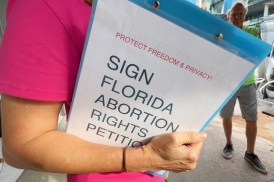 But when it comes to the issue of abortion, she’s breaking with her party.
“Women are concerned about what’s happening with our bodies and our right to choose. And there’s a lot of people that you wouldn’t think would be the pro-choice advocates, but they are,” she said. “And the government overreach, it’s huge right now.”
Carter is one of more than 150,000 registered Republican voters who have signed a petition in support of a ballot amendment that would bar the state from restricting abortion “before viability” — which is usually at 24 weeks — or “when necessary to protect the patient’s health.”
That total comes from the Florida Women’s Freedom Coalition, one of several groups working to gather the 891,523 signatures necessary to get the measure on the ballot, working with Floridians Protecting Freedom, the campaign leading the ballot initiative. The group says it has gathered and submitted more than 1.3 million signatures so far. The website of the Florida Division of Elections says it has validated 687,699 signatures as of mid-December.
Florida is one of nine states where groups are pushing to get measures on the ballot that would bar restrictions on abortion rights, following a streak of wins for similar measures in Kansas and Ohio.
And as the Feb. 1 deadline to get the petitions submitted and verified approaches in Florida, some Republican voters are coming out publicly to support and even advocate for it.
Very interesting. I wonder if Ron DeSantis has heard about this yet?
This is the day that House Republicans ordered Hunter Biden to undergo a behind-closed-doors deposition. In a surprise move, Biden held an impressive press conference, in which he reiterated his willingness to answer questions at a public hearing.
Luke Broadwater at The New York Times: Hunter Biden, Defying Deposition Subpoena, Again Offers Public Testimony.
Hunter Biden, the president’s son, appeared on Capitol Hill on Wednesday morning to offer to publicly testify in House Republicans’ impeachment investigation into his father, though he insisted he would not appear for a private deposition they scheduled over his refusals.
The younger Mr. Biden, who has been served a subpoena to testify, spoke to reporters in a hastily called news conference outside the Capitol near the Senate, across the complex from a House office building where Republican lawmakers were waiting to question him behind closed doors.
“I am here,” Mr. Biden said. “Let me state as clearly as I can: My father was not involved in my business.”
“There is no evidence to support the allegations my father was involved in my business because it did not happen,” he added.
The younger Mr. Biden has objected to providing private testimony, saying he fears Republicans will selectively leak his remarks and try to distort what he says. He has repeatedly proposed that he appear at a public hearing instead to answer their questions.
“They have lied over and over,” Mr. Biden said of Republicans.
Republicans have threatened to hold him in contempt of Congress if he does not comply.
Jacqueline Alemany and Matt Viser at The Washington Post: Ahead of House GOP vote on impeachment inquiry, Hunter Biden defies subpoena.
Hunter Biden will not appear for a closed-door deposition Wednesday, defying a subpoena from House Republicans who are investigating the Biden family’s finances.
“I’m here to testify at a public hearing today,” Hunter Biden said in a statement outside of the Capitol on Wednesday morning. “Republicans do not want an open process where Americans can see their tactics … or hear what I have to say.” [….]

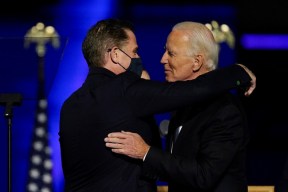
Hunter Biden
Hunter Biden maintained that he would answer questions only in a public hearing. His legal team has pointed to past comments in which House Oversight Committee Chairman James Comer (R-Ky.) all but dared Hunter Biden to testify — publicly or privately — and the team has said they don’t trust House Republicans not to selectively leak his testimony.
“For six years I’ve been targeted by the unrelenting Trump Machine asking ‘where’s Hunter,’” Hunter Biden said. “Here’s my answer: I am here.”
Comer over the past two weeks has rebuffed Hunter Biden’s offer to publicly testify before the committee, and Republicans on Wednesday vowed to move expeditiously to initiate proceedings to hold him in contempt of Congress for defying their subpoena.
Hunter Biden “does not get to dictate the terms of the subpoena,” Comer told reporters outside of an empty hearing room where Hunter Biden was scheduled to be deposed. Pressed about whether he has found evidence that President Biden had engaged in wrongdoing or criminal conduct, Comer said he had found “some very serious evidence,” before citing two examples of banking records he has repeatedly mischaracterized.
The fake charges against President Biden:
The foundation of the impeachment inquiry, outlined by Judiciary Committee Chairman Jim Jordan (R-Ohio) in a briefing with reporters last week, rests on an unsubstantiated accusation that has become the linchpin of allegations regarding the Biden family’s purported corrupt and criminal conduct.
 Republicans allege that Joe Biden as vice president pushed for the firing of Ukraine’s top prosecutor, Viktor Shokin, to quash a probe into the former owner of Burisma, the Ukrainian gas company where Hunter Biden sat on the board. That allegation has been widely refuted by former U.S. officials, as well as Ukrainian anti-corruption activists.
As part of the inquiry, House Republicans also have elevated claims that the Biden administration slowed a Justice Department investigation into Hunter Biden’s financial background, but that testimony has been repeatedly disputed by officials involved in the case.
“There is no fairness or decency in what these Republicans are doing. Their false facts have become the beliefs of too many people,” Hunter Biden said Wednesday.
“They have taken the light of my dad’s love for me and presented it as darkness,” he continued. “They have no shame.
Jonathan Chait at New York Magazine: We Were Told Biden Is Secretly Running the DOJ. Why Is His Son Being Charged?
It has long been an article of faith on the right that Attorney General Merrick Garland is prosecuting Donald Trump because President Biden wants him to. Even the Trump-skeptical corners of the conservative media casually assert, without bothering to supply any evidence for the charge, that Biden is behind the DOJ investigations.
“Biden Justice Department officials and Democratic prosecutors are currently trying to put the other side’s leading contender for the White House in jail … The vapors over Trump saying he’s going to target his enemies,” argues National Review editor-in-chief Rich Lowry, “is rich coming from people who have targeted their enemy by any means necessary for years now.”
“Meantime, a Justice Department special counsel has filed trumped-up charges against Mr. Trump for allegedly defrauding the U.S. … writes Wall Street Journal columnist Allysia Finley, “Abuse executive power. Ignore the law. Run roughshod over individual liberties. Retaliate against political opponents. Mr. Biden and his allies have done exactly what they warn Mr. Trump will do if he returns to the White House.”
You’d think those conservatives might be questioning this assumption, now that Garland’s Justice Department is prosecuting Joe Biden’s son for tax evasion. But no, they’re just pretending it isn’t happening.
There was never any basis for the charge that Garland is working at Biden’s behest. Garland is well-respected by legal types in both parties — that’s why Barack Obama thought he was the only Supreme Court nominee who stood any chance of confirmation by a Republican Senate in 2016 — and received 70 votes for his confirmation.
Unlike Trump, who repeatedly demanded his attorneys general prosecute his enemies and let his criminal buddies go free, and made these demands privately with even more corrupt intent, there is zero public evidence or reporting to suggest Biden has improperly tried to influence Garland’s decisions.
What’s more, the two Justice Department cases against Trump both flow directly from publicly identifiable sources. Trump is being charged in the documents case because the National Archive asked him to return government property, he refused, and then covered up his crimes when the FBI came looking. The January 6 case comes directly out of an investigation by a House committee that turned up damning evidence….
Indeed, the president is angry with his attorney general. “Biden’s relationship with Garland — which was already tense — has become more frigid amid Biden’s frustration at the lengthy criminal investigation and now prosecution of Hunter by the Justice Department,” reports Alex Thompson, “People close to Biden also have fumed at Garland for appointing a special counsel in August.” Thompson also reports, “One person close to the president unflatteringly compared Garland to the former FBI director James Comey, claiming they both have been obsessed with the appearance of having integrity rather than just trying to make the right decision.”
Read the rest at the link.
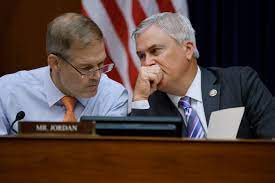
The accusers: Jim Jordan and James Comer
The New York Times: House Set to Approve Biden Impeachment Inquiry as It Hunts for an Offense.
The Republican-led House is on track to approve a formal impeachment inquiry into President Biden on Wednesday, pushing forward with a yearlong G.O.P. investigation that has failed to produce evidence of anything approaching high crimes or misdemeanors.
Republicans say the vote, which is expected in the evening, is needed to give them full authority to carry out their investigations amid anticipated legal challenges from the White House. Democrats have denounced the inquiry as a fishing expedition and a political stunt.
G.O.P. leaders refrained for months from calling a vote to open an impeachment inquiry, given the reservations of mainstream Republicans, many of them from politically competitive districts, about moving forward without proof that Mr. Biden did anything wrong. But the political ground has shifted considerably, and most of them are now willing to do so, emphasizing that they are not yet ready to charge the president.
“Voting in favor of an impeachment inquiry does not equal impeachment,” Representative Tom Emmer of Minnesota, the No. 3 House Republican, said at a news conference on Tuesday. “We will continue to follow the facts wherever they lead, and if they uncover evidence of treason, bribery or other high crimes and misdemeanors, then and only then will the next steps towards impeachment proceedings be considered.”
Read more at the NYT. I guess we’ll learn later today if the Republicans have the votes for their impeachment inquiry without a shred of evidence to support it.
More stories worth checking out today:
AP: Biden takes a tougher stance on Israel’s ‘indiscriminate bombing’ of Gaza.
The New York Times: Top Court Clears Path for Democrats to Redraw House Map in New York.
Reuters: US agency will not reinstate $900 mln subsidy for SpaceX Starlink unit.
The New York Times: In a First, Nations at Climate Summit Agree to Move Away From Fossil Fuels.
Shan Wu at The Daily Beast: Trump, Elon Musk, and Billionaire ‘Populists’ Threaten Democracy and Freedom.
Did you like this post? Please share it with your friends:
Posted: December 9, 2023 | Author: bostonboomer | Filed under: just because |
Good Morning!!

Painting by Carlton Alfred Smith
After all these years of carefully avoiding Covid-19, I finally came down with it about a month ago. I wasn’t that sick at first, and I never got any upper respiratory symptoms. However I became extremely weak and after several days, I sat down and was unable to get up again. I had to call 911, and I ended up in the hospital.
Once I got there, it turned out that the sodium level in my blood was dangerously low. That may have been responsible for my weakness. I had no idea that sodium was so important, but apparently it is. You can have seizures and other serious health problems if it is too low or too high.
Day after day the doctors tried to increase my sodium level. Fortunately, the hospital had very good food. I was never really hungry, but part of raising the sodium level was to eat! So I was in the hospital for about two weeks. Then I was transferred to a rehab, but I signed myself out after 3 days, because they weren’t doing anything for me.
I’m doing OK at home, although I’m still tired and somewhat weak. I seem to have a bit of a mental hangover from the Covid. My memory seems a little worse and I feel spaced out at times. I think it’s improving though.
I saw my own doctor on Wednesday, and learned that my sodium level is back in the low normal range. That is a relief, but I also tested low for iron and protein. I’m waiting to hear back from my doctor about this.
I did manage to stay abreast of the politics news while I was hospitalized. My TV got CNN, but not MSNBC, and I could read news on my phone. Unfortunately, the news has been disturbing, what with the clear evidence that Trump plans to turn our county into a dictatorship and the war between Israel and Hamas.
So what’s happening today? A real horror story in Texas where the government is forcing a woman to continue a pregnancy even though the fetus will not survive and continuing to carry it will likely result in the woman being unable to have any more children.
CNN: Texas Supreme Court temporarily blocks pregnant woman from emergency abortion.
The Texas Supreme Court has temporarily blocked a pregnant woman from obtaining an emergency abortion in a ruling issued late Friday.
The court froze a lower court’s ruling that would have allowed Kate Cox, who sued the state seeking a court-ordered abortion, to obtain the procedure. “Without regard to the merits, the Court administratively stays the district court’s December 7, 2023 order,” the order states.
The court noted the case would remain pending before them but did not include any timeline on when a full ruling might be issued. Cox is 20 weeks pregnant. Her unborn baby was diagnosed with a fatal genetic condition and she says complications in her pregnancy are putting her health at risk.
Following the ruling, Cox’s attorney said they remain hopeful the state’s request is quickly rejected. “We are talking about urgent medical care. Kate is already 20 weeks pregnant,” said Molly Duane, an attorney at the Center for Reproductive Rights. “This is why people should not need to beg for healthcare in a court of law.”
The ruling came just hours after Texas Attorney General Ken Paxton petitioned the high court to intervene in the case.
Paxton’s petition stemmed from a ruling on Thursday by a Texas judge who granted a 14-day temporary restraining order against the state’s abortion ban, so Cox could legally terminate her pregnancy.
The decision marked a significant development in the ongoing debate over the state’s medical exception to its controversial ban on abortions after six weeks – one of the strictest in the nation.

Elizabeth Allan Fraser Seated, Reading with a Cat., by Patrick-Allan-Fraser
More from The New York Times: Texas Supreme Court Temporarily Halts Court-Approved Abortion.
The Texas Supreme Court late Friday temporarily halted a lower court order allowing a Dallas woman to obtain an abortion in spite of the state’s strict bans, after she learned her fetus has a fatal condition.
The state court’s ruling was in response to an appeal from Attorney General Ken Paxton of Texas, who opposed the woman’s abortion.
The Supreme Court said that, “without regard to the merits” of the arguments on either side, it had issued an administrative stay in the case, to give itself more time to issue a final ruling.
The stay meant that, for the moment, the order from a judge in Travis County district court permitting the abortion was on hold. That order allowed the woman, Kate Cox, to obtain an abortion and protected her doctor from civil or criminal liability under Texas’s overlapping abortion bans.
“We fear that justice delayed will be justice denied,” said Molly Duane, a senior staff attorney at the Center for Reproductive Rights, which is representing Ms. Cox.
Paxon is a crook who has been under indictment for years and who recently survived an attempt by the legislature to impeach him.
While the Texas bans allow for exceptions to protect the health and life of a pregnant woman, doctors have said that vague legal language created fear of prosecution and an unwillingness to perform abortions.
Mr. Paxton’s filings came hours after a district court judge issued a temporary restraining order barring Mr. Paxton and others from enforcing the state’s overlapping abortion bans against Ms. Cox’s doctor, Damla Karsan, or anyone who assisted her with providing an abortion to Ms. Cox.
In granting the order, the judge, a Democrat, found that Ms. Cox, 31, a mother of two young children living in the Dallas area, met the criteria for an exception to the state’s abortion bans. Her fetus was diagnosed with trisomy 18, a fatal condition in all but a small number of rare cases; Ms. Cox, who is 20 weeks pregnant, had been to the emergency room several times for pain and discharge during her pregnancy.
On Friday, lawyers from the Center for Reproductive Rights, which is also representing Dr. Karsan, filed a response to Mr. Paxton with the state’s highest court.
“The State’s mandamus petition is stunning in its disregard for Ms. Cox’s life, fertility, and the rule of law,” the lawyers for Ms. Cox wrote. “Plaintiffs respectfully request that this Court deny the writ and instruct the Attorney General to comply with binding orders from a Texas court.”
A ruling would apply only to Ms. Cox and her current pregnancy.

Abbott Handerson Thayer (American painter, (1849-1921) Favorite Kitten
A large majority of Americans support abortion rights. At Politico, Alice Miranda Ollstein and Adam Cancryn suggest that what’s happening in Texas could help Democrats in 2024: Dems want to focus on abortion rights. A Trump ally may have just helped.
A showdown in Texas over one woman’s right to terminate a non-viable pregnancy could keep abortion at the center of the 2024 election and change the trajectory of legal challenges to state bans.
The case underscores the legal and ethical gray areas physicians have faced since the Supreme Court overturned Roe v. Wade. And it has amplified a debate over who is exempt from strict abortion bans, who has legal standing to challenge the bans and the liabilities doctors risk in interpreting vague laws with stiff penalties as they help patients navigate time-sensitive medical crises.
Legal experts say the Texas case’s implications stretch far beyond the state’s borders and highlight the defects of a post-Roe legal regime in which a patchwork of state laws is open to clashing interpretations. Several states have vaguely worded exemptions to their abortion bans that rely on the judgment of medical providers to decide who is sick enough to qualify. And those doctors risk losing their license, and can face steep fines or years in prison if a jury disagrees with their call.
“All of this confusion is revealing that Dobbs is not itself workable,” said Greer Donley, a law professor at the University of Pittsburgh, referring to the case that overturned Roe. “Dobbs is premised on the distinction between elective and therapeutic abortions, that … you can ban one while protecting the other. We’re learning in real time that that’s not possible.”
Read more at the Politico link.
Recently, there have been a number of stories in the mainstream media acknowledging the obvious fact the Trump plans to turn our country into a dictatorship modeled on Putin’s Russia and Kim Jong Un’s North Korea. Now the Trump campaign is trying to put the genii back in the bottle.
The Washington Post: Trump camp escalates attempt to limit second-term talk from outside allies.
Top officials in Donald Trump’s campaign sought Friday to quell discussions about his possible second term in the White House, amid alarms about authoritarianism and reports about personnel.
“Let us be very specific here: unless a message is coming directly from President Trump or an authorized member of his campaign team, no aspect of future presidential staffing or policy announcements should be deemed official,” Susie Wiles and Chris LaCivita said in a written statement to the media.
The unusual statement, which came after a similar message from the senior advisers last month, reflected growing concerns in Trump’s circle about some perceptions associated with his second term. It comes as experts and political opponents have raised alarms about the former president and his allies embracing authoritarian ideas and rhetoric.
Wiles and LaCivita added a warning to their missive: “Let us be even more specific, and blunt: People publicly discussing potential administration jobs for themselves or their friends are, in fact, hurting President Trump … and themselves. These are an unwelcomed distraction.” [….]

Two girls dressing a kitten by candlelight, by-candlelight-by-joseph wright of derby (1734-1797), English
The Washington Post and other outlets have previously reported that Trump and his allies have drawn up specific plans to use the federal government to punish his opponents, including discussions of invoking the Insurrection Act on his first day in office, which would allow him to use the military against civilian demonstrations. Trump, who is campaigning on his grievances and vowing retribution, has also repeatedly said that he sees his prosecutions as justification to turn the Justice Department and the FBI against his opponents.
Friday’s statement also came amid an escalating response from the campaign against reports describing a second Trump term that would be more extreme and autocratic than his first. Trump advisers, who have sought to run a more disciplined campaign compared with Trump’s previous ones, view those reports as unhelpful for the general election.
Trump, however, has at times undercut that message, including on Tuesday during a town hall with Fox News’s Sean Hannity. When asked whether he “would never abuse power as retribution against anybody,” Trump said, “Except for Day 1,” and proceeded to talk about drilling for oil and closing the border.
A coalition of right-wing groups known as Project 2025 has been preparing for an incoming Republican administration. But in light of reports about Trump’s potential second-term policies, including on immigration and personnel, Wiles reached out to the project’s director, Paul Dans of the Heritage Foundation, to tell him the reports were not helpful, The Post previously reported.
Putting a genii back in the bottle is not an easy thing. Democrats should run on the autocratic threats that Trump himself has made repeatedly.
The New York Times: Fears of a NATO Withdrawal Rise as Trump Seeks a Return to Power.
For 74 years, the North Atlantic Treaty Organization has been America’s most important military alliance. Presidents of both parties have seen NATO as a force multiplier enhancing the influence of the United States by uniting countries on both sides of the Atlantic in a vow to defend one another.
Donald J. Trump has made it clear that he sees NATO as a drain on American resources by freeloaders. He has held that view for at least a quarter of a century.
In his 2000 book, “The America We Deserve,” Mr. Trump wrote that “pulling back from Europe would save this country millions of dollars annually.” As president, he repeatedly threatened a United States withdrawal from the alliance.
Yet as he runs to regain the White House, Mr. Trump has said precious little about his intentions. His campaign website contains a single cryptic sentence: “We have to finish the process we began under my administration of fundamentally re-evaluating NATO’s purpose and NATO’s mission.” He and his team refuse to elaborate.
That vague line has generated enormous uncertainty and anxiety among European allies and American supporters of the country’s traditional foreign-policy role.
European ambassadors and think tank officials have been making pilgrimages to associates of Mr. Trump to inquire about his intentions. At least one ambassador, Finland’s Mikko Hautala, has reached out directly to Mr. Trump and sought to persuade him of his country’s value to NATO as a new member, according to two people familiar with the conversations.
In interviews over the past several months, more than a half-dozen current and former European diplomats — speaking on condition of anonymity for fear of retribution from Mr. Trump should he win — said alarm was rising on Embassy Row and among their home governments that Mr. Trump’s return could mean not just the abandonment of Ukraine, but a broader American retreat from the continent and a gutting of the Atlantic alliance.
Read more at the NYT.

Platt Powell Ryder – American artist, 1821–1896 Woman at Spinning Wheel
One more story on Trump’s autocratic plans from ABC News: Liz Cheney says Donald Trump’s ‘dictator’ remark should be taken ‘literally and seriously.’
Former GOP Rep. Liz Cheney, who is warning about the potential dangers of a second Donald Trump presidency, said Americans should take his recent dictator remark “literally and seriously.”
Trump raised alarms earlier this week when he declined to flat out reassure the public that he wouldn’t abuse power if he is elected, instead telling Fox News host Sean Hannity he wouldn’t be a dictator “except on Day One.”
Some Republicans have suggested Trump was making a joke but Cheney — who had a lead role in investigating his actions after the 2020 election and on Jan. 6, 2021 — disagreed.
“I think we have to take everything that Donald Trump says literally and seriously,” Cheney said in an interview with ABC News Chief Washington Correspondent Jonathan Karl, which will air Sunday on “This Week.”
“And I think that we saw, frankly, what he was willing to do already after the 2020 election in the lead up to Jan. 6, after Jan 6,” she continued. “People need to remember that when Donald Trump woke up on the morning of Jan. 6, he thought he was going to remain as president. And we saw the extent to which he was willing to attempt to seize power when he lost an election.”
Cheney called it “wishful thinking” to believe that Trump would “now abide by the rulings of the courts or be stopped by the guardrails of our democracy.”
She is absolutely right.
Just a couple more stories before I don’t have the energy to continue:
Speaking of NATO, if Republicans continue to block U.S. aid to Ukraine, we may soon be forced to send U.S. troops into a shooting war. If Ukraine is no longer able to resist being taken over by Russia, Putin will not stop there. If he attacks a NATO ally, we will be forced to a war that could possibly become World War III.
BBC News: Laura Kuenssberg: Ukraine in ‘mortal danger’ without aid, Olena Zelenska warns.
Olena Zelenska has warned that Ukrainians are in “mortal danger” of being left to die if Western countries don’t continue their financial support.
Ukraine’s first lady spoke to Sunday with Laura Kuenssberg a day after Republican senators in the US blocked a key aid bill.
It would have provided more than $60bn (£47.8bn) worth of support to Ukraine.
Speaking hours after a Russian missile attack, she said: “If the world gets tired, they will simply let us die.”

Auguste Lorange (1830-1875) Girl sleeping with kittens
The White House has warned that US funds for Ukraine could soon run out, but Republicans have held up a deal to authorise more assistance.
They are seeking to secure compromises from President Joe Biden and Democrats in Congress on funding for US border measures, in exchange for their support.
President Biden said the failure to agree Ukraine aid would be a “gift” for President Vladimir Putin, warning history would “judge harshly those who turned their back on freedom’s cause”.
Nearly two years since Russia’s illegal invasion of Ukraine, the first lady expressed grave concern over delays in funding.
In an exclusive interview to be broadcast on Sunday, Olena Zelenska told the BBC the slowdown in aid represented a “mortal danger” for her country.
She said: “We really need the help. In simple words, we cannot get tired of this situation, because if we do, we die.
“And if the world gets tired, they will simply let us die.”
The first lady continued: “It hurts us greatly to see the signs that the passionate willingness to help may fade.
“It is a matter of life for us. Therefore, it hurts to see that.”
Another “first lady,” Casey DeSandis, really put her foot in it yesterday.
The Daily Beast: Florida First Lady’s Plea to ‘Moms and Grandmoms’ Sows Confusion.
Florida first lady Casey DeSantis sparked confusion on the campaign trail Friday after calling on supporters of her husband, Ron DeSantis, to flock to Iowa to participate in its looming caucuses.
“We’re asking all of these moms and grandmoms to come from wherever it might be—North Carolina, South Carolina—and descend upon the state of Iowa to be a part of the caucus because you do not have to be a resident of Iowa to be able to participate in the caucus,” Casey DeSantis said during an appearance on Fox News.
“So moms and grandmoms are going to be able to come and be a part and let their voice be heard in support of Ron DeSantis,” she continued.
The Iowa Republican party then issued a reminder that, actually, “you must be a legal resident of Iowa and the precinct you live in and bring photo ID with you to participate in the #iacaucus.”
[Emphasis added] The Iowa Republican party then released a statement explaining that you must live in Iowa in order to participate in the caucuses. Casey then pretended that she was only calling for volunteers, not out-of-state voters. Sure. Casey is apparently as dumb as her husband.
That’s all I have for you today. I know there is much more happening, so please post any thoughts and links on any topic in the comment thread.
Did you like this post? Please share it with your friends:










 peej
peej Carissa
 bostonboomer
 dakinikat
 ecocatwoman
 jjlo
jjlo mablue2
 Mama Lopez
 peggysue22
 quixote
 skydancingguestblogger
 Mona (aka Wonk the Vote)



 Sky Dancing
Recent Comments