Posted: September 5, 2023 | Author: bostonboomer | Filed under: Afternoon Reads, American Fascists, just because | Tags: anti-semitism, Covid, Democrats, Donald Trump, Elon Musk, Erikson's stages of psychosocial developent, George Conway, Jill Biden, MAGA shutdown, Mitch McDonnell, old age, prison, weather |

Isaac Levitan, Golden Autumn, Slobodka, 1889
Good Afternoon!!
Meteorological Autumn has begun, even though most of the country is still experiencing hot weather. Here in New England, it looks like we will have summer weather for at least the first half of September. It has been in the high 80’s lately, and later this week it will hit 92 for a couple of days. Of course it’s still comfortable here in my cozy apartment with my heat pump keeping things cool.
I was thinking this morning that I’m an orphan now. My Mom and Dad are both gone, along with all of their siblings. I’m in the older generation now. How does time go by so quickly? I can really tell that I’m old now. People my age (75) are dying every day. I come from long-lived stock on both sides, so I probably have a few years left, but you never know. I just hope I don’t live to see fascism take over the U.S.
Lately, I’ve been thinking about Erik Erikson’s stages of psychosocial development. Maybe you learned about his theory in school. I’ve always liked it.
— Infancy – Basic trust versus mistrust
— Toddler – Autonomy versus shame and doubt
— Preschool-age – Initiative versus guilt
— School-age – Industry versus inferiority
— Adolescence – Identity versus identity confusion
— Young adulthood – Intimacy versus isolation
— Middle age – Generativity versus stagnation
— Older adulthood – Integrity versus despair
I guess I’m finally moving into the 8th stage; but I still care a lot about what happens to the next generation, so I’m still partly in stage 7, generativity–when you care more about giving to the next generation than satisfying yourself.
When I was in grad school, my mentor, Richard, (who is gone now, too, sadly) used to teach that Erikson’s states are flexible. You can go back and repair the damage that happened in an earlier stage and you can be in more than one stage at a time. Because people live longer than in Erikson’s day, it can take longer to get into that last stage, where you are supposed to look back on your life and come to terms with all you have experienced, good and bad.
I do find myself looking back at times, reevaluating things that happened to me and reaching acceptance. I believe that I did repair damage from the past over the 40+ years since I’ve been sober, and I’ve learned to accept my life as it is most of the time.
Now back to the present moment, where we are up in the air as to whether our country will be a democracy or a dictatorship ruled over by an insane idiot. Today is a slow news day, but here is some news:
CNN: Capitol Hill doctor: McConnell did not have a stroke or seizure when freezing before cameras.
The Capitol’s attending physician, Brian Monahan, said in a new letter that Senate GOP Leader Mitch McConnell did not suffer a stroke or seizure – and is not suffering from Parkinson’s disease – after the 81-year-old Kentuckian was evaluated by a group of neurologists following two recent health scares in front of TV cameras.

Vincen Van Gogh, The Garden of St. Paul’s Hospital Leaf Fall
The new letter, released by McConnell’s office Tuesday, comes after he froze in front of cameras for the second time in as many months, raising questions about whether the GOP leader could continue to hold his powerful position atop the Senate GOP Conference. After he froze last week in Covington, Kentucky, McConnell was evaluated by four neurologists, according to a person familiar with the matter.
Monahan said in the Tuesday letter that he consulted with McConnell’s neurologists and conducted several evaluations, including brain MRI imaging and a test that measures electrical imaging in the brain.
“There is no evidence that you have a seizure disorder or that you experienced a stroke, TIA or movement disorder such as Parkinson’s disease,” the letter said.
So what did happen, then? No one knows.
It’s still unclear exactly why McConnell froze up for roughly 30 seconds each time.
The Republican leader’s office had attributed the two frozen moments to “lightheadedness,” and Monahan had indicated in a previous letter that it’s “not uncommon” for victims of concussion to feel lightheaded. McConnell suffered a concussion and broken ribs after falling at a Washington hotel and hitting his head in March, sidelining him from the Senate for nearly six weeks.
I still say he should retire. He’s 81, for heaven’s sake!
The media keeps telling us that Republicans are going to force a government shutdown. Politico claims to know what Democrats are going to do about it: How Democrats are bracing for a ‘MAGA shutdown.’
There’s still a month to go, but Capitol Hill is girding for an appropriations breakdown — and Democrats are already strategizing over how to make Republicans pay for what some have already started calling a “MAGA shutdown.”
Their challenge: Maximizing the GOP political pain while avoiding blame themselves. After all, it has been a full 10 years since the government has shut down with a Democrat in the White House. And this time, the president needs to win reelection in 14 months.

The Birch Wood, Gustav Klimt
“This is really going to be driven by the House,” Sen. Tammy Duckworth (D-Ill.) told reporters in the Capitol on Friday. “They’re the ones that are going to bring [a shutdown] upon the country.”
To be sure, top House Democrats are still hoping to avoid a shutdown, and the party’s rank-and-file stands ready to approve a bipartisan deal — preferably a clean stopgap with some amount of Ukraine and disaster aid attached, likely sent over from the Senate.
But the key funding decisions lie with Speaker Kevin McCarthy and his capricious Republican conference, and putting a deal along those lines up for a vote could prove disastrous to McCarthy’s standing as leader.
With members of the hard-right Freedom Caucus escalating their threats, Democratic leaders want their members to stay unified around a message decrying GOP hostage-taking and accusing Republicans of reneging on a bipartisan deal on spending caps reached in May.
A solid Democratic front, the thinking goes, will squeeze Republicans from districts won by President Joe Biden and force McCarthy to the negotiating table. Absent that pressure, “I don’t think there’s a lot of hope that Kevin McCarthy for once will actually stand up to the far right,” said Rep. Gerry Connolly (D-Va.).
The House comes back next week, so I guess we’ll learn more about their idiotic plans then.
CNN: First lady Jill Biden tests positive for Covid-19.
First lady Jill Biden tested positive for Covid-19 on Monday and is experiencing “mild symptoms,” the White House said. President Joe Biden has tested negative.
The diagnosis has upended the first lady’s plans to begin teaching the fall semester at Northern Virginia Community College on Tuesday. She is working with the school to “ensure her classes are covered by a substitute,” Vanessa Valdivia, the first lady’s spokesperson, said.
Dr. Biden, 72, who remains at the family’s home in Rehoboth Beach, Delaware, typically teaches on Tuesday and Thursdays.
Biden will be “monitored by the White House medical team” after her diagnosis and follow the team’s advice about when to return the White House, Valdivia said. In addition to starting school on Tuesday, Biden was supposed to speak in the evening in Fort Belvoir, Virginia, at a send-off dinner for the US team competing in the Invictus Games in Düsseldorf, Germany next week, but now she will not participate, Valdivia said.
An administration official told CNN Monday that there are no changes to White House Covid protocols or to the president’s schedule at this time.
I just hope the president doesn’t come down with it.

Claude Monet, Autumn on the Seine at Argenteuil, 1873
Raw Story: George Conway reveals why ‘nihilist’ Republicans have turned ‘anti-American.’
George Conway diagnosed the underlying problem that’s causing Republicans to undermine military readiness and attack law enforcement.
Sen. Tommy Tuberville (R-AL) continues to block military promotions to force the reversal of a Pentagon policy granting leave and travel expenses for military personnel stationed in states where they cannot obtain an abortion, but the conservative Conway told MSNBC’s “Morning Joe” the political stunt was emblematic of the GOP’s attitude toward the U.S. government at large.
“They hate the United States military because it’s a part of the United States government,” Conway said. “This is basically, the Republicans have become anti-American, anti-government, anti-the United States. That’s their shtick now. That’s why they’re attacking the State Department, FBI, prosecutors, and they attack the institutions that normally Republicans were very, very supportive of — now, it’s just this nihilistic attack on American institutions.”
More Conway from HuffPost via Yahoo News: ‘Beyond Question’: George Conway Hits Trump With Dire Prison Prediction.
Conservative attorney George Conway said Donald Trump should be locked away for good if he’s found guilty in the two federal cases currently pending against him.
The former president has been charged in Washington for his attempts to cling to power after the 2020 election, and in Florida over his retention of classified documents.
Conway shared a tweet from former federal prosecutor Elizabeth de la Vega, who wrote that Trump should be given a prison sentence “equal to or greater than” the sentences handed down in other key Jan. 6 cases if convicted in Washington.
That would make 18 years a starting point ― but Conway said the 77-year-old former president’s potential prison time could be much longer than that if he’s convicted in the classified documents case.
“It’s beyond question he should spend the rest of his natural life in prison,” Conway wrote on X, the site formerly known as Twitter….
Conway has called the Florida case against Trump “airtight,” and said “he should and he will” go to jail over it “because the obstruction case is just so strong.”
If only . . .

Cresheim Glen, Wissahickon, Autumn, 1964
The Guardian: Elon Musk threatens to sue Anti-Defamation League over lost X revenue.
Elon Musk has threatened to sue the Anti-Defamation League after accusing the civil rights group that campaigns against antisemitism and bigotry of trying to “kill” his X social media platform.
The owner of X, formerly known as Twitter, said the ADL was trying to shut down his company by “falsely accusing it and me of being antisemitic”.
In a series of posts on X, Musk said advertising sales for the business were down 60% and “based on what we’ve heard from advertisers, ADL seems to be responsible for most of our revenue loss”.
The world’s richest man also indicated that he would sue the group for defamation, posting on X that “it looks like we have no choice but to file a defamation lawsuit against the Anti-Defamation League … oh the irony!”
Musk recently sued another anti-hate speech group, the Center for Countering Digital Hate, in a lawsuit accusing it of damaging X’s relationship with advertisers. CCDH has said it will fight the lawsuit and keep holding “Twitter’s feet to the fire”.
In his posts on Tuesday, Musk added that to be “super clear” he was in favour of free speech “but against antisemitism of any kind”.
Yeah, right. If Musk sues, the ADL will be able to get discovery of all the anti-Semites and Nazis Musk let back on Twitter, so he’s unlikely to do it, but you never know. The guy is really stupid, as far as I can tell.
This is from Josh Marshall at Talking Points Memo: Musk’s Epic, Antic Labor Day Weekend Against The Jews.
Because Twitter is no longer a publicly traded company with a public stock price there’s no straightforward way to assess its current value. But most market analysts estimate the company is now worth no more than a third of the $44 billion Musk paid for it a year ago. To be fair, Musk clearly overpaid for the company. He paid a premium over the company’s current stock price and even that price was probably inflated. But there’s no question Musk’s erratic and destructive reign has dramatically damaged the company, torching its public reputation and leading to a catastrophic decline in ad revenues which Musk and independent press reports have pegged at between 50% and 60%.

Gustave Courbet, Forest in Autumn, 1841
But Musk has found a new scapegoat: the Jews. Or rather, the Anti-Defamation League, the American Jewish community’s largest and oldest organization dedicated to fighting not only anti-Semitism but all forms of racial and religious bigotry and other forms of discrimination. But I suspect the “rather” or the distinction in general might be lost on Musk’s 155 million Twitter followers. Over the past several days Musk has gone on a tear claiming that the catastrophic decline in his company’s value since he purchased it is mostly or entirely the fault of the ADL and churning up Twitter debates that at least big time anti-Semitic accounts think is clearly boosting their cause.
As is often the case, Musk’s attacks have evolved out of tag teaming with notorious anti-Semitic accounts on the platform. It kicked off on Friday when Musk responded to a tweet by Keith Woods, an Irish white nationalist and self-described “raging anti-Semite.”
“ADL has tried very hard to strangle X/Twitter,” Musk told Woods.
From here, Musk went on to gin up support for the #BanTheADL hashtag while alternately claiming that he should ban the group but might not, before rolling into claims that the ADL was responsible for tens of billions of dollars of Twitter losses. This all culminated with Musk announcing he was being forced to sue the ADL “to clear our platform’s name on the matter of anti-Semitism.”
Discussing the defamation suit, Musk claimed the ADL could “potentially be on the hook for destroying half the value of the company, so roughly $22 billion.” Later he said that “giving them the maximum benefit of the doubt,” the ADL might only be responsible for $4 billion in damages.
Read the rest at TPM.
So that’s today’s news as I see it. Please share your thoughts and any other stories that interest you.
Did you like this post? Please share it with your friends:
Posted: September 2, 2023 | Author: bostonboomer | Filed under: Afternoon Reads, cat art, caturday, just because | Tags: Astrophysics, Coffee County GA, Elon Musk, FEMA, Jimmy Buffett, Joe Biden, Ron De Santis, Webb Space Telescope |

Christabel with cat by Camilla Dickerson
Happy Caturday!!
We’ve lost another musician from my generation. Jimmy Buffett has died last night at age 76. He was very popular in Boston and played outdoor concerts on the Boston Common many times.
From Kelly McClure at Salon: Jimmy Buffett got in one last summer before shipping off to the big Margaritaville in the sky.
There’s a poetry to Jimmy Buffett checking out just prior to a holiday that celebrates working. As a musician who built a reputation for himself as someone who encouraged grabbing on to leisure — and a frosty margarita — whenever possible, you can almost hear him saying, “Labor? Hard pass,” before kicking up his heels in a swaying hammock one last time.
According to an official statement posted to his website, “Jimmy passed away peacefully on the night of September 1st surrounded by his family, friends, music and dogs. He lived his life like a song till the very last breath and will be missed beyond measure by so many.” He was 76-years-old. No cause of death has been given at this time.
Throughout his career, Buffett shrugged off pressure to seem “cool” or insert himself as a cog in the machine of industry or publicity. His best known song, “Margaritaville” (released in 1977) was his only Top 10 hit. “What seems like a simple ditty about getting blotto and mending a broken heart turns out to be a profound meditation on the often painful inertia of beach dwelling,” Spin magazine wrote in 2021. “The tourists come and go, one group indistinguishable from the other. Waves crest and break whether somebody is there to witness it or not. Everything that means anything has already happened and you’re not even sure when.” Buffett broke the mold, and the world is a little less chill with him gone.
The New York Times’ take by Bill Friskics-Warren: Jimmy Buffett, Roguish Bard of Island Escapism, Is Dead at 76.
Jimmy Buffett, the singer, songwriter, author, sailor and entrepreneur whose roguish brand of island escapism on hits like “Margaritaville” and “Cheeseburger in Paradise” made him something of a latter-day folk hero, especially among his devoted following of so-called Parrot Heads, died on Friday. He was 76.
His death was announced in a statement on his website. It did not say where he died or specify a cause. Mr. Buffett had rescheduled a series of concerts this spring, saying he had been hospitalized, although he offered no details.
Peopled with pirates, smugglers, beach bums and barflies, Mr. Buffett’s genial, self-deprecating songs conjured a world of sun, salt water and nonstop parties animated by the calypso country-rock of his limber Coral Reefer Band. His live shows abounded with singalong anthems and festive tropical iconography, making him a perennial draw on the summer concert circuit, where he built an ardent fan base akin to the Grateful Dead’s Deadheads.
Mr. Buffett found success primarily with albums. He enjoyed only a few years on the pop singles chart, and “Margaritaville,” his 1977 breakthrough hit, was his only single to reach the pop Top 10.

By Noeline Mostert
“I blew out my flip-flop/Stepped on a pop-top/Cut my heel, had to cruise on back home,” he sang woozily to the song’s lilting Caribbean rhythms. “But there’s booze in the blender/And soon it will render/That frozen concoction that helps me hang on.”
Mr. Buffett’s music was often described as “Gulf and western” — a play on the name of the conglomerate Gulf & Western, the former parent of Paramount Pictures, as well as a nod to his fusion of laid-back twang and island-themed lyrics.
His songs tended to be of two main types: wistful ballads like “Come Monday” and “A Pirate Looks at Forty” and clever up-tempo numbers like “Cheeseburger in Paradise.” Some were both, like “Son of a Son of a Sailor,” a 1978 homage to Mr. Buffett’s seafaring grandfather, written with the producer Norbert Putnam.
“I’m just a son of a son, son of a son/
Son of a son of a sailor,” he sang. “The sea’s in my veins, my tradition remains/I’m just glad I don’t live in a trailer.”
The Caribbean and the Gulf Coast were Mr. Buffett’s muses, and no place was more important than Key West, Fla. He first visited the island at the urging of Jerry Jeff Walker, his sometime songwriting and drinking partner, after a gig fell through in Miami in the early 1970s.
“When I found Key West and the Caribbean, I wasn’t really successful yet,” Mr. Buffett said in a 1989 interview with The Washington Post. “But I found a lifestyle, and I knew that whatever I did would have to work around my lifestyle.”
Read more at the NYT.
I’m really in a vacation frame of mind right now. Even though I’m retired and don’t have to keep a rigid schedule, I seem to get this laid back feeling on holidays and long weekends. I don’t have to be anywhere or worry about anyone knocking on my door for three days. I just want to read a good book or watch a movie on TV and hang out. I just started reading Demon Copperhead by Barbara Kingsolver, and it’s very good. Anyway, I don’t feel much like focusing on politics today. And I especially don’t want to read anything about Donald Trump.
There’s a very interesting non-political opinion piece in The New York Times today by Astrophysicist Adam Frank and theoretical physicist Marcelo Gleiser: The Story of Our Universe May Be Starting to Unravel.
Not long after the James Webb Space Telescope began beaming back from outer space its stunning images of planets and nebulae last year, astronomers, though dazzled, had to admit that something was amiss. Eight months later, based in part on what the telescope has revealed, it’s beginning to look as if we may need to rethink key features of the origin and development of the universe.
Launched at the end of 2021 as a joint project of NASA, the European Space Agency and the Canadian Space Agency, the Webb, a tool with unmatched powers of observation, is on an exciting mission to look back in time, in effect, at the first stars and galaxies. But one of the Webb’s first major findings was exciting in an uncomfortable sense: It discovered the existence of fully formed galaxies far earlier than should have been possible according to the so-called standard model of cosmology.
According to the standard model, which is the basis for essentially all research in the field, there is a fixed and precise sequence of events that followed the Big Bang: First, the force of gravity pulled together denser regions in the cooling cosmic gas, which grew to become stars and black holes; then, the force of gravity pulled together the stars into galaxies.

Helena Wagenaar, South Africa
The Webb data, though, revealed that some very large galaxies formed really fast, in too short a time, at least according to the standard model. This was no minor discrepancy. The finding is akin to parents and their children appearing in a story when the grandparents are still children themselves.
It was not, unfortunately, an isolated incident. There have been other recent occasions in which the evidence behind science’s basic understanding of the universe has been found to be alarmingly inconsistent.
Take the matter of how fast the universe is expanding. This is a foundational fact in cosmological science — the so-called Hubble constant — yet scientists have not been able to settle on a number. There are two main ways to calculate it: One involves measurements of the early universe (such as the sort that the Webb is providing); the other involves measurements of nearby stars in the modern universe. Despite decades of effort, these two methods continue to yield different answers.
At first, scientists expected this discrepancy to resolve as the data got better. But the problem has stubbornly persisted even as the data have gotten far more precise. And now new data from the Webb have exacerbated the problem. This trend suggests a flaw in the model, not in the data.
Two serious issues with the standard model of cosmology would be concerning enough. But the model has already been patched up numerous times over the past half century to better conform with the best available data — alterations that may well be necessary and correct, but which, in light of the problems we are now confronting, could strike a skeptic as a bit too convenient.
Physicists and astronomers are starting to get the sense that something may be really wrong. It’s not just that some of us believe we might have to rethink the standard model of cosmology; we might also have to change the way we think about some of the most basic features of our universe — a conceptual revolution that would have implications far beyond the world of science.
Keep reading at the NYT link.
A few political stories:
CNN has an important article on Georgia’s Coffee County, where some Republicans are charged by Fani Willis with illegally accessing election data. Elle Reed and Samantha Guff at CNN: ‘Crooked Coffee’: The alleged election office breach in the Trump indictment was part of a years-long pattern, some locals say.
The breach of the Coffee County elections office can seem almost out of place in the 97-page Georgia indictment of former President Donald Trump and associates.
The sprawling racketeering allegations spread from centers of power with pressure on the vice president to ignore the Constitution, reported calls to secretaries of state to change vote counts, and the creation of slates of fake electors for Congress. They also include the invitation of a tech team to a non-public area of a small-town administration building.
But to some people in Coffee County, deep in southern Georgia and far from interstates, the alleged crimes were merely the latest chapter in a local history of failing to secure the rights and votes of residents. And they worry it’s a history that will repeat.
Among the 19 mugshots that flowed from the charges brought 200 miles north in Atlanta were faces that were familiar in Douglas, the seat of Coffee County.

By Virginia Di Savarino, Italy
Prosecutors allege that former county Republican Party chair Cathy Latham and former elections supervisor Misty Hampton helped to facilitate employees from a firm hired by Trump attorneys to access and copy sensitive voter data and election software. Surveillance video captured Latham waving the visitors inside, and Hampton in the office as they allegedly accessed the data. Both have pleaded not guilty.
Mike Clark, owner of some small businesses in Douglas, said he was struck by the way the surveillance footage showed the election officials entering the building in broad daylight. “You walk inside the voter registration office with no mask on, and they just give you the votes. They just give them to you! Why? Why would that be?” Clark said. “That shows you right there it ain’t just started. It’s always been just like that.”
Douglas City Commissioner Kentaiwon Durham agreed. “That’s what power and privilege do. It makes you feel as if you can do anything you want to do,” he said. “They thought they were above the law and above the Constitution.” Durham, who like Clark is Black, thought it would be “a whole different ballgame” if it were his face in the surveillance footage.
Douglas is a majority Black city, and the surrounding Coffee County is about 68% White and 29% Black. Like many places in the South, Black citizens have had to fight for democratic rights in court – repeatedly suing for representative districts for the election of local officials since the 1970s. In the late summer, it’s unbearably hot – so hot that if you sit outside too long people ask if you’re crazy. If you have a latent southern accent, the town will draw it out.
When CNN asked local people how to put the alleged election office breach in the broader context of voting rights in the county, nearly everyone suggested we speak to “Miss Livvy.” Olivia Coley-Pearson is a Douglas city commissioner, the first Black woman elected to the position. She’s a tall woman who wore a Barbie-pink blazer when we met, and like many others CNN spoke with in Coffee County, she saw the involvement of her county in the alleged Trump scheme as part of a long local pattern of voter suppression and intimidation.
“There’s power – a certain amount of power and control when you’re in certain offices,” Coley-Pearson told CNN. “Some people will do whatever it takes to maintain it. … And if it takes voter intimidation to do it, some people willing to intimidate to maintain that power and control.”
More details at the link.
Ron De Santis is such an asshole. Politico: DeSantis will not meet with Biden in Florida on Saturday.
Ron DeSantis will not meet Joe Biden on Saturday when the president comes to Florida to survey damage from Hurricane Idalia, the governor’s administration said Friday.
The governor’s office, in a statement, said the visit will disrupt recovery efforts.

Erzhena, the cat and the mobile phone. 2020, by Indira Baldano
“We don’t have any plans for the Governor to meet with the President tomorrow,” said Jeremy Redfern, DeSantis’ spokesperson, in a statement. “In these rural communities, and so soon after impact, the security preparations alone that would go into setting up such a meeting would shut down ongoing recovery efforts.”
The White House on Friday night said the president and first lady Jill Biden will still travel to Florida Saturday, along with Deanne Criswell, administrator of the Federal Emergency Management Agency. It remains unclear where and what time they will be in Florida.
“Their visit to Florida has been planned in close coordination with FEMA as well as state and local leaders to ensure there is no impact on response operations,” the White House said in a statement.
A White House official, who was granted anonymity to speak freely about the trip, said Biden informed DeSantis Thursday and the governor “did not express concerns at that time.”
As he was leaving Washington for Florida on Saturday morning, Biden said that he did not know what happened to the meeting, adding that “we are going to take care of Florida,” according to a pool report.
And Elon Musk is an even bigger asshole. Joseph Menn at The Washington Post: Musk’s new Twitter policies helped spread Russian propaganda, E.U. says.
Elon Musk’s X (formerly Twitter) has played a major role in allowing Russian propaganda about Ukraine to reach more people than before the war began, according to a study released this week by the European Commission, the governing body of the European Union.
The research found that, despite voluntary commitments to take action against Russian propaganda by the largest social media companies, including Meta, Russian disinformation against Ukraine, thrived. Allowing the disinformation and hate speech to spread without limits would have violated the Digital Services Act, the E.U.’s social media law, had it been in force last year, the year-long commission study concluded.

Vera and Lola, by Alberto Morrocco
“Over the course of 2022, the audience and reach of Kremlin-aligned social media accounts increased substantially all over Europe,” the study found. “Preliminary analysis suggests that the reach and influence of Kremlin-backed accounts has grown further in the first half of 2023, driven in particular by the dismantling of Twitter’s safety standards.” The social media platform was recently renamed X.
The E.U. has taken a far more aggressive regulatory approach to government-backed disinformation than the United States has. The Digital Services Act, which went into effect for the biggest social media companies Aug. 25, requires them to assess the risk of false information,stop the worst from being boosted by algorithms and subject their performance to auditing. Separately, European sanctions on Russian state media have prompted YouTube and other platforms to ban the likes of RT, the Russian news outlet formerly known as Russia Today that was once one of the most-followed channels.
The study is the starkest indication yet that the legal and voluntary measures are not getting the job done, following June warnings from E.U. Commissioner Thierry Breton that X had work to do to avoid potentially massive fines under the DSA. The research was conducted by nonprofit analysis group Reset, which advocates for greater oversight of digital platforms.
Musk has also been retweeting white supremacist posts and actually allowed a white supremacist ad on the platform. Read more here:
Mashable: Elon Musk ‘likes’ trending #BanTheADL posts as white supremacist ad runs on platform.
Over the past 24 hours, the hashtag #BanTheADL has been trending on X, the platform formerly known as Twitter. The trending hashtag refers to the Anti-Defamation League, the Jewish anti-extremism civil rights organization.
Even more concerning is that X owner Elon Musk has signaled support for the attacks against the ADL on the platform.
Within the same time frame, numerous X users have also reported being served an X-approved advertisement on the platform that promotes white supremacy.
Media Matters: Elon Musk again undermines X CEO Linda Yaccarino, reinforcing why advertisers can’t trust her promises about addressing hate speech.
After the Anti-Defamation League spoke with X’s new CEO about hate speech, Musk boosts anti-ADL posts from an antisemite he reinstated to the platform.
Elon Musk, the owner of the social media platform X (formerly Twitter), “liked” and responded to posts from a known antisemite with ties to white nationalist Richard Spencer demanding that the Anti-Defamation League be banned from the platform after its CEO spoke with X’s Linda Yaccarino.
On August 30, ADL CEO Jonathan Greenblatt posted that he had “a very frank + productive conversation” with Yaccarino and discussed what the platform needs to do “to address hate effectively on the platform.”
Following Greenblatt’s announcement, Keith Woods — an antisemitic YouTuber who has associated with Spencer and who was seemingly reinstated to the platform under Musk after previously being banned — posted that “the ADL is an anti-White organisation which waged financial terrorism against this platform as soon as Elon Musk took over in an attempt to stifle free speech. It’s time to #BanTheADL.”
In response, other right-wing figures and far-right accounts, including white nationalist and Holocaust denier Nick Fuentes, promoted the hashtag, contributing to “#BanTheADL” trending nationally on the platform.
Musk was among those who interacted with the hashtag, “liking” one of Woods’ tweets claiming the ADL is “financially blackmailing social media companies into removing free speech.” Woods subsequently bragged that “Elon Musk likes my call to #BanTheADL” and appeared to take credit for the hashtag trending.
You can read lots more on Twitter (I will never call it X) if you’re interested.
That’s it for me. Have a great Labor Day weekend!!
Did you like this post? Please share it with your friends:
Posted: August 31, 2023 | Author: bostonboomer | Filed under: Donald Trump, just because, morning reads | Tags: Diane Feinstein, Mark Meadows, Mitch McConnell, Trump court cases |
Good Morning!!
Lately, I’ve been thinking about how to feel about our chances of saving American democracy. Now that Trump and many of his cronies have been indicted, can we breathe easy? I think things are looking better, but it looks like Trump will get the Republican nomination no matter what happens with all his criminal and civil cases. It’s also highly likely that Trump and many of his allies will appeal court decisions again and again in order to delay convictions.
It seems that the Georgia case is likely to proceed quickly; but Trump is going to try to get his case transferred to federal court, as Meadows has already done, and both of them are going to appeal a negative decision all the way to the Supreme Court.
The January 6 case is also moving fairly quickly; but, again, there will be appeals.
The stolen documents case looked promising, but Judge Cannon is determined to protect Trump. It’s likely that Jack Smith will eventually have to appeal her rulings to the 11th Circuit. Whether she can be removed from the case is an open question.
It is very likely to come down in the end to Joe Biden beating Trump again in the 2024 election. I believe he can do it, but those of us who care are going to have to go through some anxious times. I’d be interested to know how others feel about all this.
Now, here’s what’s happening in political news and opinion.
Yesterday, Mitch McConnell had another public episode of “freezing up” while speaking to reporters. I’m guessing this has probably happened more then once–just not during a public appearance.
These could be mini-strokes or symptoms of Parkinson’s disease, according to CNN’s Dr. Sanjay Gupta. Gupta also suggested that these episodes have likely been more frequent than we know, base on the way McConnell’s aides seemed to immediately know what to do.
The New York Times: McConnell Freezes Up a Second Time While Addressing Reporters.
Senator Mitch McConnell of Kentucky, the longtime Republican leader who has appeared increasingly diminished and frail after a series of falls and a serious head injury this year, froze up suddenly during a news conference on Wednesday in Covington, Ky., the second such episode he has experienced on camera in recent weeks.
Mr. McConnell, 81, was taking questions from reporters after an event hosted by the Northern Kentucky Chamber of Commerce when he was asked for his thoughts on running for re-election in 2026. Mr. McConnell, who appeared thinner and paler than he has in recent months, began to answer the question with a slight chuckle and abruptly stopped speaking for about 30 seconds, standing motionless as he gripped his lectern with his mouth pursed and his eyes fixed.
When an aide approached to ask if he had heard the question, he mumbled “yes,” but he seemed unable to continue speaking or to move.
It was the second such incident in two months, and the scene intensified questions about Mr. McConnell’s health condition, his ability to serve and his future in the Senate.
Mr. McConnell had a concussion in March when he fell at a Washington hotel during a fund-raising event, and was absent from the Senate for weeks while giving almost no updates on his health status. Since then, he has had at least two more falls, which his office did not disclose.
Read more at the NYT link.
Politico: McConnell quickly convenes with allies after second public freeze.
The Senate GOP leader paused for roughly 30 seconds during a press availability in Kentucky, a little more than a month after a similar episode in the Capitol in late July. His office attributed both episodes to lightheadedness, adding that McConnell would consult on Wednesday with a physician as a precautionary measure.
That explanation may not stem questions when the Senate reconvenes next week. While worries about McConnell’s first freeze had faded somewhat during August recess, with even some critics publicly defending his abilities, the second incident is sure to trigger increased scrutiny of McConnell’s hold on the conference, as well as who might succeed him.
Senators quickly sought more information about McConnell’s health after the incident, according to one person familiar with the dynamics. Shortly after the Wednesday incident, McConnell held calls with his closest allies including Minority Whip John Thune (R-S.D.), Conference Chair John Barrasso (R-Wyo.) and Sen. John Cornyn (R-Texas), according to people familiar with the calls. All of them are potential successors to McConnell.
What’s going on in the Senate GOP behind the scenes?
Internally, McConnell is facing dual dynamics: His potential successors — Cornyn, Thune and Barrasso — are backing his leadership, staying supportive and say he’s sharp. There’s no mechanism to force another leadership race until the end of next year, though a group of five senators can call a special conference meeting to discuss the matter.
There’s no sign of that yet, though some Republican senators privately say his grip on the caucus and his engagement in meetings has waned since March. The dynamics are complicated by McConnell’s 2022 leadership race, in which he both won handily and faced his first opposition ever. He beat Sen. Rick Scott (R-Fla.), a former chair of the National Republican Senatorial Committee, 37-10. That means he has a built-in group of detractors amid the latest health queries.
McConnell has led the conference since 2007, the longest run for a Senate party leader in history. He will be up for reelection in 2026, and his pause on Wednesday occurred after a question about whether he will run again.
The GOP leader still has unfinished business. He’s trying to facilitate more aid to Ukraine and offer an alternate vision to former President Donald Trump. Trump and McConnell haven’t spoken since December 2020, and Trump continues to advocate for Republicans to replace McConnell. The Kentucky Republican refuses to speak about Trump even as the presidential candidate cruises toward the GOP nomination.
McConnell is also highly focused on flipping the Senate in 2024, particularly after 2022’s disappointing election losses. And he’s hoping to help Daniel Cameron, a former aide, win the Kentucky governorship this fall, even dispatching his chief of staff to the state to help beat Democratic Gov. Andy Beshear. If there is a Senate vacancy, the governor would select the replacement from a small group of Republicans recommended by the state GOP.
What’s happening with McConnell also puts the spotlight on 90-year-old Diane Feinstein.
Politico: Feinstein is a silent character in her sad and messy final chapter.
SAN FRANCISCO — A beach house in an exclusive neighborhood. A trust fund worth more than most Americans will see in a lifetime. A family so prominent that the increasingly acrimonious legal dispute must be turned over to an out-of-town judge.

Sen. Dianne Feinstein (D-Calif.), flanked by aides, arrives for a Senate Judiciary Committee meeting on Capitol Hill May 11, 2023. (Francis Chung/POLITICO via AP Images)
The feud over the estate left by Sen. Dianne Feinstein’s late husband, Richard Blum, has many of the ingredients of a Netflix thriller — complete with a billion-dollar fortune and the potential for a season-ending cliffhanger over whether she will unleash political chaos by retiring from the Senate. It’s the story that everyone is whispering about given the messy final chapter in the life of a grand dame of California politics.
The family struggle that has emerged in recent weeks raises fresh questions about the 90-year-old senator’s ability to serve. A review of the San Francisco Superior Court file, along with a half-dozen interviews with family friends and associates, suggests Feinstein appears to be almost completely removed from the legal brawl, despite her stature and vast knowledge of government and the law.
“The estate battle is a spectacle that diminishes people’s image and memory of her,” said Jerry Roberts, a journalist who wrote a biography of Feinstein and has closely followed her career for 50 years. “It’s a great sadness.”
The family legal battle mirrors the uncomfortable debate over her future in Washington — with Feinstein herself largely silent about the drama surrounding her.
Feinstein continues to serve in Congress despite questions about her ability to hold office, including memory issues amplified by muddled public comments and concerns about her overall health following a bout of shingles that sidelined her for nearly three months.
The stakes for her party are huge. If she were to step down before her term ends in early 2025, Senate Republicans have said they would prevent another Democrat from taking her place on the Judiciary Committee to block President Joe Biden’s federal court appointments. The Democrats lack the 60 votes needed to change committee assignments.
Read the rest at Politico.
And what is that “stable genius” Trump up to?
The Daily Beast: Trump Posts More than 30 Video Rants in One Day on Truth Social.
Former President Donald Trump went absolutely buck wild online Wednesday, posting more than 30 angry videos railing against his 2020 opponent Joe Biden, the Department of Justice, Democrats in general, Fox News, special prosecutor Jack Smith, Rupert Murdoch, and his own attorney general Bill Barr, among others. He bragged that his recent interview with Tucker Carlson has beaten Oprah’s interview with Michael Jackson as the most watched in history, and claimed the first Republican primary debate on Fox News was “one of the lowest rated EVER, if not THE LOWEST.” After hours of posting the rambling video messages, he paused to wish everyone in Florida dealing with Hurricane Idalia well—but immediately returned to his furious ranting. It’s unclear if anything in particular prompted the display, though he did promise on Tuesday to post more videos covering “many subjects in many timeframes.”
You can find some of the crazy videos on Twitter. Here’s one if you’re curious.
Martin Pengally at The Guardian: Donald Trump vows to lock up political enemies if he returns to White House.
Donald Trump says he will lock up his political enemies if he is president again.
In an interview on Tuesday, the rightwing broadcaster Glenn Beck raised Trump’s famous campaign-trail vow to “lock up” Hillary Clinton, his opponent in 2016, a promise Trump did not fulfill in office.
Beck said: “Do you regret not locking [Clinton] up? And if you’re president again, will you lock people up?”
Trump said: “The answer is you have no choice, because they’re doing it to us.”
Trump has encouraged the “lock her up” chant against other opponents but he remains in considerable danger of being locked up himself.
 Under four indictments, he faces 91 criminal charges related to election subversion, retention of classified information and hush-money payments to an adult film star. He denies wrongdoing and claims to be the victim of political persecution. Trials are scheduled next year….
Trump told Beck that Biden was behind the indictments against him. In fact, all were brought by prosecutors independent of the White House: 44 by the justice department special counsel Jack Smith, 34 by the Manhattan district attorney, Alvin Bragg, and 13 by Fani Willis, the district attorney of Fulton county, Georgia.
Trump also claimed “the woman that I never met, that they accused me of rape, that’s being run by a Democrat, a Democrat operative, and paid for by the Democrat [sic] party”.
That was a reference to civil claims brought by E Jean Carroll, a writer who says Trump sexually assaulted her in New York in the 1990s. Earlier this year, Trump was found liable for sexual abuse and defamation and fined about $5m. A second trial is due next year. The judge in the case has said Trump has been adjudicated a rapist.
Also facing investigations of his business affairs, Trump said Democrats and other opponents were “sick people … evil people”.
It’s still so hard for me to understand how anyone can support this maniac, but here we are.
The New York Times: Trump Asks to Dismiss Suit as A.G. Says He Inflated Worth by $2.2 Billion.
Before Donald J. Trump was indicted four times over, he was sued by New York’s attorney general, who said that for years the former president, his business and members of his family had fraudulently overvalued their assets by billions of dollars.
Before any of those criminal trials will take place, Mr. Trump is scheduled for a civil trial in New York in October. During the trial, the attorney general, Letitia James, will seek to bar him and three of his children from leading their family business, the Trump Organization, and to require him to pay a fine of around $250 million.
On Wednesday, Ms. James fired an opening salvo, arguing that a trial is not necessary to find that Mr. Trump and the other defendants inflated the value of their assets in annual financial statements, fraudulently obtaining favorable loans and insurance arrangements.
The fraud was so pervasive, she said in a court filing, that Mr. Trump had falsely boosted his net worth by between $812 million and $2.2 billion each year over the course of a decade.
“Based on the undisputed evidence, no trial is required for the court to determine that defendants presented grossly and materially inflated asset values,” the filing said.
But Mr. Trump’s lawyers, in their own motion, argued that the entire case should be thrown out, relying in large part on a recent appellate court decision that appeared as if it could significantly narrow the scope of the case because of a legal time limit. Mr. Trump had received most of the loans in question too long ago for the matter to be considered by a court, his lawyers argue.
Read more at the NYT.
One more before I wrap this up, an opinion piece by Chris Whipple (author of a book of White House chiefs of staff) in The New York Times: Mark Meadows Is a Warning About a Second Trump Term.
On Monday, Mark Meadows, a former White House chief of staff, testified in an effort to move the Georgia racketeering case against his former boss Donald Trump and co-defendants to federal court. On the stand, he said that he believed his actions regarding the 2020 election fell within the scope of his job as a federal official.
The courts will sort out his legal fate in this and other matters. If convicted and sentenced to prison, Mr. Meadows would be the second White House chief of staff, after Richard Nixon’s infamous H.R. Haldeman, to serve jail time.
But as a cautionary tale for American democracy and the conduct of its executive branch, Mr. Meadows is in a league of his own. By the standards of previous chiefs of staff, he was a uniquely dangerous failure — and he embodies a warning about the perils of a potential second Trump term.
Historically, a White House chief of staff is many things: the president’s gatekeeper, confidant, honest broker of information, “javelin catcher” and the person who oversees the execution of his agenda.
But the chief’s most important duty is to tell the president hard truths.
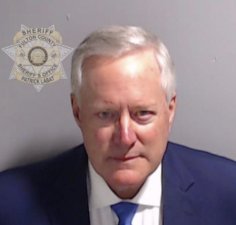 President Dwight Eisenhower’s Sherman Adams, a gruff, no-nonsense gatekeeper, was so famous for giving unvarnished advice that he was known as the “Abominable No Man.” In sharp contrast, when it came to Mr. Trump’s myriad schemes, Mr. Meadows was the Abominable Yes Man.
It was Mr. Meadows’s critical failure to tell the president what he didn’t want to hear that helped lead to the country’s greatest political scandal, and his own precipitous fall….
There used to be stiff competition for the title of history’s worst White House chief of staff. Mr. Eisenhower’s chief Adams was driven from the job by a scandal involving a vicuna coat; Mr. Nixon’s Haldeman served 18 months in prison for perjury, conspiracy and obstruction of justice in the Watergate scandal; and George H.W. Bush’s John Sununu resigned under fire after using government transportation on personal trips.
But the crimes Mr. Meadows is accused of are orders of magnitude greater than those of his predecessors. Even Mr. Haldeman’s transgressions pale in comparison. Mr. Nixon’s chief covered up a botched attempt to bug the headquarters of the political opposition. Mr. Meadows is charged with racketeering — for his participation in a shakedown of a state official for nonexistent votes — and soliciting a violation of an oath by a public officer.
Mr. Meadows didn’t just act as a doormat to President Trump; he seemed to let everyone have his or her way. Even as he tried to help Mr. Trump remain in office, Mr. Meadows agreed to give a deputy chief of staff, Chris Liddell, the go-ahead to carry out a stealth transition of power to Joe Biden. This made no sense, but it was just the way Mr. Meadows rolled. Mr. Trump’s chief is a world-class glad-hander and charmer.
Read the rest at the NYT.
That’s it for me today. What stories are you following?
Did you like this post? Please share it with your friends:
Posted: August 29, 2023 | Author: bostonboomer | Filed under: Afternoon Reads, American Fascists, Congress, Donald Trump, Joe Biden, just because | Tags: Catholic reactionaries, Franklin Foer, government shutdown, Mark Meadows, Pope Francis, Rep. Andrew Clyde, UNC Chapel Hill shooting |
Good Afternoon!!
As a lapsed Catholic, I was surprised and heartened yesterday to read that Pope Francis has criticized right wing American Catholics–several of whom sit on the Supreme Court.
From the AP via Yahoo News: Pope says some ‘backward’ conservatives in US Catholic Church have replaced faith with ideology.
Pope Francis has blasted the “backwardness” of some conservatives in the U.S. Catholic Church, saying they have replaced faith with ideology and that a correct understanding of Catholic doctrine allows for change over time.
Francis’ comments were an acknowledgment of the divisions in the U.S. Catholic Church, which has been split between progressives and conservatives who long found support in the doctrinaire papacies of St. John Paul II and Benedict XVI, particularly on issues of abortion and same-sex marriage.
Many conservatives have blasted Francis’ emphasis instead on social justice issues such as the environment and the poor, while also branding as heretical his opening to letting divorced and civilly remarried Catholics receive the sacraments.
Francis made the comments in a private meeting with Portuguese members of his Jesuit religious order while visiting Lisbon on Aug. 5; the Jesuit journal La Civilta Cattolica, which is vetted by the Vatican secretariat of state, published a transcript of the encounter Monday.
More details:
During the meeting, a Portuguese Jesuit told Francis that he had suffered during a recent sabbatical year in the United States because he came across many Catholics, including some U.S. bishops, who criticized Francis’ 10-year papacy as well as today’s Jesuits.
The 86-year-old Argentine acknowledged his point, saying there was “a very strong, organized, reactionary attitude” in the U.S. church, which he called “backward.” He warned that such an attitude leads to a climate of closure, which was erroneous.
“Doing this, you lose the true tradition and you turn to ideologies to have support. In other words, ideologies replace faith,” he said.
“The vision of the doctrine of the church as a monolith is wrong,” he added. “When you go backward, you make something closed off, disconnected from the roots of the church,” which then has devastating effects on morality.
“I want to remind these people that backwardness is useless, and they must understand that there’s a correct evolution in the understanding of questions of faith and morals,” that allows for doctrine to progress and consolidate over time.
I’m surprised this pope has lasted this long. I hope he has supporters in the hierarchy.
The Daily News added more specifics:
He said it was an “error” to consider the Church’s stances on issues a “monolith,” citing how it had changed positions in the past on issues like slavery.
“In other words, doctrine also progresses, expands, and consolidates with time and becomes firmer but is always progressing,” he said.
In regards to LGBTQ issues, he said, “It is apparent that perception of this issue has changed in the course of history.”
Well, that’s a breath of fresh air. Unfortunately, I doubt if the reactionaries in the Supreme Court and the Federalist Society will be swayed by Francis’ arguments.
NBC News has some specifics on the shooting at the University of North Carolina Chapel Hill yesterday.
NBC News: UNC-Chapel Hill graduate student charged with murder in fatal shooting of faculty member.
A graduate student at the University of North Carolina-Chapel Hill was charged with first-degree murder after the fatal shooting of a professor in his research department.
Tailei Qi, an applied physical sciences major, was apprehended Monday afternoon following the shooting at Caudill Labs, a science building on the UNC campus, which prompted an hourslong lockdown that forced students and faculty to barricade themselves in classrooms and dorms as authorities searched for a suspect.
Qi, 34, was booked Tuesday in the Orange County Detention Center in Hillsborough and also charged with possession of a gun on an educational property, a felony.
The incident, which occurred in the second week of the fall semester at UNC, began when students were alerted to an armed and dangerous person after 1 p.m. The university issued another alert at 2:24 p.m. that the suspect remained at large. A photo of an unnamed person was released, and the suspect was later apprehended in a residential neighborhood near campus.
It sounds like the victim–a faculty member–might have been targeted, but that’s just my speculation.
The victim was initially described as a university faculty member, and was not immediately identified pending notification of family. The arrest warrant names the shooting victim as Zijie Yan, an associate professor in the applied physical sciences department.
A university department web page that has since been removed had listed Qi as being a member of Yan’s lab group.
On his LinkedIn profile, Qi says he enrolled at UNC’s flagship campus in January 2022 as a graduate student and research assistant, and shared links to papers on his research. One paper published last month
in the journal Advanced Optical Materials was co-authored by Yan.
So the two were well known to each other. We’ll probably learn more in the coming days.
At The Daily Beast, attorney Shan Wu has a piece on Mark Meadows’ choice to testify under oath yesterday: Mark Meadows Just Took an Enormous Risk. Will It Pay Off?
Meadows wants out of the Fulton County court so badly that on Monday, he took the enormous risk of testifying in his own criminal trial and subjecting himself to cross-examination by the Fulton County District Attorney’s Office.
Meadows’ longing for federal court may seem puzzling because switching is but a change of courthouses. In federal court, Meadows will face the same charges, under the same state laws (including the Georgia RICO Act), brought by the same prosecutor.
However, Meadows may be counting on the fact that a federal trial would give him a broader geographic jury pool which might be more favorable to him. He also may think that a federal court would be more sympathetic to his argument that his position as a federal official should automatically make him immune from a state criminal prosecution.
Theoretically, Meadows’ removal argument under 28 U.S. code § 1442 doesn’t look that hard to make, since he only needs to show that he was a federal official at the time and that he can raise a “colorable legal defense.” Meadows was a federal official at the time as Trump’s White House chief of staff, so he can meet that part of the legal standard.
He also has a “federal defense” to raise based on so-called “Supremacy Clause Immunity,” meaning that as a federal officer he cannot be criminally prosecuted by a state for actions performed in his official federal capacity. The question though is whether that defense is a “colorable one” in these circumstances. In plain English, a “colorable defense” is just one that passes the smell test. That may prove challenging for Meadows.
The problem for Meadows is that he needs to convince federal judge Steve C. Jones–a former state judge appointed to the U.S. District Court by President Obama–that his actions in allegedly conspiring with Trump and 18 other co-defendants to overturn the election results in Georgia were part of his job description as White House chief of staff.
Holding aside the fact that the Hatch Act bars a federal official from using their office to engage in partisan political activity, Meadows must prove that his involvement in such acts as the phone call to Brad Raffensberger, in which Trump pressured the Georgia secretary of state to find votes for Trump, were just part of doing his job.
The federal government does not have the power to regulate presidential elections. A strict reading of Article II, Section 1, clause 4 of the Constitution would allow only regulation of the “time” of choosing presidential electors and certainly there is no known precedent for a White House chief of staff overseeing any aspect of a state election process.
Read more at the link.
Republicans are trying to find a way to shut down the prosecutions of Trump by any means necessary.
From NBC News:
WASHINGTON — Four criminal indictments of Donald Trump have ignited his followers and spurred his House Republican allies to try to use the upcoming government funding deadline of Sept. 30 as leverage to undermine the prosecutions.
The bad news for them: A government shutdown wouldn’t halt the criminal proceedings against the former president.
Trump’s indictments in New York and Georgia would not be affected, while his federal indictments — for allegedly mishandling classified documents and for his role in the Jan. 6 insurrection — are criminal matters that have been exempted from shutdowns in the past. The Justice Department said in a 2021 memo that in a shutdown, “Criminal litigation will continue without interruption as an activity essential to the safety of human life and the protection of property.” The Justice Department’s plans assume that the judicial branch remains fully operational, which it has said in the past can carry on for weeks in the event of a funding lapse.
Special counsel Jack Smith’s office is funded by a “permanent, indefinite appropriation for independent counsels,” the department said in its statement of expenditures. Given its separate funding source, the special counsel would not be affected by a shutdown and could run off of allocations from previous years.
So how are these idiots planning to stop the prosecutions?
As a result, Republicans are looking at ways to insert provisions in government funding legislation that would hinder federal and state prosecutors who have secured indictments of Trump, based on unproven claims that he’s being politically targeted.
It won’t be easy to achieve. The demands, spearheaded by hard-right Republicans, have sparked internal party divisions over reining in law enforcement power and will struggle to pass the House. The Justice bill is one of two appropriations measures the House GOP hasn’t yet passed, out of 12 total, a Democratic aide noted, which could signify splits about how to proceed. And Democrats, who control the Senate and the White House, are pushing back on those calls to derail law enforcement as interference in Trump’s cases….
Rep. Andrew Clyde, R-Ga., a Trump ally who sits on the Appropriations Committee, said Monday he will introduce two amendments to eliminate federal funding for all three of Trump’s prosecutors — Smith, Fulton County District Attorney Fani Willis and Manhattan District Attorney Alvin Bragg. His office said the measures would block their prosecutorial authority over “any major presidential candidate prior to” the 2024 election.
“Due to my serious concerns about these witch hunt indictments against President Trump, I intend to offer two amendments to prohibit any federal funds from being used in federal or state courts to prosecute major presidential candidates prior to the 2024 election,” Clyde said in a statement.
These so-called legislators have done nothing this session except “investigate” Hunter and Joe Biden and try to protect Trump.
A new book on the Biden administration by Franklin Foer is coming out on September 5. You can read an excerpt that focuses on the withdrawal from Afghanistan at The Atlantic.
This is from today’s Politico Playbook: A first look at the big new Biden book.
Atlantic staff writer FRANKLIN FOER originally set out to write an account of Biden’s first one hundred days in office, focusing on the Biden team’s response to the pandemic and the undoing of Trump’s major policies. But Foer kept reporting as the story of the American Rescue Plan, the Inflation Reduction Act, the Afghanistan withdrawal, Ukraine and ultimately the midterm elections unfolded.
Along the way he conducted nearly 300 interviews from November 2020 to February 2023. The result is his eagerly anticipated 407-page tome about Biden world: “The Last Politician: Inside Joe Biden’s White House and the Struggle for America’s Future” ($30).
In recent days Biden aides have been scrambling to secure a password-protected PDF of the book that has been sent to select journalists and reviewers, some of whom were required to sign nondisclosure agreements and promise not to share the contents with newsroom colleagues.
A major media rollout of the book is set to kick off this week. (In fact, we’ll be recording a conversation with Foer this afternoon for next week’s episode of the Playbook Deep Dive podcast.)
In the publishing world, “The Last Politician” is seen as a test of the market for political books about figures other than DONALD TRUMP. In Washington, the book will be a test for how a generally leak-proof White House grapples with the first detailed excavation of its successes and failures from the Inaugural through the midterms.
Minutes ago, the first excerpt of the Foer book was posted at the Atlantic and will appear across 13 pages in the magazine’s October issue. The piece — “The Final Days” — is a gripping history of America’s withdrawal from Afghanistan during August 2021, a month that marks one of the low points for a team that was elected for its competence. Foer’s account is notable both for his deep reporting as well as his shrewd insights into how Biden thinks, including the president’s unsentimental views on his decision to end America’s longest war.
Read more Politico-style analysis at the link.
That’s all I have for you today. Here’s hoping that Hurricane headed for Florida won’t cause too much damage. Take care everyone.
Did you like this post? Please share it with your friends:
Posted: August 27, 2023 | Author: bostonboomer | Filed under: just because | Tags: 60th anniversary, John F. Kennedy, John Lewis, Lincoln Memorial, March on Washington for Jobs and Freedom, Martin Luther King |
Good Day!!
Tomorrow is the 60th anniversary of the March on Washington for Jobs and Freedom, which took place on August 28, 1963.
In August of 1963, I was just about to begin my sophomore year in high school. I was so inspired by the the events I saw on TV that day! John Kennedy was president, Martin Luther King was a hero, and it seemed that the times they really were a-changing, to paraphrase Bob Dylan.
When I got back to school, I interviewed a number of my classmates who had attended the march, and wrote a feature article about their experiences for my school paper The Munsonian.
Little did we know that on November 22 that year, John Kennedy would be assassinated in Dallas. Lyndon Johnson carried out many of Kennedy’s goals; but his obsession with Vietnam destroyed his presidency, and he decided not to run for reelection.
On April 4, 1968, Martin Luther King would be assassinated. The man whom Kennedy had defeated in 1960 would win the 1968 presidential election, and the rest was history, so to speak. The high hopes for freedom and equality were dashed. Nixon and the Republicans used racial animus to gain power–the famous “Southern strategy.”
This page at The Smithsonian gathers interesting memorabilia from that day in 1963.
On August 28, 1963, more than 250,000 people gathered in the nation’s capital for the March on Washington for Jobs and Freedom. The march was the brainchild of longtime civil rights activist and labor leader A. Philip Randolph. With the support of the gifted organizer Bayard Rustin, the march was a collaboration of all factions of the civil rights movement. Originally conceived as a mass demonstration to spotlight economic inequalities and press for a new federal jobs program and a higher minimum wage, the goals of the march expanded to include calls for congressional passage of the Civil Rights Act, full integration of public schools, and enactment of a bill prohibiting job discrimination. The program at the Lincoln Memorial featured an impressive roster of speakers—including John Lewis—and closed with Dr. Martin Luther King Jr. Midway through his address, King abandoned his prepared text and launched into the soaring expression of his vision for the future, declaring, “I have a dream today.”
On 60th anniversary of the March on Washington, the Smithsonian’s National Museum of African American History and Culture reflects on its historical legacy. King’s “I Have a Dream Speech” will be on view in the museum for a limited time, Aug. 7–Sept. 18, 2023, in the Defending Freedom, Defining Freedom gallery.
People gathered in Washington DC over the weekend to mark the anniversary.
From the AP: Thousands converge on National Mall to mark the March on Washington’s 60th anniversary.
WASHINGTON (AP) — Thousands converged Saturday on the National Mall for the 60th anniversary of Rev. Martin Luther King Jr.’s March on Washington, saying a country that remains riven by racial inequality has yet to fulfill his dream.
“We have made progress, over the last 60 years, since Dr. King led the March on Washington,” said Alphonso David, president and CEO of the Global Black Economic Forum. “Have we reached the mountaintop? Not by a long shot.”
The event was convened by the Kings’ Drum Major Institute and the Rev. Al Sharpton ‘s National Action Network. A host of Black civil rights leaders and a multiracial, interfaith coalition of allies rallied attendees on the same spot where as many as 250,000 gathered in 1963 for what is still considered one of the greatest and most consequential racial justice and equality demonstrations in U.S. history.
Inevitably, Saturday’s event was shot through with contrasts to the initial, historic demonstration. Speakers and banners talked about the importance of LGBTQ and Asian American rights. Many who addressed the crowd were women after only one was given the microphone in 1963.
Pamela Mays McDonald of Philadelphia attended the initial march as a child. “I was 8 years old at the original March and only one woman was allowed to speak — she was from Arkansas where I’m from — now look at how many women are on the podium today,” she said.
For some, the contrasts between the size of the original demonstration and the more modest turnout Saturday were bittersweet. “I often look back and look over to the reflection pool and the Washington Monument and I see a quarter of a million people 60 years ago and just a trickling now,” said Marsha Dean Phelts of Amelia Island, Florida. “It was more fired up then. But the things we were asking for and needing, we still need them today.”
CBS News: On the March on Washington’s 60th anniversary, watch how CBS News covered the Civil Rights protest in 1963.
On Aug. 28, 1963, Walter Cronkite began his evening news broadcast with a vivid description of the March on Washington. The day would come to be a watershed moment in the equal rights movement for Black Americans.
“They called it the March on Washington for Jobs and Freedom,” said Cronkite. “They came from all over America. Negroes and Whites, housewives and Hollywood stars, senators and a few beatniks, clergymen and probably a few Communists. More than 200,000 of them came to Washington this morning in a kind of climax to a historic spring and summer in the struggle for equal rights.”
One of those clergymen was the Rev. Martin Luther King Jr., who made his famed “I Have A Dream” speech on the steps of the Lincoln Memorial on the afternoon of Aug. 28. He spoke for 16 minutes in a rallying cry for all to have equal rights….
The March on Washington for Freedom and Jobs was meant to support the Civil Rights Act, which President John F. Kennedy was attempting to pass through Congress. The act called for an expanded Civil Rights Commission, the desegregation of public schools and other locations and voting rights protections for Black Americans.
On the day of the march, more than 250,000 people walked from the Washington Monument to the Lincoln Memorial. Cronkite remarked that the march sometimes looked “more like a parade of signs than of people,” as marchers carried signs calling for equality and the end of police brutality.
Along the parade route was CBS News correspondent Dave Dugan. He called the enthusiasm of the march “contagious,” with older attendees “taking it rather relaxed and calmly” and younger marchers singing freedom songs like “We Shall Overcome,” bubbling with energy and “exuberance.”
The Civil Rights Act was signed into law by President Lyndon B. Johnson on July 2, 1964, after Kennedy’s assassination in Dallas in November of 1963. It outlawed discrimination based on race, sex and other protected classes, prohibited discrimination against voters of color and racial segregation in schools. It would be one of the most important legislative bills passed in American history.
NBC News: 60th March on Washington event merges Black America’s current concerns with history.
WASHINGTON, D.C.— As a teenager in 1963, Ann Breedlove rode in a caravan of buses and cars from Albany, Georgia, to the March on Washington. It took more than a day, she said, but the journey proved to be pivotal.
It was then that she learned of the power of fighting for justice, a cause she has taken up for the last six decades.
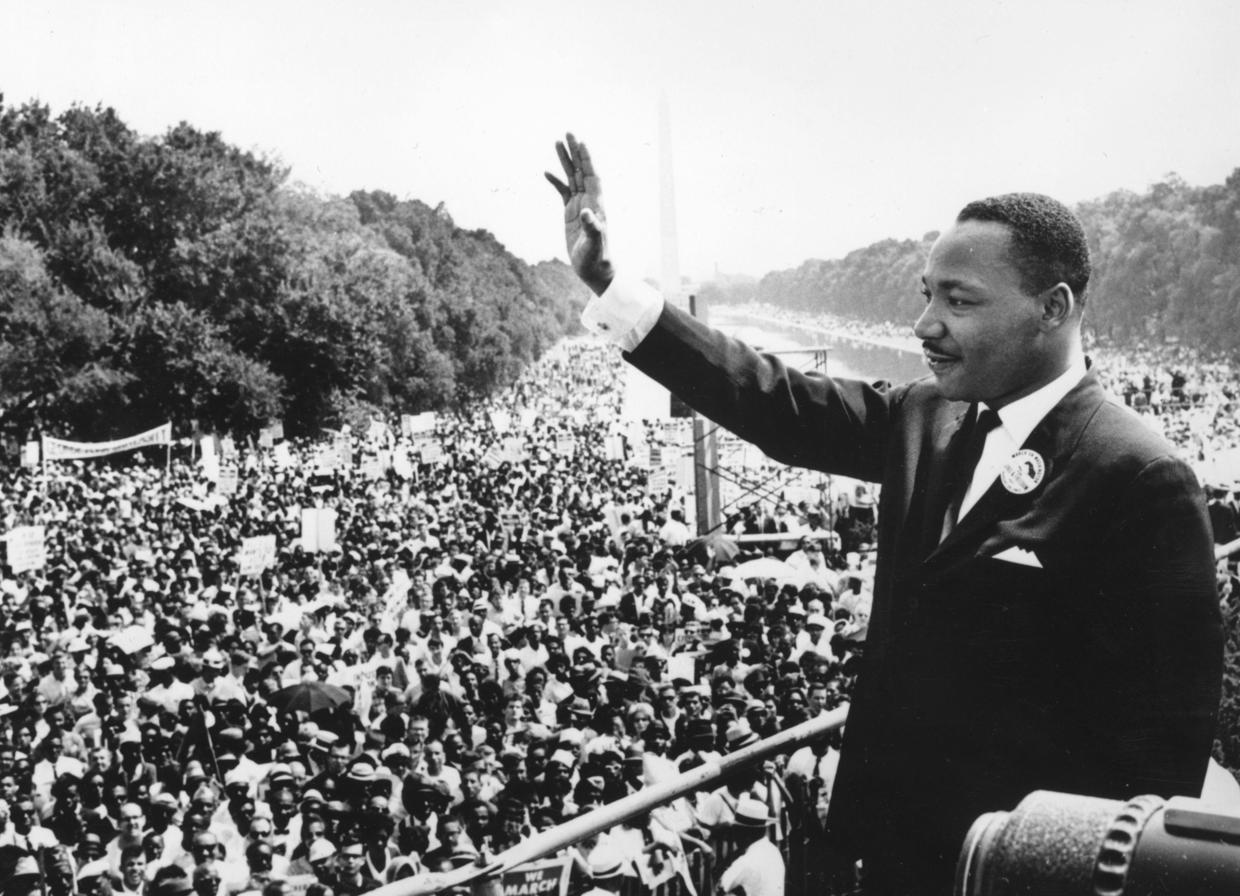 On Saturday, Breedlove was back in the shadow of the Lincoln Memorial for the 60th anniversary of the March on Washington. Her feelings on being there were mixed.
“I see many little children and young people walking around here and they will remember this day as a day that they were present for something that mattered,” said Breedlove, who now lives in Atlanta. “That’s what it was like for me. I wasn’t into social justice as a teenager. But coming to the march changed me. And that’s what this can do for these children here.”
The parade of dozens of speakers, each addressed many of the same concerns of the Aug. 28, 1963, March on Washington for Jobs and Freedom, speaking to the progress yet to be made. The emphasis then was multi-pronged: end segregation; strengthen voting rights; improved public education; fair wages and civil rights. It was a watershed moment in the Civil Rights movement, marked by Martin Luther King Jr.’s “I Have A Dream” speech, the most famous of the dynamic orator’s addresses.
Saturday was billed as a “continuation, not a commemoration,” hosted by a number of organizations, including Al Sharpton’s National Action Network and the Drum Major Institute, which is modeled after King’s principles. The speakers addressed some of the aforementioned issues, along with the added concerns over Black history being scrubbed from K-12 education, the chipping away of abortion access, the Supreme Court abolishing race-conscious college admissions, and a reversal on LGBTQ rights.
“It’s a shift, a change that has taken place,” Breedlove said. “It’s too bad we are still talking about these issues. But our leaders and Black people are speaking louder. We’re tired — sick and tired — of asking for justice. It’s time to fight back. I’m a great grandmother who remembers the Ku Klux Klan raiding our house and us having to get under the bed when they came on their horses. Today is different. That’s not happening. But we still are getting it in different ways.”
“Our voices are going to be louder than the politicians,” she added, “who are not doing what they need to do to help us.”
Another speaker at the 1963 march was a young John Lewis. An opinion piece by Rutgers history professor David Greenberg at The New York Times: How John Lewis Saved the March on Washington.
The tides of history sand down complex events to smooth, shiny baubles, and the 1963 March on Washington for Jobs and Freedom — whose 60th anniversary arrives Monday, Aug. 28 — is no exception.
This oversimplification of history is at work not only with respect to Martin Luther King’s historic speech, which decried persistent Black poverty before dreaming of racial harmony, but also that of John Lewis, at 23 the march’s youngest speaker. Anointed a veritable saint before his death in 2020, Lewis was regarded back then as an enfant terrible fronting a headstrong new generation of rebels. Neither caricature quite captures the principled yet pragmatic Lewis, whose 1963 speech bluntly assailed deficiencies in the civil rights bill others were championing — but who succeeded in doing so without undermining the day’s unity.
Lewis’s experience with his controversial speech offers us a window onto the competing political pressures at work — the tricky context of an evolving protest movement groping for the right mix of defiance and accommodation. Striking such a delicate balance remains a challenge and an imperative for protest movements pushing for social change today.
That John Lewis even spoke at the March on Washington was something of a fluke. Only weeks earlier, he had been tapped as chairman of the Student Non-Violent Coordinating Committee, a fledgling body formed during the lunch-counter sit-ins of 1960. Of all SNCC’s units, Lewis’s Nashville chapter was the most thoroughly steeped in Gandhian nonviolence, and among the Nashvillians Lewis had imbibed those teachings most completely. After the Nashville movement forced the city to thoroughly integrate its public facilities in May 1963, Lewis — with his earnest, gentle demeanor and unimpeachable devotion to peaceful methods — was a natural choice to become SNCC’s public face.
A bit more:
Even as those methods led that spring to major victories in Nashville and (more famously) Birmingham, however, discontent with the Gandhian ways was mounting. The Birmingham campaign spawned demonstrations in 200 cities nationwide, and while many proceeded peacefully, some — such as in Cambridge, Md. — turned violent, sparking fears of mass mayhem that summer.
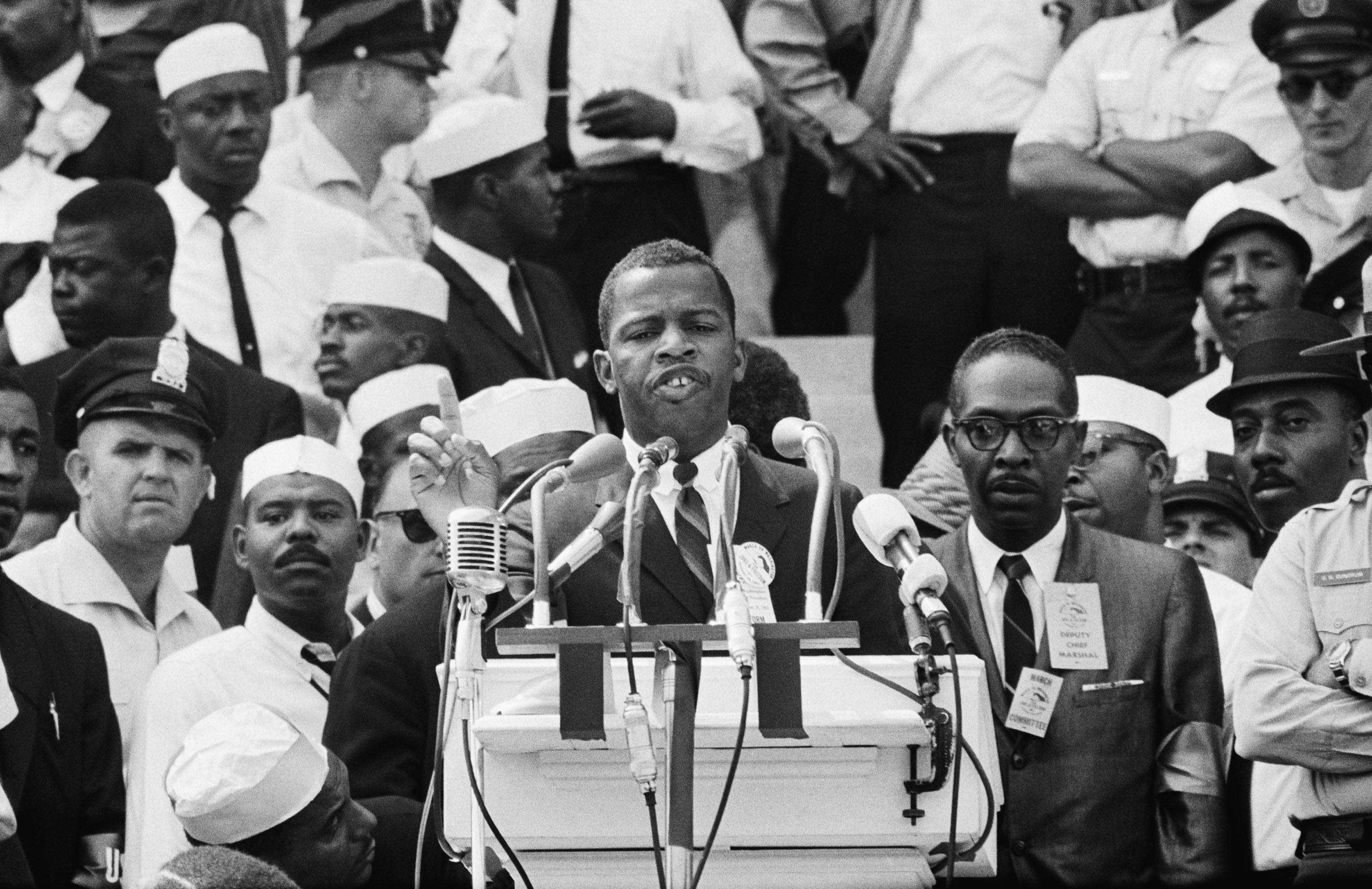 Media commentators now spoke of the “new militancy.” King would use this ambiguous term in his March on Washington speech. To some, like Lewis, militance meant not a renunciation of nonviolence but an intensification of protest, the adoption of a defiant edge. But rivals of King’s such as Representative Adam Clayton Powell Jr. and Malcolm X threatened that rioting would rock America’s streets if the government didn’t act on civil rights.
Partly to stave off violence, President John F. Kennedy announced a sweeping civil rights bill that June. At that moment, too, the movement elders A. Philip Randolph and Bayard Rustin were lining up co-sponsors for the Washington march. Many of SNCC’s young radicals balked, fearing it would be, Lewis later recalled, “a lame event, organized by the cautious, conservative traditional power structure of Black America.” But Lewis, an inveterate optimist, naturally inclined to cooperate and compromise, was for it.
On June 22, Lewis — who just several years earlier had been living with nine siblings in a shotgun shack on an Alabama farm — joined some 30 civil rights honchos in the White House Cabinet Room to meet with the president. Kennedy intended to dissuade them from holding the march, which, because of the outbursts earlier that summer, he feared might turn destructive.
Awed to be in such august company, Lewis stayed silent through the meeting. But King, Randolph and others made clear that the march would take place. Kennedy acquiesced and then pivoted, spending the rest of the summer trying to turn the gathering into a rally to pass his bill.
SNCC, meanwhile, scored its own victory. Once shut out of meetings of the major civil rights groups, it now won recognition as one of the six main march sponsors. That meant a speaking slot for Lewis before an audience immeasurably larger than he had ever addressed.
I don’t dare post any more. Read the whole thing at the NYT.
That’s the end of my trip down memory lane. The real anniversary is tomorrow.
Take care everyone!
Did you like this post? Please share it with your friends:


 peej
peej Carissa
 bostonboomer
 dakinikat
 ecocatwoman
 mablue2
 Mama Lopez
 peggysue22
 quixote
 skydancingguestblogger
 Mona (aka Wonk the Vote)



 Sky Dancing
Recent Comments