Posted: October 11, 2023 | Author: bostonboomer | Filed under: Afternoon Reads, Hamas, Israel, just because, Lebanon, Palestine | Tags: Gaza, George Santos, House Speaker, Jim Jordan, President Joe Biden, Secretary of State Antony Blinken, Steve Scalise, terrorism, United Nations |
Good Day!!

Dove 1949 by Pablo Picasso
The war between Hamas and Israel rages on. NPR published this background article by Fatima Tanis early this morning: Why Hamas and Israel reached this moment now — and what comes next.
It’s not uncommon for violence to break out between Israel and Hamas militants in Gaza. It typically goes like this: Hamas throws rockets over the Gaza border into Israel, most of which are intercepted by the Iron Dome — Israel’s very sophisticated missile defense system. The impact in Israel is usually minimized.
Israel then responds with airstrikes on the densely populated Gaza Strip.
But what happened last weekend was unprecedented in its scale and coordination.
Militants attacked Israeli communication towers with improvised explosives, they breached the Gaza-Israel border fence within minutes and assumed control of several Israeli communities. They paraglided over the border and gunned down civilians at a music festival.
Hamas killed 1,200 people in the attack, and took dozens hostage, including women, children and the elderly — all while Israel’s military was late to respond. It was the deadliest attack Israel has seen in decades.
In retaliation, Israel has laid siege to Gaza with hundreds of airstrikes that have killed at least 1,000 Palestinians and displaced more than 200,000 people. It has cut off electricity, food and fuel supplies.
Speaking to mayors of the southern border towns that were hit by the attack, Israeli Prime Minister Benjamin Netanyahu said that Israel’s response “will change the Middle East.”
Troops have now amassed for a possible ground invasion of Gaza – which last happened in 2014 and resulted in at least 2,000 Palestinians killed, and more than 70 on the Israeli side. It’s the biggest escalation in the decades-long conflict between Israelis and Palestinians in recent years.
But experts who follow the region closely point to key developments over the past year in Israel and the Palestinian territories that set the stage for this explosion of violence.
Read about those developments at NPR.
Hezbollah has gotten into the fight now. From BBC News this morning: Lebanon: Israel shells militant targets across border.
Israel says it has reinforced its northern area with thousands of extra units after trading fire with Lebanon.
Its army shelled militant targets in Lebanon after two missiles were fired at an Israeli military post near the unofficial border.
Three people were injured in the shelling which hit several towns and villages, Lebanese state media said.
The Hezbollah movement said the missiles were a response to the killing of three of its fighters on Monday.
The exchange came as Israel bombed Gaza in retaliation for Palestinian militant group Hamas’ unprecedented attack.

Turning from Inner War to Inner Peace, by Monika Kretschmar
The Israel Defense Forces (IDF) said an anti-tank missile was fired from Lebanon towards an Israeli military post near the village of Arab al-Aramshe, which is just south of the UN-demarcated Blue Line – the unofficial border which separates Israel and Lebanon.
Hezbollah said it targeted the position “in a decisive retaliation to Zionist aggression on Monday”. It claimed that the missile caused several Israeli casualties.
The IDF said that as part of its response to the attack, aircraft attacked an observation post inside Lebanon belonging to Hezbollah. Artillery also shelled the missile launch site. It did not report any casualties among its troops.
Lebanon’s National News Agency reported that three civilians were wounded and 10 houses were damaged by Israeli fire in the town of Marwahin. The towns of Yarin, and Dharya were also hit, it said.
“We have deployed tens of thousands additional units along the northern border,” IDF spokesperson Jonathan Conricus said on Wednesday, referring to infantry, special forces, armoured forces, artillery, air forces and intelligence.
“The message to Hezbollah is very clear. If they will try to attack, we are ready and vigilant along our border,” he added.
Click the link to read the rest.
Yesterday afternoon, President Biden spoke about the terrorist attack on Israel. This is from the official White House website:
You know, there are moments in this life — and I mean this literally — when the pure, unadulterated evil is unleashed on this world.
The people of Israel lived through one such moment this weekend. The bloody hands of the terrorist organization Hamas — a group whose stated purpose for being is to kill Jews.
This was an act of sheer evil.
More than 1,000 civilians slaughtered — not just killed, slaughtered — in Israel. Among them, at least 14 American citizens killed.
Parents butchered using their bodies to try to protect their children.
Stomach-turning reports of being — babies being killed.
Entire families slain.

Imagine, by Lisa Botto Lee
Young people massacred while attending a musical festival to celebrate peace — to celebrate peace.
Women raped, assaulted, paraded as trophies.
Families hid their fear for hours and hours, desperately trying to keep their children quiet to avoid drawing attention.
And thousands of wounded, alive but carrying with them the bullet holes and the shrapnel wounds and the memory of what they endured.
You all know these traumas never go away.
There are still so many families desperately waiting to hear the fate of their loved ones, not knowing if they’re alive or dead or hostages.
Infants in their mothers’ arms, grandparents in wheelchairs, Holocaust survivors abducted and held hostage — hostages whom Hamas has now threatened to execute in violation of every code of human morality.
It’s abhorrent.
The brutality of Hamas — this bloodthirstiness — brings to mind the worst — the worst rampages of ISIS.
This is terrorism.
But sadly, for the Jewish people, it’s not new.
Read the rest at the link above.
From The Hill this morning: 9 UN staffers killed in airstrikes in Gaza.
Nine United Nations staff members have been killed by Israeli airstrikes in Gaza since Saturday, the UN’s agency for Palestinian refugees confirmed Wednesday.
The U.N. Relief and Works Agency (UNRWA) said nine staffers have been killed in airstrikes since the start of Israel’s counterattack on Gaza, with several of the staff members killed late Tuesday.

Deborah Milton, I wish I could
“The protection of civilians is paramount, including in times of conflict,” Juliette Touma, UNRWA director of communications, told The Associated Press. “They should be protected in accordance with the laws of war.”
The strikes are part of an aggressive counteroffensive by the Israeli military, after the Palestinian militant group Hamas sent a barrage of rocket strikes and militants into the country Saturday in a surprise attack, leaving behind horrific scenes of brutalized villages along the border….
By Wednesday, several neighborhoods in the Gaza Strip had been demolished after the Israeli military pounded the area with air strikes.
Touma told the AP the U.N. staff members were killed in their homes across the Gaza Strip. She said the UNRWA headquarters in Gaza City and many schools-turned-shelters were damaged as well.
The U.N. Independent International Commission of Inquiry on the Occupied Palestinian Territory, including East Jerusalem and Israel, said Tuesday that clear evidence has emerged showing war crimes being committed on both sides of the conflict.
From The Washington Post yesterday afternoon: Biden dispatches Blinken to Israel in show of support.
Secretary of State Antony Blinken is flying to Israel on Wednesday in a show of support for the country as it begins a major offensive campaign in the Hamas-controlled Gaza Strip in response to a wave of deadly cross-border attacks by the militant group.
The top U.S. diplomat is expected to meet with senior Israeli officials to receive an update on the security situation and inquire what else the United States can provide to Israel as it works to regain control of its border, free hostages and destroy Hamas’s operational capacity following the surprise attacks by gunmen who inflicted the bloodiest day in Israel’s 75-year history.
“It will be a message of solidarity and support,” State Department spokesman Matthew Miller said in describing the thrust of the trip.
Since the Hamas invasion on Saturday morning and massacre of Israeli civilians, Blinken has made a flurry of calls with his counterparts in the Middle East in an effort to have U.S. allies and partners send a clear message to Iran, Hezbollah and Palestinians in the West Bank to refrain from entering the conflict.
“We’ve been on the phones throughout our government over the last 24 hours, engaging everyone in the region and well beyond,” Blinken told CNN on Sunday, “both to make sure that there is support for Israel and that every country is using every effort to pull Hamas back and to prevent this from escalating.”
Israeli officials have made several specific requests to Washington in response to the military offensive by Hamas, including a replenishment of Iron Dome ground-to-air missile interceptors, small-diameter bombs, ammunition for machine guns and heightened cooperation on intelligence-sharing particularly in southern Lebanon, according to U.S. officials familiar with the requests.
“President Biden’s direction was to make sure that we’re providing Israel everything it needs in this moment to deal with the attacks from Hamas,” Blinken said.

Heal the World, by Hiske Bain
Back in the U.S., House Republicans are still trying to figure out what to do about finding a new Speaker. It’s not looking good at the moment. The choice so far is between two deeply flawed candidates: Jim Jordan and Steve Scalise. Jordan is tainted by a sexual abuse scandal when he was a wrestling coach at Ohio State; Scalise once referred to himself as “David Duke without the baggage.” He’s also being treated for an aggressive form of cancer.
Former student wrestlers are speaking up about Jordan. The Guardian: Ex-Ohio State wrestlers say Jim Jordan unfit for speakership for ignoring sexual abuse scandal.
Former Ohio State wrestlers who accuse Jim Jordan of ignoring sexual abuse when he was a coach said the hard-right Republican should not be elected speaker of the US House.
“Do you really want a guy in that job who chose not to stand up for his guys?” Mike Schyck, one of hundreds of wrestlers who say they were assaulted by a team doctor, told NBC News. “Is that the kind of character trait you want for a House speaker?”
Another former wrestler, Dunyasha Yetts, told NBC: “He doesn’t deserve to be House speaker. He still has to answer for what happened to us.”
Jordan, 59 and a founder of the hard-right Freedom Caucus, is competing for the speakership with Steve Scalise, the majority leader from Louisiana, after the historic ejection of Kevin McCarthy by disgruntled right-wingers last week. Jordan has secured the endorsement of Donald Trump, the presidential frontrunner whose supporters orchestrated McCarthy’s defenestration.
Before entering politics, Jordan was an assistant OSU wrestling coach from 1986 to 1994. Former athletes have said he ignored rampant sexual abuse by Richard Strauss, a team doctor who died in 2005.
A bit more:
Jordan has long denied helping orchestrate a cover-up. On Tuesday, a spokesperson told NBC: “Chairman Jordan never saw or heard of any abuse, and if he had, he would have dealt with it.”
But Jordan also refused to co-operate with an official investigation which found Strauss’s abuse was an “open secret”, and that “coaches, trainers and other team physicians were fully aware of Strauss’ activities, and yet few seemed inclined to do anything to stop it”.

Healing from the Inside, by Kathryn Rutherford
At one hearing, another former wrestler, Adam DiSabato, said: “Jim Jordan called me crying, crying, groveling, on the Fourth of July … begging me to go against my brother, begging me, crying for half an hour. That’s the kind of cover-up that’s going on here. He’s a coward. He’s a coward.”
Yetts has previously said: “If Jordan says he didn’t know about it, then he’s lying.”
Speaking to NBC, another former wrestler, Rocky Ratliff, said Jordan “abandoned his former wrestlers in the Ohio State sexual abuse scandal and cover-up”….
Schyck told NBC he was himself a Republican, and Jordan “was somebody I revered, somebody I looked up to.
“If early on he jumped in on our side and validated what we were saying, what everybody knew about what Dr Strauss was doing to us, then this wouldn’t be happening. But he decided early on, for reasons I still don’t understand, that he was going to deny knowing anything about this.
As everyone here knows, Jordan is also not very bright and a lying MAGA conspiracy theorist.
House Republicans were expected to meet this morning at 10:00, and they are voting now. Neither candidate is believed to have the votes to be elected. Financial Times: House Republicans begin voting on nominee for Speaker.
House Republicans have started voting for their nominee for Speaker, amid a growing sense of urgency to determine who will lead the lower house and address pressing issues on the US’s domestic and international agendas.
Steve Scalise, the House majority leader, and Jim Jordan, who chairs the judiciary committee, made their cases to colleagues in a closed-door forum on Tuesday evening, although neither candidate was in a position to claim the upper hand ahead of Wednesday’s conference vote. The two rival candidates are vying for support on the private ballot, after eight rebels led an unprecedented revolt against Kevin McCarthy last week. Ken Buck, a Republican from Colorado, told the FT he voted “present” for Speaker after neither Scalise nor Jordan adequately answered his question on Tuesday about who won the 2020 presidential election. “It’s a yes or no question,” he said.
“I don’t think anybody has 217 [votes],” Georgia Republican Marjorie Taylor Greene said on Tuesday night. “If it comes out that neither one of them can get there, then yes, we’re going to have to produce another candidate.” For Republicans, the lack of a clear outcome risks a replay of events in January, when it took a record 15 rounds of voting for the party to elect McCarthy as Speaker. More broadly, the abrupt downfall of the former Speaker last week has created chaos in the House. The lower chamber is at a standstill, unable to pass legislation, as the US weighs whether to provide additional aid to Israel and Ukraine in their respective conflicts with Hamas and Russia. Lawmakers must also pass a spending bill by November 17 to avoid a US government shutdown.
One more bit of news from the House. NBC News: Embattled Rep. George Santos hit with additional charges, including identity theft.
Federal prosecutors hit Rep. George Santos, R-N.Y., with 23 additional charges Tuesday, including allegations of identity theft and that he charged a supporter’s credit card in excess of the supporter’s contribution and then transferred the money to his personal bank account.
Prosecutors said Santos faces “one count of conspiracy to commit offenses against the United States, two counts of wire fraud, two counts of making materially false statements to the Federal Election Commission (FEC), two counts of falsifying records submitted to obstruct the FEC, two counts of aggravated identity theft, and one count of access device fraud” in a superseding indictment filed Tuesday.

Keith Morant, Requiem
“As alleged, Santos is charged with stealing people’s identities and making charges on his own donors’ credit cards without their authorization, lying to the FEC and, by extension, the public about the financial state of his campaign. Santos falsely inflated the campaign’s reported receipts with non-existent loans and contributions that were either fabricated or stolen,” Breon Peace, the U.S. attorney for the Eastern District of New York, said in a statement….
Prosecutors said in a news release that the scheme included falsely claiming that relatives of Santos and his then-campaign treasurer, Nancy Marks, had donated big bucks to his campaign to make it appear that he was raising more money than he actually was in order to qualify for assistance from the national party.
“To create the public appearance that his campaign had met that financial benchmark” for additional funds from the Republican Party “and was otherwise financially viable, Santos and Marks agreed to falsely report to the FEC that at least 10 family members of Santos and Marks had made significant financial contributions to the campaign when Santos and Marks both knew that these individuals had neither made the reported contributions nor given authorization for their personal information to be included in such false public reports.”
He is also alleged to have been involved in a credit card scheme in which the campaign would charge contributors’ credit cards repeatedly and above FEC individual contribution limits.
Some Republicans are finally talking about expelling Santos. NBC News: Republican lawmakers to introduce resolution to expel Rep. George Santos from Congress.
A group of House Republicans from New York are introducing a resolution to expel Rep. George Santos, R-N.Y., from Congress.
“Today, I’ll be introducing an expulsion resolution to rid the People’s House of fraudster George Santos,” Rep. Anthony D’Esposito, R-N.Y., said in a post on the social media platform X.
He said the resolution will be co-sponsored by fellow New York House Republicans Nick LaLota, Mike Lawler, Marc Molinaro, Nick Langworthy and Brandon Williams.
Booting Santos would require a two-thirds vote of the entire House.
The move comes a day after federal prosecutors issued Santos a 23–count superseding indictment alleging he committed identity theft, fraud and other offenses. Santos, who was first indicted in May, has said he plans on fighting the charges. He pleaded not guilty to the charges in the original 13-count indictment earlier this year.
Those are the top stories today. What are your thoughts? What other stories are you following?
Did you like this post? Please share it with your friends:
Posted: October 7, 2023 | Author: bostonboomer | Filed under: 2020 Elections, cat art, Cats, caturday, COVID19, Crime, Donald Trump, just because | Tags: Anthony Pratt, Benjamin Netanyahu, cult deprogramming, Hakeem Jeffries, Hamas attack, Hillary Clinton, House in chaos, Israel at war?, Jim Jordan, Speaker of the House, Trump blabs top secret information, Trump NY fraud trial |

Autumn Cat Leaves, by Erin Martin Lowell Herrero
Happy Caturday!!
It has been another busy week in politics, with Trump’s businesses on trial in New York as well as new evidence that Trump shared top secret information with foreign nationals; the House of Representatives in chaos without a speaker; a violent attack by Hamas on Israel overnight; and other odds and ends. Let’s get started.
The story getting the most attention today is the attack on Israel.
The New York Times and The Washington Post are running live updates.
From The New York Times: ‘We Are at War,’ Netanyahu Says After Hamas Attacks.
The Israeli prime minister ordered a call-up of reservists after Palestinian militants fired thousands of rockets and invaded several Israeli towns. More than 250 people have been killed, according to Israeli and Palestinian officials.
Israel battled on Saturday to repel one of the broadest invasions of its territory in 50 years after Palestinian militants from Gaza launched an enormous and coordinated early-morning assault on southern Israel, infiltrating several Israeli towns and army bases, kidnapping Israeli civilians and soldiers, and firing thousands of rockets toward cities as far away as Jerusalem.
By early evening, the Israeli military said fighting continued in at least five places in southern Israel, around 70 Israelis had been reported dead by emergency medical groups, and Israel had retaliated with huge strikes on Gazan cities. At least 198 Palestinians were killed in either gun battles or airstrikes, the Gazan Health Ministry said….
At least 100 Israelis have been killed since the Palestinian militant assault began on Saturday morning, said Zaki Heller, a spokesman for the Magen David Adom emergency service. The number is expected to continue to rise in the coming hours and days.
From The Washington Post: Netanyahu says Israel ‘at war’ after Hamas attack; Israeli civilians and military personnel held captive in Gaza Strip.
Israeli Prime Minister Benjamin Netanyahu said Saturday “we are at war, and we will win it” after the Islamist militia Hamas launched an assault and took captives following the 50th anniversary of the start of the 1973 Yom Kippur war. The confrontation, which has killed at least 40 Israelis and injured at least 740, is one of the most serious in years after weeks of rising tensions along the volatile border. Israeli air force strikes killed nearly 200 people on the Gaza Strip and injured 1,600, according to the Palestinian Health Ministry. Israeli authorities said that an unknown number of Israeli civilians, soldiers and commanders have been taken captive by Hamas….

Autumn Cat, by Tatiana Feoktistova
Israel ordered residents in areas around Gaza to remain inside after militants infiltrated Israeli territory — including by paraglider and by sea — and launched more than 3,000 rockets, the Israel Defense Forces said. The Israeli air force began striking targets late Saturday morning, the military said, adding that gun battles were taking place in Israeli areas near the border.
U.S. officials including President Biden, Secretary of State Antony Blinken and numerous members of Congress condemned the attacks on Israel. Biden described the attacks as “appalling” and said he offered Netanyahu “rock-solid and unwavering” support.
And from The Hill: Pentagon says it will support Israel after Netanyahu declares war.
Defense Secretary Lloyd Austin said the U.S. stands squarely by Israel and will ensure it “has what it needs to defend itself” after Israeli Prime Minister Benjamin Netanyahu declared war against Palestinian militants that launched a surprise attack on his country.
Austin said in a statement he was “closely monitoring developments in Israel” and extended his condolences to families of the victims who lost their lives in the Saturday attack.
“Our commitment to Israel’s right to defend itself remains unwavering,” Austin said. “Over the coming days the Department of Defense will work to ensure that Israel has what it needs to defend itself and protect civilians from indiscriminate violence and terrorism.”
The U.S. is one of Israel’s staunchest allies and has provided around $3.8 billion a year to the country.
This doesn’t sound good.
The House without a Speaker
Burgess Everett at Politico: Empty speaker’s office aggravates House-Senate beef.
The chaos-ridden, speaker-less House is threatening to stymie a host of bipartisan legislative efforts across the Capitol — and senators are getting really tired of it.
Forget the expectations earlier this year of achieving even modest policy reforms, or passing spending bills under so-called “regular order.” Senators will consider themselves lucky to escape the calendar year without a catastrophe. Among the possibilities: a shutdown and a crush of blown deadlines on expiring legislation addressing aviation law, surveillance authority and flood insurance.
Possibly, the best case is lurching from crisis to crisis until the presidential election.
“It’s hard to pass legislation and send it to the president when one House is not able to function,” Sen. John Cornyn (R-Texas) said of the prognosis for the months ahead, one of several senators interviewed who implied the legislative calendar is looking bleak.
One of the frontrunners for House speaker, Jim Jordan of Ohio, didn’t even support the stopgap spending bill that avoided a shutdown. And he opposes new aid for Ukraine — the two biggest priorities among Senate Democrats and at least half of the Senate Republicans.
 What’s more, with no speaker and no clear candidate who has the votes to wrap up an election quickly, there’s no one currently empowered to negotiate with Senate Majority Leader Chuck Schumer and the White House on behalf of the only Republican-controlled lever of the federal government.
“Only a new speaker [can negotiate], if they’re willing to do that,” echoed Sen. Kevin Cramer (R-N.D.), a former House member. “Somebody has to face the reality.”
The Senate’s challenges for the next few months are tough to square with the disorderly state of the House GOP majority. Aviation law, surveillance authority and flood insurance all expire later this year. That’s not to mention modest Senate policy priorities that bipartisan gangs are coalescing around.
There’s much more at the link.
Igor Bobic at HuffPost: Jim Jordan, Who’s Running For Speaker, Played A Key Role In Trump’s 2020 Election Plot.
Staunch conservative Rep. Jim Jordan (R-Ohio) is in the spotlight after launching a bid for the speaker’s gavel this week, a race that is sure to provide even more drama and chaos than the unprecedented ouster of Rep. Kevin McCarthy (R-Calif.).
But one critical aspect of Jordan’s history that has been omitted by most Beltway publications is the prominent role he played in spreading lies about the 2020 election and rallying supporters to contest the results. The extraordinary effort led by former President Donald Trump, who has endorsed Jordan’s bid for speaker, led to the deadly Jan. 6, 2021, attack on the U.S. Capitol.
“Jim Jordan knew more about what Donald Trump had planned for Jan. 6 than any other member of the House of Representatives,” former Rep. Liz Cheney (R-Wyo.), who co-chaired the House Select Committee tasked with investigating the insurrection, said in a speech at the University of Minnesota this week.
“Jim Jordan was involved, was part of the conspiracy in which Donald Trump was engaged as he attempted to overturn the election,” she added.
Jordan, who now chairs the House Judiciary Committee, refused to cooperate with the select committee regarding his communications with Trump as the attack was occurring, defying subpoenas for testimony.

Cat in autumn, unknown illustrator
Trump spoke on the phone with Jordan for 10 minutes on the morning of Jan. 6. Jordan has never divulged the nature of the conversation, saying only that he had spoken to Trump “a number of times” that day.
Jordan also phoned then-White House chief of staff Mark Meadows while the attack was underway, according to former Meadows aide Cassidy Hutchinson.
“They had a brief conversation,” Hutchinson told the committee. “In crossfire, I heard briefly what they were talking about. I heard conversations in the Oval [Office] dining room at that point talking about the ‘Hang Mike Pence’ chants.”
Jordan also sent a text to Meadows on Jan. 5 outlining a legal theory that then-Vice President Mike Pence, who presided over the Senate chamber on Jan. 6, had the authority to block the certification of Joe Biden’s 2020 election win.
More on Jordan’s role at HuffPost.
Democratic Leader Hakeem Jeffries has an op-ed at The Washington Post: A bipartisan coalition is the way forward for the House.
In recent days, Democrats have tried to show our colleagues in the Republican majority a way out of the dysfunction and rancor they have allowed to engulf the House. That path to a better place is still there for the taking.
Over the past several weeks, when it appeared likely that a motion to vacate the office of speaker was forthcoming, House Democrats repeatedly raised the issue of entering into a bipartisan governing coalition with our Republican counterparts, publicly as well as privately.
It was my sincere hope that House Democrats and more traditional Republicans would be able to reach an enlightened arrangement to end the chaos in the House, allowing us to work together to make life better for everyday Americans while protecting national security.
Regrettably, at every turn, House Republicans have categorically rejected making changes to the rules designed to accomplish two objectives: encourage bipartisan governance and undermine the ability of extremists to hold Congress hostage. Indeed, Rep. Kevin McCarthy (R-Calif.) publicly declared more than five hours before the motion to vacate was brought up for a vote that he would not work with House Democrats as a bipartisan coalition partner. That declaration mirrored the posture taken by House Republicans in the weeks leading up to the motion-to-vacate vote. It also ended the possibility of changing the House rules to facilitate a bipartisan governance structure.
Things further deteriorated from there. Less than two hours after the speakership was vacated upon a motion brought by a member of the GOP conference, House Republicans ordered Speaker Emerita Nancy Pelosi (D-Calif.) and former majority leader Steny H. Hoyer (D-Md.) to “vacate” their hideaway offices in the Capitol. The decision to strip Speaker Emerita Pelosi and Leader Hoyer of office space was petty, partisan and petulant.
“A different path?”
House Republicans have lashed out at historic public servants and tried to shift blame for the failed Republican strategy of appeasement. But what if they pursued a different path and confronted the extremism that has spread unchecked on the Republican side of the aisle? When that step has been taken in good faith, we can proceed together to reform the rules of the House in a manner that permits us to govern in a pragmatic fashion.

By Lorelai ArtsyPartsy
The details would be subject to negotiation, though the principles are no secret: The House should be restructured to promote governance by consensus and facilitate up-or-down votes on bills that have strong bipartisan support. Under the current procedural landscape, a small handful of extreme members on the Rules Committee or in the House Republican conference can prevent common-sense legislation from ever seeing the light of day. That must change — perhaps in a manner consistent with bipartisan recommendations from the House Select Committee on the Modernization of Congress.
In short, the rules of the House should reflect the inescapable reality that Republicans are reliant on Democratic support to do the basic work of governing. A small band of extremists should not be capable of obstructing that cooperation.
Trump New York Fraud Trial
From NBC News: Trump trial Day 5 highlights: Ex-Trump executive says Allen Weisselberg asked for help in committing tax fraud.
What to know about Friday’s court session:
On the final day of the first week of the trial, lawyers for New York Attorney General Letitia James’ office again grilled Jeffrey McConney, a former Trump Organization senior vice president.
In a dramatic finale, McConney admitted that ex-Trump Organization CFO Allen Weisselberg asked for his help in committing tax fraud. He said he kept engaging in this illegal conduct because Weisselberg was his boss and if he refused, he would probably have lost his job.
Judge Arthur Engoron later in the day turned down an effort from Trump’s lawyers to suspend the trial.
Trump went to the appeals court to try to stop the trial: Appeals court stays cancellation of Trump biz certificates.
Also:
An appeals court judge denied Trump’s bid to halt the fraud trial, but agreed to stay enforcement of Engoron’s order canceling business certificates involving the former president and top officials at his company.
An Appellate Division judge who heard emergency arguments Friday wrote the application is “granted solely to the extent of staying enforcement of Supreme Court’s order directing the cancellation of business certificates. The interim application is denied in all other respects.”
In a court filing earlier in the day, Trump’s attorneys argued that part of Engoron’s ruling was tantamount to “corporate death sentences” for various Trump companies that would have to be dissolved.
Attorney General Letitia James had already said she would hold off on the cancellation of certificates until the end of the trial, so not a big deal.
Trump once again blabbed top secret information
Here’s the background from ABC News: Trump allegedly discussed US nuclear subs with foreign national after leaving White House: Sources.
Months after leaving the White House, former President Donald Trump allegedly discussed potentially sensitive information about U.S. nuclear submarines with a member of his Mar-a-Lago Club — an Australian billionaire who then allegedly shared the information with scores of others, including more than a dozen foreign officials, several of his own employees, and a handful of journalists, according to sources familiar with the matter.

Autumn Pumpkin Cat, by Ryan Conners
The potential disclosure was reported to special counsel Jack Smith’s team as they investigated Trump’s alleged hoarding of classified documents at Mar-a-Lago, the sources told ABC News. The information could shed further light on Trump’s handling of sensitive government secrets.
Prosecutors and FBI agents have at least twice this year interviewed the Mar-a-Lago member, Anthony Pratt, who runs U.S.-based Pratt Industries, one of the world’s largest packaging companies.
In those interviews, Pratt described how — looking to make conversation with Trump during a meeting at Mar-a-Lago in April 2021 — he brought up the American submarine fleet, which the two had discussed before, the sources told ABC News.
According to Pratt’s account, as described by the sources, Pratt told Trump he believed Australia should start buying its submarines from the United States, to which an excited Trump — “leaning” toward Pratt as if to be discreet — then told Pratt two pieces of information about U.S. submarines: the supposed exact number of nuclear warheads they routinely carry, and exactly how close they supposedly can get to a Russian submarine without being detected.
It’s far from the first time Trump has done this. In fact, very early in his term as “president,” Trump outed an Israeli spy to Russians in the oval office. Remember that? It was the day after he fired James Comey and he thought the Russia investigation was over.
Tori Otten recalls a few instances at The New Republic: Trump Loves Sharing National Security Secrets With Random Strangers.
Trump allegedly told Australian billionaire Anthony Pratt in April 2021 that Australia should start buying its submarines from the U.S. Trump then told Pratt the supposed exact number of nuclear warheads a U.S. sub can carry, and how close it can supposedly get to a Russian sub without being detected, ABC News reported late Thursday, citing anonymous sources.
Pratt then told at least 45 other people—including six journalists, 11 employees at his company, 10 Australian officials, and three former Australian prime ministers—about Trump’s comments before he was approached by special counsel Jack Smith’s team….
The incident with Pratt is far from the first time that Trump shared classified information with people unauthorized to hear it. In May 2017, Trump shared highly classified information with the Russian foreign minister and the Russian ambassador to the United States that the U.S. hasn’t shared with some of its closest allies. Current and former U.S. officials warned that Trump had jeopardized a crucial intelligence source on the Islamic State group.
Later that month, Trump told then-Philippine President Rodrigo Duterte that the U.S. had positioned two nuclear submarines off the Korean peninsula. The locations of nuclear subs are meant to be kept secret, as a matter of national security. In fact, only the captains and crews know the sub’s exact location.
Then, in July 2017, CNN reported that the U.S. was forced to extract a spy embedded in the Russian government after concerns that Trump had shared classified information that could have exposed them.
Rather than learn his lesson, Trump met privately with Russian President Vladimir Putin during the G20 summit (also in July 2017). Trump confiscated the interpreter’s notes at the end of the meeting, an unusual move that led intelligence officials to believe he had shared more classified information.
Trump tweeted a video in December 2018 of the Al Asad Airbase in Iraq, exposing a SEAL team’s faces and location. The next year, he bragged about U.S. nuclear weapons capabilities to reporter Bob Woodward and tweeted photos that revealed the location of U.S. spy satellites.
And of course, it didn’t stop after he left office. One of the documents he allegedly kept detailed a plan to attack Iran. He is accused of waving the paper around in front of people.
Weird Odds and Ends
Republicans and Fox News are once again up in arms about something Hillary Clinton said.
The Guardian: Hillary Clinton says Trump supporters may need to be ‘deprogrammed.’
Supporters of Donald Trump may need to be “deprogrammed” as if they were cult members, Hillary Clinton said.
“Sadly, so many of those extremists … take their marching orders from Donald Trump, who has no credibility left by any measure,” the former first lady, senator, secretary of state and Democratic nominee for president told CNN.
“He’s only in it for himself. He’s now defending himself in civil actions and criminal actions. And when do they break with him? Because at some point maybe there needs to be a formal deprogramming of the cult members. But something needs to happen.” [….]

By Atey Ghailan
Clinton said: “I think, sadly, he will be the nominee and we have to defeat them. And we have to defeat those who are the election deniers, as we did and 2020 and [in the midterms of] 2022. And we have to just be smarter about how we are trying to empower the right people inside the Republican party.”
Clinton was speaking after the fall of Kevin McCarthy, who became first US House speaker ever ejected by his own party thanks to pro-Trump extremists.
Clinton called Trump “an authoritarian populist who really has a grip on the emotional [and] psychological needs and desires of a portion of the population and the base of the Republican party, for whatever combination of reasons.”
Republicans, she said, “see in him someone who speaks for them and they are determined they will continue to vote for him, attend his rallies and wear his merchandise, because for whatever reason he and his very negative, nasty form of politics resonates with them.
“Maybe they don’t like migrants. Maybe they don’t like gay people or Black people or the woman who got the promotion at work they didn’t get. Whatever reason.”
Hey, she’s right. But now all the Trump fans have something else to have fun being outraged about.
CBS News: Florida man, sons sentenced to years in prison after being convicted of selling bleach as fake COVID-19 cure.
Three months after a Florida man and his three sons were convicted of selling toxic industrial bleach as a fake COVID-19 cure through their online church, a federal judge in Miami sentenced them to serve prison time.
Jonathan Grenon, 37, and Jordan Grenon, 29, were sentenced on Friday to 151 months in prison for conspiring to defraud the United States by distributing an unapproved and misbranded drug, and for contempt of court, according to a news release from the U.S. Attorney’s Office Southern District of Florida. Mark Grenon, 66, and Joseph Grenon, 36, were sentenced to 60 months in prison, the statutory maximm for conspiring to defraud the United States by distributing an unapproved and misbranded drug.
All four had been found guilty by a federal judge this summer after a two-day trial where the Grenons represented themselves, according to The Miami Herald. Mark Grenon is the father of Jonathan, Jordan and Joseph Grenon.
Prosecutors called the Grenons “con men” and “snake-oil salesmen” and said the family’s Genesis II Church of Health and Healing sold $1 million worth of their so-called Miracle Mineral Solution, distributing it to tens of thousands of people nationwide. In videos, the solution was sold as a cure for 95% of known diseases, including COVID-19, Alzheimer’s, autism, brain cancer, HIV/AIDS and multiple sclerosis, prosecutors said.
But the U.S. Food and Drug Administration had not approved MMS for treatment of COVID-19, or for any other use. The FDA had strongly urged consumers not to purchase or use MMS for any reason, saying that drinking MMS was the same as drinking bleach and could cause dangerous side effects, including severe vomiting, diarrhea, and life-threatening low blood pressure. The FDA received reports of people requiring hospitalizations, developing life-threatening conditions, and even dying after drinking MMS.
Read more nutty stuff at the link if you so desire.
Have a nice weekend, everyone!!
Did you like this post? Please share it with your friends:
Posted: October 4, 2023 | Author: bostonboomer | Filed under: Donald Trump, just because | Tags: Attorney General Letitia James, bank fraud, Fulton County RICO case, gag order, Jim Jordan, Judge Arthur Engoron, Kevin McCarthy, Matt Gaetz, Nancy Pelosi, Rudy Giuiani |
Good Day!!
 It’s only Wednesday, and it has already been a crazy week in politics. Here’s what’s happening:
Trump is attending day three of the civil trial against the Trump Organization for tax and bank fraud. As he did on Monday and Tuesday, he stood in front of the courthouse and whined to reporters about how unfairly he is being treated. He called the trial a “witch hunt” and claimed he would eventually testify.
Yesterday Judge Arthur Engoron issued a gag order after Trump posted Judge Engoron’s primary clerk on Truth Social.
The Guardian: Judge issues gag order after Trump’s comments on court clerk in civil trial.
The judge overseeing Donald Trump’s civil fraud trial issued a gag order on Tuesday after the former president made comments about the judge’s clerk.
“Consider this statement a gag order forbidding all parties from posting, emailing or speaking publicly about any of my staff,” the judge, Arthur Engoron, said on Tuesday afternoon. “Personal attacks on members of my court staff are unacceptable, inappropriate and I will not tolerate them in any circumstances.
“Failure to abide by this order will result in serious sanctions.”
The second day of Trump’s trial got off to another combative start after Trump branded the case a “fraud” and a “scam” and pledged to take the stand in his own defense.
Asked if he would testify in the case, Trump said: “Yes, I will. At the appropriate time I will be.”
But Trump’s comments about Engoron’s law clerk, the attorney Allison Greenfield, proved a step too far. Over lunch Trump attacked Engoron’s clerk in a social media post, linking to a picture of her with the Democratic Senate majority leader, Chuck Schumer. He called her “Schumer’s girlfriend” and said she “is running this case against me. How disgraceful! This case should be dismissed immediately.”
The post on Trump’s Truth Social platform was deleted on Engoron’s orders.
Later the Judge met privately with Trump and Letitia James. Jose Pagliery at The Daily Beast: Judge Kicks Reporters Out of Courtroom to Talk to Trump and AG.
A turbulent second day at Donald Trump‘s bank fraud trial in New York came to an equally puzzling end, when the judge unceremoniously kicked out all journalists from the courtroom to speak privately with the former president and Attorney General Letitia James.
When one reporter asked whether the courtroom was being sealed, Justice Arthur F. Engoron did not respond. Instead, security personnel yelled at journalists to leave immediately.
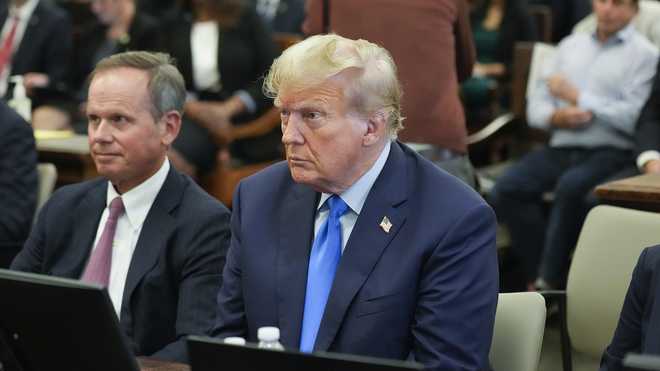
Donald Trump glowers at the Judge on day one of the New York civil trial.
Trump, James, and their respective legal teams remained in the courtroom for more than 20 minutes before exiting.
On his way out, Trump surprised everyone by stating that he will return to court Wednesday.
“I’ll be back tomorrow. Good day,” he said with a wave, before ducking into a side exit with his attorneys and Secret Service security detail.
James refused to answer any questions on her way out, preventing the public from knowing what was going on inside.
Earlier in the day, Engoron issued a gag order against Trump after he posted on his social media site, Truth Social, accusing one of Engoron’s law clerks of having a relationship with Sen. Chuck Schumer (D-NY).
Pagliery reports from the courthouse today: Trump Finally Brings His Online Rage to the Courtroom.
A day after receiving a tongue lashing from a judge disturbed by Donald Trump’s insolence outside the New York courtroom, the former president began to make exasperated remarks inside the court, as the third day of his bank fraud trial started Wednesday.
The increasingly furious Trump—whose real estate empire has already received the kiss of death from the judge—remained quiet during the first two days of proceedings, instead choosing to rail against the entire justice system outside the room’s wooden doors. But when Justice Arthur F. Engoron noted that typical formalities could be cast aside because there’s no jury here, Trump began to grumble and angrily folded his arms while staring at the judge.
Trump turned to defense lawyer Alina Habba at his left to complain in loud groans—this reporter could only make out the words “no jury!”—then threw his arms up and shook his head.
The former president then let out an annoyed sigh and slumped forward, stretching his dark blue suit jacket.
Just before the trial got underway on Wednesday, he was even louder online, where he wrote, “I am not even entitled, under any circumstances, to a JURY. This Witch Hunt cannot be allowed to continue. It is Election Interference and the start of Communism right here in America!”
Minutes later, Trump then complained in court that he couldn’t make out what was being said by the witness on the stand: his longtime former accountant Donald Bender, who became a state witness and disavowed much of the work he did for the Trump Organization and its vastly inflated assets. The testimony could be perceived as a betrayal given that Bender made millions at the firm Mazars USA by working for the Trump family, which invited him to golf courses, hotels, and parties.
Yesterday afternoon, House Republicans came close to eclipsing Trump news, as Matt Gaetz and a few other MAGA crazies removed House Speaker Kevin McCarthy, leaving the House in utter chaos.
The New York Times: House Is Paralyzed, With No Speaker After McCarthy Ouster.
The House of Representatives was in a state of paralysis on Wednesday, ground to a halt by the ouster of Republican Speaker Kevin McCarthy and with no clear sense of who might succeed him — or when.
After a historic vote to remove Mr. McCarthy on Tuesday, lawmakers quickly departed Washington and scattered to their districts around the country, abandoning the Capitol as Republicans remained deeply divided over who could lead their fractious majority.
“What now?” one Republican muttered aloud on the House floor just after the vote on Tuesday afternoon, the first time the chamber had ever removed a speaker from his post involuntarily.
 It underscored the chaos now gripping the chamber, which is effectively frozen, without the ability to conduct legislative business, until a successor to Mr. McCarthy is chosen. The California Republican said late Tuesday that he would not seek the post again after being deposed by a hard-right rebellion.
The vacancy promised to tee up another potentially messy speaker election at a time when Congress has just over 40 days to avert another potential government shutdown. But it was not yet clear who might run.
Discussions on the future of the conference were being led by Representative Patrick T. McHenry of North Carolina. Mr. McCarthy had named Mr. McHenry first on a list of potential interim speakers in the event of a calamity or vacancy, but he does not have power to run the chamber — only to preside over the election of a new speaker.
While no Republican has announced a bid for the post, some names reliably come up in conversations with G.O.P. lawmakers, including Mr. McHenry and Representative Tom Cole, the Oklahoma Republican and Rules Committee chairman, as well as the No. 2 and No. 3 House Republicans, Representatives Steve Scalise of Louisiana and Tom Emmer of Minnesota.
This morning, Ohio Rep. Jim Jordan announced he would run for Speaker. Politico: Jim Jordan becomes first to announce run for speaker.
Rep. Jim Jordan said he will run to be the next speaker, a move likely to prompt praise from House conservatives.
Jordan, the House Judiciary chair and member of the House Freedom Caucus, has worked closely with Oversight Chair James Comer (R-Ky.) on the impeachment inquiry into Joe Biden. He had also become a close ally of now-ex Speaker Kevin McCarthy in recent years.
But his candidacy will likely run right into Majority Leader Steve Scalise (R-La.), who is also considering a speakership bid and has worked to court conservatives.
“Jim is a friend, and I certainly think he brings a whole lot that this conference would be able to rally around, but we’ve got to all have a conversation and I’m not going to say who I’m supporting at this point,” said Rep. Chip Roy (R-Texas), a member of the conservative House Freedom Caucus.
“We’re going to figure this out behind closed doors as a family,” he added.
The Ohio Republican was elected to Congress in 2007. He is a Trump ally within the GOP conference and one of the many chairs to have called for Congress to defund the Department of Justice over whistleblower claims that DOJ hampered the Hunter Biden investigation.
But wouldn’t Jordan have to wear a suit and get a couple of new ties if he were Speaker?
Patrick McHenry’s first act as Speaker Pro Tempore was to kick Nancy Pelosi out of her Congressional office. Pelosi didn’t vote to remove McCarthy, because she is in California for Diane Feinstein’s funeral.
Politico: McHenry ordered Pelosi to leave her Capitol hideaway office by Wednesday.
As one of his first acts as the acting speaker, Rep. Patrick McHenry ordered former Speaker Nancy Pelosi to vacate her Capitol hideaway office by Wednesday, according to an email sent to her office viewed by POLITICO.
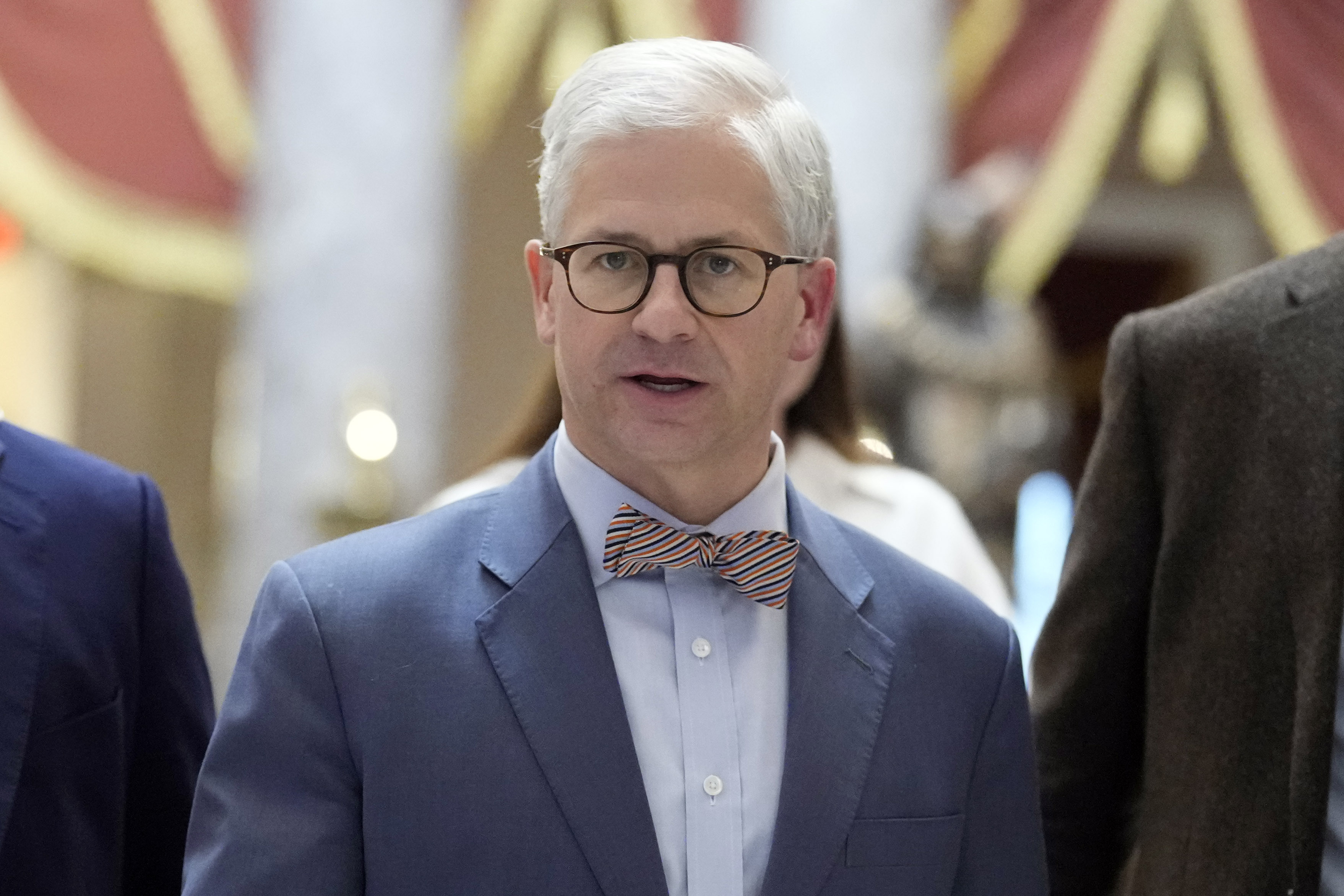
Rep. Patrick McHenry, R-N.C.
“Please vacate the space tomorrow, the room will be re-keyed,” wrote a top aide on the Republican-controlled House Administration Committee. The room was being reassigned by the acting speaker “for speaker office use,” the email said….
Only a select few House lawmakers get hideaway offices in the Capitol, compared to their commonplace presence in the Senate.
House Minority Leader Hakeem Jeffries’ staff helped Pelosi’s office make the move, according to a spokesperson for the former speaker.
Here’s Pelosi’s full response to the eviction, from Raw Story:
“With all of the important decisions that the new Republican Leadership must address, which we are all eagerly awaiting, one of the first actions taken by the new Speaker Pro Tempore was to order me to immediately vacate my office in the Capitol,” Pelosi said in a statement, according to Politico’s Nicholas Wu. “Sadly, because I am in California to mourn the loss of and pay tribute to my dear friend Dianne Feinstein, I am unable to retrieve my belongings at this time.”
“This eviction is a sharp departure from tradition. As Speaker, I gave former Speaker Hastert a significantly larger suite of offices for as long as he wished,” She noted.
“Office space doesn’t matter to me, but it seems important to them,” Pelosi added. “Now that the new Republican Leadership has settled this important matter, let’s hope they get to work on what’s truly important to the American people.”
Three longer opinion pieces on the McCarthy mess:
John F. Harris at Politico Magazine: The House GOP Is a Failed State.
Amanda Marcotte at Salon: Kevin McCarthy’s embarrassing lesson: MAGA torches everything it touches — and will destroy itself.
NBC News: Kevin McCarthy’s ‘original sin’: What drove the House speaker’s historic downfall.
Two more interesting stories to check out:
The Atlanta Journal-Constitution: Fulton prosecutors float plea deals to Trump defendants.
Fulton County prosecutors are floating plea deals to a number of defendants in the election interference case involving former President Donald Trump, according to people with knowledge of the proposals.
At least a handful of the now 18 defendants have received offers from the District Attorney’s office — or prosecutors have touched base with their attorneys to gauge their general interest in striking a deal for a reduced charge in exchange for their cooperation, according to the legal sources, who spoke on condition of anonymity to discuss sensitive ongoing negotiations.
It’s common for prosecutors to float plea deals to lower-level defendants in large racketeering cases as they home in ontheir biggest targets. Trump and his former personal attorney Rudy Giuliani face the most chargesin the 41-count indictment, which centers on efforts to overturn the results of Georgia’s 2020 presidential election.
Late last week, Atlanta bail bondsman Scott Hall became the first defendant to accept a deal, pleading guilty to five misdemeanor counts in exchange for his testimony.
The Atlanta Journal-Constitution has learned that Fulton prosecutors have also offered a deal to Michael Roman, who worked as director of Election Day operations for the Trump campaign in 2020. A member of Roman’s legal team told The AJC theyrejected the DA’s proposal and that no agreement has been reached….
People who were indicted for their alleged roles in the appointment of a slate of Trump electors, election data breach in Coffee County and harassment of Fulton poll worker Ruby Freeman have also been approached by prosecutors, according to multiple sources. In the case of at least two of those defendants, no concrete offer has been made.
Click the link to read the rest.
The New York Times: Giuliani’s Drinking, Long a Fraught Subject, Has Trump Prosecutors’ Attention.
Rudolph W. Giuliani had always been hard to miss at the Grand Havana Room, a magnet for well-wishers and hangers-on at the Midtown cigar club that still treated him like the king of New York.
In recent years, many close to him feared, he was becoming even harder to miss.
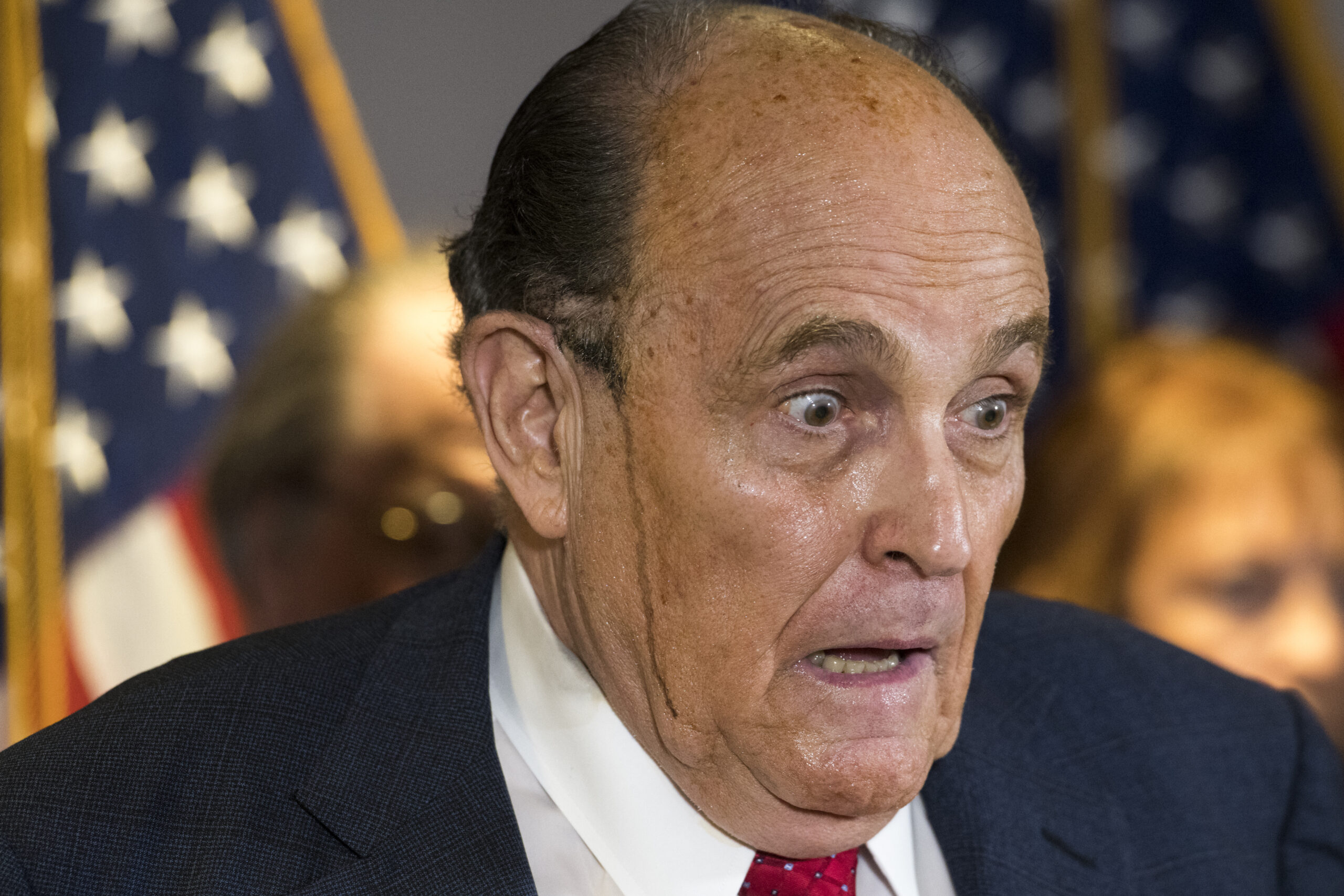 For more than a decade, friends conceded grimly, Mr. Giuliani’s drinking had been a problem. And as he surged back to prominence during the presidency of Donald J. Trump, it was getting more difficult to hide it.
On some nights when Mr. Giuliani was overserved, an associate discreetly signaled the rest of the club, tipping back his empty hand in a drinking motion, out of the former mayor’s line of sight, in case others preferred to keep their distance. Some allies, watching Mr. Giuliani down Scotch before leaving for Fox News interviews, would slip away to find a television, clenching through his rickety defenses of Mr. Trump.
Even at less rollicking venues — a book party, a Sept. 11 anniversary dinner, an intimate gathering at Mr. Giuliani’s own apartment — his consistent, conspicuous intoxication often startled his company.
“It’s no secret, nor do I do him any favors if I don’t mention that problem, because he has it,” said Andrew Stein, a former New York City Council president who has known Mr. Giuliani for decades. “It’s actually one of the saddest things I can think about in politics.”
Now prosecutors are looking at Giuliani’s problem.
Now, prosecutors in the federal election case against Mr. Trump have shown an interest in the drinking habits of Mr. Giuliani — and whether the former president ignored what his aides described as the plain inebriation of the former mayor referred to in court documents as “Co-Conspirator 1.”
Their entwined legal peril has turned a matter long whispered about by former City Hall aides, White House advisers and political socialites into an investigative subplot in an unprecedented case.
The office of the special counsel, Jack Smith, has questioned witnesses about Mr. Giuliani’s alcohol consumption as he was advising Mr. Trump, including on election night, according to a person familiar with the matter. Mr. Smith’s investigators have also asked about Mr. Trump’s level of awareness of his lawyer’s drinking as they worked to overturn the election and prevent Joseph R. Biden Jr. from being certified as the 2020 winner at almost any cost. (A spokesman for the special counsel declined to comment.)
The answers to those prompts could complicate any efforts by Mr. Trump’s team to lean on a so-called advice-of-counsel defense, a strategy that could portray him as a client merely taking professional cues from his lawyers. If such guidance came from someone whom Mr. Trump knew to be compromised by alcohol, especially when many others told Mr. Trump definitively that he had lost, his argument could weaken.
That’s it for me today. What do you think? What other stories have caught your interest?
Did you like this post? Please share it with your friends:
Posted: September 27, 2023 | Author: bostonboomer | Filed under: Donald Trump, just because, morning reads | Tags: bank fraud, insurance fraud, Judge Arthur Engoron, Letitia James, Trump Organization |
Good Day!!

Lady Justice, by Eduardo Rodriguez, 2017
All hell broke loose in Donald Trump’s life yesterday afternoon. New York Supreme Court Judge Arthur Engoron cancelled his business licenses in the state and ordered them into receivership. Legal experts call this the “corporate death penalty.”
From long-time Trump expert David Cay Johnston at DC Report: Judge Gives Trump Organization the Corporate Death Penalty.
Donald Trump is no longer in business.
Worse, the self-proclaimed multibillionaire may soon be personally bankrupt as a result, stripped of just about everything because for years he engaged in calculated bank fraud and insurance fraud by inflating the value of his properties, a judge ruled Tuesday.
His gaudy Trump Tower apartment, his golf courses, his Boeing 757 jet and even Mar-a-Lago could all be disposed of by a court-appointed monitor, leaving Trump with not much more than his pensions as a one term president and a television performer.
A New York State judge on Tuesday cancelled all of the business licenses for the Trump Organization and its 500 or so subsidiary companies and partnerships after finding that Trump used them to, along with his older two sons, commit fraud.
Under the New York General Business Law you can only do business in your own name as a sole proprietor or with a business license, which the state calls a “business certificate.” All of Trump’s businesses were corporations or partnerships that require business certificates.
The civil fraud case was brought by Letitia James, the elected attorney general of New York State.
The evidence and the issues were so clear cut, Judge Arthur F. Engoron ruled on Tuesday, that there was no reason to waste the court’s time trying them.
In a 35-page decision, Judge Engoron also excoriated Trump and his lawyers for making nonsense arguments, so badly misquoting legal cases that they turned the law upside down, and other legal misconduct.
The judge also sanctioned Trump’s lawyers $7,500 each for repeatedly advancing frivolous arguments. Judge Engoron’s decision can be appealed, but that may not have much chance of succeeding.
I give Trump’s chances of prevailing on appeal at somewhere between zero and nothing except perhaps on some minor procedural point, which you can be sure Trump will describe as complete vindication.
The summary judgement decision Tuesday was partial, however.
A non-jury trial before Judge Engoron next week will determine how much Trump will be fined for his years of bank fraud and insurance fraud.
Barring a highly unlikely reversal by an appeals court, Trump’s business assets eventually will be liquidated since he cannot operate them without a business license. Retired Judge Barbara Jones was appointed to monitor the assets, an arrangement not unlike the court-supervised liquidation of a bankrupt company or the assets of a drug lord.

Justice, by Pierre Subleyras
I thought this piece by Jose Pagliery at The Daily Beast gave the clearest explanation of the details of the case among the many that I read: Trump Basically Just Lost the New York Bank Fraud Case Before It Even Started. I’ll post some of it, but I’d recommend read the whole article if you have the time and interest.
Former President Donald Trump, his top executives, and heirs were declared completely liable of “persistent and repeated fraud”—and the real estate empire was unceremoniously stripped of its business licenses in New York—after a judge’s powerful ruling Tuesday ahead of a massive trial that seeks to hit them with more than $250 million in penalties for bank fraud.
And in a stunning development, the judge has already ordered the complete dissolution of the fabled Trump Organization–the tycoon’s pride and joy, the empire that made him famous and elevated him into the White House. The Trump Organization and its sister companies will be sent into receivership to be under the control of a court-appointed officer.
Even before the trial officially starts, the ruling handed New York Attorney General Letitia James a near total victory, meaning that next week’s trial will mostly focus on damages that could pulverize whatever is left of Trump’s many business entities and bank accounts.
In his 35-page opinion, Justice Arthur F. Engoron tore apart what he called the Trump family’s “bogus arguments” and obstreperous conduct. And he summed up the entire defense as “a fantasy world, not the real world.”
“In defendants’ world: rent regulated apartments are worth the same as unregulated apartments; restricted land is worth the same as unrestricted land, restricts can evaporate into thin air… all illegal acts are untimely if they stem from one untimely act; and square footage [is] subjective,” he wrote.
Trump, several of his heirs, and top executives will now be fighting off accusations of bank and insurance fraud at a civil trial that’s scheduled to run from early October until late December. AG Letitia James seeks to punish them all for routinely lying about property values to score better deals. At trial, it will be up to Judge Engoron alone whether the Trumps will owe $250 million-plus in penalties, be prohibited from serving as executives, and have the company charters revoked.
Of course, Trump posted an idiotic statement on the decision to Truth Social. It’s reproduced in the article. A bit more on the case itself:
The judge’s ruling represents a significant setback for Trump by revoking his company’s authority to do business in New York, where the Trump Organization is headquartered and where Trump has major real estate interests. It also represents a victory for Attorney General Letitia James (D), who had asked that Engoron simplify the upcoming trial by deciding in advance that fraud was broadly committed so the state would need to prove only specific illegal acts.
On Tuesday, Engoron ripped the Trumps—and their lawyers—apart for dragging this on so long with legal arguments that wasted the courts time by repeatedly questioning whether the AG even had the authority to hold them accountable this way.

Justice, by Francisca Vogel
Those arguments “glaringly misrepresent” the law and trying them again and again “invoke the time-loop in the film Groundhog Day,’” the judge wrote, calling attempts to topple the case this way “pure sophistry.”
Engoron also made the pivotal decision to keep all of the AG’s lawsuit intact, concluding that all of the real estate deals in question are not too old for law enforcement to crack down on for bank fraud. He brushed off the Trumps’ attempt to whittle down the lawsuit ahead of a trial that could drain the wealthy family’s bank accounts.
The timing of this decision also throws a wrench into the Trumps’ Hail Mary play, in which they sued the judge directly and prematurely asked a state appellate court to intervene because he hadn’t yet made his decision on the statute of limitations—an oddly aggressive move that reeked of delay tactics. That higher court, the appellate division’s First Judicial Department, has yet to weigh in. Doing so now might be a moot point. As such, the trial appears to be set to start next Monday, as planned.
There’s still more from the Judge on Trump’s fraudulent behavior at the link. Pagliery tweeted from the New York courthouse this morning, where Trump’s lawyers were back arguing with the judge this morning. Here’s his latest article:
Jose Pagliery at The Daily Beast: Team Trump Prepares for Doom at New York Bank Fraud Trial.
On the heels of yesterday’s critical court ruling ordering the death of the fabled Trump Organization, lawyers for Donald Trump appeared in court on Wednesday to pick up the pieces and make sense of how this can possibly get any worse for the former president.
Huge sections of the Trump family’s real estate empire are having their business licenses revoked, and the Trumps are losing control of their companies to a court-appointed official. The trial set to start next week threatens to empty their bank accounts too.
Half a day after Justice Arthur F. Engoron’s Tuesday ruling, it’s evident the real estate tycoon and his lawyers still aren’t sure what will happen to Trump’s Monopoly board collection of buildings in Manhattan and elsewhere.
“Certain of the entities own physical assets, like 40 Wall Street and Trump Tower. Are those assets now going to be sold? Or managed under direction of the monitor?” Trump defense lawyer Christopher Kise asked the judge in court.
After privately discussing the matter with his law clerk, the judge declined to make a final decision “right now.” But the judge made clear an independent person will play a role in determining the fate of this multibillion dollar network of companies, giving both investigators and the Trump family extra time to jointly find an outside official who can oversee this while they’re wrested from the family’s control.
Engoron on Tuesday decided that New York Attorney General Letitia James already proved the Trump family routinely lied to banks by wildly inflating property values for years—the first of seven counts in the AG’s lawsuit. Each count alleges a violation of the state’s Executive Law § 63(12), which keeps corporations honest. In court today, Trump’s attorneys asked a question dripping with existential dread.
“What’s the point of the others?” Kise asked the judge. “I don’t know how many 63(12) counts you need. You’ve already granted relief, except for disgorgement.”
Kise was referring to the next punishment the Trumps might face, as state investigators want to seize $250 million-plus in profits that they obtained after faking asset values on business paperwork submitted to banks for loans.

La Justice, by Gee
This process is going to be fascinating. My guess is it will end up taking a long time before we know the final upshot. But as of now, Trump has been stripped of his identity as a successful businessman. That has to be deeply humiliating for him.
Trump whisperer Maggie Haberman and fellow New York Times reporter wrote about this: Ruling Against Trump Cuts to the Heart of His Identity.
Nearly every aspect of Donald J. Trump’s life and career has been under scrutiny from the justice system over the past several years, leaving him under criminal indictment in four jurisdictions and being held to account in a civil case for what a jury found to be sexual abuse that he committed decades ago.
But a ruling on Tuesday by a New York State judge that Mr. Trump had committed fraud by inflating the value of his real estate holdings went to the heart of the identity that made him a national figure and launched his political career.
By effectively branding him a cheat, the decision in the civil proceeding by Justice Arthur F. Engoron undermined Mr. Trump’s relentlessly promoted narrative of himself as a master of the business world, the persona that he used to enmesh himself in the fabric of popular culture and that eventually gave him the stature and resources to reach the White House.
The ruling was the latest remarkable development to test the resilience of Mr. Trump’s appeal as he seeks to win election again despite the weight of evidence against him in cases spanning his years as a New York developer, his 2016 campaign, his efforts to overturn his 2020 election loss and his handling of national security secrets after leaving office.
The authors note that, so far, none of the cases against Trump have seemingly hurt his campaign to win the presidency again in 2024.
Whether the effect of Justice Engoron’s ruling is any different remains to be seen. But his finding imperils both Mr. Trump’s public image and his business empire. The former president now faces not only the prospect of having to pay $250 million in damages, but he could also lose properties like Trump Tower that are inextricably linked to his brand….
In all of Mr. Trump’s recent legal travails, his typical tactics for self-preservation have largely failed him. When cornered, Mr. Trump has traditionally sought to bluster his way out of trouble, falling back on exaggerations or outright lies to escape.
These methods have served him well in the business and political arenas, where there is often little price to pay for bending the truth and where voters tend not to distinguish between gradations of prevarications. Those methods, though, have been much less effective so far in the courts, which operate according to strict standards of veracity and staid and sober rules.
In straightforward terms, Justice Engoron punctured Mr. Trump’s bubble of protective falsehoods about the way he conducted his business.
More Interesting Stories to Check Out
NBC News: The FBI is probing whether Egyptian intelligence played a role in Bob Menendez’s alleged bribery scheme.
Molly Jong-Fast at Vanity Fair: Let’s Not Sleepwalk Into Another Trump Presidency.
Amanda Marcotte at Salon: President Drink Bleach says what? Trump now claims he beat George W. Bush and Barack Obama.
CNN: Commander Biden bites another Secret Service agent, the 11th known incident.
The New Republic: The Sick, Racist Message Behind Why Trump Chose That Particular Gun Store.
The Hill: FCC chair proposes reinstating Obama-era net neutrality rules.
The Messenger: Trump Adds Two Attorneys to Criminal Defense Team.
The Daily Beast: UAW Leader Has No Desire at All to Talk to Trump in Michigan.
Have a great Wednesday everyone!!
Did you like this post? Please share it with your friends:

 Happy Caturday!!
 For weeks, Democratic and Republican senators have been watching the House with growing alarm as Speaker Kevin McCarthy has struggled to cobble together the votes to pass a short-term spending bill along party lines – all as he has resisted calls to cut a deal with Democrats to keep the government open until a longer-term deal can be reached. The initial plan: Let McCarthy get the votes to pass a bill first before the Senate changes it and sends it back to the House for a final round of votes and negotiations.
 Fingerprints belonging to the driver of co-defendant Fred Daibes were found on at least one of the envelopes, as well as his DNA and his return address, prosecutors said. “Thank you,” Nadine Menendez texted Daibes around Jan. 24, 2022, according to the indictment. “Christmas in January.”
 “Tuesday, I’ll go to Michigan to join the picket line and stand in solidarity with the men and women of UAW as they fight for a fair share of the value they helped create,” Biden
  “Mark Milley, who led perhaps the most embarrassing moment in American history with his grossly incompetent implementation of the withdrawal from Afghanistan, costing many lives, leaving behind hundreds of American citizens, and handing over BILLIONS of dollars of the finest military equipment ever made, will be leaving the military next week,” Trump wrote on his Truth Social social media site, created when he was banned from several others. “This will be a time for all citizens of the USA to celebrate!”
 Whiting’s precise role on Smith’s team is unclear. A spokesperson for Smith declined to comment, and Whiting did not immediately return requests for comment. The prosecutors’ office in the Hague and Harvard University also did not respond to requests for comment about Whiting’s current employment status.
 In hindsight, that phenomenon may be eclipsed by another one: Republicans deserting their party precisely because of Trump, forming a demographic now familiarly known as “Never Trump Republicans.” Whether it was his xenophobic
 peej
peej Carissa
 bostonboomer
 dakinikat
 ecocatwoman
 mablue2
 Mama Lopez
 peggysue22
 quixote
 skydancingguestblogger
 Mona (aka Wonk the Vote)



 Sky Dancing
Recent Comments