
Manchester Union Leader Endorses Newt Gingrich
Posted: November 27, 2011 Filed under: 2012 presidential campaign, Republican presidential politics, U.S. Politics | Tags: Barack Obama, Bill Clinton, Herman Cain, John Huntsman, Manchester Union Leader, Mitt Romney, New Hampshire primary, Newt Gingrich 22 Comments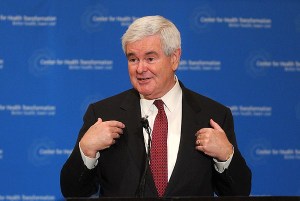
The ultra-conservative Manchester Union Leader, the largest and most influential newspaper in New Hampshire has endorsed Newt Gingrich in the New Hampshire Republican primary, which will be held on January 10.
America is at a crucial crossroads. It is not going to be enough to merely replace Barack Obama next year. We are in critical need of the innovative, forward-looking strategy and positive leadership that Gingrich has shown he is capable of providing.
He did so with the Contract with America. He did it in bringing in the first Republican House in 40 years and by forging balanced budgets and even a surplus despite the political challenge of dealing with a Democratic President. A lot of candidates say they’re going to improve Washington. Newt Gingrich has actually done that, and in this race he offers the best shot of doing it again.
Interesting. The Union Leader gives credit to Gingrich for the surplus, implying that Bill Clinton fought against balancing the budget. They also don’t mention Gingrich’s ethics problems. Gingrich must be dancing a jig with Callista today. Steve Benen looked to see what the newspaper’s record is on picking primary winners.
Looking back, the track record is mixed:
1976: The paper endorsed Ronald Reagan over Gerald Ford, but Reagan lost
1980: Reagan won the endorsement and the primary
1988: The Union Leader supported Pete du Pont, who finished fourth in the primary
1992: The paper supported Pat Buchanan, who finished a competitive second against an incumbent president
1996: The Union Leader again backed Buchanan, who this time won the primary
2000: Steve Forbes won the paper’s endorsement, in advance of a third-place showing
2008: The Union Leader supported John McCain, who won the state’s primary
While the endorsement doesn’t mean Gingrich will catch up with Romney, I don’t see how it can hurt. I’m sure the White House is celebrating today too. Gingrich would certainly be an easier opponent for Obama than Romney. And Bill Clinton basically confirmed that by praising Gingrich in an interview with Newsmax. [WARNING: wingnut site!]
Former President Bill Clinton praised his erstwhile nemesis former House Speaker Newt Gingrich, crediting Gingrich’s strong debate performances with propelling him into front-runner status for the GOP presidential nomination.
“It’s not any traditional charisma,” said Clinton, who discussed his new best-seller, “Back to Work: Why We Need Smart Government for a Strong Economy,” in an exclusive interview with Newsmax.TV. Instead, Clinton believes Gingrich is emerging because “he thinks about this stuff all the time.”
The White House must be grateful to Clinton for heaping the following praise on Gingrich:
“He’s articulate and he tries to think of a conservative version of an idea that will solve a legitimate problem,” Clinton told Newsmax in the exclusive interview this week, by way of explaining the Gingrich resurgence. Gingrich holds frontrunner status in the race for the GOP nomination, as several polls have him surpassing former Massachusetts Gov. Mitt Romney.
Clinton continued: “For example, I watched the national security debate last night. And Newt said two things that would make an independent voter say, ‘Well, I gotta consider that.’
“He said, ‘OK, I don’t want to legitimize immigrants who came here undocumented, illegally.’ On the other hand, a lot of those people have been here for years, they worked hard, they paid taxes, they’ve got kids in the schools, they’re not criminals, we’re going to have a hard time sending them all home, there’s millions of them. So, I’d like to have a process where they could be here legally but not have a path to citizenship. That sort of splits the difference between the immigration reforms proposed by President Bush and President Obama, which would give a path to citizenship, and would be a version of what President Reagan did.”
Newsmax notes that Clinton didn’t go so far as to predict Newt would be the Republican nominee.
And how are the losers in the endorsement race reacting? The Boston Globe:
Romney campaign spokeswoman Gail Gitcho declined to comment. Appearing on CNN’s State of the Union this morning, Cain blamed his failure to secure the paper’s endorsement on “false accusations” of sexual harassment from his tenure as head of the National Restaurant Association and confusion over his position on abortion.
“Obviously false accusations and confusion about some of my positions has contributed to it and that was to be expected,” Cain said. “Some people are heavily influenced by perception more so than reality. The good news is most of my supporters have stayed on the Cain train, as we say.”
Former Utah governor Jon Huntsman, on Fox News Sunday, shrugged off the impact.
“It once again proves how fluid and unpredictable New Hampshire is,” Huntsman said of the endorsement. “A month ago for Newt Gingrich to have been in the running to capture the Union Leader endorsement would be unthinkable.”
Cain blew it when he publicly snubbed the Union Leader by cancelling a planned candidate interview a couple of weeks ago and then rescheduled it a few days later. I imagine Romney is really grinding his teeth over this. I can’t imagine how he could win the nomination without taking the New Hampshire primary.
Political Cage Match: Professor versus Puffed-Up Congressman
Posted: November 25, 2011 Filed under: Congress, corruption, education, Environment, U.S. Politics | Tags: ANWR, Arctic National Wildlife Refuge, conservation, Douglas Brinkley, House Natural Resources Committee, oil drilling, Rep. Don Young (R-Alaska), Republicans 9 Comments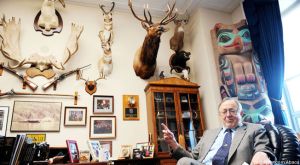
Rep. Don Young (R-Alaska)
Last Friday historian Douglas Brinkley testified before the House Natural Resources Committee on the topic of preserving the Arctic National Wildlife Refuge. The Republicans, of course, have been trying for years to open it up to oil drilling. Brinkley, whose latest book is The Quiet World: Saving Alaska’s Wilderness Kingdom, 1879-1960, argued that preserving one of the last truly wild places in the U.S. should trump helping the oil companies make more money.
Alaska Rep. Don Young (who had skipped most of the testimony) broke into Brinkley’s presentation, calling the historian by the wrong name and saying his testimony was “garbage.” Then the two had a hilarious shouting match. IMO, Brinkley came out the winner, but judge for yourself:
Young: If you ever want want to see an exercise in futility … That side has already made up its mind and this side has already made up its mind. I call it garbage, Dr. Rice, it comes from the mouth –
Brinkley: It’s Dr. Brinkley. Rice is a university – I know you went to Yuba [a community college] and you couldn’t graduate.
Young: Well, okay, I can call you anything I want if you sit in that chair. You just be quiet! You be quiet!
Brinkley: You don’t own me. I pay your salary.
Young: I don’t own you, but I can tell you right now—
Brinkley: I work for the private sector, you work for the taxpayer.
Next, committee chairman Doc Hastings interrupted and lectured Brinkley. But Young was still “pissed right now.”
Finally, Brinkley said he was surprised to
hear a congressman today say there’s nothing in his district. It’s boring. It’s flat. It’s not exciting. I don’t know a representative who doesn’t love their district. Every state in America’s landscape is beautiful if you love it. But some people love money more than their homeland or where they live, and I’m afraid that that’s why this fight has to keep coming up 50 years later, we’re still trying to tell people the Arctic refuge is real. It belongs to the American people.
On Friday evening, Brinkley appeared on The Ed Show on MSNBC to discuss his experience with Rep. Young.
A week later, the Congressional cage match is still causing controversy. At the Minnesota Post, Don Shelby, a friend of Brinkley’s wrote a column about the dust up.
Brinkley told me he knew that Congressman Young, at another hearing, had waved a walrus penis bone at Mollie Beattie, the incoming chief of the Fish and Wildlife Service. Brinkley may have read the Rolling Stone article about Young that quotes the congressman as saying, “Environmentalists are a self-centered bunch of waffle-stomping, Harvard-graduating, intellectual idiots.” The quote continues, “[They] are not Americans, never have been Americans and never will be Americans.” ….
Brinkley should not have been surprised that Congressman Young showed up late and missed the bulk of the historian’s testimony. Young is often cited as the congressman missing more votes than any other member of the House. Brinkley would have known that Young was the co-sponsor, with discredited Alaska Sen. Ted Stevens, of the bill to pay for the infamous “bridge to nowhere.”
Brinkley told me: “Everyone knows that Young is just a menacing blowhard. He has a history of being rude, he browbeats and he’s snotty toward anyone who cares about the environment.”
I asked Brinkley if he was surprised that Committee Chair Doc Hastings took Young’s side and continued lecturing the historian. “No,” said Brinkley. “They are tied together at the hip. They are both oil company factotums. They are a tag team.”
Young claims that Brinkley is just milking the incident to sell books. Brinkley told a Houston TV station
that his students applauded when he walked into class. “I have received now hundreds and hundreds of emails from people all over, I’ve not received one negative one,” he said. “I’ve had my entire Rice University and including Texas conservatives cheering me on for standing up to his bullying tactics.”
I’m not usually much of a fan of Brinkley’s, but I have to applaud him on this one. I don’t care if he’s doing it to sell books. Greedy, incompetent politicians like Don Young need to be revealed for what they are: pigs at the trough.
Thanksgiving Day Reads
Posted: November 24, 2011 Filed under: morning reads | Tags: Morning reads, Thanksgiving 16 Comments
Happy Thanksgiving!! I’m going to devote this Thursday post to Thanksgiving-oriented material. Feel free to talk about whatever you want in the comments.
Here’s a little background on the origins of the Thanksgiving feast from Wikipedia:
Thanksgiving in North America had originated from a mix of European and Native traditions.[1] Typically in Europe, festivals were held before and after the harvest cycles to give thanks for a good harvest, and to rejoice together after much hard work with the rest of the community.[1] At the time, Native Americans had also celebrated the end of a harvest season.[1] When Europeans first arrived to the Americas, they brought with them their own harvest festival traditions from Europe, celebrating their safe voyage, peace and good harvest….
In the United States, the modern Thanksgiving holiday tradition traces its origins to a 1621 celebration at Plymouth in present-day Massachusetts. There is also evidence for an earlier celebration on the continent by Spanish explorers in Texas at San Elizario in 1598, as well as thanksgiving feasts in the Virginia Colony. The initial thanksgiving observance at Virginia in 1619 was prompted by the colonists’ leaders on the anniversary of the settlement. The 1621 Plymouth feast and thanksgiving was prompted by a good harvest. In later years, the tradition was continued by civil leaders such as Governor Bradford who planned a thanksgiving celebration and fast in 1623. While initially, the Plymouth colony did not have enough food to feed half of the 102 colonists, the Wampanoag Native Americans helped the Pilgrims by providing seeds and teaching them to fish. The practice of holding an annual harvest festival like this did not become a regular affair in New England until the late 1660s
I don’t really know how accurate that is. The Christian Science monitor has listed five myths about Thanksgiving that they believe will surprise people. Number three on the list was news to me:
3. Pilgrims dressed in all black and wore buckles
Not so fast. This modern-day likeness of the first American Pilgrims was conjured sometime in the 19th century, when the popular image of Pilgrims was formed – but it’s mostly false. The garb of the Pilgrims was actually brightly colored and buckle-free.
Pilgrim women normally dressed in red, earth green, brown, blue, violet, and gray, and the men wore white, beige, black, earth green, and brown clothing. Buckles were not commonly worn until much later in the 17th century, and black and white clothing was typically only worn on Sundays and when observing formal occasions.
So why give the Pilgrims this now-iconic appearance?
Former Plimoth (yep, we double-checked the spelling) Plantation historian James W. Baker writes that, in the 19th century, buckles were assigned to Pilgrims because they served as an emblem of quaintness, which is the same reason illustrators gave Santa Claus buckles. Also associated with Pilgrims – the blunderbuss, a muzzle-loading firearm with a stout caliber barrel – was so designated because of its old-fashioned, unthreatening look. But the Pilgrims probably didn’t use that either.
According to The Boston Globe the Thanksgiving travel rush was going full tilt yesterday.
Undeterred by costlier gas and airfare, millions of Americans set out Wednesday to see friends and family in what is expected to be the nation’s busiest Thanksgiving weekend since the financial meltdown more than three years ago….
About 42.5 million people are expected to hit the road or take to the skies for Thanksgiving this year, according to travel tracker AAA. That’s the highest number since the start of the recession at the end of 2007.
Heavy rain slowed down early travelers along the East Coast. Snow across parts of New England and upstate New York made for treacherous driving and thousands of power outages. And a mudslide covered train tracks in the Pacific Northwest. But most of the country is expected to have clear weather Thursday.
Quite frankly, some of my happiest Thanksgiving days have been spent alone. I find holidays somewhat stressful, and besides I have kind of a crazy family. This year I’m going to spend the day with my brother’s family at the home of some of their friends. I’m pretty sure everyone will be nice, but if not I can always excuse myself early. Here’s an article from Time for people with big crazy families like mine: 5 Ways to Keep Your Family From Ruining Thanksgiving. Here’s my favorite (Number 5):
The key to maintaining your calm is to send yourself the right mental messages. That means practicing mindful awareness, loving kindness and compassionate self-talk. Sound like new age psychobabble? The truth is, you’re already sending yourself messages all the time. “You’re telling yourself throughout the day what you’re bothered by and disappointed in….It’s worse at holiday time when your expectation of what you thought your life was going to look like is most acute.”
I found two writers (probably both conservatives) who claimed that the lesson of the first Thanksgiving is that capitalism trumps socialism.
From Tom Arneberg at the Chippewa Herald:
When they first started the colony, their overseas investors forced them to share all their property together. According to Bradford, “all profits and benefits that are got by trade, working, fishing, or any other means” were to be shared, and that “all such persons as are of this colony are to have their meat, drink, apparel, and all provisions out of the common stock.”
In other words, put into the common stock all you can, and take out only what you need. “To each according to his need; from each according to his ability.” Sound familiar?
Communism may be okay for a small group like a family or a Boy Scout patrol, but it doesn’t scale very well for larger groups.
According to Arneson “communism” made the pilgrims lazy and selfish so William Bradford, the governor of Plimouth, decided to try “free market capitalism.”
Bradford and the colony elders divided up the property among the families. Whatever produce a family did not use for themselves, they were free to trade away with others for something else they wanted.
It was an astonishing success — the harvests of 1623 and beyond provided a bounty of excess food, not just for a single Thanksgiving meal as in the previous two years, but enough to last the winter….
Once the creative powers of individual rewards were unleashed, where every person was allowed to keep the fruits of his own labor for his own family or for trade, everything was different.
And from Dr. Milton R. Wolf at the Washington Times:
The Plymouth colonists were socialists before socialism was cool. They entered into a contract with one another and a finance company called Merchant Adventurers to create an egalitarian commune in which their wealth, food in particular, would be collectively stored and redistributed equally among members. This was the forebear of the modern-day American counterculture collectivist commune or even Israel’s more mainstream kibbutz, which survive on government subsidies. Equality is put before freedom or even productivity.
And so on…with even more right-wing propaganda included than in the article by Arneberg. I guess the first Thanksgiving was about sharing, but a couple of years later the pilgrims learned that greed is good. Incidentally, the author’s bio at the end of the article says the Wolf is Barack Obama’s cousin. Is this meme the latest White House effort to push austerity?
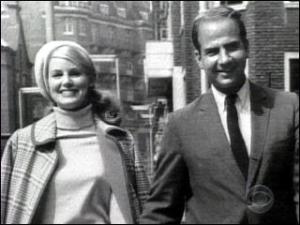
Calvin Trillin and his wife Alice in 1965
Since we were talking about mac and cheese on Thanksgiving last night, I thought I’d share my favorite alternative Thanksgiving story. For many years, humorist Calvin Trillin has led a campaign to change the official Thanksgiving dish from turkey to spaghetti carbonara. I located Trillin’s piece about it on-line, and since it was copied from Trillin’s book Third Helpings, I figured it would be OK for me to copy it too.
I have been campaigning to have the national Thanksgiving dish changed from turkey to spaghetti carbonara.
It does not take much historical research to uncover the fact that nobody knows if the Pilgrims really ate turkey at the first Thanksgiving dinner. The only thing we know for sure about what the Pilgrims ate is that it couldn’t have tasted very good. Even today, well brought-up English girls are taught by their mothers to boil all veggies for at least a month and a half, just in case one of the dinner guests turns up without his teeth… (It is certainly unfair to say that the English lack both a cuisine and a sense of humor: their cooking is a joke in itself.)
It would also not require much digging to discover that Christopher Columbus, the man who may have brought linguine with clam sauce to this continent, was from Genoa, and obviously would have sooner acknowledged that the world was shaped like an isosceles triangle than to have eaten the sort of things that the English Puritans ate. Righting an ancient wrong against Columbus, a great man who certainly did not come all this way only to have a city in Ohio named after him, would be a serious historical contribution. Also, I happen to love spaghetti carbonara.
[In our family]…Thanksgiving has often been celebrated away from home. It was at other people’s Thanksgiving tables that I first began to articulate my spaghetti carbonara campaign–although, since we were usually served turkey, I naturally did not mention that the campaign had been inspired partly by my belief that turkey is basically something college dormitories use to punish students for hanging around on Sunday… I reminded everyone how refreshing it would be to hear sports announcers call some annual tussle the Spaghetti Carbonara Day Classic.
I even had a ready answer to the occasional turkey fancier at those meals who insist that spaghetti carbonara was almost certainly not what our forebears ate at the first Thanksgiving dinner. As it happens, one of the things I give thanks for every year is that those people in the Plymouth Colony were not my forebears. Who wants forebears who put people in the stocks for playing the harpsichord on the Sabbath or having an innocent little game of pinch and giggle?
Finally there came a year when nobody invited us to Thanksgiving dinner. Alice’s theory was that the word had got around town that I always made a pest out of myself berating the hostess for serving turkey instead of spaghetti carbonara…
However it came about, I was delighted at the opportunity we had been given to practice what I had been preaching–to sit down to a Thanksgiving dinner of spaghetti carbonara.
Naturally, the entire family went over to Rafetto’s pasta store on Houston Street to see the spaghetti cut. I got the cheese at Joe’s dairy, on Sullivan, a place that would have made Columbus feel right at home–there are plenty of Genoese on Sullivan; no Pilgrims–and then headed for the pork store on Carmine Street for the bacon and ham. Alice made the spaghetti carbonara. It was perfection. I love spaghetti carbonara. Then I began to tell the children the story of the first Thanksgiving:
In England, along time ago, there were people called Pilgrims who were very strict about making everyone observe the Sabbath and cooked food without any flavor and that sort of thing, and they decided to go to America, where they could enjoy Freedom to Nag. The other people in England said, “Glad to see the back of them.” In America, the Pilgrims tried farming, but they couldn’t get much done because they were always putting their best farmers in the stocks for crimes like Suspicion of Cheerfulness. The Indians took pity on the Pilgrims and helped them with their farming, even though the Indians thought that the Pilgrims were about as much fun as teenage circumcision. The Pilgrims were so grateful that at the end of their first year in America they invited the Indians over for a Thanksgiving meal. The Indians, having had some experience with Pilgrim cuisine during the year, took the precaution of taking along one dish of their own. They brought a dish that their ancestors had learned from none other than Christopher Columbus, who was known to the Indians as “the big Italian fellow.” The dish was spaghetti carbonara–made with pancetta bacon and fontina and the best imported prosciutto. The Pilgrims hated it. They said it was “heretically tasty” and “the work of the devil” and “the sort of thing foreigners eat.” The Indians were so disgusted that on the way back to their village after dinner one of them made a remark about the Pilgrims that was repeated down through the years and unfortunately caused confusion among historians about the first Thanksgiving meal. He said,
“What a bunch of turkeys!”
Alice Trillin died on September 11, 2001.
Here’s a recipe for spaghetti carbonara:
1 pound spaghetti Ask the
hotline about
this ingredient!
1/2 pound pancetta (sliced 1/4 “ thick at the deli, and cut into lardons)
4 large eggs (locally raised and cage-free if possible)
1 tablespoon garlic, finely chopped
this ingredient!
1 cup Pecorino Romano cheese, freshly grated
2 tablespoons extra virgin olive oil
2 tablespoons finely minced fresh parsley
Freshly ground black pepper
Freshly grated parmesan reggiano to pass at the tablePut salted water on the boil for the pasta, grate the romano cheese and set aside, finely mince the fresh parsley and reserve.
In a very large skillet, saute the pancetta lardons in the olive oil over medium heat until the bacon has rendered much of its fat. You don’t want to cook the pancetta to the point of being crisp, it is better with a little fatty “chew” still left in it. Just before the pancetta is done, add the minced garlic to the pan and allow to cook until the garlic is golden brown. Set the pan aside to cool. (Allowing the pan to cool some at this point is important, because if the pan is too hot when you add the eggs later, they will immediately scramble, and not gently cook into the creamy sauce that is your ultimate goal.
Break the eggs into a medium sized bowl and whisk them till smooth. Add the grated cheese to the eggs and keep handy.
Cook the pasta to the maker’s instructions for “al dente”, and as soon as it is done, quickly strain it and toss it into the skillet with the pancetta, reserving a cup of the pasta cooking water to thin your sauce later if needed. Add the cheese and egg mixture to the pasta along with the parsley, and toss to coat. The heat from the pasta will gently cook the eggs, and melt the cheese into a luxuriously rich and smooth sauce. If the sauce is too thick for your liking, add some of the reserved pasta cooking water to loosen it.
To serve, place the pasta into warmed bowls, top liberally with freshly ground black pepper, and sprinkle with some freshly grated parmesan.
I hope everyone has a wonderful day and lots to be grateful for!
Republican Debate Open Thread and Live Blog
Posted: November 22, 2011 Filed under: 2012 presidential campaign, U.S. Military, U.S. Politics | Tags: live blog, national security, open thread, Republican Debate 58 Comments
Look what vcame out of the clown car!
Can you believe there’s another Republican debate tonight? I’m going to listen to at least part of it, because I’m hope Newt Gingrich will melt down. I expect everyone will be trying to trip him up since he’s now the {shudder} frontrunner.
The debate will be on CNN from 8-10PM. CNN will probably be live streaming it. I’ll find the link ASAP. The topic tonight’s debate is national security. I wonder if Herman Cain will show up? Or perhaps he’ll have one of the boxes on his back so that his advisers can cue him?
With new trouble appearing in the Middle East and the Pentagon facing possible budget cuts, the Republican White House contenders are debating for the second time in as many weeks how they would do better than President Barack Obama in protecting and extending America’s national security.
Six weeks to the day before the first nominating contests in Iowa, the candidates were looking to use the pre-Thanksgiving holiday debate to build or — for former Massachusetts Gov. Mitt Romney and former House Speaker Newt Gingrich at the head of the pack — sustain momentum in the battle to pick a 2012 election challenger for Obama.
Businessman Herman Cain, Texas Gov. Rick Perry, Reps. Ron Paul of Texas and Michele Bachmann of Minnesota, former Utah Gov. Jon Huntsman and former Sen. Rick Santorum of Pennsylvania also were meeting in Tuesday night’s forum put together by CNN, the Heritage Foundation and the American Enterprise Institute.
With unemployment stubbornly high and the economy sluggish to recover from recession, the candidates also were likely to drive the foreign policy discussion back to pocketbook issues at home.
With this crazy crowd, you never know what could happen. I don’t want to miss any ghastly gaffes or monstrous meltdowns! If you’re listing/watching too, please join me in documenting the atrocities. You can feel free to bring up other topics as well. This is an open thread.
Tuesday Reads: 11/22/63
Posted: November 22, 2011 Filed under: Media, Medicare, U.S. Military, U.S. Politics | Tags: assassination, John F. Kennedy 30 Comments
Today is the 48th anniversary of the assassination of President John F. Kennedy. Every year reams of material about media that long ago day are produced by the media. But even though a congressional investigation determined that a conspiracy was behind the murder of JFK, the media narrative never changes: most writers claim that Oswald was the only person involved.
In my opinion, if Oswald killed Kennedy, he could not have done it alone. If you watch the videos of the assassination, it’s very clear that bullets hit Kennedy from both back and front. Witnesses reported hearing three shots. Witnesses at the scene ran toward the “grassy knoll,” the direction from which shots came. I think Oswald was a patsy, as he himself claimed after his arrest. A great deal of evidence has been released over the years, and a number of books have been published that clearly demonstrate that powerful forces wanted JFK dead. But the media continues to defend the “lone gunman” theory, because if the truth were publicly acknowledged, they would have to admit that there was in fact a coup in the U.S. 48 years ago today.
I don’t know who was really behind the assassination of course, but I suspect rogue elements in the CIA, the FBI, and possibly the military. Obviously we will never know for sure, because the cover-up began immediately after the murder–in Dallas, where doctors saw wounds that were apparently tampered with before the official autopsy took place at Bethesda Naval Hospital–at which federal agents refused to allow the President brother Bobby to attend, according to David Talbot’s book Brothers: The Secret History of the Kennedy Years.
Talbot also wrote that neither Bobby Kennedy nor Jackie Kennedy ever believed that Oswald had killed JFK. Bobby immediately suspected the CIA, which Jack Kennedy had vowed to “splinter…into a thousand pieces and scatter to the winds.” Bobby also suspected that Lyndon Johnson was involved.
One of RFK’s goals in running for President was to reopen the investigation into the JFK assassination. But we all know what happened to Bobby.
Richard Nixon was obsessed with finding out what happened to JFK, and he once “joked” about LBJ being involved.
All I know is that Johnson didn’t want anyone looking too closely at what had happened. He wanted the “investigation” to be wrapped up very quickly. President Johnson
immediately set up a commission to “ascertain, evaluate and report upon the facts relating to the assassination of the late President John F. Kennedy.” Johnson asked Warren if he would be willing to head the commission. Warren refused but it was later revealed that Johnson blackmailed him into accepting the post. In a telephone conversation with Richard B. Russell Johnson claimed: ” Warren told me he wouldn’t do it under any circumstances… I called him and ordered him down here and told me no twice and I just pulled out what Hoover told me about a little incident in Mexico City… And he started crying and said, well I won’t turn you down… I’ll do whatever you say.”
Not a very auspicious beginning for a thorough, unbiased investigation.
I’m by no means an expert on the assassination literature, although I’ve read several recent scholarly books about it in recent years. For anyone who is interested, I recommend reading some of what Joseph Cannon has written on the subject over the years.
What I think is that on that day in November 48 years ago there was essentially a coup, and after that Presidents knew that if they really tried to take on the CIA, they might end up dead like John and Bobby Kennedy did. The longer I live and the more I see what has happened to our government, the more strongly I believe this.
I do not by any means consider Jack Kennedy to be a “great President.” His time in office was far too short to permit a real evaluation. I honestly don’t care about Kennedy’s sex life or about his relationship with his wife Jackie. I don’t believe either Jack or Jackie was a saint or a villain. I think they were flawed human beings. But I do know that when they were in the White House, there was a sense of hope in the country. There was a feeling of a new beginning, of new possibilities. And I know that those feelings died with Jack Kennedy on 11/22/63.
Kennedy had signed an order to remove the American advisers from Vietnam, but Johnson immediately reversed the order. He plunged the country into a bitter bloody war. He also did some good things. He managed to get Congress to pass some of the legislation that Kennedy had championed like the Civil Rights Bill and Medicare. But Vietnam brought LBJ down and then we got Nixon, Ford, Carter, and Reagan, and Bush I. We had a bit of a respite with Clinton, but Bush II managed to wreak as much or more destruction as Reagan had. How would things be different today if Kennedy had lived? We’ll never know, of course; but the country has sure gone to hell since he died.
There will be hundreds of articles about JFK’s death published. I’ll link to just a few that I’ve read recently.
Famed horror writer Stephen King has written a fantasy novel in which a man travels back in time to a few years before the assassination in order to try to stop Oswald and save JFK and America (King is convinced that Oswald acted alone).
On one end is 2011. An unpopular diner has finally been bought out by L. L. Bean. The diner — and the time portal inside it — may last a few more weeks in the footprint of a burned textile mill.
On the other end is America under Eisenhower. The mill churns out white smoke. “Vertigo” is showing at the outdoor movie theater — on its first run. The Kennebec Fruit Company isn’t a curio for tourists; it sells oranges. And John Kennedy, the young senator from Massachusetts, is still alive.
The rules of the rabbit hole into the past are outlined in the first pages of the novel. Al Templeton, the owner of the diner, explains them to Jake Epping, an English teacher at the local high school. Walk to the back of the pantry. Mind the 60-watt bulb overhead. Expect the smell of sulfur. And keep walking until you feel your foot fall.
Suddenly you’re back on Sept. 9, 1958. It’s 11:58 a.m. There are, Al says, only two conditions. One, it’s not a one-way trip. It doesn’t have to be. But when you return, no matter how long you’ve stayed in the past — two days, five years, whatever — only two minutes have gone by in the present. Two, each time you go back to the past, there is a reset. Like a Magic Slate. It’s 11:58 a.m., and everything you did on your previous trip has been erased.
I haven’t read the novel, but Frank Rich has, and he’s written a lengthy article in New York Magazine in which he argues that Kennedy faced a barrage of right-wing hatred similar to that directed at President Obama in 2011.
At the two-year mark of February 1963, the Times Washington bureau chief James Reston lamented that the “exuberant optimism of the first few months of the Kennedy administration” had given way “to doubt and drift” in a Washington nearing “the point of paralysis.” The president, Reston wrote, was “a moderate confronted by radical facts,” among them “a whopping budget deficit and an alarming army of the unemployed.” Kennedy was in “trouble both with the conservatives who think he has gone too far and the liberals who think he has not gone far enough.”
Unlike Obama, JFK enjoyed consistently high poll numbers, still hovering near a 60 percent approval rating in November 1963. But that fall, both Newsweek and Look speculated he could lose his bid for reelection in 1964. The hatred he aroused, while from a minority of voters, was heated and ominous. On Sunday, November 24, 1963, the Times was packed with elegiac coverage of the leader who had been slain that Friday. But the No. 1 book on the nonfiction best-seller list, as it had been for weeks, was JFK: The Man & the Myth, by Victor Lasky, a newspaperman who would years later enjoy a second vogue on the right as a die-hard Nixon defender after Watergate. Lasky’s thick slash-and-burn Kennedy book, which even questioned his World War II heroism as the skipper of PT-109, was a precursor of the Swift Boat hatchet job on John Kerry.
Rich writes of Stephen King’s novel:
But another controversy from the assassination—one that has never received remotely the attention generated by the endless “grassy knoll” and “second gunmen” debates—is forcefully revived by King: the role played in Oswald’s psyche by the torrid atmosphere of political rage in Dallas, where both Lady Bird Johnson and Adlai Stevenson had been spat upon by mobs of demonstrators in notorious incidents before Kennedy’s fateful 1963 trip. As the time-traveling Epping gets settled in that past, he describes an inferno of seething citizens, anti-Semitic graffiti on Jewish storefronts, and angry billboards demanding the impeachment of Supreme Court Chief Justice Earl Warren and equating racial integration with communism. That last one, King’s protagonist observes, “had been paid for by something called The Tea Party Society.”
That “Tea Party Society” is the novelist’s own mischievous invention, but the rest of his description is accurate. King’s touchstone is The Death of a President, by William Manchester, a meticulous biographer and historian who was chosen by Jacqueline Kennedy to write the authorized account of the assassination. Manchester received cooperation from almost every conceivable party, the Warren Commission included, but after the Kennedy camp read the manuscript and objected to the disparaging treatment of Lyndon Johnson, as well as some (G-rated) domestic details about the First Couple, Mrs. Kennedy filed a quixotic injunction to halt publication. Her brief, failed effort only enhanced the book’s blockbuster appeal; soon after its release in 1967, The Death of a President became arguably more prominent than the Bible in middle-class American households. In his afterword to 11/22/63, King says he was “deeply impressed—and moved, and shaken” when rereading it. It’s hard to disagree. But what also struck me in a rereading was Manchester’s stern rejection of one major Warren Commission finding. Though he was onboard for its conclusion that Oswald was the lone assassin, he did not buy its verdict that there was “no evidence” of any connection between Oswald’s crime and Dallas’s “general atmosphere of hate.”
Manchester is uncharacteristically contentious about this point. He writes that “individual commissioners had strong reservations” about exonerating Dallas but decided to hedge rather than stir up any controversy that might detract from the report’s “widest possible acceptance.” While Manchester adds that “obviously, it is impossible to define the exact relationship between an individual and his environment,” he strongly rejected the universal description of Oswald as “a loner.” No man, he writes, is quarantined from his time and place. Dallas was toxic. The atmosphere was “something unrelated to conventional politics—a stridency, a disease of the spirit, a shrill, hysterical note suggestive of a deeply troubled society.”
The ultra-right wing hasn’t really changed all that much–but today the haters are mainstream, treated by the media as “moderates.” In JFK’s day they were in the John Birch Society and the Ku Klux Klan; today they control the Republican Party.
Here’s an interesting piece by Edward Lane of Wichita Falls, TX: Who Really Killed President John F. Kennedy?
Although many eyewitnesses said they thought the gunfire came from a grassy knoll in front of the President’s automobile, the Warren Commission determined the shots came from the Texas School Book Depository Building behind Kennedy. The Commission also said a lone gunman fired all the shots.
The Warren Commission, headed by Chief Justice Earl Warren, in 1964 ordered that much of its records be sealed for 75 years until 2039.
Why all the secrecy if, in fact, the government wanted the American people to be confident that they were getting the truth?
Although many eyewitnesses said they thought the gunfire came from a grassy knoll in front of the President’s automobile, the Warren Commission determined the shots came from the Texas School Book Depository Building behind Kennedy. The Commission also said a lone gunman fired all the shots.
The Warren Commission, headed by Chief Justice Earl Warren, in 1964 ordered that much of its records be sealed for 75 years until 2039.
One Wichita Falls man today speculated as to why there was need for secrecy until the year 2039.
He said he was puzzled by the need to keep the public in the dark for so long.
“Evidently they want to wait until everybody is dead before they release those records. Who are they protecting?” he asked, as he thought about one of the darkest days in American history.
Most of the sealed records belong to the CIA and will automatically become public in 2017.
And why are “long lost tapes” related to the assassination still turning up?
The tape is titled “Radio Traffic involving AF-1 in flight from Dallas, Texas to Andrews AFB on November 22, 1963.”
It consists of in-flight radio calls between the aircraft, the White House Situation Room, Andrews Air Force Base, and a plane that was carrying Kennedy press secretary Pierre Salinger and six Cabinet members from Hawaii to Tokyo when the president was assassinated.
Many Americans are unaware that there was an attempt to assassinate JFK by a New Hampshire man only a month before he was murdered in Dallas. A week later there was another foiled attempt in Chicago. Neither involved Lee Harvey Oswald.
This post is getting way too long, so I’ll end there. What’s on your reading and blogging list today?

 peej
peej Carissa
 bostonboomer
 dakinikat
 ecocatwoman
 mablue2
 Mama Lopez
 peggysue22
 quixote
 skydancingguestblogger
 Mona (aka Wonk the Vote)



 Sky Dancing
Recent Comments