
Romney Pollster Says Obama’s Convention Bounce is Just a “Sugar High”
Posted: September 10, 2012 Filed under: 2012 presidential campaign, U.S. Politics | Tags: Barack Obama, Mitt Romney, Neil Newhouse, Public Opinion Strategies 66 Comments
Neil Newhouse of Public Opinion Strategies
Just a quick post to call attention to a memo put out by Mitt Romney’s pollster, Neil Newhouse of Public Opinion Strategies. Buzzfeed reproduced the entire memo here.
“Don’t get too worked up about the latest polling,” wrote Romney campaign pollster Neil Newhouse. “While some voters will feel a bit of a sugar-high from the conventions, the basic structure of the race has not changed significantly.”
Newhouse argues that Obama continues to own the weak economy, and that the issue will soon “reassert itself” as the guiding factor in the election — the chief talking point that has always served as the founding rational (sic) of Romney’s campaign….
The memo notably strays from the straight number-crunching pollsters typically focus on, with Newhouse writing about campaign strategy and ad buys, among other things. It could represent an effort to leverage the pollster’s perceived credibility as a numbers guy — less likely to spin than a political strategist, or the campaign manager.
But what does it mean when a campaign feels the need to tell supporters “Don’t Panic?” At The Caucus Blog, Ashley Parker writes:
The mere existence of the memo seemed to place Team Romney on the defensive, forced to publicly assert that it is still in a position to win on Election Day. But the Romney campaign used the memo to underscore what has been its existing rationale for his candidacy — the struggling economy, which has not improved as quickly as Mr. Obama and most voters had hoped.
“The key numbers in this election are the 43 straight months of 8 percent or higher unemployment, the 23 million Americans struggling to find work, and the 47 million Americans who are on food stamps,” Mr. Newhouse wrote, citing the disappointing jobs report that came out on Friday. “Americans are not better off than we were four years ago, and that is why President Obama has struggled in this race.”
In the memo, the campaign also pointed to the expanding map of swing states, as well as its post-convention cash advantage, as reasons why it expects to win in November.
Now let’s get some perspective from Boston, where journalists are familiar with the history Newhouse’s reassurances and predictions, shall we? David Bernstein of The Boston Phoenix writes: “Well, If Newhouse Says So… PANIC!!!!!”
“[W]e’ve seen this kind of thing from Newhouse before,” says Bernstein:
Who in Massachusetts can forget the mid-October release of a Newhouse memo claiming an internal poll had Charlie Baker 7 points ahead of Deval Patrick, countering the public polls to the contrary — most notably a Suffolk University poll showing Patrick ahead by 7?
And two weeks later, the Newhouse memo claiming that “it appears that Charlie Baker is well-positioned to win this race”?
Patrick won by 6 points.
Or how about 2006, when the Kerry Healey campaign ran around touting an internal Newhouse poll that showed Patrick’s lead cut in half, to single digits, and public opinion of her improving? Healey lost by 21 points.
I’m not saying Newhouse is a terrible pollster. What I’m saying is that when a campaign is touting Newhouse claims to counter external evidence, in my experience that spells trouble for the campaign.
I’ll end with this piece by Salon’s Steve Kornacki, who points out that–despite the media narrative–President Obama has been ahead throughout the entire 2012 presidential campaign.
Open Thread: Sunday Night Funnies
Posted: September 9, 2012 Filed under: 2012 presidential campaign, open thread, U.S. Politics, War on Women | Tags: Barack Obama, editorial cartoons, Mitt Romney, Paul Krugman, Paul Ryan, Rand Paul 28 Comments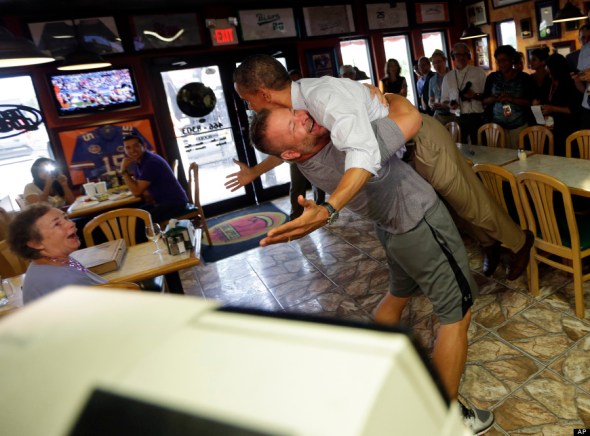
Obama Gets a Lift in Florida:
In this key swing state, Obama stopped at Big Apple Pizza & Pasta Italian Restaurant, where he was greeted by owner Scott Van Duzer, a muscular man dressed in a gray T-shirt and matching athletic shorts.
Van Duzer was so smitten by the president that he embraced him in a bear hug, leaned backward and lifted the 6-foot-2 president a foot off the ground. Photos of the moment show Obama with his arms spread wide and palms turned upward, as if to say he’s at the mercy of the pizzaman….
Afterward, a reporter at the scene reported that Van Duzer, 46, from Port St. Lucie, stands 6-foot-3 and weights 260 pounds, and he can bench-press 350.
“Everybody look at these guns,” Obama said, pointing to Van Duzer’s chest. “If I eat your pizza, will I look like that?”
“Look at that!” Obama exclaimed after Van Duzer put him down. “Man, are you a powerlifter or what?”
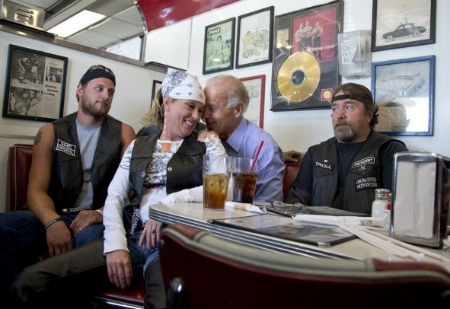
Joe Biden had a big day too.
SEAMAN, Ohio — Vice President Joe Biden was looking to cozy up with voters as he toured Ohio this weekend, but he did not imagine that an Ohio woman would nearly end up in his lap.
Biden was chatting up customers in the Cruisers Diner in southern Ohio Sunday when he met a group of motorcycle riders in black leather vests and bandanas.A female group member was watching, and Biden waved her over, telling her, “I know who runs the show.”
The woman had no place to sit, so Biden pulled a chair in front of himself and pulled her nearly into his lap. He put his hands on her shoulders and leaned in for a conversation as photographers snapped away.
Economics lessons aren’t usually all that funny, but the one Paul Krugman gave Rand Paul on ABC’s This Week was hilarious. Cokie Roberts interrupted with some Villager nonsense–she seems as unteachable as Rand Paul.
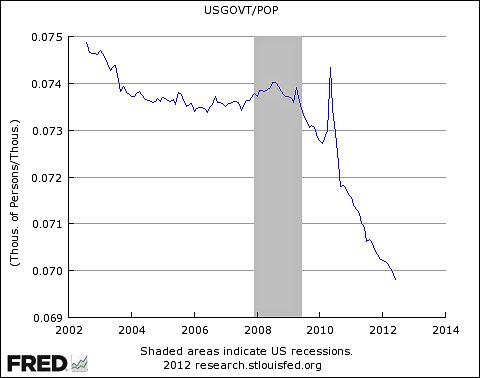
Krugman was so amazed by the ignorance that he wrote two blog posts about it. The first one is mostly a chart showing the steep drop in government employment under President Obama.
Krugman’s second post: The Zombie That Ate Rand Paul’s Brain
After watching the video, Krugman noticed the shocked expression on Rand Paul’s face. How could he be so stunned by a fact that is out there for anyone to read about?
Almost surely it’s a case of a zombie lie that has gone unchallenged in the hermetic world of movement conservatism, so that people like Paul know, just know, something that ain’t so. I wrote about this way back: the usual suspects seized on the Census bulge in employment as evidence of a big-government surge; and because nobody in that business ever admits having been wrong, this became a “fact” that people like Rand Paul believe. He wouldn’t have made this mistake if he ever read or listened to an analysis from nonpartisan sources, but he evidently doesn’t.
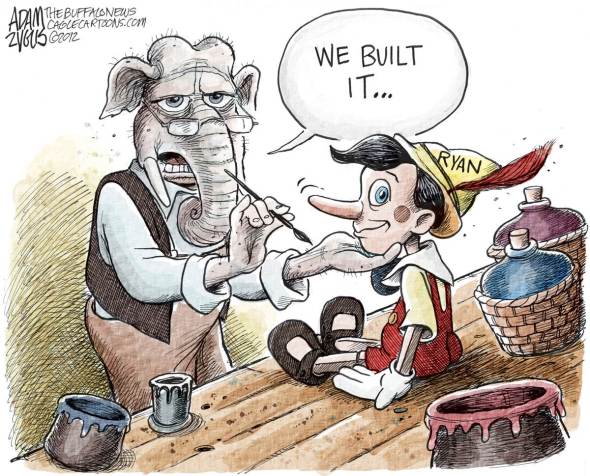
I’ve got a few editorial cartoons for you too. The first two are about Bill Clinton’s speech to the DNC.


Two on the “We built it” theme.
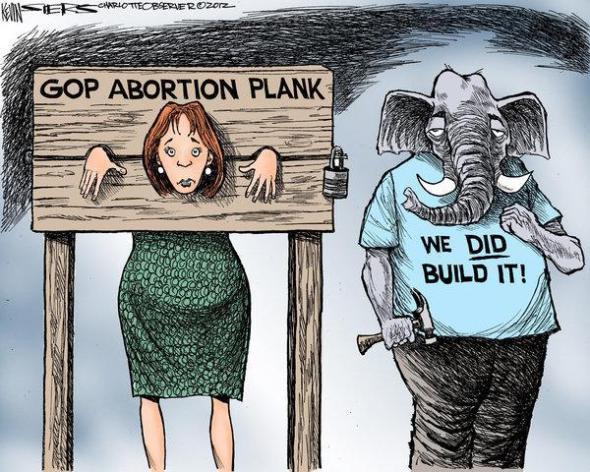
And one more on Romney’s ridiculous “Are you better off” question.

What next? I’m looking forward to more craziness next week.
Saturday Reads: President Obama’s Acceptance Speech
Posted: September 8, 2012 Filed under: 2012 presidential campaign, Barbara Ehrenreich, Civil Liberties, Civil Rights, Mitt Romney, morning reads, U.S. Economy, U.S. Military, U.S. Politics | Tags: acceptance speech, Charles P. Pierce, citizenship, democracy, Democratic National Convention 2012, Howard Kurtz, Michael Tomasky, Nielson ratings, Peter Beinart, Politico, self-government, Tom Junod 68 Comments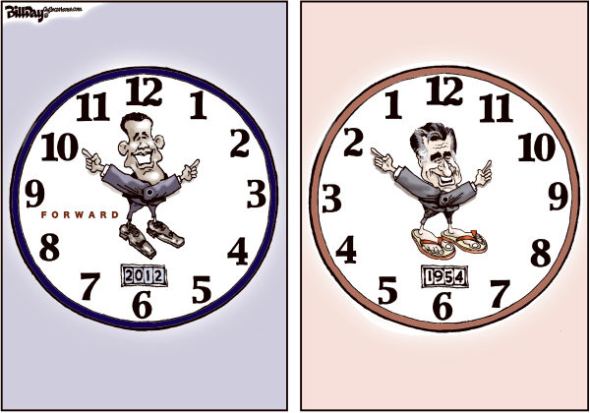
Good Morning!
Generally speaking the pundits didn’t care for President Obama’s acceptance speech on Thursday night. It’s not surprising that the guys at Politico thought it “fell flat.”
A surprisingly long parade of Democrats and media commentators described the speech less as a failure than a fizzle—an oddly missed opportunity to frame his presidency or the nation’s choice in a fresh or inspirational light.
Even those who liked the president’s performance generally went no further than saying that he was effective in doing a job that needed to be done, in a tough-minded if prosaic style.
These shoulder-shrug reactions confront Obama with a question no one expected to be asking when the week in Charlotte began: How did a president for whom stirring speeches were the engine of his rise to power manage to give, at best, only the third-most compelling speech at a convention devoted to his own re-election?
But even more liberal commentators found Obama’s speech wanting. Peter Beinart called it “underwhelming and anticlimactic.”
Obama’s acceptance speech had two apparent goals: The first was to lay out an agenda for the next four years so people feel they have something forward-looking to vote for. The second was to recapture the sense of hope that defined Obama’s 2008 campaign.
On paper, he did both things. But what the speech lacked was a coherent explanation of the nightmare this country has gone through for the last four years. Republicans are laying the Great Recession at Obama’s feet. Obama is saying that Republicans created it and, if elected, will make it worse. To win that argument, Obama needed to explain why the financial crisis happened, and he didn’t. Yes, he mocked the GOP for proposing tax cuts as the answer to every problem, but the financial crisis didn’t happen because of tax cuts. It happened, in large measure, because Republican and some Democratic politicians—blinded by free-market fundamentalism and Wall Street largesse—allowed bankers to create unregulated markets in which they gambled the savings of millions of Americans, knowing that if their bets failed, they wouldn’t be the ones to lose their homes and their life’s savings.
Obama should have told that story, and then gone at Romney for doubling down on the ideology that almost brought America to its knees. Then he should have contrasted that with his own interventions to protect people who the market has failed: whether they be auto workers or people with sick kids.
Michael Tomasky called it Pedestrian and Overconfident
Let’s be blunt. Barack Obama gave a dull and pedestrian speech tonight, with nary an interesting thematic device, policy detail, or even one turn of phrase. The crowd sure didn’t see it my way. The delegates were near delirium; to what extent they were merely still feeding off the amassed energy of the previous two nights I can’t say.
And swing voters watching at home? They probably weren’t as bored as I was, but it seems inconceivable that they’d have been enraptured. This was the rhetorical equivalent, forgive the football metaphor, of running out the clock: Obama clearly thinks he’s ahead and just doesn’t need to make mistakes. But when football teams do that, it often turns out to be the biggest mistake of all, and they lose.
Nevertheless, the final night of the Democratic Convention drew about 35.7 million viewers. The second night of the convention, when Bill Clinton spoke pulled in more views than the Giants-Cowboys game that played opposite the Convention coverage, about 25.1 million people–but nowhere near the number who watched the speeches by Vice President Biden and President Obama. Mitt Romney’s acceptance speech attracted 30.3 million viewers.
Howard Kurtz reported that Obama’s acceptance speech was deliberately “low-key.”
While the pundits are generally calling the president’s Thursday night address mediocre, Obama and his advisers had taken great pains to avoid soaring rhetoric that might have been derided as empty.
Indeed, they extensively tested the president’s speech in dial groups, a type of focus group where voters twist dials to register approval or disapproval of specific passages, and say it tested off the charts. The reaction, they say, was more positive than to Obama’s 2008 acceptance speech in Denver.
In short, the president deliberately dialed it down, stopping well short of the altitudes he is capable of reaching. Perhaps that will prove to be a mistake, but the decision to go with a less rousing approach was carefully considered.
The campaign’s primary goal at the Democratic convention was to provide a concrete sense of what Obama would do in a second term. That was what independent voters wanted, according to the research, and that was the focus in Charlotte.
Personally, I thought the first half of Obama’s speech was underwhelming, but I’ve never been a big fan of his speeches. About half-way through I thought the speech became more interesting. I was impressed that Obama admitted how difficult the job is and that he has questioned himself at times and that he has been “changed” by being President of the United States. I think the best evaluation of the speech that I read yesterday was by Tom Junod at Charles Pierce’s blog: President Obama Falls Back to Earth, Transformed. Junod’s thesis statement: “We should have known that Barack Obama would emerge from this convention conventionalized — that is, as a more conventional politician than he was when he went in. Or that we ever thought he could be.”
He didn’t rise to the occasion on Thursday night; he not only didn’t reinvent the possibilities of political language, he used language that many people had to feel they’d heard before. His speech was disappointing until, with about ten minutes to go, it acknowledged disappointment, and so began its rise. “The times have changed — and so have I,” he said. “I’m no longer just a candidate. I’m the president.” Of course, he was reminding us of his power; the fact of his presidency has become an argument for his presidency. But he was also reminding us that as a candidate who rose to power on the politics of pure potential, he is, as president, a fallen man. “And while I’m proud of what we’ve achieved together, I’m far more mindful of my own failiings, knowing exactly what Lincoln meant when he said, ‘I have been driven to my knees many times by the overwhelming conviction that I had no place else to go.'”
This was where the speech turned, and became, in its statement of humility, a statement of rousing power. “I ask you for your vote,” he said, and his commonplace words had a beseeching quality that put them outside the realm of political performance. He had failed to transform his office, and failed to transform our politics, but he sounded fully aware that he had been himself transformed.
He had started out as the Cassius Clay of our politics, brash and blinding, with an abilty to do things in the ring that no one else had ever thought of — with an ability to be untouchable. Now he stood inside the ring of stars on the blue carpeted stage of the Democratic National Convention as the Muhammad Ali whose greatness was proven after he returned to boxing bigger, slower, harder-hitting but also easier to hit. Oh, Ali got touched, all right, and since he lost his skill at avoiding punches he had to find the skill of taking them. He became a prodigy not of otherworldly gifts but rather of sheer will, and so it was with Obama in his speech on Thursday night. At an event that paid endless tributes to our wounded warriors, he rebranded himself as something of a wounded warrior himself; and at the very moment when those who remembered 2008 hoped he might say something that no one had ever heard before and maybe even reinvent, one more time, the possibilities of a word as hackneyed as hope itself, he instead completed his hard-won journey to convention.
Of course I never thought Obama was anything but an ordinary, conventional politician. As everyone here knows, I never bought the “hope and change” schtick. I never saw Obama as a great liberal savior. I was impressed with his acceptance speech, because he showed humility. By the end of the speech I was convinced that this man had matured in office, and because of that, I saw hope for his second term.
Apparently, Charlie Pierce never saw the transcendent Obama either.
I never heard the music.
People told me it was there. People told me it sang to them. People told me that its chords touched them deeply in their hearts. I watched as it make them weep and cheer. I watched as it moved them while I stood there, an unbeliever at the grotto, seeing only rocks and weeds where everyone around me saw and heard and joined in something altogether transformative. I was there in Boston when the president gave the speech that first sent him rocketing up the charts, and I didn’t hear it. Since then, I have seen him give an acceptance speech, an inaugural address, a Nobel oration, and three State of the Unions, and the only thing I remember about any of the latter is that he got heckled by some peckerwood from South Carolina, and that he called out the corporate meat-puppets of the Supreme Court in what I still believe is the finest — and certainly, the most prescient — moment of his presidency.
But I never found the poetry in it all. I thought he was a good, smart orator with some uniquely gifted writers and a talent for creating a warm and comfortable context in which people could take what they believed were all their best instincts out for a walk. I still believe that. He still reaches people at depths that I cannot fathom. He still reaches them in frequencies beyond my poor ability to hear.
That is pretty much how I’ve always reacted to Obama’s speeches. But in his convention speech, I thought I saw something more substantive. And it gave me hope. Pierce was impressed with Obama’s reference to “…the hard and frustrating and necessary work of self-government.”
That I heard. That I understood. It is not musical. It is not in any way poetic. But it is a clear line drawn between the president and the person and the party that would like to take his job from him. It is now an article of absolute faith among Republicans that “the government” is an entity separate from “the American people,” which they say the same way that the old Jesuits talked about “the mystical Body of Christ.” It is now an ironclad commandment of conservative orthodoxy that “the government” is something parasitic and alien. There is a reason why conservatives talk about “government” and not “self-government,” because to refer to the latter is to concede that “the government” is really the most basic product of our political commonwealth, that it is what we produce among ourselves so as to order the production of everything else that we do together. This is not an idle distinction. It is the entire message of last week’s Republican convention, and it is the entire message of the campaign they are planning to run, and, make no mistake, it resonates deeply with millions of people because it has been spoonfed to them as a kind of noxious anesthetic for almost foty years now, a long enough time for it to seem as though it is the natural order of things.
“…the hard and frustrating and necessary work of self-government.”
Make no mistake. This little throwaway line was the most direct, and the most serious, challenge that the president threw down at the feet of the Republican ticket on Thursday night because it strikes at the very essence of four decades of conservative political philosophy. We create “the government” we have. “The government” is not imposed from without. It is our creation. Its proper operation is our responsibility. If we do not like the way it operates, we do the hard and frustrating and necessary work to change the way it does. If we believe that it is being hijacked, we do the hard and frustrating and necessary work of using the tools of self-government to run the moneychangers out of the place. If we do not like the way the person we vote for is doing the job with which we have entrusted him — if he, say, allows the crooks who brought down the economy to walk away free, or if he perpetuates policies antithetical to civil liberties, or if he gets a little too cozy with fracking or if he gives away too much in some Grand Bargain — then we do the hard and frustrating and necessary work of self-government to hold his damn feet to the fire and say, “No further.”
Please go read the whole thing if you haven’t already. Obama articulated the key difference between today’s Republicans and the rest of us. They hate government and believe it should do nothing for people, just fund national defense and aid corporations. Most Democrats still believe that Government has a role in making people’s lives better, in ensuring that even the weakest and most vulnerable among us have rights to “life, liberty, and the pursuit of happiness.”
At the same time we citizens have the responsibility to stand up to our leaders, to voice our needs and our values, to remind our leaders that they work for us and there are certain things we won’t tolerate–whether that’s privatizing social security and medicare, limiting women’s rights, killing people with unmanned drones, limiting voting rights or some other policy that is important to us.
I think Obama’s speech got the job done. It made the convention delegates happy, and it laid a foundation for the arguments he will make over the final few weeks of the campaign. I hope he will continue to emphasize the importance of citizenship–of the necessity of every American being involved in “self-government.” That is the price of democracy.
Now what are you reading and blogging about today? This is an open thread!
Ann Romney Will Decide What this Election is About, Not Women Voters
Posted: September 7, 2012 Filed under: 2012 presidential campaign | Tags: Ann Romney, Birth Control, Davenport IA, David Nelson, KWQC TV, lesbian mothers, Mitt Romney, same-sex marriage, women's health care 17 Comments
Via ABC News, this morning, Ann Romney gave an satellite interview to KWQC new anchor David Nelson from Davenport, Iowa. Mrs. Romney said that her message to women voters is “I hear your voices.”
Maybe so, there are issues women voters say they are interested in that Mrs. Romney won’t address. She doesn’t want to talk about same-sex marriage or birth control, for example. David Wilson asked her about those issues and she refused to answer because those questions are “distractions” and “not about what this campaign is going to be about.”
Here are some excerpts from the interview. You can watch it here.
KWQC TV6: “Here in Iowa, as you know, same-sex marriage is legal. Do you believe a lesbian mother should be allowed to marry her partner?”
Ann Romney: “You know, I’m not going to talk about the specific issues. I’m going to let my husband speak on issues. I’m here to really just talk about my husband and what kind of husband and father he is and, you know, those are hot-button issues that distract from what the real voting issue is going to be at this election. That, it’s going to be about the economy and jobs.”
Since when do candidates or the wives of candidates get to determine what an election is about? Wilson tried again:
KWQC TV6: “Do you believe that employer-provided health insurance should be required to cover birth control?”
Ann Romney: “Again, you’re asking me questions that are not about what this election is going to be about. This election is going to be about the economy and jobs.”
KWQC TV6: “Well, a Pew research poll shows those issues are very important to women, ranking them either “important” or “very important.”
Ann Romney: “You know, but I personally believe, and this is what I’m hearing from women all across the country that they are going to look for the guy that’s going to pull them out of the weeds and get them job security and a brighter future for their children. That’s the message.
Listen, I’ve been across this country, I’ve been for a year-and-a-half on the campaign trail. I’ve spoken with thousands of women and they are telling me, they’re telling me a couple of things, one they say they’re praying for me which is really wonderful, and then they’re saying, ‘please help, please help. We are so worried about our jobs.’
So really if you want to try to pull me off of the other messages it’s not going to work because I know because I’ve been out there.”
Wilson did make one more attempt to get Mrs. Romney to address whether her stated wish for “women to have a secure and stable future” applied to lesbian mothers. But Mrs. Romney didn’t want to talk about it, because she knows what “this election is going to be about” and women voters don’t.
When Ann Romney addressed RNC delegates last week, she yelled out “I love you women!” I guess for Mrs. Romney love gives her permission to condescend to the objects of her love and decide what political issues they should care about.

 peej
peej Carissa
 bostonboomer
 dakinikat
 ecocatwoman
 mablue2
 Mama Lopez
 peggysue22
 quixote
 skydancingguestblogger
 Mona (aka Wonk the Vote)



 Sky Dancing
Recent Comments