
Tuesday Reads
Posted: May 26, 2020 Filed under: morning reads, U.S. Politics | Tags: coronavirus, Covid-19, Donald Trump, Lake of the Ozarks, Massachusetts coronavirus response, Memorial Day crowds, second wave, Trump losing older voters 25 Comments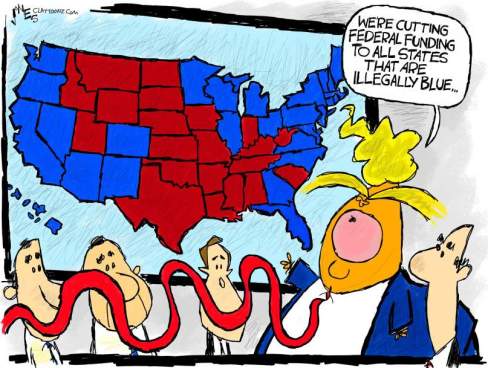
Good Morning!!
Massachusetts, along with other states, is slowly reopening its economy. The numbers of deaths from and positive tests for Covid-19 have been dropping here in recent days, but it’s not at all clear that we are safe from a second wave of the virus. From The Boston Globe: With reopening comes the threat of a second wave of COVID-19, scientists warn.
It could start in a half-empty restaurant or a Sunday morning church service, with a stray cough or a joyful hymn. Public health experts warn that without a vaccine or a heavy dose of caution, Massachusetts could easily be hit by a second wave of COVID-19 infections that rivals the first.
Such a wave could come in the fall or sooner, as restrictions ease and people return to traveling and spending time in crowded, closed-in spaces. And, experts say, if the state’s tools for tracking the virus’s spread are not up to snuff by then, a second wave could go undetected until it’s too late.
The state began reopening some stores and offices on Monday, the latest step in the long journey back to something resembling pre-pandemic life. But the road to normalcy may prove to be a two-way street.
Built into Governor Charlie Baker’s reopening plan is something epidemiologists caution is not just possible but perhaps even likely: a return to the severe lockdowns of April and most of May.
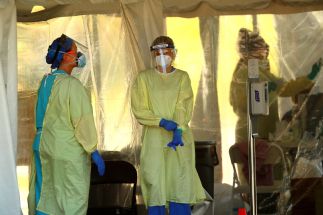
The state opened a nine-lane COVID-19 drive-thru testing center in Lawrence last week.JOHN TLUMACKI/GLOBE STAFF
What experts say:
“The virus may be with us for a good part of the next year,” said Barry Bloom, a professor and former dean of Harvard T.H. Chan School of Public Health. “The public has to be prepared that there will be continuous monitoring of the numbers.”
Bloom said that reopening may not be a straight path toward a new normal. Rather, restrictions may ease in fits and starts — or even backtrack, with all or parts of the state periodically relapsing into total lockdown.
“If [the number of cases] gets to the point where they threaten again to be a giant peak and even overwhelm the hospitals,” he said, “the state and the cities are going to have to have some re-installation or re-imposition of constraints.”
From the very start of the coronavirus outbreak, those inside and outside of the scientific community have feared a second wave. History shows that several pandemics have returned with a vengeance after months of seeming calm. The Spanish flu of 1918 lasted two years. Its second peak was its deadliest.
Now, as Massachusetts reopens before it has fully left the first wave of infection behind, epidemiologists say fears of a second are well-founded.
“The chances are pretty high that we’re going to see the number of cases come back up” as the economy reopens, said Samuel Scarpino, a Northeastern University professor who specializes in infectious disease.
The question, Scarpino said, is just how much those case counts will rise.
Read more at the Globe.
Meanwhile, lots of Americans are acting as if there is no pandemic.
The Washington Post: ‘An international example of bad judgment’: Local officials stunned by raucous Memorial Day festivities.
At a flashy club in Houston, dozens splashed around the pool and sipped on drinks on the patio. In rural North Carolina, thousands packed the stands shoulder to shoulder at Ace Speedway on its opening night, where face masks were the exception. And in Daytona Beach, Fla., even after an event called “Orlando Invades Daytona” was canceled, hundreds still danced in the street and on top of cars near the boardwalk.
Lake of the Ozarks on Memorial Day
“It looks like there are two people out the sunroof throwing money,” the seemingly perplexed pilot of a police helicopter said over his radio, flying over the wild scene near the beach to get a closer look. “They’re clearly throwing cash at the crowd.”
The raucous events across the country over the holiday weekend led some local officials to sound the alarm Monday, warning that consequences could be dire if such behavior continued unchecked.
Some, like Houston Mayor Sylvester Turner (D), vowed to crack down on businesses failing to enforce capacity restrictions. Turner chastised the clubbers who may end up exposing responsible people “who chose to do the right thing” by staying home. In Missouri, viral images of pool parties at waterfront bars and yacht clubs in the Lake of the Ozarks even led St. Louis County officials to issue a travel advisory, calling the scenes an “international example of bad judgment.”
One Ozarks pool party at Backwater Jack’s featured live music under the theme “Zero Ducks Given,” while photos at another yacht club showed dozens of people crammed together beneath a sign that said, “Please practice social distancing.” On Monday, St. Louis County Executive Sam Page, who is also a physician, urged employers to question workers about their recent travels, and recommended a 14-day quarantine for anyone who flouted social distancing.
“This reckless behavior endangers countless people and risks setting us back substantially from the progress we have made in slowing the spread of COVID-19,” Page said in a statement announcing the travel advisory.
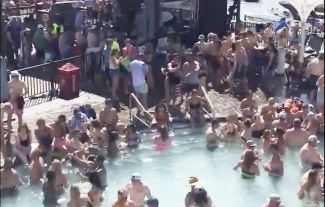
Not surprisingly, these “bad examples” happened in red states.
More from the WaPo: Memorial Day weekend parties and crowds spark warnings from public health officials.
Beaches, parks, restaurants and churches were open for recreational use in many states over the holiday weekend – with restrictions for social distancing that were not always followed.
As coronavirus cases in the United States crossed 1.6 million, people mobbed boardwalks and oceanfronts in Maryland, Georgia and Florida. Crowds were sometimes dense from Newport Beach, Calif., to the Tampa, Fla., area, where law enforcement started turning away beachgoers and closed full parking lots.
Flocks of people sans face coverings packed the beach at Indiana Dunes National Park. And “more than 100 partygoers packed into a swimming pool area at a club in Midtown Houston Saturday and flouted social distancing orders to maintain space or wear masks a day after Texas Gov. Greg Abbott (R) eased restrictions on bars and restaurants,” our colleagues report.
Videos of a packed pool party in Lake of the Ozarks, Missouri went viral online.
Read more and see photos at the link above.
Slightly different behavior at a Rhode Island beach.
Trump spent the long weekend playing golf and sending out vile tweets, and there has been some pushback in the media, as Dakinikat reported yesterday. Now the husband of a long-dead woman Trump tweeted about is fighting back and asking Twitter for some common decency.
Kara Swisher at The New York Times: Twitter Must Cleanse the Trump Stain.
“Please delete those tweets,” the widower begged in a letter last week to Twitter’s chief executive, Jack Dorsey. “My wife deserves better.”
Yes, Twitter, Lori Klausutis certainly does deserve better, nearly two decades after she died in a tragic accident that has morphed into a macabre and continuing nightmare for her husband, Timothy Klausutis.
The boogeyman plunging him and the family of his late wife into the very worst of memory holes is a conspiracy-theory-loving, twitchy-fingered and often shameless tweeter who also happens to be the president of the United States, Donald J. Trump.
“President Trump on Tuesday tweeted to his nearly 80 million followers alluding to the repeatedly debunked falsehood that my wife was murdered by her boss, former U.S. Rep. Joe Scarborough. The son of the president followed and more directly attacked my wife by tweeting to his followers as the means of spreading this vicious lie,” wrote Mr. Klausutis, in a letter sent to Mr. Dorsey on Thursday that I obtained over the weekend.
“I’m asking you to intervene in this instance because the president of the United States has taken something that does not belong to him — the memory of my dead wife — and perverted it for perceived political gain.” (You can read the letter in full here.)
Mr. Klausutis deserves an answer from Mr. Dorsey, who has the unenviable task of sorting out what is perhaps unsortable, which is to say, the ugly heart of Twitter’s most famous customer. While sources close to the company said executives had been trying to figure out what to do over the weekend, the company has at this writing been silent about this latest controversy involving Mr. Trump’s appalling and rule-breaking Twitter habit.
Trump tweeted about this conspiracy theory again this morning. You can go to his timeline to see the tweets if you’re interested.
It’s beginning to look like Trump is losing older voters because of his catastrophic failure to deal with the pandemic.
The Washington Post: Trump’s poor handling of the crisis may lose him the GOP’s most reliable voters.
One of the most durable political assets that Republicans have enjoyed throughout the 21st century is their edge among Americans 65 and older, who tend to turn out at the polls more reliably than any other group.
But with President Trump’s inept and erratic handling of the novel coronavirus pandemic, he is rapidly losing support among the age group most vulnerable to its ravages — which is a big warning sign to Republicans as they look to the fall. Trump has also been showing slippage in support among the next-oldest cohort, those 55 and older.
The shift has been showing up in a string of recent polls, reportedly including those that have been conducted by Trump’s own campaign. One of the most striking is a survey of 44 battleground House districts done by Democratic pollster Geoff Garin during the second week of May.
In those districts, voters over 65 said they had supported Trump in 2016 by a 22-point margin — 58 percent to 36 percent.
But this year, those same respondents are practically evenly divided, with 47 percent saying they are planning to vote for the president and 43 percent expressing an intention to cast their ballots for former vice president Joe Biden, the presumptive Democratic nominee. That is an enormous net swing of 18 percentage points.
“They’re in real trouble if they can’t count on a strong showing with seniors,” said Garin, who did the survey for a client he declined to name. “Trump is blowing what had become an important Republican advantage.”
Also from the WaPo: In crucial Florida, some senior voters cast a skeptical eye toward Trump’s reelection.
Allen Lehner
Allen Lehner was a Republican until Donald Trump became his party’s nominee in 2016. The 74-year-old retiree says he couldn’t bring himself to vote for someone who lied, belittled others, walked out on his bills and mistreated women — but he also couldn’t bring himself to vote for Hillary Clinton. So he didn’t vote.
Trump has done nothing since to entice Lehner back.
Lehner, who now considers himself an independent, says he is frightened by the president’s lack of leadership and maturity amid the nation’s health and economic crisis. Several people in his gated community in Delray Beach, Fla., have gotten sick; at least one has died. He worries about his own health — he has an autoimmune disease — and also about his adult children, including a daughter who has gone back to work and a son whose pay has been cut.
He plans to vote for Joe Biden in November.
“Regardless of what they say about his senior moments, I think he would be good and take good care of the country,” said Lehner, who owned furniture and fireplace-supply stores in central Pennsylvania before retiring to Florida.

How did you spend your Memorial Day? What stories are you following today?
Lazy Caturday Reads
Posted: May 23, 2020 Filed under: morning reads, U.S. Politics | Tags: Barack Obama, caturday, coronavirus pandemic, Donald Trump, Joe Biden, pandemics and historical change, vintage cat ladies 15 Comments
Good Morning!!
After several days of a media diet–reading and playing video games instead of following the news closely–I’m feeling a lot more grounded. The fake “president” is still insane and we are still living through a global pandemic that was made much worse by the actions and non-actions of Trump and his gang of evil thugs, but I feel more able to handle it today. It helps that it’s a long weekend and Trump might go play golf and leave us alone for some stretches of time.
Anyway, I hope all of you are doing well and staying safe in these crazy times. Please stay home as much as you can and take good care of yourselves and your loved ones.
Here’s the latest on the pandemic:
The Washington Post: Study estimates 24 states still have uncontrolled coronavirus spread.
The coronavirus may still be spreading at epidemic rates in 24 states, particularly in the South and Midwest, according to new research that highlights the risk of a second wave of infections in places that reopen too quickly or without sufficient precautions.
Researchers at Imperial College London created a model that incorporates cellphone data showing that people sharply reduced their movements after stay-at-home orders were broadly imposed in March. With restrictions now easing and mobility increasing with the approach of Memorial Day and the unofficial start of summer, the researchers developed an estimate of viral spread as of May 17.
It is a snapshot of a transitional moment in the pandemic and captures the patchwork nature across the country of covid-19, the disease caused by the virus. Some states have had little viral spread or “crushed the curve” to a great degree and have some wiggle room to reopen their economies without generating a new epidemic-level surge in cases. Others are nowhere near containing the virus.
The model, which has not been peer reviewed, shows that in the majority of states, a second wave looms if people abandon efforts to mitigate the viral spread.
“There’s evidence that the U.S. is not under control, as an entire country,” said Samir Bhatt, a senior lecturer in geostatistics at Imperial College.
The model shows potentially ominous scenarios if people move around as they did previously and do so without taking precautions. In California and Florida, the death rate could spike to roughly 1,000 a day by July without efforts to mitigate the spread, according to the report.
Nic Robertson at CNN: The pandemic could reshape the world order. Trump’s chaotic strategy is accelerating US losses.
London (CNN)Europe outright rejected US President Donald Trump’s vision of the world this week. Tensions between these historic democratic allies that have been simmering since Trump came to office three years ago have now come to a boil during the coronavirus pandemic.
Covid-19 has shocked the world by the speed of its spread, but it is also accelerating another global change in the balance of power — and not in America’s favor.
The extent of the divide became clear on Tuesday during a vote at the World Health Organization annual assembly in Geneva, Switzerland, backing Europe’s conciliatory approach to China relating to an investigation into the outbreak. Power had visibly ebbed away from the United States as its demand for a tougher approach was dismissed, a move that should sound alarm bells in Washington.Vladimir Sichov, street portrait
Five months into 2020 and it already feels like a new era: now there is only BC and AC — before and after coronavirus. Suddenly the dynamics of almost every single geopolitical dispute are being exacerbated by the pandemic, sharpened by the complexity and urgency of the situation.
Chief among these is the perennial, three-way battle for dominance between the US, Europe and China. Despite Trump’s early hailing of Xi Jinping’s handling of the pandemic, he has since blamed the Chinese President for covering up the early stages of China’s outbreak. Beijing has consistently denied such accusations, and criticized the US approach to the pandemic.

Trump has tried to blame China and WHO for his own disastrous response to the pandemic, but Europe is sticking with China and WHO.
Despite deep concerns about China’s handling of the pandemic, European leaders backed the WHO resolution calling for “a stepwise process of impartial independent and comprehensive evaluation, including using existing mechanisms, as appropriate to review experience gained and lessons learned” from the global response to Covid-19.
The language is convoluted and hardly inspires confidence China will atone appropriately for its early failures, but it is a measure of the gulf opening up between Trump and his European allies that such a compromise could even be countenanced….
Europe’s decision to reject Trump’s confrontation with China and the WHO will affect both parties vying to win this year’s US election. Regardless of who wins that race, Trump and his handling of Covid-19 are weakening America’s global leverage.
At The Atlantic, Charles C. Mann on “What history can tell us about the long-term effects of the coronavirus”: Pandemics Leave Us Forever Altered. I hope you’ll read the whole thing; here’s just a brief excerpt:
Americans may have forgotten the 1918 pandemic, but it did not forget them. Garthwaite matched NHIS respondents’ health conditions to the dates when their mothers were probably exposed to the flu. Mothers who got sick in the first months of pregnancy, he discovered, had babies who, 60 or 70 years later, were unusually likely to have diabetes; mothers afflicted at the end of pregnancy tended to bear children prone to kidney disease. The middle months were associated with heart disease.
Other studies showed different consequences. Children born during the pandemic grew into shorter, poorer, less educated adults with higher rates of physical disability than one would expect. Chances are that none of Garthwaite’s flu babies ever knew about the shadow the pandemic cast over their lives. But they were living testaments to a brutal truth: Pandemics—even forgotten ones—have long-term, powerful aftereffects.
The distinguished historians can be forgiven for passing over this truth. Most modern people assume that our species controls its own destiny. We’re in charge! we think. After all, isn’t this the Anthropocene? Being modern people, historians have had trouble, as a profession, truly accepting that brainless packets of RNA and DNA can capsize the human enterprise in a few weeks or months.
The convulsive social changes of the 1920s—the frenzy of financial speculation, the resurgence of the Ku Klux Klan, the explosion of Dionysian popular culture (jazz, flappers, speakeasies)—were easily attributed to the war, an initiative directed and conducted by humans, rather than to the blind actions of microorganisms. But the microorganisms likely killed more people than the war did. And their effects weren’t confined to European battlefields, but spread across the globe, emptying city streets and filling cemeteries on six continents.
Unlike the war, the flu was incomprehensible—the influenza virus wasn’t even identified until 1931. It inspired fear of immigrants and foreigners, and anger toward the politicians who played down the virus. Like the war, influenza (and tuberculosis, which subsequently hit many flu sufferers) killed more men than women, skewing sex ratios for years afterward. Can one be sure that the ensuing, abrupt changes in gender roles had nothing to do with the virus?
We will probably never disentangle the war and the flu. But one way to summarize the impact of the pandemic is to say that its magnitude was in the same neighborhood as that of the “war to end all wars.”
What societal and health changes will follow the coronavirus pandemic? Read Mann’s speculations at The Atlantic.
Some presidential election news:
The Guardian: Barack Obama poised to add his star appeal to Joe Biden’s campaign.
Former president Barack Obama has dipped his toes into the 2020 presidential campaign recently and is positioned to do more in the coming months as Joe Biden’s effort to defeat Donald Trump gathers steam.
Interviews with about a dozen Democratic strategists, party officials and people close to Obama want the popular former president utilizing his powerful online presence and focusing on rallying key Democrat constituencies that are critical to a Biden victory.
Obama is regarded as one of the most popular politicians in American politics and a huge asset within the Democratic party. He left the White House with a near-60% approval rating. His endorsement for any candidate is the political campaign equivalent of an oilman and hitting a gusher.
Obama would be most effective, interviewees said, in highlighting his former vice-president’s résumé, rallying key Democratic voting groups like African American women, and pushing voters to register.
The situation is unique. There hasn’t been a popular former two-term president eager to hit the trail for his former running mate for years. On top of that, the coronavirus pandemic limits in-person campaigning and rallies. Still, the strategists interviewed say Obama is valuable and should be used everywhere.
“You rarely have a former president that is more popular than the now-sort-of-nominee,” Democratic pollster Cornell Belcher said. “Barack Obama is the most popular political figure in America right now.”
Read the rest at The Guardian.
Trump may be losing some evangelicals. Politico: Behind Trump’s demand to reopen churches: Slipping poll numbers and alarm inside his campaign.
A sudden shift in support for Donald Trump among religious conservatives is triggering alarm bells inside his reelection campaign, where top aides have long banked on expanding the president’s evangelical base as a key part of their strategy for victory this November.
The anxiety over Trump’s standing with the Christian right surfaced after a pair of surveys by reputable outfits earlier this month found waning confidence in the administration’s coronavirus response among key religious groups, with a staggering decline in the president’s favorability among white evangelicals and white Catholics. Both are crucial constituencies that supported Trump by wide margins in 2016 and could sink his reelection prospects if their turnout shrinks this fall.
The polls paint a bleak picture for Trump, who has counted on broadening his religious support by at least a few percentage points to compensate for weakened appeal with women and suburban populations. One GOP official said the dip in the president’s evangelical support also appeared in internal party polling, but disputed the notion that it had caused panic. Another person close to the campaign described an April survey by the Public Religion Research Institute, which showed a double-digit decline in Trump’s favorability among white evangelicals (-11), white Catholics (-12) and white mainline protestants (-18) from the previous month, as “pretty concerning.”
To safeguard his relationship with religious conservatives, Trump on Friday demanded that America‘s governors permit houses of worship to immediately reopen, and threatened to “override“ state leaders who decline to obey his directive. The announcement — which came days after the Centers for Disease Control and Prevention omitted religious institutions in new guidance about industry reopenings — featured clear appeals to white evangelicals, many of whom have long supported Trump’s socially conservative agenda.
Read more at the link.
According to The Daily Beast, Trump wants an in-person convention despite the pandemic, and his advisers are afraid to tell him it might not happen: Trump Plows Ahead With His Convention Planning, Virus Be Damned.
President Donald Trump has been adamant that the 2020 Republican National Convention—or some version of it—go on. For months, he’s demanded that back-up options for less crowded gatherings be fully explored by his staff, if a full-blown convention isn’t ultimately possible or safe, according to three people familiar with his private insistence. But he has scoffed at the notion of a virtual convention in recent weeks, saying that it sounds like “something Joe Biden would do from his basement,” said a source who heard Trump mock the idea.
Trump’s desire to have some sort of coronation moment fits his love of pageantry and spectacle. But various staffers working on plotting the Republican gathering aren’t quite so optimistic that it’s doable, knowing that they are entirely at the mercy of the virus and that the convention may end up even sparser than some expect.
“I don’t want to be the one to tell the president,” the White House official said, envisioning a scenario in which a disappointed, possibly angry Trump is informed he would have to be livestreamed into his own convention.
More stories to check out, links only:
The New York Times: Trump’s Press Secretary Displays One of His Checks in a Little Too Much Detail.
The Washington Post: Trump administration discussed conducting first U.S. nuclear test in decades.
WJC CBS Baltimore: Baltimore Mayor Jack Young On President Trump’s Memorial Day Fort McHenry Visit: ‘I Think He’s Violating The Law’
New York Magazine: That Office AC System Is Great — at Recirculating Viruses.
NBC News: Jeff Sessions stands up to former boss Trump on Twitter.
Business Insider: Roughly half the Twitter accounts pushing to ‘reopen America’ are bots, researchers found.
Now it’s your turn. What stories are you following today?
Thursday Reads
Posted: May 21, 2020 Filed under: morning reads, U.S. Politics 13 Comments
Woman reading a newspaper by Partosh Sen
Good Morning Sky Dancers!
I’m still not handling the news very well. I’ve pretty much tried to tune it all out since my last post on Tuesday. It was probably a mistake to start reading The Stand, by Stephen King; but now I’m hooked, and I was already freaked out by the pandemic in real life anyway. So this post is going to be a quick one so I can go back to trying to maintain my sanity in this time of Trump and Covid-19.
Massachusetts is starting to open up, and people will be allowed to go to beaches beginning on Memorial day. I don’t think that’s a very good idea, but I have nothing to say about it. We are still seeing more than 100 deaths a day here. I’m planning to keep on staying home except for grocery shopping. I’m considering getting my hair cut in June. The hair salons are opening on the May 26th, with lots of restrictions. I got an email from my hairdresser explaining all the rules:
APPOINTMENTS
We appreciate your patience as some service providers may have limited availability. Due to the scheduled shifting of the Service Providers, your scheduled appointment may not stand as it was previously scheduled, however, you will be notified. We have limited phone staff that will be working to accommodate the many changes that have occurred.If you are experiencing any of the following symptoms; Fever (>100.4) or Feverish, Cough, Sore Throat, Shortness of Breath, Unusual Fatigue, Chills, Body Aches, we ask that you stay home and call us at 617-489-7733 to reschedule. Let’s all stay healthy.
UPON ARRIVAL
We ask that you arrive for your appointment at the time of your appointment and no earlier. Please wait in your car outside the salon for your appointment. We will text/call you when to enter. Please limit personal belongings to payment methods and cell phones. Please do not bring any guests with you and please do not bring children to your appointment at this time.CONTACTLESS CHECKOUT
Before you arrive for your appointment, we ask that you call and provide a credit card for us to securely store on file – the same way you might store it with Amazon or Netflix. After your appointment, we can simply charge your card through our system – no buttons to press, no screens to touch, no unnecessary physical contact required. Just safe & healthy service.
So it’s going to be pretty complicated. But I’m getting desperate.
Here are the news stories that caught my attention today.
This one isn’t really news to anyone, but it’s a reminder of Trump’s limited cognitive abilities and his deteriorating mental condition. The article is a response to Trump’s claims that intelligence briefers didn’t warn him adequately about the coming pandemic.

Man Reading Newspaper c.1918 – Hugo Scheibe
The New York Times: For Spy Agencies, Briefing Trump Is a Test of Holding His Attention.
Mr. Trump, who has mounted a yearslong attack on the intelligence agencies, is particularly difficult to brief on critical national security matters, according to interviews with 10 current and former intelligence officials familiar with his intelligence briefings.
The president veers off on tangents and getting him back on topic is difficult, they said. He has a short attention span and rarely, if ever, reads intelligence reports, relying instead on conservative media and his friends for information. He is unashamed to interrupt intelligence officers and riff based on tips or gossip he hears from the former casino magnate Steve Wynn, the retired golfer Gary Player or Christopher Ruddy, the conservative media executive.
Mr. Trump rarely absorbs information that he disagrees with or that runs counter to his worldview, the officials said. Briefing him has been so great a challenge compared with his predecessors that the intelligence agencies have hired outside consultants to study how better to present information to him.
Working to keep Mr. Trump’s interest exhausted and burned out his first briefer, Ted Gistaro, two former officials said. Mr. Gistaro did not always know what to expect and would sometimes have to brief an erratic and angry president upset over news reports, the officials said.
The simple truth is that Trump is a childish, narcissistic jerk with no interest in serving the American people. He’s never been particularly bright, and now he’s sinking into dementia. But the media continues to try to normalize him. It’s frightening how hard they work at it.

Woman reading a newspaper, Todros Geller, 1944
Mother Jones on the person who is supposedly leading the administration’s response to the pandemic: Jared Kushner Had One Job: Solve America’s Supply Crisis. He Helped Private Companies Instead.
On March 29, President Trump held a press briefing to tout “Project Airbridge,” the administration’s new effort to organize and pay for airlifts of personal protective equipment and other medical supplies from abroad. The first of Project Airbridge’s “big, great planes” coming from Asia had landed in New York that day, Trump said, bringing in “2 million masks and gowns, over 10 million gloves, and over 70,000 thermometers,” which would be distributed to virus hot spots across the country. The heads of some of the country’s biggest medical supply distributors joined him at the podium to pay tribute to the administration and talk about the project. “They’re big people,” Trump declared of the executives working together with the administration to deliver “record amounts of lifesaving equipment.”
The origins of Project Airbridge lie with MIT experts, who originally proposed a government led and funded airlift of supplies, according to the Washington Post. But it was seized upon by Trump’s son-in-law, Jared Kushner, who ran a volunteer shadow coronavirus task force that included his former roommate and people from private-equity companies and consulting firms like McKinsey. (“Young geniuses” Trump called them.) Unhappy employees at the Federal Emergency Management Agency (FEMA) dubbed them “the children.”
Yet less than two months later, after many glowing PR hits, the administration decided to put an end to Project Airbridge as members of Congress and the media started demanding answers about how the supplies were being distributed, who received them, and whether the White House was making distribution decisions based on politics rather than public health. On April 21, 10 Democratic senators, led by Elizabeth Warren, asked the inspector general of the Department of Health and Human Services to investigate the project. “The novelty and complexity of this arrangement demands heightened scrutiny and transparency,” they wrote in a letter. “However, the administration’s implementation of Project Airbridge has been completely opaque.”
The short-lived Project Airbridge is an example of how the Trump administration has taken advantage of the pandemic to boost some of the country’s biggest companies while doing little more than offer hard-hit states photo ops and the chance to compete against each other to pay exorbitant prices for PPE. And while the project did little to ameliorate national shortages of PPE, it may have a lasting impact on everything from health care costs to the consolidation of corporate power.
Read the rest at Mother Jones.

Jeffrey DeVore, Woman reading newspaper
Gabriel Sherman on Trump’s “Obamagate” obsession: “With Obama He’s Going for the Jugular”: As Trump Goes After Obama, Some in Trumpworld See a “Big Risk.”
On May 7, Donald Trump’s campaign manager, Brad Parscale, tweeted a GIF of the Death Star firing its planet-destroying laser to announce the start of the campaign’s war on Joe Biden. Parscale’s choice of pop-culture ephemera was widely mocked. But the meme’s biggest weakness was that it bore no resemblance to the campaign’s messaging, which so far has been all over the place. During a week when America’s COVID-19 death toll approached 90,000, Trump allies floated smears that Biden was a tool of China, an invalid eating from a spoon, and even a pedophile, none of which caused damage. Sources close to Trump said the president has vented to friends about the lack of focused firepower coming out of the campaign. “There is deep frustration that there is no overarching message,” an unofficial campaign adviser told me. (The White House and Trump campaign did not respond to requests for comment.)
According to sources, Trump believes the answer to the message weakness is to declare all-out war on Biden’s former boss: Barack Obama. “Trump knows Biden is only popular because he was Obama’s V.P.,” a prominent Republican told me. Which is why, a few days after Parscale’s Death Star tweet, Trump accused Obama of unnamed crimes under the umbrella of “Obamagate.” “Obama is going to be on the campaign trail in a big way. He’s the most popular Democrat of the past four decades. Trump knows you have to neutralize him, and he’s frustrated Brad didn’t think of that,” the campaign adviser said. “Trump feels he’s doing it all alone.”
But Trump’s targeting of Obama has been causing consternation among Republicans, who fear he is pursuing a base-incitement strategy when he needs to appeal to crucial suburban voters in must-win battleground states. “Going after Obama is a big risk,” a former West Wing official said. “Obama is seen as trustworthy and reasonable. If you attack him and people don’t buy it, then you have a huge swing and a miss in front of the entire country.” Another prominent Republican agreed: “Trump cannot draw Obama into this. Obama can’t be ‘softened’ up. American people know him and like him.”
Read the rest at Vanity Fair.

Painting by Armand Schönberger (Hungarian, 1885–1974)
It looks like Trump country is soon going be in deep trouble from the pandemic. The Daily Beast: White House’s Own Data Crunchers: Southern Counties About to Get Hit Hard.
A new analysis being reviewed by the White House shows southern states that moved too quickly to relax social distancing guidelines face significant risk for a resurgence of the coronavirus over the next several weeks. In several cases, counties will see hundreds of additional cases by June 17.
The study, which was put together by PolicyLab at Children’s Hospital of Philadelphia, is part of a data set being reviewed by top coronavirus task force officials and people working with the team, The Daily Beast reported earlier this month. A previous model by the PolicyLab predicted that if officials moved too quickly and too aggressively to reopen in mid-May, individual counties could witness hundreds, if not a thousand-plus, more coronavirus cases reported each day by August 1.
The new model shows that in southern counties, particularly in Texas, Florida, Alabama, and Virginia, the risk for resurgence is high over the next four weeks. These states have moved to reopen, at least partially, since the team published its last model in April.
The data set now takes into consideration current levels of social distancing rather than projections about what would happen when local communities reopened. It also includes data for more than 200 additional counties across the country. The findings indicate that the risk for large second waves of outbreaks remains low if communities continue to implement cautious, incremental plans to reopening that limit crowding and travel to non-essential businesses. Doctors working on the study said that without vigilance in masking, hygiene, and disinfection, certain southern counties will remain high risk.
The new data, which has been presented to members of the White House’s coronavirus task force, is likely to validate fears by doctors and scientists, including Dr. Anthony Fauci, the top infectious disease official in the administration, that opening states too soon could have disastrous health consequences.
That’s all I have the strength for today. I’m going to spend the rest of the day trying to pull myself out of my current funk. It’s hard not to feel despairing when the world is upside down and we have zero leadership on the national level.
Take care of yourselves Sky Dancers!
Can’t Take Any More Tuesday Reads
Posted: May 19, 2020 Filed under: morning reads, U.S. Politics | Tags: Ahmaud Arbery, coronavirus, Covid-19, Covid-19 antibodies, Donald Trump, hydroxychloroquine, immunity, lynching, nurses in art, U.S. global reputation 25 Comments
Richard Prince, Nurse of Greenmeadow (2002)
Good Morning!!
I’m going through one of my “I can’t take it anymore” phases. Yesterday I almost succeeded in shutting out the news entirely until last night when I accidentally learned that Trump claims to be taking hydroxycholoquine. He has to be lying, right? But the White House doctor sorta kinda confirmed it.
CNN: Trump says he is taking hydroxychloroquine though health experts question its effectiveness.
President Donald Trump claimed Monday he is taking daily doses of hydroxychloroquine, a drug he’s long touted as a potential coronavirus cure even as medical experts and the US Food and Drug Administration question its efficacy and warn of potentially harmful side effects.
Speaking at a meeting of restaurant executives, Trump said he began taking the antimalarial drug after consulting the White House doctor, though stopped short of saying his physician had actually recommended the drug.
“A couple of weeks ago, I started taking it,” Trump said. He later said he’d been taking it every day for a week and a half.
The admission was a dramatic development in Trump’s attempts to promote hydroxychloroquine as a treatment for coronavirus, which began earlier in the outbreak and has been met with resistance from medical professionals.Because the drug is prescribed to treat malaria and other conditions, Trump has cast it as safe and suggested coronavirus patients have little to lose by trying it.

The infirmary at Helgelandsmoen, Edvard Munch
But there are concerns about using the drug for coronavirus, which Trump claimed he doesn’t have:
…at least one study has shown the drug does not work against Covid-19 and could cause heart problems.
The study was published in the Journal of the American Medical Association. It follows a study published in the New England Journal of Medicine that also showed the drug doesn’t fight the virus.
Even before these reports were published, the FDA and the National Institutes of Health issued warnings about using the drug for coronavirus patients.
Trump said he hadn’t been exposed, and that he started taking the drug because he had heard from frontline responders who sent him letters saying they were taking it preventatively.
There’s no evidence for using it as a preventative, but Trump claims it works because “I get a lot of positive calls about it.” Shouldn’t this be the last straw for the V.P. and the Trump Cabinet? Shouldn’t they be invoking the 25th Amendment today? But of course it won’t happen, and the media will try to normalize his latest insanity.
At The Los Angeles Times, Chris Megerian, Noah Bierman, and Eli Stokols remind us that the hyroxychloroquine controversy is just part of Trump’s attempts to distract us from all the deaths he’s responsible for: Trump lashes out with distractions and disinformation.
President Trump has accelerated his attacks on government watchdogs, judges, reporters and other independent voices as he runs for reelection, escalating his spread of disinformation about perceived enemies and his administration’s record during the COVID-19 crisis.
Trump fired yet another inspector general, raged against a government whistleblower and repeatedly retweeted video of a local TV reporter being harassed in New York — all since Friday. He also amplified a sinister conspiracy theory he dubbed “Obamagate” in which he alleges, but never specifies, crimes by his predecessor.
Angry Nurse, Astrid Haereid
On Monday, Trump abruptly said he has been taking hydroxychloroquine pills daily for “about a week and a half” as a preventative against the novel coronavirus, dramatically intensifying his efforts to promote an unproved anti-malaria drug that he has touted as a potential “game changer” for dealing with the pandemic.
His comments caused alarm because the Food and Drug Administration warned last month that the prescription drug has “not been shown to be safe and effective” at treating or preventing COVID-19, saying it could cause “serious heart rhythm problems.”
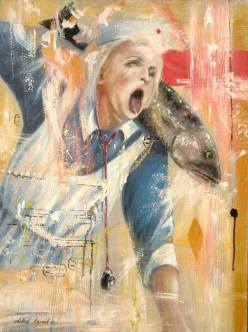
It’s crazy making.
Experts struggled to think of a historical parallel where the president has turned the world’s most powerful and influential office into a megaphone for wholesale fabrications and bizarre claims in an effort to confuse voters and salvage his own political future.
“Trump is certainly not the first politician to lie or invent stories,” said Eileen Culloty, who researches disinformation at Dublin City University in Ireland. “But his history of making baseless, conspiratorial claims — whether it’s Obama’s birth certificate, linking Ted Cruz’s family to the Kennedy assassination or now Obamagate — is striking for its scale and frequency.”
Critics said Trump’s messaging was particularly destructive as Americans struggle with the pandemic, which has crippled the economy and killed more than 90,000 in the U.S. as of Monday.
“A pandemic is the perfect laboratory for disinformation because people are scared, they’re anxious — and all of the social science around conspiracy theories shows when people feel anxious and scared, they’re more likely to believe conspiracy theories,” said Richard Stengel, a former editor of Time magazine and former senior State Department official.
“Trump has figured that out. This campaign is headed to a low point that we’ve never experienced before in American history, because he is not at all compelled to align his message with reality,” he added.
Read more at the LA Times.
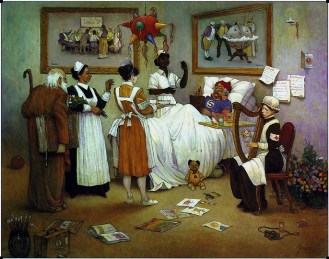
The Nurse, Jose Perez
Richard Stengel, quoted in the LA Times piece, writes at Vanity Fair about what Trump’s incompetence has done to our country’s reputation: The Bungling Superpower: COVID-19 Has Recast America as a Global Chump.
When I was under secretary of state for public diplomacy during the Barack Obama administration—the job that is essentially the chief marketing officer for the American brand around the world—I found that the most common request I got from international diplomats and leaders was, could I help them get in touch with the Silicon Valley tech companies? Would I introduce them to someone at Google, Apple, and Facebook? Our brand differentiator was no longer drones, Tomahawks, and foreign assistance—though all of them still mattered—it was search, likes, and Twitter. No, we weren’t as generous and deep-pocketed as we once had been, nor could we build bridges and highways like China was doing, but we were seen as the land of the future, and people wanted to know how we did it. It was a welcome change.
But the election of Donald Trump and our inept response to the coronavirus has reversed much of that. Even when we were the arrogant and galumphing superpower—a continuation of the Ugly American stereotype from the 1950s—we were always seen as competent. Yes, we were headstrong and naive, but we got things done. Now, thanks to the combination of Trump’s much-mocked America First doctrine and his administration’s chaotic and chuckleheaded response to the coronavirus, the Trump administration has recast our brand in a new way: the bungling superpower. The country that created the iPhone could not figure out how to manufacture enough cotton swabs. While Germany is led by a woman with a doctorate in quantum chemistry, the U.S. president was suggesting that people inject disinfectant to cure the virus.
Nursing, by Jeff Conway
Last week, in a rare move in its nearly 200-year history, the distinguished British medical journal The Lancet published an editorial saying that the U.S. had fallen from what it once was, the gold standard in disease detection and control, and must not reelect a president who prized partisanship above science. A poll in France earlier this month found that Angela Merkel, and not the American president, was overwhelmingly regarded as the leader of the free world. Only 2% of those polled said Trump was heading in the right direction. A Bosnian TV journalist proclaimed that the White House was dysfunctional and America was beginning to resemble the Balkans. The Balkans.
Many people have cited the line from the Irish Times that “the world has loved, hated, and envied the U.S. Now, for the first time, we pity it.” That’s not quite right. The emotion is not pity, but schadenfreude: people around the world are taking a secret pleasure in the U.S.’s ineptitude. They feel the U.S is getting payback for its self-righteousness, boasting, and incessant lecturing. It’s karmic retribution, not pity.
But there’s a greater and more existential threat to American influence than the scorn people around the world have for Trumpism: it is the increasing non-essentialness of America among nations and the discrediting of the American model of governance and capitalism.

Bloomberg reports on a study that shows that Covid Patients Testing Positive After Recovery Aren’t Infectious.
Researchers are finding evidence that patients who test positive for the coronavirus after recovering aren’t capable of transmitting the infection, and could have the antibodies that prevent them from falling sick again.
Gregg Chadwick, Nurses and therapy dog
Scientists from the Korean Centers for Disease Control and Prevention studied 285 Covid-19 survivors who had tested positive for the coronavirus after their illness had apparently resolved, as indicated by a previous negative test result. The so-called re-positive patients weren’t found to have spread any lingering infection, and virus samples collected from them couldn’t be grown in culture, indicating the patients were shedding non-infectious or dead virus particles.
The findings, reported late Monday, are a positive sign for regions looking to open up as more patients recover from the pandemic that has sickened at least 4.8 million people. The emerging evidence from South Korea suggests those who have recovered from Covid-19 present no risk of spreading the coronavirus when physical distancing measures are relaxed.
The results mean health authorities in South Korea will no longer consider people infectious after recovering from the illness. Research last month showed that so-called PCR tests for the coronavirus’s nucleic acid can’t distinguish between dead and viable virus particles, potentially giving the wrong impression that someone who tests positive for the virus remains infectious.
The research may also aid in the debate over antibody tests, which look for markers in the blood that indicate exposure to the novel coronavirus. Experts believe antibodies probably convey some level of protection against the virus, but they don’t have any solid proof yet. Nor do they know how long any immunity may last.

Read more at the link.
I’ll end with a non-Trump story from The Guardian: Exclusive: Police tried to tase Ahmaud Arbery in 2017 incident, video shows.
Police attempted to use a Taser on Ahmaud Arbery, the slain Georgia jogger, after questioning why he was sitting alone in his car in a park one morning in November 2017, according to records and a police video obtained by the Guardian.
Edwin Harleston, The Nurse
The video, obtained through a public records request, comes to light as law enforcement in the area faces scrutiny after Arbery was shot dead by two white men while jogging in February. Police did not arrest Gregory and Travis McMichael, who chased down and killed the unarmed Arbery, and a prosecutor assigned to the case wrote a lengthy memo explaining why the killing was legally justified….
In the video an officer patrolling the area suspected Arbery of using marijuana, saying he was in a park known for drug activity.
Arbery, dressed in a green hat, winter coat and athletic pants, said he didn’t have drugs and refused to let the officer search his car. He told the officer he was relaxing by rapping in his car over instrumental beats and had the day off from work at Blue Beacon Truck Wash.
The incident, previously described by the Atlanta Journal-Constitution, escalated when Arbery began to question why the officer, Michael Kanago, was hassling him. Kanago claimed he began to feel threatened by Arbery, later writing in his report that “veins were popping from [Arbery’s] chest, which made me feel that he was becoming enraged and may turn physically violent towards me”. Kanago requested help from a second officer.
“You’re bothering me for nothing,” Arbery said to Kanago, according to body camera footage. After Kanago told him he was looking for criminal activity, Arbery said “criminal activity? I’m in a fucking park. I work.”

How dare a young black man sass a George police officer. Well, they finally got him killed, didn’t they? Racist monsters.
That’s all I have for you today. What’s on your mind? What stories are you following?
Surreal Caturday Reads: Insane Conspiracy Theories and Cats
Posted: May 16, 2020 Filed under: Surreality | Tags: cat art, conspiracy theories, Donald Trump, surrealism, surrealistic cats 39 Comments
Topiary Cat at home evening, created by Richard Saunders
Good Morning!!
Our so-called “president” is a malignant narcissist with rapidly advancing dementia and we’re in a losing battle with a pandemic that the “president” has decided not to deal with at all. Instead he has been trying gin up outrage among his cult followers by claiming a vast conspiracy against him led by former president Obama. He began his morning by rage-tweeting about another supposed conspiracy against him by multiple social media sites–based on claims by right wing nut Michelle Malkin.
I highly recommend exploring The Atlantic magazine’s “Shadowland” project, which explores current and past conspiracy theories and their impact on American and world history. I’ve posted a couple their articles recently. We are going to need to understand this kind of conspiracy thinking as we get closer to the 2020 presidential election. Some background: “Shadowland”: A New Project From The Atlantic on the Power and Danger of Conspiracy.
Conspiracy thinking has shaped the world for centuries, destroying great institutions, eradicating knowledge, endangering democracies, and ending lives. These theories threaten not just individual facts, but the idea that empirical truth exists at all. And now, with a president of the United States who advances conspiracy thinking about a pandemic that has led to 82,000 reported deaths in America, it becomes an existential threat.
In an effort to better understand how we got here, and how we might find a way out, The Atlantic today launches “Shadowland,” an exploration of how conspiracy theories have shaped America, and why they are more powerful, and dangerous, now than ever.
Leonora Carrington’s Self Portrait (1938)
Shadowland takes you down the rabbit hole through an interactive project portal, built with the mobile reader in mind; the product and visuals are central to the storytelling. It represents some of the most ambitious work of the year, even as The Atlantic continues to apply the full weight of its newsroom to cover the biggest stories of our age: the global pandemic, the Trump presidency, and the spread of illiberalism across the planet.
The project debuts with “The Prophecies of Q,” executive editor Adrienne LaFrance’s cover story on QAnon for The Atlantic’s June issue. With its legions of followers, fabrications about the coronavirus, and dark predictions about the “deep state,” QAnon’s power—and the rejection of reality it represents—only grows. LaFrance warns that QAnon “is a movement united in mass rejection of reason, objectivity, and other Enlightenment values. And we are likely closer to the beginning of its story than the end … To look at QAnon is to see not just a conspiracy theory but the birth of a new religion.”

Read the rest at The Atlantic link.
Susan Glasser on “Obamagate”: “Obamagate” Is Niche Programming for Trump Superfans.
Donald Trump will not shut up about Barack Obama—not now, not ever. On Thursday morning, amid the gravest economic crisis in a century and a deadly pandemic that will have killed more than a hundred thousand Americans by the end of this month, Trump yet again accused his predecessor of culpability in “the biggest political crime and scandal in the history of the USA.” Obama, he said, should be hauled before the Senate to testify. “He knew EVERYTHING,” Trump added in his tweet, one of dozens of attacks in the past few days in which he has targeted “Obamagate.” What crime, exactly, was Trump accusing Obama of? What should he testify about? Trump never said, and it’s a safe bet that he never will.
Field of Dreams – Heidi Taillefer #Surreal #Cat
On Monday afternoon, at a press conference on the White House lawn, Trump made that clear, in a memorable exchange with Phil Rucker, of the Washington Post, that echoed the paranoid fulminations of Trump’s hero Joseph McCarthy at his worst. “What crime, exactly, are you accusing President Obama of committing?” Rucker asked. “Obamagate,” Trump replied. “It’s been going on for a long time,” he added, without offering specifics. “What is the crime, exactly, that you’re accusing him of?” Rucker asked again. “You know what the crime is,” Trump answered. “The crime is very obvious to everybody.” Days later, that is still where we are: Trump is accusing Obama of a grave crime but refusing even to say what Obama allegedly did, while repeating over and over that the former President is guilty of something, a technique of political agitprop that recalls not only McCarthy but every wannabe dictator for whom the rule of law has little or nothing to do with accusations of illegality.
Perhaps, to Trump and his defenders, “Obamagate” really is such a known commodity that defining it is superfluous, even if it is not at all obvious to those who don’t populate Trump’s alternate reality of conspiracy theories and outright lies, a world in which Obama figures as a regular and sinister presence. This is not the first time, nor will it be the last, that the gap between partisan truths in Washington is so wide it’s practically a vortex. In many ways, the “Obamagate” exchange on Monday reminded me of the first day of the public impeachment hearings last fall in the House Intelligence Committee, in which Democrats spent hours outlining what they knew of the Trump Ukraine-shakedown scheme that had triggered the impeachment proceedings, while Devin Nunes, the Republican ranking member, offered up an array of little-known intrigues that seemed entirely unrelated to the matter at hand, including an alleged plot to “obtain nude pictures of Trump,” which, he said, was part of a “three-year-long operation” by Democrats, “the corrupt media,” and “partisan bureaucrats to overturn the results of the 2016 election.” I remember thinking: Naked pictures? What was he even talking about? It appeared to have something to do with a 2017 phone call to Representative Adam Schiff from two Russian pranksters claiming to represent the Ukrainian government and offering nude pictures of Trump with a Russian celebrity. Or something. If you had been following along with Fox News and the darker corners of the right, you knew exactly what Nunes was talking about.

Read the rest at The New Yorker

Andre Ferez, Russian artist
The New York Times on Trump’s latest crazy obsessions: A Sitting President, Riling the Nation During a Crisis.
Even by President Trump’s standards, it was a rampage: He attacked a government whistle-blower who was telling Congress that the coronavirus pandemic had been mismanaged. He criticized the governor of Pennsylvania, who has resisted reopening businesses. He railed against former President Barack Obama, linking him to a conspiracy theory and demanding he answer questions before the Senate about the federal investigation of Michael T. Flynn.
And Mr. Trump lashed out at Joseph R. Biden Jr., his Democratic challenger. In an interview with a sympathetic columnist, Mr. Trump smeared him as a doddering candidate who “doesn’t know he’s alive.” The caustic attack coincided with a barrage of digital ads from Mr. Trump’s campaign mocking Mr. Biden for verbal miscues and implying that he is in mental decline.
That was all on Thursday.
Far from a one-day onslaught, it was a climactic moment in a weeklong lurch by Mr. Trump back to the darkest tactics that defined his rise to political power. Even those who have grown used to Mr. Trump’s conduct in office may have found themselves newly alarmed by the grim spectacle of a sitting president deliberately stoking the country’s divisions and pursuing personal vendettas in the midst of a crisis that has Americans fearing for their lives and livelihoods.
A bit more:
Since well before he became president, Mr. Trump’s appetite for conflict has defined him as a public figure. But in recent days he has practiced that approach with new intensity, signaling both the depths of his election-year distress and his determination to blast open a path to a second term, even at the cost of further riling a country in deep anguish.
Rene Magritte, Cat in a Hat
His electoral path has narrowed rapidly since the onset of the pandemic, as the growth-and-prosperity theme of his campaign disintegrated. In private, Mr. Trump has been plainly aggrieved at the loss of his central argument for re-election. “They wiped out my economy!” he has said to aides, according to people briefed on the remarks.
It is unclear whether he has been referring to China, where the virus originated, or health experts who have urged widespread lockdowns, but his frustration and determination to place blame elsewhere have been emphatic.
Ken Goldstein, a professor of politics at the University of San Francisco, said that Mr. Trump and his campaign were going on the offensive in nasty ways in an attempt to shift the attention of the public away from him and onto other targets, and ultimately onto Mr. Biden.
“If this election is about Trump, he probably loses,” Mr. Goldstein said. “Trump’s only hope is to make the election about Biden.”

Jack Shafer argues at Politico that we should ignore the idiot “president”: How Not to Listen to Donald Trump.
It turns out President Donald Trump’s status as the most accessible person to ever hold the office is more a curse than a blessing. Day after day, he fills the air with the ack-ack of disinformation and misdirection, needlessly alarming the public and sending reporters on wild goose chases to either confirm or disprove his allegations. On Thursday, in an interview with Fox Business’ Maria Bartiromo, Trump repeated his newest figment that Joe Biden and Barack Obama are guilty of some unnamed crimes for which they are deserving of “50-year sentences.”
Strong meat! The heinous crimes—to which he has applied the “Obamagate” moniker and calls “the biggest political crime and scandal in the history of the USA, by FAR”—is a relatively new creation of the Trump Disinformation Laboratory. He only started talking about it on May 10 and has yet to specify exactly what Obamagate is aside from telling reporters in a press conference that it’s “obvious” and that he wants Sen. Lindsey Graham, R-S.C., to investigate it.
By Daniel Merriam
Despite a lack of interest from his minions in Congress (Graham has said he has no plans to grill Obama), Trump’s foggy demagoguery has mobilized the entire press corps to determine what the hell Trump is talking about. Explainers from Reuters, the Washington Post, the Guardian, CNN, and elsewhere struggle to decipher Trump’s vague but strident accusations with little success. We can say this much with certainty. It appears linked to the counterintelligence operation against Gen. Michael Flynn in late 2016, and the requests from Obama administration officials that his identity be “unmasked” from intelligence reports so they could understand who, exactly, was talking to the Russian ambassador. Flynn lied to the FBI about speaking to the ambassador about sanctions and later pled guilty to lying to the FBI about those conversations. (Unmasking, by the way, is a routine, not nefarious thing, which the Trump administration has requested thousands of times.) But until Trump uses his words to make his charges about Obama more specific, we can only guess at what the actual crime might be.
Why must we fetch every bone that Trump hurls into the high, prickly brush? Well, he’s the president, and he wouldn’t make such an extreme charge if it weren’t true, would he? But he does, and he does all the time. This tidy list from Business Insider demonstrates his historic capacity for making baseless but grotesque claims of criminality and deception: implicating Ted Cruz’s father in the Kennedy assassination; claiming that Obama wasn’t born in the United States; surmising that Justice Antonin Scalia did not die of natural causes; accusing Joe Scarborough of complicity in the death of an intern; asserting massive voter fraud in the 2016 presidential election; saying windmills cause cancer; connecting the Clintons to Jeffrey Epstein’s death; and the Bidens-in-Ukraine baloney.

I’m not sure ignoring Trump’s insanity will work as long as he has rabid support from around 40 percent of the electorate (who knew there were so many idiots in the U.S.?). I tend to agree with The Atlantic’s point of view–we need to become more aware of the programming these Americans are receiving from Trump and his friends in the media and on-line forums.
What do you think? What other stories are you following today?

 peej
peej Carissa
 bostonboomer
 dakinikat
 ecocatwoman
 mablue2
 Mama Lopez
 peggysue22
 quixote
 skydancingguestblogger
 Mona (aka Wonk the Vote)



 Sky Dancing
Recent Comments