
Lazy Caturday Reads: The Atlanta Mass Shootings
Posted: March 20, 2021 Filed under: Afternoon Reads, U.S. Politics | Tags: Anti-Asian violence, Atlanta mass shootings, massage therapy spas, misogyny, Racism 15 Comments
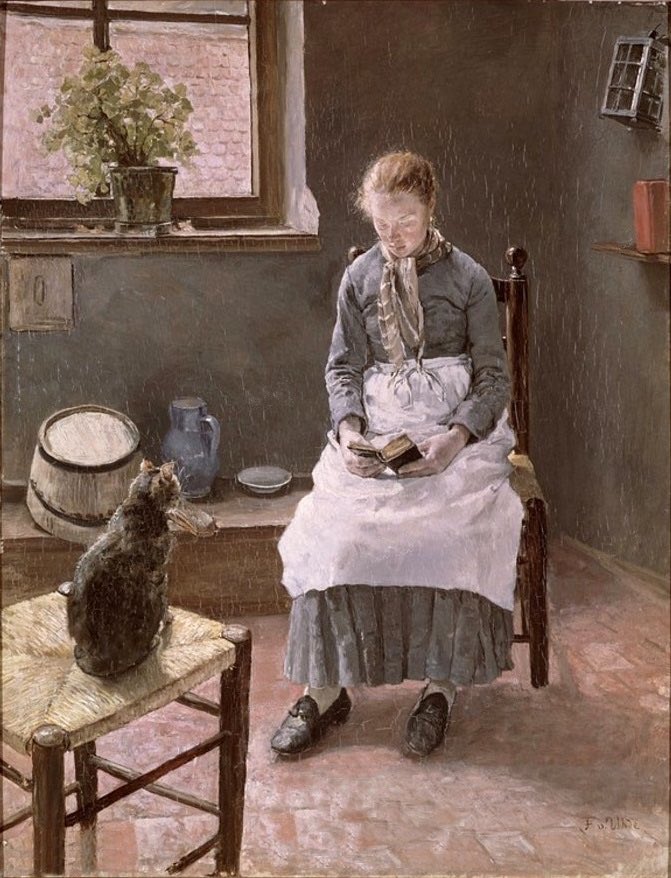
Woman reading with large cat under the couch, Paula Zima
Good Afternoon!!
I’m going to focus on the Atlanta spa shootings again. There has been an effort by some white male writers to argue that racism and misogyny didn’t motivate the shooter. Of course these things are complicated, but there is no doubt that attacks on Asian Americans have increased dramatically over the past year, as the former occupant of the White House tried to put the blame for the pandemic on China. Some white journalists have also been defending the Cherokee Sheriff’s spokesman who appeared to sympathize with the shooter having “a bad day.”
Here’s Andrew Sullivan’s take on this story: When The Narrative Replaces The News.
…this story has…been deeply instructive about our national discourse and the state of the American mainstream and elite media. This story’s coverage is proof, it seems to me, that American journalists have officially abandoned the habit of attempting any kind of “objectivity” in reporting these stories. We are now in the enlightened social justice world of “moral clarity” and “narrative-shaping.”
Woman Lying on a Bench, Carl Larsson, 1913
Here’s the truth: We don’t yet know why this man did these horrible things. It’s probably complicated, or, as my therapist used to say, “multi-determined.” That’s why we have thorough investigations and trials in America. We only have one solid piece of information as to motive, which is the confession by the mass killer to law enforcement: that he was a religious fundamentalist who was determined to live up to chastity and repeatedly failed, as is often the case. Like the 9/11 bombers or the mass murderer at the Pulse nightclub, he took out his angst on the source of what he saw as his temptation, and committed mass murder. This is evil in the classic fundamentalist sense: a perversion of religion and sexual repression into violence.
We should not take the killer’s confession as definitive, of course. But we can probe it — and indeed, his story is backed up by acquaintances and friends and family. The New York Times originally ran one piece reporting this out. The Washington Post also followed up, with one piece citing contemporaneous evidence of the man’s “religious mania” and sexual compulsion. It appears that the man frequented at least two of the spas he attacked. He chose the spas, his ex roommates said, because he thought they were safer than other ways to get easy sex. Just this morning, the NYT ran a second piece which confirms that the killer had indeed been in rehab for sexual impulses, was a religious fanatic, and his next target was going to be “a business tied to the pornography industry.”

The sympathy for the sheriff’s spokesman has led to attacks on Vox’s Aaron Rupar, who posted the original video of the spokesman.
I admit that I have no way of judging the shooter’s motives, but I do know that mass shooters tend to be men who have previously abused women, and they are frequently racists. I went looking for takes by people who are more knowledgeable about anti-woman and anti-Asian violence than Andrew Sullivan, Matthew Yglesias, and Ken Vogel. Here’s some of what I found.
Atlanta Journal-Constitution: Before killing spree, women – especially Asian women – exploited and ‘enslaved’ at spas.
Six large red arrows point to the entrance of Aromatherapy Spa on Atlanta’s Piedmont Road, beacons to those seeking untold pleasures within.
Robert Aaron Long claimed he found the invitation irresistible.The 21-year-old from Woodstock frequented Aromatherapy, as well as the Gold Spa directly across the street, establishments open around the clock and whose advertisements feature women — particularly Asian women — in suggestive poses.
On Tuesday, authorities say, Long purchased a 9 mm handgun and headed to three spas — one in south Cherokee County and the two in Atlanta — where he shot eight people to death and seriously wounded one other. His motives remain the subject of investigation, but he told police he was trying to purge the sources of temptations while battling sex addiction.
This is what we know about the industry and the women that Long chose to attack:
Painting by Fritz von Uhde
While the exact services offered at the spas that were attacked are not clear, last week the eyes of the world fell on this often-ignored segment of Atlanta’s “adult entertainment” industry. Despite more than a decade of trying, Georgia has failed to rein in certain illicit massage businesses that hypersexualize and commodify women.
Laws and local ordinances aimed to crack down on prostitution and potential human trafficking have only resulted in sporadic police busts and occasional losses of state-issued massage therapy licenses. Meanwhile, behind the darkened windows of undistinguished commercial buildings, an invisible population remains vulnerable to the type of deadly, misogynistic violence seen Tuesday….
What roles the victims played at the spas is not clear. At least one woman who died at Young’s Asian Massage, Delaina Ashley Yaun, 33, was on the premises as a customer. Paul Andre Michels, 54, who was white, also was killed in the Acworth shooting, along with Daoyou Feng, 44, and Xiaojie Tan, 49.
Tan, who held a state massage therapy license, is listed as the owner of that spa, as well as at least one other in Kennesaw.
Greg Hynson, a customer of the Cherokee location, said he was close friends with Tan and never saw or heard any evidence of illegal activity. “She ran a reputable business,” he said.
On the Atlanta victims:
The Atlanta victims, all of Korean descent, were identified Friday as Soon Chung Park, 74; Suncha Kim, 69; Yong Ae Yue, 63; and Hyun Jung Grant, 51. According to a report in The Korea Daily, a Korean language daily published in the U.S., the three older women essentially acted as site managers, opening the door for customers or serving meals to workers.
Court records indicate a 51-year-old by the name of Hyun Jung Grant was arrested in Gwinnett County in 2009 on charges of pimping, prostitution, keeping a place of prostitution and giving a massage in a place used for lewdness.
Were women in their 50s, 60s, and 70s really engaged in prostitution? I’ve quoted a lot from this article, but it is very long and the rest is well worth reading at the link.
Patrick Adams at The Daily Beast: Son of Atlanta Shooting Victim Calls ‘Bullshit’ on Sex Addiction Claim.
Randy Park said he learned of his mother’s murder while he was playing his favorite video game, League of Legends, in their townhome in Duluth, Georgia.
Woman Reading with Cat, Carol Keiser
It’s a short drive from the Atlanta spas where police say 21-year-old Robert Aaron Long shot and killed four Asian women shortly after he shot and killed four other people in a suburb north of the city, two of those victims also Asian women….Park, 23, said he got a call that evening from the daughter of a survivor who had been next to his mother, Hyun Jung Grant, at Gold Spa when the shooting occurred….
Park and his mother were “very close,” he said. “I could tell her anything. If I had girl problems or whatever. She wasn’t just my mother. She was my friend.” [….]
Much of the national conversation about the shooting has centered on Cherokee County sheriffs apparently taking the suspect, a white kid from the suburbs, at his word that he was not motivated by racial animus. That dynamic was only worsened when, as The Daily Beast first reported, it was revealed the very official in that department perpetuating that narrative posted racist T-shirts that specifically targeted the Asian-American community.
Instead of racism, law-enforcement officials have said, the suspect has suggested he was motivated by his addiction to sex. Atlanta police on Thursday said he frequented the spas he attacked.
Park does not buy that explanation for a second.
“That’s bullshit,” he told The Daily Beast.
“My question to the family is, what did y’all teach him?” he added. “Did you turn him in because you’re scared that you’ll be affiliated with him? You just gonna scapegoat your son out? And they just get away scot free? Like, no, you guys definitely taught him some shit. Take some fucking responsibility.”

Park didn’t know anything about his mother being involved in sex work, but it sounds like he had been worried about it. But they were poor and “she did what she had to do” to keep her family going in the U.S. I think Park has a point that racism had to be involved in this crime and it’s important to know what the shooter learned during his upbringing.
Frankie Huang at The Daily Beast: White Fragility Is a Disease, and It Just Killed Six Asian Women.
For most of my life as a Chinese American woman, I accepted that a “normal” amount of feeling unsafe is simply part of my life in America, that if I lived more carefully I can avoid danger. Now, as I’m bombarded with reports of people who look like me that are being assaulted on sight, like vermin, I wonder how I ever thought this kind of dehumanization is something I can live with?
Actually, I do know how. It’s easier to self-soothe with the wishful fantasy that good behavior can be an effective prophylactic than it is to confront the bleak reality of being a person of color who lives in a country with a white supremacy problem.
Woman reading with a cat on a snowy day, Belinda Del Pesco
Which is what I reflexively did when the news about the horrific shooting in Atlanta popped up on my phone. My very first thought was, “Maybe it wasn’t a hate crime, but just a coincidence that six out of eight victims were Asian women.” I was scared to acknowledge that there are those who would want me dead just from the look of me, and that I live in their midst.
But then I came face to face with a different kind of denial about America’s problem with racism, one far grander and more dangerous than my own: the powerful white fragility engine that has roared into life to efficiently and systematically distort the narrative about the Atlanta massacre.
One can almost admire how the machine churns, the way the killer’s claim that his actions were not racially motivated has been amplified by the police and major media platforms, accepting a young white man’s claims at face value even after he murdered eight people. The Cherokee County sheriff said in a press conference, almost sympathetically, that the murderer “had a really bad day” and had admitted to “sex addiction.” Online, I’ve seen people speculating about mental illness, poverty, and substance abuse, with these narratives laid on thick to create a barrier around the obvious, distinct possibility that it was white supremacy that drove this white man to kill Asian women.
I’ve heard this song before. It starts with “maybe it’s not racism” and builds briskly to “he’s just a sad lone wolf” and ends in fading refrains of “thoughts and prayers.”

Read the rest at the Daily Beast link.
May Jeong at The New York Times: The Deep American Roots of the Atlanta Shootings.
In some massage parlors, women, often Asian, may sometimes perform sexual services.But I did not know whether those who died this week would have identified themselves as sex workers.
I have spent the past few years researching the various ways sex work intersects with race, class and gender, routinely amazed by how it connects to such disparate issues as criminal justice, gentrification, poverty, immigration and trans rights. I have come to understand sex work rights as an overlooked civil rights issue that deserves study. I soon found myself placing the Atlanta killings within the context of a horrific history….
Since the terrible events this past Tuesday, much effort has been devoted to understanding Mr. Long — an earnest inquiry that betrays a particular kind of American naïveté. He claimed to have been driven by “sexual addiction”; investigators have not yet ruled out race as a factor. For now, we do not know whether the massage parlor workers who were killed would have considered themselves sex workers, and we may never know. But the answer is less relevant to their deaths than their murderer’s answer: Does it matter how one identifies oneself if a mass killer conflates any Asian woman in a massage parlor with a sex worker?
Fernand Léger. Woman Reading with a Cat, 1921
The stereotype of the Asian woman as simultaneously hypersexualized and submissive is borne of centuries of Western imperialism. An early documented instance of Asian fetishization can be found in “Madame Chrysantheme,” a thinly fictionalized account of a French naval officer’s time visiting 19th-century Japan. “Madame Chrysantheme” was wildly popular when it was published, and went on to create a subgenre of Orientalizing prose. The women in such accounts were, as Edward Said wrote in “Orientalism,” “creatures of a male power-fantasy. They express unlimited sensuality, they are more or less stupid, and above all they are willing.”
Later, an untold number of American servicemen in Korea and Vietnam had their first sexual encounter with Asian women. The U.S. military tacitly endorsed prostitution, considering it good for morale, and at times even explicitly encouraged troops to explore the local sex industry. According to the book “Sex Among Allies” by Katharine Moon, an assistant professor of political science at Wellesley College, an ad in Stars and Stripes, the main military newspaper, read: “Picture having three or four of the loveliest creatures God ever created hovering around you, singing, dancing, feeding you, washing what they feed you down with rice wine or beer, all saying at once, ‘You are the greatest.’ This is the Orient you heard about and came to find.”

This is an important article–I hope you’ll go read the rest at the NYT.
More stories to check out on this topic:
The Washington Post: Surveillance video shows Atlanta suspect entered first spa more than an hour before shooting.
Alex Wagner at The Atlantic: Our Asian Spring. In the ashes of violence and death, Asians and Americans of Asian descent are ready to put up a fight.
Melissa Jeltson at New York Magazine: The Flattening of the Atlanta Shootings.
USA Today: Atlanta spa shootings: Illicit reviews raise red flags that shooter targeted vulnerable women.
Slate: Coverage of Bay Area Anti-Asian Violence Is Missing a Key Element.
I think it’s clear that the motives of men who murder women are complicated. It may be true that Long had a sexual addiction, but he chose to act out the addiction in specific places with primarily Asian women employees. I doubt if he is a reliable reporter of his own reasons for his behavior. I think it’s important to listen to Asian and female voices over white men like Andrew Sullivan, Matthew Yglesias and Ken Vogel.
As always, this is an open thread.
Thursday Reads: A Bad Day For Him?
Posted: March 18, 2021 Filed under: morning reads, U.S. Politics | Tags: Asian women, Atlanta, Attacks on Asian Americans, Cherokee County GA, hate crimes, Jay Baker, mass shootings, misogyny, Racism 32 Comments
Young Lady Reading the Newspaper at Home in the Evening, by Yann Rebecq
Good Morning!!
There’s a police captain in Atlanta named Jay Baker who needs to fired immediately. Since when do we take the word of mass murders on their motives?
So this pathetic loser was having a bad day? What about the 8 women he killed and their surviving family members? Or don’t they count because they aren’t white males?
You probably won’t be surprised to learn that Captain Baker appears to be a racist. The Daily Beast: Georgia Sheriff Spokesman Posted Racist COVID Shirts on Facebook.
A Cherokee County, Georgia, Sheriff’s Office spokesperson came under fire Wednesday afternoon for pinning the deadly Tuesday shooting rampage that left eight dead—including six Asian women—on a 21-year-old white man’s “really bad day.”
“Yesterday was a really bad day for him and this is what he did,” Jay Baker said during the joint news conference with the Atlanta Police Department about 21-year-old Robert Aaron Long.
But it seems the same spokesperson shared racist content online, including pointing the finger at China for the ongoing coronavirus pandemic—the same vitriol advocates say has fueled a horrific surge in violence against Asian Americans.
In a Facebook page associated with Capt. Jay Baker of the Cherokee Sheriff’s Office, several photos show the law enforcer was promoting T-shirts with the slogan “COVID-19 imported virus from CHY-NA.”
“Place your order while they last,” Baker wrote with a smiley face on a March 30 photo that included the racist T-shirts.
“Love my shirt,” Baker wrote in another post in April 2020. “Get yours while they last.’”
The shirts appear to be printed by Deadline Appeal, owned by a former deputy sheriff from Cherokee County, and sold for $22. The store, which promotes fully customizable gear, also appears to print shirts for the Cherokee County Sheriff’s Office Honor Guard, a “ceremonial unit, all volunteers, who represent not only the Sheriff’s Office but also the county when participating in a variety of events,” according to a March 10 Instagram post.
https://twitter.com/viet_t_nguyen/status/1372307208587776001?s=20
The Washington Post Editorial Board: Opinion: The Atlanta shootings cannot be dismissed as someone having a ‘bad day.’


When Georgia law enforcement briefed the public on Wednesday morning about the 21-year-old white man who shot and killed eight people—six of them Asian women—at Atlanta-area massage parlors Tuesday night, it wasn’t helpful.
Officials made a puzzling series of claims of fact, despite being cartoonishly cautious about other aspects of the case. Officials claimed that 21-year-old Robert Aaron Long had a “sex addiction” but admitted they didn’t know whether sex work occurred at the places where Long killed people. Who told them that Long had a sex addiction? Was it Long himself?
They weren’t sure whether Long was motivated by the racial identity or gender of his victims, and thus said they couldn’t say with certainty that a hate crime had been committed, but then again, they said with certainty that before he’d committed the crimes the shooter had “a really bad day.” Who told them that Long had a really bad day? Did they fact-check that one, or did they once again simply repeat the words of a suspected mass killer into a microphone? (I think I speak for a lot of people when I say: I don’t give a flying-saucer fuck about what kind of day a mass shooter was having before opening fire.)
In her book Down Girl, philosopher Kate Mann describes the phenomenon of “himpathy,” which she defines as “the inappropriate and disproportionate sympathy powerful men often enjoy in cases of sexual assault, intimate-partner violence, homicide, and other misogynistic behavior.” The phenomenon is particularly on display when a male public figure is accused of sexual misconduct and his defenders comment on how the man’s life has been “ruined,” like when Lindsey Graham lost his marbles during the Brett Kavanaugh confirmation hearings.
By Mai Trung Thu, Vietnamese artist
When men specifically target women in their violent crimes, some in positions of power fall all over themselves to make the case that those crimes were somehow in women’s power to stop, that men’s out-of-control unmet entitlement functions like a semitruck that lost the use of its brakes while heading down a steep grade, and that those who get hit should have moved out of the way.
Violent acts committed by men who have a problem with women and sex—they’re not getting enough; they feel bad about getting too much; the women who they believe should be giving them sex are instead choosing to have sex with other men—are similarly excused as something we should understand on an emotional level. If only women had been sluttier/less slutty when it came to the sad men, perhaps the men wouldn’t have been pushed to do what they did….
The murder of six Asian women and a white man and white woman in Atlanta didn’t only call to mind over-empathization with maleness; Long’s treatment by law enforcement also draws attention to the way authorities treat whiteness.

Harmeet Kaur at CNN: Fetishized, sexualized and marginalized, Asian women are uniquely vulnerable to violence.
Of the eight people who were killed when a White man attacked three metro Atlanta spas, six were Asian women.
Investigators said it was too early to say whether the crime was racially motivated, and instead pointed to the suspect’s claim of a potential sex addiction.
But experts and activists argue it’s no coincidence that six of the eight victims were Asian women. And the suspect’s remarks, they say, are rooted in a history of misogyny and stereotypes that are all too familiar for Asian and Asian American women.
They’re fetishized and hypersexualized. They’re seen as docile and submissive. On top of that, they’re often working in the service sector and are subject to the same racism that affects Asian Americans more broadly.
The way their race intersects with their gender makes Asian and Asian American women uniquely vulnerable to violence, said Sung Yeon Choimorrow, executive director of the non-profit advocacy group National Asian Pacific American Women’s Forum….
Painting by Di Li Feng
The perceptions of Asian and Asian American women as submissive, hypersexual and exotic can be traced back centuries.
Rachel Kuo, a scholar on race and co-leader of Asian American Feminist Collective, points to legal and political measures throughout the nation’s history that have shaped these harmful ideas.
One of the earliest examples comes from the Page Act of 1875.
That law, coming a few years before the Chinese Exclusion Act, was enacted seemingly to restrict prostitution and forced labor. In reality, it was used systematically to prevent Chinese women from immigrating to the US, under the pretense that they were prostitutes.

Read more details at CNN.
A few more stories on this topic:
Rex Huppke at The Chicago Tribune: Column: Atlanta shooting suspect’s ‘bad day’ and the whitewashing of white crime.
The Washington Post: Asian Americans see shooting as a culmination of a year of racism.
As always this is an open thread. What’s on your mind today?
Tuesday Reads
Posted: March 16, 2021 Filed under: just because 10 Comments
Isaac Grunewald, Woman Reading
Good Morning!!
It’s strange that the news is so boring since Trump disappeared from view. Don’t get me wrong–I’m glad he’s gone, but I’m still getting adjusted to the new reality. We are starting to see more media criticism of Biden, so his honeymoon could be ending. There are also the pandemic and the investigations into Trump’s finances and the January 6 insurrection to read about. There are some interesting stories out there today; here’s what I’ve come across this morning.
Something weird is going on with the attacks on the AstraZenica vaccine. Stat: The curious case of AstraZeneca’s Covid-19 vaccine.
AstraZeneca’s Covid-19 vaccine is facing a crisis of confidence, with one European country after another, as if seized by a fit of panic, temporarily suspending its use over concerns about reports of blood clots in people who received it.
Denmark, Iceland, and Norway had earlier said they would temporarily stop using the two-dose vaccine. On Sunday, Ireland announced a similar decision. France, Germany, and Italy followed on Monday.
Experts and Europe’s regulatory body insist that the vaccine’s benefit — preventing Covid-19 and helping to stop the pandemic — outweighs its risks. They note that the number of people to report the side effect is relatively small, and no causal link has been established.
But experts are also now worried that the decisions by multiple countries to suspend the vaccine’s use could make it harder to convince people to receive it should the concerns turn out, as they expect, to be a false alarm.
More from Stat:
“When there are choices, I think the inclination would be that you aren’t stuck, so to speak, with a vaccine if you have questions,” said Sue Desmond-Hellmann, the former CEO of the Bill & Melinda Gates Foundation and a Pfizer board member. She said the concerns may be overstated, and that she is surprised how quickly European countries decided to act.
William Merritt Chase
The decisions, even if temporary, are likely to have other ripple effects. They put extraordinary pressure on a large clinical trial of the AstraZeneca vaccine being conducted in the United States, which has not authorized the vaccine’s use. And they raise questions about the rollout of a product that, globally, was expected to be produced most inexpensively and distributed most broadly.
In the wake of the decisions by more countries to suspend the vaccine’s use, the European Medicines Agency called an “extraordinary meeting” on Thursday to analyze the risks of the vaccine.
“While its investigation is ongoing, EMA currently remains of the view that the benefits of the AstraZeneca vaccine in preventing COVID-19, with its associated risk of hospitalisation and death, outweigh the risks of side effects,” the agency said in a statement.

Who benefits if the AstraZenica vaccine continues to be rejected by countries? Pfizer. What’s going on?
So I guess we’ll be learning more about this, but it looks like AstraZenica’s vaccine has the same risks as the others.
A shocking story at the Atlantic about the government’s tracking of data on the Coronavirus by Robinson Meyer and Alexis C. Madrigal: Why the Pandemic Experts Failed. We’re still thinking about pandemic data in the wrong ways.
A few minutes before midnight on March 4, 2020, the two of us emailed every U.S. state and the District of Columbia with a simple question: How many people have been tested in your state, total, for the coronavirus?
By then, about 150 people had been diagnosed with COVID-19 in the United States, and 11 had died of the disease. Yet the CDC had stopped publicly reporting the number of Americans tested for the virus. Without that piece of data, the tally of cases was impossible to interpret—were only a handful of people sick? Or had only a handful of people been tested? To our shock, we learned that very few Americans had been tested.
The consequences of this testing shortage, we realized, could be cataclysmic. A few days later, we founded the COVID Tracking Project at The Atlantic with Erin Kissane, an editor, and Jeff Hammerbacher, a data scientist. Every day last spring, the project’s volunteers collected coronavirus data for every U.S. state and territory. We assumed that the government had these data, and we hoped a small amount of reporting might prod it into publishing them.
Santiago Rusiñol
Not until early May, when the CDC published its own deeply inadequate data dashboard, did we realize the depth of its ignorance. And when the White House reproduced one of our charts, it confirmed our fears: The government was using our data. For months, the American government had no idea how many people were sick with COVID-19, how many were lying in hospitals, or how many had died. And the COVID Tracking Project at The Atlantic, started as a temporary volunteer effort, had become a de facto source of pandemic data for the United States.
After spending a year building one of the only U.S. pandemic-data sources, we have come to see the government’s initial failure here as the fault on which the entire catastrophe pivots. The government has made progress since May; it is finally able to track pandemic data. Yet some underlying failures remain unfixed. The same calamity could happen again….
The COVID Tracking Project ultimately tallied more than 363 million tests, 28 million cases, and 515,148 deaths nationwide. It ended its daily data collection last week and will close this spring. Over the past year, we have learned much that, we hope, might prevent a project like ours from ever being needed again. We have learned that America’s public-health establishment is obsessed with data but curiously distant from them. We have learned how this establishment can fail to understand, or act on, what data it does have. We have learned how the process of producing pandemic data shapes how the pandemic itself is understood. And we have learned that these problems are not likely to be fixed by a change of administration or by a reinvigorated bureaucracy.
That is because, as with so much else, President Donald Trump’s incompetence slowed the pandemic response, but did not define it. We have learned that the country’s systems largely worked as designed. Only by adopting different ways of thinking about data can we prevent another disaster:
Read the rest at The Atlantic. Let’s hope the Biden administration is paying attention.
Trump won’t promote the vaccine among his followers, but his staff rushed to get them before they left the White House. Vanity Fair: Shot Chasers: How Officials in Trump’s Lame-Duck White House Scrambled to Score COVID-19 Vaccinations.
In late December and early January, as COVID-19 vaccines were just beginning their chaotic rollout to the states, a secretive scramble took place inside the Trump White House. One after another, political appointees at very high levels approached chief of staff Mark Meadows and members of the National Security Council to ask a favor: They wanted to be on the list.
Adolf Heinrich-Hansen, Interior Kitchen Scene With A Woman Reading The Paper, 1918
It was, to be sure, the ultimate VIP list: On it were the names of U.S. government officials whose work was considered so essential that they needed to be vaccinated against COVID-19 from a limited allotment that would otherwise have gone to the general public. The allotment was intended to protect career staff who could not telecommute (such as White House butlers), critical workers in the field (such as Secret Service agents), and those in the line of presidential succession (such as the secretary of state). The question of who was eligible in an outgoing administration, with just weeks remaining until the inauguration of a new president, was complex. To make the cut your role had to be “essential” to national functions.
The quest to get on the White House list—which was closely guarded by Meadows’s office and a small cadre of NSC officials—attracted an array of supplicants. They ranged from the representatives of cabinet secretaries to young White House desk jockeys to those prepared to leverage their connections to President Donald Trump’s senior adviser and son-in-law, Jared Kushner.
Among this group, Vanity Fair has learned, were chiefs of staff of cabinet agencies, some of whose bosses had become notorious for publicly disregarding pandemic safeguards like mask wearing. They wanted to know, “Would they be able to get four or six doses for their front office?” said a former senior administration official. Though some would claim to be inquiring on behalf of their teams, the official said, in fact “their ask was not about their employees.”

According to the story, Meadows told people they would have to wait, but . . .
But in a White House awash in special favors, that didn’t stop almost every stripe of political appointee, at almost every rung of the ladder, from “shamelessly” attempting to jump the line, according to a senior administration official. (Meadows and President Trump did not respond to requests for comment.) [….]
The previously unreported struggle over the White House list was just one front in a sprawling secret war that raged for months at the highest levels of the federal government. The question of how to equitably vaccinate a federal workforce of 2.1 million people in the midst of a presidential transition ended up pitting the National Security Council against officials from Operation Warp Speed, and career staff against political appointees. It also sparked resentment, suspicions of missing doses, and allegations of line jumping.
Read more at Vanity Fair.
On the New York investigation into the Trump Organization, Business Insider, (via Yahoo news) reports: Trump’s CFO’s ex-daughter-in-law is cooperating with prosecutors and ‘refuses to be silenced,’ her lawyer says.
An attorney representing the former daughter-in-law of the Trump Organization CFO Allen Weisselberg says she’s cooperating with prosecutors conducting an inquiry into Donald Trump’s finances and “refuses to be silenced.”
Ivan Kramskoi (1837-1887) Portrait of a woman reading, 1881
“Jennifer Weisselberg is committed to speaking the truth, no matter how difficult that may be,” her attorney, Duncan Levin, told Insider in a statement. “She will continue to cooperate fully with the various law enforcement agencies that are investigating her ex-husband’s family and the very powerful interests they represent.”
“Jennifer refuses to be silenced any longer by those who are conspiring to prevent her from sharing what she has learned over the past 25 years,” Levin added.
Levin’s comments come in response to a request for comment Friday about a New Yorker story on Manhattan District Attorney Cyrus Vance Jr.’s investigation into the former president and the Trump Organization. The story includes an anecdote from Jennifer Weisselberg, who told the New Yorker’s Jane Mayer she met Trump at a shiva and that he shared photos of naked women at the Jewish mourning ceremony.
The Manhattan District Attorney’s office is conducting a wide-ranging inquiry into Trump and his company. Court filings suggest prosecutors are focusing on whether they illegally kept two sets of books – one that painted a rosy financial picture to obtain favorable loan terms, another featuring grim data to pay less in taxes.

Click the link for more details.
A few more links of possible interest:
The Daily Beast: HBO’s QAnon Docuseries ‘Q: Into the Storm’ Believes It Has Discovered Q’s Identity.
The Daily Beast: Did the Trump White House Create a Batshit Report on Dominion Voting?
The Washington Post: Biden and allies launch stimulus campaign focused on competitive battleground states.
Catherine Rampell at The Washington Post: Opinion: Biden can easily lift the refugee ceiling. So why hasn’t he?
The New York Times: Plenty of Vaccines, but Not Enough Arms: A Warning Sign in Cherokee Nation.
So . . . what’s on your mind today?
Lazy Caturday Reads
Posted: March 13, 2021 Filed under: morning reads, U.S. Politics | Tags: abuse of power, Andrew Cuomo, Donald Trump, Fox News, Joe Biden, Peter Alexancer, presidential press conferences, Rebecca Traister, Sexual harassment, stimulus checks, TD bank, vaccine rollout 19 Comments
Franz Marc, Cat with Kittens
Good Morning!!
Everyone wants to know when they will be getting their $1400 stimulus check. Some people were posting on Twitter last night that they had already gotten their direct deposit. People are also saying on Twitter that TD Bank, Wells Fargo, and Bank of America are holding the deposits until Wednesday. WTF? My bank is TD Bank.
https://twitter.com/whattheautumnn/status/1370492187209764864?s=20
So I guess I can stop checking my bank balance for the time being. They have the deposits, but they are going to collect a few days’ interest before they let us have our money.
On Monday, we should be able to track our payments on-line. Forbes:
The Internal Revenue Service (IRS) could start sending stimulus checks as early as this weekend. If you got a first stimulus check or second stimulus check, you know how important it is to check the status of your stimulus payment. You can check the status of your third stimulus check using the Get My Payment Tool, which is available on the IRS website.
Beginning Monday, March 15, 2021, it is expected that you can use the Get My Payment Tool to check the status of the American Rescue Plan stimulus payments, also known as an Economic Impact Payment. The IRS website says that the IRS is reviewing the tax provisions of the American Rescue Plan Act of 2021, which President Joe Biden signed into law on March 11, 2021.
In other news, the Washington DC media is working very hard to find ways to criticize Joe Biden. They have all been harping on why Biden hasn’t yet held a press conference. The Washington Post: After 50 days as president, Biden still hasn’t given a news conference. Critics and allies wonder why.

Of course he’s been kind of busy rolling out vaccines and helping pass a huge stimulus bill. In addition his press secretary has been holding daily briefings. But the press has to find something to complain about.
The latest thing is the media asking why Biden isn’t giving Trump credit for the millions of vaccines have have now been distributed.
And it’s not just Fox News either. Here’s The New York Times: Biden Got the Vaccine Rollout Humming, With Trump’s Help.
When President Biden pledged last week to amass enough vaccine by late May to inoculate every adult in the United States, the pronouncement was greeted as a triumphant acceleration of a vaccination campaign that seemed to be faltering only weeks earlier.
And it is true that production of two of the three federally authorized vaccines has sped up in part because of the demands and directives of the new president’s coronavirus team.
But the announcement was also a triumph of another kind: public relations. Because Mr. Biden had tamped down expectations early, the quicker timetable for vaccine production conjured an image of a White House running on all cylinders and leaving its predecessor’s effort in the dust.
“On Saturday, we hit a record of 2.9 million vaccinations in one day in America, and beyond the numbers are the stories,” Mr. Biden said on Wednesday at a White House event to celebrate the latest vaccine advancements. “A father who says he no longer fears for his daughter when she leaves to go to work at the hospital. The children are now able to hug their grandparents. The vaccines bring hope and healing in so many ways.”
Beyond the triumphant tone, a closer look at the ramp-up offers a more mixed picture, one in which the new administration expanded and bulked up a vaccine production effort whose key elements were in place when Mr. Biden took over for President Donald J. Trump. Both administrations deserve credit, although neither wants to grant much to the other.
NBC News got in on it too. Mediaite: WATCH: NBC News’ Peter Alexander Literally Wrote a Statement for Biden to Credit Trump on Vaccines, Read it Aloud at Briefing.
NBC News White House correspondent Peter Alexander took the initiative to compose a statement that President Joe Biden could use in order to give former President Donald Trump some credit for the success of the vaccination program that’s currently underway.
Several news outlets, including ABC News and The New York Times, criticized President Biden’s address to the nation on the anniversary of the Covid pandemic shutdown for failing to credit Trump.
Theodore Duret in His Study, Edouard Vuillard, 1912
At Friday’s White House daily briefing, Alexander asked Press Secretary Jen Psaki about that aspect of the speech, and went a step further by reading his own version of what Biden could have said to credit Trump.
Alexander said that Biden “spent a lot of time touting the success of vaccines, yet there was no mention of the president under whose administration these vaccines were developed,” and asked, “Does former President Trump not deserve any credit on vaccines?”
Psaki noted that the President and his team have praised the development of vaccines as “a Herculean incredible effort by science and by medical experts. And certainly, we have applauded that in the past, and we are happy to applaud that again.”
“But, I would say there is a clear difference, clear steps that have been taken since the president took office, that have put us on a trajectory that we were not on when he was inaugurated,” she added. “And leadership starts at the top, it includes mask-wearing, it includes acknowledging it is a pandemic, it includes getting a vaccine in public.”
Psaki went on to say that most of the infrastructure to vaccinate people was not in place when Biden took office.
Alexander conceded some of Psaki’s points, and said: “But on the development of the vaccines, it was Operation Warp Speed that was invented, executed, initiated under the former president.”
“So in the spirit of bipartisanship and unity last night, as opposed to the first comments which were about the denials in the first days weeks or months, why not just say, ‘With credit to the previous administration and the former president for putting us in this position, we are glad that we have been able to move it forward?’” Alexander asked.
“That is an excellent recommendation as a speechwriter,” Psaki said with a smile, then restated much of her previous answer, and told Alexander the purpose of the speech, as she saw it.

It’s looking worse for Andrew Cuomo as more women come forward and more people talk about his bullying and incompetence. Definitely check out Rebecca Traister’s long article at New York Magazine’s The Cut.
Traister also gave an interview to Audie Cornish at NPR: Gov. Cuomo’s Pattern Of Abuse Of Power.
CORNISH: Let’s just start with some of the common threads. What did you hear from some of these women?
TRAISTER: Well, I spoke to women and men, and I heard of a variety of ways in which Andrew Cuomo wields his power and in many cases, I think, abuses it both within the office, how he treats personnel and employees, and in terms of how he governs.
In terms of what I heard from some of the women who have worked for him, there were all kinds of common patterns – the feeling of being objectified, in some cases being hired because of how they looked. There is a woman who tells the story of meeting him at a party for two minutes and then getting invited in for a job offer two days later for no other reason she says she understood at the time except that he liked the way she looked at the party, a meeting where he also sort of grabbed her uncomfortably and did a dance move in front of a photographer.
Marc Chagall, The cat transformed into a woman,
There was a lot of women talking about how he touched them uncomfortably – again, not necessarily the kind of groping that he has reportedly been accused of by one woman in Albany in an incident that’s been reported to police, but touching them at weddings, kissing them on their heads. And then one thing is…
CORNISH: And you stress this a couple of times. You talk about the idea of diminishment, tokenization, and that sometimes that takes a sexualized form but doesn’t always.
TRAISTER: Yes, some of it is objectification. A lot of women talked about his constant commentary on how they were dressed, how they looked, whether they’d done their makeup that morning, questions about their dating life, use of nicknames or – not just from Cuomo but from some of his high-up staffers – a refusal to sort of learn their real names or refer to them by names. It’s all various forms of making other people feel small, in part to emphasize his own power and maintain these hierarchies within his administration.
CORNISH: Another thing you noted is that there was a sense that there was no information-sharing, that it allowed the governor’s office to evade responsibility on some things. Can you talk about how and why you see a link between this – the allegations we’re hearing now and the problems that Cuomo is having when it comes to the deaths at nursing homes, for example?
TRAISTER: Well, I think so much of it is about his approach to power and how he wields it. He’s often been written about for years as somebody with a hard-knuckled style of politics, which sort of refers to this kind of old white male brute patriarchy in which toughness is read as strength, you know, in which – and in some cases abuse, I think, is read as strength. But what’s common there is this sense of impunity, and I think you can see that – that he’s so powerful that he can get away with things.

Read more or listen at the link. A couple more new articles:
The New York Times: For Some Women, Working for Cuomo Is the ‘Worst Place to Be’
In interviews over the past week, more than 35 people who have worked in Mr. Cuomo’s executive chamber described the office as deeply chaotic, unprofessional and toxic, especially for young women.
It is a workplace, the current and former employees said, where tasks are assigned not based on job titles, but on who is liked by Mr. Cuomo and his top aides.
Cat with Cactus Flower’, 1921, Dorothea Maetzel-Johannsen
Those interviewed described an environment where the senior executive staff regularly deride junior workers, test their dedication to the governor and make them compete to earn his affection and avoid his wrath.
The workers, for the most part, said they did not personally witness overt sexual harassment. But many said they believed that Mr. Cuomo and other officials seemed to focus on how employees looked and how they dressed. Twelve young women said they felt pressured to wear makeup, dresses and heels, because, it was rumored, that was what the governor liked.
One high-ranking current official and two former aides said they believed they had been denied opportunities because they did not dress in the preferred manner.
The workplace culture described by the employees is not uncommon in Albany, a state capital with a long history of sexual misconduct scandals and a reputation for after-hours mingling among lobbyists, elected officials and their aides at bars and fund-raisers. But the issues are notable for a governor who has cast himself as a champion for workers and women.

Michael Shnayerson at Vanity Fair: “I Started to Think, This is a Bad Guy”: Andrew Cuomo’s Biographer on the Governor’s Brutish History.
In 2012, I began writing an unauthorized biography of the governor of New York, who’d been in office a year. I talked to his associates and enemies. I gathered a dossier on his bullying ways and confrontational tactics. I pored over court documents surrounding his nasty split, a decade before, from his wife, Kerry Kennedy, a member of another powerful Democratic dynasty. As I plunged into writing, I hoped he might even agree to sit for an interview—and he did agree, sort of.
By the time I was about to hand in my manuscript, the governor had a book of his own in the works. It was titled All Things Possible. And his intention was to beat me to market. But I was ahead. Back came word that if I would let his book appear first, he would grant me all the interview time I wanted. So I agreed. But the governor pulled a fast one. I never did get that interview; his book came out in October 2014, a full five months ahead of mine. And there was, after all, no longer anything he needed from me. It was a quintessential Cuomo move: underhanded, stealthy, self-serving, and hard-ass.
This week I decided to dip back into the pages of my 2015 Cuomo biography, The Contender—and to do some additional reporting, given the news swirling around the governor. And I discovered that much of Cuomo’s M.O. and many of his character flaws—some of which have resurfaced as he’s been upended by the nursing home scandal and claims of sexual harassment, workplace misconduct, and predatory behavior (currently under investigation by New York’s attorney general, Letitia James, and prompting an impeachment investigation by state legislators)—have been evident for years.
Here, then, are 12 hard truths I learned about Andrew Cuomo while writing The Contender.
Read the rest at Vanity Fair.
Those are my suggested reads for today. What’s on your mind?
Thursday Reads
Posted: March 11, 2021 Filed under: morning reads, U.S. Politics | Tags: $1400 checks, American Rescue Plan Act, Climate change, Joe Biden, Marcia Fudge, Merrick Garland, Michael Regan, public transit 8 Comments
By Santiago Rusiñol
Good Morning!!
Yesterday was a historic day.
But the biggest accomplishment of the day was the House passage of Biden’s $1.9 Trillion American Rescue Plan Act. Also huge: the Senate confirmed Merrick Garland as U.S. Attorney General. They also confirmed Marcia Fudge as the first Black woman Secretary of Housing and Urban Development in more than 40 years, and Michael Regan, a Black man, as head of the Environmental Protection Agency.
The New York Times: Congress Clears $1.9 Trillion Aid Bill, Sending It to Biden.
Congress gave final approval on Wednesday to President Biden’s sweeping, nearly $1.9 trillion stimulus package, as Democrats acted over unified Republican opposition to push through an emergency pandemic aid plan that carries out a vast expansion of the country’s social safety net.
By a vote of 220 to 211, the House sent the measure to Mr. Biden for his signature, cementing one of the largest injections of federal aid since the Great Depression. It would provide another round of direct payments for Americans, an extension of federal jobless benefits and billions of dollars to distribute coronavirus vaccines and provide relief for schools, states, tribal governments and small businesses struggling during the pandemic.
“This legislation is about giving the backbone of this nation — the essential workers, the working people who built this country, the people who keep this country going — a fighting chance,” Mr. Biden said in a statement. He said he looked forward to signing what he called a “historic piece of legislation” on Friday at the White House.
The vote capped off a swift push by Mr. Biden and Democrats, newly in control of both chambers of Congress and the White House, to address the toll of the coronavirus pandemic and begin putting in place their broader economic agenda. The bill is estimated to slash poverty by a third this year and potentially cut child poverty in half, with expansions of tax credits, food aid and rental and mortgage assistance.

By Henri Lebasque
According to CNBC, people who have direct deposit could start their $1,400 checks next week.
The American Rescue Plan Act is expected to be signed by President Biden on Friday, and stimulus payments could start being sent out within days of him signing. That means Americans could start seeing the money as early as next week.
The first people to receive the checks are likely those who have direct deposit set up with the IRS. That’s because the government already has their account information on file and doesn’t need to go through the process of printing, sorting and mailing physical checks or pre-paid debit cards.
Americans who don’t have direct deposit will have to wait for the payments to be produced and sent, a process that can be time consuming.
The Washington Post: How big is the Biden stimulus bill? And who gets the most help?
This latest round of aid, which was rejected by all Republicans in Congress, marks the first major legislative victory for President Biden. In contrast with the emergency bills passed last year, the Democratic bill focuses the vast majority of aid on households, states and cities, and vaccine distribution. There is little money directed this time toward businesses….
Over half the money — 54 percent — in the bill goes toward households. In addition to the popular $1,400 checks, there is also funding for extra unemployment insurance through Labor Day, expanded tax credits, and various programs to make rent, food and health insurance more affordable.
Economists say low- and moderate-income Americans will benefit the most from this aid, especially individuals earning $75,000 or less and couples earning $150,000 or less. The number of Americans living in poverty is predicted to drop in 2021 by as much as a third because of this legislation.
The cash infusion is expected to result in a 20 percent income boost for the bottom 20 percent of earners (those making $25,000 or less), according to the nonpartisan Tax Policy Center.
At The Atlantic, Robinson Meyer writes that the bill will an important impact on climate change: The Weekly Planet: Biden’s Stimulus Is a Big Deal for Public Transit.
In little-noticed ways, the rescue bill is going to reshape several areas of American climate policy. It will revive a number of crucial, pandemic-hammered institutions central to the country’s climate response. More important, it shows how the prevailing atmosphere of American governance has shifted.
Giovanni Segantini
This isn’t to say it’s a climate bill, per se. But it is part of the broader climate agenda being advanced by the Biden administration.
First, the bill devotes $30.5 billion to public-transit agencies. “COVID has really decimated transit ridership, and that has eaten a huge hole in agencies’ budgets,” Ben Fried, the communications director at the think tank TransitCenter, told me. Including the latest bill, Congress has spent $60 billion on transit over the past year, money that has been key to keeping the agencies solvent, Fried said. “If they didn’t get funding, then transit would have faced existential peril at the end of last year.” In Washington, D.C., for instance, the local Metro system was contemplating eliminating weekend service and permanently closing 19 stations. The new bill is enough to support agencies’ daily operations into 2023, he said….
Second, the rescue bill has quietly become an infrastructure bill. It devotes $350 billion to supporting state and local governments. These funds, initially proposed to plug COVID-19-created holes in public budgets, in many cases now exceed those holes. So the Senate has allowed states, cities, and counties to spend that money on improving services such as water, sewage, and broadband. Because many water systems are vulnerable to climate change and must be adapted, this is de facto climate funding. The bill also contains $31 billion for tribal governments and Indigenous communities, including line items for new infrastructure, housing, and language preservation.
More broadly, the bill epitomizes the Biden administration’s more forceful approach to running the economy. It shows that much of the American political establishment—from Representative Alexandria Ocasio-Cortez of New York to Jerome Powell, the Donald Trump–appointed Federal Reserve chair—is comfortable pursuing a strategy of restoring full employment as quickly as possible, even if that creates some inflation in the short term.

Read the rest at The Atlantic.
Tonight President Biden will give a prime time speech to discuss the way forward. CNN: Biden seeks to chart a path out of the pandemic in prime-time address.
President Joe Biden can report in his first prime-time address Thursday that a vaccination drive now reaching 2 million people daily has brought America far closer to exiting the pandemic than when he took office 50 days ago.
With new infections and deaths way down from their peaks of a horrific winter, Biden can afford to conjure hope that better days may be imminent and will speak to the nation from a position of political strength. He is also armed with a newly passed $1.9 trillion Covid-19 rescue package — his first major legacy achievement — which represents an ambitious attempt to rebuild the US economy to favor the less well off.
Victor Gilbert
“This bill represents a historic, historic victory for the American people,” Biden said Wednesday, touting his rescue plan that finally cleared Congress on Wednesday and pivoting to an address that he said would inform the country what “comes next” in the effort to prevail over the coronavirus. A clear majority of Americans — 60% — approves of the new President’s handling of the pandemic in a new CNN poll. He has reintroduced the nation to calm, functional leadership and a scientific approach to the public health crisis, and has ended the stream of vitriol that poured from the Oval Office for four years.
Yet in a national crisis this deep and in a country so polarized less than two months since ex-President Donald Trump’s insurrection, nothing is remotely normal. While Biden honored campaign promises to take the virus seriously, to secure funds to get kids back to school and to help Americans pummeled by the economic crisis, his White House is weighed down by stark challenges.
A White House official said Biden’s Thursday night speech, expected to last about 20 minutes, would focus on the lives lost and changed in the pandemic and the work Biden’s administration has done to rapidly increase the vaccination effort. The President will also explain what must still be done to defeat the virus, the official said.

Next, Biden will begin a “media blitz” to sell his plan. Vanity Fair:
After President Joe Biden signs his $1.9 trillion American Rescue Plan into law this week, he is set to embark on a press tour to sell his COVID-19 relief package to the American public, starting with a primetime address on Thursday, likely followed by his first formal news conference in the days after, CNN reports. The media and travel blitz comes as reporters have grown increasingly frustrated over lack of access to Biden, who has yet to hold the kind of solo, back-and-forth press conference that his 15 most recent predecessors—including Donald Trump—had all submitted themselves to by this point in their term. He has also yet to address a joint session of Congress, another appearance reportedly set to take place next month.
While Biden taking off on meticulously planned sales tour may not yield the type of freewheeling exchanges that reporters are clamoring for, it makes political sense for the White House to get the president on the road. Biden’s relief package is overwhelmingly popular among Americans—about 70 percent—but less so with GOP lawmakers in Washington, whose total opposition required Democrats to push the bill through the budget reconciliation process. Going that route means many provisions, such as increased subsidies for health insurance and expanded child tax credit, have a one-year expiration date. “Making them permanent will require another act of Congress that would likely need some Republicans on board,” according to CNN.
Eerno Järnefelt
It will be a two-part effort, starting with spelling out the impact of the package to Americans. Biden has said that the Obama administration “didn’t adequately explain what we had done” with the 2009 stimulus. “I kept saying, ‘Tell people what we did.’ [Barack Obama] said, ‘We don’t have time. I’m not going to take a victory lap.’ And we paid a price for it, ironically, for that humility,” the president recently told House Democrats. This time around, Biden’s team is focused on making sure Americans know that relief measures, such as individual stimulus checks, come as direct results of his American Rescue Plan, and are reportedly using local media and outside coalition groups to help establish that connection.
Among the groups and leaders supportive of the package and thus capable of being leveraged by Biden’s team are “over 400 bipartisan mayors and governors, organized labor and the business community, as well as economists and experts from across the political spectrum,” one White House official told Axios. Benefits to schools, vaccine distribution, and food supply for low-income families are among the parts of the package that cabinet officials and White House aides will team up to publicly promote, according to another administration official. Axios notes that the strategy at play extends beyond short-term goals, such as the 2022 midterms; maintaining wide support for the bill rewards Biden’s ability to “build on the legislation and make it harder for the next Republican president to unwind.”

Much more is happening. Here are some additional stories to check out today:
Buzzfeed News says that today is a one year anniversary of our realization of the seriousness of the pandemic: March 11: Tom Hanks, The NBA, And COVID’s Day Of Reckoning In The US: An Oral History.
NPR: Whistleblowers Allege Improper Hiring At Justice Department During Trump’s Last Days.
The Bulwark: Can Biden Restore the Pentagon’s Balance of Power?
The New York Times: Oath Keepers Founder Is Said to Be Investigated in Capitol Riot.
The Washington Post: Veteran charged in Capitol riot once served in Marine One squadron, officials say.
Trump is in more trouble in Georgia than we realized. CNN: Wall Street Journal: Trump pressured Georgia investigator to find ‘the right answer’ in baseless fraud push.
More trouble in New York too. Reuters: Trump’s former fixer Michael Cohen to meet again with Manhattan DA in Trump probe.
Talking Points Memo: Cuomo Accuser Claims Governor Groped Her At Executive Mansion.
That’s it for me today. What’s on your mind?

 peej
peej Carissa
 bostonboomer
 dakinikat
 ecocatwoman
 jjlo
jjlo mablue2
 Mama Lopez
 peggysue22
 quixote
 skydancingguestblogger
 Mona (aka Wonk the Vote)



 Sky Dancing
Recent Comments