
Friday Reads: Two Years Gone and where has all the Sealife Gone?
Posted: April 20, 2012 Filed under: Gulf Oil Spill, health hazard, morning reads | Tags: BP, dead dolphins, mutant fish, oil spill, pollution, seafood, sick people 31 Comments Good Morning!
This Morning Reads will have a theme. Two years ago the Gulf was oozing nasty, icky, oil. Like Hurricane Katrina, it’s an event that’s changed our lives down here in ways that are hard to explain and share. We’ve not fully recovered from either of these events. That’s not exactly what the Oil, the seafood, or the tourist industry wants any one to tell you. It’s not what state, local, and federal governments and agencies want you to know either.
But there it is. There is still devastation. There are huge problems. The folks that created the problems are not being held to account.
The stories I will share are human, animal, vegetable, and mineral. The BP Spill turned an entire ecosystem and way of living inside out. It’s being covered up by smiling people inviting you to our Gulf Coast Cities and Beaches in ads. It’s being hidden behind pictures of big heaping plates of staged seafood buffets. What’s hidden behind the ads and the promos is disturbing science, economics, medicine, and social upheaval. Here’s somethings you may want to know from our local news stations, scientists, and doctors.
From wusf News: Two Years after the BP Oil Spill: The Oil You Cannot See
On some Florida Panhandle beaches, swimmers can come off the beach with oil from the BP oil spill still on their skin — two years after that environmental disaster.
And, even after showering, the oil can still be on their skin. Only an ultraviolent light can show it.
Tampa Bay Times environmental reporter Craig Pittman says that’s because leaked oil, mixed with chemical dispersant sprayed on the spill two years ago to break it up, is pooling in some shallow waters of Panhandle beaches.
And the mixture actually accelerates absorption by human skin. Seen under the ultraviolet light, it’s kind of creepy.
From The Nation: Investigation: Two Years After the BP Spill, A Hidden Health Crisis Festers
n August 2011 the Government Accountability Project (GAP) began its investigation of the public health threats associated with the oil spill cleanup, the results of which will be released this summer. “Over twenty-five whistleblowers in our investigation have reported the worst public health tragedies of any investigation in GAP’s thirty-five-year history,” Shanna Devine, GAP legislative campaign coordinator, told me.
Witnesses reported a host of ailments, including eye, nose and throat irritation; respiratory problems; blood in urine, vomit and rectal bleeding; seizures; nausea and violent vomiting episodes that last for hours; skin irritation, burning and lesions; short-term memory loss and confusion; liver and kidney damage; central nervous system effects and nervous system damage; hypertension; and miscarriages.
Cleanup workers reported being threatened with termination when they requested respirators, because it would “look bad in media coverage,” or they were told that respirators were not necessary because the chemical dispersant Corexit was “as safe as Dawn dishwashing soap.” Cleanup workers and residents reported being directly sprayed with Corexit, resulting in skin lesions and blurred eyesight. Many noted that when they left the Gulf, their symptoms subsided, only to recur when they returned.
According to the health departments of Louisiana, Mississippi and Alabama, from June to September 2010, when they stopped keeping track, more than 700 people sought health services with complaints “believed to be related to exposure to pollutants from the oil spill.” But this is likely an extreme undercount, as most people did not know to report their symptoms as related to the oil spill, nor did their physicians ask. Like virtually everyone I have interviewed on the Gulf Coast over the past two years—including dozens for this article—Nicole Maurer’s doctors did not even inquire about her children’s exposure to oil or Corexit.
It will take years to determine the actual number of affected people. The National Institute of Environmental Health Sciences (NIEHS), with financial support from BP, is conducting several multiyear health impact studies, which are only just getting under way. I spoke with all but one of the studies’ national and Gulf Coast directors. “People were getting misdiagnosed for sure,” says Dr. Edward Trapido, director of two NIEHS studies on women’s and children’s health and associate dean for research at the Louisiana State University School of Public Health. “Most doctors simply didn’t know what questions to ask or what to look for.” There are only two board-certified occupational physicians in Louisiana, according to Trapido, and only one also board-certified as a toxicologist: Dr. James Diaz, director of the Environmental and Occupa-tional Health Sciences Program at Louisiana State University.
Diaz calls the BP spill a toxic “gumbo of chemicals” to which the people, places and wildlife of the Gulf continue to be exposed.
From a George Washington Blog Post Crossposted at Naked Capitalism: The Gulf Ecosystem Is Being Decimated. This is a huge list of sources covering the many problems.
New York Times: “Gulf Dolphins Exposed to Oil Are Seriously Ill, Agency Says
MSNBC: Gulf shrimp scarce this season (and see the Herald Tribune‘s report)
Mother Jones: Eyeless shrimp are being found all over the Gulf
NYT: Oil Spill Affected Gulf Fish’s Cell Function, Study Finds
CBS:Expert: BP spill likely cause of sick Gulf fish (and see the Press Register’s report)
Study confirms oil from Deepwater spill entered food chain
Pensacola News Journal: “Sick fish” archive
Agence France Presse: Mystery illnesses plague Louisiana oil spill crews
MSNBC: Sea turtle deaths up along Gulf, joining dolphin trend
MSNBC:Exclusive: Submarine Dive Finds Oil, Dead Sea Life at Bottom of Gulf of Mexico
AP: BP oil spill the culprit for slow death of deep-sea coral, scientists say (and see the Guardian and AFP‘s write ups)
A recent report also notes that there are flesh-eating bacteria in tar balls of BP oil washing up on Gulf beaches
And all of that lovely Corexit dispersant sprayed on water, land and air? It inhibits the ability of microbes to break down oil, and allows oil and other chemicals to be speed past the normal barriers of human skin.
Just google up the Legacy of the BP Oil Spill and feast your eyes on the eyeless shrimp, lesions on fish, and all the dead sea mammals washing up on Gulf Cost beaches. This is from AJ.
“The fishermen have never seen anything like this,” Dr Jim Cowan told Al Jazeera. “And in my 20 years working on red snapper, looking at somewhere between 20 and 30,000 fish, I’ve never seen anything like this either.”
Dr Cowan, with Louisiana State University’s Department of Oceanography and Coastal Sciences started hearing about fish with sores and lesions from fishermen in November 2010.
Cowan’s findings replicate those of others living along vast areas of the Gulf Coast that have been impacted by BP’s oil and dispersants.
Gulf of Mexico fishermen, scientists and seafood processors have told Al Jazeera they are finding disturbing numbers of mutated shrimp, crab and fish that they believe are deformed by chemicals released during BP’s 2010 oil disaster.
Along with collapsing fisheries, signs of malignant impact on the regional ecosystem are ominous: horribly mutated shrimp, fish with oozing sores, underdeveloped blue crabs lacking claws, eyeless crabs and shrimp – and interviewees’ fingers point towards BP’s oil pollution disaster as being the cause.

Fishermen, in particular, are seeing their way of life threatened with extinction – both from lack of an adequate legal settlement and collapsing fisheries.
One of these people, Greg Perez, an oyster fisherman in the village of Yscloskey, Louisiana, has seen a 75 per cent decrease in the amount of oysters he has been able to catch.
“Since the spill, business has been bad,” he said. “Sales and productivity are down, our state oyster grounds are gone, and we are investing personal money to rebuild oyster reefs, but so far it’s not working.”
Perez, like so many Gulf Coast commercial fisherman, has been fishing all his life. He said those who fish for crab and shrimp are “in trouble too”, and he is suing BP for property damage for destroying his oyster reefs, as well as for his business’ loss of income.
People like Perez make it possible for Louisiana to provide 40 per cent of all the seafood caught in the continental US.
But Louisiana’s seafood industry, valued at about $2.3bn, is now fighting for its life.
We actually see all this reported in the local media. We see the pictures. We live the effects. I completely admit to having scaled back my consumption of seafood since the spill. It’s just not the same and I don’t trust it. But, if you watch the ads that BP runs on TV stations around our neighboring states and listen to the deafening response by governments, you think it all just disappeared. They keep saying everything is safe and it’s all back to normal. Well, it isn’t. If you ask me, I think it’s just going to get worse.
What’s on your reading and blogging list today?
The Blob Lives On!
Posted: April 21, 2011 Filed under: Environment, Environmental Protection, Gulf Oil Spill | Tags: BP, coastal restoration, Deepwater Drilling, Deepwater Horizon, Louisiana, Oil Gusher, wetlands 11 Comments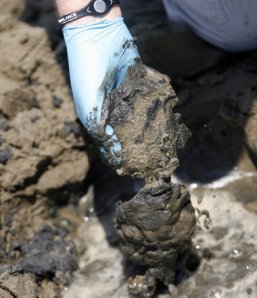 It’s been a year since the explosion of the Deepwater Horizon killed 11 people outright and destroyed an entire ecosystem. It’s the worst environmental catastrophe to ever hit the US. The US celebrates Earth Day on Friday, yet, I never hear one politician make hay over the “lessons of 4/20”. This is because policy makers refuse to learn the lessons. They’d rather sell oil and tainted seafood than deal with the real issues of the disaster.
Most of the coastline of Louisiana is still coated with oil either right in the marshes or just below the surface. The Oyster populations are way down. Dead Dolphins and Sea Turtles are washing up onto the beaches in record numbers. Where is the outrage? Where is the move to seek justice? Where are the calls about what we’re going to leave to our children?
No one who could make this right is carrying the banner to do so. Thousands of small businesses that rely on the Gulf are still hurting and going under. Those that are hurting include people who fish, oyster, shrimp, and run services businesses that support other businesses or tourist trade. It’s an ongoing tragedy and one that’s been ignored for the most part. The Times Picayune editorial staff and even Republican Politicians in the area who are obsessed with drilling for oil and the oil industry here aren’t shying away from pointing fingers and blame. BP is doing the same half-assed job of cleaning up that they did of drilling on the Deepwater Horizon. There is no justice and no peace down here on the Gulf. Real people are dying and local economies are going under. There has been more guffaw in Washington DC over defunding Planned Parenthood than making things right for people impacted by the BP Oil Gusher. Just ask Congressman Markey who has tried endlessly to pass bills to make it right and hasn’t got one through yet.
The oil lurking just under the soil in the marshes of Pass a Loutre Wildlife Management Area is a testament to that. The area was thick with roseau cane a year ago, Wildlife and Fisheries Secretary Robert Barham told reporters this week. “It was a thick, luscious, green tropical marsh,” he said. Now it is “weathered, stressed, unhealthy.”
The shoreline has visibly retreated in the past year, shrinking several yards from where the water line had been marked in the days after the spill. That is discouraging to Louisianians and ought to worry all Americans, given the importance of our coastal wetlands to the creation of fish and other marine life.
The state created the Pass a Loutre Wildlife Management Area nearly 100 years ago, and it has been an important refuge for migratory birds. Now, the state is using air cannons to keep the birds away from the oily marshes.
This is just one spot on the Gulf Coast that is still suffering from the massive amount of oil that spilled from BP’s well last spring and summer.
In some locations, we are losing 5 feet of marshes and shore line a day. Deep Horizon oil is everywhere and making things much worse. All you have to do is talk to the people that live in the affected areas like Grand Isle or Plaquemines Parish or Barataria Bay to see and hear about oil oozing along the coastline.
The noise of the cannons, combined with the swish and flash of metallic strips flapping from poles above the cane, are designed to keep birds from settling into the oily area.
“This is the very terminal end of the Mississippi Flyway,” said Todd Baker, biology program manager for Wildlife & Fisheries. “You get a wide variety of birds, waterfowl, neotropical migrants, raptors, all of them. When they come through, this is the first piece of land they see. When they leave, this is the last place they rest up before they jump across the Gulf of Mexico.
“The hazing cannons are not foolproof,” Baker said, as a Louisiana red-winged blackbird chirped from atop a cane stalk a few yards away.
About 15 miles away as the birds fly — or 30 by boat — Graves used a shovel and his hands to dig about a foot beneath the surface of a spit of sandy beach at the end of South Pass, turning over black-stained sand that smelled like diesel.
Here’s some testimony from people whose health has been impacted by working on the clean-up. There will probably be lots more of them in the coming months in years.
What does it say about a government that will not make right injustices done to so many people for the benefit of a profit-seeking company? What does it say that our media only shows up to report this story on anniversary days? How do we explain to our children that we no longer have an entire lifestyle or set of animals and birds or group of human beings because oil is more important than anything?
The silence of Congress is deafening and deadly. They’ve been more concerned with gutting the EPA than learning the lessons from this deadly oilspill and its omnipresent aftermath. Shame on them and every one else who has forgotten their fellow Americans and the country they profess to love. This is killing people and it’s killing our land. We should be talking about the lessons of 4/20 daily. Instead, we’re just learning how much more Congress loves their donors than the people they are supposed to represent. It’s a damn shame.
Welcome to the Results of TransOcean’s Record Safety Year
Posted: April 7, 2011 Filed under: Gulf Oil Spill | Tags: Aged Oil, BP, Dophin Deaths, Gulf Oil Spill, Oil still in the Gulf, Transocean 28 Comments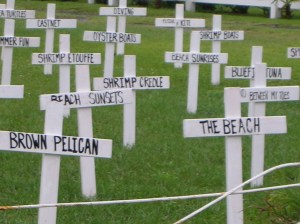 Republicans are busy today with their attempts to dismantle the EPA because, after all, they stop businesses from doing so much business, right? No reason told businesses back, is there? Those paragons of job creation and responsibility are just drowning in EPA regulation. Meanwhile, dead dolphins, drowning in BP oil continue to wash ashore down here in Louisiana. Ask me why I haven’t eaten anything from the Gulf for months now. Aren’t you glad Transocean had the best safety year evah?
The National Oceanic and Atmospheric Administration says that eight months after the Deepwater Horizon oil well was capped, dolphins are washing ashore in east Louisiana with some oil from that spilled on their bodies.
Spokeswoman Kim Amendola says the dolphins had spots of weathered oil.
Blair Mase — NOAA’s Gulf Coast stranding coordinator — emphasizes there’s no way yet to know why the dolphins died. She says the most recent dolphin bearing BP oil was found two weeks ago.
Mase says 15 dolphins with confirmed or suspected oil on their bodies washed ashore since the spill began last April — and eight had oil from that well, which was capped July 15.
I thought we got told that little miracle microbes ate it all. Get the feeling NOAA is covering up stuff again?
Related News:
Feds forbid scientists probing Gulf dolphin deaths from speaking to media
Dolphins accidentally drowned by scientists trawling in Gulf
The National Oceanic and Atmospheric Administration says federal scientists trawling for fish to test for possible damage from last year’s Gulf of Mexico oil spill accidentally caught and drowned three dolphins.
Spokeswoman Connie Barclay says the pantropical spotted dolphins were caught Wednesday by scientists on the NOAA research ship Pisces, which works out of Pascagoula, Miss.
She said Friday that NOAA is reviewing the incident and will conduct an enforcement investigation.
Here we go again x3: Oil Spills 3, New Drilling Permits 4
Posted: March 23, 2011 Filed under: Environmental Protection, Gulf Oil Spill | Tags: BP, deep water drilling, drilling permits, ecosystem restoration, Gulf Of Mexico, oil spills, wetlands 12 Comments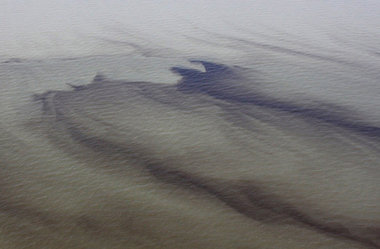 I just got a tweet from the National Wildlife Federation (NWF). This comes days after complaints that the government isn’t approving Gulf drilling permits quick enough. I should also mention that the Obama Administration has approved the fourth deep-water drilling permit since the BP oil gusher approximately one year ago. So, here’s information from the NWF where they are tracking THREE separate incidents in the Gulf right now.
At this point, we’re following what are likely three different incidents in the Gulf:
- Oil coming ashore west of the mouth of the Mississippi River near Grand Isle
- Reports of possible oil east of the mouth of the Mississippi in Chandeleur Sound
- A large amount of sediment mixed with a small amount of oil at the mouth of the Mississippi
The Times Picayune reports on the first oil occurring near beleaguered Grand Isle, LA and a Houston company has accepted responsibility for that one. TP also reports on the second oil sighting near the Chandeleur islands. That’s a picture of it at the top of the thread.
Coast Guard Petty Officer Steve Leeman said the Coast Guard had received no reports of oil-like material east of the river, but a group of environmentalists, engineers and scientists flew over Chandeleur Sound on Monday and Tuesday, and shared photographs and detailed descriptions with The Times-Picayune showing black, streaky plumes over a 20-mile stretch from just east of Quarantine Bay to just west of the shoal remains of Curlew Island.
While the oil industry whines it’s not getting to drill quickly enough, it’s becoming evident that their record of maintaining and inspecting existing rigs is pretty pathetic. Also, we’ve seen no push by the administration or any one in Congress to implement the recommendations of the National Commission on the Deepwater Horizon Oil Spill. Furthermore, BP is not living up to its obligations to deal with its damage to the wetlands done by the Deepwater Horizon Oil Spill. Louisiana’s congressional delegation has asked BP for $15 million to restore oyster beds and fisheries. Louisiana is ponying up $12 million of state funds to begin some kind of effort. BP is still supposedly cleaning up the damage still but has no projects active to restore wetlands.
BP set up the GCRO to deal with the spill. On Tuesday, the GCRO opened up its New Orleans office, in an effort to show they are still working on the oil spill.
“BP’s Gulf Coast Restoration Organization is really centered on four things,” Utsler said. “The first and foremost is continuing the completion of this response.”
Dan Favre is with the environmental advocacy “Gulf Restoration Network.” The group has a similar name to BP’s GCRO, but with a totally different take on the response.
“Unfortunately, the response is clearly lacking,” Favre said. “We’re coming up on the one-year memorial mark of the beginning of BP’s disaster here in the Gulf. And so it’s just crazy that there hasn’t been any action to actually start to repair the damage that’s been done.”
That is true, in part. BP set aside hundreds of millions of dollars for their restoration organization, but a year after the spill, only one of their restoration projects is so far underway.
“One of those is already in progress in Mississippi, in terms of wetland restoration,” Utsler said. “Other projects are in discussion in readiness for being approved and agreed to with NRDA [Natural Resource Damage Assessment] trustees, the states and ourselves to conduct.”
However, none of those projects is currently underway in Louisiana — arguably the state hardest hit by the spill. Utsler said they are working on a list of projects, with pending approval. Yet, some environmental groups believe the federal government needs to step in to move the restoration along.
“I don’t think we can leave it to BP to do it on their own accord,” Favre said. “I want to see Congress and the administration actually make BP pay for Gulf ecosystem restoration, by levying the maximum fines and penalties under the Clean Water Act and then allocating those resources directly to environmental restoration in the Gulf.”
It seems somewhat premature to allow these businesses continued access to drilling in the Gulf when they obviously haven’t maintained the rigs, inspected rigs for problems, and shown signs of good faith following damage to the ecosystem and people living in the Gulf. I think the administration should ask for implementation of the recommendations before allowing any more new permits. We also need to look for patterns of abuse so that operators with bad records are not allowed new permits. That’s just one shrimp lover’s opinion. But then, there’s Michelle Bachmann that wants to do away with the EPA and she’s a congress critter. Newt Gingrich–oil industry suck-up extraordinaire wants that too. I just want my seafood and vacations in warm Gulf Waters to be safe again.
Oh, and honk if you’ve seen or read any of this on MSM from the village.

 peej
peej Carissa
 bostonboomer
 dakinikat
 ecocatwoman
 jjlo
jjlo mablue2
 Mama Lopez
 peggysue22
 quixote
 skydancingguestblogger
 Mona (aka Wonk the Vote)





Recent Comments