Russian artist Alexander Sokht, Between books and cats
Today’s top stories:
Trump’s war on Canada escalated yesterday as he ordered 50 percent tariffs on Canadian goods. Canadian Prime Minister Mark Carney called his bluff, and the tariffs have taken effect for now.
Trump’s war on the free press also escalated Friday, after Whiskey Pete Hegseth fired the editor and publisher of Stars and Stripes because of their coverage of the dire conditions on the carrier S.S. Lincoln and their criticism of the Pentagon’s interference in their coverage.
Trump is threatening Iran with economic sanctions and Iran is threatening a “devastating response.” Iran also responded to Trump’s claim that the Strait of Hormuz is a “U.S. territory.”
ICE is getting a new weapon to use against immigrants and citizens who get in the way of their fascist attacks: shock gloves.
The disaster in Indiana is still going on after massive storms, flooding, and power outages.
The Trump administration’s latest round of tariffs against billions of dollars worth of Canadian goods took effect just after midnight Saturday, after the two countries failed to seal a last-minute trade deal that satisfied both sides.
Prime Minister Mark Carney said Ottawa would retaliate “dollar for dollar” after the White House delivered on its threat to impose crushing 50 per cent tariffs on a wide range of products. The two governments’ trade representatives said they had come close to finalizing an agreement in recent days, but Carney said Ottawa ultimately couldn’t accept the terms on the table.
“I have decided to suspend trade negotiations with the U.S. and have directed Canada’s negotiators to return to Ottawa,” the prime minister said in a statement.
“They have worked hard, in good faith, to defend the interests of Canadians throughout these negotiations up until the very last minute. However, last-minute changes in the U.S. proposed terms were unfair, uneconomic, and called into question the reliability of any deal.” [….]
In his own statement, U.S. Trade Representative Jamieson Greer said talks crumbled because Canada didn’t accept the agreement the administration had offered.
“Tonight, Canada declined to finalize the trade deal under the terms agreed earlier this week, despite the U.S. offer to Canada to receive the best treatment of any major exporter to our market, new demands and walk backs of other commitments by Canada have upended the careful balance reached in the past days,” Greer said in a statement.
“In addition, Canada is continuing to maintain its prolonged retaliation against the United States, including, among other things, flat out prohibitions on certain American goods and services.”
Now we wait for Trump to TACO (Trump Always Chickens Out), likely right before the stock market opens on Monday.
Crucial trade talks between the United States and Canada to stave off punishing new tariffs by the Trump administration on Canadian goods collapsed late Friday, with Canada saying it would retaliate “dollar for dollar.”
Prime Minister Mark Carney of Canada said he had decided to suspend the talks because the American side had introduced last-minute terms that were “unfair, uneconomic, and called into question the reliability of any deal.”
By Merle Keller
He added that the talks, which had been going on for weeks and had intensified in the past few days, had marked important progress but had ultimately “not been enough to meet our objectives for Canadians.”
United States Trade Representative Jamieson Greer told reporters that Canada had walked away from the negotiating table, minutes before a deadline ushering in new 50 percent tariffs by the Trump administration on a broad range of Canadian goods.
“Tonight, Canada declined to finalize the trade deal under the terms agreed earlier this week, despite the U.S. offer to Canada to receive the best treatment of any major exporter to our market,” Mr. Greer said on a virtual briefing with the press.
“New demands and walk backs of other commitments by Canada have upended the careful balance reached in the past days,” Mr. Greer added.
Shortly before Mr. Greer’s statement to the press, U.S. Customs and Border Protection sent out guidance for importers saying that the Canadian products that the president had identified would face tariffs after 12:01 a.m.
Use the gift link to read more if you’re interested. I still expect Trump to TACO.
Pete Hegseth’s Pentagon on Friday fired the publisher and editor of the independent military news outlet Stars and Stripes for “insubordination.”
Long-time publisher Max Lederer and Editor-in-Chief Erik Slavin were given “separation notices” that allow five days to appeal the decision, CBS News reports. Reporter Lara Korte announced on social media that she had also been fired.
Korte and Slavin traced the decision back to interviews they did that aired on CBS Sunday Morning in July.
“According to the notice, I am being fired for stating in a CBS interview that censorship of news for service members would constitute a red line. The Pentagon’s public affairs office has charged me with insubordination,” Slavin told CBS.
“I stand by the principle that Stars and Stripes must remain editorially independent, as required by law and by the department’s own policies.” [….]
Portrait of Kolya with a Cat, by Arkady Plastov
“It’s a shame for the institution and service members, who swore to defend the Constitution and deserve the right to a free and independent press,” Korte wrote in a series of posts about her firing.
Although the newspaper operates within the Department of Defense, it is legally mandated by Congress to remain editorially independent.
Lederer had announced on Wednesday his intention to step down from the post he’s held since 2007, since his opinions on how to run the media organization differed in “fundamental ways” to the Pentagon’s plans for Stars and Stripes, the newspaper reported.
“I think the right step is for me to step down, get out of the way, and let different leadership step in and continue to make this, the great organization that it is, even better,” he said.
Lederer was slated to finish up his tenure on Sept. 30, but now both he and his editor-in-chief have been turfed out.
The move comes after President Donald Trump, Hegseth, and other military leaders downplayed reporting on dire conditions aboard the USS Abraham Lincoln reported by families of service members.
The Pentagon on Friday fired the editor-in-chief of Stars and Stripes and a top reporter for insubordination after they spoke publicly against any interference by the Defense Department in the military news outlet that has a long history of editorial independence. It was the latest move by an administration that has grown increasingly aggressive toward the news media.
Erik Slavin, editor-in-chief of the military newspaper that is partly funded by the Pentagon, told The Associated Press he was dismissed for insubordination after an interview he gave that objected to potential censorship by the U.S. military. He received a notice of separation, as did publisher Max Lederer — who had just announced his upcoming retirement — and Middle East reporter Lara Korte, Slavin said.
Slavin said he was being fired “for stating in a CBS interview that hypothetical censorship of news for service members would constitute a red line.” Korte participated in the same interview.
“I stand by the principle that Stars and Stripes must remain editorially independent, as required by law and by the department’s own policies,” Slavin said.
Grocery shelves have been empty for days. Children who had just started school haven’t seen their classrooms in more than a week. Insulin has spoiled in warm refrigerators, and people who depend on oxygen cannot pump it from their tanks.
Electricity has been out for 10 days throughout much of Gary, Ind., since deadly storms ripped through, knocking down trees and power lines. On Friday, residents said they were growing increasingly desperate, even as another round of rain was on the way.
Lecture en fauteuil rouge, by French artist Flora Merleau
“Every day I’m crying,” Renita Theus, 41, said outside her darkened apartment, where her car remained trapped under a fallen tree. “It’s hot in the house. I toss and turn and can’t sleep. I walked to the dollar store and they’re all out of candles and batteries.”
Storms on Aug. 11 caused flooding and havoc throughout the Chicago area and neighboring northern Indiana, hitting Gary, where one-third of residents live in poverty, especially hard. More than a week later, the regional power company said its crews were working tirelessly to restore electricity but were overwhelmed by unprecedented levels of damage.
The utility, Northern Indiana Public Service Co., said on Friday that 43,400 of its customers remain without power in the region, down from more than 300,000 in the storm’s immediate aftermath. Service is expected to be restored to Gary by Tuesday, the company said, calling it a “monumental undertaking.”
On Friday, Gov. Mike Braun said that he had requested an expedited major disaster declaration from the Federal Emergency Management Agency that would allow more assistance to pour into the state. Last week, President Trump granted an emergency declaration for Indiana counties affected by the disaster, and a state relief fund is providing emergency aid grants of as much as $5,000.
“I will do everything in my power to ensure Hoosiers have the resources needed to recover,” said Mr. Braun, a Republican.
Local officials warned that cleanup would likely take months.
“It’s just widespread devastation throughout the city of Gary,” said Larry E. Tillman, the chief of the fire department.
Use the gift link to read more if you’re interested. So far, Trump has said nothing publicly about this disaster. I guess he’s too busy with his building projects.
That’s all I have for today. Take care everyone!
Did you like this post? Please share it with your friends:
I’m still recovering from whatever flu virus hit me last weekend. I do have my voice back and I’m coughing a bit less so I’m beginning to catch up with reading this and that. I stayed in bed with hot tea and a marathon of “Drunk History” while trying to figure out if the noise I was hearing last night was gunfire or fireworks. I have no idea what the mix of one to the other was. That’s one of those things that keeps me indoors on NY’s Eve because I really don’t want to be the one out there gathering the data. Most folks try not to think about about it.
One of the things that always amazes me is how vulnerable people are to wishful thinking and things easily demonstrated to be complete bullshit. I suppose I suffer the hubris of the scholar on this account. I didn’t have access to the internet in my home until 1980 but you generally could find me in whichever library housed the government documents drop. Yes, the University of Nebraska libraries had huge basements dedicated to the stuff at one time and I was a basement dweller. Now it’s all on spreadsheets on my hard drive. It really doesn’t take much to figure out what is what. However, everything experiences variation and intellect and curiosity are no different.
I guess the same thing that makes folks vulnerable to religion also makes them vulnerable to political myth. My first experience with all the ploy to keep people well-behaved and hopeful was as a child when I learned my parents were deliberately lying to me about Santa Claus for my sister’s sake. I later studied 3rd and 4th century Roman history and lost religion. It’s basically the same MO but with much better data. But the Santa episode really sunk in. I went to the basement, screamed at myself for being so stupid then wondered what else they’d been lying to me about. Well, it turned out that it was about a lot of things that I could easily find out about in my handy dandy local library’s reference section. I’ve spent my professional and personal life gleaning through data looking for truths. I hate being taken in.
We’ve all been stumped about why Donald Trump could gain ground in any national level political race. He says things that are blatantly hateful and false, yet he gains ground. Polls showing his demographics illustrate his base. It’s basically the ugly underbelly of the US that shows up in our history quite frequently. These folks love being taken in.
Donald Trump holds a dominant position in national polls in the Republican race in no small part because he is extremely strong among people on the periphery of the G.O.P. coalition.
He is strongest among Republicans who are less affluent, less educated and less likely to turn out to vote. His very best voters are self-identified Republicans who nonetheless are registered as Democrats. It’s a coalition that’s concentrated in the South, Appalachia and the industrial North, according to data provided to The Upshot by Civis Analytics, a Democratic data firm.
Mr. Trump’s huge advantage among these groups poses a challenge for his campaign, because it may not have the turnout operation necessary to mobilize irregular voters
The Civis estimates are based on interviews with more than 11,000 Republican-leaning respondents since August. The large sample, combined with statistical modeling techniques, presents the most detailed examination yet of the contours of Mr. Trump’s unusual coalition.
We’ve seen this set of nutcases before. It appears to be the return of the Reagan coalition. This turns my mind back to the Santa Claus story, and for that matter, any particular dead religious figure you can conjure up that people have turned into something not quite like the original narrative. Ronald Reagan was an affable fool. Any economist that has studied the time period and his policies will tell you a completely different, data-based narrative than most of the people taken in by him. BB sent me this link a few days ago. I’ve only been able to really digest it today.
Any of us that have intensely studied some aspect of his regime–in my case the economic data–know that the myth is no where close to the truth. These narratives always seem to serve the current group of rich, powerful, assholes. It doesn’t matter if you’re told to submit yourself to your husband or master or render unto Rome, it’s pretty much the same thing. These so-called populist heroes lead sheep to slaughter.
Ronald Reagan was not only intellectually ungifted, he was incurious and ignorant about the details of the day. It’s amazing to me that as historians go back and sift through their form of data on the ground, so little of it manages to take down the public id. The link to Salon takes you to an excerpt from “The American President: From Teddy Roosevelt to Bill Clinton” by WILLIAM LEUCHTENBURG whose thesis on Reagan is summed up thusily: “No one ever entered the White House so grossily ill-informed”. This says a lot given he was followed relatively shortly by Dubya Bush who didn’t even appear to have a command of his primary language let alone nuanced policy. Remember, Dubya’s the guy that declared war on a lot of Muslim-majority countries without a real grasp of the difference between Sunni and Shia let alone the minority ones.
No one had ever entered the White House so grossly ill informed. At presidential news conferences, especially in his first year, Ronald Reagan embarrassed himself. On one occasion, asked why he advocated putting missiles in vulnerable places, he responded, his face registering bewilderment, “I don’t know but what maybe you haven’t gotten into the area that I’m going to turn over to the secretary of defense.” Frequently, he knew nothing about events that had been headlined in the morning newspaper. In 1984, when asked a question he should have fielded easily, Reagan looked befuddled, and his wife had to step in to rescue him. “Doing everything we can,” she whispered. “Doing everything we can,” the president echoed. To be sure, his detractors sometimes exaggerated his ignorance. The publication of his radio addresses of the 1950s revealed a considerable command of facts, though in a narrow range. But nothing suggested profundity. “You could walk through Ronald Reagan’s deepest thoughts,” a California legislator said, “and not get your ankles wet.”
In all fields of public affairs—from diplomacy to the economy—the president stunned Washington policymakers by how little basic information he commanded. His mind, said the well-disposed Peggy Noonan, was “barren terrain.” Speaking of one far-ranging discussion on the MX missile, the Indiana congressman Lee Hamilton, an authority on national defense, reported, “Reagan’s only contribution throughout the entire hour and a half was to interrupt somewhere at midpoint to tell us he’d watched a movie the night before, and he gave us the plot from War Games.” The president “cut ribbons and made speeches. He did these things beautifully,” Congressman Jim Wright of Texas acknowledged. “But he never knew frijoles from pralines about the substantive facts of issues.” Some thought him to be not only ignorant but, in the word of a former CIA director, “stupid.” Clark Clifford called the president an “amiable dunce,” and the usually restrained columnist David Broder wrote, “The task of watering the arid desert between Reagan’s ears is a challenging one for his aides.”
I actually was convinced that Reagan was so obviously ignorant and wrong about so many things that you could run any one against him and he’d never get a second term. I was obviously young and not jaded enough to grasp the demographic that supported him because they believed what they wanted to believe because he told them so in such a “nice” way. Now, this same group of yahoos is angry and they believe what Donald Trump tells them because they believe what they want to believe because he tells them in such an “angry” way. ‘Morning in America’ does sound an awful lot like ‘Make America Great Again’ doesn’t it? All of this is basically code for ‘Save White Privilege’ even if I don’t really benefit that much from it. As long you as you can make me feel superior to (fill in the blank), I’ll wishfully hope and then vote for you.
I try to tell myself that there’s no way that Donald Trump could ever be elected but then I would not be learning from my obviously wrong hypothesis that Ronald Reagan could ever get a second term. Reagan raised taxes. He ran up the deficit hugely. There’s the Reagan “recession” and there was Iran Contra which all of these folks conveniently never heard about or forgot when they voted for the affable buffoon. The same demographic could care less about Trump’s lies and the tremendous internet base of fact checking.
“This is the first time we have named someone the ‘King of Whoppers,'” Eugene Kiely of FactCheck.org said.
Donald Trump earned that crown with the biggest whopper of 2015:
“I watched in Jersey City, New Jersey, where thousands and thousands of people were cheering as that building was coming down,” he said in a Birmingham, Alabama, rally in November 21.
The fact checkers found evidence of just a few people celebrating. But that wasn’t the only tall Trump tale of the year.
“He’s certainly keeping us busy… It is the worst that we have seen in the 12 years we have been doing this,” Kiely said.
“You know, the president’s thinking about signing an executive order where he wants to take your guns away,” Trump said at a South Carolina rally on October 19.
Then in New Hampshire, on September 30: “You know, it started off with 10,000. The other day I heard 200,000. We are going to take in 200,000 Syrians or wherever they come from,” Trump said.
“It’s just way over what the actual number is,” Kiely explains.
“It appears that Donald Trump, a pathological liar, simply cannot control himself. He lies, lies and lies again. Today, he repeated his lie that I want to raise taxes to 90 percent. Totally untrue. And PolitiFact gave Trump’s same statement last October a ‘Pants-on-Fire’ rating.
Bush talked to CNN on Wednesday and reinforced his point from the debate that Trump is “not a serious candidate.”
“I got to post up against Donald Trump,” Bush said. “I don’t think he’s a serious candidate.”
He added, “And I don’t know why others don’t feel compelled to point that out, but I did. And I think I got a chance to express my views and compare them to someone who talks a big game but really hasn’t thought it through.”
Didn’t we say all this about a gawky rogue presidential candidate named Barack Obama? Sure. But Obama had the advantage of not looking and sounding like a complete fucking idiot. Obama was on the Harvard Law Review, not the Santa Fe Community College football team. Then again, that’s not really fair to community collegians and football players: Plenty of each are smart enough to run the country. It just so happens that Rubio isn’t one of them.
For proof, simply look to Rubio’s campaign message, a bizarre simulacrum of “hope and change” focus-grouped by Red Stripe-swilling blue blazers who are slightly scared of hope and change because they’ve witnessed its power but never fully understood its appeal, like those crouched simians sizing up the galactic monolith in 2001.
This scares me. It should scare you.
I will also admit that I didn’t think Obama was going to be as good of a President as he has turned out to be. I really thought he’d continue to let the Republicans play him like a violin, but he learned, and learned well. His last few years defy the lame duck theory.
So, I’m doing a mea culpa on the two failed hypotheses today just because I do not want to be lulled into a third one. We clearly have one great candidate that is experienced, flawed, and capable. Then, we have a set of figures that look religiously mythical, are supported by people who have a lot to gain from populist ignorance, and appear to be impossibly unqualified for making national policy on all levels. They may have one area upon which they are knowledgeable but most have absolutely nothing but being able to say blatantly wrong things because they have no clue how wrong they actually are.
Work in the right campaigns and vote in 2016. Don’t make me write another mea culpa in 2017. Please.
What’s on your reading and blogging list today?
And, have a great NEW YEAR!!! I love you all!!!
Thirty years ago from 1985 and deep from Reagan d0o d0o land.
Did you like this post? Please share it with your friends:
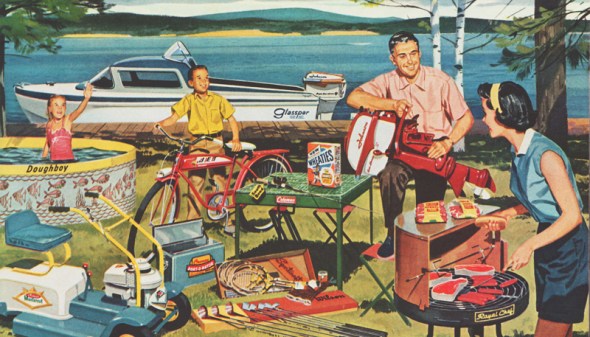
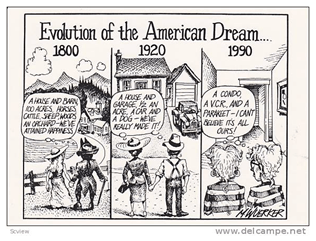
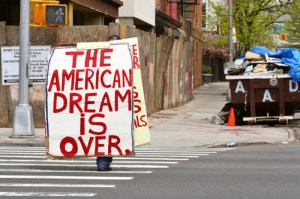
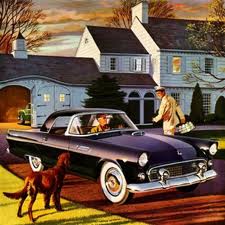
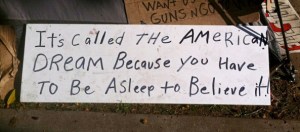
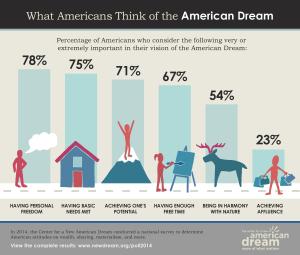
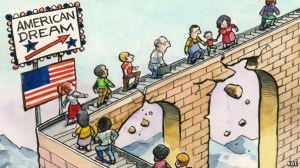
What is the American Dream? Is it prosperity for everyone? Is it access to nature and a clean environment? Is it a good job, a house, a family? Is it a good education and the chance to be upwardly mobile? Is it a better future for your children and grandchildren? Is whatever it once was dead? Is it even worth talking about?
This morning there’s a Washington Post op-ed in which Elizabeth Warren and Bill de Blasio describe their vision of “How to revive the American Dream.”
In this land of big dreams, there was never a dream bigger or more important than the one so deeply rooted in our values that it became known as the American Dream. Across generations, Americans shared the belief that hard work would bring opportunity and a better life. America wasn’t perfect, but we invested in our kids and put in place policies to build a strong middle class.
We don’t do that anymore, and the result is clear: The rich get richer, while everyone else falls behind. The game is rigged, and the people who rigged it want it to stay that way. They claim that if we act to improve the economic well-being of hard-working Americans — whether by increasing the minimum wage, reining in lawbreakers on Wall Street or doing practically anything else — we will threaten economic growth.
Warren and de Blasio are correct that the dream went terribly wrong after Ronald Reagan became president.
When the economy works for everyone, consumers have money to spend at businesses, and when businesses have more customers, they build more factories, hire more workers and sell more products — and the economy grows. For decades, our economy was built around this core understanding. We made big investments in the things that would create opportunities for everyone: public schools and universities; roads and bridges and power grids; research that spurred new industries, technologies — and jobs — here in the United States. We supported strong unions that pushed for better wages and working conditions, seeing those unions improve lives both for their members and for workers everywhere.
And it worked. From the 1930s to the late 1970s, as gross domestic product went up, wages increased more or less across the board. As the economic pie got bigger, pretty much everyone was getting a little more. That was how the United States built a great middle class.
Then in the early 1980s, a new theory swept the country. Its disciples claimed that if government policies took care of the rich and powerful, wealth would trickle down for everyone else. Trickle-down believers cut taxes sharply for those at the top and pushed for “deregulation” that hobbled the cops on Wall Street and let the most powerful corporations far too often do as they pleased.
All very true. But how do we return to fairness and prosperity for everyone, not just the wealthy few? Warren and de Blasio offer a familiar list of government policies that could turn things around–read them at the link–but they don’t explain how to accomplish these goals in the age of Citizens United, a Republican-controlled congress, and a Supreme Court that favors the rights of corporations over those of individuals. How do we get past the hopelessness and inertia and get Americans to get out and vote for candidates who will stand up for the bottom 99%? How do we even find those candidates?
Don’t get me wrong. I’m basically an optimist and I always have hope for change. But how do we get there from here?
I do think there are some positives signs.
Hillary Clinton is beginning to convince some folks that she’s really a separate person from her husband–a more liberal candidate than he was in the 1990s. In fact Bill Clinton might be more liberal now too. Despite what the Villagers preach, people can change and grow and develop new ideas an opinions. Imagine that Chris Cillizza!
For all the noise about e-mails and honoraria, and all the passive-aggressive nostalgia for the Great Penis Chase of the 1990’s, something very interesting has been going on with Rodham Clinton’s campaign since she announced its official launch….
All during her husband’s administration, HRC was considered to be the more progressive of the two. She supported the accommodations he made to get re-elected, some of which were pretty damned ghastly. She also was one of the most vocal in defense of that administration against the organized ratfking that sought to destroy it. (The only mistake she made, as Calvin Trillin pointed out at the time was that she referred to a “vast right-wing conspiracy” rather than a creepy little cabal.) I once had a long conversation with a former Clinton lawyer. He told me that, if there were 1000 people in a room, and 999 thought Bill Clinton was a direct descendant of Jesus Christ, and one of them thought he was the spawn of Satan, Clinton would seek out that one person and spend the rest of the night and all the following day trying to change that person’s mind. That is not something anyone ever has said about Ms. Rodham Clinton. The edges of her triangulations are all sharp ones.
All of this is to point out that not only is the whole “two for the price of one” trope beloved of people whose politics came of age in the 1990’s outdated and inadequate, but so is the political strategy of the first Clinton Administration. Clinton herself seems to be acknowledging this political reality. She started talking on economics like Elizabeth Warren. Her speech on criminal justice reform was aimed at excesses many of which have roots in her husband’s law-and-order compromises in the mid-1990’s. (So, it should be noted, do many of the Patriot Act’s more controversial provisions.) For the moment, I choose to believe this is not merely a bow to political expedience, but something genuine and, if progressives are smart, infinitely exploitable.
Most of them will never get it, but maybe, just maybe Hillary can get her message out to the people who count–voters–and get them fired up enough to go to the polls in November 2016.
I also think it’s a good sign that Bernie Sanders has decided to run for president. No, he has no chance in hell of getting the nomination, but he might be able to get the media to publicize some of his ideas. He could also be a foil for Hillary, giving her an opportunity to draw attention to her more innovative and liberal ideas. Some of the latest news about Bernie’s efforts:
Sanders is a funhouse mirror image of Clinton. She has universal name recognition (by her first name), unlimited funds, national campaign experience and a powerhouse political operation. He has scant name recognition, paltry funds, no national campaign experience and hasn’t begun to build a campaign staff. With a net-worth ranking among the lowest in the Senate, Sanders can be an authentic populist — the real deal. As one supporter said, he is the candidate of the “12-hour filibuster and the $12 haircut.”
Sanders’s announcement was treated with respect by a press corps eager for any kind of race on the Democratic side. Pundits dismiss his chances in part because Clinton is expected to raise a billion dollars or more for her campaign. Sanders hopes to raise $50 million.
But Sanders is likely to do far more than exceed low expectations. His candidacy could have a dramatic effect in building an already growing populist movement inside and outside the Democratic Party.
As Sanders made clear in his announcement, his focus will be on the central challenges facing this country: an economy that does not work for the vast majority of its citizens and a politics corrupted by big money and entrenched interests.
Sanders refuses to take part in politicians’ usual, incessant pursuit of large donations. So he is a political rarity: Someone free to speak forcefully to the often insidious connection between the two.
Finally, conservatives have a real socialist to go crazy about. Instead of concocting dark fairytales about how Barack Obama, a very conventional liberal Democrat, is a secret Marxist who wants to destroy the American way of life, they can shriek about Bernie Sanders, the independent Vermont senator who has never shied away from the socialist label.
Sanders is now the first person to challenge Hillary Rodham Clinton in the race to win the 2016 Democratic Party presidential nomination. Clinton, though, is not his real adversary, Sanders says. He refuses to make disparaging comments about Clinton and insists he has never run an attack ad in any campaign and will not do so against her. Sanders wants to take on the billionaires, not Hillary.
Nobody gives the 73-year-old Sanders a chance of stopping the Clinton political juggernaut, but some think he could make it veer to the left. If the Vermonter gets traction in debates and primaries with his unabashedly progressive positions, Clinton might be forced to match at least some of his rhetoric. Would that be a bad thing for Democrats? Not if enough beleaguered middle class voters get a chance to consider what Sanders’ version of “socialism” entails and like what they see.
Go to the LA Times link to read Horsey’s list of Sanders’ ideas that could interest voters.
With the help of a crew of former aides to President Barack Obama, Sen. Bernie Sanders’ (I-Vt.) campaign has raised $3 million in four days for his presidential campaign — a dramatic indication that he won’t be confined simply to a long-shot role in the Democratic primary.
Sanders, who is running for president as a Democrat, announced on Wednesday that he has retained the services of the firm Revolution Messaging to run digital ads and online fundraising. The staffers with the firm who will be working on Sanders’ campaign include Revolution Messaging’s founder, Scott Goodstein, who ran the 2008 Obama campaign’s social media and mobile programs; Arun Chaudhary, who was the first official White House videographer; Shauna Daly, who served as deputy research director on Obama’s 2008 campaign; and Walker Hamilton, who was a lead programmer for that campaign.
“Like a lot of Obama supporters, we were looking for a candidate with a track record of doing the right thing — even if it meant taking on Wall Street billionaires and other powerful interests. A candidate who could inspire a movement,” said Goodstein. “Bernie Sanders is that candidate.”
Due to his long-standing criticism of the influence of big-money interests on government, Sanders has strong online and grassroots appeal, which he hopes to leverage to raise the money needed to fund a presidential campaign. And so far, the strategy looks savvy. The campaign has received roughly 75,000 contributions, and the average amount is $43. According to a campaign adviser, 99.4 percent of the donations have been $250 or less, and 185,000 supporters have signed up on the website BernieSanders.com.
Not bad.
What do you think? What does the American Dream represent for you?
As always, this is an open thread. Post your thoughts and links on any topic in the comment thread and have a terrific Thursday!
Did you like this post? Please share it with your friends:
I thought I’d try to get off the topic of the midterm elections specifically and get on to some general things about why the U.S. Political System seems so completely screwed up right now. What exactly has led us to the point where the Republicans seem to be a combination of the John Birch Society and Theocrats and the Democratic Party sits idly by and twiddles its thumbs hoping the process works like it used to?
The second significance of this election has been the debasement of debate to a level of vulgarity, misinformation and ignorance that, while not unprecedented in American political history, certainly attained new depths and extent.
This disastrous state of affairs is the product of two Supreme Court decisions and before that, of the repeal under the Reagan Administration, of the provision in the Federal Communications Act of 1934, stipulating the public service obligations of radio (and subsequently, of television) broadcasters in exchange for the government’s concession to them of free use in their businesses of the public airways.
These rules required broadcasters to provide “public interest” programming, including the coverage of electoral campaigns for public office and the independent examination of public issues. The termination of these requirements made possible the wave of demagogic and partisan right-wing “talk radio” that since has plagued American broadcasting and muddied American electoral politics.
Those readers old enough to remember the radio and early television broadcasting of pre-Reagan America will recall the non-partisan news reports and summaries provided by the national networks and by local stations in the United States. There were, of course, popular news commentators professing strong or idiosyncratic views as well, but the industry assured that a variety of responsible opinions were expressed, and that blatant falsehood was banned or corrected.
The two Supreme Court decisions were “Buckley v. Valeo” in 1976 and “Citizens United v. the Federal Election Commission” in 2010. Jointly, they have transformed the nature of the American political campaign, and indeed the nature of American national politics. This resulted from the nature and characteristics of mass communications in the United States and the fact that broadcasting has from the beginning been all but totally a commercial undertaking (unlike the state broadcasters in Canada and Britain, and nearly all of Europe).
The two decisions turned political contests into competitions in campaign advertising expenditure on television and radio. The election just ended caused every American linked to the internet to be bombarded by thousands (or what seemed tens of thousands) of political messages pleading for campaign money and listing the enormous (naturally) sums pouring into the coffers of the enemy.
Previously the American campaign first concerned the candidate and the nature of his or her political platform. Friends and supporters could, of course, contribute to campaign funds and expenditures, but these contributions were limited by law in scale and nature. No overt connection was allowed between businesses or industries and major political candidates, since this would have implied that the candidate represented “special interests” rather than the general interest.
The Citizens United v. Federal Election Commission verdict is well known and remains highly controversial since it rendered impossible the imposition of legal limits on political campaign spending, ruling that electoral spending is an exercise in constitutionally-protected free speech. Moreover, it adjudged commercial corporations as legal citizens, in electoral matters the equivalent of persons.
Don’t think Citizens United made a difference for the GOP in Tuesday’s midterms? The plaintiff in the landmark Supreme Court case thinks so.
“Citizens United, our Supreme Court case, leveled the playing field, and we’re very proud of the impact that had in last night’s election,” said David Bossie, chairman of the conservative advocacy organization.
He complained that Democratic lawmakers were trying to “gut the First Amendment” with their proposed constitutional amendment to overturn the 2010 ruling, reported Right Wing Watch, which allowed corporations to pour cash into campaigns without disclosing their contributions.
Bossie said this so-called “dark money” was crucial to Republicans gaining control of the U.S. Senate and strengthening their grip on the U.S. House of Representatives.
“A robust conversation, which is what a level playing field allows, really creates an opportunity for the American people to get information and make good decisions,” Bossie said.
Voters across the country trying to cast votes in Tuesday’s elections ran into hurdles erected by Republican legislatures, governors and secretaries of state. Along with mechanical glitches and human error — which occurred in states with leaders on both sides of the political spectrum — voters faced new laws and policies that made it harder to vote.
In the presidential election year of 2016, it looks unlikely that those problems will subside — especially if Congress fails to restore the Voting Rights Act. The two states that had the closest vote tallies in the last presidential election — Florida and Ohio — will go into the presidential election year with Republicans controlling the offices of governor and secretary of state and holding majorities in their state legislatures.
Two influential elections for voting rights also took place in states unlikely to be presidential swing states. Kansas Secretary of State Kris Kobach, a national ringleader for advocates of restrictive voting laws, won reelection. In Arizona, which has been working with Kansas to defend their states’ respective tough voting requirements, Republican candidate Michele Reagan also won her contest.
This fall, Democrats ran like they were afraid of losing. Consider the issues that most Democrats think really matter: Climate change, which a United Nations report just warned will have “severe, pervasive and irreversible impacts” across the globe. The expansion of Medicaid, so millions of poor families have health coverage. Our immoral and incoherent immigration system. Our epidemic of gun violence, which produces a mini-Sandy Hook every few weeks. The rigging of America’s political and economic system by the 1 percent.
For the most part, Democratic candidates shied away from these issues because they were too controversial. Instead they stuck to topics that were safe, familiar, and broadly popular: the minimum wage, outsourcing, and the “war on women.” The result, for the most part, was homogenized, inauthentic, forgettable campaigns. Think about the Democrats who ran in contested seats Tuesday night: Grimes, Nunn, Hagan, Pryor, Hagan, Shaheen, Landrieu, Braley, Udall, Begich, Warner. During the entire campaign, did a single one of them have what Joe Klein once called a “Turnip Day moment”—a bold, spontaneous outbreak of genuine conviction? Did a single one unfetter himself or herself from the consultants and take a political risk to support something he or she passionately believed was right?
I’m not claiming that such displays would have changed the outcome. Given President Obama’s unpopularity, Democratic victories, especially in red states, may have been impossible.
But there is a crucial lesson here for 2016. In recent years, some Democrats have convinced themselves they can turn out African Americans, Latinos, single women, the poor, and the young merely by employing fancy computer systems and exploiting Republican extremism. But technologically, Republicans are catching up, and they’re getting shrewder about blunting, or at least masking, the harshness of their views.
We saw the consequences on Tuesday. According to exit polls, voters under 30 constituted only 13 percent of the electorate, down from 19 percent in 2012. In Florida, the Latino share of the electorate dropped from 17 to 13 percent. In North Carolina, the African-American share dropped from 23 to 21 percent.
If Hillary Clinton wants to reverse those numbers, she’s going to have to inspire people—people who, more than their Republican counterparts, are inclined toward disconnection and despair. And her gender alone won’t be enough. She lost to Obama in 2008 in part because she could not overcome her penchant for ultra-cautious, hyper-sanitized, consultant-speak. Yet on the stump this year, she was as deadening as the candidates she campaigned for. As Molly Ball put it in September, “Everywhere Hillary Clinton goes, a thousand cameras follow. Then she opens her mouth, and nothing happens.”
A day after the election, officials are still counting ballots and the investigation into who made robocalls that allegedly persuaded many judges not to show up Tuesday is heating up.
Two former Republican committeemen are telling 2 Investigator Pam Zekman they were removed because they objected to those tactics.
Judges of election are appointed by their respective parties and they look at a judge’s primary voting records as part of the vetting process. But in these cases the former committeemen we talked to said that vetting crossed a line when judges were told who they had to vote for in the Tuesdays’ election.
One says it happened at a temporary campaign headquarters at 8140 S. Western Ave, which we’ve confirmed it was rented by the Republican Party where election judges reported they were falsely told they had to appear for additional training.
And a former 7th ward committeewoman says she witnessed the same thing at 511. E. 79th Street campaign workers calling judges to come in for additional training. She says there wasn’t any training.
“They were calling election judges, telling them to come in so they could get specific orders to vote for the Republican Party,” said Charon Bryson.
She says she is a Republican but objected to the tactic used on the judges.
“They should not be be pressured or coerced into voting for someone to get a job, or to get an appointment,” said Bryson.
Bryson says she thinks it is like “buying a vote.”
“If you don’t vote Republican you will not be an Republican judge, which pays $170,” she said.
The Board of Elections is now investigating whether calls to judges assigned citywide resulted in a shortage that infuriated the mayor.
“What happened with the robocalls was intentional. As far as we can tell somebody got a list, a list with names and numbers, called them, not to educate, not to promote the democratic process, but to sew confusion,” Emanuel said.
Scared by polls that show that people do not want Republican policies and by changes in demographics, Republicans have been pulling out the stops to turn back the tide. However, none of these fundamentals seem to be driving voting trends or turnout. WTF is wrong with people? As a member of the White Women Constituency who seem to be one of the groups that continues to vote against their own interest, I can agree that we should all get our acts together now. Nowhere was this more evident than in the Wendy Davis campaign.
Once more, with feeling: Greg Abbott and the Republican Party did not win women. They won white women. Time and time again, people of color have stood up for reproductive rights, for affordable health care, for immigrant communities while white folks vote a straight “I got mine” party ticket—even when they haven’t, really, gotten theirs.
The trend is echoed in national politics; we saw it play out across the country last night. To be sure, there are many factors that contributed to America’s rightward dive over the cliff: In a post-Citizens United electoral landscape, racist gerrymandering and voter ID laws appear to have had their intended effects of dividing and disenfranchising already marginalized voters.
But there’s another factor at play that Democrats fail to grapple with, and the Republican Party capitalizes on, time and time again: the historical crisis of empathy in the white community, one much older than gerrymandered congressional districts or poll taxes.
Let’s talk about what a vote for Wendy Davis meant: It meant a vote for strong public school funding, for Texas Medicaid expansion, for affordable family planning care, for environmental reforms, for access to a full spectrum of reproductive health-care options.
On the flip side, a vote for Greg Abbott meant a vote for the status quo, for empowering big industry and big political donors, for cutting public school funds and dismantling the Affordable Care Act, for overturning Roe v. Wade.
White women chose Greg Abbott Tuesday night. We did not choose empathy. Texas has been red for two decades. We do not choose empathy. We choose the fact that our children will always have access to education, that our daughters will always be able to fly to California or New York for abortion care, that our mothers will always be able to get that crucial Pap smear.
We chose a future where maternal mortality—but not our maternal mortality—rates will rise. We chose a future where preventable deaths from cervical cancer—but not our deaths—will rise. We chose a future where deaths from illegal, back-alley abortions—but not our illegal, back-alley abortions—will rise. We chose ourselves, and only ourselves.
Is white privilege such an enticing thing to us that we’ll sell ourselves out just to protect what scraps we’re thrown?
Sure, these two guys were a little nutty to begin with, but now they’ve gone around the bend.
First up: Have you seen the latest drivel from Robert J. Samuelson? Seriously, even the Washington Post should be ashamed to publish this guy. Get this — Samuelson says that sequestration is John F. Kennedy’s fault!
How so?
Fifty years ago, President Kennedy made a decision that, with hindsight, ranks as the biggest mistake of domestic policy since World War II. In many ways, it led directly to today’s “sequester” debacle.
Good Grief! What’s he talking about? The Bay of Pigs? The Cuban missile crisis?
No silly, President Kennedy decided to stimulate the economy.
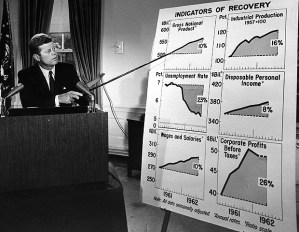
In early 1963, he proposed a $13.6 billion tax cut (today: about $320 billion) even though the economy was not in recession and the tax cut would enlarge the budget deficit. Kennedy adopted the theory that government could, by manipulating its budgets, increase economic growth, reach “full employment” (then a 4 percent unemployment rate) and reduce — or eliminate — recessions.
It was a disaster.
High inflation was the first shock. An initial boom (by 1969, unemployment was 3.5 percent) spawned a wage-price spiral. With government seeming to guarantee 4 percent unemployment, workers and businesses had little reason to restrain wages and prices. In 1960, inflation was 1 percent; by 1980, it was 13 percent. The economy became less stable. From 1969 to 1982, there were four recessions, as the Federal Reserve alternated between trying to push unemployment down and prevent inflation from going up. Only in the early 1980s did the Fed, under Paul Volcker and with Ronald Reagan’s support, crush inflationary psychology.
A disaster? Really? I was a kid in the 1960s. The economy was great in those days–until 1973, those were the best economic times I’ve experienced in my lifetime. Unemployment was low, wages were good, people like my parents were movin’ on up to the middle class. But don’t take it from me–let’s see what an actual economist has to say about this. Here’s Dean Baker at the Center for Economic Policy Research (CEPR):
Samuelson’s economic history is even more striking than the linking of Kennedy to the sequester. He notes the fiscal stimulus that was sparked by the Kennedy tax cuts (and the Vietnam War and Johnson’s Great Society programs) and the boom that resulted, and tells us that “it was a disaster.”
….
Before looking at Samuelson’s horror story here, it is worth noting what happened in the boom, which can be treated as going through 1973, in spite of the recession in 1969. Growth over the 10 years from 1963 to 1973 averaged 4.4 percent, by far the most rapid stretch in the post-World War II era.
The unemployment rate hovered near 4.0 percent for most of this period, as Samuelson complains. This led to large gains in real wages and sharp declines in poverty. The overall poverty rate fell from 19.5 percent in 1963 percent to 11.1 percent in 1973, an all-time low. For African Americans the poverty rate fell from 55.1 percent in 1959 (annual data is not available) to 31.4 percent in 1973. I suspect most folks wouldn’t mind a few more disasters like this one.
As far as the recession story, Samuelson might have told readers that we had the same number of recessions in the 13 years following 1969 as we did in the 12 years preceding 1961. I suppose those recessions were also due to the Kennedy tax cut.
There’s lots more at both links. But you have to read Samuelson’s column to believe it. He goes on to claim that because of JFK’s tax cut, we developed “the loss of budgetary discipline,” and we’re still suffering from that 50 years later. So how does he rationalize the deficit spending under Reagan and W. Bush? He doesn’t.
And over at The New York Times, Iraq War propagandist Bill Keller disagrees with Samuelson: he thinks sequestration is “Obama’s Fault.” And of course he’s still droning on about “entitlements.” Keller admits that both parties agreed on the sequestration cuts, but it’s still really Obama’s fault because he hasn’t completely destroyed the safety net yet. And here’s the best part: Obama refuses to enact Simpson Bowles.
In December 2010 the commission, led by Erskine Bowles and Alan Simpson, delivered its list of spending cuts and revenue increases, plus the entitlement reforms necessary to fortify Medicare and Social Security for the surge of baby-boom retirees.
The Simpson-Bowles agenda was imperfect, and had plenty to offend ideologues of the left and right, which meant that it was the very manifestation of what Obama likes to call “a balanced approach.”
Ummm…no, Bill, the Commission never issued a report. They couldn’t agree on a unified agenda, so Simpson and Bowles wrote up their own report which was never approved by the commission members.
Now here’s where Keller really goes off the rails:
If Obama had campaigned on some version of Simpson-Bowles rather than on poll-tested tax hikes alone, he could now claim a mandate from voters to do something big and bold. Most important, he would have some leverage with members of his own base who don’t want to touch Medicare even to save it. This was missed opportunity No. 1.
That’s really funny. If Obama had campaigned on Simpson-Bowles, Mitt Romney would be president now. Because if you campaign on really really unpopular issues, people have a tendency to like, not vote for you.
There’s much more at the link, but you get the idea.
Did you like this post? Please share it with your friends:
The Sky Dancing banner headline uses a snippet from a work by artist Tashi Mannox called 'Rainbow Study'. The work is described as a" study of typical Tibetan rainbow clouds, that feature in Thanka painting, temple decoration and silk brocades". dakinikat was immediately drawn to the image when trying to find stylized Tibetan Clouds to represent Sky Dancing. It is probably because Tashi's practice is similar to her own. His updated take on the clouds that fill the collection of traditional thankas is quite special.
You can find his work at his website by clicking on his logo below. He is also a calligraphy artist that uses important vajrayana syllables. We encourage you to visit his on line studio.









 peej
peej Carissa
 bostonboomer
 dakinikat
 ecocatwoman
 jjlo
jjlo mablue2
 Mama Lopez
 peggysue22
 quixote
 skydancingguestblogger
 Mona (aka Wonk the Vote)



 Sky Dancing
Recent Comments