It looks like some of us will be getting another stimulus check. Biden and Congressional Democrats aren’t fooling around. They are determined to inject some money into the economy, whether the Republicans like it or not. Also unhappy about it: Larry Summers, who has been wrong again and again, but still thinks he knows best and the usual “savvy” journalists.
The House gave final approval on Friday to a budget blueprint that included President Biden’s $1.9 trillion stimulus plan, advancing it over unanimous Republican opposition as Democrats pressed forward with plans to begin drafting the aid package next week and speed it through the House by the end of the month.
“Our work to crush the coronavirus and deliver relief to the American people is urgent and of the highest priority,” Speaker Nancy Pelosi wrote in a letter to Democrats shortly before the bill passed by a 219-to-209 margin.
President Biden, speaking just before the House acted, cited a weak jobs report in justifying the use of a procedural device, called reconciliation, to ram through the measure if Senate Republicans oppose his effort to speed aid to families, businesses, health care providers and local governments.
“It is very clear our economy is still in trouble,” Mr. Biden said during remarks at the White House — amping up the pressure on an upper chamber bracing for former President Donald J. Trump’s impeachment trial next week.
“I know some in Congress think we’ve already done enough to deal with the crisis in the country,” added Mr. Biden, who reiterated his commitment to fund $1,400 direct checks to low- and middle-income Americans. “That’s not what I see. I see enormous pain in this country. A lot of folks out of work. A lot of folks going hungry.” [….]
Hours earlier, as the sun rose over the Capitol dome, the Senate approved a fast-track budget measure, with Vice President Kamala Harris casting her first-ever tiebreaking vote after a grinding all-night session. The move, in theory, allows them to enact the package without any Republican votes.
Senate leaders could begin working on their own bill in hopes of delivering a final package to Mr. Biden’s desk before supplemental unemployment benefits are set to expire in mid-March.
Shirley Jackson, author of The Haunting of Hill House
Here’s the story. Late on Thursday, Summers published a ponderous op-ed in The Washington Post fretting that maybe the COVID relief package is too big. It might contain so much spending that it will push the economy above its potential full capacity, causing inflation and financial instability, he worried. Then the jokers at Politico’s Playbook newsletter (your best source for ill-disguised advertorials and tips on hiding political bribes) repeated his argument. Many “liberal wonks have been whispering about” Summers’ argument “for weeks,” worrying the package “could harm the economy next year, when Democrats will be defending narrow congressional majorities in the midterms,” they write. Politico claimed on Twitter that it was being circulated in the White House as well….
Let me first talk about the merits of the argument, because they shed light on the motivations here. In brief, these worries about “overshooting” the stimulus are completely ridiculous. Jobs data released Friday show the economy is basically stalled out — with unemployment at 6.3 percent, and the fraction of prime-age workers who are employed four points below where it was before the pandemic (just barely above the bottom of the Great Recession), the U.S. is something like 10 million jobs in the hole.
Moreover, as economist Paul Krugman points out, the pandemic relief package is mostly not stimulus per se — it is more aimed at keeping the economy on ice until everyone can be vaccinated. The boost to unemployment insurance and aid to state and local governments, for instance, will partly go unspent if we hit full employment rapidly. Indeed, we may need another round of real stimulus once the vaccines are out. And even if we were somehow to hit full capacity and inflation starts to spike, the Federal Reserve can easily raise interest rates to compensate — a fact Summers bizarrely skates over by limply suggesting they might not for some reason.
Economist Larry Summers has been the kingpin of every economic calamity Democrats have weathered over the last three decades. But Barack Obama’s National Economic Council chair during the Great Recession finds himself as persona non grata this week after penning an op-ed undermining the $1.9 trillion COVID relief package President Joe Biden is trying to push through Congress.
Summers’ treatise spread from wonk to wonk in the White House with the contagion of a venereal disease—and was about as well-received. One aide characterized the response as “widespread disagreement.” White House economists had already been booked for media hits to discuss the January jobs report, airtime that permitted many administration voices to rebuke Summers in unison. “The president and the administration have a lot of respect for Professor Summers, but we disagree here,” Bharat Ramamurti, a deputy NEC director, told CBS Radio. Jared Bernstein, a progressive labor economist and member of Biden’s Council of Economic Advisors who served alongside Summers in the Obama administration, was less polite. “I think he’s wrong,” Bernstein told CNN on Friday morning. “I think he’s wrong in a pretty profound way.”
Daphne Du Maurier, author of Rebecca
Summers’ piece suggested that the proposed $1.9 trillion was far more than the economy required, pointing to a recent analysis from the Congressional Budget Office that suggested the amount is three times larger than the hole it needs to fill. But he also argued against it on political grounds: Passing such a massive relief bill would test the political tolerance for the jobs and infrastructure package Biden has promised to follow, even though poll after poll has shown broad bipartisan support among voters for Biden’s first proposal. Summers called that pending plan the “nation’s highest priority” as he raised concerns about the federal deficit—a factor Democrats have mostly purged from consideration in moments of economic crisis.
Summers also took jabs from Senate Democrats, who have almost uniformly backed the size of the White House’s proposal. During a meeting of Senate chiefs of staff on Friday morning, an aide to Senate Majority Leader Chuck Schumer (D-N.Y.) thanked everyone for maintaining the party line, acknowledging that some of their bosses believed the package was either too much or not enough, according to a source familiar with the meeting. “And then there’s Larry Summers,” the aide said, “who can’t decide if we’re doing too much or not enough—but knows that, whatever we’re doing, is wrong.”
President Biden said on Friday that he would bar his predecessor, Donald J. Trump, from receiving intelligence briefings traditionally given to former presidents, saying that Mr. Trump could not be trusted because of his “erratic behavior” even before the Jan. 6 attack on the Capitol.
The move was the first time that a former president had been cut out of the briefings, which are provided partly as a courtesy and partly for the moments when a sitting president reaches out for advice. Currently, the briefings are offered on a regular basis to Jimmy Carter, Bill Clinton, George W. Bush and Barack Obama.
Mr. Biden, speaking to Norah O’Donnell of CBS News, said Mr. Trump’s behavior worried him “unrelated to the insurrection” that gave rise to the second impeachment of Mr. Trump.
“I just think that there is no need for him to have the intelligence briefings,” Mr. Biden said.
“What value is giving him an intelligence briefing?” Mr. Biden added. “What impact does he have at all, other than the fact he might slip and say something?”
Angela Carter, author of The Bloody Chamber and Nights at the Circus
Trump’s second impeachment trial is scheduled to begin on Tuesday, but we still don’t know much about how it will be conducted. Here’s an explainer from the Associated Press, but as far as I can tell we still don’t know what the rules will be or whether there will be witnesses. It does seem clear that Democratic impeachment managers will introduce highly emotional descriptions of the events of January 6 and their effects on members of Congress. Also from the AP: Trump impeachment trial confronts memories of Capitol siege.
The impeachment trial of Donald Trump is more than an effort to convict the former president of inciting an insurrection. It’s a chance for a public accounting and remembrance of the worst attack on the U.S. Capitol in 200 years.
In the month since the Jan. 6 siege by a pro-Trump mob, encouraged by his call to “fight like hell” to overturn the election, defenders of the former president say it’s time to move on.
Trump is long gone, ensconced at his Mar-a-Lago club, and Democrat Joe Biden is the new president in the White House. With the trial set to begin Tuesday, and a supermajority of senators unlikely to convict him on the single charge, the question arises: Why bother?
Yet for many lawmakers who were witnesses, onlookers and survivors of that bloody day, it’s not over.
One by one, lawmakers have begun sharing personal accounts of their experiences of that harrowing afternoon. Some were in the Capitol fleeing for safety, while others watched in disbelief from adjacent offices. They tell of hiding behind doors, arming themselves with office supplies and fearing for their lives as the rioters stalked the halls, pursued political leaders and trashed the domed icon of democracy.
“I never imagined what was coming,” said Rep. Mark Takano, D-Calif., recounted in a speech on the House floor.
Memory is a powerful tool, and their remembrances, alongside the impeachment proceedings, will preserve a public record of the attack for the Congressional Record. Five people died and more than 100 people have been arrested in a nationwide FBI roundup of alleged ringleaders and participants, a dragnet unlike many in recent times. While that is sufficient for some, assured the perpetrators will be brought to justice, others say the trial will force Congress, and the country, to consider accountability.
Patricia Highsmith, author of The Talented Mr. Ripley and Strangers on a Train
A clear indication that Marjorie Taylor Greene was more than a dabbler in QAnon was her 2018 endorsement of “Frazzledrip,” one of the most grotesque tendrils of the movement’s mythology. You “have to go down a number of rabbit holes to get that far,” said Mike Rothschild, whose book about QAnon, “The Storm Is Upon Us,” comes out later this year.
The lurid fantasy of Frazzledrip refers to an imaginary video said to show Hillary Clinton and her former aide, Huma Abedin, assaulting and disfiguring a young girl, and drinking her blood. It holds that several cops saw the video, and Clinton had them killed….
Contemplating Frazzledrip, it occurred to me that QAnon is the obscene apotheosis of three decades of Clinton demonization. It’s other things as well, including a repurposed version of the old anti-Semitic blood libel, which accused Jews of using the blood of Christian children in their rituals, and a cult lusting for mass public executions. According to the F.B.I., it’s a domestic terror threat.
But QAnon is also the terminal stage of the national derangement over Clinton that began as soon as she entered public life. “It’s my belief that QAnon really took off because it was based on Hillary Clinton,” said Rothschild. “It was based specifically on something that a lot of 4chan dwellers wanted to see happen, which was Hillary Clinton arrested and sort of dragged away in chains.”
I was curious what Clinton thinks about all this, and it turns out she’s been thinking about it a lot. “For me, it does go back to my earliest days in national politics, when it became clear to me that there was a bit of a market in trafficking in the most outlandish accusations and wild stories concerning me, my family, people that we knew, people close to us,” she told me….
For Clinton, these supernatural smears are part of an old story. “This is rooted in ancient scapegoating of women, of doing everything to undermine women in the public arena, women with their own voices, women who speak up against power and the patriarchy,” she said. “This is a Salem Witch Trials line of argument against independent, outspoken, pushy women. And it began to metastasize around me.” In this sense, Frazzledrip is just a particularly disgusting version of misogynist hatred she’s always contended with.
Read the whole story at the NYT link.
That’s it for me today. What’s on your mind?
Did you like this post? Please share it with your friends:
Have you seen a list of headlines in the news lately and realized there are not two Americas, there are really lots of Americas but there do seem to be two sets of realities?
You can read about the struggling economy and lackluster jobs reports, or how the Biden Administration pushed through a budget bill including a Covid-19 rescue plan with the deciding vote caste by Kamala Harris, and just anything that seems regular goings on in a developed nation. That’s a total relief because if your an Indigenous American struggling to survive on a Reservation, or a Farmer in a hard hit middle of the country state, or any number of flavors of people struggling in big cities you can certainly breathe a sigh of relief to see things working in your direction.
You’re also seeing some clean up in aisle Congress and hoping some of this remaining Trump detritus goes away or at least has limited impact on those of us living in the reality of science and the warts of our democracy. This is certainly good news: House votes to remove Rep. Marjorie Taylor Greene from committee assignments.
1914 Man Balcony by Albert Gleizes
Or, you can continue down the rabbit hole and read what Trumpism has left us. It’s not going away. It’s festering and leaving us a group of people with a severe disconnect from the rest of us.
In March, even before the shutdowns, I had my staff look at the research we use for developing behavioral indicators of individuals who might mobilize to violence. If we go down this path of having to all stay home, does that increase stress factors? Does it increase risk factors known to be common in people who carry out attacks? The answer was yes.
You started hearing the anti-government conspiracies — which was totally predictable. Anybody who has spent any time in Republican or libertarian politics knows you’re going to have people unhappy about the government. That’s fine; you can predict that. The question then is that if you know that’s going to be a challenge, what can the government do to help individuals understand why it is issuing stay-at-home orders, why it’s necessary, why it’s legal and constitutional? If the government had done a better job at that, we would have seen slightly less anger, slightly less of that victim-persecution complex.
With the pandemic, you had what was perceived to be government overreach; you had social isolation, which is a known risk factor [for extremism]; you had some people with a lot more time on their hands because they were not commuting, not taking kids to ballgames and not going to happy hour after work; you had economic stress — another known risk factor — as people lost jobs or moved to part-time status; you had people who lost loved ones. There was this great sense that people had lost control; our lives as we knew them had been upended.
People who had a strong, healthy sense of self or community were able to mitigate their isolation. But for individuals already on the cusp, this made them vulnerable. We use that word, “vulnerable,” to describe people who are not necessarily radicalized yet, but have factors in their lives that make it easier for them to move on a pathway towards extreme radicalized thought — and then, for a smaller subset, mobilizes them to violence.
That’s what we saw in 2020. We saw any number of people spending more time online looking for answers. You had increases in militia movements. The Moonshot CVE Group, which studies radicalization, said that in states with stay-at-home orders that lasted 10 days or longer, [online] searches for white-supremacist content increased by 21 percent. In states where there either weren’t stay-at-home orders or they lasted nine days or fewer, that increase was only 1 percent. We weren’t sure how it was going to happen, but we predicted that we would see violence in some form or fashion. The militia that attempted to kidnap Michigan Gov. Gretchen Whitmer — that was horrible, but not really shocking. The violence at protests? Not surprising. And the fact that you had white-supremacist groups using the protests to commit accelerationist violence was also not surprising — even though the president thought it was Antifa. We knew we were going to see more radicalization and violence.
A December NPR/Ipsos poll found that 17% of adults believe that "a group of Satan-worshipping elites who run a child sex ring are trying to control our politics and media" while 37% said they didn't know whether the baseless allegation was true or not. https://t.co/d0A4uymwI4
That’s a fairly scary number of people believing something totally off-the-wall and easily disprovable. It seriously is improvisational reality building as labelled in this NPR interview with Travis View.
View has posted screenshots showing exchanges between QAnon supporters as they discuss their delusional beliefs.
“They come to their conclusion first,” View says. “They decide what makes them feel best and then they construct conspiracy theories that help them convince themselves why that’s true.”
“It’s really kind of like an improvisational reality building,” he continues. “They don’t look to the outside world to try and figure out what is true and what is not, and as a consequence, sometimes have to face harsh truths such as the electoral victory of Joe Biden.
Last year, QAnon spread into the mainstream. As president, Trump repeatedly retweeted accounts tied to QAnon. Newly elected Republican Reps. Marjorie Taylor Greene and Lauren Boebert have spoken openly in support of QAnon.
A star of the Republican Party widely seen as a potential future House speaker, Cheney has suddenly emerged as a vivid example of something completely different — a traditional Republican who may no longer have a home in a party dominated by Trump and the far right.
No matter that she voted with Trump more than 90 percent of the time, or that she occupies the lone Wyoming congressional seat that her father, the former vice president, held for 10 years. Few voters care that as the third-ranking Republican in the House she is well positioned to bring home federal spending.
In this city in the shadow of the Rocky Mountains, her reputation has boiled down to a simple question: whether she is for Trump or against Trump. And, as far as many people here are concerned, with her Jan. 13 impeachment vote, Cheney staked her claim.
Donald Trump is plotting a comeback revenge tour targeting GOP defectors after his Senate impeachment trial. Trump is talking with aides about a road trip to campaign against Republicans who supported his removal.
We may only have to hear about these things but I truly fear that the targets will need lifelong secret service protection should the events happen.
Dems need to kill the filibuster and pass election reforms—HR1 and HR4–to have a shot at keeping their trifecta but Trump going on a "revenge tour" against disloyal Repubs is certainly gonna help. https://t.co/YLxe6mwzu9
The former president is planning a nationwide speaking tour intended to target the 10 Republicans who backed his impeachment and any GOP senators who speak out against him at next week’s trial, reported Insider.
“I’m sure he wants to get out a roulette wheel with all their faces on it,” said one Republican who speaks to Trump.
However, the former president is waiting until the trial ends and seems to understand Americans needed a break from his antics.
“Even he recognizes that we have Trump fatigue,” said the Republican source. “Even he knows that you can get overexposed, and he wore the electorate out, and that was part of the problem. He clearly wore the country out with his behavior between the election and the inauguration.”
While Charles Koch and his late brother David have dominated Republican fundraising in recent decades, the Mercers’ recent strategic investments in far-right candidates bought them a disproportionate level of influence in the Republican Party before culminating in an effort to subvert the election that fueled the deadly Capitol siege.
“The Mercers laid the groundwork for the Trump revolution,” Bannon told The New Yorker in 2017. “Irrefutably, when you look at donors during the past four years, they have had the single biggest impact of anybody, including the Kochs.” Steve Schmidt, a former Republican strategist and co-founder of the anti-Trump Lincoln Project, sees it differently. Rebekah Mercer, he said in an interview with Salon, is the “chief financier or one of the chief financiers of the fascist movement, and that’s what it is.”
Hours after the pro-Trump mob stormed the Capitol, killing five people and injuring dozens of police officers in a futile bid to stop the counting of electoral votes, Hawley joined with top Mercer beneficiaries in objecting to the results to back Trump’s “big lie” that the election was somehow stolen. There was Sen. Ted Cruz, R-Texas, whose super PAC got $13.5 million from the Mercers during the 2016 presidential campaign — before the family dropped another $15.5 million to back Trump. There was House Minority Leader Kevin McCarthy, R-Calif., defending the majority of the GOP House caucus voting to overturn legal election results after his Congressional Leadership Fund received $1.5 million from the Mercers. And there was Rep. Mo Brooks, R-Ala., who received $21,600 from the Mercers before speaking at the rally that preceded the riot and objecting to the results. Brooks was later named by “Stop the Steal” organizer Ali Alexander as having helped orchestrate the event, though his office said he has “no recollection communicating in any way with whoever Ali Alexander is.”
Alexander himself may have benefited from the Mercers’ millions while working for the Black Conservative Fund, a small and mysterious group that received $60,000 from Robert Mercer in 2016. Though the group did not raise any money in 2020, it promoted the White House rally to tens of thousands of followers, according to CNBC.
So, that should give the FBI something to chew on for awhile.
Interior artwork from DC Universe Halloween Special 2009 vol. 1, Oct 2009 Art by Ibraim Roberson, pencils and inks, and Giovani Kososki, color
Abraham Lincoln has a lot of quotable phrases but the one that always sticks with me. The powerful warning was given in his House Divided speech and is a turn of phrase in several of the gospels.
“A house divided against itself cannot stand. I believe this government cannot endure, permanently, half slave and half free. I do not expect the Union to be dissolved — I do not expect the house to fall — but I do expect it will cease to be divided. It will become all one thing or all the other.”
The quote seems appropriate at this time but in a quite abstracted way. The abhorrent institution of slavery and the so-called “southern way of life” stood as the rebel cause then. It was not complete devoid of reality. It was just completely devoid of morality even though it stood firmly on a Bible pointing out all the folks that had slaves back then.
This moment seems like a product of much of the same with the twist of there now being a lot more interactive visuals and playthings for Death Cults with apocalyptical visions. How do you connect reality with bizzaro world?
So, anyway, we can at least breathe when we watch the regular news or catch a glimpse of the headlines for the most part. We have a break. But, we and the FBI and the National Security Department need to be vigilant because it seems we’re going to have an insurgency and eventually, it really will start getting very ugly on Main Streets everywhere.
And with that spirit I leave you with this WAPO Op Ed by Eugene Robinson.
Opinion: Bipartisanship is nice, but you can’t negotiate with fantasy and lies https://t.co/cOIOk13kCG
At the state level, the Republican Party is, if anything, even less tethered to reality. The Arizona state GOP actually censured former senator Jeff Flake and Cindy McCain, widow of the late senator John McCain, for failing to blindly support Trump. A few Republican governors, such as Jim Justice of West Virginia, are doing well in the vaccination phase of the pandemic. Others, such as Ron DeSantis of Florida, continue to put politics over public health.
Trump led the GOP’s base deep into the wilderness. Republican leadership in Washington lacks the skills and the guts to lead the party back to reality — and back to constructive participation in addressing the massive challenges we face. Don’t blame “both sides” for ruining the elegant, strategic, productive political competition we’d like to see. One party is trying to move the chess pieces. The other is trying to eat them.
What’s on your reading and blogging list today?
Did you like this post? Please share it with your friends:
I’ve never been a Joe Biden fan. Early on in the 2020 primaries, I even thought I might refuse to vote for him if he were the Democratic nominee. But as time went on, he grew on me. Now I think he probably is exactly what we needed. He’s a “normal” Democratic politician, he’s extremely knowledgeable and experienced in the ways of the Senate, and he comes across as a decent person. He’s the perfect antidote to Trump’s psychotic behavior, ignorance, and incompetence. And it turns out that most Americans support what Biden is doing as president.
WASHINGTON (AP) — Two weeks into a new administration, a majority of Americans say they have at least some confidence in President Joe Biden and his ability to manage the myriad crises facing the nation, including the raging coronavirus pandemic.
Overall, 61% approve of Biden’s handling of his job in his first days in office, according to a new poll from The Associated Press-NORC Center for Public Affairs Research. Though the bulk of Biden’s support is from fellow Democrats, about a quarter of Republicans say they approve of his early days in office.
Even at a moment of deep national divisions, those numbers suggest Biden, as with most of his recent predecessors, may enjoy something of a honeymoon period. Nearly all modern presidents have had approval ratings averaging 55% or higher over their first three months in office, according to Gallup polling. There was one exception: Donald Trump, whose approval rating never surpassed 50% in Gallup polls, even at the start of his presidency.
The Travelling Companions by Augustus Egg
Obviously Biden faces serious challenges, but so far the public as a whole is supportive.
Biden’s standing with the public will quickly face significant tests. He inherited from Trump a pandemic spiraling out of control, a sluggish rollout of crucial vaccines, deep economic uncertainty and the jarring fallout of the Jan. 6 riot on Capitol Hill. It’s a historic confluence of crises that historians have compared to what faced Abraham Lincoln on the eve of the Civil War or Franklin Delano Roosevelt in the depths of the Great Depression.
Biden’s advisers know that the new president will be quickly judged by Americans on his handling of the pandemic, which has killed more than 450,000 people in the U.S. He’s urgently pressing Congress to pass a $1.9 trillion relief package that would include funds for vaccine distribution, school reopening and state and local governments buckling under the strain of the pandemic.
“We have to go big, not small,” Biden told House Democrats on Tuesday. He’s signaled that he’s open to trimming his $1.9 trillion proposal but not as far as some Republicans are hoping. A group of GOP senators has put forward their own $618 billion package.
President Biden toldRepublican senators he has “an open door and an open mind” on his $1.9 trillion coronavirus plan. But he already has the votes, and overwhelming support in the country.
Why it matters: Well, power matters. And Biden holds all of it.
Get used to this. Democrats are gleeful as they watch the media fixate on family feuds inside the GOP, while Biden pushes out executive orders and pushes through this bill on his terms.
Biden embraces the reality that the two numbers that matter most to his presidency are coronavirus cases falling and economic growth rising.
Steve Ricchetti, counselor to the president and longtime Biden confidant, was in the Oval this week for meetings with Republican and Democratic senators, and told me that the president “reaffirmed and deepened his explanation and commitment on the numbers and the substance” of the full package.
Ricchetti said Biden made it clear that he welcomes “fine-tuning or amendments or recommendations,” but “underscored that he’s committed to his plan and to the elements he outlined” — and to moving quickly.
What we’re watching: Ricchetti said the president wants to have “a bipartisan and unifying dialogue in the country,” including conversations he’s already had with mayors and local elected officials, “so that this isn’t just about a dialogue with senators and members of Congress. It is a dialogue with the country.”
Ricchetti said Biden treated a GOP counterproposal “with an open mind and with respect. He was also honest … in underscoring why he proposed what he did — that he was committed to every one of the elements in his package.”
The bottom line: Democrats will dismiss any whining about Biden’s stimulus as D.C. noise or Republican hypocrisy. They’ll be right on both fronts.
The Railway, Edouard Manet, 1873
Meanwhile, Republicans are mired in a conflict over Q Anon Congresswoman Marjorie Taylor Gree Kevin McCarthy has to be the most pathetic GOP leader ever–even worse than Paul Ryan or John Boehner. Yesterday, Republicans met to discuss the futures of Greene, a complete crackpot, and Liz Cheney, a relatively normal mainstream Republican who had the guts to vote for Trump’s impeachment. Both women have survived so far.
House Republicans voted by a large margin Wednesday to allow Wyoming Representative Liz Cheney to stay on as the GOP conference chairwoman following an hours-long meeting where members aired their grievances over her vote to impeach former President Trump last month. Just 61 Republicans voted to remove Cheney from her post, while 145 voted for her to stay in a vote by secret ballot.
The vote came after Cheney told her Republican colleagues she would not apologize for her decision, according to a source familiar with the meeting. She later praised the result as a “terrific vote.”
“We’re not going to be in a situation where people can pick off any member of leadership,” she said after the meeting. “It was very resounding acknowledgment that we need to go forward together and then we need to go forward in a way that helps us beat back the really dangerous and negative Democrat policies.”
The extremist wing of the Republican Party has lived to fight another day. But G.O.P. leaders are in knots trying to prove that the party’s factions can all live in harmony.
But at a closed-door meeting yesterday, the party’s House delegation also voted overwhelmingly to keep Representative Liz Cheney — an anti-Trump, establishment figure who has drawn fire from the party’s right wing — in her spot as the No. 3 Republican in the chamber.
At the meeting, many House Republicans expressed dismay with Cheney for her vote to impeach Trump and her condemnation of his role in the Capitol riot on Jan. 6. Members of the far-right Freedom Caucus accused Cheney of “aiding the enemy” when she joined just nine other Republicans in voting to impeach Trump, according to people familiar with the discussion. But ultimately she held on to her leadership role easily.
McCarthy’s unwillingness to strip Greene of her appointments, as Democrats and many Republicans have called on him to do, indicates that the G.O.P. plans to address the division in its ranks through messaging more than disciplinary action, at least for now.
In his statement, McCarthy used strong and direct language to reject the conspiracy-minded views promulgated by Greene, but he effectively defended her right to have held them.
“Past comments from and endorsed by Marjorie Taylor Greene on school shootings, political violence, and anti-Semitic conspiracy theories do not represent the values or beliefs of the House Republican Conference,” McCarthy said. “I condemn those comments unequivocally.”
He said that he had met with her privately and explained “that as a member of Congress,” she would be held “to a higher standard than how she presented herself as a private citizen.”
Just a Couple of Girls by Harry Wilson Watrous, 1915
Conspiracist Rep. Marjorie Taylor Greene is far more popular than Rep. Liz Cheney among Americans who align with the Republican Party, according to a new Axios-SurveyMonkey poll.
Why it matters: As the House GOP caucus is being torn over calls to yank Cheney from congressional leadership for backing Donald Trump’s second impeachment, and strip Greene from committee assignments for her baseless conspiracy theories and violent rhetoric, these findings show how strongly Trumpism continues to define most Republicans.
House Minority Leader Kevin McCarthy is much more popular with Republicans than Senate Minority Leader Mitch McConnell, the survey finds.
By the numbers: McCarthy enjoys the highest favorable versus unfavorable ratings (net favorability) of the four among Republicans, at 38%-16% (+22); followed by Greene, at 28%-18% (+10); McConnell, at 31%-46% (-15); and Cheney, at 14%-42% (-28).
Greene is the least well known of the four, with 51% of Republicans and Republican leaners saying they don’t know enough to say whether their impression is favorable or not. Respondents have the most fully formed views of McConnell.
Republican respondents are three times as likely to say their views align with Greene than with Cheney, but nearly one-third say they don’t align with either, and half say they don’t know enough to say.
Republican respondents who voted for Trump in November gave McCarthy a high net favorable rating (+31) and McConnell a high net unfavorable rating (-18).
The intrigue: People who identify with Greene are disproportionately likely to have lost faith in democracy or believe despite evidence that voter fraud is rampant in their state.
The House will vote Thursday on a measure to remove Republican Rep. Marjorie Taylor Greene from her committee assignments, a decisive step that comes in the wake of recently unearthed incendiary and violent past statements from the congresswoman that have triggered widespread backlash from Democrats and divided congressional Republicans.
House Democrats, who control the chamber, set up the vote after first attempting to pressure Republicans to strip the Georgia Republican of committee assignments on their own. House Republicans have not taken that action, however, and House GOP leader Kevin McCarthy on Wednesday released a statement calling the push by Democrats to take away the congresswoman’s committee assignments a “partisan power grab.”
The measure the House will take up calls for Greene to be removed from the House Education and Labor Committee and the Budget Committee “in light of conduct she has exhibited.”
The move could set a risky precedent as Democrats target a sitting member of the opposing party in Congress over views expressed prior to her serving as an elected official — one that has the potential to someday be used against the party by Republicans.
Interesting stories to check out today:
Young Woman Reading an Illustrated Journal, Pierre-Auguste Renoir, c. 1880
It has been quiet around here lately. I know I’ve been feeling overwhelmed, and I’m probably not alone. I’m realizing that Trump culture isn’t going to just magically go away. But I do hope you’ll check in and leave a comment or link when you can. We miss you when we don’t hear from you!
Did you like this post? Please share it with your friends:
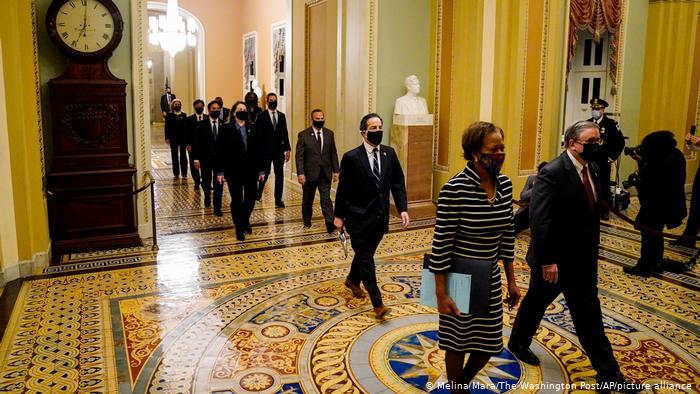
Clerk of the House Cheryl Johnson along with acting House Sergeant-at-Arms Tim Blodgett lead the Democratic House impeachment managers as they walk through the Capitol Hill
What we’re hearing: The notoriously stingy former president and his lead lawyer, Butch Bowers, wrangled over compensation during a series of tense phone calls, sources familiar with their conversations said. The argument came even though Trump has raised over $170 million from the public that could be used on his legal defenses.
The two initially agreed Bowers would be paid $250,000 for his individual services, a figure that “delighted” Trump, one of the sources said.
However, Trump didn’t realize Bowers hadn’t included additional expenses — including more lawyers, researchers and other legal fees that would be accrued on the job.
He was said to be livid when Bowers came back to him with a total budget of $3 million. Trump called the South Carolina attorney and eventually negotiated him down to $1 million.
All of this infuriated Trump and his political team, who think the case will be straightforward, given 45 Republican senators already voted to dismiss the trial on the basis it’s unconstitutional to convict a former president on impeachment charges.
Trump’s political arm also was planning to pay separately for audiovisuals, a rapid-response team and legislative liaison.
In the end, the money dispute added to frustrations Bowers and the other lawyers felt about whether the former president’s claims of election fraud should be central to their arguments.
Castor was the district attorney of Montgomery County, Pennsylvania, from 2002 to 2008. In 2005, Castor declined to prosecute Bill Cosby when he was charged with sexually assaulting Andrea Constand. Castor said at the time that “insufficient, credible and admissible evidence exists upon which any charge against Mr. Cosby could be sustained beyond a reasonable doubt,” The Washington Post reported.
Years later, after more than four dozen women had accused Cosby of sexual crimes, Castor said he’d verbally offered Cosby an immunity deal in which he declined to prosecute him in criminal court to ensure that Constand would be able to sue him in civil court.
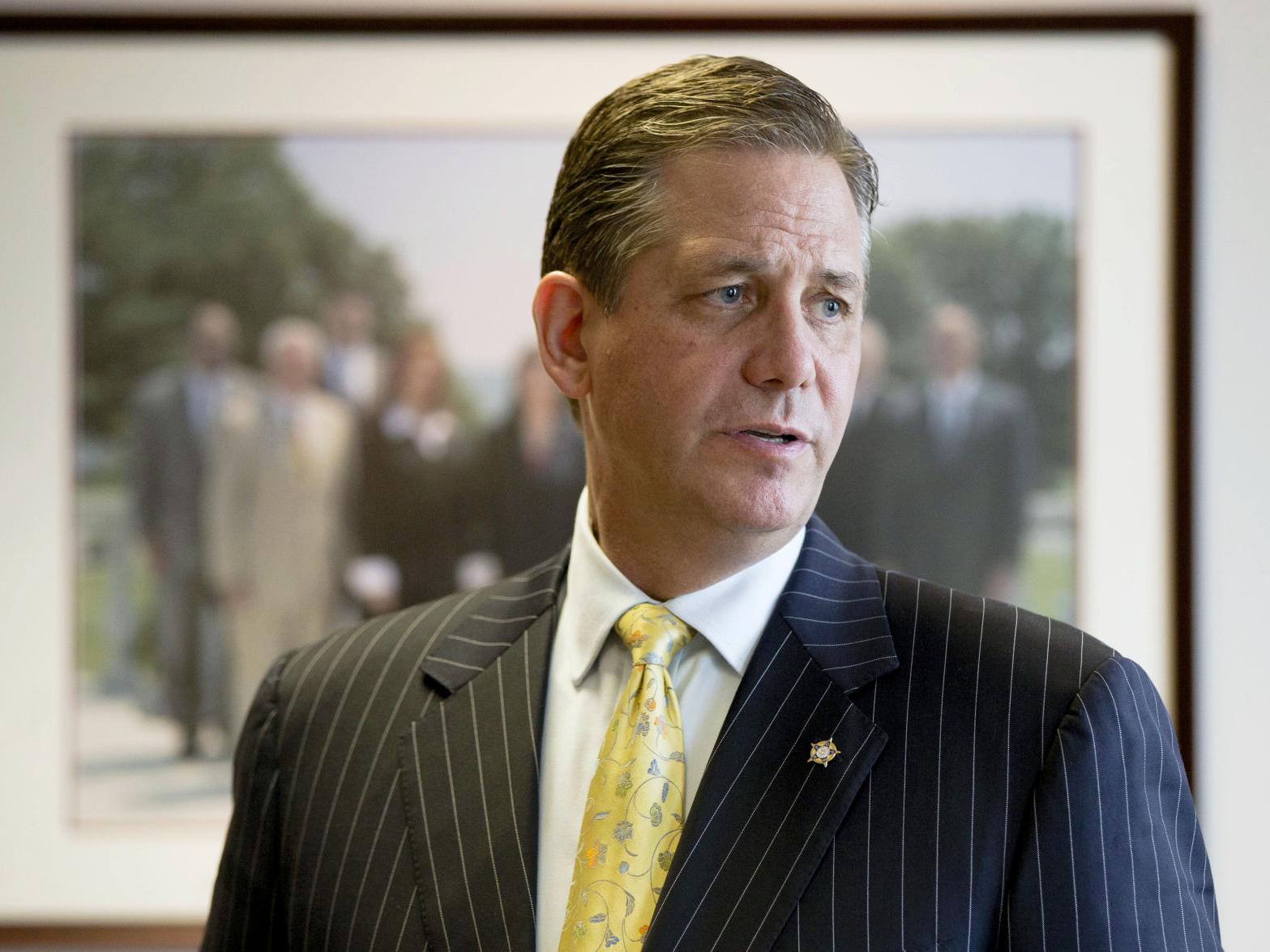
Bruce Castor Jr.
His handling of the Cosby case is widely believed to be responsible for the failure of his reelection bid in 2015….
David Schoen, a criminal-defense lawyer in Atlanta, was a part of the Trump ally Roger Stone’s defense team during his trial on charges of witness tampering, obstructing an official proceeding, and making false statements related to the special counsel Robert Mueller’s Russia investigation.
Schoen also met with the convicted sex offender Jeffrey Epstein in the days before Epstein’s death in August 2019. Schoen has claimed that Epstein’s death was not actually a suicide.
Those two sound perfect for Trump. I wonder if he’s paying them?
Former President Donald Trump’s legal team are expected to use an argument at his impeachment trial next week that is already supported by the majority of Senate Republicans in charge of his fate: That the trial is unconstitutional because Trump is no longer the commander in chief….
While Trump’s new team says fraud isn’t at the center of their arguments, they’re not closing the door on them….
Schoen, in an interview with The Washington Post Sunday evening, offered some insight on the path forward, saying he planned to focus on the “weaponization of the impeachment process” and would not argue the president’s claims of voter fraud.
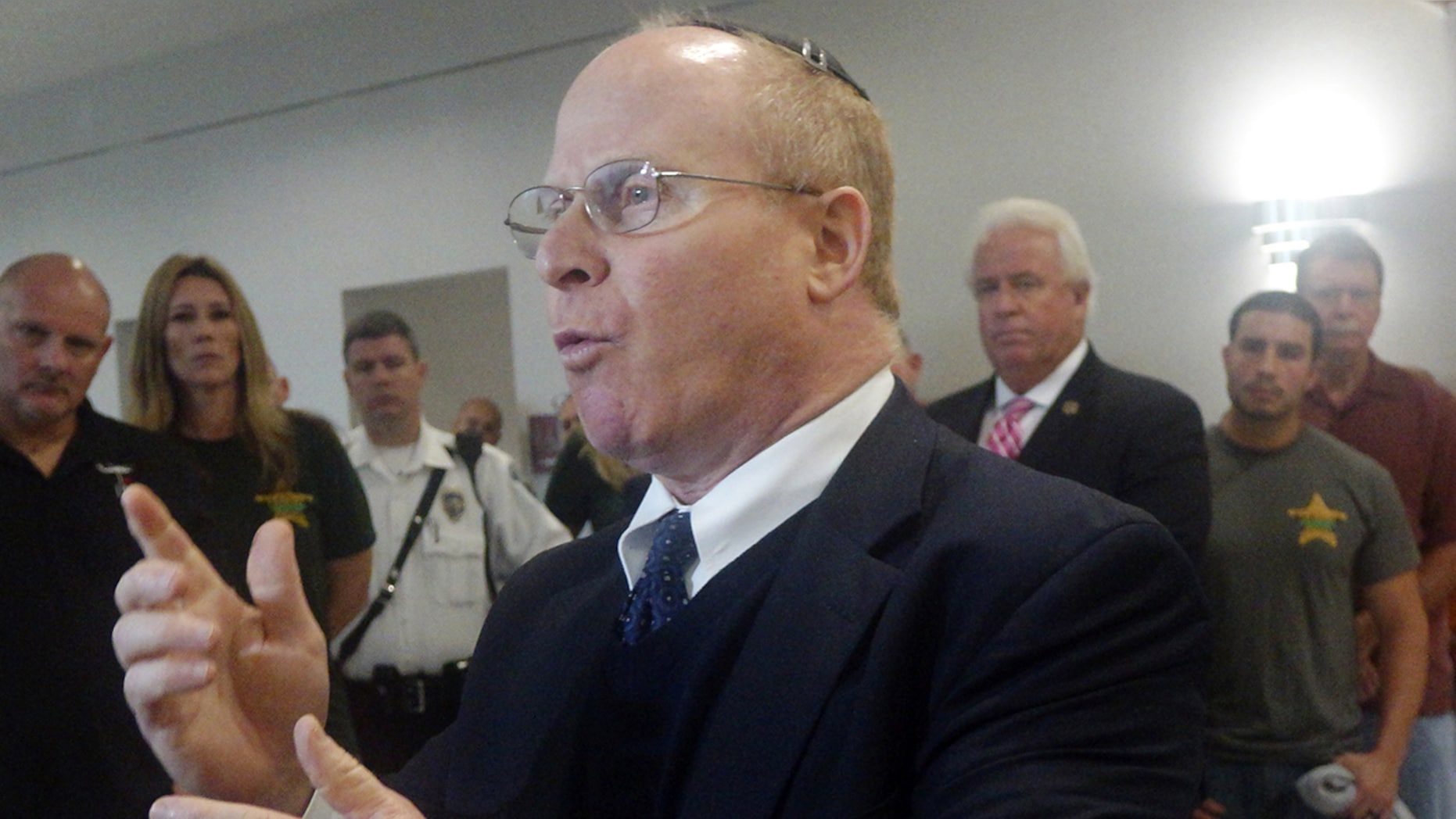
David Schoen
“I am not a person who will put forward a theory of election fraud,” Schoen told the Post. “That’s not what this impeachment trial is about.”
Schoen told Sean Hannity of Fox News on Monday night that the trial is unconstitutional and nothing more than an effort to prevent Trump from running for president again. “This is the political weaponization of the impeachment process,” he said.
Schoen also called the trial “the most ill-advised legislative action that I’ve seen in my lifetime.” [….]
The new team appears to have a two-pronged strategy: Arguing the trial is unconstitutional and that Trump’s remarks about the election did not incite the deadly riot at the Capitol.
House Democrats made their case to convict former president Donald Trump of inciting the Jan. 6 riot at the U.S. Capitol in a sweeping impeachment brief filed with the Senate on Tuesday that accused Trump of whipping his supporters into a “frenzy” and described him as “singularly responsible” for the mayhem that ensued.
In the brief, the nine House impeachment managers argue that Trump is not protected by the First Amendment’s freedom of speech provision, which was never intended, they wrote, to allow a president to “provoke lawless action if he loses at the polls.”
“If provoking an insurrectionary riot against a Joint Session of Congress after losing an election is not an impeachable offense, it is hard to imagine what would be,” the brief states.
Democrats also rejected the claim embraced by many Republicans that it is unconstitutional to convict a president after he has left office — an argument that Trump’s lawyers are expected to make in his defense.
“There is no ‘January Exception’ to impeachment or any other provision of the Constitution,” the House Democrats wrote. “A president must answer comprehensively for his conduct in office from his first day in office through his last.”
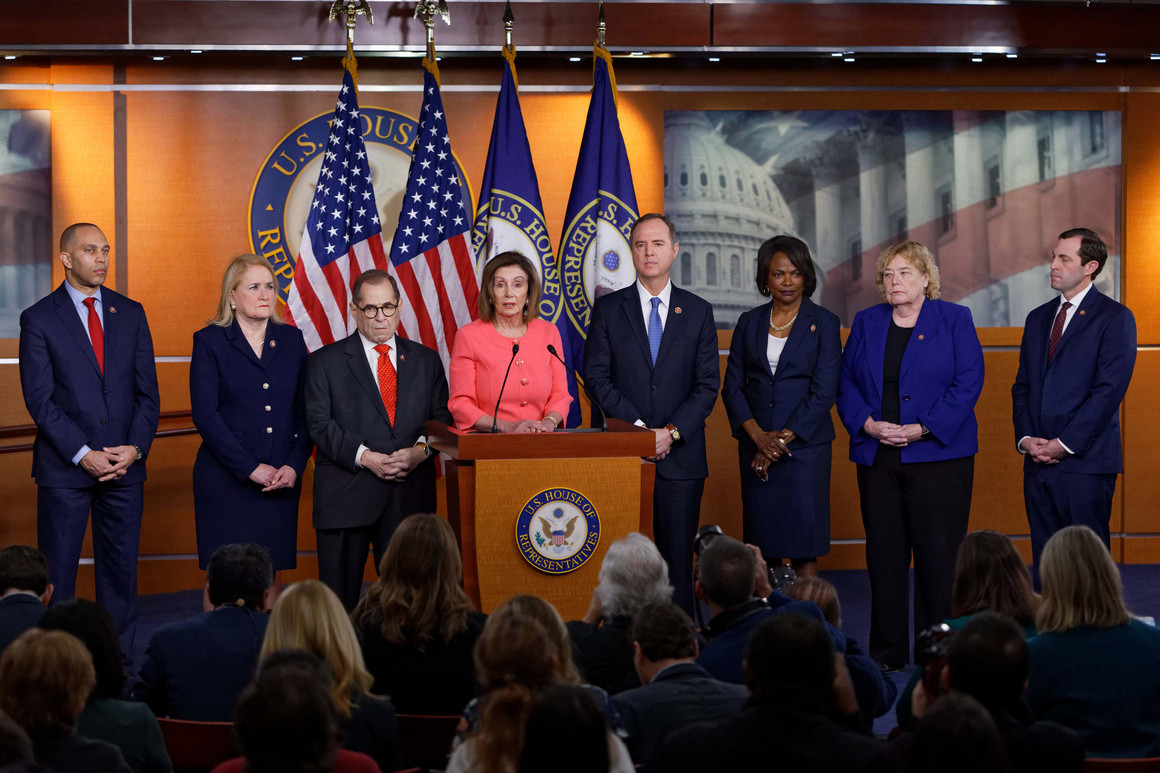
House impeachment managers
Trump is supposed to submit his response later today. It’s difficult to see how his lawyers could have had enough time to prepare careful arguments. More from the Democrat’s case:
The House Democrats wrote that Trump’s embrace of unfounded accusations that the 2020 election was stolen from him helped foment his supporters’ attack on the Capitol. When those false assertions failed to overturn the election, the Democrats wrote, Trump “summoned a mob to Washington, exhorted them into a frenzy, and aimed them like a loaded cannon down Pennsylvania Avenue.”
They added: “The Framers themselves would not have hesitated to convict on these facts.”
The House impeachment managers urged senators to bar Trump from ever serving again in elected office: “This is not a case where elections alone are a sufficient safeguard against future abuse; it is the electoral process itself that President Trump attacked and that must be protected from him and anyone else who would seek to mimic his behavior. Indeed, it is difficult to imagine a case that more clearly evokes the reasons the Framers wrote a disqualification power into the Constitution.”
The brief made clear Democrats’ intention to build an emotionally compelling impeachment case against Trump in which they have sought out new cellphone footage of the Capitol siege, as well as details about injured police officers.
The goal is to present the Senate with fresh evidence that reveals what Trump knew in advance of the Jan. 6 rampage at the Capitol, as well as how his words and actions influenced those who participated. The rioting left five dead, including one member of the U.S. Capitol Police. In addition, two officers, one with the D.C. police department, have since died by suicide.
As the Senate trial of Donald Trump nears, the defense is coming into view. It appears that most Senate Republicans will not defend Mr. Trump’s conduct around the Jan. 6 Capitol siege. Instead, they will rally around an argument about the chamber’s constitutional powers and the supposedly dangerous consequences for our politics if the Senate tries a “late impeachment.”
This argument is built on two closely connected representations, and Senator Rand Paul previewed them in his recent constitutional objection to “late impeachment.”
The first, in Mr. Paul’s words, is that “impeachment is a tool to remove someone from office. That’s it.” The Senate lacks the power to try an impeached president, once out of office, to determine if he is guilty of the charges the House has levied against him.
The second, Mr. Paul and others argued, is that Mr. Trump is now a “private citizen,” and so any action against him could serve no purpose other than revenge….
Bob Bauer
This Republican argument wholly misconstrues the text, history and structure of the Constitution’s impeachment clause. It is a mistake to minimize impeachment’s broader objectives by suggesting that removal from office was somehow its only or primary function.
The power to impeach specifically provides for two decisions: impeachment and conviction, resulting in removal, and then disqualification from holding office. As drawn from the English practice, and reflected in state constitutions at the time, both these actions were understood to serve the overall purpose of public accountability for egregious abuses of public office.
Indeed, several state constitutions at the time of the federal Constitution’s writing permitted impeachment only after public figures had left office. Public accountability and disqualification were the purposes of impeachment; the Constitution’s addition of removal from office was an expansion on these provisions.
The argument focused on Mr. Trump’s status as a former president is misguided and dangerous. When impeached, he was in office. Moreover, it is highly doubtful that the framers intended the impeachment clause to give the president free rein to commit impeachable offenses in the closing months of his term.
In any case, the Senate always decides on disqualification after the offender is a “private citizen,” since that is what he becomes upon conviction of an impeachable offense. The Constitution does not even specify that this second vote on disqualfication must be immediate. The Senate could vote weeks later, after deliberation and debate, well into the former president’s “private” life.
Still more fundamental: This “late impeachment” argument fails to grasp the constitutional framework within which the question must be considered. The Federalist Papers made plain the framers’ preoccupation with protections against the demagogue, the “unworthy candidate” of “perverted ambition” who practices “with success the vicious arts, by which elections are too often carried.” The provision for “disqualification to hold and enjoy any office of honor, trust or profit” was one of many instances of constitutional checks against popular passions that could lead to the election of officeholders who would threaten to subvert the Republic.
Read the rest at the link. I imagine the impeachment managers will read this article carefully.
So, that’s what we know so far about the impeachment trial. I’ll post more news links in the comment thread below. There’s a lot happening.
Did you like this post? Please share it with your friends:
Kate McKinnon did the #SNL cold open as herself doing a news-style talk show asking folks “What Still Works?” in the USA. It’s full of all kinds of topics we discuss a lot here and though it is certainly one of the funniest openers I’ve seen in awhile, it’s also a serious question.
This New York Times headline certainly sums up the situation with the badly broken Republican Party. I mean it couldn’t happen to a nicer bunch of greedy, power hungry, no-nothings but sheesh, we have a two party system. How does this not break most of our government and it certainly has meaning in states like mine where the leges are basically Camp Run Amok for Right Wing nut jobs.
With no dominant leader other than the deplatformed one-term president, a radical right movement that became emboldened under President Donald J. Trump has been maneuvering for more power, and ascending in different states and congressional districts. More moderate Republicans feel increasingly under attack, but so far have made little progress in galvanizing voters, donors or new recruits for office to push back against extremism.
There’s plenty of examples there to choose from in terms of what’s going on in state Republican Parties as well as the chaos ruling the Republicans in the District.
Needless to say, that explanation looks even worse now. McConnell and his allies are trying to launder their reputations. McConnell’s excuse is contained within a deeply reported New York Times narrative account of Trump’s election challenge. Apparently, McConnell was duped by Trump and his wily son-in-law:
The senator was also under a false impression that the president was only blustering, the officials said. Mr. McConnell had had multiple conversations with the White House chief of staff, Mark Meadows, and the senator’s top political adviser, Josh Holmes, had spoken with Mr. Kushner, the president’s son-in-law and senior adviser. Both West Wing officials had conveyed the same message: They would pursue all potential avenues but recognized that they might come up short. Mr. Trump would eventually bow to reality and accept defeat.
Poor sweet, naïve Mitch McConnell was told that Trump would graciously concede defeat, only to eventually realize Trump had misled him.
Clearly the Republican party is broken and the legislative sausage-making process is in dire shape. Perhaps they need a School House Rocks watch session to remember how it’s all supposed to work?
I am late to the game, I know, but this is my favorite #SNL cold open in about 100 years:https://t.co/Jw5mlwzOC5
Here’s a good question from The Atlanticwhich could actual be one of those turning points in urban economics.
As a general rule of human civilization, we’ve lived where we work. More than 90 percent of Americans drive to work, and their average commute is about 27 minutes. This tether between home and office is the basis of urban economics. But remote work weakens it; in many cases, it severs the link entirely, replacing spatial proximity with cloud-based connectivity. What knock-on changes will this new industrial revolution bring?
I’m one of those people with a job that could work from any one and I’ll tell you, that cabin on an island in the Peugeot Sound just keeps calling to me. I’ve been a Zillow traveler for at least 6 years with that project and the Covid-19 thing may have slowed me down along with a friend that needed an escape from a brutal husband but it hasn’t stopped me from searching out where the next place might be. I’ve found there’s a lot to be said about holding up at home and avoiding as much work place drama as possible even when you’ve got an office with a door that closes.
The one thing I might never be able to escape unless we do something is the gun violence even though I am in a place where the sounds of gun shots are quite common. The most threatening thing I’ve seen in awhile are those imagines of angry white militia jerks armed to the teeth. The Rev. Sharon Risher writes this op ed at WAPO: “Guns are white supremacy’s deadliest weapon. We must disarm hate.”
The defining photograph of the attempted insurrection on Jan. 6 was that of a man strolling through the broken halls of our national Capitol, amid the smashed windows and assorted rubble of the failed coup, proudly brandishing a Confederate flag on his shoulder and hoping to overturn an election decided largely by Black voters. It’s an image that tells the story not only of Jan. 6 or of the Trump presidency, but also of all the steps that led to that moment — the whole history of hate in America captured in one frame.
For me, the echoes of that picture reverberated back nearly six years, to the day my mom — Ethel Lee Lance — was shot and killed while praying in Charleston’s Mother Emanuel Church along with eight other Black Americans, including two of my cousins and one of my closechildhood friends. In the months leading up to that tragic day, my mom’s killer posed for pictures with the Confederate flag, sometimes even slinging it over his shoulder just like that insurrectionist in the Capitol did.
The similarities between these two days don’t end there: Both days ended in deaths, both attacks were perpetrated (at least in part) by white supremacists chasing a lost cause, and tragically, the perpetrators of both incidents were carrying more than just flags. My mother’s killer was armed with a handgun; the Capitol insurrectionists were armed with enough live ammunition to shoot every member of the House and Senate five times.
This is no kind of a situation to leave to the kids of America or the World for that matter. We’ve become more of a menace than ever before. And it all seems to be wrapped up in the flags of traitors.
So, I’ll just leave this topic here for you to talk about. I’m not sure what all this means in terms of trusting Joe, Kamala, Nancy, and Chuck to get the job done frankly. There’s a lot at stake and like Kate said, there’s a lot not working right now. There’s a lot of stuff that’s just really broken.
The Sky Dancing banner headline uses a snippet from a work by artist Tashi Mannox called 'Rainbow Study'. The work is described as a" study of typical Tibetan rainbow clouds, that feature in Thanka painting, temple decoration and silk brocades". dakinikat was immediately drawn to the image when trying to find stylized Tibetan Clouds to represent Sky Dancing. It is probably because Tashi's practice is similar to her own. His updated take on the clouds that fill the collection of traditional thankas is quite special.
You can find his work at his website by clicking on his logo below. He is also a calligraphy artist that uses important vajrayana syllables. We encourage you to visit his on line studio.

















 Democrats are moving forward on a plan to take away Greene’s committee assignments. CNN:

 Good Day Sky Dancers!
 It goes without out saying that the global climate isn’t in good shape, our immigration system isn’t working, and we dont’ seem to be able to get the economy working for every on or the justice system to work for people of color or the poor. The
  I’m one of those people with a job that could work from any one and I’ll tell you, that cabin on an island in the Peugeot Sound just keeps calling to me. I’ve been a Zillow traveler for at least 6 years with that project and the Covid-19 thing may have slowed me down along with a friend that needed an escape from a brutal husband but it hasn’t stopped me from searching out where the next place might be. I’ve found there’s a lot to be said about holding up at home and avoiding as much work place drama as possible even when you’ve got an office with a door that closes.

 peej
peej Carissa
 bostonboomer
 dakinikat
 ecocatwoman
 mablue2
 Mama Lopez
 peggysue22
 quixote
 skydancingguestblogger
 Mona (aka Wonk the Vote)



 Sky Dancing
Recent Comments