
Thursday Reads: The Trump Crime Family
Posted: October 18, 2018 Filed under: morning reads, U.S. Politics 34 Comments
The Basket of Apples, by Paul Cezanne, 1895
Good Afternoon!!
Remember when people used talk about the “Bush crime family?” Well, the Trump crime family makes the Bushes look like pikers.
Just a couple of weeks ago, The New York Times published a stunning 18-month report on Trump’s “dubious tax schemes during the 1990s, including instances of outright fraud.” Of course that story has been buried in the rubble of the Kavanaugh hearings and more Trump criminal behavior, including his current efforts to cover up a murder perpetrated by the Saudis.
Now Trump, Inc. (at ProPublica) has released the results of an 8-month study of the Trump Organization’s business model, Pump and Trump.
Since Donald Trump’s fortunes came surging back with the success of “The Apprentice” 14 years ago, his deals have often been scrutinized for the large number of his partners who have ventured to the very edges of the law, and sometimes beyond. Those associates have included accused money launderers, alleged funders of Iran’s Revolutionary Guard and a felon who slashed someone in the face with a broken margarita glass.
Trump and his company have typically countered by saying they were merely licensing his name on these real estate projects in exchange for a fee. They weren’t the developers or in any way responsible.
But an eight-month investigation by ProPublica and WNYC reveals that the post-millennium Trump business model is different from what has been previously reported. The Trumps were typically way more than mere licensors or bystanders in their often-troubled deals. They were deeply involved in these projects. They helped mislead investors and buyers — and they profited handsomely from it.
Autumn Patterns. Mary Gibbs. Watercolour.
Patterns of deceptive practices occurred in a dozen deals across the globe, as the business expanded into international projects, and the Trumps often participated. One common pattern, visible in more than half of those transactions, was a tendency to misstate key sales numbers.
In interviews and press conferences, Ivanka Trump gave false sales figures for projects in Mexico’s Baja California ; Panama City, Panama ; Toronto and New York’s SoHo neighborhood . These statements weren’t just the legendary Trump hype; they misled potential buyers about the viability of the developments.
Another pattern: Donald Trump repeatedly misled buyers about the amount (or existence) of his ownership in projects in Tampa, Florida; Panama; Baja and elsewhere. For a tower planned in Tampa, for example, Trump told a local paper in 2005 that his ownership would be less than 50 percent: “But it’s a substantial stake. I recently said I’d like to increase my stake but when they’re selling that well they don’t let you do that.” In reality, Trump had no ownership stake in the project.
The Trumps often made money even when projects failed. And when they tanked, the Trumps simply ignored their prior claims of close involvement, denied any responsibility and walked away.

Read the rest and listen to the Trump, Inc. episode at the link.
At The New Yorker, Adam Davison summarizes the findings of the two studies and asks: Is Fraud Part of the Trump Organization’s Business Model?
It is becoming increasingly clear that, in the language of business schools, the Trump Organization’s core competency is in profiting from misrepresentation and deceit and, potentially, fraud. There are many ways to make money in real estate. The normal way is to identify a need in the market, raise money by convincing lenders or investors that your plan is sound, build the structure, then either profit through ongoing rent or by selling units. The key variables in such a business are what is known as product-market fit—the accuracy with which a developer understands the housing or commercial needs of a place—and the ability to execute well by keeping costs down without sacrificing the right level of quality. Perhaps more than anything, practitioners of a successful real-estate business obsessively focus on maintaining the ability to borrow money cheaply. The profit on many real-estate projects often comes down to simple math: the cheaper you can borrow money to build, the more money you make. The more trustworthy you are, through a long period of successful projects, the less interest banks will demand on their loans, so the more profit you can make, and the more successful you will be.
Autumn Still Life by Ruslan Smorodinov
Rather famously, Trump overinvested in luxury housing, spent too much on his casinos, and completely blew his brief foray into a regional airline. Far worse, Trump did the very opposite of insuring a long record of fiscal prudence that would allow him to borrow money cheaply. Despite the company’s mixed record, it has survived and grown. It’s doing something well, so what is it?
This month, two incredible investigative stories have given us an opportunity to lift the hood of the Trump Organization, look inside, and begin to understand what the business of this unusual company actually is. It is not a happy picture. The Times published a remarkable report, on October 2nd, that showed that much of the profit the Trump Organization made came not from successful real-estate investment but from defrauding state and federal governments through tax fraud. This week, ProPublica and WNYC co-published a stunning story and a “Trump, Inc.” podcast that can be seen as the international companion to the Times piece. They show that many of the Trump Organization’s international deals also bore the hallmarks of financial fraud, including money laundering, deceptive borrowing, outright lying to investors, and other potential crimes.

It’s still difficult to believe that the thug who head’s this crime family is currently the “president.”
We know that with Trump, everything is about his personal money and power, not the nation he supposedly leads. So what is this all about?
The Washington Post: Saudi Arabia transfers $100 million to U.S. amid crisis over Khashoggi.
The United States received a payment of $100 million from Saudi Arabia on Tuesday, the same day Secretary of State Mike Pompeoarrived in Riyadh to discuss the disappearance of journalist Jamal Khashoggi, a State Department official confirmed Wednesday amid global calls for answers in the case.
Saudi Arabia publicly pledged the payment to support U.S. stabilization efforts in northeastern Syria in August, but questions persisted about when and if Saudi officials would come through with the money.
Autumn Still Life, William Merritt Chase
The timing of the transfer, first reported by the New York Times, raised questions about a potential payoff as Riyadh seeks to manage the blowback over allegations that Saudi agents were responsible for Khashoggi’s disappearance. The State Department denied any connection between the payment and Pompeo’s discussions with Saudi officials about Khashoggi, a Washington Post contributing columnist.

Could there be a more obvious bribe? Yet the Trump thugs expect us to believe it’s just a coincidence.
“We always expected the contribution to be finalized in the fall time frame,” Brett McGurk, the State Department’s envoy to the anti-Islamic State coalition, said in a statement. “The specific transfer of funds has been long in process and has nothing to do with other events or the secretary’s visit.”
But, the WaPo continues,
Saudi Arabia, an oil-rich monarchy and staunch U.S. ally, has long relied on its financial largesse to persuade partners to support its foreign policy objectives. Western diplomats suspect that the kingdom will also compensate Turkey for its willingness to launch a joint investigation on Khashoggi’s disappearance — a payback that could come in the form of large-scale debt relief, strategic buyouts or other arrangements that boost Turkey’s ailing economy.
We’re most likely never going to get that audiotape from Turkey, folks.
Trump won’t even let Republicans in Congress know what’s happening with the murder cover up.
The Hill: Corker: Trump administration ‘clamped down’ on Saudi intel, canceled briefing.
Sen. Bob Corker (R-Tenn.) said Wednesday that the Trump administration is restricting access to information about a missing Saudi journalist, a move that comes as President Trump has publicly echoed denials of wrongdoing from top Saudi officials.
Joke Frima (b.1952) — On the Woodpile, 2010
Corker, the chairman of the Senate Foreign Relations Committee, told The Washington Post that the administration had “clamped down” on sharing intelligence about Washington Post contributor Jamal Khashoggi, a critic of the Saudi government who has been missing for more than two weeks.
“I can only surmise that probably the intel is not painting a pretty picture as it relates to Saudi Arabia,” Corker told the Post.
Corker added that the administration canceled an intelligence briefing scheduled for Tuesday and that he was told additional information would not be shared with the Senate at this time, a development he described as “disappointing.”

According to Shane Harris at The Washington Post, the Trump administration is openly working with the Saudi’s to come up with a plausible cover story:
The Trump administration and the Saudi royal family are searching for a mutually agreeable explanation for the death of journalist Jamal Khashoggi — one that will avoid implicating Crown Prince Mohammed bin Salman, who is among the president’s closest foreign allies, according to analysts and officials in multiple countries.
But it will be difficult for the young ruler to escape scrutiny, as mounting evidence points not only to the Saudi government’s knowledge of Khashoggi’s fate, but also to a connection by Mohammed to his disappearance.
U.S. intelligence reports, accounts from Khashoggi’s friends, passport records and social media profiles paint a picture of a brutal killing that at least had its roots in Mohammed’s desire to silence Khashoggi, a former palace insider turned critic of the government and the prince in particular.
The analysts and officials said it was inconceivable that such a brazen operation as the one alleged by Turkish officials, involving a team of 15 agents sent to Istanbul, who then killed and dismembered Khashoggi, could have been pulled off by a group of “rogue killers,” as President Trump speculated this week, moments after a phone call with Saudi Arabia’s King Salman.
Even one of the president’s closest advisers, Rudolph W. Giuliani, said many senior members of the administration concluded more than a week ago that the Saudis had killed Khashoggi.
Read the rest at the WaPo.
More stories on the Kashoggi murder:
 NYT: Aide to Saudi Crown Prince, Suspect in Khashoggi Case, Is Shown Walking into Consulate.
NYT: U.S. Spy Agencies Are Increasingly Convinced of Saudi Prince’s Ties to Journalist’s Disappearance.
Ahval: Saudi suspect in Khashoggi disappearance reportedly dies in car accident – pro-gov’t Yeni Şafak.
The Washington Post: Secret recordings give insight into Saudi attempt to silence critics.
Nicholas Kristof at the NYT: A President Kowtowing to a Mad Prince.
One more Trump crime story before I call it quits for today, this time about the stolen election.
The Guardian: Revealed: Russian billionaire set up US company before Trump Tower meeting.
A Russian billionaire who orchestrated the June 2016 Trump Tower meetingformed a new American shell company a month beforehand with an accountant who has had clients accused of money laundering and embezzlement.
The billionaire, Aras Agalarov, created the US company anonymously while preparing to move almost $20m into the country during the time of the presidential election campaign, according to interviews and corporate filings.
The company was set up for him in May 2016 by his Russian-born accountant, who has also managed the US finances of compatriots accused of mishandling millions of dollars. One of those clients has its own connectionto the Trump Tower meeting.
In June 2016, Agalarov allegedly offered Trump’s team damaging information from the Kremlin about Hillary Clinton, their Democratic opponent. The offer led Trump’s eldest son to hold a meeting at their Manhattan offices that is now a focus of the inquiry into Moscow’s election interference by Robert Mueller, the special counsel.
Agalarov’s previously unreported shell company is another example of intriguing financial activity around the time of the Trump Tower meeting.
Read the rest at the Guardian.
Now, what stories are you following today?
Tuesday Reads
Posted: October 16, 2018 Filed under: morning reads, U.S. Politics 55 Comments Good Morning!!
I am completely burned out on politics today. I can’t handle any more Trump madness. It makes me feel sick even to type his last name. I can’t stand anymore Hillary bashing. I don’t really care that much for Elizabeth Warren, but I’m fed up with the attacks on her family stories. I can’t stand the media focusing on these meaningless stories and ignoring the administration’s failures to help hurricane victims and it’s torture of immigrant children and their families.
Ever since the Kavanaugh confirmation, I can barely stand to watch cable TV. Reading about politics makes me angry and depressed. I really think this state of mind is going to be with me until election day at least. I wonder if there is any chance that we as a country can come out of this dark tunnel into the light of democracy?
Here’s what’s happening. A New York Times financial reporter posted this tweet:
https://twitter.com/FlitterOnFraud/status/1051965466732875779
So far the tweet has received 1.4K replies and only 33 retweets and 116 likes. At least this ratio shows that lots of people thought the tweet was offensive and ridiculous. But why are people still relitigating something that happened 20 years ago, and why are they blaming Hillary, who was actually the victim in the events? Why is it strange that a woman would refuse to attack the husband she obviously loves?
Here’s another one–also from a woman in the media:
Sigh . . . I can’t stand any more of this. When I finish this post, I’m going to read novel and pretend everything is OK, just for today.
From The Daily Beast: Trump Hangs ‘Tacky’ Fantasy Painting of Himself With GOP Presidents in White House.
President Trump’s latest addition to White House decor is a kitschy fantasy painting that shows him relaxing with Republican presidents of the past—an update to a best-selling image commonly found in tourist gift shops and online galleries.
The print, “The Republican Club” by Andy Thomas, could be seen in the background of a photo tweeted by 60 Minutes, which aired an interview with Trump on Sunday night.
It shows a slimmed-down Trump sandwiched between Presidents Eisenhower and Nixon, directly across from Abraham Lincoln. Teddy Roosevelt, Dwight Eisenhower, Gerald Ford, Ronald Reagan, and both Bushes are also in the imaginary scene.
Amateur art critics sneered on social media that the artwork was “tacky,” “a travesty,” or “blasphemy.” Some said it looked like the political version of the famous “dogs playing poker” painting.
Here’s the painting:
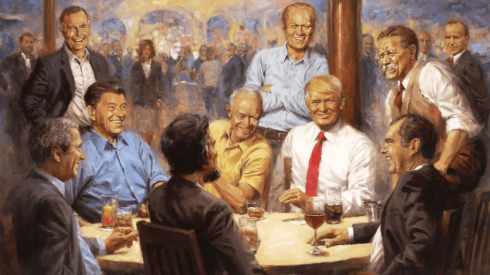
Trump also has a framed map of his electoral college win hanging in the White House. He’s so embarrassing.
In more serious news, Trump is still defending the Saudis for murdering a Washington Post journalist. CNN: Trump suggests ‘rogue killers’ behind Jamal Khashoggi’s disappearance.
President Donald Trump suggested Monday that “rogue killers” could be behind the disappearance of Saudi journalist Jamal Khashoggi, after a phone call with Saudi Arabia’s King Salman about the case.
Trump told White House reporters that Salman offered him a “flat denial” in relation to the disappearance of Khashoggi, a columnist for The Washington Post who was last seen in public when he entered the Saudi consulate in Istanbul in Turkey on October 2.
Later Monday, the Saudis were preparing to admit that Khashoggi died during an interrogation that went wrong, one that was intended to lead to his abduction from Turkey, according to two sources.
Secretary of State Mike Pompeo left Washington for Riyadh at around midday to meet with the Saudi King on Trump’s orders.Previously, Saudi authorities had maintained that Khashoggi left the consulate the same afternoon of his visit, but have provided no evidence to support the claim. Khashoggi’s fiancée, Hatice Cengiz, who was waiting outside the consulate, says she did not see him re-emerge.
Pompeo is in Saudi Arabia right now, and judging by the photos I’ve seen and reports of his meetings with King Salmon and his son Crown Prince Mohammed bin Salman, Pompeo didn’t even give the Saudi rulers a stern talking to. In fact, they are both grinning ear-to-ear in all the pictures.
CNN: Pompeo meets Saudi King as Khashoggi family calls for inquiry into ‘death.’
US Secretary of State Mike Pompeo held talks with top Saudi leaders Tuesday as sources told CNN that the Kingdom is preparing to acknowledge that missing journalist Jamal Khashoggi died at the Saudi consulate in Istanbul, Turkey.
Pompeo had a short discussion with King Salman before a longer meeting with the King’s son, Crown Prince Mohammed bin Salman, Saudi Arabia’s de facto ruler. US State Department spokeswoman Heather Nauert said Pompeo “thanked the King for his commitment to supporting a thorough, transparent, and timely investigation” of the Khashoggi case and expressed “concern” about the case to the foreign minister.
Nauert described the meetings as “direct and candid.”
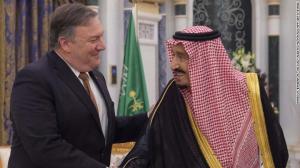
Pompeo meets King Salmon
CNN’s sources say Saudi Arabia plans to contend that the Washington Post columnist died when an interrogation went awry, but there was no public mention on Tuesday of any new Saudi explanation of Khashoggi’s disappearance.
Meanwhile, back in Turkey:
Turkey’s President Recep Tayyip Erdogan said Turkish officials, who searched the consulate for nine hours on Monday, are looking into “toxic” and “painted over material” as part of their investigation. “My hope is that we can reach conclusions that will give us a reasonable opinion as soon as possible, because the investigation is looking into many things such as toxic materials and those materials being removed by painting them over,” Erdogan told reporters.
Kashoggi’s family wants and international investigation. I doubt if Trump and Pompeo will support that.
Business Insider: Saudis reportedly preparing to claim Jamal Khashoggi was killed as a result of a botched interrogation.
The Saudi government is preparing to a release a report claiming that the Saudi journalist Jamal Khashoggi was killed as a result of a botched interrogation, CNN reported on Monday, citing two sources.
The interrogation was reportedly supposed to lead to Khashoggi’s abduction from Turkey. CNN described one source as saying the report is likely to claim that the interrogation was conducted without clearance or transparency.
In other words, he was tortured to death by “rogue” operators. Yeah, right.
The Washington Post Editorial Board points out that the U.S. really doesn’t need Saudi Arabia for anything –although Trump and Jared Kushner may be concerned about personal losses to their businesses interests.
…it’s worth considering just how much the United States might have to lose if its relationship with Saudi Arabia ruptured. What about that oil, and the $110 billion in arms purchases Mr. Trump keeps talking about? What about the war on terrorism?
Start with the oil. Saudi Arabia, according to the U.S. Energy Information Administration, supplied 9 percent of U.S. petroleum imports in 2017, or about 960,000 barrels a day. But thanks to the shale revolution, the United States is essentially energy independent: It, not Saudi Arabia, is now the world’s largest crude-oil producer. Last year, U.S. daily oil exports averaged 6.38 million barrels, or nearly seven times the Saudi imports. If the Saudis cut back production or boycotted the United States, they could temporarily drive up prices, but the beneficiaries would be U.S. shale companies, which over time would fill the gap — and deal a devastating blow to the Saudi oil industry.
Jared and Ivanka with MBS
As for arms sales, someone needs to brief Mr. Trump on the actual results of the promises made to him when he visited Riyadh last year. As Bruce Riedel of the Brookings Institution sums it up, “The Saudis have not concluded a single major arms deal with Washington on Trump’s watch.” Moreover, an end to supplies of U.S. spare parts and technical support, something Russia cannot provide, would quickly ground the Saudi air force. That would have the welcome effect of ending a bloody bombing campaign in Yemen that a U.N. investigation concluded was probably responsible for war crimes.
Saudi Arabia does supply the United States with counterterrorism intelligence. But as Andrew Miller of the Project on Middle East Democracy points out, stopping it “would be a colossal error . . . when there’s already a strong perception in Congress and with Americans that Saudi Arabia has fueled extremism.” Mr. Miller notes that a law passed by Congress in 2016 opens the way for civil suits against the Saudi government for any terrorist acts it enables.
The reality is that Saudi Arabia, which, as Mr. Trump himself has crudely pointed out, would not survive without U.S. security support, has everything to lose from a break in relations, while the United States no longer needs the kingdom as much as it once did. Mr. Trump has overvalued the relationship and encouraged Saudi leaders to believe they can behave recklessly and even criminally without consequence.

So all the concern from the administration must be about Trump’s and Kushner’s private finances. That is just sickening.
One more story before I escape into my book.
The Washington Post: ‘Blue wave’ or ‘left-wing mob’? Anti-Trump fervor fuels a new movement aimed squarely at winning elections.
If the Nov. 6 midterm elections turn into what many Democrats hope will be a “blue wave,” swamping Republican majorities from Congress to state legislatures nationwide, it will have been powered in part by a new and sprawling network of activists on the left who, like Wilburn, have leaped into action over the past two years — energized by their deep desire to thwart the rise of Trump and his agenda.
Like the conservative tea party groups that rose up after Barack Obama was elected president in 2008 and that helped Republicans retake the House and gain power in state legislatures in 2010, this new liberal movement has emerged largely outside the traditional party structure.
It is led by hundreds of thousands of mostly white, college-educated, middle-aged women who trace their inspiration to the inaugural women’s marches in January 2017 and whose ambitions have only grown amid a succession of disagreements with Trump, including over the confirmation of Supreme Court Justice Brett M. Kavanaugh.
Read the rest at the link. If anyone saves this country from Trump it will be women.
What stories are you following today?
Monday Reads: WTF did Trump Voters do?
Posted: October 15, 2018 Filed under: morning reads | Tags: 60s minutes interview with Liar in Chief, Proud Boys, Saudi Arabia 36 Comments
Good Morning Sky Dancers!
I’d like to continue to ignore the absolute breakdown of rule of law and sanity brought on by a group of outraged wypipo that just want their football and lives to be mired in some perverse black and white 50s sitcom, but it’s hard with headlines reading like an Orwellian Dystopia.
While Floridians and other survivors of hurricanes the last 2 seasons struggle to find water, food, and access to the things of basic civilization, T-Rump continues to golf at his various properties and travel to provide Hate Fest opportunities for aggrieved wypipo with random women leaders being targeted for the shouts of “lock her up”. This kind of behavior would shame any sane person. The word sane is the key idea here.
I’d like to say who are these people, but then it’s pretty obvious that I went to high school and university with a lot of them and used to sit in church pews surrounded by them. I’m not sure what wiring got crossed in their brains, but I don’t want to understand them, I want them to slink back under their rocks.
 That pretty much sums it up. KKKremlin Caligula just keeps showing himself to the world and about 20% of the population keeps acting like this is great and normal. But then, most of them also believe in a literal garden of Eden and zombie Jesus born of a virgin when there’s absolutely no proof of any of that. It seems like everything done by Republicans encourages their psychotic breaks so the donor class gets to pillage the country of treasure and resources. The VOX op ed piece is written by Matthew Yglesias.
President Trump trusts Kim Jong Un but not American climate scientists. He knows more about NATO than Secretary of Defense Jim Mattis. He thinks the European Union was created to take advantage of America on trade. And he isn’t sure whether or not Vladimir Putin is involved in assassinations.
In short, his sit-down interview with 60 Minutes’ Lesley Stahl revealed the president of the United States to be grossly dishonest, woefully ill-informed, and congenitally incapable of admitting error or demonstrating any kind of moral or intellectual growth.
He is, in other words, totally unfit for high office and fairly obviously so. Even more amazingly, despite Stahl covering an incredibly wide range of issues, she broke essentially no new ground. Every terrible, disqualifying thing he said was something he’s said before.
Donald Trump says a lot of things that aren’t true
Portrait
That doesn’t include what’s going on with Saudi Arabia which is acting like an entitled Trump Voter with the actual ability to blackmail the country and its Placeholder in the Oval Office. Trump basically said that the murdered Saudi Journalists might have been killed by “rogue” killers and that the King said they didn’t do it. Oh, great! It’s the believe a crazed dictator over all the evidence SNL skit redux!
For 45 years, it’s been considered out of bounds for Saudi Arabia. But all of a sudden, Riyadh made what many read as a veiled threat to use the kingdom’s oil wealth as a political weapon — something unheard of since the 1973 Arab embargo that triggered the first oil crisis.
Saudi Arabia, the world’s biggest oil exporter, said on Sunday it would retaliate against any punitive measures linked to the disappearance of Washington Post columnist Jamal Khashoggi with even “stronger ones.” In an implicit reference to the kingdom’s petroleum wealth, the statement noted the Saudi economy “has an influential and vital role in the global economy.”
Roger Diwan, a longstanding OPEC watcher at consultant IHS Markit Ltd., said the Saudi comments broke “an essential oil market taboo.”
While few think that Saudi Arabia is prepared to follow through, even the suggestion of using oil as a weapon undermines Riyadh’s long-standing effort to project itself as a force for economic stability. Jeffrey Currie, the head of commodities research at Goldman Sachs Inc., said Middle East tensions impacting the oil market have now “broadened to include Saudi Arabia.”
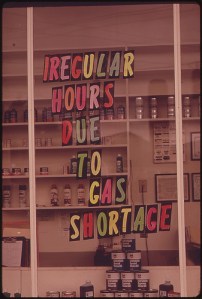
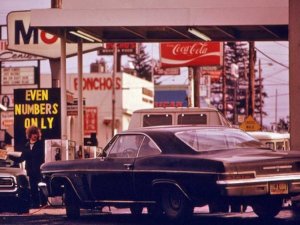
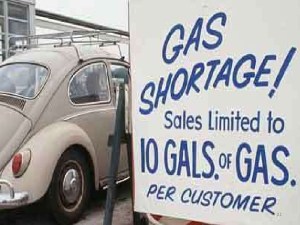
The images today should remind the older among us of the 1970s gas crisis.
In October 1972, a year before the U.S. oil crisis began, Atlantic author Steward Udall issued a warning, predicting a looming fuel shortage. Udall, a former Secretary of the Interior for the Kennedy Administration, believed the auto industry was in an unsustainable growth pattern based on the folly that cheap gas prices would persist indefinitely. He saw American oil production reaching a plateau and worried about the stability of the Middle Eastern market:
President Donald Trump on Monday suggested that “rogue killers” may be responsible for the disappearance of Washington Post columnist Jamal Khashoggi, while also dispatching Secretary of State Mike Pompeo to meet with Saudi Arabia’s King Salman.
“We are going to leave nothing uncovered,” Trump told reporters on the South Lawn of the White House. “With that being said, the king firmly denied any knowledge of it. … I don’t want to get into his mind, but it sounded to me like maybe these could have been rogue killers, who knows? We’ll try getting to the bottom of it very soon. His was a flat denial.”
 In case any one needs to be reminded, the Saudi Royal Family are not nice people and the attacks on 9/11 were instigated by Saudis. And, why do we continually kiss up to brutal regimes? Are we really still in bed with craven dictatorships? Of course, we are!!!!
So there was Crown Prince Mohammad at an April soirée at Mr. Murdoch’s vineyard in Bel Air, Calif. Guests included the Walt Disney Company’s chairman, Robert A. Iger; the studio chief at Warner Bros., Kevin Tsujihara; and the actors Morgan Freeman and Dwayne “The Rock” Johnson, who overshared on Instagram that he was “blown away to be told about the level of love the Saudi people have for me.”
As the guest of honor at a Page Six-worthy dinner at the producer Brian Grazer’s Santa Monica home, the crown prince discussed Snapchat’s popularity in his kingdom with the Snap chief Evan Spiegel;Vice’s Shane Smith; Amazon’s chief — and Washington Post owner — Jeff Bezos and the agent-turned-mogul Ari Emanuel.
Mr. Emanuel, an organizer of the evening, had reason to celebrate: the Saudis planned a $400 million investment in Endeavor, his entertainment holding company. (In light of Mr. Khashoggi’s disappearance, Endeavor is reassessing the deal, according to a person with knowledge of Mr. Emanuel’s thinking, who shared it only on condition of anonymity.)
Vanity Fair noted at the time that the festivities were not marred by talk of civilian deaths in Yemen from Saudi-led airstrikes; the crown prince’s “anti-corruption” move to imprison scores of Saudi businessmen, including the owners of Saudi television networks and key rivals, at the Riyadh Ritz-Carlton; or the five-year prison sentence the Saudi royal court handed the journalist Saleh al-Shehi for criticizing the government.
The embrace between the American establishment and the leader known as M.B.S. was set to continue in Riyadh later this month at a business conference hosted by Crown Prince Mohammed. The sponsors, partners and participants of the conference — known informally as “Davos In The Desert” — included a number of media companies: CNBC, The New York Times, Bloomberg, The Los Angeles Times, The Financial Times, The Economist, CNN and Fox Business Network.
With the exception of Fox, which is reviewing its participation, all of those organizations pulled out as the Khashoggi story climbed most-viewed article lists and drew cable coverage. The story’s popularity was helped along by its thriller-like qualities, which included the allegation that the journalist’s body was dismembered with the aid of a bone saw before it was removed from the consulate.
 So much for that little fairy tale happy ending. But one still wonders why the Bible Belt continues to lose its license to smug righteousness with its unholy alliance with D’oh Hair Furor? I don’t usually quote Maggie Habberman because I think she’s basically an overpaid gossip columnist but here we go. Why don’t the unhinged hatefests that are happening quite a few times a week turn off people who say they believe in the biblical Jesus? I mean really? Where in the bible does Jesus say “lock her up”?
Sharon Hurd didn’t know that President Trump had used the phrase “dumb Southerner” to describe his attorney general, but hearing it didn’t bother her.
“We’re ready for somebody to be that outspoken, because he seems to be getting the job done,” said Ms. Hurd, 73, a retiree who once owned a restaurant and a gift shop, standing on a street corner about an hour after Mr. Trump’s rally ended here this month. “He doesn’t try to take his words and make them please everybody, and I think that Southern people are noticing that.”
Few things have appeared to test the bond between Mr. Trump and the South, a political coupling of a thrice-married New Yorker and voters in the Bible Belt that seemed unlikely from the start. The president’s swing this month through deep-red Tennessee and Mississippi, where he basked in the warmth of supporters at political rallies, confirmed that despite the scandals and chaos that have churned out of the White House, their relationship endures.
“It is ironic that the warrior that they have found is a billionaire from New York, but he really speaks their language fluidly,” said Henry Barbour, a Republican National Committee member and party strategist based in Mississippi.
“I don’t think it’s about any specific set of policy positions, but it’s about somebody being a warrior for folks,” he said.
The relationship offers Mr. Trump benefits as well. In Johnson City, Tenn., and in Southaven, Miss., this month, Mr. Trump was far removed from bruising headlines about the special counsel investigation into possible campaign collusion with Russia, his personal finances or allegations of affairs.
And although Mr. Trump often paints a rosy, and sometimes distorted, picture of his support, his descriptions of mutual love with his voters match reality in parts of the South — particularly outside cities and suburbs. In his 2016 victory, he won every Southern state but Virginia. In Tennessee, public polling shows his approval rating is close to 60 percent, far greater than his national average.
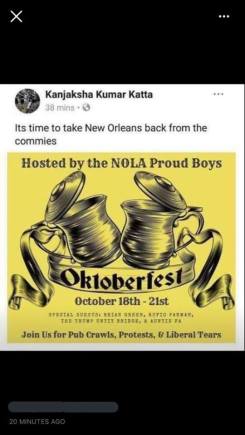 I don’t get it and I’m not sure why continually writing about these people does much good for any of us other warn us that there are zombies living among us. Oh, and then there’s this little shit show coming to my streets this week. These walking specimens of human excrement have already terrorized the streets of NYC and Portland this week. We’re not happy to be hosting them.
Newly released video reportedly shows the moment members of the far-right group the “Proud Boys” attacked anti-fascist protesters.
Dozens of protesters gathered outside the Metropolitan Republican Club on New York City’s Upper East Side Friday night, where Proud Boys founder Gavin McInnes was scheduled to give a speech.
As the event was letting out, some of the attendees allegedly assaulted some of the so-called “Antifa” protesters.
Here’s from the Portland event.
Far-right groups Proud Boys and Patriot Prayer,clashed with anti-fascist protesters in Portland, Ore. on Saturday night.
Patriot Prayer, an Oregon-based group, was holding a rally in downtown Portland yesterday; after several hours of clashes, video footage shows, an antifa protester sprays one of the far-right group members with pepper spray, setting off further violence.
The incident appears to have taken place outside Kelly’s Olympian bar and follows similar violence at the hands of Proud Boys on Friday night in New York City. According to Twitter user @itsmikebivins, the violence in Portland was “way worse” than the violence in New York.
“Right-wingers were clubbing people with clubs,” @itsmikebivins continued. Portland police confirmed that the incident was part of violence that occurred between the groups throughout the day, and involved “hard-knuckled gloves, firearms, batons and knives.”
These idiots are like a cross between Clock Work Orange’s “droogies” and freaking NAZI Brownshirts with a dash of KKK thrown in, but hey, it’s liberals that are angry mobs!
Anyway, I will stay home and away from the TV news as much as possible. My safe zone is the actual horror movies being shown on SYFY this month instead of the horror reality show that has overtaken our country.
Be excellent to each other. Oh, and Elizabeth Warren does have Native American Heritage but I don’t want to play in to the all the American Indian Lore that’s floating around this story. The only question to me is will Trump pony up the million to her chosen charity and will every one just go out and vote already!!!!
What’s on your reading and blogging list today?
Lazy Caturday Reads
Posted: October 13, 2018 Filed under: just because 13 Comments
Painting by Roxanne Driedger
Good Morning!!
While Trump spends his nights lying to his cult followers at his Hitler rallies, and his administration works at finding excuses for the murder of a Washington Post journalist, survivors of Hurricane Michael down in Florida are wondering if Trump’s flunkies will bother to help them in their time of desperate need.
The New York Times: ‘We Need Answers’: Hurricane Michael Leaves Florida Residents Desperate for Aid.
PANAMA CITY, Fla. — It was two days after Hurricane Michael, and Eddie Foster was pushing his mother in a wheelchair down a thoroughly smashed street, his face creased with a concentrated dose of the frustration and fear that has afflicted much of the Florida Panhandle since the brutal storm turned its coast to rubble.
He was in a working-class neighborhood called Millville, where many residents said they were becoming desperate for even basic necessities. Mr. Foster, 60, and his 99-year-old mother had no car, no electricity. The food had spoiled in his refrigerator. The storm had ripped off large sections of his roof. He had no working plumbing to flush with. No water to drink. And as of Friday afternoon, he had seen no sign of government help.
“What can I do?” he said. “I’m not angry. I just want some help.”
This was the problem that government officials were racing to solve on Friday, as desperation grew in and around Panama City under a burning sun. Long lines formed for gas and food, and across the battered coastline, those who were poor, trapped and isolated sent out pleas for help.

Painting by Arsen Kurbanov
Buzzfeed News: “It’s Pretty Much All Gone”: Residents Return Home To Ruins At Ground Zero Of Hurricane Michael.
As residents returned to Port St. Joe and Mexico Beach, the ground zero Florida Panhandle towns where Hurricane Michael made landfall as a dangerous Category 4 storm Wednesday, they arrived to a landscape ravaged by 155 mph winds and massive storm surge.
“We kind of knew what to expect from watching the TV, but it is horrible to be here in person,” said Maxie Warren, 69, while looking at the home her son lived in.
Warren made the trip two days after the hurricane made landfall, killing at least 14 people as it plowed through the region, from her home in southwest Georgia to check on her own ancestral home in Mexico Beach — an area nearly obliterated by Michael.
“I think it’s a total loss. It’s pretty much all gone,” Warren said of her home, which has been in her family since 1955. “It will take years to get back from this.”
People with disabilities are particularly at risk in disasters like this, and FEMA has drastically cut the number of employees trained to help them. WGBH (PBS):
In the last month, two major storms have ripped through the Southeast: Hurricane Florence drenched the Carolinas, while the high winds of Hurricane Michael “shredded” houses in the Florida Panhandle. But as state and local governments assess the damage, nonprofits that aid people with disabilities during natural disasters are worried new policy changes within the Federal Emergency Management Agency could negatively affect recovery for these residents.
Painting by Chen Yifei (Chinese, 1946 – 2005)
FEMA deploys teams of Disability Integration Advisors to provide assistance to those with disabilities during federally declared natural disasters, such as hurricanes, wildfires and floods. In the past, this included providing disability training to FEMA employees, as well as assessing what technical assistance people needed, like hearing amplifiers or sign-language interpreters. The roles of DIAs continued after the disaster, helping people find appropriate housing and avoid having to go to nursing homes.
But back in May, FEMA said it was reducing the number of DIAs per disaster from 60 to 5. For every major storm in the past, such as the 2016 flooding in Louisiana, FEMA deployed between 60 and 65 DIAs. During Florence last month, FEMA sent five advisors to North Carolina and two to South Carolina.

On murdered journalist Jamal Kashoggi, Michael Isakoff reported yesterday that what initially angered Saudi Crown Prince was Kashoggi’s criticism while the prince was sucking up to Jared Kuchner and Trump: Khashoggi friend says journalist angered Saudi government with column during its ‘charm campaign.’
In October 2017, Saudi journalist Jamal Khashoggi crossed a line that made him a marked man and led, most likely, to his brutal death, according to one of his close friends.
His offense: He dared to criticize the country’s volatile Crown Prince Mohammed bin Salman in a Washington Post column that accused the supposedly reformist strongman — and a strategic partner of White House adviser Jared Kushner — of imprisoning intellectuals, journalists and other political dissidents.
Dee Nickerson, Casting on
“That article came in the middle of this charm campaign that the Saudis and Prince Mohammed bin Salman were having,” said Khaled Saffuri, a political analyst who met with Khashoggi regularly in recent months, even smoking cigars with him a few weeks ago, shortly before the journalist left the U.S. for Istanbul.
In an interview for the Yahoo News podcast “Skullduggery,” Saffuri explained that Khashoggi evolved from a onetime defender of the royal family to an outspoken critic who became increasingly distrustful — and fearful — of his country’s powerful new de facto ruler.
He spoke as the Washington Post was reporting that Turkish officials had informed the U.S. that they had audio and video recordings proving that Khashoggi was interrogated, tortured and then murdered after he entered the Saudi consulate in Istanbul on Oct. 2.

At The Washington Post, Fred Hiatt wonders how all the U.S. lawyers and lobbyists, and former officials who work for Saudi Arabia will live with themselves now: Will you work for a murderer? That’s the question a host of ex-generals, diplomats and spies may soon face.
“Why do you work for a murderer?”
Increasingly, it seems that is a question many Americans should be preparing themselves to answer.
Each year, Saudi Arabia employs, through consultants or otherwise, a host of retired American generals, diplomats, intelligence experts and others. Until now, they could assure themselves this was a win-win: lucrative for them, to be sure, but also enhancing mutual understanding with an important U.S. ally.
Gianni Strino (Italian, b. 1953) – La sartina (The seamstress), 2013
Now, as more and more evidence implicates Saudi Arabia’s de facto ruler, Crown Prince Mohammed bin Salman, in the reported murder of journalist Jamal Khashoggi on Saudi diplomatic property in Istanbul, the equation has changed.
So how might, say, a retired Air Force colonel explain his work when his daughter asks, “Daddy, why do you work for a murderer?”
“Well, it helps to pay your future college tuition,” he might answer. “And besides, I finally get to fly business class. Riyadh is no picnic, but they always spring for a couple of nights in a five-star hotel in London or Abu Dhabi on the way over and the way back. . . . And if I don’t do it, someone else will.”

That’s how Trump sees it, Hiatt writes–it’s all about the money. Read the rest at the WaPo.
It’s all about money for Maine Senator Susan Collins too. The Washington Post: Collins blasted ‘dark money’ groups in Kavanaugh fight. One just paid to thank her for her vote.
A conservative group that poured more than $5 million into a campaign to defend Brett M. Kavanaugh launched a new ad buy this week: thanking Sen. Susan Collins (R-Maine) for her vote supporting the nominee.
“In the midst of the chaos one leader stood out,” one of the Judicial Crisis Network’s ads says. “She did the right thing, supporting him. Thanks Susan Collins, for being a reasonable voice in Washington.”
Painting by Jeffrey Nentrup (American, b. 1976)
The ad ends with a phone number for Collins’s Washington office. The group did not disclose the cost of its ad buy but said it would amount to more than $100,000 for television and digital ads.
Judicial Crisis Network is a 501(c)(4) advocacy organization — a “dark money” group that is not required to disclose the sources of its funding, regardless of the industry groups or individual donors behind them. It poured at least $5.3 million into its pro-Kavanaugh advertising campaign, much of it targeting vulnerable Senate Democrats in red and swing states. At least $1.5 million of that was spent defending Kavanaugh after Christine Blasey Ford went public with her allegation of sexual assault against him.

Is the constant onslaught of Trump chaos affecting our mental health? According to Politico, some therapists think so: Trump May Not Be Crazy, But the Rest of Us Are Getting There Fast.
During normal times, therapists say, their sessions deal with familiar themes: relationships, self-esteem, everyday coping. Current events don’t usually invade. But numerous counselors said Trump and his convulsive effect on America’s national conversation are giving politics a prominence on the psychologist’s couch not seen since the months after 9/11—another moment in which events were frightening in a way that had widespread emotional consequences.
Empirical data bolster the anecdotal reports from practitioners. The American Psychiatric Association in a May survey found that 39 percent of people said their anxiety level had risen over the previous year—and 56 percent were either “extremely anxious” or “somewhat anxious about “the impact of politics on daily life.” A 2017 study found two-thirds of Americans’ see the nation’s future as a “very or somewhat significant source of stress.”
Michael Leonard (British, b. 1933) – Rameses and Monica, 1978
These findings suggest the political-media community has things backward when it comes to Trump and mental health.
For two years or more, commentators have been cross-referencing observations of presidential behavior with the official APA Diagnostic and Statistical Manual’s definition of narcissistic personality disorder. Journalists have compared contemporary video of Trump with interviews from the 1980s for signs of possible cognitive decline. And even some people on his own team, according to books and news reports, have been reading up on the process of presidential removal under the 25th Amendment of the Constitution—fueled by suspicions that the president’s allegedly erratic and undeniably precedent-shattering approach to the Oval Office might prove eventually to be a case of non compos mentis.
A more plausible interpretation, in the view of some psychological experts, is that Trump has been cultivating, adapting and prospering from his distinctive brand of provocation, brinkmanship and self-drama for the past 72 years. What we’re seeing is merely the president’s own definition of normal. It is only the audience that finds the performance disorienting.

On that note, I’ll turn the floor over to you. What stories are you following today?
Friday Reads: We’re on the road to Nowhere
Posted: October 12, 2018 Filed under: just because | Tags: Jamal Khashoggi, Trump family crime syndicate and the Saudis 31 Comments Good Afternoon Sky Dancers!
I am moving slowly today. Yesterday was both my Daddy’s birthday and the anniversary of his death and I still miss him very much. I’m reminded these days of him growing up in Oklahoma during the dust bowl and helping his various aunts and uncles work their farms. He had 7 of them with farms around Oklahoma and only 1 uncle lost theirs and headed to California. I am reminded of farm failures as I read the news about the impact of the newly installed tariffs.
Dad would tell me stories about the old plow horse he’d ride daily that knew the way to the place to feed his older cousins and the hands working the fields. The farm had no electricity or hot water and he had to take a bath on the porch, He also talked about the Cherokee man who let my Grandad chop wood on his land so they could keep the family warm during the winter. His one Christmas gift was a pocket knife because even with Grandad’s job with the railroad, they were poor. My favorite stories were how his mother always fed the men that would come to the back door from jumping off the trains even if all she could offer was a mayonnaise sandwich.
Today, I drive some of my neighbors crazy by letting scrappers use my hose for water and offering food. They live in the abandoned navy base and most scrap metal they can sell for cash for the heroin or the meth that they crave. They jump off the rail road tracks by the base and many do eventually overdose. You can tell the EMS people pretty much make lots of calls for overdoses these days. They nearly mistake everything for drugs. There are hundreds around here and the level of homelessness is overwhelming. They are a sharp contrast to the wandering burbie tourists.
 I also spent the week trying to visualize a huge, strong bubble around the Panama City House of some who who left her cat there. I kept spending sleepless nights over some one else’s cat I’ve never met. I can’t imagine leaving any of my pets to the mercy of a hurricane. I know the woman in passing and do not want to even see her face again. Oddly, enough her house appears to be the only one left intact in about a six block radius and even her RV is still in the driveway with out as much of a dent in it. The entire place is surrounded by shattered wood and cement but there’s the house in the middle of a huge debris field. Some times nature can do the most unbelievable things. I just hope the cat still has food and water and is safe. But, I worry.
In some ways, life goes on with hurricanes and lives being lives. I try to do the things I admired about my Granddad and Nana because Dad’s stories inspired me to be like the parents he loved.
Then, I turn on the news and realize we do not live in the country my father wanted for his girls or I want for mine. I see all these raging white faces with agendas that seem so far away from my deeply christian Nana. So many people are being left behind like that little cat by the very people who are responsible for her well-being and like the scrappers sleeping at the base. They are more human than a fertilized egg. My country has become a daily disappointment. Why are we like this?
Sarah Stillman–writing for The New Yorker–introduces us to a five year old girl “Who Was Detained at the Border and Persuaded to Sign Away Her Rights”. How is this even possible in a supposedly civilized and advanced country?
Helen—a smart, cheerful five-year-old girl—is an asylum seeker from Honduras. This summer, when a social worker asked her to identify her strengths, Helen shared her pride in “her ability to learn fast and express her feelings and concerns.” She also recounted her favorite activities (“playing with her dolls”), her usual bedtime (“8 p.m.”), and her professional aspirations (“to be a veterinarian”).
In July, Helen fled Honduras with her grandmother, Noehmi, and several other relatives; gangs had threatened Noehmi’s teen-age son, Christian, and the family no longer felt safe. Helen’s mother, Jeny, had migrated to Texas four years earlier, and Noehmi planned to seek legal refuge there. With Noehmi’s help, Helen travelled thousands of miles, sometimes on foot, and frequently fell behind the group. While crossing the Rio Grande in the journey’s final stretch, Helen slipped from their raft and risked drowning. Her grandmother grabbed her hand and cried, “Hang on, Helen!” When the family reached the scrubland of southern Texas, U.S. Border Patrol agents apprehended them and moved them through a series of detention centers. A month earlier, the Trump Administration had announced, amid public outcry over its systemic separation of migrant families at the border, that it would halt the practice. But, at a packed processing hub, Christian was taken from Noehmi and placed in a cage with toddlers. Noehmi remained in a cold holding cell, clutching Helen. Soon, she recalled, a plainclothes official arrived and informed her that she and Helen would be separated. “No!” Noehmi cried. “The girl is under my care! Please!”
Noehmi said that the official told her, “Don’t make things too difficult,” and pulled Helen from her arms. “The girl will stay here,” he said, “and you’ll be deported.” Helen cried as he escorted her from the room and out of sight. Noehmi remembers the authorities explaining that Helen’s mother would be able to retrieve her, soon, from wherever they were taking her.
Later that day, Noehmi and Christian were reunited. The adults in the family were fitted with electronic ankle bracelets and all were released, pending court dates. They left the detention center and rushed to Jeny’s house, in McAllen, hoping to find Helen there. When they didn’t, Noehmi began to shake, struggling to explain the situation. “Immigration took your daughter,” she told Jeny.
“But where did they take her?” Jeny asked.
“I don’t know,” Noehmi replied.
The next day, authorities—likely from the Office of Refugee Resettlement (O.R.R.)—called to say that they were holding Helen at a shelter near Houston; according to Noehmi, they wouldn’t say exactly where. Noehmi and Jeny panicked. Unable to breathe amid her distress, Noehmi checked herself into a local hospital, where doctors gave her medication to calm her down. “I thought we would never see her again,” Noehmi said. She couldn’t square her family’s fate with the TV news, which insisted that the government had stopped separating migrant families.
Read more of Helen’s story at the link. Both her mother and grandmother have been searching for her.
 We not only abandoned children of asylum seekers like Helen and asylum seekers themselves. We have abandoned people with greencards that work and live in the USA. The case of WAPO journalist Jamal Khashoggi and his horrendous death in a Saudi consulate in Turkey still horrifies me.
The Turkish government has told U.S. officials that it has audio and video recordings that prove Washington Post columnist Jamal Khashoggi was killed inside the Saudi Consulate in Istanbul this month, according to U.S. and Turkish officials.
The recordings show that a Saudi security team detained Khashoggi in the consulate after he walked in Oct. 2 to obtain an official document before his upcoming wedding, then killed him and dismembered his body, the officials said.
The audio recording in particular provides some of the most persuasive and gruesome evidence that the Saudi team is responsible for Khashoggi’s death, the officials said.
“The voice recording from inside the embassy lays out what happened to Jamal after he entered,” said one person with knowledge of the recording who, like others, spoke on the condition of anonymity to discuss highly sensitive intelligence.

It has to be all about the money. The Trump family crime syndicate is in deep with the Saudis which is why all the outrage is outside of the white house and not in.
A foreign government — an American ally, no less — can’t just murder a US resident with impunity while he’s on the soil of a NATO member state because they didn’t like his newspaper columns.
And yet that seems to be exactly what President Donald Trump wants to let Saudi officials do, explaining to reporters on Thursday that he does not want to respond to the murder of Washington Post columnist Jamal Khashoggi because “I don’t like stopping massive amounts of money coming into our country” and “I don’t like stopping an investment of $110 billion in the United States.”
…
After Trump told reporters he didn’t want to lose the billions the Saudis spend on American goods, he suggested that perhaps because Khashoggi was murdered in Turkey, and because he is a permanent resident of the US but not a citizen, it’s all just no big deal.
US intelligence agencies are leaking like sieves trying to make the opposite point, getting word out to the American public that the American government has solid evidence that things are exactly as they appear, and that the Saudi government was behind the mysterious disappearance and likely murder of Khashoggi.
A Washington Post report based on US intelligence intercepts of Saudi officials states that MBS personally “ordered an operation to lure Washington Post columnist Jamal Khashoggi back to Saudi Arabia from his home in Virginia and then detain him.”
Meanwhile, the United States has no ambassador accredited in Riyadh. Instead, the relationship is in the hands of Kushner, an unqualified nobody whose personal finances are shot through with conflicts of interest.
It’s a situation no normal president would tolerate. But no normal president would have Trump’s level of financial conflicts of interest.

Aaron David Miller writing for The Atlantic says that “The U.S.-Saudi Relationship Is Out of Control. But even Jamal Khashoggi’s disappearance may not force the Trump administration to recognize that fact.”
The administration’s identification with the 33-year-old crown prince, Mohammed bin Salman, as a modernizer determined to open up the kingdom and tame its religious extremism has now been undermined by a crueler reality—that of a ruthless, reckless, and impulsive leader willing to repress and silence his critics at home and abroad. Whatever happened to Khashoggi is first and foremost on the Saudis. But in kowtowing to Riyadh in a fanciful effort to make it the centerpiece of U.S. strategy in the Middle East, the Trump administration has emboldened MbS, as the crown prince is known; given him a sense of invincibility; and encouraged him to believe there are no consequences for his reckless actions. And it is likely, unless confronted with incontrovertible evidence of Saudi responsibility for Khashoggi’s death or serious pressure from Congress, the president would be reluctant to impose those consequences even now. Donald Trump’s enabling of Saudi Arabia began even before he became president. He talked openly on the campaign trail about his admiration for Saudi Arabia and how he couldn’t refuse Saudi offers to invest millions in his real-estate ventures. His predecessors may have gone to Mexico or Canada for their first foreign foray; Trump chose Saudi Arabia. In a trip carefully choreographed by his son-in-law, Jared Kushner, who quickly established close personal ties with the soon-to-be crown prince, Trump was feted, flattered, and filled with hopes of billions in arms sales and Saudi investment that would create jobs back home. Trump’s aversion to Barack Obama’s Iran deal also fueled the budding romance. Trump used his anti-Iranian animus (even while he boasted that he’d make a better deal with the mullahs) to energize his ties with Riyadh, and MbS was only too happy to exploit his eagerness. Reports that MbS saw Trump’s team, particularly Kushner, as naive and untutored should have come as no surprise.Previous administrations—both Republican and Democratic—also pandered to the Saudis, but rarely on such a galactic, unrestrained, and unreciprocated scale. Through its silence or approval, Washington gave MbS—the new architect of the risk-ready, aggressive, and repressive Saudi policies at home and in the region—wide latitude to pursue a disastrous course toward Yemen and Qatar. The administration swooned over some of MbS’s reforms while ignoring the accompanying crackdown on journalists and civil-society activists. Indeed, The Guardian and other outlets reported that MbS had told Kushner in advance of his plans to move against his opponents and wealthy businessmen, including some royals, in what might be termed a “shaikhdown.”

 peej
peej Carissa
 bostonboomer
 dakinikat
 ecocatwoman
 mablue2
 Mama Lopez
 peggysue22
 quixote
 skydancingguestblogger
 Mona (aka Wonk the Vote)



 Sky Dancing
Recent Comments