
Lazy Saturday Reads: Epic Disasters and Russia Investigation News
Posted: September 9, 2017 Filed under: Foreign Affairs, morning reads, U.S. Politics | Tags: Florida history, Houston, Hurricane Harvey, Hurricane Irma, Hurricane Jose, Hurricane Katia, Mexico earthquake, Robert Muller, Trump Russia investigation 68 Comments
Couch on the Porch by Frederick Childe Hassam
Good Morning!!
The news today is full of disasters, and it looks like that will continue over the weekend.
The New York Times has live updates on Hurricane Irma: Hurricane Irma Live Updates: ‘The Storm Is Here,’ Florida Governor Says.
Hurricane Irma churned toward Florida on Saturday, leaving a trail of death and destruction across the Caribbean and prompting one of the largest emergency evacuations in American history.
The storm shifted west, putting the Florida Keys in its cross hairs and prompting officials to open more shelters. By 7 a.m., the outer bands of Irma had begun moving into Miami-Dade County.
“Expect damaging winds and heavy rain,” the National Weather Service warned.
At least 20 people were confirmed dead by Friday night, when Irma made landfall in Cuba as a Category 5, lashing the island’s northern coast with a direct hit.
The hurricane was downgraded to Category 4 around 5 a.m. but was expected to strengthen before reaching Florida. About 5.6 million people — more than a quarter of the state’s population — have been ordered to leave their homes.
“The storm is here,” Gov. Rick Scott said at news conference Saturday morning, noting that 25,000 people had already lost power.
He said the storm surge could reach 12 feet. “This will cover your house,” he said. “You will not survive all this storm surge.”
The Boston Globe: How Hurricane Irma became so huge and destructive.
Claude Monet (1840-1926)
As Hurricane Irma barrels dangerously toward Florida, scientists say that a perfect mix of meteorological conditions has conspired over the past week to make the storm unusually large and powerful.
“You need just the right ingredients for a hurricane of this magnitude to last for so long,” said Phil Klotzbach, an atmospheric scientist at Colorado State University. “And Irma has had them all.”
Weather forecasters had already expected this summer to be an active hurricane season in the Atlantic Ocean because of warmer-than-average ocean surface temperatures, which provide fuel for hurricanes, as well as weaker-than-average wind shear, which can help to dissipate storms.
But even in that context, Irma was special.

Read the rest at the Globe.
Also worth reading is this meditation on Florida’s history by Michael Gruenwald at Politico: A Requiem for Florida, the Paradise That Should Never Have Been.
ORLANDO, Fla.—The first Americans to spend much time in South Florida were the U.S. Army men who chased the Seminole Indians around the peninsula in the 1830s. And they hated it. Today, their letters read like Yelp reviews of an arsenic café, denouncing the region as a “hideous,” “loathsome,” “diabolical,” “God-abandoned” mosquito refuge.
“Florida is certainly the poorest country that ever two people quarreled for,” one Army surgeon wrote. “It was the most dreary and pandemonium-like region I ever visited, nothing but barren wastes.” An officer summarized it as “swampy, low, excessively hot, sickly and repulsive in all its features.” The future president Zachary Taylor, who commanded U.S. troops there for two years, groused that he wouldn’t trade a square foot of Michigan or Ohio for a square mile of Florida. The consensus among the soldiers was that the U.S. should just leave the area to the Indians and the mosquitoes; as one general put it, “I could not wish them all a worse place.” Or as one lieutenant complained: “Millions of money has been expended to gain this most barren, swampy, and good-for-nothing peninsula.”
Edmond François Aman-Jean (French artist, 1858–1936) Women Reading 1922
Today, Florida’s southern thumb has been transformed into a subtropical paradise for millions of residents and tourists, a sprawling megalopolis dangling into the Gulf Stream that could sustain hundreds of billions of dollars in damage if Hurricane Irma makes a direct hit. So it’s easy to forget that South Florida was once America’s last frontier, generally dismissed as an uninhabitable and undesirable wasteland, almost completely unsettled well after the West was won. “How far, far out of the world it seems,” Iza Hardy wrote in an 1887 book called Oranges and Alligators: Sketches of South Florida. And Hardy ventured only as far south as Orlando, which is actually central Florida, nearly 250 miles north of Miami. Back then, only about 300 hardy pioneers lived in modern-day South Florida. Miami wasn’t even incorporated as a city until 1896. And even then an early visitor declared that if he owned Miami and hell, he would rent out Miami and live in hell.

Head over to Politico to read the rest.
Mexico is dealing with the aftermath of an earthquake. NBC News: Mexico Earthquake Death Toll Climbs as Dozens Sleep on Streets.
JUCHITAN, Mexico — The death toll from one of the most powerful earthquakes ever recorded in Mexico rose to at least 61 early Saturday as workers scrambled to respond to the destruction just as Hurricane Katia struck its coastline.
The 8.1 quake off the southern Pacific coast just before midnight Thursday toppled hundreds of buildings in several states. Hardest-hit was Juchitan, Oaxaca, where 36 people died and a third of the city’s homes collapsed or were otherwise rendered uninhabitable, President Enrique Pena Nieto said late Friday in an interview with the Televisa news network.
Edward Dufner (1871-1957), USA, 1938
In downtown Juchitan, the remains of brick walls and clay tile roofs cluttered streets as families dragged mattresses onto sidewalks to spend a second anxious night sleeping outdoors. Some were newly homeless, while others feared further aftershocks could topple their cracked adobe dwellings.
“We are all collapsed, our homes and our people,” said Rosa Elba Ortiz Santiago, 43, who sat with her teenage son and more than a dozen neighbors on an assortment of chairs. “We are used to earthquakes, but not of this magnitude.”

And that’s not all.
Even as she spoke, across the country, Hurricane Katia was roaring onshore north of Tecolutla in Veracruz state, pelting the region with intense rains and winds.
The U.S. National Hurricane Center reported Katia’s maximum sustained winds had dropped to 75 mph, making it a Category 1 storm when it made landfall. And it rapidly weakened even further over land into a tropical storm. The center said Katia was expected to dissipate over the course of Saturday.
But it was still expected to bring life-threatening floods and storm surge off the Gulf of Mexico, though the extent of the storm’s impact was unclear in the dark of night.
The Washington Post: Jose, ‘still a dangerous Category 4 hurricane,’ threatens second blow to Irma-ravaged islands.
CABARET, Haiti — Hurricane Jose, a powerhouse tropical cyclone barreling northwest toward the Caribbean islands already hammered by Irma, is now a “little weaker but still a dangerous Category 4 hurricane,” officials said.
The National Hurricane Center said Saturday morning that Jose’s maximum sustained wind speed is at 145 mph, as the storm churned toward the northern Leeward Islands. That’s down by 10 mph from late Friday, when officials said the hurricane was just shy of a Category 5 storm. Forecasters, however, cautioned that “some fluctuation in intensity, up or down, could occur during the next 24 hours.”
A hurricane warning is in effect for Sint Maarten, St. Martin and St. Barthelemy, also known as St. Barts.
Nora Heysen (1911-2003) London breakfast, 1935
Barbuda, which had been obliterated by Irma, has been downgraded to a tropical storm warning, the hurricane center said. The islands of Anguilla, Saba and St. Eustatius are also under a tropical storm warning.
Antigua and the British Virgin Islands are under a tropical storm watch.
Once Jose passes the northern Leeward Islands, Jose is projected to hook north and steadily lose muscle. It will, however, likely throw off tropical-storm strength weather felt Saturday night in the British and U.S. Virgin Islands, which also sustained heavy damage during Irma.

The disasters caused by Hurricane Harvey have fallen off the front pages, but here’s an update at The New York Times: In Houston After the Storm, a City Split in Two.
HOUSTON — Natural disasters are capricious, carving a hopscotching path of destruction that can swamp one neighborhood but spare another, destroy a city block but leave one lone house untouched.
Across swaths of Houston, buzzing lawn mowers, crowded running paths and reopened Tex-Mex restaurants dishing out queso dip are the mile markers of a dried-out city hustling back to business.
Standing woman, reading under a tree René de Groux
But Nikki Thomason’s Houston feels like a different city altogether, one where Harvey never left.
Nearly two weeks had passed since the storm blew through, but on Thursday, brown, rancid water still filled the streets around her home in the Thornwood neighborhood, eddying around her front door and lapping at her living room windows.
“There’s two Houstons right now,” Ms. Thomason, 37, said. “We’re watching all these people begin to rebuild their lives and we’re stuck in this weird purgatory. We can’t even get our things.”
After a storm as widespread and devastating as Hurricane Harvey, which ground much of Texas to a dead stop for days and caused at least 60 deaths and up to $180 billion in damage, regular life in Houston now comes with a twinge of survivor’s guilt. It is only amplified by the knowledge that even as Houston cleans up, Florida is bracing for a direct hit from Hurricane Irma.

In Russia investigation news, Bob Mueller has signaled his intention to question Trump current and former staffers. The Washington Post: Mueller gives White House names of 6 aides he expects to question in Russia probe.
Special counsel Robert S. Mueller III has alerted the White House that his team will probably seek to interview six top current and former advisers to President Trump who were witnesses to several episodes relevant to the investigation of Russia’s meddling in the 2016 election, according to people familiar with the request.
Mueller’s interest in the aides, including trusted adviser Hope Hicks, former press secretary Sean Spicer and former chief of staff Reince Priebus, reflects how the probe that has dogged Trump’s presidency is starting to penetrate a closer circle of aides around the president.
John Lavery (Irish Painter, 1856-1941) Girl in a Red Dress Reading by a Swimming Pool
Each of the six advisers was privy to important internal discussions that have drawn the interest of Mueller’s investigators, according to people familiar with the probe, including his decision in May to fire FBI Director James B. Comey. Also of interest is the White House’s initial inaction after warnings about then-national security adviser Michael Flynn’s December discussions with Russia’s ambassador to the United States….
Roughly four weeks ago, the special counsel’s team provided the White House with the names of the first group of current and former Trump advisers and aides whom investigators expect to question.
In addition to Priebus, Spicer and Hicks, Mueller has notified the White House he will probably seek to question White House counsel Don McGahn and one of his deputies, James Burnham. Mueller’s office has also told the White House that investigators may want to interview Josh Raffel, a White House spokesman who works closely with Trump son-in-law Jared Kushner.

From expert on Russia Anne Applebaum at the Washington Post: The case for Trump-Russia collusion: We’re getting very, very close.
We now know the motives. In backing Donald Trump, Russia’s oligarchical class sought not only to disrupt U.S. politics but also to reverse sanctions, both those applied in the wake of Russia’s invasion of Ukraine and those connected to the Magnitsky Act, which targeted officials involved in human rights violations. In seeking Russian support, Trump sought not only to become president but also to make money: Even as he launched his presidential campaign, he hoped to receive a major influx of money from a proposed Trump Tower in Moscow.
Frank Dicey (1838-1888) The Novel, A Lady in a Garden reading a book.
Along with the motives, we know the methods. As the New York Times has just graphically demonstrated, professional Russian Internet trolls, probably operating out of St. Petersburg, set up hundreds of fake Facebook and Twitter accounts during the election campaign. The trolls then posted thousands of fake stories, memes and slogans, supported anti-Clinton hashtags and narratives, and linked back to DCLeaks, the website that posted emails that Russian hackers stole from the Clinton campaign. The emails “revealed” by that hack were utterly banal. But the fake operatives said they contained “hidden truths,” hinted that they were part of a secret “Soros” operation, after liberal financier George Soros, and persuaded people to click. This is a method Russian operatives had used before. Previous elections, in Poland and Ukraine, demonstrated that stolen material — any stolen material — can be used to foment conspiracy theories that never die.
We know what happened next: The fake stories, memes and slogans moved from the network of Russian-sponsored “American” accounts into the networks of real Americans. Some, such as “pizzagate,” the theory that Hillary Clinton was part of a pedophile ring being run out of Washington pizza parlor, got a lot of attention. Others, such as the theory that Barack Obama founded the Islamic State, or the theory that the Google search engine was working on Clinton’s behalf, got less attention but were notable for another reason: They were not only promoted on the fake Russian network, which bought advertising in order to push them further, but also were promoted on open Russian news networks, including the Sputnik English-language news services. Afterwards, they were repeated, also openly, by candidate Trump.
Click on the link to read more.
So . . . what stories are you following today?

Friday Reads: Grappling with Religious & Right Wing Nuttiness
Posted: September 8, 2017 Filed under: just because | Tags: Trump Wing Nuttery 53 Comments
Good Afternoon!!
I don’t know what’s worse these days. Trump himself or the increasing wingnuttery he’s bringing to our government.Fascism and the ideologies of white supremacists and bigoted, anti-science christofacists have a strong friend in 45 who sees them as an adoring mob. They are popping up every where in the few jobs he’s tried to fill. Several of them are joyfully taking us back to the Dark Ages. Here are a few recent moves that should worry us.
The oldest living confederate widow continues to place the DOJ in support of bigotry. “In major Supreme Court case, Justice Dept. sides with baker who refused to make wedding cake for gay couple.” This is just another example of the absolute glee with which the AG goes after the rights of every one who doesn’t look like him.
In a major upcoming Supreme Court case that weighs equal rights with religious liberty, the Trump administration on Thursday sided with a Colorado baker who refused to bake a wedding cake for a same-sex couple.
The Department of Justice on Thursday filed a brief on behalf of baker Jack Phillips, who was found to have violated the Colorado Anti-Discrimination Act by refusing to created a cake to celebrate the marriage of Charlie Craig and David Mullins in 2012. Phillips said he doesn’t create wedding cakes for same-sex couples because it would violate his religious beliefs.
The government agreed with Phillips that his cakes are a form of expression, and he cannot be compelled to use his talents for something in which he does not believe.
“Forcing Phillips to create expression for and participate in a ceremony that violates his sincerely held religious beliefs invades his First Amendment rights,” Acting Solicitor General Jeffrey B. Wall wrote in the brief.
 People have a right to believe what ever nonsense they want to under our first amendment and to not have those beliefs disrupted by the government. However, they do not have the right to use those beliefs to oppress others and that appears to be the case with most of these folks. They can’t keep it to themselves and to their personal lives. They have to punish the rest of us with it.
This approach to your beliefs–that you’re a strict adherent to whatever–that your beliefs preclude you from doing your job without inflicting it on the rest of us is popping up in the Senate hearing of an appellant Court Judge who is a strict Catholic. This has implications for many of the rights of people who do not carry the same beliefs. A judge is government appointed to uphold secular rule of law. Should one person’s nuttery guide every one else’s pursuit of life, liberty, and happiness?
Dianne Feinstein sat alongside other senators at a hearing on Wednesday and questioned two federal appellate-court nominees. She was particularly anxious about Amy Coney Barrett, a law professor at Notre Dame: Feinstein was not convinced that Barrett would uphold Roe v. Wade given her traditional Catholic beliefs.
“The dogma lives loudly within you,” Feinstein said. “And that’s of concern when you come to big issues that large numbers of people have fought for for years in this country.”
While recent Senate hearings have skirted the boundary of posing religious tests for public servants, raising constitutional questions, something more complicated seemed to be going on here. Sheldon Whitehouse, the Democratic senator from Rhode Island, expressed frustration that Barrett and her fellow nominee at the hearing, Michigan Supreme Court Justice Joan Larsen, refused to discuss how their personal beliefs might shape their legal thinking. He and the other Democratic senators seemed to believe that religious convictions affect how judges apply the law. “To sit here and pretend that there is no role for people’s personal and private views … when they go to the court—it’s just, it’s so preposterous as to be silly,” Whitehouse said.
As conservative, often religiously motivated positions on issues like gay marriage and banning abortion increasingly become out of step with popular opinion and legal precedent, this boundary between personal conviction and legal fidelity is going to become even tricker to navigate. What’s the line between examining a nominee’s religious convictions and believing those convictions disqualify her from serving the country?
 You cannot live in a democratic society without a live and let live philosophy. Keeping to your own personal beliefs should not mean condemning and preventing others from exercising theirs. Crazy religious fundamentalists are also stopping progress on Climate Change in this country. What can we do to stop these people from encroaching on common sense, modernity, and policy that would improve the lives of millions?
Just a day before Donald Trump announced he would withdraw the US from the Paris Climate Agreement, ExxonMobile shareholders voted for the company to come up with a plan to address climate change. When even oil companies that have long opposed environmentalism are in favor of reducing carbon emissions, why is the Trump administration set against those policies? The answer may lie in the fact that for many religious fundamentalists, a belief in God’s omnipotence and infallibility is what orders their existence—a conviction that can overrule economic incentives or earthbound politics.
Philip Schwadel is a sociologist at the University of Nebraska who studies how Americans’ attitudes about religion and politics change from generation to generation. For a study published in April, he reviewed decades of polling data to try and figure out the most likely predictor for thinking that global warming was not a major problem. Schwadel concluded that biblical literalism—or the belief that the Bible is the word of God —is what’s keeping Americans from an agreement to fight climate change.
His paper in the Journal for the Scientific Study of Religion analyzed 18,083 survey responses from 1983 to 2012 in which people answered the question, “Which of these statements comes closest to describing your feelings about the Bible?” Evangelical Protestants make up about 20 percent of the US population, and according to Schwadel’s study, 55 percent of people who identify as evangelical answered that question with, “The Bible is the actual word of God and is to be taken literally, word for word.” Overall, he found that white people who chose that answer were the most likely to de-prioritize environmental spending and not think climate change was something to worry about.
There are an estimated 35 million biblical literalists in the United States. These people—who may think, for instance, God intends for the Earth to end like it’s written in Revelation anyway, so who am I to intervene?— are incredibly hard to convert to the cause of fighting climate change. Pleas from secular scientists and journalists are going to fall on deaf ears; the two sides end up mostly talking past each other.
Those fundamentalists represent a fairly tiny minority in the US—a little more than 10 percent of all Americans. But enabled by fossil fuel money, religious climate change deniers have acquired massive amounts of political influence, to the point that some conservative politicians who favor fighting climate change are allegedly afraid to speak up. And several biblical literalists are in Trump’s cabinet, which surely had something to do with the president’s decision to pull out of the Paris Climate Agreement in June.
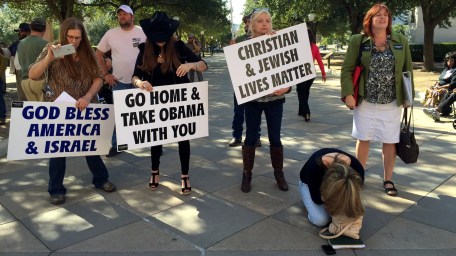 This is happening just as a time when the number of White self-identified Christians is dwindling. Yet, with the party of white supremacy and its current torch holder we see their radical agenda driving policy.
The future of religion in America is young, non-Christian and technicolor.
Almost every Christian denomination in the U.S. shows signs of growing diversity as white Christians, once the majority in most mainline Protestant and Catholic denominations, give way to younger members, who tend to be of different races, according to a study released Wednesday (Sept. 6) by the Public Religion Research Institute.
Americans are also continuing to move away from organized religion altogether, as atheists, agnostics and those who say they do not identify with any particular religion — the group known as the “nones” — hold steady at about one-quarter (24 percent) of the population.
The study, “America’s Changing Religious Identity,” contacted 101,000 Americans in 50 states, and has an overall margin of error of plus or minus 0.4 percentage points. And while the survey spotlights transformations afoot in many religious groups, it also shows a seismic shift for a long-standing American religious powerhouse: white evangelicals.
“This report provides solid evidence of a new, second wave of white Christian decline that is occurring among white evangelical Protestants just over the last decade in the U.S.,” said Robert P. Jones, PRRI’s CEO and author of “The End of White Christian America.”
“Prior to 2008, white evangelical Protestants seemed to be exempt from the waves of demographic change and disaffiliation that were eroding the membership bases of white mainline Protestants and white Catholics,” he said.
“We now see that these waves simply crested later for white evangelical Protestants.”
 Their numbers have led to enabling the crusade of Kremlin Caligula against all things Barrack Obama. You absolutely must read this essay in The Atlantic by TA-NEHISI COATES. It’s a long read with lots of data and brilliant analysis.
It is often said that Trump has no real ideology, which is not true—his ideology is white supremacy, in all its truculent and sanctimonious power. Trump inaugurated his campaign by casting himself as the defender of white maidenhood against Mexican “rapists,” only to be later alleged by multiple accusers, and by his own proud words, to be a sexual violator himself. White supremacy has always had a perverse sexual tint. Trump’s rise was shepherded by Steve Bannon, a man who mocks his white male critics as “cucks.” The word, derived from cuckold, is specifically meant to debase by fear and fantasy—the target is so weak that he would submit to the humiliation of having his white wife lie with black men. That the slur cuck casts white men as victims aligns with the dicta of whiteness, which seek to alchemize one’s profligate sins into virtue. So it was with Virginia slaveholders claiming that Britain sought to make slaves of them. So it was with marauding Klansmen organized against alleged rapes and other outrages. So it was with a candidate who called for a foreign power to hack his opponent’s email and who now, as president, is claiming to be the victim of “the single greatest witch hunt of a politician in American history.”
In Trump, white supremacists see one of their own. Only grudgingly did Trump denounce the Ku Klux Klan and David Duke, one of its former grand wizards—and after the clashes between white supremacists and counterprotesters in Charlottesville, Virginia, in August, Duke in turn praised Trump’s contentious claim that “both sides” were responsible for the violence.
The largest narrative in this piece tears apart the media narrative that no one understands the poor white working man. It delves into the demographics of Trump vs. Hillary voters and the false narrative that the Democratic Party ignores the working class.
The focus on one subsector of Trump voters—the white working class—is puzzling, given the breadth of his white coalition. Indeed, there is a kind of theater at work in which Trump’s presidency is pawned off as a product of the white working class as opposed to a product of an entire whiteness that includes the very authors doing the pawning. The motive is clear: escapism. To accept that the bloody heirloom remains potent even now, some five decades after Martin Luther King Jr. was gunned down on a Memphis balcony—even after a black president; indeed, strengthened by the fact of that black president—is to accept that racism remains, as it has since 1776, at the heart of this country’s political life. The idea of acceptance frustrates the left. The left would much rather have a discussion about class struggles, which might entice the white working masses, instead of about the racist struggles that those same masses have historically been the agents and beneficiaries of. Moreover, to accept that whiteness brought us Donald Trump is to accept whiteness as an existential danger to the country and the world. But if the broad and remarkable white support for Donald Trump can be reduced to the righteous anger of a noble class of smallville firefighters and evangelicals, mocked by Brooklyn hipsters and womanist professors into voting against their interests, then the threat of racism and whiteness, the threat of the heirloom, can be dismissed. Consciences can be eased; no deeper existential reckoning is required.
This transfiguration is not novel. It is a return to form. The tightly intertwined stories of the white working class and black Americans go back to the prehistory of the United States—and the use of one as a cudgel to silence the claims of the other goes back nearly as far. Like the black working class, the white working class originated in bondage—the former in the lifelong bondage of slavery, the latter in the temporary bondage of indenture. In the early 17th century, these two classes were remarkably, though not totally, free of racist enmity. But by the 18th century, the country’s master class had begun etching race into law while phasing out indentured servitude in favor of a more enduring labor solution. From these and other changes of law and economy, a bargain emerged: The descendants of indenture would enjoy the full benefits of whiteness, the most definitional benefit being that they would never sink to the level of the slave. But if the bargain protected white workers from slavery, it did not protect them from near-slave wages or backbreaking labor to attain them, and always there lurked a fear of having their benefits revoked. This early white working class “expressed soaring desires to be rid of the age-old inequalities of Europe and of any hint of slavery,” according to David R. Roediger, a professor of American studies at the University of Kansas. “They also expressed the rather more pedestrian goal of simply not being mistaken for slaves, or ‘negers’ or ‘negurs.’ ”
This is the same narrative realized in the dynamics of the flee to the Republican Party by Dixiecrats summed up by LBJ.
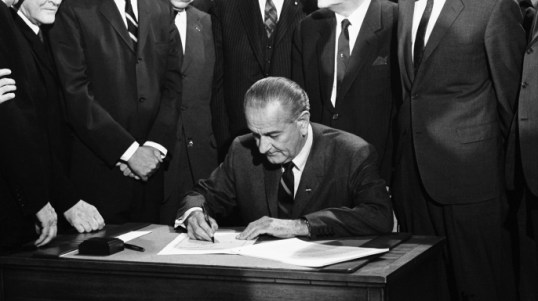
The night that Democratic President Lyndon B. Johnson signed the Civil Rights Actof 1964, his special assistant Bill Moyers was surprised to find the president looking melancholy in his bedroom. Moyers later wrote that when he asked what was wrong, Johnson replied, “I think we just delivered the South to the Republican party for a long time to come.”
It may seem a crude remark to make after such a momentous occasion, but it was also an accurate prediction.
To understand some of the reasons the South went from a largely Democratic region to a primarily Republican area today, just follow the decades of debate over racial issues in the United States.

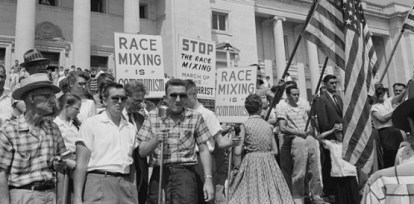
(Original Caption) Only Jeff Davis is Missing. Birmingham, Alabama: Mrs. Beulah Waller, 77, of Byron, Ga., wildly waves a confederate flag as Dixie Democrats go about the business of seceding from the Democratic Party. The rump convention, called after the Democrats had attached President Truman’s civil rights program to the party platform, placed Governor J. Strom Thurmond of South Carolina and Governor Fielding L. Wright of Mississippi in nomination. Eugene “Bull” Conner, city commissioner of Birmingham, is at extreme right.
You can read or watch more on this at the History Channel in a special on the Civil Rights movement and the signing of Civil Rights legislation in 1964. There is actually plenty of evidence that Pastors and not Politicians turned Dixiecrats Republicans. The wing nuttery of the Trumpsters is the wing nuttery of white supremacists wrapped up in a warped form of fundamentalist christianity. They are both forms of facism and they are natural allies.
Crediting the Nixon campaign with the flight of Southern conservatives from the Democratic Party dismisses the role Southerners themselves played in that transformation. In fact, Republicans had very little organizational infrastructure on the ground in the South before 1980, and never quite figured out how to build a persuasive appeal to voters there. Every cynical strategy cooked up in a Washington boardroom withered under local conditions. The flight of the Dixiecrats was ultimately conceived, planned, and executed by Southerners themselves, largely independent of, and sometimes at odds with, existing Republican leadership. It was a move that had less to do with politicos than with pastors.
Southern churches, warped by generations of theological evolution necessary to accommodate slavery and segregation, were all too willing to offer their political assistance to a white nationalist program. Southern religious institutions would lead a wave of political activism that helped keep white nationalism alive inside an increasingly unfriendly national climate. Forget about Goldwater, Nixon or Reagan. No one played as much of a role in turning the South red as the leaders of the Southern Baptist Church.
There is still today a Southern Baptist Church. More than a century and a half after the Civil War, and decades after the Methodists and Presbyterians reunited with their Yankee neighbors, America’s largest denomination remains defined, right down to the name over the door, by an 1845 split over slavery.
Spirituality may be personal, but organized religion, like race, is a cultural construct. When you’ve lost the ability to mobilize supporters based on race, religion will serve as a capable proxy. What was lost under the banner of “segregation forever” has been tenuously preserved through a continuing “culture war.” A fight for white nationalism and white cultural supremacy has in some ways been more successful after its transformation into an expressly religious, rather than merely racist crusade.
 You can also see the Republican Party’s drive to disenfranchise people of color by their crusade removing access to Voting. Disenfranchising racial minorities and limiting poll access is key to White hegemony. Kris Kobach is obsessed with the idea that outsiders are still elections in traditionally white voting enclaves that Kobach believes must’ve been stolen because after all, all white people think like him except the minority rotting away in big cities. He’s also being empowered by the Kremlin Kaligula Krewe.
Writing for Breitbart, Kobach picks up a story from the Washington Times about voting in New Hampshire last year. That state has been a focus of voter-fraud conspiracy theories for two primary reasons: (1) It was close and (2) Trump didn’t win it. (In Michigan, a state he did win and where the percentage-point margin was even narrower, no one allied with Trump has raised a question at all. In fact, his lawyers asserted in a anti-recount lawsuit in that state that “all available evidence suggests that the 2016 general election was not tainted by fraud or mistake.”)
New Hampshire has also been a focus of fraud allegations because it has same-day voter registration, allowing people to show up to a polling place to vote even if they hadn’t registered in advance. This is the focus of the Times piece, and of Kobach’s failing freshman logic paper at Breitbart.
The Times presents numbers released by the Republican speaker of the New Hampshire House, which we quote directly below:
- 6,540 people registered and voted on Nov. 8, based on presenting out-of-state licenses.
- As of Aug. 30, about 15 percent (1,014 of the voters) had been issued New Hampshire driver’s licenses.
- Οf the remaining 5,526, barely more than 200 (3.3 percent) had registered a motor vehicle in New Hampshire.
So: some 5,313 voters registered with out-of-state licenses but hadn’t then registered a car within 10 months.
Now, here’s Kobach:
“So 5,313 of those voters neither obtained a New Hampshire driver’s license nor registered a vehicle in New Hampshire. They have not followed the legal requirements for residents regarding driver’s licenses, and it appears that they are not actually residing in New Hampshire. It seems that they never were bona fide residents of the State.”
And then he’s off to the races: It’s likely that the results of the Senate race are tainted! It’s possible that New Hampshire’s electoral votes went illegally to Hillary Clinton!
 John le Carré is an author focused on bringing his experience as a British Spy to cold war spy fiction. He’s given an speech covered by The Guardian. John le Carré on Trump: ‘Something seriously bad is happening’ Author draws parallels between Donald Trump and rise of 1930s fascism, in rare public appearance at Royal Festival Hall
John le Carré, one of Britain’s greatest living writers,has spoken of the “toxic” parallels between the rise of Donald Trump and the rise of 1930s fascism.
In a rare public appearance, the 85-year-old novelist and former spy spoke of his disdain for Trump and his despair for the US and the wider world.
“Something truly, seriously bad is happening and from my point of view we have to be awake to that,” he told an audience at the Royal Festival Hall in London.
“These stages that Trump is going through in the United States and the stirring of racial hatred … a kind of burning of the books as he attacks, as he declares real news as fake news, the law becomes fake news, everything becomes fake news.
“I think of all things that were happening across Europe in the 1930s, in Spain, in Japan, obviously in Germany. To me, these are absolutely comparable signs of the rise of fascism and it’s contagious, it’s infectious. Fascism is up and running in Poland and Hungary. There’s an encouragement about.”
Even today, Le Carré said, Ang Sang Suu Kyi is speaking of “fake news” in Burma. “These are infectious forms of demagogic behaviour and they are toxic.”
Is it too much to ask that we throw all these ideologies to the ashbin of history in the age of weapons of mass destruction and the ability of mankind to forever scar the planet? There is no place for these ideas that seek to raise up the self worth and paths of some people over those of others when we need every one’s cooperation to keep the peace and save the planet. It’s not moral to enable them to do it. We must stop this assault on Civil Rights.
What’s on your blogging and reading list today?
Thursday Reads
Posted: September 7, 2017 Filed under: morning reads, U.S. Politics | Tags: Bernie Sanders, Boston, Chuck Schumer, Democrats, Donald Trump, Donald Trump Jr, Facebook, Florida hurricane preparations, future floods, Hillary Clinton book tour, Hurricane Irma, Hurricane Jose, Mitch McConnell, Nancy Pelosi, Paul Ryan, Russia investigation, Russian trolls, Senate Judiciary Committee, states of emergency 41 Comments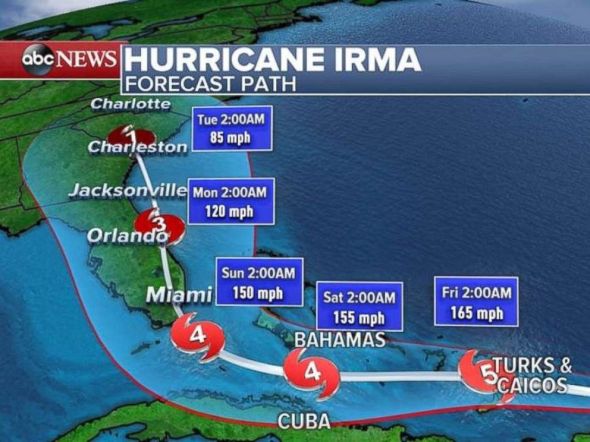
Good Morning!!
Hurricane Irma is still headed for Florida and then will move up the coast. The Weather Channel: States of Emergency Issued, Evacuations Ordered as Florida, Georgia, Carolinas Prepare for Irma.
As the dangerous Category 5 Hurricane Irma barrels toward southeast of Florida, officials in the Sunshine State, Georgia and the Carolinas have declared disasters and ordered evacuations.
The storm, which has undergone rapid intensification in the past several days is now the strongest Atlantic hurricane in the last 10 years, a dangerous Category 5, which made landfall overnight packing winds of 185 mph on the Caribbean island of Barbuda.
“The storm is massive and the storm surge is predicted to go for miles. In some instances, it could cover homes and go very far inland,” Scott said.
He urged urgent preparation:
- “Every family needs to have a plan. …Do not sit and wait. Prepare right now.”
- “Do not ignore evacuation orders.”
- “Take what you need to evacuate. Don’t take extra.”
Read more about Florida’s preparations at the link.
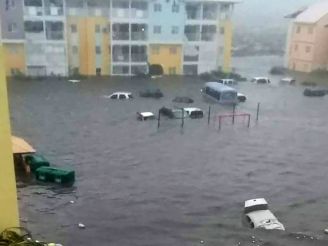
Cars sit on a flooded street on the island of Saint-Martin after Hurricane Irma passed through
The Miami Herald: South Florida comes under hurricane watch with weekend strike likely.
South Florida came under hurricane and storm surge watches Thursday morning as powerful Hurricane Irma steamed toward the peninsula on track for a weekend strike.
Tropical storm force winds could begin battering the Keys and South Florida Saturday afternoon, National Hurricane Center forecasters said in their latest advisory. The fierce center of the Cat 5 storm is also increasingly likely to plow across the state’s crowded east coast, and it’s more than 6 million residents, in three to four days.
The hurricane and storm surge watches cover much of the South Florida coast, from Jupiter Inlet south and up the west coast to Bonita Beach, including the Keys. Water levels could reach from between five and 10 feet above ground level in the storm surge watch area, forecasters said.
Because Irma is such a large hurricane, the storm surge could be widespread and life-threatening, said senior hurricane specialist Mike Brennan, with waters moving further inland along the Gulf.
Presumably, the storm will keep moving on up the coast. It’s not clear yet how it will impact us up here in New England, but environmental experts are trying to prepare Boston for future storms as the sea level rises from climate change. The Boston Globe: What a future sea barrier in Boston would look like.
According a city-sponsored report published last December, sea levels are forecasted to rise eight inches from 2000 to 2030 due to climate change. By 2050, they are expected to increase up to 1.5 feet — and by 2070, up to three feet.
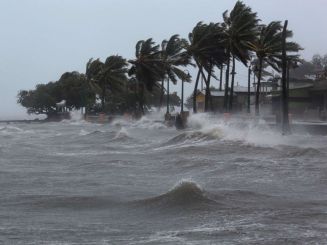
Palm trees buckle under winds and rain as Hurricane Irma slammed across islands in the northern Caribbean on Wednesday, in Fajardo, Puerto Rico Sept. 6, 2017.
The chances of a Harvey-esque 50 inches of rain are minuscule in Boston. But with the expected sea level rise, a one-in-100- or one-in-10-year storm (Harvey was a one-in-1,000-year storm) would put many Boston neighborhoods underwater, according to the report, Climate Ready Boston. Even monthly high tides would flood 5 percent of the city’s real estate market value toward the end of the century, officials said.
With the sea level rise expected within roughly 30 to 50 years, major storms could make neighborhoods including East Boston, the South End, and the Seaport “unviable.” This interactive map shows what exact places could be threatened (and it doesn’t look great for Faneuil Hall).
“You’re not going to escape it,” Curt Spalding, New England’s regional administrator for the Environmental Protection Agency, told Boston.com last year regarding sea level rise, after Boston’s waterfront was inundated by simple king tides.
According to a 2013 report by the World Bank, Boston ranked eighth out of 136 coastal cities for risk of flood damage.
Local officials are thus faced with a dilemma: how to manage the characteristic that historically made Boston a thriving commercial hub — its favorable port location — when that same asset now contributes to a potentially existential threat?
Head to the Globe to read the rest. I imagine many coastal cities are looking at possible protections from future flooding.
Donald Trump Jr. is being interviewed by investigators from the Senate Judiciary Committee this morning. MSNBC reports that he has changed his story again–now claiming he took a June 2016 meeting with Russians to get information that would help him assess Hillary Clinton’s “fitness for office.” From The New York Times:
Donald Trump Jr., the president’s eldest son, is set to meet with Senate Judiciary Committee investigators behind closed doors on Thursday to answer questions about his June 2016 meeting with a Kremlin-connected lawyer, committee officials said.
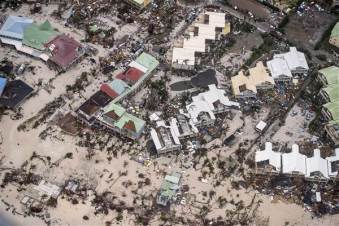
Homes are damaged after Hurricane Irma struck in Philipsburg, on the Dutch Caribbean island of St. Martin on Sept. 6, 2017. Netherlands Ministry of Defense via AFP – Getty Images
Committee aides said the interview, Mr. Trump’s first with congressional investigators, will be transcribed and could last for much of the day. It will largely focus on the meeting in Trump Tower, which appears to have been set up to deliver harmful information about Hillary Clinton to the Trump campaign, according to emails disclosed in June.
Democrats, led by Senator Dianne Feinstein of California, the committee’s top-ranking Democrat, said on Wednesday that Mr. Trump had also agreed to testify at a public hearing before the committee and that he would probably be subpoenaed if he did not follow through on that agreement. Senator Charles E. Grassley of Iowa, the panel’s chairman, declined to discuss the committee’s dealings with Mr. Trump. Lawyers for Mr. Trump could not be reached for comment.
The closed-door interview is the clearest indication yet that the Senate Judiciary Committee — after months of being eclipsed by the Senate and House intelligence committees — is emerging into a higher-profile role in investigating the president, his family and his associates in the coming months.
The committee is trying to get answers about the firing of James B. Comey as F.B.I. director this spring and has staked out a broad investigation that aims to look at everything from the Trump campaign’s interactions with Russia to the Obama Justice Department’s handling of the Clinton email case last year.
More Russia news broke last night in The Washington Post: Russian firm tied to pro-Kremlin propaganda advertised on Facebook during election.
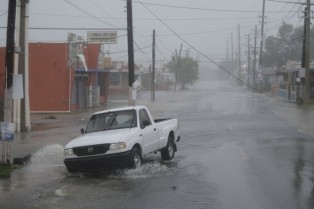
Sea water rises to a water deck as hurricane Irma approaches Puerto Rico in Fajardo. Ricardo Arduengo AFP Getty Images
Representatives of Facebook told congressional investigators Wednesday that the social network has discovered that it sold ads during the U.S. presidential campaign to a shadowy Russian company seeking to target voters, according to several people familiar with the company’s findings.
Facebook officials reported that they traced the ad sales, totaling $100,000, to a Russian “troll farm” with a history of pushing pro-Kremlin propaganda, these people said.
A small portion of the ads, which began in the summer of 2015, directly named Republican nominee Donald Trump and Democrat Hillary Clinton, the people said, although they declined to say which candidate the ads favored.
Most of the ads, according to a blog post published late Wednesday by Facebook’s chief security officer, Alex Stamos, “appeared to focus on amplifying divisive social and political messages across the ideological spectrum — touching on topics from LGBT matters to race issues to immigration to gun rights.”
The acknowledgment by Facebook comes as congressional investigators and special counsel Robert S. Mueller III are probing Russian interference in the U.S. election, including allegations that the Kremlin may have coordinated with the Trump campaign.

Read more at the WaPo.
The other big story from last night is that Trump suddenly aligned himself with Nancy Pelosi and Chuck Schumer on raising the debt ceiling and threw Paul Ryan and Mitch McConnell under the bus. Ryan Lizza at The New Yorker: How Democrats Rolled Trump on the Debt Ceiling.
A man drives through rain and strong winds during the passage of hurricane Irma, in Fajardo, Puerto Rico, Wednesday, Sept. 6, 2017.
For weeks, Chuck Schumer, the Senate Minority Leader, had been plotting a strategy to use the debt-ceiling vote to extract concessions from Donald Trump and his fellow-Republicans. Over the weekend, the White House and Senate Republicans indicated that they wanted a debt-ceiling increase attached to a bill to provide immediate aid for areas of Texas and Louisiana affected by Hurricane Harvey. The plan was perfect for the G.O.P. The House would pass a “clean” debt ceiling that most Republicans would probably support. In the Senate, Mitch McConnell, the Majority Leader, would add the Harvey money and pass the two bills together with the help of Democrats. The plan was to raise the debt ceiling for eighteen months, which would kick the next difficult vote past the 2018 midterm elections. In the House, such a bill likely would have lost some votes from both parties, but, given the urgency of the hurricane aid, it was a decent bet to pass. Best of all, for G.O.P. leaders, the bill would have taken away the Democrats’ debt-ceiling leverage from the coming debates on immigration, government spending, and health care.
But, when conservative Republicans came out vocally against McConnell and Ryan’s plan, Schumer and Nancy Pelosi, the top Democrat in the House, saw an opening. They called for the three-month debt-ceiling deal, which would kick the issue into mid-December, allowing them to maintain their leverage as Congress worked out agreements on other agenda items.
At his morning press conference, Ryan had been withering about this idea. “Let’s just think about this,” he said. “We’ve got all this devastation in Texas. We’ve got another unprecedented hurricane about to hit Florida. And they want to play politics with the debt ceiling? That will strand the aid that we need to bring to these victims of these storms that have occurred or are about to occur. And then they also want to threaten default on our debt? I think that’s ridiculous and disgraceful that they want to play politics with the debt ceiling at this moment.”
He added that the idea was “unworkable,” and, speaking for Trump, noted, “What the President doesn’t want to do is to give more leverage where it shouldn’t occur on the debt ceiling.”
But Ryan spoke too soon.
An hour later, in the Oval Office, Ryan, McConnell, Schumer, and Pelosi sat down with Trump and Steve Mnuchin, the Treasury Secretary, to negotiate. The Republican leaders—at first—stuck to their demand for an eighteen-month debt-ceiling increase. But the Democrats held fast as the Republicans dropped their request to twelve months and then to six months. Mnuchin argued that the financial markets needed a long-term deal. Trump cut him off and abruptly sided with Schumer and Pelosi on their three-month request.
Read the rest at The New Yorker.
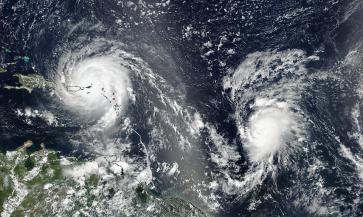
Hurricanes Irma and Jose stacked over the Caribbean and Atlantic on September 6.
Lots of media people are outraged that Hillary Clinton dared to write a book detailing the challenges she faced during the 2016 election. Never mind that Clinton won the popular vote and her book has been number 1 on Amazon for months. Those of us who voted for her are still invisible to the media. Politico: Democrats dread Hillary’s book tour.
President Donald Trump may be the only person in politics truly excited about Hillary Clinton’s book tour.
Democratic operatives can’t stand the thought of her picking the scabs of 2016, again — the Bernie Sanders divide, the Jim Comey complaints, the casting blame on Barack Obama for not speaking out more on Russia. Alums of her Brooklyn headquarters who were miserable even when they thought she was winning tend to greet the topic with, “Oh, God,” “I can’t handle it,” and “the final torture.”
Political reporters gripe privately (and on Twitter) about yet another return to the campaign that will never end. Campaign operatives don’t want the distraction, just as they head into another election season. And members of Congress from both parties want the focus on an agenda that’s getting more complicated by the week.
But with a new NBC News poll showing her approval rating at 30 percent, the lowest recorded for her, Clinton kicks it off on Tuesday with a signing at the Union Square Barnes & Noble in New York. She’ll keep it going all the way through December, all across the country.
Do the Democrats really think they can win elections without Hillary’s hard core supporters? They seem to be going all in with Bernie, who lost to Hillary in the primaries by 4 million votes. Do these people know anything about math?
That’s all I have for you today. What stories are you following?
Tuesday Reads: The Mad Ones
Posted: September 5, 2017 Filed under: morning reads, U.S. Politics | Tags: DACA, Donald Trump, Dreamers program, French Canadians, Hillary Clinton, Hurricane Irma, Jack Kerouac, Jeff Sessions, Lowell MA, Neal Cassady, On the Road 60th anniversary, What Happened? 43 Comments
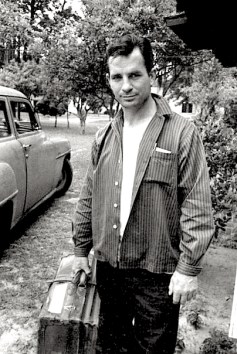
Neal Cassady and Jack Kerouac
“…the only people for me are the mad ones, the ones who are mad to live, mad to talk, mad to be saved, desirous of everything at the same time, the ones who never yawn or say a commonplace thing, but burn, burn, burn like fabulous yellow roman candles exploding like spiders across the stars…”
Good Morning!!
Sixty years ago today On the Road, Jack Kerouac’s second novel was published. It was boosted by Gilbert Millstein’s rave review in The New York Times.
“On the Road is the second novel by Jack Kerouac, and its publication is a historic occasion in so far as the exposure of an authentic work of art is of any great moment in an age in which the attention is fragmented and the sensibilities are blunted by the superlatives of fashion (multiplied a millionfold by the speed and pound of communications).
This book requires exegesis and a detailing of background. It is possible that it will be condescended to by, or make uneasy, the neo-academicians and the ‘official’ avant-garde critics, and that it will be dealt with superficially elsewhere as merely ‘absorbing’ or ‘intriguing’ or ‘picaresque’ or any of a dozen convenient banalities, not excluding ‘off beat.’ But the fact is that On the Road is the most beautifully executed, the clearest and the most important utterance yet made by the generation Kerouac himself named years ago as ‘beat,’ and whose principal avatar he is.
“Just as, more than any other novel of the Twenties, The Sun Also Rises came to be regarded as the testament of the ‘Lost Generation,’ so it seems certain that On the Road will come to be known as that of the ‘Beat Generation.’ There is, otherwise, no similarity between the two: technically and philosophically, Hemingway and Kerouac are, at the very least, a depression and a world war apart….
The ‘Beat Generation’ was born disillusioned; it takes for granted the imminence of war, the barrenness of politics and the hostility of the rest of society. It is not even impressed by (although it never pretends to scorn) material well-being (as distinguished from materialism). It does not know what refuge it is seeking, but it is seeking.
Click on the link to read the rest at the Literary Hub.

Allen Ginsberg with Jack Kerouac
I first read On the Road in 1969 when I was anticipating a cross country trip from Boston to San Francisco in a second-hand van. Years later, I went back to college in Kerouac’s birthplace of Lowell, Massachusetts.
I majored in psychology, but I also took several courses in political science. I did a major research project on Kerouac and his roots in the French Canadian community in Lowell and another psychological study of Kerouac’s literary references to his brother Gerard, who died at age 9 when Jack was only 4.
I also spent years working with the Kerouac community in Lowell, helping to plan the yearly Lowell Celebrates Kerouac Festival. I’ve read nearly every published word that Kerouac wrote, including his letters and poetry. It’s been quite awhile since I’ve read his work, but this morning I’ve been enjoying looking back at those joyous years of discovery in Lowell. I think I’m still one of the “mad ones,” and I’m OK with that.
Earlier this summer The Washington Post published a five-part series on the Beat Generation. Read it here if you’re interested. You can also check out this piece at The Independent: ‘On the Road’ at 60: How Jack Kerouac’s drug-infused prose became a classic of 20th-century literature.
After that trip down memory lane I hate the thought of writing about today’s news, but I’ll d.o it anyway.
The Washington Post: Irma intensifies to an ‘extremely dangerous’ Category 5 hurricane on its track toward the U.S.
Hurricane Irma strengthened overnight to a dangerous Category 5 as it barrels toward the Greater Antilles and Southern Florida. It’s likely that Hurricane Irma will affect the U.S. coast — potentially making a direct landfall — this weekend.
Tuesday morning, NOAA Hurricane Hunters found the storm’s maximum wind speeds are 175 mph. It now ranks among the strongest hurricanes ever recorded in the Atlantic Ocean. Forecasts suggest it will reach southern Florida and the Gulf of Mexico this weekend.
Hurricane warnings have been issued for portions of the Leeward Islands and the Greater Antilles, including Puerto Rico.
Clockwise from far right, Allen Ginsberg, Gregory Corso, the painter Larry Rivers, Jack Kerouac and the musician David Amram.
The National Hurricane Center called Hurricane Irma an “extremely dangerous” storm on Tuesday morning. “Preparations should be rushed to completion in the hurricane warning area,” the forecasters wrote in their 8 a.m. update. Devastating winds, a major storm surge and flash floods are all likely in the Leeward Islands and Puerto Rico in the next 48 hours.
Over the weekend, the forecast track for this potentially devastating hurricane shifted south and west. It seems likely now that the storm will affect or strike the U.S. coast early next week, although meteorologists don’t know exactly where. Florida and the Gulf Coast continue to be at risk. The East Coast, including the Carolinas and the Delmarva Peninsula, are also potential candidates for landfall — or, at the very least, heavy rain, strong winds and coastal flooding.

Trump took the cowardly route to end DACA–Obama’s Dreamers program–sending Jeff Sessions out this morning to make the announcement.
NBC News: Trump Ends DACA Program, No New Applications Accepted.
President Donald Trump’s Justice Department announced Tuesday it would wind down DACA, putting in place a phased termination plan that would give Congress a six-month window to pass legislation that could eventually save the Obama-era program that allowed undocumented immigrants who came to the United States as children to remain in the country.
Under the plan announced by Attorney General Jeff Sessions, the Trump administration will stop considering new applications for legal status dated after Tuesday, but will allow any DACA recipients with a permit set to expire before March 5, 2018, the opportunity to apply for a two-year renewal.
Sessions repeatedly referred to DACA as “unconstitutional” and said “the policy is vulnerable to…legal and constitutional challenges.”
“It is my duty to ensure that the laws of the United States are enforced and that the constitutional order is upheld,” Sessions said in explaining his rationale. “Such an open-ended circumvention of immigration laws was an unconstitutional executive overreach of authority by the executive branch.”
The decision could affect as many as 800,000 Dreamers who have signed up for the program, known as Deferred Action for Childhood Arrivals, since its 2012 inception. Immigrant rights advocates have said 200,000 more have sought DACA status since Trump became president.
Here’s what Jennifer Rubin had to say about this at the Washington Post yesterday: Ending DACA would be Trump’s most evil act.
Some in the media take seriously the notion that he is “conflicted” or “wrestling” with the decision [to end DACA], as though Trump were engaged in a great moral debate. That would be a first for Trump, who counts only winners and losers, never bothering with moral principles or democratic norms. The debate, if there is one, is over whether to disappoint his rabid anti-immigrant base or to, as is his inclination, double down on a losing hand.
The instantaneous backlash on social media Sunday night was a preview of the floodgates of anger that Trump’s decision to end the Deferred Action for Childhood Arrivals program would open. Both Democrats and Republicans have urged him not to end the program; about 70 percent of voters in most polls favor keeping the program. Trump, who likes to think of himself as someone with “heart,” may yet decide to reverse course. If he does not, let’s get a few things straight.
First, let’s not think Trump — who invites cops to abuse suspects, who thinks ex-sheriff Joe Arpaio was “doing his job” when denying others their constitutional rights and who issued the Muslim ban — cares about the Constitution (any of the “twelve” articles). Trump says, “We love the dreamers. … We think the dreamers are terrific.” But in fact he loves the applause he derives from his cultist followers more than anything. Otherwise he’d go to the mat to defend the dreamers and secure their legal status.

Anyone who believes Trump is “conflicted” about this is a fool. He loves hurting people–and the more vulnerable those people are the more he enjoys their suffering.
Ben Smith at Buzzfeed: Why Does Trump Always Shoot The Hostages?
President Trump, cornered, weakened, and apparently unable to get his hands on the usual levers of presidential powers, has adopted pretty much the worst possible strategy for someone trying to wield the power of the most powerful job in the world: He’s shooting the hostages.
Trump can’t seem to get the hard stuff associated with the presidency done. He hasn’t been able to mount a legislative agenda or give federal employees (besides ICE agents and the occasional EPA regulator) the foggiest idea of what he wants them to do. Congress is beyond his control and doesn’t fear him: It slapped him in the face on Russia, and when his allies “burned the ships” to pass a health care bill, his confused conquistadors didn’t make it out.
Kerouac near the end in St. Petersberg FL,with his mother
His remaining political leverage has come largely from the policies left to him as hostages by President Barack Obama: the Paris climate accord, the Iran nuclear deal, the Trans-Pacific Partnership, and, most of all, DACA and the nearly 800,000 sympathetic young Americans it allows to live normal, and sometimes extraordinary, lives.
Trump’s decision to simply kill those Obama-era acts, rather than to even attempt to use them as political leverage, helps explain the surprising weakness of his presidency. It’s far from the only way he’s frittered away his power. But if you are playing a weak political hand, hostages can be a source of enormous power. In the extreme case, it’s why we’re worried about Kim Jong Un. When you threaten to destroy something your political opponents desperately want to preserve, even your enemies will do a deal.

Hillary Clinton’s book What Happened? comes out a week from today. I preordered it and I can’t wait to read it. People were quoting parts of it on Twitter yesterday.
CNN: New Clinton book blasts Sanders for ‘lasting damage’ in 2016 race.
Hillary Clinton casts Bernie Sanders as an unrealistic over-promiser in her new book, according to excerpts posted by a group of Clinton supporters.
She said that his attacks against her during the primary caused “lasting damage” and paved the way for “(Donald) Trump’s ‘Crooked Hillary’ campaign.”
Clinton, in a book that will be released September 12 entitled “What Happened,” said Sanders “had to resort to innuendo and impugning my character” because the two Democrats “agreed on so much.”
“She says a lot in this book, and some of it is going to surprise people. People should buy it, read it, and consider what she constructively lays out. It’s a great read,” a Clinton aide said, asking not be named because they were not authorized to discuss the book.
Clinton’s decision to step back into the spotlight with the book will likely be met with wide praise from many in the Democratic Party, including some of the millions of Democrats who backed her over Trump. But it also could tear at wounds that are still open between the wing of the party Sanders animated and those who backed Clinton.
Those are my offerings for today. What stories are you following?
Monday Reads: Descent into White Trash Resentment and its Trumpian Meanness and Madness
Posted: September 4, 2017 Filed under: Afternoon Reads | Tags: DACA, South Korea 27 Comments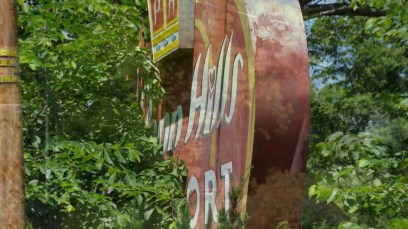 It’s Labor Day!
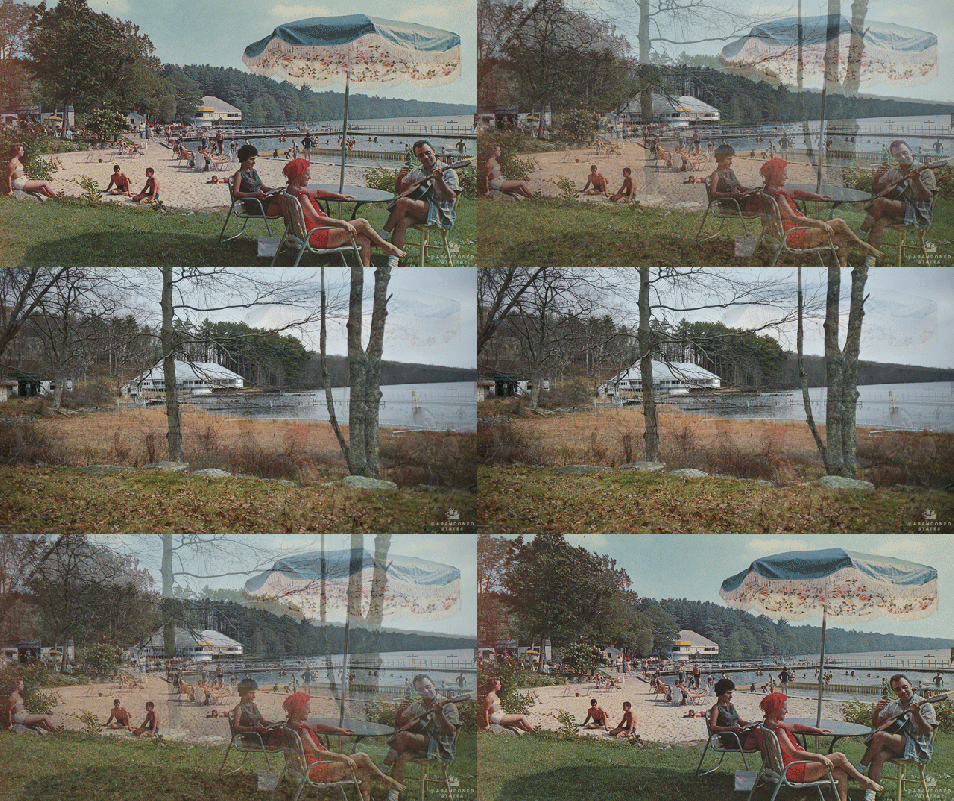
This usually means a last, long summer weekend at the beach or around the mountains. Today’s pictures are from the inspired lens of photographer Seph Lawless and the many photographers that photographed the big Pocono resorts during the 60s and 70s. I feel as though we are losing our American way of life much the way that these grand Poconos resorts have fallen into decay and destruction after giving so much to so many. Go check the photo gallery and narrative.
A photographer is sharing what he calls a “heartbreaking” look at some of the resorts that made the Poconos the “Honeymoon Capital of the World.”
Photographer Seph Lawless shared his photos of Penn Hills Resort, Buck Hill Inn, Summit Resort and Unity House with Fox 8 in Cleveland.
While the resorts became super popular starting back in the 1960s, Lawless says times have changed and “the honeymoon is over.” He said many of the most popular resorts in the area are now empty and abandoned.
 Pablo Iglesias Maurer juxtaposes now vs. then postcards and photos too. He’s written a narrative to accompany the gifs he’s created of the postcard views and his journey to capture their eerie “abandoned states”. It’s quite brilliant.
I found the old matchbook lying on a desk.
It was buried under some papers, beside a thick, water-logged book frozen solid in the January chill. I ran my fingers down its spine and read the title: “How to Run A Successful Golf Course.”
The owner of the Penn Hills Resort in the Poconos probably hadn’t followed whatever advice the author had to offer. They boarded the place up years ago, and there’s a gaping hole in the roof of his old office. Muted greens and yellows, shag carpeting peek at me through a sheet of ice.
The matchbook, which looks to be from the 60’s, is about half empty—whoever was sitting here when this place finally went under surely needed a smoke.Its cover is a reminder of better days. Swimmers are frolicking at the resort’s indoor pool, now a scene of trash, mangled deck chairs, a life preserver. I lock eyes with a huge bullfrog who didn’t make it out. He was entombed in the ice.
The matchbook no longer lines up with reality. I look down through the viewfinder of my camera and up again at the matchbook, aligning the two images the best I can. Up (snap) down (snap). It feels like I’m seeing this place in some sort of dystopian View-Master, each image on the wheel darker than the next.
Weeks later, I score a cache of old postcards from the Poconos and Catskills on eBay, the sort that end up in family albums, stuck in some box in the attic. “Our Honeymoon.” In idyllic scenes at Penn Hills, The Homowack Lodge, Grossinger’s, and a fourth resort in the Poconos which we aren’t identifying, vacation-goers and honeymooners frolic in the mountains.
They have a surreal quality. Ephemeral, disposable, they served only one purpose—to let someone know “I’m here. I’m thinking of you.” It feels a bit like social media does sometimes, where you’ll snap a photo of some vista, sometimes to bring those you care about a bit closer to you. And like social media, the postcards manage to be a little impersonal: “I didn’t quite care enough to write a letter.” It’s analog Foursquare, a non-digital check-in.
 Trumpian madness and meanness means DACA and dreamers have been ground beneath the heel of racism and of destroying Obama’s legacy.
President Donald Trump has decided to end the Obama-era program that grants work permits to undocumented immigrants who arrived in the country as children, according to two sources familiar with his thinking. Senior White House aides huddled Sunday afternoon to discuss the rollout of a decision likely to ignite a political firestorm — and fulfill one of the president’s core campaign promises.
The administration’s deliberations on the issue have been fluid and fast moving, and the president has faced strong warnings from members of his own party not to scrap the program.
Trump has wrestled for months with whether to do away with the Deferred Action for Childhood Arrivals, known as DACA. But conversations with Attorney General Jeff Sessions, who argued that Congress — rather than the executive branch — is responsible for writing immigration law, helped persuade the president to terminate the program and kick the issue to Congress, the two sources said.
In a nod to reservations held by many lawmakers, the White House plans to delay the enforcement of the president’s decision for six months, giving Congress a window to act, according to one White House official. But a senior White House aide said that chief of staff John Kelly, who has been running the West Wing policy process on the issue, “thinks Congress should’ve gotten its act together a lot longer ago.”
White House aides caution that — as with everything in the Trump White House — nothing is set in stone until an official announcement has been made.
Trump is expected to formally make that announcement on Tuesday, and the White House informed House Speaker Paul Ryan of the president’s decision on Sunday morning, according to a source close to the administration. Ryan had said during a radio interview on Friday that he didn’t think the president should terminate DACA, and that Congress should act on the issue.
Kremlin Caligula continues to attack and baffle long time allies of our country. From Wapo “Seoul tries to ignore Trump’s criticism: ‘They worry he’s kind of nuts,’ one observer says.”
After North Korea conducted its nuclear test Sunday, Trump tweeted: “South Korea is finding, as I have told them, that their talk of appeasement with North Korea will not work, they only understand one thing!”
Trump did not talk to Moon on the phone Sunday — in stark contrast to the two calls he had with Shinzo Abe, the prime minister of Japan and a leader who has proven much more willing to agree with his American counterpart. This will worsen anxieties in Seoul that Tokyo is seen as “the favorite ally,” analysts said.
Moon, who was elected in May, advocated engagement with North Korea but has also acknowledged the need for pressure to bring the Pyongyang regime back to talks. He has also come around to an agreement between his predecessor and the U.S. military to deploy an antimissile system in South Korea.
Trump’s tweet was widely reported across South Korean media, and Moon’s office responded to the tweet with a measured statement Sunday night.
“South Korea is a country that experienced a fratricidal war. The destruction of war should not be repeated in this land,” it said. “We will not give up and will continue to push for the denuclearization of the Korean Peninsula through peaceful means working together with our allies.”
 It says a lot that a country brutally occupied by Japan less than a century ago thinks more of their friendship than of ours. But then check out Moyers & Company’s montage of “What Trump and his Team have wrecked so far” written by Karin Kamp and Kristin Miller.
Policy attacks on US Labor have been unbelievable given Trump’s populist rants at rallies.
A few months ago, President Donald Trump devoted his weekly address to the beleaguered American employee. “For too long, American workers were forgotten by their government — and I mean totally forgotten,” he said. “My administration has offered a new vision. The well-being of the American citizen and worker will be placed second to none.”
No doubt he’ll come up with more pro-worker blather for Labor Day. Don’t listen. The only way Trump is helping the average employee is if you consider The Simpsons’ Mr. Burns a working stiff.
The rollback of labor rights and protections since Trump took office is staggering. It puts worker safety at risk and guarantees that many workers will earn less, but that’s not all. Measures to help victims of discrimination receive redress are on the scrap heap. Unions are running scared. “It’s a death by a thousand cuts,” explains Heidi Shierholz, a senior economist at the Economic Policy Institute.
Last week, as most of us in the United States were riveted by Hurricane Harvey’s descent on Texas, the Occupational Safety and Health Administration removed from its Internet home page a list of workers who died as a result of workplace injuries, burying it deep within the website. At the same time, it changed how the list is compiled; it will now only include instances where the company was cited for safety violations leading to a worker’s death. Details such as the name of the deceased worker are also no longer considered worthy of inclusion. The Atlanta Journal-Constitution worked out that of the at least 32 Georgia workers it determined died as a result of work-related injuries since October 1 of last year, only two even get a mention on the new list.
 This is the state of our Union. The “US has regressed to developing nation status, MIT economist warns Peter Temin who “says 80 per cent of the population is burdened with debt and anxious about job security”.
America is regressing to have the economic and political structure of a developing nation, an MIT economist has warned.
Peter Temin says the world’s’ largest economy has roads and bridges that look more like those in Thailand and Venezuela than those in parts of Europe.
In his new boo.k, “The Vanishing Middle Class”, reviewed by the Institute for New Economic Thinking, Mr Temin says the fracture of US society is leading the middle class to disappear.
The economist describes a two-track economy with on the one hand 20 per cent of the population that is educated and enjoys good jobs and supportive social networks.
On the other hand, the remaining 80 per cent, he said, are part of the US’ low-wage sector, where the world of possibility has shrunk and people are burdened with debts and anxious about job security.
Mr Temin used a model, which was created by Nobel Prize winner Arthur Lewis and designed to understand developing nations, to describe how far inequalities have progressed in the US.
When applied to the US, Mr Temin said that “the Lewis model actually works”.
He found that much of the low-wage sector had little influence over public policy, the high-income sector was keeping wages down to provide cheap labour, social control was used to prevent subsistence workers from challenging existing policies and social mobility was low.
 It isn’t black and brown people doing this to white America. It’s the Trumps of the country doing it to the rest of us. Jamelle Bouie–writing for Slate says it best. “Trump has never been less popular—and never more clearly the head of a party of racial resentment.”
Seven months into his presidency, Donald Trump is deeply unpopular. In Gallup’s latest poll of presidential job approval, he’s down to 34 percent, a level unseen by most presidents outside of an economic disaster or foreign policy blunder. In FiveThirtyEight’s adjusted average of all approval polling, he stands at 37 percent. And yet, few Republican lawmakers of consequence are willing to buck him or his agenda, in large part because their voters still support the president by huge margins. What we have clearer evidence of now is why. From polling and the behavior of individual politicians, it’s become harder to deny that people support the president not just for being president, but for his core message of white resentment and grievance—the only area where he has been consistent and unyielding.
You see broad Republican allegiance to Trump in the polling. Nearly 70 percent of Republicans say they agree with Trump on the issues. And 78 percent of Republicans say they approve of the president’s overall job performance. Republicans who have bucked or criticized Trump, like Sen. Jeff Flake of Arizona, have jeopardized their political futures as a result.
You also see the degree to which white racial resentment is a key force among Republican voters. Most Republicans, remember, agreed with President Trump’s response to the violence in Charlottesville, Virginia, where he held both sides—white supremacists and counterdemonstrators—responsible for the chaos that claimed the life of one anti-racist protester. In an analysis of recent polling, my colleague William Saletan observes that, across a number of questions gauging racial animus, Republicans generally (and Trump supporters specifically) are most likely to give answers signaling tolerance for racism and racist ideas. Forty-one percent of Republicans, for example, say that whites face more discrimination than blacks and other nonwhite groups (among strong Trump supporters, it’s 45 percent). Ten percent of Republicans and 19 percent of strong Trump supporters have a favorable impression of white nationalists, while 13 percent of the former (and 17 percent of the latter) say it’s “acceptable” to hold white supremacist views.
 Trump wants tariffs and trade wars. He insults our friends. He is willing to throw US nurses, soldiers, workers and students out of the only country and home they have known. His dream is that of a country in ruin and a palace of gold for him and his.
Have a good holiday!

 peej
peej Carissa
 bostonboomer
 dakinikat
 ecocatwoman
 mablue2
 Mama Lopez
 peggysue22
 quixote
 skydancingguestblogger
 Mona (aka Wonk the Vote)



 Sky Dancing
Recent Comments