
Friday: Exit World Stage Right
Posted: June 2, 2017 Filed under: Afternoon Reads 45 Comments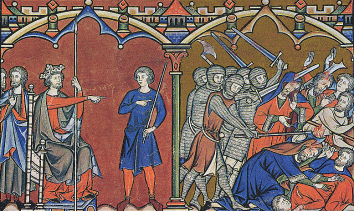 Merry Meet
Sky Dancers!
It’s no longer morning in America or any place else for that matter. We’re watching our country abdicate its global, humanitarian and moral leadership positions like Greenland sheds ice mass. Why is this country suffering due to the angst of small groups of white, backwater American voters and a cabal of Billionaire thugs? It amazes me that the concerns, well-being and health of so much is being determined by so few. You would think we were back in the days of fiefdoms.
Kremlin Caligula’s decisions to pull out of the Paris Accord placing the US along sides Syria and Nicaragua will go down as one of the worst policy decision this country has ever seen. It may be as bad as the Iraq Invasion and will at least be equal to Hoover’s economic policies that sent the US economy tailspinning into the Great Depression. Putin must be delirious with joy.
As promised, Trump stepped to the podium in the Rose Garden on Thursday afternoon, announcing that the United States would leave the Paris accord. The decision will have serious, irreversible repercussions for the United States and the world.
The president’s justifications for leaving the agreement are also just plain wrong.
First, contrary to the president’s assertions, America’s hands are not tied and its sovereignty is not compromised by the Paris climate pact. The Paris agreement is an accord, not a treaty, which means it’s voluntary. The genius (and reality) of the Paris agreement is that it requires no particular policies at all — nor are the emissions targets that countries committed to legally binding. Trump admitted as much in the Rose Garden, referring to the accord’s “nonbinding” nature. If the president genuinely thinks America’s targets are too onerous, he can simply adjust them (although we believe it would be shortsighted for the administration to do so). There is no need to exit the Paris accord in search of a “better deal.” Given the voluntary nature of the agreement, pulling out of the Paris deal in a fit of pique is an empty gesture, unless that gesture is meant to be a slap in the face to every single U.S. ally and partner in the world.
The second big lie is that the Paris agreement will be a job killer. In fact, it will help the United States capture more 21st-century jobs. That is why dozens of U.S. corporate leaders, including many on the president’s own advisory council, urged him not to quit the agreement. As a letter sent to the White House by ExxonMobil put it, the agreement represents an “effective framework for addressing the risk of climate change,” and the United States is “well positioned to compete” under the terms of the deal.
Action on climate and economic growth go hand in hand, and are mutually reinforcing. That is why twice as much money was invested worldwide in renewables last year as in fossil fuels, and why China is pouring in billions to try to win this market of the future. A bipartisan group of retired admirals and generals on the CNA Military Advisory Board is about to release a report that will also spell out the importance of competitiveness in advanced energy technologies — not just to the economy, but also to the country’s standing in the world. Pulling out of climate will result in a loss of U.S. jobs and knock the United States off its perch as a global leader in innovation in a quickly changing global economic climate.
The rationale for ditching America’s commitment to the Paris accord just doesn’t hold up. Moreover, Trump’s decision to withdraw from the Paris Agreement comes with several serious and lasting consequences for the United States and the world:
The Trump administration is hastening catastrophic effects of climate change. Scientists and economists now state with confidence that the failure to act to arrest and mitigate global climate change will have devastating global consequences, including for young Americans alive today and for their children and grandchildren. Donald Trump himself may well live to see more climate-related catastrophes hit the homeland. His children and grandchildren certainly will.
Americans all over this country are already seeing the changes — storms are more severe, big floods come more often, and in the most extreme case, Arctic waters are melting and opening up sea lanes for the first time in recorded history. Trump saw the damage from Hurricane Sandy firsthand, a preview of what climate change has in store for future generations.
Heading off the worst effects of climate change requires global action: Action by one country alone, no matter how powerful, cannot address the threat. But our country, one of the world’s two largest carbon emitters, does have significant power to improve not just our own climate, but the world’s — and Trump’s decision takes us in the wrong direction. That’s especially tragic in light of the signature achievement of the Paris Agreement, which was to get every country on board; now China and India have made the same commitments the United States and other highly developed countries have. It binds us all together through a political agreement — but the strength of that agreement depends on all of us meeting our nationally determined responsibilities.
 Probably the most significant foreign policy thing about the abandonment of this treaty along side abandoning trade agreements in Asia is that China will undoubtedly fill the leadership void. Look for fireworks and parades in Beijing. We’ve managed to undo World Order in a very short period of time.
Ceding U.S. leadership to the Chinese on this issue is likely to have political and economic costs. China, like Russia, sees value in any division between the United States and Europe — as a rising power it would rather negotiate with us separately rather than collectively. Europeans grateful to China for its continued partnership on climate will be less concerned to take account of U.S. interests with respect to, say, China’s harmful industrial policy, human rights violations, or economic and military coercion expansionism in Asia. European deals with China for the production of infrastructure and equipment related to renewable energy will surely follow. Pulling out of Paris will weaken our geopolitical standing – and complicate our efforts to work with our partners and allies to manage a rising China. Other nations that see themselves as bearing the brunt of climate change, including those of strategic importance to the United States — such as Vietnam, the Philippines, or much of Africa — will now see China as part of the solution to their problem.
Pulling out of Paris will likely result in creating jobs in China that could have been created here in the United States. It will give Chinese and other countries’ companies a leg up in the growing and competitive green economy, putting U.S. companies at a serious disadvantage. The industry and the jobs of the future are in renewables — why would we cede any of that ground to Chinese, Indian, and European companies? The United States will be relegated from a global leader, economically and otherwise, to a member of a lonely camp of pariah countries that haven’t signed this global pact, together with only Syria and Nicaragua. America First? Hardly.
Withdrawing from Paris will damage U.S. standing in the world. Pulling out of Paris will call into question the word of the United States and weaken our ability to call on other countries to work with us on other global threats, such as global terrorism and global pandemics. International agreements are not irrevocable; indeed this one, which the United States had a heavy hand in creating, was crafted carefully as a series of nationally determined, voluntary commitments precisely in order to gain worldwide support, and with the understanding that countries can adjust their commitments as needed. Walking away from that agreement sends a clear — and foolhardy — message to all other countries around the world: Don’t trust the United States.
And why should they, if we so evidently signal that U.S. foreign policy is utterly politicized, and that agreements signed with one administration will not be honored by the next. It is firmly in the U.S. interest to have others’ trust — and for us to be able to demand in return — the durability of agreements, even when governments change. As a chief architect and moral leader of the post-World War II order, our own behavior with respect to agreements and international law sets the example. If the most powerful country in the world has suddenly decided that signing and living up to an agreement no longer matters, why should it matter to other states?
 We are becoming a medieval castle on a solitary hill. We’re shunning modernity and science for appointments to courts that will instill Grand Inquisitors and the religion that brought you the Dark Ages and the Black Plague. We might as well burn cow pies in the fireplace and return our lighting system to whale oil. That is what trying to rescue the moribund coal industry at the cost of the future of alternative energies will be to our economy. I can’t even believe what it could do to our planet. The only good thing is that the big important states like California with economies that are as large as most of the world’s countries are unlikely to stop progress.
We’re beginning to see more examples of what motivates President Swiss Cheese for Brains. The first motivation appears to be removing any sign of President Obama’s policies and successes and rebranding them with slight of hand with the t-Rump name. The majority of us are not fooled. What are the possible reasons for this tragic decision?
The most revealing moment of President Trump’s announcement that he is withdrawing from the Paris climate deal came in an off-hand response of a White House official after Trump’s speech. Asked whether Trump thinks climate change is real, the official said: “Can we stay on topic?”
Why this matters: To the Trump administration, the Paris climate deal has nothing to do with climate change. It’s an economic issue. To Trump, withdrawing from the accord represents a triumph of populist America over greedy globalism.
Unlike other policy goals (healthcare and tax reform) Trump isn’t even acknowledging climate change is a problem. That makes his overtures about being open to renegotiate and re-enter the Paris deal suspect. Speaking after Trump, administration officials didn’t offer any specific ways in which Trump would do that, with one official beginning but not finishing the following sentence before switching topics: “You’ll see actions in the coming weeks…”
 There’s speculation that the young, new French Prime Minister’s taunts of Kremlin Caligula over the weekend which included direct discussion of the herky jerky handshake may have offset the voices of Ivanka and America’s CEOs. Donald Trump is ‘trolling the world’ and those of us who didn’t fall for his argle bargle.
Trump’s move won’t have much impact on emissions in the short term, and probably not even in the long term. His claims that the Paris agreement would force businesses to lay off workers and consumers to pay higher energy prices were transparently bogus, because a nonbinding agreement wouldn’t force anything. But Trump’s move to abandon it will have a huge impact on the global community’s view of America, and of a president who would rather troll the free world than lead it.
Of course, trolling the world is the essence of Trump’s America First political brand, and Thursday’s announcement reinforced his persona as an unapologetic rebel who won’t let foreigners try to tell America what to do, even when major corporations, his secretary of state, and his daughter Ivanka want him to do it. He was also leaning into his political identity as Barack Obama’s photographic negative, dismantling Obama’s progressive legacy, kicking sand in the wimpy cosmopolitan faces of Obama’s froufrou citizen-of-the-world pals.
But it’s important to recall what Obama did and didn’t do when he led the community of nations to a deal in Paris. He didn’t let the world dictate U.S. energy policy, because Paris is only a mechanism for announcing national commitments to cut emissions, not for enforcing those commitments. He didn’t commit America to unrealistically ambitious emissions goals, either, just a 27 percent reduction from 2005 levels by 2025, not that drastic considering that the U.S. led the world in emissions before Obama and led the world in emissions reductions under Obama. Our electricity sector has already achieved that 27 percent goal, thanks to the continuing decline of coal power, and while our transportation sector has a long way to go, Obama’s strict fuel-efficiency standards and the expansion of electric vehicles has it heading in the right direction. The real triumph of Paris wasn’t America’s promises; it was the serious commitments from China, India and other developing nations that had previously insisted on their right to burn unlimited carbon until their economies caught up to the developed world.
Similarly, it’s important not to exaggerate the substantive impact of Trump’s decision to bail on Paris, which will officially remove the United States from the agreement in late 2020 at the earliest. It’s a signal that the U.S. government no longer cares about the climate, but that’s been abundantly clear ever since Trump won the election and appointed an energetic fossil-fuel advocate named Scott Pruitt to run the Environmental Protection Agency. Leaving Paris won’t reverse the rapid decline of coal or the boom of cleaner energy in America, because the economics of coal have fallen apart while the cost of wind and solar have plummeted, and it won’t stop that same trend in China, India and the rest of the world. By the same token, if Trump had announced he was staying in the Paris deal, that wouldn’t have meant that Trump was abandoning his efforts to gut Obama’s climate regulations (like the Clean Power Plan for the electricity sector) and other climate policies (like those fuel efficiency standards for cars and trucks). Really, it would have been pretty weird for Trump to remain in the deal while trying to undermine everything the U.S. was doing to live up to its commitments.
 If Russia has invested in the T-Rump Family Crime Syndicate to destabilize the US and its influence in the world, then that’s been an investment with an incredible return. T-Rump shows that ignorance and lies rule the White House.
“We’re getting out, but we will start to negotiate, and we will see if we can make a deal that’s fair.”
Each country set its own commitments under the Paris Accord, so Trump’s comment is puzzling. He could unilaterally change the commitments offered by President Barack Obama, which is technically allowed under the Accord. But there is no appetite to renegotiate the entire agreement, as made clear by various statements from world leaders after his announcement.
“China will be allowed to build hundreds of additional coal plants. So, we can’t build the plants, but they can, according to this agreement. India will be allowed to double its coal production by 2020.”
This is false. The agreement is nonbinding and each nation sets its own targets. There is nothing in the agreement that stops the United States from building coal plants or gives the permission to China or India to build coal plants. In fact, market forces, primarily reduced costs for natural gas, have forced the closure of coal plants. China announced this year that it would cancel plans to build more than 100 coal-fired plants.
Gary Cohn, chairman of Trump’s National Economic Council, recently told reporters that “coal doesn’t even make that much sense anymore as a feedstock. Natural gas, which we have become an abundant producer, which we’re going to become a major exporter of, is such a cleaner fuel.”
“Compliance with the terms of the Paris accord and the onerous energy restrictions it has placed on the United States could cost America as much as 2.7 million lost jobs by 2025, according to the National Economic Research Associates. This includes 440,000 fewer manufacturing jobs — not what we need.”
Trump cited a slew of statistics from a study that was funded by the U.S. Chamber of Commerce and the American Council for Capital Formation, foes of the Paris Accord. So the figures must be viewed with a jaundiced eye. Moreover, the study assumed a scenario that no policy analyst expects — that the United States takes drastic steps to meet the Obama pledge of a 26 to 28 percent reduction in emissions by 2025.
Moreover, the study did not consider possible benefits from reducing climate change. A footnote says: The study “does not take into account potential benefits from avoided emissions. … The model does not take into consideration yet-to-be developed technologies that might influence the long-term cost.”
 There are many more examples at the WAPO link that fact check the Presidential Whoppers. MIT officials went out of their way to discuss how President Swiss Cheese for Brains misquoted their research.
“We certainly do not support the withdrawal of the U.S. from the Paris agreement,” said Erwan Monier, a lead researcher at the MIT Joint Program on the Science and Policy of Global Change, and one of the study’s authors.
“If we don’t do anything, we might shoot over 5 degrees or more and that would be catastrophic,” said John Reilly, the co-director of the program, adding that MIT’s scientists had had no contact with the White House and were not offered a chance to explain their work.
US cities and state officials went out of their way to say that their municipalities would continue with their climate change initiatives. Govern Jerry Brown of California was one of the most outspoken critics of the announcement. World leaders reacted. Again, even the CEOS of companies like Exxon Mobile expressed dismay. Elon Musk quit his position as an industry advisor to the feckless grifting Troll who is robbing our country of dignity and treasure.
Thirty states and scores of companies said Thursday that they would press ahead with their climate policies and pursue lower greenhouse gas emissions, breaking sharply with President Trump’s decision to exit the historic Paris climate accord.
In a pointed rebuttal to Trump’s announcement in the Rose Garden of the White House, New York Gov. Andrew M. Cuomo (D) unveiled a plan Thursday to invest $1.65 billion in renewable energy and energy efficiency, the largest procurement of renewable energy by an American state.
Meanwhile, more than two dozen big companies — including Apple, Morgan Stanley and Royal Dutch Shell — urged Trump not to exit the Paris agreement on Thursday.
President Trump framed his renunciation of the Paris climate accord as a historic moment in defense of American workers and the economy. But the actions of state capitols and corporate board rooms offered a counterpoint to the rationale behind Trump’s move.
Across the nation and the economy, renewable energy technologies have taken root and have gathered momentum of their own while creating thousands of new jobs, state and corporate officials said. And the pressures on executives of companies to address the issue have grown greater as major financial firms for the first time press the issue.
The Trump administration’s decision to exit the landmark climate agreement will damage America’s international standing on climate issues and make it nearly impossible for the world to reach internationally agreed goals of limiting global warming, officials said.
Elon Musk, chief executive of Tesla, and Robert Iger, chief executive of Disney, both resigned from the president’s advisory council after the announcement. Lloyd Blankfein, chief executive of Goldman Sachs, tweeted that Trump’s decision “is a setback for the environment and for the U.S.’s leadership position in the world.”
But the action comes well after many corporate board rooms and state capitols had adopted climate change as a given, officials and executives said.
On Thursday, Cuomo unveiled his plan for investing $1.5 billion in renewable energy and energy efficiency. In an interview, he said he would spend an additional $150 million to give solar energy a boost on the rooftops of schools and other public buildings with the best commercial solar panels there is to produce solar energy.
 Plus, what would a T-Rump policy decision be without a YUGE math error! This time it’s like in the multi-trillion dollar range. t-Rump’s analysis only looked at the costs and not the offsetting benefits.
President Donald Trump announced Thursday that the United States would abandon the Paris climate agreement, but his justification for withdrawing was rooted in a false economic claim.
Trump claimed that U.S. commitments under the Paris accord would cost the country’s GDP $3 trillion, but the report he took that estimate from “does not take into account potential benefits from avoided emissions.”
In other words: The study did not account for any benefits of participating in a global plan to avoid the worst effects of climate change. It is a report on climate mitigation that ignores climate change. The report also does not consider the economic benefits to renewable energy industries, nor does it consider the health costs that are associated with fossil fuel pollution.
The best thing to say about Trump’s chaotic decisions, announcements, and executive orders is that most of them will be tied up in court, are so vague as to be unenforceable or as in this case, it will take years to actually happen. Trump is likely to be out of the White House before anything substantive can be undone on this decision.
According to Axios, who on Wednesday first reported that the Trump administration was considering pulling out of the agreement, a “small team” is working out the details of how exactly to initiate leaving the deal and whether they plan on leaving only the Paris Agreement or the entire UNFCCC treaty:
Details on how the withdrawal will be executed are being worked out by a small team including EPA Administrator Scott Pruitt. They’re deciding on whether to initiate a full, formal withdrawal — which could take 3 years — or exit the underlying United Nations climate change treaty, which would be faster but more extreme.
The latter, more extreme option could theoretically bring the United States out of the Agreement (and the entire United Nations Climate Program in general) in only a year’s time, but where the ultimate authority to pull out of that treaty lies is a legally complicated issue. An increasingly relevant October 2016 note from the Center for Climate and Energy Solutions (titled “Could a Future President Reverse U.S. Approval of the Paris Agreement?”) touches on this issue:
There is some question whether the president may withdraw from the UNFCCC without Senate approval as a matter of U.S. constitutional law. Unlike the Paris Agreement, which President Obama accepted under his executive authority, the UNFCCC was ratified by President George H.W. Bush after receiving the Senate’s consent […].
Consequently, there is a plausible argument that the president may not withdraw from the UNFCCC without the Senate’s consent, for the same reason that the president may not unilaterally rescind a law enacted by Congress: Namely, termination of a law requires action by the same institutional actors that adopted the law—in this case, the president acting in conjunction with two-thirds of the Senate. In practice, however, it is very unlikely that the legality of a decision by the president to withdraw from the UNFCCC could be successfully challenged.
Doremus concurs with this assessment, but both she and the above note reference a failed attempt from senators to block Jimmy Carter’s withdrawal of the United States from a mutual defense treaty with Taiwan in 1979. In that case, Goldwater v. Carter, the Supreme Court refused to hear arguments over the legality for Carter to make that move — necessitated by the decision to open diplomatic relations with the People’s Republic of China — primarily due to the political nature of the case.
In response to this decision, a 1980 piece in the Yale Journal of International Lawargued that “both the Executive and the Congress have been left with no legal precedent to guide and inform them as to the most intelligent way to terminate future treaties.” This lack of legal clarity remains essentially unchanged to this day.
Ann Carlson, Professor of Environmental Law at UCLA, told us via e-mail that if the United States stays in the UNFCCC treaty while pulling out of the Paris Agreement, they would still be bound by the obligations under the treaty:
If Trump doesn’t withdraw the U.S. from the 1992 UNFCCC, we remain a party to it and would still have to meet our obligations under the treaty, including providing data about our greenhouse gas emissions.
A simpler option, Carlson told us, would involve the Trump administration simply ignoring the obligations of the treaty without making any formal notice. She told us:
There are no real ramifications for doing so.
So, let’s not celebrate our return to the Dark Ages that includes the weekly pillorying of the candidacy of Hillary Clinton.
“She clearly feels and many of us feel that the election was stolen from her. It’s undisputed how close the margin was in the three states that made the difference,” said Terry Shumaker, a longtime Clinton friend and former U.S. ambassador to Trinidad. “Am I angry? Yes. Do I assume she is? Yes.”
One former Clinton adviser who has been in touch with her since Election Day was blunt in their assessment of Clinton’s recent venting about the circumstances surrounding her defeat.
This person was deeply bothered by Clinton’s assertion on Wednesday in which she said “I take responsibility for every decision I make — but that’s not why I lost,” and said it reflected the fact that Clinton remains “focused on her legacy.”
“I think this time around, the confluence of the Russia hacking and that they tried to sway the election Trump’s way… and the Comey thing gave her back-up to say, ‘Hey, this wasn’t my fault,'” the ex-adviser said. “She doesn’t want to be the person that lost Donald Trump. It’s one thing to lose to Barack Obama. It’s entirely a different thing to lose to Donald Trump.”
I’m just sick and tired of everything these days. Bring on the leeches and blood draining! No doctors us!
What’s on your reading and blogging list today?
Thursday Reads: Spy Games
Posted: June 1, 2017 Filed under: Foreign Affairs, morning reads, U.S. Politics | Tags: Carter Page, Donald Trump, FBI, James Comey, Jeff Sessions, Julian Assange, Nigel Farage, Roger Stone, Russian spies, Sergey Kislyak, Trump Russia investigation 17 Comments
A Russian Tupolev Tu-160 supersonic strategic bomber and Tupolev Tu-22M3 Backfire strategic bombers fly above the Kremlin cathedrals, May 4, 2017 (NATALIA KOLESNIKOVA/AFP/Getty Images).
Good Morning!!
As as become the norm, two new Trump Russia stories dropped last night and another one this this morning.
Despite the ongoing investigation, Trump is considering reversing one of the punishments that Obama meted out to Russia for its interference in the 2016 election.
The Washington Post reports: Trump administration moves to return Russian compounds in Maryland and New York.
The Trump administration is moving toward handing back to Russia two diplomatic compounds, near New York City and on Maryland’s Eastern Shore, that its officials were ejected from in late December as punishment for Moscow’s interference in the 2016 presidential election.
President Barack Obama said Dec. 29 that the compounds were being “used by Russian personnel for intelligence-related purposes” and gave Russia 24 hours to vacate them. Separately, Obama expelled from the United States what he said were 35 Russian “intelligence operatives.”
Early last month, the Trump administration told the Russians that it would consider turning the properties back over to them if Moscow would lift its freeze, imposed in 2014 in retaliation for U.S. sanctions related to Ukraine, on construction of a new U.S. consulate on a certain parcel of land in St. Petersburg.
Two days later, the U.S. position changed. Secretary of State Rex Tillerson told Russian Foreign Minister Sergei Lavrov and Russian Ambassador Sergey Kislyak at a meeting in Washington that the United States had dropped any linkage between the compounds and the consulate, according to several people with knowledge of the exchanges.
Could they be any more obvious? It looks like Trump caved on getting anything in return for making it easier for Russia to spy on us. What did Putin threaten him with?
In Moscow on Wednesday, Kremlin aide Yury Ushakov said Russia was “taking into account the difficult internal political situation for the current administration” but retained the option to reciprocate for what he called the “expropriation” of Russian property “if these steps are not somehow adjusted by the U.S. side,” the news outlet Sputnik reported….
Any concessions to Moscow could prove controversial while administration and former Trump campaign officials are under congressional and special counsel investigation for alleged ties to Russia.
No kidding.

Late last night, CNN broke the news that Jeff Sessions is suspected of having another undisclosed meeting with the Russian ambassador. First on CNN: Sources: Congress investigating another possible Sessions-Kislyak meeting.
Congressional investigators are examining whether Attorney General Jeff Sessions had an additional private meeting with Russia’s ambassador during the presidential campaign, according to Republican and Democratic Hill sources and intelligence officials briefed on the investigation.
Investigators on the Hill are requesting additional information, including schedules from Sessions, a source with knowledge tells CNN. They are focusing on whether such a meeting took place April 27, 2016, at the Mayflower Hotel in Washington, DC, where then-candidate Donald Trump was delivering his first major foreign policy address. Prior to the speech, then-Sen. Sessions and Russian Ambassador Sergey Kislyak attended a small VIP reception with organizers, diplomats and others.
In addition to congressional investigators, the FBI is seeking to determine the extent of interactions the Trump campaign team may have had with Russia’s ambassador during the event as part of its broader counterintelligence investigation of Russian interference in the election.
The FBI is looking into whether there was an additional private meeting at the Mayflower the same day, sources said. Neither Hill nor FBI investigators have yet concluded whether a private meeting took place — and acknowledge that it is possible any additional meeting was incidental.
If this is true, Sessions needs to resign.
You may read the article for full details here about some gambling games online. Check it today.

This morning The Guardian reports that Nigel Farage is under investigation by the FBI.
Nigel Farage is a “person of interest” in the US counter-intelligence investigation that is looking into possible collusion between the Kremlin and Donald Trump’s presidential campaign, the Guardian has been told.
Sources with knowledge of the investigation said the former Ukip leader had raised the interest of FBI investigators because of his relationships with individuals connected to both the Trump campaign and Julian Assange, the WikiLeaks founder whom Farage visited in March. He’s right in the middle of these relationships. He turns up over and over again….
Farage has not been accused of wrongdoing and is not a suspect or a target of the US investigation. But being a person of interest means investigators believe he may have information about the acts that are under investigation and he may therefore be subject to their scrutiny.
Sources who spoke to the Guardian said it was Farage’s proximity to people at the heart of the investigation that was being examined as an element in their broader inquiry into how Russia may have worked with Trump campaign officials to influence the US election.
“One of the things the intelligence investigators have been looking at is points of contact and persons involved,” one source said. “If you triangulate Russia, WikiLeaks, Assange and Trump associates the person who comes up with the most hits is Nigel Farage.
“He’s right in the middle of these relationships. He turns up over and over again. There’s a lot of attention being paid to him.”
The source mentioned Farage’s links with Roger Stone, Trump’s long-time political adviser who has admitted being in contact with Guccifer 2.0, a hacker whom US intelligence agencies believe to be a Kremlin agent.
More Trump Russia news

Ryan Lizza at The New Yorker: Trump’s ‘Good Job’ Call to Roger Stone.
On May 11th Roger Stone, Donald Trump’s on-again, off-again political adviser for several decades, had just wrapped up a pair of morning television appearances when, according to two sources with direct knowledge, he received a call from the President.
Just a night earlier, Trump claimed that he was no longer in touch with Stone. In the weeks and months ahead, the relationship between Trump and Stone is expected to be a significant focus of investigators, and their call raises an important question: Why is the President still reaching out to figures in the middle of the Russia investigations? Previous reports have noted that Trump has also been in touch with Paul Manafort and Michael Flynn, two figures targeted by the F.B.I.’s Russia probe. Add Stone to the list of former top Trump aides who, despite being under investigation, are still winning attention from the President….
On May 9th, Trump fired Comey. Stone’s role in advising Trump on the abrupt dismissal of the person investigating the President’s campaign and advisers, including Stone himself, immediately became a subject of intrigue.
CNN reported that Stone “was among those who recommended to the President that he fire Comey,” a potentially explosive revelation that was also reported by Politico. Firing the F.B.I. director, according to several legal scholars, could be obstruction of justice. This made it worse. The President of the United States was not just talking to one of the subjects of the F.B.I. probe but also, if the CNN and Politico reports were accurate, colluding with Stone to terminate the head of the investigation. Trump quickly tried to contain the damage.
“The Roger Stone report on @CNN is false – Fake News,” he tweeted. “Have not spoken to Roger in a long time – had nothing to do with my decision.”
Stone himself was more circumspect. “I am not the source of Politico/CNN stories claiming I urged @realDonaldTrump 2 fire Comey,” he tweeted. “Never made such claim. I support decision 100%.” As for Trump’s claim that the two men haven’t spoken “in a long time,” Stone insisted they had actually spoken “fairly recently.”

Trump seems unable to stop himself from reaching out to those who apparently helped him coordinate with Russia during the campaign. Is he trying to get forced out of the presidency or is he just plain stupid?
…aside from contradicting Trump’s claim of not talking to Stone, the call is unusual for another reason. “The conventional wisdom is that when someone has exposure to obstruction-of-justice liability, as Trump certainly does, he should avoid unnecessary reaching out to others involved in the investigation, lest he make things worse for himself,” Norman Eisen, the ethics counsel in the Obama White House, said. “But Trump is famously unorthodox. Indeed, that is how he got into this mess in the first place.”
He added, “Trump just added another item to the investigators’ checklist.”
ABC News: Former Trump adviser Carter Page eager to provide ‘straight dialogue’ in Russia probe.
The one-time foreign policy advisor to President Donald Trump, who has since been swept up in the congressional investigation of Russian influence in the 2016 presidential campaign, told lawmakers this week that he is eager to come to Washington, D.C., to testify.
“In the interest of finally providing the American people with some accurate information at long last, I hope that we can proceed with this straight dialogue soon,” Page wrote in a letter to the House Permanent Select Committee on Intelligence.
Page told ABC News that the committee told him they are not yet ready to interview him.
For his part, Page said he told ABC News he is “more than cooperating” with the congressional probe.
But is he talking to the FBI?
One more before I wrap this up. Politico: Russia escalates spy games after years of U.S. neglect.
In the throes of the 2016 campaign, the FBI found itself with an escalating problem: Russian diplomats, whose travel was supposed to be tracked by the State Department, were going missing.
The diplomats, widely assumed to be intelligence operatives, would eventually turn up in odd places, often in middle-of-nowhere USA. One was found on a beach, nowhere near where he was supposed to be. In one particularly bizarre case, relayed by a U.S. intelligence official, another turned up wandering around in the middle of the desert. Interestingly, both seemed to be lingering where underground fiber optics cables tend to run.
According to another U.S. intelligence official, “They find these guys driving around in circles in Kansas. It’s a pretty aggressive effort.”
It’s a trend that has led intelligence officials to conclude the Kremlin is waging a quiet effort to map the United States’ telecommunications infrastructure, perhaps preparing for an opportunity to disrupt it.
“Half the time they’re never confronted,” the official, who declined to be identified discussing intelligence matters, said of the incidents. “We assume they’re mapping our infrastructure.”
Now that is scary.
As the country — and Washington in particular — borders on near-obsession over whether affiliates of Donald Trump’s campaign colluded with the Kremlin to swing the 2016 presidential election, U.S. intelligence officials say Moscow’s espionage ground game is growing stronger and more brazen than ever.
It’s a problem that’s sparking increasing concern from the intelligence community, including the FBI. After neglecting the Russian threat for a decade, the U.S. was caught flat-footed by Moscow’s election operation. Now, officials are scrambling to figure out how to contain a sophisticated intelligence network that’s festered and strengthened at home after years’ worth of inattention.
Please read the rest at Politico.
What else is happening? Let us know in the comment thread below and have a tremendous Thursday!

 peej
peej Carissa
 bostonboomer
 dakinikat
 ecocatwoman
 mablue2
 Mama Lopez
 peggysue22
 quixote
 skydancingguestblogger
 Mona (aka Wonk the Vote)



 Sky Dancing
Recent Comments