
RTT News: Dark Chocolate May Improve Walking Ability.
Monday Reads
Posted: July 7, 2014 Filed under: Barack Obama, morning reads, U.S. Economy, U.S. Politics | Tags: Bill Moyers, child sexual abuse, Constitutional originalism, Down's syndrome in history, E.J. Dionne, economic inequality, Glory Kathurima, Jill Lepore, Joseph Fishkin, Malaika Kathurima, Norfolk NE July 4 parade, oligarchy, pedophile priests, Pope Francis, Racism, Tea Partiers, U.S. Constitution, William E. Forbath 26 CommentsGood Morning!!
Today is another slow news day, and that could be bad news for some folks in Norfolk, Nebraska. Dakinikat alerted us to the story yesterday, and now it’s in the process of going viral. So far the headlines on the story seem highly understated. From the Lincoln Journal-Star: Obama float at Norfolk parade sparks controversy.
It was the parade float that elicited the loudest cheers Friday at Norfolk’s Fourth of July parade. The crowd lining the streets clapped and laughed as the flatbed truck went by.
But one loud voice rose above the rest: “This is not OK,” Glory Kathurima said. “That’s not OK.”
She kept repeating herself as the float passed, she says. She started to raise her phone to take a picture of the blue truck with the outhouse on its flatbed, along with a dark figurine in overalls propped up by a metal walker.
And nailed to the sides of the wooden privy, two signs in all-black capital letters: “OBAMA PRESIDENTIAL LIBRARY.”
Kathurima’s daughter Malaika saw the disrespectful depiction of the President of the United States, and asked her mom, “Mommy, what does that mean? What’s so funny?”
Kathurima moved to Nebraska from Kenya when she was Malaika’s age and became a naturalized citizen a few years ago. She’s raised her daughter in Norfolk and has found ways to explain the meaning of skin color. She’s turned on the TV and pointed to President Obama, showing Malaika that there was someone that looked like her — half Kenyan, half American.
“I’m angry and I’m scared,” Kathurima said. “This float was not just political; this was absolutely a racial statement.”
If a 9-year-old can see the problem, you’d think the parade organizers in Norfolk would have at least foreseen what the reaction to the float would be from normal people across the country. But apparently they didn’t.

Parade committee member Rick Konopasek said the float wasn’t meant to be any more offensive than a political cartoon would be….
“We don’t feel its right to tell someone what they can and can’t express,” he said. “This was political satire. If we start saying no to certain floats, we might as well not have a parade at all.”
Konopasek and parade announcer Wally Sonnenschein said the outhouse float was the most popular one in the parade, and the three judges awarded it an honorable mention.
“It’s obvious the majority of the community liked it,” Konopasek said. “So should we deny the 95 percent of those that liked it their rights, just for the 5 percent of people who are upset?”
Konopasek and Sonnenschein actually claimed that the float demonstrated the freedom of speech and independence that the country celebrates on the Fourth of July, and that “the man who built the float has been a longstanding member of the community, and people shouldn’t be quick to judge him for expressing his opinions.” How odd then that the “man who built the float” didn’t put his name on his handiwork and he is still anonymous, according to Omaha.com.
A Fourth of July parade float that depicted a figure standing outside an outhouse labeled the “Obama Presidential Library” has created a stir on social media and is also receiving criticism in Norfolk, Nebraska.
The float, in Norfolk’s annual Independence Day parade, was on a flatbed trailer being pulled by a blue pickup truck. The figure was dressed in overalls and standing next to a walker outside of the outhouse. The hands and head of the figure were greenish and appeared to be zombielike; the hands were pressed against the sides of the figure’s head. Miniature American flags were atop the float and on the truck.
Neither the float nor the pickup identified a sponsor; a sign in the windshield said it was entry No. 29.
Why isn’t “the man who built the float” expressing pride in his creation?
Actually the design of the float wasn’t original. I’ve seen this depiction of Obama before. From Huffington Post:
The presidential library outhouse comparison has become somewhat of a conservative meme in recent years. A similar structure was on display at Montana’s state Republican convention in 2012. And last fall, an outhouse with a “presidential library” sign drew criticism in a small New Mexico town.
It will be interesting to see how this story plays out in the next few days. Certainly if this is not racism per se (I think it is), it demonstrates a shocking lack of respect for the office of the Presidency. Will Norfolk parade officials continue to defend the float? Will “the man who built the float” come forward and defend what he did? Stay tuned.
In other news,
In his latest column, E.J. Dionne calls attention to “an article in draft” by Joseph Fishkin & William E. Forbath called “The Anti-Oligarchy Constitution” (PDF). The article addresses the issue of economic inequality, and is the basis for a planned book by Fishkin.
Dionne writes that Tea Partiers and other “conservatives” constantly talk about the Constitution to justify their extreme views on multiple issues. Dionne argues that “progressives” should “think constitutionally” too, and “challenge conservative claims about what the Constitution really demands.”
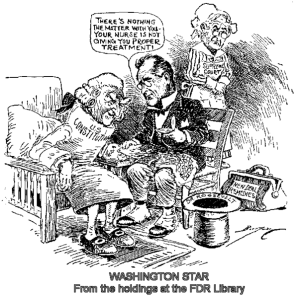
In the May issue of the Boston University Law Review, Joseph R. Fishkin and William E. Forbath of the University of Texas School of Law show that at key turning points in our history (the Jacksonian era, the Populist and Progressive moments and the New Deal), opponents of rising inequality made strong arguments “that we cannot keep our constitutional democracy — our republican form of government — without constitutional restraints against oligarchy and a political economy that maintains a broad middle class, accessible to everyone.”
Their article is called “The Anti-Oligarchy Constitution,” though Forbath told me that he and Fishkin may give the book they’re writing on the topic the more upbeat title “The Constitution of Opportunity.” Their view is that by empowering the wealthy in our political system, Supreme Court decisions such as Citizens United directly contradict the Constitution’s central commitment to shared self-rule.
“Extreme concentrations of economic and political power undermine equal opportunity and equal citizenship,” they write. “In this way, oligarchy is incompatible with, and a threat to, the American constitutional scheme.” …. they make a similar critique of what they call an excessively “court-centered” approach to constitutionalism. “Constitutional politics during the 19th and early 20th centuries” was very different and the subject of democratic deliberation. In earlier eras, they say, the Constitution was seen as not simply permitting but actually requiring “affirmative legislation . . . to ensure a wide distribution of opportunity” and to address “the problem of oligarchy in a modern capitalist society.”
The authors remind us of Franklin Roosevelt’s warning that “the inevitable consequence” of placing “economic and financial control in the hands of the few” would be “the destruction of the base of our form of government.” And writing during the Gilded Age, a time like ours in many ways, the journalist James F. Hudson argued that “imbedded” in the Constitution is “the principle” mandating “the widest distribution among the people, not only of political power, but of the advantages of wealth, education and social influence.”The idea of a Constitution of Opportunity is both refreshing and relevant. For too long, progressives have allowed conservatives to monopolize claims of fealty to our unifying national document. In fact, those who would battle rising economic inequalities to create a robust middle class should insist that it’s they who are most loyal to the Constitution’s core purpose. Broadly shared well-being is essential to the framers’ promise that “We the people” will be the stewards of our government.
Fishkin’s proposed book sounds like a worthwhile companion to Thomas Picketty’s Capital in the Twenty-First Century.
A somewhat related article from Raw Story by Bill Moyers and Co., July 4th note to tea partiers: Your politics would baffle the Founding Fathers.
Editor’s note: These days, if you see a protester donning a tricorn hat and waving a Gadsden Flag, it’s a safe bet that he or she is a Republican activist who’s furious about “death panels” or the prospect of the government meddling in the Medicare program. But the tea party movement isn’t the first to claim itself to be the true defenders of the Constitution, or to enlist its Framers in a political cause. Throughout American history, activists across the ideological spectrum have insisted that the Framers would roll over in their graves upon encountering the perfidy of their political opponents.
The reality is that the Framers disagreed about almost everything, and produced a Constitution that was filled with expedient compromises. As Jill Lepore, a professor of American history at Harvard University, pointed out in her book, The Whites of Their Eyes: The Tea Party’s Revolution and the Battle Over American History, “Beginning even before it was over, the Revolution has been put to wildly varying political purposes.” Between 1761, when the first signs of discontent with England became apparent in the Colonies, and 1791, when the Bill of Rights was ratified, Lepore wrote that Americans debated an “ocean of ideas” from which “you can fish anything out.”
One of the few areas where the Framers approached a consensus was a belief that their Constitution shouldn’t be fetishized. According to Lepore, it was none other than Thomas Jefferson who wrote, “Some men look at constitutions with sanctimonious reverence, and deem them like the arc of the covenant, too sacred to be touched. They ascribe to the men of the preceding age a wisdom more than human.”
Read an excerpt on Constitutional originalism from Jill Lepore’s book at the Raw Story link.
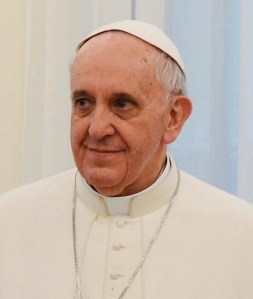
From NBC News: Pope Francis Meets Abuse Victims, Begs Forgiveness for Church.
The pontiff invited six victims of abuse from Ireland, Germany and Britain to attend an early-morning private Mass at the Domus Sanctae Marthae, the residence next to St. Peter’s Basilica where he lives.
Francis called the abuse a “grave sin” decrying how it was hidden for “so much time” and “camouflaged with a complicity that cannot be explained.”“I ask for the grace to weep, the grace for the Church to weep and make reparation for her sons and daughters who betrayed their mission, who abused innocent persons,” the pope said in his homily. “I beg your forgiveness, too, for the sins of omission on the part of Church leaders who did not respond adequately to reports of abuse.” ….
Francis strongly praised the victims’ courage in speaking up and shedding “light on a terrible darkness,” telling the mass he is deeply aware of their deep and unrelenting pain.
“Sins of clerical sexual abuse against minors have a toxic effect on faith and hope in God,” he said, adding that the victims’ willingness to come to the Vatican “speaks of the miracle of hope, which prevails against the deepest darkness.”
I guess it’s a start, but I agree with victims advocates who say it’s too little, too late. What concrete actions is the Church going to take to identify abusers and potential abusers before they act out? Child sexual abuse is a systemic problem that has continued for centuries. It’s difficult to see how it can be overcome with apologies and meetings with a few survivors.
I’ll end with a fascinating story from New Scientist, via Raw Story: Oldest case of Down’s syndrome from medieval France.
The oldest confirmed case of Down’s syndrome has been found: the skeleton of a child who died 1500 years ago in early medieval France. According to the archaeologists, the way the child was buried hints that Down’s syndrome was not necessarily stigmatised in the Middle Ages….
The new example comes from a 5th- and 6th-century necropolis near a church in Chalon-sur-Saône in eastern France. Excavations there have uncovered the remains of 94 people, including the skeleton of a young child with a short and broad skull, a flattened skull base and thin cranial bones. These features are common in people with Down’s syndrome, says Maïté Rivollat at the University of Bordeaux in France, who has studied the skeleton with her colleagues….
Oldest case of Down’s syndrome from medieval France – life – 04 July 2014 – New Scientist#.U7qdknlOXEd <!—->
Rivollat’s team has studied the way the child with Down’s syndrome was buried, which hasn’t been possible with other ancient cases of the condition. The child was placed on its back in the tomb, in an east-west orientation with the head at the westward end – in common with all of the dead at the necropolis.
According to Rivollat, this suggests the child was treated no differently in death from other members of the community. That in turn hints that they were not stigmatised while alive.
Another researcher of Down’s Syndrome in ancient history, John Starbuck of Indiana University, says drawing cultural conclusions from the method of burial is very difficult. Read more at the link.
What stories are you following today? Please post your links in the comment thread.
Lazy Saturday Reads
Posted: July 5, 2014 Filed under: morning reads, U.S. Politics, Women's Rights | Tags: "white oppression", Bill Clinton, Boston bombing, Bourbon St. shootings. New Orleans, C-Span callers, Civil Rights act, Eden Foods, Hillary Clinton, Hobby Lobby decision, Hurricane Arthur, Indianapolis shootings, Maya Angelou, Michael Potter, Racism, Richard Mellon Scaife, Samuel Alito, SCOTUS, vanilla ice cream 34 Comments
“Someone is Waiting,” by David Hettinger
Good Morning!!
I’m sure you won’t be surprised to learn that today is a very slow news day. Nevertheless, I’ve still managed to dig up a few interesting reads.
Long-time Clinton hater Richard Mellon Scaife has died at 82. The Associated Press reports via Politico:
Scaife died early Friday at his home, his newspaper, the Pittsburgh Tribune-Review, reported. Scaife’s death comes less than two months after he announced in a first-person, front-page story in his Pittsburgh Tribune-Review that he had an untreatable form of cancer.
“Some who dislike me may rejoice at the news,” wrote Scaife, who acknowledged making political and other enemies. “Naturally, I can’t share their enthusiasm.”
He was the grand-nephew of Andrew Mellon, a banker and secretary of the Treasury who was involved with some of the biggest industrial companies of the early 20th century. Forbes magazine estimated Scaife’s net worth in 2013 at $1.4 billion.
The intensely private Scaife became widely known in the 1990s when first lady Hillary Rodham Clinton said her husband was being attacked by a “vast right-wing conspiracy.” White House staffers and other supporters suggested Scaife was playing a central role in the attack.
Hillary was mocked for those remarks; but today, in the aftermath of the Hobby Lobby decision, it should be obvious to all but the most oblivious and ignorant among us that the vast right wing conspiracy exists and its tentacles have reached even the U.S. Supreme Court.
From Forbes, Clare O’Connor reports more Hobby Lobby Fallout: Catholic Soy Milk Mogul Won’t Cover Drugs That ‘Prevent Procreation’. Eden Foods founder Michael Potter has stated his determination to prevent his female employees from getting access to birth control, and the Supreme Court is helping him.
In April 2013, devout Catholic (and sole Eden Foods shareholder) Potter sued the Department of Health and Human Services, calling the Affordable Care Act’s contraceptive mandate “unconstitutional government overreach.”
In a letter he wrote in response to a shopper complaint that month, Potter described contraceptives as “lifestyle drugs” akin to “Viagra, smoking cessation, weight-loss” tools and other medications. (He also compared birth control to “Jack Daniels” in a contemporaneous interview with Salon.)
In October, the U.S. Court of Appeals decided against Potter, ruling that Eden Foods, as a for-profit corporation, couldn’t exercise religion.
Now, in the wake of this week’s controversial Supreme Court ruling recognizing craft chain Hobby Lobby’s religious rights, the court has changed its tune.The day after the Justices decided evangelical Hobby Lobby billionaire David Green doesn’t have to cover certain contraceptives for his employees, the Supreme Court vacated the judgment against Eden Foods and sent the case back to the U.S. Court of Appeals for the Sixth Circuit for further consideration.
“The court of appeals is ordered by the Supreme Court to follow its decision in Hobby Lobby,” said Erin Mersino, the attorney handling Potter’s case at the Christian, conservative Thomas More Law Center.
And the beat goes on . . .
At The Nation, Katha Pollit asks: Where Will the Slippery Slope of ‘Hobby Lobby’ End?
Facts are stubborn things, as John Adams famously said. Unless, that is, you’re talking about religion. Then facts don’t seem to matter at all: right you are if you think you are. The Hobby Lobby case was billed as a test of religious freedom versus the power of the state: Did the Religious Freedom Restoration Act (RFRA) mean that David Green, the evangelical Christian CEO of a chain of crafts stores, could be exempt from providing coverage for the full range of contraceptives for his employees under the Affordable Care Act? Green balked at including Plan B, Ella (another form of emergency contraception) and two kinds of IUD, because, he claimed, they caused “abortion” by preventing the implantation of a fertilized egg.
The Court’s 5-to-4 decision—which featured all three women justices ruling for the workers, and all five Catholic men ruling for the corporation—was wrong in many ways. But the thing I really don’t understand is why it didn’t matter that preventing implantation is not “abortion,” according to the accepted medical definition of the term. And even if it was, Plan B, Ella and the IUDs don’t work that way, with the possible exception of one form of IUD when inserted as emergency contraception. As an amicus brief from a long list of prestigious medical organizations and researchers laid out at length, studies show that emergency contraception and the IUD preventfertilization, not implantation. They are not “abortifacients,” even under the anti-choicers’ peculiar definition of abortion. (Green is actually more moderate than some anti-choicers, who include hormonal contraception, aka “baby pesticide,” as abortion.) Why doesn’t it matter that there is no scientific evidence for Green’s position? When did Jesus become an Ob/Gyn?
Good question. Today even facts are irrelevant to Supreme Court decisions. The fact is that Democrats helped Thomas, Roberts, and Alito make it onto the Court, and now we’re stuck with these religious and ideological fanatics.
At Salon, Digby writes that Alito could have been stopped: Why Dems should have filibustered the radical. And from Peter Montgomery at HuffPo, Samuel Alito: A Movement Man Makes Good on Right-Wing Investments. Read them and weep.
Dakinikat posted this Guardian piece in the comments last night; I thought it should be included in this morning’s links: Black people were denied vanilla ice cream in the Jim Crow south – except on Independence Day.
By custom rather than by law, black folks were best off if they weren’t caught eating vanilla ice cream in public in the Jim Crow South, except – the narrative always stipulates – on the Fourth of July. I heard it from my father growing up myself, and the memory of that all-but-unspoken rule seems to be unique to the generation born between World War I and World War II.
But if Maya Angelou hadn’t said it in her classic autobiography I Know Why the Caged Bird Sings, I doubt anybody would believe it today.
People in Stamps used to say that the whites in our town were so prejudiced that a Negro couldn’t buy vanilla ice cream. Except on July Fourth. Other days he had to be satisfied with chocolate.
Vanilla ice cream – flavored with a Nahuatl spice indigenous to Mexico, the cultivation of which was improved by an enslaved black man named Edmund Albius on the colonized Réunion island in the Indian Ocean, now predominately grown on the largest island of the African continent, Madagascar, and served wrapped in the conical invention of a Middle Eastern immigrant – was the symbol of the American dream. That its pure, white sweetness was then routinely denied to the grandchildren of the enslaved was a dream deferred indeed.
What makes the vanilla ice cream story less folk memory and more truth is that the terror and shame of living in the purgatory between the Civil War and civil rights movement was often communicated in ways that reinforced to children what the rules of that life were, and what was in store for them if they broke them.
Please go read the whole thing if you haven’t already.

From Politico: Why the Civil Rights Act couldn’t pass today.
It was a painful tableau: The bipartisan leaders of Congress linking hands in the Capitol Rotunda and swaying to the strains of “We Shall Overcome” as they commemorated the 50th anniversary of the passage of the Civil Rights Act of 1964. Harry Reid and Nancy Pelosi sang along with the crowd, but Mitch McConnell and John Boehner’s lips were frozen in silent, self-conscious smiles.
The climate in today’s Washington is so different from the one that produced what many scholars view as the most important law of the 20th century that celebrating the law’s legacy is awkward for Republicans and Democrats alike. Neither party bears much resemblance to its past counterpart, and the bipartisanship that carried the day then is now all but dead….
The current congressional leaders gathered last week not to honor Johnson — or any of the legislative leaders who actually passed the landmark law — but to award a posthumous Congressional Gold Medal to The Rev. Dr. Martin Luther King Jr. and his wife, Coretta Scott King, whose crusade helped create the climate that made the bill possible. In his life, racial tensions helped make King such a polarizing figure that both Johnson and John F. Kennedy worried about seeming too close to him, but in martyrdom and myth, he is the only politically safe ground on which present day leaders could unite.
They are all so pathetic. And this is beyond pathetic: Callers Use C-SPAN Civil Rights Discussion To Complain About White Oppression (VIDEO).
“Washington Journal” host Steve Scully listened as an “independent” caller named Thomas from Maryland told him that he is “much less liberal today” than he was in 1964 when the landmark law was signed by Lyndon B. Johnson.
“And I think the blacks have brought on most of their present-day problems themselves. They insult white people,” he told Scully. “I heard it right on your own show, I heard some black call Karl Rove a ‘white boy.’ And I don’t think that’s right. They’re attacking white people in the big cities and we’re supposed to put up with that kind of stuff and like them and say, ‘Well, come into our neighborhood.’ And how about the discussion of the black crime that goes on in this country?”
The caller went on to complain that the discrimination endured by Irish, Mormons and Italians is widely ignored.
“You people will never, never discuss that. You only discuss the discrimination against the black people,” he said.
Is that sick or what?
A few more news links:
Information Week on private tech companies treatment of their customers, Facebook Mood Manipulation: 10 Bigger Problems.
Fox News: Suspect arrested in Bourbon St. shootings.
USA Today: Seven hurt in Indianapolis shootings.
WSJ: A Weakened Hurricane Arthur Heads Toward Nova Scotia
ABC News: Before Boston Attack, Alleged Bomber Posed With Black Flag of Jihad at Local Mosque.
So . . . what stories are you reading and blogging about? Please share your links in the comment thread, and enjoy the rest of the long weekend!
Fourth of July Reads
Posted: July 4, 2014 Filed under: morning reads, U.S. Politics, Women's Rights | Tags: corporate personhood, corporatizing religious liberty, Declaration of Independence, Fourth of July, Hobby Lobby, Independence Day, John Roberts, legal precedent, religion, Samuel Alito, SCOTUS, separation of church and state, Statue of Liberty, Wheaton College 14 Comments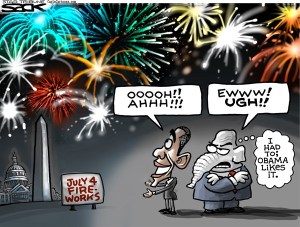
Good Morning!!
Today we celebrate the Declaration of Independence. I’ve assembled a few informational readings about this day in history.
From The Cagle Post: Fourth of July Fast Facts.
“I’m confused. I thought July 4 was the day our country declared independence from King George III of Great Britain.”
“Actually, according to ConstitutionFacts.com, that’s not so. The Continental Congress declared independence from Great Britain on July 2, 1776.”
“Then why do we celebrate our independence on the Fourth every year? Is that when we started the American Revolution?”
“That is a common misunderstanding, as well. The American Revolution began in April 1775, more than a year earlier.”
“I’m stumped. Was the Fourth the day Thomas Jefferson wrote the first draft of the Declaration of Independence?”
“Nope. Thomas Jefferson wrote the first draft in June 1776. Also, Jefferson didn’t write the Declaration alone.”
“He didn’t? I always thought he was the sole author.”
“A common misconception. In fact, the Continental Congress appointed a five-person to write the Declaration. It included Jefferson, Benjamin Franklin, John Adams, Robert Livingston and Roger Sherman.” ….
“Though Jefferson wrote the first draft, it was changed 86 times by other members of the committee and other members of the Continental Congress.”
I did not know that.
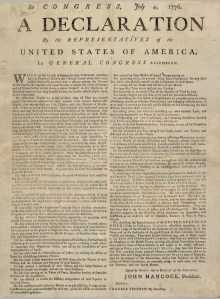
David Armitage at The Wall Street Journal: The Declaration of Independence: The Words Heard Around the World.
The Declaration of Independence is the birth certificate of the American nation—the first public document ever to use the name “the United States of America”—and has been fundamental to American history longer than any other text. It enshrined what came to be seen as the most succinct and memorable statement of the ideals on which the U.S. was founded: the rights to life, liberty and the pursuit of happiness; the consent of the governed; and resistance to tyranny.
But the Declaration’s influence wasn’t limited to the American colonies of the late 18th century. No American document has had a greater impact on the wider world. As the first successful declaration of independence in history, it helped to inspire countless movements for independence, self-determination and revolution after 1776 and to this very day. As the 19th-century Hungarian nationalist, Lajos Kossuth, put it, the U.S. Declaration of Independence was nothing less than “the noblest, happiest page in mankind’s history.”
In telling this story of global influence, however, it is important to separate two distinct elements of the Declaration—elements that sometimes get conflated. The first of these is the assertion of popular sovereignty to create a new state: in the Declaration’s words, the right of “one People to dissolve the Political Bands which have connected them with another, and to assume among the Powers of the Earth, the separate and equal Station to which the Laws of Nature and of Nature’s God entitle them.” The second and more famous element of the Declaration is its ringing endorsement of the sanctity of the individual: “We hold these truths to be self-evident, that all men are created equal, that they are endowed by their Creator with certain unalienable Rights.”
Read much more at the link.
From the LA Times: The slow-spreading news of American independence.
In this era of instant communication, it’s interesting to note the slow distribution of the Declaration, and the spreading of the word to those on whose behalf independence had been declared. (Imagine the Twitter version: Dudes, we’re on our own. #independence #totallyrad #stickitkinggeorge).
The text was set in type by Philadelphia printer John Dunlap just hours after the Continental Congress approved the manifesto on July 4. He ran off about 200 copies, most of which were then distributed via horse and boat around the Colonies. He reprinted it in his own newspaper, Dunlap’s Pennsylvania Packet, or The General Advertiser (great newspaper names back then). Over the next few weeks, Jefferson’s stirring words were reprinted inlocal newspapers and pamphlets around the Colonies.
And, naturally, in Britain. It took more than a month for the first reports of the Declaration to reach Britain in letters ferried by the Mercury packet ship. Gen. William Howe, who was leading the crown’s forces in the Colonies, included a brief mention in his report to his overseers. So the first public airing of the news came in the London Gazette, the crown’s official paper. If you weren’t a close reader, you could have easily missed it.
In the four-page issue dated Aug. 6-Aug. 10, 1776, the Gazette’s lead story was Howe’s update of the war, reporting that “the Rebels, who are numerous, and are very advantageously posted with strong Entrenchments both upon Long Island and that of New York, with more than One Hundred pieces of Cannon for the Defence of the Town towards the Sea, and to obstruct the passage of the [British] Fleet up the North [Hudson] River, besides a considerable Field Train of artillery.”
Finally, Carina Kolodny at Huffington Post: This Is Not Your Independence Day.
The 4th of July might commemorate the independence of our country — but it also serves as a bitter reminder that in 1776, the country that I love had no place for me in it.
When our founding fathers penned, “All men are created equal,” they meant it. Not all people. Not all humans. Just all men — the only reason they didn’t feel obliged to specify “white” men is because, at the time, men of color were considered less than men, less than human.
The 4th is not my Independence Day — and if you’re a Caucasian woman, it isn’t yours either. Our “independence” didn’t come for another 143 years, with the passage of The Woman’s Suffrage Amendment in 1919. The 4th of July is also not Independence Day for people of color. It wasn’t until the 15th Amendment was ratified in 1870 that all men had the right to vote regardless of race — on paper, that is, not in practice. People of color were systematically, and all too successfully, disenfranchised for another century. July 4th of 1776 was certainly not a day of Independence or reverence for Native Americans. It wasn’t until 1924 that Native Americans could unilaterally become citizens of the United States and have the voting rights to go with it.
Now, before anyone argues that Independence is about more than voting rights, I’d like to point out that our Founding Fathers would fundamentally disagree with you. The Revolutionary War was fought, in large part, because of “taxation without representation” — the then English colonists believed they were not free because their voices were not represented. The right to vote, the right to have your say is the delineating characteristic of a democracy.
The Aftermath of the Hobby Lobby Decision
On that note, today many concerned citizens are looking back at the latest Supreme Court decisions that take women backwards in their pursuit of freedom and autonomy. The court-approved limits on access to birth control go beyond the Hobby Lobby decision. Lyle Denniston at SCOTUSblog: Broader right to object to birth control.
Expanding the rights of religious opponents of birth control, a divided Supreme Court on Thursday afternoon spared an Illinois college — and maybe hundreds of other non-profit institutions — from obeying government regulations that seek to assure access to pregnancy prevention services for female workers and students. In the same order, the majority essentially told the government to modify its own rules if it wants to keep those services available.
Three Justices wrote a sharply worded dissent, accusing the majority of creating on its own a “new administrative regime” that will seriously complicate the operation of the birth control mandate under the new federal health care law. The majority, the dissenters said, “has no reason to think that the administrative scheme it foists on the government today is workable or effective on a national scale.”
The ruling, which the majority insisted was temporary and had settled nothing finally about the legal issues at stake, came three days after the Court in Burwell v. Hobby Lobby had given for-profit businesses whose owners have religious objections to birth control a right to refuse to provide those services in their employee health plans.
The plea by Wheaton College, a religious institution in Illinois with about 3,000 students, moved the Court beyond for-profit firms to the world of non-profit religious colleges, hospitals, and other charities. The government had already moved to accommodate their beliefs, but that had not gone far enough for the college and for scores of other non-profits. With the Court’s new order, they gained additional separation from the birth-control mandate.
At Mother Jones, Kevin Drum writes: Supreme Court Now Playing Cute PR Games With Hobby Lobby Decision.
For the last few days, there’s been a broad argument about whether the Hobby Lobby ruling was a narrow one—as Alito himself insisted it was—or was merely an opening volley that opened the door to much broader rulings in the future. After Tuesday’s follow-up order—which expanded the original ruling to cover all contraceptives, not just those that the plaintiffs considered abortifacients—and today’s order—which rejected a compromise that the original ruling praised—it sure seems like this argument has been settled. This is just the opening volley. We can expect much more aggressive follow-ups from this court in the future.
POSTSCRIPT: It’s worth noting that quite aside from whether you agree with the Hobby Lobby decision, this is shameful behavior from the conservatives on the court. As near as I can tell, they’re now playing PR games worthy of a seasoned politico, deliberately releasing a seemingly narrow opinion in order to generate a certain kind of coverage, and then following it up later in the sure knowledge that its “revisions” won’t get nearly as much attention.
At Slate, Micah Schwartzman, Richard Schragger, and Nelson Tebbe explain that Hobby Lobby rewrites religious-freedom law in ways that ignore everything that came before.
Monday’s decision in Hobby Lobby was unprecedented. Much of the commentary has focused on the Supreme Court’s decision to extend rights of religious free exercise to for-profit corporations. Hobby Lobby is for religion what Citizens United was for free speech—the corporatization of our basic liberties. But Hobby Lobby is also unprecedented in another, equally important way. For the first time, the court has interpreted a federal statute, theReligious Freedom Restoration Act (or RFRA), as affording more protection for religion than has ever been provided under the First Amendment. While some have read Hobby Lobby as a narrow statutory ruling, it is much more than that. The court has eviscerated decades of case law and, having done that, invites a new generation of challenges to federal laws, including those designed to protect civil rights.
The authors explain how the right wing Roberts Court has moved beyond any concern for legal precedent in making its decisions.
Hobby Lobby is unprecedented because it corporatizes religious liberty. It extends to for-profit businesses the rights and privileges that have long been associated only with churches and religious nonprofits. But that change is the result of a more pervasive and deeper upending of the law of religious liberty in America. Ignoring congressional intent, the court reads RFRA as having shed its First Amendment skin. It is not entirely clear what American law will look like after that change. But if anything is clear, it is that the Roberts Court is now unconstrained by precedent. It has loosened itself from decades of First Amendment doctrine and has begun remaking the law of free exercise.
Please read the whole thing.
Ironically, the Hobby Lobby decision may have also created some serious problems for the human beings who own corporations (h/t Dakinikat). From Mother Jones: How Hobby Lobby Undermined The Very Idea of a Corporation. Basically, now that SCOTUS has said that some corporations are inseparable from the people who own them, those owners could lose their legal protection from debts and lawsuits that result from corporate actions. There’s some instant Karma for you!
A few more links for your holiday reading pleasure:
Miami Herald: FBI records: Chilling find in Bradenton dumpster (new clues to Saudi involvement in the 9/11 and the cover-up of that involvement by the Bush/Cheney administration).
Study links Oklahoma earthquake swarm with fracking operations
Boston Globe: People prefer electric shocks to time alone with thoughts.
LA Times: Tibetans get high-altitude edge from extinct Denisovans’ genes.
What stories are you following on this Independence Day?
Thursday Reads: Towards a More Perfect Union
Posted: July 3, 2014 Filed under: Civil Liberties, Civil Rights, Crime, Discrimination against women, Domestic terrorism, Feminists, fetus fetishists, GLBT Rights, morning reads, Religious Conscience, religious extremists, Reproductive Health, Republican politics, right wing hate grouups 18 Comments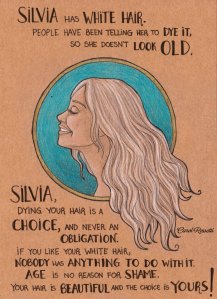 Good Morning!!
Today’s beautiful messages and images can be found here.
The reactionary and wildly creative decisions coming out of the Supreme Court are already having ramifications across the country where women, minorities, and the GLBT community are having to fight for their very basic rights. Interestingly enough, we are learning about which corporations want to be citizens and which corporations want to exist for the sole benefits of their owners.
The Hobby Lobby decision is already creating chaos as Notorious RBG and many of us have discussed.
This week, in the Hobby Lobby case, the Supreme Court ruled that a religious employer could not be required to provide employees with certain types of contraception. That decision is beginning to reverberate: A group of faith leaders is urging the Obama administration to include a religious exemption in a forthcoming LGBT anti-discrimination action.
Their call, in a letter sent to the White House Tuesday, attempts to capitalize on the Supreme Court case by arguing that it shows the administration must show more deference to the prerogatives of religion.
“We are asking that an extension of protection for one group not come at the expense of faith communities whose religious identity and beliefs motivate them to serve those in need,” the letter states.
The Hobby Lobby decision has been welcomed by religious-right groups who accuse Obama of waging a war on religion. But Tuesday’s letter is different: It comes from a group of faith leaders who are generally friendly to the administration, many of whom have closely advised the White House on issues like immigration reform. The letter was organized by Michael Wear, who worked in the Obama White House and directed faith outreach for the president’s 2012 campaign. Signers include two members of Catholics for Obama and three former members of the President’s Advisory Council on Faith-Based and Neighborhood Partnerships.
“This is not an antagonistic letter by any means,” Wear told me. But in the wake of Hobby Lobby, he said, “the administration does have a decision to make whether they want to recalibrate their approach to some of these issues.”
This decision is controversial and will remain controversial. It changes how the government can approach the court’s favored religion and possibly 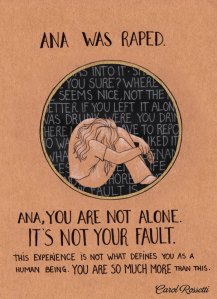 other religions.
The first source of controversy is the collapse of a national consensus on a key element of religious liberty: accommodation. Throughout American history, there has been widespread agreement that in our religiously diverse and widely devout country, it is good for the government to accommodate religious exercise. We have disagreed about particular accommodations (may a Muslim police officer wear a beard, despite police department policy?), and especially about whether religious accommodations should be ordered by judges or crafted by legislators. But we have generally agreed that our nation benefits when we help rather than burden those with religious obligations. That consensus seems, quite suddenly, to have evaporated.
A second source of controversy is that many people view the Hobby Lobby case as concerning not just reproductive rights but also, indirectly, rights for gays and lesbians. Advocates for same-sex marriage have long insisted that their own marriages need not threaten anyone else’s, but citizens with religious objections to same-sex marriage wonder whether that is entirely true: Will a small-business owner be sued, for instance, for declining to provide services to a same-sex couple? Conversely, and understandably, gay and lesbian couples wonder why they do not deserve the same protections from discrimination granted to racial and other minorities. For both sides, Hobby Lobby was merely a prelude to this dawning conflict.
The third source of controversy is a change in our views of the marketplace itself. The marketplace was once seen as place to put aside our culture wars and engage in the great American tradition of buying and selling. The shopping mall has even been called the “American agora.” But today the market itself has become a site of cultural conflict. Hobby Lobby is one of many companies that seek to express faith commitments at work as well as at home and that don’t see the workplace as a thing apart from religion. Many companies preach and practice values, religious and otherwise, that are unrelated to market considerations. CVS, for example, recently announced that it would stop selling tobacco products, regardless of how that decision might affect its bottom line.
A country that cannot even agree on the idea of religious accommodation, let alone on what terms, is unlikely to agree on what to do next
 Here’s another group of “patriotic, gawd-fearing” amuricans shouting down children and mothers fleeing violence in our neighbor countries. I just continue to find this to be the most appalling story I’ve heard in some time. The Border Patrol, ICE, and every one involved–but these horrible xenophobes–were just following our laws as written. Perhaps, they should know our laws just a little bit better themselves.
The national controversy over a surge of Central American immigrants illegally crossing the U.S. border established a new battleground this week in a Southern California small town where angry crowds thwarted detained migrants from entering their community.
In a faceoff Tuesday with three buses carrying the migrants behind screened-off windows, the demonstrators chanted “Go back home!” and “USA” and successfully forced the coaches to leave Murrieta, CNN affiliate KFMB reported.
The buses instead took the 140 or so undocumented immigrants to U.S. processing centers at least 80 miles away, in the San Diego and El Centro areas, federal officials say.
Counter-protesters squared off with the demonstrators, and a shouting match erupted over the nation’s immigration system, which recently has been overwhelmed with a tide of Central American minors illegally entering the United States alone or with other children.
A mix of poverty, violence and smugglers’ false promises is prompting the Central American inflow.
Unlike undocumented Mexican migrants, who are often immediately deported, the U.S. government detains and processes the Central Americans, who are eventually released and given a month to report to immigration offices. Many never show up and join the nation’s 11 million undocumented population, says the National Border Patrol Council, the union representing Border Patrol agents.
The Latin American immigrants rejected by Murrieta protesters were initially held in Texas, where U.S. facilities are so overflowing that detainees are sent to other states for processing.
The government doesn’t have the room to shelter the children with adults: there’s only one family immigration detention center, in Pennsylvania. To assist the unaccompanied children, President Barack Obama’s administration opened shelters last month on three military bases because federal facilities more designed for adults were overrun with minors.
Tuesday’s busloads of detained Central American immigrants didn’t include any unaccompanied minors, said Murrieta Police Chief Sean Hadden, who put the number of protesters at 125. The children on the buses were apparently in the company of relatives or other adults, said an official with the National Border Patrol Council.
Meanwhile, yet another corporation has decided that open carry of assault weapons in their stores may not create the most hospitable environment for  employees or shoppers. Target has joined other companies asking customers to leave their guns at home,
The leadership team has been weighing a complex issue, and I want to be sure everyone understands our thoughts and ultimate decision.
As you’ve likely seen in the media, there has been a debate about whether guests in communities that permit “open carry” should be allowed to bring firearms into Target stores. Our approach has always been to follow local laws, and of course, we will continue to do so. But starting today we will also respectfully request that guests not bring firearms to Target – even in communities where it is permitted by law.
We’ve listened carefully to the nuances of this debate and respect the protected rights of everyone involved. In return, we are asking for help in fulfilling our goal to create an atmosphere that is safe and inviting for our guests and team members.
This is a complicated issue, but it boils down to a simple belief: Bringing firearms to Target creates an environment that is at odds with the family-friendly shopping and work experience we strive to create.
Meanwhile, over in Georgia, the new flout your gun every where has lead to just what you’d expect.
Valdosta Police Chief Brian Childress summed the incident up for the newspaper.
“Essentially, it involved one customer with a gun on his hip when a second customer entered with a gun on his hip,” Childress said.
According to the Daily Times, the first man, Ronald Williams, approached the second man in the store and demanded to see his identification and firearms license. Williams also pulled his gun from his holster, without pointing it at the second man. The second man responded by saying that he was not obligated to show any permits or identification — then he paid for his purchase, left the store, and called the police.
Police responded to the call around 3 p.m. Tuesday, and Williams was arrested on a charge of disorderly conduct for pulling his gun in the store.
Tuesday was also the day that Georgia’s so-called “guns everywhere” law went into effect, allowing residents to carry guns into bars, nightclubs, classrooms, and certain government buildings. Among other things, the law also prohibits police from demanding to see the weapons permit of someone seen carrying a gun. Childress mentioned that last point when talking to the Daily Times about Tuesday’s incident.
“This is an example of my concern with the new gun law that people will take the law into their own hands which we will not tolerate,” Childress said.
 I wanted to share a mass shooting that happened on Bourbon Street last weekend. A beautiful young woman has lost her life in the senseless violence. Another has a lot of damage to her mouth, gums and teeth. All of this happened because one young man got into an argument and his anger and his gun led to indiscriminate firing into the crowd. A total of 10 innocent bystanders were shot.
One of the 10 victims of the weekend shooting on New Orleans’ famed Bourbon Street died Wednesday.
According to the coroner’s office, Brittany Thomas, 21, of Hammond, La., died from her injuries. She is the only victim of the shooting to die.
Thomas had been in critical condition since the early Sunday morning shooting when two gunmen sprayed the crowd with bullets.
Three others were reported in stable condition after Sunday’s shooting: a 35-year-old man from Mississippi, a 19-year-old Arkansas woman and an 18-year-old New Orleans man.
Interim LSU Hospital spokeswoman Siona LaFrance said Wednesday a 21-year-old Australian woman was released from the hospital.
On Sunday, police said nine people were injured in the shooting. Then Monday, they said a person who came into the police department Sunday afternoon also was injured in the violence.
Other victims, not hospitalized, included two New Orleans-area men; a teenage girl and a woman from Alabama; and a Florida man.
The young Australian woman has a Facebook page where you can help her defray the cost of reconstruction. As of writing this, I understand that the “person” of interest has surrendered to the police. His face has been plastered every where for about a day and half.
The shooting took place about 2:45 a.m. Sunday on Bourbon Street and involved “two young men, both armed with firearms, who chose to settle a dispute between themselves without care for anyone else,” Police Supt. Ronal W. Serpas told reporters. They exchanged gunfire, hitting bystanders, he said. Bourbon Street, a hot spot for tourists, is full of bars, restaurants and shops.
 This young man’s callous regard for life should land him in jail for a very long time. We’ll see what happens. The suspect is a young white man and the dead girl is a young black woman.
According to the New Orleans Police Department, two men are sought in the shooting that spawned from an argument between them.
“While everyone else was running away, I was running toward the gunfire,” Minsky said. “And, I don’t know, being a curious guy — that’s what I wanted to do — see what was going on basically.”
Minsky described the ordeal as “surreal,” saying he’d never seen multiple people get shot.
“There was a lot of blood, I can tell you that much, you know. And I actually stepped in a pool of blood and didn’t realize it until I was walking toward the person shot in the face,” Minksey said. “That kind of freaked me out a little bit.”
The victim shot in the face was Amy Matthews from Australia. The bullet struck her in her cheek and knocked out all but 10 teeth she told an Australian newspaper. She was released from the hospital this week.
In one of several photos Minsky took on his cellphone, Matthews is seen sitting on a sidewalk on Bourbon Street as a crowd of people attempted to help her, including two U.S. marines.
He also captured an image of an unresponsive woman lying in the middle of the 700 block of Bourbon Street.
During the chaotic moments after the shooting, Minsky said there weren’t many screams in the Vieux Carré.
“There was just a lot of people running around and trying to help each other,” he said. “The person that was shot in the face was probably the person getting the most attention at that immediate moment. But as far as the screams and commotion, I mean, yeah, there are people running and screaming but that all died down after the gunshots ended.”
I can’t believe that this is what the founders– many of whom I am a direct descendant of–planned for our union. How could they have envision this kind of hateful chaos empowered by the Supreme Court who represents the voice of reason, law, and constitutionality, and the House of Representatives which is supposed to be the voice of the people.. I do not find any of these events to be consistent with their dreams and plans for a more perfect union where no one religion would dictate the lives of others, where all were considered equal before the law, and every one had the ability to pursue life and liberty.
Tuesday Reads: Live and Let Live Edition
Posted: July 1, 2014 Filed under: Affordable Care Act (ACA), birth control, Discrimination against women, Feminists, fetus fetishists, fundamentalist Christians, GLBT Rights, Hillary Clinton, Marriage Equality, morning reads, religious extremists, Reproductive Health, Reproductive Rights 28 CommentsGood Morning!
 Why is it that many religious people just cannot live without imposing their views on others? That’s one of the things I’ve been thinking about since the reliably patriarchal side of SCOTUS took one more step to force their favorite flavor of religion on the rest of us. Today’s photo montage is via “The Invisibles”. It is a montage of gay couples during the times when theirs was a “love that dare not speak its name”. There are so many folks that choose to live outside of the conventions of the society into which they were born. I was raised to think that this country was born of the dreams of folks wanting to establish a place where they could not be persecuted for not following the majority’s norms. Our country has not had perfect beginnings. But up until recently, I always felt that we were at least creeping towards a “more perfect union”.
While the plight of the GLBT community is improving and appears to have some forward momentum, there are others that are being shoved back into conformity with lives and values not of their choosing. This includes women, immigrants and many minorities. Why do others feel they have to justify their own lives by persecuting others? We’re headed towards our nation’s birthday. What has happened to the idea of creating our “more perfect union” with “liberty and justice for all”?
So, first I feel like I have to add more to the discussion on the SCOTUS decision that allows privately and tightly held corporations that are not engaged  in the business of religion to hold religious beliefs identical to the owners that are supposedly separate from the corporation enough to be indemnified by any illegal activities it undertakes. Hillary Clinton made her views clear on the subject as did Justice Ginsberg writing for the dissent. I will rely on their words here. Hillary Clinton calls the decision “deeply disturbing”.
“It’s the first time that our court has said that a closely held corporation has the rights of a person when it comes to religious freedom,” she said during a Q&A at the Aspen Ideas Festival. “I find it deeply disturbing that we are going in that direction.”
“It’s very troubling that a sales clerk at Hobby Lobby who needs contraception, which is pretty expensive, is not going to get that service through her employer’s health care plan because her employer doesn’t believe she should use birth control,” she continued.
Justice Ginsberg wrote a masterful dissent.
On Monday, the Supreme Court sided with Hobby Lobby on the company’s challenge to the Affordable Care Act’s contraceptive mandate, ruling that the mandate, as applied to “closely held” businesses, violates the 1993 Religious Freedom Restoration Act. But the divided court’s 5-4 decision included a dramatic dissent from Justice Ruth Bader Ginsburg, who called the majority opinion “a decision of startling breadth.” Ginsburg read a portion of her decision from the bench on Monday.
Addressing the majority of her colleagues — including all but one of the six men sitting on the Supreme Court — Ginsburg wrote:
In the Court’s view, RFRA demands accommodation of a for-profit corporation’s religious beliefs no matter the impact that accommodation may have on third parties who do not share the corporation owners’ religious faith—in these cases, thousands of women employed by Hobby Lobby and Conestoga or dependents of persons those corporations employ. Persuaded that Congress enacted RFRA to serve a far less radical purpose, and mindful of the havoc the Court’s judgment can introduce, I dissent.
The justice goes on to criticize the opinion’s interpretation of the religious freedom law, writing that “until today, religious exemptions had never been extended to any entity operating in ‘the commercial, profit-making world.'”
The reason why is hardly obscure. Religious organizations exist to foster the interests of persons subscribing to the same religious faith. Not so of for-profit corporations. Workers who sustain the operations of those corporations commonly are not drawn from one religious community. Indeed, by law, no religion-based criterion can restrict the work force of for-profit corporations…The distinction between a community made up of believers in the same religion and one embracing persons of diverse beliefs, clear as it is, constantly escapes the Court’s attention. One can only wonder why the Court shuts this key difference from sight.
“In sum,” Ginsburg adds about the free exercise claims at the heart of this case,“‘[y]our right to swing your arms ends just where the other man’s nose begins.’”
Justice Alito got a little prickly in his majority opinion about Ginsburg’s strong criticism of their take on the case:
As this description of our reasoning shows, our holding is very specific. We do not hold, as the principal dissent alleges, that for-profit corporations and other commercial enterprises can “opt out of any law (saving only tax laws) they judge incompatible with their sincerely held religious beliefs.” Post, at 1 (opinion of GINSBURG, J.). Nor do we hold, as the dissent implies, that such corporations have free rein to take steps that impose “disadvantages . . . on others” or that require “the general public [to] pick up the tab.” Post, at 1–2. And we certainly do not hold or suggest that “RFRA demands accommodation of a for-profit corporation’s religious beliefs no matter the impact that accommodation may have on . . . thousands of women employed by Hobby Lobby.” Post, at 2.1 The effect of the HHS-created accommodation on the women employed by Hobby Lobby and the other companies involved in these cases would be precisely zero. Under that accommodation, these women would still be entitled to all FDA-approved contraceptives without cost sharing.
Ginsburg seems to reply to Alito by suggesting that what Alito sees as a narrow, limited decision is essentially an invitation for lots of future challenges on religious grounds: “Although the Court attempts to cabin its language to closely held corporations,” she writes, “its logic extends to corporations of any size, public or private. Little doubt that RFRA claims will proliferate.”
Further quotes from Ginsburg’s dissent can be read at MOJO.
Here are seven more key quotes from Ginsburg’s dissent in Burwell v. Hobby Lobby:
- “The exemption sought by Hobby Lobby and Conestoga would…deny legions of women who do not hold their employers’ beliefs access to contraceptive coverage”
- “Religious organizations exist to foster the interests of persons subscribing to the same religious faith. Not so of for-profit corporations. Workers who sustain the operations of those corporations commonly are not drawn from one religious community.”
- “Any decision to use contraceptives made by a woman covered under Hobby Lobby’s or Conestoga’s plan will not be propelled by the Government, it will be the woman’s autonomous choice, informed by the physician she consults.”
- “It bears note in this regard that the cost of an IUD is nearly equivalent to a month’s full-time pay for workers earning the minimum wage.”
- “Would the exemption…extend to employers with religiously grounded objections to blood transfusions (Jehovah’s Witnesses); antidepressants (Scientologists); medications derived from pigs, including anesthesia, intravenous fluids, and pills coated with gelatin (certain Muslims, Jews, and Hindus); and vaccinations[?]…Not much help there for the lower courts bound by today’s decision.”
- “Approving some religious claims while deeming others unworthy of accommodation could be ‘perceived as favoring one religion over another,’ the very ‘risk the [Constitution’s] Establishment Clause was designed to preclude.”
- “The court, I fear, has ventured into a minefield.”
You can read the full dissent here. (It starts on page 60.)
 The court attempted a narrow decision but crept into an area of corporate law that could create an interesting situation. Usually, corporations are considered distinct from their owners. Hobby Lobby is a corporation tightly held by a family so the majority view basically carved out this type of corporation and said “it’s different”. However, how can you indemnify owners from corporate malfeasance AND say that this specific corporation that doesn’t have a religious mission reflects this set of owner’s pet superstitions? Could the justices have unintentionally left a back door open to challenge the very basis of incorporation which is to make any corporation its own entity?
The decision’s acknowledgment of corporations’ religious liberty rights was reminiscent of Citizens United v. Federal Election Commission, a 2010 ruling that affirmed the free speech rights of corporations. Justice Alito explained why corporations should sometimes be regarded as persons. “A corporation is simply a form of organization used by human beings to achieve desired ends,” he wrote. “When rights, whether constitutional or statutory, are extended to corporations, the purpose is to protect the rights of these people.”
Justice Ginsburg said the commercial nature of for-profit corporations made a difference.
“The court forgets that religious organizations exist to serve a community of believers,” she wrote. “For-profit corporations do not fit that bill.”
I wanted to point out the anniversary of a sad day in New Orleans history. I’m not sure how many of you know about the UpStairs Lounge fire of 1973. The arson mass murder of GLBT stands as the largest of its kind in modern history.
On June 24, 1973, an arsonist set fire to a gay bar in New Orleans called the Upstairs Lounge, killing 32 gay men and women in what has gone down in history as thelargest gay mass murder in U.S. history.
Today is the 41st anniversary of that tragedy, which has been documented by Robert L. Camina in the new film “Upstairs Inferno”. According to the first official teaser trailer below, the horrific event led to even more reprehensible acts in its wake – several bodies from within the club were never claimed by family members, those survivors featured in the news went on to lose their jobs and livelihoods, and the New Orleans police department lagged its feet and attempted to cover up the deadly crime.
To this day, no one has ever been charged with setting fire to the UpStairs Lounge.
Many folks believe this is an event that should not be forgotten.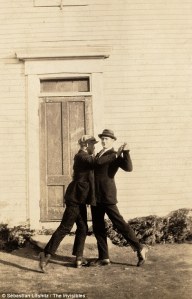
For a complex array of reasons, including homophobia, shame, and despair, the fire and its victims languished in obscurity for years, not taking its proper place in the broader sweep of LGBT history, but this is quickly changing.
“Upstairs”, my musical tragedy commemorating the fire and honoring its victims premiered last year in New Orleans to sold-out audiences, as part of the 40th anniversary memorials and Pride events. A portion of the musical is now playing at the West Village Musical Theatre Festival in New York.
A new book, “The UpStairs Lounge Arson: Thirty-Two Deaths in a Louisiana Gay Bar”, released just last month, is the most extensively-researched and carefully-told history of the subject.
And “Upstairs Inferno”, a documentary by acclaimed filmmaker Robert Camina is currently in post-production.
In addition, Delery, Camino, and I are advocating the inclusion of the UpStairs Lounge site on the National Register of Historic Places.
To commemorate the anniversary of the fire, I spoke with Camina about his documentary.
The lion’s share of published research about the fire comes from Johnny Townsend, author of “Let the Faggots Burn”, and Clay Delery. Did you interview them for the piece and what did you learn?
Well of course Townsend had a lot to contribute, because without his efforts many years ago to interview people, many of the stories would have been lost. So I think he brought a lot of insight to the tragedy that, since so many have passed on, we are not able to access.
Did you get to talk to anyone that Delery and Townsend did not get to talk to?
I don’t think they interviewed Francis Dufrene. We were able to interview him. He was a survivor of the fire. He slipped through the bars and jumped and landed on the pavement. He suffered third-degree burns. He gave us a distinctive perspective of what it was like in the middle of it when the fire started, so we definitely learned a little bit of what it was like the emotions just the mood and a frame of mind of what people going through in there.
As far as you can tell, what was the UpStairs lounge like as a bar?
It was a very comfortable place. Everyone we talked to said that the patrons were like a family. And the word that has come up that you’re very familiar with is “Sanctuary”.Yes, that’s why I opened my musical with a song of that title. And of course, when a place that is considered a sanctuary is invaded and ruined, it has a profound impact on a community. And I’m not sure I had a whole sense of the impact that it had until I was there last year for the 40th Anniversary to see how the community responded to the memorial events and the play.
Supreme Court Justice Antonin Scalia made an appearance at the Lanier Theological Library in Houston, Texas on Friday, where he claimed that the success of capitalism was deeply tied to the nation’s religious values.
“While I would not argue that capitalism as an economic system is inherently more Christian than socialism … it does seem to me that capitalism is more dependent on Christianity than socialism is,” Scalia, a devout Catholic, said during his speech,according to the Houston Chronicle. “For in order for capitalism to work — in order for it to produce a good and a stable society — the traditional Christian virtues are essential.”
Unfortunately, I can’t seem to read the part in the new testament where the jesus dude said ANY of that. Evidently, we’re supposed to all follow his brand of religion even if we find it to be complete bunk.
Why can’t we just live and let live?
What’s on your reading and blogging list today?

 peej
peej Carissa
 bostonboomer
 dakinikat
 ecocatwoman
 mablue2
 Mama Lopez
 peggysue22
 quixote
 skydancingguestblogger
 Mona (aka Wonk the Vote)



 Sky Dancing
Recent Comments