
Wednesday Open Thread: Massive NYC Explosion
Posted: March 12, 2014 Filed under: open thread | Tags: breaking news, building collapse, disasters, gas explosion 30 Comments
There has been a massive explosion in New York City’s East Harlem. Two buildings have collapsed, killing at least two people and injuring 17 others. This story is still breaking. The latest from The New York Daily News:
BREAKING: Two buildings collapse, killing 2 women and injuring 17 after gas explosion in Harlem
A loud explosion inside a five-story building on Park Ave. at E. 116th St. sent “people flying out the window,” killing two women, injuring 17 and leaving two buildings in rubble Wednesday morning, according to the Fire Department and witnesses.
“For weeks we’ve been smelling gas,” said Ashley Rivera, 21, holding back tears. “We saw people flying out of the window. … Those are my neighbors.”A law enforcement source told the Daily News the cause appeared to be a gas explosion. Mayor de Blasio was on his way to the scene.
Dramatic photos at the link. More photos from around the ‘net:


This is an open thread. What else is happening?
Tuesday Reads: More Snow, Mystery Plane, Joe McGinniss, Ed Snowden, and Ukraine Crisis
Posted: March 11, 2014 Filed under: Barack Obama, Crime, Foreign Affairs, morning reads | Tags: deaths, Edward Snowden, Fatal Vision, Jeffrey MacDonald, Joe McGinnis, missing Malaysian Airlines plane, South by Southwest Interactive conference, Ukraine crisis, Vladimir Putin, winter weather 44 Comments
A Snowy Harvard Square in 1969
Good Morning!!
I’ve had a scary couple of days. I woke up on Sunday morning to find my house very cold. I soon realized there was something wrong with my furnace. It was still running and there was hot air coming out of the vents, but it wasn’t pushing out enough heat to warm up the house. It turned out the blower motor had died so I called furnace installation davenport ia to diagnose the problem.
Why is it these things always seem to happen on a weekend or holiday? Luckily it hasn’t been terribly cold so I’ve managed to stay relatively comfortable by wearing lots of layers and using a portable electric heater. I was able to find someone to come and fix it yesterday. I got so relaxed that I overslept this morning, and so this post is going to be late.
In addition, health benefits of infrared heating impacts our mind and body. Increases your core body temperature, stimulating continuous blood flow from the heart in and around the body. The improvement of circulation enables an increased level of fresh oxygen and other nutrients to reach vital organs, removing carbon dioxide and other waste substances away from these organs, improving their functions helping to perform better and feel healthier.
So now I’m completely broke but warm, and I’m prepared for the upcoming snowstorm. Yes, the Weather Channel is predicting another one and has given it one of those annoying names. You can check out the predicted impact on your area in this summary article, Winter Storm Vulcan Forecast: Long Swath of Snow Across Rockies, Midwest, Northeast. I can only hope this one turns out to be a bust like the last one. Otherwise, I’ll be shoveling snow again on Friday.
The story of the missing Malaysion plane continues. Here are the latest reports:

Reuters (via Nipawin Journal): Malaysia military tracked missing plane to west coast: Source
KUALA LUMPUR – Malaysia’s military believes a jetliner missing for almost four days turned and flew hundreds of kilometres to the west after it last made contact with civilian air traffic control off the country’s east coast, a senior officer told Reuters on Tuesday.
In one of the most baffling mysteries in recent aviation history, a massive search operation for the Malaysia Airlines Boeing 777-200ER has so far found no trace of the aircraft or the 239 passengers and crew.
Malaysian authorities have previously said flight MH370 disappeared about an hour after it took off from Kuala Lumpur for the Chinese capital Beijing.
“It changed course after Kota Bharu and took a lower altitude. It made it into the Malacca Strait,” the senior military officer, who has been briefed on investigations, told Reuters.
That would appear to rule out sudden catastrophic mechanical failure, as it would mean the plane flew around 500 km (350 miles) at least after its last contact with air traffic control, although its transponder and other tracking systems were off.
A non-military source familiar with the investigations said the report was one of several theories and was being checked.
Authorities are pretty sure there was no terrorism involved. At least one of the men with stolen passports was an asylum-seeker from Iran.
CBS News: Malaysia Airlines Flight 370 search widens; men carrying stolen passports ID’d as young Iranians
KUALA LUMPUR, Malaysia — At least one of the two men traveling on a missing Malaysian Airlines jetliner was an Iranian asylum seeker, officials said Tuesday, as baffled authorities expanded their search for the Boeing 777 on the opposite side of the country from where it disappeared nearly four days ago with 239 people on board.
In the absence of any sign that the plane was in trouble before it vanished, speculation has ranged widely, including pilot error, plane malfunction, hijacking and terrorism, the last because two passengers were traveling on stolen passports. The terrorism theory weakened after Malaysian authorities determined that one of the two men was an Iranian asylum seeker.
Interpol Secretary General Ronald Noble said at a news conference Tuesday that the international police agency had identified two Iranian men, Pouri Nour Mohammadi, 18, and Delavar Seyed Mohammad Reza, 29. Noble said based on investigations carried out into the men to date, they were “probably not terrorists.” The chief of police in Kuala Lumpur said earlier in the day that Mohamadi was apparently trying to fly to Europe as an asylum seeker.
The plane took off from Kuala Lumpur, on the western coast of Malaysia, early Saturday en route to Beijing. It flew overland across Malaysia and crossed the eastern coast into the Gulf of Thailand at 35,000 feet. There it disappeared from radar screens. The airline says the pilots didn’t send any distress signals, suggesting a sudden and possibly catastrophic incident.

I was surprised and saddened last night to learn that Joe McGinniss has died at 71 of complications from inoperable prostate cancer. McGinniss was only 26 when his first book The Selling of the President 1968 hit the bestseller lists. I bought the book and read it way back then. I couldn’t put it down. Same thing with his pathbreaking true crime book on the Jeffrey MacDonald case, Fatal Vision. From the AP obituary (via First Post World), ‘Fatal Vision’ author Joe McGinniss passes away at 71.
McGinniss was a columnist for The Philadelphia Inquirer in 1968 when an advertising man told him he was joining Hubert Humphrey’s presidential campaign. Intrigued that candidates had advertising teams, McGinniss was inspired to write a book and tried to get access to Humphrey. The Democrat turned him down, but, according to McGinniss, Nixon aide Leonard Garment allowed him in, one of the last times the ever-suspicious Nixon would permit a journalist so much time around him. Garment and other Nixon aides were apparently unaware, or unconcerned, that McGinniss’ heart was very much with the anti-war agitators the candidate so despised.
The Republican’s victory that fall capped a once-unthinkable comeback for the former vice president, who had declared six years earlier that he was through with politics. Having lost the 1960 election in part because of his pale, sweaty appearance during his first debate with John F. Kennedy and aware of his reputation as a partisan willing to play dirty, Nixon had restricted his public outings and presented himself as a new and more mature candidate.
McGinniss was far from the only writer to notice Nixon’s reinvention, but few offered such raw and unflattering details. “The Selling of the President” was a sneering rebuttal to Theodore H. White’s stately “Making of the President” campaign books. It revealed Nixon aides, including future Fox News chief Roger Ailes, disparaging vice presidential candidate Spiro Agnew, drafting memos on how to fix Nixon’s “cold” image and debating which black man — only one would be permitted — was right for participating in a televised panel discussion.
Historian David Greenberg wrote in “Nixon’s Shadow,” published in 2003, that McGinniss “sneaked in under the radar screen, presenting himself to Nixon’s men as such an insignificant fly on the wall that they never thought to swat him away.”
McGinnis was criticized for getting too close to Jeffrey McDonald and somehow betraying him, but I think McGinnis got it right. His contract stated that he would have full independence. He started out thinking McDonald could be innocent of the murders of his wife and two daughters, and he had an inside track on the defense; but in the end McGinnis concluded that MacDonald was guilty and wrote about his change of heart in the book.

Colette, Kimberly, and Kristin MacDonald
His 1983 book “Fatal Vision” became a classic of the true crime genre and was based on unlimited access he gained to former Green Beret Jeffrey MacDonald and his attorneys during MacDonald’s 1979 murder trial in the deaths of his pregnant wife and two young daughters in Fort Bragg, North Carolina.
MacDonald, who at the time of the 1970 killings was an Army doctor, was found guilty and is serving three life sentences.
He has maintained the murders were committed by drug-crazed intruders. McGinniss had begun by expressing support for MacDonald but ended by concluding in his book that he was guilty of killing his family.
“I kept trying to find any reason I could to believe that he was not guilty,” McGinniss testified at a 2012 court hearing where MacDonald sought to be granted a new trial.
New Yorker magazine writer Janet Malcolm, in a 1989 article, accused McGinnis of displaying the underside of journalism by deceiving MacDonald with a show of support and then betraying his confidence, an argument McGinnis vehemently denied.
A terrific writer has left us far too soon.
Edward Snowden has been making more virtual appearances than a best-selling author on a publicity tour. Yesterday he was at South by Southwest Interactive in Austin Texas. I’m sure everyone here knows I’m not a fan of the pale and nerdy defector, so I’ll spare you my editorial comments and just give you a couple few links.
From Politico’s Josh Gerstein: Snowden Inc.
First, National Security Agency leaker Edward Snowden popped up in Hong Kong. Then, Russia. By Monday, the fugitive from justice, a man regularly accused of treason, was in Austin, Texas, hitting the nation’s hottest tech festival — via the Web, of course.
“They’re setting fire to the future of the Internet,” Snowden warned darkly, in jerky video relayed through a series of proxies from an undisclosed location in Russia. With an image of the U.S. Constitution projected behind him, he urged the tech-savvy SXSW attendees to ride to the rescue against rampant surveillance by the NSA and others. “The people who are in this room, now, you guys are all the firefighters, and we need you to help fight this,” he said, sounding every bit the geek as he described various encryption applications he believes should get wider use.
Snowden was painstaking in how he assembled a huge trove of top-secret documents while working as a tech contractor at an NSA facility in Hawaii. And he’s been equally deliberate in the way he and the team around him have crafted and cultivated his public image — controlling and carefully managing how he’s been perceived by the public in the months since he burst into the spotlight. It’s an endeavor that’s involved everything from coordinated efforts to beat back Obama administration attacks to the careful parceling out of tantalizing tidbits about his everyday life.

Snowden is campaigning for clemency; but frankly, I hope he ends up stuck in Russia for life. Ooops! Sorry, that’s my last nasty comment. A couple more links:
The Verge: Edward Snowden: ‘Would I do it again? Absolutely yes’
The Washington Post: ‘They’re setting fire to the future of the Internet’
I’ll wrap this up with some interesting articles on the crisis in Ukraine.
Putin biographer Masha Gessen at the LA Times, Is Vladimir Putin insane? Hardly. He is merely acting the way he always has, like a playground bully.
Politico, Bill Clinton no fan of ‘crazy’ moves on Ukraine
Financial Times, Ukraine is a test case for American power: If the Chinese leadership were ever to ‘do a Putin’, how could the US and allies react?
Robert Shrum at The Daily Beast, Obama’s All Eisenhower On Russia: Like Ike before him, Obama’s non-moves against Russia are the right moves.
Now what stories are you following today? Please post your links on any topic in the comment thread, and have a terrific Tuesday!
Monday Reads: Women’s Day Edition
Posted: March 10, 2014 Filed under: morning reads 61 CommentsGood Morning!
I’ve been thinking a lot lately about what it means to be a woman in a society that only values you under specific circumstances. It’s probably related to the passage of yet another Women’s day on March 8 where I look around and see more lost ground than ground gained. The stereotypes we identified in my women’s studies group in high school are still alive and flung across the internet.
I didn’t watch the Oscars–having no interest in celebs or movies–but I did notice the next few days were filled with the usual snipes and compliments on dresses. Then, there was the hooplah on the plastic surgery of Kim Novak and Goldie Hawn that many deemed’ pathetic and unrecognizable. Novak is 81.
The Internet gasped in horror—or was it amusement? —when the Vertigo star took the stage with Matthew McConaughey to
present the award for Best Animated Feature to Disney’s Frozen (an unfortunate coincidence, generating countless rudimentary puns on social media). A sampling of tweets, including several from well-known figures in the entertainment and media industries: Comedian Nick Youssef joked that “Kim Novak was just safely transported back to the Hollywood Wax Museum”; Chelsea Lately writer Fortune Feimster quipped, “I’m assuming Kim Novak was representing the movie ‘Mask’”; Huffington Post editorial director Howard Fineman broadened the mockery: “#AcademyAward for worst plastic surgery: tie between Kim Novak and Goldie Hawn.”
And blowback against the comments was equally fierce. Newly minted MSNBC host Ronan Farrow shot back, “Half the people being cruel about Kim Novak are ten years away from being Kim Novak.” Actress Rose McGowan tweeted a picture of the actress in her heyday as a sex symbol, adding, “Self-obsessed and disrespectful, that sums up the Oscar audience.”
In a way, by tweeting a picture of Novak sprawled out on a bed in a scene from the 1958 film, Bell, Book and Candle, McGowan was unwittingly acknowledging that we should judge actresses by their looks—because beauty is indeed one of the most important attributes for a Hollywood actress, young or old. Had Novak not won the genetic lottery, she could have easily lost her breakout role in Hitchcock’sVertigo to a prettier face (Novak was a good actress, but not a great one). So why are we surprised when, years after being out of the limelight, viewers continue obsessing over the face that once made her famous? And we should be no less surprised that Novak is obsessed with her face.
 Goldie’s dress and face didn’t fare much better. I’ve been thinking of both of them in light of Diane Keaton, Helen Mirren, and Dame Diana Rigg who are still trodding the boards and have passed on certain enhancements. Diana Rigg is one among many devious women starring in HBO’s Game of thrones. She’s a fiesty delight and I enjoyed reading this interview with her.
Diana Rigg is trying to cross the Fulham Road in London. Elegant from two-tone shoes to circular, tinted glasses, she is thwarted by the traffic. “Good timing,” she says after I introduce myself. “You can help me get across.” In the 60s, when she played Emma Peel in The Avengers, a catsuit-wearing Rigg would have vaulted across car bonnets, and if any male driver had remonstrated, she would have karate-chopped him in the throat and kicked him in the crown jewels. But not today.
“It’s my damned tin knees,” she says as we link arms and hobble across the street. She had an operation on one of them recently. I had heard that she damaged her knees with those lengthy tap-dancing routines in the 1987 West End production of Sondheim’s Follies? “No, it’s genetic. My brother, who is 80, has the same problem.”
Not that the 75-year-old actor is unhappy with her lot.”The older you get, I have to say, the funnier you find life,” she says. “That’s the only way to go. If you get serious about yourself as you get old, you are pathetic.”
We settle in the garden of a French cafe. A few years ago Rigg would have sought out the garden to indulge her 20-a-day habit, but Dame Diana gave up smoking a couple of years ago, and today wants to catch the early spring rays and feed crumbs to the birds.
“I found myself talking aloud to the pigeons in the park the other day,” she tells me. “The male pigeons were busily pursuing the female pigeons. I said: ‘You silly farts. Can’t you see they’re not interested?’ And then I realised there were people listening to me.” And what applies to birds, she reckons, applies to elderly men and women. “I think women of my age are still attractive.” She removes her glasses and faces me down with brown eyes that have turned strong men – and, indeed, women – to jelly. “Men of my age aren’t.” Why? “They’ve got their cojones halfway to their knees,” she says, giggling. “They have the same descent as tits.”
Aging is not an easy thing in a society that values women for their looks and their fertility. But, you’re either invisible or you’re fertile and thereby potential property of men and state. Here’s a list of the crap Lousiana legislators are proposing for the women in my state.
HB 388: Requires doctors to have admitting privileges at local hospital before performing abortions.
HB 401: Prohibits advertising of abortion services and distribution of abortofacients.
HB 727: Requires provision of psychological health information prior to abortion.
HB 590: (Constitutional amendment) Prohibits the use of public monies for abortion and provision of public monies to providers of abortion except as may be required by the federal government as a condition of federal financial participation in a public medical assistance program.
HB 348: Prohibits termination of life-sustaining procedures for pregnant women.
HB 305: Prohibits providers of elective abortions and their affiliates from delivering any instruction or materials in schools.
As you can see, the obsession with lady parts is ongoing. In fact, any kind of focus on the state of women in this country brings to focus exactly how unkind of a country we can be.
According to the African American Policy Forum, black girls are suspended at a higher ratethan all other girls and white and Latino boys. Sixty-seven percent of black girls reported feelings of sadness or hopelessness for more than two weeks straight compared to 31 percent of white girls and 40 percent of Latinas. Single black women have the lowest net wealth of any group, with research showing a median wealth of $100. Single black men by contrast have an average net wealth of $7,900 and single white women have an average net wealth of $41,500. Fifty-five percent of black women (and black men) have never been married, compared to 34 percent for white women.
This situation is dire at every level. But perhaps the most troubling thing of all: The report indicates that while over 100 million philanthropic dollars have been spent in the last decade creating mentoring and educational initiatives for black and brown boys, less than a million dollars has been given to the study of black and brown girls!
Several years ago, in line with the rise of the field of Girls Studies in academe, a group of students asked me to teach a course on Black Girls Studies. The number of books and scholarly articles barely added up to enough for a full course syllabus.
It’s amazing to me how many women are still invisible. And, it’s still amazing that we can’t seem to gain ground on any particular front. Here’s a bit from Robin Morgan that’s worth a read on dissent within the feminist ranks. She has some ground rules.
But I have standards, seasoned over 40 years of activism. I don’t waste time debating patriarchy’s defenders. I don’t practise or tolerate personal trashing. I don’t engage with faux feminists who, whether under the aegis of religious fiat or sexual libertarianism, refuse to understand that all women deserve full reproductive rights, all women deserve to love whomever they choose, all women deserve freedom from violence, poverty and illiteracy, that the buying and selling of any human being is slavery. Feminism is for all women and girls, not a privileged few or one ethnicity, religion, age, sexual preference, ability, region or hemisphere. Women born and raised on this fragile planet have more uniting us than dividing us – and it’s the job of feminists to help us realise that. Those are my standards.
Women are still universally treated like chattel.
Around 14 million girls, some as young as eight years old, will be married in 2014.
An estimated 1.2m children are trafficked into slavery each year; 80 per cent are girls.
In 10 countries around the world women are legally bound to obey their husbands
Only 76 countries have legislation that specifically addresses domestic violence – and just 57 of them include sexual abuse.
It makes me dizzy thinking that my 40 years as an activist really haven’t led to much change at all. I did find that there are a few places I can take refuge should I decide to move to a matriarchal society.
The Nagovisi community of South Bougainville, New Guinea is matrilineal with matriclans. The women of the Nagovisi holdpositions of authority and power, traditionally in regards to the cultivation of their gardens. These gardens are the woman’s sphere, and are inherited by daughters. The community is largely based on crop cultivation. With this control of the food, like sweet potatoes and coconuts, woman may remain independent and men are dependent on the women for that food.
The man eating the woman’s food is a symbol of their marriage, and if he were to stop, it would be a sign of divorce. Men typically move into the woman’s family for marriage, and the women are the breadwinners. Men take care of the clearing of the lands, but typically follow the instructions of the woman.
That sounds interesting!
Well, I suppose taking stock of something where progress depends on the very people that benefit from the status quo is a lot to hope for. Especially, when you look at the CPAC attendance and see how many women are willing to collaborate with the the worst of the worst.
What’s on your reading and blogging list today.
Lazy Saturday Reads: Missing Plane, Crisis in Ukraine, and Russia-U.S. Espionage
Posted: March 8, 2014 Filed under: Barack Obama, Foreign Affairs, morning reads | Tags: Edward Snowden, Malaysia Airlines missing plane, Russian moles 36 Comments
Good Morning!!
Last night Malaysia Airlines announced it had lost contact with a plane headed for Beijing.
KUALA LUMPUR, Malaysia (AP) — Malaysia Airlines said Saturday it lost contact with a plane carrying 227 passengers and 12 crew on its way from Kuala Lumpur to Beijing. Flight MH370 lost contact with the Subang air traffic control at 2:40 a.m. Saturday (18:40 GMT Friday). The flight was operated on the Boeing 777-200 aircraft.
It appears the plane “vanished” somewhere over Vietnam, and crews are now searching for it while families and friends of those on board wait for more information. From the LA Times: Crews searching for Malaysian plane spot oil slicks off Vietnam
BEIJING – As passengers’ relatives waited for news on the Malaysian Airlines jet that went missing Saturday en route from Kuala Lumpur to Beijing, reports emerged that military aircraft had spotted two oil slicks off southern Vietnam.
The Associated Press reported that a Vietnamese government statement said the slicks were each between 6 miles and 9 miles long. The statement said the slicks were consistent with the kinds that would be left by fuel from a crashed jetliner.
The Malaysia Airlines Boeing 777 disappeared from radar screens with 239 people on board.
A delegation of Chinese painters and calligraphers, an American employee of IBM and two vacationing couples from Australia were among those believed to be passengers.
Malaysia Airlines flight MH370 lost contact with air traffic controllers around 2:40 a.m. local time, two hours after takeoff. More than 14 hours later, airline officials said they had been unable “to establish any contact or determine the whereabouts” of the aircraft, a Boeing 777-200.
The airline’s CEO, Ahmad Jauhari Yahya, told a news conference in Kuala Lumpur that there was no distress call or bad weather report from the pilots before the plane lost contact with air control 120 nautical miles (140 miles) off the east coast of Kota Bharu, Malaysia.
NBC News has live updates: Desperate Wait for Families After Malaysia Airlines Jet Vanishes
And then there’s this from the LA Times: Terrorism not ruled out in disappearance of Malaysia Airlines jet.
BEIJING — Malaysian officials investigating the disappearance of a Malaysia Airlines plane Saturday said they were not ruling out terrorism — or any other causes — as reports emerged that two Europeans listed on the passenger manifest were not aboard and may have had their passports stolen….
Malaysia’s director general of civil aviation told a news conference Saturday night that authorities had reviewed closed-circuit TV footage of passengers and their luggage and hadn’t seen anything of concern. But Prime Minister Najib Razak cautioned that it was “too early” to come to any conclusions, and other officials said nothing was being ruled out of consideration at this point.
The crisis in Ukraine continues to escalate, it’s not clear what the U.S. can do about it, and the EU is apparently unwilling to take any action, so whatever the West does will be up to NATO–meaning the U.S. What a mess.
The crisis in Ukraine continues to escalate, it’s not clear what the U.S. can do about it, and the EU is apparently unwilling to take any action, so whatever the West does will be up to NATO–meaning the U.S. What a mess.
I hope at least some reasonable people who are able to apply logic to events are beginning to wake up to the fact that Russian intelligence probably has the NSA data that Edward Snowden stole, and Putin could very well be making his decisions based on the knowledge gained from their pale and nerdy guest. Logically, I think it makes a lot of sense to question whether Snowden was either working with Russia all along or was duped by Julian Assange of Wikileaks into the role of useful idiot. Keep in mind that there is a long history of Russia/the Soviet Union successfully inserting moles into U.S. intelligence agencies.
The following disturbing story was posted at CNN yesterday evening. Military spy chief: Have to assume Russia knows U.S. secrets.
Lt. Gen. Michael Flynn, the head of the Defense Intelligence Agency, made that clear when he told National Public Radio in an interview broadcast Friday how U.S. officials must plan for the possibility that Vladimir Putin’s Russia has access to American battle plans and other secrets possibly taken by classified leaker Edward Snowden.
“If I’m concerned about anything, I’m concerned about defense capabilities that he may have stolen from where he worked, and does that knowledge then get into the hands of our adversaries — in this case, of course, Russia,” Flynn said of the former National Security Agency contractor who fled to Moscow to seek asylum….
Flynn said he worried about what else Snowden knows, and how Russia — where Snowden lives now — may have access to the documents. He cited intelligence capabilities, operational capabilities, technology and weapons systems as potential subjects of so far unpublicized information Snowden — and Russia — may have.
Take that seriously, with a grain of salt, or a large box of salt, whichever you choose. I take it seriously. Based on what little has been revealed so far and the fact that most of it has focused on U.S. and U.K. cooperation with spy agencies in other countries, I no longer believe that Snowden ever intended to reveal domestic spying on Americans. His goal–and apparently Glenn Greenwald’s and Laura Poitras’ goals as well–was to damage U.S. foreign policy and national security as much possible.
Did you happen to see the latest post at Greenwald’s new site “The Intercept?” It’s a supposedly “humorous” piece by “investigative reporter” Peter Maass about an “advice columnist” who appears in an NSA publication. WTF?! This is supposed to be serious reporting from a publication that now owns the only complete sets of Snowden’s stolen NSA files? The purpose of the article can only be to make fun of NSA and any notion that it is engaged in serious work that makes a difference to U.S. national security.
That’s my rant for today, but I just want to add one more bit of newly-discovered information on Russian spying on the U.S. from John E. Dunn at TechWorld: Invisible Russian cyberweapon stalked US and Ukraine since 2005, new research reveals.
The mysterious ‘Uroburos’ cyberweapon named last week in Germany has been stalking its victims since as far back as 2005 and large enterprises and governments need to pay urgent attention to the threat it poses, UK security firm BAE Systems has urged.
German firm G Data’s recent analysis dubbed it ‘Uroburos’ while it is also known to some security firms as ‘Turla’. BAE Systems’ Applied Intelligence division, which today published its own research, prefers the catchier ‘Snake’ but under any name the picture is alarming.
According to BAE Systems, It now transpires that Snake has been slithering silently around networks in the US and its NATO allies and former Soviet states for almost a decade, stealing data, getting ever more complex and modular and remaining almost invisible.
To be clear, this isn’t any old malware. Snake is just too long-lived, too targeted, too sophisticated, too evasive, too innovative. It appears to be on par with any of the complex cyberweapons attributed to the US such as Flame, first analysed by Kaspersky Lab in 2012.
Based on the fact that the “Snake’s” target are all either Western countries or or former Russian controlled countries, the perpetrator of this malware is almost unquestionably Russia.
After several months of research, the UK firm takes what we know a lot further, offering for the first time some objective data on targets. Culling data from malware research sites (i.e. those to which suspected malware samples are submitted for inspection), it has been spotted 32 times in the Ukraine since 2010, 11 times in Lithuania, 4 times in the UK, and a handful of times altogether from the US, Belgium, Georgia, Romania, Hungary and Italy.
These are very small numbers but BAE Systems believes that on past experience they are highly indicative. While they represent a tiny fraction of the number of infections that will have occurred in these countries and beyond, they can be used to reliably infer that Snake has been aimed at Western and Western-aligned countries pretty much exclusively.
See also this earlier article by Dun, Is this Russia’s Stuxnet? Security firm spots suspicious ‘Uroburos’ rootkit.
Getting back to the crisis in Ukraine, here’s the latest news I could find:
CNN: Tensions flare as military standoff in Ukraine’s Crimea region continues
Simferopol, Ukraine (CNN) — Ukrainian officials accused pro-Russian forces in its Crimea region of fresh bullying tactics Saturday, as about 100 armed men reportedly took control of a military office in the regional capital, Simferopol.
The men — who are equipped with automatic weapons — say they belong to the Crimean self-defense forces, said Vladislav Seleznyov, head of the Ministry of Defense’s media office, on his Facebook page.
They have stationed armed men on each floor of the military registration office, he said….
Amid signs that the tense standoff of the past week is growing more volatile, Russian troops also stormed a Crimean border control point early Saturday, seizing the armory and driving the officers’ families from their living quarters, Ukraine’s border service said.
The troops beat up the senior officer on duty at the Schelkino border control point, near the city of Kerch, when he tried to stop them, the State Border Guard Service said on its website. Russian forces are now in control of the premises, it said.
How is the Ukraine situation affecting the Syrian conflict? From the WaPo: Assad taking advantage of U.S.-Russia split over Ukraine, observers say.
BEIRUT — Syrian President Bashar al-Assad is taking advantage of the rift between Russia and the United States over Ukraine to press ahead with plans to crush the rebellion against his rule and secure his reelection for another seven-year term, unencumbered by pressure to compromise with his opponents.
The collapse last month of peace talks in Geneva, jointly sponsored by Russia and the United States, had already eroded the slim prospects that a negotiated settlement to the Syrian war might be possible. With backers of the peace process now at odds over the outcome of the popular uprising in Ukraine, Assad feels newly confident that his efforts to restore his government’s authority won’t be met soon with any significant challenge from the international community, according to analysts and people familiar with the thinking of the regime.
Russian President Vladimir Putin’s defiant response to the toppling of Ukrainian President Viktor Yanukovych has further reinforced Assad’s conviction that he can continue to count on Russia’s unwavering support against the armed rebellion challenging his rule, said Salem Zahran, a Damascus-based journalist and analyst with close ties to the Syrian regime.
“The regime believes the Russians now have a new and stronger reason to keep Assad in power and support him, especially after the experience of Libya, and now Ukraine,” he said. “In addition, the regime believes that any conflict in the world which distracts the attention of the Americans is a factor which eases pressure on Syria.”
This is not good, folks.
I have few more interesting links, but I want to get this post up, so I’ll put them in the comment thread. What stories are you following today?
Friday Reads: Us Savages in New Orleans have Done Been Discovered
Posted: March 7, 2014 Filed under: morning reads | Tags: Bobby Jindal, Fauxhemians, gentrification, New Orleans 65 Comments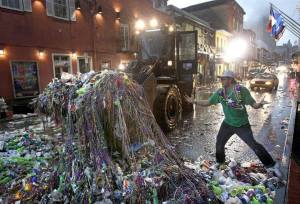
Good Morning!
And pardon me for a provincial rant here this morning!
This year will be my 20th anniversary of living in New Orleans. Yes, I was here before, during, and after Katrina. Yes, I have lived in the French Quarter and now I’ve been in the Bywater for nearly 15 of those 20 years. When I moved here, most of the folks were very old people, people living in section 8 housing, a gay contingent working in the quarter, and a very odd sundry of people trying to get out of the Quarter that had been a counterculture enclave but was rapidly turning into weekend condos for people from Texas and Georgia.
I had a few friends that owned bars and galleries here. Then, a few friends that opened up some restaurants. Then, Katrina happened. Then, we extended tax credits to movies studios and got Treme and a few interesting movies and now, well now it’s really, really attracting a group of people who have “discovered’ our wasteland and decided it’s ripe for their sort’ve civilization. We’re all so quaint here. No taxis would come here before they moved here. And, there is no kale to be found any where. But, it so authentically authentic. Isn’t it wonderful they discovered a new Brooklyn?
For some reason, I didn’t feel the need to civilize the city when I moved here. I just sort’ve dove in and let it wash all over me.
I will admit that some things are not as they should be here in the Not Always so Big Easy. There’s the NOPD. There’s still a contingent of politicians down here that are way too generous to their friends and to their own bank accounts. There’s plenty of institutional racism, sexism, and provincialism to go around. But I see this every where and at least New Orleans fills its cracks with good food, good music, and a lot of friendly people. Believe me, that makes up for a lot. However, for some reason, we’re attracting a lot of folks who want to turn us into Brooklyn or what Brooklyn has become. For this, I will reference Spike Lee who shouts “We’ve Been Here”. Discovering new lands that already exist and contain culture and people is not just a Christopher Columbus kind’ve thing.
Then comes the motherfuckin’ Christopher Columbus Syndrome. You can’t discover this! We been here. You just can’t come and bogart. There were brothers playing motherfuckin’ African drums in Mount Morris Park for 40 years and now they can’t do it anymore because the new inhabitants said the drums are loud. My father’s a great jazz musician. He bought a house in nineteen-motherfuckin’-sixty-eight, and the motherfuckin’ people moved in last year and called the cops on my father. He’s not — he doesn’t even play electric bass! It’s acoustic! We bought the motherfuckin’ house in nineteen-sixty-motherfuckin’-eight and now you call the cops? In 2013? Get the fuck outta here!
Nah. You can’t do that. You can’t just come in the neighborhood and start bogarting and say, like you’re motherfuckin’ Columbus and kill off the Native Americans. Or what they do in Brazil, what they did to the indigenous people. You have to come with respect. There’s a code. There’s people.
You can’t just — here’s another thing: When Michael Jackson died they wanted to have a party for him in motherfuckin’ Fort Greene Park and all of a sudden the white people in Fort Greene said, “Wait a minute! We can’t have black people having a party for Michael Jackson to celebrate his life. Who’s coming to the neighborhood? They’re gonna leave lots of garbage.” Garbage? Have you seen Fort Greene Park in the morning? It’s like the motherfuckin’ Westminster Dog Show. There’s 20,000 dogs running around. Whoa. So we had to move it to Prospect Park!
I mean, they just move in the neighborhood. You just can’t come in the neighborhood. I’m for democracy and letting everybody live but you gotta have some respect. You can’t just come in when people have a culture that’s been laid down for generations and you come in and now shit gotta change because you’re here? Get the fuck outta here. Can’t do that!
Yeah, you right.
You may have been reading my previous columns about how people that have just moved here have suddenly become the authentic carriers of New Orleans Culture and all things civilized. I have written about it before. The NYT just will not leave my neighborhood alone. Now, I have neighbors moving in from New Jersey, Philadelphia, New York, and all over. They just have decided that we’re passable if they can just civilize us a little bit more. We’re quaint and they can make us tolerable. Part of this post is about the hubris that comes from journalists. Part of this post is about the hubris that comes from being young. A lot of this post is about the hubris that comes from deciding that you’re just going to come into some one’s neighborhood, label them quaint, and then proceed to become the authority on what it is and isn’t.
“New Orleans is not cosmopolitan,” said the actress Tara Elders. “There’s no kale here.” Her husband, Michiel Huisman, the actor and musician who moved here with Ms. Elders in 2009 to shoot the HBO series “Treme” (he’s currently on the series “Nashville”), agreed. “The sign on a shop says that they’ll open at 10? You’re there at noon and it’s not open,” he said.
We were sitting outside at Sylvain, a restaurant in the French Quarter that Mr. Huisman said “takes Southern cuisine and pushes it a bit more modern.” With its elegant but rustic décor, cocktails featuring noirish names (Blood in the Gulfstream, Dead Man’s Wallet), and inventive food, Sylvain wouldn’t be out of place in Brooklyn — but Ms. Elders said spots like this are still the exception. “So many of the cool places here are really rundown,” she said. “And not because a stylist designed them that way.”
Just for your information, we have plenty of kale here. I went to Rouse’s Market yesterday and you can barely spot the mustard greens through the various assortment of kale. In fact, we’ve decided that #kalespotting is the new event for the post Mardi Gras let down just so they NYT knows we’ve got it. I have it on good authority that the Walmart in Chalmette even has it now.
In a long-ago episode of “The Simpsons,” a tourist to Springfield enters Moe’s bar and declares, “This isn’t a faux dive! This is a dive!” That was satire. But Goodman quotes Elders saying essentially the same thing and with apparent sincerity. “So many of the cool places here are really rundown. And not because a stylist designed them that way.”
Goodman’s story also includes a new transplant’s translation of a Mardi Gras Indian chant: “Shallow water, your mama.”
“Music really flows through the veins of the town, like where we are going tonight,” Mr. Huisman said, referring to the United Mardi Gras Indian Practice. “It’s so true to itself and so African. That really resonates with me: Nothing moves me as much as that beat, that rhythm that is truly New Orleans.”
We all piled into the family Jeep and drove out to Handa Wanda’s, an open warehouse space with a band set up in the back, a bar in the middle, and red beans and rice on hot plates up front. This spot is home base for the Wild Magnolias, one of dozens of tribes. Come Mardi Gras day, the tribe leader, or Big Chief, will lead a procession in full costume, challenging other tribes to mock battles. But tonight is an open practice and all are welcome.
Perched upstairs in the rickety balcony, we drank whiskey and Cokes out of Dixie cups while revelers of all ages shook it to a rollicking beat punctuated by chanting from the Big Chief. Instinctively, all of us leaned over the balcony and started bobbing our heads. Mr. Huisman saw me trying to sing along to words I couldn’t decipher. He smiled and said into my ear, “They’re saying, ‘shallow water, your mama,’ ” a traditional Indian call-and-response.
We are now fighting for t-shirts that say “Shallow water, Yo Mama”. Yes, the new dats are singing their own special lyrics in the shower cause you know how authentic and how, well so true and so African it all is.”
— Paradise City by Guns N’ Roses
“Take me down to a very nice city” Actual lyric: “Take me down to the Paradise City.”— Rock the Casbah by The Clash
“The sheep don’t like it, rockin’ the cat box” Actual lyric: “Shareef don’t like it, rock the Casbah”— Africa by Toto
“I left my brains down in Africa” Actual lyric: “I bless the rains down in Africa”— Bad Moon Rising by Creedence Clearwater Revival
“There’s a bathroom on the right” Actual lyric: “There’s a bad moon on the rise.”— You Sexy Thing by Hot Chocolate
“I Remove Umbilicals” Actual lyric: “I believe in miracles”— Suffragette City by David Bowie
“This mellow fat chick just put my spine out of place” Actual lyric: “This mellow thighed chick just put my spine out of place”— Waterfalls by TLC
“Don’t go, Jason Waterfalls” Actual lyric: “Don’t go chasing waterfalls”
So, a group of the local New Orleans Twitterati and facebookers spent the day coming up with just the precisely right phrase to dub our invaders. Oh, excuse me, those that are here to authenticate and purify and discover our lowly asses along with their search for Kale. We’ve adopted the term Fauxhemians.
 New Orleans does have a long outsider tradition. After all, the Barataria pirates and Jean Lafitte wandered the swamps here quite awhile ago before being pardoned for their outstanding fighting during the War of 1812. We’ve had our share of people chasing the local muses. You probably know that our long literary tradition includes Tennessee Williams and William Faulkner. The filming of the movie “Easy Rider” sent in an entire new group that took up residence in the quarter. However, Bourbon Street has always been a little bit of this and a little bit of that.
Educated young people were aware of their privilege, and a certain segment grew bored and anguished with it. As Adam Nathaniel Mayer writes, they “suffered a kind of postmodern malaise which in turn spurred a quest for meaning.” [2] Previous generations had common causes like escaping poverty or fighting wars to satisfy the top tier of Maslow’s Hierarchy of Needs; this generation did not. So they sought meaning through individualized quests for authentic experiences.
Because authenticity seemed to call for a certain demeanor, its seekers brooded, acted aloof and squinted when they dragged on their cigarettes. Because it needed a certain look, they grew or chopped their hair defiantly, got tattoos, and donned ragged or vintage clothing. Music, food, cinema, literature, cars, religion: just about every aspect of culture had a “groovy” (1960s), “alternative” (1980s) or “critical” (2000s) counterpart which pitted itself against the mainstream and viewed itself as authentic. And because authenticity also had a geography, its seekers packed their knapsacks and hit the road — out of suburbia and into the wilderness, to distant countries, communes, college towns and mountain villages, and to the decaying inner cities abandoned by their elders. In the past few decades, educated, mostly white youths from prosperous backgrounds have transformed urban spaces in cities like Brooklyn and Oakland and Baltimore and Boston and London from shabbiness and indigence to restoration and gentrification.
New Orleans fit the bill perfectly. It had history, culture, and the poignancy of tragedy and past grandeur. It had a European look, a Caribbean feel, an expatriated vibe, an abundance of historic housing at low rent, a pervasive booziness, and music, food and festivity to boot. It was authentic!
Gentrifiers seem to stew in irreconcilable philosophical disequilibrium. Fortunately, they’ve created plenty of nice spaces to stew in. Bywater in the past few years has seen the opening of nearly ten retro-chic foodie/locavore-type restaurants, two new art-loft colonies, guerrilla galleries and performance spaces on grungy St. Claude Avenue, a “healing center” affiliated with Kabacoff and his Maine-born voodoo-priestess partner, yoga studios, a vinyl records store, and a smattering of coffee shops where one can overhear conversations about bioswales, tactical urbanism, the klezmer music scene, and every conceivable permutation of “sustainability” and “resilience.”
It’s increasingly like living in a city of graduate students. Nothing wrong with that—except, what happens when they, well, graduate? Will a subsequent wave take their place? Or will the neighborhood be too pricey by then?
But, at least we’re some what separate from the state. The right wing side of the media has decided one of the movies filmed down here and about down here is far too mean to the institution of slavery. I guess every one has their notion of what we’re supposed to be about down here.
Some conservatives have started laying into the Oscar-winning movie 12 Years a Slave for creating an unfairly negative portrayal of slavery. You see, the movie portrays slaves being made unhappy by slavery. But that negativity is merely anti-slavery “propaganda,” according to James Bowman in conservative magazine The American Spectator:
If ever in slavery’s 250-year history in North America there were a kind master or a contented slave, as in the nature of things there must have been, here and there, we may be sure that Mr McQueen does not want us to hear about it. This, in turn, surely means that his view of the history of the American South is as partial and one-sided as that of the hated Gone With the Wind.
…Yes, there was much cruelty and hardship in the slave-owning South, as there has been in most of the rest of the world most of the time, and Mr. McQueen’s camera is all over that. But it strains ordinary credulity to suppose that there was nothing else.
We are wondering, was Bowman equally aggrieved by the lack of happy Jews in Schindler’s List?
To be fair to the American Spectator‘s readers, the comment thread under the article is mainly filled with people asking WTF the article is all about. The top comment reads, “‘a contented slave’ – is this article a joke of some sort?”
This state has been cursed with some of the worst leadership that could walk the planet. The head of the current plantation system is a cruel master.
“We’ve got Eric Holder and the Department of Justice trying to stand in the schoolhouse door to prevent minority kids, low-income kids, kids who haven’t had access to a great education, the chance to go to better schools,” Jindal said.
As the Washington Post points out, Jindal’s rhetoric is an apparent allusion to former Alabama Gov. George Wallace’s 1963 “Stand in the Schoolhouse Door” demonstration, during which the anti-integration governor stood in a doorway at the University of Alabama as two black students attempted to enter the institution.
Jindal also gave a shout out to some of his home state’s biggest celebrities — the stars of A&E’s “Duck Dynasty.”
“We must not let [the left] silence the Robertsons,” Jindal said of the reality show family, referencing national outrage over patriarch Phil Robertson’s homophobic remarks last year.
A new report from the state auditor shows these schools are failing miserably. 
The report also says that:
- 41 percent of voucher students scored at grade level or above on key tests.
- Voucher students account for more than half the enrollment at 18 schools in the Baton Rouge and New Orleans areas of the 118 reviewed statewide.
- The state was overcharged for tuition by 35 of the schools, including a top overbilling of $5,566 per student.
The school was not identified.
Those who get the state aid — backers call it scholarships — are not supposed to be charged more than others.
Vouchers are state aid for students who attend public schools rated C, D and F, and who meet income rules, to attend private schools with the tuition and some fees paid by the state.
Whether they provide students viable options to low-performing public schools is one of the most hotly-debated issues in Louisiana education circles.
Jindal is making a run at president and wants to replace Chris Christie as the Governor that can be taken seriously. But, any on that watches him from down here knows he only does what best for Jindal. It is only about him and his ambitions.
As governor, Jindal had an opportunity to put his big ideas into action. But his bold prescriptions look a lot like the same ideas Republicans have been pushing for decades—perhaps not surprising for a man who started out in an industry built around telling corporate leaders what they already know.
The centerpiece of his agenda was education. When he took office, Louisiana had some of the nation’s highest dropout rates and lowest literacy scores, and Katrina had battered New Orleans’ school system. Like another Southern governor, Jeb Bush, he built a reputation as an education reformer from the GOP mainstream—charter schools, teacher merit pay, and a voucher program to pay private-school tuition. But Jindal’s agenda also had a strong Christian flavor. In 2008, he signed the Louisiana Science Education Act, which allows public schools to teach creationism. Jindal framed it as a matter of giving local districts more control, but the effect was obvious: Thousands of high school students, especially in the state’s Baptist and evangelical north, were instructed that (for instance) the Loch Ness monster proves humans and dinosaurs coexisted.
Some think Jindal was simply playing politics, rewarding a religious demographic that was instrumental to his rise. “He’s smart—he was nearly gonna go to Harvard Medical School. I can’t believe that he believes in creationism,” says 20-year-old Zack Kopplin, who, as a high school student, persuaded 75 Nobel laureates to sign a letter opposing the legislation. But Jindal’s own statements suggest otherwise: As far back as 1995, fresh off his final semester at Oxford, Jindal wrote that there was “much controversy over the fossil evidence for evolution.”
Jindal’s voucher program has so far funneled at least $4 million to religious institutions, many with strict discriminatory policies. In the state’s northeastern corner, Claiborne Christian Academy students believed to be pregnant can be suspended and expelled upon confirmation. (An abortion warrants expulsion, too.)
Other voucher-funded schools in the region subject gay students to the equivalent of Don’t Ask, Don’t Tell. At Northlake Christian School in Covington, students can be refused admission if they or their family promote the “homosexual lifestyle.” Northeast Baptist School in West Monroe states that “students that profess a sexual orientation contrary to God’s Word will not be accepted and may be un-enrolled…upon discovery.”
“I guess they would confess it, and they would talk about it to the kids, and I would ask about it,” says Anita Watson, Northeast Baptist’s principal, when I call to ask how the school would find out about gay students. “To be honest, it hasn’t ever really come up because the teenagers that, I don’t know, that are leaning in that direction, they would probably choose not to come here.”
While aspects of Jindal’s education policies evoked Bush-era compassionate conservatism, in most areas he has embraced brute austerity. In the name of cutting waste—overspending has historically been a vehicle for corruption in Louisiana—Jindal has sought to slash the services on which residents of the nation’s third-poorest state have depended. He moved to cut the retirement benefits of some state employees by as much as 50 percent, while blocking even incremental increases in levies like the cigarette tax. State funding for higher education has been cut by 80 percent, with Jindal turning down federal stimulus funds that could have filled some of that gap. And last spring he vetoed $4 million to help relieve a 10-year waiting list for developmentally disabled Louisianans seeking in-home care.
His constant travel has eroded his stature at home. One state appointee who supports Jindal calls him an “absentee landlord.”Jindal touts his record as the first Louisiana governor in recent history not to raise net taxes. Instead, his approach has been to shift more of the tax burden onto the state’s poorest residents, while giving high-earners a break: In 2013, he proposed increasing sales taxes so the state couldeliminate all income and corporate taxes. (The plan died amid bipartisan rebellion.) And like 24 other Republican governorsacross the country, he turned down funding to expand Medicaid under the Affordable Care Act, denying coverage to 214,000 low-income Louisianans.
Jindal’s zeal to keep spending low and protect his reputation as a budget hawk has undercut other initiatives. He brought on environmentalists to help write his 2012 plan to shore up the coastline, but has so far fruitlessly insisted Washington, not Baton Rouge, foot the bill. When the state’s independent flood control board sought funding for the plan by suing 100 oil and gas companies for elevating flood risks through the construction of pipelines and canals, Jindal—who has received more than $1 million in contributions from the industry—asked the courts to throw the case out, and when that failed, replaced three of the board’s members. And even though Jindal had called outdated ethics rules the No. 1 obstacle to economic investment, and had pushed through an overhaul, his budget dramatically slashed the number of employees keeping watch; an analysis by the Center for Public Integrity gave Jindal’s administration a D+ for enforcement of corruption laws.
So, here I sit in a really changed post-Katrina world coming on 10 years after the flood. Who could predict that my neighborhood would be discovered by people seeking a new culture path to Brooklyn? Or that, my governor, a Rhodes Scholar who was a pre-med student at an ivy league college would put in a law that puts creation mythology on the same footing as science? It’s a strange reality and one that makes you wonder if any really cares about authenticity these days or even knows what it is.
So, there’s a lot of links to be shared down thread because I didn’t do it here. What’s on your reading and blogging list today?

 peej
peej Carissa
 bostonboomer
 dakinikat
 ecocatwoman
 mablue2
 Mama Lopez
 peggysue22
 quixote
 skydancingguestblogger
 Mona (aka Wonk the Vote)



 Sky Dancing
Recent Comments