
Saint Patrick’s Day Reads
Posted: March 17, 2014 Filed under: morning reads | Tags: Saint Patrick's Day, Sponsors of Parades pull out over homophobia 36 Comments
Top o’ the mornin’ to ya!
Like many places, New Orleans has been having St. Patrick’s Day parades and will have the traditional Irish Club Parade tonight! There’s a big difference in many places this year. Sponsors and politicians are pulling out in parades that will not open participation to gay groups. Parades in Boston and New York are losing sponsors like Guiness, Samuel Adams and Heineken Beer.
Irish brewer Guinness said on Sunday that it would not participate in New York City’s St. Patrick’s Day parade this year because gay and lesbian groups had been excluded, costing organizers a key sponsor of the annual event.
The move came on the same day that Boston’s Irish-American mayor skipped that city’s St. Patrick’s Day parade after failing to hammer out a deal with organizers to allow a group of gay and lesbian activists to march openly.
“Guinness has a strong history of supporting diversity and being an advocate for equality for all. We were hopeful that the policy of exclusion would be reversed for this year’s parade,” the brewer said in a written statement issued by a spokesman for its parent company, Diageo.
“As this has not come to pass, Guinness has withdrawn its participation. We will continue to work with community leaders to ensure that future parades have an inclusionary policy,” Guinness said.Last week New York Mayor Bill de Blasio said he would not march in the parade because gay and lesbian activists had been again precluded from taking part.
The loss of Guinness, one of the world’s top beer brands originating in Dublin, Ireland, appeared to ratchet up the pressure on organizers even further.
As noted, Boston’s Mayor also declined to participate in one of the city’s signature events that usually attracts the state and city’s major  political leaders.
After weeks of discussions that failed to convince organizers of South Boston’s annual St. Patrick’s Day parade to let gays march openly in the parade, Mayor Martin J. Walsh said today he would not take part in the event.
Walsh said he was “disappointed” and felt a “little bit of frustration.”
“I think for the most part everyone was on the same page. We had an agreement. Everything was all set. It came down to what letters were on a banner, which was very unfortunate,” said Walsh, referring to a proposed banner bearing the letters “LGBTQ” on it.
For two decades, gay men and lesbians have been excluded from openly marching. Walsh worked until the last minute to bring the statewide gay rights organization MassEquality and parade organizers from the Allied War Veterans Council to an agreement that would have changed that.
The talks broke down over a matter of language: Parade organizers would not permit any signs or clothing bearing the word “gay” or any other declaration of sexual orientation. MassEquality would not march without those words, comparing the restriction to a return to the “closet” of concealing one’s identity.
Walsh said today that the issue “came down to five letters” on the LGBTQ [standing for Lesbian, Gay, Bisexual, Transgender, and Queer] banner.
In a statement this morning praising Walsh for his efforts and for choosing not to march, Kara Coredini, executive director of MassEquality, said such a restriction was unfair.
“No other group is asked to march without a banner and their standard – not the police, firefighters, or the Irish,” Coredini said. “A double standard is the status quo and does not represent progress.”
Early Irish immigrants had to fight for their humanity and for respect. It seems odd that a persecuted group would embrace such obvious bigotry. How did the politics of Tip O’Neill’s Irish Americans move to the politics of Sean Hannity and Bill O’Reilly?
As late as the 19th century, Anglo elites in New York perceived the drunken and disorderly Irish newcomers as an unhealthful influence on the city’s industrious and long-settled black population.
But Irish-Americans rapidly absorbed the lesson that the way to succeed in their new country was to reject the politics of class and shared economic interests and embrace the politics of race. One disgraceful result was the New York draft riots of 1863, the low point of Irish-black relations in American history, when Irish immigrants by the thousands turned on their black neighbors in a thinly disguised race riot. Irish-Americans were under no delusions that the ruling class of Anglo Protestants liked or trusted them, and anti-Irish and/or anti-Catholic bigotry endured in diluted form well into the 20th century. But by allying themselves with a system of white supremacy, the Irish in America were granted a share of power and privilege — most notably in urban machine politics, and the police and fire departments of every major city.
As Joan’s book and many other sources have discussed, over the course of the last century the bulk of the Irish-American population drifted rightward through the Democratic Party and then out the other side into Archie Bunker-land. A key constituency of the New Deal coalition became, 40 years later, a key constituency of the Reagan revolution. But throughout that period there was always a countervailing social-justice tendency in Irish-American life, the tendency of the antiwar activist brothers Daniel and Philip Berrigan (quite likely the only Jesuit priests ever to make the FBI’s most-wanted list), or of 1952 left-wing presidential candidate Vincent Hallinan and his firebrand San Francisco family. This was the tradition of the radical Vatican II priests, nuns and theologians, who kept many of us from abandoning the Church altogether, and of the 1968 reawakening of Robert F. Kennedy and the subsequent career of his brother Teddy.
Without exception, those people started from an understanding of their own cultural and national history. They began with Irish nationalist or republican politics, and moved from there to consider how Ireland’s story fit into a worldwide pattern that transcended the specific racial paranoia of the United States. Of course Irish history did not end in 1998, and the current situation in that country – a land of immigrants for the first time in its modern history – is exceptionally interesting. But Ireland is no longer a divisive and charismatic “issue,” capable of galvanizing people who live thousands of miles away. With Irish-American identity now split between an optional lifestyle accessory and a bunch of unappealing right-wing guys yelling at us, its social-justice component has evaporated as well.
Can you imagine what Tip O’Neill would say to the likes of Paul Ryan?
Paul Ryan: When I said ‘inner city’ men are too lazy to work; that’s their ‘culture,’ I didn’t mean it racially.
It seems that now that poverty is spreading to white people, the topic has piqued the interest of a handful of Republican leaders. Notably, Republican bullshit artist par excellence, Paul Ryan, who has lately been trying to convince the public that he really cares and is earnestly searching his ample intellect for a solution — as long as it doesn’t require any government spending. Whoever is buying what he’s selling is dumber than a post.
So here is this deep thinker’s take on the cause of poverty: laziness. And not just any kind of laziness, the dreaded “culture” of “inner city” laziness. Or, in the House Budget Committee Chairman, ex-GOP veep candidate’s words:
“We have got this tailspin of culture, in our inner cities in particular, of men not working and just generations of men not even thinking about working or learning the value and the culture of work, and so there is a real culture problem here that has to be dealt with.”
You don’t have to be a genius at cracking codes to understand that he’s simply saying: Blacks are lazy. They prefer being poor to working. (As if working was a surefire way not to be poor.)
When called out on the thinly-veiled racism of his comments, Ryan said he had been “inarticulate” and had not intended to be racist at all. In fact, it never even occurred to him that they might be racist.
And if that isn’t the mark of a racist we don’t know what is. Surely, Ryan, with that big intellect of his, knows that the libertarian so-called-thinker he has lately been quoting, Charles Murray, who argues that Blacks and Latinos are genetically inferior, is also a self-described white Nationalist.
Note to Ryan: White Nationalist = racist!
To read more about how toxic Murray is and what a complete fraud Ryan is, click here:
So, that’s my offerings this morning. I may try to get a second post up later because I’ve been finding some interesting items up about what incredible things are going on in this country with the huge income gaps between the wealthy and every one else.
What’s on you reading and blogging list today?
Saturday Reads: Where is Malaysia Airlines Flight 370?
Posted: March 15, 2014 Filed under: Crime, Foreign Affairs, morning reads | Tags: Fariq Ab Hamid, hijackings, Malaysia Airlines Flight 370, Prime Minister Najib Razak, terrorism, Zaharie Ahmad Shah 59 Comments
Malaysia Airlines Boeing 777 in Paris in December (AP)
Good Morning!!
For completely selfish reasons I’m going to focus this post on the missing Malaysia Airlines plane mystery, because I’m obsessed with the story and I want to read about it.
A week after Malaysia Airlines Flight 370 disappeared from radar, what happened is still a mystery. Where could it have gone? Early Saturday morning, Malaysia’s Prime Minister Najib Razak announced that the plane was diverted off course by “deliberate action.” Faith Karimi and Barbara Starr at CNN:
“Malaysian authorities have refocused their investigation on crew and passengers aboard,” Najib told reporters. “Evidence is consistent with someone acting deliberately from inside the plane.” [….]
“Despite media reports that the plane was hijacked, we are investigating all major possibilities on what caused MH370 to deviate,” he said.
Shortly after he spoke, a source close to the investigation told CNN that Malaysian police had searched the home of pilot Zaharie Ahmad Shah, 53. Shah lives in a gated community in Shah Alam, outside Kuala Lumpur.
Earlier Saturday there was no police presence at the residence of his co-pilot, Fariq Ab Hamid, 27.
Here’s a transcript of the Prime Minister’s statement at CNN.
From Bernama, the National News Agency of Malaysia: Cops Visit Residence Of Missing Flight’s Captain.
SHAH ALAM, March 15 (Bernama) — Police were seen arriving at the residence of Captain Zaharie Ahmad Shah, the pilot of the Flight MH370 at about 2.42pm Saturday.
This followed Prime Minister Datuk Seri Najib Tun Razak’s press conference on the development of the missing Malaysia Airlines (MAS) aircraft.
A check by Bernama noted that three plain clothed police personnel introduced themselves as coming from Bukit Aman police headquarters to the security guard manning the Laman Seri residence at Section 13 here before obtaining a security pass to go in.
It was believed that the police have conducted a search at the pilot’s house and all of them were seen leaving the residence at about 4.46pm.
From the Sydney Telegraph: Investigators digging deep into the lives of the pilots from the missing airliner.
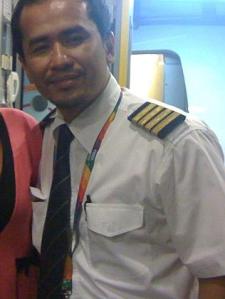
Co-pilot Fariq Abdul Hamid
THE psychological background, family life and connections of the two pilots aboard Malaysia Airlines flight MH370 have become a major focus of the investigation into the missing jet.
Pilots Zaharie Ahmad Shah, 53, and Fariq Abdul Hamid have been described as respectable, community-minded men.
Mr Fariq has drawn the greatest scrutiny after the revelation that in 2011, he and another pilot invited two women boarding their aircraft to sit in the cockpit for a flight from Phuket, Thailand, to Kuala Lumpur….
Fariq, the son of a high-ranking civil servant in Selangor state, joined Malaysia Airlines in 2007. With 2763 hours of flight experience, he had recently started co-piloting the Boeing 777. “His father still cries when he talks about Fariq. His mother too,” Ahmad Sarafi said.
Fariq had a brush with fame when he was filmed recently by a crew from “CNN Business Traveller,” and reporter Richard Quest described it as a perfect landing of a Boeing 777-200, the same model as the plane that vanished. Neighbour Ayop Jantan said he had heard Fariq was engaged and planning his wedding. The eldest of five, Fariq’s professional achievements were a source of pride for his father.
Zaharie, the pilot of MH370, joined the airline in 1981 and had more than 18,000 hours of experience. His Facebook page showed an aviation enthusiast who flew remote-controlled aircraft, posting pictures of his collection, which included a lightweight twin-engine helicopter and an amphibious aircraft. Born in northern Penang state, the captain and grandfather was an enthusiastic handyman and proud home cook.

Pilot Zaharie Ahmad Shah
Back to CNN story on the Prime Minister’s statement, linked above:
“The plane’s last communication with the satellite was in one of two possible corridors: a northern corridor stretching approximately from the border of Kazakhstan and Turkmenistan to northern Thailand, or a southern corridor stretching approximately from Indonesia to the southern Indian Ocean,” Najib said.
Given that the new search area involves a number of countries, the relevant foreign embassies have been given access to the new information. Malaysia’s Foreign Ministry will brief the governments that had passengers aboard the plane and will brief the relatives of its 239 passengers and crew….
“Based on new satellite information, we can say with a high degree of certainty that the Aircraft Communications Addressing and Reporting System, or ACARS, was disabled just before the aircraft reached the East Coast of peninsular Malaysia,” the Prime Minister said. “Shortly afterward, near the border between Malaysian and Vietnamese air traffic control, the aircraft’s transponder was switched off. From this point onwards, the Royal Malaysian Air Force primary radar showed that an aircraft — which was believed but not confirmed to be MH370 — did turn back.”
Military radar showed the jetliner flew in a westerly direction back over the peninsula before turning northwest toward the Bay of Bengal or southwest into the Indian Ocean, he said.
“Up until the point at which it left military primary radar coverage, these movements are consistent with deliberate action by someone on the plane,” he said, adding that investigators had confirmed by looking at the raw satellite data that the plane in question was the Malaysia Airlines jet.
American and British aviation authorities agreed with these conclusions. A story from McClatchy (via the Miami Herald) explains that an experienced person must have been flying the plane.
Najib’s comments further suggest that someone with significant flying experience must have commandeered the flight, or that a hijacker managed to coerce the crew to take two actions that diverted the flight from reaching Beijing. One involved disabling the flight’s “Aircraft Communications Addressing and Reporting System” over the northeast coast of Malaysia. Then, at 1:21 a.m, someone turned off a transponder that was reporting the aircraft’s location, altitude, speed and other information.
Forensics work and a review of Malaysian radar, Najib said, has now revealed that MH 370 turned back and started traveling in a westerly direction. But the flight was still tracked by satellites overhead. A review of that data, Najib said, revealed that the last confirmed communication between the plane and the satellite was at 8:11 a.m. Malaysian time last Saturday, nearly seven hours after air traffic controllers lost track of it.
Based on this new data, the prime minister said, investigators think the plane could have traveled in two possible directions — “a northern corridor stretching approximately from the border of Kazakhstan and Turkmenistan to northern Thailand, or a southern corridor stretching approximately from Indonesia to the southern Indian ocean.” An international search effort has already shifted its attention to those areas, he said.
That first scenario raises the possibility that a hijacker or hijackers could have attempted to land the plane and its passengers in a remote part of Central Asia known to harbor militant groups. But in an age of satellites, doing so undetected would be extremely difficult, and so far there’s been no reported claim of responsibility for the plane’s disappearance.
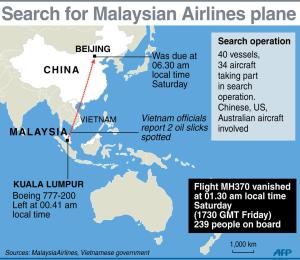
According to The New York Times, Search for Malaysian Jet Becomes Criminal Inquiry.
Mr. Najib’s news conference, at an airport hotel here on the outskirts of Kuala Lumpur, came a day after American officials and others familiar with the investigation told The New York Times that Flight 370 had experienced significant changes in altitude after it lost contact with ground control, and altered its course more than once as if still under the command of a pilot.
Military radar data subsequently showed that the aircraft turned and flew west across northern Malaysia before arcing out over the wide northern end of the Strait of Malacca, headed at cruising altitude for the Indian Ocean.
News sources indicate the plane could have kept flying as long as 7 hours after it cut off contact.
“The investigation team is making further calculations, which will indicate how far the aircraft may have flown after the last point of contact,” Mr. Najib said, reading a statement in English. “Due to the type of satellite data, we are unable to confirm the precise location of the plane when it last made contact with a satellite.”
The northern arc described by Mr. Najib passes through or close to some of the world’s most volatile countries, home to insurgent groups, but also over highly militarized areas with robust air-defense networks, some run by the American military. The arc passes close to northern Iran, through Afghanistan and northern Pakistan, and through northern India and the Himalayan mountains and Myanmar.
An aircraft flying on that arc would have to pass through air-defense networks in India and Pakistan, whose mutual border is heavily militarized, as well as through Afghanistan, where the United States and other NATO countries have operated air bases for more than a decade.
Air bases near that arc include Bagram Airfield in Afghanistan, where the United States Air Force’s 455th Air Expeditionary Wing is based, and a large Indian air base, Hindon Air Force Station.
A few more articles on missing Flight 370:
WSJ: Malaysia Airlines Flight 370 Probe Sharpens Focus on Sabotage
The Independent: Missing Malaysia Airlines Flight MH370: Plane’s communications ‘deliberately disabled’ says prime minister as new radar evidence points to hijacking
CBS News: As U.S. role expands, so do search area and suspicion of foul play
NPR: Boeing 777 Pilots: It’s Not Easy To Disable Onboard Communications
WaPo: Mystery of missing jet recalls past disappearances
What else is happening? What stories are you following today?
Friday Reads
Posted: March 14, 2014 Filed under: morning reads | Tags: Bobby Jindal, gentrification, Louisiana, Mary Landrieu, New Orleans, Rick Perry, Southern Orientalism., True Detective 30 CommentsGood Morning!
 I’ve been looking at some of the elections coming up for the midterm season as well as reading the scuttlebutt about the presidential campaigns likely to gear up at the same time. There’s still some worry that the Republicans may have the momentum going into the midterms and that the Democratic Party may lose its majority in the Senate. I figured I’d start looking towards fall with my own vulnerable senator and overtly ambitious governor.
The Koch Brothers’ money is hot and heavy in most of the races that are seen as potential switches including my one sane–albeit owned by the oil & gas industry–Senator Mary Landrieu. I’ve been getting really sick of the same stupid Obama-care based attack ad on her that plays endlessly on TV. The Democratic party is evidently trying some new strategies to run the Koch Brothers express off the tracks. Here’s the new response to that ad that’s been bugging the living daylights out of me for months now. The analysis comes from Greg Sargent.
A Dem source tells me the spot is backed by a $200,000 buy. Script:
Out of state billionaires spending millions to rig the system and elect Bill Cassidy. Their goal: Another politician bought and paid for. Their agenda: Protect tax cuts for companies that ship our jobs overseas. Cut Social Security and end Medicare as we know it. They even tried to kill relief for hurricane victims. Cassidy’s billion dollar backers: They’ve got a plan for him. It’s not good for Louisiana.
As I noted the other day, this is all about creating a framework within which voters can be made to understand the actual policy agenda Republicans are campaigning on. This is what the Bain attacks on Mitt Romney were all about: Dem focus groups showed voters simply didn’t believe Romney would cut entitlements (per the Paul Ryan plan) whilecutting taxes on the rich. The Bain narrative made Romney’s actual priorities more comprehensible.
The Koch attacks are designed to do something similar. They aren’t really about the Kochs. They are a proxy for the one percent, a means through which to tap into a general sense that the economy remains rigged in favor of the very wealthy. Placed into this frame, GOP policies – opposition to raising the minimum wage; the Paul Ryan fiscal blueprint, which would redistribute wealth upwards; opposition to the Medicaid expansion, which AFP is fighting in multiple states – become more comprehensible as part of a broader storyline. In that narrative, Republican candidates are trying to maintain or even exacerbate an economic status quo that’s stacked against ordinary Americans, while Dems are offering solutions to boost economic mobility and reduce inequality, which are increasingly pressing public concerns.
In many ways this strategy is born of necessity. The 2014 fundamentals are stacked heavily against Democrats, who are defending seven Senate seats in states carried by Mitt Romney in 2012 that are older, whiter, and redder than the diversifying national electorate. This is made even worse by the midterm electorate, in which core Dem groups are less likely to turn out.
GOP attacks on the health law in red states are not just about Obamacare. They are, more broadly, about casting Senate Dems as willing enablers of the hated president and blaming the sputtering recovery on #Obummer Big Gummint, to channel people’s economic anxieties into a vote to oust Dem incumbents.
Mary Landrieu, meanwhile, is out front and center trying to force through the Keystone Pipeline. This is likely to bring a few jobs to Louisiana and make her oil company donors quite happy.
Sen. Mary Landrieu of Louisiana intensified the pressure on Secretary of State John Kerry, a former Senate colleague, to approve the Keystone XL oil pipeline.
During a hearing on the State Department’s 2015 budget, Ms. Landrieu, a Democrat who has been a strong pipeline proponent and faces a tough re-election fight this year, pressed Mr. Kerry to approve the project, which would carry crude from Canada’s oil sands and from North Dakota’s Bakken Shale Formation to Gulf Coast refineries.
Ms. Landrieu, the new chairwoman of the Senate Energy Committee, said, “Canada is our closest, strongest trading partner,” and “a majority of American people” support Keystone. “It is hard for me to understand why there are still questions about whether building this pipeline is in our national interest,” she said.
Actually, it really isn’t in the national interest since most of the Canadian tar sands oil will be sold on the open market and the danger of polluting the major source of fresh water for five states in the center of the country remains. However, Landrieu always moves to the right during the election cycle. I am certainly not going to vote for Bill Cassidy who could be worse . He still rings all the usual right wing bells albeit not with much charisma as some of his Texas compadres in congress.
Leading Republicans figured Cassidy to be her perfect foil, as a physician (treating the poor in public hospitals) with only eight years in elected office (experience but not a career in politics). He’s not especially charismatic, but he is intelligent and trustworthy. In the recent government shutdown/debt crisis, he voted along with conservatives but, in his rhetoric, he did not get wild-eyed about it.
And that’s a problem. Though U.S. Sen. David Vitter has run interference, Cassidy has been unable to close the deal on the right. For Republicans running for Congress these days, it is not enough to be conservative. If you are not ultra-conservative, then you’re moderate, which is just a slippery slope away from closet liberal. This nagging distrust about his conservatism has created an opening on the right, into which have stepped two other Republican candidates, Rep. Paul Hollis of Covington and Rob Maness of Madisonville.
Maness, with tea party connections, lumps Cassidy together with Landrieu as compromised establishment politicians. Hollis assured Vitter that he would not criticize Cassidy but keep his aim on Landrieu. Yet in his first TV ads, standing under an oak tree, he distinguishes himself as unspoiled by the partisan politics of Washington. His bid for home boy status — “lifelong Louisiana,” he describes himself — is a sly dig at both Maness, an Air Force brat, and Cassidy, whose family moved here when he was 6 years old. His underlying message is: I’m one of us, and they are not.
A more direct slap at the GOP anointed one comes from Family Research Council president Tony Perkins, a former Louisiana legislator, who recently told The Hill newspaper that Cassidy can’t beat the incumbent because he’s not conservative enough.
Perkins has his eye on a seat some where right now so he’s hardly an objective on the candidate. Of course, the Republican Party and the Koch ads are hammering away at “Obamacare”. This is an interesting tactic in a state like Louisiana where the needs of so many go unserved and the governor is taking heat for turning down the Medicaid expansion from every paper in the state. Then, there are these numbers. Ted Cruz’s fears have come true. It’s getting popular and most of the recent advertised scare stories used in the political ads are being successfully debunked,
President Barack Obama’s health-care law is becoming more entrenched, with 64 percent of Americans now supporting it outright or backing small changes.
Even so, the fervor of the opposition shows no sign of abating, posing a challenge for Obama’s Democrats during congressional races this year, as a Republican victory in a special Florida election this week showed. In addition, 54 percent of Americans say they’re unhappy with the president’s handling of the issue, according to a Bloomberg National Poll.
That’s an improvement since the last poll, in December, when Obama’s public standing on health care hit a low of 60 percent disapproval after the botched rollout of the insurance exchanges, according to the March 7-10 poll of 1,001 adults.
So, this Louisiana race may be one to watch if you want to see what could happen in the fall. The other thing is that it’s pretty certain that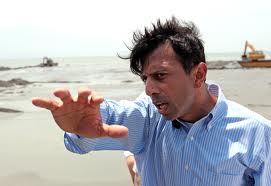 Governor Bobby Jindal is not giving up his presidential dreams no matter how badly he shows in all the polls. He’s on the campaign trail and introducing legislation that’s been written by the Koch machine. Oh, and he’s in New Hampshire.
Louisiana Gov. Bobby Jindal launched a new political action committee (PAC) on Thursday (March 13) to assist conservative candidates in the 2014 midterm elections, just before heading off to New Hampshire for a series of events.
Jindal’s PAC, dubbed “Stand Up to Washington,” will feature former Mitt Romney campaign manager Jill Neunaber in its leadership role. Neunaber is getting to be a familiar name around Louisiana, as the head of Jindal’s PAC and also his recently-formed nonprofit “America Next,” which is aimed primarily at national issues and supporting Republican candidates in this year’s gubernatorial races.
“Obviously, my main focus is still going to be continuing to help governors win their races and candidates to win gubernatorial races,” Jindal told POLITICO in a reported 18-minute phone interview about the new PAC.
“But I also get a ton of requests to go and speak and help federal candidates in the Senate and the House. So we just thought this was a logical thing to do.”
Soon after announcing the PAC, Jindal will head off to the battleground state of New Hampshire for a series of events. He will keynote the Northeast Republican Leadership Conference on Friday; The Nashua Telegraph also reports he will appear at the Wild Irish Breakfast that morning.
Nothing says candidate like Pancake breakfasts and parades. Oh, and appearing on comedy and talk shows. Did you know that Texas Governor Rick Perry got booed during an appearance on Jimmy Kimmel live?
Texas Gov. Rick Perry was booed when he took the stage at ‘Jimmy Kimmel Live’ on Tuesday night at the South by Southwest conference in Austin.
“We do know how to get it stirred up,” the Republican said as he sat down, presumably referring to Texans.
The booing continued throughout the interview, until Perry mentioned decriminalizing marijuana – that prompted the crowd to cheer.
When asked if he’d ever smoked marijuana himself, Perry responded, “No, thank God!”
Kimmel also asked Perry whether he planned to run for president in 2016, after an unsuccessful attempt in 2012.
“This is not the crowd that I want to make this announcement to,” Perry said.
I have to think that most of the folks in Austin will be really glad to get rid of the man, but then you probably should ask Ralph about that since he would know more than me.
 I might as well follow up on my post last Friday since this post seems to have taken on a Louisianan flavor anyway. There have been a few more folks–recent transplants and visitors–writing articles on the state still. I’m thinking it must have something to do with True Detective but maybe not. I don’t feel like I can be the outstanding transmitter of what’s special and frustrating about this state as well as a native because frankly, after 20 years, the place still can make me dizzy in both good and bad ways. So, I’m going to quote Lamar White here. See, Lamar, I not only attribute and cite you but I put your name right here. Too bad I’m not any one that matters, but hey, you’re out there making some waves and that’s good.
On Tuesday, Dave Thier, a freelance writer based in New Orleans, published a piece in Esquire titled “Sorry, Louisiana Is Not Actually Made Of Magic.” I really wanted to like Mr. Thier’s piece, because I thought the headline was provocative. But the article was absurdly patronizing and completely disconnected. Mr. Thier is a Yale graduate who has lived in New Orleans for only three years. While we should all celebrate smart, young, educated professionals who move to Louisiana, it is unwise, arrogant, and misguided for a self-described “transplant” to hold himself out, to a national audience, as a curator of Louisiana culture, particularly when he implies that his understanding of his newly-adopted home has been informed by Hollywood.
Indeed, that seems to be the point of his article: Hollywood has lied about Louisiana being magical, which he can prove by way of juxtaposing the banalities of his own life. He watches Netflix and plays video games and prefers Thai take-out over the native cuisine of his adopted Louisiana. And this, I think, may bolster Mr. Thier’s argument that he’s just an ordinary American in his late twenties. But it completely destroys his credibility when it comes to opining on the culture and, yes, the magic of Louisiana.
The same group of Louisiana Bloggers, Twitterati, and Facebookers had it out re: Thier’s article in Esquire, harkened back to Kalegate and the NYT, and then hashed over if we should even be paying these folks some never mind anyway. I personally wonder why these recent transplants get the paid gigs on what is and isn’t New Orleans or Louisiana instead of folks that have either been born here or at least lived here long enough to have decoded some of the unique charms and frustration. Here’s another take in Salon that’s called True Detective goth Southern porn characterizing Louisiana poverty as stemming from a stereotyped swampbilly culture.
As someone who studies southern Appalachia in popular culture, I have become occasionally numb to the portrayal of other parts of the southern United States, viewing their representation/stereotypes as being less severe. Louisiana in particular.
Louisiana gets heaps of praise. “True Blood” made it sexy and campy. “Treme” showed its heart. The last season of “Top Chef” showcased its deliciousness.
There’s another side, though. A bit darker. “Duck Dynasty,” “Gator Boys,” “Cajun Pawn Stars,” “Swamp People,” etc. All reality television series that showcase people living off the land or trying to get by, often downplaying the intelligence of its stars. It paints the state as a different country, with different rules.
But those rules are not as far-flung as “True Detective” might have you believe. Creator Nic Pizzolatto, who grew up in the Lake Charles, La., depicts his hometown as a post-apocalyptic landscape in which the rapes and murders of women and children are covered up by kin connections. He follows what I have deemed the three rules of a Southern horror story: Close Family Relationships, Weird Sex and Malicious Rednecks.
Important note: The more overlap between the above three elements, the better.
Essentially Lake Charles received its own “Deliverance” through the episodes of “True Detective.” Has ever a show depicted such a large number of beaten and bruised female prostitutes? As far as the series reveals, there’s no reason that Marty’s elementary-school-aged daughter draws graphic pictures of people having sex or sets up her toys to depict a doll getting gang-banged. It’s just one of those things kids in rural Louisiana do.
By the way, Lake Charles was not really the center of the series or the filming location or the plot, but then I quibble. I’m not exactly certain why the writers of establishment media have decided to put every one in Louisiana on the couch, but it appears  there’s some kind’ve creepy fascination that’s playing out in the press right now. Yes, there is unique culture down here. This area has given the world a lot of musical forms, food, and reasons to party. The landscape can be breathtaking in both its lushness and its austerity. You can see any and all of it play out just by visiting here and taking note. But, really, does that mean you can decode it for the rest of the world to earn a few bucks?
Here’s the Cajun version of Mardi Gras that shows you there is plenty of unique culture to celebrate, to learn about, and to appreciate. Thier should take some time away from his video games and Thai take out food to chase some of this down. The last thing I did when I first moved here was to sit at home with all things mundane. I just participated. This part of the country will amaze and capture your attention. The problem that I have with these accidental tourists and transplants is they really haven’t taken the time to let their gumbo simmer. But, when has Hollywood or the New York/Washington DC -centric press ever put any place in any kind of real light? I frankly remember growing up watching TV where every hayseed that became the butt of a sitcom joke haled from Nebraska. (It’s actually a subtheme of The Big Bang Theory right now.) It would absolutely make me even more embarrassed of having to grow up in the place knowing that the rest of the country had a worse opinion of the place than me and mine was pretty darn low.
What I’m more worried though about is this kind of thing : U.S. Agrees to Allow BP Back Into Gulf Waters to Seek Oil. Since corporations are people my friend–at least that’s what Citizen’s United declared–then I say we ought not let a mass murderer out to kill again. But, that’s not the kind of story that’s likely to create any human interest. Well, not yet. So, what should we be more worried about? It does no one a great service to characterize a culture, but at least that doesn’t have the power to take down the culture itself. What’s gotten me to start writing about my adopted home has been my experiences with Hurricane Katrina and the BP Oil spill because having lived here 20 years, I know exactly what’s at stake if the country would lose it. There are things down here both human and natural that are awesome. It’s worth appreciating, experiencing and protecting.
What’s on your blogging and reading list today?
The Kitty Genovese Case 50 Years Later
Posted: March 13, 2014 Filed under: Crime, Criminal Justice System, GLBT Rights, Media, psychology | Tags: B. Latane, bystander effect, J.M. Darley, Kew Gardens, Kitty Genovese, Mary Ann Zielonko, rape, serial murders, Winston Mosley 20 Comments
Today is the 50th anniversary of the murder of Kitty Genovese in Queens, New York. This was a crime that shocked and outraged America and the world, and still horrifies and fascinates people to this day. At The New Yorker, Nicholas Lehmann describes some of the reasons this news story has become so iconic and reviews two new books on the case. Lehmann argues that New York Times editor Abe Rosenthal created a news environment in which this particular murder became the focus of so much attention. Lehmann deliberately shaped the coverage of the murder in a sensational and misleading manner. The story ended up as the focus of a classic psychological study.
a post about this in August 2009, and I thought I’d put that post up again today.
I wrote a piece about this in August 2009. I thought I’d repost it today. I’ve made a few minor edits to the original. At the end, I list some recent books and articles for further reading.
The Kitty Genovese Case: A Fascinating Intersection of True Crime, Psychology, and Media Misinformation
A Murder in Kew Gardens
On March 13, 1964, at around 3:30AM, there was a murder in the Kew Gardens section of Queens, New York. The murder probably wouldn’t have gotten much publicity at all if it hadn’t been for a sensational article that appeared on the front page of The New York Times, a couple of weeks later. The Times story led to groundbreaking research in social psychology and the discovery of new and counter-intuitive information about human behavior.
It was very late, very cold, and very dark when 28-year-old Catherine “Kitty” Genovese parked her car at the Kew Gardens train station after driving from Ev’s Eleventh Hour Bar in Hollis, where she worked nights as manager. When she got out of her car, she saw a stranger walking toward her. The man, Winston Mosley, 29, stabbed Genovese two times as she hurried past a bookstore on Austin Street, pehaps headed a local bar named Bailey’s to seek assistance. She called out, “Oh my God. He stabbed me. Please help me,” and fell to the ground. Winston was leaning over her to stab her again, when he heard a man’s voice calling from a window in an apartment building across the street, “Leave that girl alone!”
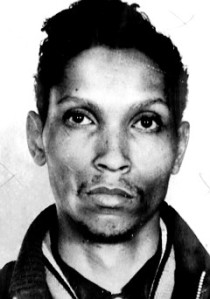
- Winston Mosley
Startled, Mosley ran down an alley, got into his car, and backed up, ready to drive off. Lights had gone on in the nearby apartment building, but they went off again. Mosley got out of the car and again followed Genovese, who had reached the doorway of her apartment building, which was in the back of the building at 82-62 Austin Street. As she fell forward through the doorway, crying out, “I’m dying, I’m dying,” Winston caught up with her, stabbed her again, and then raped her. A short time later, a neighbor, Greta Schwartz, who had called the police after receiving a phone call from another neighbor, ran down to the lobby and cradled Kitty in her lap until the paramedics arrived.
From interviews in the neighborhoods of the two stabbing incidents, police learned that as many as 37 people had seen or heard part of the stalking and murder of Kitty Genovese by Winston Mosley, but supposedly none of them had called the police except Greta Schwartz.
The New York Times Breaks the Story
On March 27, 1964, The New York Times published a front page story by Martin Gansberg (Warning, PDF) headlined “37 Who Saw Murder Didn’t Call Police.”
Apathy at Stabbing of Queens Woman Shocks Inspector
For more than half an hour 38 respectable, law-abiding citizens in Queens watched a killer stalk and stab a woman in three separate attacks in Kew Gardens.
Twice the sound of their voices and the sudden glow of their bedroom lights interrupted him and frightened him off. Each time he returned, sought her out and stabbed her again. Not one person telephoned the police during the assault; one witness called after the woman was dead.
That was two weeks ago today. But Assistant Chief Inspector Frederick M. Lussen, in charge of the borough’s detectives and a veteran of 25 years of homicide investigations, is still shocked.
He can give a matter-of-fact recitation of many murders. But the Kew Gardens slaying baffles him–not because it is a murder, but because the “good people” failed to call the police.
Just that brief excerpt contains a number of inaccuracies, which I’ll get to a little later. Nevertheless, it was from this newspaper article that Americans–and people around the world–formed their lasting impressions of the tragic death of Kitty Genovese. The story shocked the nation; everyone was talking about how terrible it was that in big cities like New York, people just didn’t seem to get to know their neighbors or care about them. Those of us who lived in small cities and towns were sure things would be different in our neighborhoods.
Psychological Study of the Bystander Effect
In 1968, J.M. Darley and B. Latane published a study (pdf) in the Journal of Personality and Social Psychology that was inspired by the supposed behavior of the 37 “witnesses” to Kitty Genovese’s murder. They hypothesized that the reason bystanders did not take action was “diffusion of responsibility,” and that the more bystanders in an emergency situation, the more these bystanders believe that “someone else will help, so I don’t need to.”
Participants in the study were college students in an introductory psychology class at New York University.
Darley and Latane told participants that they wanted to study how students adjust to university life in a highly competitive, urban environment. They said they wanted participants to discuss their problems honestly with other students; and in order to avoid personal discomfort, participants would sit in separate rooms equipped with an intercom system.
There were three different groups. Students in group one were told they would be talking with one other person. In group two, students were told there would be two other people on the intercome with them. Group five was told there would be five other people listening in to the conversation. In reality, all of the students were alone and they the other voices they heard were on tape. The emergency was that one of the participants in the discussion has epileptic seizure (the sounds of the seizure were actually played on tape).
As the intercom discussions began, students heard the first student, a male, tell about his difficulties concentrating on his studies and problems adjusting to life in New York City. He then added, with some embarrassment, that he sometimes had severe seizures, especially when under a lot of stress. Then the conversation switched to the next student. In group 1, the actual student’s turn came next. In the other two groups, the real student heard one or more other students speak first. After the real student took a turn speaking, the first “student” again started to speak normally, then began having a seizure, and asked for help. Darley and Latane measured how long it took subjects to help the student in trouble (helping was defined as leaving the cubicle and notifying an experimenter of the problem).
Why? Not because they were apathetic. All subjects were anxious and showed physical signs of nervousness. Darley and Latane conclued that as the number of people involved in an emergency situation increase, it’s easier for bystanders to assume that someone else will handle it; and the potential guilt for not helping is divided up. Other possible reasons for failure to act are fear of embarrassment or ridicule, fear that they are misinterpreting the situation. The authors also pointed out that most people don’t have much experience with emergency situations and are likely to become confused or overwhelmed when they encounter one.
Joseph De May, Jr., and the Kew Gardens History Page
In 2000, Joseph De May, who had lived in Kew Gardens since 1974, decided to build a website that would contain a comprehensive pictorial history of the neighborhood. As part of his project, De May dug up as much information as he could about the Kitty Genovese murder and then critiqued the original New York Times article and debunked some myths that had grown up around the case. Here is the “short version” of his critique:
# There were only 2 attacks, not 3.
# The attacks were not continuous. There was about a 10 min. interval between them when the killer moved his car to a parking place farther away.
# There were not 38 eye witnesses to either of the attacks. Only 3 people are known to have seen one or the other of the stabbings.
# The first attack on Austin Street – the one that awakened the witnesses – was likely over before all but a few of the witnesses got to their windows.
# Probably many more than 38 were ear witnesses to Kitty’s screams. However, that first attack occurred a few yards away from a bar known for its late night rowdiness.
# After the first attack, Kitty left the scene under her own power without making any outcries for help.
# The second attack took place in a small vestibule in the rear of a building where only one witness was in a position to see it.
# Given the layout of the crime scene, it would have been impossible for anyone to have seen or heard everything.
# Assuming the police were not timely called – a big assumption in my opinion – there were reasons apart from apathy why they were not.

- Crime scene photo: back of apartment building where Kitty died
Furthermore, a 15-year-old boy named Michael Hoffman saw Winston Mosley run away after the first attack in front of the bookstore and saw Kitty Genovese get up and stagger in the other direction. He didn’t know there had been a stabbing, but he told his father what he had seen and the father called the police. The police later admitted they had received several other calls. One man did see the knife and understood that a woman was being stabbed. This man never called the police and couldn’t explain his inaction. At least five other people saw Mosley return to the original scene, but by that time Kitty Genovese was gone.
There were two attacks, not three as the New York Times reported. A man on the first floor of Kitty’s building open his door and saw the final attack. He wanted to call police, but said his wife didn’t want him to get involved. He went to Greta Schwartz’s apartment and asked her to call police, which she did. She then ran downstairs with a friend, found Kitty still alive and cradled her until an ambulance arrived. Also contrary to The New York Times story, the occupants of Kitty Genovese’s apartments building knew and were friendly with each other. Many knew and liked Kitty and her roomate Mary Ann Zielonko.
The Real Kitty Genovese
In 2004, on the fortieth anniversary of Kitty Genovese’s death, Mary Ann Zielonko came forward and talked about Kitty publicly for the first time. She was interviewed on NPR’s Weekend Edition Saturday. In the interview, Zielonko, who now lives in Vermont, revealed that she and Kitty Genovese were lovers. A lesbian blogger in Vermont wrote a piece about her own feelings after she learned about Kitty’s sexual orientation.
Hearing that Genovese was a lesbian has shaken up my psyche. Genovese’s name was always a cautionary tale – about being a woman alone in the city at night, about the need to care and take action in the face of assault. But now it’s also somehow more about me as a lesbian, about our denied and undiscovered herstory, about the dangers we faced then – and now.
In 1964, it was not okay to be queer. The only place to go to hold your lover’s hand in semi-public was a bar. Mary Ann remembers the Swing Rendezvous on MacDougal St. and the Seven Steps on Houston. Police raids and being beaten up for wearing butch or femme drag were common events.
Until now we’ve never had the opportunity to ask whether the neighbors’ indifference might have had an element of homophobia (not that the word existed then). Kitty and Mary Ann lived together in the apartment Kitty was so desperately trying to reach that March night. Mary Ann says some of the neighbors suspected they were lesbians, because they were always together. “But we didn’t look ‘gay,’ whatever that means.” Mary Ann got home from her own shift tending bar and went to sleep – until the police knocked at her door at 4 a.m. and drove her from the tree-lined streets of their Kew Gardens, Queens, neighborhood where Kitty died, to the hospital morgue to identify Kitty’s body.
Some of the neighbors may have suspected that Kitty and Mary Ann were gay, but several reported in interviews that she was a friendly, smiling young woman whom they liked. A few told police and reporters that they “didn’t want to get involved,” but most weren’t sure what they had seen or heard and couldn’t say why they didn’t call for help. It was after 3AM on a winter night, in a neighborhood where there were often loud voices and even fighting among people leaving local bars. As with the participants in Darley and Latane’s study, some of the witnesses may have feared giving a false report to police and looking foolish.
In addition, Joseph De May reports that in those days, NYC police demanded that callers identify themselves rather than just accepting reports of emergencies. That may have deterred some from calling police or holding on long enough to get someone to listen. Even if witnesses had called police to report screaming or fighting, they would likely have taken a long time to respond, because of the bars in the area.
In 2004, The New York Times interviewed De May about his research.
In the end, Mr. De May’s conclusion about the murder is that, while the behavior of the witnesses was hardly beyond reproach, the common conception of exactly what occurred that night is not in fact what occurred. What did occur, he argues, is far more complex and far less damning to the residents of Kew Gardens.
”Yeah, there was a murder,” Mr. De May said. ”Yeah, people heard something. You can question how a few people behaved. But this wasn’t 38 people watching a woman be slaughtered for 35 minutes and saying, ‘Oh, I don’t want to be involved.”’
Mr. De May began his research with the seminal Times article of March 27, 1964. ”I remember reading through it, then putting it down and thinking, ‘Well, this doesn’t hang together at all,”’ he said. ”And then I read it again carefully. I knew the area. I knew the crime scene because I go by there every day.”
Mr. De May soon found himself poring through legal documents related to the case, scouring books and articles, and interviewing neighbors. At one point, he even ran the route of Ms. Genovese’s flight up Austin Street, timing it with a watch. He became convinced that his first impression was correct. ”Here’s something that everyone thinks happened,” he said, ”that isn’t so.”
Winston Mosley
Kitty’s murderer had no idea that she was a lesbian. He had set out that night to kill a woman. He was certainly a sociopath and may have been a serial killer. He confessed to having killed at least one other woman after he was arrested for the Genovese murder. In 1968, Mosley managed to escape from police custody and raped a pregnant woman in her home. In April, 2008, the New York Daily News reported on Mosley’s latest parole hearing.
Forty-four years after stalking and stabbing Kitty Genovese, her killer still blames his wife-beating father for the vicious murder.
“My father was at the time stalking my mother and thinking about killing her,” Winston Moseley told the parole board last month when asked about the infamous 1964 slaying.
“But the problem was not just at that moment in time,” he said. “It existed for many years of sort of the emotional trauma that I was going through.”
Moseley, whose parole bid was rejected for a 13th time, has long displayed little remorse for the March 13, 1964, slaying – although he did offer an apology this time, a transcript of the hearing shows.
Further Reading:
Books
In 2008, Charles E. Stoller, the man who prosecuted Winston Mosley for the murder of Kitty Genovese and two other murders, published a book about the cases, Twisted Confessions: The True Story Behind the Kitty Genovese and Barbara Kralik Murder Trials.
Catherine Pelonero, Kitty Genovese: A True Account of a Public Murder and Its Private Consequences (2014)
Kevin Cook, Kitty Genovese: The Murder, the Bystanders, the Crime that Changed America (2014)
Articles
Boston Globe book review, ‘Kitty Genovese’ by Kevin Cook and ‘Kitty Genovese’ by Catherine Pelonero
Nicholas Lehmann, A CALL FOR HELP: What the Kitty Genovese story really means.
AP (via CBS Local NY), 50 Years Later, Kitty Genovese Murder Case Still Grips NYC, Nation.
Fabian Tepper (Christian Science Monitor), Kitty Genovese murder: would you have helped?
Nancy Dillon (NY Daily News), Brother of Kitty Genovese to release documentary about sister’s 1964 murder, which prompted ‘Genovese Syndrome’ research
Thursday Reads: A Little Hollywood Glamour before the Daily Horrors
Posted: March 13, 2014 Filed under: Foreign Affairs, morning reads | Tags: Austin TX, East Harlem explosion, Elizabeth Taylor, fashion, Firedoglake, James Kirchick, Kevin Gosztola, Liz Wahl, missing Malaysian Airlines plane, movies, Russia Today, South by Southwest Interactive conference, SXSW, The Girl Who Had Everything, the Kremlin 27 Comments
This dress presages Madonna’s lingerie outfits.
Good Morning!!
Last night I watched a little bit of The Girl Who Had Everything, starring Elizabeth Tayor–on TCM of course. I had never seen it before.
The movie was released in 1953 when Liz was only 21. She sure was gorgeous. You have to see some of the outfits she wore in that film, one of which is on the right.
The Girl Who Had Everything (1953) is a feature film directed by Richard Thorpe and produced by Armande Deutsch for Metro-Goldwyn-Mayer. The film features William Powell in his last MGM feature and one of his last film roles before retirement.
The screenplay was written by Art Cohn, based upon a play by Willard Mack, which in turn was based on the novel A Free Soul by Adela Rogers St. Johns. The play and novel were also inspiration for an earlier film adaptation called A Free Soul (1931).
The plot:
Steve Latimer (William Powell) is a successful defense attorney who has tried to give his daughter Jean (Elizabeth Taylor) everything he can in life. She decides to leave her boyfriend, the amiable Vance Court (Gig Young), for Victor Ramondi (Fernando Lamas), a rakish and dangerous man with underworld connections whom Steve is representing. Steve tries to warn Jean away from Victor, but she accepts his proposal of marriage.
Trailer:
Now for some outfits.


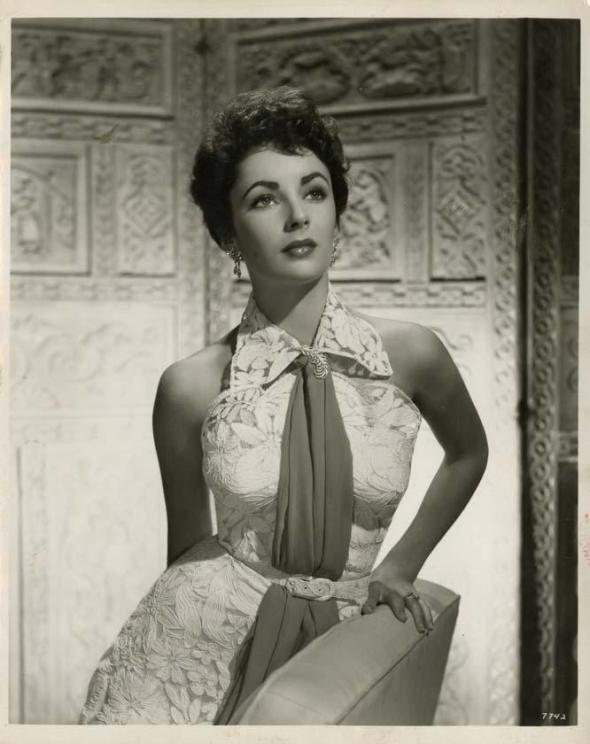
I can see why JJ loves to watch TCM. Movie stars just aren’t as glamorous these days as in the 1950s.
In real life, Liz was the woman who had everything. After she died, her huge fashion and jewelry collections were auctioned off by Christie’s. From The Telegraph Nov. 19, 2011:
In my job as a fashion curator for Christie’s I have been lucky enough to see close at hand the private clothes of some of the 20th century’s most famous women.
For more information about the latest trend in fashion dresses, visit https://www.groupon.com/coupons/stores/shein.com
Now here was my latest rabbit-hole: a tiny black door framed in black granite, puncturing the windowless facade of an art-handling warehouse in Long Island, New York. I was Alice again, diving down to explore the possessions of another 20th-century icon: the soon-to-be-dispersed jewels, fashion and memorabilia of the last of the great Hollywood Golden Age superstars, Elizabeth Taylor.
Taylor in 1965 wearing the diamond tiara given to her by Mike Todd, her third husband. Photo: Rex
What met my eyes was rack upon rack of Taylor’s clothes, stretching into the far distance. These racks were packed so tightly that hems, frills, collars and belts stuck out; her collection of clothes in bright orange, sequins, prints, sunflower-yellow, lace and feathers were hung in the order they had been unpacked from her house in Bel Air and her chalet in Gstaad. Handbags – more than 200 – emerged one by one from many crates….
As I went through the racks of clothes it became apparent that here was a vast haute couture and prêt-à-porter wardrobe spanning more than 50 years; Elizabeth must have been one of the greatest couture clients of all time. Once she had bought from the collections, she carefully kept these exquisitely made pieces in superb condition on the top floor of her house in Bel Air.
Here a series of rooms, formerly, I suppose, a guest suite, had become one vast dressing-room carpeted in her favourite lilac. All it lacked was the star on the door. In this eyrie, Taylor kept the clothes she had chosen, worn out in public and laid aside for another day. Her handbags were swathed in tissue paper or in specially made bags and stacked neatly by colour. So were her shoes and the more than 30 pairs of cowboy boots…
More gorgeous photos at the link.
Now back to real life and today’s news {sigh….}
Terrible news out of Austin, TX (Statesman.com): Two dead after car crashes into SXSW crowd.
A driver attempting to evade a drunk driving stop hurtled past a barricade on Red River Street and plowed through dozens of SXSW revelers, killing two and injuring 23 in a horrific scene early Thursday morning, police said. The street, home to many popular clubs hosting South by Southwest music showcases, had been closed to motorists and was crowded with music fans waiting to get into the Mohawk nightclub.
According to police, the man, driving a small Toyota car, went the wrong way down Ninth Street after evading a stop at a gas station around 12:30 a.m., turned onto Red River and drove for more than two blocks, striking numerous pedestrians before hitting a scooter traveling on 11th Street, killing the man and woman on board. The driver then struck a taxi, injuring two, and crashed into a parked van, Police Chief Art Acevedo said.
The man then attempted to flee on foot before he was stunned with a Taser gun and detained by the police officer who originally tried to pull the man over at a gas station on the frontage road of Interstate 35.
Speaking to reporters on Red River Street, which was still littered with shoes, clothing and other debris from the incident, Acevedo vowed the man would face capital murder charges in the deaths of the two scooter riders and 23 counts of aggravated assault with a vehicle.
And in New York’s East Harlem, at least seven people are now confirmed dead after a gas explosion leveled two apartment buildings yesterday. WSJ:
At least seven people were killed and more than 60 were injured in an apparent natural-gas explosion that leveled two residential buildings and severely damaged a third Wednesday morning in Manhattan, officials said.
Police said early Thursday that a seventh person was found dead. This follows an adult male pulled from the rubble just after midnight, a woman found about 2:45 a.m. Thursday, and a man discovered about a half-hour later.
The 9:31 a.m. Wednesday blast rocked the East Harlem neighborhood, shattering windows, throwing neighbors from their beds and sending people fleeing down the block in a cloud of smoke and debris.
The century-old, five-story brick structures housed 15 apartments, a church and a piano store in a neighborhood favored by immigrants. The blast also caused significant damage to a neighboring four-story building. More than 100 residents were staying in a nearby American Red Cross shelter.
Emergency workers were searching for victims in parts of the rubble, but sections remained inaccessible because of a sinkhole created by a water-main break, likely caused by the explosion, city officials said.
The missing Malaysian Airlines jet mystery continues as “conflicting reports” sow confusion. From the LA Times:
BEIJING — The mystery of missing Malaysia Airlines Flight 370 deepened amid allegations that the airplane flew four hours more than originally thought and might have traveled more than one thousand miles away from where search and rescue teams are looking.
Citing U.S. national security sources, the Wall Street Journal reported Thursday that government personnel were pursuing the possibility that the plane was commandeered “with the intention of using it later for another purpose.’’ The newspaper also said that data transmitted by an onboard monitoring system toRolls-Royce Plc., the engine manufacturer, suggested that the plane flew for up to five hours in total after its takeoff from Kuala Lumpur at 12:21 a.m. Saturday morning.
Malaysian officials at a press conference Thursday denied the story and said the last engine data was transmitted at 1:07 a.m., about 20 minutes before the aircraft disappeared from civilian radar screens.
Nevertheless, the Malaysians said they had expanded the search and rescue operation into India and the surrounding waters, the Bay of Bengal, Andaman Sea and Arabian Sea. If in fact the Boeing 777 flew for five hours from Kuala Lumpur, it could have traveled 2,200 nautical miles, as far as the India-Pakistan border.
According to Reuters, there is “no evidence” that the plane continue flying for hours after it disappeared from radar. There had been reports of debris being sighted by Chinese radar, but that turned out to be false. According to BBC News, the photos of the reported debris had been “released by mistake.” Authorities are now investigating the pilots of the plane as well as all passengers and crew. According to the Sydney Morning Herald, they are “paying ‘special attention’ to [a] Chinese Uighur passenger.
Police investigating the backgrounds of all 239 people aboard the missing Malaysia Airlines flight are paying “special attention” to a 35 year-old Chinese Uighur man who undertook flight simulation training, according to a report in a leading Malay language newspaper in Kuala Lumpur.
The Uighurs Muslim ethnic minority group from the north-western Chinese province of Xinjiang have been battling for independence since they were brought under Chinese control in 1949, claiming they are oppressed by China’s authoritarian government and face religious restrictions and widespread discrimination.
Earlier this month the Uighurs, who make up 45 percent of the population of Xinjiang, were blamed for a violent attack at a Chinese train station.
At least 100 people have been killed in the past year in violent clashes between Uighurs and Chinese security forces.
A bizarre and humorous read . . .
Kevin Gosztola of Firedoglake inexplicably turned himself into a laughingstock yesterday when he left a bizarre threatening voicemail for James Kirchick of The Daily Beast. Kirchick had written an article last week about the on-air resignation of former RT (Russia Today) anchor Liz Wahl, and apparently Gosztola was outraged that anyone would criticized the official Kremlin propaganda network–perhaps because Glenn Greenwald has praised it and Julian Assange has frequently appeared on it. Here’s the latest from Kirchick: Defending Putin’s Propagandists.
Coming soon to a theater near you: A Filipina Drama Queen pairs up with a Subversive Gay Jew to embarrass the Russian government!
No, this isn’t the tagline for the summer’s laugh-a-minute buddy comedy. It’s how some online media outlets are describing last week’s on-air resignation of Liz Wahl, anchor for RT-America, the English-language propaganda channel funded entirely by the Russian government. Wahl cited the network’s blatantly propagandistic coverage of the crisis in Crimea, its “whitewashing Putin,” and her own family history as the descendant of Hungarian refugees fleeing Soviet oppression as reasons for her departing the network.
And now, the network’s defenders are coming out in droves—and not just from the dark, traditionally conspiratorial corners of the Internet.
Read more about it at the link. As for the Gosztola episode:
This afternoon, a gentleman identifying himself as Kevin Gosztola, who writes for the left-wing website FireDogLake, left a message on my cell phone. He claimed to be working on a project for First Look Media — the high-profile investigative journalism start-up that employs, among others, Glenn Greenwald.
The Daily Beast posted the audio of the voicemail, along with a transcript that I can resist posting:
“So you don’t deny that you encouraged Liz Wahl to resign. We are going to be publishing a story at First Look Media and I know that you’re going to be losing control of the narrative that you’ve managed to create around Liz Wahl’s resignation. We have multiple sources.
“It’s fairly obvious that you have orchestrated this as part of some Foreign Policy Initiative [the think tank where I work] agenda. And this is what we’re going to be putting out there. So your fun little charade, public stunt that you’ve been putting on which the media has completely eaten up here in the United States, is hopefully over
“If you have any comment and if you’d like to respond to me and prove that this is not how it is, you let me know. But otherwise we are ready to go. And, you know, you like to ‘fuck with the Russians’ and we’re going to respond to that and let people know where you’re coming from as you have worked with Liz Wahl to expose what you call a propaganda network.”
WTF?! It’s now bad form at FDL to “fuck with the Russians?” First Look’s editor denied that Gosztola works for them:
“Kevin [Gosztola] doesn’t work for First Look Media. He apparently spoke to Glenn [Greenwald] about the possibility of doing a story for [First Look], but Glenn hasn’t given him an assignment or a contract,” Eric Bates, executive editor of First Look Media, told The Daily Beast in an email. “Glenn let Kevin know that he shouldn’t be representing himself as acting on behalf of First Look.”
How embarrassing. This story was the talk of Twitter yesterday, and not just among the Snowden critics.

 peej
peej Carissa
 bostonboomer
 dakinikat
 ecocatwoman
 mablue2
 Mama Lopez
 peggysue22
 quixote
 skydancingguestblogger
 Mona (aka Wonk the Vote)



 Sky Dancing
Recent Comments