
America has lost its Voice
Posted: January 28, 2014 Filed under: just because 28 CommentsI doubt I can actually count how many times I strummed my guitar and sang out “If I had a hammer”. The man was a National Treasure and definitely the voice of every hard working American. Then, there’s “This Land” which I swear should be this country’s national anthem.
 Pete Seeger, Songwriter and Champion of Folk Music, Dies at 94
Pete Seeger, the singer, folk-song collector and songwriter who spearheaded an American folk revival and spent a long career championing folk music as both a vital heritage and a catalyst for social change, died Monday. He was 94 and lived in Beacon, N.Y.
His death was confirmed by his grandson, Kitama Cahill Jackson, who said he died of natural causes at NewYork-Presbyterian Hospital.
Mr. Seeger’s career carried him from singing at labor rallies to the Top 10 to college auditoriums to folk festivals, and from a
conviction for contempt of Congress (after defying the House Un-American Activities Committee in the 1950s) to performing on the steps of the Lincoln Memorial at an inaugural concert for Barack Obama.
For Mr. Seeger, folk music and a sense of community were inseparable, and where he saw a community, he saw the possibility of political action.
Seeger gained fame as a member of The Weavers, the quartet formed in 1948 and had hits such as “Goodnight Irene.”
He continued performing and recording for six decades afterward and was still an activist as recently as October 2011 when he marched in New York City as part of the Occupy Wall Street protests.
He was onstage in January 2009 for a gala Washington concert two days before Barack Obama was inaugurated.
But in the 1950s, his leftist politics got him blacklisted and he was kept off commercial television for more than a decade.
I don’t know quite what to say about the passing of America’s Voice for Social Justice. I can’t even count how many times I’ve sung all his songs and strummed them out on my guitars. His PBS show inspired me in grade school. I think he’s more responsible for my intense activism and sense of social justice than anyone because he always framed with a tune you can sing too and a great sense of love and hope
Here’s a great tribute to the man from Mother Jones in a 2004 article.
Pete Seeger, who lives near Wappingers Falls, has been protesting the Bush administration’s actions in Iraq at these Saturday peace vigils, organized a few months before the invasion—and at dozens of other anti-war events of all sizes around the country—with the passion, if not the vigor, of a person one-fourth his age. Indeed, after an extended period of low-key concentration on local issues, during which Seeger was most visibly absorbed with cleaning up the Hudson River, the grand old lion of the American left has, in his 85th year, again taken to challenging the state of world affairs. This is the latest—and perhaps the last—of his great missions, a crusade with resonant echoes of his work in the eras of the civil rights movement and the Vietnam War.
Last year, Seeger led thousands in song at the New York City arm of the Global March for Peace. The veteran protest songwriter has since rewritten and rerecorded his Vietnam-era broadside, “Bring Them Home,” with three of his musical acolytes, Billy Bragg, Ani DiFranco, and Steve Earle. (“Now we don’t want to fight for oil / Bring ’em home, bring ’em home / Underneath some foreign soil / Bring ’em home, bring ’em home.”) And in late June, as violence in Iraq erupted in anticipation of the formal transfer of authority to an interim Iraqi government, Seeger prepared to lead a performance of antiwar songs at the Clearwater Festival, the annual Hudson River event to raise social, political, and environmental consciousness (and funds) that he and his wife, Toshi, launched 35 years ago.
The effort strikes some of his critics as quixotic, the tragicomic vagary of a clinging, misguided anachronism. A lifelong Marxist blacklisted during the McCarthy era, Seeger has long been an easy target for conservatives. (Seeger’s early group, the Almanac Singers, released an album of songs against American involvement in World War II, but recalled it and replaced it with anti-Axis songs when Hitler attacked the Soviet Union.) Since the fall of the Iron Curtain, Seeger’s little-changed politics have proved vexing even to former fellow travelers, such as Ronald Radosh, a fellow at the Hudson Institute and author of Commies: A Journey Through the Old Left, the New Left and the Leftover Left. A red-diaper baby who took banjo lessons from Seeger and organized his first concert at the University of Wisconsin, Radosh says, “I have known Pete for most of my life, and I think he is a national treasure for his contribution to American music culture, for acquainting America with its own indigenous music. But Pete doesn’t understand that this is not the ’60s, and Iraq and the war against terrorism are not the war in Vietnam. He looks at things through his old lens, and that’s more than unfortunate. It’s sort of sad and silly.”
To those he still rallies to dissent and activism, however, Seeger remains an inspiration, the unwavering embodiment of progressive idealism. After all, he has been using music to stand up for the disenfranchised and to mobilize their sympathizers since the days of the original American folk-music revival in the 1930s.
. . . Mr. TAVENNER: The Committee has information obtained in part from the Daily Worker indicating that, over a period of time, especially since December of 1945, you took part in numerous entertainment features. I have before me a photostatic copy of the June 20, 1947, issue of the Daily Worker. In a column entitled “What’s On” appears this advertisement: “Tonight—Bronx, hear Peter Seeger and his guitar, at Allerton Section housewarming.” May I ask you whether or not the Allerton Section was a section of the Communist Party?
Mr. SEEGER: Sir, I refuse to answer that question whether it was a quote from the New York Times or the Vegetarian Journal.
Mr. TAVENNER: I don’t believe there is any more authoritative document in regard to the Communist Party than its official organ, theDaily Worker.
Mr. SCHERER: He hasn’t answered the question, and he merely said he wouldn’t answer whether the article appeared in the New York Times or some other magazine. I ask you to direct the witness to answer the question.
Chairman WALTER: I direct you to answer.
Mr. SEEGER: Sir, the whole line of questioning—
Chairman WALTER: You have only been asked one question, so far.
Mr. SEEGER: I am not going to answer any questions as to my association, my philosophical or religious beliefs or my political beliefs, or how I voted in any election, or any of these private affairs. I think these are very improper questions for any American to be asked, especially under such compulsion as this. I would be very glad to tell you my life if you want to hear of it.
Mr. TAVENNER: Has the witness declined to answer this specific question?
Chairman WALTER: He said that he is not going to answer any questions, any names or things.
Mr. SCHERER: He was directed to answer the question.
Mr. TAVENNER: I have before me a photostatic copy of the April 30, 1948, issue of the Daily Worker which carries under the same title of “What’s On,” an advertisement of a “May Day Rally: For Peace, Security and Democracy.” The advertisement states: “Are you in a fighting mood? Then attend the May Day rally.” Expert speakers are stated to be slated for the program, and then follows a statement, “Entertainment by Pete Seeger.” At the bottom appears this: “Auspices Essex County Communist Party,” and at the top, “Tonight, Newark, N.J.” Did you lend your talent to the Essex County Communist Party on the occasion indicated by this article from the Daily Worker?
Mr. SEEGER: Mr. Walter, I believe I have already answered this question, and the same answer.
Chairman WALTER: The same answer. In other words, you mean that you decline to answer because of the reasons stated before?
Mr. SEEGER: I gave my answer, sir.
Chairman WALTER: What is your answer?
Mr. SEEGER: You see, sir, I feel—
Chairman WALTER: What is your answer?
Mr. SEEGER: I will tell you what my answer is.
I feel that in my whole life I have never done anything of any conspiratorial nature and I resent very much and very deeply the implication of being called before this Committee that in some way because my opinions may be different from yours, or yours, Mr. Willis, or yours, Mr. Scherer, that I am any less of an American than anybody else. I love my country very deeply, sir.
Chairman WALTER: Why don’t you make a little contribution toward preserving its institutions?
Mr. SEEGER: I feel that my whole life is a contribution. That is why I would like to tell you about it.
Chairman WALTER: I don’t want to hear about it.
Fortunately, we still have his recordings and his legacy to pass forward.
Monday Reads
Posted: January 27, 2014 Filed under: income inequality, morning reads 102 Comments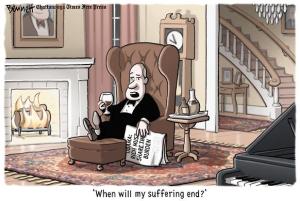 Good Morning!
This morning I thought I’d focus on income inequality, upward mobility, and our whining one percenters who just can’t get enough, in preparation for the State of the Union address tomorrow. I’m not sure if you saw this one about a poor persecuted Silicon Valley billionaire who feels that America treats the rich like the NAZIs treated Jewish people, but I think you should.
A billionaire Silicon Valley venture capitalist has been condemned for “ghastly and disgraceful” comments after he compared criticism of America’s rich to the persecution of Jews in Nazi Germany in the 1930s.
Tom Perkins, 66, wrote a letter to the Wall Street Journal, which was published, in which he likened the Occupy movement to Kristallnacht, the infamous pogrom of Nov 9-10, 1938.
In his letter titled “Progressive Kristallnacht Coming?” Mr Perkins said: “Writing from the epicentre of progressive thought, San Francisco, I would call attention to the parallels of fascist Nazi Germany to its war on its ‘one per cent’, namely its Jews, to the progressive war on the American one per cent, namely the rich.
“From the Occupy movement to the demonisation of the rich embedded in virtually every word of our local newspaper, the San Francisco Chronicle, I perceive a rising tide of hatred of the successful one per cent.”
Mr Perkins cited the antipathy in San Francisco towards luxury “Google buses” that carry technology workers to their well paid jobs, and growing anger over rising house prices caused by wealthy buyers employed by internet companies.
“This is a very dangerous drift in our American thinking,” he wrote.
“Kristallnacht was unthinkable in 1930; is its descendent ‘progressive’ radicalism unthinkable now?”
During Kristallnacht, translated as the Night of Broken Glass, Jewish shops were smashed, hundreds of synagogues were destroyed, 91 Jews were murdered and 30,000 arrested, with most of them sent to concentration camps.
If that doesn’t leave you speechless, nothing will.

Robert Reich is among the policy wonks who wonders what’s happened to this country, Most of us can’t figure out why more people aren’t taking to the streets to demand things change.
People ask me all the time why we don’t have a revolution in America, or at least a major wave of reform similar to that of the Progressive Era or the New Deal or the Great Society.
Middle incomes are sinking, the ranks of the poor are swelling, almost all the economic gains are going to the top, and big money is corrupting our democracy. So why isn’t there more of a ruckus?
The answer is complex, but three reasons stand out.
First, the working class is paralyzed with fear it will lose the jobs and wages it already has.
In earlier decades, the working class fomented reform. The labor movement led the charge for a minimum wage, 40-hour workweek, unemployment insurance, and Social Security.
No longer. Working people don’t dare. The share of working-age Americans holding jobs is now lower than at any time in the last three decades and 76 percent of them are living paycheck to paycheck.
No one has any job security. The last thing they want to do is make a fuss and risk losing the little they have.
Besides, their major means of organizing and protecting themselves — labor unions — have been decimated. Four decades ago more than a third of private-sector workers were unionized. Now, fewer than 7 percent belong to a union.
Second, students don’t dare rock the boat.
In prior decades students were a major force for social change. They played an active role in the Civil Rights movement, the Free Speech movement, and against the Vietnam War.
But today’s students don’t want to make a ruckus. They’re laden with debt. Since 1999, student debt has increased more than 500 percent, yet the average starting salary for graduates has dropped 10 percent, adjusted for inflation. Student debts can’t be cancelled in bankruptcy. A default brings penalties and ruins a credit rating.
To make matters worse, the job market for new graduates remains lousy. Which is why record numbers are still living at home.
Reformers and revolutionaries don’t look forward to living with mom and dad or worrying about credit ratings and job recommendations.
Third and finally, the American public has become so cynical about government that many no longer think reform is possible.
When asked if they believe government will do the right thing most of the time, fewer than 20 percent of Americans agree. Fifty years ago, when that question was first asked on standard surveys, more than 75 percent agreed.
 One of the most outrageous lies told by the wealthy is how they pay all the taxes. This is only true of Federal Income taxes that are designed to be progressive. Most state and local taxes are not progressive and they impact poor, working class, and middle income people. The very wealthy also have a huge amount of their income exempt from social security withholding.
The federal personal income tax only made up 28% of all U.S. government tax collections in 2012. Federal, state and local governments collected $4 trillion in taxes last year; just $1.1 trillion of that was federal personal income tax.
And people with low incomes who don’t pay federal personal income tax do pay lots of those other taxes: payroll tax, state income tax, sales tax, property tax, excise taxes, and more. They pay other taxes indirectly: Workers bear the burden of employer-paid payroll taxes and part of the burden of corporate income taxes.
Here’s a chart I made earlier this year showing the distribution of the tax burden when you add all the taxes together. Earners in the top 1% pay about 43% of their incomes in tax. People in the middle quintile pay 25%. The poorest fifth pays 13%.
Business Insider, data from Tax Policy Center and Institute on Taxation and Economic Policy
Rich people do pay a lot more taxes than poor people, both in absolute terms and as a percentage of income. But the rich are not paying all the taxes. And looking just at the federal personal income tax and trying to draw conclusions about who pays “taxes” will lead you to wrong answers.
You’ll notice that a lot of this discussion comes from economists or business journalists. Here’s an article from HBR that says that “We Can’t Afford to Leave Inequality to the Economists”.
But the aforementioned Emanuel Saez, together with Thomas Piketty of the Paris School of Economics, has for the past decade-plus been using income tax records to compile a rich account of what’s been going on up there in the top 1%. You’re probably familiar with the basic outlines, but it’s worth throwing out a few numbers from their most recent update:
- From 1993 to 2013, incomes of the bottom 99% of taxpayers in the U.S. grew 6.6%, adjusted for inflation. The incomes of the top 1% grew 86.1%.
- The top 0.1% of U.S. taxpayers claimed 11.33% of overall income in 2012, up from 2.65% in 1978. The top 0.01% got 5.47%, up from 0.86% in 1978.
- The average income of the top 0.01% was 859 times that of the bottom 90% in 2012. In 1973 the top-0.01%-to-bottom-90% ratio was just under 80.
Something really dramatic is going on up there in the top 5%, the top 1%, the top 0.01%. But while economists know some things about the impact of increasing overall income inequality, they still don’t know all that much about what this 1% stuff means. In their new paper, Chetty, Hendren, Kline, Saez, and Turner write that their finding of steady intergenerational income mobility “may be surprising in light of the well-known negative correlation between inequality and mobility across countries.” A possible explanation, they continue, is that
[M]uch of the increase in inequality has been driven by the extreme upper tail … [and] there is little or no correlation between mobility and extreme upper tail inequality — as measured e.g. by top 1% income shares — both across countries and across areas within the U.S. Instead, the correlation between inequality and mobility is driven primarily by “middle class” inequality.
That’s the thing about this rise in “extreme upper tail inequality” — most pronounced in the U.S. but by now a clearly global phenomenon. It is one of the most dramatic economic developments of the past quarter century. And it seems like it might be bad thing. But conclusive economic evidence for its badness is hard to find.
Yes, there are theories: All that wealth sloshing around in the top 1% leads to more bubbles and crashes. Extreme wealth corrupts the political process. Income inequality may be slowing overall economic growth. And, as my colleague Walter Frick put it in an email when I brought this up, “given the diminishing marginal utility of income, it’s hugely wasteful for the super rich to have so much income.”
I happen to believe there’s some truth to all four of those. But there are also lots of counterarguments and some counterevidence, and big economic studies like the new one by Chetty & Co. don’t seem to be doing much to resolve the debate.
Which leads me to another theory: I think we’re eventually going to have to figure out what if anything to do about exploding high-end incomes without clear guidance from the economists.
It will be interesting to see how the President approaches these problems in the SOTU address. 
Obama has called inequality in America the “defining issue of our time.” And although you may hear the words “opportunity” and “mobility” more than “inequality” in his speech, the intent is the same.
“The address will include a ‘healthy dose’ of the income inequality message the White House has focused on in recent weeks, according to one senior administration official familiar with the text,” The Hill newspaper reports.
“The president, who has yet to add to the big legislative accomplishments of his first term, will call for raising the minimum wage to $10 per hour and extending federal unemployment benefits that expired last month,” according to this report. “He will also discuss energy and college affordability, two other issues that relate to the economic mobility message that is a major White House theme ahead of this year’s midterm elections.”
Of course, it’s easy to talk about these things. It’s not so easy to get any thing through the Congress these days. Let’s take this idiot at Forbes for example who argues that Wealth Inequality is a sure sign of the success of an economy and country. You have to read this to believe it. This ass is a gold bug so be assured, this is insane.
When income and wealth inequality are growing, unease in our lives is shrinking. Republicans, as the alleged Party of entrepreneurial capitalism, should understand this well, and stop acting as though success is something to politicize. Wealth inequality is one of the surest signs of economic advancement. It’s time for today’s Republicans to act like adults, and embrace the very inequality that has improved the lives of so many.
Oxfam released a study that shows the problem is really worldwide.
Oxfam calculated that almost half the world’s wealth – $110trn – is owned by just 1 per cent of its population. It said that 70 per cent of people live in countries where the gap between the rich and poor has widened in the last 30 years.
“This massive concentration of economic resources in the hands of fewer people presents a significant threat to inclusive political and economic systems,” the charity said. “People are increasingly separated by economic and political power, inevitably heightening social tensions and increasing the risk of societal breakdown.”
Winnie Byanyima, Oxfam’s executive director, who will attend Davos, described the gulf between sectors of society as staggering. “We cannot hope to win the fight against poverty without tackling inequality. Widening inequality is creating a vicious circle where wealth and power are increasingly concentrated in the hands of a few, leaving the rest of us to fight over crumbs from the top table,” she said.
Oxfam is calling on the business chiefs gathering at Davos to promise to support progressive taxation and not dodge their own taxes, refrain from using their wealth to seek political favours and demand that companies they own or control pay a living wage. In a report last week the forum warned that income disparity leading to social unrest could have a significant impact on the world economy over the next 12 months.
There was a “lost” generation of young people coming of age who lacked jobs and the skills for work, the report said. This could easily boil over into protests over inequality and corruption. Jennifer Blanke, the forum’s chief economist, said: “Disgruntlement can lead to the dissolution of the fabric of society, especially if young people feel they don’t have a future. This is something that affects everybody.”

President Barack Obama will travel to Prince George’s County Maryland; Pittsburgh; Milwaukee; and Nashville in the next week to talk about proposals outlined in Tuesday’s State of the Union address.
In an email to supporters Saturday, senior adviser Dan Pfeiffer said Obama will lay out “a set of real, concrete, practical proposals to grow the economy, strengthen the middle class, and empower all who hope to join it.”
Obama opens his sixth year with some of the worst job approval ratings since he took office and with a bitterly divided Congress already turning much of its focus to the November election.
The White House will use the high-profile speech to try anew for momentum for the president’s agenda – and perhaps his legacy – as he declares 2014 a “year of action” with or without congressional support.
Tens of millions are expected to watch the 9 p.m. EST address, which Obama will deliver from the U.S. Capitol.
Obama is expected to make the widening income gap between rich and poor a centerpiece of his speech, calling on lawmakers to restore jobless benefits for 1.3 million long-term unemployed Americans, expand preschool initiatives and boost the federal minimum wage.
After he returns to Washington, he will outline new efforts to help the long-term unemployed, the White House says.
“The core idea is as American as they come: If you work hard and play by the rules, you should have the opportunity to succeed,'” Pfeiffer wrote. “Your ability to get ahead should be based on your hard work and ambition and who you want to be, not just the raw circumstance of who you are when you’re born.”
What’s on your reading and blogging list today?
Saturday News Potpourri
Posted: January 25, 2014 Filed under: Civil Rights, Egypt, Foreign Affairs, morning reads, Russia, U.S. Politics | Tags: apps, artisanal toast, banks, Booz Allen Hamilton, Brian Glyn Williams, Chechnya, China, Dagestan, discrimination, diva test, Don Graham, Dr. Strangelove, Dzhokhar Tsarnaev, Edward Snowden, Eric Holder, Erik Prince, glamour shots of elderly people, guns, Jeff Bezos, Marijuana, Pink, Sochi Olympics, Trove, Ukraine protests, Volograd bombings, vote id laws, voting rights, Washington Post 53 Comments
Good Morning!!
I have quite a few articles to share this morning, a real Saturday potpourri! So let’s get started. First up, on Thursday Attorney General Eric Holder gave a wide-ranging interview to Ari Melber of MSNBC, and quite a bit of breaking news came out of it. Here are some of the resulting headlines: NY Daily News: Eric Holder: Could talk deal with NSA-leaker Edward Snowden, but no clemency
Holder told MSNBC that the Obama Administration “would engage in a conversation” about a resolution in the case, but said it would require Snowden acknowledge wrongdoing…. At a University of Virginia forum, where Holder was asked about Snowden, he elaborated on his position, saying, “If Mr. Snowden wanted to come back to the United States and enter a plea, we would engage with his lawyers. We would do the same with any defendant who wanted to enter a plea of guilty, so that is the context to what I said.” But he stressed that the NSA leaker would not walk. “We’ve always indicated that the notion of clemency isn’t something that we were willing to consider.”

Seattle PI: Holder: Marijuana banking regulations on the way
Attorney General Eric Holder says the Obama administration is planning to roll out regulations soon that would allow banks to do business with legal marijuana sellers. During an appearance Thursday at the University of Virginia, Holder said it is important from a law enforcement perspective to enable places that sell marijuana to have access to the banking system so they don’t have large amounts of cash lying around. Currently, processing money from marijuana sales puts federally insured banks at risk of drug racketeering charges. Because of the threat of criminal prosecution, financial institutions often refuse to let marijuana-related businesses open accounts.
There’s a good piece about this at Forbes, but they won’t even let you copy their headlines anymore. Mediaite: Eric Holder: Voter ID Used to ‘Depress the Vote’ of People Who Don’t Support GOP
Attorney General Eric Holder sharply criticized state-level voter identification policies and said that he believes those policies are a “remedy in search of a problem.” He added that, while some may be arguing for voter ID in good faith, he believes that most are advocating for this policy in order to “depress the vote” of those who do not support the “party that is advancing” voter ID measures. “I think many are using it for partisan advantage,” Holder said of voter ID. “People have to understand that we are not opposed to photo identification in a vacuum,” he continued. “But when it is used in — certain ways to disenfranchise particular groups of people, whether by racial designation, ethnic origin, or for partisan reasons, that from my perspective is problematic.” He added that “all the studies” show that in-person voter fraud “simply does not exist” at a level that requires a legislative solution.
Politico: Eric Holder: Timing of Robert Gates book release ‘a mistake’
Attorney General Eric Holder waded into the controversy over former Defense Secretary Robert Gates’s new book Thursday, calling it “a mistake” for Gates to have published his recollections before President Barack Obama left the White House. “It’s my view that it’s just not a good thing thing to write a book about a president that you served while that president is still in office,” Holder said during an appearance at the University of Virginia’s Miller Center. “From my perspective I think the world of Bob Gates, but I think that the publication of that book — at least at this time — was a mistake.” [….] In the course of offering his critique of the timing of Gates’s book, “Duty: Memoirs of a Secretary at War,” Holder twice praised the former defense secretary for his leadership. “I like Bob Gates a great deal. He was a good secretary of defense,” the attorney general said.
LA Times: Holder says no bank ‘too big to indict,’ more financial cases coming
“I think people just need to be a little patient,” Holder said, according to a transcript of an interview with MSNBC to air at noon Pacific time Friday. “I know it’s been a while. But we have other things that are in the pipeline.” [….] Holder has taken heat for telling a Senate hearing last year that some financial institutions were “so large that it becomes difficult to prosecute them” because criminal charges could hurt the U.S. and even world economies. Since then Holder has tried to emphasize that the Justice Department is not intimidated by the size of a financial institution and would bring any charges it believed it could prove.
As I said, quite a bit of news out of one interview. Good job by Ari Melber.
In other news . . .
The Economist has a brief article that provides some background on the situation in Ukraine: On the march in Kiev –The protests turn nasty and violent, but the president is not giving ground. 
JANUARY 22nd was meant to mark Ukraine’s unity day, a celebration of its short-lived pre-Soviet independence. Instead, it was a day of civil unrest and perhaps the biggest test of Ukraine’s post-Soviet integrity. After two months of largely peaceful encampment on the Maidan in Kiev, the protests turned violent. Five people were reported killed and hundreds were injured. An armoured personnel carrier pushed through the streets. Clouds of black smoke and flames mottled the snow-covered ground. Never in its history as an independent state has Ukraine witnessed such violence. It was triggered by the passage of a series of repressive laws imposing tight controls on the media and criminalising the protests of the past two months. One law copied almost verbatim a Russian example, including stigmatising charities and human-rights groups financed from abroad as “foreign agents”. If Russian human-rights activists denounce their parliament as a “crazy printer” churning out repressive legislation, says Oleksandra Matviichuk of the Centre for Civil Liberties in Kiev, Ukraine has a “crazy photocopier”. The clashes show vividly the refusal of the protesters to heed such laws.
Brian Glyn Williams, the U. Mass Dartmouth professor who interacted with Boston Marathon bomber Dzhokhar Tsarnaev and recommended some sources of information on Chechnya for a report Tsarnaev was writing, has a post up at HuffPo on how the history of Chechya and Dagestan is coming back to haunt the Winter Olympics in Russia: The Dark Secret Behind the Sochi Olympics: Russia’s Efforts to Hide a Tsarist-Era Genocide. Here’s the conclusion:
The twin bombings in Volgograd in late December 2013 and an earlier one in October are clearly meant to show the Russians that the Chechen-Dagestani terrorists have reignited their terror jihad. They are also meant to remind the world of the tragedy that befell the Circassians of the Caucasus’s Black Sea shore exactly 150 years ago this winter. This is the dark secret that Russia’s authoritarian leader, Putin, does not want the world to know. Putin has thus far been very successful in conflating Russia’s neo-colonial war against Chechen separatists with America’s war on nihilist Al Qaeda Arab terrorists. Any attempt to remind the world of Imperial Russia/Post-Soviet Russia’s war crimes in the Caucasus is a threat to Putin’s pet project, the whitewashed Sochi Olympics. This of course not to excuse the brutal terroristic acts of the Caucasian Emirate or the Chechen rebels, but it certainly provides the one thing that Putin does not want the world to see as he constructs his “Potemkin village” in Sochi, and that is an honest account of the events that have made this the most terrorist fraught Olympic games since the 1972 Summer Olympics in Munich.
 Remember Erik Prince, the Michigan millionaire who founded Blackwater? Guess what he’s doing these days? The WSJ has the scoop: Erik Prince: Out of Blackwater and Into China. Erik Prince —ex-Navy SEAL, ex-CIA spy, ex-CEO of private-security firm Blackwater —calls himself an “accidental tourist” whose modest business boomed after 9/11, expanded into Iraq and Afghanistan, and then was “blowtorched by politics.” To critics and conspiracy theorists, he is a mercenary war-profiteer. To admirers, he’s a patriot who has repeatedly answered America’s call with bravery and creativity.
Now, sitting in a boardroom above Hong Kong’s Victoria Harbour, he explains his newest title, acquired this month: chairman of Frontier Services Group, an Africa-focused security and logistics company with intimate ties to China’s largest state-owned conglomerate, Citic Group. Beijing has titanic ambitions to tap Africa’s resources—including $1 trillion in planned spending on roads, railways and airports by 2025—and Mr. Prince wants in…. “I would rather deal with the vagaries of investing in Africa than in figuring out what the hell else Washington is going to do to the entrepreneur next,” says the crew-cut 44-year-old. Having launched Blackwater in 1997 as a rural North Carolina training facility for U.S. soldiers and police, Mr. Prince says he “kept saying ‘yes’ as the demand curve called—Columbine, the USS Cole and then 9/11.” In 100,000 missions in Iraq and Afghanistan, he says, Blackwater contractors never lost a U.S. official under their protection. But the company gained a trigger-happy reputation, especially after a September 2007 shootout that left 17 civilians dead in Baghdad’s Nisour Square. At that point, charges Mr. Prince, Blackwater was “completely thrown under the bus by a fickle customer”—the U.S. government, and especially the State Department. He says Washington opted to “churn up the entire federal bureaucracy” and sic it on Blackwater “like a bunch of rabid dogs.” According to Mr. Prince, IRS auditors told his colleagues that they had “never been under so much pressure to get someone as to get Erik Prince,” and congressional staffers promised, “We’re going to ride you till you’re out of business.”
Awwwwww…..Poor little rich boy. Where’s my tiny violin?

Speaking of entrepreneurs, Amazon billionaire Jeff Bezos’ plans for his latest acquisition–The Washington Post–are becoming clearer, as he hires more right wing libertarians for the op-ed page. Now Pando Daily reveals what Don Graham is up to now that he’s dumped the family business: The company formerly known as WaPo moves into tech apps.
Today, the company formerly known as WaPo — now called Graham Holdings – has announced a new business endeavor in journalism. Surprisingly, said endeavor doesn’t have much to do with actual journalism at all — it falls squarely in the tech camp. It’s a content discovery app called Trove. Trove fits in the now-torrential trend of such applications. Companies like Flipboard,Prismatic, Rockmelt, and N3twork have all tread this ground long before Trove. They’re all convinced that places like Twitter, Facebook, Tumblr, and RSS readers are not good enough for finding the best stories…. The two men behind Trove have rich and storied histories. Vijay Ravindran, the CEO of Trove, served as The Washington Post’s Chief Digital Officer before the sale, and ran ordering at Amazon for seven years before that. Reuters oped columnist Jack Shafer even divpredicted (incorrectly) that Ravindran would be named the new WaPo publisher after the sale. The other Trove heavyweight is product lead Rob Malda, who is also the co-founder and former editor-in-chief of Slashdot — the predecessor of every user-focused news aggregator since, from Digg to Reddit to Hacker News.
Read all about it at the above link.
A few short takes:
In other tech news, CSM’s Security Watch reports that Booz Allen, Snowden’s old firm, looking to help US government with ‘insider threats’. Author Dan Murphy asks, “Are defense and intelligence contractors the best choice to manage a threat they’ve contributed to?” Read it and weep.
According to Fox News, gun manufacturers Smith & Wesson and Ruger will no longer do business in California because they don’t want to comply with a new CA law that allows law enforcement to trace bullets to the individual gun they came from. After all, why would gun companies want to help police catch murderers? Unbelievable!
Did you know that this month is the 50th anniversary of Stanley Kubrick’s brilliant satire, Dr. Strangelove? IMHO, it is one of the funniest movies of all time. Well, Eric Schlosser has a not-so-funny article about it at The New Yorker: ALMOST EVERYTHING IN “DR. STRANGELOVE” WAS TRUE. Don’t miss this one; it’s a must read!
Apparently the latest food craze to emerge from San Francisco is “artisanal toast.” How did toast become the latest artisanal food craze? Ask a trivial question, get a profound, heartbreaking answer. John Gravois writes about it at Pacific Standard: The Science of Society. Weird.
A silly test to take at Buzzfeed: Which Pop Diva Are You? I got Pink. I know nothing about her…but she looks kinda cool. 
Finally, I posted this link in the comments recently, but I don’t know if anyone looked at it. I’m posting it again, because I think it’s absolutely adorable. It’s some glamour shots of elderly people having fun dressing up and posing as various movie heroes and heroines. Here’s just one example:

“Easy Rider”: Walter Loeser (l.), 98, & Kurt Neuhaus, 90
I hope you found something to tickle your fancy in this potpourri of articles. Now it’s your turn. Please post your recommended links in the comment thread, and have a wonderful weekend!
Friday Reads: Orbiting Planet Hillary
Posted: January 24, 2014 Filed under: just because | Tags: David Byrne, Ghost Ship, Hillary Clinton 52 Comments Good Morning!
I thought I’d start very local with an interesting read by David Byrne who spent his New Year in my neighborhood.
Our neighbor here has a chicken coop in their backyard. The birds wander into our yard from time to time. A rooster crows every morning. There is a satsuma orange tree in the yard. As the man who told us about St. Roch related, his family observed Lent very strictly when he was young. No mid-day meals and no meat the whole time. He imagined that for some that would seem a privation, but for New Orlineans, they’d happily subsist on fish, shrimp, crabs, crawfish and oysters.
What is nice here is that a food place can be considered great and be either a funky joint or a fancy place that demands that men wear suits. Fancy places have no perogative on quality and reputation. The humblest joint can have a citywide reputation for its specialty dish. The restaurant scene has, I read, rebounded and is growing since Katrina. Maybe the gentrification and white-ification of parts of NOLA account for that trend, as many of the new places seem to be along the Magazine Street strip, and they’re more uptown. There are some great Vietnamese places around as well, and folks seems to be developing a taste for pho.
Our group stayed local—we mainly hit the local spots here in Bywater
Meanwhile, on the Texas side of Louisiana, you’re not going to believe this story that’s caused the ACLU to file suit on behalf of a young  buddhist child.
The American Civil Liberties Union and the ACLU of Louisiana on Wednesday filed a federal lawsuit against Negreet High School in Sabine Parish on behalf of two parents, Scott and Sharon Lane, and their son, “C.C.” The lawsuit claims the school has “a longstanding custom, policy, and practice of promoting and inculcating Christian beliefs,” including the teaching of creationism.
Sixth-grade teacher Rita Roark has told her students that the universe was created by God about 6,000 years ago, and taught that both the Big Bang theory and evolution are false, according to the lawsuit. She told her students that “if evolution was real, it would still be happening: Apes would be turning into humans today.”
One test she gave to students asked: “ISN’T IT AMAZING WHAT THE _____________ HAS MADE!!!!!!!!!!!!!!!!!!!!!!!!!!!!!!!!” The correct answer was “Lord,” but C.C. wrote in something else. Roark responded by scolding the boy in front of the entire class.
When informed that C.C. was a Buddhist and therefore didn’t believe in God, Roark allegedly responded, “you’re stupid if you don’t believe in God.”
On another accusation, she allegedly described both Buddhism and Hinduism as “stupid.”
When the outraged parents confronted Sabine Parish Superintendent Sara Ebarb about the incidents, she allegedly told them “this is the Bible belt” and that they “shouldn’t be offended” to “see God here.” Ebarb advised that C.C. should either change his faith or be transferred to another District school where “there are more Asians.”
The parents, “hoping to save him from suffering additional psychological harm,” decided to transfer their son to another school, according to the lawsuit. The school is 25 miles away from their home.
 Here’s a story from the Independent that sounds almost like an internet hoax. I’ll just post the title for full effect: Mystery of the Lyubov Orlova: Ghost ship full of cannibal rats ‘could be heading for Britain’. Should rats in the UK be very afraid?
The Lyubov Orlova cruise liner has been drifting across the north Atlantic for the better part of a year, and salvage hunters say there is a strong chance it is heading this way.
Built in Yugoslavia in 1976, the unlucky vessel was abandoned in a Canadian harbour after its owners were embroiled in a debt scandal and failed to pay the crew.
The authorities in Newfoundland tried to sell the hull for scrap – valued at £600,000 – to the Dominican Republic, but cut their losses when it came loose in a storm on the way.
Sending the ship off into international waters, Transport Canada said it was satisfied the Lyubov Orlova “no longer poses a threat to the safety of [Canadian] offshore oil installations, their personnel or the marine environment”.
Experts say the ship, which is likely to still contain hundreds of rats that have been eating each other to survive, must still be out there somewhere because not all of its lifeboat emergency beacons have been set off.
So, The New York Times’ cover of Planet Hillary is the basis of the art work in the post this morning. Here’s the background of that cover.
When we created the cover of this Sunday’s magazine to accompany Amy Chozick’s article — to be published online tomorrow — about Hillary Rodham Clinton’s influence on the various people within her political universe, the immediate idea that came to mind was Clinton’s face embedded on a planet. .
The issue is coming out on Sunday and will be online shortly. However, this article from the NYT on the Obama campaign finance machine  and team towards Clinton’s potential campaign is quite interesting.
On Thursday, Priorities USA Action, a “super PAC” that played an important role in helping re-elect President Obama, announced that it was formally aligning itself with Mrs. Clinton and would begin raising money to fend off potential opponents for 2016. The group — the largest Democratic super PAC in the country — also named new directors to steer the organization, appointments that will both cement the group’s pro-Clinton tilt and also thrust veterans of Mr. Obama’s political and fund-raising operation into the center of the post-Obama Democratic Party.
The move marks perhaps the earliest start to big-dollar fund-raising in support of a nonincumbent presidential candidate, providing a fund-raising portal for wealthy Clinton supporters eager to help her White House prospects — and to the legions of others eager to ingratiate themselves with Mrs. Clinton and her inner circle.
Jim Messina, Mr. Obama’s campaign manager in 2012, who has forged close ties with many Democratic donors, will serve as co-chairman of the revamped super PAC and an affiliated nonprofit, along with Jennifer M. Granholm, the former governor of Michigan, who is among the most persistent voices calling for Mrs. Clinton to enter the 2016 race.
Mr. Messina joins a growing list of Obama veterans aligning themselves with Mrs. Clinton: Jeremy Bird and Mitch Stewart, for example, who led Mr. Obama’s field efforts in 2012, are working closely with Ready for Hillary, a pro-Clinton super PAC that is focused on recruiting small donors and building lists of grass-roots supporters.
Here’s a fun and righteous grand jur outcome. Creepy Dinesh D’Souza has been indicted on federal campaign fraud charges.
Conservative filmmaker and author Dinesh D’Souza was indicted in federal court on Thursday for allegedly arranging for $20,000 worth of campaign contributions — far above legal limits, Reuters reported.
The indictment did not name the candidate benefitting from the donations, but the Federal Bureau of Investigations (FBI) accused D’Souza of reimbursing others in August 2012 for making the donations in his name, enabling for them to be falsely reported to the Federal Elections Commission (FEC). Taken together, the charges carry possible penalties of up to seven years in prison.
In 2012, D’Souza campaigned on behalf of Republican Wendy Long in her unsuccessful bid to unseat Sen. Kristen Gillibrand (D). Federal law prohibits individuals from donating more than $2,500 to a candidate in either a primary or general election campaign.
“Trying to influence elections through bogus campaign contributions is a serious crime,” Assistant Director-In-Charge George Venizelossaid in a statement. “Today, Mr. D’Souza finds himself on the wrong side of the law. The Federal Election Campaign Act was written to limit the influence of money in elections; the FBI is fiercely committed to enforcing those laws to maintain the integrity of our democratic process.”
And, for my Republican Asshat of the day … I chose Scott Walker who lauded a sex offender in his State of the State address on Wednesday as a sign of a great economy.
Wisconsin Gov. Scott Walker (R) blamed a lack of background research after it was revealed that one of the people he lauded as a symbol of his administration’s success is a registered sex offender with three drunk-driving convictions, the Milwaukee Journal-Sentinel reported.
“They did not do a full scale background check, which is why (he) slipped through,” Walker said of 32-year-old Christopher Barber, who was photographed being applauded by Walker during his State of the State address on Wednesday. “Obviously, we would never had this person up if that was the case.”
Barber, who currently has a seasonal welding job for the snowblower and mower manufacturer Ariens, has had his probation revoked for two separate convictions, including a 2005 conviction on third-degree sexual assault charges. He has also been convicted of forgery, battery and drunk driving. His last drunk-driving conviction was in 2011. On Wednesday he joined a group of people standing onstage near Walker as the governor praised them for being able to find work during his tenure as governor.
“Each of these people were looking for a job, or a better opportunity, over the past three years,” Walker said. “They represent the people and the families behind the numbers. These are the faces of an improving economy in our state. Wisconsin is going back to work.”
Yup, sex offenders for Walker. You heard it here first.
What’s on your reading and blogging list today?
Thursday Reads: Snowden Saga Update
Posted: January 23, 2014 Filed under: just because 99 Comments
Good Morning!!
I woke up this morning to something I haven’t seen in a very long time–bright sunshine! I sure hope it lasts. It’s only 7 degrees outside, but the sun makes the cold a little more bearable. I see that those of you who live down South are getting more wintry weather–what a strange winter this has been!
There has been quite a bit of national security/spying news over the past week. Over the weekend, Republican Reps. Mike Rogers (MI) and Mike McCaul (TX) offered Snowden a golden opportunity for more publicity by suggesting that he might be some sort of Russian intelligence asset. Chairman of the House Permanent Select Committee on Intelligence, and McCaul is Chairman of the House Committee on Homeland Security. From ABC News:
“I don’t think Mr. Snowden woke up one day and had the wherewithal to do this all by himself,” McCaul, R-Texas, said on the ABC News Sunday morning program. “I think he was helped by others.
“To say definitively I can’t answer that, but I personally believe that he was cultivated by a foreign power to do what he did. Again, I can’t give a definitive statement on that, but I think given all the evidence I know Mike Rogers has access to, that I’ve seen, that I don’t think he was acting alone,” he added.
McCaul’s comments were in response to a statement issued by House Intelligence Committee Chairman Rep. Mike Rogers, R-Mich., in an earlier interview, who said, “I believe there’s a reason he ended up in the hands and the loving arms of an FSB [Federal Security Service of the Russian Federation] agent in Moscow. I don’t think that’s a coincidence.”
Democratic Senator Diane Feinstein tried to play down these suggestions by Rogers and McCaul. The WaPo reports:
Senate Intelligence Committee Chairman Dianne Feinstein (D-Calif.) on Sunday downplayed suggestions that Russia may have prompted Edward Snowden to steal spy information but said a connection is possible.
Asked on NBC’s “Meet the Press” whether the former National Security Agency contractor may have had help from the Russians, Feinstein said: “He may well have. We don’t know at this stage.”
Still she was attacked by the Greenworld cultists for even saying that much. Of course anything is possible, but as Eric Schitt and David Sanger wrote in the NYT on Sunday night,
…[T]here has been no public indication that the F.B.I.’s investigation of Mr. Snowden’s actions, bolstered by separate “damage assessment” investigations at the N.S.A. and the Pentagon, has uncovered evidence that Mr. Snowden received help from a foreign intelligence service. A senior F.B.I. official said on Sunday that it was still the bureau’s conclusion that Mr. Snowden acted alone.
I have to agree with the ACLU’s Ben Wizner (quoted in the NYT article) that the accusations from McCaul and Rogers are “silly.”
Even the eminent Jane Mayer of The New Yorker was trundled out to defend Snowden’s honor: Snowden Calls Russian Spy Story “Absurd” In Exclusive Interview. Oddly, Mayer did not ask Snowden if he stayed in the Russian Consulate in Hong Kong as was reported by Russian newspaper Kommersant. From the WaPo, Aug. 26, 2013:
Before American fugitive Edward Snowden arrived in Moscow in June — an arrival that Russian officials have said caught them by surprise — he spent several days living at the Russian Consulate in Hong Kong, a Moscow newspaper reported Monday.
The article in Kommersant, based on accounts from several unnamed sources, did not state clearly when Snowden decided to seek Russian help in leaving Hong Kong, where he was in hiding to evade arrest by U.S. authorities on charges that he leaked top-secret documents about U.S. surveillance programs….
Kommersant reported Monday that Snowden purchased a ticket June 21 to travel on Aeroflot, Russia’s national airline, from Hong Kong to Havana, through Moscow. He planned to fly from Havana to Ecuador or some other Latin American country.
That same day, he celebrated his 30th birthday at the Russian Consulate in Hong Kong, the paper said — although several days earlier he had had an anticipatory birthday pizza with his lawyers at a private house.
Although she noted the report in her article, she chose to ask Ben Wizner about it instead. But how would he know for sure? What Mayer apparently forgot or didn’t know is that Russian President Vladimir Putin himself admitted that Snowden had contacts with Russia while in Hong Kong. Isn’t it funny how the mainstream media just manages to forget events that distract from their chosen narratives? Simoom of Little Green Footballs tried to help Mayer by posting the video of Putin discussing Russia’s contacts with Snowden.
Here’s Simmoom’s transcription (begins at ~1:50):
PUTIN: “I’m going to honestly tell you something I never said before, though I’ve hinted, but I haven’t said it. Snowden first met with our diplomats while in Hong Kong. I was told about it and that he was an intelligence agency employee. ‘What does he want?’ I asked. The answer was that he fought for freedom of information. Fought with illegal activities in the US and violations of international law. I said, ‘tell him that if he wants to stay in Russia he has to stop any work that damages Russia / US relations. We are not an NGO, we have national interests, and we have no intention of damaging Russian / American relations’. And he said, ‘no, I’m a human rights activist and I urge you to join my cause.” I said, ‘no, we aren’t joining his cause. If he wants to fight, let him fight on his own.’ So he just walked out and that’s it.”
Isn’t it fascinating how the mainstream media just manages to forget events that distract from their chosen narratives?
Personally, I think it is much more likely that Snowden was encouraged to steal the files and later go to Russia by Wikileaks. As I wrote in a post last July. hacker Jacob Applebaum, of the Tor Project, who is closely associated with Julian Assange of Wikileaks and Laura Poitras, the only other person besides Glenn Greenwald who has the full cash of Snowden documents actually met with and interviewed Edward Snowden in Hawaii before he left for Hong Kong.
This is stunning news, because Applebaum’s name has never been mentioned in connection with the Snowden story until now, although he (Applebaum) has been very visible on Twitter defending Snowden and hyping Greenwald’s articles….
Shortly before he became a household name around the world as a whistleblower, Edward Snowden answered a comprehensive list of questions. They originated from Jacob Appelbaum, 30, a developer of encryption and security software. Appelbaum provides training to international human rights groups and journalists on how to use the Internet anonymously.
Appelbaum first became more broadly known to the public after he spoke on behalf of WikiLeaks founder Julian Assange at a hacker conference in New York in 2010. Together with Assange and other co-authors, Appelbaum recently released a compilation of interviews in book form under the title “Cypherpunks: Freedom and the Future of the Internet.”
Applebaum explains how he got involved.
“In mid-May, documentary filmmaker Laura Poitras contacted me,” Appelbaum said. “She told me she was in contact with a possible anonymous National Security Agency (NSA) source who had agreed to be interviewed by her.”
“She was in the process of putting questions together and thought that asking some specific technical questions was an important part of the source verification process. One of the goals was to determine whether we were really dealing with an NSA whistleblower. I had deep concerns of COINTELPRO-style entrapment. We sent our securely encrypted questions to our source. I had no knowledge of Edward Snowden’s identity before he was revealed to the world in Hong Kong. He also didn’t know who I was. I expected that when the anonymity was removed, we would find a man in his sixties.”
Please note the timeline: Poitras says Snowden contacted her in January, and Greenwald says he began working with Poitras and Snowden in February. Poitras also contacted Barton Gellman of the Washington Post in February–apparently without Greenwald’s knowlege. At some point Snowden was working for NSA as a Dell contractor, but he quit this job in order to get one at Booz Allen, where he would have access to more top secret information about U.S. spy facilities around the world. He took the job with Booz Allen sometime in March and went to a training course back in the U.S. that lasted a couple of months. According to Booz Allen, Snowden was employed by them for less than three months and was only on the job in Hawaii for about three weeks, during which time he stole four laptops full of classified documents.
There’s no doubt this operation was premeditated; Snowden admitted that in an interview with the South China Morning Post. The only real questions are whether it was initiated or aided by Julian Assange and Wikileaks and whether Jacob Applebaum aided Snowden in hacking into NSA computers.
I haven’t seen anything so far to change my mind about Wikileaks being involved in the Snowden operation from the beginning. I think it’s pretty clear that they are the ones who steered Snowden to Russia–after all, they paid for his travel and living expenses. Perhaps Snowden himself didn’t even know he would be stuck in Russia for the duration.
But this entire argument about how Snowden ended up in Russia is a huge distraction from another important question: Why haven’t there been any truly startling revelations in the material that has been released so far from the vast number of files that Snowden supposedly stole? So far we have been told very little that is new about domestic spying; the majority of the stories published from the Snowden material have focused on NSA foreign intelligence gathering, which–whether you approve of it or not–is the main function of NSA.
Since Greenwald signed on to form a brand new media operation with Ebay/Paypal billionaire Pierre Omidyar, more bloggers have begun to ask questions about why Glenn Greenwald and Laura Poitras are seemingly hoarding the Snowden Material. For example, Cryptome reported recently that only about 1% of the files reported to have been stolen has been published. They argue that once the files were liberated from the government, they are in the public domain and should be available to everyone. They say that neither the Greenwald team nor Snowden has the right to withhold this information.
Cryptome took to Twitter to accuse the “withholders” of hanging onto material that should be in the public domain in order to make money. They also suggested that Snowden is just a pawn in the Greenwald/Poitras/Omidyar game. I can’t link to any of this because Cryptome regularly deletes their tweets. However, I did post some of the tweets in the Tuesday comment thread:
bostonboomer
Cryptome is beginning to accuse Greenwald of stealing public docs and hoarding them for money.
Those holding the Snowden USG public domain documents are engaged in a conspiracy to steal and sell goods stolen from the public domain.
— Cryptome (@Cryptomeorg) January 21, 2014@OuchoSparks @KevinCarson1 Exactly. Snowden was duped by sleazes: all withholders are engaged in monetizing by theft of public domain goods.
— Cryptome (@Cryptomeorg) January 21, 2014
Twice Snowden USG public domain docs shared non-commercially: on ProPublica and @ioerror at 30c3. Latter, all others sold for media profit.
— Cryptome (@Cryptomeorg) January 21, 2014bostonboomer
January 21, 2014 at 6:03 pm (Edit)
Look at this:@ShrillBrigade Great exaggeration by all sides, a natsec compulsion. Little real information, mostly junk natsec powerpoint sales pitches.
— Cryptome (@Cryptomeorg) January 21, 2014The Snowden drip has not only stopped, it has become a dust bowl of lost dreams of rain.
— Cryptome (@Cryptomeorg) January 21, 2014Paltry Snowden releases are world’s greatest anti-disclosure of classified documents. ~1.7% of 58K files or ~.0057% of 1.7M files. ~0 harm.
— Cryptome (@Cryptomeorg) January 21, 2014
There is so much more I could write about the Snowden saga; but I don’t want to bore you and I’m running out of time space anyway. Sorry this post is going up so late–this spy stuff is difficult to write about!
Now what else is going on out there? Please post your recommended links in the comments, and have a great day!

 peej
peej Carissa
 bostonboomer
 dakinikat
 ecocatwoman
 mablue2
 Mama Lopez
 peggysue22
 quixote
 skydancingguestblogger
 Mona (aka Wonk the Vote)



 Sky Dancing
Recent Comments