
Friday Reads: Dismal Scientist Edition
Posted: January 18, 2013 Filed under: morning reads | Tags: Debt, deficit, economics, Economists 46 CommentsGood Morning!
I’ve got a few reads for you from economists on some of today’s economic policy questions. I always complain that we never hear from economists and always hear from politicians, journalists, and lawyers. So, here’s the take on the austerity fetish in the beltway from an economists’ perspective.
Economist Dean Baker thinks there’s a cut Social Security on the Horizon.
According to inside Washington gossip, Congress and the president are going to do exactly what voters elected them to do; they are going to cut Social Security by 3 percent. You don’t remember anyone running on that platform? Yeah, well, they probably forgot to mention it.
Of course some people may have heard Vice President Joe Biden when he told an audience in Virginia that there would be no cuts to Social Security if President Obama got reelected. Biden said: “I guarantee you, flat guarantee you, there will be no changes in Social Security. I flat guarantee you.”
But that’s the way things work in Washington. You can’t expect the politicians who run for office to share their policy agenda with voters. After all, we might not like it. That’s why they say things like they will fight for the middle class and make the rich pay their fair share. These ideas have lots of appeal among voters. Cutting Social Security doesn’t.
While the politics of cutting Social Security are bad, it also doesn’t make much sense as policy. In Washington, the gang who couldn’t see an $8 trillion housing bubble until its collapse sank the economy, has now decided that deficit reduction has to be the preeminent goal.
They don’t care that we are still down more than 9 million jobs from our growth trend; deficit reduction must take priority. These whiz kids apparently also don’t care that the cuts that have already been made are slowing growth and costing us jobs.
Meanwhile, economist Paul Krugman shows–once again–that the deficit isn’t really that big of problem and is dwindling. Oh, just a reminder, Social Security has nothing to do with the Federal Budget, debt or deficit other than than the trust fund is invested in US Treasuries.
Recently the nonpartisan Center on Budget and Policy Priorities took Congressional Budget Office projections for the next decade and updated them to take account of two major deficit-reduction actions: the spending cuts agreed to in 2011, amounting to almost $1.5 trillion over the next decade; and the roughly $600 billion in tax increases on the affluent agreed to at the beginning of this year. What the center finds is a budget outlook that, as I said, isn’t great but isn’t terrible: It projects that the ratio of debt to G.D.P., the standard measure of America’s debt position, will be only modestly higher in 2022 than it is now.
The center calls for another $1.4 trillion in deficit reduction, which would completely stabilize the debt ratio; President Obama has called for roughly the same amount. Even without such actions, however, the budget outlook for the next 10 years doesn’t look at all alarming.
Now, projections that run further into the future do suggest trouble, as an aging population and rising health care costs continue to push federal spending higher. But here’s a question you almost never see seriously addressed: Why, exactly, should we believe that it’s necessary, or even possible, to decide right now how we will eventually address the budget issues of the 2030s?
Consider, for example, the case of Social Security. There was a case for paying down debt before the baby boomers began to retire, making it easier to pay full benefits later. But George W. Bush squandered the Clinton surplus on tax cuts and wars, and that window has closed. At this point, “reform” proposals are all about things like raising the retirement age or changing the inflation adjustment, moves that would gradually reduce benefits relative to current law. What problem is this supposed to solve?
Well, it’s probable (although not certain) that, within two or three decades, the Social Security trust fund will be exhausted, leaving the system unable to pay the full benefits specified by current law. So the plan is to avoid cuts in future benefits by committing right now to … cuts in future benefits. Huh?
In today’s Wall Street Journal, Alan Blinder points out that running into the debt ceiling would provoke a severe fiscal contraction.
“At current rates of spending and taxation, federal receipts cover less than 74% of federal outlays. So if the government hits the debt ceiling at full speed, total outlays—which includes everything from Social Security benefits to soldiers’ pay to interest on the national debt—will have to be trimmed by more than 26% immediately. That amounts to more than 6% of GDP, far more than the fiscal cliff we just avoided,” Blinder writes.
The fiscal cliff, by contrast, would have erased 4.5 percent of GDP.
Any sustained captivity below the debt ceiling, in other words, means that the economy will enter a severe recession. This recession will be made far worse because the so-called automatic stabilizers that kick in when the economy slumps—think unemployment insurance—will not be able to function because of the budget constraint. So unemployment will grow while unemployment insurance contracts. This will not only pose a hardship on the people out of work, it will mean that the spending power of the American consumer will shrink rapidly.
Where the fiscal cliff might have led to a recession, this is downward spiral toward depression. The shrinking economy will shrink the government’s tax revenues. And since the budget deficit cannot increase, the spiral will go unchecked. Falling taxes will trigger falling spending. “Downward spiral” may be too mild. Economic black hole better fits the bill.
“In short, the consequences of hitting the debt ceiling are too awful to contemplate—worse even than going over the fiscal cliff. A sane Congress wouldn’t even think about it,” Blinder writes. He’s absolutely correct.
Blinder goes on to propose a plan to avoid a crises based on the assumption that Congress is sane. Let’s hope that assumption is correct.
Meanwhile, the House Republicans are discussing another short term fix to the debt ceiling.
House Republicans are discussing a short-term debt ceiling increase to buy time for broader deficit reduction negotiations with Democrats, Rep. Paul Ryan (R-Wis.) told reporters Thursday.
“We’re discussing the possible virtue of a short-term debt limit extension so that we have a better chance of getting the Senate and the White House involved in discussions in March,” Ryan told reporters gathered at the pricey Kingsmill resort in Williamsburg, where the House GOP is holding its annual retreat.
“All of those things are the kinds of things we’re discussing,” said Ryan, the party’s budget chief and 2012 vice presidential candidate.
A small hike in the $16.4 trillion debt ceiling would give the government more time to make payments on its responsibilities as lawmakers and the White House haggle over federal spending. A GOP leadership aide said there was no consensus on the size of a debt limit hike, and that it would have to be coupled with entitlement reforms or spending cuts.
Treasury Secretary Timothy Geithner has told Speaker John Boehner (R-Ohio) that the nation hit its borrowing limit at the end of 2012 and will run out of ways to avoid a first-ever default sometime between mid-February and early March. $85 billion in across-the-board 2013 cuts to defense and domestic spending are set to begin taking effect in March, and the government will run out of funding a month later.
Formulating a good metaphor for Obama’s second term is itself a task for intuitive creative thought that entails rethinking what he will propose in his second term. A good metaphor might embody the idea of an “inclusive economy.” The word “inclusive” resonates strongly: Americans do not want more government per se; rather, they want the government to get more people involved in the market economy. Opinion polls show that, above all, what Americans want are jobs – the beginning of inclusion.
The parallel to Chase’s book today is the 2012 bestseller Why Nations Fail by the economist Daron Acemoglu and the political scientist James Robinson. Acemoglu and Robinson argue that in the broad sweep of history, political orders that include everyone in the economic process are more likely to succeed in the long term.
The time seems ripe for that idea, and it fits with the triumph of inclusiveness symbolized by Obama himself. But another step in metaphor-building is needed to encapsulate the idea of economic inclusion.
The biggest successes of Obama’s first term concerned economic inclusion. The Affordable Care Act (“Obamacare”) is providing more people with access to health care – and bringing more people to privately-issued insurance – than ever before in the United States. The Dodd-Frank financial reforms created the Consumer Financial Protection Bureau, so that privately issued financial products would serve the public better, and created incentives for derivatives to be traded on public markets. And he signed the JOBS Act, proposed by his Republican opponents, which aims to create crowdfunding Web sites that allow small investors to participate in start-up ventures.
We have not reached the pinnacle of economic inclusion. There are hundreds of other possibilities, including improved investor education and financial advice, more flexible mortgages, better kinds of securitization, more insurance for a broader array of life’s risks, and better management of career risks. Much more progress toward comprehensive public futures and derivatives markets would help, as would policies to encourage the emerging world to participate more in the US economy. (Indeed, the inclusion metaphor is essentially global in spirit; had Obama used it in the past, his economic policies might have been less protectionist.)
The right metaphor would spin some of these ideas, or others like them, into a vision for America’s future that, like the New Deal, would gain coherence as it is transformed into reality. On January 29, Obama will give the first State of the Union address of his new term. He should be thinking about how to express – vividly and compellingly – the principles that have guided his choices so far, and that set a path for America’s future.
It’s the Messengers and the Basic Message
Posted: January 17, 2013 Filed under: The Right Wing, U.S. Economy, U.S. Politics, Voter Ignorance, War on Women | Tags: Republican House Retreat, Republicans, Williamsburg 18 Comments You have to wonder if there’s any hope for a political party that has to train its elected officials on what to say about rape and how to talk to women and minorities. They need more than just simple work on their message, their messengers, and their milieu. Is it possible to get personality, conscience, and brain transplants for so many people?
Here’s just an example of the insensitivity and tone deafness: “House Republicans Meet at a Former Slave Plantation to Practice Talking to Black People”.
Besides partaking in discussions about the debt ceiling and gun restrictions, GOP congressmen and women will also be getting schooled in the fine art of how to have “successful communication with minorities and women.”
One might presume that people elected to high office in America have at least a general understanding of how to talk to and about minorities and women without saying unimaginably offensive things, but one would be wrong. Far too many Republicans have a remarkable way of saying the absolutely wrong thing time and again about everything from rape to Kwanzaa. Sadly, a lesson about why it’s wrong to equivocate about a woman being raped or why it’s not a great idea to make all your House committee chairs white men is exactly what the GOP needs.
And what better place to talk about making inroads with oppressed groups than in a room named after a famous Williamsburg plantation, located in the tony Kingsmill Resort, which itself is on the site of another plantation? The GOP has heard your complaints, blacks and Latinos and women, and they’re going to try to suss it out while sitting atop dead slave bones.
The Press hasn’t really had any access but drivel keeps dribbling out of the Williamsburg Back to Recreating Reality and History Fest. I’m not holding out much hope that they’ll come out of their echo chamber with any radical paradigm shifts.
What we do have: The itinerary of the half-week meting. Among the panels:
– Polling Session (“What Happened and Where Are We Now?”), featuring Dave Winston (who produced Boehner’s poll which suggested that cuts-for-a-debt-limit-hike were popular), Kellyanne Conway, and the Tarrance Group’s David Sackett.
– What is the Role of the Republican Majority in the 113th Congress? with Bill Kristol and the influential-among-conservatives WSJ columnist Kim Strassel.
– American Trends — How Is America Changing?, with election prognosticator Charlie Cook.
– Who Speaks for Middle America?, with National Review’s Kate O’Berine and Ramesh Ponnuru, and EPPC’s Jim Capretta
– How to Communicate Principles in Today’s Media Environment, with Ari Fleischer, Frank Luntz, and onetime Bachmann/Romney debate coach Brett O’Donnell.
– Common Ethics Pitfalls, with two attorneys from Wiley Rein LLP.
– Successful Communication with Minorities and Women, with a female moderator (Rachel Campos-Duffy), a female consultant (Ana Navarro), a female congressman (Rep. Jaime Herrera Buetler), and three congressmen who are neithor female nor minorities: Rep. Adam Kinzinger, Rep. Scott Rigell, and Rep. Frank Wolf.
I’ve decided that a lot of their problems have to do with the fact that most of them have blind faith and think that’s a good thing. They keep offering up things that have never worked and will not work. Blind faith suggests you should just do it regardless of anything but blind faith. As long as they operate from this frame, they have no hope of ever becoming relevant again.
All you have to do is look at various quotes on evidence from great minds and you’ll get the major difference between a great mind and today’s crop of republicans. This is one of my favorite quotes on the difference between those really seeking the truth and solutions and those that just cling to whatever belief they really, really, really want to believe.
In scientific study, or, as I prefer to phrase it, in creative scholarship, the truth is the single end sought; all yields to that. The truth is supreme, not only in the vague mystical sense in which that expression has come to be a platitude, but in a special, definite, concrete sense. Facts and the immediate and necessary inductions from facts displace all pre-conceptions, all deductions from general principles, all favourite theories. Previous mental constructions are bowled over as childish play-structures by facts as they come rolling into the mind. The dearest doctrines, the most fascinating hypotheses, the most cherished creations of the reason and of the imagination perish from a mind thoroughly inspired with the scientific spirit in the presence of incompatible facts. Previous intellectual affections are crushed without hesitation and without remorse. Facts are placed before reasonings and before ideals, even though the reasonings and the ideals be more beautiful, be seemingly more lofty, be seemingly better, be seemingly truer. The seemingly absurd and the seemingly impossible are sometimes true. The scientific disposition is to accept facts upon evidence, however absurd they may appear to our pre-conceptions.
Republicans have faith in pre-conceptions that-even when proven wrong continuously–they believe just require a little cosmetic messaging makeover so the rest of us will see where they are coming from and embrace their ideology. They don’t seem to understand that those of us that find blind faith to be defined as “embrace of complete ignorance” don’t find anything they say the least bit compelling as a result. They assume they just need to become better dog whistle whisperers and the dogs, the cats, the dolphins, and all manner of animals will come.
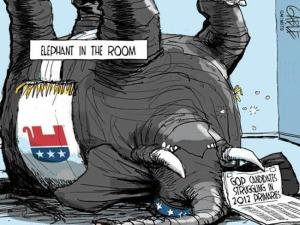 Paul Ryan came out of the snakepit long enough to dribble the usual economic memes that completely deny economic theory, evidence, and policy needs. They continue to link the debt ceiling increase–which is necessary because they’ve already spent a lot of money–to spending less money on things they hate which usually gives them hard little willies. They want to punt yet again on the debt thing until they figure out a way to get their way without looking like the jerks the really, truly are.
The House’s Republicans, assembled at a retreat outside Williamsburg, Virginia, are discussing the “virtues” of passing a short-term increase in the federal debt limit.
So says Rep. Paul Ryan, the House Budget Committee chairman from Wisconsin.
“We are discussing the possible virtues of a short-term debt-limit extension so that we have a better chance of getting the Senate and White House involved in the discussion,” Ryan told reporters outside the private meetings.
So, Politico thinks they have all the answers to the GOP’s problems.
Internal GOP polls back the GOP image problem: A mere 11 percent of respondents thought national spending and deficits were the most important issue facing the American public. Thirty-five percent pegged the economy as the top issue. The GOP has had a tough time connecting the two.
Yes, the GOP has a tough time connecting the two because every one knows their austerity pogrammes have nothing to do with creating jobs and economic well-being and everything to to do with their faith based economics which basically keep enriching and empowering their billionaire donor base and corporate overlords. Perhaps, as Tiger Beat on the Potomac suggests, they need to focus on a bigger question?
Times have changed for Republicans. For much of the past decade, they have been rallying around making permanent the Bush-era tax rates. Now, many have voted to let those rates lapse on high-income earners while keeping low middle-class rates. Now tax reform — long a Republican mantra — seems a distant possibility.
The fractured majority, the last bastion of power for Republicans in Washington, faces a more existential question: What does it mean to be a Republican during a second Obama term? How can they exact legislative victories from Obama while driving forward their own agenda in a town where they have just a sliver of control?
And what exactly is a Republican agenda at a time when complicated fiscal issues — on which Republicans used to have a distinct polling advantage — are at the fore?
Let me suggest something here. Repu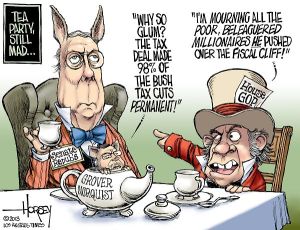 blican policies hurt every one but the extremely wealthy. They declare very long wars with very large, unpaid bills for non-US Defense related purposes and none of them die for any of it. They assign women, minorities, and GLBTs to less-than-equal citizen status based on specific religious whims and allow the proliferation of assault weapons while they hide up in gated fortresses. The force us to rely on dirty, climate destroying fossil fuels all the while ignoring the extreme weather around us and the resulting disasters. They give their friends monopoly profit from death, pestilence, and war. None of this makes the majority of Americans happy and the majority of Americans want none of it if you actually poll them honestly. None of this brings economic prosperity. None of this increases US median incomes, quality of life, or public safety, health or security. In short, we continually get the same agendas that have been proven disastrous and costly over and over and over again. We tell them no in elections and polls. They just regroup to find better ways to tell us just have a little more faith. Then, their rich asshole benefactors like Pete Peterson and the Koch Brothers spread money around trying to convince every one in the country that up is really done. We’ve seen this repeatedly since the 1980s. A lot of us have wised up to it.
House Republicans heard it loud and clear Wednesday: They are unpopular, and need to change their ways.Speaker John Boehner’s House Republican Conference is more disliked now than when it took the majority two years ago, lawmakers and aides here found out. After taking a bruising in the 2012 elections, the Republican Party needs an image makeover and the GOP must learn to relate better to voters.
Ya think when polls show that communism in America is more popular than House Republicans that all they need is an image makeover?
David Winston, a top GOP pollster and close adviser to Boehner, unveiled the House Republicans’ most recent favorable rating based on his own analysis: It came in at a barrel-scraping 27 percent.
House Democrats’ numbers are a full 19 points higher at 46 percent. Winston’s analysis: Neither party is popular, but the GOP is less so. The lawmakers heard that the way to turn things around is for the party to pivot squarely to the economy and jobs — the chief concerns of most voters.
After an election dominated by a steady stream of gaffes by the GOP’s presidential nominee, Mitt Romney, and some of its highest-profile candidates, some of the speakers at Wednesday’s retreat counseled the GOP on how to turn things around. Doing so will be paramount as the party enters a period of tense conflict with President Barack Obama over fiscal matters like the nation’s debt ceiling and the sequester.
Domino’s Pizza CEO J. Patrick Doyle explained to House Republicans how he remade his company’s brand.
At the tail end of a panel, Winston and fellow Republican pollsters Kellyanne Conway and Dave Sackett urged the GOP to work hard to relate better to voters. That’s why, the pollsters said in a question-and-answer session, Romney lost his bid for the White House — because no one identified with the aloof-seeming wealthy former venture capitalist whom Democrats painted as way out of touch with the average voter.
Romney may not have been likable but his message–that 47% of us are grifters–was even more unlikable and the voting public resoundingly defeated all of that. I’m still waiting to hear the results from this panel: the National Review’s Ramesh Ponnuru, journalist Kate O’Beirne and James Capretta of the American Enterprise Institute will explore “Who speaks for middle America?”. It’s going to be a bit like watching Marlon Perkins describing what it’s like to wrestle a tiger by standing in front of the video showing some one else doing it. Can any one think of three people less likely to get the middle class than those three? Maybe they could’ve gotten George Will, Tom Brokaw, and David Brooks to do it less believably than that. I’m actually thinking Romney could probably do a better job. At least, he never spent most of his days in the Washington DC beltway elite bubble.
I’m still of the opinion that the Republican party needs to go the way of the WHIGS. I can’t see them ever rising above representing any one but the American Equivalent of the Saudi Royal Family and the Taliban ever again. But then, I’m a researcher so I always test my hypotheses against evidence rather than begging you all to just take it on blind faith.
Thursday Reads: Is It Finally Time for Some Hope and Change?
Posted: January 17, 2013 Filed under: Barack Obama, children, Crime, education, Media, Mental Health, morning reads, U.S. Politics | Tags: baseball, Boston Red Sox, gun safety, Joe Biden, life-defying death-affirming right wingers, Manti Te’o, Newtown school shooting, Notre Dame football, NRA, Rachel Maddow, research on gun violence, Richard Wolffe, Sasha and Malia Obama 39 Comments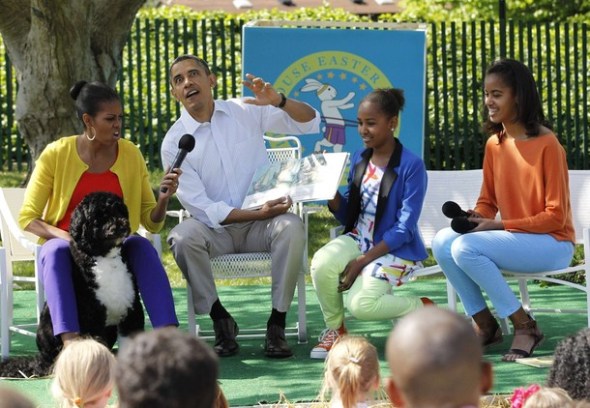
Good Morning!!!
Rachel Maddow is such an optimist. After I listened to her show last night, I began to have real hope for change (pun intended) on the gun control front. Rachel talked about President Obama’s announcements yesterday, and how the knee jerk reaction of the DC pundits was basically, “ho hum, it’s nice talk but there’s no chance for real change.” But the American people agree with Obama on gun safety. If he gets out there and fights for his initiatives, he could accomplish a lot.
Another encouraging note–I can’t recall if it was on Rachel or another MSNBC show–Richard Wolffe said that he saw a look in Obama’s eyes that he’s seen before. Wolfe said it was like Obama’s determination on health care, a sign that he really cares of this and will follow through. I think Joe Biden deserves a lot of credit for this too–as he did in pushing Obama to come out in favor of gay marriage last year.
As we saw with the gay marriage issue, when the President focuses on something it becomes big news. Yesterday there was lots of discussion and it was the main topic on Morning Joe this morning too. Interestingly, after a lot of excited pro-gun-safety talk, Scarborough brought on Jim DeMint to talk about the Heritage Foundation reaction, and DeMint punted. He talked in circles and refused to offer any ideas! The right wingers simply weren’t prepared for this fight. They thought the fear of the NRA would carry the day as always.
Anyway, I feel hopeful for now. Maybe Obama can continue to change the political conversation in his second term. To me the most powerful decision the president made was to enable federal support for research on the causes of gun violence. From Inside Higher Ed:
Obama issued an order to the Department of Health and Human Services to have the CDC as well as the National Institutes of Health study issues related to gun violence, and asked Congress to appropriate $10 million for additional work in the area. Obama said in his public remarks that research is part of the solution to gun violence, and he sharply criticized the past limits on studies.
“While year after year, those who oppose even modest gun safety measures have threatened to defund scientific or medical research into the causes of gun violence, I will direct the Centers for Disease Control to go ahead and study the best ways to reduce it — and Congress should fund research into the effects that violent video games have on young minds,” Obama said in introducing his new policies. “We don’t benefit from ignorance. We don’t benefit from not knowing the science of this epidemic of violence.”
He followed that up immediately with a memo to Kathleen Sebelius, secretary of the Department of Health and Human Services, telling her to work with the CDC “and other scientific agencies within the Department of Health and Human Services [to] conduct or sponsor research into the causes of gun violence and the ways to prevent it. The Secretary shall begin by identifying the most pressing research questions with the greatest potential public health impact, and by assessing existing public health interventions being implemented across the nation to prevent gun violence.”
The president’s actions are consistent with several requests from violence scholars in the last month, as Vice President Biden led an administration task force to develop the plan released Wednesday. Dozens of scholars of violence this month — organized by the Crime Lab of the University of Chicago — issued a joint letter to draw attention to the impact of federal policies that have effectively banned federal support for their
This is how the anti-science Republicans think: Avoid facts and data, stifle knowledge, close your eyes and ears and scream if anyone tries to break through the denial. But the American people are with Obama on this. Some people are saying that Congress will never appropriate the money for this research. I’m not so sure. If the Republicans continue their pro-gun and anti-people tantrums, they may find themselves in the minority in both houses of Congress in 2014.
Here’s the NYT writeup of Obama’s announcement on gun safety: Obama to ‘Put Everything I’ve Got’ Into Gun Control.
Surrounded by children who wrote him letters seeking curbs on guns, Mr. Obama committed himself to a high-profile and politically volatile campaign behind proposals assembled by Vice President Joseph R. Biden Jr. that will test the administration’s strength heading into the next four years. The first big push of Mr. Obama’s second term, then, will come on an issue that was not even on his to-do list on Election Day when voters renewed his lease on the presidency.
“I will put everything I’ve got into this,” Mr. Obama said, “and so will Joe.” [….]
“I tell you, the only way we can change is if the American people demand it,” Mr. Obama said. “And, by the way, that doesn’t just mean from certain parts of the country. We’re going to need voices in those areas, in those Congressional districts where the tradition of gun ownership is strong, to speak up and to say this is important. It can’t just be the usual suspects.”
Meanwhile on the life-dying, death-affirming, ideological side of this fight, the NRA really hurt itself yesterday by going after President Obama’s daughters in an attack ad. From the National Journal: Has the NRA Finally Gone Too Far?
The National Rifle Association has been skirting the lines of decency for years, but the gun-rights group stoops to a new low with a Web ad calling President Obama an “elitist hypocrite.” The ad criticizes Obama for giving his daughters Secret Service protection while expressing skepticism about installing armed guards in schools.
The ad is indisputably misleading, and is arguably a dangerous appeal to the base instincts of gun-rights activists….
The fact is, Obama is not opposed to armed guards in schools. Indeed, many of the nation’s schools already hire security. This is what Obama is skeptical of: the NRA’s position that putting more guns in schools is the only way to prevent mass shootings.
The president wants to ban assault rifles, require background checks, and ban high-capacity ammunition. He does not want to confiscate guns, despite the NRA’s unsubstantiated warnings to the contrary.
There are fair arguments to be had over Obama’s proposals: Redefining the Second Amendment shouldn’t be done without a vigorous debate. But to drag the president’s daughters into the fight, and to question their need for security, suggests that the NRA is slipping further away from the mainstream. Over-the-top tactics discredit the NRA and its cause.
Well it sure looks like we’re going to have that “vigorous debate” now.
Read the rest of this entry »
John Mackey and Whole Foods: Biting The Hands That Feed Them
Posted: January 16, 2013 Filed under: Affordable Care Act (ACA), open thread, U.S. Economy, U.S. Politics | Tags: Bread and Circus, Erewhon, fascism, John Mackey, Libertarianism, natural foods, organic foods, socialism, Whole Foods 16 Comments
My local Whole Foods Mkt.
When I first moved to Boston in 1967, there was an amazing natural food store on Newbury Street called Erewhon. It was started by Michio Kushi and his wife Aveline and focused on Kushi’s macrobiotic diet. You could get all kinds of interesting foods there like tamari sauce, miso, natural peanut butter made out of just peanuts, and all kinds of strange grains, beans, and vegetables. The store had sawdust on the floor and big barrels with foodstuffs in them. I used to take the T downtown to shop there and then drag my purchases home in great big cloth bags. Eventually Erewhon expanded and opened a store in Cambridge and it got easier to shop there. Erewhon was a pioneer in making organic foods available to the public.
In the late 1970’s another natural foods store opened in Brookline. It was called Bread and Circus, and the company soon expanded into Cambridge, Wellsley, and a few other Boston suburbs. It was a great place to shop and didn’t have the “health food” aura of Erewhon, where you would see lots of sickly-looking macrobiotic mavens. Unfortunately, in the early 1990’s Bread and Circus was bought out by the Texas company, Whole Foods Market. And it’s been pretty much downhill from there. The prices are sky high and the standards for what constitutes “whole foods” have slipped.
Under co-founder and CEO John Mackey, Whole Foods is much more focused on marketing than on health. Mackey is an obsessive libertarian, who in 2009 wrote an obnoxious op-ed in the Wall Street Journal in which he suggested that Obama’s health care initiative was socialistic. Here’s just a taste.
With a projected $1.8 trillion deficit for 2009, several trillions more in deficits projected over the next decade, and with both Medicare and Social Security entitlement spending about to ratchet up several notches over the next 15 years as Baby Boomers become eligible for both, we are rapidly running out of other people’s money. These deficits are simply not sustainable. They are either going to result in unprecedented new taxes and inflation, or they will bankrupt us.
While we clearly need health-care reform, the last thing our country needs is a massive new health-care entitlement that will create hundreds of billions of dollars of new unfunded deficits and move us much closer to a government takeover of our health-care system. Instead, we should be trying to achieve reforms by moving in the opposite direction—toward less government control and more individual empowerment.

In 2010, Mackey tried to save the company some money by punishing employees with exercise and garcinia cambogia supplementation for those whom he deemed to be too fat, giving them smaller discounts for their purchases from the stores than thinner employees got. The reaction was swift and negative, and from what I can tell, the initiative was quietly dropped. The company would have been sued over it anyway. Oh, and Mackey hates unions too.
I don’t know who shops at Whole Foods in Texas, but around here it’s mostly the ex-hippies like me along with what we used to call “yuppies” and other politically liberal types. As Mackey found out in 2009 and 2010, his libertarian lecturing doesn’t go over too well with his clientele. After each of these episodes, I became less interested and wasting my “whole paycheck” at Whole Foods. I still go there sometimes, but usually only to buy things I can’t find anywhere else. After today, I’m going to feel even less enthused about shopping in Mackey’s Markets.
I’m sure you’ve heard by now that today Mackey told NPR that Obamacare is worse than socialist–it’s fascism! It’s seems Mackey has a new book out called Conscious Capitalism. He told NPR that his goal is to convince people that corporations aren’t really “primarily selfish and greedy.”
Mackey sat down with Morning Edition host Steve Inskeep to discuss his philosophy and the new book he co-authored, Conscious Capitalism. Part 1 airs Wednesday, Part 2 on Thursday….
When Inskeep asks him if he still thinks the health law is a form of socialism, as he’s said before, Mackey responds:
“Technically speaking, it’s more like fascism. Socialism is where the government owns the means of production. In fascism, the government doesn’t own the means of production, but they do control it — and that’s what’s happening with our health care programs and these reforms.”
Apparently NPR has been dissing Whole Foods for awhile now. There was funny piece about it at The Atlantic in 2011: NPR Is Slowly Breaking Up with Whole Foods. Mackey would probably be more comfortable appearing on right wing talk shows; but he wouldn’t reach his target demographic that way, so he has to go on NPR. There’s a real mismatch between this CEO and his customers.
Well, around here, lots of the supermarkets carry organic fruits, vegetables, eggs, butter, dairy products and meats now, so there isn’t as much need to go to a specialty store with sky-high prices. My biggest problem is that Whole Foods recently bought out a local food chain that ran the most inexpensive and convenient store in my neighborhood. By next fall, the closest grocery store to me will be a Whole Foods. Can I resist stopping there and drive 15-20 minutes to get to another store when I’m in a rush or tired? It won’t be easy but I’m going do my best.
Anyway, this is an open thread. What’s on your mind tonight?
Can We Really Get Sensible Gun Safety Laws?
Posted: January 16, 2013 Filed under: American Gun Fetish | Tags: gun control, gun safety 12 Comments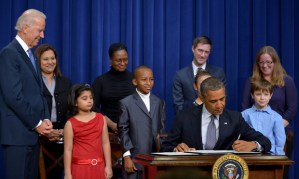 The President had a presser unveiling potential Gun Safety Laws and Regulation. Have we finally passed a threshold where we can finally deal with the proliferation of killing machines without hearing the gun fetishists whine about their inability to maintain an arsenal worthy of a military installation that worries police and citizens alike? Will we get a dialogue and not some kind of right wing hate fest? Probably, not … but we’re moving towards restricting some of the worst abuses of some people’s idea of the second amendment.
The White House has published the full text of the president’s proposals [pdf] – and a hashtag #nowisthetime to take the message to social media.
There’s a new White House website on preventing gun violence with smart interactive text and video, state of the art stuff.
The feedback from wing nuttia as well as the usual political questions are getting full court press.
At a White House event at noon, Mr. Obama announced plans to introduce legislation by next week that includes a ban on assault weapons, limits on high-capacity magazines, expanded background checks for gun purchases and new gun trafficking laws to crack down on the spread of weapons across the country.
He also promised to act without Congressional approval to increase the enforcement of existing gun laws and improve the flow of information among federal agencies to keep guns out of the hands of criminals and others who shouldn’t have them.
The announcement was the culmination of a monthlong process that began after the massacre of 20 children at an elementary school in Newtown, Conn. In the wake of the shootings, Mr. Obama pledged action, but it was not immediately clear how far he was willing to go in the face of intense political opposition.
Wednesday’s announcement reflected a decision by the White House to seize on public outrage to challenge the political power of the National Rifle Association and other forces that have successfully fought new gun laws for decades.
The president vowed to fight hard for the new gun laws, saying that the country’s leaders are compelled to act by the tragedies of gun deaths across the country.
“In the days ahead, I intend to use whatever weight this office holds to make them a reality,” he said. “If there’s even one life that can be saved, then we’ve got an obligation to try.”
Mr. Obama opened his call for new gun laws by quoting from some of the letters he received from children — several of whom were sitting in the audience at the White House — urging him to take action on gun violence.
“This is our first task as a society,” Mr. Obama said. “Keeping our children safe. This is how we will be judged. And their voices should compel us to change.”
There’s some indication that the proposals will be given the slow walk treatment in Congress.
Speaking before Obama, Vice President Biden said “we have a moral obligation” to diminish the prospect that tragedies such as last month’s massacre in an elementary school in Connecticut could happen again.
“I have no illusions about what we’re up against,” Biden said. But he added: “The world has changed, and it’s demanding action.”
Senate Judiciary Committee Chairman Patrick J. Leahy (D-Vt.) said his panel would begin examining gun-control measures in two weeks. “In our hearings, we will ensure an open forum for a constructive discussion about how we can better protect our communities from mass shootings, while respecting the fundamental right to bear arms recognized by the Supreme Court,” he said in a statement. “As President Obama has made clear, no single step can end this kind of violence. But the fact that we cannot do everything that could help should not paralyze us from doing anything that can help.”
There are a number of disturbing ads, images, and statements coming from the Gun Fetish crowd including comparisons of the President to Hitler, Saddam Hussein, and Osama Bin Laden. It’s hard to imagine that the right wing could get any more hateful and racist about these measures given that both Presidents Bush and President Reagan have pretty much proposed or signed similar measures. The worst is an NRA political ad that uses the President’s daughters as an example of how well giving school kids armed guards works. Rush Limbaugh was particularly disgusting today. He actually made fun of the children that wrote letters who appeared with the President. He referred to the children as “human shields”.
We knew this would get ugly because the fringe right is ugly. I can only imagine this will get worse as we try to move towards sensible gun safety laws like the rest of the civilized world. The NRA has announced it’s going to mount “the fight of the century”.
LaPierre accused Vice President Biden of lying when he said there would be an open discussion before the administration developed its plan to restrict access to certain weapons and clips.
“The NRA sat in on a White House meeting that was sold to the public as an ‘open discussion’ about how to improve school safety.” LaPierre wrote. “But that was a dirty lie. They didn’t listen to gun owners’ concerns…they didn’t consider any real solutions on how we can keep our kids safe. Instead Barack Obama, Joe Biden and their gun ban allies in Congress only want to BLAME you, VILIFY you, BULLY you, and STRIP you of your Second Amendment freedoms.”
LaPierre warned his members about Obama’s plan, saying: “Right now, they’re steamrolling ahead with legislation that would ban your guns, register your ammunition purchases and even force you to register the firearms you already own with Obama’s anti-gun bureaucrats.”

 peej
peej Carissa
 bostonboomer
 dakinikat
 ecocatwoman
 jjlo
jjlo mablue2
 Mama Lopez
 peggysue22
 quixote
 skydancingguestblogger
 Mona (aka Wonk the Vote)





Recent Comments