
Sequestration Boogie
Posted: March 1, 2013 Filed under: Federal Budget, Federal Budget and Budget deficit, Sequester 39 Comments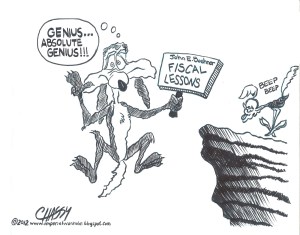 Well, it’s here. It’s the day the Mayans predicted!! It’s the beginning of the end of civilization in the Americas! Sequester Disaster Day is here! Well, it’s here for those of us that like to drive on roads and across bridges. It’s here for those of us that will rely on social security or medicare this month or shortly. It’s here for those of us that have kids in schools or would like to go to university. It’s here for those of us that would prefer to live in a civilized country instead of The United States of Mississippi. For politicians and punditry in the beltway, it’s just another ball where they get to show off their designer formal wear and fancy dance steps.
As the automatic across-the-board spending cuts are set to take effect today and as President Obama meets at the White House with congressional leaders, we have to get this off our chest: This has been an absurd week. Today’s White House meeting is coming only at the last second; there’s been no sense of urgency, no negotiating, and Congress has left town; and, when you think about it, this hasn’t even been a true budget showdown. Given the lack of urgency and negotiating, it’s hard not to conclude that — deep down — plenty of folks on both sides of the aisle are OK with having these cuts take place, at least in the short term.
That’s from Chuck Todd et al. I agree. None of this makes sense if you think of economic policy or actually the idea of governing a country efficiently. I have decided that the only thing Washington cares about is the political dance and political boogie surrounding the process and not what actually happens to the nation. For some reason, these cuts play in the beltway. In that vein, Dave Weigal thinks Obama is winning the process cotillion. Will it’s good some one is winning because there are certainly going to be about 320 million losers out here in the great fly over that exists behind Washington DC and Manhattan.
Republicans have one goal, running through all of these negotiations. They don’t want sequestration to be replaced by tax revenue. Any tax revenue. Forcing the president to swallow $85 billion in cuts this year would do that. They’ve got no obvious alternatives.
But a plan like this exposes a quirk of Obama-era fiscal hawksmanship. Republicans want specific cuts. Some of them—total repeal of Obamacare!—they’ll put on the record. The rest of them, they try to put on the White House. As soon as the “supercommittee” failed and sequestration looked real, it became “the president’s sequester.” The 2011 debt-limit deal delayed real action until after the 2012 election, betting $1.2 trillion of chips on its results and giving them to the president. Even the first great structural victory of the Tea Party, the ban on legislative earmarks, handed more clout to the White House. “The power to make thousands of spending decisions, on everything from which flood control projects will be funded to how spending on military bases will be distributed, to President Obama,” warned two political scientists at the time. Republicans ignored those particular political scientists.
Vote by vote, accidentally, Republicans are endorsing an imperial vision of the presidency. Perhaps they’re picking this up by osmosis. The default position of the punditocracy is that the president must lead. The lazy pundit invokes Harry Truman’s desk ornament, “The Buck Stops Here,” as a totem of great wisdom. Brendan Nyhan, who isn’t lazy, calls this “the Green Lantern Theory of the Presidency,” after the D.C. Comics superhero and his ring that runs on willpower. Bob Woodward offered a sterling example of the theory this week, when he suggested that the president’s willingness to obey the Budget Control Act (the law that mandates sequestration) was “madness.”
See, I actually think they all must want all these cuts. They are so far removed from any impact that any of this would actually have that they’re just ignoring it. As a matter of fact, the similarly out of touch punditry likes the idea of it too. Let me offer of this from Ygelasias:”A Cheer or Two for Sequestration“.
But on the merits it seems to me that while sequestration is hardly optimal budget policy, it really isn’t all that bad in the scheme of things, and really going through with it would be better than repealing it. The key reason is that fully half the cuts are cuts to “defense” spending, and yet nobody from either party is seriously trying to maintain that America will be left defenseless in the wake of this reduced military spending. The specific sequestration mechanism is clearly awkward and clumsy, but again nobody’s saying the Mexican army is going to come swarming over the border to reconquer Santa Fe, that the Taliban is now going to be able to outspend the Pentagon, or that America’s NATO allies are now left unable to fend off a Russian invasion. That’s half the cuts with basically zero real public policy harm.
So then you look at the domestic side. Your basic transfer payments to poor people are spared, your transfer payments to the elderly are basically spared, and then everything else gets cut willy-nilly. That leads to some real policy harms. Valuable research grants are going to not happen. We’ll see some real bottlenecks at regulatory agencies. But obviously there’s some waste and fat in this domestic discretionary spending.
Long story short, if you’re a defense dove like me and have a nonutopian view of the domestic discretionary budget, then this looks like we’re mostly talking about harmless spending cuts.
This from a man who had to get a wife from an on line dating service which is basically the equivalent of a mail order bride. How much do you have to hate yourself to troll around online for an equally desperate person?
Let me just return to the economic impact of all of this.
Yes, the across-the-board spending cuts will lead to hundreds of thousands of job losses and a fiscal drag of 0.6 percent for 2013, according to the forecasting firm of Macroeconomic Advisers. Mostly, though, the rub is the timing and the inartful nature of the cuts.
“It would clearly be preferable to have a more orderly process for fiscal adjustment than the indiscriminate effects of sequestration,” wrote Macroeconomic Advisers in a recent research note.
The inopportune moment of sequestration — hitting just as the economy shows bright spots — will create a drag on the economy in a slow-motion manner. First, the furlough notices will go out in March to federal employees, the majority of whom live outside of the Washington metro area. Unemployment checks will drop as early as April for the long-term unemployed who receive the federal benefit checks.
States eventually will have to decide how to cut programs for low-income or vulnerable people that are funded through federal grants, such as child-care assistance, nutrition programs for women and children, mental-health services, and meal programs for senior citizens.
If Congress keeps the sequester cuts in place for a few months, then the economy will start to feel the effects. Federal workers furloughed for as many as 22 days between mid-April, when the furloughs are expected to begin to occur, and the end of the fiscal year will face a pay cut of as much as 20 percent. This will have ripple effects throughout the economy on consumer spending as well as state income and sales taxes.
By July, August, and September, the impact of sequestration should be fully felt. “We’re not going to go into a downward spiral overnight, but the spending cuts will build, and as they build, the effects will become noticeable,” says Nigel Gault, the chief U.S. economist of IHS Global Insight.
Already, the economic data showed a dip in federal-government spending for defense in the first quarter, a reaction to the impending cuts.
That is the real takeaway of the sequester and its economic impact. It will not hurt the economy immediately, but it still serves as a reminder of the power the federal government holds over the economy. Even if the government cannot enact policies to boost growth, it certainly can hurt the long-term prospects.
I’d really like to know why politicians these days are united in making most people’s lives worse off while maintaining things like preferable tax treatment for people that are already better off than nearly 99.9 % of the people living on the planet? The only thing I can figure out is that none of this impacts any of them so they could care less. It’s not about what happens to the nation or to its people. It’s like they’re teenagers at a country club dance. The only thing that matters is who dances with who and how they each will be perceived in the outfit they’ve chosen. Meanwhile, what will be the cost to the country in the eventual crime and social unrest? Ah, who cares, just buy stock in the latest company that runs the privatized jails. It’s a sure winner.
Friday Morning Reads
Posted: March 1, 2013 Filed under: fetus fetishists, morning reads, U.S. Economy, U.S. Politics, Vagina, War on Women, Women's Rights | Tags: Arkansas anti-abortion law, Bernadette Peters, Eric Cantor, the sequester, transvaginal ultrasound, Violence Against Women Act 20 Comments Good Morning!!!
I’ve been a little out of the loop recently since I have a friend here to visit. So, I’m going to start with a Happy 65th Birthday wish to Bernadette Peters because I saw her in concert last night. She’s 59 in this youtube but she wore the same dress and did this song. I was shocked!! shocked! to hear that she told us that it was her first time!!!
It was a night of Broadway songs and overtures with the Louisiana Symphony Orchestra.
So, the House passed the Senate version of the Violence Against Women Act which is finally on its way to the President for his signature.
After months of delay, GOP leaders allowed the bill to come to the floor only after a Republican substitute version of the legislation — set up as an amendment to the Senate’s bipartisan bill — failed, 166-257. The House amendment was expected to fail, but allowed members to vote for a version of VAWA while not supporting the Senate bill.
Still, House leaders were under pressure from members of their own party to pass the Senate version without any changes. Nineteen House Republicans sent a letter to Majority Leader Eric Cantor and House Speaker John Boehner urging them to pass a bipartisan version of VAWA.
This is the third time Boehner has allowed a bill to pass with a majority of Democratic votes.
Democrats for the most part were united in their opposition to the House version, arguing it stripped out important protections for LGBT and Native American women. Sixty Republicans joined them in opposition. Only two Democrats, Dan Lipinski of Illinois and Mike McIntyre of North Carolina, supported the House version.
In the last Congress, House Majority Leader Eric Cantor (R-Va.) played a critical role in blocking reauthorization of the Violence Against Women Act. In this Congress, Cantor was so eager to get VAWA passage over with, he told House Republicans yesterday to either clear the way for the already passed Senate version or risk causing a “civil war” within the party.
Well, that’s some progress, however. TODAY is SEQUESTER day!!
It’s Friday, March 1, and that means the federal government has crossed the much-hyped and dreaded deadline for the fiscal reductions known as the “sequester.”
The members of Congress who for voted for the Budget Control Act – and the budget cuts contained within – and President Barack Obama who signed it into law on Aug. 2, 2011, may not have believed the day would arrive, but now it has.
But today is only the beginning of the beginning.
For one thing, Obama must sign an order formally starting the “sequester” or spending reductions – which according to a new estimate from the Congressional Budget Office – would amount to $42 billion in the current fiscal year.
And White House aides have indicated that the president is not likely to put pen to paper on that order until after he meets with congressional leaders, a meeting slated for Friday morning.
Once Obama signs the order to start the spending cuts, any furloughs of federal workers could not begin at least for another 30 days due to federal regulations and to collective bargaining agreements which the government has with the unions that represent roughly half of the federal workforce.
I guess Transvaginal Ultrasounds are fine as long as your representative doesn’t feel it’s all that relevant for him.
Rep. Sean Duffy (R-WI) declined to take a position last week during a town hall meeting on whether transvaginal ultrasounds should be mandatory for women seeking abortions, saying he has never heard of the practice and couldn’t weigh in on it because “I haven’t had one.”
Ultrasound requirements are a top priority for anti-abortion advocates in Wisconsin and other states. Similar legislation in past years has landed Republicans in political hot water, and this time around many GOP leaders are distancing themselves from proposed ultrasound requirements.
Duffy has described himself as “100 percent prolife without exceptions” (though he also said “To qualify, I believe that if we have the life of a mother as an issue, the mother’s life takes priority, but we must make every effort to save the life of the child.”) Asked about one of the main goals for the pro-life movement, however, Duffy said he had not heard of transvaginal ultrasounds at all.
A Democratic operative recorded Duffy’s exchange with the questioner at a Feb. 21 townhall meeting in Spooner, Wisc. Through his congressional office, Duffy declined to comment or clarify his views on mandated ultrasounds.
Arkansas became the eighth state Thursday to enact a near-ban on abortions starting in the 20th week of pregnancy, and by next week it could outlaw most procedures from the 12th week onward, which would give it the most restrictive abortion laws in the country.
The Republican-led Senate voted 19-14 along party lines to override Democratic Gov. Mike Beebe’s veto of a bill barring most abortions starting in the 20th week of pregnancy that was based on the disputed notion that a fetus can feel pain by that point. The Arkansas House voted to override the veto Wednesday. A simple majority was needed in each chamber.
That law, which took effect immediately but which will likely be challenged in court, includes exemptions for rape, incest and the life of the mother.
Senate President Michael Lamoureux, R-Russellville, voted to override the veto, but later told reporters he wasn’t sure the new law would survive a constitutional challenge.
“If it was an easy answer, then people wouldn’t be raising that subject,” he said after the vote.
After overriding the veto, the Senate voted 26-8 in support of a separate measure that would outlaw most abortions starting in the 12th week of pregnancy. In addition to the exemptions for rape, incest and the mother’s life, it would allow abortions when lethal fetal conditions are detected.
The proposed 12-week ban, which would ban abortions from the point when a fetus’ heartbeat can generally be detected through an abdominal ultrasound, would give Arkansas the most restrictive abortion laws in the country, said Cecile Richards, the president of Planned Parenthood Action Fund.
Yes, the religious extremists in this country have taken over a number of state legislatures. Look for more violations of your civil rights–except the right to arm yourself with a nuclear bomb–in a state near your.
So, I’m going to make this short this morning . What’s on your reading and blogging list today?
Gene Sperling: “A mix of entitlements and revenues was part of the DNA” of the Sequester “from the start.”
Posted: February 28, 2013 Filed under: 2012 presidential campaign, Austerity, Barack Obama, Medicaid, Medicare, Social Security, U.S. Economy, U.S. Politics | Tags: Bob Woodward, digby, entitlement cuts, Gene Sperling, Jon Walker, Robert Kuttner, the sequester 38 Comments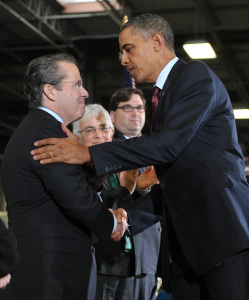
Gene Sperling and Barack Obama
I want to call attention to some rather startling statements in Gene Sperling’s e-mail to Bob Woodward, which I posted earlier. Please note the highlighted sections.
From Gene Sperling to Bob Woodward on Feb. 22, 2013
Bob:
I apologize for raising my voice in our conversation today. My bad. I do understand your problems with a couple of our statements in the fall — but feel on the other hand that you focus on a few specific trees that gives a very wrong perception of the forest. But perhaps we will just not see eye to eye here.
But I do truly believe you should rethink your comment about saying saying that Potus asking for revenues is moving the goal post. I know you may not believe this, but as a friend, I think you will regret staking out that claim. The idea that the sequester was to force both sides to go back to try at a big or grand barain with a mix of entitlements and revenues (even if there were serious disagreements on composition) was part of the DNA of the thing from the start. It was an accepted part of the understanding — from the start. Really. It was assumed by the Rs on the Supercommittee that came right after: it was assumed in the November-December 2012 negotiations. There may have been big disagreements over rates and ratios — but that it was supposed to be replaced by entitlements and revenues of some form is not controversial. (Indeed, the discretionary savings amount from the Boehner-Obama negotiations were locked in in BCA: the sequester was just designed to force all back to table on entitlements and revenues.)
I agree there are more than one side to our first disagreement, but again think this latter issue is diffferent. Not out to argue and argue on this latter point. Just my sincere advice. Your call obviously.
My apologies again for raising my voice on the call with you. Feel bad about that and truly apologize.
Gene
Really? Does anyone recall President Obama saying that at the time the sequester was proposed and voted on in 2011? Did President Obama discuss these plans for entitlement cuts during his campaign for re-election? I’ve always suspected he did plan cuts in Social Security, Medicare, but when did he publicly state this? I’ve done a somewhat cursory search, but I can’t find anything.
There is no mention of these agreed-upon cuts in the Wikipedia entry on the Budget Control Act of 2011. There no mention of “entitlement” cuts in this extensive article at The Bipartisan Policy Center. This analysis (pdf) notes that the Supercommittee was authorized to cut Social Security:
The “Super Committee” deficit reduction plan: BCA also creates a new, special joint committee of Congress charged with finding at least $1.2 trillion in deficit reduction to avoid any potential sequestration. This “Super Committee” can cut spending (including Social Security and Medicare), raise revenue, or propose a combination of both. If the committee cannot agree on a plan, or Congress fails to approve it, automatic cuts of $1.2 trillion will be triggered through sequestration. To assist the Super Committee with its task, Congress also provided for an accelerated review of the Super Committee recommendations, provided that the Super Committee followed specific timelines, as outlined in the text.
But I think it was generally assumed that the Super Committee would not be able to agree on anything, and if they did that the Senate at least would not vote for Social Security cuts.
So now the truth has come out. Certainly no one from the White House has come rushing out to deny that cuts in Social Security, Medicare, and Medicaid are what is supposed to balance any new revenue. A few other bloggers have written about this.
Digby is always alert for any mentions of Obama’s seeming obsession with cutting Social Security, and she didn’t miss this one.
I don’t know that anyone’s ever admitted that in public before or that the president was completely, shall we say, honest when he ran for his second term about that specific definition of “a balanced approach”. I haven’t heard anyone say publicly that the sequester “deal” as far as the White House was concerned was to cut “entitlements” in exchange for new revenues. I wonder how many members of congress were aware of this “deal” when they voted for the sequester? The public certainly wasn’t.
I wish I could understand why it is so important to Barack Obama to cut these vital programs before he leaves office. It seems to be his obsession. But there you have it. It’s not just in the DNA of the sequester, it seems to be in the DNA of this White House.
In this sense, it seems that Sperling and Woodward–and by extension Obama–do “see eye to eye.”
At FDL, John Walker gets right to the point in his headline: Sperling: Obama Wanted Sequester to Force Democrats to Accept Entitlement Cuts.
The way Obama has handled basically every manufactured crisis from the debt ceiling, to the Bush tax cuts expiration, to the sequester has been about trying to force both Democrats and Republicans to embrace his version of a “grand bargain.” While it is clear this has been the driving force behind Obama’s decisions, if you pay close attention to his actions is is rare than an administration official will directly admit this. This is actually what I think it most interesting about the recently leaked email exchange between Bob Woodward and Gene Sperling up on Politico…..
Obama wants to cut Social Security and Medicare benefits. Obama also wants to raise taxes, but he only wants to do these unpopular things if he can get bipartisan cover to destroy basic democratic accountability. If everyone is to blame than no one is to blame.
What has sometimes been viewed as incompetence on the part of Obama during negotiations is actually Obama trying to weaken Democrats’ hand to “force” them to accept entitlement cuts while being able to blame it on the mean Republicans.
That is why even now Obama isn’t calling for the sequester to be simply repealed or delayed. Obama still wants to use this manufactured crisis to force congressional Democrats to betray their base by adopting Social Security cuts and get Republicans to accept revenue increases.
Finally, thanks to JJ for sending me the link to this piece by Robert Kuttner at The American Prospect: Dear White House, You’ll Regret This.
[Gene Sperling’s] e-mail is pure confirmation that Obama’s position, dating back to at least 2011, has been to try to trade cuts in Social Security and Medicare for new revenues. It confirms that Sperling and his boss have been channeling the likes of Robert Rubin, Pete Peterson, the corporate-sponsored Fix the Debt campaign, et al., who have been promoting exactly this grand bargain. Sperling confirms that the sequester was designed to force exactly such a dismal deal.
But even worse, writes Kuttner, is what the e-mail demonstrations about Sperling’s–and Obama’s–pathetic negotiating skills.
The Woodward-Sperling exchange is far more interesting for what it reveals about Sperling/Obama’s propensity for giving ground on core issues and getting almost nothing in return. I supposed we should be grateful that Sperling is only wrecking the economy, the Democrats, Social Security, and Medicare—and not negotiating nukes with the Ayatollah.
I’ve said ever since I read The Audacity of Hope back in 2007 that Obama wanted to cut Social Security. Actually, he made it clear in the book that he wanted to privatize it, but he must have realized that wasn’t going to happen. It’s time for those of us who care about these issues to start screaming bloody murder again. We need to get on this ASAP. So tell your friends and call your Congress critters.
The floor is open for discussion.
Thursday: Bob Woodward’s Non-Scoop, and Some Interesting Long Reads
Posted: February 28, 2013 Filed under: Barack Obama, morning reads, the villagers, U.S. Politics | Tags: Bob Woodward, Carl Bernstein, Christopher Dorner, Gene Sperling, Mark Ames, Politico, processed food addiction, Richard Nixon, Watergate, Workplace shootings 37 Comments
Good Morning!!
Poor Bob Woodward! The only way he can get attention nowadays is by whining and crying and generally creating a tempest in a teapot.
Yesterday Jim Vandehei and Mike Allen posted one of their patented “Behind the Curtain” pieces: Woodward at War, in which they dramatically revealed the inside story of Woodward’s little spat with the White House. This is the sort of story only the Villagers really care about, but when they care about something, they insist on forcing their opinions about it on the rest of us. It was the subject of the first hour of Morning Joe for yesterday and today, and the focus of countless media reports and blog posts throughout the day yesterday. Woodward must be in heaven with all this attention. From Politico:
Bob Woodward called a senior White House official last week to tell him that in a piece in that weekend’s Washington Post, he was going to question President Barack Obama’s account of how sequestration came about — and got a major-league brushback. The Obama aide “yelled at me for about a half-hour,” Woodward told us in an hourlong interview yesterday around the Georgetown dining room table where so many generations of Washington’s powerful have spilled their secrets.
Digging into one of his famous folders, Woodward said the tirade was followed by a page-long email from the aide, one of the four or five administration officials most closely involved in the fiscal negotiations with the Hill. “I apologize for raising my voice in our conversation today,” the official typed. “You’re focusing on a few specific trees that give a very wrong impression of the forest. But perhaps we will just not see eye to eye here. … I think you will regret staking out that claim.”
Woodward repeated the last sentence, making clear he saw it as a veiled threat. “ ‘You’ll regret.’ Come on,” he said. “I think if Obama himself saw the way they’re dealing with some of this, he would say, ‘Whoa, we don’t tell any reporter ‘you’re going to regret challenging us.’”

Horrors! “I think you will regret staking out that claim” is a “major league brushback?” Either Nixon and his men were quite a bit wimpier than we all thought, or Woodward is a lot touchier now than he was in the Watergate days.
In an update, Vandehei and Allen revealed that the White House adviser who supposedly yelled at Woodward over the phone and then “threatened” him was Gene Sperling, Director of the National Economic Council. This morning they published the actual e-mails between Sperling and Woodward. Frankly, I was underwhelmed. Follow me below the fold to read them.
Read the rest of this entry »
Early Morning Open Thread: The Voting Rights Act
Posted: February 28, 2013 Filed under: morning reads, U.S. Politics | Tags: Civil Rights, George Wallace, Lyndon B. Johnson, Selma Alabama, Voting Rights Act 18 Comments
President Lyndon Johnson signs the Voting Rights Act, 1965
Lyndon Johnson: Voting Rights Act Address
Delivered March 15, 1965, Washington, D.C.
I speak tonight for the dignity of man and the destiny of democracy.
I urge every member of both parties—Americans of all religions and of all colors—from every section of this country—to join me in that cause.
At times history and fate meet at a single time in a single place to shape a turning point in man’s unending search for freedom. So it was at Lexington and Concord. So it was a century ago at Appomattox. So it was last week in Selma, Alabama.
There is no Negro problem. There is no southern problem. There is no northern problem. There is only an American problem.
And we are met here tonight as Americans—not as Democrats or Republicans—we are met here as Americans to solve that problem.
This was the first nation in the history of the world to be founded with a purpose. The great phrases of that purpose still sound in every American heart, north and south: “All men are created equal” — “Government by consent of the governed” — “Give me liberty or give me death.”…
Those words are a promise to every citizen that he shall share in the dignity of man. This dignity cannot be found in man’s possessions. It cannot be found in his power or in his position. It really rests on his right to be treated as a man equal in opportunity to all others. It says that he shall share in freedom, he shall choose his leaders, educate his children, provide for his family according to his ability and his merits as a human being….
Many of the issues of civil rights are very complex and most difficult. But about this there can and should be no argument. Every American citizen must have an equal right to vote. There is no reason which can excuse the denial of that right. There is no duty which weighs more heavily on us than the duty we have to ensure that right.
Yet the harsh fact is that in many places in this country men and women are kept from voting simply because they are Negroes….
Experience has clearly shown that the existing process of law cannot overcome systematic and ingenious discrimination. No law that we now have on the books—and I have helped to put three of them there—can ensure the right to vote when local officials are determined to deny it.
In such a case our duty must be clear to all of us. The Constitution says that no person shall be kept from voting because of his race or his color. We have all sworn an oath before God to support and to defend that Constitution.
We must now act in obedience to that oath.
Wednesday I will send to Congress a law designed to eliminate illegal barriers to the right to vote….
To those who seek to avoid action by their National Government in their home communities—who want to and who seek to maintain purely local control over elections—the answer is simple. Open your polling places to all your people. Allow men and women to register and vote whatever the color of their skin. Extend the rights of citizenship to every citizen of this land. There is no constitutional issue here. The command of the Constitution is plain. There is no moral issue. It is wrong—deadly wrong—to deny any of your fellow Americans the right to vote in this country. There is no issue of States rights or National rights. There is only the struggle for human rights.
I have not the slightest doubt what will be your answer….
But even if we pass this bill, the battle will not be over. What happened in Selma is part of a far larger movement which reaches into every section and State of America. It is the effort of American Negroes to secure for themselves the full blessings of American life.
Their cause must be our cause too, because it is not just Negroes but really it is all of us, who must overcome the crippling legacy of bigotry and injustice. And we shall overcome….
This great, rich, restless country can offer opportunity and education and hope to all—all black and white, all North and South, sharecropper and city dweller. These are the enemies—poverty, ignorance, disease—they are our enemies, not our fellow man, not our neighbor. And these enemies too—poverty, disease, and ignorance—we shall overcome.
Montgomery Advertiser, February 26, 2013: Has South changed enough to end Voting Rights Act?
Lyndon Johnson had been a southern U.S. Senator from Texas.
He had fought all civil rights legislation with as zealous an effort as the other bloc of southern senators. This southern bloc of U.S. Senators totally controlled the Senate through their seniority and prowess. They were a formidable coalition. However, Lyndon had now become a national politician. He had ascended to the presidency at the death of John Kennedy and aspired to win the brass ring on his own in 1964.
When Lyndon Johnson set his sights on something nothing or nobody better get in his way. Whatever it took or by whatever means necessary, Lyndon Johnson was determined to win.
Johnson called George Wallace to the White House to meet with him. Wallace was cocky and full of vim and vinegar. At barely 5’8” he was like a bantam rooster. Although he was used to being the cock of the walk, it did not take long for the tall, tough, crude, intimidating Johnson to put Wallace in his place.
Johnson scowled at Wallace and told him he was nothing more than a redneck, tin horn demagogue and he could shout segregation and racist jargon as much as he wanted but it was not going to make a bit of difference. Johnson went on to say that by the end of the year he was going to pass a civil rights bill and sign it. He told Wallace that Strom Thurmond and his allies could filibuster all they wanted but at the end of the day it was going to be the law of the land and it was going to propel Johnson to victory in 1964. Wallace came back to Alabama with his hat in hand. He knew Johnson meant business.
The bill passed and Johnson signed it. Being a southerner Lyndon Johnson knew the ramifications when he signed the Civil Rights Act. He looked up and said, I have just signed the South over to the Republican Party. His words were prophetic….
In 1965, Johnson set his sights on a higher goal and passed the Voting Rights Act. He took aim at the Deep South and bestowed his renowned retribution extraction in Section 4B and Section 5. It requires that those five states and certain regions that voted for Goldwater must have any changes to their voting laws or procedures approved by the U.S. Justice Department.


 peej
peej Carissa
 bostonboomer
 dakinikat
 ecocatwoman
 jjlo
jjlo mablue2
 Mama Lopez
 peggysue22
 quixote
 skydancingguestblogger
 Mona (aka Wonk the Vote)





Recent Comments