
CNN and NBC Reporting that Israel has Conducted Air Strike in Syria
Posted: May 3, 2013 Filed under: Breaking News, Foreign Affairs, Israel, Syria | Tags: chemical weapons, Hezbollah, Israeli air strike inside Syria 8 Comments
Border between Israel and Syria
The United States believes Israel has conducted an airstrike into Syria, two U.S. officials tell CNN.
U.S. and Western intelligence agencies are reviewing classified data showing Israel most likely conducted a strike in the Thursday-Friday time frame, according to both officials. This is the same time frame that the U.S. collected additional data showing Israel was flying a high number of warplanes over Lebanon.
One official said the United States had limited information so far and could not yet confirm those are the specific warplanes that conducted a strike. Based on initial indications, the U.S. does not believe Israeli warplanes entered Syrian airspace to conduct the strikes.
Both officials said there is no reason to believe Israel struck at a chemical weapons storage facilities. The Israelis have long said they would strike at any targets that prove to be the transfer of any kinds of weapons to Hezbollah or other terrorist groups, as well as at any effort to smuggle Syrian weapons into Lebanon that could threaten Israel.
The Lebanese army website listed 16 flights by Israeli warplanes penetrating Lebanon’s airspace from Thursday evening through Friday afternoon local time.
Chris Hayes is still on MSNBC reporting the latest. Israel has acknowledged striking inside Syria. I don’t know why Rachel Maddow hasn’t come on with him.
Please add anything you’re hearing in the comments.
Friday Reads
Posted: May 3, 2013 Filed under: morning reads | Tags: bank abuses, debtor's prisons, increase in US suicide rates, Jeffrey Sachs, Rubber Duck project, The Girls of Atomic CIty 38 Comments Good Morning!
It’s still raining here and we’re under a flash flood warning and have been since yesterday afternoon. It’s May! Enough of the April Showers already! My magnolia tree out front is blooming up a storm on its own. The huge white blossoms are picture perfect!
Well, you knew it was coming! It was just a matter of time before Debtors Prisons came back given the way Banana Republican States are trying to shove us back several centuries. Why do people feel like the poor should be punished?
The jailing of people unable to pay fines and court costs is no longer a relic of the 19th century American judicial system. Debtors’ prisons are alive and well in one-third of the states in this country.
In 2011, Think Progress’ Marie Diamond wrote: “Federal imprisonment for unpaid debt has been illegal in the U.S. since 1833. It’s a practice people associate more with the age of Dickens than modern-day America. But as more Americans struggle to pay their bills in the wake of the recession, collection agencies are using harsher methods to get their money, ushering in the return of debtor’s prisons.”
In 2010, the ACLU did a study titled In for a Penny: The Rise of America’s New Debtors’ Prisons, which revealed the use of debtors prison practices in five states, Louisiana, Michigan, Ohio, Georgia and Washington.
In his 1964 State of the Union address, President Lyndon B. Johnson said: “Unfortunately, many Americans live on the outskirts of hope – some because of their poverty, and some because of their color, and all too many because of both. Our task is to help replace their despair with opportunity.”
Nearly 50 years after Johnson’s address, which launched the “War on Poverty,” “poverty in America has not dissipated,” the ACLU’s report states that “the number of people living in poverty in Ohio grew by 57.7% from 1999 to 2011, with the largest increase coming from suburban counties.”
This year’s ACLU report – which takes its name from a phrase in Johnson’s speech – points out that many poor “Ohioans … convicted of a criminal or traffic offense and sentenced to pay a fine an affluent defendant may simply pay … and go on with his or her life [find the fine] unaffordable [launching] the beginning of a protracted process that may involve contempt charges, mounting fees, arrest warrants, and even jail time. The stark reality is that, in 2013, Ohioans are being repeatedly jailed simply for being too poor to pay fines.”
According to the report, Ohio courts in Huron, Cuyahoga, and Erie counties “are among the worst offenders. In the second half of 2012, over 20% of all bookings in the Huron County Jail were related to failure to pay fines. In Cuyahoga County, the Parma Municipal Court jailed at least 45 people for failure to pay fines and costs between July 15 and August 31, 2012. During the same period in Erie County, the Sandusky Municipal Court jailed at least 75 people for similar charges.”
Meanwhile, suicide rates are on the rise in the US.
More people now die of suicide than in car accidents, according to the Centers for Disease Control and Prevention, which published the findings in Friday’s issue of its Morbidity and Mortality Weekly Report. In 2010 there were 33,687 deaths from motor vehicle crashes and 38,364 suicides.
Suicide has typically been viewed as a problem of teenagers and the elderly, and the surge in suicide rates among middle-aged Americans is surprising.
From 1999 to 2010, the suicide rate among Americans ages 35 to 64 rose by nearly 30 percent, to 17.6 deaths per 100,000 people, up from 13.7. Although suicide rates are growing among both middle-aged men and women, far more men take their own lives. The suicide rate for middle-aged men was 27.3 deaths per 100,000, while for women it was 8.1 deaths per 100,000.
The most pronounced increases were seen among men in their 50s, a group in which suicide rates jumped by nearly 50 percent, to about 30 per 100,000. For women, the largest increase was seen in those ages 60 to 64, among whom rates increased by nearly 60 percent, to 7.0 per 100,000.
It is likely the stress of joblessness, lack of access to health care, loss of assets like the values of homes and retirement funds is correlated with  this. Bank abuses, however, are “in your face” and out of control according to Jeffrey Sachs. Sachs is a Columbia University Economics professor.
When I really started to count in fact and keep track of the number of lawsuits, and the number of settlements, and it’s amazing actually how many there are, of course. Libor, Abacus, other financial fraud scandals, money laundering, insider trading. The list is actually extraordinary. The frequency of new cases, new settlements, new SEC charges, is stunning. And the lack of any apparent remorse from leaders of the industry.
[There hasn’t been one] major figure in the industry acknowledging this rot, and also calling upon the industry to clean itself up. And I find that amazing because I would’ve expected at least one or two voices that would’ve have played that role and that hasn’t happened yet.
Why the lack of prosecution?
The legal defenses are very powerful, the lobbying is very powerful, the government in general is completely squeezed even if it would like to regulate. But we also have a revolving door of senior regulatory officials, congressional staff, congressmen and senators. Everyone’s in on this. So the question is how is this going to be cleaned up, what will it really take to get this under control? We just haven’t seen glimmers of that yet.
What will it take to change the system?
I think that the public is utterly disgusted, of course, and that is a major start.
There’s going to be a massive backlash. But some thought, and I thought at the beginning, that Obama was going to bring in control, that’s essentially what he promised, but he actually essentially brought in Wall Street to do the clean up. Perhaps the next government, or perhaps the next crash, it’s hard to say. But what one does feel is that the extent of abuse, the stench of it, is reaching such a high level that we’re not in an equilibrium, political or social, right now.
This is explosive stuff (scandals like Abacus and insider trading). It’s unbelievable. So far it hasn’t stopped the practice, but it can’t get more in your face than this actually.
I think in the end the question will be for our politics in general, whether a political movement not based on mega-donations can win political control. I believe that it can actually.
Some movement like the populist movement or the progressive era of the past is going to rise and say ‘we don’t need contributions, we’re not taking them, and if you the American people want a way out of this that doesn’t involve politicians bought for big money, we’re the ones.”
But short of that I don’t see a way out. Our politicians are not heroes, to say the least, and they seem to have no taste for this.
Will Dodd-Frank be effective?
It’s clearly being eaten alive and at critical points — of too big to fail and the control of derivatives — I doubt that it’s going to have any real effect as it is right now. The lobbying is just simply so overwhelming that I doubt that it’s going to have much sticking power.
 There’ a great book reviewed about some of the women who really helped win World War II. It’s called “The Girls of Atomic City” written by Denise Kiernan. Here’s an excerpt from a review at td.
In the fall of 1942, residents of a rural swath of east Tennessee began receiving official notifications that their homes and farms were no longer theirs and that they would have to move. The new owner was the U.S. government, which swept up some 59,000 acres of land and in a matter of months built an instant city of 75,000 people so secret it wasn’t even listed on maps.
Its purpose? To process uranium for the world’s first atomic bomb.
The fascinating story of the Manhattan Project has been told often, and often told well—Richard Rhodes’ “The Making of the Atomic Bomb” placing high on that lengthy list. But given the project’s significant and lasting impact, there’s plenty more mining to be done, and Denise Kiernan has found a rich vein in “The Girls of Atomic City.” Rosie, it turns out, did much more than drive rivets.
The secret Tennessee city eventually became modern Oak Ridge, built to support what was known as the Clinton Engineer Works. The sprawling complex was off-limits to anyone without proper ID. It was so vertically segregated in its operations that only a handful of people at the top knew what was really going on, and so swaddled in internal secrecy that to speculate on the purpose of your job invited immediate dismissal and eviction.
To see long excerpts from “The Girls of Atomic City” at Google Books, click here. As Kiernan demonstrates, because of the shortage of manpower during the war years, much of the work at Oak Ridge was done by women. They were drawn from cities in the Northeast, farms in the South, and small towns in the Midwest, were paid good money for the time and the place, and were crammed into dormitories and trailers; and for the small contingent of African-Americans, there were four-person, 256-square-foot “hutments,” each one “a square plywood box of a structure that had a potbellied stove sitting right smack-dab in the middle.” Houses, impermanent as they were, were reserved for families.
Women may have migrated to Oak Ridge in droves, but they were still hemmed in by the social and racial narrows of the time. Few achieved levels of authority at work; housing policies forbade gender or racial mixing; a household wasn’t a household unless it was led by a man, which meant women with children who arrived ahead of their husbands struggled to find shelter.
Kiernan has amassed a deep reservoir of intimate details of what life was like for women living in the secret city, gleaned from seven years of interviews and research.
Here’s some fun from Victoria Harbor in Hong Kong. This is part of the Rubber Duck Project conceived by Dutch artist Florentijn Hofman.
The artist has used this installment in other cities. The artist explains its purpose.
The piece, called Rubber Duck, is by Dutch conceptual artist Florentijn Hofman, internationally renowned for his large-scale sculptures, which often originate from recognisable, everyday objects. He said: “The Rubber Duck knows no frontiers, it doesn’t discriminate people and doesn’t have a political connotation. The friendly, floating Rubber Duck has healing properties: It can relieve mondial tensions as well as define them.”
So, that’s my bit for this morning. What’s on your reading and blogging list today?
Workers of the World Unite
Posted: May 2, 2013 Filed under: income inequality, worker rights | Tags: 401(k), diminishing real wage, Felix Salmon, Henry Blodgett, Income Inequality, Thomas Friedman whore 8 Comments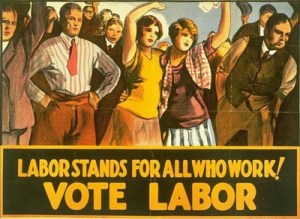 We continue to see abuse of labor from the horrible explosions in a West, Texas chemical plant to the collapse of a building in Bangladesh. US workers continue to get the shaft when it comes to working harder and more productively for less. It is a sad trend that just keeps reaching new records. The gap between incomes going to workers and profits going to owners–mostly passive stockholders–continues unabated. This gap does not reflect a lack of labor productivity. It appears to reflect mostly the ability of capital owners to gamble themselves into strong positions. Industrialists are force to drive down costs to attract capital and to do some very short sighted things. The rush to increase ROE with no thought to other factors is a very bad omen for this country.
Henry Blodgett provides some very depressing May Day graphs at Business Insider.
Corporate profit margins just hit another all-time high. Companies are making more per dollar of sales than they ever have before. If you’re a shareholder, that seems like good news (in the very short term, anyway). Alas, most people aren’t shareholders. And for folks whose investment horizon is longer than “this quarter” and “this year,” it’s actually bad news. Companies are under-investing in their employees and the future.
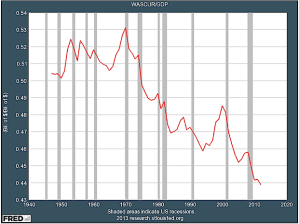 Normally, high profits are a good sign. What is disturbing is the the under-investing and the unequal increase in wages. Labor–in theory–should gain with productivity gains. This tends to stoke the growth of an economy and of a solid middle class. This trend means there is less purchasing power among the majority of households and more wage and job insecurity. This is Felix Salmon’s take.
It’s May Day, and Henry Blodget is celebrating — if that’s the right word — with three charts, of which the most germane is the one above. It shows total US wages as a proportion of total US GDP — a number which continues to hit all-time lows. Blodget also puts up the converse chart — corporate profits as a percentage of GDP. That line, you won’t be surprised to hear, is hitting new all-time highs. He’s clear about how destructive these trends are:
Low employee wages are one reason the economy is so weak: Those “wages” are represent spending power for consumers. And consumer spending is “revenue” for other companies. So the short-term corporate profit obsession is actually starving the rest of the economy of revenue growth.
In other words, we’re in a vicious cycle, where low incomes create low demand which in turn means that there’s no appetite to hire workers, who in turn become discouraged and drop out of the labor force. Blodget’s third chart is one we’re all familiar with: the employment-to-population ratio, which fell off a cliff during the Great Recession and which will probably never recover. The current “recovery” is not actually a recovery for the bottom 99%, for real people who need to live on paychecks. And today is exactly the right day to point that out.
And yet that’s Tom Friedman’s column this May Day:
If you are self-motivated, wow, this world is tailored for you. The boundaries are all gone. But if you’re not self-motivated, this world will be a challenge because the walls, ceilings and floors that protected people are also disappearing. That is what I mean when I say “it is a 401(k) world.”
This manages to be both incomprehensible and incredibly offensive at the same time. I have no idea what Friedman thinks he’s talking about when he blathers on about disappearing protective floors; I can only hope that he isn’t making a super-tasteless reference to the recent disaster in Bangladesh. But it’s simply wrong that today’s world is “tailored” for anybody who happens to be “self-motivated”. Both the self and the motivation are components of labor, not capital, and as such they’re on the losing side of the global economy, not the winning side.
Friedman is a billionaire (by marriage) who — like all billionaires these days — is convinced that he achieved his current prominent position by merit alone, rather than through luck and through the diligent application of cultural and financial capital. His paean to self-motivation recalls nothing so much as Margaret Thatcher’s “there is no such thing as society” quote: “parenting, teaching or leadership that ‘inspires’ individuals to act on their own will be the most valued of all,” he writes, bizarrely choosing to wrap his scare quotes around the word “inspires” rather than around the word “leadership”, where they belong.
True leadership, in a society where the workers are failing to be paid even half the fruits of their labor, would involve attempting to turn the red line in Blodget’s chart around, and to spread the nation’s prosperity among all its citizens. Rather than telling everybody that they’re “on their own” and that if they’re not a success then hey, they’re probably just not “self-motivated” enough.
The ultimate Friedman kick in the balls, however, doesn’t come from his lazily meritocratic priors. Rather, it comes from his overarching metaphor: the idea that if you have a 401(k) plan, then you’re somehow in charge of your own destiny. Friedman might be right that we’re living in a 401(k) world, but if he is then he’s right for the wrong reason. In Friedman’s mind, a 401(k) plan is an icon of self-determination: you get out what you put in. “Your specific contribution,” he writes, italics and all, “will define your specific benefits.”
We are learning more and more each day on how the finance industry games the kinds of investments available to you in those plans. We also know that mega corporations are getting congress to defund OSHA and any regulatory agency that watches over worker safety. Many investments are also subject to whacked performance because of excessive speculation that is encouraged by our tax laws. This has destroyed home values during the Great Recession and eaten up many folks retirement plans and savings. Frankly, it’s difficult to see how any one that relies on their sweat and has no rich family connections these days even crawls into the middle class. All of these things add up to major insecurities and risks. This is simply not the way things are supposed to work. But, it is the world that the Koch Brothers and others have carefully crafted by making politicians and pundits whores to their agenda of greed.
Pity the poor working man and woman.
Thursday Reads
Posted: May 2, 2013 Filed under: Barack Obama, corporate greed, hunger, income inequality, morning reads, net-neutrality, Reproductive Health, Reproductive Rights, science, The Bonus Class, the internet, U.S. Economy, U.S. Politics, War on Women | Tags: archaeology, cannibalism, CEO pay, Commerce Department, DOJ, emergency contraception, FCC, fracking, Jamestown Colony, JC Penney Co., North Dakota, Obama bundlers, Penny Pritzker, Plan B, Ron Johnson, Tom Wheeler 45 Comments
Good Morning!!
President Obama isn’t looking so “progressive” this morning (what else is new?). Yesterday, his “Justice” department announced they will ignore science as well as the health needs of women and girls by fighting a judge’s order to make Plan B emergency contraception available over-the-counter without age limits. NYT:
The appeal reaffirms an election-year decision by Mr. Obama’s administration to block the drug’s maker from selling it without a prescription or consideration of age, and puts the White House back into the politically charged issue of access to emergency contraception.
The Justice Department’s decision to appeal is in line with the views of dozens of conservative, anti-abortion groups who do not want contraceptives made available to young girls. But the decision was criticized by advocates for women’s reproductive health and abortion rights who cite years of scientific research saying the drug is safe and effective for all ages.
“Age barriers to emergency contraception are not supported by science, and they should be eliminated,” Cecile Richards, the president of Planned Parenthood Federation of America, said in a statement on Wednesday.
In December 2011 the secretary of health and human services, Kathleen Sebelius, blocked the sale of the drug to young girls without a prescription, saying there was not enough data to prove it would be safe. In doing so, Ms. Sebelius took the unprecedented step of overruling the Food and Drug Administration, which had moved, based on scientific research, to lift all age restrictions.
I could use some profane language here, but I’ll spare you for the moment. You may be mumbling to yourself too, after you read about Obama’s latest picks for the FCC and Commerce Department.
First the FCC. The New York Times reports: Telecom Investor Named to Be F.C.C. Chairman.
Tom Wheeler, President Obama’s pick to be the next chairman of the Federal Communications Commission, knows all about the most advanced telecommunications systems — of the 19th century.
In his 2008 book “Mr. Lincoln’s T-Mails: How Abraham Lincoln Used the Telegraph to Win the Civil War,” Mr. Wheeler, an investor in start-up technology and communications companies, documents how Lincoln was an “early adopter” of what has been called “the Victorian Internet.”
Lincoln’s championing and advancement of popular uses of the telegraph are not unlike the challenges Mr. Wheeler is likely to face as chairman of the F.C.C., which is waging an intense battle to keep Internet service free of commercial roadblocks and widely available in its most affordable, up-to-date capabilities.
Mr. Wheeler’s qualifications for “one of the toughest jobs in Washington,” Mr. Obama said, include a long history “at the forefront of some of the very dramatic changes that we’ve seen in the way we communicate and how we live our lives.”
“He was one of the leaders of a company that helped create thousands of good, high-tech jobs,” Mr. Obama said, referring to Core Capital Partners, the Washington investment firm where Mr. Wheeler is a managing director. “He’s in charge of the group that advises the F.C.C. on the latest technology issues,” adding that “he’s helped give American consumers more choices and better products.”

They look happy, don’t they?
But does all that qualify Wheeler to protect consumers at the FCC? From Ars Technica:
President Barack Obama today announced his choice to run the Federal Communications Commission. As reported yesterday, the nominee is Tom Wheeler, a venture capitalist who was formerly a lobbyist at the top of the cable and wireless industries, leading the National Cable Television Association (NCTA) and Cellular Telecommunications & Internet Association (CTIA).
The nomination continues the parade of lobbyists becoming government officials and vice versa, a trend that has favored moneyed interests over the average American citizen and consumer time and again. One can take solace in the fact that Wheeler will be tasked with implementing the communications policies of President Obama, who says he is eager to fight on behalf of consumers and to maintain thriving and open Internet and wireless marketplaces.
But the same President who said “I am in this race to tell the corporate lobbyists that their days of setting the agenda in Washington are over” when he was running for office has given the FCC’s top job to a former lobbyist. Wheeler donated $38,500 to Obama’s election efforts and helped raise additional money for Obama by becoming a “bundler,” arranging for large contributions from other donors after hitting legal limits on personal contributions.
Not surprisingly, the cable and telecom companies that Wheeler springs from are ecstatic about the nomination.
Gotta get rid of those nasty regulations that protect Americans from price gauging, internet censorship, and all that bad stuff.

Penny Pritzker
Next up, behold Obama’s nomination for Commerce Secretary, old pal Penny Pritzker.
Making official what many Democrats have expected for weeks, President Obama plans to nominate Chicago business executive Penny Pritzker, a longtime political supporter and heavyweight fundraiser, as his new Commerce secretary on Thursday morning.
Pritzker’s nomination could prove controversial. She is on the board of Hyatt Hotels Corp., which was founded by her family and has had rocky relations with labor unions, and she could face questions about the failure of a bank partly owned by her family.
With a personal fortune estimated at $1.85 billion, Pritzker is listed by Forbes magazine among the 300 wealthiest Americans. She is the founder, chair and CEO of PSP Capital Partners, a private equity firm, and its affiliated real estate investment firm, Pritzker Realty Group. She played an influential role in Obama’s rise from Illinois state senator to the nation’s 44th president, serving as Obama’s national finance chair in his first campaign for the White House and co-chair of his reelection campaign.
The president is expected to make the announcement at 10 a.m. at the White House.
If confirmed by the Senate, Pritzker would take charge of the administration’s efforts to build relations with business leaders who were often on the sharp end of the president’s first-term rhetoric.
Sigh . . .
This next story is guaranteed to make your blood boil. Bloomberg reports:
It’s been almost three years since Congress directed the Securities and Exchange Commission to require public companies to disclose the ratio of their chief executive officers’ compensation to the median of the rest of their employees’. The agency has yet to produce a rule.
So Bloomberg decided not to wait around any longer and figured out the ratios for us. See the chart at the above link. More:

CEO Pay 1,795-to-1 Multiple of Wages Skirts U.S. Law
Former fashion jewelry saleswoman Rebecca Gonzales and former Chief Executive Officer Ron Johnson have one thing in common: J.C. Penney Co. (JCP) no longer employs either.
The similarity ends there. Johnson, 54, got a compensation package worth 1,795 times the average wage and benefits of a U.S. department store worker when he was hired in November 2011, according to data compiled by Bloomberg. Gonzales’s hourly wage was $8.30 that year.
Across the Standard & Poor’s 500 Index of companies, theaverage multiple of CEO compensation to that of rank-and-file workers is 204, up 20 percent since 2009, the data show. The numbers are based on industry-specific estimates for worker compensation.
Almost three years after Congress ordered public companies to reveal actual CEO-to-worker pay ratios under the Dodd-Frank law, the numbers remain unknown. As theOccupy Wall Street movement and 2012 election made income inequality a social flashpoint, mandatory disclosure of the ratios remained bottled up at the Securities and Exchange Commission, which hasn’t yet drawn up the rules to implement it. Some of America’s biggest companies are lobbying against the requirement.
“It’s a simple piece of information shareholders ought to have,” said Phil Angelides, who led the Financial Crisis Inquiry Commission, which investigated the economic collapse of 2008. “The fact that corporate executives wouldn’t want to display the number speaks volumes.” The lobbying is part of “a street-by-street, block-by-block fight waged by large corporations and their Wall Street colleagues” to obstruct the Dodd-Frank law, he said.
Are you angry yet? These greedheads are going to keep pushing the envelope until Americans wake up and take to the streets with pitchforks and dust off the guillotines.
My birthplace, North Dakota is changing rapidly–and maybe not in a good way. It turns out the state’s oil is even more plentiful than anyone has realized up till now.
The sea of oil and natural gas underneath North Dakota is far larger than first thought.
There are 7.4 billion barrels of recoverable oil in the western part of the state and extending into Montana, according to the latest estimate by the U.S. Geological Survey.
That’s more than twice the oil the USGS estimated could be recovered five years ago. What’s more, the USGS has nearly tripled its estimate of the natural gas available in the area.
The revised totals could make the North Dakota field the greatest oil and gas find ever in the continental United States, topping the fabled East Texas field that made Texas synonymous with oil wealth. And it would put North Dakota second to Prudhoe Bay as the largest oil producer in U.S. history.
And even this estimate may have to be “revised upward”:
“We think it’s even a little bit conservative,’’ said Ron Ness, president of the North Dakota Petroleum Council.
The new estimate will give fresh momentum to an economic boom within the state that has made it the fastest growing in the nation in both population and incomes. Per capita income has risen to $52,000 a year, sixth-highest in the nation, and once quiet farm towns have been overwhelmed by oil field workers, creating shortages of housing and services.
The USGS said the drilling of 4,000 wells since 2008 in what is known as the Bakken formation has given geologists a better idea of the riches underground. The new analysis also highlights the rapid ascent of North American oil and gas production driven by the advent of the technique known as hydraulic fracturing.
I guess I’m happy about the new jobs and population growth, but it will be sad if North Dakota no longer has clean air and vast open spaces.

Four shallow chop marks on the top of the girl’s skull, evidence of cannibalism during the “starving time” over the winter of 1609-1610. (Smithsonian Institution / Don Hurlbert)
You may have heard about this fascinating story–it was up toward the top of Google News much of yesterday. Archaeologists have found strong evidence that Starving Settlers in [the] Jamestown Colony Resorted to Cannibalism. From Smithsonian Magazine:
The harsh winter of 1609 in Virginia’s Jamestown Colony forced residents to do the unthinkable. A recent excavation at the historic site discovered the carcasses of dogs, cats and horses consumed during the season commonly called the “Starving Time.” But a few other newly discovered bones in particular, though, tell a far more gruesome story: the dismemberment and cannibalization of a 14-year-old English girl.
“The chops to the forehead are very tentative, very incomplete,” says Douglas Owsley, the Smithsonian forensic anthropologist who analyzed the bones after they were found by archaeologists from Preservation Virginia. “Then, the body was turned over, and there were four strikes to the back of the head, one of which was the strongest and split the skull in half. A penetrating wound was then made to the left temple, probably by a single-sided knife, which was used to pry open the head and remove the brain.”
Much is still unknown about the circumstances of this grisly meal: Who exactly the girl researchers are calling “Jane” was, whether she was murdered or died of natural causes, whether multiple people participated in the butchering or it was a solo act. But as Owsley revealed along with lead archaeologist William Kelso today at a press conference at the National Museum of Natural History, we now have the first direct evidence of cannibalism at Jamestown, the oldest permanent English colony in the Americas. “Historians have gone back and forth on whether this sort of thing really happened there,” Owsley says. “Given these bones in a trash pit, all cut and chopped up, it’s clear that this body was dismembered for consumption.”
There’s much more at the link.
Now it’s your turn. What are you reading and blogging about today? Please post your links on any topic in the comment thread, and have a great day!
The Current State of Op Ed Writing or Things that Belong in a Hello Kitty Diary
Posted: May 1, 2013 Filed under: The Media SUCKS, We are so F'd | Tags: David Brooks, Maureen Dowd, Op Ed criticism, op ed writers 12 Comments Okay, so I was torn between using Hello Kitty Diary and Hello Kitty Litter Box in the title of this thread because I am so tired of seeing hacks get money and column space in what used to be the world’s great papers. Let’s face it! My cats’ litter box is a better use of a newspaper that’s filled with the inane ramblings of the likes of Ross Douthat, Maureen Dowd, David Brooks, George F. Will, and well, you get my drift. There were op ed writers with whom I disagreed but whose arguments, evidence, and writing style made for compelling reading and arguments. The group that’s left to us now should still be doing penmanship exercises in second grade.
So, obviously I was inspired to write this. I use the world ‘inspired’ loosely because it was more like I was influenced by the painful awareness of cats screeching in the alley looking for attention from other heat-seeking cats. The primary source of screeching came from MoDo today who Charlie Pierce promptly diced and sliced in “In Which MoDo Loses A Fight With James Madison” in his Esquire blog
Maureen Dowd has fashioned herself another Chronic Ward of a newspaper column today on her now-regular theme of what a wimpety-wimp-wimp Barry Obama is, and why she never should have let him take her to prom instead of the hunky Andrew Shepherd from The American President who, while admittedly fictional, never would take this guff from actual human beings like John Boehner and Eric Cantor and Louie Gohmert, to which latter we give the benefit of a considerable doubt on this score. From the available evidence (again), and for all the relevance her insights have on what’s actually going on in American politics, Dowd once again seems to be writing from an assisted-living facility on the far side of a world Beyond The Planet Of The Ultra-Vixens. First of all, she, along with Jonathan Karl, seems to be overly concerned with the condition of the president’s “juice,” which she seems to feel is less fortified with essential vitamins and iron than the juice of a president should be. And, somewhere in the Beyond, Freud gives up the business entirely and opens a cigar store.
Pierce offers this more succinct explanation.
Look, I make the same criticism of the president from time to time, but mine is based on what I believe is the obvious empirical fact that the Republican party has gone insane and that the president has been painfully slow in coming to realize that he is dealing with lunatics. I don’t find this “professorial” or “high-minded.” I just find it wrong. But, then again, I don’t measure politics by the inseam, either.
What is it about reality that most of the op ed writers don’t appear to get these days? Well, I stumbled across an equally good take down and explanation over at NY magazine written by Jonathan Chait called “David Brooks and the Role of Opinion Journalism”. David Brooks is the nearly the best example of an op ed writer that is a waste of good reading time. He has the dial set to 11 for vacuity nearly every day.
Brooks likes to veer frequently from the beaten path of topicality. He wants us to associate this habit with intellectual honesty. But why should we? One could just as easily think of it as an evasive tactic designed to spare him from confronting the uncomfortable pathologies of his own side.
Brooks goes further, smuggling into his schema notions not merely unrelated to but actually at odds with intellectual honesty. The detached writer, he argues, “sees politics as a competition between partial truths.” Well, yes, sometimes it is. On the other hand, sometimes politics is not a competition between partial truths. If you’re committed a priori to always seeing politics as a competition between partial truths, you will render yourself unable to accurately describe the times when it’s not and find yourself writing things that are provably untrue. Writing things that are provably untrue — rather than, say, being irritating — ought to be the central thing to avoid.
It’s a shame Brooks has done such an injustice to the topic, since the question of standards for opinion journalism is a pretty important and underexplored one. Straight news reporters tend to lump opinion writing of all forms into the same bin — punditry, essays, agitprop — and to therefore shy away from holding it to any defined standard. (This is why, for instance, the Washington Post blithely lets George Will misstate facts about climate science on its op-ed page.)
So, I would like to say that the standard for op ed “journalism” is there is no honor among thieves, but given their platform, it’s hard to just write off  99.99% of them as hapless hacks and ignore them. Chait actually offers up some common sense advice on how to make an argument instead of publishing your dreamy-eyed Potomac platitudes. Most of them are common sense like don’t set up and attack straw men and avoid reflexive equivocation and black-and-white moralism. These last two are staples of op ed pages today. Douthat is a lousy writer who specializes in his own specious form of black-and-white moralism to the point that I wonder if he ever leaves his house or was actually weaned by his mother. This glib last bit from Chait sums up the state of op ed writing today for me. I’ve edited it to what it should be.
If you’re going to write
a guide toopinionwritingthat’s completely self-aggrandizing, you should probably own up to it.
Not only should you own up to it, you should stop pretending it’s anything else but self-aggrandizing twaddle. I’m tired of seeing endless self-pleasuring in high circulation papers. I am so not into that!!!
But, I see this as the main stay of today’s opinion writers. It is always about them and never about their topic, the actual good of the country or an idea, or the greater search for truth. WAPO and NYT excel at placing free range WATBs on their op pages who only engage in self-aggrandizing and who never see the world outside the thunderdomes of Manhattan and the DC beltway. Most of them are so comfortably snuggled into their socio-economic status they probably couldn’t tell a homeless person from a fireplug.
Thankfully, there are now blogs and there are blogger/writers like Pierce and Chait or I would be one very depressed Kat who would consider reading Romance Novels or Pop! Star Magazine in lieu of David Brooks or Maureen Dowd. They are all about on the same level of intellectual discourse and reality. And for that, the NYT put up a paywall and WAPO wants to still think of itself as the paper of investigative journalism. Douthat belongs on the pages of Catholic Voice or maybe some nice rag promoting the return of The Inquisition. None of these folks are the serious human beings they presume themselves to be.
Here kitty, kitty!!! I just changed your litter box and its nicely lined!!!

 peej
peej Carissa
 bostonboomer
 dakinikat
 ecocatwoman
 jjlo
jjlo mablue2
 Mama Lopez
 peggysue22
 quixote
 skydancingguestblogger
 Mona (aka Wonk the Vote)





Recent Comments