
Universal Kitto Care
Posted: October 3, 2013 Filed under: just because 13 CommentsKitto Love and Hugs for Lady Liberty’s weak, poor, tired, huddled masses yearning to breathe free…
for Beata, for JJ, for Ralph,
for BB’s brother for helping tell the story on Frontline.
for all.
Just an open thread of musing from me until Bostonboomer’s Thursday Morning Reads go up!
So, this is Rue at the beginning of summer giving me one of her Mama’s girl poses:

I love her. She loves and depends on me. When I adopted her and her big sister, they are the ones who *rescued* me. Not the other way around.
Jesus the original hippie didn’t say the meek shall go to hell and the ‘good capitalists’ to the promised land. St. Francis of Assisi didn’t say hmm, yeah, people less fortunate than me or “dependent” on me are beneath me. He devoted his life to them:
Lord, make me an instrument of Your peace;
Where there is hatred, let me sow love;
Where there is injury, pardon;
Where there is error, the truth;
Where there is doubt, the faith;
Where there is despair, hope;
Where there is darkness, light;
And where there is sadness, joy.
O Divine Master, Grant that I may not so much seek
To be consoled, as to console;
To be understood, as to understand;
To be loved as to love.
For it is in giving that we receive;
It is in pardoning that we are pardoned;
And it is in dying that we are born to eternal life.
Nurture and care isn’t that difficult. I’m not going to go into object relations theory (Dr. Bostonboomer would be the go-to person for a primer anyway), but…
Even ET and Elliot were all, “you ouch, I ouch…” There’s nothing overemotional or nanny state about that.
It is the right of all to experience the healing that comes from human interdependence.
Dependency isn’t the worst thing. Lack of nurture is. It’s the stuff antisocial atrocities like mass shootings are made of.
You give fish first while you teach to fish. When babies and the elderly can’t fish much less chew, historically our human ancestors didn’t say well that sucks for you! The human species would have never survived if survival of the fittest was not mitigated by our care and concern for the most vulnerable. Human babies take much longer than other animals to be physically capable of independence from our primary caregivers. We’re not biologically built to be raised by wolves. It takes a village. (Wendy Davis 2014, Hillary 2016!)
Life, liberty, and the pursuit of happiness is not the privilege for only the ‘good capitalists’ who make paper money off paper money (my laywoman vague notion of “derivatives”) for generations of Rockefellers etc.
If ordinary Americans (women, minorities, labor) in the year 2013 have to struggle everyday for basic civil rights, healthcare, clothes, shelter, education, job and food security–in short basic human rights and dignity–for the rest of their lives, what is so exceptional about America? What is left of the American Dream? Is this the standard of living we’ve been waiting for?
Like Dr. King, all I’m asking is be true to what you said on paper. Make good on the more perfect union. Always leave the next generation better off than you were. Be exceptional.
🙂
How Long?
Posted: October 2, 2013 Filed under: Federal Government Shutdown, U.S. Economy | Tags: hostage taking, Shut down 45 CommentsExactly how long can the Tea Party Republicans hold the country hostage to their unpopular demands? Well, for what it’s worth, the Wall Street and Business political donors have headed for the door and thrown in with the President. That doesn’t bode well for 2014 fundraising. Yes, the corporate overlords are speaking.
Having failed to persuade their traditional Republican allies in Congress to avert a government shutdown, business leaders fear bigger problems ahead, and they’re taking sides with a Democratic president whose health care and regulatory agenda they have vigorously opposed.President Barack Obama is embracing the business outreach, eager to employ groups like the U.S. Chamber of Commerce and Wall Street CEOs to portray House Republicans as out of touch even with their long-established corporate and financial patrons.
Yet, the partial closing of the government and the looming confrontation over the nation’s borrowing limit highlight the remarkable drop in the business community’s influence among House Republicans, who increasingly respond more to tea party conservatives than to the Chamber of Commerce.
On Wednesday, Obama is hosting chief executives from the nation’s 19 biggest financial firms. Moreover, the Chamber of Commerce has sent a letter to Congress signed by about 250 business groups urging no shutdown and warning against a debt ceiling crisis that they say could lead to an economically disastrous default.
The divide between some GOP lawmakers and the corporate groups that have helped shape the Republican agenda in the past is partly a result of a legacy of the Wall Street bailouts of 2008-09 and a changing communication and campaign finance landscape that has weakened the roles of corporate donors and of the major political parties.
Interviews with House Republicans from all regions of the country demonstrate the corporate community’s waning clout.
Reid has held a carrot out hoping the tea party bunnies will hop along.
Senate Majority Leader Harry Reid (D-Nev.) offered to open negotiations on tax reform Wednesday if Republicans agree to a clean resolution to reopen the government.
Reid sent a letter to Speaker John Boehner (R-Ohio) pledging to appoint negotiators to a budget conference if House Republicans relent on a six-week funding stopgap.
The budget conference is something Democrats have long sought, however, and the proposal was quickly shot down by Boehner’s office.
Reid offered to include tax reform, which has bogged down in partisan politics this year, on the agenda. The letter suggested that Democrats would be willing to negotiate changes to ObamaCare as part of budget talks as well.
“I commit to name conferees to a budget conference, as soon as the government reopens,” Reid wrote. “This conference would be an appropriate place to have those discussions, where participants could raise whatever proposals — such as tax reform, health care, agriculture, and certainly discretionary spending like veterans, National Parks and NIH — they felt appropriate.”
Boehner’s office said Reid’s terms would give Democrats exactly what they want. “The entire government is shut down right now because Washington Democrats refuse to even talk about fairness for all Americans under ObamaCare,” Boehner spokesman Michael Steel said. “Offering to negotiate only after Democrats get everything they want is not much of an offer.”
Senate Democrats have repeatedly called for a budget conference, yet Reid’s letter framed it as a concession to end the government shutdown.
Senate Republican conservatives blocked 18 motions by Senate Democratic leaders to begin budget conference talks with the House earlier this year.
Okay, first of all, is “Hostage Taking 101” an actual course of study taught to members of the Bush administration? Even if this is a metaphor, it seems like a problematic model for governance. Also, Thiessen argues that Obama will have to give concessions to avoid a debt breach because he cares about the loss of millions of jobs. That seems to imply that Republicans don’t care. After all, if Republicans cared just as much, Obama could be threatening to veto the debt-ceiling hike if Republicans didn’t give him concessions.
Boehner does not seem to share his party’s sociopathic embrace of hostage tactics. Boehner resembles William H. Macy’s character in Fargo, who concocts a simple plan to have his wife kidnapped and skim the proceeds, failing to think a step forward about what happens once she’s actually seized by violent criminals. He doesn’t intend for her to be harmed, but also has no ability to control the plan once he’s set it in motion. In the end, Boehner’s Speakership is likely to end up in the wood chipper, anyway.
The pundit class on TV appears to believe we’re in for a few weeks of this. Well, alrighty then!!! Meanwhile, more than a few people are feeling the pain. So, now the House Republicans are trying piecemeal funding. The Dems are having none of it. Lots of things are different now. Here’s some behind the scenes info from the previous deals.
In previous confrontations, this would be the point at which Biden and McConnell rushed in to prevent national peril. It was those two who finalized the 2010 tax deal, the 2011 debt deal and the 2012 “fiscal cliff” pact.
For now, that seems unlikely. McConnell is fighting a two-front reelection battle, with a tea party-backed primary challenger accusing him of selling out conservative principles in his deals with Biden and a younger Democrat accusing him of being cowed by the far right.
McConnell has publicly declared that he won’t step into any talks involving increased taxes or increased spending.
Biden, meanwhile, has spent more time in the past month fanning the flames of his own presidential ambitions. A few weeks ago he attended a high-profile event in Iowa, followed by a trip to South Carolina, two of the early testing grounds of the 2016 campaign.
This has left rank-and-file lawmakers completely unsettled, with no one particularly sure how the process will unfold.
Meanwhile,we get to watch the theatre unfold on TV news. Who is eventually going to blink?
Tuesday Reads
Posted: October 1, 2013 Filed under: Affordable Care Act (ACA), Barack Obama, morning reads, U.S. Economy, U.S. Politics | Tags: Fourteenth Amendment, health insurance exchanges, John Boehner, meteor, Obamacare, science, Tea Party Extremists 61 Comments
Good Morning!!
It’s October first in the good ol’ US of A, and one Senator, one ex-Senator, and thirty Republican House members, with the help of the weakest Speaker of the House in history, John Boehner, have managed to shut down the government. And yet, despite the concentrated efforts of these terrorist blackmailers, the Affordable Care Act, AKA Obamacare, continues onward, with health care exchanges opening today. Wall Street is nervous, but still not really accepting that Republicans are really trying to crash the economy.
Despite the claims of John Boehner that he and the Tea Party Republicans are just “listening to the American people,” the American people don’t support what they are doing. Bloomberg: Americans by 72% Oppose Shutdown Tied to Health Care Cuts.
In a rejection of congressional Republicans’ strategy, Americans overwhelmingly oppose undermining President Barack Obama’s health-care law by shutting down the federal government or resisting an increase in the nation’s debt limit, according to a poll released today.
By 72 percent to 22 percent, Americans oppose Congress “shutting down major activities of the federal government” as a way to stop the Affordable Care Act from going into effect, the national survey from Quinnipiac University found.
By 64 percent to 27 percent, voters don’t want Congress to block an increase in the nation’s $16.7 trillion federal borrowing limit as a way to thwart implementation of the health-care law, which Obama signed into law in 2010 with a goal of insuring millions of Americans, known as “Obamacare.”
A majority of the public, 58 percent, is opposed to cutting off funding for the insurance program that begins enrollment today. Thirty-four percent support defunding it.
That’s pretty much it for national politics news today. As an American, I feel really embarrassed that a small number of wingnut terrorists have been permitted to take over the government of a nation of 300 million people. What else can you call it but a coup? And of course it won’t end here. We are approaching the debt limit, and a couple of weeks from now the GOP will most likely hold us all hostage again. At Policymic, Drew Mendelson writes:
I spent some time on the topic of the debt ceiling last year. I won’t repeat that except to note that we are approaching the limit of $16.7 trillion set last year on how much debt the federal government can maintain. Since government sending continues to outpace its income, we will need to borrow to pay some of our debts. Unless the debt ceiling is raised, once we hit it we will no longer be able to borrow and will likely default on some of that debt. The resulting catastrophe of frozen credit, climbing interest rates, and a stalling economy could bring a replay of the Great Recession of 2007-2009.
Conservative icon Ronald Reagan once warned that “the full consequences of a default — or even the serious prospect of default — by the United States are impossible to predict and awesome to contemplate. Denigration of the full faith and credit of the United States would have substantial effects on the domestic financial markets and the value of the dollar.”
I can’t imagine that even the hardest core in either party wants that. But the threat of it could give the Republicans (or maybe just its Tea Party faction) an opportunity for hostage-taking far more ominous than in the budget resolution battle. We went to the brink on the debt ceiling last year and ended up passing an increase but at the cost of maintaining most of the sequester cuts in the process.
This doesn’t have to happen. It’s time for President Obama to use the Constitutional option and raise the limit on his own. Back to Mendelson:
Does President Obama have to put up with this? Some say no. There is a range of opinion on whether or not the Section 4 of the Fourteenth Amendment gives the president the power to bypass Congress and raise the debt ceiling by executive order. House Minority Leader Nancy Pelosi (D-Calif.) said earlier this year: “Well, you ask the Republicans …we always passed the debt ceiling. When President Bush was president, as he was incurring these massive debts, and the Republicans weren’t saying ‘boo’ at the time.… In fact, if I were president, I’d use the Fourteenth Amendment, which says that the debt of the United States will always be paid.” [….]
Our cautious President obviously doesn’t want to do it. But experts say he has the power.
in a July 2011 New York Times op-ed piece, law professors Eric A. Posner and Adrian Vermeule argue that even without the Fourteenth Amendment the president would have the power to override the debt ceiling based on “the necessities of state, and on the president’s role as the ultimate guardian of the constitutional order, charged with taking care that the laws be faithfully executed.”
As Mendelson writes, we are going to find out pretty soon whether President Obama will use the power he has to stop Congress from holding the entire country hostage to the fantasies of a few extremists.
As of today, the President and Democrats in general are the winners in this ugly little drama, according to NBC News’s Michael O’Brien:
The shutdown of the federal government is poised to reshuffle U.S. politics, as Americans observe one of the starkest examples of political dysfunction since the last shutdown in the mid-90s.
That crisis reinvigorated President Bill Clinton and badly set back a then-resurgent Republican Party that had designs of retaking the White House in the 1996 elections. The GOP fell well short of expectations in that election, though some conservatives now argue that the party’s performance wasn’t as bad as it seemed at the time.
Nonetheless, after two-and-a-half years of standoffs and gridlock, the fact that a shutdown has finally come to pass — 17 days before Congress must also raise the debt ceiling, no less — could upend politics with unforeseen consequences for many of this fight’s key players.
Read O’Brien’s take on the winners and losers in this battle as of today at the link. Spoiler: Obama is up right now, but he could hurt himself if he doesn’t step up and deal with the childish tantrums of the Tea Party Republicans over the debt ceiling.
Now I want to move on from the ridiculous and embarrassing battles in Washington DC to a story about women making a difference.
From PBS News Hour: World Pulse’s “web” of women keeps growing.
In her early 20s, Jensine Larsen was working as a freelance journalist in Burma and the Amazon region of South America, and learned that many of the stories affecting women weren’t being reported in the media. She then realized that women shouldn’t have to depend on the media to tell their stories.
“If we want to solve water issues and health care, the only way we can solve them is by listening to women,” she told the PBS NewsHour recently over the phone.
Larsen, a Portland, Ore., native, visualized a place where women could report for themselves, and founded World Pulse magazine, which came out with its first edition in 2004.
As technologies and social media evolved, so did World Pulse, and it launched an online component in 2007 with the goals of bringing women together and giving them a voice and the ability to improve their communities and their lives.
“We’re not about professional journalists, we’re more about that emerging woman leader who’s just coming online and has a powerful contribution to make,” Larsen said.
It’s an inspiring story–please go read the whole thing.
Finally, a little science news:
Ohioans who were outside late last night got a surprise from the Universe, according to the Columbus Dispatch: Meteor over central Ohio lights up night, phone lines.
The bright flash of light at 11:33 p.m. prompted some people to call Columbus police to ask what it was while officers chatted about the event over their radios.
“The initial trajectory suggests it passed over Columbus, Ohio, moving slightly north of west,” Bill Cooke of NASA’s Meteoroid Environments Office told The Dispatch in an email. Cooke said there were some reports of sounds similar to sonic booms, which suggests some of the fireball’s fragments made it to fairly low altitudes.
NASA’s meteor camera in Ohio and Pennsylvania first detected it at 67 miles up, and it began breaking apart 41 miles above the earth. Cooke said it’s not yet certain, but it’s unlikely that the fireball produced meteorites on the ground given the “tremendous” speed at which it was moving.
“The fireball was so bright our meteor-detection software ‘went home to momma’ and thought it was seeing lightning,” Cooke wrote. “The fireball lit up the sky, so the detection software thought it was lightning and did not flag it as a meteor/fireball.”
According to the American Meteor Society’s website, Ohio was ground zero for the sighting. The society’s fireball coordinator, Robert Lunsford, said the fireball already had generated 900 reports to the society’s website, making it the third-most reported meteor event since the group began tracking them in 2005.
What was exciting was that this event happened at a time when lots of people were awake and looking up at the sky. I would just love to see a meteor! See a short video at the link.
Here’s another science story from The A Register: Egad! TUPPERWARE FOUND on ALIEN MOON: NASA shocker.
A NASA spacecraft sniffing the smoggy atmosphere of Titan has found traces of the chemical used to make plastic Tupperware boxes….
As if the place wasn’t nasty enough, space boffins now know that it is home to detectable quantities of propylene, which is a key ingredient in food containers as well as car bumpers.
NASA used Cassini’s Composite Infrared Spectrometer (CIRS) to scan the hazy atmosphere, measuring the heat radiation emitted as infrared light from the moon in a process that NASA described as being similar to “the way our hands feel the warmth of a fire”.
The first chemical the scientists discovered using the CIRS was propylene, which was identified in small quantities at various altitudes throughout the lower levels of the soupy hydrocarbon fog found in the moon’s noxious skies.
“This chemical is all around us in everyday life, strung together in long chains to form a plastic called polypropylene,” said Conor Nixon, a planetary scientist at NASA’s Goddard Space Flight Center in Greenbelt, Maryland, and lead author of a paper describing the findings.
“That plastic container at the grocery store with the recycling code 5 on the bottom – that’s polypropylene.”
Geographer Franck Lavigne of the Université Paris 1 Panthéon-Sorbonne and his research group believe they have solved an 800-year-old puzzle: Deadly 13th-Century Volcano Eruption: Mystery Solved?
One of history’s great disaster mysteries may be solved—the case of the largest volcanic eruption in the last 3,700 years. Nearly 800 years ago, the blast that was recorded, and then forgotten, may also have created a “Pompeii of the Far East,” researchers suggest, which might lie buried and waiting for discovery on an Indonesian island.
The source of an eruption that scattered ash from pole to pole has been pinpointed as Samalas volcano on Indonesia’s Lombok Island. The research team, led by geographer Franck Lavigne of the Université Paris 1 Panthéon-Sorbonne, has now dated the event to between May and October of 1257. The findings were published today in the Proceedings of the National Academy of Sciences.
“It’s been a long time that some people have been looking,” said Lavigne. After glaciologists turned up evidence for the blast three decades ago, volcano experts had looked for the origin of the eruption everywhere from New Zealand’s Okataina volcano to Mexico’s El Chichón.
The previously unattributed eruption was an estimated eight times as large as the famed Krakatau explosion (1883) and twice as large as Tambora in 1815, the researchers estimate. (Related: “Tambora: The Greatest Explosion in History.”) “Until now we thought that Tambora was the largest eruption for 3,700 years,” Lavigne said, but the study reveals that the 1257 event was even larger.
Those are my offerings for today. What stories are you following? Please share your links in the comment thread.
Countdown to Shutdown (live blog)
Posted: September 30, 2013 Filed under: Live Blog | Tags: government shutdown 68 Comments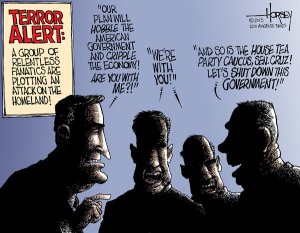 Well, it seems a shut down is eminent!
There are 233 Republicans in the House. Insiders estimate that three-quarters of them, or about 175 GOP lawmakers, are willing, and perhaps even eager, to vote for a continuing resolution that funds the government without pressing the Republican goal of defunding or delaying Obamacare.
On the other side, insiders estimate about 30 House Republicans believe strongly that Obamacare is such a far-reaching and harmful law that the GOP should do everything it can — everything — to stop it or slow it down. That includes precipitating a standoff leading to a government shutdown. “This isn’t just another bill,” Rep. Michele Bachmann, R-Minn., one of the most vocal of the 30, told me. “This isn’t load limits on turnip trucks that we’re talking about. This is … an extremely consequential bill that will impact every American, and that’s why you have such passionate opinions.”
Another 20 to 30 GOP members sympathize with that position but might be willing to compromise, except for the fact that they fear a primary challenge from the Right.
In the continuing resolution fight, it is the 30 most committed members, along with their 20-30 allies in the next-most-committed group, who are setting the House Republican agenda. The ones pushing for a fight over Obamacare, even if it leads to a shutdown, are controlling what the House does.
Which has led to the question: How can 30 Republicans beat 200 Republicans? How does that work?
Polls consistently show that Americans aren’t happy with Obamacare. They think the law will make health care more expensive, and decrease its quality. But a new survey of 1,976 registered votersfinds that only 33 percent believe that the health law should be repealed, delayed, or defunded. 29 percent believe that “Congress should make changes to improve the law,” 26 percent believe that “Congress should let the law take effect” and see what happens, and 12 percent believe that the law should be expanded. The bottom line? Voters are skeptical that Obamacare will live up to Democrats’ hype. But they also believe that it should be given a chance to succeed.
The new poll was conducted by the Morning Consult, a healthcare media company founded by Michael Ramlet. Ramlet, in evaluating the results of his survey, finds that voters are “unmoved by three months of the defund argument,” and that a majority would “blame congressional Republicans a lot for a government shutdown.”
How’s that working for Speaker Boehner? He really has to choose between his country and his tea party caucus. Many Republicans aren’t with him either. Does he really think he can keep his speakership either way?
Rep. Tom Cole (R-OK): Asked on MSNBC on Monday if a shutdown was “going to hurt the Republicans,” Cole said, “I do, but more importantly I think it’s going to hurt the American people.”
Rep. Charlie Dent (R-PA): “I’m prepared to vote for a clean resolution tomorrow… It’s time to govern. I don’t intend to support a fool’s errand at this point.”
Rep. Rodney Frelinghuysen (R-NJ): “Obamacare is definitely not ready for prime time. But I do not want the government to shut down. I think after voting against it some 40 times, we have represented our constituents and made our point.”
Rep. Chris Gibson (R-NY): “From my perspective, the desired end state remains the same — a delay of the Affordable Care Act/Obamacare and a temporary lifting of the sequester — both to January 2015… However, we need a successful strategy to get that implemented, and this approach will not do it.”
Rep. Michael Grimm (R-NY): “The circus created the past few days isn’t reflective of mainstream Republicans — it projects an image of not being reasonable. The vast majority of Republicans are pretty level-headed and are here to govern.”
Rep. Richard Hanna (R-NY): “[A]s a lifelong and consistent supporter of women’s rights and health care, I do not support addressing divisive social issues such as access to birth control on a last-minute continuing resolution.’’
Rep. Peter King (R-NY): “We should not be closing down the government under any circumstances… That doesn’t work, it’s wrong, and, you know, Obamacare passed. We have to try to defund it, we have to try to find ways to repeal it. But the fact is, we shouldn’t be using it as a threat to shut down the government.”
Rep. Devin Nunes (R-CA): “We’re pretty much out of options at this point. They’re all giddy about it. You know who benefits the most here from a shutdown? The Democrats benefit and they know that.”
Rep. Tom Rooney (R-FL): “The shutdown doesn’t do anything to help our reputation as an incompetent Congress,.. People hire us not to get to this point in the first place.”
Rep. Paul Ryan (R-WI): “We have to stay on the right side of public opinion…Shutting down the government puts us on the wrong side. The fight is on the debt limit.”
Rep. Frank Wolf (R-VA): Wolf warned that his party will be blamed in the case of a shutdown. “That’s the battle that’s going on in my party. There are some that are saying, ‘shut it down! … If we shut the government down, who’s going to fund the [Veteran Affairs] Hospital? Who’s going to fund the veteran who doesn’t have a leg? Who’s going to fund the FBI who’s working on a counter-terrorism case? Who’s going to fund cancer research?”
Exactly who is behind this push besides Cruz’s ego and a few maniacs like Bachmann?
Republicans and Democrats in Congress are trading blame ahead of Tuesday’s government shutdown, but there’s another culprit in DC’s latest dysfunction whose offices are not to be found in the gilded suites of the Capitol, but in a drab, fluorescent-lit office five blocks away. There, a team of organizers, lobbyists and 20-something social media specialists are harnessing the power of the Tea Party to drive a wrench into Congress’ gears. Heritage Action for America, the political arm of the once esteemed Heritage Foundation, has been working day and night for years to bring about just the crisis now gripping DC.
Since its founding in 2010, Heritage Action has worked aggressively to influence lawmakers on issues from immigration to agriculture to the budget. It uses a three-pronged strategy to twist arms on Capitol Hill: lobbying members on hot-button issues, ranking them publicly on how they vote, and getting word out far and wide when lawmakers buck the conservative line. That combination—unparalleled in either party—has given Heritage the ammo to take on the leadership of its own party, widening the gap between the conservative grassroots and their leaders in Congress. As Heritage’s clout accumulates, the group’s divisive style offers a window into the new way of doing business in Washington, where, thanks to redistricting, lawmakers are more worried about primary challengers than the opposition
I guess this is the revenge of outcasts like Demint and Grover Norquist who seem like prime candidates for the sociopath of the month club.
How long do you think this will last?
Monday Reads
Posted: September 30, 2013 Filed under: morning reads, U.S. Economy, U.S. Politics | Tags: Affordable Health Care Act, conscience clause 67 Comments Good Morning!
Most of the news today is about the looming shutdown of the Federal Government. Our government is truly dysfunctional. The states have gerrymandered us into a Congress that doesn’t care about the country at all. They just take care of their base and their personal pork. We’ve also got a krewe of congress critterz that’s about as dumb as they come. Why are some of them gleeful over the idea of a shutdown? What do they think they have to gain and why would they hurt so many people?
Why have House Republicans pursued their effort to defund, and now to delay, Obamacare so relentlessly, even though they have almost zero chance of success in the face of a rapidly-approaching deadline for shutting down the government? And why have they done so when many in their party have warned that a shutdown would be suicidal for the GOP?
I talked with one of the most vocal of the defund/delay advocates, Minnesota Rep. Michele Bachmann, on Friday night, as she waited to hear what path the House Republican leadership would take. It’s safe to say her views reflected those of many of her conservative colleagues, and her reasoning was this: One, Obamacare as a policy is so far-reaching, so consequential, and so damaging that members of Congress should do everything they can — everything — to stop it before it fully goes into effect. Two, lesser measures to fight Obamacare — repealing the medical device tax or making Congress purchase coverage through the exchanges without special subsidies — are just not big enough to address the problem. And three, there have been government shutdowns in the past over far less urgent reasons that did not result in doom for Republicans.
“There is a very large group of us who believe that this is it, this isn’t just another year, this isn’t just another CR fight,” Bachmann told me. “This is historic, and it’s a historic shift that’s about to happen, and if we’re going to fight, we need to fight now.”
“This isn’t just another bill,” Bachmann continued. “This isn’t load limits on turnip trucks that we’re talking about. This is consequential. And I think the reason why you’ve come to this flash point is that this is an extremely consequential bill that will impact every American, and that’s why you have such passionate opinions. And we’re not giving up and we’re not caving in that easily.”
For Bachmann and many of her colleagues, the enormity of the issue serves to highlight the problem with less extensive anti-Obamacare measures. “The Vitter Amendment isn’t going to help real people,” Bachmann told me. “It’s going to be a political move, but it’s not going to help real people. Obamacare will continue to destroy the economy. Now, repealing the medical device tax does help the economy. Here in the Beltway, we get the medical device tax issue. And in my state of Minnesota, we get the medical device tax issue. That’s our industry. And I’m all for [repealing] it, but for most Americans, that is not something that they see that they want to get.”
It’s really strange to see the apoplexy shown by Republicans when they call the American Heritage’s Dole/Chaffey Care alternative to Hillarycare some kind of socialist plot. What happens under the law if implementation is slowed down even one year? Many states, businesses, insurance companies and health care providers have already started their transition.
So what does this “compromise” actually look like? For a party that has centered their platform around reducing spending and the deficit, it’s surprisingly bad economics.
First of all, repealing the medical device tax would actually add $30 billion to the deficit. That provision, which imposes a 2.3 percent tax on medical devices, is one of the funding sources for Obamacare’s coverage expansions. Proponents say that the tax will be balanced out by the influx of new Americans entering the insurance market. But getting rid of it now without finding another way to finance health reform would simply increase health reform’s price tag.
Furthermore, delaying Obamacare’s individual mandate — a central tenet of the health law that requires everyone to purchase insurance — would have catastrophic effects. The Congressional Budget Office (CBO) projects it would end up forcing Americans to pay higher premiums for their health coverage. Healthier people would be discouraged from buying insurance, resulting in an older and sicker pool of people in the individual market and encouraging insurers to submit higher rates. The delay would ultimately hike premiums by an estimated 15 to 20 percent.
And according to the CBO, a one-year delay would leave about 11 million Americans uninsured, ultimately reducing the expected coverage gains under the health reform law by nearly 85 percent. As those uninsured Americans end up seeking care in hospitals, the cost of providing that uncompensated care will offset any costs that are achieved by delaying Obamacare’s coverage expansion. Ultimately, delaying the mandate doesn’t actually save the government any money.
As Wonkblog reports, delaying the individual mandate would have a “ripple effect” throughout the health insurance industry. That sector has been preparing for impending changes under Obamacare, and a last-minute decision to delay the law would be a huge drain on the companies that have already spent millions of dollars on advertising and outreach campaigns. “It’s just too late,” Joe Antos, a health policy researcher at the American Enterprise Institute,told Wonkblog. “Everybody who is involved, insurance companies and hospitals and any other big entity, they’re ready to go. They really can’t make any changes.”
When the Affordable Care Act was winding its way through the court system last summer, a conservative federal judge made the point that suddenly striking down health reform would create “economic chaos.” And at this point, as many of Obamacare’s consumer protections have already taken effect, the individual mandate is inextricably linked to making the health reform law work in practice. A new paper from the Urban Institute notes that delaying the individual mandate would “seriously disrupt overall implementation” of health reform.
Most folks believe that the GOP will get the blame for the shutdown.
The federal government swerved toward a shutdown on Saturday when House Republicans demanded to hold a vote to delay Obamacare by one year instead of cooperating with the Senate to pass a “clean” spending bill. It’s now practically assured that parts of the government will go dark on Tuesday for the first time in 17 years.
From a Republican point of view, there are three possible happy endings to the looming catastrophe.
Happy Ending #1: The president blinks. He’s blinked before after all—notably when he agreed to sequestration in 2011—and who knows? He might blink again.
Problem with Happy Ending #1: This time, though, “blinking” means blowing up the president’s most important legacy: his health-care plan. That’s more than a blink. He might as well hand in his resignation after that.
Happy Ending #2: The country blames the Democrats for the shutdown. After all, the GOP is only asking for the president to negotiate. It’s the president who refuses to yield.
Problem with Happy Ending #2: Republicans actually shut down the government in 1995. They took the country to the brink of debt default in 2011. Their caucus is reacting to this shutdown with enthusiasm, not regret. It’s going to be hard to sell the claim that it’s the Democrats who brought about this latest outcome when Republicans come out of caucus looking so happy about it.
Happy Ending #3: Even if the president does not blink, and even if Democrats don’t get blamed, perhaps Republican activists will be so motivated and mobilized by the shutdown that their excitement will loft the party to big wins in the 2014 races.
Problem with Happy Ending #3: Because Happy Endings 1 and 2 look so unlikely, the shutdown is likely to end in a Republican retreat. Party activists will be demotivated—and may waste their energy recriminating against their own leadership rather than organizing to fight Democrats.
 There is also the usual Republican slap to women included in the budget.
Typical of the privileged, entitled spoiled brats that they collectively are, the House Republicans threw everything but the kitchen sink into their government funding bill. The bill, which purportedly was to stave off a government shutdown, was instead a big, fat sloppy kiss to all of the special interests that want to curtail average Americans’ lives while enriching the top one percent even further.
Telling, perhaps, that they were unable to do it without drinking heavily enough to be noticeable from the gallery. Putzes.
The “funding” bill included a clause that for the puritanical and/or science ignorant Republicans, may be the king of unintended consequences: delaying funding for contraceptive care under ACA:
House Republicans included a so-called “conscience clause” in the government funding billin a plan they approved early Sunday.
The House voted 231-192 on a bill that would delay much of the 2010 health care overhaul for a year. It would also repeal a tax on medical devices that helps finance the health care law. The measure would allow employers and insurers to opt out of providing health care services that they find morally or religiously objectionable. The addition reignites the debate over a portion of the health care reform law that requires most insurers to cover women’s preventative health care, including contraception.
It’s enough to make me want to nut punch a Republican member of Congress. Need I remind them once again that in addition to preventing unwanted pregnancies, contraceptives are used therapeutically as well for a host of women’s health issues? Those “family-friendly” idiots will not be satisfied until Americans see an increase of abortions (oh, wait…), an increase in people applying for federal assistance due to the forced births (oh, wait…) or a bunch of motherless children,
However, the Exchanges set up by the Affordable Healthcare Act are being set up. It’s interesting that the Republican plan to shut down the Government isn’t really shutting down Obamacare.
Many pieces of the health care law, the Affordable Care Act, aren’t tied to the annual spending bills. Much of the health law is mandatory spending — a kind of fiscal autopilot that’s not part of the annual appropriations battle that has Congress tied in knots. The mandatory components of the health law include the subsidies to help people buy private health plans as well as the expansion of Medicaid in many states. Both of those functions will be handled through the new health insurance markets or exchanges.
Because those programs are mandatory, the Department of Health and Human Services has a lot of leeway to say whether Obamacare activities can continue — and HHS officials have made clear they’re going to use it.
On Friday, the HHS quietly posted its shutdown contingency plan. The bottom line is clear: Obamacare would continue, including the health exchanges and their coordination with Medicaid. It also said Medicare coverage “will continue largely without disruption.” True, lots of HHS workers would be furloughed — but those who would be told to stay home are concentrated in agencies that are not driving the launch of the health law.
HHS says its plan is consistent with legal advice that allows activities that “do not rely on annual appropriations, and activities that involve the safety of human life and protection of property” to keep running even if much of the government shuts down. And that means the staff that carry out mandatory programs like those in the health law can keep working — even if their positions are funded through the annual spending bills
I’ll let you know how the process is going to work down here in one of the states that’s fighting the law every way it can. I was told Friday that the adjunct health care plan that I’ve had for the past few years doesn’t meet the minimum standards for the Act and won’t be offered. I am going to head to the exchange next week and find out what my options are going to be. I’m glad to be out of my subpar health insurance plan, but wondering if the federal exchange is going to have many choices here in a state with a hostile governor.
So, I know this was a little oriented to the one topic of the day, but I thought we needed to spend some time on it. Feel free to share your thoughts on this or any other links on any other subjects that made your reading and blogging list today!!!

 peej
peej Carissa
 bostonboomer
 dakinikat
 ecocatwoman
 jjlo
jjlo mablue2
 Mama Lopez
 peggysue22
 quixote
 skydancingguestblogger
 Mona (aka Wonk the Vote)





Recent Comments