
A little Night Humor
Posted: October 28, 2013 Filed under: open thread, The Media SUCKS 7 Comments
We frequently complain about the media’s coverage of politics here. Most of us also have websites and sources that we laugh at. Politico often brings out a number articles that cause us to groan, do frantic face palms, and complain. So,this is good.
What If POLITICO Had Covered the Civil War?Playbook, Emancipation Day Edition
….
WEST-WING MINDMELD: This shows a direct, decisive president, something that will improve Lincoln’s ability to get his agenda through Congress
FORMER GEN.-IN-CHIEF GEORGE MCCLELLAN, on MORNING JEHOSEPHAT: “Lincoln has flip-flopped once again on emancipation…. Washington politicians are doing an end run around the Constitution… I think we need less polarization and divisiveness during a civil war. A leader needs to stand up to extremists and reach out across the aisle. Lincoln has not led.” 1864 TEA LEAVES: “I am not ruling anything out, but I’m not ruling anything in.”
PLAY-BOOK FACTS OF LIFE: If the president can convince the public that he emancipated slaves simply to preserve the union, the story will blow over. If it emerges that he actually issued the proclamation because he believes involuntary bondage is an immoral affront to human dignity, we could be looking at months of hearings.
FLASHBACK: “I am not, nor have ever been in favor of bringing about in any way the social and political equality of the white and black races.” –Lincoln, IL-SEN debate, 1858
,,,
Yup. That would be about right.
Monday Reads
Posted: October 28, 2013 Filed under: morning reads 65 Comments Good morning!
So, I had a rather uneventful weekend. I spent a lot of time grading stuff for my International Finance class and getting ready for my Security Analysis Class. I am still getting used to teaching MBAs and graduate students instead of undergrads. Plus, I teach Finance now with very little Economics so I feel mercenary. I tell myself that it keeps me in the kathouse and in red wine. But, it’s difficult at times because teaching economic literacy is more of a calling to me. Finance is much more utilitarian so I try to look at it as giving some one a life skill but it’s not quite the same. I used to be appalled that undergrad students could get through high school knowing so little and now I have learned that you can get an undergrad degree and come out with bad skills too. Color me jaded. At least I am not training predators. I am training people that are just trying to survive in a world of predators.
Anyway, I did watch a few things over the weekend that helped me cope with the ordeal of reading so many cut and pastes from the internet instead of original thoughts. AMC ran White Zombie. I had never seen that. I learned how little Lugosi made for the movie and was rather shocked. I guess he was worried about loosing his career to Boris Karloff at that point and was taking all offers. Then, I spent some time with Front Line which has a special place in our hearts here since Boomer’s brother is a cinematographer there. The topic also figures predominantly in my life and JJ’s since it dealt with antibiotic resistant bacteria.
I’ve battled a MRSA (antibiotic resistant staph infection) for several years. You may remember one of them put me in the hospital and doctors were worried about me losing my eye sight. Thankfully, there’s one last drug that works for me. But, it will lose its efficacy eventually. My doctors now trust me to rush to the pharmacy and get antibiotics when it gets out of hand. I have a topical lotion that seems to control anything that looks suspicious. I really try to not use the oral antibiotics unless it doesn’t respond to the topical and it looks like I’m in trouble. Trouble means it doesn’t go away and the entire site begins to swell like a balloon even when I drain it, clean it, and douse it with the topical stuff. At that point, waiting to see the doc even is dangerous. I imagine that one day that routine won’t work.
That seems to be the message of the episode and of some eecent articles with warnings from the CDC. There are some bacteria that no longer respond to anything and that list is growing. Dr. Arjun Srinivasan of the CDC says “We’ve Reached The End of Antibiotics, Period”.
For a long time, there have been newspaper stories and covers of magazines that talked about “The end of antibiotics, question ma?” Well, now I would say you can change the title to “The end of antibiotics, period.”
We’re here. We’re in the post-antibiotic era. There are patients for whom we have no therapy, and we are literally in a position of having a patient in a bed who has an infection, something that five years ago even we could have treated, but now we can’t. …
…I wonder if you can reflect a little bit and describe how the MRSA phenomenon, this resistant bacteria, changed public awareness about the problem.
So methicillin-resistant Staphylococcus aureus, or MRSA, for a lot of people is the first time that they had really encountered one of these highly drug-resistant bacteria. …
Literally for decades it’s been something that’s been difficult to treat. There were, up until recently, limited treatment options for MRSA. There is really one antibiotic that was available to treat it.
Was it that bad? Did people die from it?
People did die from it. It caused very serious infections. … MRSA was something that if you asked any doctor or nurse about MRSA, they would tell you, “Oh, yes, it’s a very serious issue. We struggle with it in our patients, in our intensive care units,” but if you asked the average person outside of hospitals about MRSA, they probably would never have heard of it. That all changed maybe about a decade or so ago.
What changed?
We began seeing MRSA infections outside of health-care settings. …
We were seeing it in young people who were athletes, who were young football players who had serious infections, who died of these MRSA infections which had previously been limited to hospitals.
We saw outbreaks in schools. We saw outbreaks in health clubs. And what most of these people were getting was something very different from what we saw in hospitals.
I guess nearly every one in New Orleans that spent some time in the post-Katrina environment now harbors MRSA if you believe the Doctors who deal with my outbreaks. I had read about Super Bugs some years ago but it wasn’t something I kept at the front of my mind. The biggest problem now is that it’s not really a good investment for pharmaceutical companies to do research in future antibiotics because they are only one shot drugs instead of drugs used perpetually. Therefore, there is a distinct need for the Federal Government to step in and fund the research. That, of course, is not really happening in this country of course. There is also this ghoulish term of “nightmare” bacteria that sounds like something from a horror movie. The man who was interviewed by Frontline and was a major researcher for antibiotics passed away last week. This adds to the story that sounds like a human disaster in the making.
We wanted to share the sad news that John Quinn, a veteran Gram-negative researcher featured in Hunting the Nightmare Bacteria, passed away last weekend. We knew him only briefly but in that short time he made an enormous contribution to our efforts to understand the importance of this subject and why major pharmaceutical companies have been pulling out of antibiotic development.
We knew companies had been abandoning antibiotic drug development and wanted to help viewers understand what that looked like from the inside. The story of Pfizer soon became an obvious example because the company had such a long history in developing antibiotics and had, until recently, been one of the stalwarts that remained involved in seeking a cure for Gram negatives.
But finding someone who was able to talk about the company and its decision to close down its antibiotic research efforts proved more difficult than we’d anticipated. Though we reached out to many researchers and scientists who had worked at Pfizer, they were all reluctant to speak on camera about the program.
That is until we found John Quinn. Quinn was a doctor by training and had been working in academia on Gram-negative resistance before it became a major public health concern. He watched first hand as resistance grew and doctors he worked with had few options to treat patients. “I’d seen [Gram-negative bacteria] kill patients,” Quinn told us. “I had, you know, seen the drugs that we were using cause kidney failure. So I was acutely aware — personally aware, professionally aware — of the need to make progress in this space.”
As usual, I’ve already found a response that really seems to misunderstand the problem by a writer in the National Review. It really isn’t the patent issue that  thwarts the development of antibiotics by Big Pharma. It’s the fact that antibiotics should be used sparingly, rarely, and basically for one illness. The lack of ongoing cashflow to return to the original investment is the issue. Granting patent extensions isn’t going to solve this problem at all. It seems clearly to be an area that requires nationalization from an economic standpoint and the standpoint that it clearly will become a national health issue.
Before we get too upset with the evil pharmaceutical industry, remember that it can take billions to develop a new drug. And, we have restricted the patent time for the drugs they successfully develop to permit less expensive generics to be manufactured.
It seems to me that if we want new and better antibiotics–we should ensure that the financial risk taken has the potential to lead to a substantial financial gain by extending the patent life for new antibiotics an extra ten years from the time it receives formal approval. Then, maybe, drug companies will more energetically jump into the research for new antibiotics.
We could also have the NIH fund more research into antibiotics and make the results available to everyone. But that would mean making antibiotics a priority over other areas of research. I’m not sure the politics would permit such an explicit triage.
Is our political system so fraught with ideology that we can’t even deal with an oncoming plague? This is a typical economic problem of “the commons”. We’ve had an overuse and a large abuse of antibiotics. This is especially true in food production where antibiotics typically are used without cause in animals raised for food.
A big part of the trouble is that the gains from the overuse of antibiotics are private, whereas the losses are public. Problems such as these are rarely soluble without outside intervention. Ramanan Laxminarayan of Princeton University, who has been thinking for many years about how to deal with the question of resistance, suggests the answer is a mixture of incentives and scourges. Prize funds, or guaranteed-purchase arrangements for new drugs and the rapid-diagnostics systems that would allow them to be deployed appropriately, would help overcome the financial problem of antibiotics being cures, rather than just treatments. Stricter dispensing guidelines for doctors and pharmacists might help deal with the moral hazard of overtreatment.
A bit of realism would be good, too. Derrick Crook, a consultant microbiologist at Oxford, where Florey and Chain once worked, observes, “It is hard to massively restrict the use of antimicrobials when they are doing good. It is possible that the enormous use in Asia is a good thing for a short time in a given country.” That, combined with ignorance about precisely how much the unnecessary use of antibiotics contributes to increasing resistance, makes restriction highly controversial.
So, wow. I took a lot more time on this subject than I thought I would. Here’s some other links you may want to look at today!
Charles M Blow writes about Billionaires’ Row and Welfare Lines
Forbes’s list of the world’s billionaires has added more than 200 names since 2012 and is now at 1,426. The United States once again leads the list, with 442 billionaires.
It’s a great time to be a rich person in America. The rich are raking it in during this recovery.
But in the shadow of their towering wealth exists a much less rosy recovery, where people are hurting and the pain grows.
This is the slowest post-recession jobs recovery since World War II. The unemployment rate is falling, but for the wrong reason: an increasing number of people may simply be giving up on finding a job. The labor force participation rate — the percentage of people over 16 who either have a job or are actively searching for one — fell in August to its lowest rate in 35 years.
David Gregory spends his Sunday Show concern-trolling Obama Care.
But David Gregory has never come across a Republican talking point that he didn’t love, embrace and swallow up whole to faithfully regurgitate to the masses. So he dutifully confronts Blue Cross and Blue Shield of Florida CEO Patrick Geraghty about the news that 300,000 Floridians have found their policies dropped because they fall below the minimum standards of coverage set by Obamacare. Problem was, Geraghty wasn’t going to playGregory’s gotcha game with people’s healthcare:
“We’re not cutting people,” Geraghty said. “We’re actually transitioning people. What we’ve been doing is informing folks that their plan doesn’t meet the test of the essential health benefits; therefore, they have a choice of many options that we make available through the exchange. And, in fact, with subsidy, many people will be getting better plans at a lesser cost. This really is a transition. In fact, the 300,000 figure is the entire year. So it’s really 40,000 people for January 1, and we’re walking them through that transition.”
Now, it’s absolutely true that there will be a fraction of people who find that their costs have gone up, the specific number and amount is still up for debate. And if they don’t qualify for subsidies, that will mean a higher out-of-pocket cost, at least in the short term. However, short-term partisan gains notwithstanding, the program will factor in long-term the inclusion of healthy, young people on the exchanges, which will help mitigate the ailing people who rushed for the initial coverage. Specifically, the re-insurance tax is being levied for the first three years is intended to help smooth that transition to allow for the long-term sustainability of the program.
More than 60 women took to driving cars to defy the ban on women drivers in Saudi Arabia.
Brushing off threats from the government, more than 60 Saudi women got behind the wheel on Saturday in a bold protest of the nation’s de facto ban on women driving.
Sara Hussein, a Saudi woman involved in the effort, drew parallels to the U.S. civil rights movement: “Think back in history — Rosa Parks was the only person who sat down on the bus, wasn’t she? And then it started to happen gradually. It does have to start with the few brave people who are willing to risk whatever there is to risk.”
Many women documented the act of civil disobedience on social media, even posting videos to YouTube. The most popular video, which has already been viewed nearly 100,000 times, was posted by May al-Sawyan, a 32-year-old economics researcher. She drove to the grocery store.
So, that’s it for me this morning! What’s on your reading and bloging list today
RIP Lou Reed
Posted: October 27, 2013 Filed under: open thread | Tags: Lou Reed 4 Comments So, I’m smack in the middle of the generation that was really influenced by Lou Reed and the Velvet Underground so I just couldn’t resist doing an open thread here. They’ve been using this song for a great PS4 ad recently. I keep seeing it on SyFy and now it seems really ghoulish. It’s only fitting he died on a Sunday Morning and right before Halloween.
From Rolling Stone: 20 Essential Lou Reed Tracks.
With the Velvet Underground in the late Sixties, Reed fused street-level urgency with elements of European avant-garde music, marrying beauty and noise, while bringing a whole new lyrical honesty to rock & roll poetry. As a restlessly inventive solo artist, from the Seventies into the 2010s, he was chameleonic, thorny and unpredictable, challenging his fans at every turn. Glam, punk and alternative rock are all unthinkable without his revelatory example. “One chord is fine,” he once said, alluding to his bare-bones guitar style. “Two chords are pushing it. Three chords and you’re into jazz.”
Lewis Allan “Lou” Reed was born in Brooklyn, in 1942. A fan of doo-wop and early rock & roll (he movingly inducted Dion into the Rock and Roll Hall of Fame in 1989), Reed also took formative inspiration during his studies at Syracuse University with the poet Delmore Schwartz. After college, he worked as a staff songwriter for the novelty label Pickwick Records (where he had a minor hit in 1964 with a dance-song parody called “The Ostrich”). In the mid-Sixties, Reed befriended Welsh musician John Cale, a classically trained violist who had performed with groundbreaking minimalist composer La Monte Young. Reed and Cale formed a band called the Primitives, then changed their name to the Warlocks. After meeting guitarist Sterling Morrison and drummer Maureen Tucker, they became the Velvet Underground. With a stark sound and ominous look, the band caught the attention of Andy Warhol, who incorporated the Velvets into his Exploding Plastic Inevitable. “Andy would show his movies on us,” Reed said. “We wore black so you could see the movie. But we were all wearing black anyway.”
Maybe he’s taken the ultimate Walk on the Wild Side. Maybe he’s on a Satellite of Love. Who knows? Just know he was the epitome of cool in my misspent youth with Harry, Mark, and John.
Creating a Shadow Reality
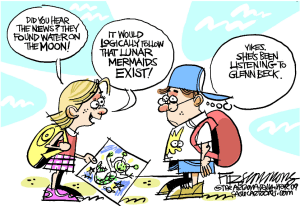
Posted: October 26, 2013 Filed under: John Birch Society in Charge, Republican Tax Fetishists 12 Comments There is a rich history of Orwellian realities in fiction. One of my recent favorite reads is 1Q84 which borrows heavily from Orwell–including the title–to create an alternate Tokyo. You figure out that you’re in the alternate universe when a character looks into the sky and sees a second moon. Haruki Murakami’s book is based on the idea that you can step through some kind of portal and wind up in the world with the second moon by making one fateful decision. In the modern US, you enter the world of two moons by consuming anything come from the Murdoch Empire or the Koch endowments or any other number of billionaires that can afford to place a small green moon in the sky next to the usual one. It’s amazing to me how many politicians see that second moon. Bill Moyers and and Michael Winship see these as The Lies that will Kill America.
Here in Manhattan the other day, you couldn’t miss it — the big bold headline across the front page of the tabloid New York Post, screaming one of those sick, slick lies that are a trademark of Rupert Murdoch’s right-wing media empire. There was Uncle Sam, brandishing a revolver and wearing a burglar’s mask. “UNCLE SCAM,” the headline shouted. “US robs bank of $13 billion.”
Say what? Pure whitewash, and Murdoch’s minions know it. That $13 billion dollars is the settlement JPMorgan Chase, the country’s biggest bank, is negotiating with the government to settle its own rip-off of American homeowners and investors — those shady practices that five years ago helped trigger the financial meltdown, including manipulating mortgages and sending millions of Americans into bankruptcy or foreclosure. If anybody’s been robbed it’s not JPMorgan Chase, which can absorb the loss and probably take a tax write-off for at least part of it. No, it’s the American public. In addition to financial heartache we still have been denied the satisfaction of seeing jail time for any of the banksters who put our feet in cement and pushed us off the cliff.
Moyers details the number of Murdoch outlets that echo and repeat the lies.
Over the last few days, The Wall Street Journal, both Bible and supplicant of high finance as well as one of Murdoch’s more reputable publications — at least in its reporting — echoed the “UNCLE SCAM” indignation of the more lowbrow Post. The government just wants “to appease their left-wing populist allies,” its editorial writers raged, with a “political shakedown and wealth-redistribution scheme.” Perhaps, the paper suggested, the White House will distribute some of the JPMorgan Chase penalty to consumers and advocacy groups and “have the checks arrive in swing congressional districts right before the 2014 election.” We can hear the closet Bolsheviks panting for their handouts now and getting ready to use their phony ID’s to stuff the box on Election Day with multiple illegal ballots.
Such fantasies are all part of the Murdoch News Corp. pattern, an unending flow of falsehood and phony populism that in reality serves only the wealthy elite. Fox News is its ministry of misinformation, the fake jewel of the News Corp. crown, a 24/7 purveyor of flimflam and the occasional selective truth. Look at the pounding they’ve given Obama’s healthcare reform right from the very start, whether the non-existent death panels or claims that it would cause the highest tax increase in history.
The Murdoch media empire is perhaps the most obvious example of billionaires buying their own reality. However, it’s not the sole example. There are a number of billionaires each with their addition to the alternative reality of the world with the second, small, green moon. Other than George Soros, there have been very few taking up the science and fact based reality where there is only one moon, climate change, and a financial oligarchy run wild. That may be changing.
There is no shortage of billionaires — the Koch brothers, Carl Icahn, Dan Loeb and, yes, Mike Bloomberg, to name a handful — who are willing to use their vast wealth to push a particular political agenda or to advocate for a specific social reform. That’s hardly a revelation.
Then there’s Tom Steyer, a former Goldman Sachs Group Inc. arbitrager who was mentored by Robert Rubin and eventually formed the San Francisco hedge fund Farallon Capital Management. Since then, Steyer has made a bloody fortune. He has never spoken publicly about how he raked it in at Farallon. Nor has he talked on the record about his years at Goldman. (He didn’t respond to my interview requests when I was writing a book about Goldman in 2011.)
But now that he has departed Farallon to become a political activist — some say he is considering a run for the U.S. Senate or the governorship of California — he is everywhere. Last month, the New Yorker’s Ryan Lizzawrote a lengthy profile of Steyer. This month, Bloomberg Markets magazine explained why Steyer has teamed up with Henry Paulson, like Rubin a former Treasury secretary and Goldman chairman, as well as with Bloomberg, the outgoing New York City mayor and the founder and majority owner of Bloomberg LP, the parent of Bloomberg News, to commission a study about the economic consequences of failing to curb carbon emissions.
On Oct. 1, at a benefit for the North Country School and Camp Treetops in New York’s Adirondack Mountains, Steyer and Bill McKibben, his fellow environmental activist, led a paneldiscussion on their efforts to defeat the Keystone XL pipeline.
You may recall recently that the CEO of Starbucks decided that his outlets were not going to be places open to concealed weapon carrying.
In the end, the Seattle-based coffee giant says all it wants to do is sell coffee.
But increasingly, it has been dragged into the fracas between open-carry gun activists who want to be able to keep taking their firearms with them when they buy their morning lattes and gun-control advocates who’d rather the company banned such behavior.
Starbucks struck a compromise when itannounced this week that guns were no longer welcome in its stores, but stopped short of an outright ban.
The company will run an ad in some major newspapers Thursday, an open letter from CEO Howard Schultz, explaining that his company is being used as a political stage and that guns in his stores make his customers uneasy.
There has also been a number of CEOs that are standing firm in the face of anti-GLBT crusaders. However, none of this is quite the same as owning news and media outlets and funding think tanks that come up with conclusions at odds with academic studies. It’s also not the same as buying tons of air time to run ads made to creep young people out of looking into Health Care Insurance via the ACA exchanges. There’s also targeted campaigns aimed at various states.
Conservative advocates funded by the billionaire industrialist brothers Charles and David Koch have launched a massive campaign pressuring states to deny health care coverage to lower income Americans through the Medicaid expansion contained in the Affordable Care Act.
The effort, orchestrated by the group Americans for Prosperity, is targeting lawmakers in Virginia tasked with deciding whether the state should accept federal dollars to provide insurance to individuals and families below 133 percent of the federal poverty line ($31,321 in income for a family of four). Volunteers with the organization are distributing flyers through door-to-door canvassing, attending committee hearings, and according to one lawmaker who has become a target of the campaign, intimidating constituents.
As many as 400,000 Virginians could qualify for coverage if the state expands the Medicaid program, but AFP is warning Virginians that the system “will cost Virginia taxpayers billions,” require “future tax hikes and budget cuts to vital services like schools, police and fire departments,” undermine the “doctor-patient relationship,” increase wait times and even endanger lives. “Medicaid patients are almost twice as likely to die during surgery than individuals with private insurance,” the group writes on its website.
It’s difficult to imagine that this could get worse, but there is a possibility it will even if a few billionaires on the other side of the political spectrum try to provide an offset. A new SCOTUS case that could remove limits to campaign contributions might create even more havoc.
At issue in McCutcheon v. Federal Election Commission (12-536) are aggregate contribution limits that restrict the total amount of money an individual can give a candidate and committees during a two-year election cycle.
Supporters of the limits say they are necessary to prevent crafty contributors from circumventing other campaign finance restrictions to funnel huge amounts of money from one donor to one candidate.
Opponents of the limits say they are unnecessary and lack any constitutional justification in the wake of the high court’s Citizens United decision.
The 5-4 opinion in Citizens United v. FEC declared that corporations and unions have a First Amendment rightto spend unlimited amounts of money on independent issue advertisements during election season.
Certainly, we have seen some push back recently to billionaire activists who are funding alternative realities. The blow back to “Fix the Debt” and Pete Peterson who seeks to end Social Security and Medicare as we know it comes to mind. But, it’s hard to keep up with all of them. We need to keep a keen eye out for the second green moon if we are to protect our democracy, our country, our economy, and our hard-earned entitlement programs.
Saturday Reads: Obama’s “Grand Bargain” Rears Its Ugly Head Again, and Other News
Posted: October 26, 2013 Filed under: Barack Obama, Medicaid, Medicare, morning reads, seniors, Social Security, U.S. Economy, U.S. Politics | Tags: "grand bargain", American Red Cross, baby girl names, demon possession, Drew Brees, entitlement cuts, Eric Schneiderman, Fox News, Gene Sperling, Giovanni Graziano, Hurricane Sandy, Joan McCarter, Joshua Green, religion, Shepard Smith 28 Comments
Good Morning!!
Just in time for Halloween, Obama’s nightmare “Grand Bargain” once again rears its ugly head. Yesterday morning Bloomberg’s Joshua Green followed a hunch and attended a briefing by the President’s top economic adviser (who is not an economist). According to Green, Sperling told Democrats “they’ll have to swallow entitlement cuts.”
In his usual elliptical and prolix way, Sperling seemed to be laying out the contours of a bargain with Republicans that’s quite a bit different that what most Democrats seem prepared to accept. What stood out to me was how he kept winding back around to the importance of entitlement cuts as part of a deal, as if he were laying the groundwork to blunt liberal anger. Right now, the official Democratic position is that they’ll accept entitlement cuts only in exchange for new revenue—something most Republicans reject. If Sperling mentioned revenue at all, I missed it.
But he dwelt at length—and with some passion—on the need for more stimulus, though he avoided using that dreaded word. He seemed to hint at a budget deal that would trade near-term “investment” (the preferred euphemism for “stimulus’) for long-term entitlement reform. That would be an important shift and one that would certainly upset many Democrats.
Here’s some of what Sperling had to say. He led off with the importance of entitlement cuts. (All emphasis is mine):
“Sometimes here [in Washington] we start to think that the end goal of our public policy is to hit a particular budget or spending or revenue metric—as if those are the goals in and of itself. But it’s important to remember that each of these metrics … are means to larger goals. … Right now, I think there is among a lot of people a consensus as to what the ingredients of a pro-growth fiscal policy are. It would be a fiscal policy that—yes—did give more confidence in the long run that we have a path on entitlement spending and revenues that gives confidence in our long-term fiscal position and that we’re not pushing off unbearable burdens to the next generation. That is very important.”
After Green’s article was posted, White House spokesperson Amy Brundage tried to minimize the talk of cuts in the safety net in the following e-mail:
“Gene was reiterating what our position has been all along: that any big budget deal is going to have to include significant revenues if Republicans insist on entitlement reforms. And any budget deal needs to have first and foremost the goal of creating good jobs for middle class families and growing the economy—that’s our north star in any budget deal, big or small.”
Uh huh. They know Americans are paying attention to the constant threat of cuts in Social Security, Medicare, and Medicaid. We need to stay vigilant and keep pushing back hard.
At Daily Kos, Joan McCarter responded: No, White House advisor Gene Sperling, entitlement cuts are not necessary.
You know what would be a really, really crappy idea? Making cuts to programs that are keeping millions from poverty in order to make a bad economy marginally better. But that’s what President Obama’s top economic advisor—Gene Sperling, director of the White House’s National Economic Council—is telling Democrats they’ll have to swallow….
Yeah, that would upset many Democrats. It would upset a helluva lot of voters, too. Millions and millions of them who have every reason right now to vote against Republicans. It would probably also not go over too well with the next generation who’s going to be far less impacted by the national debt than by having no hope of a secure retirement because a handful of austerity fetishists sold them up the river when they were young.
Sperling is saying that this will have to be done because “we still need to give this recovery more momentum.” Because of course the answer to the recovery is sacrificing some old people. By all means, get their skin in the game. They maybe have an inch or two of skin to spare.
Here’s an article at The Atlantic that Obama and Sperling should read: Raising the Medicare Age: A Popular Idea With Shockingly Few Benefits
Increasing the Medicare age would barely save the government any money, while increasing healthcare spending overall by keeping seniors in less-efficient private insurance (if they even have it). Other than that, Mrs. Lincoln, the policy is fine.
It may seem obvious that raising the Medicare age should save money. After all, the projected rise of the long-term debt is mostly about the projected rise of federal health-care spending. If we raise the Medicare age, Washington can wait longer to pay for seniors’ health care, which means they’ll pay less, overall.
Any time there’s any chance for any kind of budget bargain, “grand” or otherwise, the discussion inside the Beltway inevitably turns to hiking the Medicare age. (Call it Peterson’s Law: As a fiscal debate grows longer, the probability of a CEO proposing a higher Social Security and Medicare age approaches one). Right on cue, this got trial-ballooned during the debt ceiling talks in 2011, and then again during the fiscal cliff talks in 2012. Professional deficit hawks think of raising the Medicare age as a sign of seriousness. It’s not so much about the money it saves as the message it supposedly sends markets: that the debt will be fixed.
Except it’s all a pack of lies. Read all about it at the link.
It’s been a year since Hurricane Sandy hit the East Coast and caused so much havoc that it was “the second-costliest hurricane in United States history.” In July 2013, it came out that four charities had been holding back millions in donations that were collected specifically for Sandy relief. Now NY is forcing them to cough up some of the money. From the NY Daily News:
Four charities that had been under fire for sitting on millions of dollars of Hurricane Sandy relief funds have agreed to pony up $10 million to aid victims of the storm.
The charities — including the American Red Cross and a fund created by New Orleans Saints quarterback Drew Brees — reached an agreement with state Attorney General Eric Schneiderman. The deal came after revelations in July that 40% of the $575 million in Sandy aid collected by 90 charities had been disbursed within six months of the storm.
“We have been dogged about making sure that when they raise money and tell the world they are going to spend it on Sandy recovery, they in fact spend it on Sandy recovery,” Schneiderman said during an appearance Thursday in hard-hit Long Beach, L.I.
Brees’ charity had seriously dropped the ball, having received a single $300,000 donation but only allocating $75,000 of it, officials said.
Under the agreement with Schneiderman, the Brees Dream Foundation agreed to disperse the remaining $225,000 by October 2014, the second anniversary of the storm.
In less serious news–it IS Saturday after all, Gawker has learned that Fox News’ Shepard Smith began carrying on an office romance with a young producer at Fox, Giovanni “Gio” Graziano. Apparently, the two have been seen together all over Manhattan.
Gawker has learned that Smith is dating a 26-year-old Penn State grad and Fox Business producer named Giovanni “Gio” Graziano. According to multiple sources with knowledge of their relationship, the couple met sometime after Graziano started working at Fox Report in October 2011 as a production assistant. He’s the man with whom Smith frequents Bathtub Gin.
“Yes, that’s Shepard’s boyfriend,” Katya Minskova, the Bathtub Gin waitress Smith berated in March, confirmed to Gawker when shown a photo of Graziano. Another source who had seen them together at the Chelsea speakeasy confirmed Graziano’s identity as well. Both sources say they saw Graziano and Smith together at the bar on multiple occasions, and that they appeared to be romantically involved.
While Smith and Graziano’s boss Roger Ailes, a notorious homophobe, was apparently kept in the dark about the relationship—“higher ups had no idea,” a source close to Graziano said—the pair doesn’t appear to have gone to great lengths to keep the workplace romance from their co-workers.
Shep Smith arranged for Graziano to be transferred to Fox Business a year ago, so the two wouldn’t be directly working together. Now it’s not clear if Graziano is even working at Fox anymore.
Graziano’s current status at Fox is unclear. His LinkedIn profile indicates that he is currently employed at Fox Business (after three years as a production assistant at Fox News, including one year at Smith’s show). But the source close to Graziano claimed that he abruptly left Fox in mid-July. Graziano “dropped off the planet, cut off all his friends, to be with Shep,” the source said. “His former work friends are clueless about his current whereabouts.”
Very interesting . . .
I noticed this story at The Atlantic a few days ago, and saved it for today. Go to the link to check out this GIF of most popular baby girl names from 1960 to the present, based on data compiled by the Social Security Administration. Rebecca Rosen writes:
My friend Judy used to always say that whenever she met another Judy, she knew exactly how old that Judy was—to the day.
Now that level of precision might be a bit of a stretch, but, as the above map wonderfully shows, there’s good reason for that line of thinking. The most popular baby girl names in the United States are flashes in the pan—each one appearing on the map briefly, before being swept out by an up-and-comer.
The map was built in Adobe Illustrator by Deadspin‘s Reuben Fischer-Baum using data from the Social Security Administration. “Color palette,” Fischer-Baum wrote to me over email, “has to be credited to Stephen Few, from his excellent data viz book Show Me The Numbers.” Earlier drafts gave each name a unique color, he says, but in the end “it was a lot cleaner and more interesting to limit the palette to just the most popular name for any given year, and put the rest in grayscale so you could see how the different ‘eras’ of top names progressed.”
Over at Jezebel, Fischer-Baum describes the picture that emerges:
Baby naming generally follows a consistent cycle: A name springs up in some region of the U.S.—”Ashley” in the South, “Emily” in the Northeast—sweeps over the country, and falls out of favor nearly as quickly. The big exception to these baby booms and busts is “Jennifer”, which absolutely dominates America for a decade-and-a-half. If you’re named Jennifer and you were born between 1970 and 1984, don’t worry! I’m sure you have a totally cool, unique middle name.
Finally, here’s a really scary story for you from Talk to Action: A Majority of Americans 18-29 Years Old Now Believe in Demon Possession, Shows Survey.
Are Americans becoming less religious? While church affiliation is probably declining, don’t expect the atheist revolution anytime soon:
Over one half (63 percent, to be exact) of young Americans 18-29 years old now believe in the notion that invisible, non-corporeal entities called “demons” can take partial or total control of human beings, revealed an October 2012Public Policy Polling survey that also showed this belief isn’t declining among the American population generally; it’s growing.
Please read the whole creepy article at the link. It will scare you silly!

 peej
peej Carissa
 bostonboomer
 dakinikat
 ecocatwoman
 jjlo
jjlo mablue2
 Mama Lopez
 peggysue22
 quixote
 skydancingguestblogger
 Mona (aka Wonk the Vote)





Recent Comments