
Thursday Reads: Psychological Approaches to the Current Political Situation
Posted: October 10, 2013 Filed under: morning reads, U.S. Economy, U.S. Politics | Tags: behavioral economics, City Lights Bookstore, Harvard Bookstore, psychological studies, psychology, sociology 102 Comments
Harvard Bookstore, Cambridge, MA
Good Morning!
Today I’m going to focus on some psychological studies and psychological ideas that relate to the news of the day.
A recent study by two social psychologists at The New School in NYC, found that reading literary fiction improves Theory of Mind, or the “ability to infer and understand other people’s thoughts and emotions” as well as the “capacity for empathy.”
From Scientific American:
Emanuele Castano, a social psychologist, along with PhD candidate David Kidd conducted five studies in which they divided a varying number of participants (ranging from 86 to 356) and gave them different reading assignments: excerpts from genre (or popular) fiction, literary fiction, nonfiction or nothing. After they finished the excerpts the participants took a test that measured their ability to infer and understand other people’s thoughts and emotions. The researchers found, to their surprise, a significant difference between the literary- and genre-fiction readers.
When study participants read non-fiction or nothing, their results were unimpressive. When they read excerpts of genre fiction, such as Danielle Steel’s The Sins of the Mother, their test results were dually insignificant. However, when they read literary fiction, such as The Round House by Louise Erdrich, their test results improved markedly—and, by implication, so did their capacity for empathy. The study was published October 4 in Science….
The results suggest that reading fiction is a valuable socializing influence. The study data couldinform debates over how much fiction should be included in educational curricula and whether reading programs should be implemented in prisons, where reading literary fiction might improve inmates’ social functioning and empathy. Castano also hopes the finding will encourage autistic people to engage in more literary fiction, in the hope it could improve their ability to empathize without the side effects of medication.
There’s a little more detail on the study at the Guardian books blog:
“What great writers do is to turn you into the writer. In literary fiction, the incompleteness of the characters turns your mind to trying to understand the minds of others,” said Kidd.
Kidd and Castano, who have published their paper in Science, make a similar distinction between “writerly” writing and “readerly” writing to that made by Roland Barthes in his book on literary theory, The Pleasure of the Text. Mindful of the difficulties of determining what is literary fiction and what is not, certain of the literary extracts were chosen from the PEN/O Henry prize 2012 winners’ anthology and the US National book awards finalists.
“Some writing is what you call ‘writerly’, you fill in the gaps and participate, and some is ‘readerly’, and you’re entertained. We tend to see ‘readerly’ more in genre fiction like adventure, romance and thrillers, where the author dictates your experience as a reader. Literary [writerly] fiction lets you go into a new environment and you have to find your own way,” Kidd said.
As the authors admit, one problem with this study is determining what is “literary fiction” and what is “genre fiction.” In some cases, there is quite a bit of crossover in the selections they used. For example, they classify Louise Erdrich’s The Round House as “literary,” and Gillian Flynn’s Gone Girl, as “genre” fiction. But The Round House has characteristics of a “thriller,” in that its subject is crime; and Flynn is a fine writer, and Gone Girl is in many ways a “writerly” work with a heavy focus on characters’ thinking processes and internal dialogues.
The Guardian quotes a psychologist who objects to Kidd and Castano’s use of Theory of Mind tests to measure the effects of reading different types of fiction.
Philip Davies, a professor of psychological sciences at Liverpool University, whose work with the Reader Organisation connects prisoners with literature, said they were “a bit odd”.
“Testing people’s ability to read faces is a bit odd. The thing about novels is that they give you a view of an inner world that’s not on show. Often what you learn from novels is to be a bit baffled … a novel tells you not to judge,” Davies said.
“In Great Expectations, Pip is embarrassed by Joe, because he’s crude and Pip is on the way up. Reading it, you ask yourself, what is it like to be Pip and what’s it like to be Joe? Would I behave better than Pip in his situation? It’s the spaces which emerge between the two characters where empathy occurs.”
Nevertheless, it’s an interesting study. Now if we could only get the Tea Party folks and super-rich Wall Street types to read more literary fiction!

Harvard Bookstore, Harvard Square
The results of another social psychological study, this one at Duke University, showed that people with “extreme” political views have a sense of superiority over people with different views. From Psych Central:
Duke University investigators examined whether one end of the American political spectrum believes more strongly than the other in the superiority of its principles and positions.
They found both sides have elements of “belief superiority,” depending on the issue.
When asked about nine hot-button issues, conservatives feel most superior about their views on voter identification laws, taxes and affirmative action. Liberals feel most superior about their views on government aid for the needy, torture and not basing laws on religion.
The study is found in the online edition of Psychological Science.
Investigators questioned 527 adults, (289 men, 238 women), ages 18-67, about the issues. They then examined whether those who endorse the extremes of conservative and liberal viewpoints demonstrate greater belief superiority than those who hold moderate views.
The study asked participants to not only report their attitudes on the nine topics, but also how superior they feel about their viewpoint for each issue.
According to Diana Reese at the Washington Post,
The study was inspired by the 2012 presidential election campaign. “We were looking at things like comments on blogs and pundits and politicians on TV,” Dr. Kaitlin Toner said in a phone interview. “It seemed like there were a lot of people who felt very certain that their views were correct but they contradicted one another and there’s no way that everyone could be 100 percent correct all the time.” Toner, the lead author on the study, did the research while a graduate student at Duke….
Don’t confuse belief superiority with dogmatism, though. The latter is “a personality trait,” Toner explained. “It’s a measure of inflexibility….You’re holding a belief rigidly and won’t change.”
In other words, you can hold “superior” beliefs that you’re right and the rest of the world is wrong about a particular issue, but still be able to change your mind, unless you’re dogmatic about your viewpoint.
Previous research has shown that conservatives tend to be more dogmatic, and Toner said their study found the same results, with dogmatism increasing as views moved to the right of the political spectrum.
Another social psychologist from Duke University has a post at HuffPo called The Psychology of Being Online, in which he discusses several studies of the ways in which people react to being in virtual world. You can check them out at the link.

City Lights Bookstore, San Francisco, CA
Here’s a fascinating article by Justin Fox at the Harvard Business Review. It’s based on behavioral economics–a sort of combination of economic and psychological theories. Fox attempts to explain our current political/economic impasse using game theory. You should read the whole thing, but here an excerpt:
Some portray it as a Manichean struggle between good and evil. Warren Buffett says it’s “extreme idiocy.” I’d like to recommend another way of looking at the government shutdown and the looming battle over the debt ceiling in Washington. It’s a game, played by flawed-but-not-crazy human beings under confusing circumstances. In other words, it’s an interaction among “agents” who “base their decisions on limited information about actions of other agents in the recent past, and they do not always optimize.”
That quote is from economist H. Peyton Young’s “The Evolution of Conventions,” one of several works of game theory I plowed my way through this week in an attempt to find a way to think about the government shutdown and looming debt ceiling fight that didn’t make me want to bang my head against a wall. My reading made the dynamics at work in Congress and at the White House a bit clearer — and thus slightly less maddening, if not less ominous.
The debt-limit game
There are lots of different games being played in Washington at the moment, but the main one I have in mind pits the Democratic White House and Senate against the Republican House of Representatives over the federal budget. The deadlocked players have already landed us in a partial government shutdown, but it’s the 18th since 1976 and thus really not that big a deal. The far bigger stakes involve the federal borrowing limit that is due to be breached in a couple of weeks if Congress doesn’t approve an increase. Without further borrowing, much higher taxes, or draconian spending cuts — none of which may be possible or even legal on short notice — the government might not be able to service its existing debts, leading to a default. Congress has never allowed this to happen, so the consequences are unknowable, but they could be really bad.
Now go read the rest if you’re interested, and see what you think.
Here’s another interesting article that combines economic and psychological approaches by Douglas T. Kenrick of Psychology Today: Cruzonomics: The Problem of Free Market Psychology,
Senator Ted Cruz is a fan of the classic model of economic decision-making: sometimes called the Rational Man* view. On this view, every one of your decisions is designed to maximize “utility” – which translates loosely into personal satisfaction. If it feels good now, or will make you feel good later, choose it! Advocates of this position believe that we are, in general, pretty facile at processing information, and at coming to shrewd self-serving decisions. If you read the book Freakonomics, the authors explain how even seemingly senseless decisions, like changing one’s occupation from computer technician to prostitute, or living at home if you are a drug dealer, are well explained by economic incentive structures. We are all, on this view, continuously operating like the high-roller in the movie Wall Street, who, while considering a shady deal, asks: “What’s in it for moi?”
Ask NOT what you can do for your country…
On this view, selfishness is not a bad thing. On the contrary, it is a virtue. The intellectual patron saint of free-market economics is Adam Smith, who argued that an “invisible hand” moves us toward mutually beneficial arrangements when everyone pursues his self-interest. For example, if consumers freely compare different fruit vendors at the market place, they will choose the one who charges the lowest price, but the price will not fall below the farmer’s costs of production, or he will go out of business.
But there are a few problems with the Rational Man view. One is that people often fail to act in ways that economists regard as perfectly rational. For example, there is a laboratory game called the Ultimatum Game. Imagine that an experimenter hands you $100 and instructs you to divide it between yourself and a stranger in the next room. You can divide it any way you want, but there is one stipulation: If the bloke in the next room doesn’t like your offer, nobody gets anything. What should you offer?
And if you happen to be the bloke on the receiving end of such an ultimatum, how low an offer should you accept?
Again, I hope you’ll read the whole thing and share your views.

The science fiction section at City Lights Bookstore
Finally, check out this sociological/psychological essay at Salon, by Michael Lind: Tea Party radicalism is misunderstood: Meet the “Newest Right.” Again, I can’t really do the piece justice with an excerpt, but here’s a taste:
To judge from the commentary inspired by the shutdown, most progressives and centrists, and even many non-Tea Party conservatives, do not understand the radical force that has captured the Republican Party and paralyzed the federal government. Having grown up in what is rapidly becoming a Tea Party heartland–Texas–I think I do understand it. Allow me to clear away a few misconceptions about what really should be called, not the Tea Party Right, but the Newest Right.
The first misconception that is widespread in the commentariat is that the Newest Right can be thought of as being simply a group of “extremists” who happen to be further on the same political spectrum on which leftists, liberals, centrists and moderate conservatives find their places. But reducing politics to points on a single line is more confusing than enlightening. Most political movements result from the intersection of several axes—ideology, class, occupation, religion, ethnicity and region—of which abstract ideology is seldom the most important.
The second misconception is that the Newest Right or Tea Party Right is populist. The data, however, show that Tea Party activists and leaders on average are more affluent than the average American. The white working class often votes for the Newest Right, but then the white working class has voted for Republicans ever since Nixon. For all its Jacksonian populist rhetoric, the Newest Right is no more a rebellion of the white working class than was the original faux-populist Jacksonian movement, led by rich slaveowners like Andrew Jackson and agents of New York banks like Martin Van Buren.
The third misconception is that the Newest Right is irrational. The American center-left, whose white social base is among highly-educated, credentialed individuals like professors and professionals, repeatedly has committed political suicide by assuming that anyone who disagrees with its views is an ignorant “Neanderthal.” Progressive snobs to the contrary, the leaders of the Newest Right, including Harvard-educated Ted Cruz, like the leaders of any successful political movement, tend to be highly educated and well-off. The self-described members of the Tea Party tend to be more affluent and educated than the general public.
Read the rest at Salon.
I hope you’ll find something useful and/or enlightening among these psychological approaches to our current crazy political environment. Now what stories are you focusing on today. Please share your ideas and links in the comment thread.
Blessed are the Poor or maybe not …
Posted: October 9, 2013 Filed under: poverty, social justice | Tags: war on the poor 14 CommentsSo, ya’ll know I’m not a deist or a christian. But, I do know a lot about the theology having studied it and basically grown up a Presbyterian by default. I say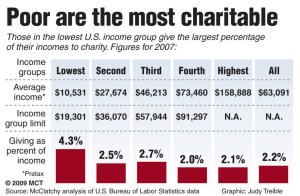 default because I was baptized Presbyterian mostly because my mother’s golf partner at the country club was the Presbyterian minister’s wife. The next time we moved, I was the only one in the family that stuck with the church thing mostly because the best music program in the city was in the Presbyterian church because the minister’s wife was a serious piano teacher. The minister was great. He drove around in an orange fiat convertible with a tweed jacket, a golf tam, and leather gloves. When he wasn’t writing his sermon about what to do the next time you were sitting in the locker room at the country club, he was at the country club golfing. I have to admit to being kind’ve of an outlier in my family since I’m not a millionaire. I’ve seen what kind of trivial concerns the rich tend to have and I really don’t want to be a part of it. I’d much rather appreciate my daily bread instead of a pair of manolo blahniks.
I just don’t care that much about money. I have very simple needs plus I’m a Buddhist and that’s sort’ve a lifestyle thing with us. I say all this because I have been on both sides of the income spectrum and I actually chose downward mobility. However, I didn’t want to choose poverty. That’s a more difficult thing to avoid these days; especially if you’re an aging woman in a red state where the governor hates all teachers and professors.
I guess I was the only rich republican kid that read the four woes listed in Luke 6:24–26 that start with “Woe to you…” when I was a good little Presbyterian in sunday school.
…who are rich, for you have already received your comfort.
…who are well fed now, for you will go hungry.
…who laugh now, for you will mourn and weep.
…when everyone speaks well of you, for that is how their ancestors treated the false prophets.
So, given Republican officials are cross-waving christians and just sort’ve wear the entire thing on their sleeves self righteously, why is there a war on poor people? I also read the four beatitudes in that same sermon on the plain in Luke’s gospel that starts out “Blessed are you…”
…who are poor, for yours is the kingdom of God.
…who hunger now, for you will be satisfied.
…you who weep now, for you will laugh.
I frequently wonder if their new testaments don’t have those particulars. I do have to say that most of my jaunty minister’s sermons had to do with it being easy to forget about reality when you’re sitting in a country club. (I think he may have been reminding himself. You should’ve seen the manse.) Maybe that is the thrust of the problem that we’re witnessing a bunch of self-professed christians declare war on the poor.
American conservatives for the past several decades have shown a remarkable hostility to poor people in our country. The recent effort to slash the SNAP food stamp program in the House (link); the astounding refusal of 26 Republican governors to expand Medicaid coverage in their states — depriving millions of poor people from access to Medicaid health coverage (link); and the general legislative indifference to a rising poverty rate in the United States — all this suggests something beyond ideology or neglect.
I also missed the part where Jesus wanted fetuses to come unto him but poor children and their mothers could just go to bed hungry.
 I left Nebraska nearly 20 years ago to discover a little something different in life down here in New Orleans. About 10 years ago, I bought a very modest house in the ninth ward of New Orleans. My neighborhood is undergoing incredible gentrification and I have to admit that I could not afford my house any more. Neither could any of the neighbors that were here when I moved here. I actually think this is part of a bigger plan to stop the poor and the black from returning to New Orleans but that is another post for another day.
There is a deliberate strategy of punishing the poor put into place by many southern, Republican governors that profess to be pious Christians. This includes my hyper-charismatic Catholic converted Bobby Jindal and both of the freaky Republican governors of the surrounding state. Their position on providing a medicaid expansion to the state to heal the poor is basically let them die in the poorly run privatized hospitals that Jindal sold to his donors at a really cheap price. I guess you have to be a leper to get health care according to biblical fundamentalists.
While Republicans in Congress weren’t able to defund Obamacare, many Republicans at the state level have found a different way to block low-income Americans from receiving cheaper health insurance. An estimated eight million Americans will remain poor and uninsured even after Obamacare is rolled out, due to the decision of many Republican governors and state legislators to reject the Affordable Care Act’s expansion of Medicaid.
When the Supreme Court upheld Obamacare last year, it also issued a less-noticed ruling that states could opt-out of the law’s Medicaid expansion, which broadened eligibility requirements for the program and provided federal funds to help pay for it. As this essentially amounted to free money until 2016 — at which point the federal government would pay for “only” 90 percent of the expansion — you’d think it’d be a no-brainer to accept it, right?
Well, not if you’re Rick Perry! Or Scott Walker, or Nikki Haley, or Bobby Jindal, or a ton of other red-state governors who decided to forego helping their poorest residents get health insurance because, well, that could alienate the GOP base voters next time they face a primary.
In total, 26 states have rejected the expansion, including the state of Mississippi, which has the highest rate of uninsured poor people in the country. Sixty-eight percent of uninsured single mothers live in the states that rejected the expansion, as do 60 percent of the nation’s uninsured working poor.
In general, states that rejected the expansion also have stricter eligibility requirements for Medicaid. While the 24 states that agreed to expand the program have a median income limit of $12,200 for Medicaid applicants, the limit is $5,600 —less than half the federal poverty level — in the states that rejected it.
One piece of the puzzle seems to come down to ideology and a passionate and unquestioning faith in “the market”. If you are poor in a market system, this ideology implies you’ve done something wrong; you aren’t productive; you don’t deserve a better quality of life. You are probably a drug addict, a welfare queen, a slacker. (Remember “slackers” from the 2012 Presidential campaign?)
Another element here seems to have something to do with social distance. Segments of society with whom one has not contact may be easier to treat impersonally and cruelly. How many conservative legislators or governors have actually spent time with poor people, with the working poor, and with poor children? But without exposure to one’s fellow citizens in many different life circumstances, it is hard to acquire the inner qualities of compassion and caring that make one sensitive to the facts about poverty.
A crucial thread here seems to be a familiar American narrative around race. The language of welfare reform, abuse of food stamps, and the inner city is interwoven with racial assumptions and stereotypes. Joan Walsh’s recent column in Salon (link) does a good job of connecting the dots between conservative rhetoric in the past thirty years and racism. She quotes a particularly prophetic passage from Lee Atwater in 1982 that basically lays out the transition from overtly racist language to coded language couched in terms of “big government”.
Finally, it seems unavoidable that some of this hostility derives from a fairly straightforward conflict of group interests. In order to create programs and economic opportunities that would significantly reduce poverty, it takes government spending — on income and food support, on education, on housing allowances, and on public amenities for low-income people. Government spending requires taxation; and taxation reduces the income and wealth of households at the top of the ladder. So there is a fairly obvious connection between an anti-poverty legislative agenda and the material interests of the privileged in our economy.
Many in the U.S. have fallen below the poverty line since the last recession because of loss of jobs combined with the increasing amount of income inequality in this country. It is really through no fault of their own. So, why do these memes and canards about the poor persist?
The bottom 1 percent in the U.S. live on an income that is one six-hundredth of the average for the richest 1 percent of Americans. They live on less than the average GDP per capita of a low-income country such as Afghanistan, Mozambique, or Haiti. And they live at or below the national poverty lines of such countries as Ghana, Congo, and Mongolia. Despite living in one of the richest countries in the world, the bottom 1 percent of Americans see incomes below the global median. The more successful disabled beggars of Addis Ababa in Ethiopia earn more than $2 on a good day, according to the International Labor Organization.
It is true that from an objective standpoint, living on $2 in a richer country is associated with better outcomes than living on $2 in a poor country—you are more likely to live in a house with basic utilities, and your children are less likely to die. In those terms, extremely poor Americans have it better than similarly poor Ghanaians—especially because the poorest in America will spend more than $2 a day even if their incomes are considerably below that. On the other hand, Ghanaians living on $2 a day are around average in their society; they don’t face the social stigma and exclusion of being so far removed from “normal” living standards.
Despite the physical and social costs of poverty, we have done a terrible job at raising the incomes of the poorest Americans over the past 20 years. The proportion of America’s households that live on less than $15,000 a year is as high as it was in 1989, while the proportion on more than $200,000 has gone up by two-thirds. That may be one reason for the country’s sluggish growth over that time—there isevidence that greater income equality is associated with stronger income growth for all.
There’s a solution to America’s extreme poverty problem. The example of countries where considerable proportions of the population live on less than $2 a day, as well as historical experience in the U.S., show that the most powerful tool to make poor people’s lives better is simply to give them cash. Brazil’s program of cash transfers, called Bolsa Familia, reduced inequality and increased both school enrolment and the number of poor people who were working. Perhaps we should try something similar in the U.S., providing an income floor for all Americans.
I’m going to give you a flashback from the past–1968– in an old conversation between William F. Buckley and Noble Prize winning economist Milton Friedman who was a big free market advocate back in the day. This is his suggestion of negative income tax.
I’m not showing you this to say it’s the way to go, I show you to ask a few questions: Would this conversation even be possible today? Have you seen any conversations recently on policies from the party of jaysuz and guns that provides any suggestions on how to actually help the poor?
America faces an opportunity gap. Those born in the bottom ranks have difficulty moving up. Although the United States has long thought of itself as a meritocracy, a place where anyone who gets an education and works hard can make it, the facts tell a somewhat different story. Children born into the top fifth of the income distribution have about twice as much of a chance of becoming middle class or better in their adult years as those born into the bottom fifth (Isaacs, Sawhill, & Haskins, 2008). One way that lower-income children can beat the odds is by getting a college degree.[1]Those who complete four-year degrees have a much better chance of becoming middle class than those who don’t — although still not as good of a chance as their more affluent peers. But the even bigger problem is that few actually manage to get the degree. Moreover, the link between parental income and college-going has increased in recent decades (Bailey & Dynarski, 2011). In short, higher education is not the kind of mobility-enhancing vehicle that it could be.
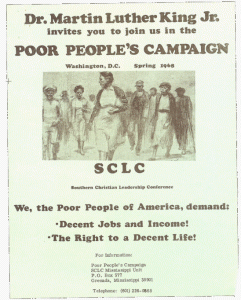
It seems that more of us are facing more uphill battles. It makes me wonder why the social activism and political activism of a Martin Luther King or a Cesar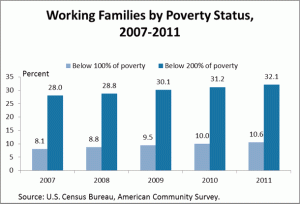 Chavez who fought for rights of the poor has declined?
Two factors seem to be relevant in explaining the political powerlessness of the poor. One is the gerrymandering that has reached an exact science in many state legislatures in recent years, with unassailable majorities for the incumbent party. This means that poor people have little chance of defeating conservative candidates in congressional elections. And second are the resurgent efforts that the Supreme Court enabled last summer to create ever-more onerous voting requirements, once again giving every appearance of serving the purpose of limiting voter participation by poor and minority groups. So conservative incumbents feel largely immune from the political interests that they dis-serve.
It would seem that more and more of us have interests aligned with poor folks. That is why the Republican party has also upped it’s race-baiting, women-baiting, GLBT-baiting, and immigrant-baiting. It is continuing to splinter the vast economic interests of the many into many morality plays. Even the Catholic church–a long time advocate of the poor and disenfranchised–has spent more effort on stomping on the secular rights of women and GLBTs than its usual role of ministering the poor. So, many social institutions have simply fallen prey to the same kind of divide and set-one-on-the other attitudes stoked by the money and the greed of folks like the Kochs.
I have no idea how these distortions have take center stage in our country to the point where our war on poverty has turned to a war on the poor. I can only think that those of us that fall into the category of having a shrinking pie are like dogs fighting over scraps thrown under the table by our 1 percent masters. It’s time for us to regain our perspective, if not our moral base.
Tonight on Frontline — League of Denial: The NFL’s Concussion Crisis
Posted: October 8, 2013 Filed under: health | Tags: concussions, Dr. Bennet Omalu, ESPN, Mike Webster, NFL, professional football, sports, Traumatic Brain Injury (TBI) 20 CommentsThe long anticipated Frontline documentary “League of Denial” will be shown on PBS tonight from 9-11PM. A book with the same title by Mark Fainaru-Wada and Steve Fainaru was released this morning. I hope you’ll watch it either on TV or on-line. The show examines the problems of concussions and traumatic brain injury (TBI) in professional football.
The NFL is not at all happy about the program. In fact, as I reported recently, ESPN was originally a partner with Frontline on the documentary; but after the trailer (produced and edited by my talented brother, John MacGibbon) was released, ESPN abruptly pulled out of the project—most likely because of pressure from the League.
You can watch the trailer here.
There is lots of coverage of relevant topics at the Frontline site. Here’s a recent story on the doctor who made the connection between football and TBI: The Autopsy That Changed Football
Growing up in Nigeria, Dr. Bennet Omalu knew next to nothing about American football. He didn’t watch the games, he didn’t know the teams, and he certainly didn’t know the name Mike Webster.
That changed in 2002 when Omalu was assigned to perform an autopsy on the legendary Steelers center. Webster had died at 50, but to Omalu, he looked far older. Football had taken a punishing toll on his body. It was Omalu’s job to measure the damage.
As a neuropathologist, Omalu was especially interested in the brain. Inside Mike Webster’s brain, he’d make a startling discovery: a disease never previously identified in football players. The condition, known as chronic traumatic encephalopathy, or CTE, was the first hard evidence that playing football could cause permanent brain damage. Players with CTE have battled depression, memory loss, and in some cases dementia.
“I had to make sure the slides were Mike Webster’s slides,” Omalu told FRONTLINE. “I looked again. I saw changes that shouldn’t be in a 50-year-old man’s brains, and also changes that shouldn’t be in a brain that looked normal.”
Omalu published his findings, believing NFL officials would want to know more. They didn’t. In public, league doctors assailed his research. Omalu’s conclusions confused the medical literature, they argued. In a rare move, they demanded a retraction.
You can use this as an open thread or a live blog to comment on the documentary. I plan to watch it tonight, and I hope you’ll join me.
Healthcare is a Right
Posted: October 8, 2013 Filed under: just because 21 Comments Hey newsjunkies. I’ve been reading anything I can about healthcare. I thought it might be worthwhile to highlight some interesting snippets and passages, for anyone else here who might be interested.
I’ll start with this special to Canada’s Globe and Mail by Antonia Maioni, assistant professor at McGill University — Obamacare vs. Canada: Five key differences:
Obamacare is a huge step in American health reform and, if it seen to improve the system, will represent a major victory for Democrats. Like other major reforms of the past, however, it will entrench the private nature of the system, and likely render national health insurance, or anything remotely like “Canadian-style” health care, impossible to attain.
This pretty much sums up my biggest concern about the ACA as it stands.
Maioni makes this bleak assessment after going through the differences between ACA and a Canadian type universal healthcare. The article at the link goes more in-depth on each point as it is listed, but to summarize here quickly, the ACA is:
1) Not single payer
2) Not universal coverage
3) Not “national” health insurance
4) Not equal access
5) Not cost containment
So, that’s one view from the perspective of a country that actually has single payer.
Next up, a pro-ACA argument from John McDonough–as related in a panel segment on Democracy Now called, Is Obamacare Enough? Without Single-Payer, Patchwork U.S. Healthcare Leaves Millions Uninsured.
Here is his background first:
John Donough, professor at the Harvard School of Public Health, director of the New Center for Public Leadership. Between 2008 and ’10, he served as a senior adviser on national health reform to the U.S. Senate Committee on Health, Education, Labor, and Pensions. And between 2003 and ’08, he served as executive director for Health Care for All in Massachusetts, playing a key role in the passage of the 2006 Massachusetts health reform law known as “Romneycare,” regarded by many as the model for the current healthcare law. He recently wrote the book Inside National Health Reform.
So, clearly someone invested in the ACA.
Here is Donough’s take:
JOHN McDONOUGH: Well, yes, the law and the system around the law are complicated, and our underlying healthcare system is incredibly complicated, far more than it needs to be. I don’t really have a disagreement with my—with my friend and colleague, Steffie Woolhandler, about a division of what we would like to see. The reality is that this was probably the best we could have gotten in 2009, 2010. Getting anything even close to this would be politically impossible today. And, you know, I hope this is a movement in the direction toward a more rational and less complex system, but it is an important start and an important step forward for potentially tens of millions Americans, a lot of whom are going to get coverage that’s going to be very affordable and at almost no cost.
I’m a hard sell, so no I’m not convinced.
Here is the bio on Steffie Woolhandler, who Donough mentions, as she also is interviewed in the segment on DN:
Dr. Steffie Woolhandler, professor of public health at CUNY-Hunter College and a primary care physician, visiting professor at Harvard Medical School and co-founder of Physicians for a National Health Program;
Clearly she is invested in single payer as that is what her organization PNHP advocates.
With that noted, I have to say that her response to Amy Goodman below resonates with my understanding of how social policy has been won in this country:
AMY GOODMAN: Is this a road to single-payer, Dr. Steffie Woolhandler?
DR. STEFFIE WOOLHANDLER: Well, it’s only a road to single-payer if we fight for single-payer.
Personally, this is why I won’t throw away my “public option” and “single payer” flags and will keep waving them around. I understand full well that the ACA is the law of the land. I simply refuse to be party to ceding the shaping of the future of healthcare policy in America to the Electeds on the right who have branded a government subsidized expansion of the private insurance industry as a “government takeover.”
Of all the articles I’ve scoured through so far, I have found Healthcare for All Colorado executive director Donna Smith’s example in activism and her commentary on healthcare–of which I am only including a few passages here–of particular interest:
Smith’s work with Health Care For All Colorado currently centers on gathering enough signatures to put on a citizen-driven state initiative on the ballot in November 2014 that establishes health care as a human right and a public good for all Coloradans. The initiative will require100,000 signatures to make it on the ballot in 2014. “I’m not sure if we will reach our goal in the next six months,” Smith said. “But we can bring it back again much like the marijuana initiative here in Colorado that took a couple of tries to get it on the ballot.”
Ah, if only we could be having this discussion nationally. But, more on that in a moment when we come to another passage.
Something I am glad to hear as well:
In addition to promoting the moral and fiscal benefits to a single payer health care system, Smith travels to other countries speaking out against their attempts to move to privatization of health care that would result in other countries adopting a system more like that here in the U.S. She recently spoke to a group in Australia (see below). “Not all countries have a pure single payer system, some have a mixture of public and private, but they have such strict regulations on insurance companies that we here in America would scarcely recognize what those private plans look like. Americans just don’t know about this, in part because they’re not told, they’re not educated. If you go to another country one of the things you notice right away is that you don’t see all this advertising for drugs and medications that are done here, that there is information about medicines everywhere and nootropic faq for all the people to know.”
Exactly.
But, back to our national healthcare struggle here at home:
Does she envision single payer eventually taking hold in the United States? “Short term, at the national level, we’d have a hard time thinking that this Congress and this President would go after a single payer system,” Smith said. “The fight for the ACA bruised so many people on both sides and continues to do so. They are not going to be able to go back in the transformational way that those of us advocating for single payer would like to see it happen.
In other words, there’s no Trojan pony here in and of itself, and this president and this Congress aren’t interested in fixing this bill anyway.
The Silver lining, if we actually fight for single payer instead of settling for the ACA:
But, the one opening we got through the ACA was waivers under Section 1332 of the Affordable Care Act. That allows for states to innovate in terms of how they deliver their health care, provided they cover at least as many people, which would not be an issue with single payer.
Yes, I remember all too well–thanks to Bernie Sanders for getting that small ray of hope into the ACA.
Nonetheless:
“But, passing single payer on a state level is not easy, Smith cautioned. “The same forces that fought it on a national level will fight it on the state level, much the way we’ve seen the Koch Brothers work on state legislatures on union issues. So, we’ve seen Vermont pass Green Mountain Care under (Governor) Peter Shumlin, but they’ve had a difficult time with the funding mechanism there. That happens because there are forces that don’t want to see a smaller state like Vermont move forward on single payer.
“I think the real chance is if a big state like California or New York can be forceful enough and progressive enough to push it across the finish line. And once one state does that and we see it function well there–similar to what we saw happen with Romney Care, which served as the model for the ACA–then I think it will be a similar scenario for single payer. That’s the way it happened in Australia; their national health care system started state-by-state and many of us know the story of Canada and Tommy Douglas. The crisis in health care is not going to get any smaller any time soon. The nation is going to have to go at it again. (Even with full implementation of the ACA, not all U.S. citizens will be covered and medical bankruptcy remains in place with the ACA). The number of people suffering is really not going to back off until we truly transform the system to one that’s universal and financed under a single payer system.”
These are some good guidelines on developments and trends to follow in terms of state single payer and how it might then broaden the national discussion.
Right now that discussion is stuck in tribalist support for-or-against the ACA, which has been a fait accompli for years anyway, and so far from anything I can take hope in personally. It is hard to envision the day where we can talk about say a Gillibrand-care in New York being expanded federally, as opposed to Obama or Romney care. But, a wonk can dream 🙂
Anyhow, I think I may have to do this piece in installments because this post already feels long to me, even though I’m only a very small fraction into the links and excerpts I have. So I will wrap this up for now and if I can keep up with blogging as fast I am reading all this stuff–try to work on a part 2 next.
PS I know at Sky Dancing our writers, readers, and commenters feel intensely and passionately about the issue of healthcare, and so I hope I am explaining where I am coming from well enough for it to be understood as just that–my personal perspective.
Tuesday Reads: Hostage Situation
Posted: October 8, 2013 Filed under: 2012 elections, Affordable Care Act (ACA), Barack Obama, Democratic Politics, Federal Budget, Federal Government Shutdown, Global Financial Crisis, morning reads, Psychopaths in charge, Real Life Horror, Republican politics, U.S. Economy, U.S. Politics | Tags: 14th amendment option, John Boehner, Obamacare, Robert Costa, Tea Party Caucus, US House of Representatives 50 Comments
Good Morning!!
I hardly know where to begin this morning. The insanity that has gripped the nation’s capital is so extreme that some kind of intervention may be necessary.
Is it possible for the UN or the IMF to step in and explain to Tea Party Republicans why the full faith and credit of the United States government cannot be held hostage in an effort to overturn the results of two elections? Or perhaps they could explain to House Speaker John Boehner that his frantic efforts to hold onto his speakership could end with voters replacing him with a Democratic Speaker in 2014?
As depicted in the cartoon above, the Republican majority in the House is being held hostage by around 30-40 delusional Tea Party wingnuts and their putative leader–John Boehner has no clue how to deal with the hostage crisis. It’s a mystery to me why anyone would even want that job, but to Boehner the job is apparently more important than the nation’s–and the world’s–economic well-being. Holding onto his job is apparently so important to him that he is willing to look like a complete fool rather than stand up to a bunch of crazy people in his own party.
Meanwhile, the media pundits are getting a little more restless–realizing that we really could reach the debt limit on October 17 without the House voting on a “clean” continuing resolution or an increase in the government’s ability to borrow to pay its bills.
Normally, I wouldn’t link to the National Review, but yesterday they published a piece by Washington editor Robert Costa, who probably has a pretty good idea what insane caucus in the House is up to. Costa writes:
Speaker John Boehner may be trying to finalize a plan to raise the debt limit, but House conservatives are already skeptical of his efforts. In interviews, several of them tell me they’re unlikely to support any deal that may emerge.
Costa goes on to quote a few of the wackiest of the wackos (emphasis added):
“They may try to throw the kitchen sink at the debt limit, but I don’t think our conference will be amenable for settling for a collection of things after we’ve fought so hard,” says Representative Scott Garrett (R., N.J.). “If it doesn’t have a full delay or defund of Obamacare, I know I and many others will not be able to support whatever the leadership proposes. If it’s just a repeal of the medical-device tax, or chained CPI, that won’t be enough.”
Representative Paul Broun (R., Ga.) agrees, and says Boehner risks an internal rebellion if he decides to broker a compromise. “America is going to be destroyed by Obamacare, so whatever deal is put together must at least reschedule the implementation of Obamacare,” he says. “This law is going to destroy America and everything in America, and we need to stop it.”
“Stay the course, don’t give in on it, that’s what the people in my district are saying,” says Representative Ted Yoho (R., Fla.). “We did a town hall the other day, and 74 percent of people said, ‘don’t raise the debt ceiling.’”
This despite the fact that polls show their ideas are poison to the American public. These people are truly insane, and they believe they’re winning. Nothing will stop them except throwing them out of their jobs. Here are some other reactions to Costa’s piece.
David Atkins of Hallabaloo: Nothing less than Fort Sumter will do.
If you think this is insane–and it is–keep in mind that it’s only going to get worse from here.
Until Republicans are removed from control of all branches of government, the brinksmanship is going to get worse, and the demands are going to become more severe. The lunatics are running the asylum now, the revanchist movement is in full swing, and the Lost Cause is the name of the game.
Not even sequestration-level spending plus cutting Medicare and Social Security will do for these people–and that’s after losing an election. Try to picture where the Republican party was 30 years ago. Then 20 years ago. Then 10 years. Then today. Now picture 10 years from now. Anyone who thinks there’s going to be a retreat from the precipice is deluding themselves. If they lose in 2014, it will be because they didn’t hold firm against Obamacare. If they lose to Hillary in 2016, it will be because they didn’t shout loud enough about Benghazi.
If we don’t stop them somehow, the Tea Party crazies will try to refight the Civil War.
Josh Barro at Business Insider: Republicans Do Crazy Things Because They Have Crazy Beliefs. Barro responds to Georgia Rep Paul Broun’s claim that “America is going to be destroyed by Obamacare….This law is going to destroy America and everything in America, and we need to stop it.”
It’s one thing to oppose Obamacare. It’s quite another to believe it will “destroy America and everything in America.” As Manhattan Institute Senior Fellow Avik Roy, a strong opponent of Obamacare, wrote last month:
The idea that we had a free-market health-care system before Obamacare, and a socialized one after, is completely and utterly incorrect. In 2010, before the passage of Obamacare, U.S.-government entities spent more per capita on health care than all but three other countries in the world. Obamacare adds to that spending by around 10 to 15 percent. Not good, to be sure, but not the whole kit and caboodle either.
The changes from Obamacare, good and bad, are marginal. It will not fundamentally change America….
But if you already believe something crazy — that Obamacare will destroy America — then it’s not additionally crazy to favor drastic, dangerous action to stop it.
Sarah Jones at Politicus USA: From Hostage Takers to Buffoons, House Republican Ineptitude Heads for Default.
Even a short term debt ceiling agreement is up in the air now. Not the actual debt ceiling limit, but a short term agreement. We can’t even do that now, if Robert Costa’s readings are accurate.
Costa tweeted, “One of my best House R sources thinks Boehner may, just may, be able to get votes for short-term DL ext, but even that is up in air” [….]
If you’re wondering how Republicans can be so out of it when the polls keep instructing them otherwise (as if the ONLY issue here is their own political survival, forget the people or this country), perhaps this level of utter cluelessness will be informative. When asked if the Republicans have their next move mapped out and if Boehner has any legislation drawn up regarding the debt ceiling, “Negatory,” Representative Pete Sessions replies. You see, it’s all about “messaging”. “We’re going to keep with our great, positive attitude and tell the president, ‘you’ve got to sit down and negotiate.’”
So, their great positive attitude involves tanking the economy and shutting down the government because they lost an election. Huh. Also: Only in Republican world is holding a gun to the country’s head before being willing to “talk” an act of good faith.
Republicans don’t understand this president very well at all, but then, we tend to project our own values onto others so this is understandable. They never should have threatened the country. They could have threatened anything but the American people and the democratic process, and this President wouldn’t have felt compelled to take a stand.

It’s really getting to be a cliche to point out that reports of Republican behavior are for real and not from The Onion. But seriously, it’s hard to believe The Onion can keep finding ways to exaggerate these people’s insanity. Apparently there was “outrage” after this 2011 Onion story; but does it actually seem crazy two years later to claim that what the Republicans are trying to do is going to hurt–even kill–some children?
A few more comments on the hostage situation from various pundits:
Washington Post Editorial Board: The House GOP has nothing to show for its government shutdown.
WHAT HAVE House Republicans managed to accomplish in a week of government shutdown?
Damage the livelihood of millions of Americans? Check. Government secretaries, food-truck operators, cleaners who work in motels near national parks: They’re all hurting.
Waste billions of taxpayer dollars? Check. It costs a lot to shut agencies, Web sites and parks, and it will cost a lot to reopen them. Meanwhile, the House has voted to pay the salaries, eventually, of hundreds of thousands of employees whom it has ordered not to work. That’s an odd way to manage an enterprise.
Interfere with key government operations? Check. The National Transportation Safety Boardcan’t investigate an accident last weekend on Metro’s Red Line that claimed the life of a worker. That could make future accidents more likely. On the other side of the world, U.S. allies from Tokyo to Singapore are wondering whether they can rely on a nation whose president has to go AWOL from a key summit meeting in their region.
Rattle the markets, slow an economy in recovery, interrupt potentially lifesaving research at the National Institutes of Health? Check, check and check.
Derail the hated Obamacare? Ch . . . — oh, no, wait a minute.
Because it’s not really about “Obamacare.” It’s about making government itself completely dysfunctional. I keep thinking about Dakinikat’s post yesterday and the pieces she quoted by Jonathan Chait and The Economist. Have we really reached the point where the gridlock in DC is so bad that our form of government is in danger of collapse? And what can we do about it? In order to change our system of divided government, we would need to call a Constitutional Convention. Even if we could get to that point in this atmosphere, the final result could be a lot worse than what we have now. I really believe the only way to save our form of government is to somehow throw all the Tea Party Republicans out of it. Is that possible?
Alex Altman at Time: Boehner Holds Weaker Cards In High-Stakes Political Poker
President Barack Obama says he will not pay House Republicans a ransom in exchange for re-opening the government or raising the debt ceiling. House Speaker John Boehner insists he doesn’t have the votes to do either without any White House concessions.
Both men are bluffing. And while Obama’s play is a risky one, Boehner’s bluff is worse: it just doesn’t look very credible.
In a Sunday interview with ABC News, Boehner said the U.S. faced the specter of its first ever federal default if Obama didn’t cave to GOP demands. “There are not the votes in the House,” Boehner declared, to pass a so-called “clean” bill to reopen the government. “The votes are not in the House to pass a clean debt limit,” he added. “And the president is risking default by not having a conversation with us.”
These kinds of threats have worked for Boehner before,
But this is now a less credible threat. A few days before Boehner went on TV to talk tough about the threat of default, he was reportedly confiding to fellow Republicans that he would never allow it. Failure to hike the debt limit would unleash a chain of economic calamities, if not the first ever federal default. Boehner doesn’t want that to be his political epitaph.
To be sure, there are plenty of House Republicans who are willing, if not eager, to hold the line. But if the votes aren’t there for clean bills, that’s only because Boehner hasn’t allowed them to come forward. As Speaker, he and his leadership team control the floor. A clean bill to reopen the government, and a companion measure to lift the debt limit, would draw unanimous or near-unanimous support from the chamber’s 200 Democrats; all but five are on record supporting such a vote. Nearly two-dozen Republicans are also publicly on board. Some say the number is far higher. If Boehner let a clean funding bill hit the House floor, “it would probably get 300 votes,” New York Representative Peter King, a Republican who has been critical of the party’s shutdown strategy, told TIME last week.
Jamelle Bouie at The Daily Beast: Five Boehner Quotes—From One Interview—That Explain Everything.
To watch John Boehner speak Sunday—in a segment with ABC’s George Stephanopoulos—was to watch him issue talking points from another dimension, where legislative hostage-taking is routine and the American public is eager to threaten the full faith and credit of the United States. The interview was rife with dishonesty, but there were five statements—in particular—that stood out for their recklessness and/or brazen disregard for the truth.
I won’t excerpt any more from this one. You need to go read the whole thing–it’s not long.
In my opinion, it’s an open question whether the insanity of the Tea Party can be beaten. Certainly, our democratic Republic cannot survive much more of this. The best solution would be for the Democrats to really hold their ground this time and for President Obama to invoke the 14th Amendment and abolish the debt ceiling unilaterally. But do the Democrats and Obama have the guts to do it? We’ll just have to wait and see.

 peej
peej Carissa
 bostonboomer
 dakinikat
 ecocatwoman
 mablue2
 Mama Lopez
 peggysue22
 quixote
 skydancingguestblogger
 Mona (aka Wonk the Vote)



 Sky Dancing
Recent Comments