
And you know they are Right Wing Christians by the Lies, their Hate, and their Deceit
Posted: June 30, 2013 Filed under: religious extremists, right wing hate grouups | Tags: Jim Demint, MTP, Rachel Maddow 6 Comments So, that’s a harsh title and this is a harsh post. The American Taliban were on Meet the Press today in full force. The topic was the War on Women and the War on Gays. It was the usual combination of spewing outright lies and insisting every one agrees with them. They’re beginning to look outnumbered on the War against Gays and Marriage Equality. I wish I could say the same on the War on Women. Rachel Maddow had adequate time to skewer Ralph Reed and Jim DeMint on their marriage equality lies. Even Dancing Dave headed for the door labelled popular opinion and right direction.
Social conservatives came out in full force on NBC’s Meet The Press on the Sunday after the Supreme Court struck down the Defense of Marriage Act. Former Sen. Jim DeMint (R-SC) of the Heritage Foundation and Rep. Tim Huelskamp (R-KS) both claimed the court’s decision to recognize same-sex marriages sacrificed children’s wellbeing — only to have their arguments promptly slapped down by MSNBC hosts Rachel Maddow and David Gregory.
DeMint said the court had privileged “the desires of adults” over “the best environment for children,” arguing that heterosexual marriage is “the environment where children can thrive and succeed.” Maddow immediately pointed out that this argument ignores the children of same-sex couples, who have up til now been treated as second-class citizens under the law:
Justice Kennedy addressed that issue specifically in his ruling. He says that by denying marriage rights to same-sex couples who have kids, you’re humiliating and demeaning those kids. By denying their families equal protection under the law by the parents who are raising them and who love them and who make their family. So we can put it in the interests of children, but I think that cuts both ways. And the ruling cuts against that argument. I mean, gay people exist. There’s nothing we can do in public policy can do to make more of us exist or less of us exist. And you guys for a generation have argued that public policy ought to demean gay people as a way of expressing disapproval of the fact that we exist. But you don’t make any less of us exist, you are just arguing for more discrimination. And more discrimination doesn’t make straight people’s lives any better.
Rachel really slammed them but time ran short when they insisted that most people are behind stopping abortions as early as 20 weeks in all instances, that women really want unnecessary ultrasounds using vaginal probes, and that the grizzled, unlicensed Philadelphia Doctor just convicted of murder of babies and women is equivalent to Planned Parenthood. No one had the time to challenge their unscientific facts or their false assertions about what women what and what medical science says.
Some women like being forced to have an ultrasound before receiving an abortion, according to former Senator Jim DeMint (R-SC).
Republicans in state legislatures across the country have pushed legislation that requires women to undergo an ultrasound procedure 24 hours before terminating their pregnancy. The so-called “informed consent” laws usually require women to be given a picture of the fetus and be shown a fetal heartbeat, along with general information about abortion.
“The more the ultrasounds have become part of the law, where a woman gets the opportunity to see that there’s a real child, it’s beginning to change minds, and I think that’s a good thing,” DeMint said on NBC’s Meet the Press. “It’s time that the 3,000 babies we lose every day have some people speaking up for them.”
MSNBC host Rachel Maddow pointed out that women weren’t given the opportunity to have an ultrasound, they were forced to have a medically unnecessary ultrasound by the state. She added that in many cases women were subjected to trans-vaginal ultrasounds.
“So it’s an invasive vaginal forced procedure that a woman cannot say no to by order of the state government,” Maddow continued. “And that is all right with you. I understand that. You feel that you’ve got an interest strong enough to override a woman’s desire to not have that happen to her that you can insist that it does as a legislator. But most American women I think are going to balk at that.”
DeMint, however, insisted that some women wanted the state to force them to have an ultrasound.
“She’s forgetting about the thousands of women who want an informed choice, who want the opportunity to get a free ultrasound, which they can get not from Planned Parenthood but from a lot of these pregnancy centers.”
The outrage and the war continue. I really have to say that I don’t want to even been in the same room as the likes of Ralph Reed who should be in jail for his Indian Casino scam and DeMint who belongs in a mental health facility. This isn’t religious expression. It is a well funded and organized witch hunt. They were equally bad trying to explain why minorities don’t really need their voting rights protected. It’s a damn shame David Gregory gives them a platform for their extremism.
Caturday: Celebrations and Reflections
Posted: June 29, 2013 Filed under: just because | Tags: caturday, DOMA, feminism, LGBT, Prop8, QueerTalk, Texas, WendyDavis 29 Comments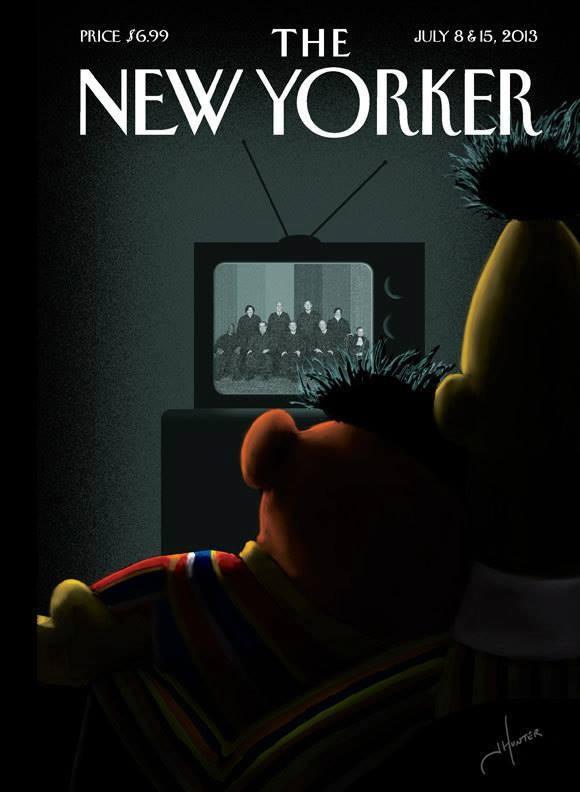 Good afternoon, newsjunkies!
Have you seen next week’s cover of The New Yorker that’s been floating around the internet yet? Well, obviously you have now if you’re reading this post. It’s nothing short of SQUEEEEE! Bert and Ernie nestled together on the couch snuggin’ while watching The Supremes in their robes on the TV.
The Supremes did good on knocking the wind out of DOMA, but it was a long time coming. They’re still in the doghouse for all their other despicable and unreal rulings this week. So while I did pop some champagne to celebrate the good things going on, including the tumbling down of DOMA, no cookies to the Supremes on this. I give the credit to all the grassroots LGBT activists and their growing accumulation of allies who have worked so hard for so many years to bring Wednesday’s ruling to fruition. Well done, everyone! The 21st century is finally starting to arrive…it’s here, it’s queer, and we as a society are not only going to live with it–we are going to live it up! Watch out, y’all, I am so happy for our LGBT sisters and brothers and for all of us as a ONE LOVE-ONE WORLD, I could about start doing some of my inner feminist Pollyanna somersaults all over this page. (I am an absolute klutz with no athletic motor skill coordination whatsoever, so that is truly a feat!)
So, to review:
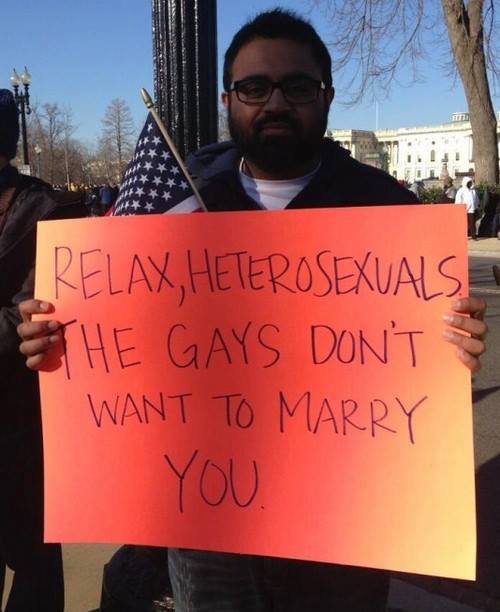
And, via HuffPo, 10 WAYS THE DOMA REPEAL WILL AFFECT ‘TRADITIONAL MARRIAGE’:
After the Supreme Court’s landmark decision that the Defense Of Marriage Act is unconstitutional, it’s time to look at the top 10 ways heterosexual marriage will be affected now that it’s not being defended.
1. Uh…
2. Uhhh…
3. Hmm…
4. Just a sec…
5. It’s like… You know how… It’s like when things… Right?
6. We swear we just had one
7. It’s coming… Wait for it…
8. Hey! Look over there!
9. Wait, where are you going?
10. Global warming?










Here’s what the wonderful Joyce L. Arnold of “Queer Talk” has been blogging over at Taylor Marsh’s, which I think gives a pretty good overview and is instructive in terms of “Where we go from here”…Note: I am only quoting excerpts here, interspersed with a bit of commentary from me, so take the time to click over and read the pieces in full when you get the chance:
The much anticipated Supreme Court rulings on DOMA and Prop 8 were announced this morning.[…] The fight for marriage equality isn’t over. Everyone knows that. But today is huge, and it’s time to do some celebrating.
Post SCOTUS, post DOMA and Prop 8 decisions, the “now what” in LGBT equality question is getting attention, and one response to that question comes by way of the Campaign for Southern Equality. The organization didn’t just come into existence, but they were very ready for this moment. Other LGBT groups are, too, of course, from local to state to national levels. I find the efforts of CSE to be particularly inspiring precisely because they refuse to comply with the “just move to where you’re more accepted” arguments – and we hear them regularly – but stay, and fight for equality. There are a lot of people doing that, in the South and other more “challenging,” but definitely changing toward the better, areas.
About CSE: (emphasis added throughout)
Based in North Carolina, the Campaign for Southern Equality is an effort to assert the full humanity and equality of LGBT people living in the South.
One of their projects is the WE DO Campaign, which
… involves LGBT couples in the Southern communities where they live requesting – and being denied – marriage licenses in order to call for full equality under federal law and to resist unjust state laws.
These WE DO actions serve to make the impact of discriminatory laws visible to the general public; they illustrate what it looks like when LGBT people are treated as second-class… citizens under the law.
Take less than three minutes to watch.
Here is the video Joyce has spotlighted, which is well worth the watch if you haven’t seen it yet. Very inspiring (this roundup continues after the video, so please keep scrolling after you view it):
More from Joyce’s post:
Celebrations continue. Statements agreeing and disagreeing with the decisions are still coming, from the White House to “citizen on the street.” Most likely the next sermon topic was an easy one for many, pro and con marriage equality.
And lots of analysis, which is obviously important, continues being done. It includes wide recognition that while this really is one of those moments we can call “historic,” there are 37 states with no marriage recognition; there are big questions about how same-sex couples are treated in terms of the military and immigration; and among other things, there is no federal employment protection. None of that detracts from the celebration. In fact, equality proponents in all of those “issues,” and more, can be energized by the SCOTUS decisions.
At The Advocate, “Message at Rallies: Celebrate Today, Fight Tomorrow.” At a post-SCOTUS decision rally in West Hollywood, with about 4000 people present, screenwriter Dustin Lanc Black said:
‘(I)t is time for each and every one of us to take that strength you now feel as Californians, and take it to Texas, and take it to Virginia … take it to Holland, Michigan … to Altoona, Pennsylvania. … You need to take your strength to these places, and share this feeling with this nation so we no longer leave a single one of our brothers or our sisters behind, no matter … which state they live.’
From the National Lesbian and Gay Task Force:
‘Today’s historic decisions are a significant leap forward for freedom and justice for same-sex couples and their families, the LGBT community and for our nation — and a lot more work needs to be done to deliver marriage equality to the rest of our nation’s same-sex couples and their families and full equality in every other respect for all LGBT people,’ said Rea Carey, Task Force Executive Director.
Parties continue around the nation, as they should. There’s a lot to celebrate. Statements and analyses will keep coming for a long time, I’d guess, as the impact of the decisions is made clear in practice. And advocacy and actions will continue, in all regions and states of the nation. Look to every region, including the South.
(We Do Campaign via Campaign for Southern Equality)
Dan Cathy, president of Chick-fil-A, tweeted his sadness about the Supreme Court decisions regarding DOMA and Prop 8, but then rather quickly deleted it. That seems a fair representation of Cathy’s efforts to somehow balance an anti-LGBT – at least related to marriage equality – while also, as a spokesperson put it, provide “genuine hospitality to everyone.”
Via Huffington, Cathy’s tweet:
Sad day for our nation; founding fathers would be ashamed of our gen. to abandon wisdom of the ages re: conerstone of strong societies
No word about what the founding mothers would think.
Ok, pardon me but I have to interrupt here to cackle my witchy woman feminist ass off. Joyce goes on to cover the ins-and-outs of Cathy’s trying to have his corporate cake and eat it too while lamenting his sadness over…what seems to me a more perfect union. That appears to be the source of Cathy and his ilk’s lament. They don’t want this union to become more perfect, because that requires giving up their various privileges and twisted means of ‘control.’ (Though it’s always hard not to ask for the most vehement of the homophobic crowd, if they are in control at all or really they are deep in the closet. Because, let’s let the elephant out the room, y’all. That’s the only reason legalizing gay marriage would affect a so-called heterosexual marriage that would need any defending from it.)
Joyce also quotes more whining tweets from Huckabee, et al., via OpEd News:
[Mike Huckabee tweet]: ‘My thoughts on the SCOTUS ruling that determined that same sex marriage is okay: ‘Jesus wept.’ …
‘Today, marriage, children, and the rule of law all suffer.’ Randy Thomassen, Save California. …
[Matt Barber tweet]: In states w/ ‘gay marriage’ there is no longer a legal or ethical defense against multi-party, incestuous or any other twiested ‘marriages’ …
How long before federal agents haul pastors out of the pulpit? – Todd Starnes, Fox News.
To which Joyce’s response is simply awesome:
Founding Fathers, weeping, suffering, children and incest … the familiar “the sky is falling” kind of responses.
As a follow-up to Joyce’s comment, I must insert the following, which I had used elsewhere on the internet (Facebook of course..on the Pink Sneaks support page JJ and I are working on) in reference to Stupakistan’s reaction. (Yes, I’m looking at you, Gov. Goodhair…) to the arrival of what Salon proposes we are now, i.e. a “Wendy Davis Nation.”
Anyhow, here is the graphic because it applies to what Joyce has highlighted about the sad, lamenting reactions to the DOMA/Prop8 reversal:
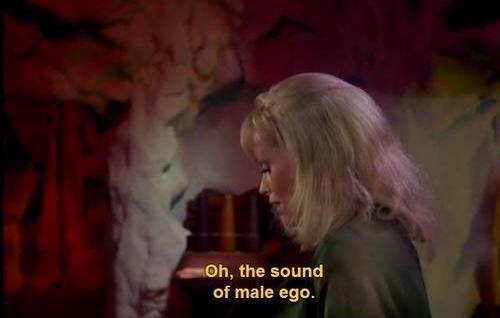
“Oh, the sound of male ego. You travel halfway across the galaxy, and it’s still the same song.” Star Trek: The Original Series, 1×06 (“Mudd’s Women”)
Joyce concludes by saying the following, which I totally agree:
My bet is the founding mothers and fathers just might approve of “liberty and justice for all” efforts. And since we’ve more or less (with some significant “less” moments and issues) been focused on that goal for quite some time, and the sky hasn’t even started falling, we’re safe to keep at it. And in trouble if we don’t.
Last but not least, Joyce reports…
The Respect for Marriage Act (RMA), filed by Sen. Diane Feinstein (D-CA) in the Senate and by Rep. Jerrold Nadler (D-NY) in the House, would completely repeal DOMA (Defense of Marriage Act). The Supreme Court decisions were a big step in that direction, but not complete.
Ok, as I said, please do go read Joyce’s pieces in full whenever you can. Here’s a handy link where you can see her posts archived together in one place.
Pivoting from “gay rights are human rights” (smiles in thoughts of Hillary and Hillary 2016) to “women’s rights are human rights,” I want to touch on that article,“It’s a Wendy Davis Nation Now,” that I briefly linked to above from Salon though, because I have a very revealing excerpt I wanted to highlight from it:
For years — particularly the ones Democrats spent in the wilderness, losing national elections — the party’s pro-choice stance was blamed for losing so-called values voters. Axelrod pointed out how that had changed: “These were motivational issues for people on our side … What’s interesting to me is that these were once wedge issues for Republicans. Now some of them are working as wedge issues against Republicans. And it shows a shift of attitudes.”
Gay rights, of course, have long since lost any traction as a wedge issue in Republicans’ favor in all but the narrowest districts. It remains to be seen how the immigration reform debate will play out politically, but the 2012 election and its “self-deportation” rhetoric is widely seen to have driven away Latinos and Asians. And of course there was defunding Planned Parenthood and Todd Akin. But, Axelrod added, abortion wasn’t part of that. Or, as he put it, “Abortion’s a separate discussion.”
If this week was any indication — along with recent protests in Wisconsin and Ohio, and possibly more to come — that may not prove true.
Thus, if we are truly entering Wendy Davis Nation, then we must be exiting not just Bush country, but also Rove-Axelrod’s understanding of women’s rights as a “separate discussion.” Keeping my ears open and my eyes wide and waiting to see what happens next!
Before I end this post, just for some Caturday fun, and for purposes of smashing the patriarchy with my crazy cat lady pink-ness, here are pictures of my nails that I got done last night (click for larger view):


And, on that note, Sky Dancers, I’m going to turn the soapbox over to you. Do the wonderful thing you do in the comments y’all, and have a great weekend!
Friday Reads
Posted: June 28, 2013 Filed under: morning reads | Tags: government contracting shams, privatization 32 Comments Good Morning!
There are so many confusing things out there at the moment about our national policies in so many areas that it gets overwhelming at times. One topic that I really think should be getting obvious at this point but isn’t really taking root as a source of discussion because of the huge amount of corporate money in elections is the absolute failure of the private sector in providing all kinds of traditionally public goods. I’ve been following the Snowden episode from a weird angle. It is probably an occupational hazard, but what if James Bond weren’t in her majesty’s secret service but Halliburton’s? What does it mean to outsource the public’s safety, welfare, and security?
Federal investigators have told lawmakers they have evidence that USIS, the contractor that screened Edward Snowden for his top-secret clearance, repeatedly misled the government about the thoroughness of its background checks, according to people familiar with the matter.
The alleged transgressions are so serious that a federal watchdog indicated he plans to recommend that the Office of Personnel Management, which oversees most background checks, end ties with USIS unless it can show it is performing responsibly, the people said.
Cutting off USIS could present a major logistical quagmire for the nation’s already-jammed security clearance process. The federal government relies heavily on contractors to approve workers for some of its most sensitive jobs in defense and intelligence. Falls Church-based USIS is the largest single private provider for government background checks.
The inspector general of OPM, working with the Justice Department, is examining whether USIS failed to meet a contractual obligation that it would conduct reviews of all background checks the company performed on behalf of government agencies, the people familiar with the matter said, speaking on the condition of anonymity because the investigation has not yet been resolved.
After conducting an initial background check of a candidate for employment, USIS was required to perform a second review to make sure no important details had been missed. From 2008 through 2011, USIS allegedly skipped this second review in up to 50 percent of the cases. But it conveyed to federal officials that these reviews had, in fact, been performed.
Ah, the profit motive as the root of all evil. Isn’t it similar to the love of money when you basically cut costs at all corners just to provide increasing bits of the pie to your voracious, nonmanagerial owners who only care about ROE?
Republicans continue to push ideological hype over reality in the fight to give any public interest institution to their friends. Sneaking into a congress near you is the possible end of Fannie and Freddie despite the fact they are currently returning goods sums of money to the Treasury. It’s all based on the false hype that they were the reason the mortgage market failed instead of private mortgage factories.
It has now been nearly five years since Fannie and Freddie were put into conservatorship by the Treasury Department. Since then, we have been through the financial crisis, the housing crisis and the foreclosure crisis. Although the housing market has come a long way back, the market for private mortgage-backed securities — that is, bundles of mortgages sold to investors without a government guarantee — remains moribund. Believe it or not, the much-maligned Fannie and Freddie have kept the housing market alive by taking on the credit risk for most plain-vanilla mortgages, especially that most sacred of sacred cows, the 30-year, fixed-rate mortgage.
Indeed, ever since the creation of mortgage-backed securities in the 1970s, this has been a critical role of Fannie and Freddie; their “wrap” helped give investors the confidence to buy securities stuffed with thousands of mortgages they were never going to inspect individually. Currently, an incredible 77 percent of the mortgages being made in America are guaranteed by Fannie and
Freddie.
Yet this can’t last forever. Conservatorship was supposed to be temporary. Although Fannie and Freddie are now making a gaggle of money, for complicated reasons having to do with the way the Treasury Department originally set up the conservatorship, that money is not reducing the government’s $180 billion bailout of the two companies.
Meanwhile, many Republicans have been screaming that the financing of housing should be left to the private market and that Fannie and Freddie must be put out of business. (They believe, wrongly, that Fannie and Freddie caused the financial crisis.) And the Obama White House — shocker! — has punted.
Thus we have Corker-Warner. (The bill has six other co-sponsors, three from each party.) The first thing to note about it is that, by god, it actually would eliminate Fannie and Freddie; the two companies are supposed to be wound down within five years.
But does that mean the private market will take over? Not a chance. Warner told me that although the bill would insist that private capital absorb the first 10 percent of any losses, the federal role remains critical. A new federal agency would be established to explicitly guarantee losses beyond that. And the bill would create programs to help make homeownership possible for low-income Americans, just like Fannie and Freddie once did. Those ads Fannie and Freddie used to run showing diverse Americans smiling in front of their home-sweet-homes could easily be replayed by supporters of Corker-Warner.
Yes. You read that right. The big change is that the profits don’t stay in these quasi agencies and they won’t remain low. The duties shift to the same kinds of contractors that have been bilking the defense department for years with a crippled over sight agency and no guarantee they will make a market.
There are instances where the public sector outperforms the private sector. Mass privatization of everything from schools to jails to spying due to ideological or rent-seeking corporations is a really bad idea. More thought should be put into these privatization schemes. There is a new book out that discusses this and uses BP as a good example of a cautionary tale.
The London civil servants of the 1960s and ’70s who all but ignored profitability as they issued directives across British Petroleum’s bloated corporate network were replaced by highly motivated managers who were rewarded for cutting costs, reducing risk and making money. The company’s more incongruous businesses — food production and uranium mines, for instance — were sold. Payroll was cut by more than half. Oil reserves jumped. The time it took to drill a deepwater well plummeted. Profits soared.
But then, in 2005, a BP refinery in Texas City blew up, killing 15 and injuring around 170. In 2006, a leak in a BP pipeline spilled hundreds of thousands of gallons of oil in Prudhoe Bay, Alaska. And in 2010, an explosion on the Deepwater Horizon oil rig killed 11 and resulted in the biggest offshore oil spill in the history of the United States. These days, BP’s stock trades about 25 percent below where it was before the disaster off the coast of Louisiana, about the same place it was a decade ago.
BP’s bumpy ride is recorded in “The Org: The Underlying Logic of the Office,” a compelling new book by Ray Fisman, a professor at Columbia Business School, and Tim Sullivan, the editorial director of Harvard Business Review Press. “The Org” aims to explain why organizations — be they private companies or government agencies — work the way they do.
The book offers telling insight on a topic that has ebbed and flowed across the world over the last 30 years, as governments of all stripes have set out to privatize state-owned enterprises and outsource services — what does the private sector do better than government, and what does it do worse? Long dormant in the United States, the debate has acquired new urgency as governments from Washington to statehouses and city halls around the country consider privatizing everything from Medicare to the management of state parks as a possible solution to their budget woes. One of the authors’ chief insights is that every organization faces trade-offs — inherent conflicts between competing objectives. The challenge is to manage them. This is way more difficult than it sounds.
While in government hands, British Petroleum paid too little attention to profitability, constrained by its need to please elected officials who often cared more about keeping energy cheap and employment high. But in private hands, it may have cared about profits far too much, at the expense of other objectives. “BP veered from being a company that made sure nothing blew up to one focusing on cost-cutting at all costs,” Professor Fisman said.
The success or failure of an organization often depends on whether it can clearly identify its goals and align the interests of managers and employees to serve them. Yet whatever reward structure an organization picks can skew incentives in an undesirable way.
The 2012-2013 school year saw the fight over public education reach a new pitch, ending with mass layoffs in Philadelphia, and other large school districts, and a cadre of parents and workers who began a hunger strike in protest. This final incident marks the end of a 10-month stretch that has seen an increasingly diverse chorus of voices speaking against American education policy’s relentless focus on high-stakes testing, massive expansions of charter schools and mass teacher and staff layoffs. But there have also been some serious advancements in that agenda, especially in large urban districts.
The Philadelphia School District decision to lay off 3,800 teachers and staff (about one-fifth of the workforce), includes 1,202 safety staff among the casualties. Only 12 will remain next school year to watch over the district’s 149,535 students while they are not in class, in the hallways and cafeteria where violence is most likely.
“I just can’t [see] school district of Philadelphia…without student safety staff. It will be a disaster,” says Patricia Norris, a cafeteria worker at Cayuga Elementary in North Philadelphia.
On Monday June 17, Norris, two parents and another school district employee began a hunger strike to protest the layoffs and the general deterioration of public education in Philadelphia. When interviewed that afternoon, she’d been drinking nothing but water all day. She was red-eyed and exhausted, but spoke animatedly from the tent on Broad Street where she was camped outside Corbett’s Philadelphia offices. “I just want the governor and people in Harrisburg to put their children in our children’s shoes. All I know is I’m fighting. And fasting.” She paused and sunk back in her metal chair. “I just want someone to listen.”
Similar layoffs are being seen in Chicago, where 50 public schools will be shuttered next year, one of the largest number of closures in America history (Philadelphia will be closing 23 public schools next year). These austerity measures put a grim cap on the 2012-2013 school year.
“The mantra of the Republicans was always choice, competition, testing and accountability, says Diane Ravitch, who served as a Assistant Secretary of Education for the first President George Bush. “Now that’s the mantra of the Democratic Party… All over the country, in most states, there is legislation to roll back any kind of rights for teachers, any tenure, any academic freedom, cut their pensions, cut their benefits, make it easier to fire them. Everywhere there is a fight going on for the survival of public education. The country is filled with ground zeroes.”
So much of the actual effectiveness of these efforts or ability to provide same service are lost in the shrillness of ideology, the quite search for political funding by providing more pork to corporations, and the corporate media who is yet another example of the public trust put up for auction. It is time to look around at many of these functions and say enough! There are a whole lot of things that die when subjected to the siphoning of profits and the idea of cost slashing as an end itself.
What is on your reading and blogging list today?
Thursday Reads: Aftermath of SCOTUS Voting Rights Decision
Posted: June 27, 2013 Filed under: 2014 elections, Civil Rights, court rulings, Elections, morning reads, open thread, racism, Real Life Horror, Republican politics, U.S. Politics | Tags: Antonin Scalia, GOP Southern strategy, hypocrisy, Judicial Activism, SCOTUS, U.S. Supreme Court, Voter ID laws, Voting Rights Act 66 Comments
Good Morning!!
This is going to be a quickie post, because I’m feeling kind of sick this morning.
Although I’m thrilled with the DOMA decision yesterday, I still can’t get past my anger and sadness about the Supreme Court’s gutting of the Voting Rights Act. So I’m just going to post the (above) “official 2013 photo” of the U.S. Supreme Court and some accompanying links that demonstrate the damage the Court has done in its horrendous decision on the Voting Rights Act.
I’ll begin with this excellent post by Linda Greenhouse at The New York Times: Current Conditions, which neatly summarizes the Court’s “conservative” wing’s blatant “judicial activism,” to quote a frequent charge of conservatives against “liberal” judges.
These have been a remarkable three days, as the Supreme Court finished its term by delivering the only four decisions that most people were waiting for. The 5-to-4 decisions striking down the coverage formula of the Voting Rights Act and the Defense of Marriage Act will go far toward defining the Roberts court, which has concluded its eighth year. Monday’s place-holding ruling on affirmative action in higher education, although it decided very little, is also definitional, for reasons I’ll explain. There is a great deal to say about each decision, and about how each reflects on the court. My thoughts are preliminary, informed by that phrase in the chief justice’s voting rights opinion: current conditions.
By this phrase, the chief justice meant to suggest that there is a doctrinal basis for drawing a boundary around Congressional authority, for judicial insistence that a burden that Congress chooses to impose on the states has to be justified as a cure for a current problem. In the context of voting rights, an area over which the 15th Amendment gives Congress specific authority, this is a deeply problematic position that Justice Ruth Bader Ginsburg’s dissenting opinion demolishes.
Please go read the whole column–it’s difficult to get Greenhouse’s thesis into an excerpt. The blatant hypocrisy of the “conservative” justices–especially Scalia is mind-boggling, especially when the stunning effects of the Voting Rights decision on “current conditions” are already obvious and dramatic–just as were the disastrous effect of the Citizens United decision. A few examples.
The Guardian: Texas rushes ahead with voter ID law after supreme court decision
Officials in Texas said they would rush ahead with a controversial voter ID law that critics say will make it more difficult for ethnic minority citizens to vote, hours after the US supreme court released them from anti-discrimination constraints that have been in place for almost half a century.
The Texas attorney general, Greg Abbott, declared that in the light of the supreme court’s judgment striking down a key element of the 1965 Voting Rights Act he was implementing instantly the voter ID law that had previously blocked by the Obama administration. “With today’s decision, the state’s voter ID law will take effect immediately. Photo identification will now be required when voting in elections in Texas.”
Greensboro News and Record: NC senator: Voter ID bill moving ahead with ruling
Voter identification legislation in North Carolina will pick up steam again now that the U.S. Supreme Court has struck down part of the Voting Rights Act, a key General Assembly leader said Tuesday.
A bill requiring voters to present one of several forms of state-issued photo ID starting in 2016 cleared the House two months ago, but it’s been sitting since in the Senate Rules Committee to wait for a ruling by the justices in an Alabama case, according to Sen. Tom Apodaca, R-Henderson, the committee chairman. He said a bill will now be rolled out in the Senate next week.
The ruling essentially means a voter ID or other election legislation approved in this year’s session probably won’t have to receive advance approval by U.S. Justice Department attorneys or a federal court before such measures can be carried out.
Northwest Ohio.com: Voter ID and restricted early voting likely after SCOTUS ruling
ATLANTA (AP) — Across the South, Republicans are working to take advantage of a new political landscape after a divided U.S. Supreme Court freed all or part of 15 states, many of them in the old Confederacy, from having to ask Washington’s permission before changing election procedures in jurisdictions with histories of discrimination.
After the high court announced its momentous ruling Tuesday, officials in Texas and Mississippi pledged to immediately implement laws requiring voters to show photo identification before getting a ballot. North Carolina Republicans promised they would quickly try to adopt a similar law. Florida now appears free to set its early voting hours however Gov. Rick Scott and the GOP Legislature please. And Georgia’s most populous county likely will use county commission districts that Republican state legislators drew over the objections of local Democrats.
AL.com: Alabama photo voter ID law to be used in 2014, state officials say
MONTGOMERY, Alabama — Today’s U.S. Supreme Court decision clears the way for Alabama’s new photo voter ID law to be used in the 2014 elections without the need for federal preclearance, state officials said.
Alabama Attorney General Luther Strange and Secretary of State Beth Chapman said they believed the voting requirement, which is scheduled to take effect with the June 2014 primaries, can simply move forward.
“Photo voter ID will the first process that we have gone through under this new ruling,” Chapman said today.
Memphis Business Journal: Mississippi voter ID law could start next year
Voters in Mississippi may have to start showing a photo ID to vote by the middle of 2014, according to Secretary of State Delbert Hosemann.
According to the Associated Press, Hoseman spoke Tuesday after the U.S. Supreme Court ruled that certain state and local governments no longer need federal approval to change election laws. That ruling opens up the possibility that Mississippi will implement a voter identification requirement.
According to Think Progress, Arizona and South Dakota will likely be trying to pass Voter ID laws soon. I’m sue that won’t be the end of it.
Just a few more links:
Joan Walsh: The ugly SCOTUS voting rights flim-flam
Ari Berman: What the Supreme Court Doesn’t Understand About the Voting Rights Act
Stephen Hill: So the Voting Rights Act Is Gutted—What Can Protect Minority Voters Now?
I’ll end there and leave it up to you guys to link to other important news stories. What are you reading and blogging about today?
Breaking News: DOMA Falls
Posted: June 26, 2013 Filed under: Marriage Equality, SCOTUS, social justice | Tags: DOMA, marriage equality, SCOTUS 59 Comments Even though SCOTUS did not rule on the broader issue of marriage equality, DOMA has fallen. The usual Klan of Religious Freaks dissented. Justice Anthony Kennedy was the swing vote.
The Supreme Court issued rulings on two highly-anticipated cases on gay marriage today. By 5-4, .
In a separate ruling, it declined to take on the broader issue of gay marriage. The court to bring the case to the court.
NPR’s Carrie Johnson explains the Prop. 8 ruling: “By a holding of 5-4 with Chief Justice John Roberts in the majority, the Supreme Court rules the petitioners lack standing so the court avoids the underlying issues, remands and wipes away the decision by 9th Circuit Court of appeals, which means for now the lower court ruling invalidating California’s Prop. 8 stands.”
That means same-sex marriages in California may resume, but the ruling does not have a broader implication across the country.
The Defense of Marriage Act case is simpler. As SCOTUSblog reports, the court struck down the federal law because it denies same-sex couples the “equal liberty” guaranteed by the Fifth Amendment.
The 1996 Defense of Marriage Act, or DOMA, was signed into law by President Bill Clinton, barring federal recognition of same-sex marriages for purposes such as Social Security survivors’ benefits, insurance benefits, immigration and tax filing.
Section 3 of the law defines marriage as “a legal union between one man and one woman as husband and wife” and a spouse as “a person of the opposite sex who is a husband or a wife.” That provision had been struck down by eight lower courts before the Supreme Court’s 5-4 ruling in United States v. Windsor settled the matter for good.
This decision means that legally married same-sex couples are now entitled to the same federal benefits as married opposite sex couples.
The majority opinion was written by Justice Anthony Kennedy and joined by Justices Ruth Bader Ginsburg, Stephen Breyer, Sonia Sotomayor and Elena Kagan. Chief Justice John Roberts and Justices Antonin Scalia, Clarence Thomas and Samuel Alito dissented.
SCOTUS Blog has some analysis here.
Cutting to the marquee issue – whether DOMA is constitutional – the Court acknowledged that Congress can pass laws that affect marriage in limited ways, but in its view DOMA goes much further than that: it applies to over a thousand federal laws and all federal regulations. (In this week’s version of “Supreme Court Justices: They’re Just Like Us,” the version of the opinion that was distributed to reporters misspells “statutes” as “statues,” suggesting that perhaps someone was up late last night finishing up the draft.) But states, rather than the federal government, have historically been responsible for regulating and defining “marriage” – establishing their own (and sometimes different) minimum ages for marriage, for example. In recent years, the Court explained, some states have decided to allow same-sex couples to marry, giving them the same protection and dignity that opposite-sex couples get from marriage. But despite the traditional role of the states in regulating marriage, the Court reasoned, DOMA discriminates against same-sex couples by preventing the federal government from recognizing their marriages, and it does so to express disapproval of state-sanctioned same-sex marriage.
As a result of today’s decision, same-sex couples who are legally married must now be treated the same under federal law as married opposite-sex couples. That conclusion (and the steps that the Court took to get there) drew the ire of the Court’s four more conservative Justices – Chief Justice John Roberts and Justices Scalia, Thomas, and Alito – who filed three separate dissenting opinions totaling nearly fifty pages.
Justice Antonin Scalia read from the bench to demonstrate his severe disagreement with the ruling. The opinion is an “instant classic” that uses Scalia-isms like “jaw-dropping” and “rootless and shifting” to describe the Court’s rationales; at one point, he indicates that “[t]he sum of all the Court’s nonspecific hand-waving is that this law is invalid (maybe on substantive-due-process grounds, and perhaps with some amorphous federalism component playing a role).” Although the four dissenters did not completely agree on everything, they were united in their belief that DOMA is constitutional.
Here, in summary, is what the Court did — and did not do — on same-sex marriage on the final day of its 2012-13 Term:
** It ruled unconstitutional the Defense of Marriage Act’s Section 3, which defines marriage for purposes of one thousand federal laws and multitudes of official regulations as the union of one man and one woman only — a definition that excludes probably millions of already-married same-sex couples from any of those benefits or opportunities. “DOMA,” the Court majority said caustically, ”writes inequality into the entire U.S. Code.”
** It decided that sponsors of California’s “Proposition 8,” adopted by the state’s voters in an election almost five years ago, did not have a legal right to be in the Supreme Court or in a federal appeals court to try to defend that measure from constitutional attack. That is likely to have the early impact of putting into final effect a San Francisco federal judge’s 2010 decision striking down Proposition 8 under the U.S. Constitution. Some 18,000 California same-sex couples already had been married when they had a brief chance to do so as the issue developed in that state, but now millions are likely to gain the right to marry when the judge’s ruling is implemented by state officials. Happening perhaps in just a few weeks, that would make California the fourteenth — and largest — state to permit such marriages (along with Washington, D.C.).
** It declared, in quite explicit terms, that it was not deciding at this point whether the Constitution guarantees gays and lesbians a right to marry or whether the Constitution forbids states’ bans on such marriages. That will leave the promoters of marriage equality to continue with their efforts, in state legislatures and in lower courts, to try to win the right one more state at a time. The Court itself has a chance to take up that basic issue, as early as tomorrow, in a pair of new cases — from Arizona and Nevada — but it may not yet be ready to do so.
** And the Court did not spell out a new constitutional test for courts to use in judging new laws or other government actions that treat homosexuals less favorably than other people in similar settings and factual contexts. Although DOMA’s benefits ban was nullified under the Fifth Amendment’s guarantee of legal equality, the majority opinion did not sort out explicitly which level of judicial review — in escalating toughness — is supposed to be used in gay rights cases. In fact, the test that was applied this time appeared to be notably indistinct.
With the demise of the Defense of Marriage Act’s benefits ban in Section 3, for legally married gays and lesbians, the Court immediately — even if inadvertently — gave rise to a situation in which couples living in states that will not allow them to marry because they are homosexuals will still be able to qualify for federal benefits, many of which are handed out or managed by state governments.
But the ruling did not do anything explicitly about another section of DOMA — Section 2, which gives the states the right to refuse to recognize gay marriages performed in other states. That thus raised the prospect that a same-sex couple married in one of the states now allowing such unions could face obstacles to their marital rights when they moved into states that still do not recognize their unions. This might be a particular problem for already-married gay couples serving in the military, who often have to move from state to state.
Although Chief Justice John G. Roberts, Jr., dissented from the ruling in the DOMA case, he went to special lengths in his opinion in that case to apply the states’ rights language that Justice Anthony M. Kennedy’s majority opinion had employed in justifying the nullification of Section 3.
Roberts wrote, borrowing words from the Kennedy opinion: “While ‘the state’s power in defining the marital relation is of central relevance’ to the majority’s decision to strike down DOMA here, that power will come into play on the other side of the board in future cases about the constitutionality of state marriage definitions. So too will be concerns for state diversity and sovereignty that weighs against DOMA’s constitutionality in this case.”
The Court, the Chief Justice added, “may in the future have to resolve challenges to state marriage definitions affecting same-sex couples.” His remarks about the majority arguments on states’ rights in this field seemed to be telegraphing his views on the basic definition of marriage — and an implied suggestion that lower courts might be interested in following.
At least in one regard, we are closer to the reality of liberty and justice for all.

 peej
peej Carissa
 bostonboomer
 dakinikat
 ecocatwoman
 mablue2
 Mama Lopez
 peggysue22
 quixote
 skydancingguestblogger
 Mona (aka Wonk the Vote)



 Sky Dancing
Recent Comments