
Open Thread: Boston Marathon Bombings
Posted: April 18, 2013 Filed under: Crime | Tags: Boston Marathon bombings, FBI, persons of interest 42 Comments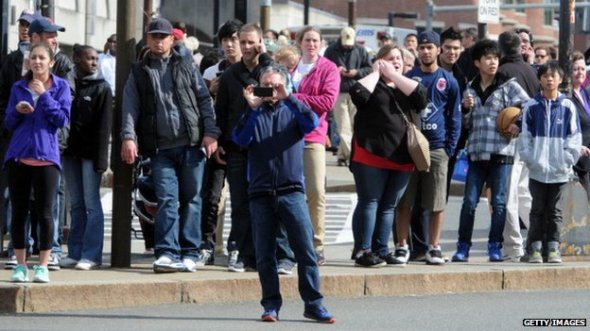
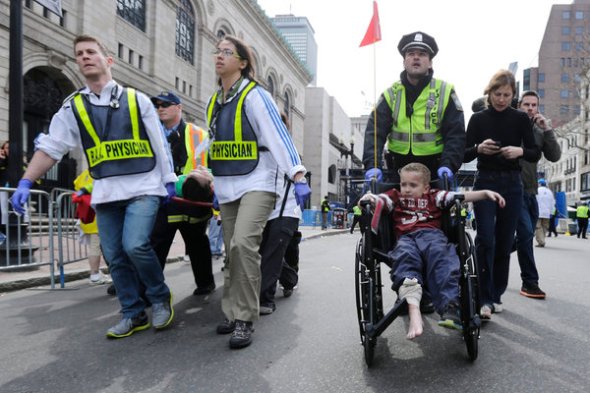
Many of the spectators at the Boston Marathon had cameras on hand
Once again, we’re hearing that the FBI will release photos of persons of interest in the Boston Marathon bombing. One image is a screen grab from a video and the other is a still photo. One image comes from the site of the first explosion and the second comes from the second bombing site.
I’m listening to WBUR right now, and the news conference is just beginning. I’ll add more to this post after I listen to the announcement. If you’re watching on TV, please chime in. I don’t want to miss anything by running in the other room to turn on the TV.
Agent Des Lauriers says these are the only images the public should trust–any others you see on-line or in newspapers are not relevant.
The images can be viewed at the FBI website, which is opening very slowly, unsurprisingly.
Here are two relevant links that I found before the press conference began.
The Boston Globe: Feds using photo analysis in Boston case
USA Today: Investigators to release images of two men near Marathon bomb sites
Here’s the video released by the FBI:
Screen grabs from the FBI website:

FBI Press Conference Video:
From the FBI Website:
To Provide Tips in the Investigation
If you have visual images, video, and/or details regarding the explosions along the Boston Marathon route and elsewhere, submit them on https://bostonmarathontips.fbi.gov/. No piece of information or detail is too small.
You can also call 1-800-CALL-FBI (1-800-225-5324), prompt #3, with information.
All media inquiries should be directed to the FBI’s National Press Office at (202) 324-3691.– Boston FBI
– Boston Police Department
Some information on the victims of the bombings:
The Boston Globe: A list of known victims so far.
Time: The Boston Bombings: Peculiar Benefits of the 9/11 Wars
Within hours of the Boston Marathon bombing Monday, the Navy dispatched a three-member team from Newport, R.I., to try to help to track down the perpetrators. As word spread of multiple amputations among the victims, military doctors agreed that their skills at outfitting troops with prosthetics could help those maimed in Boston.
But beyond that obvious help, the military has learned lessons since 9/11 that are all too applicable in the wake of the Boston bombings.
“Because of the wars in Iraq and Afghanistan, there are many people in the country that are skilled in treating traumatic injuries like amputations and traumatic brain injuries,” Alex Horton, an Iraq-war veteran who now blogs for the VA, noted Tuesday. “Physicians have a larger breadth of knowledge about these injuries than a dozen years ago, and lessons learned from the wars undoubtedly saved many lives in operating rooms in and around Boston.”
In a post on the VA’s Vantage Point blog, Horton noted that many of those first on the scene to tend to the casualties had learned their skills in the wars in Afghanistan and Iraq.
The Boston Globe: 5-year-old boy among Marathon bombing victims who are ‘getting better’ at Boston Medical Center
A 5-year-old boy grievously injured in Monday’s Marathon bombings is getting better, according to Boston Medical Center Chief of Trauma Services Peter Burke, and is no longer listed in critical condition….
The boy suffered soft tissue injuries to his extremities and “significant pulmonary injuries,” Burke said. The pulmonary injuries, he said, were likely caused either by compression from the blast or from being thrown into something. His mother was injured and is at a different hospital.
Burke discussed the similarities between the injuries in Boston and those encountered in Iraq and Afghanistan.
Sixteen patients remain in the hospital, Burke said: one 60-year-old man is still in critical condition, 10 patients are in serious condition and five are in fair condition; doctors expect to reoperate on two patients today. In the past 48 hours, he said, three patients have been discharged.
Doctors at BMC have amputated seven limbs on five patients, he said….
Several patients still require more surgeries, Burke said.
“These injuries are massive and require multiple trips to the operating room sometimes,” said Burke.
If doctors close wounds in one single operation, he said, they risk infection. Instead, wounds must be cleaned several times. Doctors have removed metal and concrete from patients, he said, and infection is one of the biggest concerns.
Patients are also suffering emotional repercussions, including flashbacks of the bombings.
An update: 5-year-old Boston bomb victim no longer critical
Burke says the boy, whose name has not been released, had significant soft tissue injuries and pulmonary injuries. He says a blast can often compress a child’s chest, bruising the lungs and heart. Burke says he’s pleased with the boy’s progress.
ABC News: Boston Marathon Bomber Wanted to Kill ‘as Many People as Possible’
The bombmakers behind the Boston Marathon explosions weren’t looking to scare people, a trauma surgeon with nine years of military experience told ABCNews.com.
They intended to kill, said former Navy surgeon Dr. Gary Schwendig.
“That person or those people did everything they could to create a bomb that damaged and injured as many people as they possibly could,” said Schwendig, who now works at Scripps Health in San Diego.
It won’t be clear for some time how many patients will need to have limbs amputated.
Many victims of the Boston Marathon bombings face possible amputations in the coming days and months, hospitals reported.
Brigham and Women’s Hospital has already performed one amputation, and is working to save another patient’s injured limb. Massachusetts General Hospital has amputated four limbs so far, and is treating two patients who could face amputation in the coming days. At Tufts Medical Center, doctors have not yet performed any full amputations, but four victims have limb-threatening injuries.
A trauma expert in the article says that amputation is often better choice than trying to save a mangled arm or leg. The process of trying to save an extremity can take years and be extremely painful. Even then, amputation may become necessary in the long run.
LA Times: Many Boston victims require limb amputations
It may have lacked the dust and dirt of battlefields in Iraq and Afghanistan, but Monday’s bomb attack on the Boston Marathon produced a number of injuries rarely seen outside of war zones — traumatic limb amputations.
Medicine has made great strides in the reattachment of severed limbs in the last two decades, but the nature of bomb blast injuries makes such repairs impossible.
“The only types of injuries that can be re-implanted are those involving clean separations, like a limb that’s been cut off by a sword or industrial machinery that cleanly cuts the arm or leg off,” said Dr. Jeffrey Eckardt, chairman of the orthopedic surgery department at UCLA. “With an explosion, whole sections of the bone and muscles are gone. Vessels and nerves get pulled and stretched and yanked.”
I’ve been unable to find organized information about how many victims were initially brought in to hospitals in critical condition, but this morning I heard on NPR that 62 victims were still being treated in various Boston area hospitals. Some could have been released today. As of yesterday–two days after the bombings–14 patients were still classified as critical, but all are expected to recover.
Two children are still in critical condition.
An 11-year-old California boy and a 9-year-old girl are in critical condition at Boston Children’s Hospital following the deadly bombings at the Boston Marathon. A 5-year-old boy is in critical condition at Boston Medical Center.
Aaron Hern, of Martinez, Calif., has undergone multiple operations, including three to four hours of surgery on Wednesday to further treat his badly injured leg, including removing shrapnel and damaged tissue. His 12th birthday is May 1.
The 9-year-old girl also has a severe leg injury.
I just found some information on those who have been released from hospitals. (HuffPo) The article gives specifics on how many patients each hospital had and how many are still critical.
Final Note:
As Dakinikat has pointed out to me, all the focus on the events in Boston is probably inappropriate since there are hundreds (thousands?) of worse bombings every day all over the world.
I guess because I live here, I’m inordinately interested in and emotionally involved with the situation, but I realize not everyone is. Of course for people in New England and those who run marathons, these events will signal a dramatic change. As Charles Pierce wrote, Patriots Day and the Boston Marathon will never be the same.
The Marathon was the old, drunk uncle of Boston sports, the last of the true festival events. Every other one of our major sporting rodeos is locked down, and tightened up, and Fail-Safed until the Super Bowl now is little more than NORAD with bad rock music and offensive tackles. You can’t do that to the Marathon. There was no way to do it. There was no way to lock down, or tighten up, or Fail-Safe into Security Theater a race that covers 26.2 miles, a race that travels from town to town, a race that travels past people’s houses. There was no way to garrison the Boston Marathon. Now there will be. Someone will find a way to do it. And I do not know what the race will be now. I literally haven’t the vaguest clue.
I had actually started writing a post on the explosion in Texas, but then the FBI press conference suddenly came up. This will be my last post on the situation here in Boston unless truly dramatic news of national interest breaks.
Thursday Reads
Posted: April 18, 2013 Filed under: Barack Obama, Crime, morning reads, Republican politics, U.S. Politics | Tags: Boston Marathon bombings, Cynthia McLelland, Eric Williams, Gabrielle Giffords, gun control, gun lobby, Joseph Cannon, Mark Hasse, michelle obama, Mick McLelland, Paul Kevin Curtis, ricin terrorism, Texas prosecutors murders, West Texas fertilizer plant explosion 38 Comments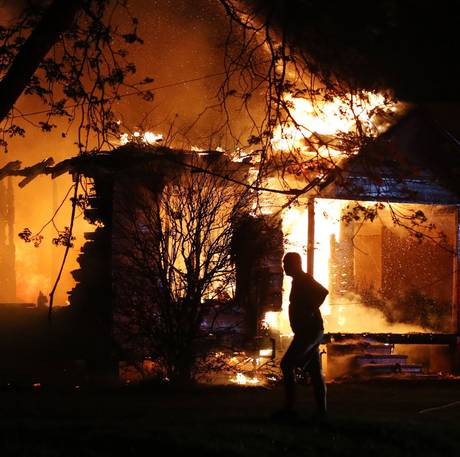
Good Morning!!
Another day, another shocking, violent event. This time it’s the explosion of a fertilizer factory in the tiny town of West, Texas: ‘Like a nuclear bomb’: Deadly fertilizer plant blast devastates Texas town
(CNN) — The full extent of the devastation will have to wait until the light of day Thursday. But residents of the small Texas town of West already know what to expect.
“There are a lot of people that got hurt,” West Mayor Tommy Muska forewarned Wednesday night. “There are a lot of people that will not be here tomorrow.”A massive explosion at a fertilizer plant on the edge of the town killed an estimated five to 15 people, wounded more than 160, leveled dozens of homes and prompted authorities to evacuate half their community of 2,800.
“It was like a nuclear bomb went off,” Muska said. “Big old mushroom cloud.”
The Wednesday night blast shook houses 50 miles away and measured as a 2.1-magnitude seismic event, according to the United States Geological Survey….[F]ire officials fear that the number of casualties could rise as high as 60 to 70 dead, said Dr. George Smith, the emergency management system director of the city.
The photo at the top of this post comes from the Dallas-Ft. Worth Morning News–you can see more photos at that link.
The paper also posted this video of the explosion, apparently taken from inside a truck. Be aware that the video is somewhat disturbing.
From the Houston Chronicle: Crews looking for victims of fertilizer plant blast
WEST — Rescue workers searched rubble that witnesses compared to a war zone early Thursday for survivors of a fertilizer plant explosion in a small Texas town. The blast injured more than 160 people and killed between five and 15. It left the factory a smoldering ruin and leveled buildings for blocks in every direction.
The explosion in downtown West, about 20 miles north of Waco, shook the ground with the strength of a small earthquake and could be heard dozens of miles away. It sent flames shooting into the night sky and rained burning embers, shrapnel and debris down on shocked and frightened residents.
“They are still getting injured folks out and they are evacuating people from their homes,” Waco police Sgt. William Patrick Swanton said early Thursday morning. “At this point, we don’t know a number that have been killed. … I think we will see those fatalities increase as we get toward the morning.”
Among those believe to be dead: A group of volunteer firefighters who responded to a fire call at the West Fertilizer Co. about an hour before the blast. They remained unaccounted for overnight.
The explosion that struck around 7 p.m. leveled a four-block area around the plant that a member of the city council, Al Vanek, said was “totally decimated.” Other witnesses compared the scene to that of the 1995 Oklahoma City bombing, and authorities said the plant made materials similar to that used to fuel the bomb that tore apart that city’s Murrah Federal Building.
Although authorities said it will be some time before they know the full extent of the loss of life, they put the number of those injured at more than 100. West Mayor Tommy Muska told reporters that his city of about 2,800 residents needs “your prayers.”
I’m sure we’ll learn much more about this story in the course of the day today.

Eric and Kim Williams
In another shocking Texas story, the wife of former Kaufman County Justice of the Peace Eric Williams whom I wrote about on Sunday has confessed to her involvement in the murders of Texas prosecutors Mark Hasse and Mike McLelland and McLelland’s wife Cynthia. The NYT reports:
KAUFMAN, Tex. — The mystery of who shot and killed two prosecutors this year clouded life in this rural county southeast of Dallas for more than two months, with investigators delving into possible leads that led to white-supremacist groups and Mexican drug cartels.
But in the end, it apparently came down to a bitter local grudge. A former justice of the peace whose legal and political career collapsed in a hard-fought legal battle was accused Wednesday of killing the two prosecutors, who had been his courtroom rivals. And his wife not only named him as the gunman, but also confessed to having been the driver in both shootings as part of her role in the vendetta, the authorities said….
The two prosecutors that the authorities say the couple conspired to kill had helped convict Mr. Williams last year on burglary and theft charges in a dispute about three computer monitors worth less than $1,500. The Williamses — he a portly, diabetic lawyer who volunteered with the Texas State Guard; she his ailing yet supportive wife of 15 years — were accused of pulling off what even ruthless criminal organizations have rarely dared in modern times: the executions of two prosecutors, and the wife of one, to avenge a guilty verdict….
According to an affidavit filed by the authorities, Ms. Williams confessed to her involvement in the shootings in an interview with investigators on Tuesday, and told them that her husband had been the one who shot Mr. Hasse in January and Mr. McLelland and his wife in March.
During her interview, [Kim Lene Williams] supplied investigators with details of both shootings that had not been made public. One law enforcement official confirmed that Ms. Williams was not a gunman in the murders, but had been the driver, and had also used the storage unit where Mr. Williams had kept a car and more than 20 guns.
Yesterday Joseph Cannon dug up some amazing information on Paul Kevin Curtis, who has been arrested for sending letters that tested positive for ricin to President Obama and other government leaders, and today the mainstream media is catching up. The gist is that Curtis claim to have uncovered a plot to harvest and self human body parts at a hospital in a hospital in Tupelo, Mississippi.
Basically, he says that he (almost literally) stumbled upon evidence that the Medical Center was involved in the illegal organ trade. He also says that his attempts to expose the problem led to retaliatory action:
I have no faith left in the Mississippi Justice system. I feel my coming forward with my story and releasing it to news media all over the USA in 2001 has helped expose the illegal body parts and organ trade market world-wide.I personally sent out more than a million emails in one year detailing what happened to me when I found the body parts at NMMC. In 2004, 4 arrests were made in New York City. In 2006, another illegal body parts scam was discovered in North Carolina. I am confident that although no local media has agreed to put in print what happened to me in Tupelo or the trigger-happy, intoxicated assistant DA, I know in my heart that my coming forward has brought national attention to this terrible and illegal black market.
This is Kevin Curtis and I approve this report.
Read all about it at Cannonfire.

Kevin Curtis
Also at Time, Michael Crowley writes about the history of ricin terrorism.
To be clear, ricin is no laughing matter. The toxic compound, which can be extracted from widely available castor beans with relative ease, is lethal in tiny quantities. In a John le Carré–style plotline, a pellet of ricin deployed with a jab from a pointed umbrella tip killed the Bulgarian dissident Georgi Markov in 1978. If ingested, inhaled or absorbed through the skin, ricin can cause vomiting, bloody urine and seizures, then massive organ failure. It has no antidote.
Hence its appeal to some nasty characters. Saddam Hussein tried to weaponize it in large quantities. Al-Qaeda’s Yemen affiliate has worked to produce ricin, and the organization’s online English-language Inspire magazine touted the substance to aspiring lone-wolf terrorists in America who “possess basic scientific knowledge.”
There have actually been several domestic ricin plots in recent years, none involving jihadists and most the work of antigovernment radicals. Not that any have come close to executing a successful attack: in late 2011, for example, federal agents arrested four Georgia men with militia ties whose plans included bombmaking and killing government officials with ricin. “This is worse than anthrax,” one of them reportedly boasted. “There ain’t no cure for it either.” The men, all in their 60s and 70s, were busted before they even began brewing the substance, whichexperts said they likely would have been unable to use on the mass scale of their imagination anyway.
Read more at the Swampland blog link.
In Boston, officials say they have
isolated images of a suspect carrying and perhaps dropping a black bag believed to have held one of two bombs that exploded 12 seconds apart Monday near the finish line of the historic race, said an official briefed on the investigation.
Authorities were “very close” Wednesday in their pursuit of the bomber, said the official, who declined to be named.
A surveillance camera at the Lord & Taylor store, across Boylston Street from the Forum restaurant where the second bomb exploded, has provided video of the area, though it was unclear whether the image of the suspect came from that camera, the official said….
A second person briefed on the investigation indicated that the image may have come from a cellphone.
President Obama and First Lady Michelle Obama are is in Boston today to attend and interfaith service in honor of the victims of the bombings at the Boston Marathon.
President Obama will speak at an interfaith prayer service to honor victims of the Boston Marathon bombings Thursday morning at the Cathedral of the Holy Cross.
Titled “Healing Our City,” the service begins at 11 a.m. at the cathedral, on Washington Street in Boston’s South End. The renowned cellist Yo-Yo Ma will perform, and clergy from different faiths will offer readings, prayers, and reflections.
“A violent and cruel intrusion like the bomb blast sends people scattering, and it’s terrorizing,” said the Rev. Nancy Taylor, senior minister of Old South Church, who will speak at the service. “The coming together is creating a space of unity and community in defiance of that kind of cruelty and violence.”
Four former governors will attend, Governor Deval Patrick said: Mitt Romney, William F. Weld, Michael S. Dukakis, and Jane M. Swift.
Traffic will be hell on earth, and I plan to say in my own neighborhood today and avoid it.

Gabby Giffords
I’ll end with Gabriel Giffords’ op-ed, published in today’s NYT: A Senate in the Gun Lobby’s Grip
SENATORS say they fear the N.R.A. and the gun lobby. But I think that fear must be nothing compared to the fear the first graders in Sandy Hook Elementary School felt as their lives ended in a hail of bullets. The fear that those children who survived the massacre must feel every time they remember their teachers stacking them into closets and bathrooms, whispering that they loved them, so that love would be the last thing the students heard if the gunman found them.
On Wednesday, a minority of senators gave into fear and blocked common-sense legislation that would have made it harder for criminals and people with dangerous mental illnesses to get hold of deadly firearms — a bill that could prevent future tragedies like those in Newtown, Conn., Aurora, Colo., Blacksburg, Va., and too many communities to count.
Some of the senators who voted against the background-check amendments have met with grieving parents whose children were murdered at Sandy Hook, in Newtown. Some of the senators who voted no have also looked into my eyes as I talked about my experience being shot in the head at point-blank range in suburban Tucson two years ago, and expressed sympathy for the 18 other people shot besides me, 6 of whom died. These senators have heard from their constituents — who polls show overwhelmingly favored expanding background checks. And still these senators decided to do nothing. Shame on them.
I watch TV and read the papers like everyone else. We know what we’re going to hear: vague platitudes like “tough vote” and “complicated issue.” I was elected six times to represent southern Arizona, in the State Legislature and then in Congress. I know what a complicated issue is; I know what it feels like to take a tough vote. This was neither. These senators made their decision based on political fear and on cold calculations about the money of special interests like the National Rifle Association, which in the last election cycle spent around $25 million on contributions, lobbying and outside spending.
Read the rest at the Times.
There sure has been an awful lot of awful news this week so far. What else is happening? Please let us know what’s on your mind in the comments. Take care today, everyone!
Tax Day, Oklahama City, the Atlanta Olympics and the Return of the Ricin Letters
Posted: April 17, 2013 Filed under: Breaking News | Tags: bombers, breaking news, Lone Wolf Killers, ricin letters 87 Comments The Lone Wolf has long been a literary and movie character type. I always think of the old spaghetti westerns–like High Plains Drifter–and Clinton Eastwood. The Lone Wolf is a popular Manga character in Japan too. He’s a samurai that has a lot in common with Eastwood’s scruffy cowboy in poncho persona. The Lone Wolf in the criminal justice system has come to represent more of a pathetic, extremely disturbed man that kills people in an attempt to make some kind of statement. You can think Eric Rudolph–the Clinic and Olympics bomber–when you think of this profile. The last big Lone Wolf killer who did serious damage was the Sikh Mosque shooter.
Wade Michael Page, the alleged killer, according to multiple news sources was a 40 year old Army veteran with a hate symbol tattoo who received a demotion and a less than honorable discharge from the military in 1998 for “patterns of misconduct” according to CNN after six years of service, finishing up at Fort Bragg, North Carolina. Disgruntled military veteran killers like Nidal Hassan (who was in the Army), Holocaust Museum shooter James von Brunn, Olympic and clinic bomber Eric Robert Rudolph as well as executed Oklahoma City Bomber Timothy McVeigh and D.C. Sniper John Allen Muhammad (the latter two had accomplices), have led many to mechanistically conclude that military service is part of a profile of loner extremists.
The real story is far more complex, as it is more likely that a first responder or victim to a mass shooting will be a military veteran than the shooter. Irrespective of their military status, these kind of killers are often depressed, socially and psychologically itinerant adult males whose significant and defining life setbacks in career or relationships create a festering anger that explodes into violence against a symbolic target. These targeted locations and innocent people are the sincere focus of aggression in the contorted thinking of someone whose anger and belief system leads them to settle a score and reaffirm their self worth by achieving notoriety through violence. A violent act transforms them from losers to warriors for a cause that is bigger than they are, and they are hitting back, not only on behalf of themselves, but for others who faced similar unfairness from an uncaring society.
The three main categories of extremist aggressors are listed below, and usually one is the primary element with an offender, with at least one other playing a secondary supporting role:
. The Ideologically Motivated (Religious, Political or Hybrid)
. The Psychologically Dangerous (Sociopath or Cognitively Impaired)
. Personal Benefit or Revenge
Two significant stories are developing this afternoon. The first is that the bomb types used by the Boston Bomber are thought to be of the type most used by a lone wolf killer.
The devices used in the Boston Marathon attack Monday are typical of the “lone wolf:” the solo terrorist who builds a bomb on his own by following a widely available formula.
In this case, the formula seems very similar to one that al Qaeda has recommended to its supporters around the world as both crudely effective and difficult to trace. But it is also a recipe that has been adopted by extreme right-wing individuals in the United States.
The threat of the “lone wolf” alarms the intelligence community.
“This is what you worry about the most,” a source with knowledge of the investigation told CNN’s Chief Political Analyst Gloria Borger. “No trail, no intelligence.”
Officials have told CNN that among the materials used in the attack on the marathon were some sort of timing device, a basic mixture of explosives and some sort of metal container containing nails and other projectiles. The FBI said late Tuesday that what appeared to be fragments of ball bearings, or BBs, and nails had been recovered and had possibly been contained in a pressure cooker.
One federal law enforcement source told CNN’s Deborah Feyerick the devices contained “low-velocity improvised explosive mixture — perhaps flash-powder or sugar chlorate mixture likely packed with nails or shrapnel.”
An explosives expert told CNN the yellowness of the flame probably came from carbon or some organic fuel such as sugar that contains it. The expert, who is frequently consulted by the FBI and other government agencies, said the white smoke made it “unlikely that a military-grade high explosive, such as those used in shells and bombs, which is usually grey or black, was used.”
U.S. Rep. Mike McCaul, chairman of the House Homeland Security Committee, said “most likely gun powder” was used in the devices.
The breaking news this morning is that President Obama has received a Ricin-laced letter. Two other Washington Congressional members also received letters. The Senate Building is being evacuated because of a number of suspicious packages.
Authorities said Wednesday they had intercepted a letter to the White House that tested positive for ricin poison.
The Secret Service acknowledged the letter addressed to President Obama contained a suspicious substance, and the FBI later said tests showed it was ricin, the same deadly poison sent in a letter addressed to Sen. Roger Wicker (R-Miss.). The Wicker letter was made public on Tuesday.
The Secret Service said the letter was sent to Obama on April 16 and was discovered at an remote White House mail screening facility.”This facility routinely identifies letters or parcels that require secondary screening or scientific testing before delivery,” the Secret Service said in a statement. “The Secret Service White House mail screening facility is a remote facility, not located near the White House complex, that all White House mail goes through.”
The agency said it is working closely with the U.S. Capitol Police and the FBI in the investigation.
White House press secretary Jay Carney said Obama had been briefed twice on the investigation. “He was briefed last night and again this morning,” Carney said.
 They may have a man in mind for these letters.
(UPDATE 12:00 p.m. ET)
Capitol Hill Police are questioning a man with a backpack in the area of the Hart Senate Office Building. He raised suspicions with the contents of his backpack and the way he responded to police questions, two Capitol Hill police officers told CNN. The man’s backpack contained sealed envelopes, one of the officers said. The backpack is being X-rayed, one of the officers said.(POSTED 11:43 a.m. ET)
U.S. Capitol Police are evacuating the first floor of the Hart Senate Office Building due to a suspicious package. People on other floors of the building are being told to go into their offices. Separately, there is a suspicious envelope at the office of Sen. Richard Shelby of Alabama, in the Russell Senate Office Building. Security has cleared the hall but is not officially evacuating.
It drives me nuts that so many whacked political right wingers immediately jump on the islamic conspiracy bandwagon for events like these. It’s so bad that some poor Saudi who was a victim of the Boston Bomber was tackled while he was injured. Right Wing paranoia blogs began to publish the poor guys name as a possible suspect when he was being questioned by the FBI as a witness. All you have to do is read the ratfucker blogs and the crazy go nutters like Geller to see how some of these lone wolves get their paranoia juiced.
A twenty-year-old man who had been watching the Boston Marathon had his body torn into by the force of a bomb. He wasn’t alone; a hundred and seventy-six people were injured and three were killed. But he was the only one who, while in the hospital being treated for his wounds, had his apartment searched in “a startling show of force,” as his fellow-tenants described it to the Boston Herald, with a “phalanx” of officers and agents and two K9 units. He was the one whose belongings were carried out in paper bags as his neighbors watched; whose roommate, also a student, was questioned for five hours (“I was scared”) before coming out to say that he didn’t think his friend was someone who’d plant a bomb—that he was a nice guy who liked sports. “Let me go to school, dude,” the roommate said later in the day, covering his face with his hands and almost crying, as a Fox News producer followed him and asked him, again and again, if he was sure he hadn’t been living with a killer.
Why the search, the interrogation, the dogs, the bomb squad, and the injured man’s name tweeted out, attached to the word “suspect”? After the bombs went off, people were running in every direction—so was the young man. Many, like him, were hurt badly; many of them were saved by the unflinching kindness of strangers, who carried them or stopped the bleeding with their own hands and improvised tourniquets. “Exhausted runners who kept running to the nearest hospital to give blood,” President Obama said. “They helped one another, consoled one another,” Carmen Ortiz, the U.S. Attorney for Massachusetts, said. In the midst of that, according to a CBS News report, a bystander saw the young man running, badly hurt, rushed to him, and then “tackled” him, bringing him down. People thought he looked suspicious.
What made them suspect him? He was running—so was everyone. The police reportedly thought he smelled like explosives; his wounds might have suggested why. He said something about thinking there would be a second bomb—as there was, and often is, to target responders. If that was the reason he gave for running, it was a sensible one. He asked if anyone was dead—a question people were screaming. And he was from Saudi Arabia, which is around where the logic stops. Was it just the way he looked, or did he, in the chaos, maybe call for God with a name that someone found strange?
We simply cannot deal with the idea that we have a culture that seems to breed these very angry and disturbed men. Most of them appear to be heavily anti-government and focused on stockpiling weapons of all kinds. They bear many grudges. Of course, Norway just had its own Lone Wolf that shot up a bunch of teenagers at a summer camp but the US gets more than its share and they have easy access to horrible weapons here. The most scary things about the Lone Wolf Killer is that there is usually no way to unmask him until he has done a hell of a lot of damage.
There are some good sources to read about this phenomenon.
The Dumb Math Error Heard ‘Round the World
Posted: April 16, 2013 Filed under: Austerity, U.S. Economy | Tags: austerity fail, math fail, Reinhart & Rogoff (2010) 47 Comments Rarely has any one study had such an immediate impact on global policy. Usually, folks wait until a study is replicated and put through robust follow-up before any one takes research to heart. Reinhart & Rogoff (2010) basically played into the narrative of the plutocracy and what the ‘very serious people’ around the world wanted. So, its significant findings were taken very seriously before all those secondary tests of robustness and such were undertaken. Well, now we find out the wunderkind study that justified a lot of unnecessary austerity has some serious math mistakes. I’m still reading through all the criticisms but, as Krugman puts it “Holy Coding Error, Batman”! Let’s just call this some serious MATH FAIL!
The intellectual edifice of austerity economics rests largely on two academic papers that were seized on by policy makers, without ever having been properly vetted, because they said what the Very Serious People wanted to hear. One was Alesina/Ardagna on the macroeconomic effects of austerity, which immediately became exhibit A for those who wanted to believe in expansionary austerity. Unfortunately, even aside from the paper’s failure to distinguish between episodes in which monetary policy was available and those in which it wasn’t, it turned out that their approach to measuring austerity was all wrong; when the IMF used a measure that tracked actual policy, it turned out that contractionary policy was contractionary.
The other paper, which has had immense influence — largely because in the VSP world it is taken to have established a definitive result — was Reinhart/Rogoff on the negative effects of debt on growth. Very quickly, everyone “knew” that terrible things happen when debt passes 90 percent of GDP.
Some of us never bought it, arguing that the observed correlation between debt and growth probably reflected reverse causation. But even I never dreamed that a large part of the alleged result might reflect nothing more profound than bad arithmetic.
The best explanation of the problem that I’ve seen comes from Mike Konczal at RortyBomb.
In 2010, economists Carmen Reinhart and Kenneth Rogoff released a paper, “Growth in a Time of Debt.” Their “main result is that…median growth rates for countries with public debt over 90 percent of GDP are roughly one percent lower than otherwise; average (mean) growth rates are several percent lower.” Countries with debt-to-GDP ratios above 90 percent have a slightly negative average growth rate, in fact.
This has been one of the most cited stats in the public debate during the Great Recession. Paul Ryan’s Path to Prosperity budget states their study “found conclusive empirical evidence that [debt] exceeding 90 percent of the economy has a significant negative effect on economic growth.” The Washington Post editorial board takes it as an economic consensus view, stating that “debt-to-GDP could keep rising — and stick dangerously near the 90 percent mark that economists regard as a threat to sustainable economic growth.”
Is it conclusive? One response has been to argue that the causation is backwards, or that slower growth leads to higher debt-to-GDP ratios. Josh Bivens and John Irons made this case at the Economic Policy Institute. But this assumes that the data is correct. From the beginning there have been complaints that Reinhart and Rogoff weren’t releasing the data for their results (e.g. Dean Baker). I knew of several people trying to replicate the results who were bumping into walls left and right – it couldn’t be done.
In a new paper, “Does High Public Debt Consistently Stifle Economic Growth? A Critique of Reinhart and Rogoff,” Thomas Herndon, Michael Ash, and Robert Pollin of the University of Massachusetts, Amherst successfully replicate the results. After trying to replicate the Reinhart-Rogoff results and failing, they reached out to Reinhart and Rogoff and they were willing to share their data spreadhseet. This allowed Herndon et al. to see how how Reinhart and Rogoff’s data was constructed.
They find that three main issues stand out. First, Reinhart and Rogoff selectively exclude years of high debt and average growth. Second, they use a debatable method to weight the countries. Third, there also appears to be a coding error that excludes high-debt and average-growth countries. All three bias in favor of their result, and without them you don’t get their controversial result.
Whenever you model a system, you have to make some assumptions going in. These assumptions–coupled with the coding error–basically show the statistician’s slight of hand. You can prove just about everything and anything with numbers if you manipulate the data enough. The UMAss-Amherst professor et al has really pulled the curtain away from the big green talking head this time. Here’s the abstract.
Herndon, Ash and Pollin replicate Reinhart and Rogoff and find that coding errors, selective exclusion of available data, and unconventional weighting of summary statistics lead to serious errors that inaccurately represent the relationship between public debt and GDP growth among 20 advanced economies in the post-war period. They find that when properly calculated, the average real GDP growth rate for countries carrying a public-debt-to-GDP ratio of over 90 percent is actually 2.2 percent, not -0:1 percent as published in Reinhart and Rogo ff. That is, contrary to RR, average GDP growth at public debt/GDP ratios over 90 percent is not dramatically different than when debt/GDP ratios are lower.
The authors also show how the relationship between public debt and GDP growth varies significantly by time period and country. Overall, the evidence we review contradicts Reinhart and Rogoff ’s claim to have identified an important stylized fact, that public debt loads greater than 90 percent of GDP consistently reduce GDP growth.
Shorter Abstract: They REALLY screwed the pooch.
So, there’s now this bigger problem out there which is the very serious people that are crashing economies based on a set of very biased assumptions and a very serious coding error. To put that in a more politically correct way: How Much Unemployment Was Caused by Reinhart and Rogoff’s Arithmetic Mistake? Followed by, will the very serious people correct their very serious policy errors now?
This is a big deal because politicians around the world have used this finding from R&R to justify austerity measures that have slowed growth and raised unemployment. In the United States many politicians have pointed to R&R’s work as justification for deficit reduction even though the economy is far below full employment by any reasonable measure. In Europe, R&R’s work and its derivatives have been used to justify austerity policies that have pushed the unemployment rate over 10 percent for the euro zone as a whole and above 20 percent in Greece and Spain. In other words, this is a mistake that has had enormous consequences.
In fairness, there has been other research that makes similar claims, including more recent work by Reinhardt and Rogoff. But it was the initial R&R papers that created the framework for most of the subsequent policy debate. And HAP has shown that the key finding that debt slows growth was driven overwhelmingly by the exclusion of 4 years of data from New Zealand.
If facts mattered in economic policy debates, this should be the cause for a major reassessment of the deficit reduction policies being pursued in the United States and elsewhere. It should also cause reporters to be a bit slower to accept such sweeping claims at face value.
I spent most of Monday’s Morning Reads showing the current US economic data that shows that the deficit and debt of the US are melting like the wicked witch under that bucket of water. I worry any more deficit reduction will throw our economy into recession and pave the way for Republican take over of the Senate. However, the big green talking heads have been ignoring the data and just about everything else that a legion of economists have said citing this one–now clearly known to be flawed–study. As Krugman mentioned in his blogs, their results was counter-intuitive and controversial among economists from day one of publication. Policymakers through out Europe and the US gratuitously ignored all that because the questions did not fit their plan to push the mistakes of banks on a lot of hapless citizenry.
This is literally the most influential article cited in public and policy debates about the importance of debt stabilization, so naturally this is going to change everything.
Or, rather, it will change nothing. As I’ve said many times, citations of the Reinhart/Rogoff result in a policy context obviously appealing to a fallacious form of causal inference. There is an overwhelming theoretical argument that slow real growth will lead to a high debt:GDP ratio and thus whether or not you can construct a dataset showing a correlation between the two tells us absolutely nothing about whether high debt loads lead to small growth. The correct causal inference doesn’t rule out causation in the direction Reinhart and Rogoff believe in, but the kind of empirical study they’ve conducted couldn’t possibly establish it. To give an example from another domain, you might genuinely wonder if short kids are more likely to end up malnourished because they’re not good at fighting for food or something. A study where you conclude that short stature and malnourishment are correlated would give us zero information about this hypothesis, since everyone already knows that malnourishment leads to stunted growth. There might be causation in the other direction as well, but a correlation study woudn’t tell you.
The fact that Reinhart/Rogoff was widely cited despite its huge obvious theoretical problems leads me to confidently predict that the existence of equally huge, albeit more subtle, empirical problems won’t change anything either. As of 2007 there was a widespread belief among elites in the United States and Europe that reductions in retirement benefits were desirable, and subsequent events regarding economic crisis and debt have simply been subsumed into that longstanding view.
The very serious policymakers were looking for any justification for their austerity pogrom. This is mainly because German taxpayers and pols don’t want to be on the hook for what German and US bankers did around the Eurozone. It is also because Republican law makers and their plutocratic overlords–like the Dr. Strangelove of Wall Street Pete Peterson–don’t want any funds floating around anywhere that could possibly find residency in their fee-churning ponzi schemes of investment funds.
It is not unusual, unfortunately, for some academics to neatly choose assumptions to drive results towards their hypothesis. That is why peer review is extremely important. Nearly every major study done using empirical data should be easily replicated. It is usual for the authors to share their database and R&R obliged on this matter. But, this emphasizes why major studies with major findings that don’t fit snugly with the current body of theory should undergo robust challenge. Many economists had challenged the findings back in 2010 and the fact that some felt compelled to repeat their research indicated a healthy level of skepticism which is the hallmark of good research and researchers.
What is most disturbing about this is that agendas that drive the interests of a few start to reflect these theories-in-process. R&R 2010 fit the gross ambitions of people that were less concerned about truth than philosophy and ability to drive policy that basically is at odds with everything we’ve known about fiscal policy. So, this takes us back to Matt’s question. There is incredible discussion on this in nearly all economics and finance blogs and circles. Will these findings engender the same discussion and any course correction of the very serious people that used this very serious paper to do some very serious damage around the world.
I know it’s too much to hear those wonderful words ” We were wrong” on top of some course corrections. But, hey it’s not too late for our President to give up the debt and deficit hysteria or is it?
Live Blog #3 Boston Marathon Bombings
Posted: April 15, 2013 Filed under: Crime, open thread | Tags: Boston Marathon bombings, Patriots Day, terrorism 44 Comments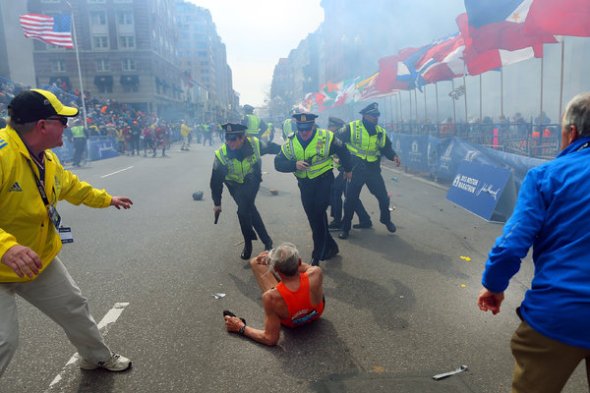
I thought I’d put up one more thread, since the last one has so many comments. Feel free to talk about other topics if you want.
One interesting report from The New York Times. an unexploded bomb was found in Newton, which is a suburb Southwest of Boston.
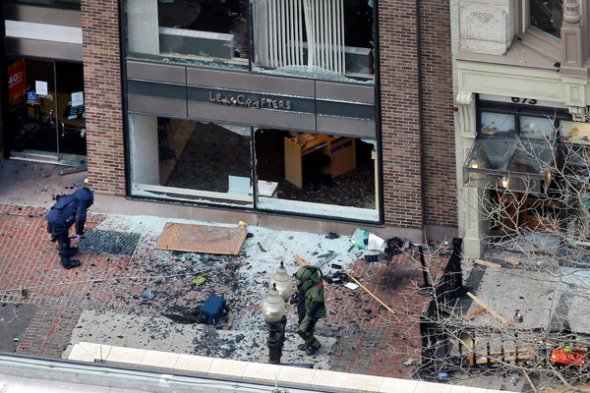
Police officials said they did not yet have any suspects in custody. A person briefed on preliminary developments in the investigation said that members of Boston’s Joint Terrorist Task Force were at Brigham and Women’s Hospital interviewing a wounded man seen running from the scene of the two blasts, near 671 Boylston Street. The person said that police investigators had contacted the local gas and electric company and determined that the explosions were not related to gas or electrical service.
The authorities also found a device at St. James and Trinity Streets that did not explode, the person said, and two other devices were found, including one in Newton, outside of Boston.
The Mandarin, Marriott and Lenox hotels were evacuated because of reports of suspicious packages, but no confirmed explosive devices have yet been found at those hotels.
The person also said that the maritime security level in Boston was raised from level one to level two; three is the highest level.
“We’re treating this as an ongoing event at this time,” Edward F. Davis, Boston’s police commissioner, said at a late afternoon news conference.

 peej
peej Carissa
 bostonboomer
 dakinikat
 ecocatwoman
 mablue2
 Mama Lopez
 peggysue22
 quixote
 skydancingguestblogger
 Mona (aka Wonk the Vote)



 Sky Dancing
Recent Comments