
Monday Reads
Posted: March 11, 2013 Filed under: morning reads | Tags: Etiquette in the digital age, Hunger Epidemic in America, presidential power grabs and scandals, rape, sexual assault, Steubenville Rape Trial, violence against women, Zerlina Maxwell 56 Comments Good Morning!
I’m afraid if you’re looking for a cheery Monday morning set of reads that I am not going to fill your bill today.
I’m not sure if you’ve been following the story of Zerlina Maxwell who suggested that we consider teaching men not to rape since we’ve got so many incidences of rape in so many places here and around the world. This is a timely question given the awful Steubenville Rape Trial that is scheduled to start today in Ohio. In many ways, the videos and tales from Steubenville show that rapists are more common than the psychopathic sexual predator that many want to conjure up to gloss over the problems we with have with rampant male entitlement. Get ready for this week in rape culture and apologia. It will be coming to media near you.
With the trial scheduled to start this week and after a judge refused to change the trial location, officials are again prepping for the glare of the media spotlight to descend on the town.
In a press conference last week, DeWine told reporters that additional charges may be brought against the other teenagers after this trial concludes. He estimated the case would last between three to four days.
DeWine also met with protesters lead by Jacqueline Hillyer of the Ohio chapter of the National Organization of Women, who called for the arrest of Nodianos and the other teens involved for failing to report a crime.
“The worst thing about the crime in Steubenville and it was a crime, it was not that it was so ugly and horrible and disgusting but that it was ordinary,” Hillyer said. “It happens all the time across the state, across the country in high schools and people don’t intervene.”
Rape is all too ordinary. So, to many of us, Maxwell asks a legitimate question. She even braved Hannity–the patron saint of white male entitlement–to begin a conversation on why rape is so pervasive and how we might try telling boys that it’s not okay to rape girls instead of telling girls to be in a constant state of alert and fear. She got way more than she bargained as a result.
As Maxwell, a rape survivor herself, told Salon on Friday, “I don’t think we need to be telling a rape survivor that statistics are not on your side. That’s insensitive.” But where she drew outrage was in her suggestion to Hannity that “I don’t think that we should be telling women anything. I think we should be telling men not to rape women and start the conversation there.” She told Hannity, “You’re talking about this as if it’s some faceless, nameless criminal, when a lot of times it’s someone you know and trust,” adding, “If you train men not to grow up to become rapists, you prevent rape.”
The mere notion that maybe men need to be involved in the conversation about sexual violence earned Maxwell instant disdain, anger – and a lot worse. The Blaze called her remarks “bizarre” and the Washington Times reported that she’d “argued against women arming themselves.” Deeper down on the Internet, the responses got even more scathing, from bloggers who said she’d been “oversimplifying” to the Twitter trolls who told her she ought to get raped. Thanks for the feedback, Internet dopes. Why would anybody think that you need some sensitivity training?
“I knew going in I was going to get a lot of pushback,” Maxwell says. “I didn’t think I would receive rape threats. I can’t even go on my Facebook page; it’s full of people wanting to rape me. It’s too triggering. The amount of insensitivity is shocking.”
As Maxwell tells Salon, her point to Hannity was not about self-defense; it was about how we look at the big picture. “Telling every woman to get a gun is not rape prevention,” she explains. “The reality is that we need to be changing how we train and teach young men. We need to teach them to see women as human beings and respect their bodily autonomy. We need to teach them about consent and to hold themselves accountable.” And when we do, things change. After Canada launched a “Don’t be that guy” consent awareness campaign in 2011, the sexual assault rate dropped for the first time in years — by 10 percent.
There’s a basic problem with the argument that Hannity made which is essentially a similar statement made by the victim’s father in  Steubenville. The father said
“I’ve tried to show my girl that not all men are like this, but only a despicable few,” and their mothers that ignore the truth that they gave birth to a monster”
while Hannity told Maxwell that “evil exists in the world”. I don’t think mothers give birth to monsters. I think most cultures teach men that women and children are prey and property and can be brought into control in whatever ways it takes.
One in three women will be raped in her life time. Rape is all too ordinary.
I suppose I should backstory this by letting you know that I’ve never been raped by a stranger but I sure as hell have had to fight off bosses and high school and college peers to varying degrees. I am not a rape survivor. I’m a girl who got lucky many times. I was ‘volunteered’ by a Junior League neighbor when I was a junior in high school for a rape and violence line they were establishing in Omaha. There were very few things like that at the time. It’s now a major program staffed with professionals. The program resides with the local YWCA. Back then, it was a few psychologists and concerned women. They got volunteers where they could and trained us with what little they had.
Two years of answering that phone one night a week morphed me into an advocate for changing rape laws by the time I got to university. By that time, I fully understood the threat of date and acquaintance rape. We succeeded in getting most Nebraska police departments to take officers responding to rape out of the property crimes division and asked for trained, women police officers. Sex crimes are now properly placed into the major crimes divisions. We also got the law changed so that a women married to her rapist could be legally recognized a a victim. We fought the clause that said two people had to witness the rape and testify in order for it to be ‘rape rape’. We also worked to block a woman’s previous sexual history as well as things like where she was or what she was wearing or had been eating or drinking.
Then there were changes that had to be made by the hospital and police responses to rape victims too. I remember when one of my friends got raped by a stranger on campus. She told me she thought she couldn’t report it because she’d been smoking pot before she was ambushed in the library by this criminal. She was afraid no one would take her seriously. I told her hell no and let’s call a police woman right now. But, of all the times I went to speak about rape at high schools and sororities, it became apparent to me what is apparent in the numbers. The majority of women are not raped by ski-masked, gun wielding strangers that could be taken care of with the careful aim of the right caliber of gun. I learned that was a myth of the old west about 40 years ago. I still want to strangle any one that says women make up rapes or ask for it. It’s obvious there needs to be some education out there otherwise this crap would go away instead of showing up in US Senator debates and on major news shows.
No one would ever blame a man for being the victim of a burglary or hold up. But, our rape culture gives many folks the idea that women are always at least partially to blame for the aggressive sexual behavior of men. No matter how old we get, how dowdy we dress, or how careful we are about the locks on our doors or where we park, the fear and danger is there. It’s not about our behavior, it’s about theirs.
Think about what kinds of things we teach children not to do via school. These things include not engaging in consensual sex, not stealing, not fighting, and a lot of other things. Check out these statistics on sexual assault and tell me it’s not a pervasive problem in this country. Many children–of both sexes–are not even safe in their homes, churches, or social groups. Anyway, I know that we have many rape survivors here whose stories are more compelling than anything I could write. It’s just that it’s going to be a week of watching this trial and listening to the same old canards. I’m prepackaging my hugz already because I’m aware that were going to hear rape apologia along with the facts of the case.
Anyway, if you want to see how cruel the world can be to victims of crime, here’s a look at some of Maxwell’s twitter stream via TPM. It’s awful beyond words. That she’s a rape survivor makes it more than awful beyond words.
So, here’s a few other things that you might want to read this morning that are slightly less traumatizing.
This is a compelling article on punditry and presidential scandal by Robert Parry.
A favorite saying of Official Washington is that “the cover-up is worse than the crime.” But that presupposes you accurately understand what the crime was. And, in the case of the two major U.S. government scandals of the last third of the Twentieth Century – Watergate and Iran-Contra – that doesn’t seem to be the case.
Indeed, newly disclosed documents have put old evidence into a sharply different light and suggest that history has substantially miswritten the two scandals by failing to understand that they actually were sequels to earlier scandals that were far worse. Watergate and Iran-Contra were, in part at least, extensions of the original crimes, which involved dirty dealings to secure the immense power of the presidency.
There’s an amazing piece of cinema out on America’s Hunger Epidemic called ‘A Place at the Table’. It couldn’t be more timely given the impact of the sequester on basic programs like WIC. I watched it On Demand so I’m sure it’s probably there for you too if you have access to that or some other on-line movie source.
Table’s statistics are overwhelming, but they are intended to overwhelm. Whether it’s the 50 million Americans who are living in food-insecure households (which means they are struggling with hunger), or the fact that 1-out-of-2 kids in America will, at some time in their childhood, have to rely on federal assistance for food. This is happening in the richest country in the world, and the problem is only getting worse. Under President Reagan there were 20 million Americans living with food insecurity. We’re well over double that figure now.
Table’s stories will overwhelm too. Whether it’s the fifth grader who is so hungry that she envisions her teacher as a banana and her fellow students as apples, or the single mother of two who finally gets a fulltime job only to realize that she is no longer food stamp eligible, a loss of $3-per-day that puts her family into serious food insecurity. That means her kids no longer have breakfast or lunch at daycare, and her youngest is already developmentally disabled due to improper nutrition. Lest we think she’s living large off her new job, food stamp eligibility ended once her salary passed $23,000, a figure hardly sufficient to pay for rent, utilities, insurance and transport, let alone food. (Most Americans are surprised to learn that the parents of hungry children typically have fulltime jobs.) Those who think food stamps breed dependency are wrong. As a child, raised singly by my mom after my dad died early, I too depended on food stamps. For many of us, they are critical lifelines of support while we get back on our feet.
I’ve got one last suggestion for you to ponder and then I’m off to finish coffee and work with students. How do you redefine etiquette in the Digital Age?
Some people are so rude. Really, who sends an e-mail or text message that just says “Thank you”? Who leaves a voice mail message when you don’t answer, rather than texting you? Who asks for a fact easily found on Google?
Don’t these people realize that they’re wasting your time?
Of course, some people might think me the rude one for not appreciating life’s little courtesies. But many social norms just don’t make sense to people drowning in digital communication.
So, what’s on your reading and blogging list today?
Delusional Paul Ryan Bases New Budget on Repealing Obamacare
Posted: March 10, 2013 Filed under: 2012 presidential campaign, U.S. Economy, U.S. Politics | Tags: Chris Wallace, Fox News Sunday, Medicaid, medicare, Paul Ryan 20 Comments
Oh man, this is too much!
Paul Ryan appeared on Fox News Sunday with Chris Wallace today and admitted to that the new “Ryan Plan” budget is based on the assumption that the Affordable Care Act will be repealed along with the planned Medicaid expansion.
Here’s the transcript of the interview.
Ryan explains that he plans to turn Medicare into a voucher program and Medicaid, food stamps, and “49 different job training programs spread across nine different government agencies” into block grants and let the states decide what to do with the money. Wallace had some questions.
Let me ask you about a couple of the specific cuts that you made last year, and tell me if they’re not in the new budget — I assume that they are. You cut Medicaid by $770 billion, over the next 10 years. You cut $134 billion from food stamps. You cut $166 billion from education, training and social services.
….
WALLACE: Can you honestly say by turning Medicaid into a block grant and giving it to the states that you can cut $770 billion —
RYAN: Yes.
WALLACE: — out of that program, over the next 10 years, and that’s going to have no impact on legitimate recipients?
RYAN: These are increases that have not come yet. So, by repealing Obamacare, and the Medicaid expansions which haven’t occurred yet, we are basically preventing an explosion of a program that is already failing.
So, we’re saying don’t grow this program through Obamacare because it doesn’t work. Prevent that growth from going because it’s not going to work, it’s going to hurt people who are trying to help, it’s going to hurt hospitals and states and, give the states the tools that they are asking for.
I’m kind of surprised Wallace didn’t do a Ricky Ricardo-type double take after that.
WALLACE: I’m going to pick up on this because I must say I didn’t understand it. Are you saying that as part of your budget, you would repeal, you assume the repeal of Obamacare?
RYAN: Yes.
WALLACE: Well, that’s not going to happen.
RYAN: Well, we believe it should. That’s the point. That’s what’s — but this is what budgeting is all about, Chris. It’s about making tough choices to fix our country’s problems.
And here’s the really crazy part. Wallace points out that, you know, Obama won the election and Medicare was a huge issue during the campaign and the voters rejected the Romney/Ryan plan.
Ryan doesn’t buy it:
I would argue against your premise that we lost this issue in the campaign. We won the senior vote. I did dozens of Medicare town hall meetings in states like Florida, explaining how these are the best reforms to save the shrinking Medicare program and we are confidently this is the way to go. It has bipartisan support. It’s an idea that came from Democrats in the first place.
Wha– ?! Has this guy gone around the bend or what? Haven’t the House Republicans already tried to repeal Obamacare more than 30 times?
Here’s the video from Think Progress:
This is a completely wacko, insane, what-is-he-smoking open thread!
Paul Krugman Tries to Explain “Facts” to Ron Johnson and ABC “Powerhouse Roundtable”
Posted: March 10, 2013 Filed under: Affordable Care Act (ACA), Barack Obama, Medicare, open thread, Republican politics, Social Security, U.S. Economy, U.S. Politics | Tags: ABC's This Week, Paul Krugman, Senator Ron Johnson 23 Comments
Are there stupider Senators than Ron Johnson (D-WI)? Maybe, but he has to be in the top five. Via Think Progress, this morning on ABC’s This Week, Johnson pulled out an old Republican canard, claiming that the Social Security Trust Fund is “a myth.” Nobel Prize-winning economics Paul Krugman attempted to set him straight. You can watch the partial video down below, but I decided to read the whole transcript of the interaction. Here’s how it went down.
Johnson and Krugman participated in the “Powerhouse Roundtable” with George Will, Bloomberg News White House Correspondent Julianna Goldman, and DNC Chair Rep. Debbie Wasserman Schultz. The group began by discussing President Obama’s supposed charm offensive of the past few days. Johnson rambled on about how Obama is doing the right thing by “reaching out” to the GOP and maybe something can come of it. I have to hand it to Krugman, because he immediately steered the discussion toward the GOP and Obama’s hopes for cutting earned benefit programs.
KRUGMAN: I’m really skeptical, because I — I mean this is not — this is not about bad personal relations. People are perfectly capable of being polite to each other, being nice, having a nice dinner. This is about a fundamental difference in visions about what America should be…One party really wants to take down the — the — the safety net we have. One party really wants….to privatize Medicare, wants to, you know roll back, wanted to try to privatize Social Security back in 2005. The other party wants it somewhat extended, wants Obamacare to go into place, would do more if it could. That’s not something you’re going to resolve with a few dinners.
Corporate media shill Juliana Goldman chimes in to state the village consensus:
Look, both sides understand what a grand bargain is going to look like. You’re going — Republicans are going to have to give on revenues, Democrats are going to have to give on entitlements. And so there is some case for optimism now that if the president, in trying to build trust…if Republicans see the president moving forward, putting Medicare savings on the table that doesn’t just hit providers, but also hits beneficiaries as well, then — and also going out and selling it to give Republicans some cover, then there could be a sense that you could get some Senate Republicans to — to help bring the House along.
George Will brings up raising the Medicare age and asks Debbie Wasserman Schultz if there’s any chance all those old codgers in Florida will ever see the light so that Democrats could go along with this brilliant idea? No real response from Schultz, so Krugman (he was on fire today!) jumped in again. From here on, I’ll just focus on the interaction between Johnson and Krugman and leave out the few remarks by others.
KRUGMAN: Is it a condition of any Republican support that you have to go for really terrible policies? Because raising the Medicare age is a terrible policy. It raises medical costs, it does very little to improve the budget. It introduces a lot of hardship. Means testing in Medicare is a better policy. I don’t particularly like it, but it’s a better policy. There are other things you can do. There are other ways you can cut. Even — I don’t like the business about changing, you know the price index for Social Security, but that’s not as bad…
JOHNSON: To say that the Republicans haven’t done anything, is just false. The House has actually passed budgets. You know with — with proposals to — to try and save Medicare, bipartisan proposals, quite honestly. The Senate hasn’t passed a budget in over four years. Listen, unless we do something, these programs are going broke. It drives me nuts. When I — when I hear people say that Social Security is solvent to the year 2035, it’s not….
Listen, if you — if you’re taking a look at, in a entitlement reform package, in term — you know actually bringing in revenue for those entitlement reforms, I might look at that. But the fact of the matter is — the fact of the matter is, we already have a $1 trillion in middle income tax increases hitting us in Obamacare. They’re hidden, but it’s middle-class….it’s certainly true, as well as another $600 billion. So, you’ve already got $1.6 trillion worth of tax increases hitting us in the next 10 years….
KRUGMAN: Just a question, you say let’s start with the facts, but there — we’ve just — we’ve just run aground right there….JOHNSON: You’ve made my point — you’ve made my point, we have to agree on the facts….But the facts are false.
JOHNSON: No they are not….They are not false.
KRUGMAN: The Social Security thing, Social Security is — there — it has a dedicated revenue base. It has a trust fund based on that dedicated revenue base. You can’t change the rules midstream and say, oh suddenly….
JOHNSON: …here’s the problem with the trust fund, the federal government owns U.S. Treasury bonds, it’s the same thing as if you have $20.00, you spend it. And by the way, that money is spent, it’s gone. You write yourself a note for $20.00, stick it in your pocket and say, I got 20-bucks…No, you don’t. You — you have a note that you have to sell in the open market. The trust fund is a fiction, it doesn’t — it’s…
KRUGMAN: If you — if you want to think of Social Security as not just being part of the government, then there’s no such thing as a Social Security problem, it’s just part of the general budget. You — you cannot say on the one hand….on — on the other hand we’re going to — we’re going to restrict it to only operating off of…it’s important to realize that the facts that are being brought out here are in fact, non-facts.
Here’s the video from Think Progress:
From a piece Kevin Drum wrote last fall in response to WaPo columnist Charles Krauthammer spouting the “Social Security Trust Fund is a fiction” meme. Like Johnson, Krauthammer was arguing that because Social Security funds are invested in Treasury bonds which it cashes in when current funds aren’t sufficient for immediate needs, that the Trust Funds is just “a bunch of useless IOU’s,” to quote George W. Bush.
Here’s Drum:
What Krauthammer means is that as Social Security draws down its trust fund, it sells bonds back to the Treasury. The money it gets for those bonds comes from the general fund, which means that it does indeed have an effect on the deficit.
That much is true. But the idea that the trust fund is a “fiction” is absolutely wrong….Starting in 1983, the payroll tax was deliberately set higher than it needed to be to cover payments to retirees. For the next 30 years, this extra money was sent to the Treasury, and this windfall allowed income tax rates to be lower than they otherwise would have been. During this period, people who paid payroll taxes suffered from this arrangement, while people who paid income taxes benefited….
As the baby boomers have started to retire, payroll taxes are less than they need to be to cover payments to retirees. To make up this shortfall, the Treasury is paying back the money it got over the past 30 years, and this means that income taxes need to be higher than they otherwise would be. For the next few decades, people who pay payroll taxes will benefit from this arrangement, while people who pay income taxes will suffer.
If payroll taxpayers and income taxpayers were the same people, none of this would matter. The trust fund really would be a fiction. But they aren’t. Payroll taxpayers tend to be the poor and the middle class. Income taxpayers tend to be the upper middle class and the rich. Long story short, for the past 30 years, the poor and the middle class overpaid and the rich benefited. For the next 30 years or so, the rich will overpay and the poor and the middle class will benefit.
The trust fund is the physical embodiment of that deal. It’s no surprise that the rich, who didn’t object to this arrangement when it was first made, are now having second thoughts. But make no mistake. When wealthy pundits like Krauthammer claim that the trust fund is a fiction, they’re trying to renege on a deal halfway through because they don’t want to pay back the loans they got.
It’s disgusting that this has to be explained over and over again to the willfully obtuse Republicans and the media talking heads, but I have to say that I’m glad Krugman was there this morning to call attention to the stupidity of what the GOP–and Obama–are proposing.
Now, here’s a bonus for you that I found at Americablog this morning. Florida Rep. Alan Grayson is warning there will be “civil disobedience” if Social Security benefits are cut.
What are you hearing and seeing out there? This is an open thread.
Republicans Hate Government Programs that Work because they Prove them Wrong
Posted: March 9, 2013 Filed under: Social Security | Tags: Josh Barro, Munnell (2012), Private retirement accounts fail, retirement savings, Social Security 16 Comments I’m always bemused by conversations with government-hating Republicans because the assumption is that the private sector always does it better and government programs aren’t–by definition–cost or service efficient. As you know, I’m an economist by training. This puts me in the category of people that look specifically for things that minimize costs and maximize output because economics is chiefly concerned with helping society allocate scarce resources to the most efficient use. So, I examine each product or service and look at the various characteristics and look for signs of market vitality or market failure.
It becomes obvious fairly quickly that the government is actually best at doing some things and that in some markets, the government must interfere to guarantee an efficient outcome. This totally goes against the ideological bent of those that just want to drown government in their golden bath tubs. This is because they’re really not looking for the best outcomes for the market or for the society. They’re looking to set up a zero-sum game where they get as much as possible because most of them have been set up into positions where they can do so through no attributes of their own. This means that others get less by no fault of their own which goes without consideration. No one also discusses the aspect that it comes from “no fault of their own” because it goes against the “these people are weak and dependent” canard that the advantaged like to push. Most so-called ‘free-market champions’ don’t like efficient, competitive markets because these markets produce efficient outcomes. The advantaged really prefer markets that they can game so they get more than an efficient market would allocate.
I’ve spent some time in the past describing situations where it’s really impossible for the market to work without some government interference. Usually, these markets are full of risks like information asymmetry and moral hazard. Actually, I think most of you recognize those terms because I use them so much. Essentially, any market can be gamed if the demand or supply of that market exhibits pretty specific characteristics. We’ve known these characteristics for a very long time. They are no secret. The markets that function the least efficiently when left alone are markets where the pricing mechanism doesn’t work because it’s for a good or service that is hard to price. Many times there’s the risk of unknown or hidden information where there are a lot of third parties that step in to provide expert information because the buyers can’t navigate the markets by themselves.
Any market where there are information brokers or ‘insurance’ or ‘maintenance’ plans usually indicates a good or a service where the buyers are in a weak position of knowing what’s going on and have to pay others to negotiate the risk for them. This also makes them vulnerable to scams. Financial markets are rife with that kind of situation. So are markets where it’s hard to get the service or good because it’s so pricey, rare, or technical and not many people can afford it. Some of the things that many countries offer through government provision are health insurance or service, education and scientific research, public safety, and old age and disability insurance. We’ve found–through careful study–that government provision of many of these things is cheapest and most efficient because placing every one in one market eliminates these risks. These programs have come under increasing attack in the US by the current nuts in the Republican Party and a bunch of sold-out Democrats. That’s because there are profits to be made from re-introducing the risk into the market.
The attacks on government provision are never based on the efficacy of the programs themselves. Almost every one can see that programs like  Head Start and Social Security do exactly what they’re supposed to do. In most places–including the states where I grew up–public education works so well that the demand for private education is fairly limited. But, rather than look at what’s right with the public schools in Minnesota or Nebraska or North Dakota, Louisiana Governor Jindal turns to a private providers. We’ve had that now for about 7 years and the school district in New Orleans filled with private charters has no better outcomes than it did before privatization. The experiment is already shown to be failing but still, the push is on. Similarly, if you would turn retirement funds completely over to Wall Street, chances are you’d have the same kinds of miserable failures that characterize most 401K plans. One of the biggest problems is fee churning where people pay exorbitant fees that drain their returns and principle despite fund performance. Such is profit-driven third party provision.
So, I could spend some more virtual ink on the documented failures of these many privatization schemes for goods and services where the academic studies document the failures and the press and the politicians ignore the stylized facts. Instead, I want to share Josh Barro’s excellent article explaining why we should be expanding Social Security--one of these highly successful programs–rather than quietly watch the program be strangled by greedy ideologues. He’s provided wonky graphs and numbers. I’m showing you photos of elderly poverty during the Great Depression. Elder poverty was vast at that time. Social Security changed that. So, why strangle something that works so well? Take a look at those pictures because if these folks get away with dismantling the program, those situations will return. What kind of burden will that leave to our children or will they just gently step over all the sick and dying old people in the streets who haven’t been taken in by their still struggling relatives?
With everyone in Washington experiencing sea-bass-induced euphoria, we’re talking again about a “grand bargain” to replace the sequestration and shrink the federal budget deficit. And that means we’re talking about using the chained consumer-price index, a lower and more accurate inflation measure, to modestly raise taxes and cut Social Security benefits over time.
Back in December, I wrote that applying chained CPI to Social Security is the wrong solution to our budget problems: It’s just a way of dressing
up a cut to retirement benefits at a time when retirement insecurity is rising. Despite its problems, Social Security is the best-functioning component of the U.S.’s retirement-saving system. Instead of cutting, the federal government should be expanding its role in retirement saving.
I’m always struck when people talk about Social Security as “just” an insurance program, when it’s in fact the most important retirement-saving vehicle. The chart below, adapted from a 2012 paper by Boston College Professor Alicia Munnell, shows the financial situation of a “typical” pre-retirement household. These are the mean holdings of a household in the middle net worth decile among households headed by people age 55 to 64.
Okay, I had to give into my inner wonk and put in one graph. As you can see, most older Americans are or will be highly reliant on their Social Security Savings. I would also like to remind a few people that folks of my age were told if we went along and paid all of our working incomes into Ronald Reagan’s big FICA tax increase, our Social Security benefit would be safe. So, how does it feel to watch these folks ready and able to pull the rug out from under those folks especially after most of their investments and home prices have not really recovered since the Great Recession of 2007.
Keep in mind, that most folks nearing or at retirement rely on bonds which are paying nearly historically low rates of interest and will continue to do so for some time because of Fed policy to keep interest rates low. You are told to shift your funds away from equities and into bonds as you close in on retirement. Anyone that followed that advice for their 401ks or 403bs is probably looking at a pretty grim situation. The same Fed Policy that is stimulating all those grand stock market surges and corporate profits is killing most older adults and retired folks’ retirement savings portfolios. And, that implies some that they have them. Large number of studies say that a lot of folks do not have any kind of retirement benefit or savings outside of their homes and social security. So, you can see that I’m really not kidding when I envision kids either having to take their grandparents into their homes or endure stepping over them in the streets. Social Security is the program that keeps the elderly independent, fed, and alive. Or, as Barro puts it more succinctly:
Social Security is dominant: Forty-nine percent of this household’s wealth is in the form of the expectation of drawing government benefits in the future. The next largest slice, 23 percent, is accrued benefits in traditional pension plans. But that figure is skewed by a handful of workers who are lucky enough to participate in such plans; as of 2010, only 14 percent of U.S. workers were earning benefits in such a plan.
Private saving for retirement is woeful. This typical near-retirement household has just $42,000 in retirement accounts and $18,300 in other financial assets. For most Americans, Social Security isn’t augmenting private saving; private saving is (just barely) augmenting Social Security.
And as both home equity and stocks were battered over the last few years, retirement insecurity worsened. Munnell and her colleagues estimate that as of 2010, 53 percent of American households were on track to be more than 10 percent below the amount of assets they would need at age 65 to maintain their standard of living in retirement, up from 44 percent in 2007.
There are many ways to enhance Social Security. Barrow mentions three of them. But, as he points out, none of those are the default option of the Beltway crowd.
The default assumption in Washington is that Social Security needs to be cut to fix our long-term budget problems. But it’s really a question of priorities. Social Security is, by definition, an efficient program: About 98 percent of its costs go out in the form of benefit checks, which the beneficiaries spend on whatever they value most. If we raise taxes on the people who would gain from increased benefits and cut in areas like Medicare, where the government buys a lot of things we don’t really need, we can afford to augment the federal role in retirement saving and alleviate the problem of retirement insecurity.
See that? We’re talking about an efficient government program. But, again, that seems to just fly in the face of the current Republican party’s–and more than a few Democratic enablers– desire to recreate Mississippi in every possible place in America. They don’t want any example of government programs that work well because that doesn’t fit in with their 100% privatization schemes that increase their personal wealth and the wealth of their plutocrat overlords. The most sad thing is that the most successful public programs are those that provide security to the most vulnerable populations; poor children and the elderly. So, granny and baby-starving Republicans are literally hurting the least among us to do the bidding of their corporate plantation masters who seem to never, ever get enough.
It’s obviously not about what works and what doesn’t or what’s an efficient use of tax payer money and what’s not. It’s about enriching the few at the cost of the many while using outright lies and distortions to confuse the issue. We don’t need to socialize many things in order to achieve an efficient economy. Indeed, there are many markets that would operate better without government interference to subsidize the suppliers. But, you rarely hear any one talk about removing the many market-killing examples of corporate welfare. Instead, you only hear about sinking the government programs that are efficient and provide a modicum of safety to the least among us. I think a lot of it is because it outrages their sensibilities to see themselves be proved so hugely wrong time and time again. Government subsidies to corporations are seen as enabling the free market even when they do the very opposite. But, political decision makers create or make programs inefficient to support their world views. This makes the ridiculous attacks on Social Security and Head Start even more spurious. What really kills me is the number of pundits that would rather spout platitudes pushed in their mouths by their delusional overlords than find studies like Munnell’s that prove them so very wrong. At least a few of them–like Josh Barro at Bloomberg who is also the son of one of the gods of economics–takes the time to do a little research. Now, if some of that research would only reach the President’s desk.
Saturday Reads: Unpredictable Weather, Rand Paul, and Other Odd News
Posted: March 9, 2013 Filed under: morning reads, Republican politics, science, Senate, U.S. Economy, U.S. Politics, Women's Rights | Tags: archaeology, Bernie Sanders, coronavirus, drones, Filibuster, Rand Paul, SARS, sequestration cuts, snow, Stonehenge, The Girls of the Manhattan Project, weather 32 Comments
Good Morning!!
I got about a foot of snow dumped on me by the latest storm, when the prediction the day before had been for about 3-5 inches. Boy were the predictions wrong for this one! Last night the Boston Globe weather blogger tried to explain “Why was there so much more snow than predicted?”
Now that the big storm is over, I am looking at why this was such a poor forecast. The basic reason was a bit more cold air than expected, more moisture and it lasted longer. No one expected so much snow to fall from 4 AM this morning until mid-afternoon. Storms usually need to be at roughly 40 degrees latitude and 70 degrees west longitude to give us a major snow event. Meteorologists around here call this the benchmark. If a storm passes near the benchmark, and it’s cold enough, we are often in for a good snowstorm. This storm passed hundreds of miles further east than that typical spot for a major snowstorm. One of the reasons I was confident in not seeing this size snowstorm, was the predicted distance of the storm from our area. That prediction by the models turned out to be pretty good. Temperatures were also forecast to be about 4 degrees milder. As it turn out, it’s sort of a good thing it ended up being colder because heavy wet snow of these amounts would have been catastrophic to the power situation.
I see . . . well, not really. Anyway, the stuff is melting already which is a good thing, because I wasn’t able to shovel my driveway out completely yesterday. We’re supposed to get temperatures in the 40s and 50s for the next few days, so I guess that will rescue me. Now what’s in the news today?
I see that Kentucky Senator Rand Paul is really full of himself after his “talking filibuster” the other day.
He’s got an op-ed in the Washington Post bragging, “My filibuster was just the beginning.”
If I had planned to speak for 13 hours when I took the Senate floor Wednesday, I would’ve worn more comfortable shoes. I started my filibuster with the words, “I rise today to begin to filibuster John Brennan’s nomination for the CIA. I will speak until I can no longer speak” — and I meant it.
I wanted to sound an alarm bell from coast to coast. I wanted everybody to know that our Constitution is precious and that no American should be killed by a drone without first being charged with a crime. As Americans, we have fought long and hard for the Bill of Rights. The idea that no person shall be held without due process, and that no person shall be held for a capital offense without being indicted, is a founding American principle and a basic right.
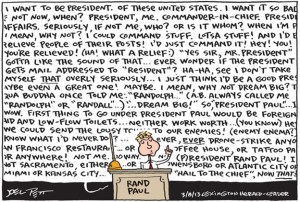
I certainly agree that the president shouldn’t have the power to kill Americans without due process, but I’d be more impressed with Paul if he supported other constitutional rights like equal treatment under the law for minorities, women and LGBT people. I can’t take anyone seriously as a defender of the Constitution if he opposes civil rights and the right of a woman to control her own body.
According to Grace Wyler at Business Insider, Libertarians Believe Their Moment Has Finally Arrived. On the other hand, Chris Cillizza explains why Why the Rand Paul filibuster might not be such good news for the GOP.
Everyone seems to be calling Paul’s filibuster “historic,” and no one is even mentioning the (IMO) much more dramatic and impressive filibuster by Bernie Sanders just a couple of years ago.
Sequestration cuts, anyone?
While the Village media types focus on either fawning over or condemning Rand Paul’s performance, local journalists around the country are reporting on the damage being done by sequestration cuts.
The debate over sequestration this past week has come down to two questions: Was the administration exaggerating the impact of the spending cuts, and did they really need to shut down White House tours because of them?
It’s been the predominant theme at the White House briefings, a constant subject of discussion on cable news and a topic of fascination on Capitol Hill. House Speaker John Boehner (R-Ohio) even took up the cause at a press briefing this week, saying: “I think it’s silly that they have insisted on locking down the White House, which the American people actually own.”
Beneath that debate, however, is a different type of conversation about the impact of the $85 billion in cuts. While the national media has focused on those two questions, local coverage has been more directed at the tangible impact the budget restraints will have. The Huffington Post reviewed dozens of local television news broadcasts, using the service TVeyes.com, to survey coverage of sequestration outside of the Beltway.
Check out the many examples of real pain for localities at the link. And besides, according to Buzzfeed, Nobody Liked The White House Tours That Much Anyway. They’re only rated 3.5 on Yelp. Read the negative reviews at the link.
Interesting book review at The Daily Beast
The Girls of the Manhattan Project.
They were the employees of the gigantic uranium-enrichment plant at Oak Ridge, Tenn.—those who lived and toiled in this purpose-built secret city in the Appalachian Mountains, many of them young women, had only been told that their efforts would help bring home American soldiers. Then, when atomic power was deployed against an enemy nation for the first (and so far, last) time, Oak Ridge residents realized what they had been working toward, and why their every move had been monitored, their every utterance policed, and their every question stonewalled.
In The Girls of Atomic City: The Untold Story of the Women Who Helped Win World War II, Denise Kiernan recreates, with cinematic vividness and clarity, the surreal Orwell-meets-Margaret Atwood environment of Oak Ridge as experienced by the women who were there. They were secretaries, technicians, a nurse, a statistician, a leak pipe inspector, a chemist, and a janitor. “Site X” began construction in late 1942, and was also known as the Clinton Engineering Works (CEW) and the Reservation. Staff members were recruited from all over the U.S., but particularly from nearby Southern states, and were offered higher than average wages, on-site housing and cafeterias, and free buses.
More importantly, they were offered the chance to join the 400,000 or so American women performing non-combatant roles in the armed services, as well as those keeping vital industries afloat and helping the men on the front lines. But whereas a female Air Force pilot or munitions factory worker understood precisely her contributions to the war effort, the women at Oak Ridge were kept in the dark about the actual purpose of their workplace, a mystery heightened by the apparent lack of anything ever leaving the site. Provided with “just enough detail to do their job well, and not an infinitesimal scrap more,” workers at all levels were forbidden from taking the slightest interest in anyone else’s duties. “Stick to your knitting,” in the words of Lieutenant General Leslie Groves, head of the Project.
That sounds like a fascinating book!
ABC News reports on a scary new virus–the coronaviris.

Coronavirus
Health officials are warning of a new virus that has sickened at least 14 people worldwide, killing eight of them.
There are no known American cases of the coronavirus, known as hCoV-EMC, but the U.S. Centers for Disease Control is urging doctors with patients who have an unexplained respiratory illness after traveling to the Arabian peninsula or neighboring countries to report the cases to the CDC.
Doctors should also report patients with known diseases who don’t respond to appropriate treatment, the agency said its Morbidity and Mortality Weekly Report. Close contacts of a symptomatic patient should also be evaluated.
The novel virus, which is associated with severe respiratory illness with renal failure, was first recognized last September and caused alarm because it is genetically and clinically similar to the SARS virus, which caused hundreds of deaths worldwide.
Read more at the CDC website.
A new archaeological theory about Stonehenge
The Guardian: Stonehenge may have been burial site for Stone Age elite, say archaeologists.

Centuries before the first massive sarsen stone was hauled into place at Stonehenge, the world’s most famous prehistoric monument may have begun life as a giant burial ground, according to a theory disclosed on Saturday.
More than 50,000 cremated bone fragments, of 63 individuals buried at Stonehenge, have been excavated and studied for the first time by a team led by archaeologist Professor Mike Parker Pearson, who has been working at the site and on nearby monuments for decades. He now believes the earliest burials long predate the monument in its current form.
The first bluestones, the smaller standing stones, were brought from Wales and placed as grave markers around 3,000BC, and it remained a giant circular graveyard for at least 200 years, with sporadic burials after that, he claims.
It had been thought that almost all the Stonehenge burials, many originally excavated almost a century ago, but discarded as unimportant, were of adult men. However, new techniques have revealed for the first time that they include almost equal numbers of men and women, and children including a newborn baby.
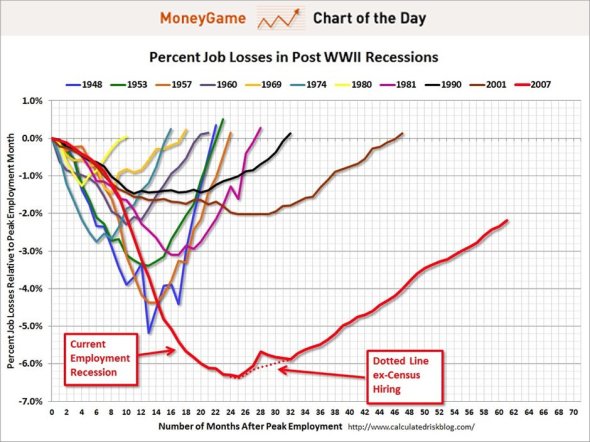
I’ll end with this “chart of the day” from Business Insider:
“The Scariest Jobs Chart Ever”

 peej
peej Carissa
 bostonboomer
 dakinikat
 ecocatwoman
 mablue2
 Mama Lopez
 peggysue22
 quixote
 skydancingguestblogger
 Mona (aka Wonk the Vote)



 Sky Dancing
Recent Comments