
Friday Reads: Confessions of a Naughty Professor
Posted: March 22, 2013 Filed under: morning reads | Tags: Elizabeth Warren, JIndal's plan to tax mom and pop enterprises, modern day slavery in the USA, Too Big Too Fail 20 Comments Good Morning!
I’ve felt discombobulated all week. I’m hoping this phase passes since it is spring and things are supposed to spring alive right now. Right now, however, does not seem to apply to me. It’s been one of those weeks where I’ve felt like the stereotype of the absent-minded professor fits me like a snug glove. I get distracted easily and hours pass before I realize I’ve done nothing for the day. It fits so do not acquit. Maybe I’ll just lie around in bed this weekend a little bit more and think these kinds of thoughts.
For some time, I’ve been writing how worried I am about the systemic risk involved with all these huge banks that have a near monopoly on credit card and house loans. They also hold the deposits of some our of largest industrial and service corporations that actually provide things people use and need in their daily lives. It’s the same situation in Europe and the UK where the needs of banks–based on their own faulty lending and investing strategies–have passed on tremendous costs to countries, their treasuries and their peoples. I was glad to read that Ben Bernanke made a clear atement yesterday that he was in agreement with Senator Elizabeth Warren on the entire problem of banks considered “too big to fail”. I’d also like to add that it’s refreshing to see a senator on a committee that actually knows what they’re doing for a change.
During that conversation, Bernanke seemed to imply that the problem had been solved, suggesting that the Dodd-Frank financial-reform act had given policy makers the tools to wind down a giant bank without hurting the economy — although his conviction faded as the argument went on. On Wednesday, he wanted it to be known that fully sided with Warren.
“I agree with Elizabeth Warren 100 percent that it’s a real problem,” he said.
He also sided with Warren against those banks and others who suggest that having gigantic banks is not really a problem at all.
“Too Big To Fail was a major source of the crisis,” he added a little later, “and we will not have successfully responded to the crisis if we do not address that successfully.”
He talked about some of the tools policy makers could use to address the problem, including Dodd-Frank rules forcing the biggest banks to hold more capital or pay regulators a little more than smaller banks.
“If we don’t achieve the goal” of solving too big to fail with these measures, Bernanke said, “we will have to take additional steps. It is important.”
You only need to look at the entire senate hearing on JPM’s “Whale” situation to understand how these big bank purport themselves. This analysis is from NYT’s Simon Johnson.
At its heart, the Levin-McCain report reveals executives with a profound misunderstanding of risk in the world’s largest bank (I use the calculations of comparative bank size offered by Thomas Hoenig, vice chairman of the Federal Deposit Insurance Corporation). Even worse, the report shows us in some detail that banks – even after Dodd-Frank – can and do readily manipulate complicated measures of risk in order to make their positions look safer than they really are.
As Jeremy Stein, a Fed governor, pointed out recently, there are strong incentives to do this repeatedly in banking organizations (read the opening few paragraphs of his speech carefully).
The banking regulators – in this case, the Office of the Comptroller of the Currency – are clearly unable to keep up with this form of “financial innovation” (which is really just clever ways to misreport risk).
Did JPMorgan Chase’s top management do this intentionally? Did they mislead investors, particularly in the fateful conference call on April 13, 2012? This is a fascinating question on which the courts will no doubt rule. (You should also review this report by Josh Rosner of Graham Fisher, with the link kindly provided by Better Markets.)
Jamie Dimon will survive because JPMorgan Chase remains profitable. But it is profitable precisely because it receives implicit subsidies from being too big to fail. JPMorgan Chase disputes the precise scale of these subsidies – as I discussed here last week. Let’s just call them humongous.
This is not about individuals, this is about policy. And Richard Fisher has exactly the right approach:
At the Dallas Fed, we believe that whatever the precise subsidy number is, it exists, it is significant, and it allows the biggest banking organizations, along with their many nonbank subsidiaries (investment firms, securities lenders, finance companies), to grow larger and riskier.
This is patently unfair. It makes for an uneven playing field, tilted to the advantage of Wall Street against Main Street, placing the financial system and the economy in constant jeopardy.
It also undermines citizens’ faith in the rule of law and representative democracy.
You can see that regulators at all levels realize they have a problem. I should probably mention here that Fed Branches and the Board of  Governors of the Fed are very independent of one another and each have distinct characters. We have two layers of Fed bureaucracy championing reform. Unfortunately, they can’t do much with out laws passed by Congress and signed by the President who are captured at every turn by the FIRE lobby.
Bernanke also compared himself to Volcker, when talking about the US banking system, which the Fed regulates. Volcker once said, famously, that the only great financial innovation of recent decades was the invention of the automated teller machine. Bernanke smiled as he quoted Volcker’s bellicose quip and said he wouldn’t go that far – but he was surprisingly frank in talking about the failures of the financial system and regulation.
“[‘Too big to fail’] is not solved and gone. It’s still here,” he said, emphasizing the point. He also threw in his lot with Elizabeth Warren, who often opposed Tim Geithner and others in her insistence that banks are of a dangerous size:
“I agree with [Warren] 100% that [‘too big to fail’] is a real problem … We will not have successfully responded to the crisis if we do not address [‘too big to fail’] successfully.”That view is consistent with what Bernanke said as far back as 2009. But the subject of “too big the fail” has been a nonstarter for at least a year, since Occupy Wall Street protests receded.
Bernanke also took an activist view of sorts by plumping for a return to regulatory reform and advocating that banks need to pay higher surcharges to help the country bail them out if things go wrong. Then Bernanke criticized banks again, implicitly, by saying that they had restricted lending too much, making it hard for ordinary Americans to get a mortgage.
He went on to say that the Fed’s bond-buying program has been successful largely because the Fed has learned how to monitor the markets better – implying, correctly, that those trading on Wall Street need a regulator to keep an eye on them. All of this was surprising on two fronts: first, that Bernanke actually shared his own opinion, instead of a technocratic, non-committal vague fluttering of economic opinions, as is often the case. Second, it’s surprising that he took a somewhat controversial view, not designed to make friends on Wall Street.
And that, in fact, may be the most important development of this first press conference of 2013: we already know Ben Bernanke is a savvy politician who knows how to read a room. If Bernanke has thrown his lot in with those who have said that Wall Street needs to come under tighter control, you can be sure that he thinks it’s a historically smart view to take. Those who are against reform should take notice.
I am consistently reminded in many of these conversations of Lenin who wrote a lot about banking. He said that the downfall of capitalism would come from the power of banks and their eventual destruction of the actual productive parts of the economy. I realize when I quote Lenin that I run a very high risk of being called all kinds of things by Republicans looking to demean academics. However, I read his 1916 Treatise Imperialism: The Highest Stage of Capitalism in a comparative economics class in my senior year at the University of Nebraska. Let me tell you that the business school at the University of Nebraska in Lincoln does not harbor any communists to my knowledge and probably is not all that populated with Democrats, either. However, this is an important book to read to understand why the two Roosevelts were able to stop communism from taking root here. A lot of it had to do with the control and regulation of monopolies and huge banks that stalled a lot of what Lenin foresaw. I’ve pointed to this several times over the time I’ve been blogging, but it always bears repeating. Lenin had a point and does now since so much of these kinds of regulations have been removed over the last 30 years.
Lenin provides a careful,5-point definition of imperialism: “(1) the concentration of production and capital has developed to such a high stage that it has created monopolies which play a decisive role in economic life; (2) the merging of bank capital with industrial capital, and the creation, on the basis of this “finance capital”, of a financial oligarchy; (3) the export of capital as distinguished from the export of commodities acquires exceptional importance; (4) the formation of international monopolist capitalist associations which share the world among themselves, and (5) the territorial division of the whole world among the biggest capitalist powers is completed. Imperialism is capitalism at that stage of development at which the dominance of monopolies and finance capital is established; in which the export of capital has acquired pronounced importance; in which the division of the world among the international trusts has begun, in which the division of all territories of the globe among the biggest capitalist powers has been completed.”
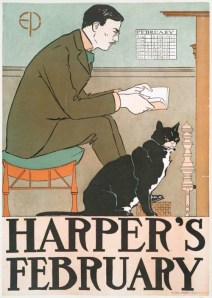 Now, I’m not pushing Lenin’s view of what will happen once capitalism collapses, I’m only saying that he makes some really good points about how banks can play a huge role in bringing down market economies. I also think that Lenin never imagined a world in which nationalism may play a lesser role given the international flavor of bank havens today. Both Roosevelts did their share of trustbusting and bank regulation to make me believe that they saw a lot of the same problems with the JPM of their times that we’ve got with the JPM of our our time. Unfortunately, there is a dearth of Roosevelts these days.
Banks are not the only entities that still employ practices that the government must regulate or we fail to have an economy that allocates benefits to all. It’s not only that but in some very sad cases we have companies that deny the rights and liberties of others and behave criminally. We have a very robust, 21st century version of slavery here in the US. I fully believe that both Rand and Ron Paul are neoconfederates with their views of state’s rights and many of the positions they take. Rand Paul has recently suggested that we make more visas available so foreign workers can come here legally. As I’ve seen in my state in oil rig companies and after Katrina during the clean-up, these visas are just as likely to lead to abuse of workers than those who come here under the wire. So, what’s the real purpose? Do we just need to ‘dog-tag’ every one?
Under a system of “legalized slavery,” foreign workers are routinely thrown in massive debt, cheated out of wages, housed in squalid shacks, held captive by brokers and businesses that seize passports, Social Security cards and return tickets, denied healthcare, rented to other employers (including the military), and sexually harassed and threatened with firing and deportation if they complain, according to two detailed reports by the Southern Poverty Law Center and the National Guestworker Alliance. The reports are based on sworn testimony gathered for lawsuits.
The H-2B visa program that brought 83,000 foreign guestworkers to the U.S. in 2011 for non-farm work has become a stalking ground for some of the worst abuses in American capitalism, according to recentreports by anti-poverty law groups. These reports describe in excruciating detail how predatory capitalists in many manual labor-based industries (supplying national brands like Walmart) lure and prey upon foreigners whose jobs average less than $10 an hour with little regard for human rights, labor law or legal consequence.
“We called it modern-day slavery,” said Daniel Contreras, who borrowed $3,000 to come from Peru and whose story is told in the Guestworker Alliance report. He was one of 300 foreigners brought to New Orleans by a hotel chain after Hurricane Katrina. “Instead of hiring workers from the displaced and jobless African-American community, he sent recruiters to hire us. At around $6 an hour, we were cheaper. As temporary workers, we were more exploitable. We were hostage to debt in our home countries. We were terrified of deporation. And we were bound to [owner Patrick] Quinn and could not work for anyone else. We were Patrick Quinn’s captive workforce.”
These are all circumstances that create revolutionaries and circumstances that both Roosevelts righted by ensuring that both sides of the market have an equal chance to succeed.
So, I can see that this post turned into a really long treatise on two of the factors of production which probably means I must’ve been working and thinking way too much this week. I did not intend this post to be any kind of seminar on how dissimilar we treat the factors of labor and capital in this country. So, don’t take this as a closed thread so much as me going off on a tangent after having gotten very pissed about how badly we treat people that work in this country vs how well we treat people that collect cash and gamble. Perhaps it’s just the impact of watching all those folks get there savings stolen by EUCB.
Btw, if you want to see a most outrageous example of the government discouraging people that actually earn livings, please take a look at the types of things that my Governor Jindal is proposing to tax and tax hugely. He just proposed $1.4 billion in new taxes on services.
Your paycheck will grow larger, but in exchange the price of your haircut, cable TV and Internet service will go up if lawmakers agree to Gov. Bobby Jindal’s rewrite of Louisiana’s tax code.
Jindal wants to do away with state income taxes, but he doesn’t want to shrink the state’s tax revenue overall.
So to help make up the gap, the governor wants to charge $1.4 billion in new sales taxes on items that have not previously been taxed, under the plan outlined to lawmakers this week.
That includes home landscaping, visits to the museum and zoo, a pet’s trip to the veterinarian, time at the tanning salon and more.
Businesses that pay outside accountants, architects, environmental consultants, computer programmers and janitors would see new taxes on those services.
In all, three dozen new categories of services would be swept into the state’s current 4 percent state sales tax to drum up $961 million. They also would be included as the sales tax jumps to 5.88 percent under the governor’s plan, to boost the total to $1.4 billion from the newly-taxed services, according to data from the Department of Revenue.
So basically, every hairdresser and barber, every kid that mows the lawn, every musician on the street corner, every plumber, every independent bookkeeper and tree trimer, and a whole lot of other mom and pop ventures must collect, account for, and pay sales taxes to the State of Louisiana under Jindal’s plan while every huge corporation is off the hook for property and income taxes.
Now, look at me honestly and say that court eunuchs and jesters like Jindal aren’t just asking for a revolution. Shoo-be-doo-wah.
What’s on your reading and blogging list this morning?
Native American Kansas State Rep. Smacks Down Anti-Immigrant Secretary of State Kris Kobach
Posted: March 21, 2013 Filed under: immigration, open thread, U.S. Politics | Tags: ALEC, Kansas, Kris Kobak, Native Americans, Rep. Ponka-We Victors 21 Comments
This is such a great story, via Think Progress:
A Native American state representative in Kansas rebuked Secretary of State Kris Kobach, a leader in the anti-immigrant movement, at a hearing yesterday.
“I think it’s funny Mr. Kobach, because when you mention illegal immigrant, I think of all of you,” said State Rep. Ponka-We Victors (D), a member of the Tohono O’odham Nation of Arizona, during a hearing on Wednesday about a state statute that allows children of undocumented immigrants to pay in-state tuition rates at public universities. Her comments drew loud applause from the audience.
From The Topeka Capital-Journal:
Students who have lived in the United States most of their lives got choked up as they described the academic lifeline in-state tuition has provided to improve their lives. A counselor who works with such students in Wichita high schools shed tears as she showed legislators a scrapbook of success stories. Murmurs of unrest were heard in the gallery as one House member asked about the prevalence of illegal immigrants from gangs and drug cartels in American prisons.
But nothing drew a bigger reaction than when Rep. Ponka-We Victors, D-Wichita, wrapped up a series of questions to the bill’s chief proponent, Secretary of State Kris Kobach.
….
Wednesday’s hearing on House Bill 2192 would have repealed a nearly 10-year-old statute that allows students who graduate from Kansas high schools and have lived in Kansas for at least three years to pay in-state tuition at state universities and community colleges, regardless of residency status.
Kobach, a lightning-rod for controversy on immigration issues, told the committee federal law conflicts with that statute.
“U.S. citizens should always come first when it comes to handing out government subsidies,” Kobach said.
Kris Kobach is the architect of the Arizona “papers please” immigration law as well as other anti-immigrant laws around the country. He is also a strong supporter of the extremist Arizona voter registration law that is currently being reviewed by the U.S. Supreme Court. Read more about him at the Mother Jones Link (2012)–and if you have time, check out this 2011 piece at the Southern Poverty Law Center: When Mr. Kobach Comes to Town: Nativist Laws and the Communities They Damage.
Kris Kobach is the architect of the Arizona “papers please” immigration law as well as other anti-immigrant laws around the country. He is also a strong supporter of the extremist Arizona voter registration law that is currently being reviewed by the U.S. Supreme Court. Read more about him at the Mother Jones Link (2012)–and if you have time, check out this 2011 piece at the Southern Poverty Law Center: When Mr. Kobach Comes to Town: Nativist Laws and the Communities They Damage.

Rep. Ponka-We Victors was elected in 2010, and the Indian Country Today Media Network characterizes her as a “political warrior.”
As a young, first-term legislator, Victors, the first American Indian woman elected to the Kansas legislature, garnered state headlines in 2012 when she urged colleagues to reject proposals for strict immigration-enforcement laws during a hearing of the House Federal and State Affairs committee. “Personally,” said Victors, “my people have been fighting immigration since 1492. It doesn’t get any better.”
Read an interview with her at the Indian Country link.
So…. What else is happening out there? Got any feel good stories to share? This is a wide-open thread!
Thursday Reads: Crisis in Cyprus, The End of the “Creative Class” Dream, the Grand Betrayal, and Other News
Posted: March 21, 2013 Filed under: Barack Obama, Foreign Affairs, morning reads, the blogosphere, U.S. Economy, U.S. Politics, Violence against women | Tags: "grand bargain", chris bowers, Cyprus crisis, Dick Durbin, eurozone crisis, Joe Weisenthal, Richard Florida, the Great Betrayal 41 Comments
Good Morning!!
There’s quite a bit of news on the Cyprus crisis this morning. But first, last night Joe Weisenthal posted this assessment of how bad things had already gotten: In Just Days A Modern Economy Has Been Set Back 50 Years, And It May Never Be The Same Again. That’s a quote from Ciaran O’Hagan of Société Générale in Paris. Weisenthal writes:
According to reports, Cyprus will try again tomorrow to cobble together some kind of bank bailout bill that can pass parliament.
Cyprus needs to raise another 5.8 billion euros, which it could do from some combination of deposit taxes, Russian money, and pension nationalization.
None of the options are good, but until it’s done, banks will likely have to remain closed, a situation that can’t go on much longer.
This is a stunning turn of events for a modern Eurozone nation.
This morning, the news broke that the European Central Bank (ECB) has given Cyprus an ultimatum. Bloomberg reports:
The European Central Bank said it will cut Cypriot banks off from emergency funds after March 25 unless the Mediterranean island agrees on a bailout with the European Union and International Monetary Fund.
“The Governing Council of the European Central Bank decided to maintain the current level of Emergency Liquidity Assistance, ELA, until Monday, 25 March 2013,” the Frankfurt- based ECB said in an e-mailed statement today. “Thereafter, ELA could only be considered if an EU/IMF program is in place that would ensure the solvency of the concerned banks.”
The Cypriot parliament this week rejected a proposed levy on bank deposits to raise 5.8 billion euros ($7.5 billion), which euro-area finance ministers backed as a condition for the country’s bailout. A bank holiday in Cyprus has been extended to March 25, giving policy makers until Monday to find a compromise to prevent a collapse of the country’s banks.
“With this statement, the ECB put even more pressure on European finance ministers and the Cypriot government to come up with a deal,” said Juergen Michels, chief euro-area economist at Citigroup Inc. in London. “But we’ll have to see whether they’ll actually follow through with their threat if there’s no deal by Monday and policy makers decide to further extend the bank holiday.”
The Audacity of Unrepentant War Criminals
Posted: March 20, 2013 Filed under: Anti-War, Foreign Affairs, Iraq, U.S. Military, U.S. Politics | Tags: Dick Cheney, Donald Rumsfeld, war criminals 32 Comments The Elephants of the Republican Party don’t seem to have very good memories. Diaper Dave Vitter, Ralph Reed, and even Mark Sanford seem to have continuing careers despite basic transgressions of civility and law. Words fail me on the convenient memories of the perpetrators of one of America’s greatest sins on its 10th anniversary.
The media and the Bush administration led a whole lot of people–never me–down a garden path filled with imaginary WMDs, mushroom clouds, and Al Quaida Terrorists to support its NeoCon Agenda which has cost this country precious lives and treasure. You’d have to ask the Iraqis if they feel ‘liberated’. Too bad we can’t poll all the dead innocents because I’m sure they’d have something to say about Rumsfeld and Cheney’s War of Ideological Convenience too. It’s hard to believe they even have the audacity to pop their heads up like some Neo Con Ground Hog Day Rodents let lone make statements like the one above. None of them can take vacations in Europe any more because most countries realize they belong in the justice system with the other War Criminals. There is nothing like the hubris of absolute gall.
There are so many things that are wrong with the lead-up and the shock-and-awe of the Iraq War that we should make yesterday a national holiday to remember the criminal enterprise that brought us the likes of Cheney, Rumsfeld, Paul Wolfowitz, Richard Perle and all the other murderous chicken hawks of the Republican Party. Voters should be made to remember that Jeb Bush was also a signatory to neocon documents that became policies of the of group of folks that were disgruntled that Poppy Bush didn’t take the initiative to get us into Iraq after the Kuwait Invasion. That’s another resurrection that shouldn’t happen. PNAC and all its signatories and enablers should go down in history as a list of War Criminals. Judith Miller and various other ‘journalists’ should be added to the list of enablers of war crimes too.
But, back to the absolute mistake and horror that became the Iraq invasion and occupation via Beltway Bob who mentions he got all caught up in the propaganda and complicity of the press at the time too. Even then he was showing signs of the gullibility trait that we like to kid him for around here. Hence, his nickname. He spoke to Ken Pollack who is one of those people that should shrink into permanent obscurity.
I supported Ken Pollack’s war, which led me to support George W. Bush’s war. Both were wrong. The assumptions required to make them right — Hussein had WMDs, Hussein was truly crazy, Hussein couldn’t be contained, American military planners and soldiers could competently destroy and then rebuild a complex, fractured society they didn’t understand — were implausible.
But saying, in retrospect, that I shouldn’t have supported the Iraq War is easy. The harder question is how to avoid a similarly catastrophic misjudgment in the future.
So here are some of my lessons. First, listen to the arguments of the people who will actually carry out a project, not the arguments of the people who just want to see the project carried out. Who manages a project can be as important as what the project is.
Second, don’t trust what “everybody knows.” There is, perhaps, nothing more dangerous than a fact that everyone thinks they know, because it shuts down critical thinking. In a retrospective for Foreign Policy, Stephen Hadley, Bush’s national security adviser, said, “It never occurred to me or anyone else I was working with, and no one from the intelligence community or anyplace else ever came in and said, ‘What if Saddam is doing all this deception because he actually got rid of the WMD and he doesn’t want the Iranians to know?’ Now, somebody should have asked that question. I should have asked that question. Nobody did. It turns out that was the most important question in terms of the intelligence failure that never got asked.”
People that were that gullible and wrong do not need to be interviewed. We need a day each year to point and laugh at them and spread national loathing in their general direction. However, I frankly believe that Dick Cheney and Donald Rumsfeld knew there were no WMDS. They need a completely different sort’ve of treatment. The kind of treatment the court at The Hague dishes and serves cold. I’m not sure if the President knew because frankly, at that time, he appeared at his most clueless on a scale of almost infinite cluelessness. But, if you read the current writings of some of the men that should be standing in front of judges at The Hague, you would think that the now well-known absence of WMDS isn’t even historically relevant. By the way, many Republicans still believe the Iraqis had them so when I say “well-known’ I leave out the cult of cluelessness that is the core Republican base. Try this rationalization and excuse for size from HuffPo. Richard Perle says ‘Not A Reasonable Question’ To Ask Whether Iraq War Was Worth It.
NPR “Morning Edition” host Renee Montagne asked, “Ten years later, nearly 5,000 American troops dead, thousands more with wounds, hundreds of thousands of Iraqis dead or wounded. When you think about this, was it worth it?”
“I’ve got to say, I think that is not a reasonable question. What we did at the time was done in the belief that it was necessary to protect this nation. You can’t, a decade later, go back and say, ‘Well, we shouldn’t have done that,'” Perle responded.
Perle’s refusal to evaluate the question seems to underscore just how little those who made decisions in the lead-up to the invasion want to go back and re-evaluate a choice that most Americans think was a mistake.
The war hawk made some spectacularly wrong predictions and proclamations prior to the Iraq war. Mother Jones reported that Perle claimed Saddam Hussein had ties to Bin Laden days after 9/11, suggested that war with Iraq would be easy (requiring only about 40,000 troops), and claimed that Hussein was “working feverishly” to acquire nuclear weapons. Perle also said that Iraqis could finance their own reconstruction.
Elsewhere in Wednesday’s interview, Monagne asked Perle if it ever crossed anyone’s minds that Iraq’s deception about its chemical weapons could have been directed towards, say, Iran — with which the country fought an eight-year war — rather than the United States.
“I’m sorry to say that I didn’t achieve that insight,” Perle replied.
Perle also cast the toppling of Hussein’s reign of nearly 24 years without any centralized authority as an opportunity. “You can say we left it broken. I think we left it open for opportunity. And then we closed our own opening by moving into an occupation,” he said.
If you really want to be appalled, go read John Yoo who justifies the war by saying “We shared the benefits with the Iraqis“. Why is UC Berkely paying this man to pollute young minds?
And isn’t that what we did in Iraq? We spent billions of dollars in Iraq as damages. We did so not because the war was wrong, but because it was right — and we shared the benefits of the war with the Iraqi people by transferring some of it in the form of reconstruction funds.
It’s at these times when I understand the appeal of an almighty deity that will firmly send such folks to eternal suffering for all their hubris, ignorance, and murderous acts. However, I’d just like to see a little justice done to them here on Earth while we can. It could start with never, ever letting them show up as experts on anything and absolute excoriation when they try to redefine their mistakes. I know it’s too much to think the Justice Department would deliver their arrogant asses to a court. But, I would like to think the court of opinion and the press could treat them with the contempt they deserve. It galls me to think that they’re moving around press circles trying to spread more lies and resurrect themselves. What they should be doing is Public Service for the rest of their lives to make living tolerable for Iraqi veterans, their families, and for Iraqis. None of them should live any kind of life of ease nor should any of us ever let them try to forget that they are Unrepentant War Criminals.
Cyprus Parliament Unanimously Rejects Bailout Plan
Posted: March 19, 2013 Filed under: Global Financial Crisis | Tags: Angela Merkel, Cyprus bailout, eurozone crisis 13 Comments
Well, they did it. Matthew Boesler at Business Insider:
The Cypriot parliament has voted against the controversial bank bailout deal hatched with the EU over the weekend, reports Bloomberg.
36 voted no.
19 abstained from voting.
No one voted in favor of it.
The vote was held in a show of hands.
The big part of the bailout plan that has everyone up in arms: a controversial decision to apply haircuts to depositors, which essentially amounts to an expropriation of a certain percentage of money from everyone’s bank account.
That includes insured depositors – those with up to 100,000 euros in the bank – whose funds, up to now, were widely considered sacrosanct.
Now what? Your guess is as good as mine.
I imagine Russia is likely to play a role in this situation going forward, so I found some reactions to the bailout proposal from Vladimir Putin at The Brisbane Times. He wasn’t happy with the deal, which would have removed around 10% of the value of accounts held by many Russians.
Russia’s President Vladimir Putin called the proposed levy ”unfair, unprofessional and dangerous”, and his finance minister suggested Moscow could withdraw a €2.3 billion loan made to Cyprus in 2011. The bank levy was partly intended by Brussels and Berlin to prevent European Union taxpayers spending billions propping up the ill-gotten gains of Russia’s super-rich in Cypriot accounts.
Russian deposits in Cyprus, which offers attractive interest rates and asks few questions, are estimated at €20 billion, meaning Russian corporate and individual investors could lose up to €2 billion in one fell swoop.
Russia’s Finance Minister Anton Siluanov said: ”We had an agreement with colleagues from the eurozone that we’d co-ordinate our actions. So, we will consider the issue of restructuring of the loan taking into account our participation in the co-ordinated actions with the European Union to help Cyprus.”
Other Russian officials tried to allay fears by publicly announcing that whatever happens in Cyprus, the Russian financial system will remain stable.
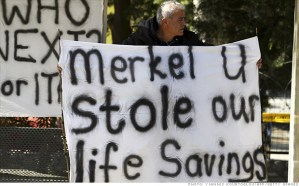
I guess Angela Merkel is going to have to come up with another plan or else dream up some better threats.
Obviously this is a fast-moving story, but I’ll include links to the very latest headlines below and then post updates in the comments.
Financial Times: Stocks fall as Cyprus uncertainty mounts
Miamai Herald: Give Cyprus more time, Greece tells EU
Bloomberg: S&P 500 Falls for Third Day as Euro Weakens on Cyprus
Bloomberg: German Stocks Decline Before Cyprus Votes on Bank Levy
Guardian UK: Crisis deepens as Cyprus MPs reject savings tax

 peej
peej Carissa
 bostonboomer
 dakinikat
 ecocatwoman
 mablue2
 Mama Lopez
 peggysue22
 quixote
 skydancingguestblogger
 Mona (aka Wonk the Vote)



 Sky Dancing
Recent Comments