
Gene Sperling: “A mix of entitlements and revenues was part of the DNA” of the Sequester “from the start.”
Posted: February 28, 2013 Filed under: 2012 presidential campaign, Austerity, Barack Obama, Medicaid, Medicare, Social Security, U.S. Economy, U.S. Politics | Tags: Bob Woodward, digby, entitlement cuts, Gene Sperling, Jon Walker, Robert Kuttner, the sequester 38 Comments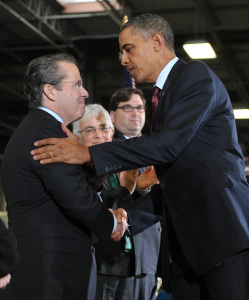
Gene Sperling and Barack Obama
I want to call attention to some rather startling statements in Gene Sperling’s e-mail to Bob Woodward, which I posted earlier. Please note the highlighted sections.
From Gene Sperling to Bob Woodward on Feb. 22, 2013
Bob:
I apologize for raising my voice in our conversation today. My bad. I do understand your problems with a couple of our statements in the fall — but feel on the other hand that you focus on a few specific trees that gives a very wrong perception of the forest. But perhaps we will just not see eye to eye here.
But I do truly believe you should rethink your comment about saying saying that Potus asking for revenues is moving the goal post. I know you may not believe this, but as a friend, I think you will regret staking out that claim. The idea that the sequester was to force both sides to go back to try at a big or grand barain with a mix of entitlements and revenues (even if there were serious disagreements on composition) was part of the DNA of the thing from the start. It was an accepted part of the understanding — from the start. Really. It was assumed by the Rs on the Supercommittee that came right after: it was assumed in the November-December 2012 negotiations. There may have been big disagreements over rates and ratios — but that it was supposed to be replaced by entitlements and revenues of some form is not controversial. (Indeed, the discretionary savings amount from the Boehner-Obama negotiations were locked in in BCA: the sequester was just designed to force all back to table on entitlements and revenues.)
I agree there are more than one side to our first disagreement, but again think this latter issue is diffferent. Not out to argue and argue on this latter point. Just my sincere advice. Your call obviously.
My apologies again for raising my voice on the call with you. Feel bad about that and truly apologize.
Gene
Really? Does anyone recall President Obama saying that at the time the sequester was proposed and voted on in 2011? Did President Obama discuss these plans for entitlement cuts during his campaign for re-election? I’ve always suspected he did plan cuts in Social Security, Medicare, but when did he publicly state this? I’ve done a somewhat cursory search, but I can’t find anything.
There is no mention of these agreed-upon cuts in the Wikipedia entry on the Budget Control Act of 2011. There no mention of “entitlement” cuts in this extensive article at The Bipartisan Policy Center. This analysis (pdf) notes that the Supercommittee was authorized to cut Social Security:
The “Super Committee” deficit reduction plan: BCA also creates a new, special joint committee of Congress charged with finding at least $1.2 trillion in deficit reduction to avoid any potential sequestration. This “Super Committee” can cut spending (including Social Security and Medicare), raise revenue, or propose a combination of both. If the committee cannot agree on a plan, or Congress fails to approve it, automatic cuts of $1.2 trillion will be triggered through sequestration. To assist the Super Committee with its task, Congress also provided for an accelerated review of the Super Committee recommendations, provided that the Super Committee followed specific timelines, as outlined in the text.
But I think it was generally assumed that the Super Committee would not be able to agree on anything, and if they did that the Senate at least would not vote for Social Security cuts.
So now the truth has come out. Certainly no one from the White House has come rushing out to deny that cuts in Social Security, Medicare, and Medicaid are what is supposed to balance any new revenue. A few other bloggers have written about this.
Digby is always alert for any mentions of Obama’s seeming obsession with cutting Social Security, and she didn’t miss this one.
I don’t know that anyone’s ever admitted that in public before or that the president was completely, shall we say, honest when he ran for his second term about that specific definition of “a balanced approach”. I haven’t heard anyone say publicly that the sequester “deal” as far as the White House was concerned was to cut “entitlements” in exchange for new revenues. I wonder how many members of congress were aware of this “deal” when they voted for the sequester? The public certainly wasn’t.
I wish I could understand why it is so important to Barack Obama to cut these vital programs before he leaves office. It seems to be his obsession. But there you have it. It’s not just in the DNA of the sequester, it seems to be in the DNA of this White House.
In this sense, it seems that Sperling and Woodward–and by extension Obama–do “see eye to eye.”
At FDL, John Walker gets right to the point in his headline: Sperling: Obama Wanted Sequester to Force Democrats to Accept Entitlement Cuts.
The way Obama has handled basically every manufactured crisis from the debt ceiling, to the Bush tax cuts expiration, to the sequester has been about trying to force both Democrats and Republicans to embrace his version of a “grand bargain.” While it is clear this has been the driving force behind Obama’s decisions, if you pay close attention to his actions is is rare than an administration official will directly admit this. This is actually what I think it most interesting about the recently leaked email exchange between Bob Woodward and Gene Sperling up on Politico…..
Obama wants to cut Social Security and Medicare benefits. Obama also wants to raise taxes, but he only wants to do these unpopular things if he can get bipartisan cover to destroy basic democratic accountability. If everyone is to blame than no one is to blame.
What has sometimes been viewed as incompetence on the part of Obama during negotiations is actually Obama trying to weaken Democrats’ hand to “force” them to accept entitlement cuts while being able to blame it on the mean Republicans.
That is why even now Obama isn’t calling for the sequester to be simply repealed or delayed. Obama still wants to use this manufactured crisis to force congressional Democrats to betray their base by adopting Social Security cuts and get Republicans to accept revenue increases.
Finally, thanks to JJ for sending me the link to this piece by Robert Kuttner at The American Prospect: Dear White House, You’ll Regret This.
[Gene Sperling’s] e-mail is pure confirmation that Obama’s position, dating back to at least 2011, has been to try to trade cuts in Social Security and Medicare for new revenues. It confirms that Sperling and his boss have been channeling the likes of Robert Rubin, Pete Peterson, the corporate-sponsored Fix the Debt campaign, et al., who have been promoting exactly this grand bargain. Sperling confirms that the sequester was designed to force exactly such a dismal deal.
But even worse, writes Kuttner, is what the e-mail demonstrations about Sperling’s–and Obama’s–pathetic negotiating skills.
The Woodward-Sperling exchange is far more interesting for what it reveals about Sperling/Obama’s propensity for giving ground on core issues and getting almost nothing in return. I supposed we should be grateful that Sperling is only wrecking the economy, the Democrats, Social Security, and Medicare—and not negotiating nukes with the Ayatollah.
I’ve said ever since I read The Audacity of Hope back in 2007 that Obama wanted to cut Social Security. Actually, he made it clear in the book that he wanted to privatize it, but he must have realized that wasn’t going to happen. It’s time for those of us who care about these issues to start screaming bloody murder again. We need to get on this ASAP. So tell your friends and call your Congress critters.
The floor is open for discussion.
Thursday: Bob Woodward’s Non-Scoop, and Some Interesting Long Reads
Posted: February 28, 2013 Filed under: Barack Obama, morning reads, the villagers, U.S. Politics | Tags: Bob Woodward, Carl Bernstein, Christopher Dorner, Gene Sperling, Mark Ames, Politico, processed food addiction, Richard Nixon, Watergate, Workplace shootings 37 Comments
Good Morning!!
Poor Bob Woodward! The only way he can get attention nowadays is by whining and crying and generally creating a tempest in a teapot.
Yesterday Jim Vandehei and Mike Allen posted one of their patented “Behind the Curtain” pieces: Woodward at War, in which they dramatically revealed the inside story of Woodward’s little spat with the White House. This is the sort of story only the Villagers really care about, but when they care about something, they insist on forcing their opinions about it on the rest of us. It was the subject of the first hour of Morning Joe for yesterday and today, and the focus of countless media reports and blog posts throughout the day yesterday. Woodward must be in heaven with all this attention. From Politico:
Bob Woodward called a senior White House official last week to tell him that in a piece in that weekend’s Washington Post, he was going to question President Barack Obama’s account of how sequestration came about — and got a major-league brushback. The Obama aide “yelled at me for about a half-hour,” Woodward told us in an hourlong interview yesterday around the Georgetown dining room table where so many generations of Washington’s powerful have spilled their secrets.
Digging into one of his famous folders, Woodward said the tirade was followed by a page-long email from the aide, one of the four or five administration officials most closely involved in the fiscal negotiations with the Hill. “I apologize for raising my voice in our conversation today,” the official typed. “You’re focusing on a few specific trees that give a very wrong impression of the forest. But perhaps we will just not see eye to eye here. … I think you will regret staking out that claim.”
Woodward repeated the last sentence, making clear he saw it as a veiled threat. “ ‘You’ll regret.’ Come on,” he said. “I think if Obama himself saw the way they’re dealing with some of this, he would say, ‘Whoa, we don’t tell any reporter ‘you’re going to regret challenging us.’”

Horrors! “I think you will regret staking out that claim” is a “major league brushback?” Either Nixon and his men were quite a bit wimpier than we all thought, or Woodward is a lot touchier now than he was in the Watergate days.
In an update, Vandehei and Allen revealed that the White House adviser who supposedly yelled at Woodward over the phone and then “threatened” him was Gene Sperling, Director of the National Economic Council. This morning they published the actual e-mails between Sperling and Woodward. Frankly, I was underwhelmed. Follow me below the fold to read them.
Read the rest of this entry »
Early Morning Open Thread: The Voting Rights Act
Posted: February 28, 2013 Filed under: morning reads, U.S. Politics | Tags: Civil Rights, George Wallace, Lyndon B. Johnson, Selma Alabama, Voting Rights Act 18 Comments
President Lyndon Johnson signs the Voting Rights Act, 1965
Lyndon Johnson: Voting Rights Act Address
Delivered March 15, 1965, Washington, D.C.
I speak tonight for the dignity of man and the destiny of democracy.
I urge every member of both parties—Americans of all religions and of all colors—from every section of this country—to join me in that cause.
At times history and fate meet at a single time in a single place to shape a turning point in man’s unending search for freedom. So it was at Lexington and Concord. So it was a century ago at Appomattox. So it was last week in Selma, Alabama.
There is no Negro problem. There is no southern problem. There is no northern problem. There is only an American problem.
And we are met here tonight as Americans—not as Democrats or Republicans—we are met here as Americans to solve that problem.
This was the first nation in the history of the world to be founded with a purpose. The great phrases of that purpose still sound in every American heart, north and south: “All men are created equal” — “Government by consent of the governed” — “Give me liberty or give me death.”…
Those words are a promise to every citizen that he shall share in the dignity of man. This dignity cannot be found in man’s possessions. It cannot be found in his power or in his position. It really rests on his right to be treated as a man equal in opportunity to all others. It says that he shall share in freedom, he shall choose his leaders, educate his children, provide for his family according to his ability and his merits as a human being….
Many of the issues of civil rights are very complex and most difficult. But about this there can and should be no argument. Every American citizen must have an equal right to vote. There is no reason which can excuse the denial of that right. There is no duty which weighs more heavily on us than the duty we have to ensure that right.
Yet the harsh fact is that in many places in this country men and women are kept from voting simply because they are Negroes….
Experience has clearly shown that the existing process of law cannot overcome systematic and ingenious discrimination. No law that we now have on the books—and I have helped to put three of them there—can ensure the right to vote when local officials are determined to deny it.
In such a case our duty must be clear to all of us. The Constitution says that no person shall be kept from voting because of his race or his color. We have all sworn an oath before God to support and to defend that Constitution.
We must now act in obedience to that oath.
Wednesday I will send to Congress a law designed to eliminate illegal barriers to the right to vote….
To those who seek to avoid action by their National Government in their home communities—who want to and who seek to maintain purely local control over elections—the answer is simple. Open your polling places to all your people. Allow men and women to register and vote whatever the color of their skin. Extend the rights of citizenship to every citizen of this land. There is no constitutional issue here. The command of the Constitution is plain. There is no moral issue. It is wrong—deadly wrong—to deny any of your fellow Americans the right to vote in this country. There is no issue of States rights or National rights. There is only the struggle for human rights.
I have not the slightest doubt what will be your answer….
But even if we pass this bill, the battle will not be over. What happened in Selma is part of a far larger movement which reaches into every section and State of America. It is the effort of American Negroes to secure for themselves the full blessings of American life.
Their cause must be our cause too, because it is not just Negroes but really it is all of us, who must overcome the crippling legacy of bigotry and injustice. And we shall overcome….
This great, rich, restless country can offer opportunity and education and hope to all—all black and white, all North and South, sharecropper and city dweller. These are the enemies—poverty, ignorance, disease—they are our enemies, not our fellow man, not our neighbor. And these enemies too—poverty, disease, and ignorance—we shall overcome.
Montgomery Advertiser, February 26, 2013: Has South changed enough to end Voting Rights Act?
Lyndon Johnson had been a southern U.S. Senator from Texas.
He had fought all civil rights legislation with as zealous an effort as the other bloc of southern senators. This southern bloc of U.S. Senators totally controlled the Senate through their seniority and prowess. They were a formidable coalition. However, Lyndon had now become a national politician. He had ascended to the presidency at the death of John Kennedy and aspired to win the brass ring on his own in 1964.
When Lyndon Johnson set his sights on something nothing or nobody better get in his way. Whatever it took or by whatever means necessary, Lyndon Johnson was determined to win.
Johnson called George Wallace to the White House to meet with him. Wallace was cocky and full of vim and vinegar. At barely 5’8” he was like a bantam rooster. Although he was used to being the cock of the walk, it did not take long for the tall, tough, crude, intimidating Johnson to put Wallace in his place.
Johnson scowled at Wallace and told him he was nothing more than a redneck, tin horn demagogue and he could shout segregation and racist jargon as much as he wanted but it was not going to make a bit of difference. Johnson went on to say that by the end of the year he was going to pass a civil rights bill and sign it. He told Wallace that Strom Thurmond and his allies could filibuster all they wanted but at the end of the day it was going to be the law of the land and it was going to propel Johnson to victory in 1964. Wallace came back to Alabama with his hat in hand. He knew Johnson meant business.
The bill passed and Johnson signed it. Being a southerner Lyndon Johnson knew the ramifications when he signed the Civil Rights Act. He looked up and said, I have just signed the South over to the Republican Party. His words were prophetic….
In 1965, Johnson set his sights on a higher goal and passed the Voting Rights Act. He took aim at the Deep South and bestowed his renowned retribution extraction in Section 4B and Section 5. It requires that those five states and certain regions that voted for Goldwater must have any changes to their voting laws or procedures approved by the U.S. Justice Department.

President Obama Is Driving The Village Pundits Insane!
Posted: February 27, 2013 Filed under: Barack Obama, the villagers, U.S. Economy, U.S. Politics | Tags: Bob Woodward, Cat on a Hot Tin Roof, Dana Millbank, David Ignatius, Major Garrett, mendacity, Tennessee Williams, the sequester, Washington Post 31 Comments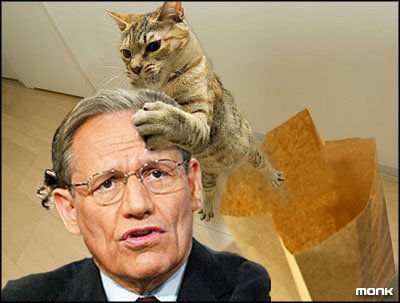
Wow. The Village pundits are so wound up over the “sequester” these days that I hate to think what’s going to happen over the weekend when the automatic budget cuts have taken effect. Will there be weeping and wailing instead of dancing at Disco Dave’s place? Will Bob Schieffer have to talk David Ignatius off a ledge? Will Dana Millbank freak out and require hospitalization? Will Bob Woodward’s hair catch fire? Will Major Garrett spontaneously combust?
Honestly, I’ve never seen anything like the temper tantrums the Village pundits have been throwing over the past week or two; and now that they are finally realizing that they’re not going to get the White House and Congress to agree to replace the “sequester” with Simpson Bowles 2.0, they’ve begun to scream and stamp their feet. I’m afraid one of them may throw himself to the floor and have a kicking and shrieking tantrum soon.
First up, Bob Woodward. Last Friday, the poor, frustrated stuffed shirt published a hectoring op-ed in the Washington Post in which he assigned full blame for the “sequester” to President Obama. As evidence, Woodward misleadingly sourced his own book on last year’s debt limit fight. He was rounding mocked on numerous liberal websites, and that must have really gotten his dander up.
Today Woodward appeared on Morning Joe and upped the ante. Mediaite reports:
Washington Post reporter Bob Woodward’s ongoing war of words with President Barack Obama’s White House escalated on Wednesday when Woodward took to the set of MSNBC’s Morning Joe to slam the president’s handling of the sequester fight. Woodward said that the president has displayed a “kind of madness” in his decision to make those cuts as painful and deleterious to the nation’s war fighting capability as possible….
He then turned to the sequester: “I think peoples’ heads are about to explode about all of this, you know, what the hell is going on here,” Woodward said. “I’m not sure the White House understands exactly what happened in all of these negotiations at the end of 2011 with the sequester and the super committee, because they were really on the sidelines.”
Woodward slammed Obama’s decision to announce that sequester cuts would force an American aircraft carrier to not deploy to the Persian Gulf.
“Can you imagine Ronald Reagan sitting there and saying ‘Oh, by the way, I can’t do this because of some budget document’?”
Watch it:
h/t to TPM and to RalphB for the catch!

Woodward’s pompous WaPo colleague David Ignatius also strongly disapproves of President Obama’s failure to make what Ignatius thinks is the obviously correct choice:
We have a political system that is the equivalent of a drunk driver. The primary culprits are the House Republicans. They are so intoxicated with their own ideology that they are ready to drive the nation’s car off the road. I don’t know if the sequestration that’s set to begin Friday will produce a little crisis or a big one; the sad fact is that the Republicans don’t know, either, yet they’re still willing to put the country at risk to make a political point.
At least Ignatius admits the Republicans are mostly to blame for the crisis. But…
I’m no fan of the way President Obama has handled the fiscal crisis. As I’ve written often, he needs to provide the presidential leadership that guides Congress and the country toward fiscal stability. In my analogy, he should take the steering wheel firmly in hand and drive the car toward the destination where most maps show we need to be heading: namely, a balanced program of cuts in Social Security and Medicare and modest increases in revenue.
Why is it always Social Security and Medicare that these guys want to cut? Surely there has to be a better way to deal with the noncrisis than to starve granny and then refuse her health care when she’s dying in the street?

Dana Millbank in drag
Last Tuesday Dan Millbank, also of the WaPo, stated his demand that Simpson-Bowles be enacted right now!
On Tuesday morning, as President Obama and House Republicans were abandoning hope of reaching a compromise to avoid across-the-board spending cuts on March 1, the indefatigable duo of Erskine Bowles and Alan Simpson made one more attempt to float a bipartisan compromise. They were literally shouted down.
Seconds after Bowles and Simpson were introduced at a breakfast forum hosted by Politico, hecklers in the audience began to interrupt: “Pay your share of taxes! Stop cutting jobs! Stop cutting Medicare and Medicaid!”
“Wait your turn,” pleaded the moderator, Politico’s Mike Allen, as the half-dozen demonstrators were gradually removed.
Good grief! How shocking that the peons would dare to demand that the Villagers “sacrifice” instead of resigning themselves to “feel the pain” so that the Villagers and their wealthy friends aren’t inconvenienced!
These politicians aren’t “serious,” Millbank tut tuts, claiming that “neither [Obama nor Boehner] is offering anything close to a workable plan.”
I’ve left the best (or worst, depending on your point of view) for last. Major Garrett’s bizarre and incomprehensible (to me anyway) op-ed in the National Journal: Tennessee Williams Offers Window Into the Mendacity That Defines the Sequester.

Major Garrett disapproves
According to Garrett, the way to understand the “sequester” is to listen to Big Daddy in Cat on a Hot Tin Roof. The problem is “mendacity,” which is a fancy word for lying.
How can anyone look upon the sequester with anything but revulsion and venom — the kind of smoldering rage that spills out of Big Daddy Pollitt (played by Burl Ives in the 1958 movie) when he begins to peel back the slippery layers of deception that defined his seemingly respectable Mississippi Delta life. Big Daddy’s life and all those who spin around it are reduced, as if by the centripetal force of fakery, into one word: mendacity.
Williams was not speaking for the South or plantation owners, but everyone who can kid themselves into believing something that simply isn’t true. Acid drips from Big Daddy’s sweet-sounding and recurrent question: “Wouldn’t it be funny if that was true?” After listening to all the varied finger-pointing and blame-shifting on our latest budget crisis, I will from now substitute the word “mendacity” for “sequester.”
Ooooookaaaay….
Encapsulated within the confines of a tortured Mississippi family, Tennessee Williams captured in the 1950s a bit of the writhing, frustrating, and at times grotesque antics of modern American budget mendacity. In his immortal Cat on a Hot Tin Roof, Big Daddy Pollitt and his son Brick — a high school football hero turned town drunk — argue over Brick’s refusal to see the consequences of his drinking, how his indolence breeds chaos in the lives of others. Earlier, Brick speaks mournfully of mendacity — the lies of his young life.
Big Daddy: “But it’s always there in the mornin’, ain’t it—the truth? And it’s here right now. You’re just feeling sorry for yourself; that’s all it is — self-pity.… Life ain’t no damn football game. Life ain’t just a buncha high spots. You’re a 30-year-old kid. Soon you’ll be a 50-year-old kid, pretendin’ you’re hearin’ cheers when there ain’t any. Dreamin’ and drinkin’ your life away. Heroes in the real world live 24 hours a day, not just two hours in a game. Mendacity, you won’t … you won’t live with mendacity but you’re an expert at it. The truth is pain and sweat and payin’ bills.”
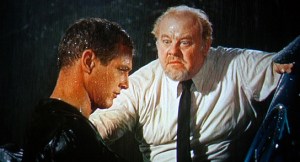
Big Daddy and Brick
Garrett doesn’t mention that Brick’s drinking and “indolence” stems from clinical depression triggered by denial of his homosexuality, but maybe Garrett doesn’t know that. But we now know how what Garrett believes is the solution to the financial noncrisis:
Our mendacities now are about dollars and cents. We hate ourselves, at some level, for being unable to produce enough to pay our bills. Our politics invites us to dream our life away. But the sequester and the fiscal cliff and the debt/default drama fractiously and dramatically remind us of our limits. We are frustrated. We don’t want to live with mendacity. But, sadly, we’ve become experts at it.
The truth is pain and sweat and payin’ bills.
Except that American does pay its bills and will continue to do so unless the Republicans refuse to raise the debt ceiling. And yes, as Garrett writes, most American families pay their bills too. But just like the federal government, most American families go into debt in order to buy a house or a car. Only the very richest among us can pay cash for those items. Like the government, families borrow and then pay the loans back with interest.
If anyone can figure out what else Garrett is trying to say, I’d be glad to hear it. Frankly, I think he’s lost his mind, and so have the rest of these Village idiots. I’m going to be fascinated to watch what happens to them over the next few days as their Simpson-Bowles fantasies crash and burn.
The Sequestration Blues: Part 2 Pete Peterson Creates a Crisis
Posted: February 26, 2013 Filed under: Austerity, Barack Obama, Catfood Commission, Economy, Federal Budget, Federal Budget and Budget deficit | Tags: Astroturf, Deficit Delusion, deficit hawks, Deficit Hysteria, Fix the Debt, Pete Peterson, Simpson-Bowles 13 Comments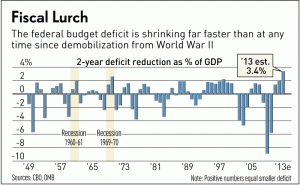 Ben Bernanke joined the chorus of economists concerned about the impact of the sequester on the sluggish recovery. This is not the first time the Fed chair has commented on misguided and dysfunctional Fiscal Policy in our country.
Federal Reserve Chairman Ben Bernanke warned Congress risks slowing the economy by allowing $85 billion in automatic spending cuts to be triggered on Friday, arguing they should be replaced with more deliberate, long-term cuts.
In prepared testimony for the Senate Banking Committee, Bernanke argued the sequester would pose a “significant headwind” to the economic recovery.
“Given the still-moderate underlying pace of economic growth, this additional near-term burden on the recovery is significant,” he warned.Bernanke did not offer an opinion on whether tax hikes should be included as part of a replacement bill, and he did not call for any specific entitlement reforms.
Meanwhile, the White House released reports on how the expected cuts will impact states. This undoubtedly will trigger more Republican whining on how mean the President continues to be to them as they continue their role as economic agents of chaos.
In Kentucky, home of the Senate Republican leader, Mitch McConnell, residents woke up on Monday to news articles like these: Widespread government spending cuts that begin on Friday will cost 21,484 jobs in the state. A construction project at Fort Knox will come to a halt. Three airports may endure partial shutdowns. Nearly $12 million in grants to public schools would be cut, putting at risk the jobs of 160 teachers and aides. More than 1,000 children would lose access to Head Start.
The White House released warnings for every state on Sunday in the hope that angry voters would besiege Republican lawmakers like Mr. McConnell and the House speaker, John Boehner, to stop the $85 billion in cuts, known as a sequester. President Obama wants to replace the sequester with a mix of tax increases on the rich and less damaging spending reductions. Republicans say they won’t consider any proposal that isn’t all cuts, so the sequester is all but certain to begin this week.
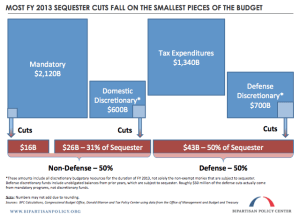 There’s a fairly good list of the types of spending items that will be subject to cuts at the Bipartisan Policy Center.
Setting aside the magnitude of the reductions, the most difficult aspect of both the defense and domestic cuts is that they will be made across the board to all non-exempt government spending regardless of programs’ merits or demerits.*** The reductions designed by law are executed at the Program, Project & Activity (PPA) level of the federal budget, sometimes defined in appropriations bills and which often includes very granular categories of expenditures, such as “two Virginia Class Submarines” or “salaries and benefits” of a particular agency.
Absent a new law passed by Congress, the president has little ability to spare one type of spending and cut more from another. This creates uncertainty in both the public and private sector because there remains much to be determined about how PPAs will be defined by agency administrators and how the cuts will be implemented. This inability to plan is already acting as a drag on economic growth.
Furthermore, the immediate and across the board nature of the cuts, along with their magnitude concentrated in a seven-month period, will impair economic growth as the year progresses. At BPC, we estimated last year that the sequester would reduce 2013 gross domestic product (GDP) growth by half a percentage point, and would cost the economy approximately one million jobs over the next two years. More recent estimates released by the CBO and Macroeconomic Advisors have roughly confirmed these projections.
Given all of this, you would think that most congress critterz would want to avoid the sequester. However, there’s that same group of tea party crazies that are so disconnected from an evidence-based reality it appears congress will tank the economy rather than develop a cogent Fiscal Policy related to economic theory and the state of the economy itself.
The White House strategy on the sequester was built around a familiar miscalculation about Republicans. It assumed that, in the end, they would be reasonable and negotiate a realistic alternative to indiscriminate cuts. Because the reductions hurt defense programs long held sacrosanct by Republicans, the White House thought it had leverage that would reduce the damage to the domestic programs favored by Democrats.
It turns out, though, that the defense hawks in the party are outnumbered. More Republicans seem to care about reducing spending at all costs, and the prospect of damaging vital government programs does not seem to bother them. “Fiscal questions trump defense in a way they never would have after 9/11,” Representative Tom Cole, a Republican of Oklahoma, told The Times. “But the war in Iraq is over. Troops are coming home from Afghanistan, and we want to secure the cuts.”
Cuts this draconian have no place in a tottering economy. But, realistically, the only way to break this standoff is for the cuts to exact their toll on daily life, causing Republicans to face pressure from the public to negotiate an alternative plan with higher revenues in March as part of talks to finance the government for the final six months of the fiscal year.
It’s difficult to believe that so many folks can be so misguided about the need to drastically cut the budget. Read the rest of this entry »

 peej
peej Carissa
 bostonboomer
 dakinikat
 ecocatwoman
 mablue2
 Mama Lopez
 peggysue22
 quixote
 skydancingguestblogger
 Mona (aka Wonk the Vote)



 Sky Dancing
Recent Comments