
Tom Ricks vs. Fox News, Take 2
Posted: November 27, 2012 Filed under: Republican politics, U.S. Military, U.S. Politics | Tags: Benghazi, Fox News, Hollywood Reporter, Michael Clemente, Thomas Ricks 22 Comments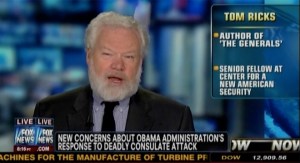
What is the deal with this Tom Ricks story? Fox News sure is touchy these days. A Fox executive told the Hollywood Reporter that after his abruptly terminated interview yesterday, Ricks apologized for telling the truth about the network on the air.
Tom Ricks, a former Washington Post reporter and author of best-selling books Fiasco and The Generals, briefly spoke with FNC’s Jon Scott about the death of four Americans in Benghazi, Libya. In a brief interview, Ricks first said FNC “hyped” the embassy attack and said a bit later that “Fox was operating as a wing of the Republican Party” before Scott ended the interview.
Michael Clemente, executive vp, news editorial at FNC, tells The Hollywood Reporter that Ricks dodged Scott’s question (“When you have four people dead, including the first U.N. ambassador in more than 30 years, how do you call that ‘hype’?”).
“When Mr. Ricks ignored the anchor’s question, it became clear that his goal was to bring attention to himself — and his book,” Clemente said in an e-mail to THR. “He apologized in our offices afterward but doesn’t have the strength of character to do that publicly.”
But Ricks says the apology story is a big ol’ lie. From Politico:
Ricks told POLITICO that Michael Clemente, Fox’s executive vice president of news, made the claim he apologized privately because “when the facts aren’t on their side, they attack the person.”
“Clemente is making it up, and it is sloppy of Hollywood Reporter to not ask him for specifics — what exactly am I alleged to have said? — and also to seek a response from me,” Ricks wrote in an e-mail. “Why are they doing this? Because their MO is that when the facts aren’t on their side, they attack the person.”
Ricks told the Washington Post that
I had told the producer before I went on that I thought the Benghazi story had been hyped. So it should have been no surprise when I said it and the anchor pushed back that I defended my view.
I also have been thinking a lot about George Marshall, the Army chief of staff during World War II, and one of the heroes of my new book. He got his job by speaking truth to power, and I have been thinking that we all could benefit by following his example as much as we can.
After I went off the air I saw some surprised faces in the hallway. One staff person said she thought I had been rude. My feeling was that they asked my opinion and I gave it.
Ricks also told the Hollywood Reporter in an e-mail:
“Please ask Mr. Clemente what the words of my supposed apology were. I’d be interested to know,” he said. “Frankly, I don’t remember any such apology.”
Clemente responded, according to TPM:
“I’m surprised by the General’s utter dishonesty,” Clemente said. “I’ll refresh his memory – what he said following the segment was, ‘Sorry… I’m tired from a non-stop book tour.’ Perhaps now he can finally get some rest.”
Ricks is not a general, but he did write a book called The Generals.
You be the judge. I report, you decide. (This is an open thread.)
Tuesday Reads: Hitchcock, Hearing Aids, and Republican Delusions
Posted: November 27, 2012 Filed under: 2012 elections, Barack Obama, John McCain, morning reads, the GOP, U.S. Politics | Tags: Alma Reville, Anthony Hopkins, Anthony Perkins, Asian American voters, Charles Murray, Grover Norquist, Helen Mirren, Jamelle Bouie, Janet Leigh, Kelly Ayotte, Latino voters, Michael Morell, Psycho, Susan Rice 34 Comments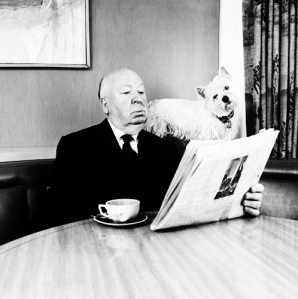
Good Morning!!
I’m really looking forward to seeing Hitchcock, the new movie about the making of Psycho. Unfortunately, the film may not come to Muncie, IN, so I might have to just hope it will still be playing in Boston when I get back home sometime in December. If you have a chance to see it where you are, let me know how you like it.
Last night the Wall Street Journal posted an interview with Helen Mirren, who plays the great director’s wife Alma Reville Hitchcock in the new film. Mirren is one of my favorite actresses!
Alfred Hitchcock once said that there were four people who helped make him who he was—one was a film director, one a script writer, one a cook and one the mother of his daughter. “Their names are Alma Reville,” he said of his wife of 44 years, who performed all four roles. In the new biopic “Hitchcock,” Helen Mirren rolls Reville’s many facets into a singular performance.
The movie, which opened in the city over the weekend, traces Hitchcock’s (Anthony Hopkins) effort to make his 1960 classic, “Psycho,” from his struggle with Hollywood studios to finance the picture to Reville’s pivotal role in the movie’s—and her husband’s—success. “I was surprised to find out about the importance of Alma,” Ms. Mirren said recently.
Read what Mirren had to say at the link.
And here’s an interview with Anthony Hopkins, who plays Alfred Hitchcock at “Vulture.”
Do you remember the first time you saw Psycho?
When it first came out in Manchester on a wet September evening and I was knocked out by it. That was the most terrifying film I’d ever seen. I couldn’t believe it: Where’s Janet Leigh? She’s got to come back. She’s the star of the movie! I thought she perhaps escaped from the trunk of the car. So I’ve been watching these films over the years, long before I knew I was going to play him.
Did you talk to anyone who worked with Hitchcock? What insights did they share?
I met Janet Leigh in New York, and then later in Hollywood at a function. She said, “Mr. Hitchcock was one of the funniest men I’ve ever worked with. My ex-husband Tony [Curtis] and I used to go to his house in Bel-Air, and we’d laugh ourselves sick, because he was so funny, so wicked, a great practical joker.” She said he wasn’t an easy man to get to know, but she got on with him.
Read lots more at the link.
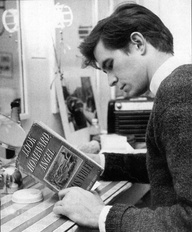
Psycho came out in 1960, when I was only 12 years old. My parents wouldn’t let me see horror movies, which is probably why I love them so much now. I don’t remember when I first saw Psycho–it must have been on TV, probably in the late 60s or 70s. By then the shock value wasn’t as huge as when the movie first came out.
Entertainment Weekly has a “look back at the mystique of ‘Psycho'” by Owen Glieberman
Alfred Hitchcock’s Psycho was released in the summer of 1960, and in the half a century since, it has become the rare movie in which every image and detail and motif is now, more or less, iconic. Every moment in the movie is a piece of mythological Americana.
In a way that I couldn’t quite say about any other film, I feel as if I’ve spent most of my movie life thinking — and writing — about Psycho. Part of the film’s mystique is that no matter how many times you’ve seen it (and it may be the ultimate movie that you can watch over and over again), it keeps coming back to provoke and tantalize and haunt you. Its power of revelation never wears thin or gets old. It’s one of the only films in Hollywood history — the others, I would say, are The Wizard of Oz, Citizen Kane, The Godfather, and Star Wars — that is so alive, its experience so vivid and immediate and larger-than-life, that it effectively transcends time….
In the infamous shower scene, when that big, fat kitchen knife, wielded by a mysterious Victorian shrew named Mrs. Bates, came slashing down, over and over again, into the body of Marion Crane, it was also slicing through years — decades, centuries — of popular expectation that the hero or heroine of a fictional work would be shielded and protected, or would at least die (usually at the end) in a way that made some sort of moral-dramatic sense. In Psycho, murder made no sense at all; the suddenness — and viciousness — of it tore at the fabric of our certainty. What it suggested is that none of us, in the end, are ever truly protected. Hitchcock seemed to be pulling the rug, the floor, and the earth right out from under the audience. He opened an abyss, exposing moviegoers to a dark side that few, at the time, could ever have dared to imagine.
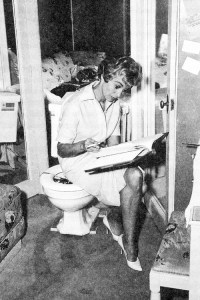
Eeeeeeeeek!
In other news, I had a big day yesterday. I’ve had moderate hearing loss since I was pretty young–at least since my early 30s. When I first found out I had nerve damage, I was told there was nothing that could be done. My problem was that I had trouble making out words, and hearing aids would only make the garbled words louder.
Technology has advanced over the past 30 years, and yesterday I got some hearing aids, thanks to the generosity of my mother. Suddenly I can hear things that I never heard before. I can hear the words people are saying even if I’m not looking at them and watching their lips. I can hear people when they whisper–previously I couldn’t make out whispering even if the person’s mouth was right next to my ear. It’s just amazing. I hope you don’t mind me sharing that.
Now some national news. Republicans are still trying to figure out why they lost the presidential election and, as Lawrence O’Donnell pointed out last night, they still don’t want to give President Obama any credit for beating them. No, it’s all about demographics, fooling Latinos and women into thinking Republicans actually care about their issues. But what about Asian-Americans, another group that voted for Obama by a lopsided percentage?
Right wing racist Charles Murray argues that the problem (with both Latinos and Asians) is that the Republican Party has tied itself to socially conservative issues (no kidding!)
My thesis is that the GOP is in trouble across the electoral board because it has become identified in the public mind with social conservatism. Large numbers of Independents and Democrats who are naturally attracted to arguments of fiscal discipline, less government interference in daily life, greater personal responsibility, and free enterprise refuse to vote for Republicans because they are so put off by the positions and rhetoric of social conservatives, whom they take to represent the spirit of the “real” GOP….
Asians are only half as likely to identify themselves as “conservative” or “very conservative” as whites, and less than half as likely to identify themselves as Republicans. Asians are not only a lot more liberal than whites; a higher percentage of Asians identify themselves as “liberal” or “extremely liberal” (22%) than do blacks (19%) or Latinos (17%). And depending on which poll you believe, somewhere in the vicinity of 70% of Asians voted for Barack Obama in the last presidential election.
Something’s wrong with this picture. It’s not just that the income, occupations, and marital status of Asians should push them toward the right. Everyday observation of Asians around the world reveal them to be conspicuously entrepreneurial, industrious, family-oriented, and self-reliant. If you’re looking for a natural Republican constituency, Asians should define “natural.”
And so on… bla bla bla…
At the American Prospect, Jamelle Bouie explains to Murray How Not to Appeal to Asian Americans. Hint: cut out the racism.
As with Latinos, Asian American movement to the Democratic Party has a lot to do with with the explicitly anti-immigrant stance of the GOP, as well as the overwhelming sense that the GOP is a party for hidebound whites, and actively hostile toward nonwhites of all stripes.
There’s a policy component in this as well; the Asian American community is highly diverse (ethnically, economically, and otherwise), and there many who would benefit from the core Obama agenda of health care reform, stronger social services, and investments in education and other programs. Still, even with that in mind, it’s fair to say that Asian American support for Obama is as much about inclusion as it is about policy.
Which is why this piece, from conservative scholar Charles Murray, rankles. Rather than consider Asian American political preferences on their own terms—or even acknowledge the range of experience among different Asian American groups—Murray lumps them all into a single, undistinguished mass of model minorities, and then wonders why they don’t vote for Republican candidates.
But Murray’s argument is based on a false premise:
It’s worth noting the implicit contrast here. Entrepreneurism, industriousness, family-orientation, self-reliance—these are things that Murray sees as unique to Republican constituencies. Which must also mean that these are thing that go unvalued by Democratic constituencies, namely, African Americans, Latinos, young people, and single women.
Furthermore, as Bouie notes today’s Republicans actually are a bunch of fundamentalists who are anti-gay and anti-woman. That’s not just a perception, it’s the reality that Charles Murray doesn’t want to accept. It’s not that Latinos, Asians, and African Americans are deluded about the nature of the Republican Party. But what else would you expect from the author of the racist screed The Bell Curve?
Today Susan Rice will begin facing down her Republican critics on Capital Hill.
With congressional opposition softening, U.N. Ambassador Susan Rice could find her name in contention as early as this week to succeed Hillary Rodham Clinton as secretary of state. It’s a step that may signal greater U.S. willingness to intervene in world crises during President Barack Obama’s second term.
As Obama nears a decision on who should be the country’s next top diplomat, Rice has emerged as the clear front-runner on a short list of candidates that many believe has been narrowed to just her and Sen. John Kerry, despite lingering questions over her comments about the deadly Sept. 11 attack on a U.S. Consulate in Libya.
According to congressional aides and administration officials, Rice will be making the rounds on Capitol Hill this week for closed door meetings with key lawmakers whose support she will need to be confirmed. Those appearances follow her first in-depth explanation of her Benghazi remarks that Republicans seized on as evidence of the administration’s mishandling of the attack that took the lives of the U.S. ambassador to Libya and three other Americans.
Acting CIA Director Michael Morell will join Rice in her meetings with lawmakers.
Today Rice will meet with Senators John McCain and Kelly Ayotte. When asked about the meeting, McCain was his usual testy self:
McCain said he would ask Rice “the same questions I’ve been talking about on every talk show in America.” Asked whether he thinks she’s still unfit for secretary of state and what he was hoping for, McCain interrupted and said, “I’m not hoping for anything. She asked to see me and I agreed to see her.”
What a jerk. I’d love to be a fly on the wall in that meeting.
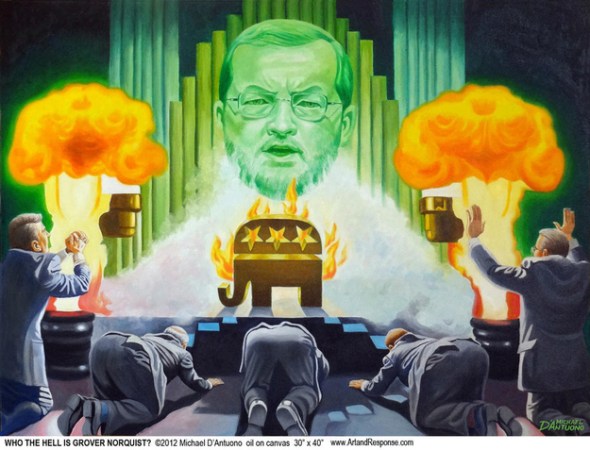
I’ll end with this amazing artistic depiction of Republican delusion, Grover Norquist as the Wizard of Oz (via Buzzfeed).
Artist Michael D’Antuono has painted anti-taxi activist Grover Norquist as a Wizard of Oz-like disembodied head with Republican politicians bowing before him as an elephant burns, to symbolize Norquist’s powerful position in the Republican party.
Now it’s your turn. What are you reading and blogging about today?
Tom Ricks Challenges Fox News on Beghazi; Interview Ends Abruptly
Posted: November 26, 2012 Filed under: open thread, U.S. Military, U.S. Politics | Tags: Benghazi, Fox News, John McCain, Susan Rice, Tom Ricks 31 Comments
Tom Ricks, Pulitzer Prize-winning journalist, author, and blogger at Foreign Policy appeared on Fox News this morning, where he was asked by talking head Jon Scott why John McCain has toned down his attacks on Susan Rice recently. Ricks opted to answer truthfully. From Raw Story:
“I think that Benghazi was generally hyped by this network especially,” Ricks explained. “And now that the [2012 presidential] campaign is over, I think [McCain] is backing off a little bit. They’re not going to stop Susan Rice from being secretary of state.”
At that point, Scott shifted the interview’s focus from McCain to defending his employer, asking Ricks, “How do you call that hype” when four Americans died in the Benghazi attacks?
“How many security contractors died in Iraq, do you know?” Ricks wondered.
“I don’t,” Scott admitted, seemingly at a loss for words.
“No, nobody does because nobody cared,” Ricks pointed out. “Several hundred died but there was never an official count done of security contractors dead in Iraq. So when I see this focus on what was essentially a small fire fight, I think — number one — I’ve covered a lot of fire fights, it’s impossible find out what happened in them sometimes.”
“And second, I think the emphasis on Benghazi has been extremely political, partly because Fox was operating as wing of the Republican Party,” the author added.
Oops! And suddenly the interview with the distinguished military expert was terminated.
This is an open thread.
Monday Reads
Posted: November 26, 2012 Filed under: morning reads | Tags: Black Thursay Walmart, drone strikes, Norquist pledge 37 Comments
Good Morning!
This story in the NYT has my head spinning. It seems the Obama administration was thinking about putting together some kind of “Rule Book” for the use of Drones and assassination in the war against terror because they didn’t really trust Romney under the current situation. I have to wonder if Romney would ‘ve followed it any way. The bigger question is how do these policies jive with our Constitution and what should both our Legislative and Judicial Branches do to at least curb their use?
Facing the possibility that President Obama might not win a second term, his administration accelerated work in the weeks before the election to develop explicit rules for the targeted killing of terrorists by unmanned drones, so that a new president would inherit clear standards and procedures, according to two administration officials.
The matter may have lost some urgency after Nov. 6. But with more than 300 drone strikes and some 2,500 people killed by the Central Intelligence Agency and the military since Mr. Obama first took office, the administration is still pushing to make the rules formal and resolve internal uncertainty and disagreement about exactly when lethal action is justified.
Mr. Obama and his advisers are still debating whether remote-control killing should be a measure of last resort against imminent threats to the United States, or a more flexible tool, available to help allied governments attack their enemies or to prevent militants from controlling territory.
Though publicly the administration presents a united front on the use of drones, behind the scenes there is longstanding tension. The Defense Department and the C.I.A. continue to press for greater latitude to carry out strikes; Justice Department and State Department officials, and the president’s counterterrorism adviser, John O. Brennan, have argued for restraint, officials involved in the discussions say.
More broadly, the administration’s legal reasoning has not persuaded many other countries that the strikes are acceptable under international law. For years before the Sept. 11, 2001, attacks, the United States routinely condemned targeted killings of suspected terrorists by Israel, and most countries still object to such measures.
But since the first targeted killing by the United States in 2002, two administrations have taken the position that the United States is at war with Al Qaeda and its allies and can legally defend itself by striking its enemies wherever they are found.
Partly because United Nations officials know that the United States is setting a legal and ethical precedent for other countries developing armed drones, the U.N. plans to open a unit in Geneva early next year to investigate American drone strikes.
I doubt the UN will put any pressure on us but I wonder if this will at least get us all talking about the policy and if that’s the kind of policy we want as a country.
Several more Republican office holders in the District have announced they are willing to break with the Norquist pledge.
Sen. Lindsey Graham (R-S.C.) on Sunday said he is ready to violate conservative activist Grover Norquist’s anti-tax pledge to reach a deal to avoid the looming “fiscal cliff.”
“I will violate the pledge, long story short, for the good of the country,” Graham said on ABC’s “This Week.” “When you’re $16 trillion in debt, the only pledge we should be making to each other is to avoid becoming Greece.”
But Graham cautioned that he he would violate the pledge “only if Democrats will do entitlement reforms” and ruled our increasing tax rates.
“I am willing to generate revenue,” he said. “I will not raise tax rates to do it; I will cap deductions.”
The transcript shows that Graham was specific about what he was willing and unwilling to accept.
STEPHANOPOULOS: OK, Senator Graham, you’ve signaled that you’re willing to raise revenues as part of an overall deal that also includes spending cuts, and that’s drawn the fire of Grover Norquist, you know, the author of that no-tax pledge that’s been in place among so many Republicans for 20 years right now. He thinks the best solution is actually not to negotiate a compromise right now, is to go over the cliff. He says the world won’t come to an end if this isn’t resolved before January. Take the sequester. The only thing worse than sequester cuts is to not cut spending at all. He’s saying don’t raise taxes, accept those spending cuts.
GRAHAM: Well, what I would say to Grover Norquist is that the sequester destroys the United States military. According to our own secretary of defense, it would be shooting ourselves in the head. You’d have the smallest Army since 1940, the smallest Navy since 1915, the smallest Air Force in the history of the country, so sequestration must be replaced.
I’m willing to generate revenue. It’s fair to ask my party to put revenue on the table. We’re below historic averages. I will not raise tax rates to do it. I will cap deductions. If you cap deductions around the $30,000, $40,000 range, you can raise $1 trillion in revenue, and the people who lose their deductions are the upper-income Americans.
But to do this, I just don’t want to promise the spending cuts. I want entitlement reforms. Republicans always put revenue on the table. Democrats always promise to cut spending. Well, we never cut spending. What I’m looking for is more revenue for entitlement reform before the end of the year…
This has to be the most horrible story of valuing stuff over people that I’ve ever heard. Three Walmart workers killed a man who had shoplifted two dvd players.
It’s a sad, simple story. An unidentified man allegedly stole two DVD players from the electronics department and left the store through the front door. Two Walmart employees and a contracted security guard chased him into the parking lot. A “physical altercation” took place, and apparently, the security guard put the man in a choke hold. Police arrived soon thereafter to find the three workers on top of the suspected shoplifter who was unresponsive and bleeding from his nose and mouth. The man was taken to the hospital, where he was pronounced dead.
“No amount of merchandise is worth someone’s life,” said Walmart spokesperson Dianna Gee in a statement. “Associates are trained to disengage from situations that would put themselves or others at risk.” She added, “That being said, this is still an active investigation and we’re working with police to provide any assistance.” Walmart put the two employees on paid leave and fired the security guard.
Regardless of what happens at the end of that investigation, there’s no way Walmart is going to come out of this one looking good. It truly sounds like this was a horrible accident, the kind that makes it hard to point fingers or figure out what went wrong. However, this incident also happened as thousands of Walmart workers nationwide were protesting poor treatment by their employers. Are the two things related? Only insofar as it adds up to a ton of bad press for a company long known to promote mass hysteria on Black Friday weekend. It’s a problem that people are still dying at their stores, years after warnings signs like the Walmart employee who was trampled to death on Black Friday.
This has to be the worse thing I’ve ever heard in terms of class war. Dancing Dave’s Disco is always the place to be for outraged q’billionaires.
Carly Fiorina, who reportedly stood to receive more than $42 million after being ousted at HP in 2005, says that public workers should receive less benefits because “it is not fair” that unions are “so rich.”
During a Sunday panel segment on NBC, MSNBC host Al Sharpton asserted that Congress must agree to raise taxes on the wealthy before cutting spending.
“This is about fairness,” he explained. “Why do we need to need to deal with the tax on the rich first? Because we must ensure Americans we are dealing with fairness. We keep talking about shared sacrifice, there was not shared wealth and shared prosperity. So, you’re asking people that didn’t enjoy the good times to share in paying for the tab that they never enjoyed.”
“Let us accept Rev. Al’s point and the president’s point about fairness,” Fiorina replied. “But equally, it is not fair that public employee union pensions and benefits are so rich now that cities and states are going bankrupt and college tuition is going up 25 and 30 percent or police and firefighters are being cut. There’s a lot that isn’t fair right now.”
During Fiorina tenure as the CEO of HP, at least 18,000 workers were laid off after the company’s disastrous merger with Compaq.
Evidently, it’s okay to pay bad management millions of dollars but it’s just too much for any one else to get a living wage and benefits. What is wrong with these people?
So, that’s my list of reads today! What’s on you reading and blogging list this morning?
Steven Spielberg’s Dark and Gloomy “Lincoln”
Posted: November 25, 2012 Filed under: Congress, U.S. Politics, War on Women | Tags: Abraham Lincoln, Daniel Day Lewis, Elizabeth Hobbs Keckley, Frederick Douglass, Kate Masur, Lincoln, Lydia Hamilton Smith, Mary Todd Lincoln, movies, Ronald C. White, Steven Spielberg, Thaddeus Stevens, Tommy Lee Jones, William Slade 27 Comments
Daniel Day Lewis as Lincoln
I went to see Spielberg’s latest film “Lincoln” today. That was three hours of my life I’ll never get back. I admit that I’m not a fan of Steven Spielberg or of historical dramas, so maybe my judgment isn’t worth that much; but I’m going to write about it anyway. I am a fan of Daniel Day Lewis, and I suppose he was the best thing about the movie. The second best thing was that Tom Hanks wasn’t in it.
Spielberg’s film covers the last four months of Lincoln’s life and is centered on the fight for passage of the Thirteenth Amendment to the Constitution. Certainly, the subject had the potential for a gripping drama, but instead Spielberg managed to turn a thrilling story into a movie that I found boring, pretentious, and depressing.
What bothered me most as I watched the film was how dark and grim it was–scene after scene after scene of men wearing dark clothing and talking incessantly. But as the endless scenes wore on, I couldn’t keep my own present-day irritations from affecting my reactions. I was incredibly annoyed to watching important national decisions being made solely by white men–most of whom were old and not very pleasant to look at–without any input from women or African Americans.
The make-up seemed designed to emphasize wrinkles, bags under the eyes, and unattractive facial hair in microscopic detail. Tommy Lee Jones was never handsome, but in his role as Radical Republican Thaddeus Stevens he was made to look almost monstrous, with deep wrinkles, sagging jowls and giant pouch-like bags under his eyes.
But back to my growing irritation. After the misogyny and racism we have seen in this country over the past four years, I found the domination of “Lincoln” by white males to be incredibly annoying. And my irritation only grew as time went on. Surely there must have been black people who fought to pass the amendment–where were they?
The talk of “equality” of the races and the evils of treating “men” as property really rubbed me the wrong way, considering that women and children were to continue being treated as property for at least another hundred years after the passage of the Thirteen Amendment and that black men even in 2012 are still very far from being treated equally. Even our black President isn’t immune from the patronizing and bigoted attitudes of many Americans.
Admittedly, it’s unfair of me to judge the movie based on my present-day anger. Still, I think part of that feeling did arise from the fact that the movie–I think wrongly–ignored the thoughts and feelings of women and black people.
Only two women are shown having any kind of role in events: Mary Todd Lincoln and Elizabeth Hobbs Keckley. Mary Todd Lincoln is shown interpreting her husband’s dreams, trying to prevent her eldest son from enlisting in the Union Army, and supporting her husband’s policies. Her closest companion was Keckley, a black women who had purchased freedom for herself and her son, and become a seamstress. She was eventually introduced to Mary Todd Lincoln and went with her to the White House. Keckley wrote an autobiography, Behind the Scenes: Behind the Scenes: Or, Thirty Years a Slave, and Four Years in the White House. But none of this was spelled out in the movie.
As for black characters, there is a sort of butler who says he was born a free man, a couple of black Union soldiers and anonymous black audience members who file in to the House gallery to watch the final vote on emancipation. I later learned that the “butler” was William Slade, who along with Elizabeth Keckley, was active in the abolition movement. Toward the end of the film, Thaddeus Stevens is shown getting into bed with a black woman whom I later learned was Stevens’ housekeeper Lydia Hamilton Smith. The two were lovers for 23 years, so why didn’t Spielberg emphasize her influence on Stevens’ attitudes about racial equality? Why was she included in the film almost as an afterthought?
At least one reviewer, historian Kate Masur, expressed a similar reaction to mine–except that hers was based on actual historical knowledge. Masur writes:
[I]t’s disappointing that in a movie devoted to explaining the abolition of slavery in the United States, African-American characters do almost nothing but passively wait for white men to liberate them. For some 30 years, historians have been demonstrating that slaves were crucial agents in their emancipation; however imperfectly, Ken Burns’s 1990 documentary “The Civil War” brought aspects of that interpretation to the American public. Yet Mr. Spielberg’s “Lincoln” gives us only faithful servants, patiently waiting for the day of Jubilee.
This is not mere nit-picking. Mr. Spielberg’s “Lincoln” helps perpetuate the notion that African Americans have offered little of substance to their own liberation. While the film largely avoids the noxious stereotypes of subservient African-Americans for which movies like “Gone With the Wind” have become notorious, it reinforces, even if inadvertently, the outdated assumption that white men are the primary movers of history and the main sources of social progress.
I’m no historian–or movie reviewer–so I was relieved to learn that I’m not the only person who was deeply disappointed in “Lincoln,” despite fine performances by many of the white cast members. According to Masur,
In fact, the capital was also home to an organized and highly politicized community of free African-Americans, in which the White House servants Elizabeth Keckley and William Slade were leaders. Keckley, who published a memoir in 1868, organized other black women to raise money and donations of clothing and food for the fugitives who’d sought refuge in Washington. Slade was a leader in the Social, Civil and Statistical Association, a black organization that tried to advance arguments for freedom and civil rights by collecting data on black economic and social successes. The film conveys none of this, opting instead for generic, archetypal characters.
Masur was offended by the
brief cameo of Lydia Smith…housekeeper and supposed lover of the Pennsylvania congressman and Radical Republican Thaddeus Stevens… Stevens’s relationship with his “mulatto” housekeeper is the subject of notoriously racist scenes in D. W. Griffith’s 1915 film “Birth of a Nation.” Though Mr. Spielberg’s film looks upon the pair with far more sympathy, the sudden revelation of their relationship — Stevens literally hands the official copy of the 13th Amendment to Smith, before the two head into bed together — reveals, once again, the film’s determination to see emancipation as a gift from white people to black people, not as a social transformation in which African-Americans themselves played a role.
And why was Frederick Douglass left out of the film entirely? Masur notes that he was invited to the White House after Lincoln was inaugurated for the second time. According to Lincoln biographer Ronald C. White,
what the audience doesn’t fully understand, in the final scene – almost the final scene – where suddenly African-Americans arrive in the balcony as the final vote is to be taken, that one of those is Charles Douglass, the son of Frederick Douglass. Charles had fought in the famous Massachusetts 54th; he will write to his father after that climactic vote: ‘Oh, Father, how wonderful it is. People were cheering, they were crying tears of joy.’ So that had the potential for more black agency, but it doesn’t come to full fruition in the film.”
To add insult to injury, Lincoln is far too long at 2-1/2 hours (plus ads and previews). It could easily have been edited to 2 hours or less, especially since Spielberg chose to ignore the historical roles of African Americans and women in the events the film depicts.

 peej
peej Carissa
 bostonboomer
 dakinikat
 ecocatwoman
 mablue2
 Mama Lopez
 peggysue22
 quixote
 skydancingguestblogger
 Mona (aka Wonk the Vote)



 Sky Dancing
Recent Comments