
Monday Reads
Posted: September 10, 2012 Filed under: morning reads | Tags: Ani DeFranco, Chicago school strike, denying voters the right to vote, Marie ANNtoinent Romney, Ohio battle ground state poll, Republican voter suppression, Richard III 62 Comments Good Morning!
The Twitterati were all aTwit about the Romney’s really really rough “struggle” in life yesterday. It was a pretty funny hashtag thread in response to Ann Romney trying to list the Romney “struggles”. You know, it must’ve been tough waiting for that fourth draft deferment for Vietnam while Mitt lived in a palace in France. Then, you know, we all have that problem of having to dip into the stock portfolio our parents gave us while trying to go to Harvard. So, it goes with out saying, life is just one struggle to keep up with the Vanderbilts, the Astors, and the P-Diddys.
Ann Romney pushed back Sunday against detractors whom she said have called her husband “heartless,” emphasizing that she and Mitt Romney have struggled, even if not financially.
“Mitt and I do recognize that we have not had a financial struggle in our lives,” Ann Romney said in an interview with Mitt Romney that aired on NBC’s “Meet the Press” Sunday. “But I want people to believe in their hearts that we know what it is like to struggle. And our struggles have not been financial, but they’ve been with health and with difficulties in different things in life.”
President Obama leads Mitt Romney in the polls when it comes to which candidate has more empathy for people struggling in the economy. At the Republican convention last month, the campaign tried to combat that narrative. Ann Romney tried to humanize Mitt Romney in her address, calling their life together a “real marriage” that began by eating “a lot of pasta and tuna fish.” The campaign also enlisted several of Romney’s friends from his congregation in Massachusetts to paint the candidate as compassionate.
All of us “you people” just don’t understand. That would include the Fact Checkers at The Atlantic.
Ann Romney 2012: “I saw the long hours that started with that first job. I was there when he and a small group of friends talked about starting a new company. I was there when they struggled and wondered if the whole idea just wasn’t going to work. Mitt’s reaction was to work harder and press on.”
The Real Romney, by Michael Kranish and Scott Helman: At Bain & Company, founder Bill Bain treated Romney “as a kind of prince regent at the firm, a favored son.” He selected Romney to start and run Bain Capital. “It would be Romney’s first chance to run his own firm and, potentially, to make a killing,” they write. “It was an offer few young men in a hurry could refuse. Yet Romney stunned his boss by doing just that.” They continue:
“He explained to Bain that he didn’t want to risk his position, earnings, and reputation on an experiment. He found the offer appealing but didn’t want to make the decision in a “light or flippant manner.” So Bain sweetened the pot. He guaranteed that if the experiment failed Romney would get his old job and salary back, plus any raises he would have earned during his absence. Still, Romney worried about the impact on his reputation if he proved unable to do the job. Again the pot was sweetened. Bain promised that, if necessary, he would craft a cover story saying that Romney’s return to Bain & Company was needed due to his value as a consultant. “So,” Bain explained, “there was no professional or financial risk.” This time Romney said yes.”
Yeah. All of us should be blessed by THESE kinds of struggles.
Okay, it’s time for another kat’s adventure in historical grave stuff item. This time it’s on the search for the grave for Richard III in the UK.
An archaeological dig searching for the grave of Richard III has uncovered evidence of a lost garden, organisers said.
Experts from the University of Leicester who are leading the search discovered paving stones which they believe belong to the garden of Robert Herrick where, historically, it is recorded there was a memorial to Richard III.
Work by the “time tomb team”, as they have become known, has so far involved the digging of two trenches at a Leicester city centre car park – and this week a third was excavated – thought to cover the site of a Franciscan friar where the former king is believed to have been buried in 1485.
Working alongside members of the Richard III Society, archaeologists also confirmed they had found the church of the Grey Friars.
Research at the site, which is owned by Leicester City Council, began on August 24 with archaeologists using ground-penetrating radar equipment to mark out the trenches.
Philippa Langley, of the Richard III Society, said: “This is an astonishing discovery and a huge step forward in the search for King Richard’s grave.
“Herrick is incredibly important in the story of Richard’s grave and in potentially helping us get that little bit closer to locating it.”
In the early 1600s, Alderman Robert Herrick, a mayor of Leicester, bought the land of the Grey Friars and built a large mansion house with a garden on the site.
In 1612, Christopher Wren, father of the famous architect, was visiting Herrick and recorded seeing a handsome three foot stone pillar in Herrick’s garden.
Inscribed on the pillar was: “Here lies the body of Richard III sometime King of England.”
No mention of Richard III would be complete without a h/t to Shakespeare
Now is the winter of our discontent
Made glorious summer by this sun of York;
And all the clouds that lour’d upon our house
In the deep bosom of the ocean buried.
Now are our brows bound with victorious wreaths;
Our bruised arms hung up for monuments;
Our stern alarums changed to merry meetings,
Our dreadful marches to delightful measures.
Grim-visaged war hath smooth’d his wrinkled front;
And now, instead of mounting barded steeds
To fright the souls of fearful adversaries,
He capers nimbly in a lady’s chamber
To the lascivious pleasing of a lute.
But I, that am not shaped for sportive tricks,
Nor made to court an amorous looking-glass;
I, that am rudely stamp’d, and want love’s majesty
To strut before a wanton ambling nymph;
I, that am curtail’d of this fair proportion,
Cheated of feature by dissembling nature,
Deformed, unfinish’d, sent before my time
Into this breathing world, scarce half made up,
And that so lamely and unfashionable
That dogs bark at me as I halt by them;
Why, I, in this weak piping time of peace,
Have no delight to pass away the time,
Unless to spy my shadow in the sun
And descant on mine own deformity:
And therefore, since I cannot prove a lover,
To entertain these fair well-spoken days,
I am determined to prove a villain
And hate the idle pleasures of these days.
Since I’m waxing poetic, philosophical, and political, here’s a quick music break.
Public Policy Polling finds that Obama leads in Ohio by 5 points. Ohio is an important swing state.
PPP’s first post-conventions poll in Ohio finds Barack Obama with a 5 point lead over Mitt Romney, 50-45. This is the largest lead PPP has found for Obama in an Ohio poll since early May. Last month Obama led 48-45.
Both candidates have seen their images improve with Ohio voters in the wake of the conventions. Obama now breaks even in his approval rating at 48%, after being under water with 46% of voters approving and 51% disapproving of him a month ago. Romney’s numbers are up from a 41/52 favorability rating a month ago as well, but he still remains unpopular. Only 44% see him favorably to 49% with a negative opinion.
Romney actually leads 46-44 with independents but Obama has the overall advantage thanks to a more unified party base. He leads 86/11 with Democrats, compared to Romney’s 83/13 advantage with Republicans. Obama’s 75 point lead within his own party is up from 70 points a month ago, suggesting that his party has coalesced around him a little bit more in the wake of a successful convention. By a 47/35 margin Ohio voters say they think the Democrats had a better convention than the Republicans.
In the last few weeks, nearly a dozen decisions in federal and state courts on early voting, provisional ballots and voter identification requirements have driven the rules in conflicting directions, some favoring Republicans demanding that voters show more identification to guard against fraud and others backing Democrats who want to make voting as easy as possible.
The most closely watched cases — in the swing states of Ohio and Pennsylvania — will see court arguments again this week, with the Ohio dispute possibly headed for a request for emergency review by the Supreme Court.
In Wisconsin, the home state of the Republican vice-presidential candidate, Representative Paul D. Ryan, the attorney general has just appealed to the State Supreme Court on an emergency basis to review two rulings barring its voter ID law. But even if all such cases are settled before Nov. 6 — there are others in Florida, Iowa and South Carolina — any truly tight race will most likely generate post-election litigation that could delay the final result.
“In any of these states there is the potential for disaster,” said Lawrence Norden of the Brennan Center for Justice at New York University School of Law. “You have close elections and the real possibility that people will say their votes were not counted when they should have been. That’s the nightmare scenario for the day after the election.”
In the 2000 presidential election, a deadlock over ballot design and tallying in parts of Florida led the Supreme Court, in a 5-4 vote, to stop a recount of ballots, which led to George W. Bush defeating Al Gore. Since then, both parties have focused on voting procedures.
The Obama campaign, for example, brought suit in Ohio over its reduction of early voting weekends used more by blacks than other groups.
Denying people their constitutional rights appears to be the Republican Party priority these days.
Why are these 29,000 teachers and school workers going on strike in the nation’s third-largest public school district?
Because they want what all workers want: fair pay and decent working conditions. They also want what all teachers want — to serve their students to their best of their abilities.
Here’s a few things you need to know about the strike, and why the CTU is right and Mayor Rahm Emanuel — who has failed to fairly bargain with the union — is wrong:
- Powerful Outside Interests Worked With Rahm To Cripple CTU’s Ability To Strike (They Failed): Last year, outside groups education privatization groups like Stand for Children worked with the city council and mayor to raise the strike threshold limit to 75 percent — meaning that 3/4 of teachers had to vote to strike. Jonah Edelman, who works for the group, bragged during the Aspen Ideas Festival that they had essentially eliminated teachers’ ability to strike. But in June, nearly 90 percent of CTU members voted to authorize a strike, easily surpassing the barrier that the city and education privatization groups had placed on them. But outside groups haven’t stopped taking aim at union rights. They’ve even paid protesters to demonstrate against CTU.
- Rahm Refuses To Pay Teachers What They Were Promised: Being a teacher takes hard work, and it’s one of the most most poorly-paid professions relative to the work load. The leadership of Chicago Public Schools (CPS) had agreed to offer teachers a four percent raise last year, but Mayor Emanuel canceled this agreement. The district has refused to address this raise in negotiations. While gutting teachers’ pay increases, CPS is calling for longer school days. Would you want to work more hours without being fairly compensated for it?
- The City Won’t Agree To Limit The Number Of Kids In Classrooms: Over-crowded classrooms are bad for students, teachers, and parents. That’s why 32 states have limits on classroom size. Illinois does not. CTU wants to see limits on class sizes in its contract, but the city refuses to discuss it.
- Rahm Is Intent On Shifting Funds To Untested And Unproven Charter Schools: Rahm has been laying the groundwork for a rapid expansion of charter schools, and wants to create nearly 250 more within five to ten years (this would amount to half the system). This massive diversion of funds from the public system is not based on the facts of what actually works for students. The most comprehensive study of charter schools in the United States found that most deliver results similar to those of public schools. Not surprisingly, Chicago’s charter schools are largely devoid of unions and the benefits they provide for students and teachers alike. Charter school teachers tend to earn 8 percent less than normal public school teachers — which makes them an attractive tool for austerity-prone conservatives. CTU wants a more fair distribution of funds.
I can’t honestly say that I’d want to teach there for $42,000 a year. I could make more money than that tending bar in the French Quarter and live much
more cheaply.
Anyway, I’ve had another lost week trying to catch up from Isaac. I’ve been visited by FEMA and my insurance agent and I seem to have myself situated into a start up media production company on its way to challenging a well-known cable TV channel. I shall be interviewed this week–actually about this blog–and will send you the link later. Life is always interesting down here in the Big Easy, that’s for sure.
What’s on your reading and blogging list today?
Open Thread: Sunday Night Funnies
Posted: September 9, 2012 Filed under: 2012 presidential campaign, open thread, U.S. Politics, War on Women | Tags: Barack Obama, editorial cartoons, Mitt Romney, Paul Krugman, Paul Ryan, Rand Paul 28 Comments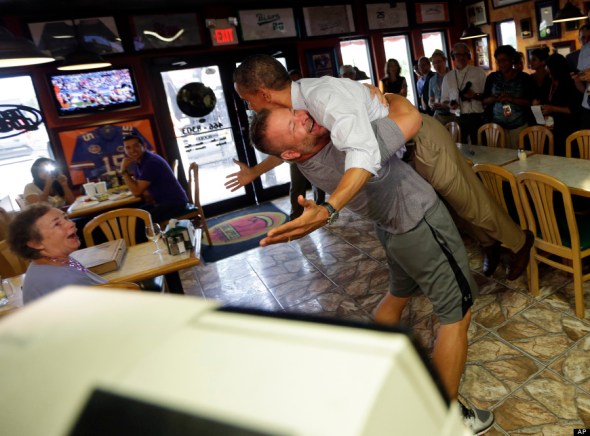
Obama Gets a Lift in Florida:
In this key swing state, Obama stopped at Big Apple Pizza & Pasta Italian Restaurant, where he was greeted by owner Scott Van Duzer, a muscular man dressed in a gray T-shirt and matching athletic shorts.
Van Duzer was so smitten by the president that he embraced him in a bear hug, leaned backward and lifted the 6-foot-2 president a foot off the ground. Photos of the moment show Obama with his arms spread wide and palms turned upward, as if to say he’s at the mercy of the pizzaman….
Afterward, a reporter at the scene reported that Van Duzer, 46, from Port St. Lucie, stands 6-foot-3 and weights 260 pounds, and he can bench-press 350.
“Everybody look at these guns,” Obama said, pointing to Van Duzer’s chest. “If I eat your pizza, will I look like that?”
“Look at that!” Obama exclaimed after Van Duzer put him down. “Man, are you a powerlifter or what?”
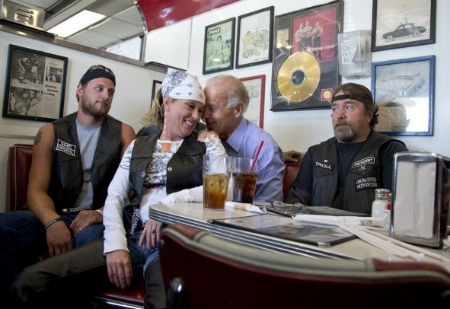
Joe Biden had a big day too.
SEAMAN, Ohio — Vice President Joe Biden was looking to cozy up with voters as he toured Ohio this weekend, but he did not imagine that an Ohio woman would nearly end up in his lap.
Biden was chatting up customers in the Cruisers Diner in southern Ohio Sunday when he met a group of motorcycle riders in black leather vests and bandanas.A female group member was watching, and Biden waved her over, telling her, “I know who runs the show.”
The woman had no place to sit, so Biden pulled a chair in front of himself and pulled her nearly into his lap. He put his hands on her shoulders and leaned in for a conversation as photographers snapped away.
Economics lessons aren’t usually all that funny, but the one Paul Krugman gave Rand Paul on ABC’s This Week was hilarious. Cokie Roberts interrupted with some Villager nonsense–she seems as unteachable as Rand Paul.
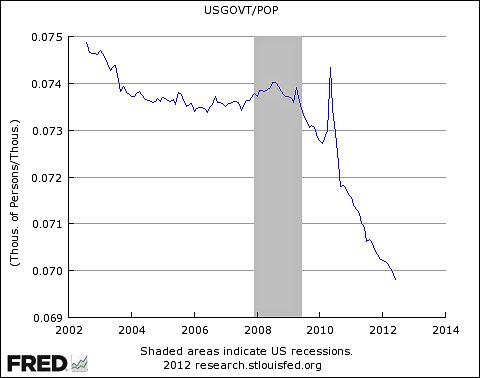
Krugman was so amazed by the ignorance that he wrote two blog posts about it. The first one is mostly a chart showing the steep drop in government employment under President Obama.
Krugman’s second post: The Zombie That Ate Rand Paul’s Brain
After watching the video, Krugman noticed the shocked expression on Rand Paul’s face. How could he be so stunned by a fact that is out there for anyone to read about?
Almost surely it’s a case of a zombie lie that has gone unchallenged in the hermetic world of movement conservatism, so that people like Paul know, just know, something that ain’t so. I wrote about this way back: the usual suspects seized on the Census bulge in employment as evidence of a big-government surge; and because nobody in that business ever admits having been wrong, this became a “fact” that people like Rand Paul believe. He wouldn’t have made this mistake if he ever read or listened to an analysis from nonpartisan sources, but he evidently doesn’t.
I’ve got a few editorial cartoons for you too. The first two are about Bill Clinton’s speech to the DNC.


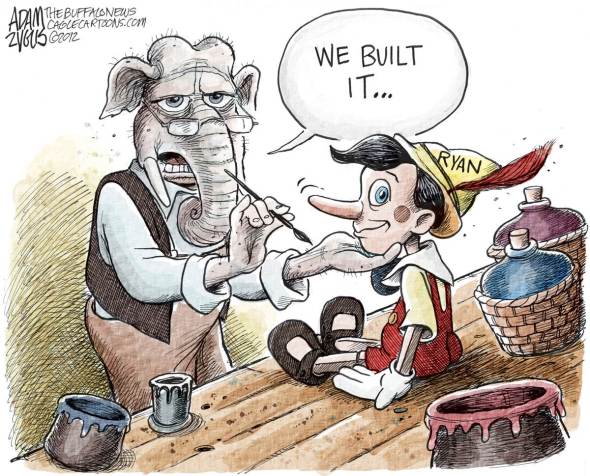
Two on the “We built it” theme.
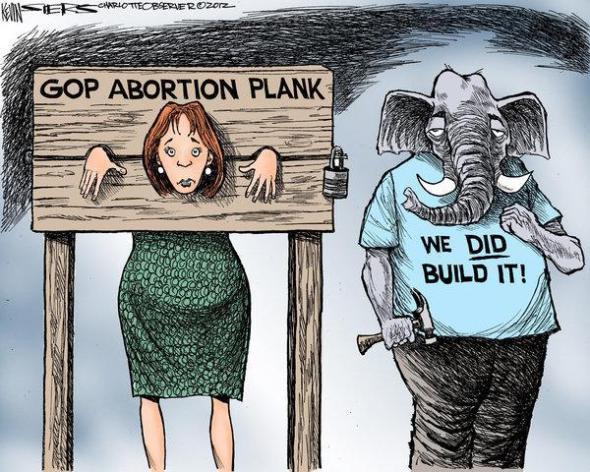
And one more on Romney’s ridiculous “Are you better off” question.

What next? I’m looking forward to more craziness next week.
Does Romney Actually Stand for Anything?
Posted: September 9, 2012 Filed under: 2012 elections | Tags: Obamacare, Romney Flip Flops 99 Comments I had to laugh at Brad DeLong’s post on Romney’s repositioning on “Obamacare”. Go take a look at “Why Oh Why Did the Republicans Nominate This Clown?” So first he was for it, then he was against it, then he’s sorta kinda for it again.
ObamaCare allows parents to keep their young-adult children on their insurance, requires insurers to offer guaranteed issue and community rates, and imposes an individual mandate to purchase insurance on individuals.
Now comes Mitt Romney:
Romney says he won’t repeal all of Obamacare: Mitt Romney says his pledge to repeal President Barack Obama’s health law doesn’t mean that young adults and those with medical conditions would no longer be guaranteed health care.
So there we have it: Romney will keep the parts of ObamaCare that are young-adult coverage, and guaranteed issue and community rates.
It continues:
The Republican presidential nominee says he’ll replace the law with his own plan. He tells NBC’s “Meet the Press” that the plan he worked to pass while governor of Massachusetts…
So there we have it: Romney will keep the parts of ObamaCare thatimposes on individual mandate to purchase insurance.
So what’s left?
Romney says he doesn’t plan to repeal of all of Obama’s signature health care plan. He says there are a number of initiatives he likes in the Affordable Care Act that he would keep in place if elected president…
Like: the whole thing. Duh.
There is something very wrong with anybody working for, contributing to, or arguing for Ryan-Romney right now.
So, isn’t the repeal of Obamacare the holy grail of republicans and teabaggers right now? They’ve voted to repeal it over 30 times.
Since the start of this Congress, Republicans have taken 30 votes to repeal, defund or dismantle the Affordable Care Act. When they vote to repeal the health law later this week that will make 31. House Republicans will then have had as many health-repeal votes as Baskin Robbins has ice cream flavors.
As we’ve seen 30 times before, the health-care-repeal votes aren’t going anywhere. Repeal bills passed in the House are dead-on-arrival in the Democratic-controlled Senate. So why do they keep going?
To start, there’s a lot of support in the Republican base for a repeal. Kaiser Family Foundation asked voters, shortly after the Supreme Court decision, whether they wanted legislators to continue blocking the health law — or move on and implement it.
Overall, 65 percent sided with the latter option. But dig deeper into the numbers, and you’ll find widespread support among Republicans to continue blocking the law. There’s significant support among Independents to keep fighting, too
Mark Thoma really has some good points on this.
I won’t complain about “a major fold” on healthcare, but it does bring up a question. Does Romney stand for anything? He seems to know how to set his principles aside and submit to the highest bidder — something his touted business experience taught him I suppose. But with all of the flip-flops, Etch-a-Sketch moments, his refusal to take a stand on budget cuts, his dishonest campaigning, etc., etc., is there any principle that Romney won’t conveniently overlook if it looks like there’s a few votes to be gained?
I’ve said this over and over, but I honestly can’t figure out why this guy keeps running for president. What on earth is his reason? To do something Daddy couldn’t do? I’m open for suggestions.
You can call this an open thread!!!
The Real Debt we’re Leaving our Children
Posted: September 8, 2012 Filed under: academia | Tags: student loan crisis 12 Comments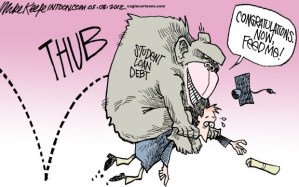 As you know, I just finished my doctorate and my youngest just finished her online bachelors degree. I’d really like her to go get an MBA right now but she sees the debt that her sister accumulated during med school and my student loan debt which just basically happened over the last two years. Tuition is going up almost as astronomically as health care costs because of the great recession. Lack of jobs after school is a problem. The youngest is bar-tending and doing part-time temp jobs in NOmaha. She has yet to round up a good job. I’m still looking for a tenure track position while working as an adjunct. The only one that can probably hand the student loan debt is Dr. Daughter. I didn’t get student loans for my undergrad or my first graduate degree. I paid for them both. This time, I just couldn’t swing the tuition. My student loan is actually larger than my house loan at the moment. That scares me when I think about it. But, it would worry me more if I was younger. Read these two NYT articles to see why.
At a protest last year at New York University, students called attention to their mounting debt by wearing T-shirts with the amount they owed scribbled across the front — $90,000, $75,000, $20,000.
Amanda Cordeiro of Clermont, Fla., owes $55,000 in student loans. She has changed her phone number about four times in a year to avoid being found.
On the sidelines was a business consultant for the debt collection industry with a different take.
“I couldn’t believe the accumulated wealth they represent — for our industry,” the consultant, Jerry Ashton, wrote in a column for a trade publication, InsideARM.com. “It was lip-smacking.”
Though Mr. Ashton says his column was meant to be ironic, it nonetheless highlighted undeniable truths: many borrowers are struggling to pay off their student loans, and the debt collection industry is cashing in.
As the number of people taking out government-backed student loans has exploded, so has the number who have fallen at least 12 months behind in making payments — about 5.9 million people nationwide, up about a third in the last five years.
In all, nearly one in every six borrowers with a loan balance is in default. The amount of defaulted loans — $76 billion — is greater than the yearly tuition bill for all students at public two- and four-year colleges and universities, according to a survey of state education officials.
Yes, collecting student loan debt from students who face the worst job market since the Reagan years is now a cottage industry. Oh, wait, I forgot, I was just supposed to take a loan out from my 90 year old father. Right?
Last year, a study by the Institute for Higher Education Policy found that for every borrower who defaulted, at least two more borrowers were delinquent in their payments. And in March, the Federal Reserve Bank of New York, using a survey of credit reports, concluded that more than one in four borrowers of student loans, both federal and private loans, were behind on their payments.
Long-range projections by the Department of Education estimate that the default rate over 20 years, for borrowers who began repayment in 2009, is 17 percent; among students who attended profit-making colleges, the predicted default rate is 49 percent.
It is messy, though, to compare those long-range estimates with the official default rate published by the Department of Education. The long-range estimates are calculated on the dollar amount of loans in default, while the official rate is based on the number of borrowers in default.
Looking at defaults another way, about 15 percent of all borrowers have been in default at the end of the last six fiscal years, which ends Sept. 30, according to Department of Education data. Currently, 16 percent of borrowers are in default, nearly twice the official default rate.
This is a problem on all kinds of levels.
Government officials estimate they will collect 76 to 82 cents on every dollar of loans made in fiscal 2013 that end up in default. That does not include collection costs that are billed to the borrowers and paid to the collection agencies.
While the government’s estimates take into account the uncertainty of collecting money over long periods, some critics say they don’t go far enough.
A 2007 academic study, for instance, estimated that the recovery rate was closer to 50 cents on the dollar.
“The reporting standards that the government imposes on themselves are far weaker than what they require of private institutions,” said Deborah J. Lucas, a finance professor at the Massachusetts Institute of Technology and an author of the study.
Over all, collections on federally backed student loans were $12 billion in the last fiscal year, 18 percent higher than the previous year. Of that, $1.65 billion came from seizures of government checks like tax returns and $1.01 billion was collected by garnisheeing borrowers’ wages. More than $8 billion of defaulted loans, however, were consolidated or rehabilitated.
Here’s some more interesting items. Here’s some items from Florida.
Student loan debt is now higher than credit card debt, and could become the next bubble to burst. Understandably, the recession has made it hard for recent graduates to repay their loans, but Baby Boomers have no such excuse. Plenty of employed Americans under 35 include loan repayments in their budgets.
The real unfairness is that during the last decade the government allowed students to be suckered, by privatizing student loans. Colleges got in on the scam. Florida State University’s financial aid director sat on the board of a company that did $27 million in loans to FSU students. Stetson University Law School’s financial aid director sat on the advisory board of a lender that did 70 percent of the school’s loan business. More than a dozen officials in the Department of Education under President Bush came from the student loan industry or left to work there.
Loans matter more than ever to many students. Florida has cut spending on higher education and raised tuition. Some in Congress want to cut Pell grants to students. Online courses may be one way to cut the cost of obtaining a college degree. For now, though, one way to reduce student debt is to force older students to repay it.
Hidden in this St. Augstine editorial is a nugget. For nearly a decade, student loans were a free-for-all pig run for private lenders. This has changed since 2010. However, it exposes the deeper problem of students trying to get ahead in a world that demands skills when tuition costs keep skyrocketing. Do talented students need to just settle for community college or hope they have a rich dad with deep pockets–as suggested by Republican Presidential candidate Romney–or is there a third way?
A college degree is still worth the time, money, and effort. How can we help our citizens achieve this goal without saddling them with a house-sized debt?
… college graduates are doing better than everyone else. For instance, the median earnings of a college graduate with a BA working full-time in 2008 was $55,700 and for those with an Associates Degree (typically awarded by community and technical colleges) was $42,000. That’s significantly better than the $33,800 for high school-only grads and $24,300 for those without a high school diploma.
The unemployment numbers are striking, too. The latest figures from the Bureau of Labor Statistics show an unemployment rate of 4.3 percent for college graduates and above who are 25 years and older. That compares with 9.5 percent for high school graduates and 13.9 percent for those with less than a high school education. “The real damage has happened with the loss of low-skill jobs,” says Stephen Rose, research professor at the Georgetown University Center on Education and the Workforce.
The benefits of postsecondary education are apparent even after drilling down deeper into the unemployment numbers. For instance, some high-wage workers have little education—a plumber, say. And highly educated workers can make very little—an English PhD, for instance, working in the back office of a nonprofit. Specifically, after dividing worker wages into fifths, about 25 percent of those in the two highest wage groups, or quintiles, have only a high school diploma. Similarly, about 20 percent of workers with a college degree were in the lowest two wage quintiles. Yet from 2007 through 2009 the unemployment rates for less-educated high-wage workers rose faster than for college-educated low-wage workers, according to researchers at the Federal Reserve Bank of Minneapolis.
There are a number of ways to help our future work force invest in themselves. First, we could actually decrease their burden or give them paybacks for success. What about giving them some incentives not to quit school? We can also encourage them to move or work in under-served areas. Many states will pay for nurses and doctors to go to school if they will agree to practice in rural areas or go into practices that serve a key populace. Other countries treat higher education like other forms of public education. This problem of debt will not go away and we have to think creatively to find ways to help our graduates deal with it. This should be something other than growing a cottage industry of folks to harass them into paying. We need to invest in educated and trained workers and help students that succeed. We also need to encourage schools to improve their delivery systems. Where’s the conversation about all of this during this election year?

 peej
peej Carissa
 bostonboomer
 dakinikat
 ecocatwoman
 mablue2
 Mama Lopez
 peggysue22
 quixote
 skydancingguestblogger
 Mona (aka Wonk the Vote)



 Sky Dancing
Recent Comments