
Taking on a Big Question: Why Embrace Plutocracy over Working Class Heroes?
Posted: June 9, 2012 Filed under: religious extremists, right wing hate grouups, Voter Ignorance | Tags: fear, Reagan Democrats, the conservative brain, voting against your interests 66 Comments The UK Guardian has always been one of my favorite papers. One of my high school social science teachers–Steve Wiitala–introduced me to the paper when I was taking an honors world history seminar class. I’ve been reading it ever since. Jonathan Haidt–a psychology prof–asks a question that I’ve been wondering for years. Why on earth would any working class person support some one like Ronald Reagan or Mitt Romney? Why would they even consider voting for reactionaries funded by the likes of the Koch Brothers? Why would they vote against their own interests?
I’ve always looked to the slave plantation model for answers. White overseers for rich masters were given just enough special favors and made to feel above the plantations’ slaves that they felt better thinking “well, at least I’m not one of them”. White working class people have a history of indentured servitude and sharecropping. Why go back to people that really would like to re-institute these things? Haidt says that fear of the collapse of society sends them look for order and anything national greatness. I wanted to explore his arguments here. (You can also watch this interview with Haidt by Bill Moyers. ht/ to EcoCatWoman.)
Many commentators on the left have embraced some version of the duping hypothesis: the Republican party dupes people into voting against their economic interests by triggering outrage on cultural issues. “Vote for us and we’ll protect the American flag!” say the Republicans. “We’ll make English the official language of the United States! And most importantly, we’ll prevent gay people from threatening your marriage when they … marry! Along the way we’ll cut taxes on the rich, cut benefits for the poor, and allow industries to dump their waste into your drinking water, but never mind that. Only we can protect you from gay, Spanish-speaking flag-burners!”
One of the most robust findings in socialpsychology is that people find ways to believe whatever they want to believe. And the left really want to believe the duping hypothesis. It absolves them from blame and protects them from the need to look in the mirror or figure out what they stand for in the 21st century.
Here’s a more painful but ultimately constructive diagnosis, from the point of view of moral psychology: politics at the national level is more like religion than it is like shopping. It’s more about a moral vision that unifies a nation and calls it to greatness than it is about self-interest or specific policies. In most countries, the right tends to see that more clearly than the left. In America the Republicans did the hard work of drafting their moral vision in the 1970s, and Ronald Reagan was their eloquent spokesman. Patriotism, social order, strong families, personal responsibility (not government safety nets) and free enterprise. Those are values, not government programs.
Brain research is beginning to find that folks that tend to call themselves “conservative” tend to be more fearful. Chris Mooney–Author of The Conservative Brain–explains it like this.
Looking at MRIs of a large sample of young adults last year, researchers at University College London discovered that “greater conservatism was associated with increased volume of the right amygdala” ($$). The amygdala is an ancient brain structure that’s activated during states of fear and anxiety. (The researchers also found that “greater liberalism was associated with increased gray matter volume in the anterior cingulate cortex” – a region in the brain that is believed to help people manage complexity.)
That has implications for our political world. In a recent interview, Chris Mooney, author of The Republican Brain, explained, “The amygdala plays the same role in every species that has an amygdala. It basically takes over to save your life. It does other things too, but in a situation of threat, you cease to process information rationally and you’re moving automatically to protect yourself.”
Haidt says that this kind of thinking has some disturbing impact on people that tend to obsess on fear. Group loyalty can drive people who want to feel safe. Does this explain the effectiveness of Willie Horton ads and all those Rovian tricks that seem paranoid and some what zombieland-like to us?
But on matters relating to group loyalty, respect for authority and sanctity (treating things as sacred and untouchable, not only in the context of religion), it sometimes seems that liberals lack the moral taste buds, or at least, their moral “cuisine” makes less use of them. For example, according to our data, if you want to hire someone to criticize your nation on a radio show in another nation (loyalty), give the finger to his boss (authority), or sign a piece of paper stating one’s willingness to sell his soul (sanctity), you can save a lot of money by posting a sign: “Conservatives need not apply.”
In America, it is these three moral foundations that underlie most of the “cultural” issues that, according to duping theorists, are used to distract voters from their self-interest. But are voters really voting against their self-interest when they vote for candidates who share their values? Loyalty, respect for authority and some degree of sanctification create a more binding social order that places some limits on individualism and egoism. As marriage rates plummet, and globalization and rising diversity erodes the sense of common heritage within each nation, a lot of voters in many western nations find themselves hungering for conservative moral cuisine.
Does our place in Maslow’s hierarchy really determine our susceptibility, vulnerability, and motivation at the voting booth? Haidt says yes and sums his thesis up this way.
When working-class people vote conservative, as most do in the US, they are not voting against their self-interest; they are voting for their moral interest. They are voting for the party that serves to them a more satisfying moral cuisine.
So, these are the same motivators that drive people to guns, bibles, and tribal thinking that demonizes the ‘other’. Is the angry right just a bunch of folks that are scared shitless? It’s an interesting theses. Dr. Bostonboomer probably has more information on some of this than me. I am interested in hearing your thoughts. What is the appeal of voting for your own servitude?
Lazy Caturday News and Open Thread
Posted: June 9, 2012 Filed under: 2012 presidential campaign, Afghanistan, Barack Obama, corruption, Discrimination against women, Economy, Foreign Affairs, Health care reform, Iran, Mitt Romney, morning reads, PUMA, religion, Russia, the GOP, U.S. Politics, War on Women | Tags: algae bloom, Catholic Church, cats, caturday, Charles P. Pierce, NASA, phytoplankton, Richard Nixon, Wages of Fear, Watergate 40th anniversary, Woodward and Bernstein 29 Comments
Good Morning All!
The 40th anniversary of the Watergate break-in is coming up on June 17. Bob Woodward and Carl Bernstein published a piece about it in yesterday’s Washington Post.
Today, much more than when we first covered this story as young Washington Post reporters, an abundant record provides unambiguous answers and evidence about Watergate and its meaning. This record has expanded continuously over the decades with the transcription of hundreds of hours of Nixon’s secret tapes, adding detail and context to the hearings in the Senate and House of Representatives; the trials and guilty pleas of some 40 Nixon aides and associates who went to jail; and the memoirs of Nixon and his deputies. Such documentation makes it possible to trace the president’s personal dominance over a massive campaign of political espionage, sabotage and other illegal activities against his real or perceived opponents.
In the course of his five-and-a-half-year presidency, beginning in 1969, Nixon launched and managed five successive and overlapping wars — against the anti-Vietnam War movement, the news media, the Democrats, the justice system and, finally, against history itself. All reflected a mind-set and a pattern of behavior that were uniquely and pervasively Nixon’s: a willingness to disregard the law for political advantage, and a quest for dirt and secrets about his opponents as an organizing principle of his presidency.
Long before the Watergate break-in, gumshoeing, burglary, wiretapping and political sabotage had become a way of life in the Nixon White House.
What was Watergate? It was Nixon’s five wars.
The Post also provides links to it’s coverage of the Watergate Scandal back in the good old days when the press believed in exposing government corruption. Today, the Post admits that “investigative journalism is at risk.”
Remember this?
The sad thing about Watergate is that if it happened today there wouldn’t be any investigation or arrests. We’d be told to move along, look forward not backward.
To see how things work today, you can read the White House e-mails that detail President Obama’s sellout to the pharmaceutical industry on health care. Apparently this one was leaked by House Republicans. Down With Tyranny has some good commentary.

um…huh? Must have dropped off for a second there. Let’s see what else is happening.
At the San Francisco Chronicle, Jeff Brinkley, a former New York Times foreign correspondent, now a Professor of Journalism at Stanford University finds Mitt Romney’s foreign policy positions deeply disturbing. He thinks it’s highly problematic that Romney has no experience and seemingly no knowledge about foreign policy. Brinkley notes that Obama already had to learn on the job, and now the Republicans have nominated another foreign policy naif who may be even less prepared than Obama was.
Romney…declared a couple of months ago that “Russia is America’s No. 1 geopolitical foe.” What nonsense. The U.S.-Russia relationship is a bit strained, but what about Iran, North Korea, Pakistan? Every one of those states poses a strategic threat that Russia does not.
“Immediately, speculations surfaced that the former governor of Massachusetts continues to live in a Cold War world and has few, if any, insights about American foreign policy,” Klaus Larres, a German American academic, wrote for the American Institute for Contemporary German Studies. And former Russian President Dmitry Medvedev told Romney to use his head and “check the time. It’s now 2012, not the mid-1970s.”
His advice on Afghanistan has been no better. Repeatedly he has called the plan to gradually withdraw forces “misguided” and “an extraordinary admission of failure.”
In the past, Romney has asserted that the United States and NATO need to defeat the Taliban before leaving. That has been the goal for nearly 11 years, and NATO is no closer today. The most recent National Intelligence Estimate asserts that the war is unwinnable as long as the Taliban maintains a safe haven in Pakistan and the Afghan government continues its corrupt, malevolent and counterproductive ways.
I wonder if Romney knows that one-third of the Western forces killed in Afghanistan so far this year died at the hands of Afghan soldiers they were training or leading.
There’s lots more at the link.
Charles Pierce is talking about “PUMA-ism” again, but I’ll forgive him because of this description of Obama’s defensive behavior of late:
In many ways, this president reminds me of the truck drivers in The Wages of Fear, trying to get the nitroglycerine over the mountains with blowing themselves all to hell and gone. In so many ways, he is still outside of things. In so many ways, he is still the flyer the Democratic party took in 2008. In so many ways, the path he has to walk to re-election is similar to the path he has had to walk through his life. It was hard not to notice the subtext present in all those earnest warnings about hurting the fee-fees of our financial titans. The president was stepping out of his place. The president was being uppity again.
This is also the case with what is perhaps the most noxious idea out there: that Barack Obama “failed” in his promise to “bring the country together,” and that he is now — Glorioski! — campaigning like he wants to be president all over again. He is engaging in politics. Mother of mercy, I swear David Brooks is just going to break down and go all to pieces on PBS some evening over the president’s betrayal of his role as the country’s anodyne black man and, of course, his upcoming role as black martyr to incivility and discord. It is his duty, dammit, to be all the things that people like Brooks wanted him to be so that he could lose, nobly, and then the country could go back to its rightful owners.
The Wages of Fear: now that was a great movie!
At Time, Tim Pagett has an excellent piece called The Catholic Contraction.
If you want some perspective on just how benighted the Roman Catholic Church looks today on the subject of women, consider Hildegard of Bingen. Hildegard was a German Benedictine nun in the 12th century and a leading feminist writer of her time. But even though that time was the 1100s, the Vatican rarely hassled her for asserting that men and women are equal — that God’s true nature, in fact, is maternal — or that nonprocreative sexual pleasure is O.K.

In the 21st century, however, Hildegard would no doubt receive the same censure that Sister Margaret Farley is facing this week after the Vatican denounced her book Just Love: A Framework for Christian Sexual Ethics. Farley, a Sisters of Mercy nun, a retired Yale divinity professor and a past president of the Catholic Theological Society of America, condones practices that have been morally acceptable to most U.S. and European Catholics for quite a while, including divorce, homosexuality, nonprocreative intercourse and masturbation. But Rome’s doctrinal bulldogs are sternly reminding her that those acts are “disordered,” “deviant” and “depraved.”
Sadly, it’s the church that’s looking unhinged these days. The Vatican was apparently just warming up in 2010 when it declared, astonishingly, that ordaining females into the all-male Catholic priesthood would be a “grave sin” on par with even pedophilia. Since then, as if scapegoating women for the escalating dissent among Catholics toward its hoary dogma, the church seems to have embarked on a misogynist’s crusade. Its legal assault on the Obama Administration’s requirement that Catholic institutions like colleges and hospitals make contraception available to female employees as part of their health coverage is, ultimately, less about religious freedom than about women’s freedom. Then there’s the U.S. bishops’ absurd probe of whether the Girl Scouts are selling feminist theology as well as fattening thin mints — and Rome’s accusation of “radical feminism” within the Leadership Conference on Women Religious (LCWR), which represents most of the U.S. nuns doing genuinely Christ-inspired work with the poor and the sick.
In science news,
NASA has discovered "a massive algae bloom under the slowly diminishing Arctic ice."
The same year that NASA researchers launched the Icescape expedition to the Arctic — the project that resulted in NASA’s astounding new discovery — there was a dire report on the world’s phytoplankton.
A Canadian team said in the journal Nature, as The Times reported in July 2010, that the world’s phytoplankton had been disappearing at a rate of about 1% a year for the previous 100 years.
“A global decline of this magnitude? It’s quite shocking,” Daniel Boyce, Dalhousie University marine scientist and lead author of the 2010 study, told The Times.
Phytoplankton — the basis of the marine food chain — “are key to the whole ecosystem,” he said. “In terms of climate changes, the effect on fisheries, we don’t know exactly what these effects will be.”
Could his latest discovery of a mass of phytoplankton in the Arctic signal a turnaround for this crucial organism?
The jury’s out. But it’s a question scientists will be pursuing, according to Paula Bontempi, NASA’s ocean biology and biogeochemistry program manager in Washington.
I think I need another little break.

Okay, back. Wouldn’t you know it? Addicting Info: Koch Brothers Linked To Florida Voter Purge
Former Secretary of State Kurt Browning worked with [Gov. Rick] Scott on the purge. Just before Scott selected Browning as Secretary in 2011, Browning led a group, Protect Your Vote Inc., which was created to oppose fair redistricting. One of the biggest checks that Browning’s organization received for $100,000 in 2010 was from the Center To Protect Patients’ Rights. At the time of the donation, the source of the money was cloaked in secrecy.
Last month, Republic Report exclusively reported that Center To Protect Patients’ Rights is part of a collection of front groups funded by David and Charles Koch as well as other billionaires as part of an election-influencing effort. The Koch Brothers plan to use these front groups to finance $400 million of a $1 billion campaign in outside money to defeat President Obama as well as defeating congressional Democrats. Mitt Romney’s Super Pac and many other nonprofits run by Karl Rove will supply the other $600 million needed to accomplish their goal.
Here’s Here’s something I missed this week:
Pranksters ‘Jiggly Puff,’ ‘Weedlord Bonerhitler’ sign anti-’Obamacare’ petition.
When the National Republican Congressional Committee (NRCC) set about thinking how to engage the Internet in new and unique ways, it probably did not occur to them that sometimes, the Internet tends to engage you right back.
That misunderstanding apparently led to an NRCC petition drive this week seeking to trump up the number of people who want to see “Obamacare” repealed. Unfortunately for them, it all went horribly, hilariously awry on Thursday night after they hooked an office printer up to the Twitter hashtag #IWantRepeal, then turned on a live video stream.
It was not long before NRCC staff completely lost control and were forced to pull the plug.
In almost no time at all, their printer was spitting out pages of petitions signed by “Weedlord Bonerhitler,” “Jiggly Puff,” “Boner Junkmonkey,” “Pointless Empty Gesture,” “Turd Sniffer,” “Like 20 more boners” and “HelpI’mStuckInThisPrinter,” among many, many others. Screen shots of this Twitter debacle and links to the live video began circulating almost immediately.
Okay, I’ll sign off with this:

“How we behave toward cats here below determines our status in heaven.” – Robert A. Heinlein
Mitt Romney Says We Don’t Need More Firemen, Policemen, or Teachers
Posted: June 8, 2012 Filed under: 2012 presidential campaign, U.S. Economy, U.S. Politics | Tags: Barack Obama, jobs, Mitt Romney, private sector, public employees, public sector, unemployment 34 Comments
This afternoon Mitt Romney was in Council Bluffs, Iowa mocking President Obama for saying at a press conference earlier today that the private sector of the U.S. economy of the U.S. economy:
“The truth of the matter is that, as I said, we’ve created 4.3 million jobs over the last 27 months, over 800,000 just this year alone. The private sector is doing fine. Where we’re seeing weaknesses in our economy have to do with state and local government”
Of course, he shouldn’t have said it that way, but it actually is true that employment in the private sector has improved greatly, and overall unemployment wouldn’t be that bad except for cutbacks in state and local government workers. Here’s the private vs. public employment data, via TPM.
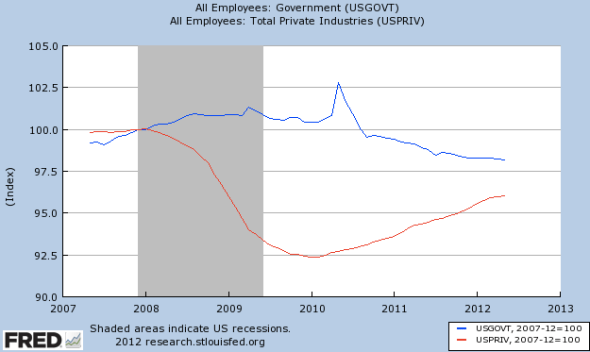
After Republicans crowed loudly about Obama’s “gaffe,” he “clarified” his remarks. Frankly, I would have preferred that he or a staffer had simply shown the above chart and explained what it means.
Here’s what Romney said at his campaign appearance in Council Bluffs, Iowa this afternoon:
“he wants another stimulus, he wants to hire more government workers. He says we need more fireman, more policeman, more teachers. Did he not get the message of Wisconsin? The American people did. It’s time for us to cut back on government and help the American people.”
How could that be the “message of Wisconsin?” Scott Walker exempted police and firefighters from laws banning collective bargaining? Walker at least understood that Americans want people to show up if their homes catch fire. People also want someone to protect them from crime. And certainly most people want teachers to help educate their children.
Romney claims Obama is “out of touch,” but how out of touch do you have to be not to understand the importance to communities of firefighters, police and teachers? Does Romney think these people are not Americans? What exactly is he proposing: that groups of people band together and raise funds to pay for these services outside of government?
Friday Reads
Posted: June 8, 2012 Filed under: 2012 presidential campaign, campaign financing, morning reads | Tags: American economic outlook, Bill Clinton on Wall Street, monetary policy, the Fed, tightening of MS, voter polls, Wisconsin recall 35 Comments Good Morning!
I admit to being completely exhausted. So, let’s see what I can dig up while I’m half asleep.
Josh Holland at AltNet thinks right wingers shouldn’t get too excited about Scott Walker’s win in Wisconsin on Tuesday.
An honest reading of the published exit poll leads to an important conclusion about Walker’s victory that has little to do with unions, Walker’s policies, the economy or any of the other factors that have pundits’ tongues wagging.
Fully 70 percent of those voters polled believed that recall elections are either never appropriate (10 percent) or are only appropriate in the case of official misconduct (60 percent).
The governor won 72 percent of this group. And it’s worth noting that a third of those voters who said “official misconduct” is a good reason to recall a governor voted to oust Walker, who has seen six of his staffers charged with 15 felonies in the “John Doe” probe.
While Walker himself has not yet been charged, reports suggest that the investigation is circling closer to him. Over the past seven weeks, he transferred $160,000 from his campaign funds to a legal defense fund, according to the Milwaukee Journal-Sentinel.
Mohamed A. El-Erian –CEO and co-Chief Investment Officer of the global investment company PIMCO speculates on US economic growth at Project Syndicate. He wonders “Is American Healing Fast Enough?”
Six internal factors suggest that the United States’ economy is slowly healing. For some observers, these factors were deemed sufficient to form the critical mass needed to propel the economy into escape velocity.
While I hoped that they might be proven right, the recent stream of weak economic data, including May’s timid net job creation of only 69,000, confirmed my doubts. With this and other elements of a disheartening employment report now suddenly raising widespread worries about the underlying health and durability of America’s recovery, it is important to understand the positive factors and why they are not enough as yet.
For starters, large US multinational companies are as healthy as I have ever seen them. Their cash balances are extremely high, interest payments on debt are low, and principal obligations have been termed out. Many of them are successfully tapping into buoyant demand in emerging economies, generating significant free cash flow.
Company cash is not the only source of considerable spending power waiting on the sidelines. Rich households also hold significant resources that could be deployed in support of both consumption and investment.
The third and fourth positive factors relate to housing and the labor market. These two long-standing areas of persistent weakness have constituted a major drag on the type of cyclical dynamics that traditionally thrust the US out of its periodic economic slowdowns. But recent data support the view that the housing sector could be in the process of establishing a bottom, albeit an elongated one. Meanwhile, job growth, while anemic, has nonetheless been consistently positive since September 2010.
Great! The richer are richer and big corporations are making it big abroad. What about the poor American worker? Evidently the Fed must think things are shaping up because Bernanke and Yellen are both hinting that the days of historically low interest rates might be nearing the end.
In spite of May’s weak jobs report, Fed Chairman Ben Bernanke still sees no reason for the central bank to expand its efforts to boost the American economy. The Fed is assessing whether the economy would continue to grow fast enough to reduce the unemployment rate without further intervention, he said.
This is an interesting youtube by Mauro Martino at Northeastern University. It’s aninfographic of fundraising by the presidential candidates from March 2011 to Feburary 2012.
David a Graham of The Atlantic gives us some analysis.
There’s a lot going on here, but the animated graphic shows how much each of the candidates raised each week and what states it came from, based on the amount of contribution per capita. The top half lists the states on a spectrum from most liberal to most conservative.
What’s great about the graphic is it shows just how drastically Mitt Romney and Barack Obama are in a different monetary league than the other Republican candidates who battled Romney for the nomination. That’s most obvious in the spikes — Ron Paul, Newt Gingrich, and Rick Santorum seldom did better than Romney even on their best days, but Romney’s highest peaks are exponentially larger than theirs.
The disparity becomes clear in the geographic breakdown, too. Romney and Obama tend to raise the most money in the same set of states: D.C., Massachusetts, California, New York, Florida, Texas, Connecticut, and Colorado. Of those states, five are solid Democratic, one is solid Republican, and two are swing. But they’re also the states with the highest concentrations of wealthy people. Meanwhile, the circles for Santorum, Gingrich, and Paul are fairly consistent across the map. At a time when the role of money and politics is fiercely debated, this visualization shows just how far out of proportion the relation between money and votes is. Obama has no chance of winning Texas, but it’s a cash cow for him; the same goes for Romney and California. It’s not hard to imagine how that distorts incentives for candidates. It’s not just that Romney and Obama are playing in a different league. Until August or so, they might as well be playing in a different nation, one comprised of 10 states or so.
Alec MacGillis asks: “Why we are listening to Bill Clinton on Wall Street?” over at TNR in an interesting article called “Let Us Bow Down before the Big Dog”.
Left largely unsaid, though, is that it is also hardly unsurprising for Clinton to be speaking up in defense of high finance. Remember: this is the man who as president presided over the alliance of Wall Street and the Democratic Party, embodied in his treasury secretary, Goldman Sachs veteran (and future Citigroup executive) Robert Rubin. It was Clinton who signed the repeal of Glass-Steagall, the 1933 law breaking up securities firms and commercial banks; it was Clinton whose advisers, notably Rubin and Larry Summers, blocked Brooksley Born’s push for tighter regulation of derivatives; it was Clinton who lowered the capital gains tax in 1997, vastly boosting the bottom line of private equity managers like Mitt Romney who, via the carried interest loophole, had their compensation treated as capital gains rather than ordinary income.
Surely it is no accident that Clinton’s other recent remark undermining Obama was also related to Obama’s allegedly over-populist stance toward high finance and the very wealthy. In an interview last fall with Newsmax — yes, Newsmax — Clinton critiqued Obama’s talk of raising taxes on millionaires who currently pay at very low rates (“The Buffett Rule”) by saying that it was a bad idea to raise anyone’s taxes “until we get this economy off the ground.” He added for good measure: “We don’t have a lot of resentment against people who are successful. We kind of like it, Americans. It’s one of our best characteristics that, if we think someone earned their money fairly, we do not resent their success. Americans lost the fact that, whatever you think about this millionaire surcharge — I don’t really care because I would pay it but it won’t affect me because I already paid income because I live in New York. I will pay more, but it won’t solve the problem.” Clinton tried to clarify these remarks later, but not before Crossroads GPS, the group founded by Karl Rove, built an Obama attack ad around the remarks.
What is utterly lost in the pundits’ exaltation of Clinton’s comments on Bain is that there is, in fact, a real debate going on within the Democratic Party, and that the reaction to the Obama campaign’s attacks on Bain are bringing out the intra-party tensions. On the one side are Democrats like Obama who have seen many former Wall Street supporters turn away from them for daring to hold them responsible for the 2008 financial collapse, for proposing reforms like closing the carried-interest loophole, and for generally believing that the explosive growth of the financial sector the past three decades has not exactly been healthy for the country. These Democrats argue that, while attacks on Bain might not play so well in the Acela Corridor, they may well resonate in Ohio. On the other side of the debate are Democrats like Clinton and Cory Booker, the mayor of the 68th biggest city in the country, who have managed to remain in the good graces of Wall Street, not least because they are not in the position of having to fix what went terribly wrong in the fall of 2008, and who also, it must be noted, are indebted to the high-finance world — Booker for its crucial support of his campaigns, and Clinton for its support of his post-White House philanthropic efforts.
Big dogs never bite the hand that feeds them.
So, this is my offering this morning. What’s on your reading and blogging list today?
Wisconsin Recall Election – My Take on it
Posted: June 7, 2012 Filed under: Elections, worker rights | Tags: Scott Walker, unions, Wisconsin 49 Comments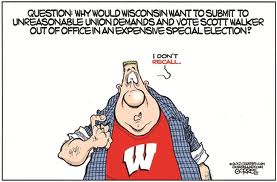
My anticipation about Tuesday’s election was high. My information about the how, why, when and what of this recall election came from the Left side of politics. I generally avoid the blogs and the radio and television shows of the Right.
I am pro-union because I am pro-worker. No business can operate without employees, no business can succeed without employees. Employees are a vital part of any business and are, all too often, dismissed or ignored when the success of owners and CEOs are applauded. And unions give employees a voice in working conditions, employee safety, wages, health care and pensions. Within large companies and/or corporations individual employees have relatively no chance to ensure their health and welfare, along with what they are paid. That isn’t saying that employee versus employer is a good guy versus bad guy situation. It is more like one person, with no weapons, facing another armed with guns, ample ammunitions, tanks, missiles and more. Or even going into a poker game where one person is dealt a single card while the other has six cards. It simply isn’t a level playing field.
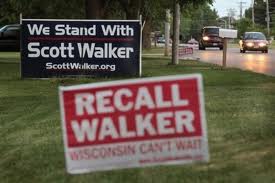
Regardless of what news outlet you follow, there have been a wide variety of speculations, theories and hypotheses about why the election turned out as it did. Personally, I don’t think the outcome can be narrowed down to one single reason that Walker won the election or that Barrett lost.
Walker is only the third governor in U.S. history to face a recall. The other two both lost and were recalled. Each of the political pundits is feverishly competing to come up with the definitive explanation for this outcome. Personally I think the bigger story is the solidification of the division between the opposing sides and the repercussions which will follow for, not only, the state of Wisconsin but the rest of the country as well. Families and friendships have broken apart because of this battle. For me it seems our increasingly contentious political system is becoming as toxic as the lead up to the Civil War and the animosity between those who supported slavery and the abolitionists.
Initially, I felt certain that the imbalance of money in the election would be the determining factor in the election (Walker is estimated to have outspent Barrett 7 to 1). After reading some of the post election coverage, I am not so sure that the enormous amount of money spent (estimated at $60 million) really had much impact on how people voted. In a piece at HuffPo, it was pointed out that the vote split in the recall almost matched the initial faceoff between Walker and Barrett. Basically the people of Wisconsin voted this time the way they voted in the governor’s race in 2010. The undecided voters only amounted to about 8%, with new voters accounting for around 13%. To me that means that those 8% were the only ones who might have been influenced by “the money” issue. The article goes on to say that Walker managed to turn out a higher percentage of his original supporters than did Barrett.
Joshua Holland has a similar take on Alternet called 8 Ways Right-Wingers Are Blowing Wisconsin Out of Proportion. He says the Right Wingers
claimed the outcome spelled doom for Obama this fall, marked the death of the labor movement and was a pure reflection of voters’ love for Scott Walker’s economy-crushing austerity policies.
He goes on to refute the rest of the Right Wing’s claims. Check out the post because it is worth your time.
Recall elections are few and far between in the U.S., as evidenced by my earlier point that Walker is only the third governor in our history to face a recall election. Several sources, including the one I’ve cited above, have put forth that about a third of people polled don’t support recall elections unless the politician has done something egregious, like committing a crime. Their political affiliation doesn’t matter. The seriousness of the offense is the concern of to the voting public regardless of political party. What that says to me is that most voters believe in democracy, meaning the voters have chosen and the person with the most votes, whether or not you voted for him/her, is the winner. Shut up, bite the bullet and let the winner serve out their term. (NOTE: I am not saying that I believe we actually live in a democracy, but that the general public believes in democracy and that our American system is a democracy……..because that is what they have been told. The formerly and currently disenfranchised probably have a different perspective).
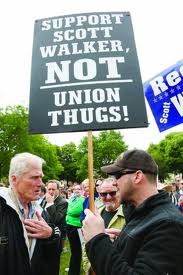
Add to this that the opinion of unions, unlike in the mid 20th century, is mostly negative. After about 50 years of chipping away at the number of American workers who belong to a union or have a union member in the family, the number of union workers has declined substantially. Where once both union and non-union workers banded together in solidarity, it has become a mostly contentious relationship, where union workers are seen as greedy, lazy and recipients of unfair pay scales, benefits and pensions. Big business has succeeded in demonizing the collective power of unions who were responsible for the 5 day 40 hours work week, minimum wage, paid sick time and the formation of OSHA to protect the safety of workers on their job. For me, that is the story, not the fact that Walker successfully kept his job. It’s the workers and employees of America that are the losers in this race.
And then there is Jon Stewart’s take on the recall:
crossposted from ecocatwoman.blogspot.com

 peej
peej Carissa
 bostonboomer
 dakinikat
 ecocatwoman
 mablue2
 Mama Lopez
 peggysue22
 quixote
 skydancingguestblogger
 Mona (aka Wonk the Vote)



 Sky Dancing
Recent Comments