
Caturday Reads: Dogma vs. Karma-Karma-Chameleon
Posted: April 21, 2012 Filed under: just because 51 Comments Morning, news junkies! I’m gonna keep this simple and… catty:
- via TED.com… Moral behavior in animals (video: 16 mins + transcript and subtitles).
Wonk sez: Animals can too haz morality! Which is why my atheisht, feminisht, socialisht kitties are not fans of Romney or Obama “dogma” (and can I just say how sad it is that our 2012 election cycle has been reduced to supporters of both empty suits defending the strapping of dogs to cars and the eating of dogmeat? Seriously… Honeybadger 2012!)
- from Joyce Arnold… Super PACS and Sesame Street: Court OKs Political Ads on Public Broadcasting
Wonk sez: We’ve been reduced to an idiocracy of empty acronyms… PBS, CTW (Children’s Television Workshop), NPR, PAC… less and less of it means anything of substance anymore.
Wonk sez: There’s still some hope left in public broadcasting media. Better hang your hat on what you can before it too gets subsumed by a SuperDuperPac.
- USA Today… Women lag in life-expectancy gains
Wonk sez: Not only is the life expectancy of American women lagging, but, in many U.S. counties, daughters are living shorter lives than their mothers. Please take the time to read and pass along to your friends. This is disturbing.
- h/t Liz Warren via facebook… END THE FREE RIDE: What if GE paid its fair share in taxes?
Wonk sez: You know what else we could do if GE paid its fair share? We could keep the U.S. postal mail going on Caturdays too.
What’s on your Read ‘n Rant list this morning? Rawr in the comments 😉
WTF? Sen. Joe Manchin (D-WV) Not Sure If He’ll Vote for Obama or Romney
Posted: April 20, 2012 Filed under: 2012 elections, 2012 presidential campaign, Democratic Politics, U.S. Politics | Tags: Barack Obama, Ben Nelson, energy, Joe Manchin, Mitt Romney, Ryan budget, The Chicago Way 15 Comments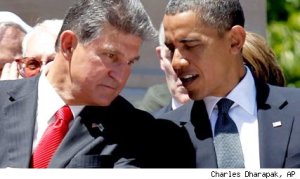
Joe Manchin with Barack Obama
From The Boston Globe:
In a statement Friday, the West Virginia lawmaker said he had “some real differences” with both leaders, finding fault with Obama’s energy and economic policies while questioning whether Romney could understand the challenges facing ordinary people.
“I strongly believe that every American should always be rooting for our president to do well, no matter which political party that he or she might belong to,” Manchin said. “With that being said, many West Virginians believe the last 3 1/2 years haven’t been good for us, but we’re hopeful that they can get better.”
The Globe writer has the nerve to call Manchin “moderate.”
Manchin, one of the more moderate Senate Democrats, has broken with his party on several issues as he seeks re-election this year. His state has backed the Republican candidate in the last three presidential elections, and Obama did not fare well in 2008. Obama lost to GOP nominee Sen. John McCain, 56-43 percent, and was overwhelmed by Hillary Rodham Clinton in the Democratic primary, losing 67-26 percent.
Last time I checked Hillary Clinton was a Democrat and a more liberal one than Obama, so I guess West Virginians are capable of voting Democratic.
Manchin told the National Journal (NJ) that he will vote for the person his constituents want, (which right now looks like it will be Romney says the NJ), but he has concerns about Romney’s support for the Ryan budget because the folks in WV might not like losing their Social Security, Medicare, and Medicaid. But he doesn’t like Obama’s energy policies. Whatever happened to politicians showing leadership?
Manchin’s position echoes the stance he took during his 2010 special election campaign to serve out the term of the late Sen. Robert Byrd. He declined ahead of that election to endorse a second term for Obama or to say if he would vote for Sen. Harry Reid, D-Nev., to remain majority leader.
If Manchin in fact votes based on which candidate most of his constituents embrace, he will likely cast his ballot for Romney. Obama lost West Virginia by 13 points in 2008 and remains unpopular there. While Romney’s wealth, Mormonism, and views on entitlement reform may not be a perfect fit in a state that remains relatively poor, Protestant, and dependent on federal spending, Obama probably will not take the state….
The share of voters who split their ballots between a presidential candidate and a Senate candidate has steadily declined since 1960. It is now common for more than 80 percent of voters who approve of a president’s performance to back the Senate nominee from the same party, a National Journal analysis of competitive races since 2004 found. Similarly, more than 80 percent of voters who disapprove of a president’s performance tend to support the Senate candidate from the other party, according to the analysis. That is Manchin’s challenge.
I’m guessing the Obama campaign’s reaction to Manchin’s up front announcement that he’ll likely vote for Romney is going to be a bit of a challenge too. Has Manchin ever heard of “The Chicago Way?” I don’t recall even Ben Nelson ever going so far as to publicly announce he would vote for the Republican presidential candidate.
Trayvon Martin: Why Is the Zimmerman Family Getting Preferential Treatment?
Posted: April 20, 2012 Filed under: Civil Rights, Crime, racism | Tags: bond hearing, George Zimmerman, preferential treatment, profiling, Trayvon Martin 76 Comments
I just watched George Zimmerman’s bond hearing, and I was shocked to see that Zimmerman’s family members were permitted to testify by telephone. Where is the evidence that their lives are in danger? All of the protests have been peaceful so far. Why the exaggerated fear that somehow African Americans will use violence against Zimmerman and his family? And why is the court going along with it?
If George’s father Robert and his brother Robert, Jr. are so fearful of all the scary black people out there, why have they been willing to make multiple appearances on television and radio programs? Robert, Sr. appeared with his face hidden, although I don’t know why that was the case. Robert, Jr., the brother, was on a high-profile CNN program twice, and was in no way disguised.
Who was more hated than Casey Anthony and her family? They even experienced having people picketing their home and screaming “baby killer” at them when they came out of their house. Yet they were not permitted to testify by telephone. Even child witnesses in abuse cases have to come to court to testify. Occasionally they are allowed to testify by video-conference, but I have never heard of telephone testimony before. The implication was that George Zimmerman and his family are in danger comparable to testifying in a mafia trial.
The state permitted George Zimmerman’s attorney Mark O’Mara to hold a mini-trial during a bond hearing! An investigator was called to the stand and cross examined about the wording of the probable cause affidavit.
“Evidence” was introduced to indicate that George Zimmerman had two vertical cuts on the back of his head, and O’Mara got the investigator to say that that is consistent with Zimmerman’s story that Trayvon Martin banged his head on concrete. How would that cause two vertical scratches? Isn’t it more likely those scratches were caused by Martin’s fingernails as he tried to defend himself from his mysterious stalker?
The ultimate insult came when George Zimmerman was permitted to take the stand and “apologize” to Trayvon Martin’s parents. He was also permitted to claim that he did not know how old Trayvon was and that he believed Trayvon was only a little younger than he (George) is. Yet, on one of the police tapes, Zimmerman is heard saying that he thinks Trayvon is in his “late teens.” Zimmerman is 28.
Why is Zimmerman apologizing now? As Ben Crump, the Martin family attorney said afterwards, this was nothing but a self-serving act on Zimmerman’s part. It has been fifty days since Zimmerman shot Martin. He never apologized through his attorneys. His father and brother never expressed any sorrow at the young man’s death. Instead they tried to paint Martin as a thug who beat up on their son and brother. George Zimmerman created a private website, and he did not express remorse or sorrow on the site. In fact he posted photos of graffiti that had been posted on a black student center building and signs from a rally led by Koran-burning Florida pastor Terry Jones. Why didn’t the prosecution object to this self-serving display?
In the end, the judge granted George Zimmerman $150,000 bail, meaning that he only needs to pay $15,000 and he is free. He does have to have GPS tracking, but he will be permitted to leave the state and keep his location secret.

Alleged photo of Zimmerman's head after the shooting
Finally, to top all this off, a supposed photograph of the back of Zimmerman’s head taken by an anonymous bystander was released to the media today. It shows blood dripping from two small cuts, but it doesn’t seem like that much blood for a head wound. We also know that the EMTs didn’t see fit to bandage the cuts after they wiped the blood off, and there was no blood visible in the videotape of Zimmerman arriving at the police station less than an hour after the shooting.
I think we are seeing the writing on the wall. I am very concerned that George Zimmerman is going to get off on the stand your ground defense. I think it is time for those who care about justice for Trayvon Martin to start marching again.
Friday Reads: Two Years Gone and where has all the Sealife Gone?
Posted: April 20, 2012 Filed under: Gulf Oil Spill, health hazard, morning reads | Tags: BP, dead dolphins, mutant fish, oil spill, pollution, seafood, sick people 31 Comments Good Morning!
This Morning Reads will have a theme. Two years ago the Gulf was oozing nasty, icky, oil. Like Hurricane Katrina, it’s an event that’s changed our lives down here in ways that are hard to explain and share. We’ve not fully recovered from either of these events. That’s not exactly what the Oil, the seafood, or the tourist industry wants any one to tell you. It’s not what state, local, and federal governments and agencies want you to know either.
But there it is. There is still devastation. There are huge problems. The folks that created the problems are not being held to account.
The stories I will share are human, animal, vegetable, and mineral. The BP Spill turned an entire ecosystem and way of living inside out. It’s being covered up by smiling people inviting you to our Gulf Coast Cities and Beaches in ads. It’s being hidden behind pictures of big heaping plates of staged seafood buffets. What’s hidden behind the ads and the promos is disturbing science, economics, medicine, and social upheaval. Here’s somethings you may want to know from our local news stations, scientists, and doctors.
From wusf News: Two Years after the BP Oil Spill: The Oil You Cannot See
On some Florida Panhandle beaches, swimmers can come off the beach with oil from the BP oil spill still on their skin — two years after that environmental disaster.
And, even after showering, the oil can still be on their skin. Only an ultraviolent light can show it.
Tampa Bay Times environmental reporter Craig Pittman says that’s because leaked oil, mixed with chemical dispersant sprayed on the spill two years ago to break it up, is pooling in some shallow waters of Panhandle beaches.
And the mixture actually accelerates absorption by human skin. Seen under the ultraviolet light, it’s kind of creepy.
From The Nation: Investigation: Two Years After the BP Spill, A Hidden Health Crisis Festers
n August 2011 the Government Accountability Project (GAP) began its investigation of the public health threats associated with the oil spill cleanup, the results of which will be released this summer. “Over twenty-five whistleblowers in our investigation have reported the worst public health tragedies of any investigation in GAP’s thirty-five-year history,” Shanna Devine, GAP legislative campaign coordinator, told me.
Witnesses reported a host of ailments, including eye, nose and throat irritation; respiratory problems; blood in urine, vomit and rectal bleeding; seizures; nausea and violent vomiting episodes that last for hours; skin irritation, burning and lesions; short-term memory loss and confusion; liver and kidney damage; central nervous system effects and nervous system damage; hypertension; and miscarriages.
Cleanup workers reported being threatened with termination when they requested respirators, because it would “look bad in media coverage,” or they were told that respirators were not necessary because the chemical dispersant Corexit was “as safe as Dawn dishwashing soap.” Cleanup workers and residents reported being directly sprayed with Corexit, resulting in skin lesions and blurred eyesight. Many noted that when they left the Gulf, their symptoms subsided, only to recur when they returned.
According to the health departments of Louisiana, Mississippi and Alabama, from June to September 2010, when they stopped keeping track, more than 700 people sought health services with complaints “believed to be related to exposure to pollutants from the oil spill.” But this is likely an extreme undercount, as most people did not know to report their symptoms as related to the oil spill, nor did their physicians ask. Like virtually everyone I have interviewed on the Gulf Coast over the past two years—including dozens for this article—Nicole Maurer’s doctors did not even inquire about her children’s exposure to oil or Corexit.
It will take years to determine the actual number of affected people. The National Institute of Environmental Health Sciences (NIEHS), with financial support from BP, is conducting several multiyear health impact studies, which are only just getting under way. I spoke with all but one of the studies’ national and Gulf Coast directors. “People were getting misdiagnosed for sure,” says Dr. Edward Trapido, director of two NIEHS studies on women’s and children’s health and associate dean for research at the Louisiana State University School of Public Health. “Most doctors simply didn’t know what questions to ask or what to look for.” There are only two board-certified occupational physicians in Louisiana, according to Trapido, and only one also board-certified as a toxicologist: Dr. James Diaz, director of the Environmental and Occupa-tional Health Sciences Program at Louisiana State University.
Diaz calls the BP spill a toxic “gumbo of chemicals” to which the people, places and wildlife of the Gulf continue to be exposed.
From a George Washington Blog Post Crossposted at Naked Capitalism: The Gulf Ecosystem Is Being Decimated. This is a huge list of sources covering the many problems.
New York Times: “Gulf Dolphins Exposed to Oil Are Seriously Ill, Agency Says
MSNBC: Gulf shrimp scarce this season (and see the Herald Tribune‘s report)
Mother Jones: Eyeless shrimp are being found all over the Gulf
NYT: Oil Spill Affected Gulf Fish’s Cell Function, Study Finds
CBS:Expert: BP spill likely cause of sick Gulf fish (and see the Press Register’s report)
Study confirms oil from Deepwater spill entered food chain
Pensacola News Journal: “Sick fish” archive
Agence France Presse: Mystery illnesses plague Louisiana oil spill crews
MSNBC: Sea turtle deaths up along Gulf, joining dolphin trend
MSNBC:Exclusive: Submarine Dive Finds Oil, Dead Sea Life at Bottom of Gulf of Mexico
AP: BP oil spill the culprit for slow death of deep-sea coral, scientists say (and see the Guardian and AFP‘s write ups)
A recent report also notes that there are flesh-eating bacteria in tar balls of BP oil washing up on Gulf beaches
And all of that lovely Corexit dispersant sprayed on water, land and air? It inhibits the ability of microbes to break down oil, and allows oil and other chemicals to be speed past the normal barriers of human skin.
Just google up the Legacy of the BP Oil Spill and feast your eyes on the eyeless shrimp, lesions on fish, and all the dead sea mammals washing up on Gulf Cost beaches. This is from AJ.
“The fishermen have never seen anything like this,” Dr Jim Cowan told Al Jazeera. “And in my 20 years working on red snapper, looking at somewhere between 20 and 30,000 fish, I’ve never seen anything like this either.”
Dr Cowan, with Louisiana State University’s Department of Oceanography and Coastal Sciences started hearing about fish with sores and lesions from fishermen in November 2010.
Cowan’s findings replicate those of others living along vast areas of the Gulf Coast that have been impacted by BP’s oil and dispersants.
Gulf of Mexico fishermen, scientists and seafood processors have told Al Jazeera they are finding disturbing numbers of mutated shrimp, crab and fish that they believe are deformed by chemicals released during BP’s 2010 oil disaster.
Along with collapsing fisheries, signs of malignant impact on the regional ecosystem are ominous: horribly mutated shrimp, fish with oozing sores, underdeveloped blue crabs lacking claws, eyeless crabs and shrimp – and interviewees’ fingers point towards BP’s oil pollution disaster as being the cause.

Fishermen, in particular, are seeing their way of life threatened with extinction – both from lack of an adequate legal settlement and collapsing fisheries.
One of these people, Greg Perez, an oyster fisherman in the village of Yscloskey, Louisiana, has seen a 75 per cent decrease in the amount of oysters he has been able to catch.
“Since the spill, business has been bad,” he said. “Sales and productivity are down, our state oyster grounds are gone, and we are investing personal money to rebuild oyster reefs, but so far it’s not working.”
Perez, like so many Gulf Coast commercial fisherman, has been fishing all his life. He said those who fish for crab and shrimp are “in trouble too”, and he is suing BP for property damage for destroying his oyster reefs, as well as for his business’ loss of income.
People like Perez make it possible for Louisiana to provide 40 per cent of all the seafood caught in the continental US.
But Louisiana’s seafood industry, valued at about $2.3bn, is now fighting for its life.
We actually see all this reported in the local media. We see the pictures. We live the effects. I completely admit to having scaled back my consumption of seafood since the spill. It’s just not the same and I don’t trust it. But, if you watch the ads that BP runs on TV stations around our neighboring states and listen to the deafening response by governments, you think it all just disappeared. They keep saying everything is safe and it’s all back to normal. Well, it isn’t. If you ask me, I think it’s just going to get worse.
What’s on your reading and blogging list today?
Catholic Republicans to Catholic Bishops: STFU
Posted: April 19, 2012 Filed under: poverty, religion, Religious Conscience, Republican politics, social justice, U.S. Economy, U.S. Politics, voodoo economics | Tags: Eric Cantor, food stamps, John Boehner, Paul Ryan, taxes 15 Comments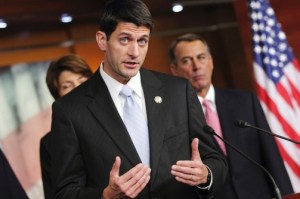
Ryan to Catholic Bishops: "Are you talking to me?"
On Tuesday I wrote a post about Paul Ryan’s claim that his Catholic faith informed his budget plan.
The Conference of Catholic Bishops responded to this outrageous claim by sending letters to every Congressional Committee affected by the Ryan Budget explaining that Catholic doctrine does not support starving children and elderly people to death in order to give tax cuts to rich people and buy more weapons of war for the Pentagon.
Today Paul Ryan responded to the Bishops’ criticism.
House Budget Committee Chairman Paul Ryan (R-WI) on Thursday dismissed criticism from the U.S. Conference of Catholic Bishops (USCCB), falsely claiming the group did not represent all Catholic bishops.
Referencing Matthew 25, the USCCB called on Congress to put the poor first in budget priorities and rethink cuts to programs that benefited the least among us.
“These are not all the Catholic bishops, and we just respectfully disagree,” he said on Fox News after being questioned about the bishops criticism of his budget plan.
Later the Bishops responded to Ryan’s statement by explaining to The Hill:
USCCB spokesman Don Clemmer told The Hill that the letters do represent all Catholic bishops, as they were penned by members of the church that were elected to represent the bishops on policy matters at the national level.
“Bishops who chair USCCB committees are elected by their fellow bishops to represent all of the U.S. bishops on key issues at the national level,” Clemmer said. “The letters on the budget were written by bishops serving in this capacity.”
Yesterday, fellow Catholic John Boehner weighed in in support of his budget hit-man:
“I want them to take a bigger look,” Boehner said at a Wednesday press conference. “And the bigger look is, if we don’t make decisions, these programs won’t exist, and then they’ll really have something to worry about.”
Hmmmm…that sounds like a threat.
Boehner, a Catholic, acknowledged that the bishops had a moral argument in pushing to preserve aspects of the budget that provide aid to the poor, but said if the United States can’t get its finances in order, those programs would be completely eliminated through a fiscal crisis.
“There won’t be these programs, and I don’t know how often some of us have to talk about the fact that you can’t spend $1.3 trillion more than what you bring in — that’s what’s going to happen this year, $5 trillion worth of debt over the last five years — and think that this can continue,” Boehner said.
It seems that the opinion of Conference of Catholic Bishops is to be respected on abortion and birth control, but not on economic and social justice issues. I guess Ryan and Boehner are only “cafeteria Catholics.” Just look how Ryan responded last year when a fellow Catholic offered him a Bible so he could read about Jesus’ teachings.
Not a Catholic, but apparently not wanting to look less of a soulless, evil skinflint than Ryan and Boehner, Eric Cantor suggested the solution to the country’s economic problems is raising taxes on the poorest of the poor.
The GOP has repeatedly made the claim that the poorest Americans need more “skin in the game.” Today, response to a question by ABC’s Jon Karl, Cantor made it clear that Republicans are interested in raising taxes on the poor while lowering tax rates for everyone else as part of any comprehensive tax reform plan:
CANTOR: We also know that over 45 percent of the people in this country don’t pay income taxes at all, and we have to question whether that’s fair. And should we broaden the base in a way that we can lower the rates for everybody that pays taxes. […]
KARL: Just wondering, what do you do about that? Are you saying we need to have a tax increase on the 45 percent who right now pay no federal income tax?
CANTOR: I’m saying that, just in a macro way of looking at it, you’ve got to discuss that issue. … How do you deal with a shrinking pie and number of people and entities that support the operations of government, and how do you go about continuing to milk them more, if that’s what some want to do, but preserve their ability to provide the growth engine? … I’ve never believed that you go raise taxes on those that have been successful that are paying in, taking away from them, so that you just hand out and give to someone else.
As Think Progress points out, most of the people who don’t pay income taxes are students, elderly people receiving lower amounts of social security, or people so desperately poor that they don’t earn enough to pay taxes. These people are, however, subject to many taxes, such as gas taxes, property taxes, and federal payroll taxes if they are working.
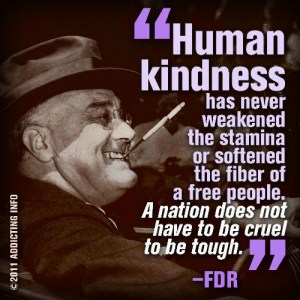
I wonder what FDR would say about all this?

 peej
peej Carissa
 bostonboomer
 dakinikat
 ecocatwoman
 mablue2
 Mama Lopez
 peggysue22
 quixote
 skydancingguestblogger
 Mona (aka Wonk the Vote)



 Sky Dancing
Recent Comments