
When Newt Gets Cranky, Really Cranky and then . . . Goes Nuclear
Posted: January 10, 2012 Filed under: 2012 primaries, Mitt Romney, Newt Gingrich | Tags: 2012 presidential election, gop race, leveraged buyouts 23 CommentsAhhh. The Day of Reckoning is upon us. Again. The clown cars come out, circle the ballot box and we all . . . wait the results with bated  breath. But until all those votes are counted, we have Uncle Newt’s latest reincarnation:
The Anti-Capitalist!
It’s amazing to watch the GOP race. We ‘ve had stars rise and flame out before they streak across sky. But Newt Gingrich took the super-nova route after Iowa’s humiliating results. Still, the latest attack on Mitt Romney for making money, lots of money, while heading Bain Capital is really off the charts for Republicans. Any Republican. Here’s what Newt said to a group of reporters in Manchester, NH:
“You have to ask the question, is capitalism really about the ability of a handful of rich people to manipulate the lives of thousands of people and then walk off with the money?”
Okay. I can certainly appreciate that statement. But I’m a Democrat Wandering the Wilderness. Better yet, back in the 90s, my husband and I had a run-in with a corporate raiding mission that took down a 100+ year-old company in Philadelphia. A lot of wreckage left behind with displaced workers and economic ripples to the wider community. It’s called ‘creative’ capitalism, which is a nice, almost fuzzy phrase that takes the sting out—for those that create the mess, and then walk away, pockets a-jingle.
 But Uncle Newt? He’s a champion of capitalism, even the ugly, crony kind. I’m not sure how Gingrich squares this attack on Romney, particularly with the latest reveal that, back in the day, Gingrich himself was involved with leveraged buyouts.
Upon leaving Congress in 1999, the former Speaker joined private equity firm Forstmann Little & Co. as a member of its advisory board.
It is unclear how long Gingrich served on the advisory board, or how much he was paid. The campaign has not yet responded to a request for comment.
Hummm. Wonder if the firm hired him as a historian? Inquiring minds want to know. Btw, in the CNN Money piece, Forstmann, Little & Co is cited as one of the original leveraged buyout firms.
To steal from Rick Perry–Oops!
Gingrich’s attacks were signaled earlier, of course, when he publicly vowed a blood feud, retribution for the carpet-bombing Mitt Romney’s Super-Pac delivered in the run up to the Iowa caucus. Hell hath no fury like a foiled presidential candidate. Especially when the candidate in question has such a high regard of himself [often referred to as hubris] and for whom hypocrisy is second nature. We’ve seen this side of Newt Gingrich before when he righteously carried the impeachment standard against Bill Clinton, all the while carrying on his own illicit affair.
But considering how the entire Republican establishment has worked with such diligence, sworn absolute allegiance in making Barack Obama a one-term president, this strategy seems short-sighted, flawed. Unless, of course, party politics takes a back seat to personal vendettas.
Gingrich has not gone uncritiqued by the party faithful. Some of the responses I’ve picked up in columns and online are: disgraceful, disgusting, unhelpful and my favorite—he sounds like an Occupier [you know those people who need to take a bath and get a job].
Gingrich’s daughter, Jackie Cushman, attempted to defend her father’s bomb throwing when pressed with the question—won’t this undermine the GOPs’ conservative message [ya think?]:
I think the process that we’re going through — the whole primary process — the whole point is to figure out who is the best candidate to beat President Barack Obama.
That must be the official line from Gringrich’s campaign people because the prickly candidate said much the same thing.
Gingrich yesterday defended his new attacking posture, saying it is better for Republican voters to know the truth now and to force Romney to aggressively back his record.
“If somebody is going to crumble, they better crumble before the nomination,’’ Gingrich said.
So, it’s for the good of the party? Tear Mitt Romney a new one and voters will come to their senses, see what they’re missing in not voting for Newt.
Good try but no cigar. Although as Minx mentioned last night, Newt Gingrich has one solid fan, Todd Palin. Someone [a small-minded person, no doubt] suggested that Todd’s endorsement was in exchange for Alaska’s Independence. I cannot verify that.
True, I’m merely a spectator [a biased one at that] to the ongoing fracas. But what I see in Newt Gingrich is pettiness, a hair-trigger temper and envy, none of which is becoming in a presidential candidate. Still, I can almost feel sympathy for Uncle Newt—Mitt Romney appears untouchable, unflappable. He’s handsome, calm, in good shape and from all reports, far richer. It really isn’t fair.
Here’s the thing: I’m guessing Gordon Gekko would be downright stunned and heartbroken by these blistering attacks.
Greed is not good? Predatory capitalism should be shunned?
Newt, we hardly knew ye.
New Hampshire will decide now.
Tuesday Reads: Gordon Gekko for President?
Posted: January 10, 2012 Filed under: 2012 presidential campaign, Barack Obama, Hillary Clinton, Mitt Romney, morning reads, Newt Gingrich, Republican presidential politics, U.S. Economy, U.S. Politics, unemployment | Tags: Citizen's United, corporate raiders, leveraged buyout firms, Massachusetts Governor's race 2002, Mitt Romney, New Hampshire primary, Newt Gingrich, Robert Reich, Roberts Court, SCOTUS, Wall Street 27 Comments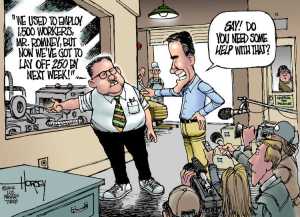
Good morning! Today is the New Hampshire primary. We’ll live blog the returns later tonight. As of last night, Gordon Gekko Mitt Romney had a big lead in the polls, with Ron Paul second and John Huntsman and Rick Santorum tied for third place.
Romney, the former governor of neighboring Massachusetts, holds a 24 percentage point lead over his closest rival, with 41 percent of likely Republican primary voters indicating they’d vote for him, the WMUR New Hampshire Primary Poll said.
U.S. Rep. Ron Paul from Texas was favored by 17 percent of likely primary voters, followed by former Utah Gov. Jon Huntsman and former U.S. Sen. Rick Santorum of Pennsylvania, each with 11 percent, and former House Speaker Newt Gingrich collecting 8 percent.
Several polls indicated Gingrich would finish in the top three.
“All of the candidates behind Romney have a good chance finishing anywhere between second and fifth place,” said Andrew Smith, director of the UNH Survey Center in Durham.
Yesterday Romney stepped in it again when he told an audience that he really likes firing people.
The final day of campaigning saw Romney under fire for a comment about health insurance that quickly became fodder for criticism.
Asked about the issue in Nashua, New Hampshire, Romney said he wanted a person to be able to own his or her own policy “and perhaps keep it the rest of their life.”
“That means the insurance company will have the incentive to keep you healthy. It also means if you don’t like what they do, you can fire them,” he said.
“I like being able to fire people who provide services to me,” Romney added. “If someone doesn’t give me the good service I need, I want to say I am going to get somebody else to provide that service to me.”
Romney complained that everyone was taking his remarks out of context, but when you’re a former corporate raider worth $250 million, it’s probably a good idea to watch what you say about putting people out of work.
Anyway, the latest meme about Romney is that he’s Gordon Gekko brought to life. I think it’s a pretty good comparison. I don’t know if you recall the quote from the recent Vanity Fair profile of Romney that I included in a recent post:
Romney described himself as driven by a core economic credo, that capitalism is a form of “creative destruction.” This theory, espoused in the 1940s by the economist Joseph Schumpeter and later touted by former Federal Reserve Board chairman Alan Greenspan, holds that business must exist in a state of ceaseless revolution. A thriving economy changes from within, Schumpeter wrote in his landmark book, Capitalism, Socialism and Democracy, “incessantly destroying the old one, incessantly creating a new one.” But as even the theory’s proponents acknowledged, such destruction could bankrupt companies, upending lives and communities, and raise questions about society’s role in softening some of the harsher consequences.
Romney, for his part, contrasted the capitalistic benefits of creative destruction with what happened in controlled economies, in which jobs might be protected but productivity and competitiveness falters. Far better, Romney wrote in his book No Apology, “for governments to stand aside and allow the creative destruction inherent in a free economy.” He acknowledged that it is “unquestionably stressful—on workers, managers, owners, bankers, suppliers, customers, and the communities that surround the affected businesses.” But it was necessary to rebuild a moribund company and economy.
That sure sounds Gekko-like, doesn’t it?
Yesterday, Rick Klein of ABC News addressed the Romney/Gekko issue.
Virtually all of Romney’s rivals are now sensing a powerful issue. Jon Huntsman said today that the firing comment shows that Romney is “completely out of touch” with the American economy.
Rick Perry, skipping ahead a state, is calling it the “ultimate insult for Mitt Romney to come to South Carolina and tell you he feels your pain, because he caused it.”
Gingrich is equating Romney’s business style with finding “clever legal ways to loot a company.” Rick Santorum’s stump speech includes a line about not needing a CEO as president, and he suggested at ABC’s Saturday night debate in New Hampshire that Romney’s background calls into question whether he “can inspire and paint a positive vision for this country.”
Romney hasn’t made matters easier for himself as he’s tried to connect with voters on the economy. The son of a millionaire business titan said over the weekend: “I know what it’s like to worry about whether or not you are going to get fired.”
Klein claims it’s too late for any of this to affect the New Hampshire primary results. I wouldn’t be so sure. New Hampshirites are famous for making up their minds at the last minute. Remember Hillary’s surprise win in 2008?
Romney has been expecting the Gordon Gekko comparisons, so you have to wonder why he hasn’t managed to curb some of these Gekko-like remarks. I guess he just can’t help himself.
Mitt Romney says he knows a photo in which he appears with other executives at Bain Capital LLC posing with cash in their hands, pockets and mouths will be used against him if he wins the Republican presidential nomination.
The 1980s image — called the “Gordon Gekko” photo by some Democrats, a reference to the Michael Douglas character in the movie “Wall Street” — offers an easy attack line at a time of high unemployment and sharp rhetoric against the nation’s top money managers, investors and bankers.
“We posed for a picture, just celebrating the fact that we had raised a lot of money and then we hoped to be able to return it with a good return,” Romney said on “Fox News Sunday.”
Here’s Romney’s defense of the photo on Fox News Sunday.
Andrew Leonard of Salon also discussed the comparison of Romney with Gekko.
Like Gekko, Romney made his fortune buying and selling companies; and like Gekko, he believes that his “greed is good” version of rough-and-tumble creative destruction is a positive force for America, weeding out the bad performers and nurturing lean-and-mean profit engines. If you are looking for the paradigmatic exemplar of the new style of capitalism mogul launched by the Reagan revolution, Romney is your man. Michael Douglas’ Gordon Gekko is merely ersatz.
But what Leonard finds so amazing is that this attack on Romney and his leverage buyouts is being led Newt Gingrich.
The shock is to see Newt Gingrich and his financial backers channeling the Oliver Stone critique so passionately and wholeheartedly. If you have not seen the three-minute advertisement “When Romney Came to Town,” the soon-to-be debuted documentary lambasting Romney as the enemy of the American worker, prepare to be flabbergasted.
“Their greed was only matched by their willingness to do anything to make millions in profits.”
“This film is about one such raider and his firm.”
“His mission: To reap massive rewards for himself and his investors.
“Romney took foreign seed money from Latin America, and began a pattern exploiting dozens of American businesses.”
And so on. Michael Moore doesn’t sting this hard, and MoveOn isn’t this angry. If Romney, as expected, ends up winning the Republican nomination, Obama’s campaign team can relax. Their work has already been done.
Here’s the trailer for the 27-minute documentary that Gingrich backers have purchased.
Politico calls it “the Bain Bomb.”
While conservatives look unlikely to unite around one alternative to Romney, the campaigns themselves are uniting around the theme that the former head of Bain Capital looted companies, tossed people out of jobs and is now exaggerating his success at the venture capital firm.
In the context of this moment in American politics, in which frustration with the privileged is boiling hot, the attack, from Republicans on one side and the Obama campaign on the other, will test Romney. If he ends up looking more like an opportunist who profited for the few than like a man who created jobs for the many, it’s hard to imagine his polls numbers won’t drop.
Conservative bloggers, who generally can’t stand Romney have begun defending him against his rivals attacks, and Dana Millback called Romney “the Scrooge McDuck of the 2012 presidential race. Bloomberg reports that buyout firms are getting nervous about damage to their reputations.
This could be fun to watch. I thought Newt’s attack on Romney yesterday was spot on.
Is Romney full of shit or what? He even makes Newt Gingrich look good. I hope Newt sticks around and continues letting it all hang out. Every single word he said about Romney was the truth.
I’m going to wrap this up with a more serious take on Romney from Robert Reich: Mitt: Son of “Citizen’s United.” I had forgotten that Reich ran for governor of Massachusetts in the the Democratic primary in 2002. Please go read the whole thing and try not to weep while you’re doing it.
As Reich says, Romney is the ultimate big money candidate. He was in 2002, and now with the help of the Roberts Court, he has more money than any candidate ever dreamed of before. If you thought Obama was the candidate of Wall Street–and he was in 2008–Romney is soooo much more so. He has money and connections that make Obama’s fundraising look pathetic. And none of this money even needs to be reported–it could be coming from overseas, even from foreign governments, and we’d never know.
Tonight we’ll find out of any of this barrage of Gordon Gekko/Mitt Romney comparisons will have any effect. I’m rooting for Romney to be taken down a peg. And then on to South Carolina!
Please share your links in the comments, and I hope to see you tonight for the live blog.
It Can Happen Here
Posted: January 9, 2012 Filed under: Barack Obama, Civil Liberties, court rulings, George W. Bush, Gitmo, Human Rights, legislation, torture | Tags: Barack Obama, Defense Authorizattion Act, due process, Gitmo, Guantanamo, Habeas Corpus, indefinite detention, Lakhdar Boumediene, Military Commissions Act (MCA), terrorism, Torture 20 Comments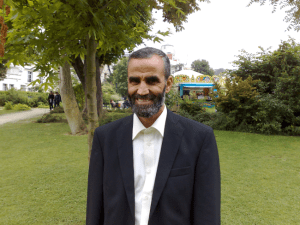
Lakhdar Boumedienne
Now that President Obama has signed the 2012 Defense Authorization Act, what happened to Lakhdar Boumediene could happen to any of us.
In a horrifying op-ed in yesterday’s New York Times Boumediene described how he was arrested in Bosnia in 2002 and held in Guantanamo for seven years without due process. At the time of his arrest Boumediene was working as a humanitarian aid worker focusing on helping children. During his imprisonment, he was never allowed to see his wife or his children, and received only a few of the many letters they sent him. The ones he did receive were cruelly censored.
Boumediene writes:
I left Algeria in 1990 to work abroad. In 1997 my family and I moved to Bosnia and Herzegovina at the request of my employer, the Red Crescent Society of the United Arab Emirates. I served in the Sarajevo office as director of humanitarian aid for children who had lost relatives to violence during the Balkan conflicts. In 1998, I became a Bosnian citizen. We had a good life, but all of that changed after 9/11.
When I arrived at work on the morning of Oct. 19, 2001, an intelligence officer was waiting for me. He asked me to accompany him to answer questions. I did so, voluntarily — but afterward I was told that I could not go home. The United States had demanded that local authorities arrest me and five other men. News reports at the time said the United States believed that I was plotting to blow up its embassy in Sarajevo. I had never — for a second — considered this.
The fact that the United States had made a mistake was clear from the beginning. Bosnia’s highest court investigated the American claim, found that there was no evidence against me and ordered my release. But instead, the moment I was released American agents seized me and the five others. We were tied up like animals and flown to Guantánamo, the American naval base in Cuba. I arrived on Jan. 20, 2002.
I still had faith in American justice. I believed my captors would quickly realize their mistake and let me go. But when I would not give the interrogators the answers they wanted — how could I, when I had done nothing wrong? — they became more and more brutal. I was kept awake for many days straight. I was forced to remain in painful positions for hours at a time. These are things I do not want to write about; I want only to forget.
Eventually he went on a hunger strike that lasted two years and was brutally force fed twice a day. Finally, in 2008, his case reached the Supreme Court.
In a decision that bears my name, the Supreme Court declared that “the laws and Constitution are designed to survive, and remain in force, in extraordinary times.” It ruled that prisoners like me, no matter how serious the accusations, have a right to a day in court. The Supreme Court recognized a basic truth: the government makes mistakes. And the court said that because “the consequence of error may be detention of persons for the duration of hostilities that may last a generation or more, this is a risk too significant to ignore.”
When he was finally freed, France took him in, and he was reunited with his family. Boumediene writes that there are 90 prisoners at Guantanamo who have also been cleared to leave the facility, but they are being held because they are from countries where they would be tortured or killed if they returned.
So there they sit, not guilty of any crime but held in indefinite detention. Just as you or I could be held if this president or the next one decides we somehow helped or supported terrorism.
Monday Morning Reads
Posted: January 9, 2012 Filed under: John Birch Society in Charge, morning reads, Republican politics, Republican presidential politics | Tags: christofascists, libertarian fascists, Republicans 33 Comments Good Morning!
Yes, it’s that time of year when Republicans try to convince us that everything old, disproved, and thrown out is shiny, patriotic and new again. Angry sky gods, debunked scientific hypotheses, and myth trump rule of law, science, and reason. Here’s a few things on their most choice delusions.
We’re not only fighting the war for abortion access and rights, we’re fighting for legal access to birth control. There’s a group of religious radicals in our country that just won’t take a supreme court case at face value. I was appalled by Romney’s insistence in this weekend’s debate that this really wasn’t a problem and wouldn’t be one. Once again, some pharmacists think they are above the law and know more than doctors because some high priest of ignorance said make it so. Men trying to buy Plan B are having trouble doing so .
Defenders of Kathleen Sebelius’ decision to overrule the FDA’s decison to make Plan B emergency contraception available over-the-counter without age restrictions floated the specter of 11-year-old girls having sex to justify the decision. (Though, of course, the sex has already happened when the Plan B is purchased, so really, people who float this argument are just arguing that it’s better for the 11-year-old in question to be pregnant than not, which seems really cruel.) The reality is that fewer than 1 percent of 11-year-olds are sexually active, so the real people hurt by these restrictions are the 15- and 16-year-olds having sex with age-appropriate partners and those 17 and older who have a legal right to the pill but find that having to ask for a pharmacist to fetch it is too much of an obstacle, because either the pharmacy counter is closed or because the pharmacy staff won’t hand it over, either out of ignorance or malice.
For those who would scoff at the chance that these are serious concerns, I give you the story of a Jason Melbourne of Mesquite, Texas went to the Mesquite CVS to buy Plan B for his wife, who had to stay home to look after their two small children. The reward he got for being a good husband who goes to the drugstore to buy lady things for his wife was resistance from the pharmacy staff, who refused to sell him the drug because they claimed to believe that men don’t have a legal right to buy it. Well, the problem is there are no gender restrictions on access to Plan B, something that Melbourne demonstrated to the staff by use of Google on a smartphone. They continued to refuse to sell to him, making outrageous claims about men supplying the drug to rape victims, even though he got his wife on the phone to explain the situation. Melbourne is the second man who has reported being denied Plan B at a CVS to the ACLU. Considering how many people don’t contact the ACLU after having their rights violated—or who would believe the pharmacy staff’s claims—that suggests this could be a widespread problem.
The Economist is suggesting that Americans are entering an age where they should lock their doors lest the morality police get inside. There are folks like Rick Santorum that want to control our sex acts, our reproductive processes, and our basic civil rights based on personal bigotry and religious hysteria. They warn us that “Now is the time for consenting adults to lock their bedroom doors”. Who needs to be concerned about creeping sharia law when we’ve got this set actively pushing their equally creepy religious cult practices?
Last September the former senator was one of nine Republican hopefuls participating in a televised debate in Orlando, Florida. A question was posed over video by a soldier in Iraq who said he had hidden the fact that he was gay because he did not want to lose his job. Did any of the candidates intend to repeal the measure Barack Obama signed into law last year that had at last given gay soldiers the right to serve their country openly? Mr Santorum’s unblinking answer was Yes. Allowing gays to serve in the military was giving one group of people “a special privilege”; it was “social policy” that ought to have no place in the armed forces.
This became a notorious exchange, not least because some members of the ultra-conservative audience in Orlando booed the soldier. But the episode hardly does justice to the depth of the former senator’s feelings about the things gays get up to. The propinquity of the wicked plainly has an unsettling impact on the peace of mind of the virtuous Mr Santorum.
Gays should not only be disqualified from serving their country, says Mr Santorum. They should also be prohibited from marrying one another. Even if unmarried, they would be ill-advised to have sex. To Mr Santorum the Supreme Court’s ruling in 2003 that anti-sodomy laws were unconstitutional was a bad mistake: this was a slippery slope that would establish a right to bigamy, polygamy, incest, adultery—“anything”.
It is not quite clear what Mr Santorum thinks about heterosexuals who have sex for fun—or at least who have it only for fun. The special status of marriage, he told the New York Time, does not exist “because people like to hang out together and have fun”; it is there to provide “a stable environment for the raising of children”. As president, he said more recently, he would at last address “the dangers of contraception in this country”, because contraception is a “licence to do things in a sexual realm that are counter to how things are supposed to be”.
If Mr Santorum has doubts about contraception, he has none about abortion. It is wrong, even in cases of rape or incest, because life is sacred and begins at conception (he does, however, support the death penalty, as it is not the innocent who die). Any doctor who performs an abortion should face criminal charges.
The Economist must feel that we are so confused about the role of religion in the founding of our country, that they must to show us and the rest of the world that our founding fathers weren’t fundamentalist crusaders. They have a special Religion in America section up about how the founders were trying to avoid having Rick Santorum moments. Here’s an apt and correct description of the religious philosophy of then Presbyterian Thomas Jefferson.
But Jefferson, like most of the top figures in the American Revolution, was far more of a sceptic in religious matters. He was fascinated by metaphysics but he had no time for the mystical. In contrast with today’s vituperative exchanges, these differences did not stop the two gentlemen maintaining a warm correspondence. But Jefferson’s approach to redacting the Bible involved something more radical than translation. He literally snipped out everything supernatural: miracles, the Virgin birth, the resurrection. The result was his own, non-mystical account of the life of Jesus. He told his old comrade: “I too have made a wee little book from the same materials which I call the ‘Philosophy of Jesus.’ It is a paradigma [sic] of his doctrines, made by cutting the pages out of the book and arranging them on the pages of a blank book…A more beautiful or precious morsel…I have never seen. It is a document in proof that I am a real Christian, that is to say, a disciple of the doctrines of Jesus, very different from the Platonists who call me infidel and themselves Christians.”
If Jefferson was a Christian of any kind, he was an idiosyncratic one. He admired Jesus as a moral teacher but like many of America’s revolutionaries, he had a visceral loathing for priestcraft. Jefferson blamed Saint Paul, the early Church, and even the Gospel writers for distorting the mission of Jesus, which, as he saw it, had been to reverse the decadence of the Jewish religion. Starting from the (correct) proposition that mystical ideas originating from Plato were influential when Christian theology was being developed, he castigated followers of the Greek philosopher for corrupting what he saw as the original Christian message.
Did Jefferson believe in God? Certainly not the Christian idea of a God in three Persons; he saw that notion as incomprehensible and therefore impossible for a rational person to accept. One view is that like many of America’s founders, he was a Deist, believing in a Creator who set the universe and its laws in motion but did not intervene thereafter. (The Deist God has been described as rather like a rich aunt in Australia—benevolent, a long way off, and mostly leaving the world to its own devices.)
Modern fundamentalists are rewriting history in the same way they like rewriting science. They place dinosaurs and modern people in their garden of Eden panoramas. Some now argue that the founders didn’t like “Darwinism” which wasn’t even around at that time Of course, that doesn’t stop Texas putting that kind’ve nonsense in textbooks. This also explains Michelle Bachmann’s odd notion that the founding fathers fought against slavery.
Believers in the idea that America was established as a Christian state scored a hit last year when the Texas school board, a politicised body in which evangelicals control crucial votes, ordered up textbooks laying out this view. Given the size of the Texan market, school-book publishers across the country often follow its lead. The best-known advocate of the “Christian nation” theory is a Texan, an author and evangelist called David Barton, who has been writing on the subject since the 1980s.
Among his recent claims are that the founding fathers rejected Darwinism (although they pre-dated Charles Darwin), and that they broke away from Britain in order to abolish slavery. In fact the southern states only joined the Revolution on the understanding that slavery would not be questioned. Strange as his views may sound to most scholars, Mr Barton’s philosophy is taken seriously in Republican circles. When Rick Perry, the Texas governor and presidential candidate, held a day of prayer for the nation in August, Mr Barton was an acknowledged endorser. One of Mr Barton’s admirers is Newt Gingrich, the former House speaker who argues that American history has been distorted by secular historians to play down the role of faith. “I never listen to David Barton without learning a whole lot of new things,” Mr Gingrich has said.
Here’s another bit of founder philosophy. This time it’s George Washington.
Virtually absent from Washington’s pronouncements was any reference to Jesus. He did not take communion—for most Christians, the most important rite of their faith—and he did not summon a Christian minister to his death bed. Was Jefferson right, then, to claim that “[Washington] thinks it right to keep up appearances but is an unbeliever”? Washington was certainly a diplomat. Although he remained formally Anglican, as president he wrote friendly letters to many Christian and Jewish communities and attended their services. And when he needed a job done on the estate, he was firm, for his time, about the irrelevance of religion: “If they are good workmen,” he said, “they may be Mahometans, Jews or Christian of any sect, or they may be atheists.”
As every American youngster has been taught, one thing that Washington, Jefferson and all the founders did believe in was religious freedom. They were appalled by the fusion of religious and political power, epitomised by the divine right of kings.
Another example of reheated nonsense popping up in the current Republican primaries is Ron Paul’s obsession This is a completely debunked set of economic philosophies and musings roughly associated with Fredich Hayek who had a few good ideas about the pricing mechanisms of the market that were completely contorted by some fascists. If you ever hear any one say anything about Mises, cover your ears. It’s basically akin to learning astrophysics from a flat earther who denies the theory of gravity. No amount of historical data deters these people. This description is from Matt Yglesias.
But “Austrians” in Paul’s sense refers to something narrower, specifically the thought of Ludwig Von Mises and his student Murray Rothbard. It is a form of capitalism that is even more libertarian and anarchic than that espoused by many libertarians. Rothbard‘s followers, most prominently longtime Paul associate and founder of the Mises Institute Lew Rockwell, have been waging a decades-long war against the Koch brothers and the more mainstream form of libertarianism the Kochs represent.
“Austrian economics,” in this sense, goes beyond standard-issue free market thinking in a number of ways. Most notably, it seeks to build a strong ethical case for strict libertarianism without admitting that this would lead to any practical problems whatsoever. Therefore, along with rejecting the legitimacy of any intervention to protect the poor or regulate anything (a position much more extreme than even the Hayek of Road to Serfdom), Austrians reject the idea that there is anything at all the government can do to stabilize macroeconomic fluctuations. This, to be clear, is different from the mainstream Republican view that the stimulus bill enacted by Congress in 2009 and signed into law by President Obama was wasteful or ineffective. Austrians also believe that cutting taxes to boost economic activity doesn’t work either. And they disagree with Milton Friedman that appropriate monetary stimulus by the Federal Reserve could have prevented the Great Depression. Indeed, they disagree with even the least controversial of all stabilization measures, the ordinary tweaking of short-term interest rates that all modern central banks use to try to prevent either inflation or deflation. In the view of the Austrians, practically every economic policy pursued by the federal government and Federal Reserve is a mistake that distorts markets. Rather than curing recessions, claim Austrians, stimulative policies cause them by producing unsustainable bubbles.
Not only did the analysis of the Great Depression thoroughly debunk this school of thought’s ridiculous hypotheses, the only places in the later part of the century that tried to implement the weirdness were countries like Pinochet’s Chile. Most of the Austrian Schools founders admired Mussolini so this as really not as big a leap as one would think for these guys. I know I always associate liberty with fascist dictators and authoritarian regimes, don’t you? It worked so well that the entire financial system there collapsed in 1982. In fact, when Pinochet disappeared, one of his cabinet members showed up at the Cato Institute and even helped Dubya Bush with his efforts to privatize social security His name is José Piñera . I guess just crashing the economy and safety nets of the Chilean people just wasn’t enough.
You may wonder why I associate Ron Paul with the idea of a neoconfederacy. Believe me, I’m not stretching on this either.
When it comes to American history, libertarians tend retrospectively to side with the Confederacy against the Union. Yes, yes, the South had slavery — but it also had low tariffs, while Abraham Lincoln’s free labor North was protectionist. Surely the tariff was a greater evil than slavery.
The posthumous induction of Jefferson Davis into the libertarian hall of fame was too much for David Boaz, a vice president of Cato. In a 2010 essay in Reason magazine titled “Up From Slavery: There’s No Such Thing as a Golden Age of Lost Liberty,” Boaz observed that even whites in the antebellum North “did not actually live in a free society … Liberalism seeks not just to liberate this or that person, but to create a rule of law exemplifying equal freedom. By that standard, even the plantation owners did not live in a free society, nor even did people in the free states.”
Boaz asked his fellow libertarians, “If you had to choose, would you rather live in a country with a department of labor and even an income tax or a Dred Scott decision and a Fugitive Slave Act?” It says something that in 2009 this question stirred up a controversy on the libertarian right.
Libertarians and conservatives, to be sure, can point to many examples of naive liberals in the last century who embarrassed themselves by praising this or that squalid, tyrannical communist regime, from the Soviet Union and communist China to petty police states like North Korea, communist Vietnam and Castro’s Cuba. But the apologists for tyranny on the left were always opposed by anti-communist liberals and anti-communist democratic socialists. Where were the anti-authoritarian libertarians, denouncing libertarian fellow travelers of Pinochet like von Hayek and Milton Friedman?
For that matter, where was the libertarian right during the great struggles for individual liberty in America in the last half-century? The libertarian movement has been conspicuously absent from the campaigns for civil rights for nonwhites, women, gays and lesbians. Most, if not all, libertarians support sexual and reproductive freedom (though Rand Paul has expressed doubts about federal civil rights legislation). But civil libertarian activists are found overwhelmingly on the left. Their right-wing brethren have been concerned with issues more important than civil rights, voting rights, abuses by police and the military, and the subordination of politics to religion — issues like the campaign to expand human freedom by turning highways over to toll-extracting private corporations and the crusade to funnel money from Social Security to Wall Street brokerage firms.
So, I’ve obviously gone a bit over my usual acceptable word count, but believe me, in all my years of education, I would never believe that so much debunked tripe would form the central arguments of so many people running for president. They will not be happy until everything is returned to the days of Dixie or pyramid building. I’m having a hard time figuring out how far back in time they would throw us. It’s enough to make me run for the hills.
What’s on your reading and blogging list today?
Doublespeak, the Devil’s Advocate and Diogenes’ Endless Quest
Posted: January 8, 2012 Filed under: 2012 elections, 2012 presidential campaign, Civil Liberties, double-speak, executive orders, Politics as Usual, POTUS | Tags: 2012 presidential election, Barack Obama, John Yoo, Republican primaries 10 CommentsJust when you think current events and various public utterances cannot get any more ridiculous, they do. Often, much of what we hear and are expected to take seriously is wrapped in doublespeak, deliberately vague, obscure language to hide the speaker/writer’s true intent.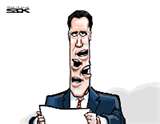
We’ve had examples galore as the 2012 election looms over DC, political candidates twisting themselves into pretzels to find the right combination of words to seduce voters. Newt Gingrich, for instance, referred to his lobbying involvement with Fannie Mae and Freddie Mac [for which he was paid handsomely] as providing advice as an ‘historian.’ John Boehner has taken a page out of Frank Luntz’s cannon, repeating the phrase ‘job creators’ as if it were a magical incantation. Democrats are certainly not immune to this form of prevarication. Every time I recall Nancy Pelosi’s infamous statement about the Healthcare Reform Bill, I wince: We have to pass the bill before we know what’s in it.
That being said, there’s a special spot in Doublespeak Heaven or Hell for John Yoo, who often writes for the American Enterprise Institute.
John Yoo. Name sound familiar? Mr. Yoo, the infamous legal advisor to the Bush Administration’s inner circle, recently jumped up, expressing considerable distaste for and worry over President Obama’s overreaching his authority, abusing and doing considerable damage to the US Constitution. A reasonable person might conclude this is in reference to the recent indefinite detention clause in the National Defense 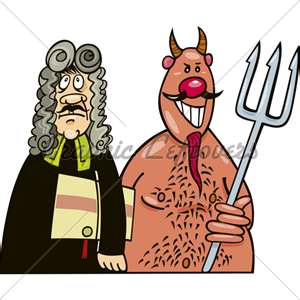 Authorization Act, the one POTUS claimed he would not sign. But then did.
But we’re not talking reasonable. We’re talking John Yoo, deputy assistant attorney general in the Office of Legal Counsel [OLC], Department of Justice from 2001-2003.
John Yoo helped strangle the English language, managing to transform the word torture into ‘enhanced interrogation,’ a smoke screen phrase that former Vice President Cheney is still defending, so he and his buddies can sleep at night.
Let’s recall the past.
John Yoo spun out legal arguments for wiretapping, warrantless surveillance on all communication coming in or out of the country as well as warrentless surveillance against American citizens; defended the use of torture [excuse me, enhanced interrogation], authoring the infamous ‘torture memo,’ in which he cited permissible techniques, including assault, maiming and drugging on orders of the President as long as they do not result in death, organ failure or impairment of bodily functions. He also advised the suspension of the Geneva Convention, War Crimes Act, indicating that the US is no longer restrained by International Law in our endless War on Terror; declared that the President is empowered to make war without Congressional permission and, in fact, has the power to order military strikes inside the US. He defended the President’s right to order rendition without Congressional approval, etc., etc., etc.
That John Yoo. He was a very busy man while he held tenure as the Devil’s Advocate.
Mr. Yoo now says President Obama has exceeded his powers by his recess appointment of Richard Cordray to head the Consumer Financial Protection Bureau. As you may recall this is the nefarious agency, the wicked brainchild of Elizabeth Warren, to protect American consumers from the labyrinth of confusing language offered in loan and credit agreements. For example, credit card agreements and home loans.
According to Mr. Yoo, who wrote a piece for the National Review Online, President Obama is making a sweeping claim in the very definition of ‘recess.’
But President Obama is making a far more sweeping claim. Here, as I understand it, the Senate is not officially in adjournment (they have held “pro forma” meetings, where little to no business occurs, to prevent Obama from making exactly such appointments). So there is no question whether the adjournment has become a constitutional “recess.”
And,
This, in my view, is not up to the president, but the Senate. It is up to the Senate to decide when it is in session or not, and whether it feels like conducting any real business or just having senators sitting around on the floor reading the papers. The president cannot decide the legitimacy of the activities of the Senate any more than he could for the other branches, and vice versa.
I find this argument particularly startling coming from Yoo, considering his defense of all things related to the expansion of presidential authority.
But there’s more,
Even with my broad view of executive power, I’ve always thought that each branch has control over its own functions and has the right — if not the duty — to exclude the others as best it can from its own decisions.
Broad view is an understatement because John Yoo is on record, as early as March 1996, declaring that the President has the right to declare war, not Congress. During his tenure with OLC, he asserted that a President can suspend First Amendment Freedoms in wartime and that the power of the Executive is virtually unlimited in times of war.
You can’t have it both ways. We’re still engaged in Afghanistan, involved in a seemingly perpetual state of war.
Yoo further states that in view of President Obama’s gross overreach:
Most importantly, private parties outside government can refuse to obey any regulation issued by the new agency. They will be able to defend themselves in court by claiming that the head of the agency is an unconstitutional officer . . .
Now to be clear, I am not a lawyer. I cannot comment on the legalistic merits of the argument. Others have done that. But I do think I have a fairly good eye for hypocrisy. And then there’s this, in reviewing Mr. Yoo’s past declarations, summaries of his memos and advice on matters of war, torture and the suspension of civil rights, this recent charge against President Obama seems out of proportion.
And duplicitous.
It’s okay when neo-cons play with the boundaries and definitions of the Constitution but not when our presumably Democratic President does the same thing. That’s not to say I agree with either political class redefining, remaking and declaring right and true what is and what is not permissible under the Constitution for very distinct political purposes, merely extending a particular agenda. But once this questionable threshold is crossed? The results are what they are.
What neither side refuses to speak to is the considerable danger there is in not accounting for what the next elected Executive is likely to do with ‘expanded’ powers, the establishment of a unitary president. This falls under the heading: Short-Term Goals. It should be noted that redefining the scope of the Executive Office was all the rage during the Bush years, something that Obama vowed to change.
But he did not.
Recalling Mr. Yoo’s penchant for reinterpreting the US Constitution during 2001-2003 [not a pleasant journey], I felt as if I’d literally entered a parallel Universe, one in which language is weaponized. In this strange, ever-evolving cosmos, white is black, up is down, evil is good and ultimate power [with no accountability] is the Law.
George Orwell is screaming from the Heavens to be named a true prophet.
As for the US Constitution? It can mean anything you want it to mean. It depends on which side of the political divide you’re standing on.
John Yoo is not a person I would ever turn to for legal advice. Not for the world I wish to inhabit or wish available to my children and future grandbabies. In fact, I would think after all the damage Mr. Yoo [admittedly, he was not alone] did during the early years of the Bush Administration, he’d be reluctant to level charges against anyone ever again.
And yet, a quick check through the archives found that Yoo had weighed in on President Obama’s proposed Executive Order on Federal contractor disclosure. This proposal would require contractors to provide their political-giving history, any gift over $5000. The proposal, it is argued, will make the Federal contract system more transparent and accountable to the public.
How radical!
Yet Mr. Yoo suggests the proposal makes some of Richard Nixon’s ‘dirty tricks’ look quaint by comparison. As an example, he conjures up the humiliating fate of anyone tempted by Presidential overreach, undoing the time-honored, Constitutional right of anonymous political speech [conveniently avoiding the issue of money-giving, as in, swamping our elections in massive amounts of payola]. Namely, the consequence of these sins leads to impeachment.
I’m falling down a rabbit hole. A really dark rabbit hole.
A case in point, Mr. Yoo ties his concern for poor, vulnerable corporations to MoveOn’s boycott of the retail operation, Target, in Minnesota. The boycott and subsequent bad press disclosed that Target had made a contribution to a conservative group supporting a gubernatorial candidate opposed to gay marriage. Yet Target had repeatedly proclaimed itself a gay-friendly corporation.
Ian Millhiser at Think Progress summarizes Yoo’s analysis this way:
In other words, Target misled the public by calling itself a gay-friendly corporation, when it actually was secretly funding an anti-gay effort. Yet, because of disclosure, it was no longer able to maintain this charade and forced to end its two-faced practices. In Yoo’s twisted understanding of the world, this is a great tragedy and not a compelling argument for why disclosure laws are necessary.
I would like to think there’s a place in the Universe where bad actors are rehabilitated, where they reconsider bad decisions, damaging policies that serve only to injure the weak and/or take advantage of human vulnerabilities. Yet reviewing the twisted logic of John Yoo has given me real pause. If fact, all these political players give me great pause.
This is particularly true with a primary season trudging along, Republican candidates making whacko statements and mean-spirited declarations. We’ve witnessed:
Michelle Bachmann’s delusions, the Eye of the Newt’s vindictive nature, Romney’s spinning positions, Santorum’s woman and gay problem, Perry’s aphasia, Jon Huntsman’s [sadly] invisible campaign and the cuddly libertarian Ron Paul, who yearns to return to the good ole days of 1900. We have not had the benefit of listening to the likes of Buddy Roemer, a voice that should be heard. But now add John Yoo to the brigade of howling voices, then mix a large measure of contradiction, deception and slick language games.
President Obama [who certainly has employed doublespeak with flair, spun numerous fantastic tales of his own] begins to look grounded, normal.
Which means, of course, I’ve definitely entered an alternate Universe. Maybe this one:
The crazy season just goes on and on and on. Which makes me think of Diogenes, wandering ancient Greece with lantern in hand, searching for that one honest man.
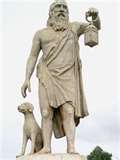
That was nearly 2500 years ago. We haven’t learned much.

 peej
peej Carissa
 bostonboomer
 dakinikat
 ecocatwoman
 mablue2
 Mama Lopez
 peggysue22
 quixote
 skydancingguestblogger
 Mona (aka Wonk the Vote)



 Sky Dancing
Recent Comments