
Tuesday Reads
Posted: October 25, 2011 Filed under: morning reads, Republican presidential politics | Tags: Bernie Sanders, Obama's mortgage refinance plan, optimism bias, Perry Flat Tax, republican politics 24 Comments Good Morning!
The Republicans continue to tear each other apart as the 2012 elections get closer. Karl Rove considers Herman Cain “not up to the job”. Bachmann’s former NH staff have released a letter that puts the candidate in a bad light.
“Team members were repeatedly ignored regarding simple requests, sometimes going weeks with little or no contact with the national team,” they wrote.
The former New Hampshire staffers said they maintained a sense of loyalty to Bachmann as a candidate and were willing to continue helping her despite lingering uncertainty about payment of wages.
“Sadly, they were deceived, constantly left out of the loop regarding key decisions, and relegated to second-class citizens within a campaign in which they were the original members,” the group said.
The ex-staffers laid out a timeline very different from the one put forth by the Bachmann campaign, claiming that the New Hampshire campaign manager, Jeff Chidester, resigned in an email 10 days ago. When nobody reached out to the other staffers to address their concerns, they called it quits.
Meanwhile, Cain and Gingrich are going rogue by trying to have their own debate in Texas with Tea Party activists.
Presidential rivals Herman Cain and Newt Gingrich (R-Ga.) will participate in a “Lincoln-Douglas” influenced debate hosted by Tea Party activists in Texas next month, National Review is reporting.
The debate will focus on fiscal issues and the economy, and will be moderated by Rep. Steve King (R-Iowa).
“We initially wanted a forum with all of the candidates,” Bill O’Sullivan, treasurer for the Texas Tea Party Patriots, told National Review. “But when we heard Gingrich say he wanted a more serious debate, like the Lincoln–Douglas debates, we wanted to do that, especially since watching the recent superficial debates has been frustrating.”
Rick Perry has introduced his tax plan which is a flat tax plan of 20%. As expected, it will give a huge tax break to the wealthy and to corporations. It also would eliminate inheritance and capital gains taxes. Perry seems to think that middle class tax payers will be able to appreciate those things too! What a moron! Here’s some of the plan’s major points.
- “The plan starts with giving Americans a choice between a new, flat tax rate of 20% or their current income tax rate. The new flat tax preserves mortgage interest, charitable and state and local tax exemptions for families earning less than $500,000 annually, and it increases the standard deduction to $12,500 for individuals and dependents.”
- Elimination of the estate tax
- Cut the corporate tax rate to 20 percent.
- Temporarily lower corporate tax rate to 5.25 percent to encourage repatriation.
- Transition to “territorial” tax system that only taxes in-country income.
- Eliminates the tax on Social Security benefits
- Eliminates the capital gains tax
I wanted to share the first of this Bloomberg series on bias and blindness by one of the father’s of behavioral finance Daniel Kahneman. He explains some of the frames folks use that some times leads them to make bad decisions in the face of risk. Optimism evidently leads to excessive risk taking.
The evidence suggests that an optimistic bias plays a role — sometimes the dominant role — whenever people or institutions voluntarily take on significant risks. More often than not, risk-takers underestimate the odds they face and, because they misread the risks, optimistic entrepreneurs often believe they are prudent, even when they are not. Their confidence sustains a positive mood that helps them obtain resources from others, raise the morale of their employees and enhance their prospects of prevailing. When action is needed, optimism, even of the mildly delusional variety, may be a good thing.
An optimistic temperament encourages persistence in the face of obstacles. But this persistence can be costly. A series of studies by Thomas Astebro shed light on what happens when optimists get bad news. (His data came from Canada’s Inventor’s Assistance Program — which provides inventors with objective assessments of the commercial prospects of their ideas. The forecasts of failure in this program are remarkably accurate.)
In Astebro’s studies, discouraging news led about half of the inventors to quit after receiving a grade that unequivocally predicted failure. However, 47 percent of them continued development efforts even after being told that their project was hopeless, and on average these individuals doubled their initial losses before giving up.
Many House Democrats don’t think the Obama plan to help homeowner’s with underwater mortgages goes far enough.
“It’s far too little, it’s just baby steps,” Rep. Dennis Cardoza (D-Calif.), a longtime critic of the administration’s housing policies, said in a phone interview. “They’re still not getting it.”
Cardoza, who announced last week he’ll retire at the end of 2012, noted that the housing collapse was a leading cause of the recession but among the last to be addressed.
“We need to excise the cancer that caused the illness before the patient can recover,” he said.
Rep. Lois Capps, another California Democrat critical of the administration’s foreclosure-prevention efforts, echoed that concern Monday, saying “much more is needed” to stabilize the struggling housing market.
“Today’s announcement is an encouraging step forward, but it is only one of a number of steps needed to fully address the growing foreclosure crisis,” Capps said in an email.
Here’s some common sense from Bernie Sanders speaking on the Ed Show and a few comments on the President’s program. Senator Sanders also thinks the plan does not go far enough
So, that should get us started today. What’s on your reading and blogging list today?
The obesity epidemic
Posted: October 24, 2011 Filed under: health hazard | Tags: endocrine disruptors, obesity, pollution 9 CommentsPeople discuss obesity as an epidemic, but the solution somehow remains individual action. That doesn’t work for real epidemics. You can’t, for instance, not catch smallpox all by yourself. (You can be lucky and have natural resistance, but that’s different.)
It’s turning out that people spoke more truth than they realized. Evidence is accumulating that obesity is a real epidemic, i.e. a public health issue with social and environmental causes. It’s something I’ve suspected for years.
Obesity has become more prevalent over the last thirty to forty years. That means — at the population level — it can’t be caused by the human tendency to eat too much. People have always been primed to eat too much, but large numbers of very overweight people relative to the whole population is a phenomenon of the last few decades.
And note that this isn’t just a matter of changing measurements or statistics. When coffin makers have to upsize coffins because the ones they’ve used for decades no longer work, there’s a real change. It’s not just PR.
So the cause(s) of the problem have to be something that’s changed in the last few decades. I’ll list all the changed factors I can think of, but the one I want to talk about is the last. Some of them are most developed in the US, but if and when they manifest elsewhere, they can be expected to promote obesity likewise.
- The baby boom generation, which is large relative to the whole population, has aged, and older people are often heavier. (A factor beyond anyone’s control.)
- Advertising for high-calorie fast food has grown very sophisticated and ubiquitous, and fast food is much more available. (A social environment factor that requires changes to industries.) (A side note: advertising is not something that can be simply ignored. It functions to steer choices whether you’re paying attention or not. The only way to avoid its effect is to avoid the advertising itself, which involves avoiding almost all modern media. Individuals may do that, but it’s not going to happen at a population level, and that’s where public health issues operate.)
- Related to that is the increase in drinking sweetened sodas. That’s upped average calorie intake by a couple of hundred calories per day. (Again, advertising and availability combine to make this a social environment factor.)
- Related to both of the above is the use of refined sugar, which has never before been used on the huge scale of the last few decades according to a report by birthorderplus. It promotes obesity by the simple mechanism of making it too easy to get too many calories. There’s also a potential added wrinkle involving high fructose sweeteners. Scientists argue about its effect. Fructose is processed differently than glucose, and given the way it’s regulated, it could be a contributing factor to the problem. (A social environment factor due to industry practices and agricultural subsidies.)
- Urban factors contribute as well. Urban sprawl makes distances too big for walking. Use of mass transit, which requires walking to and from stops, has declined versus personal cars. And many urban areas don’t have adequate parks or play spaces where adults and children can be physically active. Epidemiology indicates that (lack of) urban planning is a measurable factor in increasing obesity. (NYTimes 2003 article) (Another social environment issue.)
- Last, there’s my pet peeve: endocrine disruptors. These are pollutants that are byproducts of some plastics, some agricultural chemicals, some hormone therapies, and the like. Bisphenol A (BPA) is a well known example. Once they’re in the environment they can break down into related compounds, they get into the food chain, and once they’re ingested, they latch on to some of the same receptors as the body’s own hormones. Once they’ve latched on, they can rev up or shut down the normal function, or they can cause strange results not in the body’s normal repertoire. Widespread endocrine disruptor pollution has happened only in the last few decades. (An environmental factor involving dozens of industries.)
Recent research (press release, article summary in Cell Metabolism) has shown that estrogen receptors in the brains of female mice regulate hunger and energy expenditure. (Male brains likewise have various androgen and estrogen receptors and are expected to have similar regulatory pathways. However, that wasn’t the topic of this research. The recent increase in the phenomenon of “man-boobs” on young and not-obese men shows rather plainly that endocrine disruptors have no less effect on fat deposition in men.)
Interestingly, one implication the researchers draw is that estrogen replacement therapy for postmenopausal women may have an overlooked benefit by keeping weight down and therefore keeping the complications of obesity down.
However, they don’t draw the far more significant implication for the entire population. If sex hormone receptors regulate energy balance, and if we’ve flooded the environment with bad substitutes for sex hormones, is it any wonder that people are having trouble regulating energy balance?
It’s one more instance where the flood of chemicals released by modern industry is affecting the environment, in this case the environment of the human body.
Like all public health issues, nothing less than a population-level approach will work. Dysentery, cholera, and typhoid are never wiped out by drinking boiled water. They’re wiped out by building municipal sewers. Smallpox wasn’t eradicated by avoiding smallpox patients. It was eradicated by universal vaccination. The individual actions aren’t useless. They just don’t change the widespread causes of the widespread problem.
Modern health problems like cancer and obesity aren’t going to be wiped out by eating fresh vegetables. Eating veggies is good, but it doesn’t address the basic problem. That’s going to take nothing less than a change to clean sustainable industry.
It’s almost enough to make you wish a mere diet really was all that’s needed.
Going around Congress
Posted: October 24, 2011 Filed under: Barack Obama | Tags: executive orders, mortgage refinancing, student loan debt, underwater mortgages 13 Comments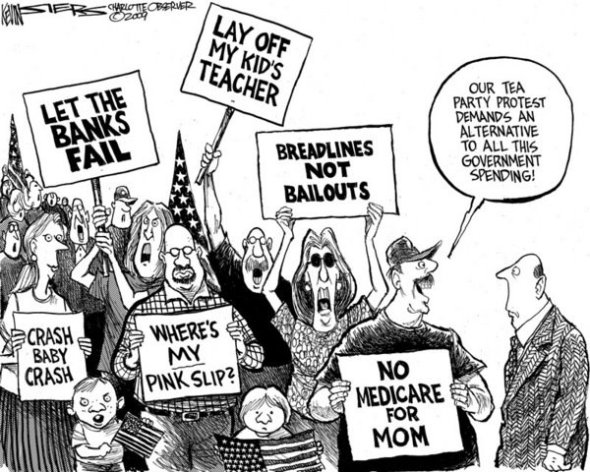 It has been clear from the very beginning of the Obama administration that Republicans were out to make him a one term president and to tank just about any initiative he could possibly make. It has amazed me that the President sought middle ground with folks that had pre-announced their intention to find none. I could never figure out why executive orders were not flying out of the White House from the get go. It seems that re-election prospects and the economy are now registering as bleak enough to justify that strategy.
In a few short minutes, President Obama will announce a series of executive branch orders that will deal with refinancing mortgages and student loans. He’s in Las Vegas today which is undoubtedly home to the worst of the housing crisis. The major problem recently has been with underwater mortgages. The new loans will require no appraisal, no credit check, and you will not have have to be 90 days delinquent. You can miss only one payment to qualify. Evidently the new strategy is to move instead of wait for lawmakers.
According to an administration official, Mr. Obama will kick off his new offensive in Las Vegas, ground zero of the housing bust, by promoting new rules for federally guaranteed mortgages so that more homeowners, those with little or no equity in their homes, can refinance and avert foreclosure.
Interesting enough, I just was in Denver discussing a Philadelphia Fed study that showed how the current refinancing programs were actually encouraging default on primary mortgages. Hopefully, this will reduce the time period between experiencing financial stress and getting relief for many home owners.
And Wednesday in Denver, the official said, Mr. Obama will announce policy changes to ease college graduates’ repayment of federal loans, seeking to alleviate the financial concerns of students considering college at a time when states are raising tuition.
The president’s announcements will bookend a three-day Western trip during which he also will hold fund-raising events in the two cities — both Nevada and Colorado are election battlegrounds — as well as in Los Angeles and San Francisco.
The “We can’t wait” campaign is a new phase in Mr. Obama’s so-far unsuccessful effort — punctuated until now by his cries of “Pass this bill!” on the stump — to pressure Republicans to support the job creation package he proposed after Labor Day. It comes after unanimous votes by Senate Republicans in the past week to block the plan; House Republican leaders have refused to put the measure to a vote.
There are two possible ways this can help. First, it may keep homes from going to foreclosure and being placed on the market. This could possibly slow down the price decline in the market which would stop forcing home values into the underwater condition. Second, lower mortgage payments could keep people their homes and free up some income for other expenditures. The details of the student loan plan have not been announced yet but the President will be talking about it in Denver on Wednesday. Let’s hope some of this works. Better late than never.
Monday Morning Reads
Posted: October 24, 2011 Filed under: morning reads | Tags: birtherism, Day of the Dead, Donald Trump, Euro, flat tax, Global Economic Crisis, Halloween, judges, judicial system, Michele Bachmann, Mitt Romney, Paul Krugman, Rick Perry, Ron Paul, student loans, stupid Republicans 26 Comments
Good Monday Morning! Not a day goes by without more examples of Republican stupidity. I’ve got several for you this morning. First up, Rick Perry had a talk with Donald Trump and now Governor Goodhair thinks President Obama’s birth certificate might be fake. That legend will never die. Think Progress:
In an interview with PARADE Magazine, Perry said that he recently met with Donald Trump and discussed the issue. Perry stated that he doesn’t “have a definitive answer” on whether Obama was born in the United States or “any idea” if Obama’s birth certificate is real….
Perry recently secured the endorsement of Orly Taitz, known as the “birther queen” for repeatedly filing lawsuits asserting that Obama was born outside the United States. Taitz told ThinkProgress that she believed Perry will use the birther issue to attack Obama.
Governor, do you believe that President Barack Obama was born in the United States?
I have no reason to think otherwise.That’s not a definitive, “Yes, I believe he”—
Well, I don’t have a definitive answer, because he’s never seen my birth certificate.But you’ve seen his.
I don’t know. Have I?You don’t believe what’s been released?
I don’t know. I had dinner with Donald Trump the other night.And?
That came up.And he said?
He doesn’t think it’s real.And you said?
I don’t have any idea. It doesn’t matter. He’s the President of the United States. He’s elected. It’s a distractive issue. “
“distractive?” Is that in the dictionary?
Herman Cain is still trying to walk back his accidentally pro-choice comments on abortion. From Politico:
Herman Cain tried to clean up the running confusion over his position on abortion last night, but in the meantime opened questions about his grasp of the Constitution.
In an interview with David Brody last night, Cain said he’d sign a pro-life constitutional amendment if it crossed his desk as president.
“Yes. Yes I feel that strongly about it. If we can get the necessary support and it comes to my desk I’ll sign it,” he said. “That’s all I can do. I will sign it.”
The only problem with that statement? Presidents don’t sign constitutional amendments — they’re passed in Congress and then need to be ratified by the states, and the president plays no formal role in the process.
Is this guy the most ignorant person to ever run for president? He’s worse than Michele Bachmann.
It appears Mitt Romney is about to do another flip flop: Romney, Once a Critic, Hedges on Flat-Tax Plans
As several leading Republican presidential candidates embrace a flat tax as a core campaign position, one contender stands out in not doing so: Mitt Romney, who has a long record of criticizing such plans and famously derided Steve Forbes’s 1996 proposal as a “tax cut for fat cats.”
Lately, though, his tone has been more positive. “I love a flat tax,” he said in August.
Flat-tax plans have come and gone before, and analysts note that they have tended to lose support once they come under scrutiny. But Mr. Romney’s support of the concept of a flat tax underscores the tightrope he is walking as taxes become a larger focus of the Republican presidential race and he faces rivals’ accusations of inconsistency on the issues.
But Ron Paul wins today’s prize for Republican stupidity. He wants to get rid of student loans.
Republican presidential contender Ron Paul said Sunday he wants to end federal student loans, calling it a failed program that has put students $1 trillion in debt when there are no jobs and when the quality of education has deteriorated.
Paul unveiled a plan last week to cut $1 trillion from the federal budget that would eliminate five Cabinet departments, including education. He’s also wants young workers to be able to opt out of Social Security.
The student loan program is not part of those cuts, but Paul said Sunday on NBC’s “Meet the Press” that he’d kill the loan program eventually if he were president. That could put him at odds with some of his young followers, many of whom are college students.
Turning to economic issues, the Financial Times has a scary article about the possible failure of the Euro.
It is time to prepare for the unthinkable: there is now a significant probability the euro will not survive in its current form. This is not because I am predicting the failure by European leaders to agree a deal. In fact, I believe they will. My concern is not about failure to agree, but the consequences of an agreement. I am writing this column before the results of Sunday’s European summit were known. It appeared that a final agreement would not be reached until Wednesday. Under consideration has been a leveraged European financial stability facility, perhaps accompanied by new instruments from the International Monetary Fund.
A leveraged EFSF is attractive to politicians for the same reason that subprime mortgages once appeared attractive to borrowers. Leverage can have different economic functions, but in these cases it simply disguises a lack of money. The idea is to turn the EFSF into a monoline insurer for sovereign bonds. It is worth recalling that the role of those monolines during the bubble was to insure toxic credit products. They ended up as a crisis amplifier.
To be honest, the article is a bit too technical for me to follow, but maybe Dakinikat can help me if she has sufficiently recovered from her nightmarish trip to Denver. Paul Krugman says Europe’s problem is (what else?) the stupidity of austerity.
First, the grim news from Greece is, as many commentators are pointing out, a big refutation for the doctrine of “expansionary austerity.” And it’s worth pointing out that European leaders, and especially the ECB, went in for that doctrine in a big way. Look at the June 2010 monthly report of the ECB (pdf), specifically the discussion of “fiscal consolidation” on page 83 and following. Basically, the ECB pooh-poohs any notion that austerity would have major negative effects on the economy, suggests that it’s quite likely that the confidence fairy will make everything OK, and specifically says that
Determined action on the part of governments to undertake fiscal and structural reforms is necessary to preserve stability and cohesion in the euro area. A sustained commitment to consolidation, possibly including a speeding up of current plans and their delivery, is required from all governments to ensure that the time afforded by the exceptional measures is used to put public finances on a permanently sounder footing.
So the ECB was calling for austerity everywhere. Was any concern expressed about how that would affect Europe-wide growth? Was there any suggestion of expansionary monetary policy to offset such a coordinated fiscal contraction? No and no.
And now they’re shocked, shocked that the Greek economy is plunging into a hole.
Maybe Ron Paul has a solution. LOL
Fannie posted this link last night, but I thought it should be on the front page: Republicans Turn Judicial Power Into a Campaign Issue
Republican presidential candidates are issuing biting and sustained attacks on the federal courts and the role they play in American life, reflecting and stoking skepticism among conservatives about the judiciary. Gov. Rick Perry of Texas favors term limits for Supreme Court justices. Representatives Michele Bachmann of Minnesota and Ron Paul of Texas say they would forbid the court from deciding cases concerning same-sex marriage. Newt Gingrich, the former House speaker, and former Senator Rick Santorum of Pennsylvania want to abolish the United States Court of Appeals for the Ninth Circuit, calling it a “rogue” court that is “consistently radical.”
Criticism of “activist judges” and of particular Supreme Court decisions has long been a staple of political campaigns. But the new attacks, coming from most of the Republican candidates, are raising broader questions about how the legal system might be reshaped if one of them is elected to the White House next year.
I’m going to end with this funny Halloween-themed satire from The New Yorker: Dear Mountain Room Parents, by Maria Semple. Here’s a bit of it, but please read the whole thing. You won’t be sorry.

Hi, everyone!
The Mountain Room is gearing up for its Day of the Dead celebration on Friday. Please send in photos of loved ones for our altar. All parents are welcome to come by on Wednesday afternoon to help us make candles and decorate skulls.
Thanks!
Emily
Hi again.
Because I’ve gotten some questions about my last e-mail, there is nothing “wrong” with Halloween. The Day of the Dead is the Mexican version, a time of remembrance. Many of you chose Little Learners because of our emphasis on global awareness. Our celebration on Friday is an example of that. The skulls we’re decorating are sugar skulls. I should have made that more clear.
Emily
Parents:
Some of you have expressed concern about your children celebrating a holiday with the word “dead” in it. I asked Eleanor’s mom, who’s a pediatrician, and here’s what she said: “Preschoolers tend to see death as temporary and reversible. Therefore, I see nothing traumatic about the Day of the Dead.” I hope this helps.
Emily
It gets funnier, so please go read the rest! Now what are you reading and blogging about today?
Late Night: Pete Seeger and Arlo Guthrie at Occupation Columbus Circle
Posted: October 23, 2011 Filed under: #Occupy and We are the 99 percent!, U.S. Economy, U.S. Politics | Tags: Arlo Guthrie, occupy Wall Street, open thread, Pete Seeger 6 Comments
If Fox News didn’t think Occupy Wall Street protesters are just a bunch of hippies already, this sure won’t help. Pete Seeger and Arlo Guthrie were the latest celebrities to join the 99%, treating the crowd to a spontaneous folk performance Friday night near New York’s Columbus Circle.
F**k Fox News!
92-Year-Old Folk Legend Lends His Voice to ‘Occupy’
On Friday night, over a month since the ‘Occupy Wall Street’ protests began as a small gathering of people so small that there was a virtual media blackout, Pete Seeger emerged from a show he had been performing on New York City’s Upper West Side to join in the protests.
There have been many musicians and celebrities who have thrown their weight behind these protesters, but the 92-year-old folk legend gives these young Americans a new sense of hope and rejuvenation. In the 1960s, he established himself as a prominent protest singer, bringing awareness to causes such as civil rights, international disarmament and the environment.
Seeger, who was wearing a red cap and carrying two canes, was joined a crowd of 600 as they headed south towards Columbus Circle (some 30 blocks away) starting from Symphony Space on 95th and Broadway. On both sides, Seeger was flanked by people carrying placards reading “Lost my job, found an occupation,” and “Corporate greed is revolution’s seed.”
The crowd resembled that of an earlier decade, as they sang “Down by the Riverside,” and “We Shall Not Be Moved,” and [Woody]Guthrie’s “This Land is Your Land.”
The audio and video aren’t that great, but it’s the revolutionary spirit that counts.

 peej
peej Carissa
 bostonboomer
 dakinikat
 ecocatwoman
 mablue2
 Mama Lopez
 peggysue22
 quixote
 skydancingguestblogger
 Mona (aka Wonk the Vote)



 Sky Dancing
Recent Comments