
Did White House Push for $535 Million Loan to Now Bankrupt Solyndra?
Posted: September 2, 2011 Filed under: Republican politics, Team Obama, U.S. Economy, U.S. Politics, unemployment | Tags: ABC News, bankruptcy, Barack Obama, Department of Energy, George Kaiser, green energy, House Energy Committee, Job Creation, jobs, layoffs, Rep. Fred Upton (R-MI), solar energy, Solyndra, stimulus bill, unemployment 18 Comments
Obama visiting the Solyndra plant
Minkoff Minx highlighted this story earlier today, but I thought I’d expand on it a little bit. As Minx wrote earlier, Solyndra is a solar energy company that the Obama admnistration has hyped as an example of the potential of green energy technology to create jobs in the U.S. From the LA Times editorial page:
Solyndra was the first company to be awarded a federal loan guarantee under the stimulus, worth $535 million. Taxpayers are likely to end up on the hook for much if not all of that amount, a highly embarrassing development for President Obama because he was among the company’s biggest cheerleaders. He visited its Fremont plant in May 2010 even though PricewaterhouseCoopers had weeks earlier raised doubts about its plans for an initial public offering by questioning whether it could continue as a going concern.
That’s especially troubling because Solyndra is backed by one of Obama’s key fundraisers, George Kaiser of Tulsa. Congressional Republicans were raising alarms about Obama’s connections to Solyndra well before Wednesday’s announcement, with GOP members of the House Energy and Commerce Committee voting in July to subpoena documents from the Office of Management and Budget on the loan-guarantee decision.
Two important questions are raised by Solyndra’s failure: Should the government be in the business of picking winners and losers by providing loan guarantees to risky energy ventures? And is Obama using stimulus funds to reward his political contributors?
The Times says “yes” to the first question and “maybe” to the second, pending the results of the House investigation.
As the LA Times noted, questions were being asked about the Solyndra loan even before the bankruptcy announcement. Brian Ross and his colleagues at ABC News have also been looking into the White House connection.
ABC News and the Center for Public Integrity’s iWatch News first reported on questions about the choice of Solyndra for the loan in May after the Department of Energy disclosed it was being forced to restructure its loan package for the company, which was showing early signs of financial distress. One of Solyndra’s major investors was George Kaiser, an Oklahoma billionaire who raised between $50,000 and $100,000 for Obama during the 2008 election.
Following the ABC News and iWatch News reports, the House Energy and Commerce Committee opened their own investigation into the loan and into the Kaiser link, which Stearns office said in a statement “raised concerns that politics may have played a role in putting taxpayer dollars at risk making this loan guarantee.” ….
White House officials deferred ABC News’ request for comment on this report to the Department of Energy. There, officials told ABC News and iWatch News that it used objective factors in selecting Solyndra. The department released a statement Wednesday on its website blaming changing economics in the industry — including a major push by Chinese firms to drive down solar panel prices — for the company’s collapse along with two other domestic firms. According to the Energy Department, the price for solar products dropped 42 percent in 2011.
I don’t know why anyone would be surprised to learn that Obama was using government money to help his big donors. Isn’t that what he’s been doing with Wall Street since the fiscal crisis began? Even before he was elected, Obama whipped for TARP. If he hadn’t convinced members of the Congressional Black Caucus to vote for it, the bailout bill never would have passed. So now Republicans control the House, and they can’t wait to investigate.
House Energy Committee Chair Fred Upton (R-MI) sent a letter to the White House
which calls on the White House to turn over correspondence between administration officials, Solyndra and its investors….”How did this company, without maybe the best economic plan, all of a sudden get to the head of the line?” Upton told ABC News in an interview this week. “We want to know who made this decision … and we’re not going to stop until we get those answers.”
The White House denies any involvement in the approval of the loan, although members of the administration have enthusiastically and publicly praised it. Yet more neutral observers have been critical of the deal.
While Energy Department officials steadfastly vouched for Solyndra — even after an earlier round of layoffs raised eyebrows — other federal agencies and industry analysts for months questioned the viability of the company. Peter Lynch, a longtime solar industry analyst, told ABC News the company’s fate should have been obvious from the start.
“Here’s the bottom line,” Lynch said. “It costs them $6 to make a unit. They’re selling it for $3. In order to be competitive today, they have to sell it for between $1.5 and $2. That is not a viable business plan.”
Furthermore, OMB considered the loan to be “risky,” according to ABC News.
The White House’s Office of Budget and Management viewed the arrangement as a riskier bet to taxpayers than DOE had. That forced the government to set aside millions more in case of a default, iWatch reported last month.
I guess we’ll have to wait and see what happens, but I can only assume that Republicans in the House are going to be on this like white on rice. They hate Obama and they hate green energy.
ZERO new jobs
Posted: September 2, 2011 Filed under: U.S. Economy, unemployment | Tags: jobs, unemployment 11 Comments I’m reviewing the jobs market stats right now and the austerity pogrom is having an impact on employment. It’s stifling growth of GDP and job creation. We don’t need the confidence fairy or more tax cuts. We need policy that directly creates jobs because we don’t even have anemic growth at this point. This may put some pressure on the President to think big when he announces his jobs plan next week. I have a feeling that will be anemic also and tempered by what he thinks he can get past the Republicans. The clear news is that state, local and the federal governments are clearly joined together in an effort to create another recession.
The lack of growth in nonfarm payrolls placed the job market well below the consensus forecast by economists of a 60,000 increase, which itself was none too optimistic. It was a sharp decline from July, which the Labor Department on Friday revised to show a gain of 85,000 jobs.
August’s stall came after a prolonged increase in economic anxiety this summer that began with the brinksmanship in Washington’s debt-ceiling debate, followed by the country’s loss of its triple-A credit rating, stock market whiplash and renewed concerns about Europe’s sovereign debt.
On Friday, Wall Street stocks promptly lost more than 2 percent of their value at the opening of trading, with the Dow Jones industrial average down about 200 points by midday, and some economists upgraded their odds for a double-dip recession.
The jobs figure, a monthly statistical snapshot by the Department of Labor, appears slightly more negative than it is because it does not include 45,000 Verizon workers who were on strike when the survey was taken but who will reappear in next month’s report. But even factoring in the Verizon jobs, private sector growth was the slowest it has been since May of last year. In addition, the report showed that job growth in June and July was softer than previously thought.
“As long as payrolls are weak, you will continue to hear cries of not just recession risk, but cries that the United States is in a recession and we just don’t know it,” said Ellen Zentner, the senior United States economist for Nomura Securities.
Economists blamed both sluggish demand for goods and services and the heightened uncertainty over the economy’s direction for the slow pace of job creation, saying political deadlock was creating economic paralysis.
The worse trends continue to happen in the fundamentals where duration still remains a huge problem. The other problem is in ‘underutilized’ workers or people that really want to work full time but are stuck in temp or part time positions and those that are working jobs beneath their skill and experience levels.
The number of workers only able to find part time jobs (or have had their hours cut for economic reasons) increased to 8.826 million in August from 8.396 million in July.
These workers are included in the alternate measure of labor underutilization (U-6) that increased to 16.2% in August from 16.1% in July.
…
According to the BLS, there are 6.034 million workers who have been unemployed for more than 26 weeks and still want a job. This was down from 6.185 million in July. This is very high, and long term unemployment is one of the defining features of this employment recession.
There are some pretty amazing long term patterns appearing in the recent numbers. If you haven’t had a chance to read “The Slow Dissappearance of the American Working Man” from Bloomberg Businessweek, you should. Basically, a smaller share of men have jobs today than anytime since World War 2. A lot of this is due to the disappearance of traditional manufacturing jobs, but also the lack of construction jobs since the housing crash. Here’s some other interesting demographics.
The portion of men who work and their median wages have been eroding since the early 1970s. For decades the impact of this fact was softened in many families by the increasing number of women who went to work and took up the slack. More recently, the housing bubble helped to mask it by boosting the male-dominated construction trades, which employed millions. When real estate ultimately crashed, so did the prospects for many men. The portion of men holding a job—any job, full- or part-time—fell to 63.5 percent in July—hovering stubbornly near the low point of 63.3 percent it reached in December 2009. These are the lowest numbers in statistics going back to 1948. Among the critical category of prime working-age men between 25 and 54, only 81.2 percent held jobs, a barely noticeable improvement from its low point last year—and still well below the depths of the 1982-83 recession, when employment among prime-age men never dropped below 85 percent. To put those numbers in perspective, consider that in 1969, 95 percent of men in their prime working years had a job.
Men who do have jobs are getting paid less. After accounting for inflation, median wages for men between 30 and 50 dropped 27 percent—to $33,000 a year— from 1969 to 2009, according to an analysis by Michael Greenstone, a Massachusetts Institute of Technology economics professor who was chief economist for Obama’s Council of Economic Advisers. “That takes men and puts them back at their earnings capacity of the 1950s,” Greenstone says. “That has staggering implications.”
What is going on here? For one thing, women, who have made up a majority of college students for three decades and now account for 57 percent, are adapting better to a data-driven economy that values education and collaborative skills more than muscle. That isn’t to say women have yet eclipsed men in the workplace. They continue to earn about 16 percent less than men and struggle against gender discrimination and career interruptions as they disproportionately take time away from the job to raise children. And both men and women have confronted job losses in the weak economy. In July, 68.9 percent of women aged 25-54 had jobs, vs. 72.8 percent in January 2008. (In 1969, however, fewer than half did.) After a long decline in men’s work opportunities, the recession worsened things with a sharp drop in male employment. Unemployed men are now more likely than women to be among the long-term jobless.
This is not good for the economy or society. Here’s another disturbing result when so many working class men go without a living wage and a job. Men are frequently raised to feel self worth from jobs so that losing that identity can create havoc for the man and the people around him.
While unemployment is an ordeal for anyone, it still appears to be more traumatic for men. Men without jobs are more likely to commit crimes and go to prison. They are less likely to wed, more likely to divorce, and more likely to father a child out of wedlock. Ironically, unemployed men tend to do even less housework than men with jobs and often retreat from family life, says W. Bradford Wilcox, director of the National Marriage Project at the University of Virginia.
Also, since women’s wages are clearly not raising in response, women may be employable but they are certainly not valued in terms of the services they provide. Until we find a way to provide jobs for all skill levels, we are not going to see an end to our economic problems. It seems really counter-intuitive to me that the government is so obsessed on its debt right now that they are willing to slow growth and incur increasing safety net expenditures rather than implement the lessons of the past and provide jobs programs for services that would jump start the private sector by providing willing customers. Rebuilding our infrastructure seems like a no-brainer expenditure right now. I continue to feel like we’re in opposites world. Since the President appears willing to adopt traditional Republican economic policies thatjust stall the economy, I wonder where the Republicans will go. My understanding is that five of the Republican presidential candidates want to eliminate the very minimal tax on capital gains now. I guess the conversation will start next week. I have a feeling that the only winners in the debate and policy push will once again be the extremely rich who make their incomes from speculation and gambling in financial markets rather than a decent day of work.
Friday Morning Reads
Posted: September 2, 2011 Filed under: 2012 presidential campaign, abortion rights, Barack Obama, commercial banking, Domestic terrorism, Economy, Elections, fetus fetishists, financial institutions, House of Representatives, morning reads, Planned Parenthood, Reproductive Health, Reproductive Rights, Republican politics | Tags: FED, fiscal stimulus, Goldman Sachs investigation, James Carville, Litton, Obama Polls, Obama speech schedule, Stonehenge, Subprime mortgages 24 Comments Well, it looks like I’m in a tropical storm warning right now. I’m just hoping the electricity stays on as TD 13 becomes TS Lee when it drifts around and comes on shore some time on Saturday. I’m also hoping Hurricane Katia stays a fish storm but that’s looking less likely at the moment. Lot’s of us may get flooded yet again. I’m just hoping we can go get NJ Governor Chris Christie to go beat up Eric Cantor in the interim. Poor Vermont looks like it needs a lot of help right now! We’re expected to get rain that may fall at 2-3 inches an hour. I’m not sure if our pumps can handle that; especially the crappy ones the Corps bought from Jeb Bush that have been problematic since they were installed.
So, it’s nice to see that the FED has decided that Goldman Sachs is now under its jurisdiction and is ordering it to review its foreclosure practices of a former subsidiary. So many heads should roll over the subprime mortgage market mess and so few have to date. The Fed’s a pretty aggressive regulator when it feels some institution is in its charter. It’s good to see the charter is extending beyond commercial banks and thrifts now that the cheap lending has been extended to other financial institutions too. They take the truth-in-lending laws very seriously.
The Federal Reserve ordered Goldman Sachs Group Inc to hire a consultant to review practices of a former mortgage subsidiary on Thursday and said it plans to assess a monetary penalty for wrongful foreclosures.
The Fed’s crackdown sent Goldman shares down 3.5 percent on Thursday, even as the bank announced that it had completed the sale of Litton Loan Servicing LP, the mortgage-servicing business at the heart of its foreclosure problems.
Litton’s regulatory troubles stem largely from the practice of “robosigning,” in which bank employees signed foreclosure documents without reviewing case files as required by law.
Many large banks, including Bank of America Corp, JPMorgan Chase & Co, Wells Fargo & Co and Citigroup Inc, have been targets of probes by state and federal regulators over the same issue, in the clean-up after a world financial crisis triggered in large part by bad mortgages in the United States and bonds backed by those loans.
The Fed cited “a pattern of misconduct and negligence” at Litton in announcing its enforcement action against Goldman.
The Economist has been having a reader debate on the necessity of Fiscal stimulus for the US. The Hell, Yes! vote appears to have it. The comments are about as interesting as the two economists debating the motion.
The American economy has remained extremely weak since officially leaving recession in mid-2009. The unemployment rate has barely fallen. Recent figures suggest GDP grew at less than a 1% annualised rate through the first half of the year and the odds of a return to recession have risen. The headwinds facing the economy are considerable: the private sector is still trying to reduce the burden of debt it is carrying from the pre-crisis boom years. House prices are still in the doldrums and mortgage credit is hard to get. State and local governments, which are required to balance their budgets, have been forced to cut spending, workers and hours to cope with falling tax collections. Many argue that in such a situation, the federal government is the only entity left that can provide a boost to overall demand and keep the economy from slipping back into recession or prolonged stagnation. At present, however, federal fiscal policy is scheduled to do the opposite: at the end of this year, a temporary payroll tax cut and enhanced jobless benefits expire.
“I do think this is a really big debate and I think the White House was out of bounds…in trying to schedule a speech during a debate,” Carville said on “GMA.”
This will be Gov. Rick Perry’s first debate, and as Carville said this morning the stakes are high.
“Given a choice between watching a debate and the speech I would have watched the debate and I’m not even a Republican or even close to being a Republican,” he said, adding it will be a “barn burner.”
The administration agreed to move the speech to Thursday- possibly competing with the kick off of the NFL season instead. The White House has been touting this jobs plan telling ABC News that he will propose tax relief, infrastructure investment and assistance for the long term unemployed.
Obama has received advice from both sides with some arguing for an ambitious proposal and others recommending finding middle ground.
Carville, an ABC News consultant, told me it doesn’t matter what Obama proposes, it won’t get through Congress.
For the first time this year, Texas Governor Rick Perry leads President Obama in a national Election 2012 survey. Other Republican candidates trail the president by single digits.
A new Rasmussen Reports national telephone survey shows Perry picking up 44% of the vote while the president earns support from 41%. Given the margin of sampling error (+/- 3 percentage points) and the fact that the election is more than a year away, the race between the two men is effectively a toss-up. Just over a week ago, the president held a three-point advantage over Perry. (To see question wording, click here.)
Perry leads by nine among men but trails by five among women. Among voters under 30, the president leads while Perry has the edge among those over 30. The president leads Perry by 16 percentage points among union members while Perry leads among those who do not belong to a union.
I’d vote for a dead dog before I’d vote for Rick Perry, just in case you’re wondering where I stand. A Quinnipiac University poll also shows the President’s approval on handling of unemployment and the economy is still bleak.
President Barack Obama’s overall job approval rating has sunk to an all-time low, as American voters disapprove 52 – 42 percent, compared to 47 – 46 percent approval in July, and among whites and men his approval has dropped into the 30s, according to a Quinnipiac University poll released today. Congressional leaders rate even lower in the public eye. Voters nationwide are more pessimistic about the economy, saying 49 – 11 percent that it is getting worse rather than improving, a precipitous drop from a July 14 survey by the independent Quinnipiac (KWIN-uh-pe-ack) University, in which voters said 32 – 23 percent the economy was worsening and January 18, when voters said 36 – 20 percent it was improving. The economy is in a recession, 76 percent of voters say, and is not beginning to recover, voters say 68 – 28 percent. Voters trust Obama more than congressional Republicans to handle the economy 44 – 41 percent, but they say 46 – 42 percent that Republican presidential candidate Mitt Romney would do a better job than Obama. They are split 43 – 41 percent on whether Obama or GOP candidate Rick Perry would be better on the economy.
This should be an interesting political season. My guess is that it’s going to get very ugly.
There’s some good news from NPR about the Obama Justice Department. It seems they have made a priority of keeping abortion providers and women seeking abortions safe from violence and protestor harassment.
The Obama Justice Department has been taking a more aggressive approach against people who block access to abortion clinics, using a 1994 law to bring cases in greater numbers than its predecessor.
The numbers are most stark when it comes to civil lawsuits, which seek to create buffer zones around clinic entrances for people who have blocked access in the past. Under the Freedom of Access to Clinic Entrances Act, or FACE Act, the Justice Department’s civil rights division has filed eight civil cases since the start of the Obama administration. That’s a big increase over the George W. Bush years, when one case was filed in eight years.
“There’s been a substantial difference between this administration and the one immediately prior,” says Ellen Gertzog, director of security for Planned Parenthood. “From where we sit, there’s currently much greater willingness to carefully assess incidents when they occur and to proceed with legal action when appropriate.”
Over the past two years, the Justice Department and FBI have been meeting with abortion-rights groups and medical providers all over the country to explain their work and talk about a federal task force designed to prevent violence against doctors and women seeking abortions.
The National Abortion Federation, which tracks violent incidents, says major violence is down since the 2009 murder of abortion doctor George Tiller. The man who killed Tiller has been convicted, and a federal grand jury is investigating the conduct of his alleged accomplices.
But Sharon Levin, a vice president at the National Abortion Federation, says there are still some signs of trouble, including two incidents this summer involving Molotov cocktails and the arrest of a man who told police he wanted to shoot two abortion doctors in Wisconsin.
So I admit to being totally fascinated by Stonehenge. I wanted to share this Tomb find in the place where the famous stones were most likely quarried.
The tomb for the original builders of Stonehenge could have been unearthed by an excavation at a site in Wales.
The Carn Menyn site in the Preseli Hills is where the bluestones used to construct the first stone phase of the henge were quarried in 2300BC.
Organic material from the site will be radiocarbon dated, but it is thought any remains have already been removed.
Archaeologists believe this could prove a conclusive link between the site and Stonehenge.
The remains of a ceremonial monument were found with a bank that appears to have a pair of standing stones embedded in it.
The bluestones at the earliest phase of Stonehenge – also set in pairs – give a direct architectural link from the iconic site to this newly discovered henge-like monument in Wales.
The central site had already been disturbed so archaeologists chose to excavate around the edges
The tomb, which is a passage cairn – a style typical of Neolithic burial monument – was placed over this henge.
How cool is that?
So, that’s my contribution for the day. Hopefully, I’ll be on line through the weekend but if you don’t see me, you’ll know what happened!
What’s on your reading and blogging list today?
During Transition, Obama “Signaled” Endorsement of Bush Secret Programs
Posted: September 1, 2011 Filed under: Psychopaths in charge, Team Obama, torture, U.S. Military, U.S. Politics | Tags: assassination, Barack Obama, Bush administration counterterrorism policies, CIA, extraordinary rendition, Frontline, John Rizzo, PBS, terrorism, Top Secret America, Torture 15 Comments
In a 2007 speech to the Council on Foreign Relations, Obama promised to roll back the secret programs put in place by Bush and restore civil liberties and respect for the Constitution. Here’s an excerpt:
This [Bush] Administration…puts forward a false choice between the liberties we cherish and the security we demand. I will provide our intelligence and law enforcement agencies with the tools they need to track and take out the terrorists without undermining our Constitution and our freedom.
That means no more illegal wire-tapping of American citizens. No more national security letters to spy on citizens who are not suspected of a crime. No more tracking citizens who do nothing more than protest a misguided war. No more ignoring the law when it is inconvenient. That is not who we are. And it is not what is necessary to defeat the terrorists. The FISA court works. The separation of powers works. Our Constitution works. We will again set an example for the world that the law is not subject to the whims of stubborn rulers, and that justice is not arbitrary.
This [Bush] Administration acts like violating civil liberties is the way to enhance our security. It is not. There are no short-cuts to protecting America, and that is why the fifth part of my strategy is doing the hard and patient work to secure a more resilient homeland.
But since Obama took office, his Justice Department has defended every Bush/Cheney policy and refused to hold any Bush administration or CIA officials accountable for torture, rendition, and illegal spying on Americans. Obama has instead gone even further, claiming the right to assassinate American citizens on the sole authority of the President.
The new season of PBS Frontline begins next Tuesday with a bang. The show is part of Frontline’s collaboration with the Washington Post in an investigative project called Top Secret America.
Today Frontline posted some teasers for the show, one of which I found unsurprising but still very important.
FRONTLINE has learned from a former high-ranking CIA official that even before he took office, Obama’s team “signaled” they had no intention of rolling back secret programs begun under the Bush administration. In his first televised interview, for next Tuesday’s Top Secret America John Rizzo, a 34-year agency veteran described as “the most influential lawyer in CIA history,” tells FRONTLINE:
I was part of the transition briefings of the incoming Obama team, and they signaled fairly early on that the incoming president believed in a vigorous, aggressive, continuing counterterrorism effort. Although they never said it exactly, it was clear that the interrogation program was going away. We all knew that.
But his people were signaling to us, I think partly to try to assure us that they weren’t going to come in and dismantle the place, that they were going to be just as tough, if not tougher, than the Bush people….
With a notable exception of the enhanced interrogation program, the incoming Obama administration changed virtually nothing with respect to existing CIA programs and operations. Things continued. Authorities were continued that were originally granted by President Bush beginning shortly after 9/11. Those were all picked up, reviewed and endorsed by the Obama administration.
You can watch part of the interview at the Frontline link.
What Exactly Does S&P stand for?
Posted: September 1, 2011 Filed under: financial institutions | Tags: mortgage backed bonds, ratings, S&P, Subprime mortgages, US Debt 4 CommentsI don’t often put on the finance hat part of the financial economist moniker ’round these parts, but I couldn’t resist donning it long enough to pooh pooh S&P. It’s hard to take the bond rating portion of 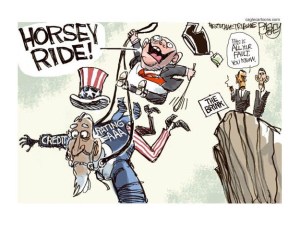 their business seriously when they do things like this: “Subprime Mortgage Bonds Getting AAA Rating S&P Denies to U.S. Treasuries”. How much sense does that make?
Standard & Poor’s is giving a higher rating to securities backed by subprime home loans, the same type of investments that led to the worst financial crisis since the Great Depression, than it assigns the U.S. government.
S&P is poised to provide AAA grades to 59 percent of Springleaf Mortgage Loan Trust 2011-1, a set of bonds tied to $497 million lent to homeowners with below-average credit scores and almost no equity in their properties. New York-based S&P stripped the U.S. of its top rank on Aug. 5, saying Washington politics were making the country less creditworthy.
Treasuries gained about 1.95 percent and U.S. borrowing costs have fallen to record lows as investors repudiated the downgrade, according to Bank of America Merrill Lynch indexes. S&P has awarded AAAs to more than $36 billion of securities in the U.S. this year that were created by bankers who continue to gather thousands of loans, bundle them into bonds of varying risk and pay ratings firms a fee to assign credit rankings.
“Everybody has been led to believe over the years that AAA means AAA means AAA across the board,” Gregory W. Smith, the general counsel for the $41 billion Public Employees’ Retirement Association of Colorado, said in a telephone interview on Aug. 24. “Anybody that didn’t learn in the 2008 crisis that doesn’t apply should find another line of work.”
Yup, that’s right. The same bonds in a still stinky market are getting better ratings than assets that are basically still serving as a universal safe haven and are showing signs of being about the only bull market among the surly August bears. Lest we forget, even a Senate subcommittee found that S&P’s inflated ratings significantly contributed to the financial crisis of 2007-2008. It’s somewhat obvious the market doesn’t believe the raters given the current pricing of US Treasuries. However, these kinds of ratings still remain important in some circles around Wall Street despite what seems like monumental problems and conflicts of interest. It’s difficult to imagine a for profit business not being influenced by large, paying customers. The reason they remain key is that many charters of institutional investment funds have minimum ratings requirements and institutional funds are a huge chunk of the market.
Even after Congress included rules in the Dodd-Frank Act last year designed to cut reliance on ratings, S&P and its competitors remain a key part of the financial markets. Pension and mutual funds often require minimum ratings to buy debt securities. Banks are generally required to hold less capital to back higher rated bonds as regulators including the Federal Reserve have yet to find an alternative.
The Justice Department is probing S&P and Moody’s over mortgage-bond ratings between 2005 and 2008, according to three former analysts who said they were interviewed by investigators. The Senate Banking Committee and the Securities and Exchange Commission are scrutinizing the decision to downgrade the U.S. rating, according to people with knowledge of the inquiries.
The Justice Department probe is fairly new, but details show that the probe is based on these potential conflicts of interest. Still, there are hints that the probe was also a possible political strategy to press the rater to raise the rating on U.S. sovereign debt. The Justice Department does have to prove a case before a judge so that could offset any political motivation in the long run.
The Justice Department has been asking about instances in which S&P analysts wanted to assign lower ratings to mortgage bonds but may have been overruled by S&P business managers, the newspaper reported. Its story cited unidentified sources familiar with the matter.
It was unclear whether the Justice Department investigation involves the other two ratings agencies. A Justice Department spokesman was not immediately available for comment.
Ed Sweeney, a spokesman for S&P, told the newspaper in an e-mail that the agency had received several requests from different government agencies over the last few years and that it was cooperating.
The newspaper said that despite the outcry over the ratings agencies’ failures in the financial crisis, investors still rely heavily on ratings from the three main agencies for their purchases of sovereign and corporate debt, as well as other complex financial products.
Companies and some countries, though not the United States, pay the agencies to receive a rating. For decades, the government issued rules that banks, mutual funds and others could rely on a AAA stamp of approval for investing decisions — which bolstered the agencies’ power, the newspaper said.
A successful case or settlement against a giant like S&P could accelerate the shift away from the traditional ratings system, the report said.
Collateralized loan obligations are probably among some of the most difficult assets to price and rate. S&P handles a boatload of them. They also have a history of being wrong.
More than 14,000 securitized bonds in the U.S. are rated AAA by S&P, backed by everything from houses and malls to auto- dealer loans and farm-equipment leases, according to data compiled by Bloomberg.
S&P has said it made mistakes in structured finance since the crisis including misunderstanding cash flows and using conflicting methods to analyze the securities. Its owner, New York-based McGraw-Hill Cos., depended on credit ratings for 27 percent of its $6.19 billion of revenue last year, down from 33 percent of $6.77 billion in 2007, Bloomberg data show.
“These are errors that could cause airplanes to crash if this was aerospace engineering,” said Sylvain Raynes, a principal at R&R Consulting in New York and a former analyst at Moody’s Investors Service.
There really is a need for reform and regulation in the way ratings institutions operate. That’s unlikely to happen as long as Republicans have any say in Congress and financial institutions hold sway in places like the U.S. Treasury.

 peej
peej Carissa
 bostonboomer
 dakinikat
 ecocatwoman
 mablue2
 Mama Lopez
 peggysue22
 quixote
 skydancingguestblogger
 Mona (aka Wonk the Vote)



 Sky Dancing
Recent Comments