
The Shadow Boys
Posted: April 17, 2011 Filed under: financial institutions, Global Financial Crisis | Tags: Goldman Sachs, Hank Paulson, Money and Power: How Goldman Sachs Came to Rule the World, Steven Friedman, William Cohen 10 Comments
Yond’ Cassius has a lean and hungry look;
He thinks too much: such men are dangerous.
— Julius Caesar
There will be plenty of both academic and journalistic research done trying to figure out what went woefully wrong with finance markets in the first decade of this century. I’ve just co-authored a paper that will be out shortly in a peer reviewed journal on how the bubble in the mortgage market probably passed into the market for Real Estate Investment Trust funds (REITS) that were once considered one of the safest and least volatile investments on the planet. They used to have good patterns of fairly consistent returns too. However, that was then and this is now. Now is a different reality and the three scoundrels in the picture above are part of the reason. These three are part and parcel of how the vampire squid came to rule the world of finance. You’re looking at a young Ex-Treasury secretary Hank Paulson, Steve Friedman, and Jon–was Governor of New Jersey–Corzine. Take a good long look at that trio of dangerous, lean and hungry men.
Their exploits are outlined in the latest who-did-this-to-us book “Money and Power: How Goldman Sachs Came to Rule the World” By William Cohan. I don’t have the book yet but the reviews and articles that its release is spawning are everywhere. The firm started out as man named Goldman who was a simple dealer in commercial paper at the onset of the switch from mercantilism with its emphasis on natural resources and people to capitalism with its emphasis on money. For years, the company was a partnership (the start of IPO move started around 1996 and happened in 1999) and its reputation was that of a firm committed to teamwork and a laser-like focus on serving clientele despite a past riddled with scandals. How this situation went from that corporate identity to a group of hot shot sales egos selling toxic mortgages and derivatives to customers is the focus of the book. Oh, and the most important part is that they did all that selling while having offsetting bets to what they were pushing to customers during the financial crisis that paid of hugely. The Economist’s review of the book explains why Cohan’s book stands out in the recent flurry of Goldman Sachs psychodrama financial novels. Cohan has some fresh material which seems even more revealing given Carl Levin’s latest pronouncement. Basically, Levin argues that Goldman Sachs bet against the stuff they sold clients (Credit Default Obligations) and then lied to congress about it.
Much of the blame for the 2008 market collapse belongs to banks that earned billions of dollars in profits creating and selling financial products that imploded along with the housing market, according to the report. The Levin-Coburn panel levied its harshest criticism at investment banks, in particular accusing Goldman Sachs and Deutsche Bank AG (DB) of peddling collateralized debt obligations backed by risky loans that the banks’ own traders believed were likely to lose value.
In a statement, New York-based Goldman Sachs denied that it had misled anyone about its activities. “The testimony we gave was truthful and accurate and this is confirmed by the subcommittee’s own report,” Goldman Sachs spokesman Lucas van Praag said.
“The report references testimony from Goldman Sachs witnesses who repeatedly and consistently acknowledged that we were intermittently net short during 2007. We did not have a massive net short position because our short positions were largely offset by our long positions, and our financial results clearly demonstrate this point,” van Praag said.
It remains to be seen if the Obama DOJ will pursue any legal action against the firm. The Economist article has a more succinct explanation albeit it with a bit of finance jargon thrown in. Are the actions of the shadow banking behemoth illegal or just maleficent? Given the horrible state of regulatory framework and the abysmal performance of the SEC under Christopher Cox, it appears to be walking both sides of that line that’s frequently called the Chinese Wall. We could also say that the District has not had an active interest in translucent, standardized, and information symmetric-financial markets for decades. Eliot Spitzer–who knows about Wall Street wrongdoing–thinks Holder should prosecute GS or quit. The Economist states that:
Goldman has pushed this envelope further than other investment banks, believing it had the skill to manage the resulting conflicts. It insists that the Chinese walls separating its traders and bankers are always impermeable.
But outsiders are less inclined to trust it these days. Using client information to increase its trading edge—if that is what Goldman does—may not be against the law, but it is hardly honourable. As the author puts it, the scandal may not be what’s illegal but what’s legal.
Controversy also swirls around Goldman’s “marks”, or the prices at which it valued its mortgage holdings during the crisis. These were much lower than those of its rivals, drawing accusations that it was trying to force them to mark their portfolios down to the same level so that it could pick up assets on the cheap in the ensuing wave of firesales.
Goldman’s aggressive stance certainly caused massive pain, speeding the demise of Bear Stearns and AIG. But as mortgage delinquencies ballooned, Goldman’s marks were shown to be more accurate than those of the other big houses. Its longstanding “mark-to-market” discipline meant it was better placed to face the truth. There is no evidence of a conspiracy to post unreasonably low valuations. There was, in fact, a vigorous debate within Goldman about the right level, just as there was over the firm’s overall risk levels. Angry at being reined in by its powerful risk managers, traders dubbed them the “VAR police”, a reference to the value-at-risk models they used to measure how much was on the line.
My late night relaxing in the tub reading of all this started with the book’s adaptation in Vanity Fair. There’s an interview with author William Cohan on its website. I suppose I should mention that Cohan worked at GS. His excerpt in the May issue characterize GS of the 1990s as the stage for an Alpha War. I have to say from what I’ve read to date, John Corzine is the one that comes off the worst for exposure. I pity poor New Jersey. Corzine’s trading positions in fixed income sound like something out of Bonfire of the Vanities and The Black Swan simultaneously. Corzine appears to be the type who won’t stop doubling down, even when he’s losing big time. Cohan’s VF article focuses on the period of around 1994 when Friedman was trying to deal with the loss of Robert Rubin who had headed of to the Clinton Administration to be Secretary of the Treasury. One of the big things that I realized when reading all of this was how many Secretaries of the Treasury over a huge number of years have connections to GS. It makes you believe in secret banking cabals.
Popular at the firm for his genial manner, Corzine also had his critics. “He is charming,” says one partner. “He’s got a really nice style. He comes in an attractive package, so although he has got a huge ego and huge ambition—which far exceeds his ability in both those things—he comes across in a laid-back, low-key, disarming style.”
The partner explains the origin of Corzine’s Goldman nickname: “Fuzzy.” It derived not only from his beard, but also because he was “a fuzzy thinker. He wasn’t crisp and wasn’t black and white. He fuzzed things when he communicated.”
The VF article is a veritable soap opera of tension and struggles between Corzine and Paulson. The one pervasive criticism that I’ve seen of the book as of right now is that the drama still didn’t stop or explain how GS manages to make so much money. Perhaps the Levin Report and its supporting documents have more information that would interest a financial economist. The narrative in this book is from former employees, clients, and just about any one else that would dish the conflicts to Cohan. Many of these remain “unnamed sources”. Goldman’s sketchy history was also fascinating to me.
After all, this is a firm that periodically eviscerates those who trust it most. In the 1920s, Goldman ran a Ponzi-like scheme involving investment trusts. In the 1970s, it peddled soon-to-be-worthless commercial paper for the soon-to-be-bust Penn Central Railroad. And, in 2007, the firm that prided itself on being “long-term greedy” sold gullible clients on the merits of mortgage-backed securities while simultaneously shorting some of those same debt obligations. The firm has succeeded, in part, by ignoring these nastier aspects of its past. In fact, Goldman never misses an opportunity to celebrate the holier-than-thou principles laid down by former senior partner John Whitehead. Rule No. 1: Our client’s interests always come first.
Money and Power suggests the bank does possess a few special powers, starting with its remarkable ability to convince some of the world’s smartest young people that touting stocks, sniffing out arbitrage opportunities, and shaking down corporate clients amount to a noble calling. One illuminating anecdote in Money and Power concerns Robert Rubin, the former Goldman head who would go on to become Treasury Secretary under Bill Clinton. During his third year at the firm, back in 1969, Rubin’s career path may have hit a rough patch. Sandy Lewis, who at the time ran the arbitrage department for a rival bank, tells Cohan that Rubin approached him regarding a job opportunity. Lewis explains that Rubin had grown disgusted with the Goldman way. “It’s a dishonest mess,” Lewis recalls Rubin saying to him, “that’s making honest people dishonest.”
I skipped into this interesting bit of hearsay quoted by the NYT. As you know, GS has friends in high high places so I find this a bit ominous. This is where the book lends credence to the recent Levin pronouncement.
About Goldman Sachs’s present-day business practices, one “private equity investor” says this: “They view information gathered from their client businesses as free for them to trade on … it’s as simple as that. If they are in a client situation, working on a deal, and they’re learning everything there is to know about that business, they take all that information, pass it up through their organization, and use that information to trade against the client, against other clients, et cetera, et cetera.” The speaker stops short of labeling this as insider trading, but only barely, saying, “I don’t understand how that’s legal.”
Mr. Cohan raises the same question as he writes that the firm’s onetime dedication to its clients has evolved into something more ruthlessly self-serving. “Its primary source of profit has shifted from banking to trading,” he writes, “and the firm is intentionally quite vague about how, and precisely where, those trades are made or, equally relevant, from whom the profits are coming.”
Indeed, the GS Big Short” may have been more responsible for the meltdown than any one thought previously and hearing about these behind-the-scene alpha male wars doesn’t enhance the firm’s supposed client-centric claim or its testimony that fell back on its mantel as the role of market-maker. I watched the hearing completely and was appalled at how little Levin’s panel knew of the world it was supposed to regulate. There were few intelligent questions and even fewer cogent responses.
But the key players in enacting the strategy were Dan Sparks, head of the mortgage division, and his most senior traders, Josh Birnbaum and Michael Swenson.
All three were key witnesses called by Levin’s committee a year ago. The trio were quizzed alongside the now notorious trader Fabrice Tourre, who is still defending himself in the American courts against a separate claim by the Securities and Exchange Commission that he duped investors into buying mortgage assets that he expected to collapse in value.
That trade was in fact a sideshow to the wider strategy set in motion by that momentous meeting in December 2006. From that point onwards Goldmans began to cut its exposure to American mortgages and set up a series of short positions to gamble on a housing market crash.
At the same time it began publicly marking down the value of those mortgage securities it held, forcing other banks to do the same. But unlike Goldmans, the others had not taken out short positions and when the crisis came they could not offset the huge losses these markdowns involved.
Within eight months of the December meeting, the storm had broken. Credit was drying up in financial markets, rumours of banks in crisis swept through the world’s financial capitals and by September the squeeze on banks led, in Britain, to the emergency loans to Northern Rock and eventually its collapse into State ownership.
Cohan, who interviewed Birnbaum and many others for his book, claims that in 2007 Goldmans’ mortgage desk made a profit of $4 billion from its shorting, helping the bank turn a total profit for the year of $13.5 billion – $9 billion of which ended up as bonuses for staff. Birnbaum, Cohan claims, had wanted to be even more aggressive but the risk department at Goldmans was frightened of going too far in case the gambles went wrong.
In the end, this saga may well play itself out in the world of researchers outside of the beltway who get access to the Levin committee’s documents. We can always hope that Holder will investigate his boss’s biggest campaign contributor during a campaign cycle in the way that children hope that Santa Claus is real. The White House could make Carl Levin into an old man who tilts at Windmills. What is worrisome is how interconnected the alpha males on Wall Street are with the ones that strut around Pennsylvania Avenue. It’s hard to miss the co-dependency of campaign-fund addict with drug dealer who needs special favors when you read so many sources with similar themes. It makes a mere mortal like me want to put my money some place out of their reach. I don’t think I’d want a stake in anything near New Jersey either. My greatest fear, however, is that we know so much about how all this happens and yet we do nothing. The evidence is out there. There’s no real change afoot. Who will the ghost of Caesar haunt?
Late Night: FEC Investigating Obama’s 2008 Fundraising
Posted: April 16, 2011 Filed under: 2012 presidential campaign, Barack Obama, Democratic Politics, U.S. Politics | Tags: 2008 presidential campaign, Barack Obama, campaign donations, FEC violations, money, The Kingsmen 8 Comments
Individuals familiar with the [Obama 2012] campaign told Roll Call Friday that the FEC has been investigating the financial records of Obama’s previous campaign. The scope of the probe, which began approximately two years ago, is unknown. Presidential audits typically take years to complete and can cost millions of dollars….
The FEC was not required to audit the president’s campaign because Obama chose not to accept $84 million in federal funds following the Democratic National Convention in 2008….The potential for the FEC’s audit became increasingly more likely as the FEC questioned some of Obama campaign filings. In all, the FEC wrote 26 letters to Obama for America warning the campaign that if it did not adequately respond to the agency’s questions that it “could result in an audit or enforcement action.”
These letters totaled more than 1,500 pages of questions and data that outlined compliance concerns — including the longest one ever sent to a presidential candidate.
The article says that the Obama campaign has spent millions on legal fees since 2008 and has had to pay hundreds of thousands of dollars to the Treasury department because of “unverifiable contributors.”
Like me, you may recall stories about how the Obama campaign had disabled software that would catch people who had already given the maximum or people who were using false identities. I located this relevant article from the October 9, 2008 LA Times.
Barack Obama’s money machine is fueled by the likes of Martha Murphy, a grandmother who has donated 104 times for a total of $2,475.34.
Murphy has used her credit card to donate in amounts as small as $10. “It is amazing how it adds up,” she said.
The Democratic candidate’s donors also include “Derty Poiiuy,” an individual with a scatological sense of humor who has given $950. “Mong Kong” has contributed $1,065 and lists an address in a nonexistent city. “Fornari USA” gave $800 and listed the address of an apparel store of that name near San Francisco.
The Republican National Committee filed a federal complaint this week, alleging that some of Obama’s small donations are illegal because they come from foreign nationals or exceed the limit.
Obama’s contributions have also exposed a loophole in the law, which does not require disclosure of the identities of donors who give $200 or less, making it impossible to determine whether they are legitimate without a federal audit.
I realize nothing will probably come of this, but it would be nice if it at least got enough play to be embarrassing for Obama’s campaign staff. I really don’t think Obama himself is capable of guilt or shame.
Abe Lincoln Probably Couldn’t Be Elected in Today’s Theocratic U.S.
Posted: April 16, 2011 Filed under: religion | Tags: Abraham Lincoln, religion, William Herndon 4 Comments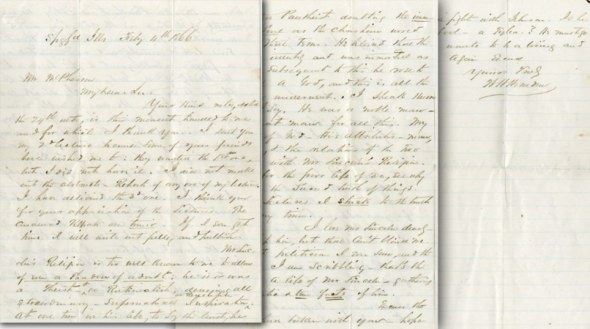
Long lost letter discusses Lincoln's religious beliefs
I missed this earlier in the week. From The Independent UK:
A three-page letter highlighting the 16th president’s unconventional relationship with the Almighty has just been put on sale. It offers a possible insight into why he was never baptised, did not attend a church and, in defiance of political protocol of the era, would refuse to publicly discuss his spiritual beliefs. Such was his reluctance to embrace piety that, if he were standing for office today, there is a good chance he would be unelectable.
In the letter, William Herndon, “a legal partner and close friend” of Lincoln’s before he was elected President, wrote:
he is, or was, a Theist and a Rationalist, denying all extraordinary, supernatural inspiration or revelation,” it reads, before detailing the president’s spiritual evolution in the years after Herndon met him in Springfield, Illinois, in the 1840s.
“At one time in his life, to say the least, he was an elevated Pantheist, doubting the immortality of the soul as the Christian world understands that term. He believed that the soul lost its identity and was immortal as a force. Subsequent to this, he rose to the belief of a God, and this is all the change he ever underwent. I speak knowing what I say. He was a noble man – a good great man for all this.”
I wonder if Michelle Bachmann knows about this?
CBS News 60 Minutes: “Three Cups of Tea” Author Fabricated Stories in Book
Posted: April 16, 2011 Filed under: Afghanistan, Foreign Affairs, Middle East, Pakistan | Tags: Afghanistan, CBS News 60 Minutes, charity, Fraud, Greg Mortensen, Jon Krakauer, Pakistan, philanthropy, Three Cups of Tea 17 Comments
According to an investigation by Steve Croft of CBS’ 60 Minutes, a number of stories in Greg Mortenson’s bestselling book may be false or exaggerated.
The heart of Mortenson’s “Three Cups of Tea” is the story of a failed attempt in 1993 to climb the world’s second-highest peak, K2.
On the way down, Mortenson says, he got lost and stumbled, alone and exhausted, into a remote mountain village in Pakistan named Korphe.
According to the book’s narrative, the villagers cared for him and he promised to return to build a school there. In a remote village in Pakistan, “60 Minutes” found Mortenson’s porters on that failed expedition. They say Mortenson didn’t get lost and stumble into Korphe on his way down from K2. He visited the village a year later.
That’s what famous author and mountaineer Jon Krakauer, a former donor to Mortenson’s charity, says he found out, too. “It’s a beautiful story. And it’s a lie,” says Krakauer. “I have spoken to one of his [Mortenson’s] companions, a close friend, who hiked out from K2 with him and this companion said, ‘Greg never heard of Korphe until a year later,'” Krakauer tells Kroft.
Mortenson also claimed to have been kidnapped and held for eight days by the Taliban in Waziristan. In his new book, Stones into Schools, he included a photo of three of his supposed captors.
“60 Minutes” located three of the men in the photo, all of whom denied that they were Taliban and denied that they had kidnapped Mortenson. One the men in the photo is the research director of a respected think tank in Islamabad, Mansur Khan Mahsud.
He tells Steve Kroft that he and the others in the photo were Mortenson’s protectors, not his kidnappers. “We treated him as a guest and took care of him,” says Mahsud. “This is totally false and he is lying.”
Kroft also talked to Daniel Borochoff of the American Institute of Philanthropy, who says that Mortenson’s foundation, The Central Asia Institute, spends most of the donations to promote his books. Jon Krakauer told 60 Minutes that he stopped donating after he learned from a former member of the Central Asia Institute board that that Mortenson uses the Central Asia Institute “as his private ATM machine.”
Kroft says he visited schools in Pakistan and Afghanistan that Mortenson supposedly has built and funded. He found that “some of them were empty, built by somebody else, or simply didn’t exist at all. The principals of a number of schools said they had not received any money from CAI in years.” But Mortenson blamed a “disgruntled employee” for not paying teachers and didn’t respond to the other accusations.
Mortenson has ignored CBS’s requests for an interview, but he defended himself in his hometown newspaper, the Bozeman Daily Chronicle.
“I hope these allegations and attacks, the people doing these things, know this could be devastating for tens of thousands of girls, for the sake of Nielsen ratings and Emmys,” Mortenson told the Chronicle in a phone interview Friday.
“I stand by the information conveyed in my book,” he wrote in a statement, “and by the value of CAI’s work in empowering local communities to build and operate schools that have educated more than 60,000 students.”
In the statement, Mortenson implied that the central story of his book was falsified.
The book told how Mortenson got lost on a 1993 climb of K2, the world’s second highest peak, and then stumbled exhausted into the remote village of Korphe, was cared for by villagers, and promised to return and build a school.
“I stand by the story of ‘Three Cups of Tea,'” Mortenson said in a written statement, but added, “The time about our final days on K2 and ongoing journey to Korphe village and Skardu is a compressed version of events that took place in the fall of 1993….What was done was to simplify the sequence of events for the purposes of telling what was, at times, a complicated story.”
According to records examined by the paper, the CAI pays Mortenson $180,000 per year. In 2009, the charity took in $14 million, of which it spent “$4.6 million on travel, guest lectures and educating Americans about the plight of Pakistani and Afghan children.” It spent $3.6 million on “schools overseas.” Mortenson told the Daily News that “as of now,” he will be paying his own travel expenses.
I haven’t read Mortenson’s books, mainly because they always sounded a little too good to be true to me. A blogger at Discover Magazine, Razib Kahn, wrote something similar based on actual knowledge:
I’ve been a bit skeptical of the details of Greg Mortenson’s story in his book Three Cups of Tea for years. It seems be to so predicated on contemporary biases about the basic universal goodness of human nature. I hoped everything was true, but it seemed too good to be true. Other people who worked in Afghan NGOs tended to tell a more gritty and gray story, so either Mortenson was embellishing, or he had a special magic touch. Since I don’t believe in magic touches, I wondered as to the nature of embellishment.
Kahn still says he’s not going to judge until he learns more.
A quick Google search shows that Mortenson has spoken at numerous colleges and universities as well as high schools and middle schools around the country. If any of this is true, a lot of young people are going to be very disillusioned.
Saturday: The “smartest men” in DC vs. First Ladies
Posted: April 16, 2011 Filed under: morning reads 31 Comments
U.S. Secretary of State Hillary Rodham Clinton, right, is greeted by a South Korean government official Ahn Young-jip upon her arrival at Seoul military airport in Seongnam, South Korea, Saturday, April 16, 2011. (Photo: AP)
Morning, news junkies. As you probably know, the April 15th tax deadline is pushed back to April 18th this year because of Emancipation Day. My roundups are usually jampacked with headlines–it’s out of control, I know–but since it’s tax season and nobody needs any more homework, I’m going to cover a few headlines and then switch to some lighter stuff.
Newsy Reads
So I guess you’ve heard about the “Huntsman love letters“ that were leaked to the Daily Caller by now. Full text of Huntsman’s letters to Obama and Bill Clinton here. I haven’t checked out all the heads exploding on rightwinger blogs, and judging from the headlines piling up on memeorandum alone, I have no interest in doing so. As usual, the right wants to marginalize the one GOPer who I would consider voting for in 2012, which figures. What’s struck me more than anything else about these not-shocking-at-all letters is that Huntsman’s praise of Obama is exceedingly generic while his praise of Bill and Hillary Clinton is full of specifics and gives a sense of how completely engaged they both are in public service.
In other not-surprising news, Obama was caught on a mic at a fundraiser taking jabs at Paul Ryan and the GOP and now poor witto Republicans are complaining that their fee-fees have been hurt. Hard to feel sorry for them when they’re always so quick to criticize everyone else in the world for playing the victim. Anyhow, I caught a few seconds of Rove commenting on the Obama fundraiser comments as I was flipping through channels on Friday night–after he got done with his obligatory hagiography of Paul Ryan, Rove said Obama is probably just jealous of the attention Paul Ryan is getting. I had to laugh at that part.
What I want to know is after the Bittergate and Naftagate episodes from 2008, why is anyone surprised by anything Obama says to different audiences anyway? He’s a Nowhere Man trying to raise money from Democratic donors while chasing after right-leaning Independent voters. So publicly Obama hailed Ryan’s proposal as a serious one, and privately he told his donors that Ryan’s proposal is “not on the level.” All of it is just words to Obama.
In the midst of this, almost as if on cue, David Brooks bumbles away saying that “Obama and Ryan are the smartest, most admirable and most genial men in Washington” and laments over what a pity it is that Obama won’t ask Ryan over for lunch.
If Obama and Ryan are the best DC has to offer (I don’t think they are, but if they are…), then perhaps the great American experiment is already over.
On that note, I’m going to switch over to the fun stuff.
First Lady Reads
Lately I’ve been coming across items about “first ladies,” various and sundry. I’ve rounded them up to share with you. I hope you enjoy.
The (first) First Lady of Flight: Harriet Quimby… On this day in history (April 16) in 1912, America’s first licensed woman pilot, Harriet Quimby, became the first woman to fly across the English Channel. Click here to read the NYT article that ran on Quimby on April 17, 1912. To quote Ed. Y. Hall, aviation historian: “Harriet Quimby was flying 25 years before Amelia Earhart. She carried airmail as early as 1912.” Quimby’s achievement went largely unrecognized, but she continued to break ground in the few months she lived after, until July 1, 1912, when she became the first American woman to die in a plane crash in the US. (Julia Clark died two weeks earlier in a US crash, but she wasn’t American.) For more information, check out this fantastic post about Quimby: Pioneering Aviatrix Harriet Quimby flies into history from Michigan. There’s a nice youtube and neat pictures of Arcadia, Michigan, Quimby’s hometown.
First Lady of the World meets the First Lady of Television… See here. Eleanor and Lucy. My two favorites together. To quote from Carl Anthony’s post:
Within a decade of this meeting, both women would be accused of being Communists, the former for her social activism, the latter for once registering with the party to please her old grandpappy who did belong. In truth, neither of them was Red. Not one hair.
First Lady of the United States meets First Lady of American Cinema… Part 1 and Part 2. There are three pictures of Jackie O and Liz meeting (the only known photos), as well as a wonderful essay by Carl Anthony which reads like the True Hollywood Story of First Ladies, only better. Here’s an excerpt from Part 2:
The death of Onassis on March 15, 1975 and the divorce from Burton in June 26, 1974 (although Liz gave it a second try from October 10, 1975 to July and separated on February 23, 1976, finally divorcing five months later) began a process that helped the real Jackie and Liz to begin defining their lives on their own terms, regardless of the public narrative defined by what the former once called “the little cartoon that runs beneath one’s real life.” Treating them as proprietary commodities, the tabloids felt free to print the most outrageous claims to make their Liz-Jackie storylines sell, but strangely refrained from treading into sensitive areas of the real women’s lives which they themselves had used to craft the public images they wished to convey – and didn’t want contradicted.
First Lady Betty Ford turned 93 this month… One more link to Carl Anthony because he wrote a refreshing “Beyond Rehab” retrospective on Betty Ford’s legacy. Teaser:
The imagination correctly conjures 1974 with maternal pleasantness and welcoming comfort, tied up in a daisy yellow ribbon of straight talk as “The Year of Bettys.”
On February 18, 1974, spiffy Betty Furness began looking out for housewives as not just theToday Show’s consumer advocate but for NBC’s evening news as well, her smoky voice ratting out manufacturers of household goods for high costs and poor quality. On September 14, 1974, after five guest appearances a year before, veteran actress Betty White joined the television sitcom cast of The Mary Tyler Moore Show, appearing as the character Sue Ann Nivens, who hosted a show called “The Happy Homemaker,” dishing out frank-and-beans-on-a-budget as easily as sex advice.
And on August 9, 1974 Betty Ford became a White House wife, at ease before the press whether dispensing chicken hash recipes as evidence of her inflation-fighting meals, making the case for women’s reproductive rights, or pondering whether her kids might have tried pot or how they’d handle pre-marital sex like the nation’s Den Mother chatting over a backyard fence. On the face of it, she was traditional, her Episcopal faith a rock in times of difficulty, her love of husband unabashed and demonstrated in public. The first sign this was a First Lady like no other has been attributed to a reporter asking the startling question of how often she slept with the President and Mrs. Ford shrugging, “As often as possible.”
First Ladies of Rhythm and Jazz Appreciation Month (April)… The Smithsonian has an excellent theme for Jazz appreciation month this year– Women & Jazz: Transforming a Nation. Excerpt from the Smithsonian website:
Jazz Appreciation Month 2011 – the 10th Anniversary – examines the legacies of jazz women, and their advocates, who helped transform race, gender and social relations in the U.S. in the quest to build a more just and equitable nation. The International Sweethearts of Rhythm, founded in 1937 at the Piney Woods School in Mississippi, will be the focus of the JAM Launch, a museum display and special online and public programming offered by the National Museum of American History to highlight the unique legacy of the school that music built and their dynamic, women’s jazz band.
The International Sweethearts of Rhythm gained global recognition as the nation’s first, integrated, female big band. Founded in 1937 at the Piney Woods School, band members were students, 14-years old and older, who paid for their education by performing as a jazz band to help promote and sustain the financially struggling school. Traveling nationwide in a customized, tour bus named Big Bertha, the Sweethearts performed at churches, state fairs, dance and civic halls and later entertainment venues such as the Howard Theater and the Apollo, setting box office records.
The Sweethearts confronted dual biases of gender and race and excelled during a period in history when many Southern blacks lived in slavery without chains and women were second class citizens. The band performed in Battle of the Band competitions against bands led by Fletcher Henderson and Earl Fatha Hines, played the Jim Crow South with white band members who disguised themselves as minorities, and toured overseas for the USO during World War II, when integrated performances were taboo. Original band members had come from a school with a legacy of excellence and overcoming difficulties.
And, of course who can forget the First Lady of Song herself. Some fun Ella quotes from the end of this blog tribute:
“It isn’t where you came from, its where you’re going that counts.”- Ella Fitzgerald
“Ella’s amazing! My daughter says that every time she makes a mistake, it becomes a hit record.”
– Lucille Ball“The best way to start any musical evening is with this girl. It don’t get better than this.”
– Frank Sinatra
That’s it for me. What’s on your blogging list this Saturday?
[originally posted at Let Them Listen; crossposted at Taylor Marsh and Liberal Rapture]

 peej
peej Carissa
 bostonboomer
 dakinikat
 ecocatwoman
 mablue2
 Mama Lopez
 peggysue22
 quixote
 skydancingguestblogger
 Mona (aka Wonk the Vote)



 Sky Dancing
Recent Comments