
Finally Friday Reads: Think and Vote Local and Global
Posted: July 7, 2023 Filed under: 2024 presidential Campaign | Tags: All Politics is Local!!!, defunding public education, Plan Your Vote!, State level line item veto, women's reproductive rights 16 Comments Good Day, Sky Dancer!
There’s always been a debate within the belief communities that embrace karma concerning its application to a group of people, a nation-state, or perhaps, even a global community. I’ve always been on the side that embraces something akin to the psychological concept of gestalt. That is the idea that “an organized whole that is perceived as more than the sum of its parts.”
Sometimes, you have to make the parts matter.
While mainstream America was complacent and asleep, a group of radical right Republicans began scheming a way to shape the courts and state government bodies into entities where they could capture American Laws. It took a manic form in the 90s. Now, just as the states began sending lawsuits up to courts packed with their minions, it appears other states are using means to put their states back on track to normalcy and constitutional law.
You can see the struggles clearly if you watch the headlines from state to state. It’s clearest in the so-called culture war issues. Blue state governors and citizens are finding legal ways to bypass the Supreme Court by changing their state laws or using the tools they’ve already been given. This is driving the right-wingers crazy, so they are now looking for more Federal intervention to save their crusades.
Here are two examples where Governors from the Democratic Party are using their line-item veto creatively. The first to do this was Governor Gretchen Whitmer of Michigan in 2019.
“The Republican budgets were a complete mess, and today I used my executive powers to clean them up to protect Michiganders,” said Governor Whitmer. “The state’s budget is a reflection of our values, and make no mistake that public health and safety, access to health care, and protecting classroom spending is more important than handouts to lobbyists and vendors.”
The governor of Wisconsin brilliantly got the Republicans in the state to go along without knowing the final intention. This is from VOX. “How Wisconsin’s governor bested the GOP and secured education funding for 400 years.” This is reported by Li Zhou.
This week, Wisconsin’s Democratic Gov. Tony Evers made key changes to the state budget passed by the Republican-controlled legislature, slashing GOP tax cuts and guaranteeing education funding increases for the next 402 years. It was a staggering maneuver that follows years of battles between Evers and GOP lawmakers. And it’s one that highlights how a Democratic state leader can use singular executive powers to combat a legislature dominated by Republicans.
Evers pulled these changes off by leveraging a tool known as the line-item veto, a power granted to governors in 44 states, which allows them to veto parts of a budget bill instead of the entire measure. Wisconsin, in particular, gives governors “uniquely powerful” line-item veto authorities for appropriations bills that allow them to target “sentences, words or in some cases even a single character or digit,” according to WisContext’s Will Cushman.
Evers made full use of this power when changing a phrase that increased funding for the “2023–24 school year and the 2024–25 school year” to the “2023–2425” school years by vetoing parts of that sentence. On Wednesday, Evers signed the new $99 billion budget, which will span the next two years, into law.
 A similar move happened in Pennslyvania. This is from Spotlight Pennslyvania. “Pa. Gov. Shapiro says he will scrap school vouchers in end-run on Senate Republicans.” This time Democratic members of the state’s legislature tanked the deal. See what happens when we actually fight back?
Gov. Josh Shapiro says he plans to scrap his push for private school vouchers in Pennsylvania’s state budget in order to close a deal with the commonwealth’s divided legislature five days after the deadline.
The Democrat issued a statement Wednesday acknowledging that talks had deadlocked over a $100 million voucher program, which he had supported and which state Senate Republicans passed as part of their budget proposal last week. Pennsylvania House Democratic leaders oppose vouchers and had refused to act on the Senate’s bill.
Shapiro’s solution, he said, was to promise state House Democrats that if they pass the Senate’s budget, he will then line-item veto the vouchers from the $45.5 billion spending plan.
“Our Commonwealth should not be plunged into a painful, protracted budget impasse while our communities wait for the help and resources this commonsense budget will deliver,” Shapiro said in a statement.
See, elected officials from the Democratic Party can hold up a budget too.
 Catch this move by Arizona’s governor Katie Hobbs. This is from NPR via the AP. “Arizona governor approves over-the-counter contraceptive medications at pharmacies.” Aren’t you happy that Kari Lake got “a couple of bucks and a one-way ticket to Palookaville,” i.e., Maralardo?
Adults in Arizona can now obtain contraceptive medications over the counter at a pharmacy without a doctor’s prescription under a governor’s order announced Thursday.
Gov. Katie Hobbs said the rule will go into effect immediately. It applies to self-administered birth control such as hormonal and oral contraceptives, and patients 18 or older need only complete a screening and a blood pressure test.
“We are building an Arizona for everyone, which means ensuring people across the state have what they need to live a free and healthy life,” the Democratic governor said in a statement.
Over 20 states have statutes that let pharmacists dispense FDA-approved hormonal contraceptives without a prescription, according to a statement from the Arizona Department of Health Services.
Hobbs has used her executive powers in recent weeks to promote reproductive freedom. In June she issued a sweeping executive order effectively stripping prosecutors of their ability to pursue charges against anyone involved with a legally obtained abortion.
 Meanwhile, Ohio voters take matters into their own hands just like Kansas did last year. This is from the New York Times. “Ohio Moves Closer to Ballot Issue That Would Protect Abortion Rights. Supporters of protecting abortion in the state’s Constitution submitted enough signatures to get on the November ballot. But another vote in August could make it harder to win.” This is reported by Kate Zernike.
Ohio moved one step closer to becoming the next big test case in the nation’s fight over abortion, after supporters of a measure that would ask voters to establish a right to abortion in the state’s Constitution this week said they had filed more than enough signatures to put it on the ballot in November.
Ohioans United for Reproductive Rights said on Wednesday that it had collected roughly 710,000 signatures across all of the state’s 88 counties over the last 12 weeks. Under state law, the coalition needed 413,466 to qualify for the ballot. State election officials now have until July 25 to verify the signatures.
Supporters of abortion rights are turning to ballot measures in the aftermath of the ruling last year by the United States Supreme Court overturning Roe v. Wade, which for 50 years had guaranteed a right to abortion in the federal Constitution. They are betting on polls showing that public opinion increasingly supports some right to abortion, and opposes the bans and stricter laws that conservative state legislatures have enacted since the court’s decision.
Voters in six states, including conservative ones such as Kentucky and Kansas, voted to protect or establish a right to abortion in their constitutions in last year’s elections, and abortion rights advocates in about 10 other states are considering similar plans.
 Meanwhile, we have to remember that School Boards and the State Superintendent of Schools’ position is crucial. Checking down-ballot in your state is as important as voting for President. This is shameful. This is from Raw Story and was written by Mattew Chapman. “
Far-right Oklahoma State Superintendent Ryan Walters suggested at a public hearing in Norman that lessons about the infamous racial massacre that destroyed the most prosperous Black community in Oklahoma don’t have to mention race, reported Fox 25 News.
“The Cleveland County Republican Party invited him to speak at the Norman Central Library. The room was packed with many unhappy Oklahomans, making for an hour of chaos,” reported David Chasanov.
“It doesn’t matter how much the radical left attacks me,” Walters told the crowd. ‘It doesn’t matter how much the teachers union spends against me. I will never stop speaking truth.”
However, things got tricky for Walters when someone asked him if teaching about the infamous “Black Wall Street” massacre in the city of Tulsa would be banned under his restrictions on teaching “Critical Race Theory.”
“Let’s not tie it to the skin color and say that the skin color determined that,” Walters replied.
The Tulsa massacre was an act of racial mass terrorism in 1921 that destroyed the Greenwood District of Tulsa, a nationally-renowned prosperous community nicknamed “Black Wall Street.” After a 19-year-old Black shoeshiner named Dick Rowland was arrested on trumped-up charges for allegedly assaulting a white elevator operator named Sarah Page, white residents of Tulsa rioted, looting and burning down the Greenwood District. Roughly 300 people were killed, and when the National Guard was sent in, the Black residents were arrested by the thousands.
 Meanwhile, down here in Lousyana, our Democratic Governor John Bel Edwards put his personal religion above the health of women. My tax dollars will support pregnancy propaganda centers. This is from the Louisiana Illuminator and was reported by Julie O’Donohue. “Tax credit approved for donors to Louisiana anti-abortion centers.” I’d like to challenge this one as going against many of our religious views. Wonder if the ACLU is up to it?
“Gov. John Bel Edwards signed a new tax credit for donors to anti-abortion crisis pregnancy centers into law last week – about a year after Louisiana put a near-total ban on abortion in place.
Donors to the organizations, which have been renamed maternal wellness centers in the state law, will be able to benefit from $30 million worth of income tax breaks that will be issued from 2025 through 2030.
A donor will be able to claim an income tax credit equal to 50% of their contribution to a center or 50% of their total state income tax liability in the year the contribution was made, whichever is lower.
The total amount of tax credits that can be given out will be generally limited to $5 million per year, except that credits from years where the $5 million maximum is not reached can be rolled forward and made available in subsequent years.
If the $5 million is maxed out early in a given year, then donors who weren’t able to receive a credit that year are put to the front of the line for getting the tax break in the following year. No one center is allowed to benefit from more than 20% of the tax credits made available, according to the law.
Anti-abortion groups pushed for the law sponsored by Senate President Pro Tempore Beth Mizell, R-Franklinton.
“It is critical for the pro-life movement to find every avenue to support Louisiana mothers, whether that be through private or public resources,” said Ben Clapper, executive director of Louisiana Right to Life, one of the state’s large anti-abortion advocacy organizations.
“We believe this important law permitting Louisiana citizens to receive a tax credit when they donate to a maternal wellness center will strengthen resources for families,” he said.”
Mizell, in hearings during the legislative session, said she thought the centers could help improve women’s health in Louisiana.
Here’s the deception. This will undoubtedly include child trafficking (i.e., coerced letting babies go up for adoption).
Donors to the organizations, which have been renamed maternal wellness centers in the state law, will be able to benefit from $30 million worth of income tax breaks that will be issued from 2025 through 2030…
 Everyone is waiting to see if it is possible for the AG of Colorado to take on the Supreme Court in that Fake Wedding Planner Case. Neal Katyal suggested it was possible. Other Legal Scholars do not think it is possible. This is from Salon. “Legal scholars: SCOTUS can’t be forced to reconsider “made-up” case — but lawyers can be punished. Professors push back on ex-solicitor general’s claim that SCOTUS can be compelled to reexamine 303 Creative cases”
But legal scholars pushed back on Katyal’s argument.
“I think this is a nonstarter,” former U.S. Attorney Barb McQuade, a University of Michigan law professor, told Salon. “The Court glossed over standing in this case because a plaintiff is permitted to make a facial challenge to a law on the ground that yet violates the First Amendment.”
“If the allegations about fabrication are true, then the lawyers may have an ethics problem to address with their state bar, but it will not affect the outcome of the case,” McQuade added.
Leah Litman, a law professor at the University of Michigan, told Salon that parties are “free to file a motion for reconsideration or rehearing,” but ultimately, it will be up to the court to decide whether to do anything about it.
“Attorneys are subject to judicial discipline & discipline from bar organizations if they lie to the court,” Litman said.
Longtime Harvard Constitutional scholar Laurence Tribe told Salon that Katyal “certainly knows that no state attorney general has any such authority,” adding that he doesn’t take Katyal literally when he suggests that.
“But it would be a mistake to let that obscure the central fact that the entire case was based on entirely hypothetical ‘worries’ that the web designer claimed to have about how the state’s officers might come after her under the state anti-discrimination laws if a same-sex couple were to ask her to design a wedding site for them and if she were to refuse,” Tribe said. “In my view, the disgraceful fact, which in no way depends on the falsity of the allegations about the fellow who supposedly asked Lorie Smith to design a website for a same-sex wedding, is the very fact that the Supreme Court’s majority was willing to render what amounted to an advisory opinion that it would never have done but for its eagerness to denigrate same-sex marriage and LGBTQ rights generally and that, under Article III, it had no business doing.”
There are 486 days to the next President Election. Be sure to check your state’s primaries, and carefully choose all the candidates from POTUS to your dog catcher. It can make a difference.
What’s on your reading and blogging list today?
Monday Reads: lt’s getting ugly out there in Twitterland
Posted: May 9, 2022 Filed under: just because | Tags: women's reproductive rights 27 Comments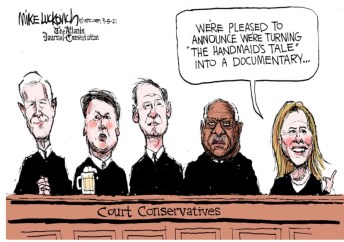 Good Day Sky Dancers!
We always knew there was a theocratic cabal out there. It’s been sneaking around since Ronald Reagan invited the Dominionists into the Republican party. The Religious Right got its mojo when they found out they could no longer get taxpayers to subsidize their Christian forms of Madrassas and ignore laws ordering integration. Here’s a little trip through history. “The Real Origins of the Religious Right. They’ll tell you it was abortion. Sorry, the historical record’s clear: It was segregation. ” They just needed a good sideshow to stir up some good old righteous hellfire without coming off as the good KKK types they were. Segregation was becoming increasingly unpopular even in the south. They found a new target and totally changed their theology to abuse their power.
Some of these anti- Roe crusaders even went so far as to call themselves “new abolitionists,” invoking their antebellum predecessors who had fought to eradicate slavery.
But the abortion myth quickly collapses under historical scrutiny. In fact, it wasn’t until 1979—a full six years after Roe—that evangelical leaders, at the behest of conservative activist Paul Weyrich, seized on abortion not for moral reasons, but as a rallying-cry to deny President Jimmy Carter a second term. Why? Because the anti-abortion crusade was more palatable than the religious right’s real motive: protecting segregated schools. So much for the new abolitionism.
 These mean and quite rude zealots are now at the center of what may domino into taking away the rights of GLBT and also, those laws that passed in the 1960s during the civil rights era that ended Jim Crow and the many blocks to full citizenship experienced by Black Americans. Many state governors are already testing the waters to chip away at the now gaping hole in the idea of the right to privacy.
Today, evangelicals make up the backbone of the pro-life movement, but it hasn’t always been so. Both before and for several years after Roe, evangelicals were overwhelmingly indifferent to the subject, which they considered a “Catholic issue.” In 1968, for instance, a symposium sponsored by the Christian Medical Society and Christianity Today, the flagship magazine of evangelicalism, refused to characterize abortion as sinful, citing “individual health, family welfare, and social responsibility” as justifications for ending a pregnancy. In 1971, delegates to the Southern Baptist Convention in St. Louis, Missouri, passed a resolution encouraging “Southern Baptists to work for legislation that will allow the possibility of abortion under such conditions as rape, incest, clear evidence of severe fetal deformity, and carefully ascertained evidence of the likelihood of damage to the emotional, mental, and physical health of the mother.” The convention, hardly a redoubt of liberal values, reaffirmed that position in 1974, one year after Roe, and again in 1976.
When the Roe decision was handed down, W. A. Criswell, the Southern Baptist Convention’s former president and pastor of First Baptist Church in Dallas, Texas—also one of the most famous fundamentalists of the 20th century—was pleased: “I have always felt that it was only after a child was born and had a life separate from its mother that it became an individual person,” he said, “and it has always, therefore, seemed to me that what is best for the mother and for the future should be allowed.”
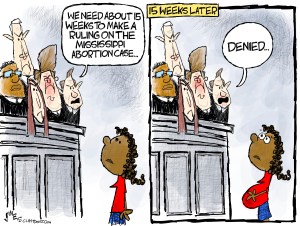 So, chipping away at birth control has started in Mississippi. “Miss. governor doesn’t rule out banning contraception if Roe falls.”
Mississippi Gov. Tate Reeves (R) on Sunday refused to rule out the possibility that his state would ban certain forms of contraception, sidestepping questions about what would happen next if Roe v. Wade is
On CNN’s “State of the Union,” Reeves confirmed that, if the Supreme Court overturns Roe v. Wade, a trigger law passed in Mississippi in 2007 would go into effect that essentially outlaws abortions in the state, although it makes exceptions for rape and for the life of the mother.
When asked if Mississippi might next target the use of contraceptives such as the Plan B pill or intrauterine devices, Reeves demurred, saying that was not what the state was focused on “at this time.”
“My view is that the next phase of the pro-life movement is focusing on helping those moms that maybe have an unexpected and unwanted pregnancy,” Reeves said. “And while I’m sure there will be conversations around America regarding [contraceptives], it’s not something that we have spent a lot of time focused on.”
In other words, bring on the baby mills for healthy white babies and send the rest wherever! Tennesse’s Governor is up to the same Shenanigans!
BB sent me this thread that really states the deep shit our democracy has been buried under. Can we yet rise from the tyranny of a fanatical minority? Happy the decade of killing all mothers! Already I’ve reported people shrieking about baby killers and abortions after birth on Twitter! They deserve no quarter from us.
And there is more to this thread. Go read and realize we are at the end of our country as we have known it. We have a takeover just like the Taliban have taken over Afghanistan again because Donald Trump handed it to them. Just like he tried to hand Ukraine to Russia. He and Mitch McConnell have handed us over to “Charismatic Catholics’ that off-beat brand that 5 justices subscribe to and the leftovers of the so-called Moral Majority. We’re under the sway of theocratic rule and they’ll take it all the way back to where they will use public funds for segregated Christian academies that serve the same purpose that Madrasas serve in Afghanistan.
So, if anyone tells you it’s impolite for neighbors to protest in their streets near Brent Kavanaugh’s house. Tell them he must’ve been drunk and wearing something that made him deserve it. Fuck off. We still have our first Amendment rights and this court overruled a politeness buffer in 2013/4. These people deserve as much respect as the forced birth crowd gave every women’s clinic.
Resist!
And get your butt on it now Biden! No more Mister Middle of the Road Nice Guy!
Thursday Reads: SCOTUS=American Taliban
Posted: September 2, 2021 Filed under: abortion rights, just because, morning reads, SCOTUS | Tags: abortion, American Taliban, Roe v. Wade, US Supreme Court, women's bodily autonomy, women's reproductive rights 24 Comments
American Taliban
Good Day, Sky Dancers.
As far as I’m concerned, the most important story today is that the corrupt U.S. Supreme Court is signaling the approaching death of reproductive rights for American women. I was so angry that I couldn’t sleep last night, and I’m not thinking too clearly this morning. As I’m sure you know, the Court allowed the insane Texas abortion ban to take effect around midnight on Tuesday, without explanation or comment. Late Wednesday night, the court released the justices’ opinions. The New York Times summarized all of them: Supreme Court, Breaking Silence, Won’t Block Texas Abortion Law.
The vote was 5 to 4, with Chief Justice John G. Roberts Jr. joining the court’s three liberal members in dissent.
The majority opinion was unsigned and consisted of a single long paragraph. It said the abortion providers who had challenged the law in an emergency application to the court had not made their case in the face of “complex and novel” procedural questions. The majority stressed that it was not ruling on the constitutionality of the Texas law and did not mean to limit “procedurally proper challenges” to it.
But the ruling was certain to fuel the hopes of abortion opponents and fears of abortion rights advocates as the court takes up a separate case in its new term this fall to decide whether Roe v. Wade, the landmark 1973 decision establishing a constitutional right to the procedure, should be overruled. It also left Texas abortion providers turning away patients as they scrambled to comply with the law, which prohibits abortions after roughly six weeks.
The “conservatives” were too cowardly to explain their votes, but the other four justices filed dissenting opinions
“The court’s order is stunning,” Justice Sonia Sotomayor wrote in her dissent. “Presented with an application to enjoin a flagrantly unconstitutional law engineered to prohibit women from exercising their constitutional rights and evade judicial scrutiny, a majority of justices have opted to bury their heads in the sand.”
“The court has rewarded the state’s effort to delay federal review of a plainly unconstitutional statute, enacted in disregard of the court’s precedents, through procedural entanglements of the state’s own creation,” Justice Sotomayor wrote. “The court should not be so content to ignore its constitutional obligations to protect not only the rights of women, but also the sanctity of its precedents and of the rule of law.”
Chief Justice Roberts wrote that he would have blocked the law while appeals moved forward.
“The statutory scheme before the court is not only unusual, but unprecedented,” he wrote. “The legislature has imposed a prohibition on abortions after roughly six weeks, and then essentially delegated enforcement of that prohibition to the populace at large. The desired consequence appears to be to insulate the state from responsibility for implementing and enforcing the regulatory regime.”
The chief justice underscored the tentative nature of the majority’s ruling. “Although the court denies the applicants’ request for emergency relief today,” he wrote, “the court’s order is emphatic in making clear that it cannot be understood as sustaining the constitutionality of the law at issue.”
Justice Elena Kagan criticized the court’s practice of deciding important issues in rushed decisions without full briefing or oral argument — on what Supreme Court specialists call its “shadow docket.”
“Today’s ruling illustrates just how far the court’s ‘shadow-docket’ decisions may depart from the usual principles of appellate process,” she wrote. “That ruling, as everyone must agree, is of great consequence.”
“Yet the majority has acted without any guidance from the court of appeals — which is right now considering the same issues,” she wrote. “It has reviewed only the most cursory party submissions, and then only hastily. And it barely bothers to explain its conclusion — that a challenge to an obviously unconstitutional abortion regulation backed by a wholly unprecedented enforcement scheme is unlikely to prevail.”
“In all these ways,” Justice Kagan wrote, “the majority’s decision is emblematic of too much of this court’s shadow-docket decision making — which every day becomes more unreasoned, inconsistent and impossible to defend.”
“Today’s ruling illustrates just how far the court’s ‘shadow-docket’ decisions may depart from the usual principles of appellate process,” she wrote. “That ruling, as everyone must agree, is of great consequence.”
“Yet the majority has acted without any guidance from the court of appeals — which is right now considering the same issues,” she wrote. “It has reviewed only the most cursory party submissions, and then only hastily. And it barely bothers to explain its conclusion — that a challenge to an obviously unconstitutional abortion regulation backed by a wholly unprecedented enforcement scheme is unlikely to prevail.”
“In all these ways,” Justice Kagan wrote, “the majority’s decision is emblematic of too much of this court’s shadow-docket decision making — which every day becomes more unreasoned, inconsistent and impossible to defend.”
 Justices Breyer and Kagan joined Roberts’ dissent, and Breyer also wrote his own dissent. Zoe Tillman at Buzzfeed News:
Breyer — who has spent the past year fending off calls from the left to step aside and let President Joe Biden appoint a successor while he has a Democratic majority in the Senate — wrote that it was true that the lawsuit raised difficult threshold questions about how this type of case could be handled by the courts. But he wrote that there had to be a way for courts to deal with an imminent violation of a party’s legal rights.
“There may be other not-very-new procedural bottles that can also adequately hold what is, in essence, very old and very important legal wine: The ability to ask the Judiciary to protect an individual from the invasion of a constitutional right — an invasion that threatens immediate and serious injury,” Breyer wrote.
Amber Phillips at The Washington Post: What to know about the Texas abortion law.
The law, which was passed in May and went into effect Wednesday, says that any pregnancy in which a heartbeat is detected cannot be aborted. That effectively means if you’re six weeks pregnant, you cannot have an abortion in the state of Texas, because that is around when most fetal cardiac activity can be detected. (Doctors opposed to this legislation say that is misleading language, and that the fluttering detected isn’t always necessarily a heartbeat so early in a pregnancy.)
The law makes no exceptions for rape, sexual abuse or incest.
The law does something else novel: It effectively incentivizes the public to police abortions. It allows people — anyone living in the state of Texas — to sue an abortion provider or anyone else they suspect is “aiding and abetting” abortions after that six-week mark. And the law sets a $10,000 award for any successful lawsuit to stop an abortion.
Taken together, those decisions allowed Texas lawmakers to essentially end abortions in their state, abortion rights activists say.
 On the SCOTUS decision:
The court announced that a five-person conservative majority had decided to let the ban stand. The court’s most conservative justices, including the three President Donald Trump nominated, such as Amy Coney Barrett, decided to let the law stand. In a one-paragraph statement, these justices said there are “serious questions regarding the constitutionality of the Texas law,” but indicated that the way the law was set up, the court is unsure how to stop if from going into effect.
The three liberal justices, joined by Chief Justice John G. Roberts Jr., dissented. Roberts said he would stop the law from going into effect because it is so novel and far-reaching.
The justices didn’t say anything about whether the statute is constitutional. They just said it will stay in place while that question is litigated.
That was an unexpected move that could signal the court is ready to strike down Supreme Court precedent created nearly 50 years ago in Roe v. Wade that guarantees a woman access to abortion services in the first half of her pregnancy before the fetus would be viable outside the womb,said Lisa Soronen, executive director of the State and Local Legal Center, which supports municipalities in cases before the Supreme Court.
“The justices know that this Texas law violates Roe v. Wade. They all know that,” she said. To keep the law in place, “that still doesn’t overturn Roe v. Wade, it just makes a really big statement about what they think of it.”
Phillips notes that other Republican-controlled states are likely to quickly pass similar laws effectively banning abortion. Read about it at the WaPo link.
Joan Biscupic at CNN: In the shadows: Why the Supreme Court’s lack of transparency may cost it in the long run.
Supreme Court justices tout judicial integrity and the importance of public confidence in their decisions, but the court’s midnight silence Tuesday while letting a Texas law that curtails abortion rights take effect — followed by a midnight order Wednesday — offers the latest and most compelling example of its lack of transparency and the cost.
The justices’ secretive patterns have gained new attention as confidence in all government institutions has waned. Witnesses before a bipartisan commission set up by President Joe Biden to consider court revisions — most visibly, the options of term limits and the addition of more seats — have targeted the justices’ secrecy and how it contributes to public distrust of the high court, along with the lopsided advantage the court gives to some litigants.
Such lack of transparency is only part of the context behind the Supreme Court’s silence in the closely watched Texas case. The emboldened conservative majority already is poised to reverse or at least undercut Roe v. Wade, the 1973 landmark ruling that declared women’s constitutional right to end a pregnancy. The court announced last spring that it would take up in the 2021-22 session a dispute over Mississippi’s ban on abortions after 15 weeks. The Texas law goes much further, making it illegal to terminate a pregnancy when a fetal heartbeat is detected, which may be typically around six weeks.
Both laws sharply conflict with Roe v. Wade, which forbade states from interfering with a woman’s abortion decision before the fetus would be viable, that is, able to live outside the womb, at about 22-24 weeks.
The justices have made plain their concerns regarding public mistrust and misunderstanding of the Supreme Court. Chief Justice John Roberts regularly declares that judges differ from elected lawmakers, and Justice Stephen Breyer protested in a speech at Harvard last spring that they should not be regarded as “junior-varsity politicians.” Breyer cited the court’s long-standing preservation of abortion rights as evidence of its nonpartisan, nonideological character.
Separately last spring, Justices Sonia Sotomayor and Neil Gorsuch emphasized in a joint appearance, advocating civics education, the deep reasoning that underlies their opinions. They criticized those who would look only for a bottom-line judgment.
Yet no judgment — or word of any sort — came late Tuesday night, with the clock ticking, anxiety rising among both sides in Texas and a national audience watching.
Read the rest at CNN.
More opinions:
Gail Collins at The New York Times: Texas Is Trying to Overturn Roe v. Wade All by Itself.
Mark Joseph Stern at Slate: The Supreme Court Overturned Roe v. Wade in the Most Cowardly Manner Imaginable.
Dana Millbank at The Washington Post: Opinion: Texas shows us what post-democracy America would look like.
Michelle Goldberg at The New York Times: Republicans Are Giving Abortion Opponents Power Over the Rest of Us.
Any man who expresses “concerns” about women in Afghanistan needs to explain why they aren’t concerned about women in Texas and ultimately the entire U.S. Or they need to STFU!
Hang in there Sky Dancers!!
We Have Choice
Posted: February 8, 2012 Filed under: just because | Tags: contraception, Human Rights, pro choice, religion, women's reproductive rights 36 CommentsWe’ve watched the Republicans flail in all directions, trying to find a message, a mission, an issue to drive them to victory in November. It’s been tough going for the GOP with less than stellar candidates and the endless circus ride the public has witnessed. Now down to four ‘iffy’ wannabes, attention has focused on flaws, egos, missteps and gaffes. Uncle Newt appeals to the confederate South. Ron Paul is loved by the Ayn Rand aficionados. Reptilian Rick Santorum cheers and warms the cockles of the Religious Right. And Mitt Romney. Poor Mitt is loved by virtually no one.
So, I can only imagine the excitement with the new-but-old controversy boiling over birth control and reproductive freedom. The right to choose. It sticks in the craw of the Republican Party, even as the loudest voices scream about liberty and individual rights. This isn’t a question of abortion at this juncture. We’re talking about the basics: contraception, the freedom to choose how many children we have and when we have them. And privacy. A woman’s right to decide these things herself in the privacy of her own space, heart and mind, with or without a husband, with or without government or religious leaders telling her, demanding she turn one way or the other.
To listen to the likes of Newt Gingrich, Rick Santorum and the faux religious warriors, one might think that all religion, but particularly Christianity, has been put on the rack, whipped into humiliating submission or fed to the lions for the vile amusement of secular humanists.
Enough with the lying! Enough with the bully pulpit exhortations with the emphasis on ‘bully.’
Demanding equal access to healthcare, expecting reproductive freedom and sexual/gender equality is not a Satanic plot. It’s what reasonable  people do and think. We are not living in the Middle Ages [though I suspect many fundamentalists think of the era as ‘the good ole days]. If anyone doubts the politicization of women’s healthcare issues, please review the past week’s headlines, the unseemly expose of the Komen Foundation, more concerned about dissing Planned Parenthood than serving lower-income women with breast screenings. Or the manufactured outrage of the Catholic Church hierarchy and their mouthpieces, who [sputter, sputter] decry the Administration’s insistence on equitable healthcare service as a vicious attack on religious freedom.
Really? Twenty-eight states require organizations offering prescription insurance to cover contraception. Ninety-eight percent of Catholic women use birth control and many Catholic institutions offer the benefit to their employees.
Let’s review some recent statistics:
Two-thirds of Catholics, 65 percent, believe that clinics and hospitals that take taxpayer money should not be allowed to refuse procedures or medications based on religious beliefs. A similar number, 63 percent, also believe that health insurance, whether private or government-run, should cover contraception.
A strong majority (78 percent) of Catholic women prefer that their hospital offers emergency contraception for rape victims, while more than half (55 percent) want their hospital to provide it in broader circumstances.
Yet despite these numbers, the Church, the Religious Right and the heat-seeking Republican establishment are foaming at the mouth, waving mummified fists in righteous indignation.
Make no mistake. This is an old war. I wrote about the struggles and absolute determination of Margaret Sanger a few days ago. She fought these battles. The arguments were identical; the accusations the same. She fought the religious establishment, she fought the righteous, small-minded moralists 100 years ago. If anything this should be a wakeup call: the defense of reproductive rights, which are basic human rights, need to be taken seriously, day-in, day-out. Freedoms gained can quickly become freedoms lost. Gender equality, which is a matter of civil rights, should be supported with voices and votes pitched against the ugliness of bigotry and discrimination.
This is a power play wrapped in thin prayer and religious dogma. It’s a desperate attempt by traditional religion to regain ground lost to modernity, a world where the old stories and myths have lost their power, their ability to control by fear, a world in which human dignity applies to all our members, a world where the mysteries of the Universe and our place in it is far grander than our words and imaginations can conjure.

We have choice. We always have. It’s time to put away childish things and become accountable, rational adults if we’re ever to deal with the problems facing us. We can fearfully grasp the old ways, allow ourselves to be drawn into self-limiting dictums. We can argue how many angels dance on the head of a pin with religious fanatics and the politicians who love them.
Or we can say, ‘No!’ We have that choice.
Margaret Sanger: A Rebel With A Mighty Cause
Posted: February 6, 2012 Filed under: birth control, black women's reproductive health, children, Civil Liberties, education, Feminists, health, Hillary Clinton, Human Rights, just because, Planned Parenthood, PLUB Pro-Life-Until-Birth, Women's Rights | Tags: An American Rebel, Birth Control, contraception, Margaret Sanger, sex education, women's reproductive rights 11 CommentsA Book Review; Review of a Life
Two weeks ago, I had the pleasure of catching Jean Baker, history professor at Goucher College, featured on BookTV. Baker discussed her book ‘Margaret Sanger: A Life of Passion,’ but more importantly connected the dots between the Right Wing’s attack on Sanger and the Pro-Choice, Family Planning movement.
A couple years ago while Glenn Beck hurled his diatribes, chalk boarding his twisted worldview on an unsuspecting public, he took Margaret Sanger to task. Beck described Sanger as one of his ‘evil’ progressives, a woman dedicated to racism and the application of eugenics in America.
The attack startled me. Why Sanger? I knew she had spearheaded the whole idea of inexpensive, reliable contraception and that her family clinics and her own reputation had come under constant assault. Anything and everything having to do with sexual behavior was taboo when Sanger began her work in the early, heady days of the 20th century. I also knew that Hillary Clinton had specifically mentioned Sanger as a personal hero. At the time, I thought that was Beck’s aim—discredit Sanger, discredit Clinton.
Au contraire!
Though Hillary Clinton did, in fact, make it on the list of evil progressives [along with Teddy Roosevelt, Wilson, FDR, even Lindsey Graham and John McCain], the attack on Margaret Sanger had and continues to have far broader implications. This is particularly true in any discussion of birth control, abortion and/or family planning and in the midst of a concerted effort to push a fetal personhood amendment to the fore.
The recent dustup between the Komen Foundation and Planned Parenthood is a case in point. Women’s healthcare has become politicized. We as women are discussed in a myriad of parts—our uteruses, our vaginas, our breasts, our reproductive capabilities. Too often, our autonomy as full-fledged human beings, adults capable of thought and decision-making about our own destiny is dismissed, made secondary to the considerations of others. Sadly, today’s opposition to female self-determination is the same that Sanger faced throughout her lifetime: men, who were convinced they had the right to an opinion and the hierarchy of the Catholic Church and other religious institutions that felt and continue to feel perfectly justified to chime in, making moral declarations, complete with Biblical arguments and opinions.

Young 'Maggie'
Professor Baker claims [and makes a very good argument] that the attack on Sanger’s work is also directly related to the attacks now being waged—female autonomy, the ability for women to direct their own reproductive lives. But Sanger had an especially hard road to travel, introducing her radical vision on the heels of the Victorian era.
Whatever’s old is new again!
While reading Baker’s new biography, I was startled by the similarity of the arguments, the pitfalls, the myriad of excuses to block any and all reasonable discussion when it comes to reproductive freedom. That being said, it’s hard to contemplate a time when the very discussion of or writing about birth control was considered perverse, pornographic and could end in jail time. Such was the case in the early 20th century.
Sanger’s efforts were so reviled by the status quo and Catholic Church that she was forced to leave the country for a brief stay in the UK or face arrest. She faced continuous harassment and was eventually arrested for her public, relentless stands. But ironically, this woman who had a spotty formal education, no training in public speaking would become by age fifty, one of the most influential women in the world.
Why? Because she would not stop. Because she was totally gripped by a single, burning idea–women were entitled to information [sexual or otherwise] and had a right to be empowered when it came to their own bodies.
Her background was fertile for dissent, her family a template for radical reaction. Born Margaret [Maggie] Higgins in 1879 in Corning, NY., she was the sixth child of 11 surviving children. Her mother, a devout Catholic, died at the age of 48, suffering with tuberculosis, the scourge of the 19th and early 20th centuries.
But here’s a factoid that Sanger’s critics rarely mention: her mother had eighteen pregnancies during her short life.
Eighteen!
Sanger’s father, a stone carver who royally ticked off the Church with his firebrand criticisms of Rome’s dictates, found it difficult to provide for his huge, ever-growing family. The family was poor, shanty Irish poor, with too many mouths to feed and an increasingly sick mother, made all the worse by cramped, squalid surroundings.
Though her impossible dream had been medical school, Sanger went to New York City following her mother’s death. There she trained as a nurse and midwife and spent several years attending patients on the Lower East Side. The living conditions in the tenements were appalling—cramped, rat-infested, devoid of anything approaching basic hygiene. She watched scores of young immigrant women die of pregnancy-related complications and botched abortions [many self-performed]. And she listened to scores of these women beg attending physicians [when available], pleading for help to prevent back-to-back pregnancies, birthing more children than they were able to feed or care for. To no avail. From that experience, that massive wave of human suffering, the idea of birth control and family planning was born.
Sanger took the remedy upon herself. Because no one else dared.
A prolific self-taught writer, Sanger traveled across America and was invited around the world to speak to the issue of contraception, sex education and reproductive services. Her work became the basis for health clinics dedicated to the health and education of women. She was, in fact, the mother of Planned Parenthood.
Ahhhh. No wonder she’s on the enemies’ list.
So what are the arguments against Sanger? Read the rest of this entry »

 peej
peej Carissa
 bostonboomer
 dakinikat
 ecocatwoman
 mablue2
 Mama Lopez
 peggysue22
 quixote
 skydancingguestblogger
 Mona (aka Wonk the Vote)



 Sky Dancing
Recent Comments