
Lazy Caturday Reads
Posted: December 4, 2021 Filed under: Afternoon Reads, just because | Tags: COINTELPRO, Ethan Crumbley, Florida, Fred Hampton, guns, James and Jennifer Crumbley, Mark Clark, Ron DeSantis, Russia, school shootings, Ukraine, Vladimir Putin 39 Comments
By Vicky Mount
Good Afternoon!!
I’m getting a late start today. The news this week has been so awful; I feel really exhausted and drained of energy.
Using the computer has gotten more difficult for me as I’ve gotten older. I can’t believe I just turned 74. Reading on the computer really bothers my eyes now; fortunately I have a tablet with a large screen as well as a Kindle. I can still read things with those and my phone. I use computer glasses and have turned down the brightness on my laptop, but I still can’t stay on the computer for more than a couple of hours without getting eyestrain and a headache. That’s why I don’t comment as much as I used to.
I still love writing these posts. It helps me to deal with all the bad news by trying to organize it a bit in my mind. It also helps to be able to share the frustration with you guys. We have gone through so much together since 2008. It’s hard to believe all that has happened. Things are still really awful in our politics, but we have to hang in there and keep hope alive. What other choice do we have?
In Today’s News
Today is the anniversary of the murders of Fred Hampton and Mark Clark by the Chicago Police in 1969. The murders were part of J. Edgar Hoover’s FBI COINTELPRO program, which infiltrated and undermined social justice groups–civil rights, feminists, anti-war, you name it. Hampton and Clark were members of the Black Panther Party. This is from the Equal Justice Initiative calendar for December 4: Chicago Police Assassinate Black Panther Party Leaders Fred Hampton and Mark Clark in Pre-Dawn Raid.
Around 4:30 am on December 4, 1969, plainclothes officers from the Chicago Police Department armed with shotguns and machine guns kicked down the door of the Chicago apartment where several Black Panther Party members were staying and opened fire on them. Though the Party members were asleep at the time and posed no threat, the officers fired over 90 bullets into the apartment, killing Fred Hampton, 21, and Mark Clark, 22—two leaders of the Black Panther Party—and critically wounding four other Party members. Mr. Hampton had been asleep next to his fiancé, who was eight-months-pregnant when he was killed.
White Cat Golden Pears, Tatiana Gorshunova
Following Mr. Hampton and Mr. Clark’s assassinations on December 4, seven Panthers at the apartment that night, who had allegedly wounded two officers, were charged with attempted murder. In a statement released after the shooting, Edward Hanrahan, the Cook County state’s attorney who had ordered the violent raid, said: “The immediate, violent, criminal reaction of the occupants in shooting at announced police officers emphasizes the extreme viciousness of the Black Panther Party.”
Huey P. Newton and Bobby Seale formed the Black Panther Party for Self Defense in Oakland, California, in 1966. Spurning civil rights tactics of marches, sit-ins, and boycotts, the Black Panther Party was inspired by the self-determination philosophy of Malcolm X and the “Black Power” speeches of Kwame Ture (born Stokely Carmichael). The Party founded youth centers and free breakfast programs, organized legally-armed patrols to guard against police brutality in Black neighborhoods, and became popular among Black urban youth as chapters spread throughout the country. In the 1968-69 school year, the Black Panther Party fed as many as 20,000 children.
Despite their goals of community empowerment and self-help, the Party was condemned by President Lyndon B. Johnson and other national leaders. FBI Director J. Edgar Hoover called the group “the most dangerous threat to the internal security of the country” in the late 1960s. The FBI also launched an aggressive counter-intelligence program aimed at dismantling the Black Panther Party through misinformation, infiltration, and by facilitating violent attacks against the group.
Just four days after the Chicago shooting, on December 8, the Los Angeles Police Department (LAPD) violently raided the Black Panther Party’s headquarters in Los Angeles, California. In 1968, as urban riots were spreading across the country in response to police brutality, the Southern California Chapter of the Black Panther Party formed to help combat the growing threat. The Party established monitoring patrols in Black neighborhoods and worked to ensure police accountability.

Read more at the link. If you would like to know more about the Black Panther Party and their work, I highly recommend Bobby Seale’s autobiography Seize the Time: The Story of the Black Panther Party and Huey P. Newton. You can learn a bit more about Mark Clark from his sister at HBCU.org: 50 Years After His Death, Mark Clark’s Sister Shares His Story With Peoria And the World. Both these men were only in their early 20s when they were murdered.
The parents of Michigan school shooter Ethan Crumbley were located early this morning after they fled involuntary manslaughter charges, leaving their deeply troubled 15-year-old son to fend for himself. Detroit Free Press: James and Jennifer Crumbley caught, arrested after vehicle is found in Detroit.
James and Jennifer Crumbley, the parents of the teen charged in the Oxford High School shooting, were located and arrested early Saturday in Detroit after a citizen saw their vehicle and called police.
Girl with Cat, by Diane Ulmer Pedersen
“Yes, they are both in custody and will be on the way to the Oakland County Jail soon,” said Oakland County Undersheriff Mike McCabe. “Kudos to Detroit PD and all the other agencies that assisted.”
Police arrived at the scene, in the area of the 1100 block of Bellevue near E. Lafayette, about 10 p.m. or 10:30 p.m., Detroit Police Chief James White told reporters about 3 a.m. Saturday morning.
It’s believed the Crumbleys — facing charges of involuntary manslaughter connected to the Oxford High School mass shooting in which their son is accused — were let into a commercial building by someone, White said.
Police know who that someone is and those who aided the couple could face criminal charges, White said.
The Crumbleys were found hiding inside and were “distressed” White said. They were unarmed.
He said security video had helped officers by revealing one of the Crumbleys entering the building.
Authorities had been searching for the Crumbleys most of the day Friday after they were charged with four counts each of involuntary manslaughter in the shooting deaths at the high school in northern suburban Detroit. Their son, Ethan Crumbley, is charged with terrorism and first-degree murder in the case.
The Crumbley parents did not show for their arraignment Friday afternoon in Rochester Hills and the U.S. Marshals Service offered a reward for information leading to their arrests.

Of course they are Trump supporters. What kids have to go through in school these days is horrible. What kind of a country and world are we leaving them with? Republicans are ruining this country with their refusal to do anything about guns, the environment, and anything else that helps make life worth living.
Have you heard the latest from Florida Governor Ron DeSantis? He wants to start a state militia at taxpayers’ expense that would answer to him alone. Michael Daly at The Daily Beast: The Disgusting Reality Behind Ron DeSantis’ New ‘Army.’
As governor of Florida, Ron DeSantis is understandably big on gators.
He had a gator logo along with the words “Don’t Tread on Florida” stenciled onto a sign he unveiled in October when calling for a special session of the legislature to counter federal COVID-19 vaccine mandates.
And his office had that gator’s twin on another sign with the words “Let Us Alone” affixed to the podium at a national guard armory in Pensacola on Thursday. The staging was completed with a huge American flag and a dozen national guardsmen who stood at attention as DeSantis entered.
Unknown artist, 19th Century
“At ease,” he quietly told them.
The soldiers immediately obeyed, for they are under his command unless nationalized by presidential order. He was there to announce increased funding for the Florida National Guard.
But he also made known a plan to revive a state military unit whose uniforms will say FLORIDA rather than U.S. ARMY like those worn by the soldiers who stood at ease behind him as he now took to the podium. No matter what the president might want, the Florida State Guard will answer only to the governor—meaning DeSantis.
Call it Ron’s army.
“The Florida State Guard will act as a civilian volunteer force that will have the ability to assist the national guard in state-specific emergencies,” DeSantis said.

Like what? Beating up protesters? DeSantis has already signed a law that allows people to drive their cars into protests without punishment. A bit of history:
Back at the start of World War II, the federal government authorized the states to form military units to fill in for the National Guard, which had been incorporated into the U.S military to fight in Europe and the Pacific. The Florida Guard was formed in 1941. Its motto, “Let Us Alone,” invoked fealty to Florida, not to America, even though this was a time that called for national unity against a common enemy.
Those same three words had appeared on a flag that Florida’s first governor, William Moseley, flew at his inauguration in 1841. But, perhaps because Florida’s leading business people were actively engaged in trade with folks from beyond its borders, the state senate took exception to the words and never officially approved the flag.
The words reappeared on April 8, 1861, when members of the Florida militia took control of Fort Clinch in Fernandina Beach. That was four days before the Battle of Fort Sumter in South Carolina marked the start of the Civil War.
“Hurrah for Florida, Let Us Alone,” this banner read.
There’s much more at the link.

By Diane Ulmer Pedersen
Vladimir Putin has been busy. The Washington Post: Russia planning massive military offensive against Ukraine involving 175,000 troops, U.S. intelligence warns.

Tuesday Reads
Posted: October 5, 2021 Filed under: just because, morning reads | Tags: Debt Ceiling, Donald Trump, Fiona Hill, Joe Manchin, Kyrsten Sinema, Mitch McConnell, Russia, Vladimir Putin 25 CommentsGood Morning!!
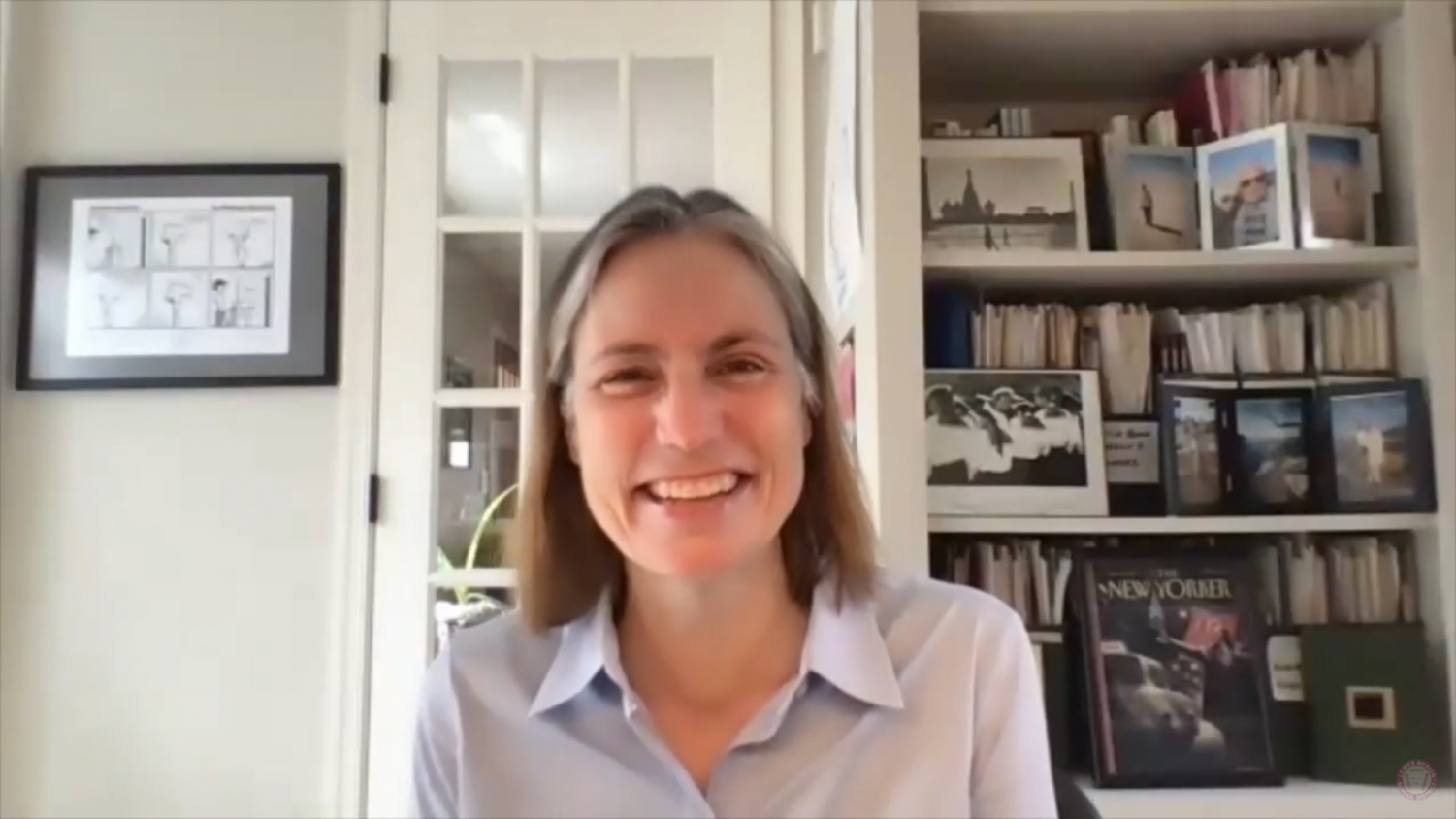
Fiona Hill
A new book about the Trump Administration was released today, and this one is likely to be much more serious than the many gossipy Trump books that have preceded it. This one is a memoir by Fiona Hill, who served in Trump’s White House as a Russia expert and then testified in the impeachment hearings.
Here’s the New York Times review by Jennifer Szalai: In a Memoir, the Impeachment Witness Fiona Hill Recounts Her Journey From ‘Blighted World’ to White House.
The arresting title of Fiona Hill’s new book, “There Is Nothing for You Here,” is what her father told her when she was growing up in Bishop Auckland, a decaying coal-mining town in North East England. He loved her, and so he insisted that she had to leave.
Hill took his advice to heart — studying Russian and history at St. Andrews in Scotland, sojourning in Moscow, getting a Ph.D. at Harvard and eventually serving in the administrations of three American presidents, most recently as President Trump’s top adviser on Russia and Europe. “I take great pride in the fact that I’m a nonpartisan foreign policy expert,” she said before the House in November 2019, when she delivered her plain-spoken testimony at the hearings for the (first) impeachment of President Trump. But for her, “nonpartisan” doesn’t mean she’s in thrall to bloodless, anodyne ideas totally disconnected from her personal experience. She wrote this book because she was “acutely aware,” she says, “of how my own early life laid the path for everything I did subsequently.”
Sure enough, “There Is Nothing for You Here: Finding Opportunity in the 21st Century” weaves together these two selves, slipping back and forth between the unsentimental memoir reflected in its melancholy title and the wonkish guide promised in its inspirational subtitle. The combination, however unlikely, mostly works — though by the end, the litany of policy prescriptions comes to sound a bit too much like a paper issued by the Brookings Institution, where Hill is currently a fellow. When recounting her life, Hill is a lucid writer, delivering her reminiscences in a vivid and wry style. As much as I wanted more of Hill the memoirist and less of Hill the expert, I began to sense that giving voice to both was the only way she could feel comfortable writing a book about herself.
Looked at from afar, Hill’s story seems like a triumphant tale of striving and accomplishment. Born in 1965, she grew up in a “blighted world.” Her father followed the men in his family into the mines when he was 14; as the industry started to collapse in the 1960s, he found a job as a hospital porter. Hill’s mother worked as a midwife. As late as the 1970s, Hill’s grandparents lived in a subsidized rowhouse without “mod cons,” or modern conveniences, including indoor plumbing. Her grandfather had been pierced by the “windy pick” — the pneumatic drill — and had to wear a brace around his pelvis “to keep his battered insides in” for the rest of his life.
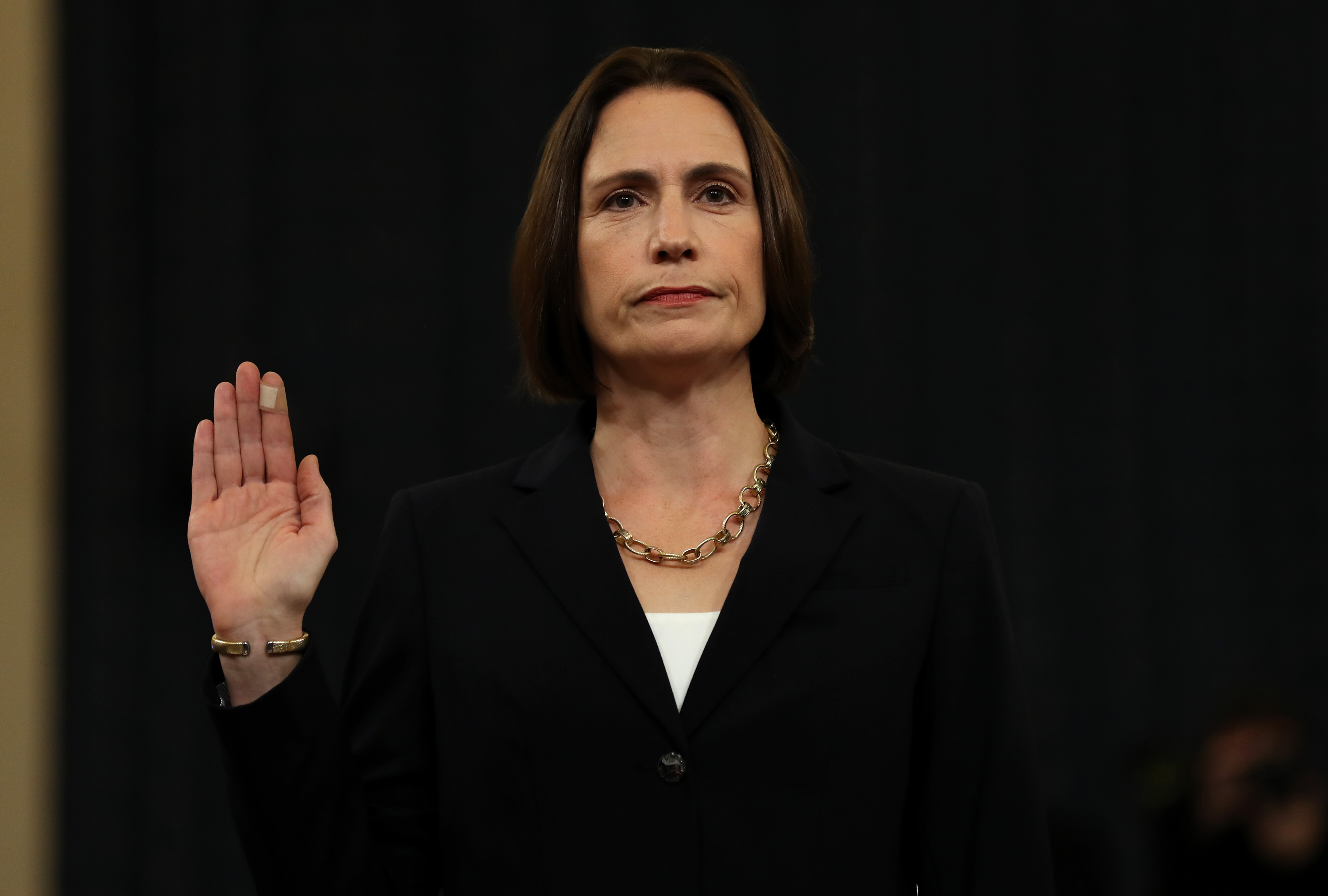
Fiona Hill is worn in at the House Intelligence Committee Open Impeachment Hearings.
Read more about Hill’s early life at the link. Here’s a bit about her experiences in the Trump White House.
Instead of making the usual insider-memoir move of fixating on all the brazenly outrageous behavior — the bizarre comments, the outlandish tweets — Hill notices his insecurities, the soft spots that, she says, made him “exquisitely vulnerable” to manipulation. Yes, she writes, the Kremlin meddled in the 2016 election — but unlike the #Resistance crowd, which insists that such meddling was decisive, Hill is more circumspect, pointing out that Vladimir Putin wasn’t the force that tore the country apart; he was simply exploiting fissures that were already there.
Just as concerning to her was the way that people around Trump would wreak havoc on one another by playing to his “fragile ego” — spreading rumors that their rivals in the administration had said something negative about Trump was often enough to land those rivals on what the president called his “nasty list.” Hill says that watching Trump fulminate made her feel like Alice in Wonderland watching the Queen of Hearts, with her constant shouts of “Off with their heads!” In Hill’s telling, Trump’s norm-breaking was so flagrant and incessant that she compares him, in her matter-of-fact way, to a flasher. “Trump revealed himself,” she writes, “and people just got used to it.”
But neither Trump nor Putin — who was the subject of one of Hill’s previous books — is what she really wants to talk about. What she sees happening in the United States worries her. Economic collapse, structural racism, unrelieved suffering: Even without Trump, she says, none of the country’s enormous problems will go away without enormous efforts to address them. Hill the expert points to heartening examples of benevolent capitalism at work. But Hill the memoirist knows in her bones that the neoliberal approach, left to its own devices, simply won’t do.
I cannot wait to read this book. More articles about it to check out:
Yahoo News: Trump’s fixation was on Putin himself rather than Russia, says fmr. WH adviser.
Raw Story: Trump’s former Russia expert has a message for voters if he runs in 2024
Financial Times: There Is Nothing for You Here by Fiona Hill — memoir from Trump White House.
Finally, Newsweek has an excerpt from the book: Donald Trump Called Fiona Hill ‘Darling,’ Thought She Was a Press Secretary.
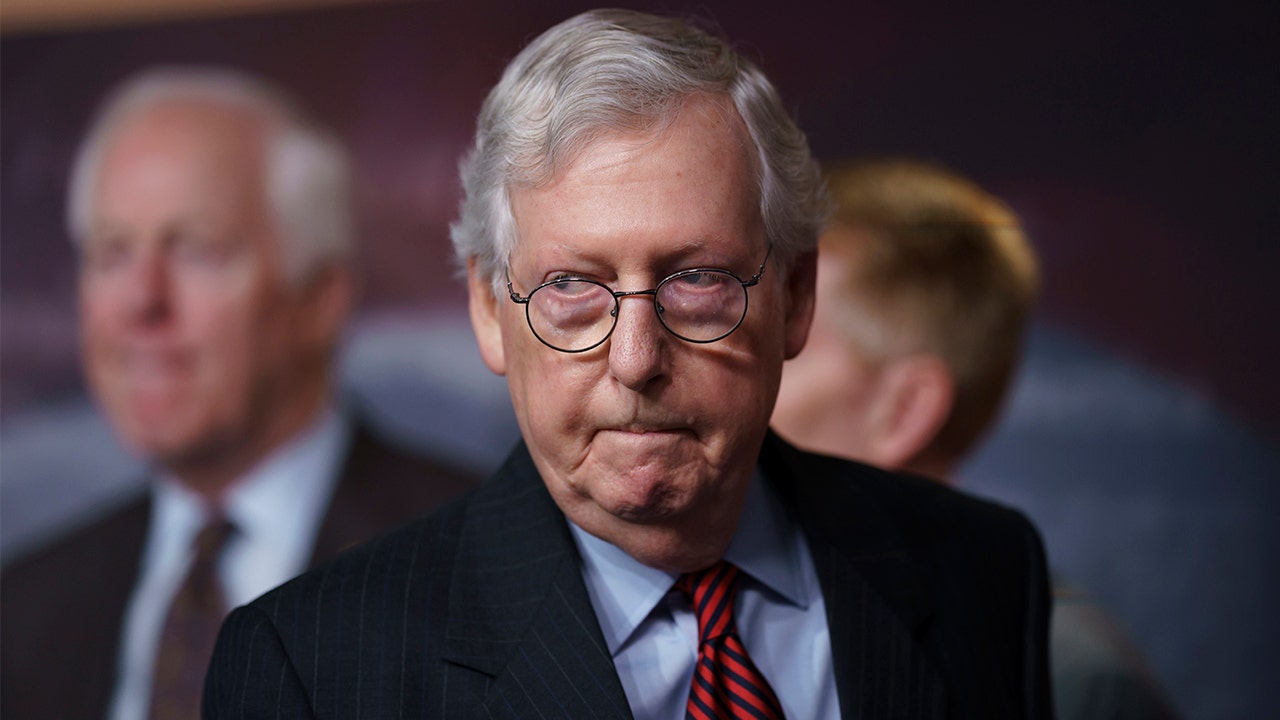 In other news, we’re still facing the possible default of the United States leading to a global financial crisis. Jonathan Weisman at The New York Times: As the U.S. Hurtles Toward a Debt Crisis, What Does McConnell Want?
In March 2006, as the government veered dangerously close to a default, Senator Mitch McConnell of Kentucky, the No. 2 Republican, let the Bush White House know he was two votes short of what he needed to raise the legal limit on federal borrowing.
Andrew H. Card Jr., then the White House chief of staff, began working the phones. He soon found two Democrats willing to break ranks and vote to put the legislation over the top. But Mr. McConnell was holding out for something else entirely, hoping to extract concessions from President George W. Bush as the price for uniting Republicans around lifting the limit.
“I don’t need your damned votes,” he snapped at Mr. Card. He lifted the debt ceiling with Republicans only.
Mr. Card never learned what the Senate leader wanted, but he tells the story for a reason: Mr. McConnell has long used the periodic need to raise the government’s borrowing limit as a moment of leverage to secure a policy win, as have leaders of both parties.
But two weeks before a potentially catastrophic default, Mr. McConnell has yet to reveal what he wants, telling President Biden in a letter on Monday, “We have no list of demands.”
Instead, he appears to want to sow political chaos for Democrats while insulating himself and other Republicans from an issue that has the potential to divide them.
Mr. McConnell has said the government must not be allowed to stop paying its debts; he has also said he will not let any Republicans vote to raise the limit, while moving repeatedly to block Democrats from doing so themselves. Instead, he has prescribed a path forward for Democrats: Use a complicated budget process known as reconciliation to maneuver around a Republican filibuster that he refuses to lift.
Asked what he wanted, that was his answer: “As I have said for two months, I want them do it through reconciliation.”
So what’s the problem then? Why don’t the Democrats just do it through reconciliation? Of course that is another problem, because Joe Manchin and Kirsten Sinema are standing in the way of the reconciliation bill. And what the hell do they want? A couple of reads on those two:
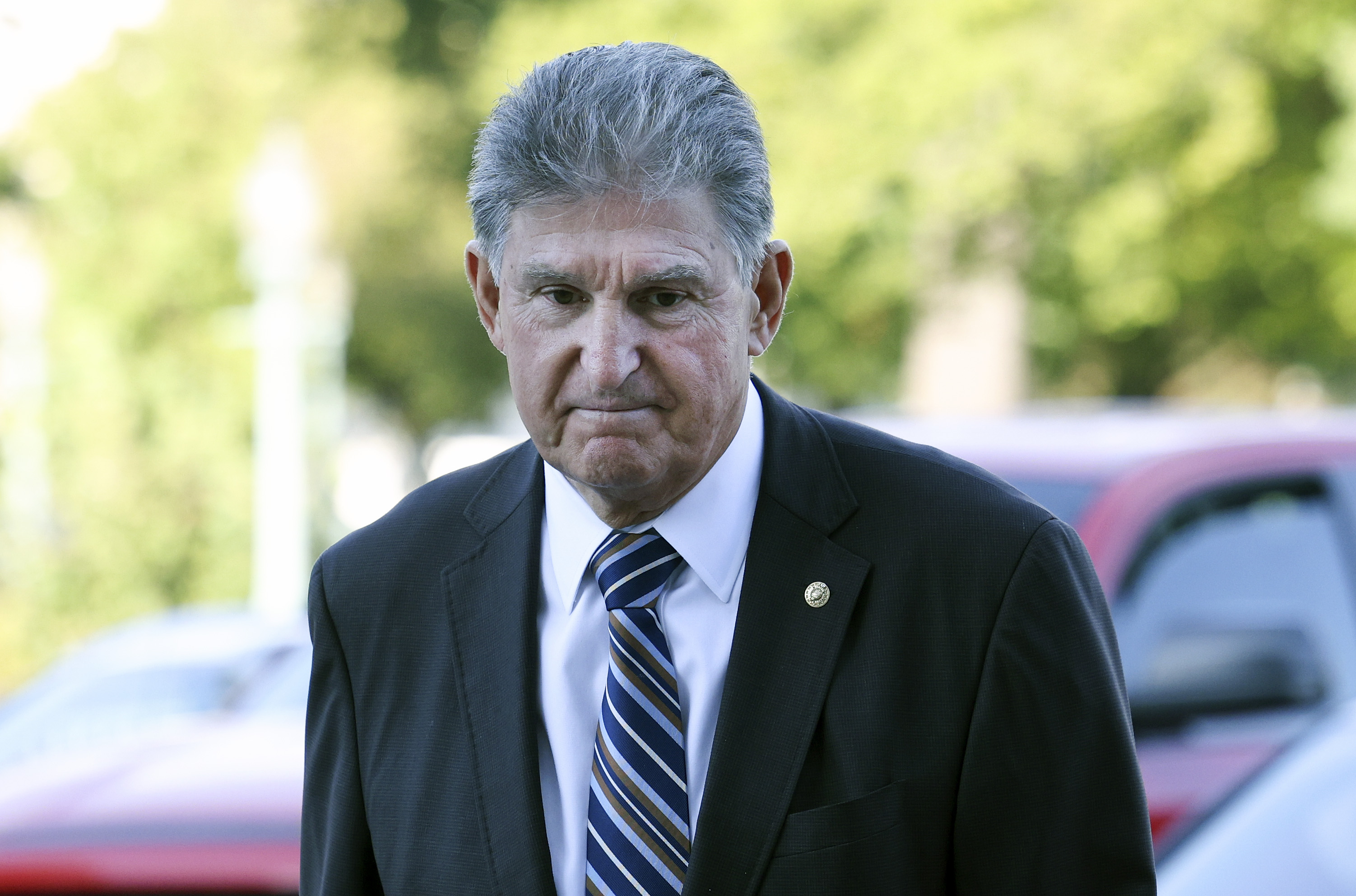 CNN: Manchin breaks with party leaders over strategy on debt ceiling and Biden’s economic package.
Democratic Sen. Joe Manchin on Monday pushed back on several politically sensitive positions his party leaders are taking at a crucial time for President Joe Biden’s domestic agenda.
The West Virginia Democrat, who holds a pivotal vote in the 50-50 Senate, indicated to CNN that he disagrees with the strategy top Democrats are pursuing in the standoff with Republicans over raising the national debt limit. Manchin said that Democrats “shouldn’t rule out anything,” including a budget process that Democratic leaders have made clear they will not employ.
Speaking to reporters, Manchin also would not commit to the new timeline set by party leaders to find a deal on the social safety net expansion by October 31. And he sounded resistant to calls from progressives and other top Democrats to raise his $1.5 trillion price tag for the package, which many in his party view as too low to achieve key policy objectives.
On Tuesday, however, Manchin did not rule out a $1.9 trillion to $2.2 trillion price tag for the social safety net package, a range Biden has floated privately. “I’m not ruling anything out,” Manchin said when asked by CNN if he would rule out that number.
In a stark warning sign to progressives, Manchin also indicated the package must include a prohibition against using federal funds for most abortions. “The Hyde Amendment is a red line,” he said. Manchin’s stance puts him at odds with progressives, with Congressional Progressive Caucus Chair Pramila Jayapal saying Sunday she would not support a package that included the Hyde Amendment.
Read more at the link.
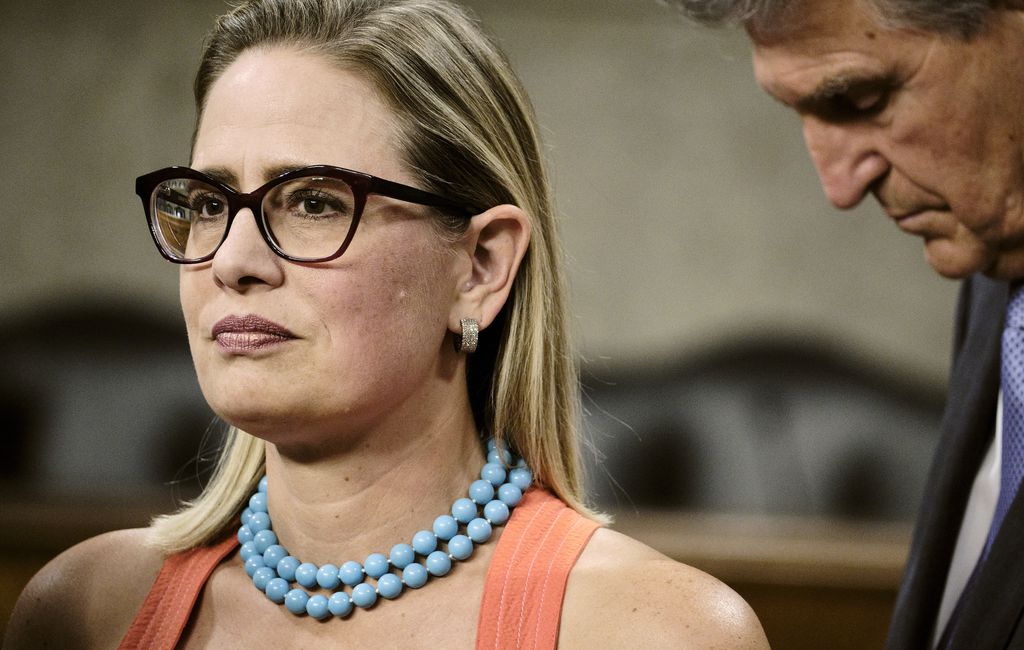 Michelle Goldberg at The New York Times: What’s Wrong With Kyrsten Sinema?
In 2003, Joe Lieberman, at the time one of the worst Democratic senators, traveled to Arizona to campaign for his party’s presidential nomination and was regularly greeted by antiwar demonstrators. “He’s a shame to Democrats,” said the organizer of a protest outside a Tucson hotel, a left-wing social worker named Kyrsten Sinema. “I don’t even know why he’s running. He seems to want to get Republicans voting for him — what kind of strategy is that?”
It was a good question, and one that many people would like to ask Sinema herself these days. People sometimes describe the Arizona senator as a centrist, but that seems the wrong term for someone who’s been working to derail some of the most broadly popular parts of Joe Biden’s agenda, corporate tax increases and reforms to lower prescription drug prices. Instead, she’s just acting as an obstructionist, seeming to bask in the approbation of Republicans who will probably never vote for her.
A “Saturday Night Live” skit this weekend captured her absurdist approach to negotiating the reconciliation bill that contains almost the entirety of Biden’s agenda. “What do I want from this bill?” asked the actress playing Sinema. “I’ll never tell.” It sometimes seems as if what Sinema wants is for people to sit around wondering what Sinema wants.
When Sinema ran for Senate, the former left-wing firebrand reportedly told her advisers that she hoped to be the next John McCain, an independent force willing to buck her own party. Voting against a $15 minimum wage this year, she gave a thumbs down — accompanied by an obnoxious little curtsy — that seemed meant to recall the gesture McCain made when he voted against repealing key measures of the Affordable Care Act in 2017.
But people admired McCain because they felt he embodied a consistent set of values, a straight-talking Captain America kind of patriotism. Despite his iconoclastic image, he was mostly a deeply conservative Republican; as CNN’s Harry Enten points out, on votes where the parties were split, he sided with his party about 90 percent of the time.
Sinema, by contrast, breaks with her fellow Democrats much more often. There hasn’t been a year since she entered Congress, Enten wrote, when she’s voted with her party more than 75 percent of the time. But what really makes her different from McCain is that nobody seems to know what she stands for.
Click the link to read more.
There’s lots more news out there. I’ll post more links in the comments. As always, this is an open thread.
Thursday Reads
Posted: June 17, 2021 Filed under: morning reads, U.S. Politics | Tags: Affordable Care Act, Donald Trump, Joe Biden, Joe Manchin, Juneteenth, SCOTUS, slavery, Vladimir Putin, voting rights bills 9 CommentsGood Morning!!

Tea break, by Sylvie Vanlerberghe
Yesterday President Biden wrapped up his European trip by meeting with Vladimir Putin. It was a very different spectacle than the one in 2018 in Helsinki when the former guy humiliated himself and our country by rolling over for the Russian president.
The New York Times: A tale of two summits: Trump at Helsinki, and Biden at Geneva.
Helsinki, Finland, was where President Donald J. Trump had his own first face-to-face meeting with the Russian president, and the moment was highly anticipated, given the investigations then taking place into Russian interference in the 2016 presidential election and its reported ties to Mr. Trump’s campaign.
The meeting offered the American president a ripe opportunity to denounce the Kremlin on a public stage. He did not.
Instead, standing by Mr. Putin’s side, Mr. Trump dismissed the conclusions by U.S. intelligence agencies about Russian meddling and said, in essence, that he believed the Russian president’s denials as much as he believed his own intelligence advisers.
“They said they think it’s Russia,” Mr. Trump said. “I have President Putin; he just said it’s not Russia.” For good measure, he said, “President Putin was extremely strong and powerful in his denial today.”
Trump met alone with Russian president for 2 hours, and we still don’t know what happened between the two men. In contrast, Biden was open about his meeting with Putin.
“Where we have differences,” he said just moments into the news conference, “I wanted President Putin to understand why I say what I say, and why I do what I do, and how we’ll respond to specific kinds of actions that harm America’s interests.”
Mr. Biden said, “I told President Putin my agenda is not against Russia or anyone else. It’s for the American people.”
The Japanese Mask (1884), painted by Gustave Claude Etienne Courtois
And he declared: “I also told him that no president of the United States could keep faith with the American people if they did not speak out to defend our democratic values, to stand up for the universal and fundamental freedoms that all men and women have in our view. That’s just part of the DNA of our country.”
To that end, he cited the jailing of the Russian opposition leader Aleksei A. Navalny, and the detentions of two Americans in Russia.
Mr. Biden also offered a warning on cyberattacks.
“I pointed out to him: We have significant cyber-capabilities — and he knows it,” the president said.

Edward Luce at The Financial Times: Biden politely reads riot act to Putin.
Summitry, contrary to a former British prime minister, is nothing like tennis. The outcome is rarely “game, set and match”. By the wide-eyed standards of Joe Biden’s last four predecessors, all of whom held ill-fated summits with Vladimir Putin, Biden went into this one with low expectations.
There were no illusions about his meeting of minds with the Russian leader, let alone souls. The modesty of Biden’s goal — to stabilise relations with America’s chief military adversary — conveyed a realism that eluded earlier presidents.
All of which is far less exciting for the world media. Biden did not praise Putin’s ability to restore Russian freedom and prosperity, as Bill Clinton did in 2000 shortly after Putin was elected president. Nor did he get a sense of Putin’s soul, as George W Bush claimed in 2001, and trust what he saw. He did not aim for an ambitious “reset” of US-Russia relations, as Barack Obama fatefully did in 2009. Most notoriously Biden’s tone was a million miles from the one-man admiration society Donald Trump brought to Helsinki when he met Putin alone in 2018.
After more than two decades in power, this Russian bear was unlikely to change its habits. Biden’s aim is to coax and cajole Putin into a moderately less dangerous stance. That goal is more difficult than it sounds. At home, Biden faces derision from Republican and some foreign policy specialists for even meeting Putin. The act of sharing a stage with America’s president is seen as an unearned reward for an adversary who sponsors regular cyber attacks on the US, not to mention waging information warfare on western democracy.
Read the rest at FT.

Woman with a book, Pablo Picasso
Max Boot at The Washington Post: Opinion: Biden wiped the smirk off Putin’s face.
Biden established an easy rapport with his fellow democratic leaders at meetings with the Group of Seven, the European Union and NATO. “I think it’s great to have the U.S. president part of the club and very willing to cooperate,” French President Emmanuel Macron said. As a congenial insider, Biden was able to accomplish far more than a testy outsider such as Donald Trump ever could. Biden got fellow leaders to agree on a 15 percent global corporate minimum tax, on sending 1 billion doses of covid-19 vaccines to the developing world (not enough, but a start), on speaking out about the challenge posed by China, and on settling a long-festering European-American trade dispute over aircraft subsidies….
The meetings with allies were, in some sense, merely a prelude for meeting with one of the United States’ most effective foes — Vladimir Putin. One cannot imagine a starker contrast between Biden and his predecessor than in their handling of the Russian strongman. At Helsinki in July 2018, then-President Trump simpered and cowered. In a low point of a presidency with more low points than Death Valley, Trump accepted at face value Putin’s “extremely strong and powerful” denials of complicity in the 2016 election attack. Putin emerged from that meeting smirking like the cat that swallowed the canary.
As the historian Michael Beschloss noted, there was no such grin on Putin’s lips when he did his solo press conference after meeting with Biden on Wednesday. While Putin engaged in his usual dishonesty and whataboutism — he compared his jailing of opposition leader Alexei Navalny with the prosecution of the Capitol rioters — his manner was subdued and far from triumphant. He attacked the United States but was careful not to insult Biden personally. He even compared the current president favorably to his predecessor: “President Biden is an experienced statesman. He is very different from President Trump.” (Ouch. That’s got to sting for Putin’s biggest fanboy in the United States.)
In his own remarks, Biden struck all the right notes. He made clear that he raised human-rights concerns with Putin. “How could I be the president of the United States of America and not speak out against the violation of human rights?” he asked. It is almost unimaginable — had we not just witnessed the Trump presidency. Biden said he told Putin that, if Navalny dies in a Russian prison, the consequences would be “devastating for Russia.” He said he also raised Russia’s complicity in cyberattacks, its interference with humanitarian aid in Syria, and its invasion of Ukraine (he expressed support for Ukraine’s “territorial integrity”), while holding out the hope of cooperation on the Iranian nuclear program, stability in Afghanistan, nuclear arms control and other issues.

Takehisa Yumeji, Woman reading a book on the sofa
Now that he’s back home, Biden will sign a bill to create a new national holiday. The Washington Post: Congress votes overwhelmingly to make Juneteenth a federal holiday. The day commemorates the end of slavery in Texas in 1865.


Tuesday Reads
Posted: June 15, 2021 Filed under: morning reads | Tags: 2020 presidential election, Arizona, Biden plan to counter domestic terrorism, Department of Justice, Donald Trump, G7, Georgia, Jeffrey Rosen, Joe Biden, NATO, Rudy Giuliani, Vladimir Putin 23 Comments
House by the Railroad, Edward Hopper.
Good Morning!!
Revelations just keep on coming about Trump’s crazy efforts to overturn the 2020 election. The New York Times and CNN have obtained emails that show how the White House tried to get the Justice Department to investigate insane claims about election conspiracy theories, including a baseless theory about Italian satellites changing votes.
Katie Benner at The New York Times: Trump Pressed Official to Wield Justice Dept. to Back Election Claims.
An hour before President Donald J. Trump announced in December that William P. Barr would step down as attorney general, the president began pressuring Mr. Barr’s eventual replacement to have the Justice Department take up his false claims of election fraud.
Mr. Trump sent an email via his assistant to Jeffrey A. Rosen, the incoming acting attorney general, that contained documents purporting to show evidence of election fraud in northern Michigan — the same claims that a federal judge had thrown out a week earlier in a lawsuit filed by one of Mr. Trump’s personal lawyers.
Another email from Mr. Trump to Mr. Rosen followed two weeks later, again via the president’s assistant, that included a draft of a brief that Mr. Trump wanted the Justice Department to file to the Supreme Court. It argued, among other things, that state officials had used the pandemic to weaken election security and pave the way for widespread election fraud.
The draft echoed claims in a lawsuit in Texas by the Trump-allied state attorney general that the justices had thrown out, and a lawyer who had helped on that effort later tried with increasing urgency to track down Mr. Rosen at the Justice Department, saying he had been dispatched by Mr. Trump to speak with him.
The emails, turned over by the Justice Department to investigators on the House Oversight Committee and obtained by The New York Times, show how Mr. Trump pressured Mr. Rosen to put the power of the Justice Department behind lawsuits that had already failed to try to prove his false claims that extensive voter fraud had affected the election results….
The documents dovetail with emails around the same time from Mark Meadows, Mr. Trump’s chief of staff, asking Mr. Rosen to examine unfounded conspiracy theories about the election, including one that claimed people associated with an Italian defense contractor were able to use satellite technology to tamper with U.S. voting equipment from Europe.

Yellow House in Arles, Vincent Van Gogh
Benner reports much more insanity in this article. Here’s just a bit more:
Much of the correspondence also occurred during a tense week within the Justice Department, when Mr. Rosen and his top deputies realized that one of their peers had plotted with Mr. Trump to first oust Mr. Rosen and then to try to use federal law enforcement to force Georgia to overturn its election results. Mr. Trump nearly replaced Mr. Rosen with that colleague, Jeffrey Clark, then the acting head of the civil division.
Mr. Rosen made clear to his top deputy in one message that he would have nothing to do with the Italy conspiracy theory, arrange a meeting between the F.B.I. and one of the proponents of the conspiracy, Brad Johnson, or speak about it with Rudolph W. Giuliani, Mr. Trump’s personal lawyer.
“I learned that Johnson is working with Rudy Giuliani, who regarded my comments as an ‘insult,’” Mr. Rosen wrote in the email. “Asked if I would reconsider, I flatly refused, said I would not be giving any special treatment to Giuliani or any of his ‘witnesses’, and reaffirmed yet again that I will not talk to Giuliani about any of this.”
More details from CNN: New emails show how Trump and his allies pressured Justice Department to try to challenge 2020 election results.
The emails also provide new detail into how Mark Meadows, then-White House chief of staff, directed Rosen to have then-Assistant Attorney General Jeffrey Clark — who reportedly urged Trump to make him acting attorney general instead of Rosen — investigate voter fraud issues in Georgia before the US attorney there resigned in January.
Amid the pressure, Rosen said he refused to speak to Trump’s personal lawyer Rudy Giuliani about his false claims that the 2020 election was stolen.
When Meadows sought to have Rosen arrange an FBI meeting with a Giuliani ally pushing a conspiracy theory that Italy was using military technology and satellites to somehow change votes to Joe Biden, Rosen said he would not help Giuliani.
Weatherside, 1965, by Andrew Wyeth
“I flatly refused, said I would not be giving any special treatment to Giuliani or any of his ‘witnesses,’ and re-affirmed yet again that I will not talk to Giuliani about any of this,” Rosen wrote to Donoghue.\The new emails provide additional detail to reports earlier this month from CNN, The New York Times and others on Meadows’ emails to Rosen after the election, which revealed how the top White House aide had urged the Justice Department to take action for Trump’s benefit. The emails included a list of complaints about voting procedures in New Mexico, alleged “anomalies” in a Georgia county and the claims about Italian satellites.
The emails also show how Trump directed allies toward Rosen, who had been named acting attorney general following Barr’s December 2020 resignation after Barr had publicly said there had not been widespread fraud in the election.
Kurt Olsen, a private attorney, reached out to John Moran at the Justice Department on December 29 requesting a meeting with Rosen, promising he could meet at the Justice Department with an hour’s notice. He attached a draft complaint modeled after the Texas Supreme Court lawsuit unsuccessfully challenging the election results in four states, and wrote in a follow-up email that Trump directed him to meet with Rosen to discuss the US bringing a similar action.
“The President of the United States has seen this complaint, and he directed me last night to brief AG Rosen in person today to discuss bringing this action,” Olsen wrote. “I have been instructed to report back to the President this afternoon after the meeting.”
The same day, Trump’s White House assistant also forwarded the draft complaint to Rosen and Donoghue to review, saying it had also been shared with Meadows and White House counsel Pat Cipollone.
By the end of the year, it was clear Rosen and Donoghue had tired of the pressure campaign from the White House.

At least it’s good to know there was pushback from some Trump appointees.
The insanity continues in Arizona and elsewhere. Will Sommer at The Daily Beast: Republicans Now Want to ‘Audit’ Election Results in States That Trump Won.
In the wake of the Arizona audit’s success at grabbing publicity across right-wing media, Republican lawmakers in states that Trump won are demanding Arizona-style audits or other election inspections of their own.
The Republican hunt for voter-fraud evidence even in states that voted for Trump reveals how far inside the party the idea has spread that the election was stolen.
Houses at Falaise in the Fog, Claude Monet
Focusing on fraud claims allows Republican officials to raise money and attention from devoted Trump supporters, according to former Republican National Committee communications director Doug Heye. It also helps lawmakers align themselves with Trump’s claims of widespread fraud, ingratiating themselves with the energized Trump grassroots as they try to claim more power in the party.“
This is about two things, and these are symbiotic,” Heye said. “The continued fealty for all things Trump, and placating the base or the portion of the base that still can’t accept a clear loss.” [….]
The prospect of audits that could somehow dispute Biden’s electoral college win have become articles of faith for Trump supporters unable to get over the former president’s defeat, as Republican-held legislatures across the country use a sense that the election was stolen to push voting restrictions across the country. Some Republican voters have also become fixated on a “domino theory” about the election, which holds that if Arizona’s audit finds fraud in their election, other states that voted for Biden will fall like dominos.

In other news, today the Biden administration released a “National Strategy for Countering Domestic Terrorism.” You can read the White House statement at that link.
The New York Times: Biden Administration Forms Blueprint to Combat Domestic Extremism.
The Biden administration is aiming to bolster information sharing with technology companies, potentially expand hiring of intelligence analysts and improve screening of government employees for ties to domestic terrorism as part of a much-anticipated plan expected to be released on Tuesday detailing how the federal government should combat extremism.
President Biden ordered the review of how federal agencies addressed domestic extremism soon after coming into office, part of an effort to more aggressively acknowledge a national security threat that has grown since the Capitol riot on Jan. 6.
Changing a Flat, Norman Rockwell
The 32-page plan synthesizes steps that have been recommended by national security officials — including bolstering relationships with social media companies and improving information sharing among law enforcement agencies — into one blueprint on how to more effectively identify extremists in the country after years of heightened focus on foreign terrorists.
“We cannot ignore this threat or wish it away,” Mr. Biden wrote in the strategy document. “Preventing domestic terrorism and reducing the factors that fuel it demand a multifaceted response across the federal government and beyond.”
The new strategy was widely expected to detail a position on whether the government should establish a domestic terrorism law that prosecutors could use to investigate and charge homegrown extremists instead of relying on assault, murder and hate crime charges. The strategy instead indicates that the administration is focused for now on bolstering methods of combating extremism already used by the government, despite Mr. Biden calling for such a law during the presidential campaign.

The Guardian: White House unveils first national strategy to fight domestic terrorism.
The White House has published its first ever national strategy for countering domestic terrorism five months after a violent mob stormed the US Capitol in Washington.
The framework released on Tuesday by the national security council describes the threat as now more serious than potential attacks from overseas but emphasises the need to protect civil liberties.
Anticipating Republican objections that Joe Biden could use counterterrorism tools to persecute supporters of Donald Trump, the strategy is also careful to state that domestic terrorism must be tackled in an “ideologically neutral” manner.
Houses in Munich, 1908, Wassily Kandinsky
It cites examples such as “an anti-authority extremist” ambushing, shooting and killing five police officers in Dallas In 2016; a lone gunman (and leftwing activist) wounding four people at a congressional baseball practice in 2017; and an “unprecedented attack” on Congress on 6 January.
“They come across the political spectrum,” a senior administration said on a media conference call. “We acknowledge the shooting at the congressional baseball, the attack on police officers in Dallas, just as we acknowledge the attack in Charlottesville and the attack on the Capitol on January 6.
“So it’s not motivating politics or ideology that matters for us or, more importantly for the strategy and its implementation. It’s when political grievances become acts of violence and we remain laser focused on that.”

Of course Biden is in Europe right now, and he will meet with Vladimir Putin soon. David Rothkopf at The Daily Beast: Here’s What Biden’s Team Expects From His Meeting With Putin.
The political world and the media have zeroed in on President Joe Biden’s meeting this week with Vladimir Putin as the most important diplomatic event in which this young administration has participated. But the truth is that the heaviest diplomatic lifting with regard to the US-Russia relationship, and American national security, will have already taken place before the meeting in Geneva begins—or it will come in its wake.
National Security Advisor Jake Sullivan said that Biden would be arriving at the Geneva meeting “with the wind at his back.” What he meant by that, according to a senior official traveling with the president, is that “in many respects, the most important part of the president’s message to Putin will have been made in the days before the meeting.” The official cited the achievements associated with Biden’s meetings with the U.K. leadership, G7 leaders, his NATO counterparts and top officials from the EU.
House in Provence, 1867, Paul Cezanne
Trump not only distinguished himself from all previous American presidents by publicly bending the knee before his political sponsor Vladimir Putin in Helsinki, on Twitter and whenever he had the chance, the only coherent part of Trump foreign policy was that he effectively rejected three-quarters of a century of U.S. history by seeking to dismantle the international order America had tried to build since World War II. He attacked our allies. He condemned NATO. He disparaged the EU. And whenever he was given a chance, he rewarded Putin despite his invasion of Ukraine, his murder of his opponents (including on foreign soil), his freelancing in Syria, his efforts to erode the west’s relationship with Turkey and more.
Biden has been one of those who helped build the international system Trump attacked. He has been committed to undoing the damage Trump did. Just in the last week, Biden announced an effort to revitalize the Atlantic Charter, mended ties within the G7, made an unprecedented pledge of 500 million doses of COVID-19 vaccine as part of the G7’s commitment to provide 1 billion doses to needy nations worldwide, and re-engaged with our allies on terms more consistent with the pro-democracy, anti-autocracy message of our past.

Read the rest at The Daily Beast.
That’s it for me. What’s on your mind today?
Thursday Reads
Posted: June 10, 2021 Filed under: morning reads | Tags: Boris Johnson, Capitol insurrection, Covid-19, Democracy in peril, Don McGahn, Donald Trump, G-7 summit, Joe Biden, lab-leak theory, NATO, Ring of fire solar eclipse, Vladimir Putin 13 Comments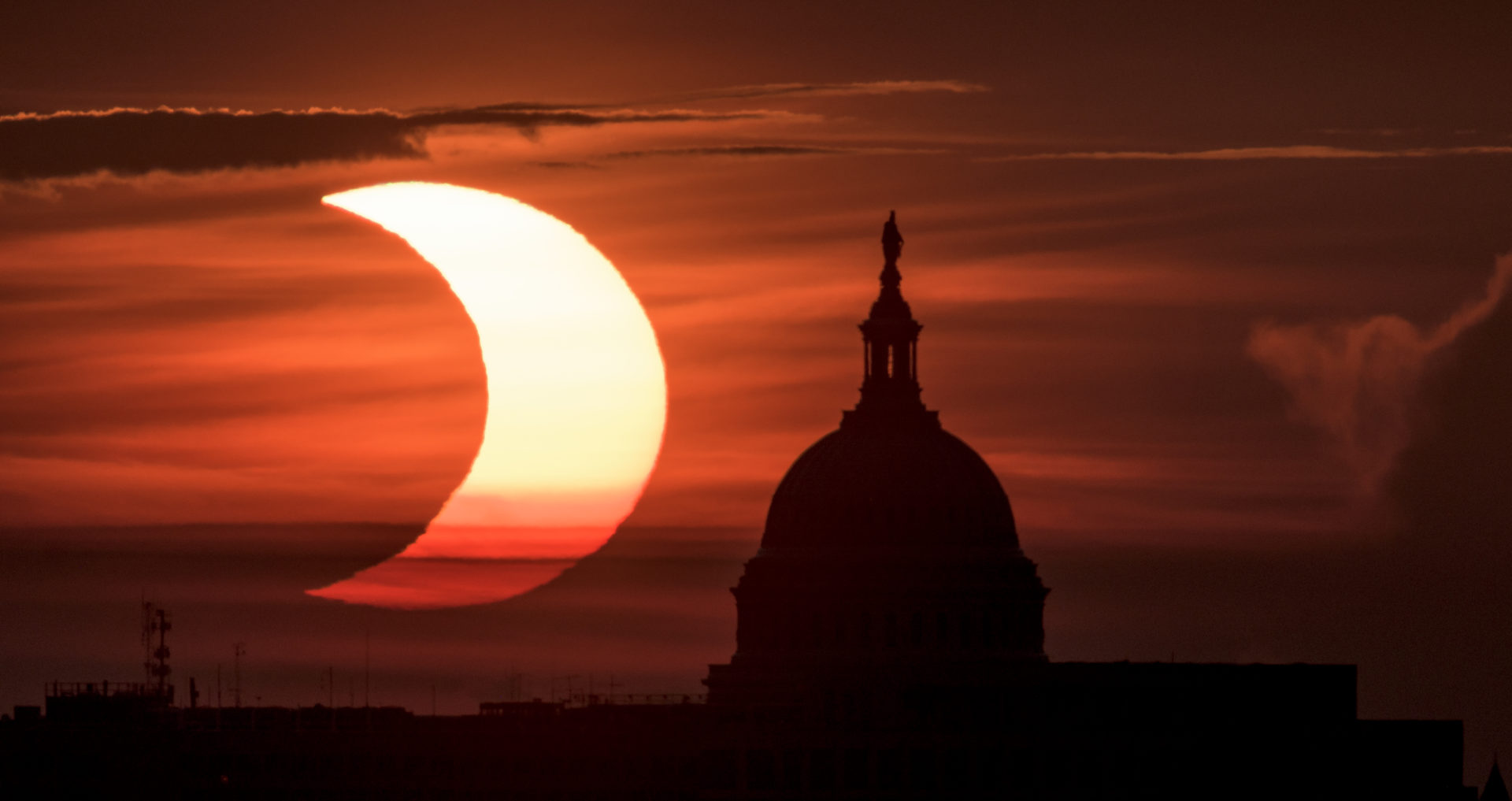
ARLINGTON, VIRGINIA – JUNE 10: A partial solar eclipse is seen as the sun rises behind the Capitol Building on June 10, 2021 in Arlington, Virginia. (Photo by Bill Ingalls/NASA via Getty Images)
Good Morning!!
I don’t know why I keep reading articles about the lab-leak theory. It’s not that I necessarily believe it’s true. I certainly don’t believe that a virus was created or modified in the Wuhan lab and then released into the population. I do think it’s possible that a researcher picked up a virus in the field and somehow carelessly infected someone on the outside. I still think the most likely scenario is the cross species (animal-to-human) route, because that clearly happens. I guess I’m just interested in why the argument has arisen in the media and won’t go away.
Anyway, there’s an interesting article on the subject at The Atlantic this morning: Don’t Fall for These Lab-Leak Traps. Recent coverage of the pandemic’s origins has ensnared readers in semantic quibbles, side points, and distractions, by Daniel Engber. I won’t try to summarize the piece because it’s so long, but here’s a bit of what Engber writes about what he calls “the mad scientist trap.”
The lab-leak theory isn’t singular; rather, it’s a catchall for a continuum of possible scenarios, ranging from the mundane to the diabolical. At one end, a researcher from the Wuhan Institute of Virology might have gone out to sample bat guano, become infected with a novel pathogen while in the field, and then seeded it back home in a crowded city. Or maybe researchers brought a specimen of a wild-bat virus back into the lab without becoming infected, only to set it free via someone’s clothes or through a leaky sewage pipe.
The microbiologists Michael Imperiale and David Relman, both former members of the National Science Advisory Board for Biosecurity, told me several weeks ago that lab-leak scenarios of this rather more innocent variety—involving the collection and accidental release of a naturally occuring pathogen—were the most probable of all the non-natural possibilities. Yet the most prominent opinionating on this topic has clustered at the other end of the continuum, at first around the dark-side theory of a bioweapon gone awry, and then around the idea that a harmless virus had been deliberately transformed into SARS-CoV-2 (and released by accident) after a reckless series of tabletop experiments.
The eclipse viewed from Brooklyn Thursday morning. Justin Lane EPA, via Shutterstock
That’s another pitfall in this debate: a tendency to focus only on the most disturbing and improbable versions of the lab-leak hypothesis, and to downplay the rest. The mad-scientist trap sprays a mist across the facts by presuming scientific motivations; it posits that researchers could have caused the pandemic only if they’d been trying to create infectious pathogens.
Efforts to enhance a virus in a lab, usually described as “gain of function” studies, have engendered hyperbolic speculation….
The problem is, depending on how one chooses to define gain-of-function research, it could well include most virological research, some forms of vaccine development, and a healthy portion of biology writ large. Anytime a scientist tries to probe or tweak the function of a gene, she could be working in this vein. In that sense, yes, the National Institutes of Health is a “huge gain-of-function bureaucracy.” So what?

Engler concludes:
One might assume that the single-minded fear of gain-of-function research is peculiar to conservatives—sitting, as it does, at the shadowy convergence of Big Government and Critical Frankenstein Studies. But the urge to blame scientific hubris for scientific problems, as opposed to farcical incompetence, seems to have long-standing, bipartisan support.
This trap was last sprung seven years ago. In March 2014, a CDC lab accidently shipped the highly virulent H5N1 bird flu to a poultry lab at the Department of Agriculture. Then in June, another CDC lab sent off samples of the bacteria that cause anthrax without properly inactivating them—and 75 government employees were potentially exposed. A few weeks after that, scientists at NIH stumbled across six vials of smallpox in a forgotten cardboard box. Regulators had every reason to believe that accidental laboratory leaks of naturally occurring pathogens were more common (and more likely) than genetic-engineering studies gone awry. But when confronted with all this evidence that scientists were slipping on banana peels, the government looked at other risks instead: It announced a pause on gain-of-function research.
The sun rises next to the Statue of Liberty during an annular eclipse on June 10, 2021 in New York City. (Photo by Gary Hershorn/Getty Images)
We’re in the process of defaulting to the same idea—that better biosafety might be achieved, and the next pandemic headed off, if we prevent or slow the development of genetically engineered bananas. That might only help ensure that no one thinks too hard about the odds of slapstick-fueled catastrophe. We may yet find, with more investigation, that the Wuhan Institute of Virology, and other places like it around the world, is positively strewn with banana peels. If that’s the case, our first and most important goal should be to clean them up. In the meantime, don’t be fooled by false antonyms. The opposite of nature isn’t hubris, and if SARS-CoV-2 turns out not to have a “natural” origin, that doesn’t have to mean someone made it in a lab.

Sorry for the long excerpt, but I do think it’s a useful article. Read more at the link if you’re interested.
The New York Times has an article on this morning’s eclipse: Highlights From the ‘Ring of Fire’ Solar Eclipse at Sunrise.
Just after sunrise over the eastern half of North America, the sun was almost completely blotted out by the moon for a few dawn hours in an annular solar eclipse.
During such an eclipse, the black silhouette of the moon — too far from Earth to completely cover the sun — will be surrounded by a thin ring of our home star’s surface, or photosphere. Many know this as a “ring of fire,” but few will get to experience the full effect.
The eclipse started after sunrise north of Lake Superior and began crossing remote regions of Canada, on its way into Greenland and the Arctic Ocean before going over the North Pole. Its course then heads south before ending in parts of the Russian Far East.
Still, some lucky souls got to experience this cosmic geometry, and a few were even intrepid and well organized enough to book airplane flights into the zone of maximum darkness. Many more of us got to experience a partial solar eclipse if we woke up early to clear enough skies….
It was dark and windy as the visitors spread out across the 86th floor observation deck 1,050 feet above midtown, adjusting camera lenses and perfecting positions as they waited for the sun to appear.
When the sky began to lighten and clouds turned shades of fuchsia pink, attendees of the event, who had paid $114.81 each to be there, could be overheard begging the skyline to clear up so there would be a better view….
Finally, the sun rose and the eclipse was visible — if a little hazily — through the cloud cover.
“You could hear the entire audience react at the first viewing of the sun,” said Jean-Yves Ghazi, president of the Empire State Building Observatory. “Everybody was gasping and it was absolutely magical.”
Read more at the link.
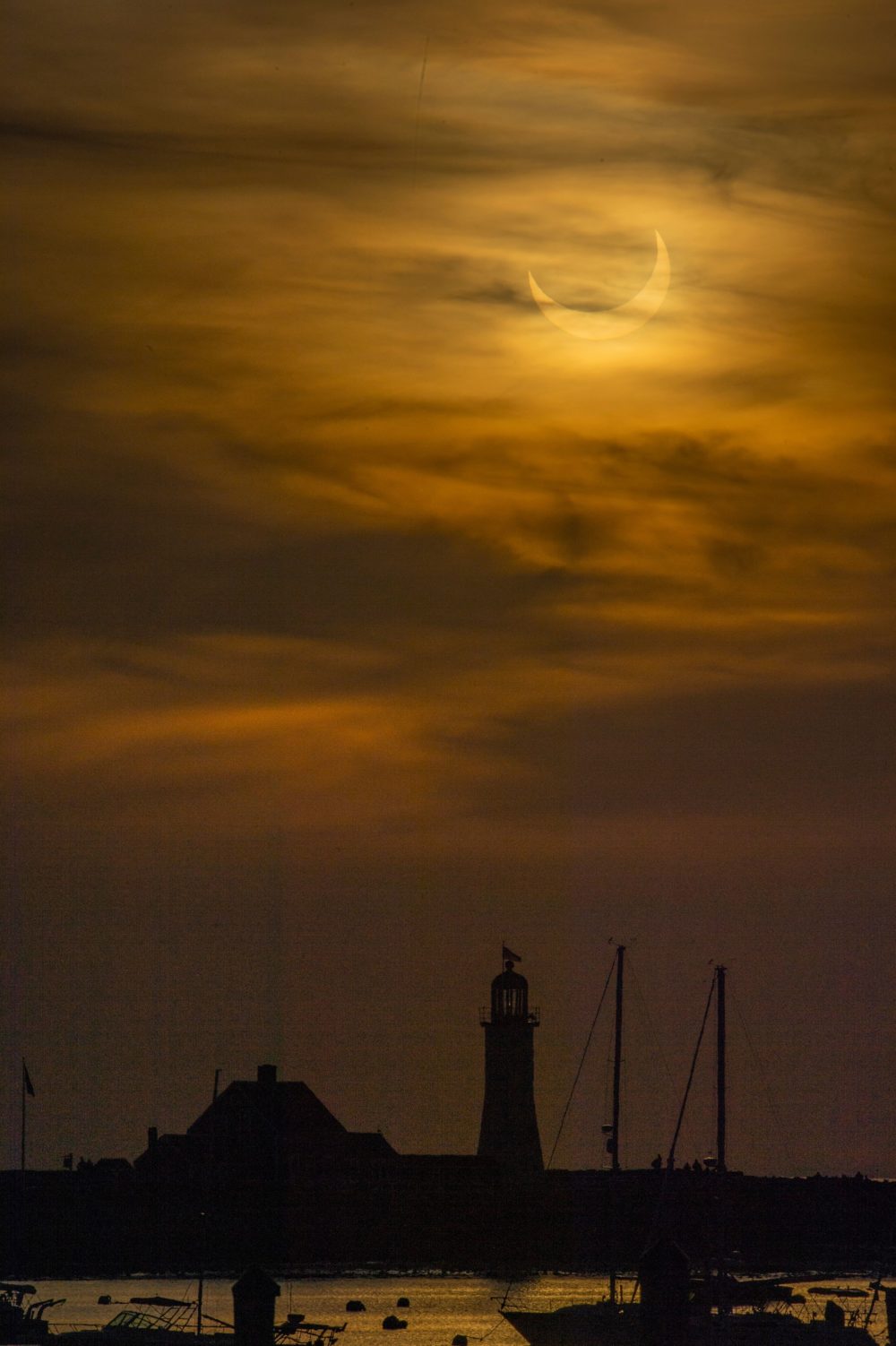
Annular (partial solar) eclipse is seen as the sun rises over Scituate Light in Scituate, MA, June 10, 2021. (Photo by Joseph Prezioso / AFP) via Getty Images)
From Stephen Collinson at CNN on Biden’s first foreign trip: Why Biden’s foreign trip is so unique and so important.
No US President has ever left the nation’s shores with democratic values under attack as broadly and systemically at home as they are abroad. This extraordinary reality will complicate his mission to purge the trauma of the Donald Trump era and convince both foes and friends that the US is reclaiming its global leadership role for good.
Biden meets British Prime Minister Boris Johnson on Thursday before the G7 summit, makes a hop to NATO in Brussels, then has a summit with Russian President Vladimir Putin in Geneva that will evoke the most tense days of the Cold War.
“We’re going to make it clear that the United States is back and democracies of the world are standing together to tackle the toughest challenges,” Biden told US troops at an air base in eastern England on WednesdaFor Biden, democracy is not just some abstract concept from civics class that Americans experience only when they enter the voting booth every few years.
It is a system, a way of life and a set of rules and norms that made the United States the strongest and richest country in history. The free, prosperous nations the US rebuilt and protected after World War II faced down communist tyranny in the form of the Soviet Union and underwrote 70 years of peace. This web of open, like-minded countries is also the key to America’s global power. If democracy ebbs abroad, so does US influence.
The rise of a new superpower, China, determined to overhaul US riches and power is becoming a grave threat to democracy, and offers potential autocrats an alternative power template of one-party rule.
Russia — the adversary that Biden will confront at the end of his Europe trip — meddled in the last two US elections to help Trump, who often seemed to advance its foreign interests over America’s.
But the most extraordinary feature of Biden’s trip is that he’s not an American President going out to confront tyranny abroad — that’s happened before. He’s huddling with US allies at a moment when the greatest threat to democracy comes from within the United States.
The world looked on, horrified, at the insurrection against the US Capitol orchestrated by Trump in January. Since then, the ex-President has poisoned millions of Americans against democracy with his false electoral-fraud claims. Republican state lawmakers are quickly passing bills that make it harder for all but their own supporters to vote and make it easier to steal elections. The principle that voters have the right to pick their own leaders is under threat.

Thursday’s eclipse over the Toronto skyline. Credit Frank Gunn, The Canadian Press, via Associated Press
I don’t see how U.S. democracy can be saved unless Trump and his enablers are investigated and prosecuted. It’s also vitally important to investigate the insurrection that Trump incited on January 6, 2021. There are endless avenues of corruption to deal with from Trump’s four years in office, but here’s the latest to hit the news (actually is old news…).
Adam Klasfeld at Law and Crime: ‘Point of No Return’: Don McGahn Told Congress How Close Trump Came to ‘Inflection Point,’ Another ‘Saturday Night Massacre.’
In a fit of pique over Special Counsel Robert Mueller’s Russia investigation, former President Donald Trump almost reached an “inflection point” and “point of no return” that would have set in motion a Richard Nixon-style “Saturday Night Massacre,” ex-White House Counsel Don McGahn recently told Congress behind closed doors.
The just-released transcript of McGahn’s closed door testimony before the House Judiciary Committee contains a series of new answers and elaborations on details that were publicized in the Mueller Report.
Releasing the June 4th transcript on Wednesday, Judiciary Chair Jerry Nadler (D-N.Y.) said: “Mr. McGahn provided the Committee with substantial new information—including firsthand accounts of President Trump’s increasingly out of control behavior, and insight into concerns that the former President’s conduct could expose both Trump and McGahn to criminal liability.”
“Mr. McGahn also confirmed that President Trump lied when he denied the accuracy of the Mueller report, and admitted that he was the source for a Washington Post report that confirmed Trump’s direction to McGahn to remove the Special Counsel,” Nadler wrote in a statement.
In the transcript, McGahn explains his reluctance to convey a message from Trump pressuring then-Deputy Attorney General Rod Rosenstein to not allow the special counsel to serve because of alleged conflicts—a request that McGahn considered an “inflection point.”
“‘Inflection point,’ with that I meant a point of no return,” McGahn testified. “If the Acting Attorney General received what he thought was a direction from the counsel to the President to remove a special counsel, he would either have to remove the special counsel or resign. We are still talking about the ‘Saturday Night Massacre’ decades and decades later.”
Have a great Thursday Sky Dancers!!

 peej
peej Carissa
 bostonboomer
 dakinikat
 ecocatwoman
 mablue2
 Mama Lopez
 peggysue22
 quixote
 skydancingguestblogger
 Mona (aka Wonk the Vote)



 Sky Dancing
Recent Comments