
Melt Down Monday: Another Fine Mess Trumplicans got us into
Posted: March 13, 2023 Filed under: just because | Tags: Bank Runs, Bernie Sanders, CryptoCurrency, Dodd-Frank bill, Elizabeth Warren, FDic, Federal Reserve Bank, Flash Digital Bank Runs, Janet Yellen, junk bond king, Katie Porter, SEC, Silicon Valley Bank, US Treasury 15 Comments My body still tells me to say Good Morning!
I’m only on my second cup of coffee while waiting for my Irish Oats to cook. The clock tells me it’s afternoon, but something about me refuses to believe it. Why am I rudely being pushed into a part of the day rather than enjoying my lazy morning and looking forward to my Night Life? The best thing about teaching Grad school is that I no longer teach morning classes. Thanks to Dubya (wrecked the country) Bush, I only have that sacred space with its full glory for about 4 months a year. I’m grading midterms and wading through a seriously unnecessary set of bank failures in a bit of a fog. This is my version of No Exit.
Every time I teach my Grad Derivatives class in the Spring, some unnecessary financial crisis pops up. It’s not a huge one like another thing for which we can thank Dubya (wrecked the economy), Bush, and his cronies. This will not be the next “Great Recession” creator.
The Republicans under Theodore Roosevelt and Ulysses S Grant determined that you cannot trust huge actors in concentrated markets to regulate themselves. They called them trusts back then. They muck things up worse than the regulations while taking advantage of their customers for extraordinary profits until the jig is up. They also lead to substantial negative spillover costs paid for with taxpayer money. Many times, especially with situations like the Norfolk situation, victims of these costs never fully recover their losses. Real economists know this. It’s why Republicans haven’t had one around since Bernanke.
I wrote extensively about why the financial system ran amok and wrecked the economy around 2008. I am again writing about a very similar situation. Much of it’s rooted in the chipping away of protections set up to protect us from a recurrence of the Great Recession removed by Trump, the Republicans, and any elected official that basically gets vast donations from Wall Street and Banks. NBC News Sahil Kapur follows the ties between that and what’s happening now. “Silicon Valley Bank collapse puts new spotlight on a 2018 bank deregulation law. Democratic Sen. Elizabeth Warren, who led the push against that Trump-era law, now wants to restore those rules on financial institutions. Biden is also calling on Congress to act.”
Five years ago, Warren was the most outspoken opponent of the Republican-led Congress’ push to undo regulations imposed under the 2010 Dodd-Frank law for small and midsize banks. The bill, led by Sen. Mike Crapo, R-Idaho, sought to reclassify the “too big to fail” standard, which came with enhanced regulatory scrutiny. By raising the threshold from $50 billion in assets to $250 billion, medium-size banks were exempted from those regulations.
“Had Congress and the Federal Reserve not rolled back the stricter oversight, S.V.B. and Signature would have been subject to stronger liquidity and capital requirements to withstand financial shocks,” Warren wrote Monday. “They would have been required to conduct regular stress tests to expose their vulnerabilities and shore up their businesses. But because those requirements were repealed, when an old-fashioned bank run hit S.V.B., the bank couldn’t withstand the pressure — and Signature’s collapse was close behind.”
Sen. Bernie Sanders, I-Vt., who also opposed the 2018 law, blamed it for Silicon Valley Bank’s collapse.
“Let’s be clear. The failure of Silicon Valley Bank is a direct result of an absurd 2018 bank deregulation bill signed by Donald Trump that I strongly opposed,” he said in a statement. “Five years ago, the Republican Director of the Congressional Budget Office released a report finding that this legislation would ‘increase the likelihood that a large financial firm with assets of between $100 billion and $250 billion would fail.’”
The 2018 battle featured intense lobbying by banks — including Silicon Valley Bank and an array of smaller community banks — that were seeking regulatory relief.
The bill passed the House 258-159, winning 225 Republicans and 33 Democrats. In the Senate, it needed some Democrats to defeat a filibuster and achieve 60 votes. Warren infuriated some colleagues when she called out some Senate Democrats by name for trying to weaken Dodd-Frank rules.
In the end, 17 Democrats joined a unanimous Senate Republican conference to pass it. Trump signed it into law.
The entire financial industry plays a role in the economy held by no other. The safekeeping role is why rules for bank deposits, the FDIC insurance mandates exist, and capitalization laws are in place. I think no one teaches about the Bank Holidays and Runs we experienced during the Great Depression. The more you chip away at what used to be legal differences and responsibilities between banks with deposits and fiduciary responsibility and their ability to play around with risky loans and investments, the more these things will reoccur. Also, speculative investors like hedge funds’ special tax treatment lower their risk costs and increase their ability to make investment decisions that have a likelihood of implosion. The rollback of substantial sections of Dodd-Frank was integral to last week’s runs.
https://twitter.com/ritujay/status/1634432765692366849
More importantly, the recent failures of financial institutions and companies involved with Cryptocurrencies will be part of the focus as state and federal regulators–including the Fed–do a post-mortem on both Silicon Valley and the Signature Bank in New York. These banks look like Country Clubs for risky and poorly managed loan portfolios. They have many big accounts backed up by cryptocurrency, a highly speculative and risky asset. This is from CNBC. “Regulators close crypto-focused Signature Bank, citing systemic risk.” The reporter is Yun Li.
The banking regulators said depositors at Signature Bank will have full access to their deposits, a move similar to that which was made to ensure depositors at the failed Silicon Valley Bank will get their money back.
“All depositors of this institution will be made whole. As with the resolution of Silicon Valley Bank, no losses will be borne by the taxpayer,” the regulators said.
The regulators shuttered Silicon Valley Bank on Friday and seized its deposits in the largest U.S. banking failure since the 2008 financial crisis — and the second-largest ever. The dramatic moves come just days after the tech-focused institution reported it was struggling, triggering a run on the bank’s deposits.
Signature is one of the main banks to the cryptocurrency industry, the biggest one next to Silvergate, which announced its impending liquidation last week. It had a market value of $4.4 billion as of Friday after a 40% sell-off this year, according to FactSet.
As of Dec. 31, Signature had $110.4 billion in total assets and $88.6 billion in total deposits, according to a securities filing.
To stem the damage and stave off a bigger crisis, the Fed and Treasury created an emergency program to backstop all deposits at both Signature Bank and Silicon Valley Bank using the Fed’s emergency lending authority.
The FDIC’s deposit insurance fund will be used to cover depositors, many of whom were uninsured due to the $250,000 cap on guaranteed deposits.
While depositors will have access to their money, equity and bondholders at both banks are being wiped out, a senior Treasury official said.
The article is written by DDay. “The Silicon Valley Bank Bailout Didn’t Need to Happen. The debate over protecting all deposits in a blink looks past the incompetence that got us here.” Buried in the fine print of the joint statement is something exciting. It states that “certain unsecured debtholders” and shareholders are not protected. Certain unsecured debtholders may likely apply to crypto-tainted accounts used to secure debt. The Fed has been anxious to get more involved with the rogue market. Will today’s Republican Congress let them?
The brightest minds in and around San Francisco Bay had an unadulterated meltdown over the weekend over the failure of Silicon Valley Bank. This was a failure that they themselves caused, mind you, engineering a digital flash bank run that forced SVB to realize heavy losses, mostly from interest rate hikes and the bank’s unbelievable failure to even attempt to manage interest rate risk.
The venture capitalist–led mob quickly moved on to another dire warning: Because over 90 percent of SVB’s depositors exceeded $250,000 in guaranteed FDIC insurance, the government must make them 100 percent whole, immediately, or every regional bank in America will see the same failure. Hedge fund titan Bill Ackman, venture capitalist David Sacks, and angel investor Jason Calacanis led the charge, saying that thousands of startup firms will have trouble making payroll, and other regionals won’t be able to stop a torrent of withdrawals. They essentially took out a match next to a gas pump and demanded that federal regulators not force them to light it.
It worked. Federal officials announced a backstop to “fully protect all depositors” at both Silicon Valley Bank and Signature Bank, which was also closed on Sunday. “Depositors will have access to all of their money starting Monday, March 13,” the joint announcement by Treasury, the Federal Reserve, and the FDIC read. A special bank assessment will offset losses, they say; all shareholders and bondholders “will not be protected,” with senior management fired. A $25 billion fund has been initiated to protect deposits, even though the theory is that no taxpayer funds will be implicated.
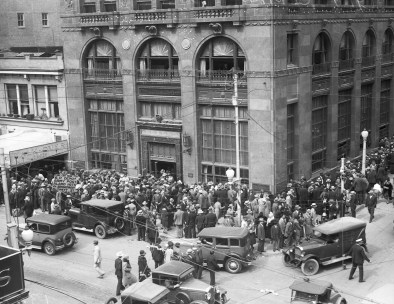
Run on San Antonio’s City-Central Bank and Trust Company during the Depression, 1931
Have I ever mentioned how much I’d admire California Representative Katie Porter?
THE FIRST WORDS OUT OF THE MOUTH of Rep. Katie Porter (D-CA) when I talked to her on Sunday were: “Can you believe we have to talk about this shit again?” She was referring to a conversation we had in 2018, when she was still just a financial expert and a candidate for Congress, about S.2155, which I call the Crapo bill, a reference to its co-author (Idaho Republican Sen. Mike Crapo) and its underlying contents.
Some of these provisions don’t mitigate risk; they encourage it. For depository institutions with fiduciary responsibilities, it’s like giving Bourbon-drenched pecan pie to alcoholics. Remember when Bill Gates sold Tesla short? Anyone with an excellent eye for financial statement analysis can see this stuff coming. But wait, how do you explain that “KPMG Gave SVB, Signature Bank Clean Bill of Health Weeks Before Collapse. Accounting firm faces scrutiny for audits of failed banks“? This is from Jonathan Weil and WSJ.
Silicon Valley Bank failed just 14 days after KPMG LLP gave the lender a clean bill of health. Signature Bank went down 11 days after the accounting firm signed off on its audit.
What KPMG knew about the two banks’ financial situation and what it missed will likely be the subject of regulatory scrutiny and lawsuits.
KPMG signed the audit report for Silicon Valley Bank’s parent, SVB Financial Group SIVB 0.00%increase; green up pointing triangle, on Feb. 24. Regulators seized the bank on March 10 after a surge of withdrawals threatened to leave it short of cash.
“Common sense tells you that an auditor issuing a clean report, a clean bill of health, on the 16th-largest bank in the United States that within two weeks fails without any warning, is trouble for the auditor,” said Lynn Turner, who was chief accountant of the Securities and Exchange Commission from 1998 to 2001.
Two crucial facts for determining whether KPMG missed the banks’ problems are when the bank runs began in earnest and when the bank’s management and KPMG’s auditors became aware of the crisis.
This reminds me of Moody’s, which had no idea how to rate tranches of mortgage-based swaps and completely missed the boat on the Mortgage crisis in 2008. You may also remember Moody’s role during the Junk Bond Kings’ rule in the late ’80s. This was also a time of intense deregulation of the industry.
. Moody’s also missed this current one. “Moody’s Failed to Warn About Silicon Valley Bank’s Problems. The prestigious rating agency still gave the bank of startups an A rating until its collapse on March 10, repeating the same errors of the subprime crisis in 2008.” This is from The Street and Luc Olinga.
Fifteen years after the subprime mortgage crisis which devastated the global economy, rating agencies continue to make the same mistakes.
At least, this seems to be the case with the prestigious rating agency Moody’s Investors Service.
Regulators shut down California’s Silicon Valley Bank on March 10, after its US Treasury bets went awry, due to the interest rate hike by the Federal Reserve.
Consequently, the Federal Deposit Insurance Corporation (FDIC) seized its assets and created a new entity, which will begin operating on March 13.
Created in 1983, Silicon Valley Bank, which presented itself as a “partner for the innovation economy,” offered higher interest rates on deposits than its larger rivals, to attract customers. The company then invested the clients’ money in long-dated Treasury bonds and mortgage bonds with strong returns.
Moody’s Gave Silicon Valley Bank an A Rating
This strategy had worked well in recent years. The bank’s deposits doubled to $102 billion at the end of 2020 from $49 billion in 2018. In 2021, deposits increased to $189.2 billion.
But everything turned upside down when the Federal Reserve began to raise interest rates, which made existing bonds held by SVB less valuable. As a result, the bank had to sell the bonds at a discount to cover withdrawals from its customers. In selling these bond positions, SVB had to take a significant loss of $1.8 billion.
Due to this loss, SVB suddenly announced that it needed to raise additional capital of $2.25 billion, by issuing new common and convertible preferred shares. This decision caused panic and a run on the bank.
While investors saw nothing coming, this is also the case with Moody’s Investors Service, whose role is to assess the intrinsic value of a company and its ability to meet its obligations, including its ability to pay lenders back. Rating agencies must flag the financial risks associated with a company.
But everything turned upside down when the Federal Reserve began to raise interest rates, which made existing bonds held by SVB less valuable. As a result, the bank had to sell the bonds at a discount to cover withdrawals from its customers. In selling these bond positions, SVB had to take a significant loss of $1.8 billion.
Due to this loss, SVB suddenly announced that it needed to raise additional capital of $2.25 billion, by issuing new common and convertible preferred shares. This decision caused panic and a run on the bank.
While investors saw nothing coming, this is also the case with Moody’s Investors Service, whose role is to assess the intrinsic value of a company and its ability to meet its obligations, including its ability to pay lenders back. Rating agencies must flag the financial risks associated with a company.
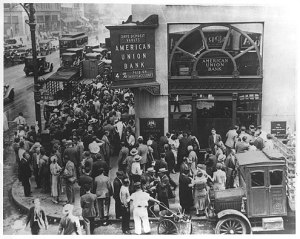
American Union Bank, New York City. April 26, 1932.
I’ve lived through a banking crisis in charge of strategic planning and financial statement forecasting for one of the original too big to fail Savings and Loan Companies in the early 1980s. I was also trying to hedge our loan commitments using GNMA futures which is why Derivatives are real to me. Any time interest rates start moving in the wrong direction and any bank that hasn’t realigned their related risks, like being long on one side of the balance sheet and short on the other, you’ll lose big.
I had to tell the head of Financial Operations there was no way to break even when every rate marks an asset to market with every tick, and you’re mismatched. I was barely 25 at the time. I also saw loan brokers selling mortgages where due diligence was lacking in 2005. A student told me he was being offered a mortgage based on his student loan as income. I can’t imagine any in-house loan officer being that ignorant. That’s what happens when you farm out your core business ou to salespeople earning money by volume. I can’t imagine how Moody’s or major Auditing firms keep missing this. They’re probably as captured by their customers as the politicians are captured by their lobbyists and checks. Right Senator Sinema?

James Stewart and Donna Reed in a scene from the film ‘It’s A Wonderful Life’, 1946. (Photo by RKO Radio Picture/Getty Images)
So, these bank runs don’t exactly look like the ones in those black-and-white photographs from the 1930s. This is a good explanation from Fast Company. What exactly is a Digital Flash Bank Run? It’s not a DC comic. Silicon Valley Bank: An ‘It’s a Wonderful Life’ bank run for the digital age. The downfall of the Valley institution, which has been called “the backbone of the startup economy,” was caused by a good old-fashioned bank run, but one that ran at internet speed.”
The run began on Thursday, after a powerful Silicon Valley VC—Peter Thiel’s Founders Fund—had begun advising its portfolio companies to withdraw their money from SVB, sources told Fast Company. Other VCs soon caught wind of the advisory and began advising their own portfolio companies to withdraw funds from SVB, the people said. As the withdrawals accelerated, the bank began taking steps to stem the tide and preserve its solvency—just like George Bailey did in the 1946 classic It’s a Wonderful Life.
SVB Financial Group CEO Greg Becker seemed to be reading from director Frank Capra’s script when he uttered the fateful words “stay calm” during a Thursday conference call with customers, as fears over the bank’s solvency grew. Those words probably only increased depositors’ anxieties. And the withdrawals likely continued to snowball.
“The whole thing was predicated on a few folks who put out calls to make withdrawals,” Spencer Greene, a general partner at the venture fund TSVC, tells Fast Company. “I think the folks who made those calls weren’t correct on the facts, but once the thing got going it was hard to stop.” In other words, before the run started there was not sufficient evidence to suggest the bank was facing serious solvency issues.

Northern Rock Bank run, September 2007
Just another point, we knew these things could happen. Here’s a 2019 article speculating about a digital bank flash run by Joe McGrath, writing for The Raconteur. “Turmoil, panic and bank runs in a digital future.”
Potentially, cash can now be transferred from accounts in greater amounts, more quickly than before and, even if banks enforce temporary limits on online withdrawals, what effect would the resulting panic have on the banking system as a whole?
“In a world without physical cash, the rules of engagement for situations such as a bank run will require a different framework,” says Simon Fairbairn, director of solution development, western Europe, for Ingenico Group. “The rules and systems of today will need to evolve to accommodate the demands of a run.”
Mr Fairbairn questions whether present digital banking infrastructure is sufficient to cope with sustained pressure of this nature. “Regulation, compliance, technology; processes have all evolved to try and prevent the sins of the past, but until tested, can we really be sure it won’t already be found wanting,” he says.
It may sound like scaremongering, but Mr Fairbairn’s cautious view has broad support from many in the financial services community.
“A digital bank run in a hypothetical future would be much more dangerous as it would happen in seconds and minutes when clients could simply use mobile banking apps to transfer money to another account,” says Susanne Chishti, chief executive of Fintech Circle.
“Such a digital bank run would be much more difficult to contain and an appropriate technical response for such a scenario would have to be coded in at the outset to offer any chance of being effective.”
In 2020, Harvest Finance experienced the first type of digital bank run. “Harvest Finance: $24M Attack Triggers $570M ‘Bank Run’ in Latest DeFi Exploit, Harvest Finance has seen its total value locked drop by more than $500 million in the 12 hours since being hit by a flash loan attack.” DeFi is short for Decentralized Finance, which is based on peer-to-peer finance services on blockchains. Welcome to the Wild West World of cryptocurrency and bitcoins. This should give you pause.
An arbitrage trade exploiting weak points in decentralized finance (DeFi) protocol Harvest Finance led to some $24 million in stablecoins being siphoned away from the project’s pools on Monday, according to CoinGecko.
According to reports, an attacker used a flash loan – a technique that allows a trader to take on massive leverage without any downside – to manipulate DeFi prices for profit. The exploit sent the platform’s native token, FARM, tumbling by 65% in less than an hour, followed by the project’s total value locked (TVL), which dropped from over $1 billion before the exploit to $430 million as of press time.
The funds were eventually swapped for bitcoin (BTC), but not before being swept through Ethereum mixing service Tornado Cash.
The jargon term for this was a “bad harvest.” Stay out of this stuff is the only thing I have to say, which is the advice I would have given to these banks. Unfortunately, Silicon Valley is rife with Elon Musk Clones taking risks for adventure and attention. All traders have their own language. I’m still surprised youngest daughter can keep her department of derivatives traders and products on a leash. They’ve always thought of themselves as Wild West Cowboys. (See Lions of Wall Street.) But then, she and the brokerage firms she’s worked for are licensed and babysat by the SEC to keep the nonsense in check. We both stay out of this market.
So, a part of this and a bit more will be a lecture for me tomorrow. Last year the Game Stop thing did this to me. You’ll be glad to know billionaire Carl Icahn is happy about that crash. Someone always is because there are two sides to every trade. If you’re head’s spinning, you’re doing just fine. I got a Ph.D. and real-life experience in the stuff, plus a daughter that lives it daily and who I consult for a reality check. It still makes my head spin.
What’s on your reading and blogging list today?
And the SEC is far behind
Down in the swamp with the gators and flamingos
A long way from Liechtenstein
I’m a junk bond king playing Seminole Bingo
And my Wall Street wiles
Don’t help me even slightly
‘Cause I never have the numbers
And I’m losing nightly
I cashed in the last of my Triple B bonds
Got a double-wide on the Tamiami Trail
I parked it right outside the reservation
Fifteen minutes from the Collier County Jail
(Warren Zevon, backed up by Neil Young live)
Tuesday Reads: Autumnal Equinox Edition
Posted: September 23, 2014 Filed under: Barack Obama, Foreign Affairs, morning reads, U.S. Economy, U.S. Politics | Tags: ancient graves, Autumnal Equinox, Festival of Mabon, Harvest festival, inversion rules, Jacob Lew, Jeremy Roloff, little people, US Airstrikes in Syria, US Treasury, Wall Street 25 Comments
Good Morning Sky Dancers!!
Today is 2014’s autumnal equinox, when day and night are equal in length. From now on, the days will get shorter and the nights longer, as we approach winter. Actually, autumn officially began in the Northern Hemisphere last night at 10:29 Eastern time.
Astronomically speaking…the fall season…comes to the Northern Hemisphere on Tuesday, September 23rd at 2:29 Universal Time (10:29 p.m. EDT on Monday, the 22nd). At that moment, the Sun shines directly on Earth’s equator, heading south as seen in the sky. For us northerners, this event is called the autumnal equinox….
The apparent position of the Sun in our sky is farther north or farther south depending on the time of year due to the globe’s axial tilt. Earth’s rotational axis does not point straight up and down, like the handle of a perfectly spinning top, but is slanted about 23½° with respect to our orbit around the Sun.
Another way to think of this is that the plane defined by Earth’s orbit around the Sun (called the ecliptic) is tilted with respect to the planet’s equator. From our perspective, the Sun follows the ecliptic in its path through the sky throughout the year. Each day the Sun’s daily arc moves northward or southward, depending on the time of the year. To observers at northern latitudes (in the U.S., Canada, and Europe, for example), the Sun appears to sneak higher in the sky from late December to late June, only to drop down again from late June through late December. The equinox occurs when the Sun is halfway through each journey.
This axial tilt also produces our seasons. When Earth is on one side of its orbit, the Northern Hemisphere is tipped toward the Sun and receives more direct solar rays (and more daylight hours) that produce the familiar climes of summer. Six months later, when Earth is on the opposite side of its orbit, the Northern Hemisphere is tipped away from the Sun. The slanting solar rays heat the ground less and daylight is shorter, producing the colder winter season.
What else happens at the equinox?
Day and night are nearly the same length; the word “equinox” comes from the Latin aequinoctium, meaning “equal night,” according to the Oxford English Dictionary. However, a poke around your almanac will show that day and night are not precisely 12 hours each, for two reasons: first, sunrise and sunset are defined as when the Sun’s top edge — not its center— crosses the horizon. Second, Earth’s thick atmosphere refracts the Sun’s apparent position slightly when the solar disk sits very low on the horizon.
The Sun rises due east and sets due west, as seen from everywhere on Earth; the equinoxes are the only times of the year when this occurs.Should you be standing on the equator, the Sun would pass exactly overhead at midday.
Were you standing at the North Pole or South Pole, the Sun would skim completely around the horizon.

Harvesting, by G. Myasoedov
The autumnal equinox marks the pagan festival of Mabon, “when livestock is slaughtered and preserved to provide enough food for the winter.” From Huffington Post,
Mabon is a harvest festival, the second of three, that encourages pagans to “reap what they sow,” both literally and figuratively. It is the time when night and day stand equal in duration; thus is it a time to express gratitude, complete projects and honor a moment of balance.
“Mabon is a time to reflect on the previous year, when we can celebrate our successes (likened to bringing in the harvest) and assess which crops, projects, or dreams didn’t come to fruition,” the Los Angeles-based pagan leader Laurie Lovekraft told HuffPost.
The pagan website The White Goddess explains:
This is the time to look back not just on the past year, but also your life, and to plan for the future. In the rhythm of the year, Mabon is a time of rest and celebration, after the hard work of gathering the crops. Warm autumn days are followed by chill nights, as the Old Sun God returns to the embrace of the Goddess.
The holiday is named after the Welsh God, Mabon, son of Earth Mother goddess Modron.
Some pagans mark the holiday by enjoying rich feasts with seasonal foods like apples, pomegranates and root vegetables. Many also observe rituals honoring the goddess’transition from mother to crone.
Endless War News
The US (and some Arab allies) have carried out airstrikes in Syria. From The Guardian, US confirms 14 air strikes against Isis in Syria.
The most intensive barrage of air strikes launched against Islamic State (Isis) since the US fight against the terror group began last month thundered into northern Syria until after dawn on Tuesday, heralding a new phase of a war that Sunni regional powers have vowed to help lead.
Large explosions were reported in the group’s stronghold of Raqqa, in eastern Syria, as well as in Idlib province. There were unconfirmed reports that attacks had also taken place near Deir Azzor and western Aleppo.
A Pentagon statement said the 14 strikes against Isis targets were carried out with Bahrain, Jordan, Saudi Arabia, the United Arab Emirates and Qatar. Jordan confirmed it its airforce had “destroyed a number of targets that belong to some terrorist groups that sought to commit terror acts inside Jordan” without making explicit reference to Syria.
More details from The New York Times (I’m unable to quote from the article), and from The BBC,
The Pentagon said warplanes, drones and Tomahawk missiles were used in the attacks, which targeted several areas including IS stronghold Raqqa.
Syria’s foreign ministry said its UN envoy was informed about the strikes against IS, which controls large swathes of Syria and Iraq.
Activists say at least 70 IS militants were killed in the strikes….
It said a total of 14 strikes destroyed or damaged IS training compounds, command and control facilities, vehicles and storage sites.
The US military will continue to conduct air strikes against IS targets in Iraq and Syria, it added.
US Gen Martin Dempsey, America’s highest-ranking uniformed military officer, said the strikes were conducted to show IS militants they had no safe haven. “We certainly achieved that,” he told reporters.
Separately, Centcom said US forces also attacked a network of al-Qaeda veterans named Khorasan who had established a safe haven west of Aleppo and were plotting imminent attacks against the West.
Experts say members of the secretive group are believed to co-operate with al-Nusra Front – Syria’s al-Qaeda-affiliate – using its training bases and resources.
President Obama plans to speak about the Syrian strikes this morning at 10AM.

Autumn landscape, by Vincent Van Gogh
Economics News
The U.S. Treasury Department has issued a new tax rules designed to prevent companies from moving operations out of the U.S. Bloomberg Businessweek reports, Lew Tries to Limit Tax-Cut Deals With Inversion Crackdown.
Treasury Secretary Jacob J. Lew’s crackdown on inversions will get an immediate test as eight U.S. companies with pending deals decide whether to proceed — and other companies contemplating a foreign address now have to think twice.
That’s exactly what Lew had in mind.
“This action will significantly diminish the ability of inverted companies to escape U.S. taxation,” Lew told reporters on a conference call yesterday. “For some companies considering deals, today’s action will mean that inversions no longer make economic sense.”
The Treasury announcement heightened the tension between the government and companies considering obtaining a foreign address to lower their tax bills. Lew and President Barack Obama made clear that they were prepared to use rule-making authority to try stop some deals, even at the risk of a backlash from the companies and from Republicans, who already complained that Lew’s moves went too far.
A wave of inversions caught lawmakers’ attention this year when large companies such as Pfizer Inc. (PFE) andWalgreen Co. (WAG) explored transactions andMedtronic Inc. (MDT), AbbVie Inc. and Burger King Worldwide Inc. (BKW) moved forward with deals.
More from The Wall Street Journal:
Treasury officials took action under five sections of the U.S. tax code to make inversions harder and less profitable, removing some of the appeal that has made the transactions more common in recent years, particularly in the pharmaceutical industry.
In an inversion, an American company reincorporates for tax purposes in a tax-friendlier country such as the U.K. or Ireland, typically while maintaining much of their operations in the U.S. Most recent inversions sprang from mergers of a U.S. firm with a smaller foreign firm after regulatory steps taken during President Barack Obama’s first term curbed other types of inversions.
The Treasury rules will make it harder for companies that invert to use cash accumulating abroad—a big draw in recent deals. In addition, the government has made it more difficult to complete these overseas mergers.
The tax changes took effect immediately, officials said, and applied to all deals that hadn’t closed by Monday.

Autumn Forest, by Thomas Kinkade
And from the AP via Bloomberg, Ahead of the Bell: Inversion rules sting stocks.
Shares of several companies stumbled Tuesday before markets opened and a day after the Treasury Department announced new regulations that aim to make it tougher to pull off overseas mergers and acquisitions that trim U.S. corporate tax bills.
The new measures attempt to keep companies from finding ways to access earnings from a foreign subsidiary without paying U.S. taxes, including “hopscotch” loans, in which companies shift earnings by lending money to the new foreign parent company while skipping over the U.S.-based company. Another rule change would make it harder for merged or acquired companies to benefit from lower foreign taxes by tightening the application of a law that says the American company’s shareholders must own less than 80 percent of the new, combined company.
About 50 U.S. companies have carried out moves known as inversions in the past decade, and more are considering it, according to the nonpartisan Congressional Research Service.
An inversion happens when a U.S. corporation and a foreign company combine, with the new parent company based in the foreign country. For tax purposes, the U.S. company becomes foreign-owned, even if all the executives and most of its operations remain in the U.S. Inversions can help companies generate significant tax savings over time in part because the United States has the highest corporate income tax rate in the industrialized world, at 35 percent.
Awwwwwwww . . . too bad corporate bigwigs. I so don’t feel sorry for you.
Offbeat News
I have a few offbeat stories for you. The first one is especially for JJ. ABC News reports, ‘Little People, Big World’ Star Jeremy Roloff Is Married.
“Little People, Big World” star Jeremy Roloff, 24, married Audrey Mirabella Botti Saturday afternoon in Oregon.
Autumn Landscape, by Wassily Kadinsky
Jeremy’s twin brother, Zach, was his best man, while the bride wore a gown designed by Lauren Graebner of Eva’s by Reclamation, People magazine reports.
The bridesmaids wore flower crowns and Botti, 23, wore a larger crown designed by Vanessa Schmidt. Roloff wore a suit from ProperSuit, which he shared on social media.

More details, photos, and tweets at the link.
From the Leicester Mercury (UK), Pictures released of two 1,000-year-old skeletons holding hands found in Leicestershire.
Pictures were released today by the University of Leicester, showing two 1,000-year-old skeletons holding hands, which have been discovered.
The pair of skeletons, which are centuries-old and holding hands have been uncovered at a ‘lost’ chapel by archaeologists.
The Mercury reported last week that the remains, of a man and a woman, were found at the Chapel of St Morrell, an ancient site of pilgrimage in Hallaton.
It is believed the pair holding hands are of a similar age.
Whoever they were, the man and woman must have died at the same time.
Leading the project is professional archaeologist Vicky Score, of the University of Leicester, who works on the project during her holidays.
She said carbon-dating on nine skeletons uncovered since the dig began had revealed them to be from the 14th century.
“’We have seen similar skeletons before from Leicester where a couple has been buried together in a single grave. The main question we find ourselves asking is why were they buried up there?” she added.
“There is a perfectly good church in Hallaton. This leads us to wonder if the chapel could have served as some sort of special place of burial at the time.”
See more photos at ABC News.
I found earlier articles about skeletons of couples embracing each other. From NBC News, Prehistoric Romeo and Juliet Discovered.
ROME, Feb. 7, 2007 — They died young and, by the looks of it, in love. Two 5,000-year-old skeletons found locked in an embrace near the city where Shakespeare set the star-crossed tale “Romeo and Juliet” have sparked theories the remains of a far more ancient love story have been found.
Archaeologists unearthed the skeletons dating back to the late Neolithic period outside Mantua, 25 miles south of Verona, the city of Shakespeare’s story of doomed love.
Buried between 5,000 and 6,000 years ago, the prehistoric pair are believed to have been a man and a woman and are thought to have died young, because their teeth were found intact, said Elena Menotti, the archaeologist who led the dig.
“As far as we know, it’s unique,” Menotti told The Associated Press by telephone from Milan. “Double burials from the Neolithic are unheard of, and these are even hugging.”

Autumn Garden, by Vincent Van Gogh
Another one from HuffPo, Skeletons ‘Embracing’ In Death May Represent Gruesome Ancient Siberian Custom.
For years researchers in the Novosibirsk region of Siberia have puzzled over dozens of ancient grave sites containing bodies buried face to face, some seemingly with hands clasped as if in an eternal embrace.
But soon DNA tests may help provide an answer to the key question: Are these the graves of star-crossed lovers, or could the remains be evidence of a gruesome ancient custom?
The bodies are part of a massive burial ground located in the Siberian village of Staryi Tartas, the Siberian Times reported. Altogether, close to 600 tombs have been discovered in the area, dozens of which contain the so-called “embracing” couples.
The graves are believed to belong to the Andronovo culture, which existed in the area during the second and first millennia B.C.E., according to Britannica. Yet many of the bodies in the graves are believed to be from the 15th, 16th and 17th Centuries B.C.E., the Siberian Times reported….
“We can fantasize a lot about all this,” Vyacheslav Molodin, an archaeology and ethnography expert at the Russian Academy of Sciences, told the Siberian Times. “We can allege that husband died and the wife was killed to be interred with him as we see in some Scythian burials, or maybe the grave stood open for some time and they buried the other person or persons later, or maybe it was really simultaneous death.”
What else is happening? Please post your thoughts and links in the comment thread.

 peej
peej Carissa
 bostonboomer
 dakinikat
 ecocatwoman
 mablue2
 Mama Lopez
 peggysue22
 quixote
 skydancingguestblogger
 Mona (aka Wonk the Vote)



 Sky Dancing
Recent Comments