
The DC Disconnect
Posted: May 31, 2011 Filed under: Economy, Federal Budget and Budget deficit | Tags: Bush tax cuts, U.S. Economy 12 Comments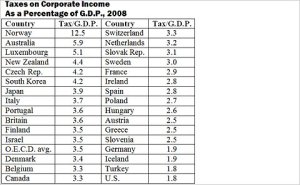 The disconnect between reality and beltway rhetoric has never been more obvious when it comes to the economy. The NYT editorial page has an op-ed up today– ‘The Numbers are Grim’–in which they call for more attention to the unemployment crisis. As I mentioned when these numbers came out, a decrease in domestic household consumption is a troublesome signal in an economy where nearly 68% of production usually goes to domestic consumption.
When consumers are constrained, so is hiring, because without customers, employers are hard pressed to retain workers or make new hires. A recent Labor Department report showed a greater-than-expected rise in the number of people claiming jobless benefits even as private-sector economic forecasts are being revised downward — both very bad omens for continued job growth.
Republican lawmakers have responded to renewed signs of weakness with a jobs plan that prescribes more of the same “fixes” that Republicans always recommend no matter the problem: mainly high-end tax cuts, deregulation, more domestic oil drilling and federal spending cuts.
The White House has offered sounder ideas, including job retraining, plans to boost educational achievement and tax increases to help cover needed spending. But its economic team is mainly focused on negotiations to raise the debt limit, presumably parrying Republican demands for deep spending cuts that could weaken the economy further while still reaching an agreement on the necessary increase.
The grim numbers tell an unavoidable truth: The economy is not growing nearly fast enough to dent unemployment. Unfortunately, no one in Washington is pushing policies to promote stronger growth now.
Even the Wall Street Journal recognizes the challenges our economy faces. Many corporate economists see similar indications of a permanent growth problem. This should not be happening. We know how to correct this. We have nearly 70 years of economy theory and empirical data that have provided a guide to every administration except the last two.
Manufacturing is cooling, the housing market is struggling and consumers are keeping a close eye on spending, meaning the U.S. economy might be on a slower path to full health than expected.
“It’s very hard to generate a rapid recovery when rapid recoveries are historically driven by housing and the consumer,” said Nigel Gault, an economist at IHS Global Insight. He expects an annualized, inflation-adjusted growth rate of less than 3% in coming quarters—better than the first-quarter’s 1.8% rate, but too slow to make a meaningful dent in unemployment.
A growing number of forecasters are downgrading their second-quarter growth predictions. JPMorgan Chase & Co. economists revised down their estimate to a 2.5% rate from 3%, while Bank of America Merrill Lynch economists cut theirs to 2% from 2.8%. Deutsche Bank cut its forecast to 3.2% from 3.7%.
Companies are similarly cautious. Applied Materials Inc., the largest maker of machines used in producing computer chips, said it expected growth in its semiconductor and solar markets to slow following one of its best quarters ever. Hewlett-Packard Co. cut its fiscal-year outlook amid weak computer sales and negative effects from the disaster in Japan. Clorox Co. offered a more guarded outlook for its household goods business as executives noted that higher prices may hurt sales.
As stated by the NYT, most Republicans put a plan forward that calls for “high-end tax cuts, deregulation, more domestic oil drilling and federal spending cuts”. This is exactly the opposite of what needs to be done. The mantra of ‘too high’ taxes strangling business which dampens unemployment is simply not true. It’s never been true. It’s a fallacy! Bruce Bartlett has done an excellent job–see the nifty graph above–in using facts to put down that meme. Not only are effective tax rates on corporations already exceedingly low, but tax revenues from wealthy individuals are so low that most of us probably have higher effective marginal tax rates. This has been the case now for nearly 7 years and for about that same time we’ve experienced some of the worst job creation and economic growth ever.
The economic importance of statutory tax rates is blown far out of proportion by Republicans looking for ways to make taxes look high when they are quite low. And they almost never note that the statutory tax rate applies only to the last dollar earned or that the effective tax rate is substantially lower even for the richest taxpayers and largest corporations because of tax exclusions, deductions, credits and the 15 percent top rate on dividends and capital gains.
The many adjustments to income permitted by the tax code, plus alternative tax rates on the largest sources of income of the wealthy, explain why the average federal income tax rate on the 400 richest people in America was 18.11 percent in 2008, according to the Internal Revenue Service, down from 26.38 percent when these data were first calculated in 1992. Among the top 400, 7.5 percent had an average tax rate of less than 10 percent, 25 percent paid between 10 and 15 percent, and 28 percent paid between 15 and 20 percent.
The truth of the matter is that federal taxes in the United States are very low. There is no reason to believe that reducing them further will do anything to raise growth or reduce unemployment.
Meanwhile, the complete disconnect between spending and cutting priorities in Congress and the White House and the American people grows. As mentioned by BostonBoomer this morning in a reference to a Paul Rosenberg peice at Alternet, Americans want none of what is being dished up in the beltway. It is true that the current spending path for the general budget, social security, and medicare are not sustainable at current levels. What is not true is that we need to accept the current path and Republican policy priorities as the solution. There is no evidence that anything they’ve suggested will remotely help our jobs and growth problem which would take care of much of the deficit problems. The rest could be solved by simply returning tax policy back to the Reagan or Clinton levels.
It’s obvious from the last set of economic numbers that the current problem stems from lack of consumer demand which is rooted in a lack of income, confidence, and wealth in the majority of US Households. People simply do not have the wherewithal to purchase homes or sustain household budgets. This is because we have an unacceptably high level of unemployment, we have let the pathway to home ownership completely collapse, and we’re allowing basic government services to collapse to fund unrealistically low tax rates for corporations and wealthy individuals. Don’t even get me started on funding never-ending wars. There is mounting evidence that these funds aren’t even staying in the country any more but are being used to fund jobs, investment, and growth in other places. This is unacceptable policy under our current economic situation. American treasury should not be used to chase profits abroad.
The President has gotten away with extending tax cuts for the wealthiest individuals. He appears ready to go to the table and accept draconian cuts to federal spending which will impact all levels of government provision of goods and services. This basically means that he has signed on to a prescription for slow economic growth. He undoubtedly does so with no worries about the upcoming election. The Republicans offer up potential candidates that have absolutely no grasp of reality or come with a facile lack of morality to deny it. Even George F. Will believes one of the front runners to be so incapable of holding office that the thought of giving the ability to launch nuclear weapons to some of the candidates bothers him. Is handing over the ability to tank our economy any less problematic?
This is beyond disheartening. It is evident that the plutocracy is doing everything it can to silence any one that could run a narrative contrary to these current fallacies. I don’t believe for one moment that Congressman Wiener’s hacker isn’t part of tearing down any one that appears to be stepping away from the abyss of Washington group think. Meanwhile, the media speak is about pushing the economy to the precipice by focusing on the debt ceiling. It’s looking like we’re being prepped for that. This will make the market demand extremely high rates of return for federal borrowing which will only increase our interest payments on the debt which are already a huge portion of the budget. How much sense does that make?
Early proposals for whittling down spending include a plan to drop federal agriculture subsidies and to require larger employee contributions to the pension system for non-military federal workers.
“Those talks, which actually we’ve been meeting for over three weeks now, they have been all positive. Everything is on the table,” House Majority Leader Eric Cantor (R-Va.) said Sunday on CBS’s “Face the Nation.” “We’ve said, as Republicans, we’re not going to go for tax increases. I think the administration gets that. But we’ve also put everything on the table as far as cuts.”
Oh, and if you think the Republicans are all about small businesses and start-ups because they create jobs, check this nifty 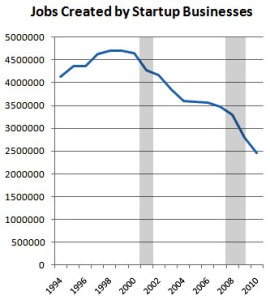 graph out from MoJo. The Dubya years basically killed that phenomenon too so it wasn’t about lowering tax rates, was it?
As this chart from the BLS shows, the number of jobs created by new businesses peaked in 2000, began declining at the start of the Bush administration, and has been plummeting ever since …
So much for that Republican meme. Facts are stubborn things, aren’t they?
This problem is basically due to the inability to govern and make prudent decisions. They’d much rather pump out lies and continue on the same path to destruction. These people ran up tons of debt to fund wars for which they found no funds. This is all about the irresponsible Bush tax cuts that Congress and the Obama administration returned to law in December. The pain for these horrible decisions are about to be extracted on middle and working class Americans who have done absolutely nothing to bring on the recent economic problems and fiscal problems. There has been no bail out or special tax breaks for us. It should be obvious by now that the policies of the last five years have done nothing but improved the situation for the very rich and the very large corporation. Shame on all of those elected officials that go along with this. It is as if they are purposefully setting out to destroy our economy and our way of life. I have no idea why they hold so many of us in contempt but it is obvious that that they prefer the donor class to voters. They seem to want a repeat of the Great Depression. At this rate, that is exactly what they will have.
Like We Need More Austerity …
Posted: April 28, 2011 Filed under: Economy, jobs | Tags: BEA, GDP growth, still feels like a recession, U.S. Economy 19 Comments
Too bad we can't buy some stock in soup kitchens ...
U.S. Economic Growth did exactly what most economists expected during the first quarter of 2011, it slowed substantially. There is some hope that the low rate was due to temporary factors like bad weather and political unrest in the MENA region that’s contributed to higher gas prices.
Of these various economic menaces, the most enduring is probably higher commodity prices, which reduce the amount of pocket money that households and businesses have available to spend on other purchases and, in the case of companies, hires. Gasoline prices have shown little sign of falling in recent weeks, and have nearly neutralized the 2011 payroll tax cuts that were intended as a stimulus.
“Consumers are spending more, but it’s getting soaked up in higher gas prices and higher food prices,” the chief economist at RDQ Economics, John Ryding, said. “That’s not leaving nearly as much left over for discretionary spending.”
Declines in government spending will continue to drag on the economy throughout the year, as strapped state and local governments cut back and the federal government tries to cut down on nonmilitary spending. Last quarter’s steep drop in military spending, which tends to be volatile, will probably reverse itself later in the year, economists said.
It’s pretty easy to tell who is experiencing the worst end of this lackluster recovery. Hint: It’s not the wealthiest Americans. But, if you had any doubts, Wal-Mart reports their shoppers are “running out of money”. Again, there’s low overall inflation but higher gas and food prices make up a large portion of the family budget for ordinary Americans.
Wal-Mart’s core shoppers are running out of money much faster than a year ago due to rising gasoline prices, and the retail giant is worried, CEO Mike Duke said Wednesday.
“We’re seeing core consumers under a lot of pressure,” Duke said at an event in New York. “There’s no doubt that rising fuel prices are having an impact.”
Wal-Mart shoppers, many of whom live paycheck to paycheck, typically shop in bulk at the beginning of the month when their paychecks come in.
Lately, they’re “running out of money” at a faster clip, he said.
“Purchases are really dropping off by the end of the month even more than last year,” Duke said. “This end-of-month [purchases] cycle is growing to be a concern.
This would explain the results of this Gallup Poll where “More than Half Still Say U.S. is in a Recession”. This amount of consumer depression in an economy driven by 70% household spending cannot bode well for future GDP growth. Businesses are expanding overseas and will not create any jobs or businesses here unless they see customers. This, in the Keynesia mold, calls for increased government spending. What we have been getting is decreases in taxes to people whose investments and job creation efforts are going outside of the country. It’s not hard to see why most citizens do not think we’re in any kind of recovery other than a technical one.
More than half of Americans (55%) describe the U.S. economy as being in a recession or depression, even as the Federal Open Market Committee (FOMC) reports that “the economic recovery is proceeding at a moderate pace.” Another 16% of Americans say the economy is “slowing down,” and 27% believe it is growing.
Meanwhile, every one within the D.C. beltway continue to eye the dwindling American safety net with greedy eyes. This has elicited comments from all over but none is perhaps more jaw-dropping than a pronouncement from Former Dubay Treasury Secretary Paul O’Neill who likened Republicans threatening to block the increase in the debt ceiling to Al Qaeda Terrorists. It does indeed seem that Republicans would like to bring on a great depression rather than find middle ground on spending and taxing priorities.
“The people who are threatening not to pass the debt ceiling are our version of al Qaeda terrorists. Really,” O’Neill, Treasury secretary in the Republican administration of George W. Bush, said Wednesday in an interview with Bloomberg Television’s InBusiness with Margaret Brennan.
“They’re really putting our whole society at risk by threatening to round up 50 percent of the members of the Congress, who are loony, who would put our credit at risk,” O’Neill said.
It’s as if our elected officials are deliberately sabotaging the country. The details in the National Income and Spending accounts are given here at the BEA. You can see that we’re not getting stimulus from either Federal Spending, Business Investments or Exports. (There’s a pretty much a wash when you look at Net Exports or you subtract Imports from Exports.)
Real exports of goods and services increased 4.9 percent in the first quarter, compared with an increase of 8.6 percent in the fourth. Real imports of goods and services increased 4.4 percent, in contrast to a decrease of 12.6 percent.
Real federal government consumption expenditures and gross investment decreased 7.9 percent in the first quarter, compared with a decrease of 0.3 percent in the fourth. National defense decreased 11.7 percent, compared with a decrease of 2.2 percent. Nondefense increased 0.1 percent, compared with an increase of 3.7 percent. Real state and local government consumption expenditures and gross investment decreased 3.3 percent, compared with a decrease of 2.6 percent.
The change in real private inventories added 0.93 percentage point to the first-quarter change in
real GDP after subtracting 3.42 percentage points from the fourth-quarter change. Private businesses
increased inventories $43.8 billion in the first quarter, following increases of $16.2 billion in the fourth
quarter and $121.4 billion in the third.
None of this is good news when coupled with the still high rates of unemployment. Despite all these tax cuts, the business sector is clearly not going anywhere. Here’s a link to some further analysis and nifty graphs from Econbrowser. This analysis is particularly germane to our conversation.
Inventory rebuilding and a gain in exports made positive contributions, but these were essentially undone by increases in imports and decreases in government spending. Perhaps the most disappointing detail was investment spending by businesses, which had been making solid contributions to growth the previous three quarters, but was essentially flat for Q1. Housing remains stuck at very low levels, but at least it’s no longer a significant factor dragging the level of GDP down.
But until housing and business investment start making a positive contribution, we’re likely to be disappointed by the employment and GDP reports.
It’s pretty obvious that fiscal policy in this country has gone to VooDoo land because we’re still in deep DooDoo. What we have here is fiscal policy malpractice. Too bad we can’t all join in a massive lawsuit and sue the Congress. Thanks a lot SCOTUS!!!
Misplaced Blame and Impact
Posted: March 14, 2011 Filed under: Bailout Blues, Economy, financial institutions, Global Financial Crisis | Tags: Banksters, credit crunch, U.S. Economy 15 Comments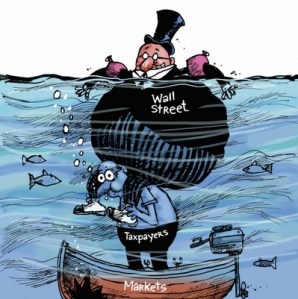 The blame for the worst recession since the The Great Depression clearly rests on the private sector where millions of bad loans and financial innovations turned peoples homes and investments into casino style gambling games. The disastrous lack of regulation, accountability, and common sense is still wrecking havoc on the economy today. The lending industry is still at odds with common sense, community well being, and the national interest. Paul Krugman wrote about this today in his NYT op ed using the academy award winning film Inside Job as the cautionary frame. What is evident in all of this fall out is that the people that deserve the blame are still acting abominably and the people they wronged are still getting the worst end of the deal.
What the film didn’t point out, however, is that the crisis has spawned a whole new set of abuses, many of them illegal as well as immoral. And leading political figures are, at long last, showing some outrage. Unfortunately, this outrage is directed, not at banking abuses, but at those trying to hold banks accountable for these abuses.
The immediate flashpoint is a proposed settlement between state attorneys general and the mortgage servicing industry. That settlement is a “shakedown,” says Senator Richard Shelby of Alabama. The money banks would be required to allot to mortgage modification would be “extorted,” declares The Wall Street Journal. And the bankers themselves warn that any action against them would place economic recovery at risk.
All of which goes to confirm that the rich are different from you and me: when they break the law, it’s the prosecutors who find themselves on trial.
To get an idea of what we’re talking about here, look at the complaint filed by Nevada’s attorney general against Bank of America. The complaint charges the bank with luring families into its loan-modification program — supposedly to help them keep their homes — under false pretenses; with giving false information about the program’s requirements (for example, telling them that they had to default on their mortgages before receiving a modification); with stringing families along with promises of action, then “sending foreclosure notices, scheduling auction dates, and even selling consumers’ homes while they waited for decisions”; and, in general, with exploiting the program to enrich itself at those families’ expense.
The end result, the complaint charges, was that “many Nevada consumers continued to make mortgage payments they could not afford, running through their savings, their retirement funds, or their children’s education funds. Additionally, due to Bank of America’s misleading assurances, consumers deferred short-sales and passed on other attempts to mitigate their losses. And they waited anxiously, month after month, calling Bank of America and submitting their paperwork again and again, not knowing whether or when they would lose their homes.”
There are more issues than just the foreclosure one. Here’s an example of a family fighting to sue BOA for the wrongful death of an elderly man who committed suicide after they recommended investments to him that failed miserably. The family has found out that the man had probably unknowingly signed away the right to sue in the fine print of the investment documents. I can’t imagine any one recommending a portfolio of risky assets to any one over the age of 50, yet this is exactly what BOA did to Mr. Phillip Grossman.
Philip Grossman saved carefully his whole life, never investing in anything more exotic than certificates of deposit. But in June 2007, his longtime banker at a Bank of America branch in Waltham told him he could do better, without taking more risk, and introduced him to a broker at the bank’s investment arm.
Two years later, Grossman, then a 65-year-old computer consultant, and his wife had lost $400,000 — more than half their savings. In despair in the fall of 2009, Grossman checked into a Woburn motel, left his glasses and watch on the desk in his room, and killed himself.
Stunned by the tragedy, his family tried to sue Bank of America, asserting that the broker invested more aggressively than promised, adding to the steep losses and contributing to Grossman’s suicide. But they soon found out they would not get their day in court: The papers the Grossmans signed to open their account required that any dispute go to a private panel of arbitrators.
“They’ve committed a crime against us, as far as I’m concerned,’’ Grossman’s wife, Gail, said in an interview. “Why do we have to go to arbitration? With other crimes you get a trial and a jury. It just seems very unfair to me.’’
The Grossmans’ case shows how entrenched arbitration has become in the financial industry, demonstrating that even in an extreme case alleging wrongful death, aggrieved clients have no recourse other than a system that critics say favors investment firms. Most investors have no idea that when they open a brokerage account, they give up their right to sue, and must, under a 1987 Supreme Court ruling, take complaints to arbitration.
There are more outrages to share with you. Think that having a perfect credit score and a huge down payment will get you a loan these days if you’re a consumer? Think again. Banks are lending to junk bond quality businesses while denying the best of households basic mortgages. The recovery is not just around the corner for the majority of US households for many reasons. Government help has been concentrated at reaching banks and businesses. This is not translating into improvement for all.
The consumer loan market, particularly housing, remains a challenge for borrowers. Total U.S. consumer credit outstanding was $2.4 trillion in January, or 6.6 percent below its July 2008 level, the Fed said in a March 7 report. Total housing debt has declined by $536 billion since 2008 to $10.1 trillion, Fed data show. The median price of an existing U.S. home has dropped 13 percent since June to $158,800, bringing its decline since July 2006 to 31 percent, according to the Chicago-based National Association of Realtors. About 10.8 million homes were worth less than the debt owed on them in the third quarter, research firm CoreLogic Inc. said in a Dec. 13 report.
By contrast, the least creditworthy corporations have been able to borrow record amounts at the cheapest rates ever. Junk- rated companies sold an unprecedented $287.6 billion in bonds in 2010 and are setting an even faster pace of issuance this year. Claire’s Stores Inc., the costume jewelry retailer that had debt that was almost 10 times its earnings last year, sold $450 million of bonds last month that Moody’s Investors Service gave its third-lowest rating.
There are several other disturbing figures in the Bloomberg article quoted directly above.
The U.S. economy grew at a 2.8 percent annual rate in the fourth quarter, slower than previously calculated, and is forecast to expand 3.2 percent this year, according to the median estimate of 66 economists in a Bloomberg survey.
Household purchases account for about 70 percent of the U.S. economy, making the consumer the single biggest driver of any economic recovery. Those consumers “stumbled at bit” at the start of this year, Michael Feroli, chief U.S. economist at JPMorgan Chase & Co. in New York, said in a February note.
While the economy expanded and companies are beginning to spend more, the improvements haven’t driven the nation’s unemployment rate below 8.9 percent for almost two years and the Conference Board’s gauge of consumer confidence is still 37 percent below the level reached in July 2007.
“The 2007-2009 recession period looks different from previous economic cycles,” John McElravey, a bond analyst at Wells Fargo Securities LLC in Charlotte, North Carolina, said in a March 8 report. “Consumer credit outstanding contracted much more sharply than in other periods, and the return to positive growth rates has been relatively slow.”
There are so many things different and bad with this recovery that it is indeed troubling. Perhaps the most important factor is that government is clearly not helping homeowners, the jobless, and the many families who have lost wealth via the crash in home values and their investments. The focus of bailouts has been on banks and businesses that have not used the funds to benefit their communities. Something is clearly wrong here with policy priorities when you’re not focused on the major source of consumption in a consumer-drive economy.
Not only is policy not aimed at the majority of people in the country, the focus in the District is now clearly turning to austerity measures and turning neighbor against neighbor. I can’t tell you exactly how worried I am that a huge number of households will still be in trouble come the next recession. Here’s another opinion on that very subject from E.J. Dionne Jr. at WAPO.
A phony metaphor is being used to hijack the nation’s political conversation and skew public policies to benefit better-off Americans and hurt most others.We have an 8.9 percent unemployment rate, yet further measures to spur job creation are off the table. We’re broke, you see. We have a $15 trillion economy, yet we pretend to be an impoverished nation with no room for public investments in our future or efforts to ease the pain of a deep recession on those Americans who didn’t profit from it or cause it in the first place.
As Sen. Al Franken (D-Minn.) pointed out in a little-noticed but powerful speech on the economy in December, “during the past 20 years, 56 percent of all income growth went to the top 1 percent of households. Even more unbelievably, a third of all income growth went to just the top one-tenth of 1 percent.” Some people are definitely not broke, yet we can’t even think about raising their taxes.
By contrast, Franken noted that “when you adjust for inflation, the median household income actually declined over the last decade.” Many of those folks are going broke, yet because “we’re broke,” we’re told we can’t possibly help them.
That’s the new excuse. We could help Chrysler. We could help GM. We could help the financial institutions and Wall Street. We could invade Iraq and Afghanistan to help them. We could do all that, but now we’re too broke to help ordinary Americans. It’s obvious that the financial institutions are doing nothing to improve the situation. It’s also pretty obvious that Iraq and Afghanistan are money pits. When do we get the government to quit throwing our money to rich people and businesses? When do we get them to stop blaming teachers, firefighters, and police offers for taking up too much of the pie? When do we actually start looking at the real numbers and the real culprits who took all this vast wealth and continue to ensure the rules only benefit the few?
Thursday Reads
Posted: January 20, 2011 Filed under: U.S. Economy, U.S. Politics | Tags: Christian fundamentalists, financial regulation, Goldman Sachs, Governor of Alabama, health care reform bill, Jerad Loughner, Robert Bentley, snow, Tucson shooting, U.S. Economy, U.S. Politics, weather 35 Comments
Good Morning!! Let’s see what’s going on out there in the world.
A federal grand jury has indicted Tucson shooter Jerad Loughner.
Jared Loughner was indicted by a federal grand jury Wednesday in Tucson on a three-count indictment for attempting to kill U.S. Rep. Gabrielle Giffords and two of her aides, Pamela Simon and Ron Barber. The announcement came from U.S. attorney Dennis K. Burke’s office.
Burke said, “This case also involves potential death-penalty charges, and Department rules require us to pursue a deliberate and thorough process. [Wednesday]’s charges are just the beginning of our legal action. We are working diligently to ensure that our investigation is thorough and that justice is done for the victims and their families.”
According to the indictment, Loughner, 22, attempted to assassinate Gabrielle Giffords, a member of Congress, and attempted to murder two federal employees, Ron Barber and Pamela Simon.
A conviction for attempted assassination of member of Congress carries a maximum penalty of life in prison, a $250,000 fine or both, according to Burke’s office.
That happened really quickly, didn’t it?
Have you heard there’s more snow coming for the Midwest and Northeast? Oh joy. Right now they are saying 3-5 inches for Boston. That’s not too bad, except for the fact that we already about about 2-1/2 feet piled up everywhere. Oh well… check the story to see what might be coming your way.
According to the Wall Street Journal, poor poor Goldman Sachs is hurting.
Goldman Sachs Group Inc.’s profit slide of 52% in the fourth quarter showed the securities giant’s size and swagger aren’t enough for it to escape the tightening squeeze of a regulatory overhaul and jittery clients and investors.
The New York company suffered its third quarterly profit decline in a row, hurt by lower revenue from its vaunted trading and investment-banking businesses. Fourth-quarter net income fell to $2.39 billion, or $3.79 a share, from $4.95 billion, or $8.20 a share, a year earlier.
Oh those nasty regulations! Is anything like that really happening? I’m confused. Oh wait. It’s not really regulations, it’s just the Wall Streeters’ fears of risk or something.
Like its rivals, Goldman is being hurt by the reluctance of many institutional investors, wealthy individuals, companies and other clients to take risks because they still are reeling from losses during the crisis. Hedge funds are weaning themselves from some of the leverage used to make big bets, and U.S. companies are holding more than $2 trillion in stagnant cash.
As a result, demand for the vast inventory of stocks, bonds and other investments that Goldman buys and sells on behalf of customers, generating commissions and other fees for the firm, fell in the latest quarter. Trading-related revenue shrank 31% to $3.64 billion from $5.25 billion in 2009’s fourth quarter.
Whatever… A bunch of rich people whining. Just what you wanted to hear about with your morning coffee, I’ll bet.
The Governor of Alabama doesn’t consider me among his brothers and sisters. Shock!
Alabama Republican Governor Robert Bentley said in a Martin Luther King Jr. Day message Monday that he does not consider Americans who do not accept Jesus Christ as their savior to be his brothers and sisters.
“There may be some people here today who do not have living within them the Holy Spirit,” Bentley said shortly after taking the oath of office, according to the Birmingham News. ”But if you have been adopted in God’s family like I have, and like you have if you’re a Christian and if you’re saved, and the Holy Spirit lives within you just like the Holy Spirit lives within me, then you know what that makes? It makes you and me brothers. And it makes you and me brother and sister.”
”Now I will have to say that, if we don’t have the same daddy, we’re not brothers and sisters,” he continued. “So anybody here today who has not accepted Jesus Christ as their savior, I’m telling you, you’re not my brother and you’re not my sister, and I want to be your brother.”
Awww… I’m really hurt.
Didja hear the new Republican House voted to repeal the useless Republican style health care non-reform bill?
The vote passed Wednesday 245-to-189 — with unanimous GOP support, plus three Democrats. But the repeal bill is destined to die in the Senate, so Republicans will use their newly acquired power in the House to wage a long-term campaign to weaken the law.
The next steps — hearings, testimony from administration officials, funding cuts — lack the punch of a straight repeal vote, but Republicans said they will keep at it, hoping the end result is the same: stalling implementation of the $900 billion law.
Republicans promise to hold a series of hearings and oversight investigations into the law, attempt to repeal individual provisions and craft an alternative health care plan. Some of the first issues they will tackle are the cost of the law, the mandate on larger employers to provide coverage and the impact of the legislation on the states.
But the GOP is expected to be thwarted at every turn by the Democratic-controlled Senate — and ultimately President Barack Obama, who has said he is willing to “improve” the law but “we can’t go backward.”
{HUGE YAWN}
At least while they’re fooling around with Obamacare, they’re not repealing Social Security….
Sooooo…. what are you reading this morning? Anything cheerful happening?
Late Night Drift
Posted: January 19, 2011 Filed under: Barack Obama, U.S. Economy, U.S. Politics | Tags: Barack Obama, Christina Romer, jobs, Larry Summers, New York Times Magazine, Obama economic team, U.S. Economy, U.S. Politics, unemployment 16 Comments
I’ll bet Dakinikat can’t wait to start plowing through the New York Times Magazine’s cover story this week: The White House Looks for Work: Inside Obama’s Struggle to Bring Down Unemployment, by Peter Baker.
Who knew Obama was involved in a struggle over jobs? As far as I can tell jobs are about the last thing on Obama’s mind. But what do I know? Apparently, there has been a life and death struggle going on within the President’s economic team over jobs.
Let me just buy them a clue: the answer isn’t cutting the deficit and wiping out the social safety net. Anyway, back to the Caucus blog’s preview of the upcoming NYT mag story and some of the “surprisingly newsy nuggets” we can look forward to reading on Sunday morning.
Mr. Baker writes that the president’s economic team “fractured repeatedly over philosophy (should jobs or deficits take priority?) and personality (who got to attend which meetings?), resulting in feuds that ultimately helped break it apart.”
Wait…that’s news?
The most sensible “tidbit” in the article comes from Christina Romer.
“In Washington, she said, ‘you’re not supposed to say the obvious thing, which is that in retrospect of course it should have been bigger. With unemployment at 10 percent, I don’t know how you could say you wouldn’t have done anything different. Of course you would have made it bigger.’”
— In the article, Ms. Romer said the Obama administration should have gone back to Congress for more stimulus money to bolster the economy when it was clear how bad things really were.
He writes: “‘In my mind,’ she said, ‘the problem was not in the original package; it was in not adjusting to changed circumstances.’ Once it was clear that the situation was deteriorating, she said, the White House should have gone back to Congress for more stimulus money. ‘That was where we could have been bolder,’ she said.”
Duh. For that kind of truth-telling, you get sent to Siberia UC Berkeley.
There’s a supposedly funny story about Larry Summers that I don’t understand. Can someone explain it to me?
Mr. Baker offers this fun tidbit about Mr. Summers: “Tan from a holiday in Jamaica and trying to get his bearings again at Harvard, where he plans to teach a course on Obama’s economic policy and write a book, Summers sat at a corner table and ordered bisque and — from the lighter-fare menu — a steak ‘as rare as your chef will make it.’”
On second thought, maybe Dak should skip the NYT mag article. If these are the highlights, it sounds like a crashing bore. And I didn’t see anything about jobs in there either.

 peej
peej Carissa
 bostonboomer
 dakinikat
 ecocatwoman
 mablue2
 Mama Lopez
 peggysue22
 quixote
 skydancingguestblogger
 Mona (aka Wonk the Vote)



 Sky Dancing
Recent Comments