I didn’t think there would be much to write about today after Dakinikat’s post last night, but there actually are a whole lot of things happening–far more than I can cover here. With Trump, it’s always maximum chaos every day of the week. Here are some of the stories that captured my interest this morning.
The effects of Trump’s tariffs
We’ve seen the last of the ships without massive tariffs arriving in U.S. ports, and now we’re seeing the results of Trump’s insane policies.
On Friday morning, West Coast port officials told CNN about a startling sight: Not a single cargo vessel had left China with goods for the two major West Coast ports in the past 12 hours. That hasn’t happened since the pandemic.
Six days ago, 41 vessels were scheduled to depart China for the San Pedro Bay Complex, which encompasses both the Port of Los Angeles and Port of Long Beach in California. On Friday, it was zero.
President Donald Trump’s trade war imposed massive tariffs on most Chinese imports last month. That’s led to fewer ships at sea carrying less cargo to America’s ports. For many businesses, it is now too expensive to do business with China, one of America’s most important trading partners.
Officials are concerned not just about the lack of vessels leaving China, but the speed at which that number dropped.
“That’s cause for alarm,” said Mario Cordero, the CEO of the Port of Long Beach. “We are now seeing numbers in excess of what we witnessed in the pandemic” for cancellations and fewer vessel arrivals.
The busiest ports in the country are experiencing steep declines in cargo. The Port of Long Beach is seeing a 35-40% drop compared to normal cargo volume. The Port of Los Angeles had a 31% drop in volume this week, and the Port of New York and Jersey says it’s also bracing for a slowdown. On Wednesday, the Port of Seattle said it had zero container ships in the port, another anomaly that hasn’t happened since the pandemic….
“If things don’t change quickly, I’m talking about the uncertainty that we’re seeing, then we may be seeing empty products on the shelves. This is now going to be felt by the consumer in the coming 30 days,” said Cordero….
That doesn’t sound good to me, but Trump thinks it’s great.
As logistics professionals sound the alarms on emptying U.S. ports as a result of steep tariffs, President Donald Trump said those major import slowdowns are actually a boon.
Following Trump’s introduction of sweeping tariffs, shipping volumes have fallen considerably, according to data from container-tracking software company Vizion. In the period between the five weeks before and five weeks after Trump introduced and implemented his tariff plan, virtually all major U.S. ports saw a decline in the number of container books. The Port of Portland in Oregon saw a 50% drop in exports, and the Port of Los Angeles, the U.S.’s largest outpost, had 17% lower exports. From the week ending April 28, Vizion reported a 43% week-over-week decrease in containers.
By Yayoi Kusama
Port of Los Angeles executive director Gene Seroka warned last month of a “precipitous drop” in shipping volumes, saying American retailers will have fully stocked shelves for only about another six weeks.
Trump not only acknowledged the shipping slowdown in a Thursday press briefing announcing a trade deal with the UK; he seemed heartened by it.
“We’re seeing as a result that ports here in the U.S., the traffic has really slowed and now thousands of dockworkers and truck drivers are worried about their jobs,” a reporter said in the press briefing.
“That means we lose less money,” Trump said. “When you say it slowed down, that’s a good thing, not a bad thing.”
He really is the stupidest president in the 250-year history of this country. He thinks it’s a good that longshore workers, truck drivers, and workers at package delivery companies like UPS and Amazon are going lose their jobs? That store shelves will be empty? That small businesses will quickly go bankrupt? He’s a fucking moron.
The Wharton School at the University of Pennsylvania release an analysis of the economic effects of the Trump’s tariffs. Here’s the introductory summary:
Summary: Many trade models fail to capture the full harm of tariffs. PWBM projects Trump’s tariffs (April 8, 2025) will reduce long-run GDP by about 6% and wages by 5%. A middle-income household faces a $22K lifetime loss. These losses are twice as large as a revenue-equivalent corporate tax increase from 21% to 36%, an otherwise highly distorting tax.
Key Points
Revenue Impact: President Trump’s tariff plan (as of April 8, 2025) is projected to raise significant revenue—over $5.2 trillion over 10 years on a conventional basis (with micro-elastic responses) and $4.5 trillion on a dynamic basis (with economic effects). This revenue could be used to reduce federal debt, thereby encouraging private investment.
Comparison with a Corporate Tax Increase: Tariffs are estimated to raise about the same amount of revenue as increasing the corporate income tax from 21 to 36 percent, in the absence of these recent tariffs. While raising the corporate tax rate is generally seen as highly economically distorting, tariffs would reduce GDP and wages by more than twice as much. All future households are worse off. The estimated economic declines are likely lower bounds, with actual declines potentially even larger.
Broader Economic Impact: Many existing trade and macroeconomic models fail to capture the full harm caused by tariffs. Larger tariffs reduce the openness of the economy, including international capital flows. This is especially costly under the nation’s current baseline debt path, which is increasing faster than GDP, that is generally excluded from trade models or treated as neutral (Ricardian). U.S. households would need to purchase more bonds, requiring bond prices to fall (yields increase), domestic capital investment prices to fall (the marginal product of capital increases), or both. Even conservatively assuming only domestic capital investment prices fall, the reduction in economic activity is more than twice as large as a tax increase on capital returns that raises the same amount of revenue.
I’m sure Trump hasn’t seen this report and wouldn’t understand it if he did.
Xi Jinping has been preparing for this moment for years.
In April 2020, long before President Trump launched a trade war that would shake the global economy, China’s top leader held a meeting with senior Communist Party officials and laid out his vision for turning the tables on the United States in a confrontation.
Tensions between his government and the first Trump administration had been simmering over an earlier round of tariffs and technology restrictions. Things got worse after the emergence of Covid, which ground global trade to a halt and exposed how much the United States, and the rest of the world, needed China for everything from surgical masks to pain medicines.
Cat catching mouse, by Koson Ohara
Faced with Washington’s concerns about the trade imbalance, China could have opened its economy to more foreign companies, as it had pledged to do decades ago. It could have bought more American airplanes, crude oil and soybeans, as its officials had promised Mr. Trump during trade talks. It could have stopped subsidizing factories and state-owned companies that made steel and solar panels so cheaply that many American manufacturers went out of business.
Instead, Mr. Xi chose an aggressive course of action.
Chinese leaders must “tighten international production chains’ dependence on our country, forming a powerful capacity to counter and deter foreign parties from artificially disrupting supplies” to China, Mr. Xi said in his speech to the Central Financial and Economic Affairs Commission in 2020.
Put simply: China should dominate supplies of things the world needs, to make its adversaries think twice about using tariffs or trying to cut China off.
A bit more:
Mr. Xi has ramped up exports and deepened China’s position as the world’s leading base for manufacturing, in part by directing the state-controlled commercial banking system to lend an extra $2 trillion to industrial borrowers over the past four years, according to data from China’s central bank. He has also introduced new weapons of economic warfare to the country’s arsenal: export controls, antimonopoly laws and blacklists for hitting back at American companies.
So when the current Trump administration slapped huge tariffs on Chinese goods, China was able to go on the offensive. Besides retaliating with its own taxes, it imposed export restrictions on a wide range of critical minerals and magnets, the global supply of which China had cornered. Such minerals are essential for assembling everything from cars and drones to robots and missiles.
In the United States, the looming threat of empty store shelves and higher consumer prices is putting pressure on the Trump administration. The prices of some critical minerals have tripled since China unveiled its curbs, according to Argus Media, a London commodities research firm.
“It’s about flipping the leverage so that the world is reliant on China, and China is reliant on no one. It is a reversal of what Xi has been so irritated about, which is that China was so dependent on the West,” said Kirsten Asdal, a former intelligence adviser at the U.S. Department of Defense who now heads a China-focused consultancy firm, Asdal Advisory.
Trump’s attitude toward natural disasters
We’re approaching hurricane season, and it looks like states are going to be on their own when such disasters hit. Here’s the latest on Trump’s plans for FEMA.
The acting administrator of the Federal Emergency Management Agency has been fired one day after he broke with fellow members of the administration when he told lawmakers he does not support dismantling the agency, a Department of Homeland Security spokesperson confirmed to CNN.
Cameron Hamilton, who was appointed by President Donald Trump, was escorted out of FEMA’s headquarters on Thursday, according to multiple sources familiar with the situation.
“It’s at the discretion of (Homeland Security Secretary Kristi Noem) to have the personnel she prefers,” DHS spokesperson Tricia McLaughlin told CNN, confirming that DHS official David Richardson will take over for Hamilton effective immediately. McLaughlin declined to explain why Hamilton was removed from the post.
The move comes one day after Hamilton defended FEMA during testimony in front of the House Appropriations Committee.
Woman and Cat, by Ukiyo-e Kuniyoshi
“As the senior advisor to the President on disasters and emergency management, and to the Secretary of Homeland Security, I do not believe it is in the best interest the American people to eliminate the Federal Emergency Management Agency,” Hamilton told the committee Wednesday. “Having said that, I am not in a position to make decisions and impact outcomes on whether or not a determination as consequential as that should be made. That is a conversation that should be had between the President of the United States and this governing body.”
For months, both Trump and Noem, whose Department of Homeland Security oversees FEMA, have called for the agency to be “eliminated.” On Tuesday, Noem reaffirmed that stance when she took questions from the same House committee.
“President Trump has been very clear since the beginning that he believes that FEMA and its response in many, many circumstances has failed the American people, and that FEMA, as it exists today, should be eliminated in empowering states to respond to disasters with federal government support.” Noem told the committee.
The new head of the federal agency tasked with responding to disasters across the country warned staff in a meeting Friday not to try to impede upcoming changes, saying that “I will run right over you” while also suggesting policy changes that would push more responsibilities to the states.
David Richardson, a former Marine Corps officer who served in Afghanistan, Iraq and Africa, was named acting administrator of the Federal Emergency Management Agency on Thursday just after Cameron Hamilton, who’d been leading the agency, also in an acting role, was fired.
Richardson has been the Department of Homeland Security’s assistant secretary for countering weapons of mass destruction. He does not appear to have any experience in managing natural disasters, but in an early morning call with the entire agency staff he said that the agency would stick to its mission and said he’d be the one interpreting any guidance from President Donald Trump.
Prefacing his comments with the words “Now this is the tough part,” Richardson said during the call with staffers across the thousands-strong agency that he understands people can be nervous during times of change. But he had a warning for those who might not like the changes — a group he estimated to be about 20% of any organization.
“Don’t get in my way if you’re those 20% of the people,” he said. “I know all the tricks.”
“Obfuscation. Delay. Undermining. If you’re one of those 20% of the people and you think those tactics and techniques are going to help you, they will not because I will run right over you,” he said. “I will achieve the president’s intent. I am as bent on achieving the president’s intent as I was on making sure that I did my duty when I took my Marines to Iraq.”
He sounds nice. On his plans for the future:
In a preview of what might be coming in terms of changes in policy, Richardson also said there would be more “cost-sharing with the states.”
“We’re going to find out how to do things better, and we’re going find out how to push things down to the states that should be done at the state level. Also going to find out how we can do more cost sharing with the states,” he said.
This issue — how much states, as opposed to the federal government, should pay for disaster recovery — has been a growing concern, especially at a time of an increasing number of natural disasters that often require Congress to repeatedly replenish the federal fund that pays for recovery.
But states often argue that they are already paying for most disaster recoveries on their own and are only going to the federal government for those events truly outside of their ability to respond.
Read more at the AP link.
Trump’s latest Surgeon General appointment
Supposedly, Trump appointed a woman who is not a doctor at the behest of Robert F. Kennedy Jr., but allies of Kennedy argue that she’s not radical enough.
The backlash to President Donald Trump’s new surgeon general nominee, an ally of Health and Human Services Secretary Robert F. Kennedy Jr., has exposed divisions in the nascent “Make America Healthy Again” movement as it gains political power.
By Katzuaki Horitomo Kitamura
Casey Means, the nominee, has been a central figure in the movement and key Kennedy ally. She promotes diet as a root cause of illness and chronic disease, echoing Kennedy’s focus on nutrition.
Trump praised Means as someone who holds “impeccable MAHA credentials,” but influential people in Kennedy’s orbit countered that she is insufficiently devoted to opposing vaccines, criticizing Means within hours of the announcement and describing her as unqualified.
In posts on X, the primary social media platform for the anti-vaccine movement, some vocal allies of Kennedy’s said the selection shows he lacks influence in the Trump administration.
“The new Surgeon General has never called for the COVID shots to be pulled off the market. That’s why she was picked,” Mary Talley Bowden, founder of the anti-coronavirus vaccine group Americans for Health Freedom, posted on X. “Kennedy is powerless.”
Good grief! This is worse than I ever imagined.
The conflict over the nominee for a lower-profile federal office reflects broader tensions over who wields influence in developing administration health policy and how far Kennedy must go to satisfy the demands of his MAHA movement. The surgeon general’s main role is as the nation’s family doctor, using a bully pulpit to dispense advice on smoking, loneliness, gun violence, alcohol and other health matters. It is a powerful platform, one that can help shape Americans’ views on important medical questions.
“This is really the first big fracture,” said Tara C. Smith, professor of epidemiology at Kent State University College of Public Health, who monitors anti-vaccine activists.“The surgeon general is the one who is usually out there and the face of the administration.”
As Means came under online assault, Kennedy posted twice on X in her defense on Thursday, calling her a “juggernaut against the ossified medical conventions.” He said the attacks were driven by “entrenched interests” and “industry-funded social media gurus,” though much of the criticism came from his own supporters.
“The goal of MAHA is to reform the largest and most powerful industry in the United States,” Kennedy said in a lengthy afternoon post, referring to the movement he developed during his unsuccessful presidential campaign. “I have little doubt that these companies and their conflicted media outlets will continue to pay bloggers and other social media influencers to weaponize innuendo to slander and vilify Casey, the same way they try to defame me and President Donald Trump.
The insane people have truly taken over our government.
President Trump ordered the Department of Homeland Security on Friday to increase the deportation force of the United States by 20,000 officers, a move that would lead to an enormous expansion of immigration enforcement if realized.
Japanese Girl with Cat, by Tsukioka Yoshitoshi
In a provision tucked into a presidential proclamation focused on pushing undocumented immigrants to leave the country voluntarily, Mr. Trump called on the Department of Homeland Security to soon begin “deputizing and contracting with state and local law enforcement officers, former federal officers, officers and personnel within other federal agencies, and other individuals.”
It was unclear how such an effort would be funded, one of several major logistical hurdles to such a large operation. There are now around 6,000 officers focused on deportation efforts at Immigration and Custom Enforcement.
Mr. Trump has pushed to deputize state and local law enforcement officers for immigration enforcement before, and Department of Homeland Security officials have already signed a series of agreements with local law enforcement in the months since took office. Late last month, local law enforcement officials in Florida assisted ICE in an operation that led to the arrest of more than 1,100 migrants across the state.
The Trump administration has spent the past few months attempting to make good on the president’s promise of mass deportations by conducting sweeping raids in major cities, arresting international students and allowing officers more freedom where they make arrests, like in courthouses. But it has still struggled to reach the pace that would be necessary for Mr. Trump’s expansive deportation goals.
In recent weeks, the Trump administration has turned to pushing for migrants to leave the country on their own accord, a concept known as “self-deportation.” Earlier this week, department officials said they would pay migrants $1,000 and the cost of their travel if they left the country voluntarily and used a government app to do so.
In his proclamation Friday, Mr. Trump repeated that call, labeling it “project homecoming.”
A fundamental promise by America’s founders — that no one should be punished by the state without a fair hearing — is under threat, a growing chorus of federal judges say.
That concept of “due process under law,” borrowed from the Magna Carta and enshrined in the Bill of Rights, is most clearly imperiled for the immigrants President Donald Trump intends to summarily deport, they say, but U.S. citizens should be wary, too.
Little girl with umbrella and cat, by Ukiyo-E
Across the country, judges appointed by presidents of both parties — including Trump himself — are escalating warnings about what they see as an erosion of due process caused by the Trump administration’s mass deportation campaign. What started with a focus on people Trump has deemed “terrorists” and “gang members” — despite their fierce denials — could easily expand to other groups, including Americans, these judges warn.
“When the courts say due process is important, we’re not unhinged, we’re not radicals,” U.S. District Judge Ana Reyes, a Washington, D.C.-based appointee of President Joe Biden, said at a recent hearing. “We are literally trying to enforce a process embodied in probably the most significant document with respect to peoples’ rights against tyrannical government oppression. That’s what we’re doing here. Okay?”
It’s a fight that judges are increasingly casting as existential, rooted in the 5th Amendment’s guarantee that “no person shall … be deprived of life, liberty or property, without due process of law.” The word “person,” courts have noted, makes no distinction between citizens or noncitizens. The Supreme Court has long held that this fundamental promise extends to immigrants in deportation proceedings. In a 1993 opinion, Justice Antonin Scalia called that principle “well-established.” [….]
“If today the Executive claims the right to deport without due process and in disregard of court orders, what assurance will there be tomorrow that it will not deport American citizens and then disclaim responsibility to bring them home?” wondered J. Harvie Wilkinson, a Ronald Reagan appointee to the Richmond-based 4th Circuit Court of Appeals. Wilkinson described an “incipient crisis” but also an opportunity to rally around the rule of law.
That’s all I have for today. What stories are you following?
Did you like this post? Please share it with your friends:
Every time I get the grocery list together these days, I think about what I need to bulk order. It’s really hard to look at a finished consumer good and find all the value-added producers along with their various locations. I wonder how the distributors are going to sort this all out. I noticed prices creeping up in the usual items. I’m pretty sure my sister has hit Costco by now and filled up the pantry. I also watched the last of the Jazz Festers leave with relief. I bet this was their last jaunt of the year. You can see it in the numbers.
USA Today had this analysis by Betty Lin-Fisher. “How will Trump’s tariffs affect grocery store prices? We explain.”
While higher tariffs could still be coming after a 90-day-pause, the baseline 10% tariff on all goods, plus higher duties on Chinese products already in effect are a big increase in food costs for American’s budgets, said Thomas Gremillion, director of food policy at The Consumer Federation of America.
“The 10% ‘default’ tariffs alone represent a truly historic federal tax increase, maybe the largest in my lifetime, with a highly regressive impact,” Gremillion said.
The tariff only applies to the value of the product at the border, Ortega said. Then there are additional costs to the product, which are accrued domestically, like transporting the goods to the store, distribution, wholesale costs and retail markups. Those things are not subject to the tariff, Ortega said.
So that doesn’t mean that the price of a particular product will go up by 10% or whatever the tariff is, Ortega said.
Overall, 15% of the U.S. food supply is imported, including 32% of fresh vegetables, 55% of fresh fruit, and 94% of seafood, according to the Consumer Federation of America, citing the U.S. Food and Drug Administration. Some products, like coffee and bananas, are almost exclusively grown abroad.
Tariffs are causing uncertainty from families checking off their grocery lists to companies importing food, he said.
“For consumers, this can mean added difficulties in managing a food budget. For food companies, this means havoc on supply chains that could lead to more food waste and more food safety risk,” Gremillion said.
Did I mention the youngest son-in-law is a biomedical engineer who is in charge of designing medical, surgical, and prosthetic devices? Plus, the oldest daughter and son-in-law are doctors. It’s just me and my youngest daughter out here trying to figure out what the economy and financial markets are experiencing. The others are just trying to deal with that, and the usual helpful regulations are being replaced with crazy ones.
Since Trump took office in late January, multiple Food and Drug Administration webpages were removed (and then restored); employees were fired from the Center for Devices and Radiological Health (and some were asked back); and the Department of Health and Human Services unveiled a plan to lay off approximately 10,000 employees, including about 3,500 at the FDA.
Meanwhile, the economy has whipsawed due to an unpredictable and aggressive tariff strategy. Later, however, pieces were delayed or walked back.
The Trump administration has reshaped the medtech industry in significant ways, and potentially long-term, in just a few months. Now that Trump has settled into power, new questions have arisen about what the many changes will mean for companies and patients, and what’s coming next.
Tom Toles Editorial Cartoon
Also, lucky us, Medicare and Medicaid modernization with be the goal of TV snake oil salesman Dr. Mehmet Oz as he takes over both. This is also from the MEDTECHDIVE.
Dr. Mehmet Oz was sworn in as the Centers for Medicare and Medicaid Services administrator on April 18, cementing his role as head of the agency that provides insurance coverage to millions of Americans.
During a ceremony at the Oval Office, Oz, a physician and former TV personality, said he wanted to “save” the nation’s public health programs and focus on reducing chronic disease, “modernizing” Medicare and Medicaid, and targeting fraud, waste and abuse in government insurance offerings.
President Donald Trump reiterated that Republicans wouldn’t cut Medicare or Medicaid. “Just as I promised, there will be no cuts. We’re not going to have any cuts. We’re going to have only help,” he said during the ceremony.
As I’ve spent most of this year being poked, prodded, pricked, shocked, MRI’d, Ultrasound’d, and EMG’d, I sure don’t feel good about any of this. I fret about someone disappearing all of that, plus my Social Security.
Speaking of crazy policy, I happened on this last night. This is from NBC News. “Trump says he will reopen ‘enlarged and rebuilt’ Alcatraz prison. Alcatraz Island hasn’t been used as a federal penitentiary since 1963. It had a capacity of roughly 300 people.” I’m actually thinking this is another one of his threats to Judges since it’s way too small to hold many prisoners. I suppose that’s one way to destroy a national park and the US Constitution in one sweep.
Alcatraz Island, a former military fortress and prison in San Francisco Bay, was turned into a federal penitentiary in 1934 and over the course of 29 years housed more than 1,500 people “deemed difficult to incarcerate elsewhere in the federal prison system,” according to the National Park Service.
According to aNational Park Service study, it was initially deemed unfit to serve as a federal institution because of its small size, isolated location and lack of fresh water. However, Sanford Bates, the director of the Bureau of Prisons in 1933,later found it “an ideal place of confinement for about 200 of the most desperate or irredeemable types.” It was formally opened as a federal penitentiary the next year.
Trump suggested in his post that he’d like to restore the facility to that purpose.
This is from Ed Mazza writing for HuffPo. This sounds a lot like his real estate deals to me. “‘Clearly Unhinged’: Critics Sink Trump’s ‘Asinine’ Plan To Reopen Alcatraz Prison. The president wants to turn the site back into a penitentiary despite the fact that it would cost a fortune.”
Alcatraz is currently part of Golden Gate National Recreation Area and has about 1.2 million visitors per year. Those who tour the island in San Francisco Bay see facilities in various states of decay. The prison was crumbling even as it was still in operation, and the high cost of maintaining it was a key reason it was shuttered in 1963.
Given those realities, restoring Alcatraz and then expanding it, as Trump called for on his Truth Social platform, would likely cost a fortune ― and then another pile of cash would be needed to maintain it.
Reopening it as a prison would also mean the loss of the tourism revenue the island currently generates as well as a loss of habitat for its thriving bird population.
The president, however, said Alcatraz’s return to use as a prison would “serve as a symbol of Law, Order, and JUSTICE.”
His critics fired back that the idea would be an expensive boondoggle:
President Donald Trump is opening a new salvo in his tariff war, targeting films made outside the U.S.
In a post Sunday night on his Truth Social platform, Trump said he has authorized the Department of Commerce and the Office of the U.S. Trade Representative to slap a 100% tariff “on any and all Movies coming into our Country that are produced in Foreign Lands.”
“The Movie Industry in America is DYING a very fast death,” he wrote, complaining that other countries “are offering all sorts of incentives to draw” filmmakers and studios away from the U.S. “This is a concerted effort by other Nations and, therefore, a National Security threat. It is, in addition to everything else, messaging and propaganda!”
The White House said Monday that it was figuring out how to comply with the president’s wishes.
“Although no final decisions on foreign film tariffs have been made, the Administration is exploring all options to deliver on President Trump’s directive to safeguard our country’s national and economic security while Making Hollywood Great Again,” said spokesperson Kush Desai.
It’s common for both large and small films to include production in the U.S. and in other countries. Big-budget movies like the upcoming “Mission: Impossible — The Final Reckoning,” for instance, are shot around the world.
On Sunday, NBC News aired an interview with Trump in which he expressed ignorance of the black-letter standards of justice established in the country’s founding document.
“The Constitution says every person, citizens and noncitizens, deserve due process,” “Meet the Press” host Kristen Welker pointed out. So why not bring Abrego García back to the U.S. and use legal avenues to potentially remove him?
“Well,” Trump replied, “I’ll leave that to the lawyers, and I’ll leave that to the attorney general of the United States.”
Welker noted that Secretary of State Marco Rubio had admitted that even immigrants had due process rights. Trump again downplayed the idea, saying that holding hearings would mean “we’d have to have a million or 2 million or 3 million trials.” This isn’t as big a hurdle as it may sound. In fiscal 2024, there were more than 900,000 immigration hearings completed. So far in fiscal 2025, there have been more than 460,000. More could be cleared if Trump hadn’t moved to fire a number of immigration judges.
Finally, Welker noted that Trump didn’t really have a choice.
“Even given those numbers that you’re talking about,” she asked, “don’t you need to uphold the Constitution of the United States as president?”
“I don’t know,” Trump replied. “I have to respond by saying, again, I have brilliant lawyers that work for me, and they are going to obviously follow what the Supreme Court said.”
You may recall that, in January, Trump put his hand on a Bible and affirmed to Chief Justice John G. Roberts Jr. that he would “faithfully execute” his role as president and to the best of his “ability, preserve, protect and defend the Constitution of the United States.” But this has never been an oath he has appeared to actually take to heart.
Trump’s dismissiveness of the Constitution has manifested itself in a lot of ways. You may recall his lack of interest in leaving office when he lost the 2020 presidential election. You may be aware that he has readily, if not giddily, accepted personal income from foreign governments while serving as president. He views the law as a cudgel, not a constraint, issuing pardons for variouspolitical allies ensnared in criminal activity while directing federal law enforcement to fish for potential criminal charges against those who work against his political power.
At its heart, Trump’s approach to his role is rooted in his parochial sense of patriotism. He didn’t come to the White House after having worked his way up through lower offices, building consensus and working to appeal to a broad range of constituents. He had no appreciation for how legislation is crafted or for the hard work of reaching compromise. Perhaps most importantly, he has never indicated any robust understanding of American history or of the debates and agreements that led to the country’s creation.
In 2011, for example, Trump was asked by Stephen Colbert if he knew what the 13 stripes on the American flag represent. He said he didn’t.
More recently, Trump was asked by ABC News journalist Terry Moran what the Declaration of Independence (a copy of which the president recently had installed in the Oval Office) means to him personally.
“It means exactly what it says. It’s a declaration,” Trump replied. “A declaration of unity and love and respect, and it means a lot. And it’s something very special to our country.”
It is special to the country, of course, but not because it is a declaration of “love,” much less “unity.” As the name would suggest, it is precisely the opposite.
Trump doesn’t have the Declaration of Independence in the Oval Office because he wants its message to serve as a guidepost for his administration. He doesn’t even appear to know its message. He has it there because it is A Famous American Thing, another decoration in the newly gilded room meant to send a message about his power, not the nation’s.
Dan Froomkin–writing for Press Watch–suggests we need to keep track of all Trump’s oddities. “We need a way to aggregate what Donald Trump is doing to this country.”
News organizations, along with good-government groups and other interested parties, are doing a commendable job of chronicling the damage the Trump regime is doing to the government, the country, and the world.
But none of them, individually, is in a position to give the public the full picture. It’s just too much.
This is a feature of Trump’s strategy of “flooding the zone.” No one entity can possibly keep up.
And as we go forward, how can any one organization keep tabs on all the fallout? It’s not possible.
What we need is a central repository of information so that the full extent of the damage can be found in one place and assessed by the public — and so that there’s a comprehensive record of what needs to be fixed and restored when the time comes to do so. (Sort of like a truth commission, but in real time.)
To aggregate all the existing information, organize it, and collect new data, we need a place, a process, and people.
It makes sense to me since Trump seems to want to undocument more than just people. Who knows how many things Doge has destroyed in the wake of having all-access to every government database and more. He’s disappearing people, children, scientific research, due process, and entire agencies and programs.
This is a site that I was just sent to by a Blue Sky Link. This DNYUZ link has an article by the NYT’s by Jack Goldsmith of Lawfare fame and Harvard Law School. This has been an issue for many people in modern times, with both parties playing the role of enablers. “It’s Not Just Trump. The Presidency Has Become Too Powerful.” So, I need to put this example of both siderisms into perspective. “Mr. Goldsmith, a former assistant attorney general under George W. Bush, is an author, with Bob Bauer, of a newsletter about presidential and executive power.”
Donald Trump’s wrecking-ball second term has revealed the full latent power of the presidency. His administration has done this most clearly in its comprehensive elimination of legal and norm-based checks inside the executive branch, its systematic disrespect of judicial process, its extortionate abuse of government power to crush foes and its destructive rhetoric and nastiness.
Yet it is important to recognize that many of Mr. Trump’s efforts to expand the powers of the office build substantially on the excesses of recent presidencies. The overall pattern of presidential action over the past few decades reveals an escalation of power grabs that put the country on a terrible course even before Mr. Trump took office again.
The presidency needs reform, and Americans must consider ways — however implausible they may seem in the context of today’s politics — to get there.
Expansionist presidential acts go all the way back to George Washington, who invited charges of monarchism with his use of the Constitution’s broad yet undefined “executive Power.” From there the presidency, with its loose design, grew and grew, with major surges during the Civil War and New Deal era. That trend continued through the 20th century, aided by the rise of mass communication, substantial delegations of power from Congress and an approving Supreme Court.
Mr. Trump’s radical second presidency is, to an underappreciated extent, operating from a playbook devised by his modern predecessors.
His use of emergency powers to impose broad tariffs is similar to a move made in 1971 by President Richard Nixon. His claims of untouchable national security authority echo arguments made after the Sept. 11 attacks by the George W. Bush administration, in which I served.
Presidents for decades have issued pardons as political or personal favors or to avoid personal legal jeopardy. Mr. Trump took this practice to newextremes in his first term, and then President Joe Biden pre-emptively pardoned his son and family as well as members of his administration and Congress, in a similar pattern. Mr. Trump in his second term has already issued many self-serving pardons.
Mr. Trump’s executive-order program is an heir of the strategy used by President Barack Obama for large-scale and sometimes legally dubious policy initiatives, including some (involving immigration) where Mr. Obama had earlier admitted he lacked authority to act. Mr. Biden also confessed a lack of power but then acted unilaterally in seeking to forgive student loans.
Mr. Trump has disregarded statutory restrictions to fire officials in independent agencies including the Federal Trade Commission, the National Labor Relations Board and the Merit Systems Protection Board. But in 2021, Mr. Biden extended the Supreme Court’s unitaryexecutive case law to fire the statutorily protected commissioner of the Social Security Administration. Mr. Biden was “the first unitary executive,” noted the legal writer Mark Joseph Stern in 2021.
Mr. Biden also purged the executive branch of Trump holdover officials who were not protected by statute, including members of arts and honorary institutions, the Administrative Conference of the United States and the Department of Homeland Security Advisory Council. The Biden administration’s defense of these firings resulted in judicialprecedents that Mr. Trump is now wielding to clean house on a broader scale.
The Trump administration has also built on past presidencies in not enforcing federal law — for example, in letting TikTok live on despite a congressional ban. This practice finds its modern roots in the Obama administration, which asserted broad nonenforcement discretion in high-profile cases involving immigration, marijuana and Obamacare, in effect changing the meaning of those laws.
Something similar has happened with spending. As one recent paper noted, “The past several presidents have all taken significant unilateral actions intruding on Congress’s control over federal spending.” The Trump 2.0 version greatly enlarges this unilateralist pattern.
There are a lot of examples here, and it’s worth thinking about. The Unitary Executive Theory has been around for a while, and since the Reagan years, it has picked up steam in the Supreme Court. Here is a recent article from Democracy Docket explaining the theory and relating to it to Yam Tits. The analysis is written by Jacob Knutsen. “What Is Unitary Executive Theory? How is Trump Using It to Push His Agenda?”
Since taking office, President Donald Trump has executed a whirlwind of dismissals across the federal government that violated federal statutes and decreed numerous executive orders, including one that blatantly defied the plain language of the Constitution.
Behind the seemingly scatter-shot opening acts of his second administration, legal analysts see a common goal: to test a once-fringe legal theory which asserts that the president has unlimited power to control the actions of the four million people who make up the executive branch.
If courts — specifically the Republican-appointed majority of the Supreme Court — uphold arguments based on the so-called “unitary executive theory,” it would give Trump and subsequent presidents unprecedented power to remove and replace any federal employee and impose their will on every decision in every agency.
Rulings in favor of the Trump administration would also further jeopardize the independence of key regulatory agencies that are susceptible to conflicts of interest and political interference, like the Federal Election Commission, which oversees federal elections and campaign finance laws.
Trump and his administration have furthered the theory by repeatedly invoking Article II of the Constitution, which vests executive power in the president, to justify the recent dismissals of federal officials. They have framed the article as allowing the president to use the whole of the executive branch for his political ends.
For example, the White House Feb. 18 invoked the article to rationalize an executive order signed that same day that asserted the president’s authority over almost all regulatory agencies that were created by Congress to act independently, or semi-independently, from the president.
Frank Bowman, a scholar of constitutional and criminal law at the University of Missouri School of Law, told Democracy Docket he believes the executive order is a step toward “an open declaration of dictatorship.”
“In essence, what he’s saying is, ‘I am the law. My will is the law. My view of what the law is the only view that can ever be expressed,’” Bowman said.
I think this take on executive power is one we should get more familiar with since it’s really taken a powerful rise. The Center for American Progress features an analysis in its series on Project 2025. This one was written back in October.”Project 2025 Would Destroy the U.S. System of Checks and Balances and Create an Imperial Presidency. Far-right extremists have a plan to shatter democracy’s guardrails, giving presidents almost unlimited power to implement policies that will hurt everyday Americans and strip them of fundamental rights.” It is an imperative read. Trump knows that he can be both pope and king.
Project 2025 takes an absolutist view of presidential authority
To wholly reshape government in ways that most Americans would think is impossible, the Project 2025 blueprint anchors itself in the “unitary executive theory.”22 This radical governing philosophy, which contravenes the traditional separation of powers, vests presidents with almost complete control over the federal bureaucracy, including congressionally designated independent agencies or the DOJ and the FBI. The unitary executive theory is designed to sharply diminish Congress’ imperative role to act as a check and balance on the executive branch with tools such as setting up independent agencies to make expert decisions and by limiting presidents’ ability to fire career civil servants for purely political purposes.
The road map to autocracy presented in Project 2025 extends far beyond the unitary executive theory first promoted by President Ronald Reagan, and later espoused by Vice President Dick Cheney, largely designed to implement a deregulatory, corporatist agenda.23 Instead, as discussed further below, Project 2025 presents a maximalist version that does not nibble around the edges but aims to thoroughly demolish the traditional guardrails that allow Congress an equal say in how democracy functions or what policies are implemented. One noted expert at the conservative think tank American Enterprise Institute, Philip Wallach, said, “Some of these visions … start to just bleed into some kind of authoritarian fantasies where the president won the election, so he’s in charge, so everyone has to do what he says—and that’s just not the system the [sic] government we live under.”24
If Congress is robbed of its imperative role as a check and balance on a president’s power, and the judicial branch is willing to bestow a president with almost unlimited authority, autocracy results. And presidents become strongman rulers—free to choose which laws to enforce, which long-standing norms to jettison, and how to impose their will on every executive branch department and agency.
Well, all these pithy reads should keep you busy for the day. I hope your week goes well. I’ve got 2 doctors’ appointments, but gladly no more procedures. And I’d like just to add if they come for professors, that I’d rather be in the gulag that holds the country’s political cartoonists. To think, I used to just use wonderful paintings.
Happy Cinco de Mayo to all the wonderful folks of Mexican descent and to those of us who just enjoy the holiday!
What’s on your Reading and Blogging list today?
Did you like this post? Please share it with your friends:
As usual, much of today’s news is awful. Trump is working hard to destroy the U.S. Government, but his actions here have had a positive effect on the leadership of two of our allies. First liberals took over in Canada and now they’ve done it in Australia.
SYDNEY — Australia’s center-left government convincingly won reelection Saturday in a remarkable turnaround driven partly by anger over President Donald Trump’s disruptive trade war and its impact on the close U.S. military ally.
Anthony Albanese became the first Australian prime minister to win a second term in more than two decades as his Labor Partydramatically increased its parliamentary majority. It marked a stunning comeback for the progressive leader, who trailed in the polls two months ago.
In a jubilant victory speech, the 62-year-old struck a tone of unity while also alluding to his opponent’s failed embrace of Trump-like policies.
“We do not need to beg or borrow or copy from anywhere else,” Albanese said to a raucous Sydney crowd. “We do not seek out our inspiration overseas. We find it right here in our values and in our people.”
Trump’s tariffs — first 25 percent on Australia’s aluminum and steel, then 10 percent across the board — had driven voters toward the even-keeled incumbent and away from his conservative opponent, Peter Dutton, whose plans and rhetoric had echoed the American president, said Sean Kelly, a political columnist for the Sydney Morning Herald.
“Trump has absolutely dominated the trajectory of this election,” Kelly said, adding that the global uncertainty unleashed by Trump had made “Albanese’s boringness quite an appealing commodity.”
Australia’s Prime Minister Anthony Albanese has secured a second term in office in a disastrous night for his conservative rivals, as voters chose stability over change against a backdrop of global turmoil inflicted by US President Donald Trump.
Australia’s return of a left-leaning government follows Canada’s similar sharp swing towards Mark Carney’s Liberal Party, another governing party whose fortunes were transformed by Trump. The loss of Liberal Party leader Peter Dutton’s seat mirrors that of Conservative Party leader Pierre Poilievre.
While Australia wasn’t facing the same threats to its sovereignty as Canada, Trump’s global tariffs and policy swings have undermined Australians’ trust in the US, according to recent surveys.
Albanese’s victory makes him the first Australian Prime Minister to win re-election for two decades and he will start his second term with at least 87 seats in the 150-seat lower house, according to the most recent estimates.
A clearly emotional Albanese took the stage to cheers just before 10 p.m. local time to thank Australians for choosing a majority Labor government, defying predictions both major parties would lose seats.
“In this time of global uncertainty, Australians have chosen optimism and determination,” Albanese said, at the Labor victory party in Sydney.
Dutton, who had hoped to end the night as prime minister, lost the outer-suburban Brisbane seat that he’s held for more than 20 years, ending a brutal night for the veteran politician who held senior seats in the last Coalition government.
Here in the USA, things aren’t so great. Trump’s tariffs are kicking in, the economy is struggling, he is trying to destroy education and the arts, RFK Jr. is working to make Americans sick, and Elon Musk and DOGE are wreaking havoc in government agencies. Here’s the latest.
Many Americans might not have felt major effects from President Donald Trump’s sweeping tariffs — until now.
That’s because a major shipping loophole expired at one minute past midnight on Friday. The de minimis exemption, as it’s known, allowed shipments of goods worth $800 or less to come into the United States duty-free, often more or less skipping time-consuming inspections and paperwork.
The loophole helped reshape the way countless Americans shop, allowing ultra-low-cost Chinese e-commerce sites like Shein, Temu and AliExpress to pour everything from yarn to patio furniture, clothes to photography equipment and more into US homes.
Its impending end has rung alarm bells across social media, with a baseline tariff as high as 145% depending on the carrier set to take effect on Chinese imports, potentially more than doubling the cost for all those cheap products deal-hungry Americans scooped up.
And the end of the de minimis exemption for Chinese goods will also distill abstract, complicated, messy, hard-to-follow trade policy into something much easier to understand: a receipt.
Major carriers like UPS, FedEx, DHL and the United States Postal Service say they’re prepared for the changes. The government says it, too, is set; a US Customs and Border Protection spokesperson told CNN that “We are prepared and equipped to carry out enhanced package screenings and enforce orders effectively.”
But whether regular American shoppers are ready for the changes is another matter.
Read more at CNN.
Caroline Petrow-Cohen and James Rainey at The Los Angeles Times:
Amid a wave of unprecedented tariffs, anxiety is running high for truck drivers like Helen, who makes her living delivering cargo containers from the Los Angeles and Long Beach harbors to warehouses and other customers around Southern California.
After a strong start to the year, the number of jobs has started to slip in recent days and truck drivers have heard reports predicting a sharp decline in incoming cargo for May and June….
“There’s real concern that we’re going to be struggling,” said Helen, a Downey resident who declined to give her last name for fear she might lose work if she is considered disgruntled. “If ships are not coming in and there are no loads, then there is no work. If there is no work there’s no money.”
As President Trump’s aggressive tariffs rattle business owners and shake the foundation of American importing, the men and women who work on the ground at the country’s busiest port are feeling the effects too.
Thousands of dockworkers, heavy equipment operators and truck drivers support a flurry of activity at the Port of Los Angeles, which covers 7,500 acres on San Pedro Bay and processed more than 10 million 20-foot-long cargo units in 2024. The neighboring Port of Long Beach moved 9.6 million 20-foot equivalent units, or TEUs, last year.
With a 145% tariff on China, a 25% tariff on Canada and Mexico, and 10% tariffs on dozens of other countries, the flow of goods into the U.S. is expected to slow drastically.
Fewer shipments into the ports of Los Angeles and Long Beach mean less work for the Californians who move cargo, said Raman Dhillon, chief executive of the North American Punjabi Trucking Assn.
“The truckers are scrambling right now,” he said. “They are at the verge of collapsing. The administration needs to move quickly, or it’s going to be chaos and price hikes and empty shelves.”
Trump isn’t worried about a recession and he doesn’t care how it will affect Americans. It’s just a transition period, he says.
President Donald Trump on Friday downplayed concerns about potential economic trouble, saying everything would be “OK” in the long term, even if the U.S economy experienced a recession in the short term.
Cat Astronaut, Michael Raiano
Asked twice by “Meet the Press” moderator Kristen Welker whether it would be OK in the long run if there were a recession in the short term, the president said, “Look, yeah, it’s — everything’s OK. What we are — I said, this is a transition period. I think we’re going to do fantastically.”
Following up, Welker asked Trump if he was worried about a recession, to which he responded, “No.” Asked whether he thinks one could happen, Trump replied, “Anything can happen, but I think we’re going to have the greatest economy in the history of our country.”
The remarks come as analysts on Wall Street are increasingly worried that the country could face a recession due to Trump’s changing tariff policy.
“Well, you know, you say, ‘Some people on Wall Street say’ — well, I tell you something else. Some people on Wall Street say that we’re going to have the greatest economy in history. Why don’t you talk about them?” Trump said during the interview at his Mar-a-Lago resort in Florida.
“There are many people on Wall Street say this is going to be the greatest windfall ever happen,” the president added.
Really? Who are those people? Name one.
Trump doesn’t want the government to support the arts.
President Trump proposed eliminating the National Endowment for the Arts and the National Endowment for the Humanities in the budget he released Friday, taking aim once again at two agencies that he had tried and failed to get rid of during his first term.
The endowments, along with the Institute of Museum and Library Services, were among the entities listed in a section titled “small agency eliminations” in his budget blueprint for the next fiscal year. The document said that the proposal was “consistent with the president’s efforts to decrease the size of the federal government to enhance accountability, reduce waste, and reduce unnecessary governmental entities” and noted that Mr. Trump’s past budget proposals had “also supported these eliminations.”
Since Mr. Trump returned to office this year, his administration has taken aim at the National Endowment for the Humanities and the Institute of Museum and Library Services, canceling most of their existing grants and laying off a large portion of their staffs. But the arts agency had yet to announce major cuts.
The proposal to eliminate the endowments drew a quick and furious reaction from Democrats. One, Senator Jack Reed of Rhode Island, vowed to fight the plan to eliminate the N.E.A. “tooth and nail.”
“We were able to restore the funding last time,” she said, “but as you know, based on the first 100 days of this administration, they’re in no mood to keep much of government alive anymore, and their attack is focused on everything, and the arts have already got a bull’s-eye on their back.
Outerspace laser cats (greeting card)
Of course Trump is also attacking our vital educational institutions. The latest is his threat to remove Harvard’s tax-exempt status. Here in Boston, Harvard and MIT are gearing up to fight back.
Harvard University signaled Friday that it would resist President Trump’s renewed threat to revoke the school’s tax-exempt status, a move for which it said there was “no legal basis” as the president escalated his bitter dispute with the nation’s oldest university.
Harvard stopped short of explicitly pledging a legal challenge to a revocation of its tax status, a change that would upend the university’s finances. But a spokesperson for the university said in a statement that there was “no legal basis to rescind Harvard’s tax-exempt status.”
“Such an unprecedented action would endanger our ability to carry out our educational mission,” the statement said. “It would result in diminished financial aid for students, abandonment of critical medical research programs and lost opportunities for innovation. The unlawful use of this instrument more broadly would have grave consequences for the future of higher education in America.”
Mr. Trump declared Friday morning on social media that the government would be “taking away Harvard’s Tax Exempt Status.” Mr. Trump added, “It’s what they deserve.”
Despite Mr. Trump’s assertion online and Harvard’s sharp response, it was not immediately clear Friday whether the I.R.S. was in fact moving forward with revoking Harvard’s tax-exempt status, a change that could typically occur only after a lengthy process. Federal law prohibits the president from directing the I.R.S. to conduct tax investigations, and I.R.S. employees who receive such a command are required to report it to an internal government watchdog.
The unrelenting high-velocity attacks from the Trump administration have forced leaders of the nation’s premier universities to navigate an extraordinary and bruising balancing act, choosing when to take a stand in the face of continued threats while trying to mitigate the loss of federal funding.
Among the schools where that intense drama is playing out is the Massachusetts Institute of Technology, where the sobering realities of the administration’s funding cuts were discussed at a meeting convened by senior leaders in April.
Under one scenario presented at that meeting by treasurer Glen Shor, MIT risks losing the equivalent of 23 percent of revenues for its central budget, according to a recording of the presentation to school staff obtained by the Globe.
“Unfortunately, we should expect a prolonged period of challenge,” MIT president Sally Kornbluth told staff, according to the recording. “We really have to balance things. And I have to say, I feel a grave responsibility to you all . . . to ensure the livelihoods of this community and to make sure that we can continue to function. I need to balance all of these goalsthat are, again, often in great tension with each other.”
Kornbluth also outlined how she is trying to preserve institutional independence while being pragmatic with so much money hanging in the balance. MIT needs to “adapt” where necessary to the priorities of the federal government, she said, but also resist by suing when it feels the administration had overreached. Senior leaders are also working to improve the university’s reputation in Washington, D.C., and among the broader public.
The recording offers a rare inside look into how institutions are trying to respond to a fast-moving and ever-changing dynamic, with new lines of pressure from the administration coming from unforeseen angles.
I’m terrified by what is happening to public health under RFK Jr. Here’s the latest on that.
A leading immunologist warned of a “post-herd-immunity world”, as measles outbreaks affect communities with low vaccination rates in the American south-west, Mexico and Canada.
The US is enduring the largest measles outbreak in a quarter-century. Centered in west Texas, the measles outbreak has killedtwo unvaccinated children and one adult and spread to neighboring states including New Mexico and Oklahoma.
“We’re living in a post-herd-immunity world. I think the measles outbreak proves that,” said Dr Paul Offit, an expert on infectious disease and immunology and director of the Vaccine Education Center at Children’s Hospital of Philadelphia.
“Measles – because it is the most contagious of the vaccine-preventable diseases, the most contagious human disease really – it is the first to come back.”
The US eliminated measles in 2000. Elimination status would be lost if the US had 12 months of sustained transmission of the virus. As of 1 May, the US Centers for Disease Control and Prevention (CDC) reported 935 confirmed measles cases across30 jurisdictions.Nearly one in three children under five years old involved in the outbreak, or 285 young children, have been hospitalized.
Three large outbreaks in Canada, Mexico and the US now account for the overwhelming majority of roughly 2,300 measles cases across the World Health Organization’s six-country Americas region, according to the health authority’s update this week. Risk of measles is considered high in the Americas, and has grown 11-fold compared with 2024.
Is RFK Jr. concerned about this situation? Not really.
With the United States facing its largest single measles outbreak in 25 years, Health and Human Services Secretary Robert F. Kennedy Jr. will direct federal health agencies to explore potential new treatments for the disease, including vitamins, according to an H.H.S. spokesman. The decision is the latest in a series of actions by the nation’s top health official that experts fear will undermine public confidence in vaccines as an essential public health tool.
The announcement comes as Mr. Kennedy faces intense backlash for his handling of the outbreak. It has swept through large areas of the Southwest where vaccination rates are low, infecting hundreds and killing two young girls. On Friday, the Centers for Disease Control and Prevention reported more than 930 cases nationwide, most of which are associated with the Southwest outbreak.
Critics have said Mr. Kennedy has focused too much on untested treatments — such as cod liver oil supplements — and offered only muted support for the measles vaccine, which studies show is 97 percent effective in preventing infection.
The decision to put more resources into potential treatments, rather than urging vaccination, could have grave consequences at the center of the outbreak….
Scientists have already thoroughly studied various vitamins and medications as potential treatments for measles, said Michael Osterholm an epidemiologist at the University of Minnesota.
Decades of research have turned up no miracle treatment for the measles virus, which can cause pneumonia, making it difficult for patients to get oxygen into their lungs, and brain swelling, which can cause blindness, deafness and intellectual disabilities.
Texas Attorney General Ken Paxton is investigating two leading toothpaste makers over their use of fluoride, suggesting that they are “illegally marketing” the teeth cleaners to parents and kids “in ways that are misleading, deceptive, and dangerous.”
Space cats from Mars, Damien Northmore
The toothpaste makers in the crosshairs are Colgate-Palmolive Company, maker of Colgate toothpastes, and Proctor & Gamble Manufacturing Co., which makes Crest toothpastes. In an announcement Thursday, Paxton said he has sent Civil Investigative Demands (CIDs) to the companies.
The move is an escalation in an ongoing battle over fluoride, which effectively prevents dental cavities and improves oral health. Community water fluoridation has been hailed by health and dental experts as one of the top 10 great public health interventions for advancing oral health across communities, regardless of age, education, or income. But, despite the success, fluoride has always had detractors—from conspiracy theorists in the past suggesting the naturally occurring mineral is a form of communist mind control, to more recent times, in which low-quality, controversial studies have suggested that high doses may lower IQ in children.
These people are insane.
Just a few Elon Musk stories before I wrap this post up.
The Trump administration asked the Supreme Court on Friday to clear the way for Elon Musk ’s Department of Government Efficiency to access Social Security systems containing personal data on millions of Americans.
The emergency appeal is the first in a string of applications to the high court involving DOGE’s swift-moving work across the federal government.
It comes after a judge in Maryland restricted the team’s access to Social Security under federal privacy laws. The agency holds personal records on nearly everyone in the country, including school records, bank details, salary information and medical and mental health records for disability recipients, according to court documents.
The government says the team needs access to target waste in the federal government. Musk, now preparing to step back from his work with DOGE, has been focused on Social Security as an alleged hotbed of fraud. The billionaire entrepreneur has described it as a “ Ponzi scheme ” and insisted that reducing waste in the program is an important way to cut government spending.
Solicitor General John Sauer argued Friday that the judge’s restrictions disrupt DOGE’s important work and inappropriately interfere with executive-branch decisions. “Left undisturbed, this preliminary injunction will only invite further judicial incursions into internal agency decision-making,” he wrote.
I shudder to think what the Supreme Court will do with this.
In the lead up to the April 1 election for the Wisconsin state Supreme Court, a little-known private equity executive by the name of Antonio Gracias joined Tesla billionaire Elon Musk on stage as the latter launched into a tirade clearly inspired by the white supremacist Great Replacement Theory — the discredited canard that the Biden administration was letting in millions of “illegals” to engage in mass voter fraud.
On the dais, Gracias described how his foray into Social Security had revealed something already widely known to immigration policymakers: that the Biden administration had substantially expanded the Temporary Protected Status program, allowing millions of immigrants to enter and work in the country legally. These noncitizens were given Social Security numbers, as is completely standard — in fact, the process was automated during Trump’s first term — but Gracias and Musk, the world’s richest man, treated it like a scandal.
“We started at the top of the system mapping the whole system of Social Security to understand where the fraud was — this is what jumped out at us,” Gracias said. “When we saw these numbers, we asked ‘What is this?’ In ‘21, you see 270,000 people, it goes all the way to 2.1 million in ‘24. These are noncitizens that are getting Social Security numbers. … This literally blew us away. We went there to find fraud, and we found this by accident.” Noting that his parents and siblings, like Musk, are immigrants, Gracias added, “I’m pro-legal immigration — this is about America and the future of America.”
The crowd of conservatives gasped as the billionaires made it sound as if they and their team at Trump’s so-called Department of Government Efficiency had finally found proof of the waste, fraud, and abuse in the Social Security Administration that Musk has repeatedly talked about — examples that might help justify the massive upheaval that DOGE has created within the agency that manages America’s core retirement program.
Check this out:
Despite all of Musk and Gracias’ rhetoric about rooting out waste, fraud, and abuse in Social Security, scant attention has been paid to how the pair has become phenomenally wealthy with support from Americans’ retirement funds.
It’s well-known that Musk’s space company, SpaceX, has long cashed in on federal contracts — a trend turbocharged by Trump’s administration. Gracias, for his part, has relied on significant investments from public retirement systems to fund his firm’s deals. In the past decade, Gracias’ private equity firm, Valor Equity Partners, has received at least $1.7 billion in investment commitments from state and local pension funds — which manage the retirement savings of unionized teachers, firefighters, social workers, bus drivers, and cops — according to a Rolling Stone review of public documents.
Much of this money has come from Democratic states and locales. For its most recent fund, Valor received $800 million in investment commitments from a range of state and local pension funds. Investors include the California Public Employees’ Retirement System; the California State Teachers’ Retirement System; the Illinois Municipal Retirement Fund; the New York State Teachers’ Retirement System; a range of New York City pension funds; the Philadelphia Board of Pensions and Retirement; and the Hartford Municipal Employees Retirement Fund in Connecticut.
There’s much more at the link. If you clear your cache, you should be able to read it.
That’s all I have for you today. What’s on your mind?
Did you like this post? Please share it with your friends:
“Kids say the darndest things.” John Buss, @repeat1968
Good Day, Sky Dancers!
File this under news you can use. You know that I warn y’all when I throw dem bones and come up with something you need to know. I will give you some analysis that should give you a heads-up on shortages at most major retailers, likely starting within two weeks. You may remember that our Black Swan Event, the COVID-19 pandemic, led to the Great Toilet Paper Panic of 2020. This upcoming one will be worse and was self-inflicted with the worst economic policy ever. We can’t completely predict the size or length because of the erratic and ever-changing policy that has disrupted equity markets and will shortly be felt in the availability of so many things that I can’t possibly list here.
However, I can tell you that the country’s largest retailers have already warned the White House. They’re also seeing a series of cargo ships return with empty containers, and that East and West Coast Ports are already showing severe drops in activity. Two of the largest retailers–Target and Walmart–met with the White House on Monday. This brief explanation comes from Bloomberg via Yahoo Finance. Yahoo Finance is actually a source I recommend to students and use a lot for assignments reflecting equity markets. The information and reprints of articles are not behind a paywall. “Walmart, Target Executives Meet Trump As Tariff Fears Spread.”
Disruptions caused in large part by Trump’s tariffs have posed challenges for retailers that are main drivers of the US economy. A selloff in US assets deepened Monday amid tariff anxiety and Trump’s threats against Federal Reserve Chair Jerome Powell.
Shares of the companies ticked up after news of the meeting, but Walmart and Home Depot remained down for the day. Target rose less than 1% at the close of trading.
American companies have warned that business could slow in the months ahead as the import taxes go into place. While companies have operated with tariffs for several years, the magnitude and fast-changing nature of Trump’s levies have become a unique problem.
Trump’s duties on nearly all trading partners and a litany of sectors, including metals, are threatening to increase prices on everything from spirits and apparel to electronics and furniture. Those changes are expected to further hamper consumer demand, as Americans have already been price-sensitive following years of inflation.
In addition to the cavalcade of overseas officials seeking lower tariffs, Trump has indicated he would be open to negotiating on rates with corporate leaders.
“We’ll also talk to companies. You know, you have to show a certain flexibility. Nobody should be so rigid,” the US president told reporters on April 13.
Trump’s administration exempted smartphones, computers and other electronics from its so-called reciprocal tariffs. The decision marked a temporary reprieve for global technology manufacturers, including Apple Inc. and Nvidia Corp., though officials later said the US would craft other specific duties for those products and started the process by launching an investigation into semiconductor imports.
This tells us he’s willing to deal with corporations looking for exemptions. These first exemptions are for the Billionaire Tech Bros. Also, “duties” have come into play.
When importing products to other countries, there are always import fees to be paid at customs. It’s important to note the distinct differences between taxes, tariffs, and duties and how they influence the costs of shipping products internationally. Here is a quick guide to these three types of import fees.
All duties are based on product characteristics, specifically the HTS code, and the certificate of origin.
Tariffs are fees applied to specific products from specific countries for specific times, they are determined by international trade negotiations and can change at the whim of the current government.
Import taxes (for example, VAT or GST) are fixed rates calculated by the total value of the product imported into the country.
Every country has different import tax and duty obligations, with different rates, rules, and declaration forms. It’s important to work with trusted international partners to ensure you comply with the current regulations, so that you don’t have any surprise fees coming your way after you import your products.
The bottom line is that they all cause the price of the products to go up and generally reduce employment and availability of goods. Prices up. Unemployment up. That’s the basic definition of a country in a Stagflation Cycle. It’s the worst of both worlds because you get inflation and unemployment. I’ve dug into the numbers to date, and it appears the Walmart and Target leaders have legitimate fears. There are many trade publications that follow supply lines and chains. Obviously, railroads, ports, shipping, and air transit are important sectors because their business depends on goods in transit. Then they’re are the importers and exporters of the goods and services. You can see the loss of exchange by looking at the numbers. You know me. I love to make those numbers dance and sing. What you can see is that there are empty containers coming into ports. What this turns into is empty shelves.
So, let’s head to the industry publications. This information comes from Transport Topics which focuses on the impact of loss of trade in ports and airports. Basically, it’s where the shipments come in or leave. “US-China Tariffs Hit Amazon, FedEx, UPS Distribution Links. L.A., Long Beach Ports Project 10% Cargo Volume Drop.” The important thing to look for is an outlier that may signal a trend change. Here’s their analsyis of the data they are gathering to help these businesses make decisionis.
President Donald Trump’s tariffs on Chinese imports threaten to disrupt Southern California’s trade and logistics economy, a sector that moves a third of the nation’s container cargo and supports nearly 2 million jobs, according to a new analysis.
“That’s going to hurt the people who unload the cargo when it lands in our ports, the longshoremen, the people who ship it on rail or truck to the warehouses, the people who store it in warehouses and send it on to its final destination,” said SCLC co-chair and former California Gov. Gray Davis in a press conference on April 22.
President Donald Trump’s tariffs on Chinese imports threaten to disrupt Southern California’s trade and logistics economy, a sector that moves a third of the nation’s container cargo and supports nearly 2 million jobs, according to a new analysis.
“That’s going to hurt the people who unload the cargo when it lands in our ports, the longshoremen, the people who ship it on rail or truck to the warehouses, the people who store it in warehouses and send it on to its final destination,” said SCLC co-chair and former California Gov. Gray Davis in a press conference on April 22.
China remains Southern California’s largest trading partner, with roughly $130 billion in imports passing through the twin ports last year, according to the report. Los Angeles port officials expect cargo volumes to fall by at least 10% as early as May, with declines likely to continue through the end of the year.
Together, the ports handle roughly 35% of all U.S. containerized cargo and anchor a vast logistics network that stretches through the Inland Empire.
The region is home to major distribution centers, rail systems and trucking routes used by Amazon, Walmart, FedEx, UPS and Prologis, a real estate giant specializing in warehouses. Trade and transportation directly employs more than 900,000 workers in Southern California and indirectly supports nearly 2 million jobs.
The tariffs tit-for-tat also leaves thousands of the region’s importers facing inputs that potentially are two-and-a-half times more expensive, forcing companies to absorb the price increases or pass them on to consumers, the report said.
Forbes has more information on the shrinking number of goods coming to the ports headed to the businesses above. You may have heard that a lot of containers coming into the west coast ports are nowarriving empty. Thas has important ramifications.
Background
The $8.5 trillion retail industry and the 132 million American households it serves are facing rapidly rising prices across the board should the proposed reciprocal tariffs be imposed. The National Retail Federation estimated tariffs could cost Americans up to $78 billion in annual spending power across six categories of goods, including apparel, toys, furniture, household appliances, footwear and travel goods. That estimate does not include food and beverage, which totaled $1.5 trillion in spending last year for off-premise personal consumption, according to the Bureau of Economic Analysis.
Vulnerabilities Vary
Walmart customers have less on the line should tariffs be imposed. Only about 33% of the products it carries are sourced internationally, though China and Mexico are its most significant trading partners. On the other hand, Target imports about 50% of its merchandise, including 30% of its private label brands come from China. And Home Depot reports 50% of its goods are sourced in North America, though how much comes in from Canada is not specified.
Crucial Quote
“Retailers rely heavily on imported products and manufacturing components so that they can offer their customers a variety of products at affordable prices. A tariff is a tax paid by the U.S. importer, not a foreign country or the exporter. This tax ultimately comes out of consumers’ pockets through higher prices,” said NRF vice president of supply chain and customs policy Jonathan Gold in a statement.
Consumers Vote Against Tariffs
American voters want government policy officials to focus on bringing down inflation and the cost of groceries as their top priorities rather than implementing tariffs to reset global trade, according to an NRF/Morning Consult survey among 2,000+ voters conducted at the end of March, before Trump’s “Liberation Day” tariff announcement. Some 76% of those surveyed expect prices to go up if tariffs are implemented. Rising prices will be a blow to all American households, but most especially to those in vulnerable communities, such as low-income households, working-class families, the elderly, families with small children, rural communities, farmers and small businesses.
Tangent
Adding to worries about retail supply chains is a report that product import levels will drop sharply in May and continue to decline through the rest of the year. The NRF predicts a total net volume decline of 15% or more by year-end, which will likely mean selective product shortages on retailers’ shelves.
Paying The Price Of Tariffs
American Apparel & Footwear Association CEO Steve Lamar told CNBC, “Higher prices, job losses, product shortages, and bankruptcies will be only some of the adversity the U.S. economy weathers while the President pursues this ill-advised tariff policy.”
Here is more on empty shipping containers returning to American Ports from Fortune. “Trump’s trade war has already sparked a massive cancellation of shipments from China to the U.S.” This article is new today and the analsyis is provided by Sasha Rogelberg.
In the weeks following President Donald Trump’s 145% tariff on China, shipping of Chinese imports to the U.S. have fallen steeply as companies try to avoid the price increases on products. The whiplash of companies stockpiling inventory ahead of tariffs, then pulling back on imports from China, is exacerbating a supply chain nightmare that will likely also have negative impacts on consumers.
Early shipping data is already beginning to show a clear drop off in imports from China as a result of President Donald Trump’s trade war, and logistics experts are warning continued tariffs could send the industry—and broader economy—into choppy waters.
With U.S. tariffs on China ballooning to 145%, companies have reacted accordingly, spending the months preceding Trump’s second term ramping up shipments in order to stockpile inventory of specific components predicted to be hit hard by tariffs. But immediately following the April 9 “Liberation Day,” ocean-shipped orders have done a 180, with volumes dropping dramatically. The Trump administration is now floating a substantial cut to Chinese tariffs, though some taxes would still remain.
To make matters more complicated for the freight industry, the administration is also pushing forward with a port fee for Chinese vessels, meaning that carriers made in China may incur levies up to $1.5 million when they visit an American port, part of a continued effort to discourage trade with China. The White House did not respond to Fortune’s request for comment.
Just weeks into the new tariff policy, U.S. imports from China have plummeted, with volumes falling more than 10% the week of April 7 compared to volumes the year before, and nearly 30% the week of April 14, according to a report published Tuesday by supply-chain platform Project44. Prior to the first week of April import volumes were consistently higher than they were the year higher, suggesting some companies pushed up order shipments in order to dodge the impact of tariffs.
Since the tariffs’ implementation, the rate of “blank sailings,” or when a carrier skips a scheduled port of call usually as a result of slowing demand, has also increased. While the East Coast saw 24 blank sailings, a 100% increase since the introduction of Chinese tariffs in February, the West Coast saw 21 blank sailings, a 31% increase from February.
The sudden drop in import activity is a sign that after months of companies scrambling to understand how to respond to tariff threats, they have finally needed to pull the trigger on a shipping strategy, and have decided at this time to pull back, according to Eric Fullerton, vice president of product marketing at Project44
“Businesses are really responding in a very, very distinct way,” he told Fortune. “A lot of that strategic planning and cost optimization and diversification, all of these strategies and approaches that they’ve been thinking through are actually to be shown in reality.”
Data from the Port of Long Beach, California—the largest U.S. port and the closest to China—backs up Project 44’s findings. The port reported 16 fewer ships to arrive in May, resulting in about 60 ships to arrive compared to the port’s usual monthly total of 80. Approximately half of imports to the Port of LA come from China.
“It’s my prediction that in two weeks time, arrivals will drop by 35%, as essentially all shipments out of China for major retailers and manufacturers has ceased, and cargo coming out of Southeast Asia locations is much softer than normal, with the tariffs now in place at this moment, and the news comes out and changes almost hourly,” Gene Seroka, executive director of the Port of LA, said in a Thursday meeting with the LA Board of Harbor Commissioners.
I suggest you plan accordingly. In another about face, Politico reports that “Trump administration reverses abrupt terminations of foreign students’ US visa registrations, DOJ announced the reversal in federal court after weeks of intense scrutiny by courts and dozens of restraining orders issued by judges.”
“The Trump administration has restored the student visa registrations of thousands of foreign students studying in the United States who had minor — and often dismissed — legal infractions.
The Justice Department announced the wholesale reversal in federal court Friday after weeks of intense scrutiny by courts and dozens of restraining orders issued by judges who deemed the mass termination of students from a federal database — used by universities and the federal government to track foreign students in the U.S. — as flagrantly illegal.
The terminations caused concern and even panic for thousands of students who feared the possibility they had lost their legal immigration status and could be quickly deported. Many who sued over the move said their schools had also blocked their ability to continue taking classes or conducting research, sometimes just weeks before graduation.
The terminations from the federal database earlier this month sparked more than 100 lawsuits, with judges in more than 50 of the cases — spanning at least 23 states — ordering the administration to temporarily undo the actions. Dozens more judges seemed prepared to follow suit before Friday’s reversal.
April Ryan Reports today on the erasure of historical achievements by black Americans atblackpress USA. “The Smithsonian PURGE: Trump Team Removes Artifacts of Black Resistance. Critics warn: it’s not just history being erased—it’s identity.”
Black Press USA has learned that Trump officials are sending back exhibit items to their rightful owners and dismantling them—starting with the 1960 Woolworth’s lunch counter sit-in exhibit.
“This president is a master of distraction and is destroying what it took 250 years to build. Here’s another distraction in his quest for attention. Another failure of his first 100 days,” said North Carolina Rep. Alma Adams, responding to efforts to physically remove the Greensboro, North Carolina, Woolworth’s lunch counter exhibit from the National Museum of African American History and Culture—affectionately known as the “Blacksonian.”
The exhibit features portions of the original lunch counter and highlights the story of four Black male students from North Carolina A&T who were brutally attacked after sitting at the whites-only counter Feb. 1, 1960. When denied service, the students refused to leave. Their defiance ignited a wave of lunch counter sit-ins across the South and became a major flashpoint in the Civil Rights Movement.
Adams added, “We are long past the time when you can erase history—anyone’s history. You can take down exhibits, close buildings, take down websites, ban books, and try to change history, but we are long past that point. We will never forget!”
Black Press USA has also obtained a letter from Dr. Amos Brown, long-standing civil rights leader and pastor of Third Baptist Church in San Francisco—also known as the home church of former Vice President Kamala Harris.
The letter notifies Dr. Brown that the museum is returning a Bible and George W. Williams’s History of the Negro Race in America, 1618-1880, one of the first books on racism in the U.S. Black Press USA has obtained emails from April 10 and 15, 2025, confirming the transfer.
I don’t know about you, but I’m not sure I’m going to be able to get through these next few years with out crying daily.
What’s on your Reading and Blogging list today?
Did you like this post? Please share it with your friends:
I’m a little late for today. I had an appointment to get to this morning. Now, I must catch a breath and a bit of meditative calming before looking at each headline. We’re seeing more evidence of ICE resembling Hitler’s Einsatzgruppen, which was a specially heinous unit within the SS. I’m waiting for some version of the Night of Long Knives now that #FARTUS has some infamous cabinet appointments. We’re seeing increased purges and attacks on Judges, Former Federal employees, Former Federal Prosecutors, and all kinds of people who would deter his fits of paranoia and dreams of revenge. His deportation pogroms continue to rise to the level of crimes against humanity. Each day brings new horrors.
This headline from 7News/NYTV in New York has shaken me. “Saturday statement: school principal wants students back.” We are a country that handcuffs third graders at school and detains them with adults.
SACKETS HARBOR, New York (WWNY) – The school principal where 3 students attended before being taken away by ICE agents wants the children back and will attend Saturday’s rally in the village.
The statement to 7NEWS comes just hours before the event being organized by community members and local democrats.
The rally came about after federal agents went to North Harbor Dairy Farm on County Route 75 in the town of Hounsfield a week ago looking for a criminal suspect. While the feds found that man, they also took 7 other people, who they called illegal aliens, to be processed at the border station on Wellesley Island.
Part of that group is a mother and 3 children.
Jaime Cook, in a statement, says, “Our 3 students who were taken by ICE were doing everything right. They had declared themselves to immigration judges, attended court on their assigned dates, and were following the legal process. They are not criminals.”
Cook continues, “We are in shock, and it is that shared shock that has unified our community in the call for our students’ release.”
Cook says the school is in direct communication with the students and says, “Let me be clear: they are not being medically evaluated. They are not being questioned as potential victims. Calling a detention center by another name does not change what it is.”
Cook is referring to a description and interview 7NEWS did with U.S. Border Czar Tom Homan earlier this week. Our 25-minute interview can be seen here: TOM HOMAN – WWNY
There was a rally later. This is the report from Newsweek. “Third Grade Student Arrested by ICE Sparks Mass Protest.” They actually put underage children in a car with the arrested suspect who is charged the possession of child pornography. They all should be charged with child endangerment.
ICE agents conducted a raid at North Harbor Dairy in Sackets Harbor, targeting an individual charged with possession of child pornography. In addition to apprehending the primary suspect, seven others were detained at a local dairy farm last month, including a mother and her three children enrolled in the local public school.
The demonstration, organized by the Jefferson County Democratic Committee, began with a rally that included a written statement from New York Attorney General Letitia James, who said she was “heartbroken and angry” over the incident.
…
Jefferson County Democratic Committee chair Corey Decillis told NBC News: “We’ve seen it occur right in the last 60 days across the country, but when it happens in your backyard, I think that’s what garners people’s attention.”
Tom Homan said in an interview Thursday on WWNY-TV: “It wasn’t a raid. It was a search warrant execution at a house where a family was found in the country illegally. ICE is doing everything by the book. Once the investigation gets to the point where we don’t have an interest in this family, then a decision will be made on release.”
Principal Jaime Cook said in a statement: “They lived in a house on the same road as a home ICE had a warrant for. The fact that ICE went door to door is unfathomable. The fact that our students were handcuffed and put into the same van as the alleged criminal from down the street is unconscionable. When I think of my third grader’s experience, my stomach twists and it is hard to breathe.”
President Donald Trump is making plans for a military parade in Washington, D.C., on his 79th birthday, according to a report.
A source in the capital told the Washington City Paperthat Trump has earmarked June 14—which is the 250th anniversary of the U.S. Army—for the event.
The display of military might will march around four miles from the Pentagon in Arlington County, Virginia, to the White House, the D.C. source told the publication.
The report said that local officials are only now hearing of plans for the parade and that no formal request has been made for their assistance.
Arlington County Board Chair Takis Karantonis told the City Paper that the White House had given the county a “heads up” about the parade on Friday, with only 10 weeks until the event.
He said “the parade’s scope ” was ” unclear” and that no firm details were disclosed.
Other unnamed officials told the paper that a big military parade will require a huge amount of coordination between the six branches of the armed forces, along with several federal agencies and regional officials.
This headline from the Washington Post just about had me gagging on my morning cuppa. This follows up on the fuck up that was supposed to be a grand production of sending a lot of hapless men to an infamous El Salvadorian Prison. “Trump asks Supreme Court to block order returning deportee from El Salvador. Judge Paula Xinis gave the Trump administration until midnight Monday to return Kilmar Abrego García, who was deported despite a court order forbidding it.” How far will those Republican Supremes shove themselves up that FARTUS ass this time around? This story was reported by Justin Jouvenal and Maria Sacchetti.
The Trump administration asked the Supreme Court on Monday to block a lower court’s order requiring officials to bring back a Maryland man who was mistakenly deported to El Salvador.
The emergency motion came after U.S. District Judge Paula Xinis gave the administration until 11:59 p.m. Monday to return Kilmar Abrego García, a Salvadoran immigrant who is married to a U.S. citizen.
Abrego García has been detained at a mega-prison in El Salvador since U.S. Immigration and Customs Enforcement deported him last month, despite a court order forbidding it because he had fled death threats from gang members in his home country.
Trump officials have argued that they have no power to return Abrego García because he is now in the custody of El Salvador.
Xinis forcefully pushed back on that assertion Sunday, writing that the federal government certainly does have the authority to return Abrego García and that while Trump officials have also alleged he is a gang member, they have offered “no evidence” to prove that.
The judge noted that the Trump administration is paying the Salvadoran government $6 million to detain Abrego García and other deportees. An agreement between the two countries states that U.S. officials will decide what happens to the detainees in the future.
I suggest we offer them Trump in exchange for holding a new election. Then, there’s just the rest of us. I was excited that my social security check hit my account this morning. That was good news. But this still tells us we shouldn’t take too much for granted. This is again from the Washington Post, which I try not to use gratuitously. “Social Security website keeps crashing, as DOGE demands cuts to IT staff. The worsening problems come as Elon Musk’s DOGE team pushes for more cuts at the agency, including in the department that oversees the website.” I still wonder which of our press and prestigious law firms are supporting the constitutional version of their businesses.
Retirees and disabled people are facing chronic website outages and other access problems as they attempt to log in to their online Social Security accounts, even as they are being directed to do more of their business with theagency online.
The website has crashed repeatedly in recent weeks, with outages lasting anywhere from 20 minutes to almost a day, according to six current and former officials with knowledge of the issues. Even when the site is back online, many customers have not been able to sign in to their accounts — or have logged in only to find information missing. For others, access to the system has been slow, requiring repeated tries to get in.
The problems come as the Trump administration’s cost-cutting team, led by Elon Musk, has imposed a downsizing that’s led to7,000 job cuts and is preparing to push out thousands more employees at an agency that serves 73 million Americans. The new demands from Musk’s U.S. DOGE Service include a 50 percent cut to the technology divisionresponsible for the website and other electronic access.
Many of the network outages appear to be caused by an expanded fraud check system imposed by the DOGE team, current and former officials said. The technology staff did not test the new software against a high volume of users to see if the servers could handle the rush, these officials said.
The technology issues have been particularly alarming for some of the most vulnerable Social Security customers. For almost two days last week, for example,many of the 7.4 million adults and children receiving monthly benefits under the anti-poverty program known as Supplemental Security Income, or SSI, confronted a jarring message that claimed they were “currently not receiving payments,” agency officials acknowledged in an internal email to staff.
Why do Republicans love fertilized eggs and hate children?
Okay, so this one kills me because I know too much about the subject area. But it’s another Black Monday on Wall Street. This is from Bloomberg News’ Timothy O’Brien. “Trump Created an Economic Sinkhole. He Doesn’t Care. There is no strategy behind the tariff chaos — it’s all about personal grievances and settling scores.”
Trump had routinely called for steep tariffs on America’s biggest trading partners during his presidential campaign, and analysts who took his threats seriously produced research indicating that his policies would reduce economic growth and personal incomes. But a tariff regime built on a war-footing seemed so extreme to some observers and Trump allies that they looked for other explanations. His chaotic policy approach — he initially would set a deadline for new tariffs and then suddenly back off — meant that he wasn’t really committed to his own agenda. Tariff Ping-Pong was just a Great Dealmaker ploy meant to get other nations to capitulate, his enablers argued.
Well, times have changed. Trump announced a massive new round of global tariffs last week and over the next two days $5.4 trillion of value was shredded as equity markets cratered. Some Wall Streeters see Trump’s tariffs plans and the future more clearly now.
“This is unambiguously stupid,” Jay Hatfield, the CEO of Infrastructure Capital Advisors, told Bloomberg News over the weekend. He labeled the tariffs poster Trump trotted out in his Rose Garden press conference last week as the “chart of death” and invoked disaster. “It’s a five-alarm fire,” he said. “There’s no argument for creating a trade war whatsoever.”
Anyone hoping that Trump will soon see the light and reverse course might want to reconsider the force of nature that they’re dealing with. He has been insulated from the consequences of his own actions his entire life and appears to care very little about the economic sinkhole he just created. He shared a video of himself golfing over the weekend and one White House insider told the Washington Post that the president, only about three months into his second term, carries the burdens of a notoriously burdensome job rather lightly.
“He’s at the peak of just not giving a f— anymore,” the official noted. “Bad news stories? Doesn’t give a f—. He’s going to do what he’s going to do. He’s going to do what he promised to do on the campaign trail.”
The Post also reported that it was Trump himself who selected the tragicomic “formula” that his administration used to calculate tariff penalties. That’s the formula that somehow positioned Cambodia and Thailand at the top of the heap of countries posing major economic threats to the US and also caused tariffs to be imposed on uninhabited islands near Antarctica. The Post said Trump didn’t finalize his plans until about three hours before he shared them with the world last week.
Trump has likened his much-maligned tariffs salvo as necessary medicine the world needs to swallow.
“THE OPERATION IS OVER! THE PATIENT LIVED, AND IS HEALING,” he allowed in a post to his social media platform. “THE PROGNOSIS IS THAT THE PATIENT WILL BE FAR STRONGER, BIGGER, BETTER, AND MORE RESILIENT THAN EVER BEFORE. MAKE AMERICA GREAT AGAIN!!!”
Given Trump’s worldview, pondering “strategy” is a fool’s errand and asking “What is the administration trying to accomplish?” is the wrong question. There isn’t a strategy. Trump operates in strategy-free zones. But he has overt and longstanding goals.
His primary aim is to address his grievances with the world, not to craft substantive or even rational public policy. An inordinate number of his goals involve self-aggrandizement or self-preservation. Many others are performative and unhinged. A meaningful number of his ambitions involve seeking revenge on people, institutions, and organizations that he believes have taken advantage of him, the country or his supporters. He has a long history of labeling America’s trading partners, some of whom are the US’s closest allies, as pickpockets and he’s now in a position to do something about it.
Well, at least I know where that stupid formula came from. But, since this is hitting everyone’s pocketbook, will it finally wake some of the little MAGA guys up? Noah Berlatsky, writing at Public Notice, says yes. “Trump’s tariffs insanity begins to fracture the MAGA cult. Republican resistance is helpful. But more of it is needed.”
Trump’s decision to single-handedly hobble the world economy and immiserate tens of millions of Americans has presented his fellow Republicans with a stark choice. Do they continue to kiss his orange butt and slavishly nod along to every nonsensical whim of their idiot Golfer King as he leads them into a recession and almost certain electoral apocalypse? Or do they defy him, splitting the party and opening themselves to a primary challenge … and possible electoral apocalypse?
The good news is that some GOP senators and members of Congress are actually disturbed enough by the prospect of their voters starving in the street that they have taken steps to push back against this grotesquely self-destructive trade policy. The not so good news is that the pushback is hesitant and half-hearted — and the majority of the party remains ready to torture and impoverish their constituents for the greater glory of Trump.
The tariffs, and the quick slide into economic calamity, have sparked real resistance. They’ve also demonstrated just how craven and/or hypnotized the GOP has become, and the extent to which most Republicans would do anything — literally anything — rather than point out that the emperor is wearing a grotesque meat suit made of the skin of his constituents.
As they are wont to do, many Republicans have gotten on their bellies to grovel and spout the usual Trump-flattering balderdash, either because they are desperate to propitiate their master or because they are genuinely fools.
Commerce Secretary Howard Lutnick has been leading the charge of the sycophants. In interviews he’s blathered that Trump’s trade policy would force other countries to “stop picking on us” and bleated, “Let Donald Trump run the global economy. He knows what he’s doing.”
The only explanation I can come up with for a leader that obliterates not only his best allies but also his own country is that #FARTUS is patently insane. He’s gone nuclear on nearly everyone, including penguins.
So I am very tired, and I still have to teach tonight. I’ll let you share any of the things you find interesting. At least with this post, we have identified several Secretaries who must be charged with crimes against humanity, all with FARTUS.
What’s on your reading and blogging list today?
“My God, what have we done?” – Bob Lewis, copilot #shorts #history #hiroshima #historyuncovered
Did you like this post? Please share it with your friends:
The Sky Dancing banner headline uses a snippet from a work by artist Tashi Mannox called 'Rainbow Study'. The work is described as a" study of typical Tibetan rainbow clouds, that feature in Thanka painting, temple decoration and silk brocades". dakinikat was immediately drawn to the image when trying to find stylized Tibetan Clouds to represent Sky Dancing. It is probably because Tashi's practice is similar to her own. His updated take on the clouds that fill the collection of traditional thankas is quite special.
You can find his work at his website by clicking on his logo below. He is also a calligraphy artist that uses important vajrayana syllables. We encourage you to visit his on line studio.








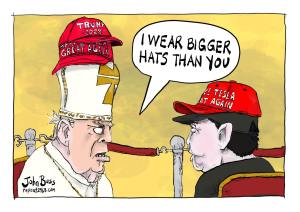
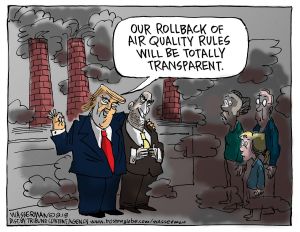 Yup. And the FDA will not be looking around for that food safety risk now. It’s also upending Health Care, but we can rest knowing that all those generic names for medicine and things will be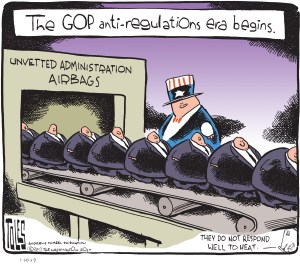
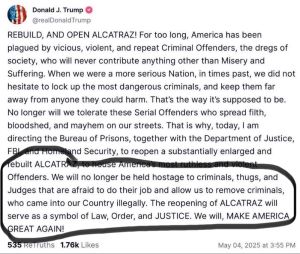 Speaking of crazy policy, I happened on this last night. This is from
 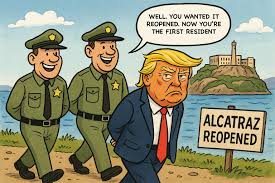 This is from Ed Mazza writing for HuffPo. This sounds a lot like his real estate deals to me. “‘Clearly Unhinged’: Critics Sink Trump’s ‘Asinine’ Plan To Reopen Alcatraz Prison. The president wants to turn the site back into a penitentiary despite the fact that it would cost a fortune.”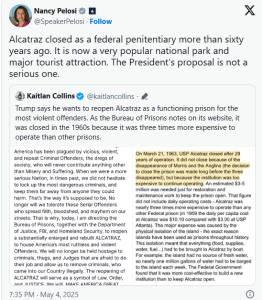
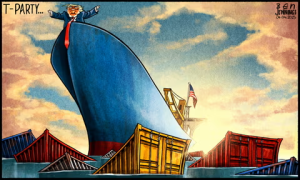 This just really sounds like how he’d run his business. Also, he now wants tariffs on all incoming films. This is about as insane as it gets.
 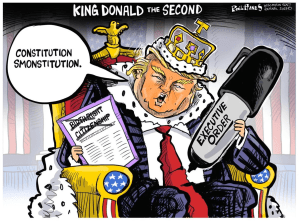 Philip Bump–writing at WAPO–has an interesting Op-Ed up today
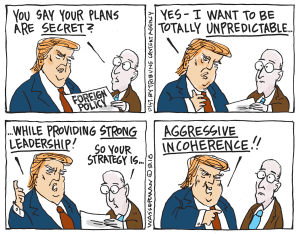 Dan Froomkin–writing for
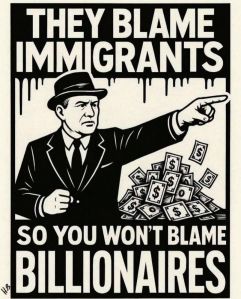 It makes sense to me since Trump seems to want to undocument more than just people. Who knows how many things Doge has destroyed in the wake of having all-access to every government database and more. He’s disappearing people, children, scientific research, due process, and entire agencies and programs.
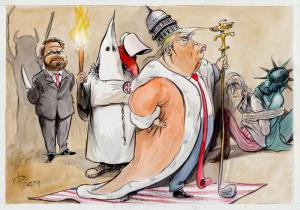 There are a lot of examples here, and it’s worth thinking about. The Unitary Executive Theory has been around for a while, and since the Reagan years, it has picked up steam in the Supreme Court. Here is a recent article from
 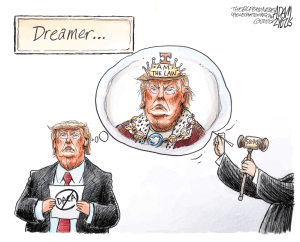 I think this take on executive power is one we should get more familiar with since it’s really taken a powerful rise. The






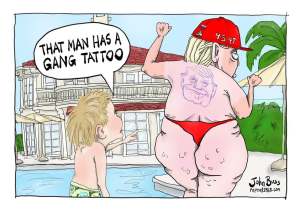
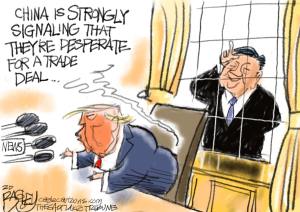 This tells us he’s willing to deal with corporations looking for exemptions. These first exemptions are for the Billionaire Tech Bros.
  The bottom line is that they all cause the price of the products to go up and generally reduce employment and availability of goods. Prices up. Unemployment up. That’s the basic definition of a country in a Stagflation Cycle. It’s the worst of both worlds because you get inflation and unemployment. I’ve dug into the numbers to date, and it appears the Walmart and Target leaders have legitimate fears. There are many trade publications that follow supply lines and chains. Obviously, railroads, ports, shipping, and air transit are important sectors because their business depends on goods in transit. Then they’re are the importers and exporters of the goods and services. You can see the loss of exchange by looking at the numbers. You know me. I love to make those numbers dance and sing. What you can see is that there are empty containers coming into ports. What this turns into is empty shelves.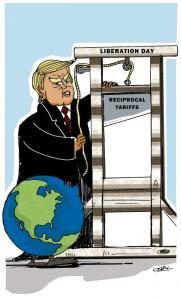
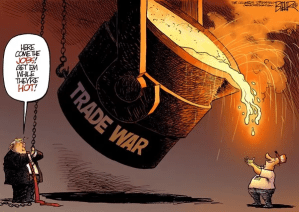 Here is more on empty shipping containers returning to American Ports from
  I suggest you plan accordingly. In another about face,
 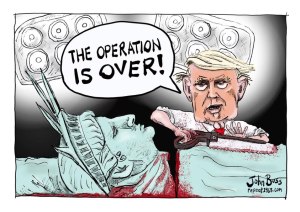 Good Afternoon, Sky Dancers
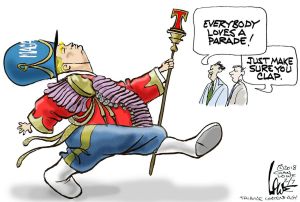 This country is our backyard. This should not stand. And next up on the WTF is THIS SHIT list? WTF country do we live in? This is from the Daily Beast.
 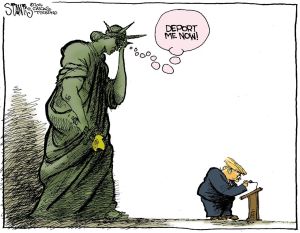 This headline from the
  I suggest we offer them Trump in exchange for holding a new election. Then, there’s just the rest of us. I was excited that my social security check hit my account this morning. That was good news. But this still tells us we shouldn’t take too much for granted. This is again from the
  Why do Republicans love fertilized eggs and hate children?
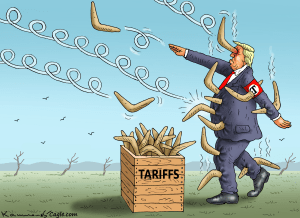 Well, at least I know where that stupid formula came from. But, since this is hitting everyone’s pocketbook, will it finally wake some of the little MAGA guys up? Noah Berlatsky, writing at
 peej
peej Carissa
 bostonboomer
 dakinikat
 ecocatwoman
 mablue2
 Mama Lopez
 peggysue22
 quixote
 skydancingguestblogger
 Mona (aka Wonk the Vote)



 Sky Dancing
Recent Comments