
Tuesday Reads: Election Day
Posted: November 2, 2021 Filed under: morning reads | Tags: Annissa Essaibi-George, Boston Mayor, Brad Raffenspurger, Glenn Youngkin, Michelle Wu, National Guard, Ruth Bader Ginsburg, SCOTUS, Terry McAuliffe, Virginia Governor 31 CommentsGood Morning!!

MIchelle Wu and Annissa Essaibi-George are running for Mayor of Boston.
Today is election day in states across the country. The is the deadlocked race between gubernatorial candidates Terry McAuliffe and Glenn Youngkin is getting the most attention, but there’s also a historic election in Massachusetts, where a woman of color most likely will be elected Mayor of Boston today. 7News Boston: Boston voters heading to the polls for historic mayor’s race.
BOSTON (AP) — Boston voters are heading to the polls Tuesday not only to choose between Democrats Michelle Wu and Annissa Essaibi George for mayor, but to mark a turning point in the city’s history, for the first time electing a woman and person of color to helm Boston.
The choice of Wu and Essaibi George for the top political post is just the latest marker of how much the Boston of not-so-long-ago — known for its ethnic neighborhoods, glad-handing politicians and mayors with Irish surnames — is giving way to a new Boston.
Throughout its long history, Boston has previously only elected white men as mayor.
Despite the groundbreaking nature of the candidates, the campaign has turned on familiar themes for the city’s 675,000 residents, including public education, policing, public transportation and the skyrocketing cost of housing.
Among the newer issues facing Boston residents is the effect of climate change on the costal metropolis.
One of the thorniest issues in the campaign is whether Boston should pursue a form of rent control or rent stabilization, something supported by Wu and opposed by Essaibi George. In 1994, Massachusetts voters narrowly approved a 1994 ballot question banning rent control statewide.
Both candidates have spent the final hours of the campaign urging their voters to get to the polls.
Nearly 40,000 ballots have already been cast in early voting. Democratic Secretary of the Commonwealth William Galvin told reporters Monday he estimates about 135,000 ballots will be cast in Boston — about 30% of the city’s 442,000 registered voters.
Both candidates are children of immigrants.
The 36-year-old Wu, whose parents immigrated to the U.S. from Taiwan, grew up in Chicago and moved to Boston to attend Harvard University and Harvard Law School.
Essaibi George, 47, a lifelong Boston resident and former public school teacher, describes herself as a first-generation Arab-Polish American. Her father was a Muslim immigrant from Tunisia. Her mother, a Catholic, immigrated from Poland.
The contest could also be a test of whether voters in a city long dominated by parochial neighborhood politics are ready to tap someone not born and raised in the city like Wu, who grew up in Chicago.
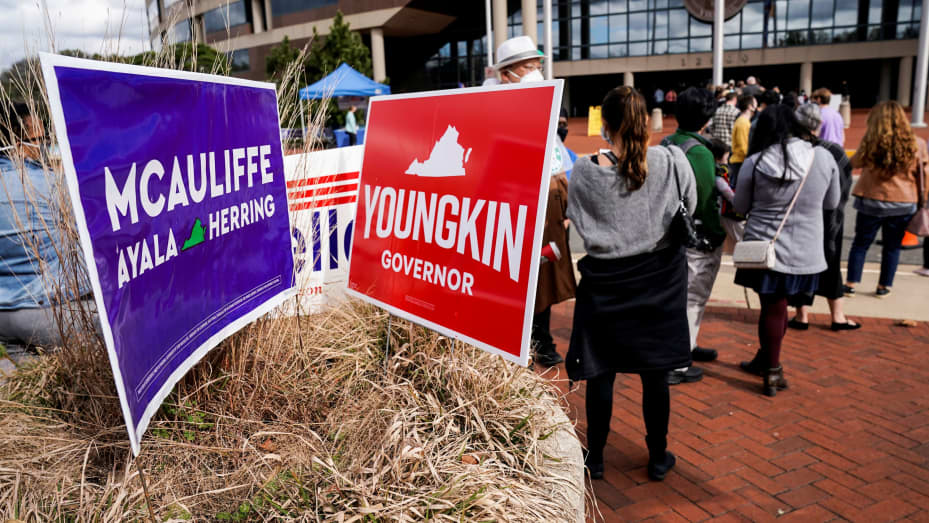 In Virginia, McAuliffe and Youngkin are running neck and neck, and observers are speculating about how the result with impact the midterm elections in 2022. Bloomberg: Virginia Race Offers Hint of 2022 Fight to Control Congress.
Virginia’s gubernatorial contest Tuesday between Terry McAuliffe and Glenn Youngkin will offer the clearest picture yet of how much momentum Republicans have heading into 2022 elections that will decide control of Congress, while President Joe Biden struggles to advance his agenda in Washington.
Polls show the Virginia race essentially deadlocked as Democrat McAuliffe’s lead during the summer evaporated along with Biden’s approval ratings. In the final weeks of the campaign, Republican Youngkin, the former co-chief executive officer of the Carlyle Group Inc., has capitalized on voter frustration with national Democrats and local education issues.
The election comes a day after Senator Joe Manchin, a moderate Democrat from West Virginia, slammed the door on Biden’s wish for Congress to take quick action on his $1.75 trillion tax and spending package, the centerpiece of his presidential campaign. Virginia, a state Biden won by 10 percentage points a year ago, is a bellwether for the Congressional midterms. A McAuliffe loss would be the biggest omen for Democratic prospects to hold onto their slim majority in Congress.
Longtime Democratic strategist Jesse Ferguson said that Virginia is often an “early-warning system” for the party in power as to how it will do in the midterms, especially because of the diversity of the state, which includes rural, suburban and urban areas; military, farming and technology workers; and White, Hispanic and Black voters.
“Virginia allows you for a dry run of the arguments you’re going to make in the midterms, to see how different parts of the electorate respond,” Ferguson said.
Read more at the link.

Peter Saul, Donald Trump in Florida, 2017.
At The Atlantic, Virginia resident Michael Tolhurst writes that a Youngkin win in Virginia could lead to a Constitutional crisis. That’s because governors control the National Guard. I can only provide a brief excerpt, so I hope you’ll read the entire article at The Atlantic.
…[i]n addition to the substantive policy disagreements or politics as pastime, people across America should be monitoring the outcome of this race for another reason: Governors command the National Guard, and after the January 6 riot, the country saw the National Guard defend our constitutional order.
at the outbreak of the Civil War, the prompt arrival of the 6th Regiment Massachusetts Volunteer Militia in Washington, D.C., in April 1861 helped secure a capital precariously close to the battlefront. Later forces arrived, building up the defenses around the city in the Northern Virginia towns of Arlington and Alexandria. This included, a century and a half before I came to live in the area, Connecticut’s 22nd Regiment in which my many-greats-grandfather Edwin Tolhurst served. (His military experience was unromantic—he dug ditches in the red mud of Northern Virginia for nine months, caught consumption, and died shortly after he was discharged.)
We’re not, of course, in a civil war. But law professors and public intellectuals have seriously discussed the possibility of secession or a “national divorce.” A recent University of Virginia study revealed that 41 percent of people who voted for Joe Biden in 2020 and 52 percent of Donald Trump voters “at least somewhat agree that it’s time to split the country.” The same study revealed that significant numbers on both sides wish their preferred president wouldn’t have to be constrained by Congress or the courts.
Given this tinderbox, we unfortunately have to revisit the question of what role the present-day state militias—the National Guard—and the governors who command them might play in a constitutional crisis. As the writer Andrew Sullivan put it, there is an “increasingly nihilist cult on the right among the GOP” that has shown an “increasingly menacing contempt for electoral integrity and a stable democracy.” Will all elected governors rush to the defense of the constitutional order when necessary, as did the 6th Massachusetts and the 22nd Connecticut? Or will they fight for a separatist movement? This is not a happy thought, but as even previously respectable institutions are being coy about the possibility of such a conflict, it must be considered.
It’s difficult to accept that the situation is getting that serious, but you just have to look at how completely the Republican Party has been captured by the Trump/Q-Anon cults to understand that we need to be prepared for the worst. I still need to finish reading the powerful Washington Post series on the January 6 insurrection, but I hope to do so this afternoon.

The Barbarians by Max Ernst, 1937
Harking back to the 2020 presidential election, Georgia Secretary of State Brad Raffenspurger has written a book. AP: Georgia official: Trump call to ‘find’ votes was a threat.
Donald Trump was threatening Georgia Secretary of State Brad Raffensperger when he asked him to help “find” enough votes to overturn his loss in Georgia to Democratic President Joe Biden, Raffensperger writes in a new book.
The book, “Integrity Counts,” was released Tuesday. In it, Raffensperger depicts a man who defied pressure from Trump to alter election results, but also reveals a public official settling political scores as he seeks to survive a hostile Republican primary environment and win reelection in 2022.
An engineer who grew wealthy before running for office, Raffensperger recounts in his book the struggle in Georgia that followed Biden’s narrow victory, including death threats texted to his wife, an encounter with men who he says may have been staking out his suburban Atlanta home, and being escorted out of the Georgia capitol on Jan. 6 as a handful of right-wing protesters entered the building on the same day many more protesters stormed the U.S. Capitol.
The book climaxes with the phone call, which was recorded and then given to multiple news organizations. Raffensperger — known as a conservative Republican before Trump targeted him — writes that he perceived Trump as threatening him multiple times during the phone call.
“I felt then — and still believe today — that this was a threat,” Raffensperger writes. “Others obviously thought so, too, because some of Trump’s more radical followers have responded as if it was their duty to carry out this threat.”
Fulton County District Attorney Fani Willis is investigating potential attempts to improperly influence Georgia’s 2020 election. Raffensperger said in an interview with The Associated Press that Willis’ investigators have talked to some employees in his office, but that he hasn’t been interviewed.
Read more about the book at USA today: Brad Raffensperger, GOP target of Trump ire in Georgia, warns of potential for more election violence.

Ruth Bader Ginsburg, by Bijou Karman
Another extremely important issue we face is that “conservatives” have taken over the Supreme Court. Linda Greenhouse at The Atlantic: What Can Liberals on the Supreme Court Do Now? They’re outnumbered, but they’re not powerless.
By the time the Supreme Court started its new term on the first Monday of October, a tumultuous summer of midnight orders and unsigned opinions had left no doubt about who was in charge. A five-member conservative bloc, anchored by three Trump-appointed justices, had largely stripped Chief Justice John Roberts of leverage and the three remaining liberals of any hope of striking a meaningful alliance with him. The best the liberals can hope for now, even with the chief justice on their side, is a 5–4 loss.
What path is open to them? Can they play a weak hand in a way that can make a difference? Is building bridges worthwhile, or has the time come to burn them all down? These are the questions hovering over the opening of a term that is likely to produce major decisions on abortion, religion, and the Second Amendment.
Perhaps some answers can be found in the memory of Ruth Bader Ginsburg, who died in September 2020 and was replaced with astonishing speed by Amy Coney Barrett. Powerless in her later years to change minds on the increasingly conservative Court, Ginsburg used the tool at her disposal: her voice. The purpose of her blunt and quotable dissenting opinions was not only to call out the majority when she believed it was wrong but to shape how the public understood the Court’s actions.
It’s easy to forget that this was not always Ginsburg’s way. For most of her years on the public stage, there was nothing flamboyant about her. Quite the opposite: A woman of few, precisely chosen words, she seemed content to fade into the background. During her years on the federal appeals court in Washington, she was so well known for her friendship with that court’s conservatives, particularly Antonin Scalia, who moved up to the Supreme Court in 1986, that many leaders of the women’s movement didn’t quite trust her when Bill Clinton chose her to fill his first Supreme Court vacancy, in 1993. In a lecture Ginsburg delivered months before her nomination, she emphasized the importance of dialogue and said that the “effective judge … strives to persuade, and not to pontificate,” and “speaks in a moderate and restrained voice.”
She didn’t become the “Notorious RBG” until much later; the bestselling biography Notorious RBG: The Life and Times of Ruth Bader Ginsburg came out in 2015. By then, Ginsburg had been on the Court for 22 years. It wasn’t so much that Ginsburg had changed as that the Court and the culture had changed around her.
Read the rest at The Atlantic.
Today will be a busy news day. What stories are you following? Please share your thoughts and links in the comment thread below.
Thursday Reads
Posted: November 21, 2013 Filed under: Affordable Care Act (ACA), Austerity, Crime, Criminal Justice System, Media, morning reads, racism, Republican politics, U.S. Politics | Tags: Anthropology, Black Beauty rock, Bucks County PA, Creigh Deeds, DA David Heckler, European DNA, Filibuster, Gus Deeds, Ken Cuccinelli, Marissa Sargeant, Mars Meteorite, Medicaid expansion, mental health funding, Native American DNA, nuclear option, Obamacare vs Iraq War or Katrina, police brutality, presidential nominees, Siberia, Terry McAuliffe, Virginia 23 Comments
Good Morning!!
Virginia State Sen. Creigh Deeds is apparently recovering from stab wounds inflicted by his son Gus on Tuesday. The young man shot himself after attacking his father. But state officials are investigating why Gus was refused psychiatric care the day before the attack. NBC Washington:
The incident has raised new questions about the capacity of Virginia’s mental health system. Tuesday, it was reported that hours before the attack Gus Deeds was the subject of an emergency custody order — but a bed at a hospital or psychiatric treatment facility was not available, and he was released home.
Now the Washington Post is reporting that three hospitals within a two-hour drive of Bath County did have beds available, and two of the three say they were never contacted by the Rockbridge County Community Services Board trying to find a placement for Deeds son.
The state inspector general has now launched an investigation to find out what led to Gus Deeds’ release after the custody order was issued.
“Regardless of whether or not there were beds, there was not a system to determine if there were beds available,” Howell said. “It seems to me we should have a clearinghouse of some kind so that when somebody needs a bed, there is a very efficient way to find out where one is available.”
Dozens of mentally ill patients at risk of doing “serious harm” to themselves or others in Virginia were denied access to some psychiatric treatment in a span of just three months studied by state investigators, according to agency documents reviewed by the News4 I-Team.
An audit of Virginia’s Behavioral Health and Developmental Services, performed over a 3-month span in late 2011, found 72 people “at risk for serious harm” and in need of care received less treatment than necessary, in part because of a shortage of available psychiatric beds in the state.
Internal state investigators call the shortfall “a failure of the system” and a “canary in the coal mine” warning for Virginia leaders.
Agency documents show a decline in the overall number of treatment space for the mentally ill in Virginia. A 2007 report found 1,794 available hospital beds for the mentally ill in Virginia, but the number had dropped to 1,699 beds available in 2011.
Internal investigators reported, “Acute and intensive treatment beds in … state-operated psychiatric hospitals have also decreased, while the population has grown by approximately 13 percent during the last decade.”
Gee, I wonder if this has anything to do with budget cuts in states controlled by Republicans? From Think Progress:
“Many states appear to be effectively terminating a public psychiatric treatment system that has existed for nearly two centuries,” wrote researchers in a 2012 report by the Treatment Advocacy Center (TAC), a nonprofit group that examines mental health issues. “The system was originally created to protect both the patients and the public, and its termination is taking place with little regard for the consequences to either group.”
According to the report, Virginia eliminated 15 percent of its public psychiatric beds between 2005 and 2010. The state has just 17.6 such beds per 10,000 people — less than 40 percent of the recommended minimum 50 beds per 10,000 people. That didn’t stop Gov. Bob McDonnell (R-VA) from proposing even more cuts to mental health programs in 2012.
But McDonnell isn’t the only one to embrace such cuts. In fact, state governments across the nation slashed psychiatric funding to the point that, overall, the nation’s hospitals had just 28 percent of the recommended minimum number of hospital beds by 2010. Those reductions continued in the following years as states slashed $4.35 billion in mental health services between 2009 and 2012, forcing State Mental Health Agencies (SMHAs) to shutter mental health hospitals and eliminate nearly 10 percent of total available beds in those three years alone.
This is an issue that was discussed during the recent VA race for governor. From the Oct. 23rd Washington Post: Virginia’s mental health system needs money; candidates differ on how to provide it.
The major-party candidates for governor of Virginia agree that mental health systems need more resources. But their approaches differ greatly, based in part on how they view the Medicaid expansion of the new health-care law in Virginia.
Democrat Terry McAuliffe favors a Medicaid expansion wholeheartedly. He says it would provide new health-care coverage for about 400,000 Virginians and would increase money for mental health treatment.
Republican Ken Cuccinelli II opposes a Medicaid expansion completely and says McAuliffe’s estimates of its effect on Virginia are greatly overstated. Cuccinelli wants to increase state funding for mental health, but he would do so by shifting current Medicaid funds from other health-care areas. He also said he would target waste, fraud and abuse and use the savings to bolster options for the mentally ill and the intellectually disabled.
Fortunately for the people of Virgina, Terry McAuliffe won the election, and corrective measures will likely be taken. But they’ll come too late for Gus Deeds and his family. If a wealthy and connected family has this problem, can you imagine what it’s like for poorer people who need mental health treatment in Republican-controlled states?

This story out of Philadelphia is horrible: Mom of Alleged Teen Shoplifter Accuses Police of Brutality. I’m sure you won’t be surprised to learn that the boy is African American.
The mother of the 14-year-old boy, who was arrested for shoplifting, is accusing police of roughing him up.
“The picture speaks a thousand words,” says Marissa Sargeant, who shared several graphic photos with NBC10 that shows her son bruised, cut and swollen.
The teen was arrested by Tullytown Police for retail theft at Walmart on Tuesday night, along with an adult relative.
“What he did was wrong. He was coerced by a 19-year-old. He does know better,” said Sargeant.
“Roughing him up?” I’d say that’s quite an understatement, based on the photo.
Authorities say after the teen’s arrest, and before he was loaded into a police car, he took off running along Route 13 while handcuffed.
Bucks County District Attorney David Heckler tells NBC10 that police officers yelled warnings at the teen and fearing for his safety, they fired a stun gun to subdue him. The D.A. says the Taser struck the boy in the face and with his hands cuffed, the boy had no way to brace himself against falling face-first.
“That doesn’t sound right. There’s no way, if he was running from behind, that he would get hit with a taser in the front of his face,” said Sargeant.
The mom suspects police probably beat up her son as well, and I’d have to agree with her. Heckler is “investigating,” but he doesn’t think police did anything wrong. Sounds like a really unbiased “investigation,” doesn’t it?
Republicans are still blocking President Obama’s judicial nominees right and left, and Democrats are once again threatening to get rid of the filibuster for appointments. {Sigh…} Do you suppose there’s any chance they actually mean it this time? From The Washington Post:
Senator Harry Reid of Nevada, the majority leader, is poised to move forward on Thursday with a vote on what is known on Capitol Hill as the “nuclear option,” several Democrats said. Mr. Reid and the senators who have been the most vocal on stopping the Republican blockade of White House nominees are now confident they have the votes to make the change.
“We’re not bluffing,” said one senior aide who has spoken with Mr. Reid directly and expects a vote on Thursday, barring any unforeseen breakthrough on blocked judges.
The threat that Democrats could significantly limit how the filibuster can be used against nominees has rattled Republicans. Senator John McCain, the Arizona Republican who has brokered last-minute deals that have averted a change to filibuster rules in the past, visited Mr. Reid in his office on Thursday but failed to strike a compromise.
Senator Charles E. Grassley of Iowa took to the Senate floor and denounced Democrats, saying that if they changed the rules, Republicans would consider them applicable to all judicial nominees, including those for the Supreme Court. Mr. Reid has said he supports keeping intact the minority party’s ability to filibuster controversial Supreme Court nominees.
“Apparently the other side wants to change the rules while still preserving the ability to block a Republican president’s ability to replace a liberal Supreme Court Justice with an originalist,” Mr. Grassley said.
At Politico, William Yeomans, an American University law professor and former Justice Department official says “Nuke ’em Harry!”
Democrats, it’s time to bid farewell to the filibuster as we’ve known it. Your restraint has gone beyond admirable to foolish. The institution for which you have shown extraordinary respect over the past four years, as Republicans flouted its best traditions, is no more. Republicans have overplayed their hand by disregarding prior agreements and turning the Senate into a graveyard—or at least a critical care unit—for obviously qualified presidential nominees. Republican obstruction has left you with nothing to lose by bringing the Senate fully into the 21st century and allowing the majority to rule. It’s time to change the rules….
Worried about blowback? Don’t be. Sen. Chuck Grassley (R-Iowa) helped expose the Republicans’ loss of leverage when he threatened that if the Democrats changed the filibuster rule, Republicans would appoint more justices like Antonin Scalia and Clarence Thomas to the Supreme Court. Whoa! Is he suggesting that Republicans won’t appoint more radically conservative justices if Democrats keep the filibuster? That might be a deal worth taking, but it wouldn’t be worth the paper it was printed on. If Republicans regain control of the White House, any Supreme Court nominees will very much be in the model of Scalia and Thomas, and their colleagues Roberts and Samuel Alito—if not worse. That means they will disregard any pretense of judicial restraint to eviscerate civil rights laws, restrain congressional authority to enact social legislation, support states over the federal government and big business over labor, oppose the interests of consumers and make sure the executioner stays in business.
In reality, Republicans have nothing left with which to threaten you. Just stop and think about how unimportant the filibuster has been to you. You chose not to use it to stop Thomas and Alito, even though more than enough Democrats to support a filibuster voted against each. You embraced Scalia (by unanimous vote!) and Roberts. When Republican presidents went too far, you mustered the majority vote necessary to stop them without resorting to the filibuster. That’s why we didn’t have a Justice Bork, Carswell or Haynsworth, or a Secretary of Defense Tower, or an Associate Attorney General Reynolds. Sure, Miguel Estrada would be on the D.C. Circuit, but that hardly justifies tying your own hands in perpetuity.
He’s absolutely right, but do the wimpy Dems have the courage to act? I’ll believe it when I see it.
Here’s your stupid right wing corporate media story for today from Media Matters. David Gregory compares Obamacare to the Iraq war.
Not once but twice in recent days Meet The Press host David Gregory announced that the troubled launch of President Obama’s new health care law is roughly the equivalent to President Bush’s badly bungled war with Iraq. The NBC anchor was quick to point out that he didn’t mean the two events were the same with regards to a death toll. (Nobody has died from health care reform.) But Gregory was sure that in terms of how the former president and the current president are viewed, in terms of damage done to their credibility, the men will be forever linked to a costly, bloody war and a poorly functioning website, respectively.
“Everybody looked at Bush through the prism of Iraq,” Gregory explained. “Here, I think people are going to look at Obama through the implementation of Obamacare.” It’s Obama’s defining event of their two-term presidency. It’s a catastrophic failure that’s tarnished Obama’s second term, and will perhaps “wreck” his entire presidency, according to the media’s “doom-mongering bubble,” as Kevin Drum at Mother Jones described it.
But like the painfully inappropriate comparisons to Hurricane Katrina that have populated the press, Gregory’s attempt to draw a Bush/Obama parallel is equally senseless. Bush’s war morass stretched over five years, so of course it defined his presidency. Obama’s health care woes are in week number six and could be fixed within the next month.
Media Matters points out that not only is this “the mother lode of false equivalency,” but it’s a sly effort to “downgrade Bush’s historical failures, and to cover the media’s tracks of deception.”
I’ll end with two fascinating science stories to take your mind off politics and other distressing news.

From BBC News: Black Beauty rock ‘is oldest chunk of Mars’
A rock discovered in the Sahara Desert is the oldest Martian meteorite ever found, scientists believe.
Earlier research had suggested it was about two billion years old, but new tests indicate the rock actually dates to 4.4 billion years ago.
The dark and glossy meteorite, nicknamed Black Beauty, would have formed when the Red Planet was in its infancy.
The research is published in the journal Nature.
Lead author Prof Munir Humayan, from Florida State University, US, said: “This [rock] tells us about one of the most important epochs in the history of Mars.”
Read the rest at the link.
And from The Sydney Morning Herald: Siberian DNA link to Native Americans discovered.
The genome of a young boy buried at Mal’ta, near Lake Baikal in eastern Siberia, about 24,000 years ago has turned out to hold two surprises for anthropologists.
The first is that the boy’s DNA matches that of Western Europeans, showing that during the last ice age people from Europe had reached farther east across Eurasia than previously supposed.
The second surprise is that his DNA also matches a large proportion – about 25 per cent – of the DNA of living Native Americans. The first people to arrive in the Americas have long been assumed to have descended from Siberian populations related to East Asians. It now seems that they may be a mixture between the Western Europeans who had reached Siberia and an East Asian population.
Tuesday Reads: Hillary in 2016?
Posted: September 24, 2013 Filed under: 2016 elections, Hillary Clinton, morning reads, Republican politics, U.S. Economy, U.S. Politics | Tags: Bill Clinton, Chelsea Clinton, Doug Band, Huma Abedin, Taylor Marsh, Terry McAuliffe 70 Comments
The face of a President?
Good Morning!!
For the past few weeks, I’ve been suffering from a bad case of what JJ calls “PAD” or “Political Affective Disorder.” I’ve been finding myself escaping into a haze of detective stories, Criminal Minds reruns, and video games. I’ve still kept up with the news–barely–but I haven’t felt much like writing about it. I feel discouraged about the fate of our nation and I’m paralyzed about my own personal future too.
Beginning in 1993, I focused most of my attention of getting the education I missed out on as a young woman after I left college after only two years. From 1993 to 2010, I lived the life of a full-time student–and I loved it! After I finally achieved my goal–a doctorate in psychology–I had no idea what to do next. I was near retirement age, and faced the reality that the best “job” I might be able to get in the current economic climate was as an adjunct professor with low pay and no benefits.
I had learned after 12 years of teaching that the kinds of teaching jobs I might be able to get wouldn’t allow me to experience the aspects of teaching that I truly enjoyed–working directly with students and leading class discussions–wouldn’t be available to me. Instead I’d be lecturing to classes of 150-200 students with little opportunity for class discussion or personal interaction. In addition, I had serious problems with grade inflation and the “customers are always right” attitude of the universities I had taught at.
I had fantasies of focusing on writing and research, and I thought that might be a realistic goal, but then my mentor died suddenly and shockingly, and I no longer had anyone in academia to turn to for advice or to help me negotiate the publishing process. I was already so exhausted by the effort to complete my dissertation and my father’s death in March of 2010, that I really felt the need to just do nothing for awhile.
I threw myself into blogging, because it gave me opportunities to write and express myself on a daily basis. I’ve always loved following politics and it has been great to connect with so many other people who have the same interests and obsessions. But lately the world of politics seems as paralyzed as I am in my own life. The Republican Party has managed to largely control the agenda despite the fact that they only control the House.
Right now, I have the ability to live on a very low income and still have a decent lifestyle. But the day is eventually going to come when I won’t have a free place to live. I’m also finding myself less satisfied with just recovering from the effort to finish my Ph.D. and the major losses of my father and my academic father figure–my mentor. What will my future look like? I seems wrong not to use the skills and knowledge I’ve gained over the years to give back in some way, no matter how small.
Well, I can’t solve all those problems today. But I can keep on keepin’ on and imagine ways things might change. You might call it, “The Audacity of Hope.” And that’s where Hillary comes in. More and more I see her as a model for survival, for achievement late in life, for looking at problems in new and productive ways. Could she really become the first woman president at approximately the same age I am? Could she be a better, more innovative leader than Barrack Obama has been? I want to take that leap of faith and believe in her ability to win the nomination and general election and succeed as president. I also want to believe that she and we can survive the Clinton hate that we’ll all have to go through to make it happen.
Suddenly Hillary is all over the news! Yesterday Dakinikat posted a link to the first major interview (at New York Magazine) Hillary has done since leaving the State Department. Yesterday I was feeling so apathetic that I didn’t even manage to read the whole thing. But I’ve promised myself I’m going to do that today. In the meantime, here are some crib sheets and reactions to the New York article:
From NBC News’ First Thoughts:
*** Clinton news — everywhere! If you wanted an idea of what the media landscape would look like the moment we get a clear indication if Hillary Clinton is running for president, we got a taste of it over the past 48 hours. Hillary Clinton gave her first private-citizen interview to a news organization; Bill Clinton is making news ahead of his Clinton Global Initiative meeting; and the New Republic runs a tough piece on Bill Clinton aide Doug Band. It’s a reminder of what comes with the Clintons — excitement, news and attention, and baggage. Now on to these individual stories…
*** “She’s running,” Hillary confidante tells New York magazine: In her first interview with a news organization since leaving her secretary of state post, Hillary Clinton certainly didn’t seem like someone who was shutting the door to a 2016 presidential bid. In fact, it was the opposite. When New York magazineasked if she wrestles with running, Clinton responded, “‘I do,’ she says, ‘but I’m both pragmatic and realistic. I think I have a pretty good idea of the political and governmental challenges that are facing our leaders, and I’ll do whatever I can from whatever position I find myself in to advocate for the values and the policies I think are right for the country. I will just continue to weigh what the factors are that would influence me making a decision one way or the other.’” It’s a significant step that she’s decided to acknowledge publicly that she’s thinking about it. We may all think we know this and treat it as a given inside the Acela Corridor, but it’s still significant to read her SAYING it. But the article adds, “Some of her close confidants, including many people with whom her own staff put me in touch, are far less circumspect than she is. ‘She’s running, but she doesn’t know it yet,’ one such person put it to me. ‘It’s just like a force of history. It’s inexorable, it’s gravitational. I think she actually believes she has more say in it than she actually does.’” Other than sending signals that she’s running, the other unmistakable take away from the Hillary interview: She won’t be surrounding herself with a lot of the Bill alum, a la 2008. More Team Hillary, less Team Bill in 2016. Translation to nervous donors/supporters about a repeat of 2008: Mark Penn and other Bill veterans aren’t running this thing.
From The Daily Beast: Seven Juiciest Bits from Hillary Clinton’s New York Profile. Go read the whole thing, but I’ll excerpt the part I found most intriguing:
7. The future of Clintonworld now lies with Chelsea.
Of course, there’s a third person in the Clinton family: Chelsea, whose name has been added to the name of the foundation, making it the Bill, Hillary, and Chelsea Clinton Foundation. Chelsea had tried out a number of careers before turning to the family business, first as a consultant at McKinsey & Co., then a hedge fund and a stint NBC. But not everyone at the foundation was happy about Chelsea’s sudden appearance and her decision to bring in an old McKinsey associate as CEO—and Bill eventually stepped out and defended his comrades, a move that hinted there might have been conflict between the three Clintons. “This is an operation that runs on its proximity to people,” one staffer said. “Now it’s three people. How does that work?”
But Hillary says Chelsea’s entrance is simply in her daughter’s DNA (a move that seemed especially true after Chelsea’s Daily Show appearance on Thursday night). Hillary said Chelsea, the family’s now-gatekeeper, “comes by it” at the foundation “naturally.” Ever the proud parents, Hillary said Chelsea is “an incredibly able—obviously I’m biased—but extremely well-organized, results-oriented person, so rather than joining a lot of other groups, on which she could pursue her interests, she thought, I want to be part of continuing to build something I have worked on off and on over the years, and I really believe in it. I was thrilled to hear that.”
A negative note from The Atlantic: Hillary Clinton’s Presidential Campaign Is Already Haunted
Clinton-watchers have an abundance of bedtime reading options this Sunday with not one, but two long profiles aimed at a possible 2016 run for Hillary Clinton. In New York magazine, Clinton herself breaks a mini “press hiatus” to spend some time with Joe Hagan, who then digs into the extensive support system for the family dynasty. But it’s The New Republic’s profile of Doug Band, longtime advisor to Bill Clinton, that hints at one of the challenges Hillary will face in a 2016 campaign: the ghosts waiting in the wings from the Clintons’ long public life.
Band, writer Alec MacGillis explains, is “rarely written about, almost never quoted, and many Clinton associates are loath to discuss him on the record.” But lately, he’s emerged from under the Clinton umbrella to strike out on his own, leaving him more vulnerable to scrutiny. In the past few months, his name has popped up as something of an antagonist in stories of troubles at the family foundation. Even though Band declined to speak to MacGillis for his expansive profile, the piece connects some dots that could be unwelcome for Team Clinton: “the unease with Band reflects an unease with the phenomenon of post-presidential Clintonism itself,” he writes. That Clintonism angst, TNR’s piece posits, could extend to Hillary, albeit with few to no direct ties. Band’s role in the Clinton administration was as the body man, a presidential version of a personal assistant.
Taylor Marsh points out that Hillary is not Bill just because she’s married to him: Bill Clinton, Hillary, and a Bone Picking Exposé on Doug Band.
The fact is Hillary Clinton doesn’t have a trail to give us an idea what she’d do, let alone if she thinks similarly to her husband on economics. What we know about Hillary in matters commander in chief is that unlike where Bill started, she’s respected at the Pentagon, which is one reason a contingent of progressives will oppose her candidacy. People tried to hook NAFTA to her back during the 2008 season, which I debunked, because not even Carl Bernstein, someone who wrote a fairly tough book on Hillary, would allow that to go unremarked upon, throwing ice cold water on any notion she supported NAFTA, a free trade agreement that exemplifies neoliberalism.
Just because she’s Bill Clinton’s wife doesn’t mean her views are identical to him. You’d think Democratic activists and progressives would understand the insult of assuming Hillary would be just like Bill. Opposing NAFTA also doesn’t mean she won’t approve of other free trade deals. Of course, for many Iraq, then her role in Libya, now Syria, is enough to make her unsupportable.
The other issue is that to people inside the power structure who want to be in charge, pretending corporations aren’t part of politics is to lose your foothold on the ladder taking you upward. You can choose not to participate as a voter and activist, but anyone in the political food chain who wants to rise cannot. This is one of the immovable, unsolvable, implacable truths that create the catch-22 of American politics.
Anyone who wants to change the system can’t get access to power without using the system and by the time they rise within the system they’ve lost credibility with the voters who put them in office to fight the system. Once in the political stream that gives you access to the power as a politician, the corporations who run the world also control the political apparatus you need to get anything done. Thus instead of Barack Obama changing Washington it changed him, as it will anyone governing in the era of international globalization. It gets to the question of whether a person is strong enough to also exact their own pound of economic flesh so that the stacked deck for the wealthy against the middle class at some points starts evening out.
So we don’t talk about neoliberalism when it comes to Democrats, Bill Clinton or Barack Obama, and a scorching investigation of Doug Band won’t change that fact, or that Hillary being married to Bill doesn’t tell us anything definitive about what she’d do if she ran for president and won.
John Dickerson at Slate via CBS News: Hillary Clinton: The long game.
Hillary Clinton, in her first interview after leaving the State Department, offered a wise metaphor about the current state of presidential election madness. “This election is more than three years away, and I just don’t think it’s good for the country,” she told New York magazine, referring to the fevered speculation about her possible candidacy. “It’s like when you meet somebody at a party and they look over your shoulder to see who else is there, and you want to talk to them about something that’s really important; in fact, maybe you came to the party to talk to that particular person, and they just want to know what’s next,” she says. “I feel like that’s our political process right now. I just don’t think it is good.”
Clinton knows what it’s like to be on both ends of that exchange. She was a political spouse; the shortsighted looked over her shoulder for many years, seeing her as merely an adjunct to her accomplished husband. Now, she is the person who draws every eye in the room–away from even her husband. (When someone says “Clinton”, it may not be long before a majority of people think of the former secretary of state and not the former president).
Read more at the link.
And finally articles on two important members of the Clinton orbit:
NY Daily News: Hillary Clinton running for president in 2016, friends say — and Huma Abedin will have tough choice
WaPo: McAuliffe leads Cuccinelli in Virginia governor’s race

 peej
peej Carissa
 bostonboomer
 dakinikat
 ecocatwoman
 mablue2
 Mama Lopez
 peggysue22
 quixote
 skydancingguestblogger
 Mona (aka Wonk the Vote)



 Sky Dancing
Recent Comments