

As a battleground state, there is a lot on the line in Arizona’s looming elections. President Biden is running for reelection after winning the state in 2020 by fewer than 11,000 votes, and the race for a Senate seat in the state could prove crucial in determining which party controls the body next year. The balance of the statehouse is at stake this election cycle, too, with Republicans holding a one-vote majority in each chamber.
Wednesday Reads: Abortion Politics: Be Enraged!
Posted: April 10, 2024 Filed under: 2024 Elections, 2024 presidential Campaign, A thread for Ranting, abortion rights, Donald Trump, just because | Tags: Abortion politics, Arizona Supreme Court, Dobbs v. Jackson Women's Health Organization, Florida, Roe v. Wade, States Rights 8 CommentsGood Day!!
 I’m sure you’ve heard about the latest outrage from the woman-hating Arizona Supreme Court. If this law takes effect, women in the state will not be able to get an abortion unless they are at death’s door. If that means you can’t ever get pregnant again, too fucking bad. If you’re 12 years old and you’ve been raped and impregnated by your stepfather, tough shit. You’re carrying that fetus to term young lady, and you’d better not complain about it. Welcome to the post-Dobbs world. Never forget: Trump did this. For now, Republicans are pretending to have problems with this decision, but if Trump is elected and Republicans control Congress, this will likely be the law of the land.
The New York Times: Arizona Reinstates 160-Year-Old Abortion Ban.
Arizona’s highest court on Tuesday upheld an 1864 law that bans nearly all abortions, a decision that could have far-reaching consequences for women’s health care and election-year politics in a critical battleground state.
“Physicians are now on notice that all abortions, except those necessary to save a woman’s life, are illegal,” the court said in a 4-to-2 decision.
But the court, whose justices are all Republican appointees, also put its ruling on hold for the moment and sent the matter back to a lower court for additional arguments about the law’s constitutionality. Abortion providers said they expected to continue performing abortions through May as their lawyers and Democratic lawmakers searched for new legal arguments and additional tactics to delay the ruling.
The ruling immediately set off a political earthquake. Democrats condemned it as a “stain” on Arizona that would put women’s lives at risk. Several Republicans, sensing political peril, also criticized the ruling and called for the Republican-controlled Legislature to repeal it.
The decision from the Arizona Supreme Court concerned a law that was on the books long before Arizona achieved statehood. It outlaws abortion from the moment of conception, except when necessary to save the life of the mother, and it makes no exceptions for rape or incest. Doctors prosecuted under the law could face fines and prison terms of two to five years.
Planned Parenthood Arizona, the plaintiff, and other abortion-rights supporters argued that the 1864 ban, which had sat dormant for decades, had essentially been overtaken by years of subsequent Arizona laws regulating and limiting abortion — primarily, a 2022 law banning abortion after the 15th week of pregnancy.
But the territorial-era ban was never repealed. And the Arizona Supreme Court said Arizona’s Legislature had not created a right to abortion when it passed the 15-week ban. Because the federal right to abortion in Roe v. Wade had now been overturned, nothing in federal or state law prevented Arizona from enforcing the near-total ban, the court wrote.
“Because the federal constitutional right to abortion that overrode § 13-3603 no longer exists, the statute is now enforceable,” the court’s four-person majority wrote, using the statutory number of the 1864 ban.
Republicans are in trouble.
The Washington Post: ‘Catastrophic,’ ‘a shock’: Arizona’s abortion ruling threatens to upend 2024 races.
A near-total abortion ban slated to go into effect in the coming weeks in Arizona is expected to have a seismic impact on the politics of the battleground state, testing the limits of Republican support for abortion restrictions and putting the issue front and center in November’s election.
Arizona’s conservative Supreme Court on Tuesday revived a near-total ban on abortion, invoking an 1864 law that forbids the procedure except to save a mother’s life and punishes providers with prison time. The decision supersedes Arizona’s previous rule, which permitted abortions up to 15 weeks.
Elisabetta Sirani, Timoclea Killing Her Rapist, 1659
Arizonans are poised to consider the issue in November, now that the groups working to amend the state’s constitution to enshrine abortion rights — which include the ACLU of Arizona and Planned Parenthood Advocates of Arizona — say that they have acquired enough signatures to establish a ballot measure, according to the Arizona Republic. Meanwhile, Republicans in the state are asking Arizona Gov. Katie Hobbs (D) and the Republican-led state legislature to come up with a solution.
The developments in Arizona are part of a wave of state actions to reckon with the future of access to reproductive care after the U.S. Supreme Court, with a conservative majority installed during Donald Trump’s presidency, overturned Roe v. Wade in 2022. While several states enacted abortion restrictions as a result of overturning Roe, protecting access to reproductive care has broadly been a winning issue for Democratic candidates and for ballot measures that protect abortion access in the elections since the 2022 ruling.
Polls show that abortion is a motivating issue for Arizona voters.
All of a sudden, Arizona Republicans are not so sure they like what’s happening, now that they got their wish to overturn Roe v. Wade.
The Guardian: Arizona Republicans denounce revived 1864 abortion ban in sudden reversal.
Hours after Arizona’s supreme court declared on Tuesday that a 160-year-old abortion ban is now enforceable, Republicans in the state took a surprising stance for a party that has historically championed abortion restrictions – they denounced the decision.
“This decision cannot stand,” said Matt Gress, a Republican state representative. “I categorically reject rolling back the clock to a time when slavery was still legal and we could lock up women and doctors because of an abortion.” [….]
“Today’s Arizona supreme court decision reinstating an Arizona territorial-era ban on all abortions from more than 150 years ago is disappointing to say the least,” said TJ Shope, a Republican state senator.
“I oppose today’s ruling,” added Kari Lake, a Republican running to represent Arizona in the US Senate and a Donald Trump loyalist. Lake called on the state legislature to “come up with an immediate commonsense solution that Arizonans can support”.
Lake has made multiple statements in support of the 1864 law, as Ron Filipkowski has been documenting on Twitter. Back to the Guardian article:
Since the US supreme court overturned Roe v Wade, leading the GOP to stumble in the 2022 midterms and abortion rights supporters to win a string of ballot measures, including in purple and red states, Republicans have struggled to find a way to talk about abortion without turning off voters. But their response to the ruling on the 1864 ban may mark their fastest and strongest rebuke of abortion bans since Roe fell.
Scowling woman, by Hope Gangloff
“This is an earthquake that has never been seen in Arizona politics,” said Barrett Marson, a Republican consultant in Arizona, of the decision. “This will shake the ground under every Republican candidate, even those in safe legislative or congressional seats.” [….]
Some of the criticisms of the Tuesday ruling came from politicians who had previously supported the 1864 ban or cheered the end of Roe v Wade. Lake previously called the ban a “great law”, according to PolitiFact. David Schweikert, an Arizona congressman who is facing one of the most competitive House races in the country this November, said on Tuesday that he does not support the ruling and wants the state legislature to “address this issue immediately”, but in 2022 said the fall of Roe “pleased” him.
The speaker of the Arizona state house and the president of the state senate, who are both Republicans, also released a joint statement saying that they would be “listening to our constituents to determine the best course of action for the legislature”. In contrast, on the day Roe fell, the Republican-controlled state senate released a statement declaring that the 1864 ban was in effect immediately. That statement unleashed confusion and chaos among abortion providers in Arizona, prompting them to stop offering the procedure out of an abundance of caution.

Here’s an example of what goes on in the Arizona Senate. This happened the day before the Supreme Court ruling came out.
Arizona Central: Arizona lawmaker leads prayer circle on state seal at Capitol building, sparking backlash.
Arizona Sen. Anthony Kern invited a prayer group to the Senate floor on Monday.
Seen in a video filmed by an anonymous attendee, Kern led the group, who spoke in tongues, through a prayer as they knelt over the state seal.
This public display comes a day before the Arizona Supreme Court upheld an 160-year-old law that bans nearly all abortions on Tuesday.
“Let it be so, Father God,” Kern said. “Lord, right now, we ask thee to release the presence of the lord in the senate chamber.”
The video of the senator and his group was originally shared on TikTok by Tony Cani and reposted on many social media platforms. Jeanne Casteen, the executive director of Secular Arizona, a nonprofit advocacy organization that promotes the separation of church and state in Arizona, called attention to the video on X, formerly known as Twitter.
In her replies, many users were baffled by the senator’s behavior, citing First Amendment violations and false practices of Christianity….
However, Kern doubled down on his actions as he responded to critics in an X post.
“Looks like our prayer team stirred up some god-haters … Not to worry though…prayer over our state at the State Senate is way more powerful,” he wrote.
The Washington Post’s Dan Baltz on the political fallout from the Arizona decision: The Arizona Supreme Court just upended Trump’s gambit on abortion.
It took little more than a day for Donald Trump’s political gambit on abortion to come undone.
On Monday, the former president declined to support any new national law setting limits on abortions. Going against the views of many abortion opponents in his Republican Party, Trump was looking for a way to neutralize or at least muddy a galvanizingissue that has fueled Democratic victories for nearly two years. He hoped to keep it mostly out of the conversation ahead of the November elections.
Auguste Toulmouche’s 1866 painting The Hesitant Fiancée
On Tuesday, the Arizona Supreme Court showed just how difficult it will be to do that. The court resurrected an 1864 law that bans nearly all abortions, except to save the life of the mother. The law also imposes penalties on abortion providers.
Trump had said let the states handle the issue. The Arizona court showed the full implications of that states’ rights strategy.
The Arizona ruling came in a state that will be especially crucial in deciding the outcome of the presidential election, a state that President Biden won by fewer than 11,000 votes and that Trump’s campaign team has eyed as one of the best opportunities for a pickup. It is likely that a referendum to protect abortion rights will be on Arizona’s ballot in November. The court ruling only heightens the significance of the issue for the rest of the campaign year.
But the court ruling reverberated far beyond Arizona’s borders. The Biden-Harris campaign and other Democrats pounced on the ruling in an effort to further their argument that Trump and Republicans are a threat to freedoms.
All abortion politics are national, not local. Abortion developments — new laws, new restrictions, new stories of women caught up in heart-wrenching and sometimes life-threatening decisions — are no longer confined to the geography where they take place. They are instantly part of the larger debate.

Joyce Vance had some choice words about the Arizona situation at Civil Discourse: Welcome to 1864.
When the Supreme Court decided Dobbs, it opened up Pandora’s Box, undoing fifty years of protection for abortion rights under Roe v. Wade. In the wake of that decision, states pulled lots of horribles out of the box and used them to prevent women from making their own choices about reproductive health care. In some cases, those decisions involved their ability to conceive and carry to term in the future and even their lives. Arizona now seems intent on joining them.
This is Dobbs in action, which leaves it up to each state to decide whether women have abortion rights and, if so, to what extent. Your gerrymandered state legislature is now in charge of your healthcare and the lives of people you love….
In a couple of weeks, virtually all abortions will be a felony event in Arizona. Doctors and providers, including people who help others obtain abortions, can be prosecuted and sentenced to two to five years in prison if convicted. There are no exceptions for pregnancies resulting from rape or incest. As we’ve seen in other states, the mere threat of consequences like this is enough to shut down abortion procedures across the state. Welcome back to 1864.
Arizona women can still travel to nearby California, New Mexico, or Colorado, where abortion is accessible, at least for now. But the distances can be long, travel prohibitively expensive for some women, and impractical for those with jobs or with children and/or parents to care for.
Arizona is leaning into the national trend. The Guttmacher Institute tracks abortion laws across the country. As of this week, only two states, Vermont and Oregon, provide what they characterize as the “most protection” for abortion. Fifteen states are in the “most restrictive” category, which includes measures like the complete ban with very limited exceptions in Idaho, North Dakota, South Dakota, Oklahoma, Texas, Missouri, Arkansas, Louisiana, Indiana, Kentucky, Tennessee, Mississippi, Alabama, West Virginia, and South Carolina. We can add Arizona to that list after today’s decision. Guttmacher categorizes six additional states as “very restrictive,” (this is where Arizona used to be) and another seven states as “restrictive”. The map is stark and getting worse.
Read the rest at Civil Discourse.
Three more pieces on Trump and his waffling on abortion politics.
Jessica Valenti at Abortion, Every Day:
If you missed Donald Trump’s abortion ‘announcement’ yesterday, the short version is that he’s trying to wash his hands of the issue by saying abortion should be up to the states. He knows abortion is a loser for the GOP—and if there’s anything Trump hates, it’s losing.
CNN notes that the disgraced former president has been waffling behind the scenes for months, and The Washington Post reports that anti-abortion advisors like Kellyanne Conway and Sen. Lindsey Graham tried to talk Trump out of yesterday’s announcement.
Blue Monday, by Annie Lee
They not only told him that his stance meant he’d be supporting the states that allow ‘abortions up until birth’, but that he’d also be implicitly supporting the states whose bans he thinks are too restrictive—like Florida’s and Arizona’s.
Indeed, a Biden campaign spokesperson didn’t waste any time before tweeting that Trump was “endorsing every single abortion ban in the states, including abortion bans with no exceptions…and he’s bragging about his role in creating this hellscape.”
The response from anti-abortion groups and other Republicans has been mixed. While groups like Susan B. Anthony Pro-Life America made clear that they’re focused on defeating President Joe Biden, they also took a couple of hits at Trump. SBA president Marjorie Dannenfelser, for example, said the group is “deeply disappointed.” Sen. Lindsey Graham also spoke up, saying he “respectfully” disagrees and that he’s going to push ahead with federal legislation. (Because Trump takes criticism so well, he lashed out at the pair in a series of posts on Truth Social.)
Former vice president Mike Pence, who has said he’s not endorsing Trump, called Trump’s stance a “slap in the face to millions of pro-life Americans.”
Others, however, aren’t so worried. Tony Perkins, president of the Family Research Council, for example, told The Washington Post that he was confident that Trump would still sign a federal ban: “I take the president’s statement with a comma, not a period.”

David R. Lurie at Public Notice: Trump’s deeply misogynist lie about moms killing babies.
On Monday, Donald Trump released a video announcing his much heralded abortion “policy.” The statement was typically garbled, deliberately vague, and chock full of absurd assertions.
For example, Trump bizarrely asserted that that “both sides wanted and, in fact, demanded” that Roe v. Wade be “ended.” His suggestion is that the entire nation was clamoring for the end of reproductive rights that he engineered with his Supreme Court nominations, when in fact national polling shows that a solid majority supports legal abortion. (If you can stomach it, you can watch Trump’s entire video statement below.)
As has long been typical, many in the press misreported the gist of the statement. A New York Times headline declared that Trump had said “Abortion Restrictions Should Be Left to the States.” This is incorrect, and gives Trump undeserved credit for his typical, and deliberate, ambiguity.
Trump did not say he would refuse to sign a federal abortion ban into law, and his record is to the contrary. He supported a federal 20-week ban when he was in the White House and said was “disappoint[ed]” when it was filibustered in the Senate.
But the headlines not only misstated what Trump said, they also omitted the most repugnant and revealing portion of his presentation — his repulsive lie that women have been “execut[ing]” their own children “after birth,” with the assistance of doctors.
Trump said:
“It must be remembered that the Democrats are the radical ones on this position because they support abortion up to and even beyond the ninth month. The concept of having an abortion in the later months and even execution after birth. And that’s exactly what it is. The baby is born, the baby is executed after birth is unacceptable. And almost everyone agrees with that.”
The claim is a grotesque derivation of the “partial birth” abortion smear GOP politicians have employed for years as a cover for their agenda to wholly, or near wholly, ban abortion care, which they have succeeded in doing in large swaths of the nation since SCOTUS ended federal abortion rights in June 2022.
Trump’s version of this familiar lie is not only over the top, but it reveals his deep affinity with the Christian right. It’s an affinity rooted not in a shared faith with right-wing Christians, but rather in a deeply shared fear of women’s empowerment, with the policy goal of taking it away.

Angry Woman, by Van Winslow
Kimberly Leonard and Arik Sarkissian at Politico: Trump’s abortion stance could put Florida Republicans in a bind.
MIAMI — There’s no state that will need to navigate Donald Trump’s abortion stance quite like Florida, which has authorized one of the strictest abortion bans in the country but also could broadly enshrine abortion rights protections in the state constitution through a ballot measure in November.
The Republican Party of Florida and key conservative lawmakers, including Gov. Ron DeSantis, consider Florida’s ballot initiative “extreme” and want voters to oppose it. But they’re not calling on Trump to pick up a megaphone over the cause. They generally support his stance to leave one of the most politically treacherous issues for Republicans up to states to decide — even as abortion rights supporters in Arizona, a key battleground state, also are trying to put a similar initiative on the ballot.
“I’ve always believed this is a states’ issue,” said Evan Power, the Republican Party of Florida chair. “That is why we will fight to oppose the Florida constitutional amendment because the people’s representatives here in Florida have adopted a Florida constitutionally-sound approach.”
State Sen. Joe Gruters, a longtime Trump ally and an RNC national committee member, agreed with Power’s assessment about state decision-making and called the former president’s statement “perfect.” Asked whether he wanted Trump’s help on getting the word out about the referendum, Gruters replied that DeSantis — someone he has clashed with in the past — could keep championing the issue.
Rep. Anna Paulina Luna, a Florida Republican who has drawn several Democratic challengers, also said this is a “states rights issue.”
“He’s doing exactly what he’s supposed to be doing,” she said of Trump.
Florida Republicans have good reason to tread lightly around Trump. The former president attacked one of his close allies, Sen. Lindsey Graham, after the South Carolina Republican broke with the president over abortion. One of the nation’s most influential anti-abortion groups, Susan B. Anthony Pro-Life America, also stated it was “deeply disappointed” by Trump’s decision. Marjorie Dannenfelser, the group’s president, later reiterated the organization’s support of Trump.
Read the rest at Politico.
That’s all I have for you today, because women’s reproductive freedom is all I can think about right now. I’m hoping other angry women and men around the country will react by voting for Democrats in November.
Monday Reads
Posted: June 3, 2013 Filed under: health, morning reads, U.S. Economy, U.S. Politics, War on Women, Women's Rights | Tags: Bernie Sanders, David Axelrod, HPV virus, Michael Douglas, Rep. Marsha Blackburn, slavery, States Rights, throat cancer 24 Comments Good Morning!
Well it’s my turn for a sinus infection I guess! I’ve been trying to fight it with sleep and the usual but it just got the better of me yesterday. Let me share a few quick links with you.
This one is a little out there but according to Michael Douglas, the HPV virus gave him his cancer. He believes oral sex was the root cause.
The cause of Douglas’s cancer had long been assumed to be related to his tobacco habit, coupled with enthusiastic boozing. In 1992, he was hospitalised for an addiction which some at the time claimed to be sex. Douglas himself denied this and said he was in rehab for alcohol abuse. He has also spoken of recreational drug use.
HPV, the sexually transmitted virus best known as a cause of cervical and anal cancer and genital warts, is thought to be responsible for an increasing proportion of oral cancers.
Some suggest that changes in sexual behaviour – a rise in oral sex in particular – are responsible. Such changes might be cultural, but could also be linked to fears about the safety of penetrative sex in the wake of the Aids epidemic.
Mahesh Kumar, a consultant head and neck surgeon in London, confirmed that the last decade has seen a dramatic rise in this form of cancer, particularly among younger sufferers. Recent studies of 1,316 patients with oral cancer found that 57% of them were HPV-16 positive.
“It has been established beyond reasonable doubt that the HPV type 16 is the causative agent in oropharyngeal cancer,” said Kumar, who also testified to increased recovery rates among this kind of cancer sufferer. This would help explain why Douglas was given an 80% chance of survival, despite the advanced stage of his illness.
But Kumar expressed scepticism that Douglas’s cancer was caused solely by HPV, and surprise at Douglas’s assertion that cunnilingus could also help cure the condition. “Maybe he thinks that more exposure to the virus will boost his immune system. But medically, that just doesn’t make sense.”
So, anyway, something to read more on if that’s the case.
A new Republican Woman politician has stepped into the role played by Sarah Palin and Michelle Bachman. It’s called let’s sell out women! Congresswoman Rep. Marsha Blackburn (R-TN) opposes Pay Equity Laws saying that women ‘Don’t want the decisions made in Washington’.
Blackburn’s comments came during a round table on Meet the Press. The panel was discussing women’s increasing roles as the primary breadwinners in American families, and women’s general rise in the corporate and political arenas. After she asserted that companies — and her own Republican Party — had to do a better job of incorporating females into the workplace, former White House adviser David Axelrod asked Blackburn whether paycheck fairness laws would bolster women’s chances of achieving success. She responded by saying that Washington should stay out of the matter:
AXELROD: How about pay equity laws to ensure that women are treated fairly in the workplace?
BLACKBURN: I think that more important than that is making certain that women are recognized by those companies. You know, I’ve always said that I didn’t want to be given a job because I was a female, I wanted it because I was the most well-qualified person for the job. And making certain that companies are going to move forward in that vein — that is what women want. They don’t want the decisions made in Washington. They want to be able to have the power and the control and the ability to make those decisions for themselves.
But as the panel pointed out immediately before the exchange, companies are already “recognizing” and hiring more and more women. Women are now the primary breadwinners for 40 percent of all American families — a four-fold increase from 50 years ago.
The problem is that many of those women aren’t placed on equal footing with their male counterparts once they’re hired. Contrary to Blackburn’s insinuation, paycheck and workplace equity legislation isn’t about affirmative action — it’s about making sure that employers don’t discriminate against their workers on the basis of gender. Women in full-time, year-round jobs only make 77 cents for every dollar a man makes for the same level of work.
After all, who wants civil rights and liberty?
I’ve often thought that basic idea of ‘state’s rights’ and of the right wing’s extreme distrust in the government was hooked historically to maintaining the institution of slavery in the south. Guess I am not the only one.
Over the last several decades, the Right also built an imposing vertically integrated media machine that meshes the written word in newspapers, magazines and books with the spoken (or shouted) word on TV and talk radio. This giant echo chamber, resonating with sophisticated propaganda including revisionist (or neo-Confederate) history, has convinced millions of poorly informed Americans that the framers of the Constitution hated a strong central government and were all for “states’ rights” – when nearly the opposite was true as Madison, Washington and Hamilton rejected the Articles of Confederation and drafted the Constitution to enhance federal power.
Further, the Right’s hijacking of Revolutionary War symbols, like yellow “Don’t Tread on Me” flags, confuses the Tea Party rank-and-file by equating the founding era’s resistance against an overseas monarchy to today’s hatred of an elected U.S. government.
Amid this muck of muddled history, the biggest secret withheld from the American people is that today’s Right is actually promoting a set of anti-government positions that originally arose to justify and protect the South’s institution of slavery. The calls of “liberty” then covered the cries of suffering from human bondage, just as today’s shouts of outrage reflect resentment over the first African-American president.
Senator Bernie Saunders has written an excellent piece in the UK Guardian saying that we can not except the status quo as the “new normal.” The worsening gap income inequality and wealth should not be acceptable.
The front pages of American newspapers are filled with stories about how the US economy is recovering. There is some truth to that. Since President George W Bush left office in 2009, significant progress has been made in moving our economy out of the abyss of the worst economic downturn since the Great Depression of the 1930s. But in the midst of this slow recovery, we must not accept a “new normal”.
We must not be content with an economic reality in which the middle class of this country continues to disappear, poverty is near an all-time high and the gap between the very rich and everyone else grows wider and wider.
The good news is that instead of losing more than 700,000 jobs a month as we were five years ago, we’ve been gaining almost 200,000 jobs a month since January. The bad news is that, in addition to those job numbers being much too low, nearly 60% of the jobs gained since the “recovery” are low-wage jobs that pay less than $14 an hour, while most of the jobs lost during the recession were decent-paying middle-class jobs.
The good news is that the official unemployment rate has gone down from 10% in October of 2009 to 7.5% in April. The bad news is that 20 million Americans still are looking for work and the real unemployment rate – counting those who have given up looking for work and those working part time when they need full time jobs – is 13.9% The very bad news is that youth and minority unemployment is far higher than that and, with the decline in factory jobs, income for poorly educated men has shrunk by nearly two-thirds over the past four decades.
I know this is a little short, but I hope you’ll understand. I just don’t to seem to have much energy. So, what’s on your reading and blogging list today?
Right off a Cliff
Posted: February 26, 2011 Filed under: abortion rights, Barack Obama, Civil Liberties, Civil Rights, collective bargaining, Corporate Crime, Democratic Politics, education, Environmental Protection, Federal Budget, Feminists, fundamentalist Christians, GLBT Rights, Human Rights, John Birch Society in Charge, Populism, Psychopaths in charge, Republican presidential politics, right wing hate grouups, Surreality, Team Obama, The Media SUCKS, the villagers, U.S. Politics, Voter Ignorance, We are so F'd | Tags: extremists, Republicans, Ron Brownstein, Scott Walker, States Rights 11 Comments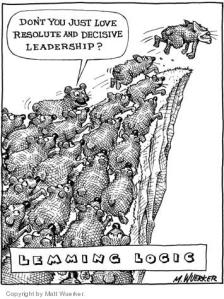 Where are mainstream Republicans these days? What has happened to the party of Lincoln, Teddy Roosevelt and Eisenhower? Prior to the Reagan years, Republican women were front and center in volunteering for planned parenthood, supporting the ERA, and working for abortion rights. First Lady Betty Ford was a proud feminist and one of the first women to put women’s health issues–including women with drinking problems and breast cancer–on the map. President Richard Nixon was responsible for many of the agencies that protect the environment. The current party is chock-full of science denying Theocrats and economics-denying Corporate Fascists. It’s making a sham out of the two party system. We may now have a window open wide enough to stop some of this. We should ready ourselves with the facts and act now.
An online conversation has been initiated with the publication of Ron Brownstein’s article in the National Journal on Thursday called ‘State’s Rights’. It is front and center in starting a discussion among Democratic bloggers, journalists, and other liberal/progressive sympathizers. States rights was code for the right to own slaves during the first 100 years of this country’s existence. It is now code for the right to discriminate against the GLBT community, insert the government into an individual woman’s gynecological care, and bust unions. The racial overtones have not gone away since the worst of the hateful verbiage is aimed at stopping any policy goal attempted by President Obama.
Any one who has read me over the last few years knows that I am not a big fan of this President and I’m even less of a fan of his zealous followers. However, it would take a fairly dim bulb to not see the racism implicit in many of the Republican attacks against him. Attacks range from the extremely bizarre personal assertions that he is a secret Muslim, foreign born, and a devout socialist/communist to a complete rewrite of any policy initiative.
Obama is about as conservative of a Democrat as one can find these days which has been one of my issues with him all along. His actions and words have not stopped the endless attacks on absolutely everything he attempts by Republicans and their monied interests. These tactics were first used against former Democratic President Bill Clinton but have reached some kind of hyper-extortionate apex today. It’s to the point that I firmly believe some of these Republican extremists would rather take the country down with them than negotiate something other than an ideologically pure outcome. Brown’s article and examples focus on the current bloc of extremist Republican governors with their take no prisoners policies. While his focus is mostly on the impact on Obama, I believe his larger point should entice us to think bigger.
But one senior Obama administration official, who also had a close view of Clinton’s interaction with Republican governors, contends that ideology is trumping interest for the governors in many of these new disputes. Health care reform, for instance, asks states for no new financial contribution to expand coverage through 2016 and only relatively small participation thereafter; because 60 percent of the uninsured live in the states where a Republican holds the governorship, their residents would receive the most new federal aid if the law survives. “One had the sense in the mid-1990s that conservative governors were doing whatever was in the best interest of their state,” the senior official said. “This time, the Republican governors appear determined to make an ideological point, even if it costs their state a great deal.”
Whatever the governors’ motivations (one man’s posturing, after all, is another man’s principle), their unreserved enlistment into Washington’s wars marks a milestone. It creates a second line of defense for conservatives to contest Obama even after he wins battles in Congress. It tears another hole in the fraying conviction that state capitals are less partisan than Washington. And it creates a precedent that is likely to encourage more guerrilla warfare between Democratic governors and a future Republican president.
American politics increasingly resembles a kind of total war in which each party mobilizes every conceivable asset at its disposal against the other. Most governors were once conscientious objectors in that struggle. No more.
I can remember attending Republican conventions in the early 1980s during the first hint of the unholy alliance between religious fanatics along the line of a Christian Taliban with the John Birch Society version of libertarians. It was a terrifying spectacle. At the time, the more pro-business and hoity-toity conservative elements in the party were willing to use them like pet pit bulls because they were incredibly organized at the grass roots level and they voted. Republicans traditionally had a much more difficult time turning out voters and their GOTV machines were dwarfed by the Democrats who could rely on well organized and managed union membership. This is one of the reasons why there is also the huge attack on the last standing unions now. They’re worth a fortune come election time and no Republican campaign strategist worth anything underestimates them. We can clearly no longer underestimate the religious zealots or those gullible to the rants of Glenn Beck. They’ve become a contagion.
Back in the day, the young me argued that this form of big daddy government intervention put forth by religionists and Birchers was basically enabling powerful business monopolies and drop kicking the constitutional mandate to deny the establishing of a state religion. It was against the very core ideology of historical Republicanism. I got no where. This was especially true as Nixon’s southern strategy began to work its evil influence on bringing in the remaining racist elements of the old Dixiecrats who frankly were all for the government taking care of any one that wasn’t like them. This added the last nail in the traditional coffin of the party of Lincoln. That sin is now manifesting in the xenophobia against Muslims and Hispanics in addition to African Americans topped by the anti-science bias from the religionists and the pro-monopoly market creation from the corporatists.
It appears that many old school Republicans now see the results of opening this Pandora’s box. They are horrified and have been trying to stuff the demons back into the chest. Now, you see those same folks that opened their kennels filled with poodles to the pit bulls are now acting absolutely appalled by the rising influence of absolutely whacked extremists like Glenn Beck. Scarborough, Rove, and Kristol are currently trying to put the Beckheads back into the box. Those of us that don’t vote Republican could afford to ignore this if it were just some intraparty feud. It’s gone beyond that with the rise of tea party hysterics and billionaire libertarian Daddy Warbucks’ propaganda machines. In many states, the Republican party infrastructure has been commandeered by the pit bulls. The poodles–like Arianna Huffington and Markos–have long left their confines. They are morphing traditional Democratic Party concerns. The same divisive issues that used to motivate the base to do the GOTV and show up at the polls has managed to bring this new crop of Republican governors and congressional members to a critical mass. They refuse any middle or even right of middle ground. They won’t negotiate on the usual country club Republican issues. It’s no longer a GOTV ploy for them because they are true believers.
Steven Benen explores this quandry in his blog at WAPO today.
Keep in mind, it’s ideology, not practical concerns, that lie at the heart of these governors’ reactionary moves. The states turning down investments for high-speed rail, for example, were effectively handed a gift — jobs, economic development, improved infrastructure — but Republicans like Rick Scott and Scott Walker turned down the benefits because of a philosophical opposition, deliberately hurting their state in the process. The administration was effectively throwing a life-preserver to a Republican who’s drowning, only to be told, “We don’t like government life-preservers.”
The same is true of health care, which would be a boon to states, but which far-right governors resist for reasons that have nothing to do with public policy.
Bill Clinton faced a watered-down version of these Republican pit bulls over a decade ago. Dealing with them is how he got his reputation for triangulation. He seemed uniquely placed to make some small progress then–that now seems impossible now–because of his past position as a southern governor with a decidedly homespun and folksy manner. President Obama has none of this going for him. He is surrounded by Businesscrats that are unlikely to fill the void. The only thing he’s managed to do is to gain the ear of the Chamber of Commerce types. These folks are hardly going to be sympathetic to social justice or middle class bread-and-butter issues. Additionally, right wing media sources and timid main stream media sources are playing into the hands of the outrageous. We have media enablers instead of investigative journalists.
That is why it is absolutely essential that whatever is left of the Democratic grassroots need to make one extremely loud noise right now. It is unconscionable that a rewrite of history, science, and economic is taking place while many of us are simply standing around with gaping mouths. I’ve spoken many times about the absolute lack of economics that is driving austerity programs. It’s already showing signs of slowing economic growth down at a time when unemployment is unacceptably high. This is only going to multiply as the days and months unfold. Ask yourself if we can really afford another recession?
I was also disheartened to read that science is not fairing well either. Scientific American has a thought provoking piece up on the overwhelming science behind global warming and climate change.Their title should be rhetorical but it is not: ‘Why Are Americans So Ill-Informed about Climate Change?’
Near the forum’s conclusion, Massachusetts Institute of Technology climate scientist Kerry Emanuel asked a panel of journalists why the media continues to cover anthropogenic climate change as a controversy or debate, when in fact it is a consensus among such organizations as the American Geophysical Union, American Institute of Physics, American Chemical Society, American Meteorological Association and the National Research Council, along with the national academies of more than two dozen countries.
“You haven’t persuaded the public,” replied Elizabeth Shogren of National Public Radio. Emanuel immediately countered, smiling and pointing at Shogren, “No, you haven’t.” Scattered applause followed in the audience of mostly scientists, with one heckler saying, “That’s right. Kerry said it.”
Such a tone of searching bewilderment typified a handful of sessions that dealt with the struggle to motivate Americans on the topic of climate change. Only 35 percent of Americans see climate change as a serious problem, according to a 2009 poll by the Pew Research Center for the People & the Press.
It’s a given that an organized and well-funded campaign has led efforts to confuse the public regarding the consensus around anthropogenic climate change.
These extremists are even rewriting the already right wing Ronald Reagan’s legacy to make it seem more extreme to support the legitimacy of their radical agendas. Here’s an example I found this morning on ThinkProgress on Reagan’s views on unions. Scott Walker’s fantasy world includes his vision of being Reagan’s heir. Yet, here is Reagan himself on the union movement in Poland during one of his radio addresses to the nation.
REAGAN: Ever since martial law was brutally imposed last December, Polish authorities have been assuring the world that they’re interested in a genuine reconciliation with the Polish people. But the Polish regime’s action yesterday reveals the hollowness of its promises. By outlawing Solidarity, a free trade organization to which an overwhelming majority of Polish workers and farmers belong, they have made it clear that they never had any intention of restoring one of the most elemental human rights—the right to belong to a free trade union.
The one thing that I learned early on when dealing with these people from within the Republican party itself in the pre-Reagan and early Reagan days is that they believe their courses are so righteous that they will lie and do anything to support them. If we do not hold their actions and lies to the light of day, our country will be completely overrun by by folks that are anti-science, anti-economics, anti-rational thought, and anti-democracy. We’ll have a theocratic plutocracy in fairly short order.
It is absolutely imperative that we put pressure on the media and Democratic politicians to fact check these people, stand up to them, and expose their lies to the public. It is possible that we’ve caught a tipping point in their overreach process. If this is the case, it means we have to work with the momentum now. Nothing short of our democracy and our children’s future is at stake here. We cannot be complacent and we cannot be left with mouths wide opened. We also cannot rely on leadership from the very top. If you’re in one of those states that is acting up, act now!!! Find and support your version of the Wisconsin 14.

 peej
peej Carissa
 bostonboomer
 dakinikat
 ecocatwoman
 mablue2
 Mama Lopez
 peggysue22
 quixote
 skydancingguestblogger
 Mona (aka Wonk the Vote)



 Sky Dancing
Recent Comments