
Late Night Speculation and Outrage
Posted: May 27, 2011 Filed under: investment banking, We are so F'd | Tags: high gas prices, speculation 17 Comments There’s another interesting WikiLeak that’s come to light about high gas prices. It seems that President Bush asked the Saudis to pump extra oil to help relieve market pressure on prices in 2007 and 2008. The Saudis suggested that Bush tackle the problem by reigning in Wall Street speculation.
When oil prices hit a record $147 a barrel in July 2008, the Bush administration leaned on Saudi Arabia to pump more crude in hopes that a flood of new crude would drive the price down. The Saudis complied, but not before warning that oil already was plentiful and that Wall Street speculation, not a shortage of oil, was driving up prices.
Saudi Oil Minister Ali al Naimi even told U.S. Ambassador Ford Fraker that the kingdom would have difficulty finding customers for the additional crude, according to an account laid out in a confidential State Department cable dated Sept. 28, 2008,
“Saudi Arabia can’t just put crude out on the market,” the cable quotes Naimi as saying. Instead, Naimi suggested, “speculators bore significant responsibility for the sharp increase in oil prices in the last few years,” according to the cable.
What role Wall Street investors play in the high cost of oil is a hotly debated topic in Washington. Despite weak demand, the price of a barrel of crude oil surged more than 25 percent in the past year, reaching a peak of $113 May 2 before falling back to a range of $95 to $100 a barrel.
The Obama administration, the Bush administration before it and Congress have been slow to take steps to rein in speculators. On Tuesday, the Commodity Futures Trading Commission, a U.S. regulatory agency, charged a group of financial firms with manipulating the price of oil in 2008. But the commission hasn’t enacted a proposal to limit the percentage of oil contracts a financial company can hold, while Congress remains focused primarily on big oil companies, threatening in hearings last week to eliminate their tax breaks because of the $38 billion in first-quarter profits the top six U.S. companies earned.
The Saudis, however, have struck a steady theme for years that something should be done to curb the influence of banks and hedge funds that are speculating on the price of oil, according to diplomatic cables made available to McClatchy by the WikiLeaks website.
The Saudis evidently repeatedly warned both the Bush and Obama administration about the roll of Wall Street speculators in the price of oil.
Matt Taibi has also written some about the WikiLeaks information.
The Wiki documents show that the Saudis had long ago concluded that this increased investor flow was a threat to disrupt the markets. An embassy cable from 2007 recounted a meeting U.S. officials had with Yasser Mufti, an Aramco planner. “The Saudi analysts indicated a link between higher oil prices and the influx of investor funds into the oil markets,” it read.
The cables also show that the Saudis urged the Americans to enact reforms to rein in Wall Street, calling for speculative limits and other changes. It also showed that some Saudi officials believed that speculation added as much as $40 to the oil price during the height of the bubble.
All of this is significant because both the Bush administration and the Obama administration have denied this narrative to various degrees. The CFTC only recently admitted that speculation played a role in the 2008 mess, having originally (and stubbornly) blamed supply and demand issues. Subsequent analyses have shown that the Saudi position, that worldwide demand for oil never increased nearly enough to account for the gigantic 2008 price spike, was almost certainly correct.
You have to wonder if the current situation also reflects the lack of will by the last two administrations to reign in Wall Street excess. Hopefully, this information will get some play in the MSM but I’m not holding my breath.
Late Night Gas Pump Shock
Posted: April 13, 2011 Filed under: Economy | Tags: high gas prices, speculation, US economic recovery 27 Comments I’m pretty happy that the mighty mustang is parked out front and staying there for the most part. Every time I do make it out, I nearly faint from the changes that I see in gas prices. I thought I’d share some links with you about what’s going on.
First, from Reuters: High gas prices hurt U.S. confidence: Reuters/Ipsos poll. It could also hurt the President’s approval rating.
Rising U.S. gasoline prices have damaged confidence in the country’s future and forced Americans to change their spending habits and lifestyles, a Reuters/Ipsos poll released on Wednesday found.
The proportion of people who believe the United States is on the wrong track jumped 5 points to 69 percent from March, the poll found, the highest wrong-track figure in an Ipsos poll since President Barack Obama took office in January 2009.
More than six of every 10 Americans have cut back on other expenses and reduced their driving as a result of the rising gas prices caused by tumult in North Africa and the Middle East.
The increase in energy costs also hurt Obama’s approval rating, which dipped for the second consecutive month to 46 percent — his lowest Ipsos poll rating since early December 2010.
“That’s all a function of gas prices. People are feeling the pinch at the pump,” said Ipsos pollster Cliff Young.
“Increased gas prices have a direct impact on the pocketbook, and there is very little lag time between rising gas prices and its effect on presidential approval and confidence,” he said.
There’s also some concerns that higher gas prices could hurt this very anemic recovery. Gas is one of those expenditures that folks usually can’t avoid without buying a better vehicle or getting a different commute to work. That means in the short run, high gas prices hurt people because they can’t adjust to them easily.
Gasoline prices are soaring toward $4 a gallon, a threshold that some analysts say will damage the fragile economic recovery and crimp consumer spending just as families are planning their summer vacations.
Higher prices saddle businesses with higher transportation costs, causing them to either swallow them or pass them along to already strapped customers. As gasoline costs go up, consumers are left with less money to spend elsewhere. And there is evidence that the hike at the pump is beginning to push drivers off the road.
Gasoline prices, which are approaching record levels, “are going to have a very profound effect on the economy,” said Peter Morici, an economist at the University of Maryland.
D.C. resident Amber Sutton, who drives 25 miles each way to her job in Woodbridge, said rising gasoline prices have caused her to cut back on restaurants and other entertainment.
“I already was spending a ton on gas,” she said. “But now it’s absolutely ridiculous.”
The average price for a gallon of regular gasoline Monday was $3.79 — up more than a dime from the previous week and 93 cents from a year earlier, according the Energy Information Administration. In California, the average is now $4.16, and prices are above $4 a gallon at some stations in the District and elsewhere.
Prices have risen so high, so fast that some market analysts predicted a sell-off in the short term. That sentiment sent crude oil prices tumbling Tuesday for the second consecutive day, dragging stock markets down about 1 percent, as evidence grew that escalating prices are beginning to threaten the global economic recovery.
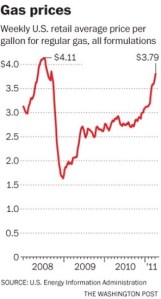
Stephen Gandel writing for Time Magazine suggests that this price level might be the “breaking point”. This analysis uses the average amount that American consumers generally budget for gas.
Americans are spending much more than they typically do at the pump. Relatively high gas prices have made that a problem throughout this recession, but the recent increase has only made it worse. For the past 19 years, (that’s as far back as the Census data, where retail sales come from would let me go) on average Americans have spent about 8% of their overall retail purchases on gas and other gas station related items. The number has generally been around 9% this recession. And in March, for the first time since the beginning of the recession, that number hit 11%. The highest the figure has been in the past 19 years is 12% and that was in March 2008, which is when Bear Stearns collapsed and was really the start of the financial crisis. It stayed at 12% until September 2008, when Lehman went under taking the rest of the economy with it.
But even 11% could be some sort of breaking point. The last time the figure rose to 11% was in November 2007. And that is right around the time when the economy shifted from creating jobs to losing them. What’s more, in past recoveries Americans in general have spent much less of their income on gas. In 1993 and 2003, for instance, Americans spent between 7% and 8% of their purchases at gas stations.

 peej
peej Carissa
 bostonboomer
 dakinikat
 ecocatwoman
 mablue2
 Mama Lopez
 peggysue22
 quixote
 skydancingguestblogger
 Mona (aka Wonk the Vote)



 Sky Dancing
Recent Comments